




Abstract
In this article, we studied the robust security transmission design for multi-user peer-to-peer relay networks, where all users demand secure communication and the eavesdropper is passive. Although the previous researches have designed the physical-layer security schemes under perfect channel state information, this study focuses on investigating the robust transmission design in the presence of a passive eavesdropper. Our goal is to maximize the artificial noise power to confuse the passive eavesdropper and subject to the worst-case signal-to-interference-noise-ratio constraints for all users under a bounded spherical region for the norm of the channel state information error vector from the relays to the destinations and the individual power constraints of all relay nodes. Mathematically, the original robust problem is difficult to solve due to its non-linearity and non-convexity. We propose to adopt S-Procedure and rank relaxation techniques to convert it to a semidefinite programming convex problem. The numerical results show the advantage of the proposed robust method.
Introduction
In order to improve the spectrum efficiency of cooperative communication, a multi-user peer-to-peer (MUP2P) relay network is proposed by Rankov and Wittneben. 1 Multiple source destination pairs communicate in pairs through multiple relay nodes in the MUP2P relay network. In recent years, MUP2P relay networks have attracted more and more attention.2–4 However, the most existing researches on multi-source and multi-destination relay networks do not consider wiretap channels. Due to the broadcast nature of the MUP2P networks, private information sent by sources is more vulnerable to be eavesdropped. It is necessary to involve the security in the MUP2P networks, and the security problem in the MUP2P networks has been gradually recognized.
Physical-layer security (PLS) technology, which utilizes inherent security of wireless channels to transmit private information, can effectively improve the security performance in the wireless communication. PLS begins with Wyner’s research on wiretapping model. The achievable security rate is defined as the secret transmission rate of information from source to destination. The maximum secrecy rate is called as security capacity. 5 In recent years, the researches of PLS have gradually expanded to multi-users,6,7 and a large number of PLS schemes and methods have been proposed.8,9
Recently, the PLS has been investigated for MUP2P relay networks. Wang et al. 10 studied the PLS of MUP2P relay networks with a secure user and other unencrypted users. Gong et al. 11 mainly studied the robust relay beamforming of MUP2P relay networks with only one secure user. Cheraghi and Darmani 12 adopted a null space beamforming way to solve the PLS problem for an MUP2P bidirectional relay network with only a pair of secure users. We notice that only one source node sends a secrecy message to its intended destination, the eavesdropper is assumed to be active, and other unclassified users send the message without confidentiality requirements by Wang et al., 10 Gong et al., 11 and Cheraghi and Darmani. 12 However, the other unclassified users may also have secrecy requirement, and the eavesdroppers are often passive in practice.
Although Gong et al. 13 studies a more general case where multiple sources transmit confidential information to their intended destinations, the eavesdropper’ channel state information (CSI) is assumed to be known by the sender and the legitimate links’ CSI is perfect. In actual eavesdropping cases, the eavesdropper may be always passive. Sometimes, we do not even know that whether there are eavesdroppers. In the absence of eavesdropper’s CSI, we cannot optimize the secrecy capacity directly. Using artificial noise (AN) to improve the secrecy capacity of wireless communication has been received much attention in the field of PLS transmission. Goel and Negi 14 and Khisti 15 adopted the AN way to improve PLS in the presence of a passive eavesdropper. The transmitter generates AN using part of available power, and only the eavesdropper is degraded by AN to ensure the secrecy communication at physical layer in the AN way. AN has also been used to improve the security transmission performance for relay communications networks with single source and single destination.16,17
In this article, we consider that all source nodes send secret messages to their intended destinations through multiple relays, while the eavesdropper is passive. All nodes are equipped with single antenna, and all relays adopt the AF protocol. First, considering perfect CSI, we maximize the transmit power of AN to interfere with the passive eavesdropper. At the same time, we consider that the receiving signal-to-interference-plus-noise ratio (SINR) constraints of all the intended destinations and individual power constraints of each relay node are subject. Second, considering imperfect CSI, we propose the robust beamforming design that maximizes the transmit power of AN under the condition of the worst-case received SINR requirement and individual power constraints at relays, which is more practical. Mathematically, the robust beamforming design is non-convex, so the solution is difficult. We propose to adopt S-Procedure and rank relaxation techniques to transform the non-convex problem into a convex problem to solve. The security performance of the proposed robust beamforming design is evaluated by simulations.
Overall, our contributions can be summarized as follows:
Mostly researches mainly focus on the security transmission schemes for relay networks with single source and single destination node, but this research considers the more general scenario for multi-sources and multi-destinations, and the eavesdropper is assumed to be passive.
The robust beamforming design is proposed for imperfect CSI, which then maximizes the transmit power of AN under the worst-case received SINR constraints and the individual relay power constraints.
Although the robust beamforming design for PLS transmission is non-convex, S-Procedure and rank relaxation techniques are adopted to get an efficient solution in this article.
The remainder of this article is organized as follows. In section “System model,” the system model is introduced. In section “Relay beamforming designs,” the relay beamforming schemes for security are given. In section “Simulations,” the simulation results are showed. We conclude the article in section “Conclusion.”
The notation is adopted as follows: Boldface lower (upper) case letters represent vectors (matrices);
System model
Assume that there are N source nodes, N destination nodes and L relay nodes in an MUP2P communication network. Multiple source-destination pairs communicate in a pairwise manner through multiple relay nodes in the MUP2P communication network. A passive eavesdropper tries to eavesdrop the messages from all the source nodes. All nodes are equipped with single antenna. We assume that the destination nodes can only receive the signals from relays due to the large path loss and strong shadow fading from source nodes to destination nodes (Figure 1). Each relay node only multiplies its received signal by a complex weight and retransmits it to the destination nodes. The distributed relay nodes do not solve the beamforming problem cooperatively. In this relay network, the destination nodes take the responsibility to solve the optimization problem.

System model.
The model in Figure 1 is also a two-hop relay network. In phase I, the source transmits the information to the relays, so the receiving signals of all relays,

where
In phase II, an eavesdropper tries to attack the signals from all relays. The eavesdropper is assumed to be passive, so its CSI cannot be obtained. So that the secrecy rate also cannot be optimized to get the security transmission. AN method can be used to realize PLS transmission. The decode ability of the passive eavesdropper can be tried to degrade in this scheme. The signal

where
The total transmit power of all relays carrying information signals is expressed as

where
The signal received by the

where
The passive eavesdropper receives the following signal.

where
The SINR of the
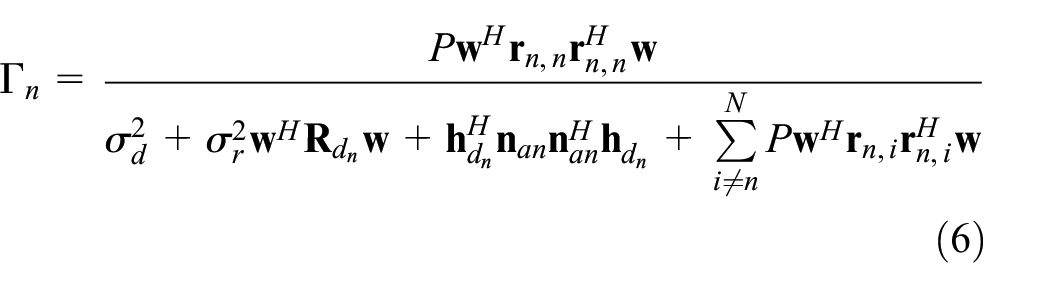
where
The passive eavesdropper’s SINR is given by

where
The achievable secrecy rate for the

Although CSI of the eavesdropper is unknown, the security transmission may be achieved by jamming the passive eavesdropper as large as possible. The transmit power of the AN is maximized to interfere with the passive eavesdropper, while satisfying the SINR constraints of the destination nodes and single relay power constraints. Under the same constraints, the optimization problem can be transformed into minimizing the total relay transmit power of the information-bearing signals. The transformed optimization problem is as follows:

where
Relay beamforming designs
Relay beamforming design with perfect CSI
If the number of destination nodes is less than the number of relay nodes, that is,
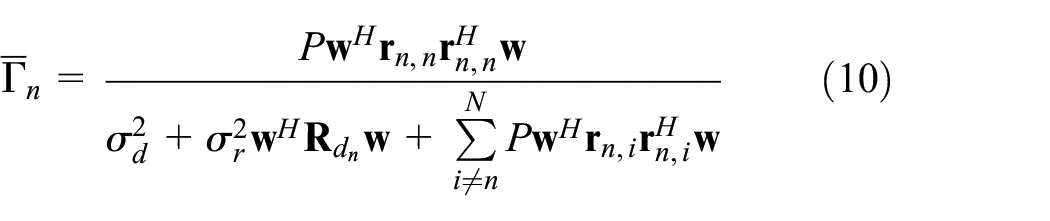
The optimization problem equation (9) is converted to
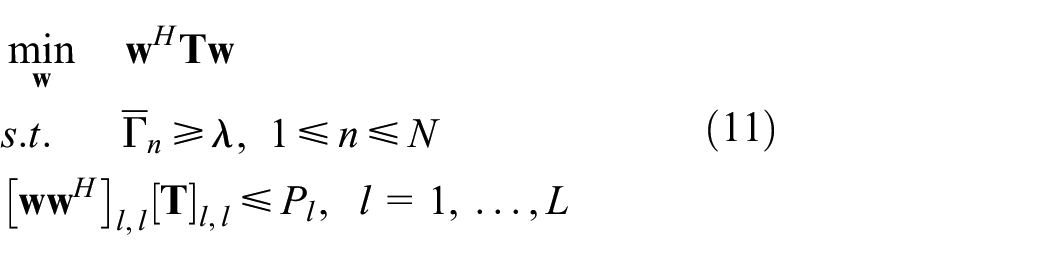
We can use the way of Wang et al.
16
to convert the problem in equation (11) to a second-order cone program (SOCP) problem. The SOCP problem is convex and can be solved by interior methods. But if the number of users is greater than the number of relays, then AN cannot lie in the null space of
Relay beamforming design with imperfect CSI
In this section, the study focuses on the robust relay beamforming design with imperfect CSI from relays to destinations. We assume that the CSI from sources to relays can be nearly obtained perfectly due to the high training SINRs. However, CSI from relays to destinations is known imperfectly. We model CSI uncertainty as

where

Then the SINR for the

For imperfect CSI, we consider the robust relay beamforming problem equation (15) under the worst-case receiving SINR constraints of the legitimate destination nodes.
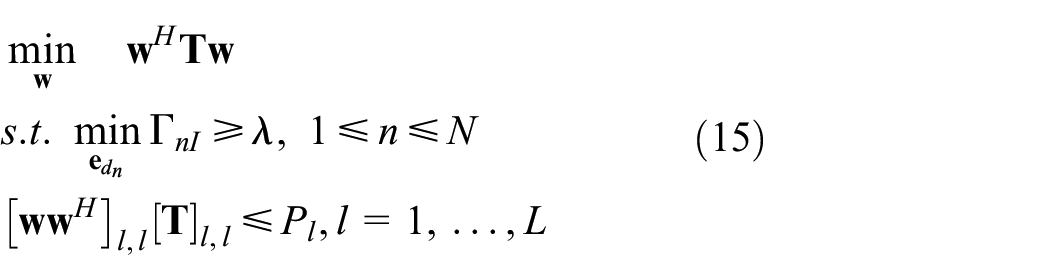
The minimum problem equation (15) is very not easy to solve, because the first constraint is mathematically intractable.
An upper bound of equation (15)
We can obtain the inequalities equations (16) and (17) by utilizing the Csuchy–Schwarz inequality and the triangle inequality.
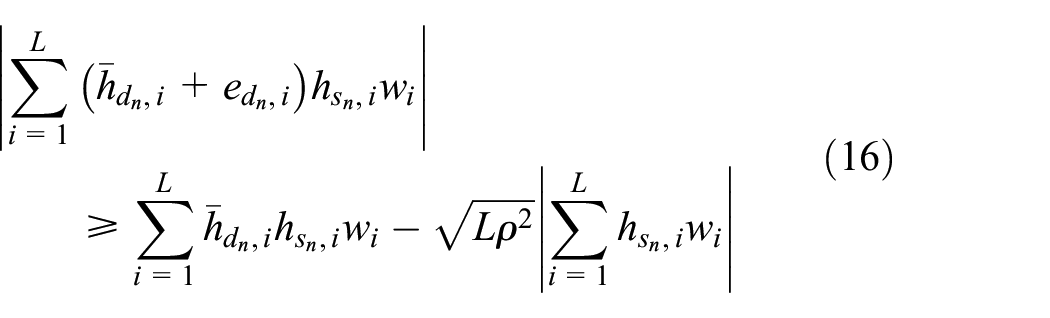

The lower bound of
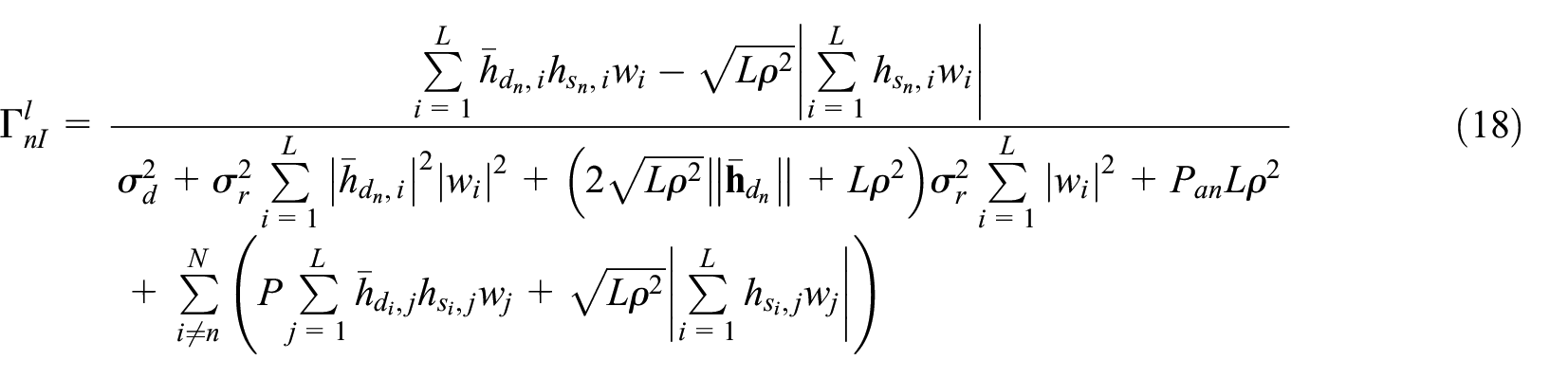
We get an upper bound of the problem equation (15) by solving the following beamforming design equation (19).

Similarly, Wang et al.’s 16 method is also used to convert the beamforming problem equation (19) to an SOCP problem.
Robust relay beamforming design
We can obtain the inequality equation (20) by using

where
The beamforming problem equation (15) is rewritten by

The first constraint in equation (21) can be rewritten as equation (22).

where
Then we can rewrite the first constraint of the problem equation (21) as equation (23) by usingS-Procedure. 18

The beamforming problem equation (21) is rewritten as equation (24) by using

The rank constraint

The robust beamforming problem equation (25) can be optimally solved by adopting interior methods due to that it is a semi-definite programming (SDP) problem. The problem in equation (25) has
Assuming that the solution to the robust beamforming problem equation (25) is
Randomization method for semidefinite relaxation.

Simulations
In this section, simulations are offered to analyze the performance of the proposed relay beamforming design for the PLS transmission. In each simulation run, we randomly generate CSI using complex zero-mean Gaussian random vectors with unit covariance, and all the noise power is same. Assuming that CSI errors are uniformly distributed and equal. We assume that the individual power constraints are equal. About 1000 independent simulations are carried out, and the average results are obtained. There are four schemes: (1) relay beamforming design with perfect CSI in section “Relay beamforming design with perfect CSI”; (2) the upper bound in section “An upper bound of equation (15)” with imperfect CSI; (3) the robust beamforming design with imperfect CSI in section “Robust relay beamforming design”; and (4) the naïve scheme in which the estimated CSI is regarded as ideal CSI without utilizing the knowledge of CSI error.
Figure 2 shows the transmit power for information-bearing signals under different number of relays. We set

Transmit power for information-bearing signals with the different number of relays.
Figure 3 plots the minimum secrecy rate for destination nodes with different number of relay nodes. The simulation sets

Minimum secrecy rate with the different number of relay nodes.
Figure 4 investigates the minimum secrecy under different individual transmit power constraints at relays. We set
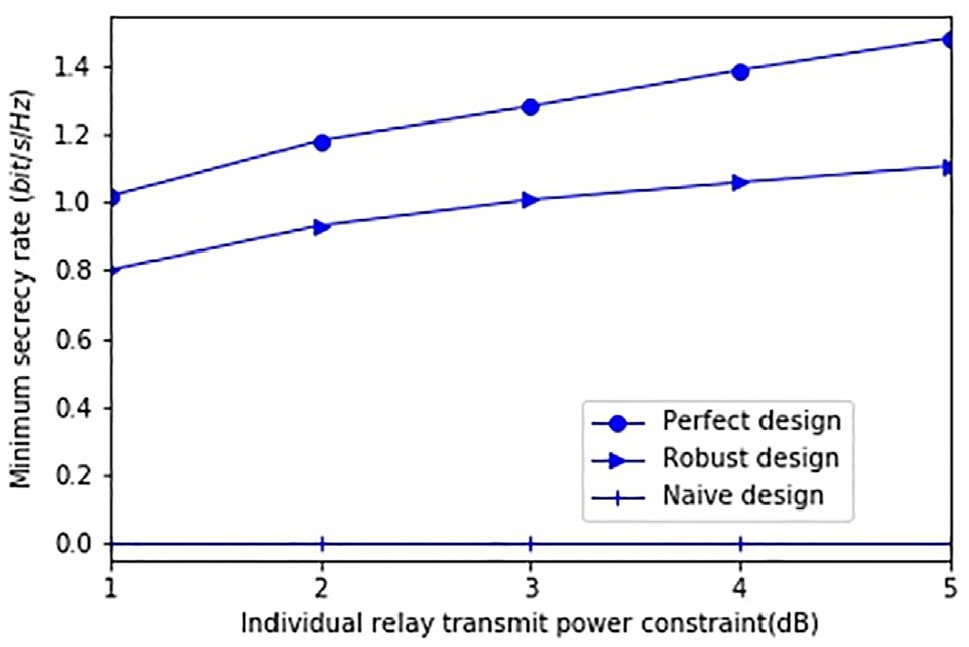
The minimum secrecy rate with different individual power constraints.
In Figure 5, we study the minimum secrecy rate with different CSI error bounds. We set
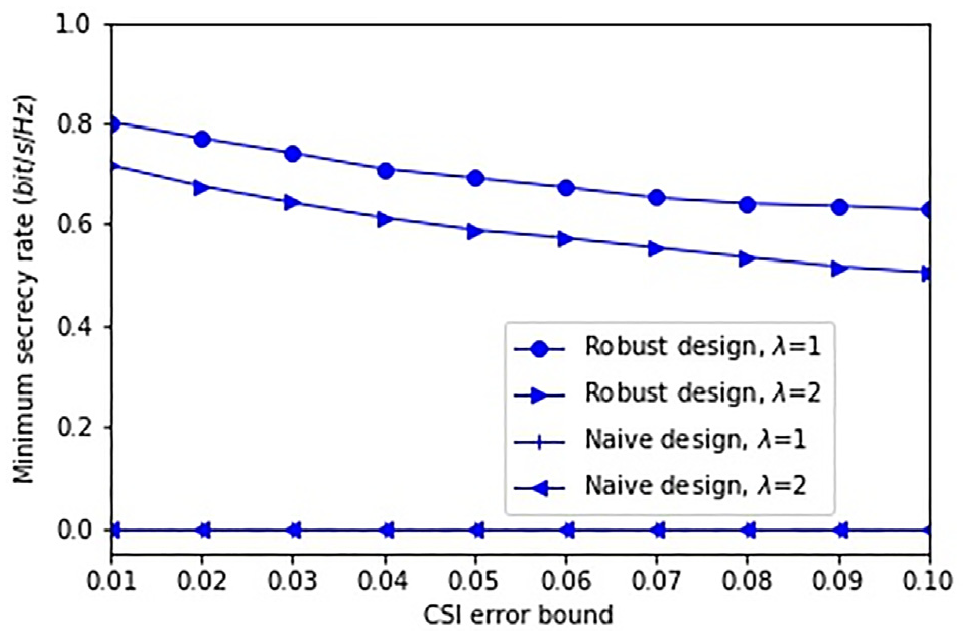
The minimum secrecy rate with different CSI error bounds.
Conclusion
In this article, the PLS transmission design is presented for MUP2P relay networks, where all source nodes transmit secrecy messages to their intended destinations through multiple relay nodes, and there is a passive eavesdropper in the networks. Focusing on researching the scenario in which the CSI is known imperfectly. We model the CSI error as a bounded spherical region. The robust relay beamforming scheme maximizes the transmitting power of AN to interfere with the eavesdropper and satisfies the worst-case received SINR constraints at all destinations and individual relay power constraints. Although the robust beamforming problem is non-convex, it can be transformed into a convex problem to solve by adopting S-Procedure and rank relaxation techniques. In order to show the performance gains of the robust relay beamforming design, the naive scheme is provided to compare the secrecy performance. The simulation results demonstrates the proposed robust beamforming design improves the PLS performance of the MUP2P networks due to that the CSI errors knowledge is adopted.
Footnotes
Handling Editor: Yanjiao Chen
Declaration of conflicting interests
The author(s) declared no potential conflicts of interest with respect to the research, authorship, and/or publication of this article.
Funding
The author(s) disclosed receipt of the following financial support for the research, authorship, and/or publication of this article: This work is supported in part by the China Postdoctoral Science Foundation (grant no. 2020M673687), in part by the National Natural Science Foundation of China (grant no. 61971474), in part by the Beijing Nova Program (grant no. Z201100006820121), and in part by the Postdoctoral Science Foundation–funded project of China (grant no. 2019T120071).
