




Abstract
By utilizing the mobile terminals’ sensing and computing capabilities, mobile crowdsourcing network is considered to be a promising technology to support the various large-scale sensing applications. However, considering the limited resources and security issue, mobile users may be unwilling to participate in crowdsourcing without any incentive. In this work, by combining reputation and contract theory, a dynamic long-term incentive mechanism is proposed to attract the mobile users to participate in mobile crowdsourcing networks. A two-period dynamic contract is first investigated to deal with the asymmetric information problem in the crowdsourcing tasks. Reputation strategy is then introduced to further attract the mobile users to complete the long-term crowdsourcing tasks. The optimal contracts are designed to obtain the maximum expected utility of service provider with reputation strategy and without reputation strategy, respectively. Simulation results demonstrate that the long-term crowdsourcing tasks can be guaranteed by combining the contract’s explicit incentive with the reputation’s implicit incentive. The incentive mechanism can gain a higher expected utility, the more implicit reputation effect factor.
Keywords
Introduction
Nowadays, with the popularity of smartphones and wearable sensing devices, most mobile devices are equipped with a wide range of processors, sensors, and enormous memories. 1 These devices can be applied to gather various data about human society, surroundings, and individuals. Then, the various mobile crowdsourcing applications appear around the world, such as CrowdTracker 2 for object tracking and PERIO 3 for industrial Internet of Things.
In mobile crowdsourcing networks (MCNs), 4 the service provider (SP) always recruits the mobile users (MUs) to participate in the crowdsourcing tasks. Most of the MUs provide crowdsourcing services based on voluntary participation. When completing crowdsourcing tasks, each MU may consume its resource (i.e. memory, battery, and time).5,6 Certain private information (i.e. location information) may also be contained in the collected crowdsourcing data, leading to the potential privacy threats to MUs.7–9 Considering the limited resources and security issue, the MUs may be reluctant to offer crowdsourcing services or have privacy concerns. 1 Thus, the effective incentive mechanisms are essential to accomplish the mutual benefit in the long-term corporation.
However, it is challenging to design an effective incentive mechanism in MCNs. Due to MUs’ mobility and crowdsourcing environment’s dynamic characteristics, the SP may not be able to obtain the MUs’ exact crowdsourcing efforts, which leads to the asymmetric information problem between the SP and the MUs. 10 In this case, even if the MUs are willing to offer their help, the MUs may deviate from the crowdsourcing tasks or provide poor performance in tasks. Fortunately, contract theory 11 was first proposed to deal with asymmetric information in the economic issues. Thus, we try to investigate a contract-based incentive mechanism to address these challenging issues under the asymmetric information scenario. Moreover, in order to motivate the MUs to participate in the long-term crowdsourcing tasks more effectively, the reputation strategy is introduced to provide the implicit incentive by combining with the explicit contract incentive.
Motivated by the above issues, this work proposes a dynamic incentive mechanism to create the mutual benefits in the long-term crowdsourcing tasks. Our contributions are summarized as follows:
New solution technique: we investigate a two-period dynamic contract under the asymmetric information scenario. A parameter named incentive coefficient is introduced to attract the MUs to offer the effective crowdsourcing efforts. The MUs’ basic salary paid by the SP is determined by the crowdsourcing efforts. Moreover, by introducing the implicit reputation parameter, reputation strategy is designed to motivate the MUs to provide the long-term crowdsourcing efforts effectively. As far as we know, the dynamic incentive mechanism by combining reputation and contract theory has not been investigated for MCNs.
Optimal incentive mechanism design: the optimization problem is formulated to achieve the maximum expected utility of the SP subject to the constraints of individual rationality (IR) and incentive compatibility (IC). The necessary and sufficient conditions of the optimization problem are systematically presented. The optimal contract designs are achieved to maximize the SP’s expected utility for both non-reputation and reputation strategies. The performance of the optimal reputation-based dynamic contract incentive mechanism is demonstrated through simulations.
The key notations summarized in this article are shown in Table 1. The remaining of this article is organized as follows. The system model and problem formulation are introduced in section “System model and problem formulation.” Then, the detailed design for the optimal two-period dynamic contract incentive methods is derived in section “Two-period contract-based incentive mechanism without reputation strategy.” In section “Two-period contract-based incentive mechanism with reputation strategy,” we present the optimal two-period dynamic contract with the reputation strategy. Section “Results and discussion” presents the experimental results. The final section summarizes this article.
Key notations.

MU: mobile user; SP: service provider.
Related works
Incentive mechanisms for MCNs were classified into three categories, which are service-based, monetary-based, and entertainment-based mechanisms. 12 A monetary-based multi-round incentive mechanism was investigated by alternating between task information diffusion and task allocation operations. 13 Jiang et al. 14 developed a crowdsourcing incentive mechanism for truth discovery of textual answers with copiers. Among these works, auction15,16 or other game-theoretic methods17,18 have gained most attention to cope with workers’ strategic behaviors. However, there are always much more signaling overheads in most game-based mechanisms. Long-term incentive problems under the asymmetric information scenario have not been taken into consideration by most of these research works.
Recently, contract theory has been applied to solve the incentive problems in many other applications, for instance, cooperative relay,19–21 cognitive radio,22,23 mobile crowdsourcing,24,25 computing,26,27 and federated learning.28,29 In mobile crowdsourcing scenario, most works designed a one-shot static contract with the static relationship between the SP and MUs. Practically, contracts between the two parties may repeat over time. The SP can continue to recruit the MUs in the next crowdsourcing tasks. In our prior work, 30 a dynamic contract mechanism was introduced into the long-term relay incentive for both the independent asymmetric information and the correlated asymmetric information. However, most existing works considered the issue of private information with little attention paid on the problems of hidden action. Considering the MUs’ crowdsourcing action may not be monitored by the SP all the time, the MUs will deviate from the incentive mechanism. Moreover, due to the dynamic characteristics of mobile crowdsourcing environment, the crowdsourcing efforts of MUs may be different in various crowdsourcing tasks. Therefore, it is necessary to design a contract to attract MUs to offer the long-term helps in such dynamic crowdsourcing environments.
Apart from the above widely used monetary incentive mechanisms, reputation theory 31 is a non-monetary incentive strategy to measure the people’s actions or efforts. A reputation-based multi-auditing algorithm was proposed for reliable mobile crowdsensing. 32 An online incentive mechanism based on reputation was proposed for mobile crowdsourcing systems. 33 Yu et al. 34 proposed a fog-blockchain distributed approach for crowdsourcing reputation management. However, in these works, the asymmetric information problems have not been taken into consideration. There is also very little research to combine the monetary and non-monetary incentive strategy for MCNs.
System model and problem formulation
In a typical MCN, there are three essential parts as follows: an SP, a set of MUs

Mobile crowdsourcing network.
System model
Assume that the MU

where
Without loss of generality, we assume that the SP pays the MU

where
Then, by subtracting the crowdsourcing cost

Note that the crowdsourcing cost of MUs increases with the resource consumption increasing. The larger crowdsourcing effort

and variance

Moreover, in order to describe the willingness of MUs to participate in crowdsourcing tasks, the crowdsourcing behaviors of MUs can be categorized as risk-averse and risk-neutral.
36
A risk-averse MU does not want to achieve too much profit from crowdsourcing tasks, whereas a risk-neutral MU only wants to maximize its own profit. Here, each MU is assumed to have a constant absolute risk aversion preference. The negative exponential utility function of the MU
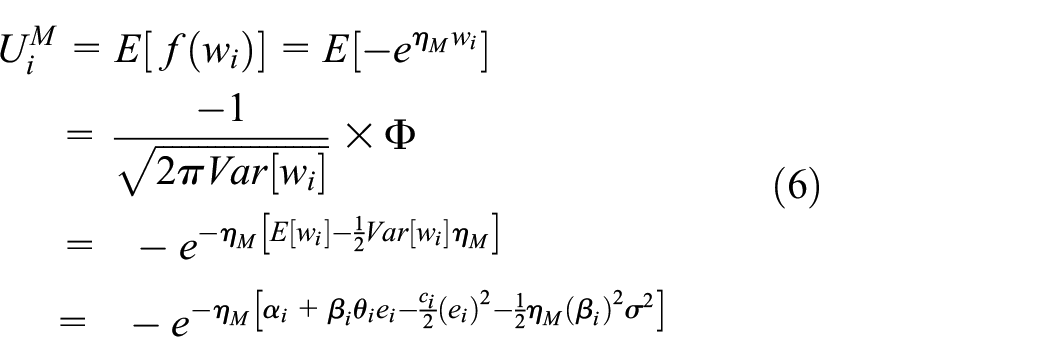
where

For simple discussion, let

Then, the utility of the SP is defined as the difference between the total achievable profit and the total payment to the MUs, which is written as

with the expectation means
Problem formulation
In this article, a dynamic incentive mechanism is proposed in MCNs by combining reputation and contract theory. The optimal contract mechanisms are investigated with the following two incentive strategies, two-period contract without reputation strategy and two-period contract with reputation strategy. The timing of two-period contract-reputation dynamic incentive mechanism is described in Figure 2. The whole process of the two incentive strategies mainly consists of three similar phases: contract confirmation phase, crowdsourcing task complete phase, and contract realization phase.
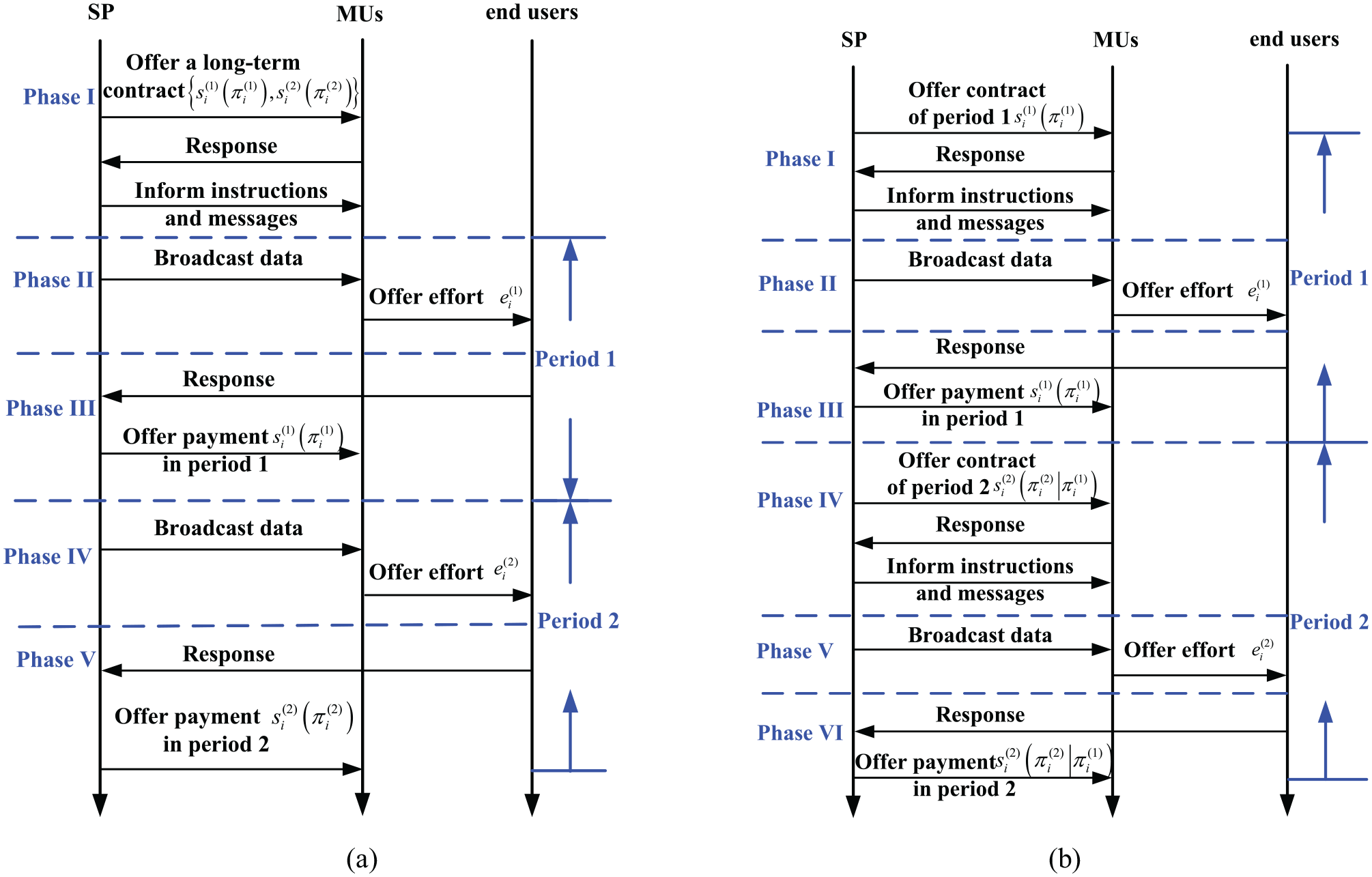
Time sequence of two-period contract dynamic incentive mechanisms: (a) without reputation strategy and (b) with reputation strategy.
Two-period contract without reputation strategy (Figure 2(a)) is presented in the third section. Two-period dynamic contract incentive mechanism is proposed to capture the dynamic characteristic of the MUs’ efforts in the long-term crowdsourcing tasks. The whole process is described as follows:
Phase I: Contract confirmation phase. At the beginning stage of contracting, the SP broadcasts a long-term contract with a set of contract items
Phase II: Crowdsourcing task complete phase of Period 1. After receiving the MUs’ confirmations, the SP offers the crowdsourcing tasks to the employed MUs. Then, the MUs offer the effort
Phase III: Contract realization phase of Period 1. At the end of Period 1, after checking the received data, end users will inform the SP of the MUs’ crowdsourcing performance by feedback. When crowdsourcing tasks succeed, the SP offers payment
Phase IV: Crowdsourcing task complete phase of Period 2. The process of crowdsourcing task is similar to that of Phase II.
Phase V: Contract realization phase of Period 2. The process is similar to that of Phase III. If crowdsourcing tasks are completed, the SP offers payment
Two-period contract with reputation strategy (Figure 2(b)) is proposed in the fourth section. Considering that reputation strategy can bring the implicit incentives to MUs, a two-period contract-based incentive mechanism with reputation strategy is investigated to further attract MUs to participate in the long-term crowdsourcing tasks. As shown in Figure 2(b), at the contract confirmation phase of each period, the SP broadcasts a contract with a set of contract items
Two-period contract-based incentive mechanism without reputation strategy
In this section, a two-period dynamic contract is investigated to solve the asymmetric information problems. According to the basic model of the SP given in equation (8), the SP’s utility of Period 1 can be given by

Similarly, the SP’s utility of Period 2 can also be defined as

Then, the SP’s total utility in the two periods can be obtained as

where
Based on the basic model of the MUs in equation (7), the expected utility of the MU

Then, the expected utility of the MU

Contracting design in Period 2
Based on backward induction,
18
the contract of Period 2 should be considered first. In order to motivate the MUs to participate in the crowdsourcing tasks of Period 2, we need to guarantee that each MU’s achieved utility

Moreover, to motivate MUs to complete the crowdsourcing tasks effectively in Period 2, a contract should be designed to ensure that each MU can maximize its utility

Then, based on the above IC and IR constraints, the optimization problem is designed to maximize the expected utility of the SP

From the above IC constraint in equation (15), the optimal crowdsourcing effort

Moreover, in order to achieve the SP’s maximum expected utility

Then, by substituting equations (17) and (18) into equation (16), the optimization problem of Period 2 in equation (16) can be simplified as
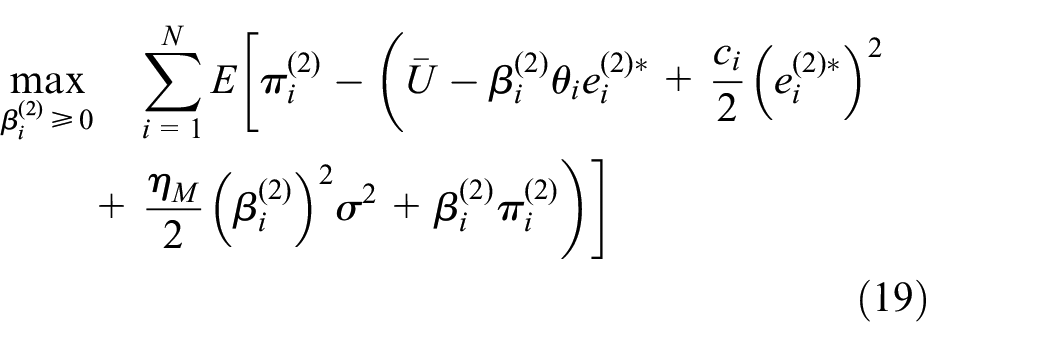
Any optimal local solution of Period 2 (denoted as

And the second-order derivative of the optimization problem in equation (19) is given by

Therefore, the optimal solution of the incentive coefficient

Contracting design in Period 1
Here, the two-period dynamic contract design is considered in both periods. In order to assure that each MU’s expected utility
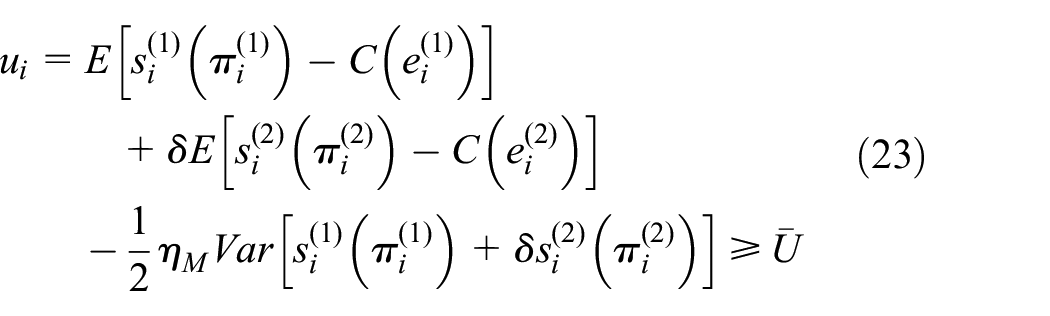
Moreover, to attract MUs to complete crowdsourcing tasks effectively in two periods, the contract should be designed to ensure that each MU can maximize its expected utility

Therefore, considering

From the IC constraint in equation (24), we can have the optimal effort

Moreover, from the optimization problem of two periods in equation (25), we can achieve the SP’s maximum expected utility
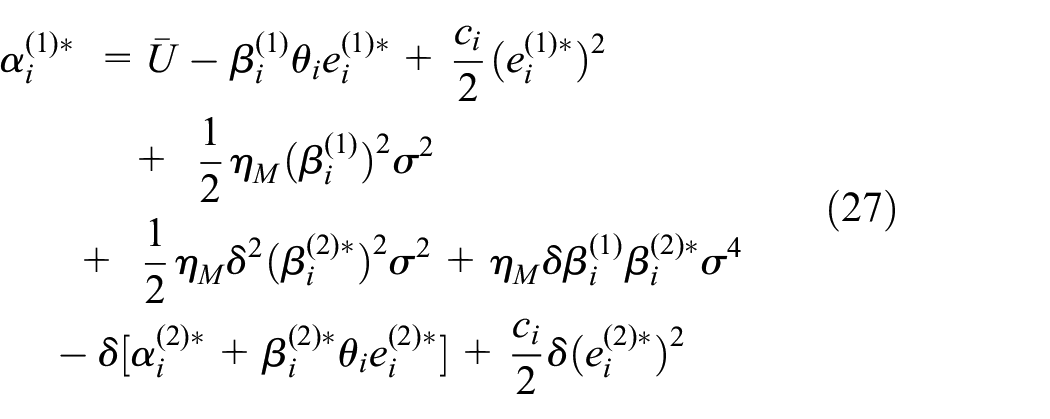
Furthermore, by substituting equations (26) and (27) in equation (25), the optimization problem of two periods in equation (25) can be further simplified as

Then, the optimal incentive coefficient

Two-period contract-based incentive mechanism with reputation strategy
In the above two-period contract-based incentive mechanism, the SP can obtain certain information about MUs through the achieved profit
Moreover, assume that the implicit achievable utility of reputation strategy to be

Then, the expected utility of the MU

Accordingly, the utility of the SP in Period 2 can be defined as

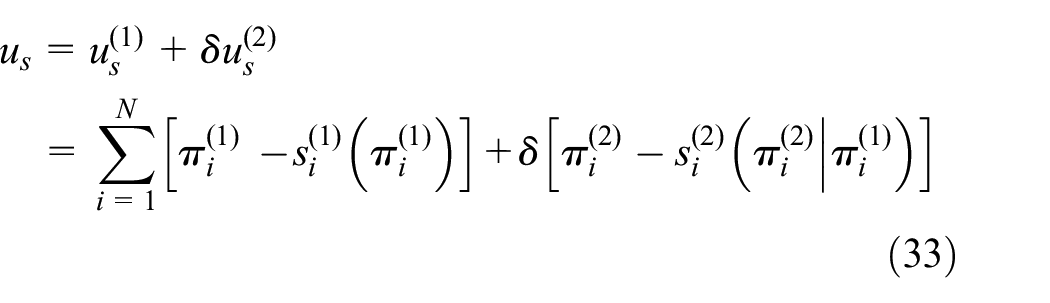
Thus, considering the SP’s utility of the Period 1
Contracting design in Period 2
Based on the conditional expectation, 37 we have

where
Similarly, the conditional variance can also be obtained as

Then, by substituting equations (34) and (35) into equation (30), the expected utility of the MU

Next, in order to assure that each MU’s achievable utility in equation (36) is no less than its retained utility

Moreover, to motivate the MUs to participate in the crowdsourcing tasks effectively, the contract design of Period 2 also needs to satisfy the following IC constraint

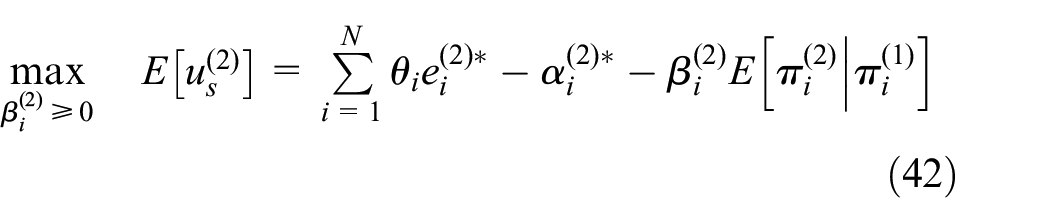
Thus, based on the above IC and IR constraints, the optimization problem is designed to obtain the SP’s maximum expected utility

Under the assumption of rational expectation,
18
when equilibrium is achieved, the crowdsourcing effort

Furthermore, from the optimization problem of Period 2 in equation (39), we can achieve the SP’s maximum expected utility

Next, by substituting equations (40) and (41) into equation (39), the SP’s utility maximization problem can be further simplified as
Then, the optimal incentive coefficient

Contracting design in Period 1
In this section, considering that each MU’s utility

Similarly, in order to motivate MUs to complete crowdsourcing tasks effectively in two periods, the following IC constraint should be satisfied to ensure that each MU can maximize its expected utility. That is

Therefore, based on the above IR and IC constraints, the optimization problem is designed to obtain the SP’s maximum expected utility

Similar to Period 2, from the IC constraint in equation (45), we can have the optimal effort

From the IR constraint in equation (44), the optimal basic salary

Accordingly, by combining equations (47) and (48) with equation (46), we can further simplify the SP’s expected utility maximization problem, that is

Then, the optimal incentive coefficient

Since there are two periods in the dynamic incentive mechanism, it is not necessary to consider the influence of reputation effect in Period 2. Then, the MUs’ optimal effort
Results and discussion
Simulation results are presented to evaluate the performance of the proposed dynamic incentive mechanism. All experiments are performed using the MATLAB platform. The profit per unit crowdsourcing effort of
Optimal contract design of two periods
Figure 3 demonstrates the performance of the two-period dynamic contract design. Figure 3(a) and (b) presents the MUs’ optimal basic salary, bonus coefficient, and crowdsourcing effort without reputation strategy in Period 1 and Period 2, respectively. The performances of the two periods show similar to each other. Specifically, when

Two-period dynamic contract design with reputation strategy and without reputation strategy: (a) Period 1 without reputation strategy, (b) Period 2 without reputation strategy, (c) Period 1 with reputation strategy, and (d) Period 2 with reputation strategy.
Moreover, the two-period dynamic contract designs with reputation strategy in Figure 3(c) and (d) show the similar performance with those of Figure 3(a) and (b), respectively. By combining the reputation’s implicit incentive with the contract’s explicit incentive, the MUs will be motivated to participate in the long-term crowdsourcing tasks more effectively. Then, the crowdsourcing effort
Effort incentive of two-period contract design
Figure 4 describes the performance of the effort incentive with the three MUs selected from Figure 3. All the simulation parameter settings are the same as those of Figure 3. Figure 4(a) and (b) presents the optimal crowdsourcing utilities of MUs without reputation strategy in Period 1 and Period 2, respectively. As

Two-period dynamic contract for the effort-incentive design: (a) Period 1 without reputation strategy, (b) Period 2 without reputation strategy, (c) Period 1 with reputation strategy, and (d) Period 2 with reputation strategy.
Moreover, Figure 4(c) and (d) shows the optimal crowdsourcing utilities and effort of MUs with reputation strategy in Period 1 and Period 2, respectively. We can observe that only if the MUs offer their optimal crowdsourcing effort
Feasibility of the proposed incentive scheme
Finally, the feasibility of the proposed incentive strategy is evaluated. Figure 5 shows the optimal expected utility of the SP with the different incentive mechanisms. As the retained utility of MUs

SP’s optimal expected utility with the various incentive mechanisms.
Figure 6 shows the optimal expected utility of the SP with the different numbers of MUs. As expected, when the number of MUs

SP’s optimal expected utility with the various numbers of MUs.
In Figure 7, the optimal expected utility of SP is studied with the various discount factors

SP’s optimal expected utility with the various discount factors
Conclusion
In this work, the crowdsourcing incentive method between the SP and the MUs is proposed in dynamic environments. Two-period dynamic contract incentive mechanism is investigated to cope with the information asymmetric issue. The SP designs the contract to describe the basic salary and incentive coefficient of MUs. Each MU chooses one contract item when participating in crowdsourcing tasks. Moreover, in order to attract the MUs to complete the long-term crowdsourcing tasks, reputation information is introduced into the two-period dynamic contract. The optimization problem is formulated to maximize the SP’s expected utility based on the IR and IC constraints. The optimal contract schemes are derived for both non-reputation and reputation strategies. Simulation results demonstrate that the proposed two-period dynamic contract method effectively increases the SP’s expected utility by breaking information asymmetry. By combining explicit contract with implicit reputation, the MUs can be motivated to participate in the long-term crowdsourcing tasks more effectively with the less payment and the more crowdsourcing effort.
Footnotes
Acknowledgements
The author thanks all the members who contributed to this research.
Handling Editor: Peio Lopez Iturri
Declaration of conflicting interests
The author(s) declared no potential conflicts of interest with respect to the research, authorship, and/or publication of this article.
Funding
The author(s) disclosed receipt of the following financial support for the research, authorship, and/or publication of this article: This work was supported by the Key Research and Development Plan of Hubei Province (no. 2021BGD013), the Science and Technology Research Program of Hubei Provincial Department of Education (no. T201805), and the Special Project of Central Government for local Science and Technology Development of Hubei Province (no. 2019ZYYD020).
