




Abstract
This paper presents an improvement in the speed and accuracy of calculating the initial angle of projection of fragments for exploding cylindrical shells. It is a fast tool that can be used by designers, where existing approaches, such as computationally intensive Finite Element Analysis, are preventively slow. An enhanced Taylor equation is presented using available experimental data and the effect of the changing shape of the warhead’s cylindrical casing on the fragment’s initial projection angle. The resulting equation is computationally fast as it uses uncomplicated equations and provides improved accuracy for estimating a fragment’s initial angle of projection in comparison to existing work.
1. Introduction
An active protection system like the Defence Aid System (DAS) requires fast reaction computation in order to analyze a threat and take rapid action, minimizing potential damage. Fast computation is also required during a vehicle’s design cycle to help maximize its survivability by gauging the effect of a wide range of threats.1,2 Neither the DAS nor designers’ computers can rely on accurate computer methods, such as Finite Element Analysis (FEA), as these methods are computationally intensive. The aim of this paper is to create an accurate enhanced Taylor equation that is computationally fast.
An explosion is one of the main threats to a military asset and involves many variables that are generally difficult to measure accurately.3–5 Several of these variables were successfully analyzed during World War II by people such as Gurney, 6 Taylor, 7 and Mott and Linfoot. 8 Their resulting equations are simple, reasonably accurate, and suitable for manual calculation as they were derived before the widespread availability of computer systems.
Taylor 7 provided the most fruitful equation to estimate the initial angle of projection of fragments created by an explosion. As computers became more powerful, authors such as Liu et al. 9 and Ma et al. 10 increased the accuracy of high explosive estimations by creating more complex physical algorithms using tools such as FEA and particle hydrodynamics. Despite improved accuracy, these approaches need significant computational effort and so are unsuitable for fast computer calculations (Spranghers et al. 11 ).
Taylor’s equation calculates the initial angle of projection for fragments in a cylindrical warhead’s explosion. In creating his equation, he assumes fragments are created as soon as the detonation wave contacts the casing. This assumption is inaccurate because the detonating explosive expands the casing before it creates fragments. This is one of the assumptions that is revised in this paper. Taylor estimated the initial velocity of a fragment from the warhead’s casing as follows:

where V is the initial velocity of a fragment, which depends on many factors including the mass of the explosive material and casing, U is the detonation velocity of the explosive, and

where
From Equations (1) and (2), Taylor derived the following equation:

Figure 1, adapted from papers by Carlucci 13 and Walters and Zukas, 14 shows the variables used in Taylor’s equation. Here, VN is the velocity of the fragment at right angles to the fragment and VA is the velocity at right angles to the original position of the casing.
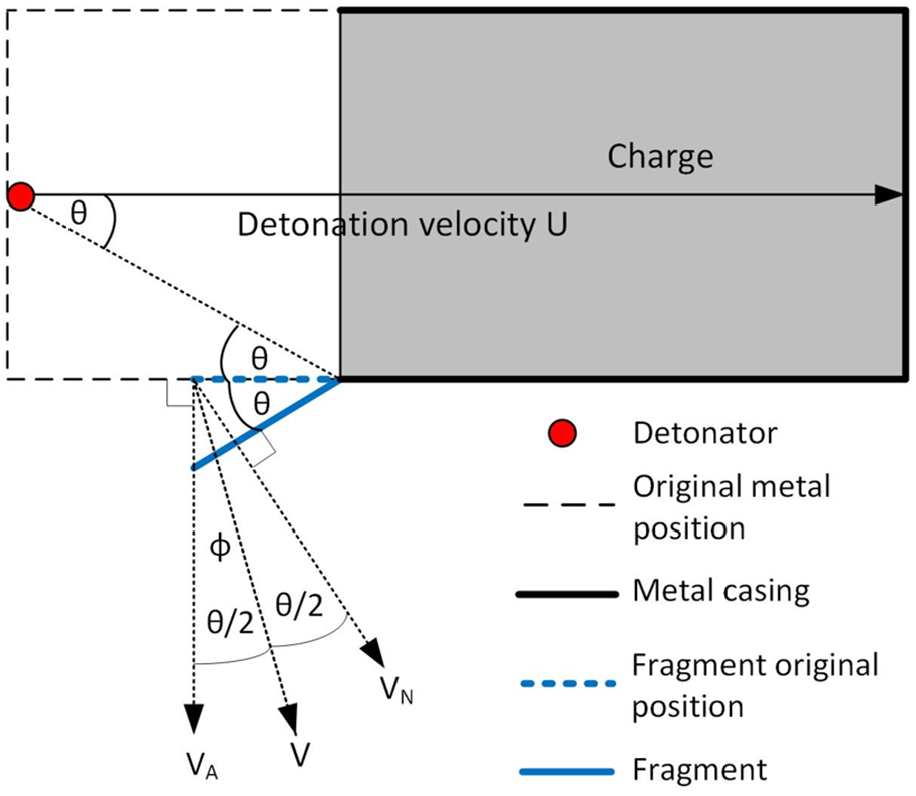
Variables used in Taylor’s equation.
Experimental data show this equation is reasonably accurate for fragments in the middle of the warhead, but inaccurate for fragments near the warhead’s end plates.
When using Taylor’s equation to calculate the initial projection angle of a fragment, several authors use the initial velocity of the fragment established by Gurney 6 (including Carlucci, 13 Kennedy, 15 Victor, 16 and Tanapornraweekit and Kulsirikasem 17 ). Unfortunately, the Gurney velocity of fragments is inaccurate for fragments close to the warhead’s end plates.12,18
Victor, 16 Kennedy, 15 Choi et al., 5 Tanapornraweekit and Kulsirikasem, 17 and Flis 19 set out methods and improvements to the value of the Taylor angle. In 2017, Wang et al. 20 simplified Flis’ equation, which uses the effects of rarefaction and blast waves to calculate the initial angle of projection of fragments.
The equation presented by Wang et al.
20
was expected to be a good comparison for the enhanced Taylor equation presented in this paper. Unfortunately, Wang et al.’s equation has limited utility because several variables, the value of
Instead, recent work by Tanapornraweekit and Kulsirikasem, 17 employing the original Shapiro’s equation, Equation (4), is considered:

where
Included in this paper are a set of steps to improve the accuracy of the Taylor equation. Firstly, the Taylor equation is modified to include an equation that estimates the initial fragment velocity, which depends on the axial position of a fragment. Secondly, the shape of the expanding casing caused by constant pressure is estimated. Finally, the method developed by Carlucci 13 is used to adjust the initial angle of projection of fragments along the expanded casing.
Low computational overhead will be achieved by utilizing non-complex methodologies.
2. Method: analysis and derivation of anew equation
2.1. Available experimental data
The most common reference case for a cylindrical warhead is one where the warhead is detonated at an end plate on the cylinder’s axis. Figure 2 shows experimental data from four researchers (Charron, 3 Karpp and Predebon, 22 König, 23 and Predebon et al. 24 ) for the initial angle of projection of fragments for end-detonated cylindrical warheads.
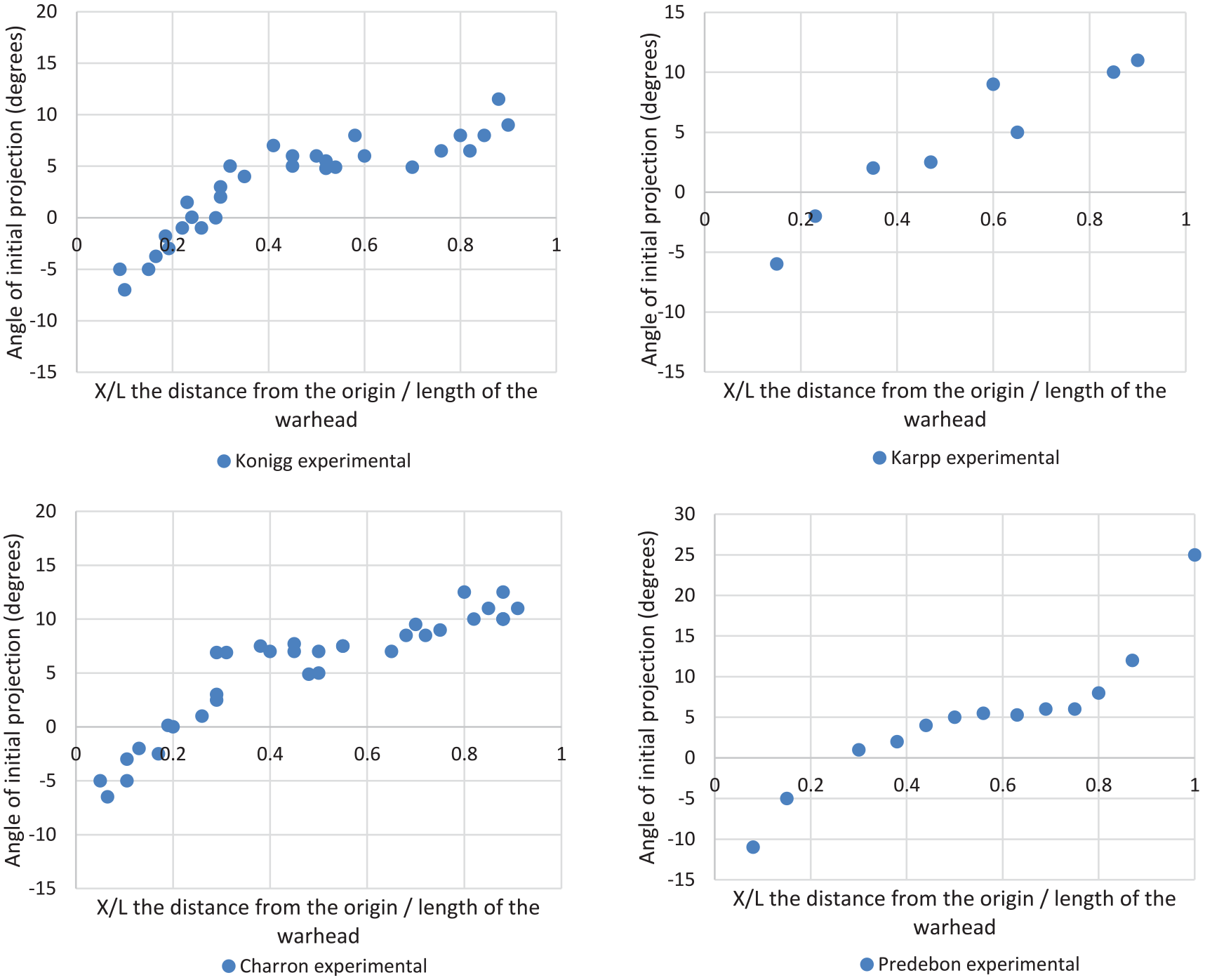
The origin in these graphs indicates the position of initial detonation. Using this experimental data, it is assumed the shape of the initial angle of projection for end-detonated warheads is as shown in Figure 3.
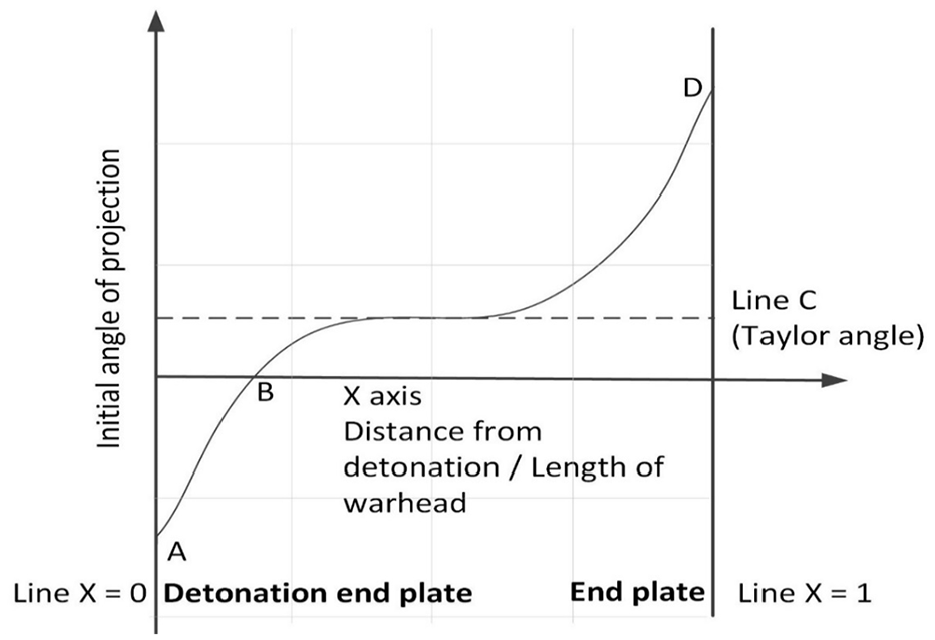
Graph of experimental data to represent the initial angle of projection of fragments.
Figure 3 indicates that the initial angle of projection is negative near the detonation, positive at the opposite end of the warhead, and constant and positive around the center of the warhead (line C). The Taylor equation to calculate the initial angle of projection of a fragment,
This paper enhances Taylor’s equation by examining the original variables (V and U) used by Taylor, together with variables such as the shape of the expanding casing and its effect on the angle of projection. One of Taylor’s initial assumptions about the creation of fragments when the detonation wave hits the casing is also examined. Overall, the steps taken are as follows:
1) to improve the initial velocity of a fragment using an equation that depends on the fragment’s axial position;
2) to estimate the shape of an expanding casing using the physics of the pressure of gases contained in the casing;
3) to include the effect the expanding warhead’s casing has on the initial angle of projection.
2.2. Improving the initial velocity of a fragment
The Gurney velocity, the initial velocity of a fragment, is constant for the whole of the warhead, and is often used to calculate the fragment velocity. However, experimental data of the initial velocity of a fragment shows the velocity is lower than the Gurney velocity for fragments formed near to the warhead’s end plates (Karpp and Predebon, 22 Charron, 3 Grisaro and Dancygier, 25 and Huang et al. 26 ). Taylor’s equation is modified to include the variable initial fragment velocity. A reasonable formula for the variation of this velocity is given in Felix’s paper. 27 The equations to calculate a fragment’s initial velocity of projection, set out in the paper, are as follows:
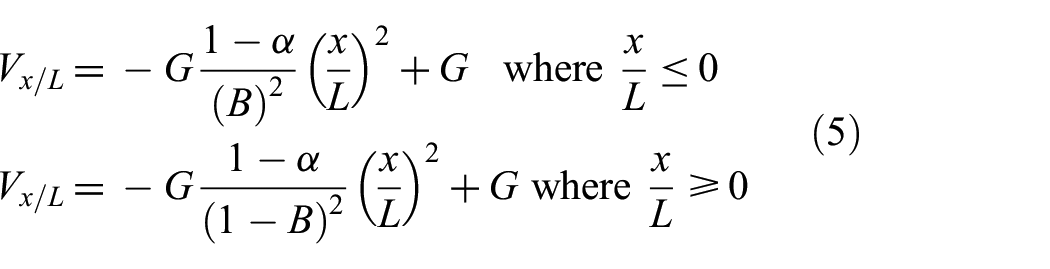
where G is the Gurney velocity, B is the distance between the origin and the maximum initial fragment velocity divided by the length of the warhead, estimated in this paper to be equal to 0.6, α satisfies 0 ≤α≤ 1 and represents the reduction of the maximum initial fragment velocity at the end plates, estimated in this paper to be equal to 0.65, x is the distance from the origin, and L is the length of the warhead.
Replace G with TA to calculate the different velocities over the length of the warhead and change the origin of the equations to the detonation point by changing
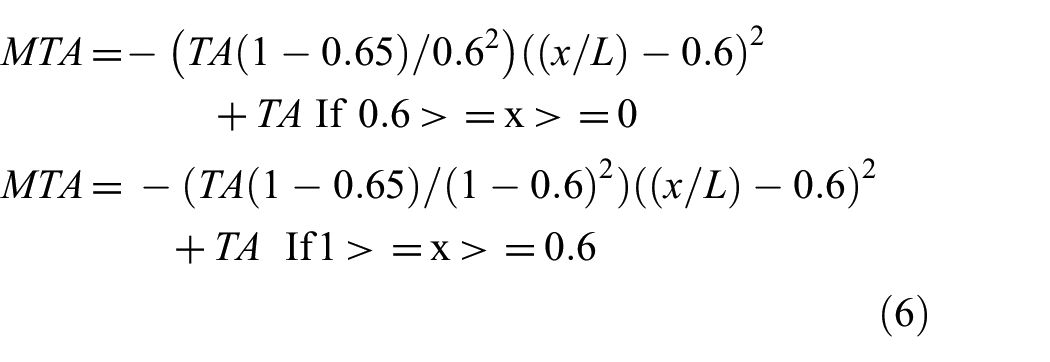
where TA is Taylor’s initial angle of projection using the assumption that the maximum initial fragment velocity is equal to the Gurney velocity. The value of 0.65 is derived from the work of several researchers and discussed in Felix’s paper. 27 It represents the fraction of the Gurney velocity for the velocity of fragments at the end plates (i.e., the Gurney velocity multiplied by 0.65). The variable x is the distance of the fragment from the detonation end plate and L is the length of the warhead. Felix 27 also uses the work of several researchers to determine the position of the maximum fragment velocity (and by implication the maximum angle of projection) at a point 0.6 of the length of the warhead from the detonation (referred to as point M in this paper).
2.3. The shape of the expanding casing
There is little research that identifies how a cylindrical casing changes during an explosion. Papers by Lu et al., 28 Zhao and Grzebieta, 29 and Rushton et al. 30 indicate that the cylindrical casing does not expand uniformly but forms a three-dimensional convex shape, viewed from outside the casing. This is also the shape yielded by Grisaro and Dancygier’s simulation. 25 These papers indicate that the maximum expansion is near the middle of the warhead’s length.
Simulations are not an ideal method to determine how explosive cylindrical casings expand. However, providing the simulations obey the laws of physics, for the casing and the explosive, they can provide a possible indication. Kong et al.’s 31 and Babu et al.’s 32 simulations give examples of an exploding cylindrical warhead and indicate that long axial fragments are first formed by the explosion. A paper by Cullis et al. 33 provides a high-speed photograph that indicates major cracks along the full length of the thick walled cylinder can be observed.
This paper assumes the casing forms a continuous, convex curve before it breaks up into long axial fragments. The shape of the expanded warhead is assumed to have a maximum expansion at a length of 0.6 of the total length of the warhead from the detonation.
2.3.1 Define the shape of the expanding casing
There are few scientific papers that define the shape of an exploding cylindrical casing, with Taylor’s paper providing one example. 7 This paper defines the shape of an exploding casing using the following approach.
The shape of the expanding casing is assumed to be caused by constant pressure within the cylindrical casing, as shown in Figure 4. The pressure is assumed to be parallel to the X- and Y-axes, with the X-axis along the axis of the cylinder and the Y-axis perpendicular to the X-axis. This pressure is caused by the rapid detonation of the explosive, to create heat and a vast amount of gases.34,35 In this paper, the distance between the end plates C1, C4, and C2, C3 is assumed to be 1. This is because this paper uses an X-axis with measurements equal to the distance from the detonation divided by the length of the warhead. The positions C1, C2, C3, and C4 are fixed during the explosion because no experimental data on the expansion at these points can be found and, therefore, no expansion is assumed.
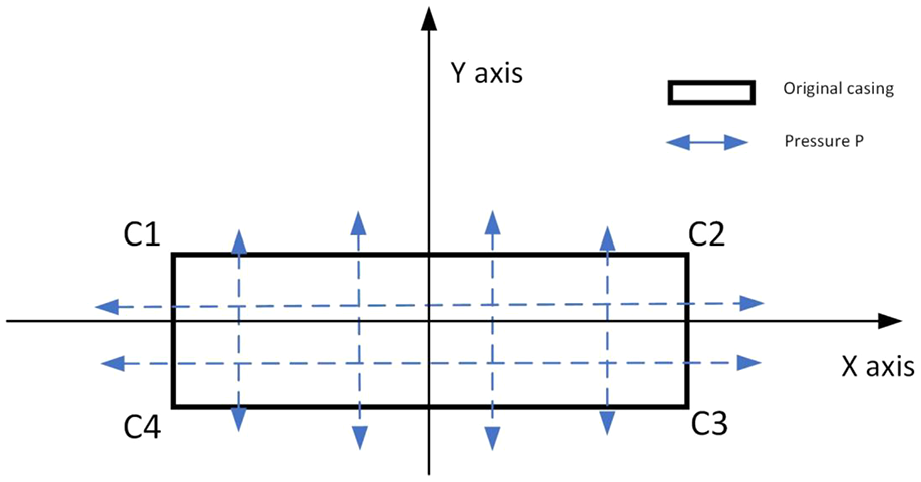
Constant pressure inside the casing.
For the vertical pressure the hot, explosive gases will push the cylinder wall between C1 and C2 and force the casing to expand. The heat and pressure will eventually plasticize the metal, forcing it to increase in length and expand further. As discussed, in the beginning of this section, long, axial, circumferential strings are formed. Figure 5 shows a long axial string formed from part of the expanding casing C1 to C2. Under these conditions the equation of the casing will form a catenary, as explained in several papers, including Lewis’ paper. 36 For clarity, this figure shows the expansion at the top of the casing, although the expansion will be the same around the cylinder.
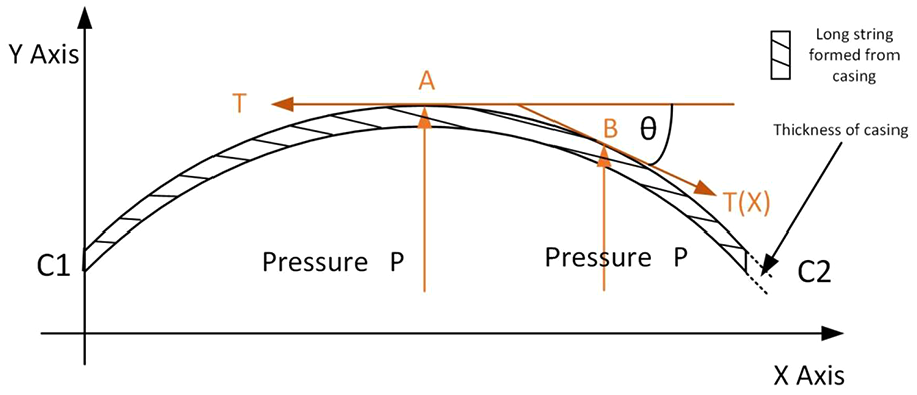
A long string formed on the casing.
The equation of a catenary is
Three points are required to define the catenary created by the exploding cylinder. These are the position of the end plates C1 and C2 and the position of the maximum expansion of the cylinder.
The effect of the horizontal pressure now must be included to define the final shape of the expanding casing. For the red curve of Figure 6, from C1 to the maximum expansion of the cylinder, the pressure is exerted to the left and from the maximum expansion of the cylinder to C2 the pressure is exerted to the right. This suggests that the final shape of the casing, given the fixed points mentioned above, is as shown as the blue curve in Figure 6. This shape is similar to the shape of exploding warheads in photographs provided by Lu et al. 28 and Kong et al. 31 Kong et al.’s simulated photographs indicate that there is a perturbance as the “flattened” part of the casing expands further and gases escape. This expansion is excluded in this paper.
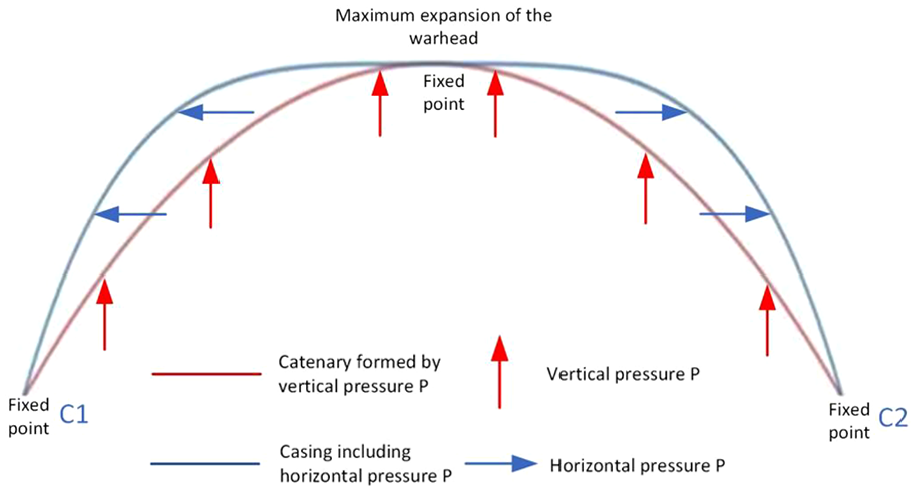
Casing expansion with equal horizontal and vertical pressure. (Color online only.)
The function that includes horizontal pressure must have the same values as the original cosh function (created by the vertical pressure P) at the end plates and at the point of maximum expansion. This function is symmetrical about the “Y”-axis passing through the point of maximum expansion (i.e., it is an even function).
Providing the above assumptions are accepted there are probably many functions that can satisfy this new even function. As the cosh function is an even function, the new function is assumed to be a cosh function. cosh(x) satisfies the shape of long sting fragments with pressure in the vertical direction, so, the function cosh(x*x) is considered for pressure in two orthogonal directions.
To simplify the mathematics, the cosh equation undergoes horizontal and vertical translations so that the curve between x = 0 and x = 1 has a positive value, less than or equal to the maximum expansion of the casing, and the points C1 and C2 lie on the X-axis (i.e., no expansion). The maximum expansion of the casing is estimated to be at a distance M (0.6) of the length of the casing from the detonation. 27 Because of this assumption, the curve representing the expanding casing is an amalgamation of two cosh curves that meet at point M (see Felix 27 for an explanation of this requirement). The cosh curves are as follows:
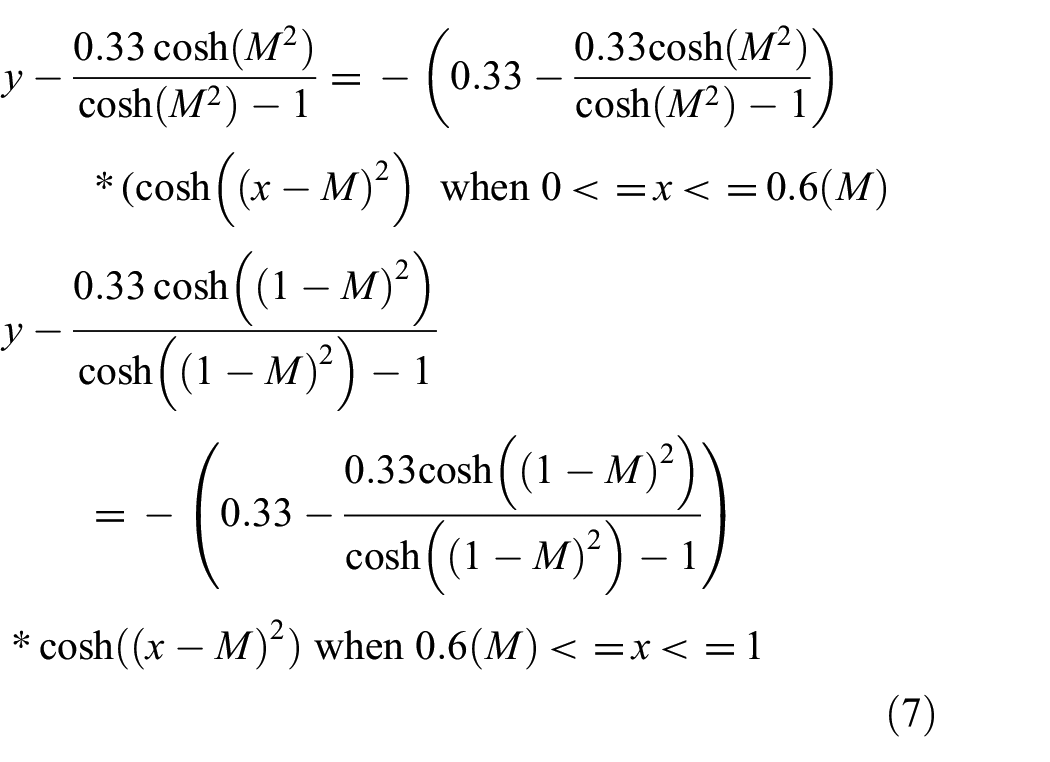
cosh(M2) and cosh(
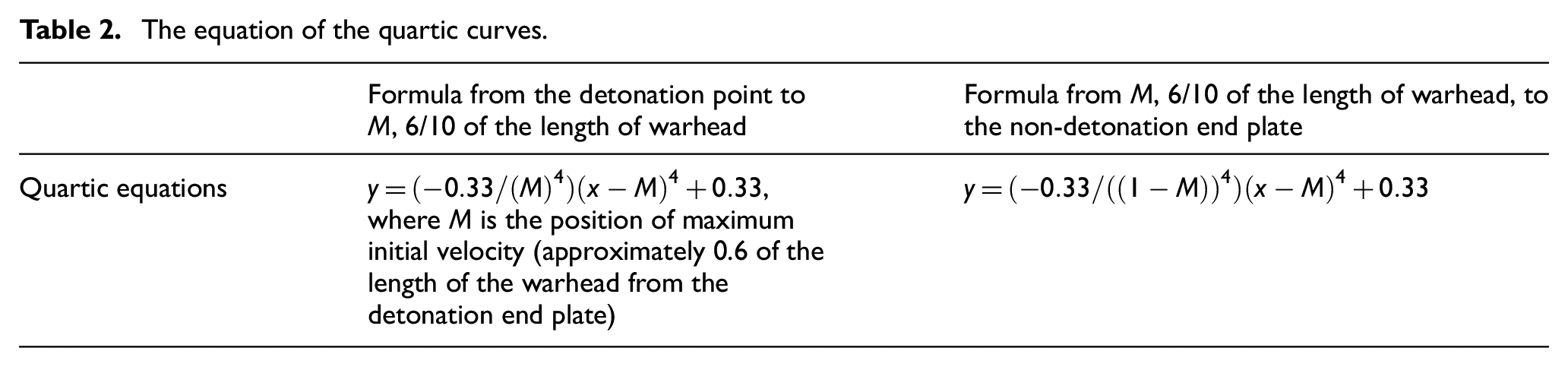
In the interval 0 ≤x≤ 1, cosh(x2) can be approximated by a quartic equation (Table 1 shows the small differences between these curves) and the execution time of a quartic equation is three times faster than the execution time of the cosh(x2) curve, verified using MATLAB.
The difference between Cosh and quartic curves to four decimal places.
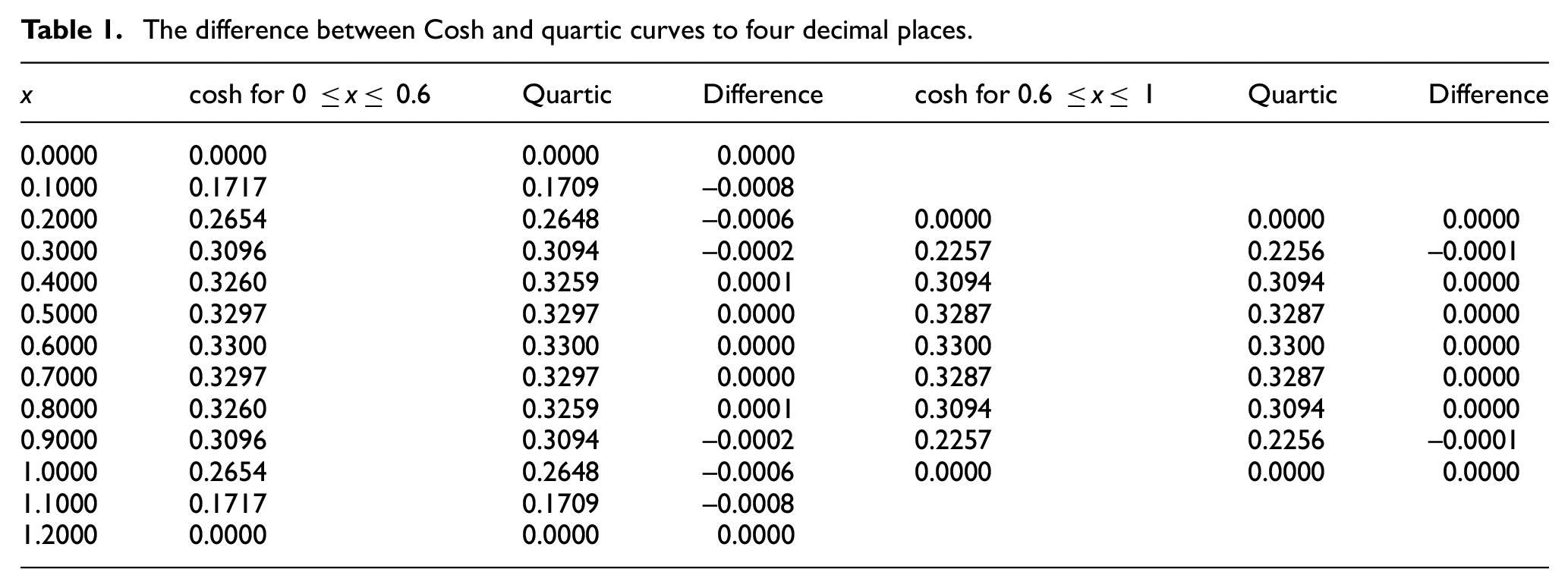
Table 2 gives the equations of the quartic curves that approximates the curves shown in Equation (7).
The equation of the quartic curves.
2.4. Include the effect of the expanding warhead’s casing
Carlucci 13 indicated that the Taylor equation should be adjusted to cater for different shaped warheads. He assumes the value of the Taylor equation should include the angle the tangent of the casing makes with the horizontal axis. Although Carlucci’s approach to calculating an adjustment to the Taylor angle of projection is investigated in this paper, other researchers such as Szmelter and Lee, 38 Tanapornraweek and Kulsirikasem, 17 and Chen et al. 39 directly or indirectly, in their equations to calculate fragment angle of projection, also include the tangent the casing makes with the horizontal axis.
Figure 7 indicates the shape of an expanding warhead casing for an end-detonated weapon as the casing starts to fragment. Using Carlucci’s logic, the fragment’s initial angle of projection is reduced by the angle of the tangent of the expanded casing to the horizontal (for example, by α1 at points A2 and A3, as shown in Figure 7. Beyond the casing’s maximum expansion, the fragment’s initial angle of projection is increased by the angle of the tangent to the expanded casing (for example by α2 at points B2 and B3, as shown in Figure 7).
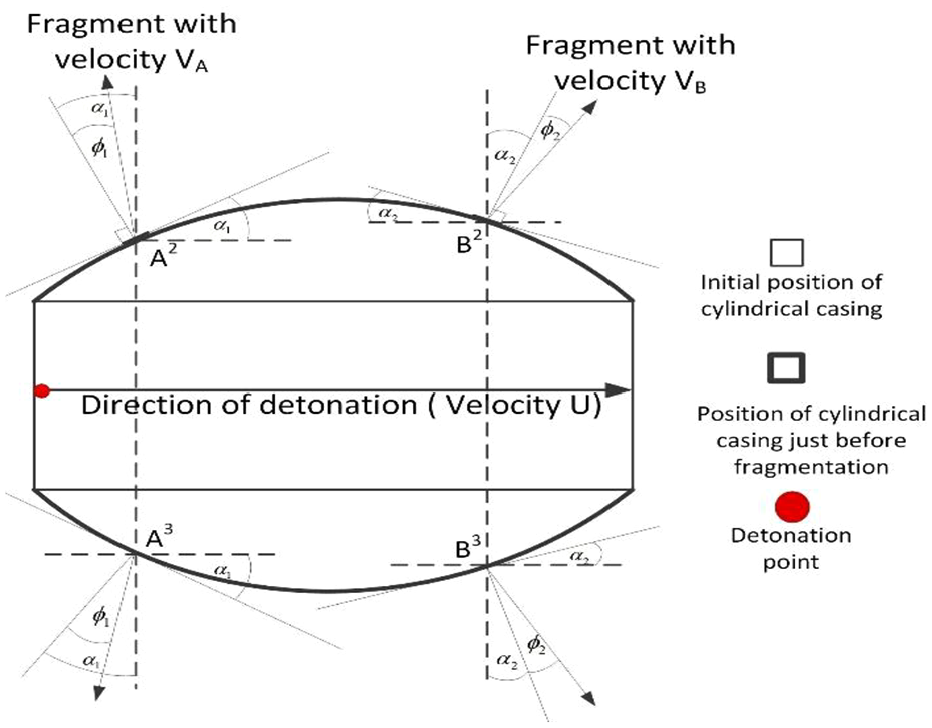
An expanding case.
In defining the shape of the expanded casing, the ratio of length over diameter (L:D) influences the final shape of the casing. In this paper it is assumed the L:D ratio is greater than 0.5:1. An expanding warhead’s casing with a ratio less than or equal to 0.5:1 may form a different shape because the exploding charge will reach the end plates before it reaches the cylindrical casing.
This paper assumes a L:D ratio of 1:1, which will cater for cylindrical warheads where L:D is greater than 0.5:1. This is so because, in this paper, X-axis values are defined as the distance from the detonation divided by the length of the warhead (i.e., values from 0 to 1 inclusive).
The publications referenced here employ L:D ratios greater than 0.5:1. Charron, 3 Karpp and Predebon, 22 Lu et al., 28 and König 23 use a ratio of 2:1, Predebon et al. 24 use 1:1, and Cullis et al. 33 use 1.3:1.
The Taylor equation is based on “initial fragment velocity / velocity of detonation.” After detonation the explosive charge is converted into gases and heat, which force the casing to expand, and so “velocity of detonation” is changed to “velocity of the explosive gases.” In Taylor’s paper, 7 he shows that the velocity of explosive gases increases as the case expands and, at maximum case expansion, the velocity of the explosive gases is almost the same as the detonation velocity. Employing the same logic that Taylor used to develop his equations, Taylor’s equation is identical for an expanding warhead casing with the detonation velocity replaced with explosive gas velocity.
Using the observation in Carlucci 13 and the result in Figure 7, the initial angle of projection depends on the angle of the tangent to a curve, which is determined by the first derivative of the curve.
2.5. Estimate the initial angle of projection
The graph shown in Figure 3 resembles a cubic curve, which requires four points (A, B, and lines C and D) to define it.
2.5.1. Points A and D in Figure 3
No published data can be found to enumerate the values of the initial angle of projection at the end plates.
2.5.2. Point B in Figure 3
Experimental data shows that point B (the intercept with the X-axis) is approximately 0.2 of the length of the warhead from the detonation (Karpp and Predebon,
22
Charron,
3
König,
23
and Predebon et al.
24
). At B the initial angle of projection is zero degrees, that is, it is at right angles to the axis of the warhead. This means the value of the Taylor angle at point B is equal to the effect of the expanding casing. This is achieved if the angle created by the expanding casing divided by the Taylor angle is set to
At point B,
2.5.3. Line C in Figure 3
In Figure 3 the value of the initial angle of projection for line C is shown as the value of the Taylor angle. Experimental data from Karpp and Predebon, 22 Charron, 3 König, 23 and Predebon et al. 24 shows this is a very good approximation.
2.6. Investigating the enhanced Taylor equations
The enhanced Taylor equation consists of the three proposed improvement identified in Section 2.1:
to improve the initial velocity of a fragment using an equation that depends on the fragment’s axial position;
to estimate the shape of an expanding casing using the physics of pressure of gases contained in the casing;
to include the effect the expanding warhead’s casing has on the initial angle of projection.
In Table 2, the equation from the detonation point to M, 6/10 of the length of warhead is as follows:

So,
The enhanced Taylor angle then becomes the result of two equations added to MTA. In Equation (8) the enhanced Taylor angle, is referred to as Angle. This is the angle compared with the published experimental results:
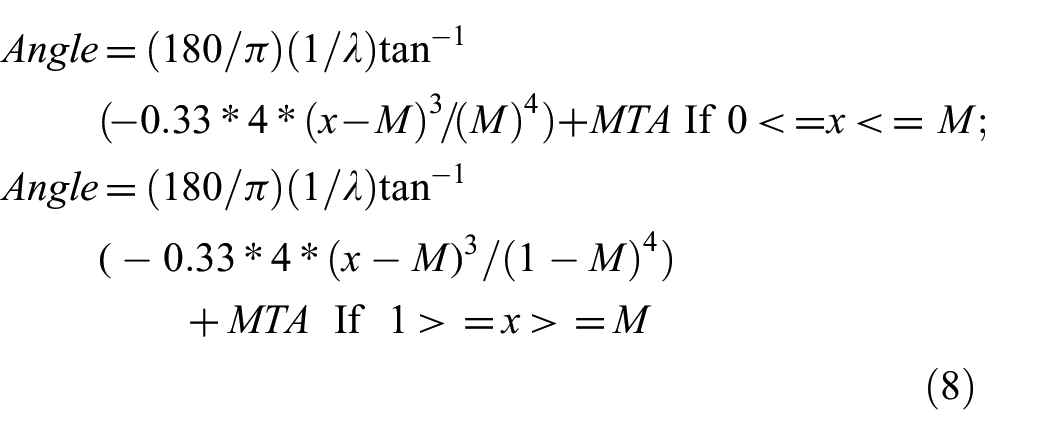
where Angle is measured in degrees and the term 180/
3. Results
Table 3 shows the correlation coefficients of the curves against the experimental data.
Correlation coefficients for curves against experimental data.
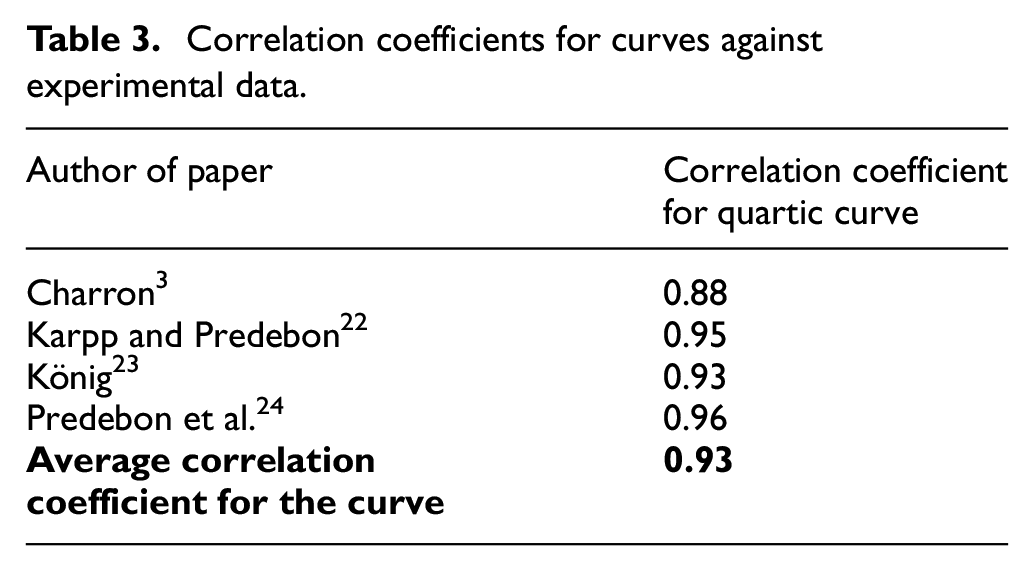
The correlation coefficient used to determine the “goodness of fit” between the experimental and calculated angles of projection is Pearson’s coefficient, as outlined by Lee Rodgers and Nicewander. 40 This coefficient has a value between −1 and 1, where the value of 1 indicates an exact positive correlation and −1 indicates an exact negative correlation. There is good correlation between experimental and calculated results. In each of the four experimental results the correlation coefficient is greater than 0.88.
For the quartic curve the standard errors of the correlation coefficients are as shown in Table 4.
Standard errors for the quartic curve.
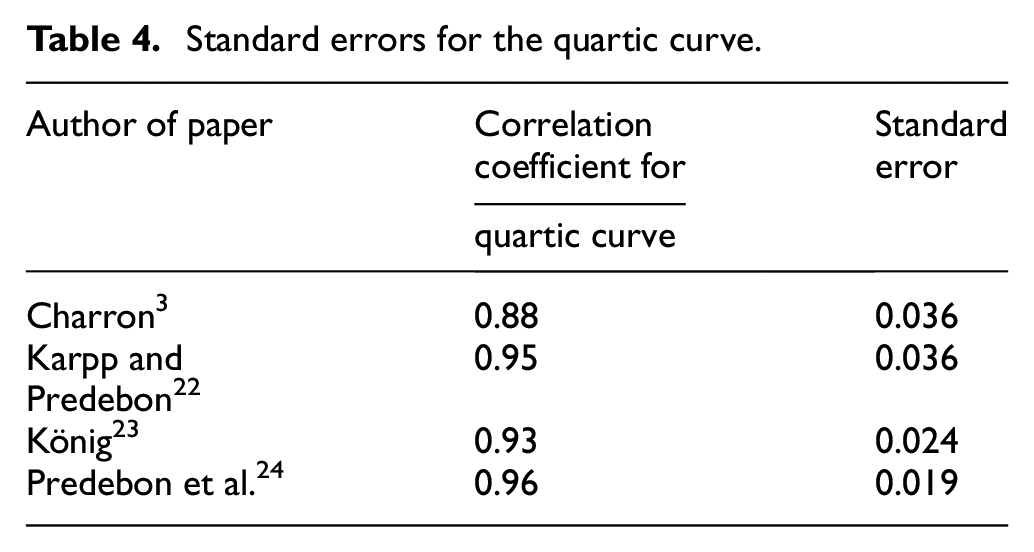
This shows that the correlation coefficients are accurate. The final enhanced Taylor angle is given by Equation (8).
The results of comparing the experimental data with Equation (8) are set out in Figure 8. The blue points represent the experimental data and the red curve represents the calculated enhanced Taylor equation.
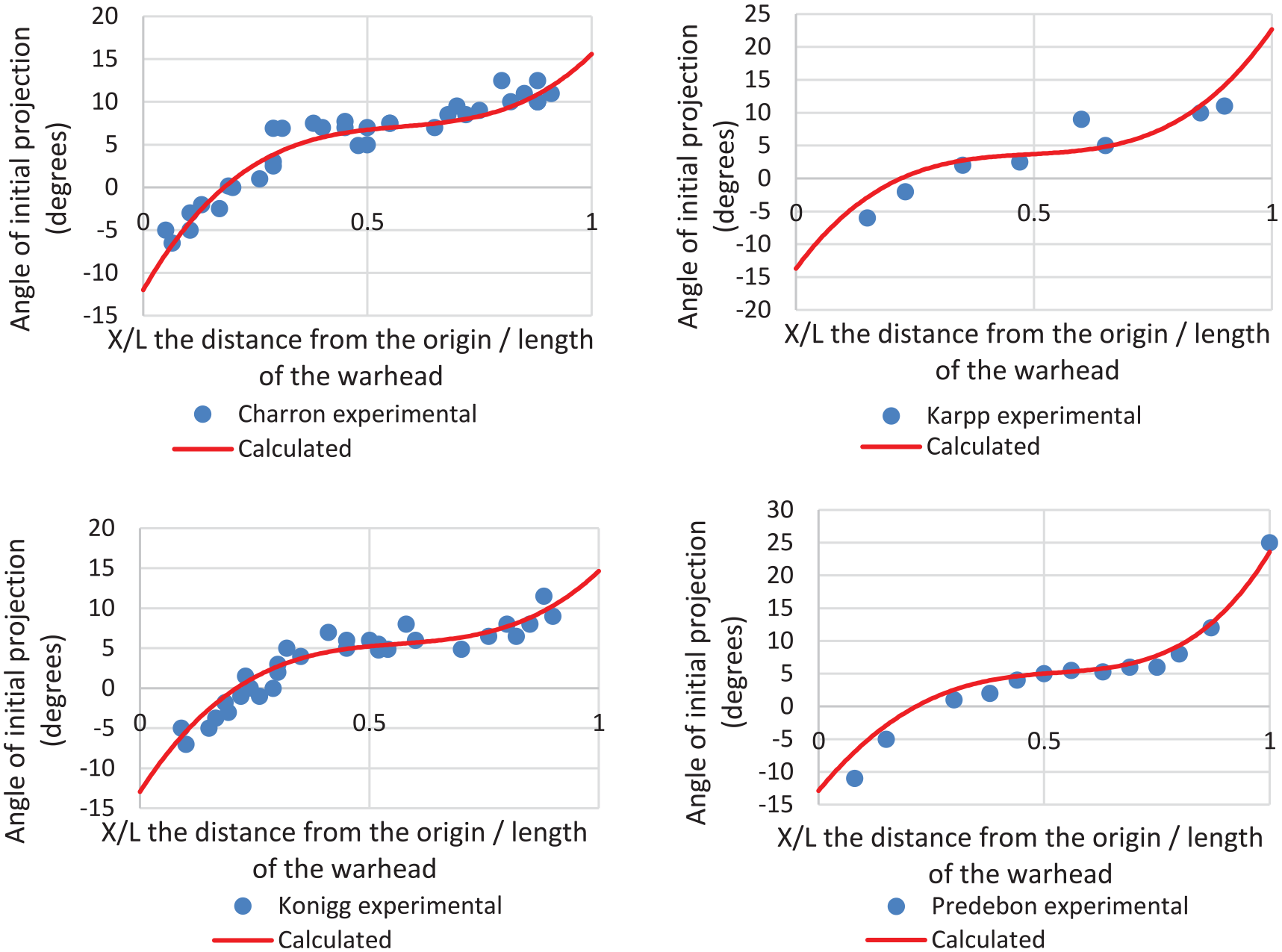
Experimental and calculated data. (Color online only.)
Although the results appear to be accurate, it must be pointed out that the experimental data had to be extracted from a small set of graphical results, the Taylor angle had to be estimated, and the equation of the expanded casing had to be investigated. If these variables can be improved the results can be better estimated.
For comparison, we examine the accuracy of our reference case against the work by Tanapornraweekit and Kulsirikasem 17 using Shapiro’s equation (Equation (4)), introduced in Section 1 above. The comparison is for two sets of experimental data that produce the lowest and highest correlation coefficient; Charron 3 and Predebon et al.’s 24 data. The results are shown in Figures 9 and 10.
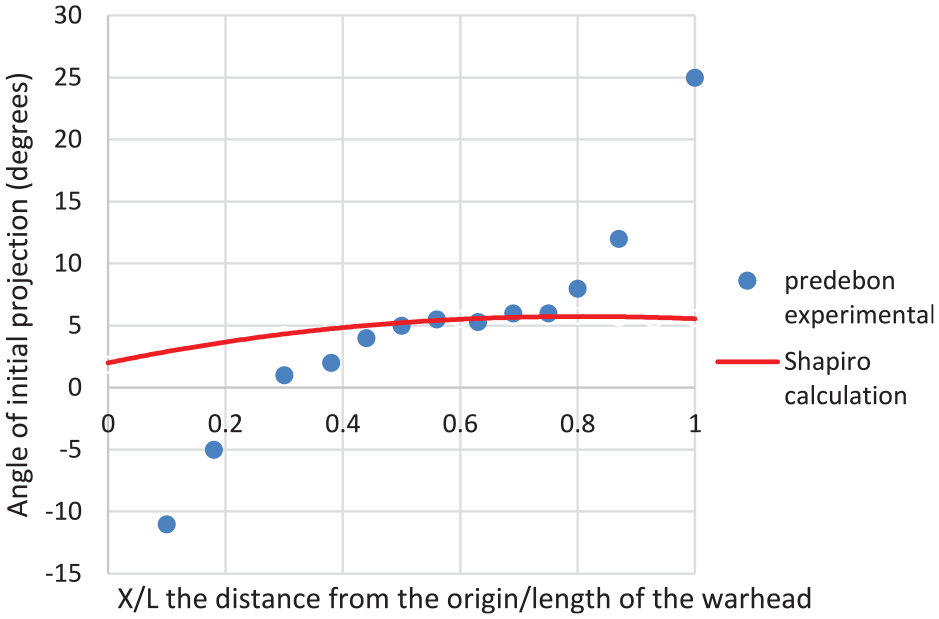
Comparison of Shapiro’s calculation and Predebon et al.’s 24 experimental data.
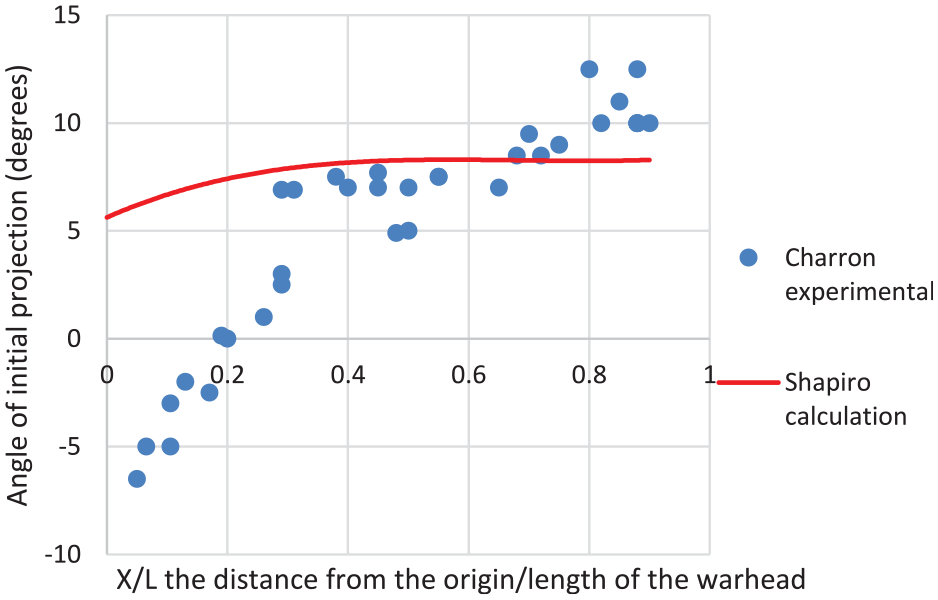
Comparison of Shapiro’s calculation and Charron’s 3 experimental data.
As shown in the charts, Shapiro’s equation is reasonably accurate in the center of the warhead but lacks accuracy near the end plates. Predebon et al.’s 24 data has a correlation coefficient of about 0.73 and Charron’s 3 about 0.62.
The original Taylor equation is a straight line parallel to the X/L-axis. When compared with the experimental results, it has a correlation coefficient that cannot be estimated because its standard deviation is zero. Making a small adjustment to the straight line, by decreasing its value by 10% at one point on the straight line, gives a correlation coefficient of about 0.3, indicating limited correlation with the experimental results.
The comparison with Shapiro’s and Taylor’s equations indicates that the enhanced Taylor equation is more accurate overall.
3.1. Computer execution times
In order to gauge the relative computational performance of the equations studied here (Taylor, Shapiro, and enhanced Taylor), we perform a comparative computer execution. Each equation is implemented in a MATLAB function and is executed on given hardware multiple times (10,000 executions); the average execution time for each cycle is then calculated.
The original Taylor equation is executed as a single element. As a direct comparison for the enhanced equation, a 21-element Taylor equation took 3.78 × 10⁻⁶ seconds. The Shapiro equation with 21 elements has an average execution time of 1.83 × 10⁻⁵ seconds, and the enhanced Taylor equation, also with 21 elements, yields an average execution time of 1.57 × 10⁻⁵ seconds. This indicates the enhanced Taylor equation is comparable with Shapiro’s equation.
4. Conclusions
This study presents a new “enhanced Taylor” equation to calculate the initial angle of projection of fragments. The new equation is compared to existing work by Taylor and Shapiro (presented by Tanapornraweekit and Kulsirikasem 17 ) for accuracy, defined as the correlation to experimental results, and comparative computer execution time.
The original Taylor equation, when compared with the experimental results, has a correlation coefficient of about 0.3, indicating limited correlation with the experimental results. The Shapiro equation (from Tanapornraweekit) yields an improved correlation coefficient of 0.73 and 0.62 for experimental data from Predebon et al. 24 and Charron, 3 respectively, indicating an increase in accuracy. The new enhanced Taylor equation (Equation (7)) provides correlation coefficients greater than 0.88, which indicates a close positive correlation with the experimental data.
In the computer execution time tests, the computation time of the Taylor equation (3.78 × 10⁻⁶ seconds) was faster than that of the Shapiro equation (1.83 × 10⁻⁵seconds), which is comparable with the enhanced Taylor equation (1.57 × 10⁻⁵ seconds).
The original Taylor equation provides very quick and approximate results and is still a reasonable first step for calculating the initial angle of projection of fragments, which may be suitable for some applications. The Shapiro equation offers slower computational speed and less accuracy than the presented enhanced Taylor equation and, thus, it is preferable to use the enhanced Taylor equation for Active Protection Systems and simulations that need many real-time results with increased accuracy but comparable computation time.
Although the enhanced Taylor equation gives better results than the original equation, there are areas for improvement, including additional work required to determine the initial angle of projection of fragments at the end plates. In addition, none of the results from the referenced physical experiments specify a margin of error. Results with a margin of error may yield a better enhanced Taylor equation.
Information on the shape of the expanding cylinder just before it breaks into fragments is also required. Other curves may be considered for the shape of the expanding cylinder. This could include a modified quartic equation that changes the point of inflection from a zero gradient to a small positive gradient, as seen in the König 23 and Karpp and Predebon 22 papers.
The sampling of graphical representations is prone to estimation error; access to authors’ data values would eliminate this inaccuracy.
Footnotes
Funding
This research received no specific grant from any funding agency in the public, commercial, or not-for-profit sectors.
