




Abstract
The core role of leadership is to mobilize and motivate members for pursuits that serve the organization's purpose, such as organizational strategy. The concept of meaning-based leadership, leader advocacy of the meaning organizational purpose gives to the work, was proposed in recognition of this role. We study the indirect influence of team leader meaning-based leadership on team strategy implementation (efforts to put organizational strategy into practice) as it is mediated by team value alignment – team similarity with top management in perceptions of organizational values. We propose that higher-level meaning-based leadership – the meaning-based leadership from the team leader's direct superior – moderates the influence of team leader meaning-based leadership: team leader meaning-based leadership is a stronger influence on team value alignment and, mediated by team value alignment, team strategy implementation with more higher-level meaning-based leadership. We found support for this research model in a survey of N = 421 teams from an energy company.
The core role of leadership in organizations is to mobilize and motivate organizational members to contribute to pursuits in the service of organizational purpose (the reason the organization exists; Selznick, 1957). Because organizational purpose is inherently values-based, it can imbue the work with meaning (Selznick, 1957). The subjective experience of meaning at work follows from the alignment of the values one embraces and the work one does, and is intrinsically motivating (Ros et al., 1999; Rosso et al., 2010; Shamir, 1991; Spreitzer, 1995). Understanding the purpose underlying organizational pursuits such as organizational strategy can therefore motivate efforts to contribute to these pursuits (van Knippenberg, 2020). An organization's purpose may for instance be to contribute to the quality of life of its external stakeholders through the services it provides. Such purpose can be understood to reflect self-transcending values – the notion that it is meaningful and desirable to contribute to the wellbeing of others and society (Schwartz, 1992, 1994). Recognizing that the work one does for external stakeholders contributes to their wellbeing and that this reflects the values-based purpose underlying one's work can imbue the work with meaning and motivate employee efforts.
Organizational purpose and the meaning that the work derives from this purpose often are not readily apparent to members, however (Selznick, 1957). An important leadership role in motivating contributions to organizational pursuits therefore is to advocate the purpose organizational pursuits serve and the meaning the work derives from it. To capture this element of leadership, van Knippenberg (2020) outlined a theory revolving around the concept of meaning-based leadership, defined as leader advocacy of the meaning organizational purpose gives to the work. Van Knippenberg argued that meaning-based leadership is important in motivating contributions to pursuits in the service of organizational purpose like organizational strategy. Such pursuits require contributions from members throughout the organization, but often come with the challenge that they are defined at a high level of abstraction that can make it difficult for members to understand how their work can meaningfully contribute to the objective. Meaning-based leadership can be influential in motivating such pursuits.
Studying meaning-based leadership thus arguably is important, because it is the only leadership concept that is explicitly tied in its conceptualization to organizational purpose and its potential to imbue the work with meaning (van Knippenberg, 2020). In view of criticisms of leadership concepts for confounding a behavioral understanding of leadership with non-behavioral elements and with attributed effects (i.e., authentic leadership, Gooty et al., 2024; charismatic-transformational leadership, van Knippenberg & Sitkin, 2013; servant leadership, Liden & van Knippenberg, in press – all leadership concepts that enjoy great popularity in research and practice), it is also noteworthy that meaning-based leadership was explicitly conceptualized as a behavioral construct to avoid such confounding.
Because in most organizations work is differentiated by team (cf. Mathieu et al., 2017; here broadly defined to include workgroups, departments, etc.), van Knippenberg (2020) argued that we should consider the role of meaning-based leadership in motivating contributions to the pursuit of organizational objectives at the team level of analysis and see the role of team leader meaning-based leadership as advocating how the organizational purpose that is served by the teamwork imbues the work with meaning. Thus, meaning-based leadership is part of the role of team leadership throughout the organization.
For meaning-based leadership theory to move to being a tested, supported, and extended theory, however, empirical research is required. Particularly valuable is research that speaks to the mechanisms through which, and the conditions under which, meaning-based leadership can be effective in motivating team member contributions to big picture organizational pursuits, because this gets to the core of what meaning-based leadership theory intends to capture (cf. van Knippenberg, 2020). Such is the focus of the present study: drawing on and extending meaning-based leadership theory to study mediation and moderation in the influence of meaning-based leadership on team efforts to contribute to big picture organizational pursuits.
To capture how meaning-based leadership may contribute to big picture pursuits, we focus on team strategy implementation. Strategy implementation refers to efforts to put organizational strategy into practice and has been identified as a major challenge for organizations (Weiser et al., 2020). A key element in this is motivational; it is a challenge to win people over to invest in putting strategy into practice (Balogun & Johnson, 2004, 2005; Floyd & Wooldridge, 1997). As per the broader point made by van Knippenberg (2020), how teams can contribute to strategy implementation likely differs from team to team, making the team level of analysis appropriate in the study of strategy implementation (Ateş et al., 2020). Consider for instance an organization that adopts a customer-centric strategy – a strategy prioritizing delivering value to customers. Customer-centricity is an abstract concept and it may not be readily apparent to teams how they can contribute to the organization's customer-centricity. Moreover, how teams can do so is bound to differ from team to team; customer-facing teams have the ability to deliver on customer-centricity in direct interactions with customer, whereas teams in internal support roles that do not directly interact with customers can for instance contribute to the organizational strategy by helping shape a context in which customer-facing teams can optimally deliver on customer-centricity.
We argue that team leader meaning-based leadership positively influences team strategy implementation through its influence on team value alignment, the extent to which team members have an understanding of organizational values that is aligned with the values underlying organizational purpose. Values lie at the core of the subjective experience of meaning at work (Ros et al., 1999; Spreitzer, 1995). Accordingly, organizational values lie at the core of how organizational purpose can give meaning to the work. Alignment around organizational values motivates contributions to organizational pursuits that are rooted in these values such as organizational strategy (van Knippenberg, 2020). Thus, meaning-based leadership, through its focus on how values-based organizational purpose imbues the work with meaning, can be expected to positively impact team value alignment. We propose that through this influence on value alignment, meaning-based leadership motivates team strategy implementation. This mediated influence of team leader meaning-based leadership on team strategy implementation is the first step in our analysis.
The second step in our analysis is to recognize that, with the exception of the individuals at the very top of the organization, team leaders enact their leadership in the context of the leadership displayed by their leaders – leaders at higher levels in the organizational hierarchy (van Knippenberg, 2020). The higher-level leadership that is likely to be particularly salient to team members is that of the team leader's direct superior, both because the team leader is likely to share at least to some extent experience with this leadership and because, other than the team leader, the team leader's direct superior is the most likely leader to interact with the team (e.g., Detert & Treviño, 2010; Liu et al., 2013; Peng et al., 2020). Thus, the higher-level leadership of the team leader's direct superior can be expected to be the contextual backdrop against which team members experience team leadership.
This holds particularly for meaning-based leadership, because meaning-based leadership is advocacy about organizational purpose. While it is directed at the team, it also stakes a claim about the organization (van Knippenberg, 2020). We propose that for this reason, meaning-based leadership displayed by this salient higher-level leader (i.e., the team leader's direct superior) is a contextual moderator of the effect of team leader meaning-based leadership on team value alignment, and thus on strategy implementation. With more meaning-based leadership from the higher-level leader to corroborate team leader meaning-based leadership, team leader meaning-based leadership has a stronger influence on value alignment, and thus indirectly on strategy implementation. Our research model, captured in Figure 1, thus posits moderated mediation.
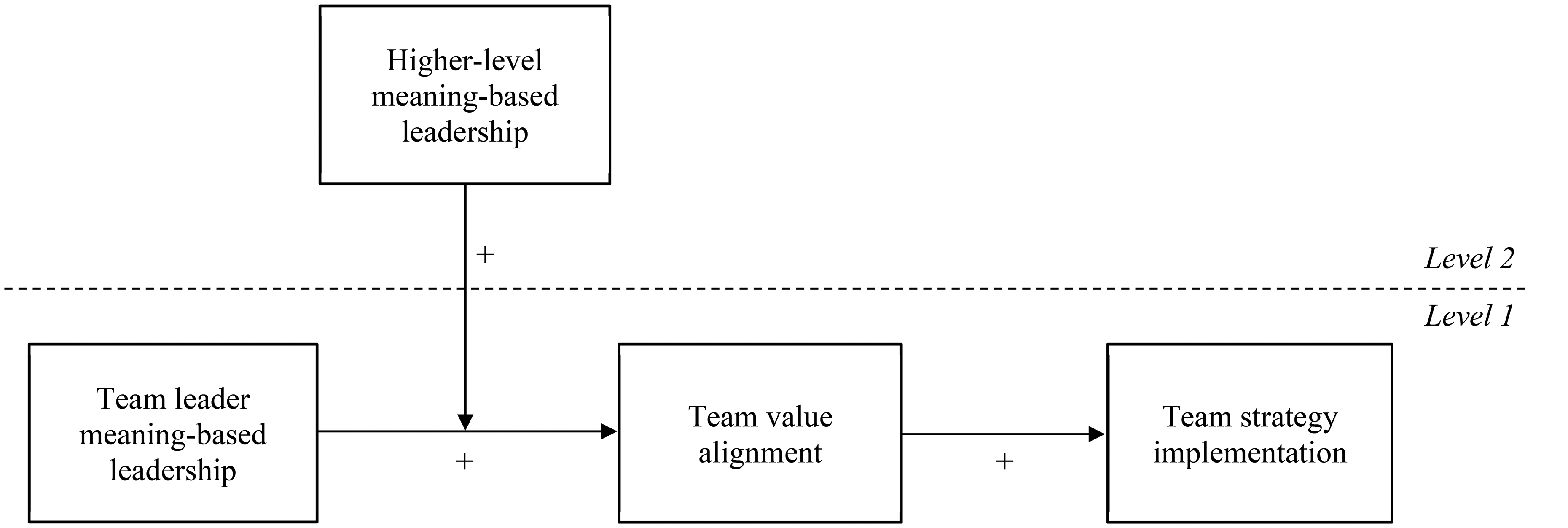
Research model.
Out study contributes to the development of meaning-based leadership theory by testing and extending core notions from the theory. Developing meaning-based leadership theory is important because most leadership theory and research do not concern bigger picture outcomes like strategy implementation (Lord et al., 2017). This is a concern because arguably the primary role of leadership in organizations is to motivate efforts in the service of such big picture objective – and it is not obvious that the outcomes typically studied such as leadership evaluations and job attitudes extrapolate to efforts to contribute to big picture pursuits (van Knippenberg, 2020). As a case in point, studying meaning-based leadership's influence on team strategy implementation is particularly relevant because a recognized challenge in strategy implementation is a lack of buy-in to the strategy (Balogun & Johnson, 2004, 2005; Wooldridge et al., 2008). Team leadership may play an important role here, but strategy implementation research has to date paid very limited attention to the role of leadership (Ateş et al., 2020; Boal & Hooijberg, 2001). Our study thus not only contributes to the development of meaning-based leadership theory but also more broadly to the leadership literature by identifying meaning-based leadership as an influence on strategy implementation that is effectuated through its influence on team value alignment. Importantly, it makes these contributions by recognizing that while the team level of analysis is appropriate for strategy implementation efforts, leadership to motivate such efforts does not operate in isolation but in the context of the leadership of the team leader's direct superior – it is nested within this higher-level leadership. This is an important recognition in that it emphasizes the importance of meaning-based leadership throughout the organization both as an influence on team process and as backdrop for meaning-based leadership lower in the hierarchy.
Theoretical Background and Hypotheses
In his seminal work, Selznick (1957) identified leading pursuits that contribute to organizational purpose as the core role of leadership in organizations. Building on Selznick's analysis, van Knippenberg (2020) proposed the concept of meaning-based leadership to capture this leadership role. Drawing on Selznick's (1957) thesis that organizational purpose is inherently values-based, and on research on meaning at work that sees meaning as flowing from the alignment between the values one embraces and the values underlying one's work (Ros et al., 1999; Spreitzer, 1995), van Knippenberg conceptualized meaning-based leadership as an appeal to the meaning the work derives from its contribution to the pursuit of values-based organizational purpose.
In doing so, van Knippenberg differentiated meaning-based leadership from the most closely aligned leadership concept, visionary leadership (Stam et al., 2014), which also concerns reference to big picture pursuits (i.e., vision rather than purpose). Van Knippenberg outlined how meaning-based leadership differs from visionary leadership on three counts. First, organizational purpose is more foundational and stable than organizational vision. Second, visionary leadership by definition is change-oriented, whereas such definitional linkage to change does not apply to meaning-based leadership. Third, meaning-based leadership by definition concerns the meaning of the work whereas such definitional linkage does not apply to visionary leadership. Van Knippenberg also outlined how by implication meaning-based leadership is also different from charismatic-transformational leadership, which is understood to include visionary leadership (Bass & Riggio, 2006).
A separate consideration in this respect is that charismatic-transformational leadership has been strongly criticized for (i) being poorly conceptualized as an overarching construct, in its dimensions, and in how these dimensions together would form charismatic-transformational leadership, and (ii) for confounding leader behavior and leadership effectiveness in definition and measurement (van Knippenberg & Sitkin, 2013). This has resulted in a strong argument to focus leadership research on more narrowly, and more behaviorally, defined concepts and avoid the validity issues associated with charismatic-transformational leadership (van Knippenberg & Sitkin, 2013).
Thus, meaning-based leadership shares construct space with visionary leadership (and by implication with charismatic-transformational leader) as both concerning reference to big picture organizational objectives, but holds a unique position within this space. Drawing on van Knippenberg's (2020) theoretical analysis, van Knippenberg et al. (2025b) empirically substantiated this differentiation between meaning-based leadership and visionary leadership through a series of measurement validation studies (that also included evidence that meaning-based leadership is distinct from inspirational motivation, the transformational leadership dimension that also refers to visionary leadership).
Meaning-based leadership is in principle relevant to the pursuit of any objective that is in the service of organizational purpose (van Knippenberg, 2020). Strategy implementation is particularly interesting in this respect, however, because strategy is where the rubber meets the road in that strategy should translate more abstract objectives into concrete actions (Floyd & Wooldridge, 1997). Because strategy implementation asks for efforts throughout the organizations and asks for different actions from different teams (workgroups, departments, units), strategy implementation requires the active involvement of leaders at the middle and lower management levels (Balogun & Johnson, 2005; Floyd & Wooldridge, 1997; O’Reilly et al., 2010). Accordingly, leadership's success in motivating strategy implementation is a particularly relevant outcome to consider from a leadership perspective. Indeed, considering the importance of strategy implementation, it is surprising to see how under-studied strategy implementation is as a behavioral outcome in leadership research (Ateş et al., 2020; Boal & Hooijberg, 2001; Wooldridge et al., 2008). Indeed, while these studies noted the lack of leadership research in strategy implementation and thus signaled the problem, they did not provide evidence of how leadership influences strategy implementation.
Team Leader Meaning-Based Leadership and Team Value Alignment
Selznick (1957) argued that organizational purpose is inherently values-based. While more mundane objectives like financial profit are in the service of sustainable purpose pursuit, they are not distinctive enough to what brought the organization into being and what the organization is doing to qualify as its purpose (e.g., financial profit does not capture why the organization pursues profit in the way it does). Purpose more specifically captures the worth the organization sees in doing what it does; purpose addresses the issue why the organization does what it does and why this is valuable, meaningful, and important (Lepisto & Pratt, 2017). This inherently draws on values, desirable end states that transcend specific situations (Schwartz, 1992, 1994); it is the reference to values that captures what makes the purpose valuable, meaningful, and important.
By advocating how teamwork is in the service of values-based purpose, meaning-based leadership brings organizational values into focus in a way that is directly connected to the teamwork. This can be expected to result in greater team alignment around organizational values. In this context, team value alignment is defined as a form of team cognition (Salas & Fiore, 2004) that captures the extent to which team members have an understanding of organizational values that is aligned with the values underlying organizational purpose. Accordingly, team value alignment implies both similarity of understanding among team members and similarity of team members’ understanding to the values underlying organizational purpose. Because the values underlying organizational purpose are not an objective given but socially construed (van Knippenberg, 2020), we treat top management's understanding of these values as an indicator of these values on the assumption that as the source of organizational strategy, top management's understanding should at least align on the values underlying organizational purpose and the values underlying organizational strategy (cf. Tarakci et al., 2014; van Knippenberg et al., 2025a). We propose that such value alignment is important, because values guide behavior (Schwartz, 1992, 1994) and in this case can be expected – as we argue in the next section – to motivate strategy implementation efforts.
Drawing on meaning-based leadership theory (van Knippenberg, 2020), we propose that team leader meaning-based leadership increases team value alignment by engendering conversations about values-based purpose and its link to teamwork. While such conversations do not guarantee team value alignment, they should be a positive influence on team value alignment for three interrelated reasons. First, conversations about how values-based organizational purpose gives meaning to the teamwork put the issue on the agenda for consideration. Absent meaning-based leadership, conversations about values-based purpose may never take place in the team, or substantially less frequently. Absent such conversations, the values-based purpose underlying the work may stay out of members’ consideration. Second, such conversations create opportunities for members to converge in their understanding as members mutually influence each other's understanding of values-based purpose in relation to the teamwork (cf. van Knippenberg et al., 2025a). Third, such conversations create opportunities to persuade people with different viewpoints that would not be created without the conversations. While persuasion is not guaranteed, all other things being equal, persuasion should be more likely when values-based purpose and meaning are discussed then when they are not discussed and disagreement may stay hidden and never be addressed. Accordingly, we propose a positive influence of team leader meaning-based leadership on team value alignment.
Hypothesis 1: Team leader meaning-based leadership is positively related to team value alignment.
Team Leader Meaning-Based Leadership, Value Alignment, and Strategy Implementation
In capturing what is valuable, meaningful, and important, values identify what are valuable, meaningful, and important pursuits: those pursuits that are aligned with one's values. This is the very reason that alignment between one's values and one's work gives meaning to the work and why meaningful work is intrinsically motivating (Ros et al., 1999; Rosso et al., 2010; Shamir, 1991; Spreitzer, 1995). Team value alignment therefore can be proposed to be an important influence on team strategy implementation for two interrelated reasons.
The first reason why team value alignment is a positive influence on team strategy implementation derives from the idea that, because senior management is both the source of espoused organizational values and of organizational strategy, organizational strategy should be aligned with organizational values (cf. van Knippenberg, 2020). As per the broader notion that the meaning derived from the alignment of values and work is intrinsically motivating (Ros et al., 1999; Rosso et al., 2010; Shamir, 1991; Spreitzer, 1995), team alignment on organizational values can be expected to motivate team strategy implementation efforts.
The second reason why team value alignment is a positive influence on team strategy implementation derives from team cognition research (Salas & Fiore, 2004). Team cognition theory recognizes that team cognition guides team actions and more so the more the cognition is shared cognition – the greater the similarity of members’ team cognition (Mathieu et al., 2000). With greater sharedness, member actions are better aligned because they are informed by more similar cognition, and such alignment of actions reinforces acting on one's understanding (Morgeson & Hofmann, 1999; van Knippenberg et al., 2013). The result of this is that team cognition exerts a stronger influence on team process and performance with greater sharedness. Team value alignment reflects the sharedness of members’ understanding of organizational values (as well as the extent to which this understanding is aligned with top management). With greater value alignment, members’ understanding of organizational values therefore will exert a stronger influence on the team. This stronger influence should express itself in a stronger positive impact on team strategy implementation.
As per the Hypothesis 1 rationale, team leader meaning-based leadership positively influences team value alignment, and, as per the considerations outlined here, team value alignment can be expected to be a positive influence on team strategy implementation. Accordingly, we propose that team leader meaning-based leadership, mediated by team value alignment, exerts an indirect positive influence on team strategy implementation.
Hypothesis 2: Team leader meaning-based leadership has a positive indirect effect on team strategy implementation through a positive influence on team value alignment and a positive influence of team value alignment on team strategy implementation.
Higher-Level Meaning-Based Leadership and Value Alignment
Team leaders do not lead in isolation, but in the context of the leadership shown by those above them in the hierarchy. Team members are not only exposed to their team leader's leadership, but also directly and indirectly (through team leader briefings) to the leadership of the team leader's direct superior (Detert & Treviño, 2010; Liu et al., 2013; Peng et al., 2020). This arguably holds particularly so when team leaders lead on broader organizational pursuits such as organizational purpose and strategy (cf. Ateş et al., 2020; O’Reilly et al., 2010; van Knippenberg, 2020). Accordingly, the meaning-based leadership (or lack thereof) of the higher-level leader most closely associated with the team (the team leader's direct superior) forms the backdrop for team members’ responses to team leader meaning-based leadership.
This is important, because consistency between team leader leadership and the leadership of team leader's direct superior can be expected to enhance the influence of the team leader's leadership, whereas inconsistency can be expected to weaken its influence (cf. O’Reilly et al., 2010). This should hold for meaning-based leadership in particular because meaning-based leadership has the same referent throughout the organization – the organization's purpose. The more the team leader's direct superior engages in meaning-based leadership, the more this adds weight to team leader meaning-based leadership. For team members, the consistency across leaders will work to subjectively validate the team leader's meaning-based leadership. This can be expected to increase members’ openness to the persuasive appeal that meaning-based leadership is (i.e., to embrace the leader's understanding of what makes the work meaningful and valuable). Conversely, the less the team leader's direct superior engages in meaning-based leadership, the more the inconsistency across leaders can render team members more hesitant to embrace the leader's advocacy as it is not subjectively validated by higher-level leadership.
As per the rationale for Hypothesis 1, we can expect meaning-based leadership to be a positive influence on team value alignment. The considerations outlined here suggest that that influence will be stronger the more the higher-level leader engages in meaning-based leadership. We therefore advance the following hypothesis.
Hypothesis 3: The positive relationship between team leader meaning-based leadership and team value alignment is stronger the more the higher-level leader engages in meaning-based leadership.
Higher-Level Leadership and Strategy Implementation
The final step in our analysis is to integrate the rationales underlying Hypothesis 1, 2, and 3 into the prediction of moderated mediation. The analysis culminating in Hypothesis 1 and 2 outlines that we can expect team leader meaning-based leadership to have a positive indirect effect on team strategy implementation as a result of its influence on team value alignment. The rationale for Hypothesis 3 captures the reasons to expect that this influence of team leader meaning-based leadership on team value alignment is moderated by higher-level leadership. We thus can extend the rationale for the indirect effect (as per Hypothesis 2) to propose that this indirect effect is moderated by higher-level meaning-based leadership – the meaning-based leadership of the team leader's direct superior (as per Hypothesis 3). Specifically, we can expect that the indirect effect of team leader meaning-based leadership on team strategy implementation is stronger the more the higher-level leader displays meaning based leadership.
Hypothesis 4: The positive indirect effect of team leader meaning-based leadership on team strategy implementation, mediated by a positive influence on team value alignment and a positive influence of team value alignment on team strategy implementation, is stronger the more the higher-level leader engages in meaning-based leadership.
Method
To test our hypotheses, we drew on a multisource survey among teams in a European energy company. The company manages cables and pipelines to supply electricity and gas to millions of families and companies across the country. Strategy implementation was high on the agenda within the company at the time of study, which made this an appropriate context to test our research model. The company commissioned an independent research company to conduct a survey to support evidence-based management of the strategy implementation process. This survey was designed to capture a range of potential influences on team strategy implementation to identify actionable influences for the energy company's management of the strategy implementation process. After the completion of the study and the reporting to the organization, the research company made the survey data available to us, as per their agreement with the energy company. The survey thus was not designed with the current study in mind, but allowed for the test of our research model.
Teams, broadly understood to include office-based teams, workgroups, and departments, were identified by the company's HR as relevant units to consider at the team level of analysis. We have no information to determine how interdependent these teams operated. However, we see this as an issue that may introduce error variance rather than as an issue that may systematically bias results in favor of hypothesis support.
Sample and Procedure
The research company administered an online survey to 7022 employees across 565 teams. As part of a larger survey, these employees were invited to rate the meaning-based leadership of their team leaders and rank organizational values (the basis for the calculation of value alignment). Team leaders rated their direct leaders’ meaning-based leadership and team strategy implementation. Responses from 4688 employees were received, achieving a 66.8% response rate. Responses from 507 team leaders were received for an 89.7% response rate. Criteria for inclusion in the final sample were a response rate of at least 50% for the teams and matching manager responses for these teams (we also tested the model using the full sample and a sample of above 60% team response rate and results remained the same). This resulted in a final sample of 421 teams (3766 members) with matching manager ratings. Team member average age was 42.3 (SD = 11.4) years, and 81.6% of them were male.
Measures
Meaning-based leadership and strategy implementation were measured with items rated on five-point scales ranging from 1 = “strongly disagree” to 5 = “strongly agree”. Value alignment was calculated based on rankings as elaborated below. This created a multisource data set where team leader meaning-based leadership was rated by team members, higher-level meaning-based leadership and strategy implementation were rated by the team leader, and the mediator value alignment was calculated based on team member rankings. Because the mediator was calculated and not a perception, there thus was not a single percept-percept relationship in our research model.
For measurement validity of this new measure, arguably the most important issue is to establish distinctiveness from visionary leadership (van Knippenberg, 2020). To establish that meaning-based leadership is distinct from visionary leadership, we first drew on another data set from the research company from a similar survey at an international seeds company (N = 1726). This other survey included both the measure of meaning-based leadership and a measure of visionary leadership that van Knippenberg and Stam (2013) proposed based on the conclusion from van Knippenberg and Stam (2014) that existing measures of visionary leadership confound visionary leadership behavior with attributions about the effects of the behavior (cf. van Knippenberg & Sitkin, 2013). These items were, with the stem “My team leader…”: “Communicates an image of what [company] should look like in the future.”; “Conveys what [company] would ideally become in the future.”; “Has a vision of the future of [company].”; “Talks about how we can make [company] a better company in the future.”; “Discusses how we can realize his/her vision for [company].”; “Shares ideas how to realize his/her vision for [company].”; “Tries to persuade team members to adopt his/her ideas for the future of [company].”; “Tries to convince us to contribute to realizing his/her vision for [company].” Confirmatory Factor Analysis (CFA) showed that a two-factor model with separate meaning-based leadership and visionary leadership factors had good fit, χ2(76) = 843.279, p < .0001; CFI = 0.967, NFI = 0.963, RSMEA = 0.077 (and better than the one-factor model, p < .0001).
Second, we drew on validation evidence from van Knippenberg et al. (2025). These authors showed in a subject matter expert study that the meaning-based leadership scale we used was judged to better reflect the meaning-based leadership construct than measures of visionary leadership by Kearney et al. (2019) and by Podsakoff et al.(1990) (as well as than the inspirational motivation dimension of transformational leadership (Bass & Avolio, 1995) that also contains a vision items even when it confounds visionary leadership with other behaviors; van Knippenberg & Sitkin, 2013). In a follow-up survey, van Knippenberg et al. (2025b) showed in CFA that the meaning-based leadership scale used here was distinct from the above-mentioned measures of visionary leadership and inspirational motivation. In addition, their CFA evidence showed that the meaning-based leadership factor is distinct from a measure of perceived leadership effectiveness (van Knippenberg & van Knippenberg, 2005), which is important in view of van Knippenberg and Sitkin's (2013) critique that the Podsakoff et al. (1990) scale and the inspirational motivation scale confound leader behavior and perceived leadership effectiveness.
Based on the combined evidence from our own CFA and the work presented by van Knippenberg et al. (2025b), we posit that there is a good basis to conclude that the current measure is a valid operationalization of meaning-based leadership as defined by van Knippenberg (2020).
Team value alignment was operationalized on the basis of the ten universal work values identified by Schwartz (1994). With one item per value (e.g., achievement, self-direction) as per the measure validated by Lindeman and Verkasalo (2005), these values were presented with brief statements that were co-created by the energy company and the research company to express the values in the language the energy company would adopt to communicate these values (e.g., achievement – “[Name of company] values performance and results; we set ambitious goals and are proud to be seen as a competent, capable, and successful network company”; self-direction – “[Name of company] values self-direction, curiosity, flexibility, and creativity, such that we are alert and attentive and feel free and independent to follow our own unique course within the energy sector”). Respondents were asked to rank these values with respect to the extent to which they see each value as underlying what the organization aims to achieve. This ranking effort was guided by first asking them to identify the two values they believed were least important to the organization, and then to identify the four values they believed were most important to the organization, before they ranked them. With similar values ranking from top management provided by the research company that is the source of our data, we could calculate value alignment as the similarity between team member rankings and top management rankings.
To do so, we applied the R measure of Tarakci et al. (2014). In a methods study, Tarakci et al. reviewed the issues with then-existing operationalizations of strategic alignment within and between groups and developed the R measure to provide a valid operationalization of alignment in understanding of strategic issues between different organizational groups. We used the R measure to capture the degree of alignment between a team and the top management team. The R measure relies on multidimensional scaling to determine two vectors, one to capture the communality in team member rankings of values, the other to capture the communality in top management team rankings. R captures the correlation between these two vectors with a theoretical range from −1 to 1, with 1 indicating perfect alignment between the team and the top management team. Because the top management team formulated the organizational strategy, team value alignment with the top management team presumably reflects alignment on the values underlying organizational strategy.
Note that high alignment scores with the R measure require both similarity within the team and similarity with top management; team members cannot align with top management on things on which there is no similarity within the team. Also note that similarity in beliefs about organizational values does not equate to agreement with these values. In this respect, our operationalization relies on the straightforward logic that team members cannot have a shared agreement with organizational values when they do not have a shared perception of these values; the former does not automatically follow from the latter, but the former requires the latter, rending this operationalization a reasonable proxy for shared agreement with organizational values even when the measure concerns perception and not agreement.
To measure strategy implementation, a 5-item scale adapted from Floyd and Wooldridge (1997) by van Knippenberg et al. (2025b) was used. The adapted scale was almost identical to the original but more explicitly referenced strategic goals (“translates goals into action plans” was changed to “translates strategic goals into action plans) and one item was adapted so it also applied to team members without subordinates (“Sells top management initiatives to subordinates” was adapted to “Sells top management initiatives to others in the organization”). Van Knippenberg et al. (2025b) present validation evidence showing that the original items and the adapted items all load on the same factor. Team leaders were asked to rate their team on these items. Cronbach's alpha for the scale was good, α = .86.
Results
Given that higher-level meaning-based leadership resides on a higher level of analysis – multiple teams and team leaders are nested within one higher-level leader – we inspected the variance component for the mediator and the dependent variable to test whether multilevel analysis is appropriate for testing our model. The team leaders in our sample were nested under 83 higher-level leaders, with the number of team leaders nested under the same higher-level leader ranging from 1 to 17. We used the higher-level leader's ID as the clustering unit to conduct a one-way analysis of variance (ANOVA). The results showed that the leader's leader accounted for a significant proportion of variance in value alignment (ICC[1] = .38; F[82, 338] = 4.09, p < .001) and strategy implementation (ICC[1] = .20; F[82, 312] = 2.19, p < .001). These results suggested that we employ hierarchical linear modeling to test our hypotheses. Hence, we performed multilevel modeling using the package nlme in R.
Before testing the hypotheses, we conducted CFA in R using the package lavaan (Rosseel, 2012) to examine discriminant validity between team leader meaning-based leadership and higher-level meaning-based leadership. The measurement model in which the two variables loaded on separate factors demonstrated a good model fit, χ2(53) = 1134.10, p < .001; CFI = .97, NFI = .96, SRMS = .02, RMSEA = .07. Wald test of parameter constraints revealed that the measurement model had a better fit than the one in which the correlation between team leader MBL and leader's leader MBL was set to 1, χ2(54) = 18794.07, p < .001; CFI = .49, NFI = .38, SRMS = .30, RMSEA = .30; Δχ2(1) = 17659.97, p < .001.
To determine whether aggregation of team member ratings of team leader meaning-based leadership to the team level and team leader ratings of higher-level meaning-based leadership to the level of higher-level leader was justified, we computed Rwg and ICCs. Results showed sufficient agreement between team member ratings on team leader meaning-based leadership, median Rwg = .76, mean Rwg = .72, ICC(1) = .12, ICC(2) = .55; different team leaders’ rating of the same higher-level leadership, median Rwg = .84, mean Rwg = .77, ICC(1) = .16, ICC(2) = .65, thus justifying the aggregation. Table 1 presents the descriptive statistics, correlations, and Cronbach's alphas for the study variables.
Means, Standard Deviations, and Correlations among Study Variables.
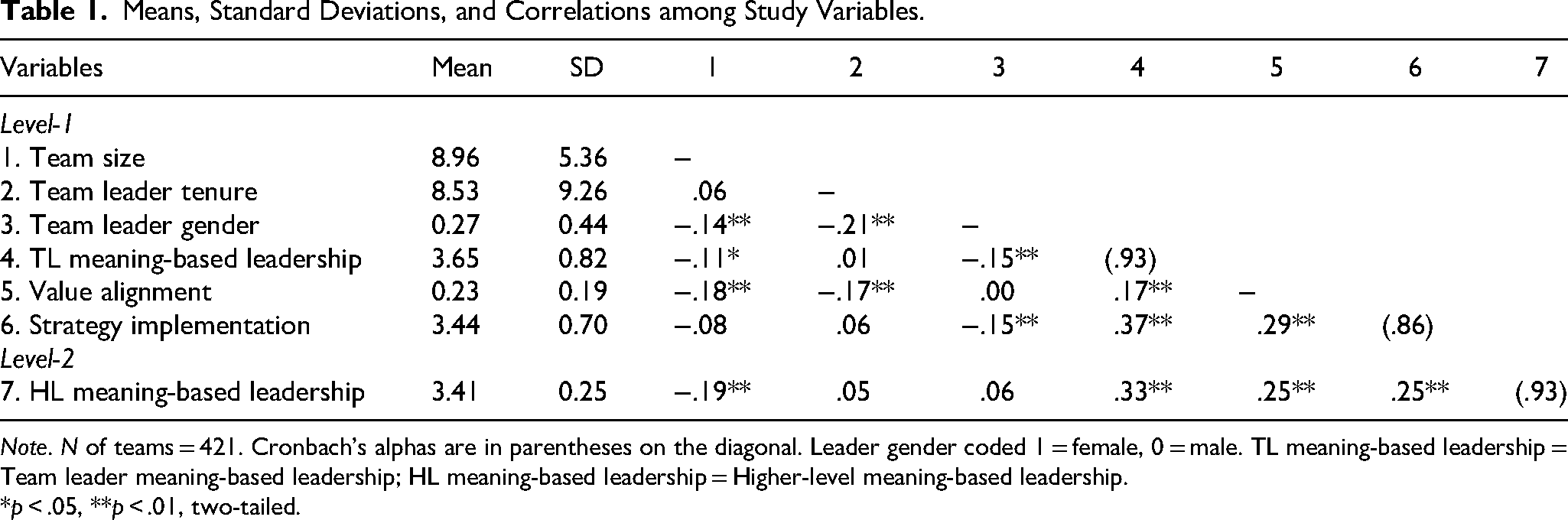
Note. N of teams = 421. Cronbach's alphas are in parentheses on the diagonal. Leader gender coded 1 = female, 0 = male. TL meaning-based leadership = Team leader meaning-based leadership; HL meaning-based leadership = Higher-level meaning-based leadership.
*p < .05, **p < .01, two-tailed.
Hypothesis Testing
Table 2 displays the results from multilevel analyses. Team leader meaning-based leadership was positively related to value alignment (b = .06, SE = 0.02, p < .01; Table 2, Model 1), supporting Hypothesis 1. Hypothesis 2 proposed the indirect effect of team leader meaning-based leadership on strategy implementation via value alignment. The result from Monte Carlo testing supported the proposed mediation (b = 0.05, 95% CI = [0.01, 0.08]).
Results of Multilevel Analysis.
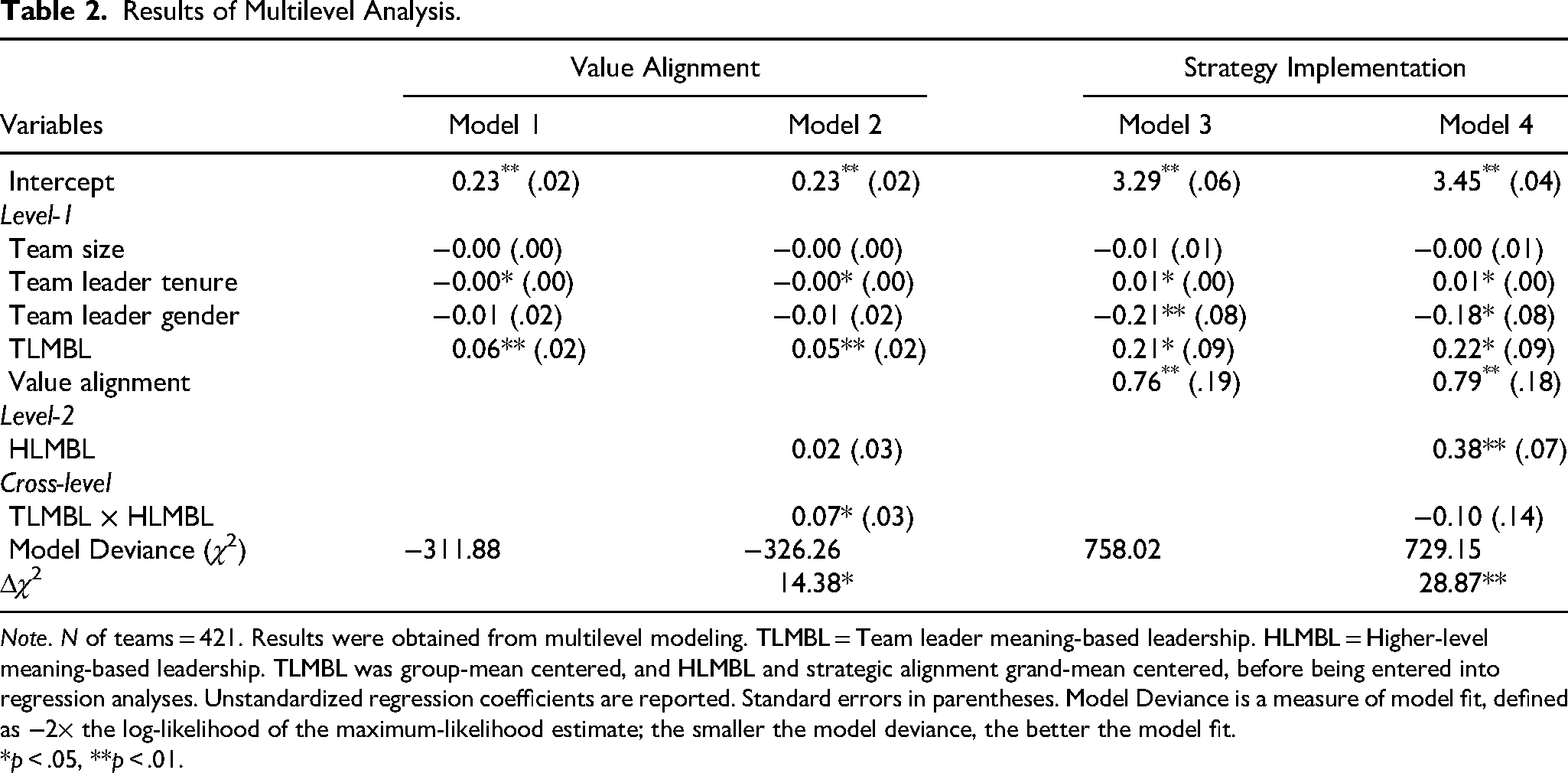
Note. N of teams = 421. Results were obtained from multilevel modeling. TLMBL = Team leader meaning-based leadership. HLMBL = Higher-level meaning-based leadership. TLMBL was group-mean centered, and HLMBL and strategic alignment grand-mean centered, before being entered into regression analyses. Unstandardized regression coefficients are reported. Standard errors in parentheses. Model Deviance is a measure of model fit, defined as −2× the log-likelihood of the maximum-likelihood estimate; the smaller the model deviance, the better the model fit.
*p < .05, **p < .01.
In Hypothesis 3, we predicted that higher-level meaning-based leadership moderates the relationship between team leader meaning-based leadership and value alignment. The interaction was significant (b = .07, SE = 0.03, p = .04; Table 2, Model 2). The regression coefficient indicates that a 1-unit increase of higher-level meaning-based leadership (on a 5-point scale) is associated with a .07 increase in the regression coefficient for team-leader meaning-based leadership in predicting team value alignment (which concerns how a 1-unit increase on the 5-point meaning-based leadership scale translates to an increase in team value alignment on the −1 to +1 range). Because interaction effects in regression are known to be underestimated, interpretations in terms of effect sizes are less helpful here; instead, we should be open to the realistic possibility that the “true” effect is larger than the observed effect (Evans, 1985; McClelland & Judd, 1993).
Figure 2 displays the interaction pattern. Analysis of simple slopes 1 SD above and below the mean showed that team leader meaning-based leadership was positively related to value alignment with more higher-level meaning-based leadership (b = 0.12, t = 3.66, p < .001), but not so with less higher-level meaning-based leadership (b = −0.01, t = −0.18, p = .86). Hypothesis 3 was supported.
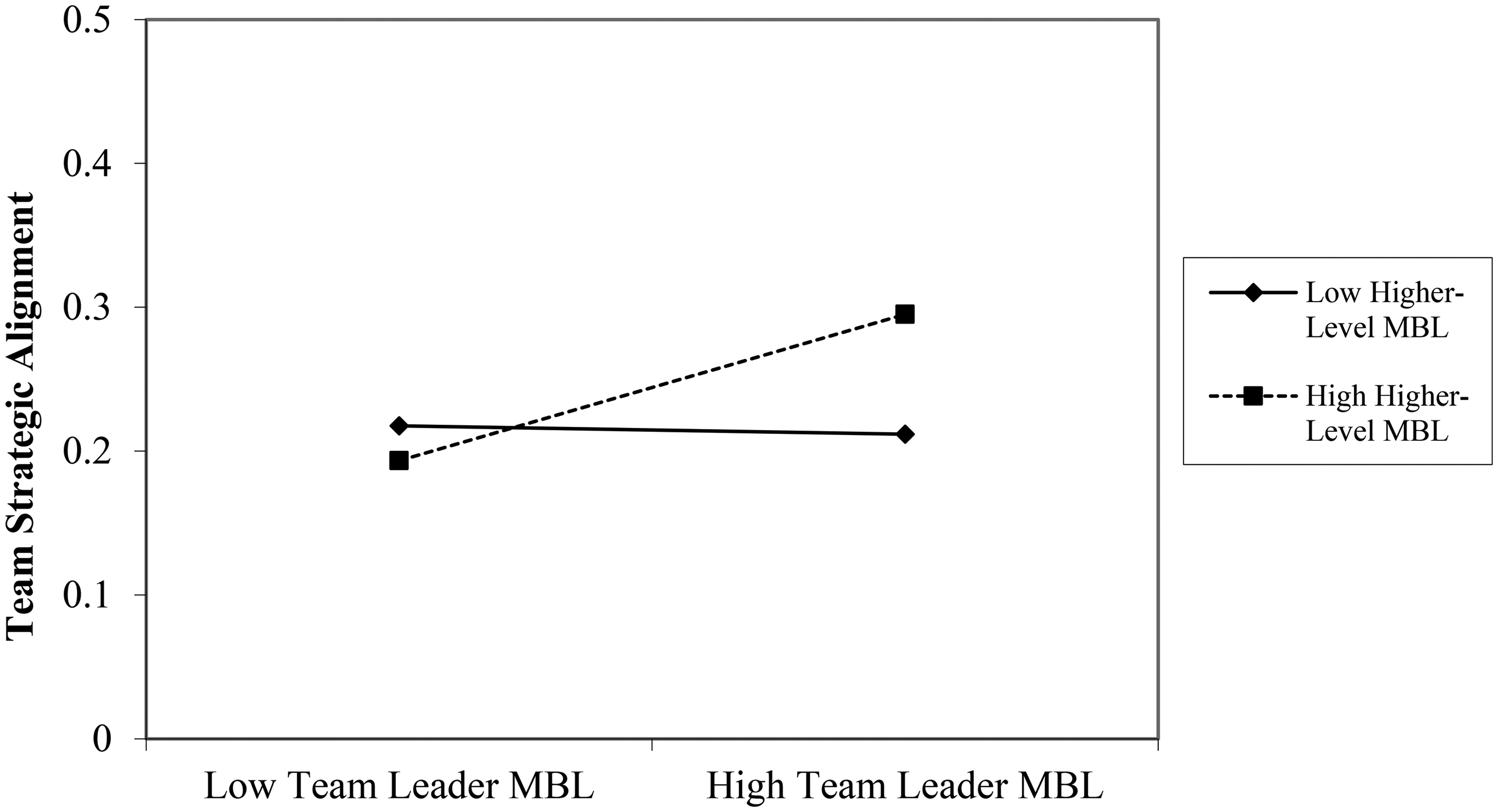
Interaction of team leader meaning-based leadership (MBL) and higher-level MBL on team value alignment.
In Hypothesis 4, we proposed that the interaction effect of team leader meaning-based leadership and higher-level meaning-based leadership on value alignment results in a moderated mediated effect on team strategy implementation. Results showed that value alignment was positively related to strategy implementation (b = .79, SE = 0.18, p < .001; Table 2, Model 4). Monte Carlo mediation testing indicated that the indirect effect of team leader meaning-based leadership on strategy implementation via value alignment was positive when higher-level meaning-based leadership was higher (+1 SD, b = 0.08, 95% CI = [0.03, 0.15]), and the indirect effect was nonsignificant when higher-level meaning-based leadership was lower (−1 SD, b = −0.01, 95% CI = [−0.06, 0.05]; high-low difference: b = 0.09, 95% CI = [0.01, 0.19]). Thus, Hypothesis 4 was supported.
Discussion
Organizational purpose, the foundational objectives the organization pursues, lies at the core of organizations. Accordingly, the core role of leadership in organizations is to lead pursuits in the service of organizational purpose (Selznick, 1957). From this perspective, it is important that organizational purpose is inherently values-based and thus has the potential to be intrinsically motivating for pursuits in the service of organizational purpose. This motivating potential is particularly valuable in view of the evidence that “big” pursuits such as putting organizational strategy into practice come with challenges in motivating efforts throughout the organization (Balogun & Johnson, 2004, 2005; Floyd & Wooldridge, 1997). The current focus on team leader meaning-based leadership as an influence on team strategy implementation thus arguably concerns both the core role of leadership in organizations and an important challenge in motivating efforts in the service of organizational purpose. Accordingly, the support for our research model adds valuable insights to the leadership and strategy implementation literatures.
Theoretical Implications
In our assessment, the key insight that our study contributes is that meaning-based leadership is not only a direct influence on team members but also a contextual moderator for the effectiveness of meaning-based leadership lower in the hierarchy. Leadership studies have shown that leader behavior can be influenced by the leadership leaders receive from their direct superiors (e.g., leaders may show more ethical leadership when they receive more ethical leadership, Mayer et al., 2009, or more abusive supervision when they receive more abusive supervision, Mawritz et al., 2012). The issue we consider here is different: it is not how meaning-based leadership of the team leader's direct superior influences team leader meaning-based leadership, but how meaning-based leadership of the team leader's direct superior moderates the effectiveness of team leader meaning-based leadership. Considering this contextual moderation is important in recognizing that even when the leadership team leaders receive may be an influence on their own leadership, team leader leadership is sufficiently independent of the leadership they receive that the leadership of their direct superior functions as a contextual moderator of the effectiveness of team leader meaning-based leadership (indeed, note that our analyses in effect “control” for such main effects of higher-level leadership in testing moderation and moderated mediation).
The moderation by higher-level meaning-based leadership is an important insight because it suggests that in seeking to motivate pursuits in the service of organizational purpose, there may be clusters of team leaders that are more effective than others because of the higher-level leadership they are nested under. Put differently, there may be variance in leadership effectiveness in motivating strategy implementation that is best captured through a multi-level approach like the current one that takes the nesting of team leadership within higher-level leadership into account (as opposed to e.g., only the team level, cf. Ateş et al., 2020, or only the organizational level, cf. O’Reilly et al., 2010). This multi-level insight emphasizes that team leadership does not operate in a vacuum, but within a broader organizational context in which higher-level leadership is a salient contextual influence.
While we are not aware of studies documenting such moderating effects of higher-level leadership for other leader behavior, such effects may not be unique to meaning-based leadership. We would contend, however, that they are likely to be relatively strong for meaning-based leadership because of its very nature – appeals to organizational purpose. Such appeals to organizational attributes arguably make the consistency, or inconsistency, with higher-level leadership more salient than it may be for other forms of leadership that do not appeal to an understanding of foundational attributes of the organization and that may be more easily interpreted as specific to the leader (e.g., humble leadership, Owens & Hekman, 2012). The current data cannot speak to this, but the extent to which contextual moderation by leadership higher in the hierarchy can also be observed for other aspects of leadership would be valuable to explore to build towards broader-ranging leadership theory (cf. van Knippenberg & Dwertmann, 2022).
Moderation by higher-level leadership is in line with meaning-based leadership theory (van Knippenberg, 2020) and complements other recent evidence that meaning-based leadership is more effective the more the team leader displays empowering leadership (van Knippenberg et al., 2025b). Combined, these findings speak to two out of three considerations highlighted in meaning-based leadership theory as to the conditions under which meaning-based leadership has stronger or weaker effects: the extent to which the leader is perceived to speak with legitimacy to organizational purpose (as per the role of higher-level meaning-based leadership) and the extent to which team members are stimulated to proactively engage with the team's role in big picture organizational pursuits (as per the role of empowering leadership). From that perspective, future research speaking to the third moderation consideration highlighted in meaning-based leadership theory – the extent to which meaning-based leadership connects with team member work values – would be particularly valuable.
Beyond research addressing these core moderation considerations from meaning-based leadership theory, we see particularly value in future research at the interface of meaning-based leadership and visionary leadership. As per meaning-based leadership theory (van Knippenberg, 2020) and the validation evidence from the current study and presented by van Knippenberg et al. (2025b), meaning-based leadership and visionary leadership are different constructs in conceptualization and operationalization. At the same time, they both concern leadership to motivate contributions to big picture organizational pursuits. This gives rise to the question how they may operate in combination. Addressing that question would be particularly valuable in further positioning these constructs vis-à-vis each other in the concept space as well as in developing our understanding of a question of great theoretical and practical relevance – how to effectively lead on big picture pursuits. This is a question that goes beyond the current evidence, but we can identify the answer that meaning-based leadership theory would suggest. Just as meaning-based leadership may imbue organizational strategy with meaning by advocating how values-based organizational purpose gives meaning to the pursuit of strategic objectives, meaning-based leadership can be argued to imbue the vision advocated through visionary leadership with meaning. Visionary leadership involves the communication of a vision for the collective to motivate contributions to make the vision reality (Stam et al., 2014). Such communication may – but need not – include reference to values-based organizational purpose and the meaning it gives to vision pursuit. To the extent that the visionary leadership would include such reference to organizational purpose and meaning, this would in effect constitute the combination of visionary leadership and meaning-based leadership. As per meaning-based leadership theory, the linkage to meaning derived from values-based organizational purpose should increase the motivational power of visionary leadership. This should for instance be evident in team members’ buy-in to the vision and in their efforts to contribute to realizing the vision (cf. Stam et al., 2014). (Note also that this would identify meaning-based leadership as the moderator and visionary leadership as the independent variable.)
Moderation set aside, the evidence that team leader meaning-based leadership can motivate team strategy implementation through its influence on team value alignment is valuable in and of itself. This insight speaks both to the values-based nature or organizational purpose and to the motivating potential of organizational purpose and organizational values (cf. Selznick, 1957; van Knippenberg, 2020). It also connects to insights from strategy implementation research that organizational strategy in and of itself may not motivate strategy implementation efforts and may even inspire active resistance to the strategy (Balogun & Johnson, 2004, 2005). While challenges in strategy implementation are not limited to motivational challenges, they likely are a substantive challenge on the behavioral side of strategy implementation that ask both for motivated effort and for team alignment around these efforts (cf. Tarakci et al., 2014). From that perspective, the finding that team leader meaning-based leadership is a positive influence on team alignment around organizational values and as a result on team strategy implementation is important. In this respect, we also highlight that meaning-based leadership is proposed to exert this influence not because it is more generally motivating (which can also be argued about other forms of leadership), but particularly so because it links team work to the organization's values-based purpose. This should be particularly relevant for such “big picture” organizational pursuits as implementation of the organization's strategy for which the link to organizational purpose may be important in imbuing the work with meaning.
Implications for Practice
Strategy implementation is a challenge in organizational practice (Weiser et al., 2020; Wooldridge et al., 2008). The current insights into the value of meaning-based leadership throughout the hierarchy thus may contribute some actionable knowledge in that respect. While leadership development is easier said than done, leadership can be developed through leadership training and leadership development programs (Day et al., 2014) and there is no reason why meaning-based leadership would be an exception in this respect. It goes too far beyond the current theory and evidence to make claims about what efforts to develop meaning-based leadership would look like, but arguably this would include at least three elements.
First, this would include developing leaders’ own thinking about organizational purpose and how this imbues the work of their team with meaning. Ideally, such efforts would focus on cohorts of leaders within the same company, so that part of the effort to develop a better understanding of values-based purpose is creating shared understanding among the organization's leadership for consistency of messaging (cf. van Knippenberg, 2020). Second, this would include developing leaders’ ability to advocate their understanding of how organizational purpose imbues teamwork with meaning to team members. This is to recognize that developing one's understanding can come with idiosyncracies that do not communicate well and that connecting with one's “audience” is a skill in and of itself. Third, this would include developing leader's ability to move beyond one-way communication about purpose and meaning and to use their advocacy to engender and guide discussion within the team. Being able to articulate one's own understanding does not equate to being able to use this to stimulate and guide team discussion, and ultimately for the team to take ownership of the understanding and the understanding to become shared within the team requires an active role for team members in these discussions (van Knippenberg, 2020).
Importantly, the current findings speak to the value of making such leadership development an integral effort throughout the organization. Organizations may be tempted to limit investment in leadership development to certain hierarchical layers (e.g., assume senior leadership is “beyond” the need for such development or that lower-level management does not need to develop its ability to lead on big picture pursuits). The current findings suggest that while that may save time and money on leadership development, it may actually return on a lower return on investment than a more full-blown approach might deliver, because, for strategy implementation at least, meaning-based leadership is not only an influence on team members but also a contextual moderator of the effectiveness of meaning-based leadership lower in the hierarchy.
In this respect, it is also important to note that, while our study only concerns a single organization (also see the next section on study limitations) and we cannot speak to generalizability empirically, there is nothing in meaning-based leadership theory to suggests that its value would be limited to a specific industry (cf. van Knippenberg et al., 2025b). Accordingly, the implications we discuss here for leadership development should apply across sectors and industries and not be limited to energy companies like the one we studied. Indeed, organizational purpose is understood to be an attribute that all organizations possess by definition (Selznick, 1957) and leadership drawing on that purpose should thus in principle be possible and valuable across different types of organizations.
Limitations and Future Directions
Our study has some notable strengths such as is multi-level nature and the fact that hypothesis tests do not concern single source or percept-percept relationships (i.e., team value alignment is a calculated variable). Inevitably the study does come with some limitations as well. A first and obvious one is that while our research model implies causality (e.g., meaning-based leadership having a causal effect on team value alignment and team strategy implementation), our data are correlational and thus cannot speak to causality. Future research developing our analysis further thus would be particularly valuable if it included causal evidence. This could for instance be achieved field-experimentally in a design that would compare teams led by leaders who completed a meaning-based leadership training group (cf. Implications for Practice, above) with leaders from a no-training (or unrelated training) control group in terms of team value alignment and team strategy implementation.
It is also important to acknowledge that our conceptualization and operationalization of team value alignment by implication treats similarity in perceptions of organizational values as a proxy for agreement with those values. Similarity in beliefs about organizational values within the team and within top management does not equate to agreement with these values and our interpretation of results does not rely on an assumption that the one would equate to the other. Rather, it relies on the far more modest, and we contend far more reasonable, assumption that, all other things being equal, greater alignment goes hand in hand with greater agreement. This follows from the simple logic that when there is no shared belief about organizational values there cannot be shared agreement about organizational values – the latter requires the former. Accordingly, even though the one does not equate to the other, the one is a decent proxy for the other. Moreover, to the extent that this is a suboptimal proxy, it introduces error variance that makes it harder to find hypothesis support. It cannot provide an alternative interpretation for findings. That said, there would be added value, in terms of greater precision in operationalization, if future research could empirically bring agreement with values into the operationalization of team value alignment.
In a related vein, our value alignment measure assumes that different organizational members understand what the values refer to in similar ways. Given the evidence presented by Schwartz (1992, 1994) that these are universal work values for which findings generalize across cultures and samples, this does not seem an unreasonable assumption. At the same time, it seems realistic to assume that there will be variation in members’ understanding of these values, for instance because of their role within the organization or their history with the organization. It seems implausible that such variation would bias results in ways that would favor hypothesis support. In that sense, such variation should not be a threat to the current conclusions. It is more likely, however, that such variation may result in underestimating the importance of value alignment in that it would in effect increase variance not accounted for by study variables. Future research that would include additional steps to increase shared understanding of what these values mean thus arguably would increase measurement precision and result in more powerful tests of the role of team value alignment.
We should also recognize that our argument for the influence of meaning-based leadership on team value alignment relies on the assumption that meaning-based leadership is likely to convey an understanding of organizational purpose that is aligned with espoused organizational values, but that we do not have data about what specifically leaders say about purpose and values when they engage in meaning-based leadership. While our assumption in this respect does not seem unreasonable, and the most parsimonious interpretation of the support for our research model is in line with this assumption, it is important to recognize that it remains an assumption. Future research that would unpack how leaders talk about values-based purpose could further bolster the confidence in our conclusions in this respect.
A more general limitation that is shared by all survey research with less than 100% response, is that we do not know how non-response – missing data from team members for teams included in the analysis as well as missing teams because of too low member response – may have influenced findings. Here too, one important consideration is that it seems implausible that non-response would have biased research in favor of support for our moderated mediation model. This does not change the fact, however, that we do not know what the influence of non-response, if any, on results was. Accordingly, there is value in future research that would be able to achieve exceptionally high response rates and/or would have information about non-respondents to analyze how they differ from respondents.
Another consideration is that the support for our research model is based on evidence from a single company. Any influence at the company level (e.g., organizational culture, the company's history of strategic initiatives, the nature of the strategy) relevant to our research model cannot be captured empirically in data drawn from a single company, which means that we cannot know how contextual influences at the company level may have influenced research findings and potentially impact the generalizability of our model. The fact that a recent study by van Knippenberg et al. (2025b) found evidence that meaning-based leadership is a positive influence on team strategy implementation in a health insurance company suggests that at least not all support for our research model is idiosyncratic to the current research context, but for the unique elements of our study, such as the role of higher-level leadership, there simply is no way of speaking to this without replication studies in different organizations. Ideally, future research would also include research designs with a sizeable number of organizations to capture such organization-level influences on the team-level processes that assume center-stage here.
A final limitation that we believe is important to mention here is that we relied on a subjective rating of team strategy implementation. This is an established measure (Floyd & Wooldridge, 1997; van Knippenberg et al., 2025b) and with the need to rely on a subjective rating it arguably is a good design choice. That said, ideally research like ours could (also) rely on more objective measures of team strategy implementation, such as logs of specific actions taken in the service of putting the strategy into practice and/or data about the intended effects of team strategy implementation. What such intended effects are would depend on the specifics of the strategy. A strategy focused on achieving a better customer experience could for instance suggest treating customer satisfaction scores for customer-facing teams as indicator of strategy implementation, while other strategies would point to other indicators. More objective indicators of team strategy implementation would thus require a context-specific decision by researchers in conversation with the management of the organization where the study takes place (i.e., to create clarity on what the strategy is aimed at achieving and what objective indicators of strategy implementation efforts or strategy implementation success would be indicators of progress towards those objectives). Future research further developing our analysis would add value also when it could incorporate more objective measure of implementation behaviors and/or of the effects the strategy would hope to establish at the team level.
Conclusion
Leading pursuits in the service of organizational purpose is the core role of organizational leadership. Our study of the influence of meaning-based leadership on team strategy implementations speaks to this role. In doing so, it lays the groundwork for the further study of meaning-based leadership in organizations’ big picture pursuits.
Footnotes

Funding
The authors received no financial support for the research, authorship, and/or publication of this article.
Declaration of Conflicting Interests
The authors declared no potential conflicts of interest with respect to the research, authorship, and/or publication of this article.