




Abstract
Individuals with psychopathic tendencies are sometimes quite capable of acquiring and maintaining leadership positions. One explanation could be that leaders with psychopathic personality profiles “hide behind the mask of sanity” by managing the public display of their emotions so that it positively affects other people's perceptions. We conducted a multisource team study (N = 306 teams) to investigate how leader primary psychopathy and emotion regulation strategies are related to follower perceptions of leader authenticity and follower trust in the leader. We found that leaders with stronger primary psychopathic tendencies would do better to adhere to a strategy of surface acting and refrain from deep acting in order to affect follower trust positively. Perceived authenticity explains the interactive effect of leader emotion regulation and psychopathy on follower trust. We also found that for leaders with higher levels of primary psychopathy deep acting is a less fruitful strategy because they lack the necessary empathic concern, and that the display of naturally felt emotions is a good strategy because it is positively associated with follower trust. We discuss whether the differential use of emotion regulation strategies might explain primary psychopaths’ upward mobility and how their use of emotion regulation strategies could help them to be perceived positively.
Even leaders with impaired empathy and remorse, who lie and manipulate, and have bold, egotistical traits are often quite capable of maintaining a positive image, despite the generally detrimental impact that these leaders can have on the functioning of subordinates, teams, and organizations (e.g., LeBreton et al., 2018). Indeed, it has been argued that leaders with such psychopathic traits are relatively successful in climbing the hierarchical ladder (Boddy et al., 2021), that they are awarded higher bonuses by their bosses (Pavlić & Međedović, 2019), and that they are viewed as charismatic individuals with excellent communication skills and the ability to make tough decisions (Babiak et al., 2010). One way to explain the positive impressions that these leaders sometimes make on others is by taking into account the notion that leaders can exercise strategic influence over the perceptions of others by effectively regulating the display of their emotions (Ashkanasy & Humphrey, 2011). To this end, leaders can, instead of showing their naturally felt emotions, adopt strategies of surface acting (faking or hiding certain emotions) or deep acting (trying to evoke the actual experience of certain emotions). We propose that leader primary psychopathy significantly affects the use of emotion regulation strategies and significantly alters the effects that the use of emotion regulation strategies has on others. This knowledge may help us understand how primary psychopaths can leave positive impressions on others in organizations and be successful.
We first explain how leader primary psychopathy may affect the selection of emotion regulation strategies. We argue that emotion regulation strategies may be used as means to influence others, and as such their use may be particularly attractive for those leaders scoring higher on psychopathy. Then, we will focus on how leader emotion regulation strategies may affect follower perceptions differently for leaders who score high or low on psychopathy (see Figure 1).
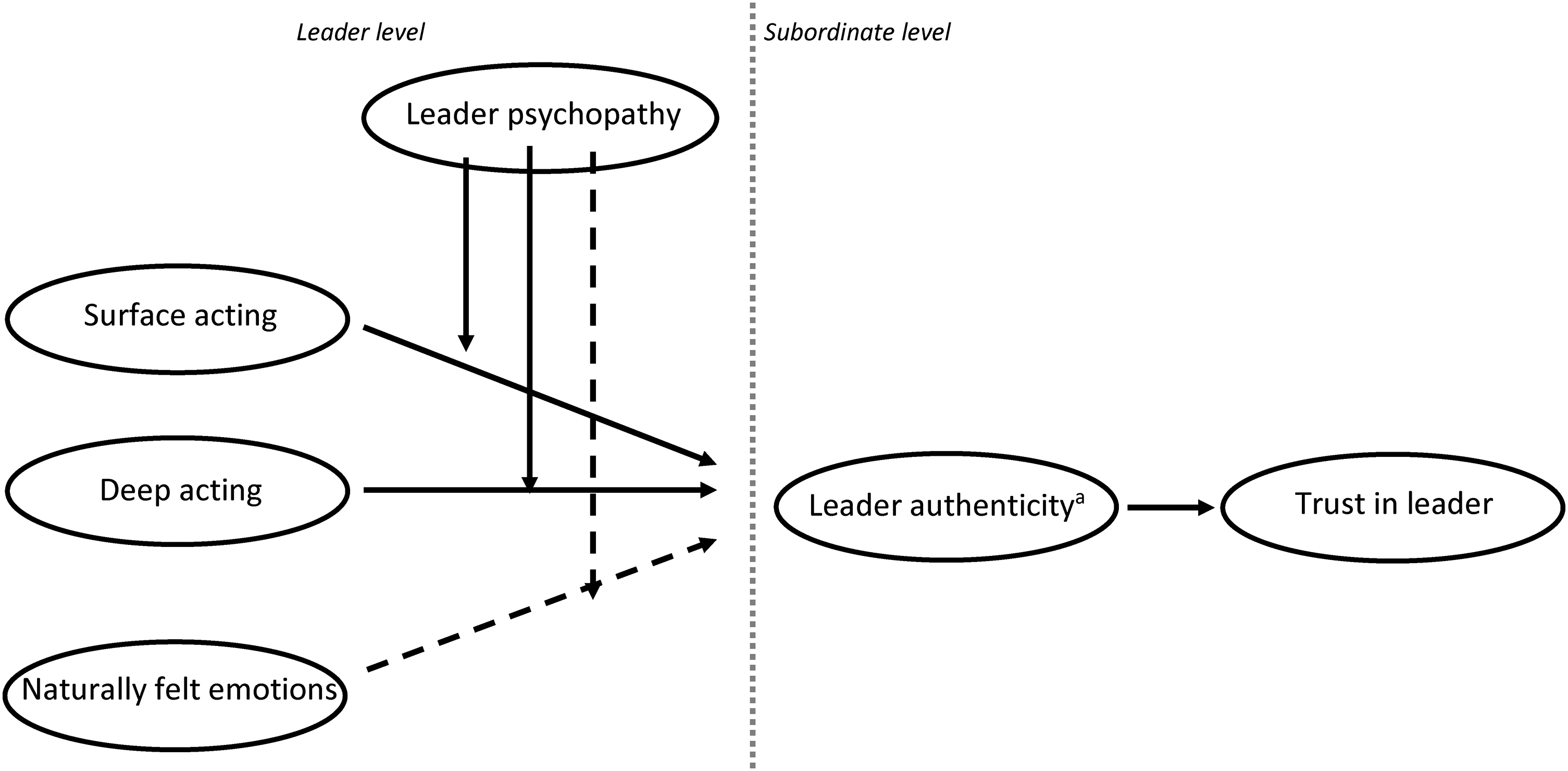
General research model depicting the combined effects of leader primary psychopathy and leader use of emotion regulation strategies on follower ratings of leader authenticity and subsequent follower trust in the leader.
As reported in the literature on emotion regulation, leaders tend to generate more positive effects on follower perceptions when they use deep acting instead of surface acting (e.g., Moin, 2018). In this study, we specifically focus on the extent to which followers perceive that they can trust their leader. Trust has been defined as an individual's expectations, assumptions, or beliefs about the likelihood that another person's actions (present or future) will be beneficial, favorable, or at least not detrimental to one's own interests (Robinson, 1996, p. 576), and is deemed a crucial determinant of leader effectiveness, leader endorsement, and follower work outcomes (Fulmer & Gelfand, 2012). We contend that leaders with weaker psychopathic tendencies might indeed do better to adhere to deep acting and refrain from surface acting to positively influence follower trust. Yet, this might not be the case for leaders with higher levels of psychopathy. We argue that leaders with stronger psychopathic tendencies tend to be good liars (Hare, 1991), which is likely to make them be perceived as more authentic, that is as acting in accordance with their true selves (such as their thoughts, feelings, traits, abilities, or experiences; see Moore et al., 2017) when they surface act. As perceived authenticity is positively related to trust (see Cha et al., 2019), leader primary psychopathy is expected to weaken the negative relationship between leader surface acting and follower perceptions of trust in the leader via perceived authenticity. However, because leaders with stronger psychopathic tendencies tend to lack the empathy that is required for effective deep acting (Hare, 1991), they are likely to be seen as less authentic when they deep act, which will subsequently be reflected in lower follower trust.
This study has several goals. First and foremost, we aim to contribute to the literature on dark leadership (Furtner et al., 2017). For a long time, the more antagonistic part of leadership has been ignored. However, current leadership literature suggests that leaders with dark personality traits (narcissism, Machiavellianism, psychopathy) are a part of leadership reality. This study focuses on explaining the relative success of individuals with higher psychopathy scores in organizations. Given the detrimental effects that employees with psychopathic traits can have on organizational functioning (see Laurijssen et al., 2024; LeBreton et al., 2018; Schyns et al., 2019), it is remarkable that they are at times able to advance their careers and garner positive impressions. How can we explain that leaders with psychopathic tendencies can appear to be trustworthy—especially in the eyes of their followers—while, in reality, they are not particularly skilled at keeping promises? Clinical (case) studies into psychopathy suggest that psychopaths are excellent liars and cheats, but studies in the work context that show how the inclination to lie and simulate is translated to behavior affecting follower perceptions are largely missing. The results of this study could help organizations prevent being blindsided by strategies employed by individuals with psychopathic tendencies by elucidating how these individuals manage their outward display of emotions. Specifically, our study illustrates how leaders with psychopathic tendencies might use emotion regulation strategies to “hide behind the mask of sanity” (Cleckley, 1941) and manage follower perceptions. Second, we aim to enhance understanding of the effects that leader emotion regulation strategies can have on others. This contribution is important, as most existing studies focus on the effects that the emotion regulation strategies can have on employees themselves (Hülsheger & Schewe, 2011), thus providing little insight into how emotion regulation strategies can be used to influence followers. Third, we challenge the notion that the use of deep acting is always superior to the use of surface acting. Instead, we argue that the relative superiority of this strategy depends on other factors, such as leader individual differences. By doing so, we answer to the call to go beyond the good–bad dichotomy of deep and surface acting and explore more complex patterns (e.g., Grandey & Melloy, 2017). Fourth, by including the concept of perceived authenticity, we explain and empirically show why leader emotion regulation strategies may be related to follower trust. Theoretical work posits that emotion regulation strategies can have an effect on others via perceived authenticity (Gardner et al., 2009), but studies that measure emotion regulation strategies very rarely also measure perceived authenticity (Cha et al., 2019).
In the following sections, after briefly introducing the broader literature on dark leadership, we will focus on leader primary psychopathy and discuss how the use of emotion regulation strategies may be affected by it. Then, we will focus on the interpersonal effects of emotion regulation and discuss how leader psychopathy might tie into this theoretical framework.
Dark Leadership and Leader Primary Psychopathy
There is an upsurge of attention to the negative influence of certain dark personality traits in those occupying leadership roles. Specifically, traits such as narcissism, Machiavellianism, and psychopathy (also called “the Dark Triad”) in leaders are linked to negative behaviors like abusive leadership, sexual misconduct, and intimidation and are found to have detrimental effects on both organizations and their members (LeBreton et al., 2018). These traits share a common core in that they denote “the general tendency to maximize one's individual utility—disregarding, accepting, or malevolently provoking disutility for others—accompanied by beliefs that serve as justifications” (Moshagen et al., 2018, p. 656). Leaders with high levels of these traits not only act in self-interest to the detriment of their team members and their organizations but also contribute to negative dynamics within their teams, leading to, for instance, instability, frequent staff changes, and an atmosphere characterized by silence and fear (Wisse & Rus, 2022). Of specific interest to the present article is the research on leader psychopathy, possibly the darkest of the Dark Triad traits (Paulhus, 2014).
Research on psychopathy began to flourish after Cleckley (1941) described clinical psychopathy and proposed a list of defining characteristics. Recently, research started to investigate the role of psychopathy within the context of work, focusing on gradual differences in the trait rather than on the clinical extremes (Spain et al., 2014). Although competing conceptualizations of psychopathy exist, psychopathy is commonly seen as a multidimensional construct (Miller & Lynam, 2012). It has been described in terms of primary and secondary psychopathy, with primary psychopathy including affective-interpersonal traits (e.g., manipulativeness, glibness, egocentricity, lack of empathy and remorse, and the inclination to lie) and secondary psychopathy concerning the lack of behavioral control (e.g., impulsivity, irresponsibility; Lilienfeld et al., 2015; Smith & Lilienfeld, 2013). High scores on secondary psychopathy often place people at considerable risk of imprisonment, because they lack many of the adaptive traits more prominently displayed by the primary psychopaths—such as boldness and charm. In contrast, those who score relatively high only on primary psychopathy have a good chance of faring well in society. In fact, primary psychopaths seem quite capable of attaining leadership positions (sometimes referred to as corporate psychopathy) and may even be more often found in leadership positions—particularly upper management—than in general population samples (e.g., Boddy et al., 2021; Lilienfeld et al., 2012). Palmen et al. (2021) argued that primary psychopaths also tend to seek out leadership positions, and pointed to their need for domination as the most important motivator to do so. We therefore focus on primary psychopathy specifically.
Even though the multifaceted nature of the psychopathic personality is not always fully addressed in empirical studies, the consensus is that psychopathy in leaders generally results in numerous negative outcomes for organizations. Research shows that leader psychopathy is positively related to reduced job performance, poor team cohesion, increased risk-taking behaviors, counterproductive work behaviors, and a propensity for engaging in unethical and illegal practices (Babiak et al., 2010; Bouncken et al., 2020; Jones, 2014; Schilbach et al., 2020; Stevens et al., 2012; Ten Brinke et al., 2018; Wisniewski et al., 2017). Furthermore, the presence of primary psychopathy in leaders has been found to negatively affect employees, damaging interpersonal relationships through behaviors rooted in affective deficiencies such as callousness and egocentrism. Research indicates that employees of leaders scoring higher on primary leadership experience increased conflict, bullying, and job dissatisfaction, and that they have higher rates of absenteeism (Boddy, 2010, 2015; Boddy et al., 2015; Boddy & Taplin, 2016; Laurijssen et al., 2024). Notably, primary psychopathy in leaders has also been related to leader self-serving behavior (Barelds et al., 2018; Laurijssen et al., 2024).
Given that leader primary psychopathy comes with costs for the organization and its employees, the question as to how it is possible that these leaders are able to function well in society and even have been able to obtain leadership positions is an interesting one.
Leader Primary Psychopathy and the Use of Emotion Regulation Strategies
Several scholars have argued that the success of corporate psychopaths is (partly) due to the fact that they are capable of engendering positive impressions of themselves (Babiak et al., 2010). Indeed, it was Cleckley (1941) who first described people with psychopathic traits as individuals who can perfectly mimic a normally functioning person, but who cloak a host of disagreeable and self-serving tendencies and are far from normal functioning. In other words, psychopathic individuals are thought to hide behind a mask of sanity. As a case in point, leader primary psychopathy has been found to be positively related to impression management, communication skills and charisma (Babiak et al., 2010; Vergauwe et al., 2021; Welsh & Lenzenweger, 2021). As such, seemingly friendly or social behavior on their part may actually be a manifestation of superficial charm and may function as a method of deception or a tactic of manipulation (Jonason & Webster, 2012). Because primary psychopaths tend to be pathological liars with a talent for conning and manipulating others, it has been argued that they are able to gain other people's trust and generate a positive impression of themselves whenever they are so inclined (Hare, 1999; Mahaffey & Marcus, 2006). Note that primary psychopaths (in contrast to secondary psychopaths) are not necessarily impulsive (Levenson, 1993; Patrick et al., 2009) and may, instead, be quite deliberative in their actions and have high self-control (Boddy, 2010; Palmen et al., 2020).
A first issue we consider is that leader psychopathy may affect the extent to which they engage in emotion regulation strategies in order to influence others. The interindividual effects of emotion regulation strategies are often discussed in the context of emotional labor. Hochschild (1983) defines emotional labor as a process involving intrinsic emotion regulation strategies where employees are encouraged to regulate their own emotions within interpersonal encounters in order to adhere to (real or imagined) organizationally mandated emotional display rules. These display rules serve the function to increase sales, enhance customer satisfaction, or boost general performance by positively influencing the interaction partner (client, patient, customer, co-worker, etc.). Emotion regulation strategies—the deliberate display or suppression of affective states—can thus be seen as a means of influence. The two commonly distinguished strategies that people can use in order to display certain emotions within the context of their work are surface acting and deep acting (see Grandey, 2000). Surface acting involves simulating emotions that are not actually felt, or hiding those that are felt. This strategy thus focuses directly on outward behavior. Surface acting can be achieved through the careful presentation of verbal and nonverbal cues (e.g., facial expressions, gestures, and tone of voice). Surface actors suppress their genuine emotions and put on a mask to display emotions that are deemed appropriate. In contrast, deep acting involves the attempt to evoke the actual experience or feeling of the emotions that one wishes or needs to display. In this strategy, feelings are actively induced, suppressed, or shaped. Deep acting involves trying to work up the desired emotion. The strategy thus focuses directly on inner feelings and its employment is facilitated by empathy (Wróbel, 2013). In addition to surface acting and deep acting, people can display naturally occurring emotions (Ashforth & Humphrey, 1993). The display of naturally felt emotions involves showing spontaneous and genuine emotions, which can be done with relatively little effortful prompting.
The concept of emotion regulation has also been applied to the study of leadership, and deemed relevant for understanding leadership emergence and, of particular importance to the present study, effectiveness. Indeed, it has been argued that the effectiveness of leaders is largely determined by their skill in emotion regulation (Ashkanasy & Humphrey, 2011; Edelman & van Knippenberg, 2017; Humphrey et al., 2008). After all, leaders are tasked with influencing how others think, feel, and behave (Yukl, 2013), and emotions have the capacity to influence others (see Ashkanasy & Humphrey, 2011). Therefore, the regulation of emotions can be used as a tool to influence important stakeholders, including subordinates, thus increasing the leader's effectiveness (also see Glasø et al., 2006).
We argue that surface acting may be more likely to be used among leaders scoring higher on primary psychopathy because that aligns well with their behavioral tendencies. Lying is considered to be a hallmark feature of psychopathy. As such, psychopathic leaders may be particularly likely to engage in surface acting, as it focuses directly on outward behavior and revolves around putting on a mask in order to display emotions that are deemed appropriate in a particular situation. This line of reasoning is corroborated by the results of a recent study investigating the relationship between primary psychopathic traits and Duchenne smiles—smiles that are positively related to lying and that facilitate attempts to appear friendly and charming (Ten Brinke et al., 2017). As expected, given the ability of people with psychopathic traits to mimic emotional expressions, exhibit interpersonal charm, and manipulate others, Ten Brinke et al. found that psychopathic traits were associated with a higher frequency of Duchenne smiles. Thus, leader psychopathic tendencies may be conducive to their use of surface acting.
Leader psychopathy could also influence the selection of deep acting, but it is not clear how exactly. On the one hand, deep acting could arguably be used as a deliberate strategy to influence others and, as such, it could be an attractive tool with which to manipulate the perceptions of others. In previous research, Jonason and Webster (2012) focused on the relationship between psychopathy and the use of influence tactics and found that psychopathy is related to a variety of tactics of social influence (ranging from charm and seduction to debasement and hardball), showing that those scoring higher on psychopathy use a toolbox of means to manipulate others. The authors argue that this is because those high on psychopathy use a “whatever-it-takes” approach to social influence (Jonason & Webster, 2012). Likewise, other studies also report that those scoring higher on psychopathy tend to use almost all tactics to a higher extent (but particularly the harder tactics) to get their way (Jonason & Webster, 2012). This may suggest that leader psychopathy is positively related to the use of deep acting as well, simply because deep acting is a means by which others can be influenced. On the other hand, deep acting should be easier for individuals who are capable of taking the perspective of others and vicariously experiencing their emotions (Reniers et al., 2011). Previous research has indeed revealed positive relationships between deep acting and empathy (Huang & Brown, 2016; Wróbel, 2013) and no relationship between surface acting and empathy (Aw et al., 2020; Wróbel, 2013). Given that leaders with high levels of psychopathy tend to lack empathy, the use of this strategy may be more difficult for them, may feel uncomfortable, and therefore less attractive. This, in turn, may suggest that leader psychopathy is negatively related to the use of deep acting. All in all, we have no ground to formulate a specific hypothesis for this relationship but will investigate it in an exploratory fashion.
Finally, we expect that leaders with higher levels of primary psychopathy are less likely to opt for the display of naturally felt emotions. One reason is that, as noted previously, people with higher levels of psychopathy are less likely to be honest (Lilienfeld et al., 2015). Moreover, leaders with psychopathic tendencies are unlikely to feel emotions in support of others, but instead do experience emotions that are negative and other-directed (e.g., anger, resentment, disgust; see Walker & Jackson, 2017). It would seem that leaders with primary psychopathic tendencies would understand that showing such emotions would often be dysfunctional if displayed to others and thus they choose to hide them. Notably, psychopathy has been negatively related to emotional expressivity, a trait-like individual difference referring to the extent to which an individual lets their emotions show in their facial expressions (Lyons & Brockman, 2017), and hiding behavior if considered useful (Pan et al., 2018). Therefore, leader psychopathy is likely to be negatively related to the display of naturally felt emotions. In sum, based on the above we state the following:
The Effects of Leader Emotion Regulation Strategies on Others in General and on Follower Trust in Particular
We also expect that leader primary psychopathy moderates the effects that emotion regulation strategies have on others. In the current study, we focus specifically on how the emotion regulation strategies of leaders may affect their followers’ perceptions of trust in their leader. Trust is a crucial determinant of leader endorsement and perceived leader effectiveness (Burke et al., 2007; Fulmer & Gelfand, 2012; Van Knippenberg et al., 2007). Follower trust in a leader is also a strong predictor of several follower work outcomes, such as organizational citizenship behaviors and job performance (Dirks & Ferrin, 2002). Trust implies that a person believes that another person's actions, now or in the future, will be good for them or at least not harm them (Robinson, 1996). Trust thus pertains to the willingness to be vulnerable to the actions of another party, regardless of the ability to monitor or control the other party (Mayer et al., 1995). As such, when followers trust their leader, they are likely to open up and accept the risk of possible exploitation by that leader. Trust signifies that the follower sees the leader in a positive light and that there is a positive orientation toward the relationship.
To explain that leader primary psychopathy moderates the effects that emotion regulation strategies have on follower trust, we first need to explain what emotion regulation strategies usually do. Notably, the vast majority of studies in the domain of emotional labor have focused on the intra-individual effects of emotion regulation strategies, and not on their inter-individual effects (see Hülsheger & Schewe, 2011; Kammeyer-Mueller et al., 2013 for overviews), but as these are less relevant to our discussion, we will not address them here. As indicated, emotion regulation strategies can be seen as a means of influence. By and large, studies on the effects of emotion regulation on others point to the beneficial effects of deep acting, as compared to surface acting. For example, in a meta-analysis, Hülsheger and Schewe (2011) report that the surface acting of service workers has small negative relationships with customer satisfaction, while deep acting has positive relationships with it. Likewise, in a study on the effects of emotion regulation on the co-workers of employees, Gabriel et al. (2020) report that deep actors, and not surface actors, experience social capital gains in the form of receiving more help from co-workers, increased goal progress and greater trust in their co-workers. The effects of the display of naturally felt emotions on others have not often been investigated (see Haver et al., 2013), but it has been argued that such displays elicit positive reactions in others (Grandey et al., 2005).
The interindividual effects of emotion regulation strategies have also been investigated in the context of leader–follower relationships. These studies also point to the relatively adverse effects of leader surface acting. For example, leader surface acting is negatively related to followers’ commitment (Moin, 2018), as well as to their job satisfaction (Fisk & Friesen, 2012), their emotional engagement, and their positive emotional reactions (Nisar et al., 2018). Moreover, leader surface acting (suppressing and faking) has been associated with lower quality of the leader–follower relationship (Glasø & Einarsen, 2008). A recent study using survey data from the banking industry showed that leader surface acting had an indirect negative relationship with follower task performance via followers’ perception of the quality of the relationship with the leader (Moin et al., 2021). In contrast, leader deep acting has been found to have a positive influence on followers’ commitment (Moin, 2018), as well as on their perceptions of leader effectiveness (Edelman & van Knippenberg, 2017), their emotional engagement, and positive emotional reactions (Nisar et al., 2018), and the perceived quality of the relationship with the leader (Richards & Hackett, 2012). Moreover, relationship quality has been found to mediate the effect of leader deep acting on follower task performance (Moin et al., 2021). The effects of leaders’ display of naturally felt emotions on the perceptions and attitudes of their subordinates has not received much research attention.
There are reasons to expect that leader surface acting, in contrast to leader deep acting or the display of naturally felt emotions, may have adverse effects on follower trust. The effects of the different modes of emotion regulation have often been explained in terms of their perceived authenticity. Theoretical arguments suggest that if others perceive the expression of emotion as more sincere or authentic (defined as the extent to which a person's expressed emotion seems to align with their true feelings) it will lead to more positive reactions in the perceiver (Grandey et al., 2005; Hennig-Thurau et al., 2006). Perceived inauthenticity is expected to have detrimental effects on the quality of the interactions, thus hampering the development of rewarding social relationships (see Cha et al., 2019). Generally, the display of naturally felt emotions is considered to have the highest level of perceived authenticity, followed by deep acting, and then surface acting (Fisk & Friesen, 2012). As leader surface acting will be perceived as lacking in authenticity, one can expect it to be negatively related to follower trust in the leader, while leader deep acting and the display of naturally felt emotions will be perceived as more authentic and therefore can be expected to be positively related to follower trust in the leader (also see Cha et al., 2019). A similar reasoning can be found in a theoretical paper by Gardner et al. (2009) in which they discussed the role of perceived authenticity in the effects of leader emotion regulation on follower trust. They argued that the perceived authenticity of the leader's emotional displays garners trust in the leader, either directly or via the development of favorable or unfavorable impressions of the leader (also see Van Dierendonck, 2011). That surface acting leads to less trust in an interaction partner (compared to a neutral display condition) via perceived authenticity, and deep acting leads to more trust in an interaction partner (compared to a neutral display condition) via perceived authenticity, has also been shown in the context of negotiations (see Cȏté et al., 2013).
Although generally speaking surface acting may be less effective than deep acting, such a “good–bad dichotomy of deep and surface acting” may present an oversimplified picture (see Grandey & Melloy, 2017, p. 411). Emerging evidence does indeed suggest that surface acting is not always bad and deep acting is not always good, with regard to either intra-individual or interpersonal effects. For example, the effect of employee surface acting on employee performance is harmful to customer perceptions and attitudes only when the customer recognizes such acting as inauthentic and inappropriate to the situation (Grandey et al., 2005; Groth et al., 2009), or when the customer is less willing to overlook and dismiss signs of inauthentic emotional displays (Wang & Groth, 2014). Based on these and similar findings, Grandey and Melloy (2017) argue for a more elaborate model of the effects of surface and deep acting that includes individual-level factors that could explain when the strategies are likely to have detrimental or beneficial effects on self and others. One important variable to consider when studying the effects of leader emotion regulation strategies on subordinates, so we argue, is the extent to which leaders have primary psychopathic tendencies.
Leader Primary Psychopathy as a Moderator of the Effects of Emotion Regulation Strategies on Follower Trust
As we argued in the above, surface acting is generally regarded as leading to negative perceptions in others (Hülsheger & Schewe, 2011), because surface acting does not come across as authentic. Leaders who surface act may be perceived as “being too self-consumed and manipulative to consider the emotional interests of anyone but themselves” (see Fisk & Friesen, 2012, p. 3), which could be expected to create a lack of follower trust (Fisk & Friesen, 2012; Hunt et al., 2008). At the same time, however, primary psychopathic individuals are often portrayed as natural-born liars, and lying and manipulation are seen as core features of psychopathy (Hare, 1991), which arguably helps them come across as charming and charismatic (Hare, 1999; Mahaffey & Marcus, 2006; Ten Brinke et al., 2017). According to one particularly relevant study in this context, primary psychopathic traits are associated with a decrease in the leakage of inconsistent emotions during deceptive emotional expressions (Porter et al., 2011). As a consequence, the use of surface acting may come across as less inauthentic if done by individuals with higher primary psychopathy scores, which would lead to fewer negative perceptions in observers. In another, recent, study, it was found that deceptive stories involving faked emotions told by young men generated higher perceptions of genuineness and more trust in observers when those men were high as compared to low in psychopathic traits (Brazil et al., 2021). Unfortunately, the relationship between perceived genuineness and trust is not reported in this study. Nevertheless, based on the above we hypothesize the following for surface acting:
In contrast, deep acting is generally regarded as leading to positive perceptions in others (Hülsheger & Schewe, 2011), such as follower perceptions of trust, because deep acting comes across as authentic. Deep acting requires that individuals actually “work up” the desired emotions. This process is facilitated by the ability to take the perspective of others, to understand their emotional states, and to feel their emotions, coupled with prosocial concern and sensitivity toward the wellbeing of others (see Reniers et al., 2011). Leaders who engage in deep acting are therefore likely to be seen as socially competent and interpersonally sensitive (Humphrey et al., 2008)—characteristics that are likely to foster follower trust. In other words, deep acting done right requires empathy. Without empathy, deep acting is less likely to generate emotional displays that are deemed appropriate and perceived as authentic. It might thus be difficult for leaders to effectively deep act if they are incapable of relating to what their followers feel and need to see reflected in their responses. For example, a leader who needs to respond to a stressed-out subordinate while being incapable of taking the subordinate's perspective and lacking prosocial concern might not be able to respond with displays that include actual sympathy and understanding, and his or her attempts may come across as fake and awkward. Notably, although empathy can be induced by the situation, it also has a clear dispositional element (Davis, 1983). Individuals scoring high on primary psychopathy have been found to lack empathy (particularly affective empathy; Jonason & Krause, 2013; Vyas et al., 2016). Leaders with higher levels of primary psychopathy could thus be expected to be less capable of effectively engaging in deep acting and therefore to be less likely to enhance follower feelings of trust, because their attempt may come across as less authentic. We therefore hypothesize the following:
The display of naturally felt emotions is regarded as generally leading to more positive perceptions in others, including follower perceptions of trust. Based on the available theory and research, it is not quite clear if and how leader psychopathy will affect this relationship. On the one hand, given the positive relationship between psychopathy and negative other-directed emotions, such as anger, resentment, and disgust (Walker & Jackson, 2017), leader psychopathy could make the display of naturally felt emotions less effective in having a positive influence on others. As a case in point, Medler-Liraz and Seger-Guttmann (2018) found that leaders who display negative authentic emotions have lower-quality relationships with their followers (who in turn suffer from higher levels of exhaustion). On the other hand, it could be that followers would prefer for their more psychopathic leaders to display their true emotions rather than to feel them simmer below the surface. In a way, by showing genuinely felt emotions, leaders provide more clarity and their behavior becomes predictable, which is valued by followers and likely to increase feelings of trust (see De Hoogh et al., 2015; Peus et al., 2012). Note that such clarity and predictability may be especially valued when leaders tend to be mean and harsh, because followers may have a higher likelihood to face negative consequences. That is, when the leader, who is in a more powerful position than followers, tends to be unkind, followers might find it particularly important to get more insight into how their leader feels as it may help them to predict leader behavior and avoid potential punishment and loss of resources (Keltner et al., 2003). All in all, the available literature does not provide us with unambiguous arguments for a specific hypothesis on the moderating effect of leader psychopathy on the relationship between the display of naturally felt emotions and perceived authenticity and/or follower trust. Instead, we investigate these relationships in an exploratory fashion.
Method
Sample and Research Design
Data were collected from 306 teams belonging to more than 140 organizations in various for-profit and nonprofit companies in the Netherlands. In each team, data were collected from leaders (89% response rate) and their subordinates (65% response rate). Of the teams in our sample, 98% had intragroup response rates of 50% or higher. Of the 306 leaders in our sample, 63% reported being male. Their mean age was 39.59 years (SD = 13.79), and their average tenure in the team was 5.65 years (SD = 6.75). Leaders had an average of six subordinates (minimum 2; maximum 29). Of the 1137 subordinates, 45% reported being male. Their average age was 33.20 years (SD = 11.82), and their average reported tenure in the team was 3.88 years (SD = 5.09).
Procedure
Data were collected as part of a study on leadership in the 21st century. Master students used their working environments, personal networks, and networks of acquaintances for recruitment purposes. Potential participants were approached by email, telephone, or in person. The requirements for participating in the study were: (1) the respondent had a paid job; (2) the team in which the respondent worked had only one identifiable leader; (3) the team had two or more subordinates. Leaders and their subordinates who were interested in participating were asked to complete a paper-and-pencil questionnaire without consulting others and to return the questionnaire to the research team. Each questionnaire started with a short introduction in which we stated that participation was voluntary and that all data would be treated as strictly confidential and used only for educational and scientific purposes. All respondents granted informed consent before completing the questionnaire. To increase trust in the confidentiality of the data-collection process, questionnaires were distributed in person, and appointments were made to collect the questionnaires. We used numerical identifiers to match leader-subordinate data. The research was conducted in line with the University's code of ethics, and approval for the study was therefore obtained.
Measures
Leader Primary Psychopathy
Leaders’ primary psychopathic traits were assessed with Levenson's Self-Report Primary Psychopathy 16-item scale (LSRPA; Levenson et al., 1995). Sample items are: “I enjoy manipulating other people's feelings” and “For me, what is right is whatever I can get away with.” Leaders indicated their agreement with the statements using a five-point Likert scale (1 = strongly disagree, 5 = strongly agree). The internal consistency of the leader psychopathy scale was high (Cronbach's α = .85).
Leader Emotion Regulation Strategies
We used the scale initially developed by Diefendorff et al. (2005), with slight adjustments to match our study purposes (e.g., instead of referring to customers, our items referred to subordinates). All items in this scale were leader self-report items that were rated on a five-point Likert-type scale (1 = strongly disagree, 5 = strongly agree). The surface acting scale has seven items (Cronbach's α = .86). Sample items include: “I put on an act in order to deal with subordinates in an appropriate way” and “I fake a good mood when interacting with subordinates.” Deep acting was measured with four items (Cronbach's α = .85). Sample items include: “I work at developing the feelings inside of me that I need to show to subordinates” and “I work hard to feel the emotions that I need to show to subordinates.” Finally, the display of naturally felt emotions was measured with three items (Cronbach's α = .92). Examples include: “The emotions I show subordinates come naturally” and “The emotions I express to subordinates are genuine.”
Leader Empathic Concern
To assess leaders’ dispositional (affective) empathy levels, we asked them to indicate the extent to which they felt each of the six empathy adjectives when thinking about people who are having a rough time in life (1 = not at all, 5 = to a great extent; see Batson et al., 2007): “sympathetic,” “softhearted,” “warm,” “compassionate,” “tender,” and “moved” (Cronbach's α = .87).
Perceived Leader Authenticity
We used a word fragment completion task to measure leader authenticity. The benefit of an implicit measure is that it offers a means to assess implicit cognition that is formed by past experience without ample introspective awareness (Greenwald & Banaji, 1995; Haines & Sumner, 2006). Word fragment completion tasks are generally accepted as indicators of concept activation, and the words that respondents generate are seen as indicators of the accessibility or strength of content (see Gawronski et al., 2007).
We asked followers to think of their leader while completing the word fragment completion task. Followers were presented with an incomplete Dutch word (“OP___CHT”) and instructed to complete it. One of the likely solutions—the Dutch word OPRECHT—translates to authentic (genuine and sincere). However, it could also be completed as several words unrelated to authenticity, such as “assignment, task or order” (OPDRACHT, which is approximately five times more used in the Dutch language than oprecht), or “point of view, standpoint, or angle” (OPZICHT, which is approximately more than half as often used in Dutch language than oprecht). Responses were coded by two raters and scoring discrepancies were resolved by one of the authors. For each participant, we scored whether or not the target word was completed to reflect authentic (authentic = 1, other = 0).
To assess the validity of our word fragment completion task, we conducted a validation study among 270 employees (see Supplemental Materials for study details). The results of this validation study show that, as expected, our implicit measure was negatively related to explicit measures of perceived leader inauthenticity (Leroy & Mor, 2015) and hypocrisy (Effron et al., 2015), r = −.20 and r = −.24, p < .01, respectively. It was also positively related to the criterion variables trust in the leader (De Jong & Elfring, 2010) and ethical leadership (Brown et al., 2005), r = .18 and r = .24, p < .01, respectively. Overall, these findings give adequate support for assessing leader authenticity using our word fragment completion task.
Trust in Leader
We used the five-item scale initially developed by De Jong and Elfring (2010), adjusting it slightly to match the purposes of our study (i.e., instead of referring to “my team members” our items referred to “my supervisor”). Subordinates indicated their agreement (1 = strongly disagree, 5 = strongly agree) with items like: “I am able to count on my supervisor for help if I have difficulties with my job” and “I can rely on my supervisor to keep his/her word” (Cronbach's α = .90).
Analytical Procedure
We used multilevel structural equation modeling (MLSEM) in the Mplus software package to test our hypotheses and account for the nested structure of the data (Muthén & Muthén, 2017). We use MLSEM to estimate between-team and within-team relationships at both levels. First, we conducted preliminary analyses (i.e., confirmatory factor analyses, intra-class correlation coefficient [ICC]) to assess construct validity. Second, to test hypothesis 1, we estimated the direct effect of leader primary psychopathy on the three emotion regulation strategies. Third, to test hypotheses 2a and 3a, we estimated two moderation models using the three emotion regulation strategies, leader primary psychopathy, and the interaction between the regulation strategies and leader primary psychopathy on follower trust in the leader. Fourth, to test hypotheses 2b and 3b, we estimated the same two moderation models but this time assessed how they were mediated by perceived leader authenticity (see Figure 1). Fifth, to test hypothesis 3c, we started by assessing whether the effects of leader deep acting on follower perceptions were moderated by empathic concern. We then estimated a moderated mediation model to assess whether the indirect effect of leader primary psychopathy on follower perceptions through empathic concern depends on leader deep acting (see Figure 2).
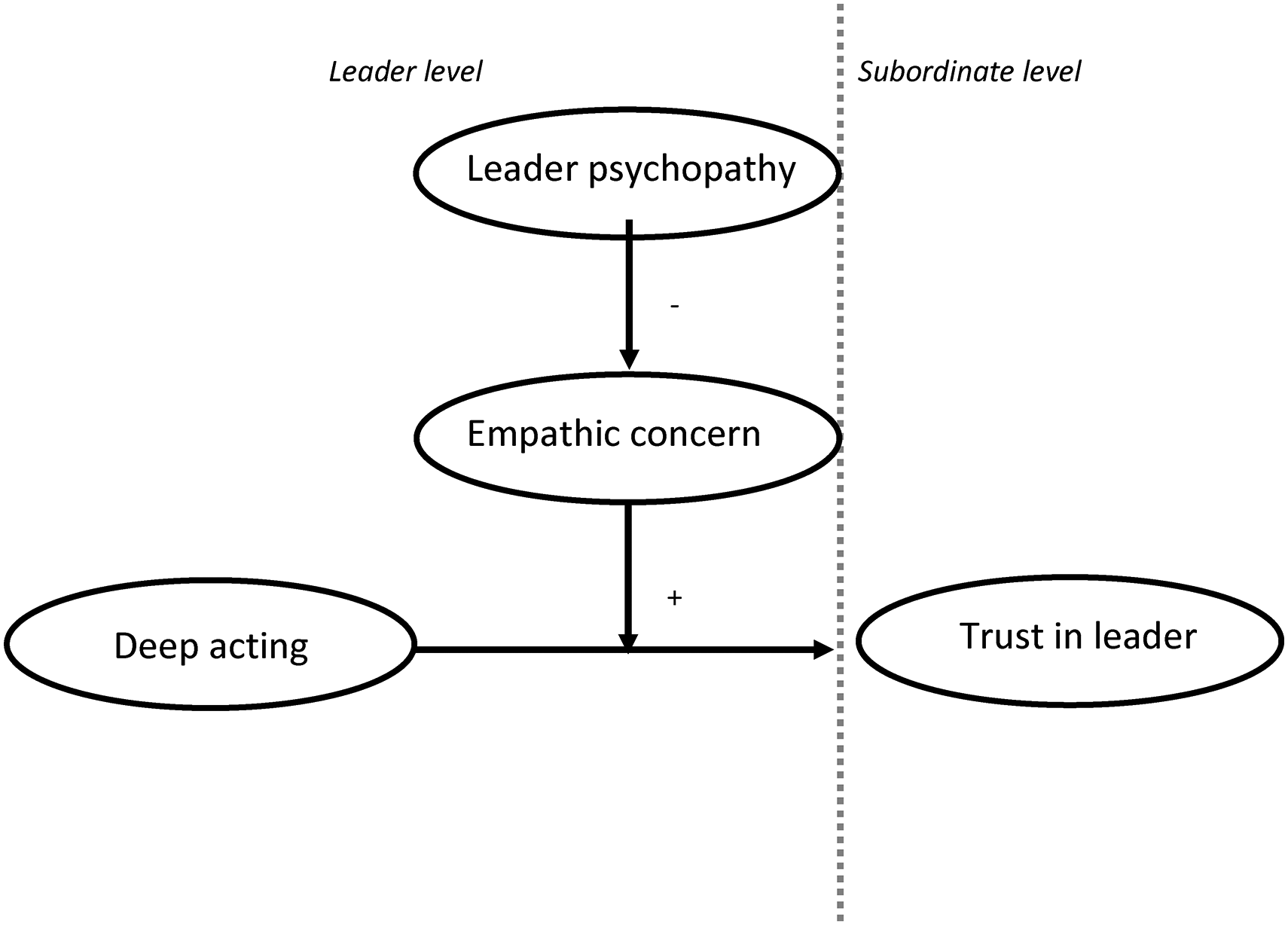
Research model depicting the relationships between leader primary psychopathy, empathic concern, and deep acting and follower ratings of trust in the leader.
We used the comparative fit index (CFI), the root mean square error of approximation (RMSEA), and the standardized root mean square residual (SRMR) to assess model fit. It has been suggested that adequate fit is indicated by values greater than or equal to .90 for CFI, and by values less than or equal to .08 for RMSEA and SRMR (see Schermelleh-Engel et al., 2003).
Results
Preliminary Analysis
We first performed multilevel confirmatory factor analyses to test the construct validity of the measures. We estimated three different models at the subordinate and leader level. We compared a six-factor solution against a four-factor solution (collapsing all leader emotion regulation strategies into a single factor) and a two-factor solution (collapsing all leader assessments into a single latent factor). For the variables assessed at the subordinate level, we specified the same factor structure at levels 1 and 2. The six-factor solution was superior (χ2(770) = 1421.0, CFI = .91, RMSEA = .03, SRMRw = .04, SRMRb = .07) to all other factor solutions (four-factor solution: χ²(779) = 2168.8, CFI = .81, RMSEA = .04, SRMRw = .04, SRMRb = .09, Δχ²= 744.8, Δdf = 9, p < .001; one-factor solution: χ²(784) = 3330.6, CFI = .65, RMSEA = .06, SRMRw = .04, SRMRb = .12, Δχ²= 1906.6, Δdf = 14, p < .001). Note that initial confirmatory factor analysis showed suboptimal model fit, however, allowing for six-item error term correlations (uniqueness correlations) resulted in good model fit. We reran the subsequently reported analyses without the negatively worded items of the psychopathy scale and any uniqueness correlations and obtained the same pattern of results. Because the psychopathy scale is widely used in the literature, we report the findings with those items here to be able to compare across studies.
We calculated ICC(1) and ICC(2) to justify multilevel modeling. The ICC(1) value provides information on the proportion of the total variance that can be explained by team membership, and the ICC(2) value indicates the reliability of the team mean scores. ICC(1) and ICC(2) justified the use of multilevel modeling for follower trust (ICC(1) = .35; ICC(2) = .67; see Bliese & Halverson, 1998).
The means, standard deviations, and correlations between the variables are presented in Table 1. Leader primary psychopathy had a mean of 2.22 in our sample. This is below the scale mean which is comparable to other studies that reported similar means when using the same instrument (e.g., Johnson et al., 2015; Barelds et al., 2018). Leader primary psychopathy was significantly and negatively correlated with leader empathic concern (r = −.24, p < .001), and follower trust (r = −.24, p < .01), but not significantly correlated with perceived authenticity (r = −.22, p = .17). Leader surface acting was negatively correlated with follower trust (r = −.19, p < .05). Neither leader deep acting nor leader display of naturally felt emotions was significantly correlated with follower trust (r = −.07 and r = .13, respectively). At level 1, follower perceived leader authenticity correlated positively with follower trust in the leader (r = .13, p < .05).
Means, Standard Deviations, and Between-Level Correlations.
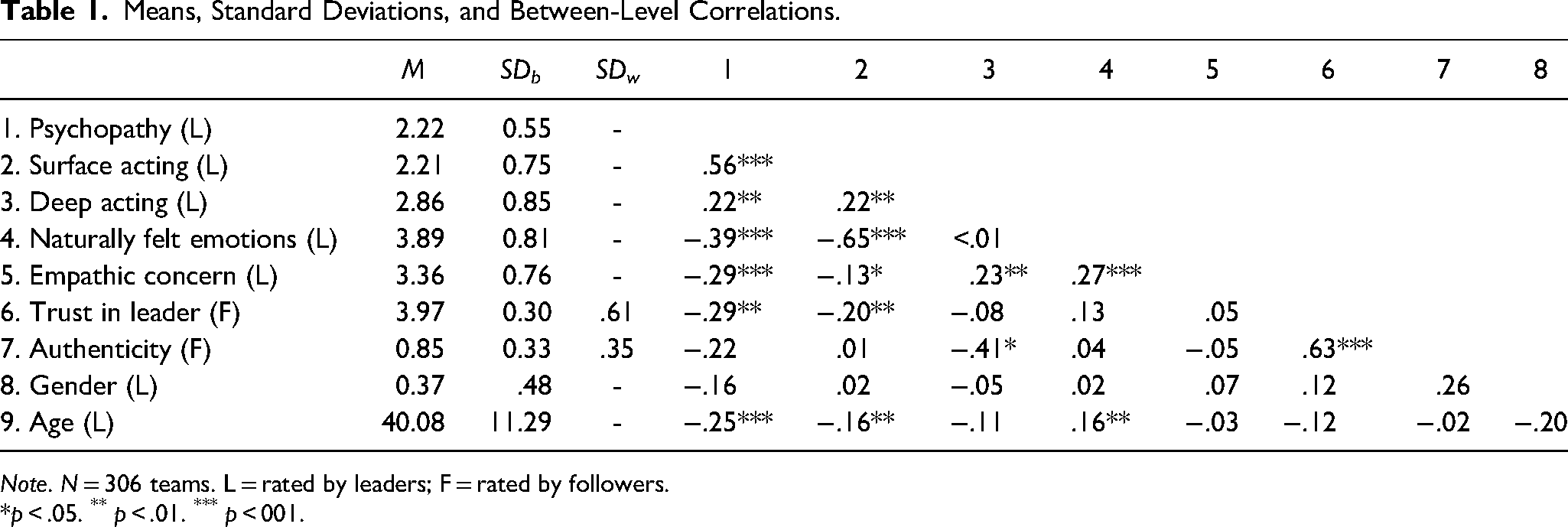
Note. N = 306 teams. L = rated by leaders; F = rated by followers.
p < .05. ** p < .01. *** p < 001.
Leader Primary Psychopathy and the Use of Emotion Regulation Strategies
We used leader primary psychopathy to predict leaders’ use of the three emotion regulation strategies to test hypothesis 1. The estimated model fitted the data appropriately (χ²(392) = 769.2, CFI = .90, RMSEA = .03, SRMRb = .07), and the results supported our assumptions. In line with our expectations, leader primary psychopathy was positively related to surface acting (b = 0.61, SE = 0.09, p < .001; R2 = .32) and negatively related to the display of naturally felt emotions (b = −0.45, SE = 0.09, p < .001, R2 = .16). Although we did not specify a hypothesis on the relationship between leader primary psychopathy and deep acting, it was positive and significant (b = 0.20, SE = 0.06, p < .01, R2 = .06).
Leader Primary Psychopathy as a Moderator in the Emotion Regulation Strategies—Follower Trust Relationship
To test hypotheses 2a and 3a, we first estimated MLSEMs in which the three emotion regulation strategies and leader primary psychopathy predicted follower trust in the leader. We then added the interaction terms, using the latent interaction approach (Klein & Moosbrugger, 2000). 1 Results for the models with and without interaction terms are reported in Table 2 (model fit for the model without interaction terms: χ²(557) = 1095.6, CFI = .92, RMSEA = .03, SRMRw = .04, SRMRb = .07). Leader primary psychopathy moderated the effects of surface acting (b = 0.45, SE = 0.13, p < .001), deep acting (b = −0.70, SE = 0.25, p < .01), and the display of naturally felt emotions (b = 0.42, SE = 0.12, p < .01) on follower trust. The model explained 8% of the leader-level variance in trust. To analyze the interactions further, we determined the simple slopes for high and low levels of leader primary psychopathy separately (Cohen et al., 2013; see Figure 3). Leader surface acting was positively related to follower trust when leader psychopathy was high (b = 0.28, SE = 0.09, p < .01), but not when it was low (b = −0.20, SE = 0.13, p = .13). These results support hypothesis 2a by demonstrating that leader primary psychopathy weakens the relationship between leader surface acting and follower perceptions of trust. In fact, when leader psychopathy was high, leader surface acting had positive effects on follower perceptions of trust in the leader. With regard to leader deep acting, results of simple slope analyses indicate that it was negatively related to follower trust when leader psychopathy was high (b = −0.24, SE = 0.08, p < .01), but that it was not significantly related to follower trust when leader psychopathy was low (b = 0.16, SE = 0.08, p = .06). These findings are in line with hypothesis 3a by showing that leader primary psychopathy weakened the positive relationship between leader deep acting and follower trust. We found that when leader psychopathy was high, leader deep acting had negative effects on follower perceptions. Finally, we found that leader display of naturally felt emotions was positively related to follower trust when leader psychopathy was high (b = 0.29, SE =0 .07, p < .001), but not when leader psychopathy was low (b = −0.17, SE = 0.13, p = .20). Although not anticipated, these results indicate that positive effects of showing naturally felt emotions on follower trust showed to the extent that leaders score higher on primary psychopathy.
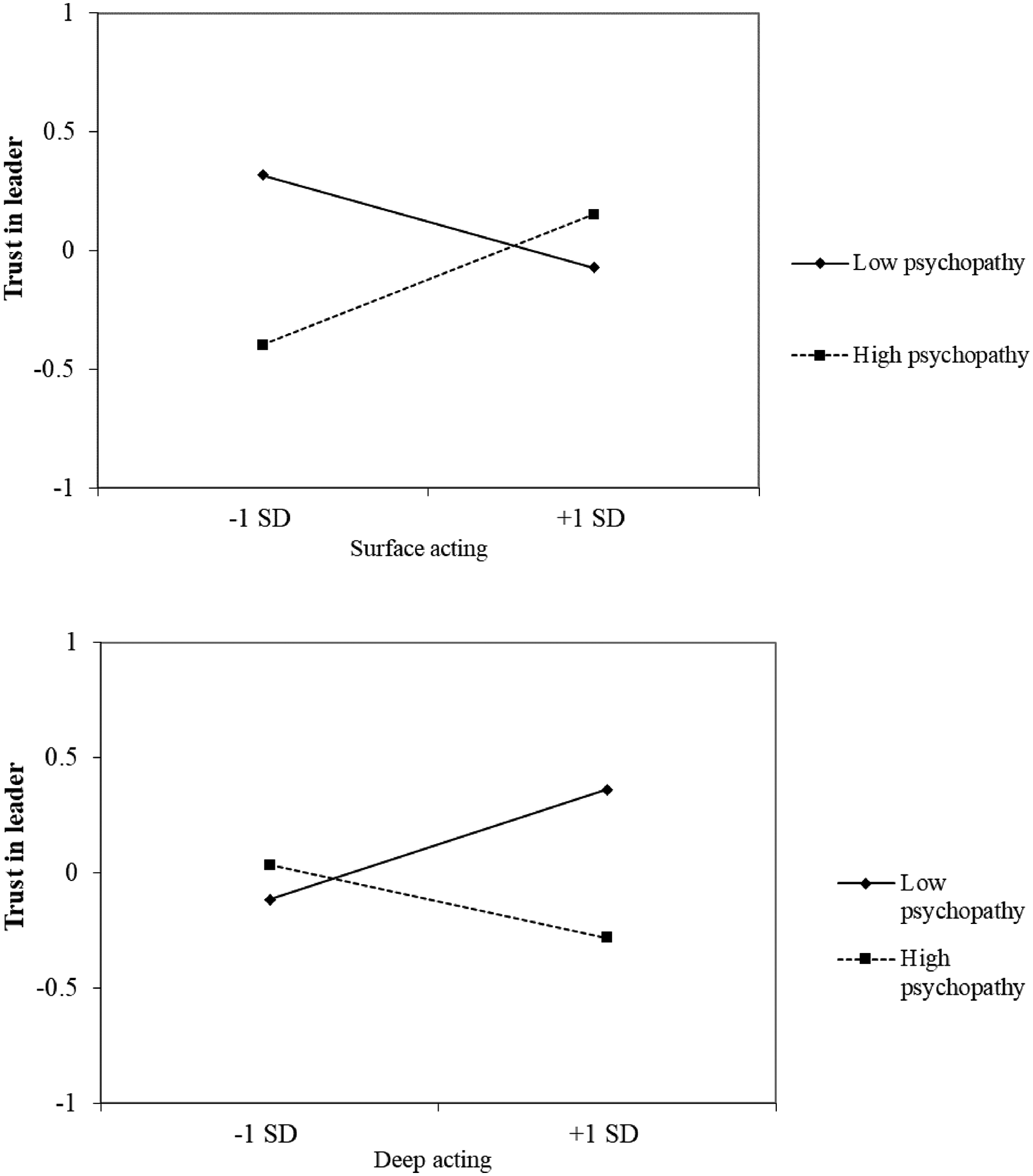
Effects of surface acting and deep acting on follower perceptions of trust in the leader moderated by leader primary psychopathy.
MLSEM Results on Followers’ Ratings of Follower Trust in Leader.
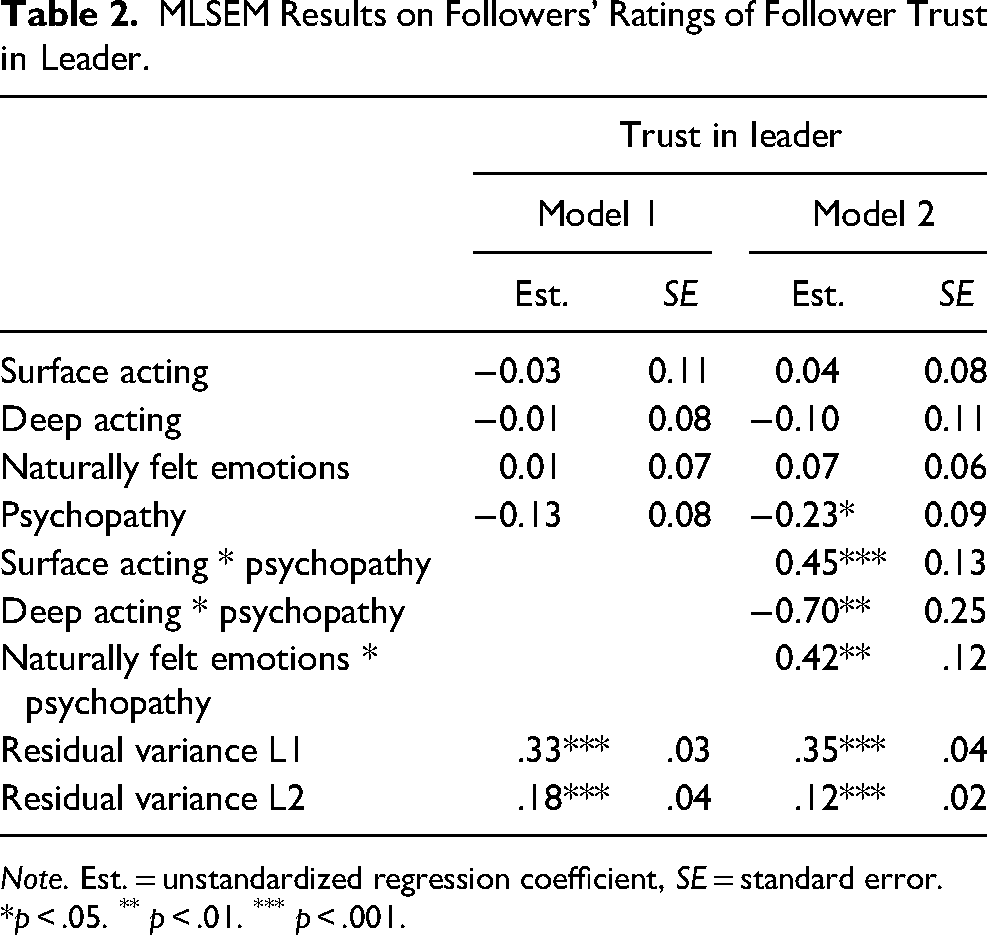
Note. Est. = unstandardized regression coefficient, SE = standard error.
p < .05. ** p < .01. *** p < .001.
Perceived Authenticity as Mediator Between Leader Emotion Regulation and Follower Trust in Leader
To test hypotheses 2b and 3b, we first added perceived authenticity as a mediator between leader emotion regulation and follower trust in the leader and then added the interaction terms between leader emotion regulations and leader psychopathy. Because authenticity is a single item, we estimated these models using path analyses. Running the model using latent variables was not possible due to the computational intensity of these models and convergence issues. The model without the interaction terms between leader emotion regulation and psychopathy fitted the data well (χ²(1) = 0.9, CFI = 1.00, RMSEA = .01, SRMRw = .01, SRMRb = .05). The model revealed no significant effects for emotion regulation—except for deep acting—and psychopathy on perceived authenticity (surface acting: b = −0.03, SE = 0.02, p = .13; deep acting: b = −0.04, SE = 0.02, p < .05; naturally felt emotions: b = 0.02, SE = 0.02, p = .25; psychopathy: b = −0.03, SE = 0.02, p = .28). However, perceived authenticity predicted trust in leader (b = 0.22, SE = 0.07, p < .01). The model explained 23% of the leader-level variance in authenticity and 61% in trust in the leader. Next, we added the three interaction terms and again obtained a good model fit (χ²(4) = 5.5, CFI = .99, RMSEA = .01, SRMRw = .01, SRMRb = .02). The interaction between leader surface acting and psychopathy positively predicted perceived authenticity (b = 0.11, SE = 0.05, p < .05) while the interaction between leader deep acting and psychopathy predicted perceived authenticity negatively (b = −0.08, SE = 0.03, p < .05). The interaction term between leader display of naturally felt emotions and psychopathy missed statistical significance (b = 0.05, SE = 0.03, p = .08). The indirect effect of leader surface acting on follower trust via perceived authenticity was not significant when leader psychopathy was low (b = −0.12, 95% CI [−0.31; 0.05]), but it was significant and positive when leader psychopathy was high (b = 0.23, 95% CI [0.05; 0.39]). These results are in line with hypothesis 2b. The indirect effect of leader deep acting on follower trust via perceived authenticity was not significant when leader psychopathy was low (b = −0.01, 95% CI [-0.12; 0.09]), but was significant and negative when leader psychopathy was high (b = −0.27, 95% CI [−0.44; −0.13], supporting hypothesis 3b. The model including the interaction terms explained 36% of the leader-level variance in perceived authenticity (ΔR2=.13). In sum, these findings demonstrate that perceived authenticity acts explain the interactive effect of leader emotion regulation and primary psychopathy on follower trust in their leader.
How Leader Empathic Concern Explains the Moderating Effect of Leader Primary Psychopathy in the Relationship Between Deep Acting and Follower Trust in Leader
Hypothesis 3c states that the theorized effects for deep acting can be explained through the lack of empathy for others that is characteristic of leaders with greater psychopathic tendencies. To test this hypothesis, we first assessed whether leader empathic concern moderates the relationship between leader deep acting and follower trust in the leader, while controlling for leader surface acting and leader display of naturally felt emotions. According to the results, empathic concern did indeed moderate the effect of leader deep acting on follower trust (b = 0.41, SE = 0.10, p < .001), such that leader deep acting had a negative effect on follower trust at low levels of leader empathic concern (b = −0.50, SE = 0.13, p < .001), and a positive effect at high levels of leader empathic concern (trust: b = 0.31, SE = 0.13, p < .05). To probe hypothesis 3c further, we estimated a moderated mediation model in which the mediation effect of leader psychopathy on follower trust via leader empathic concern is moderated by deep acting (stage 2 moderator; see Figure 2). We first estimated a model without the interaction term, and we then added deep acting as a moderator to test the full model, again controlling for leader surface acting and displays of naturally felt emotions.
The mediation model for follower trust in the leader fitted the data well (χ²(773) = 1472.6, CFI = .91, RMSEA = .03, SRMRw = .04, SRMRb = .08). As expected, leader psychopathy was negatively related to leader empathic concern (b = −0.23, SE = 0.07, p < .01) and follower trust in the leader (b = −0.16, SE = 0.06, p < .01). Leader empathic concern had no significant effect on follower trust (b = 0.01, SE = 0.06, p = .88), nor did leader emotion regulation strategies have any significant effect on follower trust (deep acting: b = −0.01, SE = 0.09, p = .90; surface acting: b = −0.04, SE = 0.11, p = .71; naturally felt emotions: b = 0.01, SE = 0.07, p = .89). This model explained 6% of the team-level variance in empathic concern and 6% in trust in the leader. The model including the interaction term revealed a moderation effect for deep acting (b = 0.43, SE = 0.13, p < .01). The indirect effect from leader psychopathy on follower trust via leader empathic concern was not significant when leader deep acting was low (b = 0.05, 95% CI [−0.01; 0.10]), but it was significant and negative when leader deep acting was high (b = −0.08, 95% CI [−0.14; −0.03]; see Liu et al., 2012). In sum, these findings support hypothesis 3c, indicating that the effect of leader deep acting on follower trust is less positive for leaders with stronger psychopathic tendencies, as they have less empathic concern for their followers. Running the model with authenticity as a control variable (without latent interaction) does not change the pattern of results reported here.
Discussion
The current study represents a first step toward investigating the possibility (1) that leader primary psychopathy affects the use of emotion regulation strategies and (2) that leader primary psychopathy moderates the effectiveness of such strategies in terms of the extent to which followers trust their leader. As such, this study enhances our understanding of when and why leaders with stronger psychopathic tendencies are able to acquire or maintain positions of power. Although the extant literature on dark leadership acknowledges the existence of successful psychopaths (LeBreton et al., 2018; Lilienfeld et al., 2015), to date there is little insight into what primary psychopaths do that helps them to get ahead. The current study sheds more light on this issue. The results largely support our hypotheses and reveal some additional interesting effects.
Surface Acting and Leader Primary Psychopathy
First, our study showed that leaders with stronger primary psychopathic traits were more likely to engage in surface acting as a strategy (see hypothesis 1). This corroborates our reasoning that the tendency of those scoring higher on psychopathy to lie and to be callous would be reflected in their engagement in surface acting, as surface acting involves presenting a facade to display emotions that are not felt but deemed fitting in a particular situation. This finding might also inform literature on emotion regulation as it shows that those who lie might be better suited for jobs that require a lot of surface acting (e.g., service workers and sales representatives), as this behavior may be more fitting to their natural tendencies.
Second, we found that leader psychopathy moderated the effects of leader surface acting on follower trust (see hypothesis 2a). For leaders with low levels of psychopathy, surface acting was not significantly (but negatively) related to follower trust. This finding aligns well with the meta-analytic finding that surface acting has small but negative effects on the interaction partner (Hülsheger & Schewe, 2011). In contrast, for leaders with high levels of psychopathy, surface acting was positively related to follower trust. These results suggest that leader psychopathy critically alters the effects of surface acting. Indeed, when leaders who score high on psychopathy use surface acting, it has positive effects on their followers’ perceptions of them. Surface acting appears to be a beneficial strategy to the extent that the actor scores higher on primary psychopathy. Paradoxically, whereas leader surface acting usually suggests to followers that the leader is insincere and manipulative (Fisk & Friesen, 2012), it does not seem to have this effect when the leader is truly insincere and manipulative. In such cases, leader surface acting results in their followers seeing them in a more positive light. This finding therefore enhances our understanding of why leaders with higher levels of primary psychopathy can be successful despite their generally negative impact on organizations and employees (see Laurijssen et al., 2024): their relatively frequent use of surface acting has positive relationships with follower trust which is not the case for leaders with lower levels of primary psychopathy.
Third, we found that perceived authenticity explained the interactive effects of leader surface acting and psychopathy (see hypothesis 2b). It has been argued that surface acting tends to be less effective than deep acting or displaying naturally felt emotions (see Fisk & Friesen, 2012), because observers are likely to recognize emotional faking as inauthentic, thus making it less effective (see Cha et al., 2019). We found that surface acting when performed by leaders scoring higher on psychopathy, is misperceived by followers as highly authentic, which, in turn, makes them trust the leader more. So, leaders with stronger psychopathic tendencies tend to engage in surface acting, come across as genuine when they engage in it, and are trusted for it. As such, these findings lend credence to the idea that psychopaths’ mask of sanity (Cleckley, 1941) originates from their ability to successfully apply surface acting as a strategy as they appear genuine when they engage in it.
Deep Acting and Leader Primary Psychopathy
Although we did not develop a specific hypothesis on the relationship, we did find that leaders with stronger primary psychopathic traits were more likely to adopt the strategy of deep acting. Perhaps indeed leader psychopathy stimulates the use of whichever available strategy to influence followers (Jonason & Webster, 2012). This pattern is intriguing given our finding that when leader psychopathy was high, deep acting was negatively related to follower trust (and when it was low, deep acting was positively but nonsignificantly related to follower trust; see hypothesis 3a). This again suggests that leader psychopathy essentially alters the effects of emotion regulation strategies on others. For leaders who have stronger psychopathic tendencies, deep acting appears to be a harmful strategy, as it detracts from their perceived trustworthiness. This finding also informs emotional labor research and testifies to the usefulness of a more elaborate model of the effects of emotion regulation strategies that include individual-level factors that could explain when the strategies are likely to have detrimental or beneficial effects on others (see Grandey & Melloy, 2017).
We also found that perceived authenticity explained the interactive effects of leader deep acting and primary psychopathy (see hypothesis 3b). When leaders scoring high on psychopathy engaged in more deep acting, followers perceived them as less authentic, which, in turn, made them trust the leader less. Our findings further indicate that the lack of empathic concern for others on the part of primary psychopathic leaders can explain why those scoring high on psychopathy are less effective in using deep acting as a means of influencing other people's perceptions (thus confirming hypothesis 3c). Primary psychopaths’ lack of empathy renders the strategy of deep acting ineffective, arguably because they tend not to be aware of the emotions that the other person needs to see reflected and displayed. Deep acting done by psychopathic individuals may be seen as less authentic because it stirs what has been termed uncanny valley-like responses in observers. The uncanny valley is a hypothesized relationship between the extent to which an object (e.g., robot and doll) resembles a human being and the emotional response that a human has to such an object. Humanoid objects that imperfectly resemble actual human beings provoke uncanny or strangely familiar feelings of eeriness and revulsion in observers (MacDorman & Ishiguro, 2006). Likewise, primary psychopathic individuals who try to mimic the emotion regulation strategies of empathic individuals by engaging in deep acting may provoke in others the feeling that something is not quite right. As demonstrated in previous research, poorly executed mimicry is likely to result in reported feelings of coldness, arguably due to a feeling that something is off (literally giving people “the chills”; Leander et al., 2012). Whereas deep acting is usually regarded as appearing particularly authentic and real (Gardner et al., 2009), such is not the case when deep acting is done by leaders with high levels of psychopathic tendencies. Notably, the finding that empathic concern explains why psychopathy moderates the relationship between deep acting on the one hand and perceived authenticity and follower trust on the other, is also interesting in itself. This finding could point to other potential moderators of the deep acting—interpersonal effects relationship. For instance, it has been argued that Asperger syndrome (Rogers et al., 2007), age (Richter & Kunzmann, 2011), and power (Galinsky et al., 2006) are also tied to various facets of empathy. It may therefore be that people with Asperger, people who are younger, or have more power, experience more difficulty in successfully influencing others with their use of deep acting.
All in all, we found that, although leaders scoring higher on primary psychopathy tend to deep act more, they could better refrain from doing that. They lack the empathic concern needed for successful deep acting and their attempts come across as less authentic and therefore they appear less trustworthy.
Display of Naturally Felt Emotions and Leader Primary Psychopathy
We found that leaders with stronger primary psychopathic traits were less likely to show how they truly feel (confirming hypothesis 1). This aligns well with the notion that psychopaths are less likely to be honest. At the same time, we also found that when leader psychopathy was high, the display of naturally felt emotions was positively related to follower trust. This is remarkable given the positive relationship between psychopathy and negative other-directed emotions, such as anger, resentment, and disgust (Walker & Jackson, 2017). It seems that, as we also mentioned in the introduction section, followers prefer for their psychopathic leaders to display their true emotions rather than to feel them simmer below the surface. In fact, it does not only make them trust their leader more, they also perceive them as being more authentic. We posit that this perceived authenticity may relate to follower feelings of trust, because by showing their true emotions leaders become more predictable, and their behavior less ambiguous, which may be particularly important when the leader can be mean and unkind. Notably, this finding ties into recently developed theory on inconsistent leadership. Inconsistent leadership arises when followers cannot make sense of their leader's behavior in light of prior behavior or traits of that leader. Leader inconsistency is problematic given its negative effects on followers (e.g., follower stress, commitment, leadership endorsement; see Schilling et al., 2023). We recommend that future research explores the relationship between psychopathy and the display of naturally felt emotions more deeply, and perhaps also investigates the role of leader ambiguity and predictability, given the current lack of insight on the matter.
Strengths, Limitations, and Further Recommendations for Future Research
In addition to the theoretical contributions that our study has to offer, one strength is that it is based on a large set of multisource team data. We asked leaders about their personality, empathy, and use of emotion regulation strategies and followers about the extent to which they trusted their leaders and perceived them as authentic. As such, we did not have to rely on leaders’ own perceptions of behavior and the impact that it may have on others (thereby avoiding self-serving bias on the part of the leader). This is important, given that research on the consequences of psychopathic personalities in the workplace so far is often based on self-perception data (see Smith & Lilienfeld, 2013).
Another strength of our research is that we were able to reduce the possibility of common method bias (Podsakoff et al., 2024; Siemsen et al., 2010) in the second stage of our model (the perceived authenticity—trust path) by applying an implicit measure to assess perceived authenticity and an explicit measure to assess trust in the leader. This is relevant given that common method variance can either inflate or deflate bivariate linear relationships (Siemsen et al., 2010). Our implicit measure also has limitations as we only had one word in our word fragment completion task (Koopman et al., 2013). This is not common practice as most work fragment completion tasks require participants to complete more than one word. However, similar to the fact that explicit measurement usually includes multiple items—and for good reason—but may sometimes be done with the use of a single item, we believe that because our one-word containing word fragment completion task is precise in assessing authenticity. Our measure uses exactly the right word (i.e., it is very specific), and because we did not aim to assess facets or a broader concept the use of a single-item measure should not be problematic (see Fisher et al., 2016). Nonetheless, future research could consider including an explicit measure of perceived authenticity or a multi-item word fragment completion task to assess the robustness of our findings.
Another potential limitation of the study is that it included a measurement only for the affective component of empathy (see Batson et al., 2007). Although we decided to focus on the affective component given its strong relationship with psychopathy, it would be interesting to see whether other facets of empathy or a composite measure of empathy (including both the cognitive and affective components; Reniers et al., 2011) would have similar moderating effects on the relationship between leader emotion regulation strategies and follower perceptions.
Our measurement of leader psychopathy also has some potential drawbacks. In our study, we assessed primary psychopathy and not secondary psychopathy (Levenson et al., 1995). Our choice to restrict our focus to primary psychopathy was based on the consideration that primary psychopathy does not seem to hinder individuals from functioning reasonably well in society (contrary to secondary psychopathy), thereby making it the more relevant of the two dimensions for studies conducted in the workplace. Moreover, primary psychopathy captures the core of the concept of psychopathy as defined by Cleckley (1941; e.g., Murphy & Vess, 2003). Future studies might nevertheless benefit from investigating the effect of both elements of the Dual Process model of psychopathy.
In our research, we focused on the interindividual effects of leader emotion regulation strategies and the results do not speak to their potential intra-individual effects. At the same time, however, it would be interesting to learn whether the intra-individual effects of leader surface acting and deep acting differ according to the psychopathy levels of those leaders. We think that this indeed could be the case. For example, it has been argued that surface acting has negative consequences for the self, given that people often use this strategy when they feel forced or coerced to display something that they do not feel, thereby leading to perceived emotive dissonance (see Grandey & Melloy, 2017). For many, lying and faking feels uncomfortable and requires considerable effort. For individuals with higher levels of psychopathy, however, lying and faking might feel more comfortable and be relatively easy. Thus, the negative consequences of leader surface acting may be less pronounced for leaders with higher levels of psychopathy. In contrast, deep acting is often considered to have more positive consequences for the self, as it allows people to display the feelings they have mustered up to feel (thus decreasing the level of emotive dissonance). However, for those scoring higher on psychopathy, deep acting may drain a large amount of energy, due to a lack of the necessary empathy for others. Thus, the positive consequences of deep acting may be less pronounced for leaders with higher levels of psychopathy.
Finally, it would be interesting to investigate how the relationships between leader psychopathy, emotion regulation strategies, and follower perceptions might develop over time. It could be that only in the short run surface acting is an effective strategy for leaders with higher psychopathy scores. When followers come to know their leader for a longer period, they might see through their lies and fake displays of emotions, rendering the effectiveness of these displays much lower. A similar process has also been suggested for leader narcissism, one of the other Dark Triad traits, in the Chocolate Cake Model (Campbell, 2005). The initial appeal of narcissistic leaders is like the first few bites of chocolate cake: rich and gratifying. However, just as eating too much cake becomes unpleasant, the appeal of narcissistic leadership diminishes over time. Studies supporting this model show that the relationship between leader narcissism and leader evaluations turns more negative over time (Ong et al., 2016). Future research might delve into this matter more closely.
Practical Implications
The results of our study suggest that organizations should be mindful of the differential use and effectiveness of emotion regulation strategies by those with higher levels of psychopathy. As demonstrated by our results, primary psychopaths’ propensity to engage in surface acting is beneficial to them as it makes them appear authentic and trustworthy. However, we also found that when psychopaths try to change their internal feelings to align them with the emotions they want to display, they are seen as less authentic and less trustworthy. Indeed, their lack of empathy hinders their effective use of deep acting. This information might be used in a couple of ways. First, organizations might consider including recruitment and promotion techniques that are less susceptible to surface acting. Given that experienced interviewers already have difficulty distinguishing between honest and dishonest impression management from ordinary interviewees (Roulin et al., 2015), expecting them to spot lies uttered by those scoring high on psychopathy is perhaps unrealistic, and a sole reliance on interviews might therefore have its drawbacks. As such, apart from conducting interviews, organizations could rely more on experiences from (former) colleagues or employers, work samples, or more objective work performance outcomes. Second, organizations might consider including recruitment and promotion techniques that require more deep acting. One possibility is to have candidates engage in role-play with trained actors. Observers could be asked to assess perceived authenticity. Another option is to develop situational judgment tests that tap into candidates’ ability to place themselves in other people's shoes or that assess interindividual emotion regulation techniques. Recent research indicated that those scoring higher on psychopathy indeed do less well on such tests (see Koschmieder & Neubauer, 2021). Notably, such measures are particularly important when the job requires deep acting for successful task performance (nursing, coaching, etc.).
Our results also have several implications for leaders with higher levels of primary psychopathy and those who have difficulty empathizing with others. If these leaders wish to appear more authentic and want to be trusted, it seems as if they would do better to adhere to the strategy of surface acting and the display of naturally felt emotions and to refrain from deep acting. Moreover, if they would like to increase their effectiveness in the use of deep acting, one option would be for them to increase their empathic capacity. Although probably not effective for everybody, an increase in empathic capacity could be accomplished with training (Teding van Berkhout & Malouff, 2016). In addition, those scoring higher on primary psychopathy may carefully consider their career choices. To be successful, they may want to choose professions in which they can rely a lot on surface acting, like working in sales, the food and hospitality industry, and the bill collector business (Hochschild, 1983; Sutton, 1991).
Conclusion
Using data from a large multisource team study, we found that leaders with stronger primary psychopathic tendencies garner positive effects by using the strategy of surface acting as it boosts their perceived authenticity and follower trust. At the same time, they would do better to refrain from the use of deep acting if they want to be seen as authentic and trusted by followers. Their lack of empathic concern renders this strategy largely unsuccessful. With our set of findings, we have uncovered further mechanisms that could explain why individuals with high levels of psychopathy are sometimes successful in the workplace, in addition to providing further insight into the interpersonal effects of the use of emotion regulation strategies and demonstrating that the good-bad dichotomy of deep and surface acting does indeed provide an oversimplified picture. We hope that our research has opened an avenue for further exploration of the effects and workings of psychopathy and emotion regulation.
Supplemental Material
sj-docx-1-jlo-10.1177_15480518241247113 - Supplemental material for The Mask of Sanity? Leader Primary Psychopathy and the Effects of Leader Emotion Regulation Strategies on Followers
Supplemental material, sj-docx-1-jlo-10.1177_15480518241247113 for The Mask of Sanity? Leader Primary Psychopathy and the Effects of Leader Emotion Regulation Strategies on Followers by Barbara Wisse, Ed Sleebos and Anita Keller in Journal of Leadership & Organizational Studies
Footnotes
Declaration of Conflicting Interests
The authors declared no potential conflicts of interest with respect to the research, authorship, and/or publication of this article.
Funding
The authors received no financial support for the research, authorship, and/or publication of this article.

Supplemental Material
Supplemental material for this article is available online.
Notes
Author Biographies
References
Supplementary Material
Please find the following supplemental material available below.
For Open Access articles published under a Creative Commons License, all supplemental material carries the same license as the article it is associated with.
For non-Open Access articles published, all supplemental material carries a non-exclusive license, and permission requests for re-use of supplemental material or any part of supplemental material shall be sent directly to the copyright owner as specified in the copyright notice associated with the article.
