




Abstract
Many innovative products are attributable to employees disobeying the mandate of their supervisors to stop working on a creative idea, that is, creative deviance. Surprisingly, there has been a dearth of empirical research on this important construct, and the possible negative social outcomes of creative deviance remain unexplored. This research integrates psychological ownership theory and motivated information processing theory to theoretically delineate psychological ownership as an antecedent of creative deviance. We further explore social undermining as a negative outcome of creative deviance and investigate the leader–member exchange (LMX) as a boundary condition of the association between creative deviance and social undermining. In a series of three studies, we validate an existing scale for creative deviance, and utilize multiple methods to test our full moderated-mediation model. Findings suggest that creative deviance partially mediates the relationship between psychological ownership and experienced social undermining and LMX attenuates the relationship between creative deviance and experienced social undermining. Our research has important theoretical and practical implications as it explores the darker sides of creative deviance.
Imagine you strongly identify with your organization and you want to go work on a creative idea, which you believe can benefit your organization. However, your manager asks you to stop working on the idea. Will you still work on that idea when your manager is not around? What might happen when your manager realizes you ignored their mandate? It is likely that your manager may consider your rejection of their mandate as an act of insubordination and might socially undermine you. In this research, we investigate why employees may disobey the mandate of their supervisors to stop working on an innovative idea, and when and why such behavior can lead to socially undermining actions taken against the employee by the manager.
When employees disobey the mandate of their managers to stop working on an innovative idea, such behavior is labeled creative deviance (Mainemelis, 2010). There are numerous documented cases in organizations where such creative deviance culminated in a revolutionary new product. For example, Macintosh (computer operating system; O’Brien, 2014), Aspirin (drug for pain; Van Wulfen, 2016), Iron-dome (Israeli defense system against rocket attacks; Leichman, 2014), and 3-D or three-dimensional printing (Feldman, 2019) are some examples of innovative products whose creators’ original ideas were rejected in their early development stages by the respective organizations’ leadership. Although we know the stories of a few cases in which the innovative products resulting from acts of creative deviance became famous, we do not know the rest of the story—that is, whether creative employees, who ignored their leaders’ mandates to cease working on their projects, were mistreated by their leaders for their insubordination.
Mainemelis (2010) first delineated the construct of creative deviance and defined it as “the violation of a managerial order to stop working on a new idea” (p. 560, italics in original). Creative deviance is evident in organizations (Criscuolo et al., 2013; Mainemelis, 2010), and is often observed in the idea development stage of the creative process (i.e., the stage of the approval or rejection of a creative idea by the social actors; see Perry-Smith & Shalley, 2003; Shukla & Kark, 2020). The occurrence of creative deviance can potentially lead to both positive and negative outcomes (Lin et al., 2016). These outcomes can contribute to creativity and innovation or can result in wasted resources and the possibility of a negative relationship with one's supervisor (Lin et al., 2016; Mainemelis, 2010). The occurrence of creative deviance in organizations (Criscuolo et al., 2013; Mainemelis, 2010), combined with the lack of research in the organizational literature on creative deviance, make it crucial to better understand what leads employees to become involved in creative deviance and when creative deviance can lead to adverse outcomes for individuals. 1
Creative deviance can have a profound impact on leader–subordinate relationships (Lin et al., 2016; Shukla & Kark, 2020), and some leadership styles (such as ethical leadership) can engender more creative deviance than other leadership styles (Liu et al., 2021). Thus, studying creative deviance can have considerable implications for leadership research as well as practice. Moreover, creative deviance is a type of norm violation that is not categorized into either constructive or destructive norm violation (Mainemelis, 2010). The intent behind the violation of managerial orders (self-benefit or benefit of the organization) and outcomes of the creative deviance (waste of resources or innovation) may be different. Because it is currently an uncategorized form of norm violation, studying creative deviance can have important implications for the norm-violation literature as well.
In our endeavor to enrich the above fields of literature by studying creative deviance, the first research question we investigate is, why do individuals engage in creative deviance? An employee may have many ideas which are rejected; however, not every rejected idea is worth the risk of going against the mandate of one's supervisor (Mainemelis, 2010). Taking such risks would likely make sense only for those ideas that employees feel can really add value to their “own” organization. When individuals have strong psychological ownership of the organization, they are more likely to keep working on those ideas which they feel can add value to the target of their psychological ownership (i.e., their organization). Supporting the above argument, findings in the creativity literature show that psychological ownership for a target fuels creativity and non-adherence to norms to benefit the target (Gray et al., 2020; Martinaityte et al., 2020; Rouse, 2013). Thus, we buttress psychological ownership theory (Pierce et al., 2001) as an explanation for why individuals might engage in creative deviance.
Psychological ownership (Pierce et al., 2001) represents the connection employees experience between themselves and their organization. This psychological ownership makes employees less likely to give up on the idea, even if it means engaging in the deviant act of neglecting a supervisor's mandate to do so. According to psychological ownership theory, a strong attachment to the target of psychological ownership can lead to such a motivated focus on the creative project that the focal person tends to ignore important surrounding information (Baer & Brown, 2012; Brown et al., 2014) such as the mandate of a supervisor to stop working on the creative project. Thus, psychological ownership of the organization can lead to the neglect of the mandate of the manager to stop working on a creative project.
Existing research suggests that psychological ownership can instigate biased information processing, especially against the suggestions of changes in one's creative ideas (Baer & Brown, 2012). We argue that employees with high psychological ownership are likely to engage in motivated information processing of the idea rejection and process the rejection as a hindrance against their motivation to work for the organization's benefit. Hence, the management styles influencing the motivated information processing of the idea rejection may be a boundary condition for the relationship between psychological ownership and creative deviance. Therefore, we further integrate motivated information processing theory (MIPT; Bechtoldt et al., 2010; De Dreu et al., 2008, 2011; Kunda, 1990) with psychological ownership theory to investigate the boundary conditions of the association between psychological ownership and creative deviance.
According to MIPT, sufficient information from the leader (e.g., about goals and strategic intent) can produce in followers a constraint based on the reasonableness of the provided information (Kunda, 1990)—a constraint that can reduce biased information processing and can prompt the follower to accept information (such as their idea's rejection) more willingly than if the information was not shared. An informative leadership style of the manager (Arnold et al., 2000) represents the leader's tendency to explain the strategic intent/rationale behind the rejection, thus reducing biased information processing (Schultze et al., 2012; Van Knippenberg et al., 2021). Integrating MIPT and psychological ownership theory, we investigate whether informing leadership style by the manager acts as a boundary condition of the relationship between psychological ownership and creative deviance.
Further supporting the biased information processing perspective, we argue that managers may process the information about creative deviance as an act of insubordination. As a result, they may feel resentment and may engage in social undermining against their willfully disobedient employee. However, when leaders and employees have a better relationship, the biased information processing of the leaders against the focal employees may be attenuated. This is because in the case of high LMX, the leader is cognizant of the employees’ proactive motivation (Epitropaki et al., 2013; Hall & Lord, 1995), and the leader also provides greater latitude for the norm violation to employees (Kluemper et al., 2019). Thus, a higher level of leader–member exchange (LMX) is expected to mitigate the supervisor's impression of insubordination by the focal employee and prevent social undermining of the employee by the manager. Based on the above argument, we add LMX as a boundary condition attenuating the creative deviance and leader-inflicted undermining relationship. Figure 1 shows our overall theoretical model.
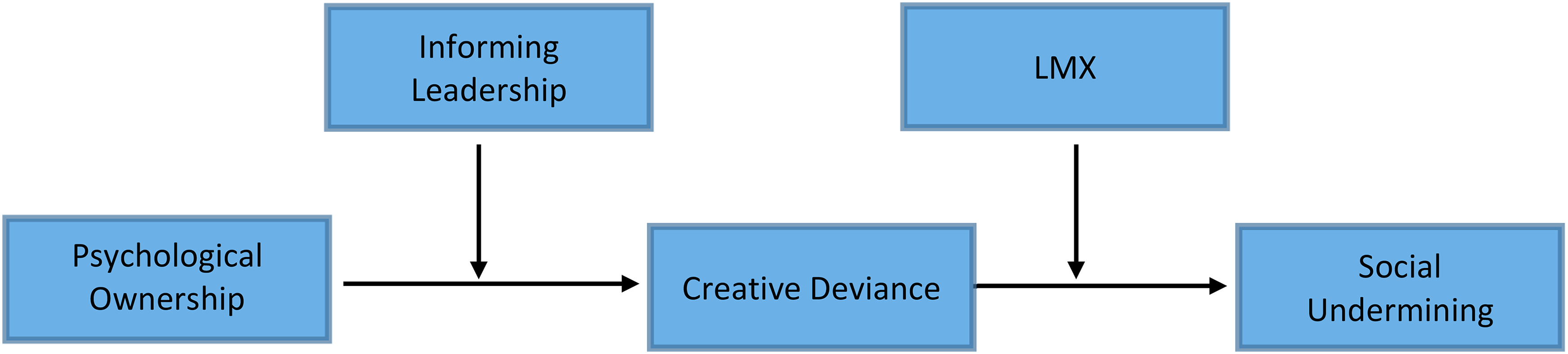
Theoretical model.
By developing and empirically testing the model described above and depicted in Figure 1, we make several theoretical and empirical contributions. First, we contribute to the scant literature on creative deviance. In particular, we extend the work of Lin et al. (2016) by validating their scale following the steps prescribed by Hinkin (1998). Further, we develop a nomological network of creative deviance. Whereas the extant literature has indicated that organizational strain and leadership styles can lead to creative deviance (Lin et al., 2016; Mainemelis, 2010), very little research has addressed the individual psychological antecedents of creative deviance or its outcomes. Our investigations expand the breadth of relevant research by focusing attention on the individual antecedents and outcomes of creative deviance.
Second, our research expands psychological ownership theory (Pierce et al., 2001). The psychological ownership literature has focused primarily on positive outcomes for the individual showing psychological ownership (Dawkins et al., 2017; Pierce et al., 2003; Vandewalle et al., 1995). We explore the negative side of psychological ownership by investigating its indirect influence, through creative deviance, on the negative outcome of social undermining from the employee's supervisor.
Third, we contribute to MIPT by integrating it with psychological ownership theory. We explain how an informing leadership style can attenuate the effect of psychological ownership on creative deviance. By establishing the theoretical contours of the above integration, we address the call of earlier researchers (e.g., Nijstad & De Dreu, 2012) to explore the individual psychological dynamics that can influence the motivated processing of information—including its constraint.
Theory and Hypotheses Development
Psychological Ownership and Creative Deviance
Psychological ownership is defined as “the state in which individuals feel as though the target of ownership or a piece of that target is theirs” and reflects “an individual's awareness, thoughts, and beliefs regarding the target of ownership” (Pierce et al., 2003, p. 86). Pierce et al. (2001) developed the theory of psychological ownership and delineated three dimensions of psychological ownership—belonging, self-efficacy, and self-identity. Belonging means that psychological ownership is rooted in the feeling that there is a specific space or territory (e.g., one's own home) where an individual can dwell and towards which he/she has some rights and responsibilities. The dimension of self-efficacy represents a belief that the actions of the focal individual have the desired impact on the space to which he/she belongs. The dimension of self-identity represents the feeling of possession of a particular space or territory by the focal individual. He/she identifies psychologically with the target, which nourishes psychological ownership. Research has shown that psychological ownership of the organization, rooted in the above dimensions, has a positive relationship with organizational citizenship behaviors (OCBs), affective organizational commitment, and job satisfaction (Avey et al., 2009; Van Dyne & Pierce, 2004; Vandewalle et al., 1995).
Psychological ownership of the organization is positively related to the adoption of creative ideas specifically targeted toward the benefit of the organization's stakeholders (e.g., customers and coworkers) or the organization itself (Baer & Brown, 2012). However, if the supervisor of the focal employee orders him/her to stop working on the creative idea targeted toward the benefit of the organization, the employee's feelings of strong psychological ownership may result in motivated information processing (Avey et al., 2012; Kamleitner & Feuchtl, 2015). Because of motivated information processing, the employee may perceive the above supervisory mandate as a hindrance to his/her objective of benefitting the organization or as an infringement of his/her right to benefit the organization (Brown & Robinson, 2011). The rejection of the creative idea might not stop the employee from continuing to work on the project because of the intense desire to benefit the organization or its stakeholders. Thus, it is likely that individuals who have stronger feelings of psychological ownership regarding the organization will be more likely to disagree with the mandate of the supervisor to stop working on the creative idea.
Hypothesis 1: Psychological ownership is positively associated with creative deviance.
Informing-Leadership Style and Creative Deviance
MIPT (De Dreu et al., 2008; Kunda, 1990; Van Knippenberg et al., 2021) suggests that the motives of an employee can lead to biased information processing that can confirm or support the already existing desires of that focal employee (De Dreu, 2007; Grant & Berry, 2011; Meffert et al., 2006). However, MIPT also considers that humans do not feel “at liberty to conclude whatever they want to conclude merely because they want to” (Kunda, 1990, p. 482). Indeed, MIPT explicitly acknowledges that “people will come to believe what they want to believe only to the extent that reason permits” (Kunda, 1990, p. 483). Contemporary research on motivated information processing has established the boundary condition of the reasonableness constraint (Boiney et al., 1997), which means that when a crucial stakeholder, such as a team leader, provides the raison d’ être for a particular decision, the focal person would be able to remove his/her blinders and process the information in a less biased manner (Van Knippenberg et al., 2021). Informing leadership style (Arnold et al., 2000) is characterized by the leader's tendency to provide followers with an elaborated explanation of the strategic intent behind managerial decisions, such as the rejection of the focal person's idea. Thus, an informing leadership style is likely to diminish the motivated information processing of the idea rejection by the employee, and in turn, is likely to attenuate the association between psychological ownership and creative deviance such that an employee whose leader has an informing leadership style is less likely to react to the rejection of their creative idea with creative deviance.
In the case of an informing leadership style by the focal employee's supervisor, the focal employee is more likely to understand and integrate management's strategic intent (e.g., rationing of resources; see Mainemelis, 2010) behind the rejection of his/her creative idea. There may be many valid reasons for the idea rejection such as changes in internal or external strategic scenarios or shortages of resources or changes in role expectation. Effective communication of these valid reasons can thus attenuate the biased information processing of the idea rejection. Thus, among the employees who have strong psychological ownership of the organization, those who receive convincing and compelling information about the strategic intent behind the idea rejection will be less likely to engage in creative deviance because they will be more receptive to their manager's reasoning as it applies to their idea. On the other hand, when leaders do not have an informing leadership style, the likelihood of the biased information processing of idea rejection will be higher by those employees who have strong psychological ownership of the organization. Thus, at lower levels of informing leadership style, there is a stronger association between psychological ownership of the organization and creative deviance.
Hypothesis 2: Informing leadership style moderates the effect of psychological ownership on creative deviance such that at higher/lower levels of informing leadership, the relationship between psychological ownership and creative deviance is weaker/stronger.
Creative Deviance and Social Undermining
Social undermining is defined as “behavior intended to hinder, over time, the ability to establish and maintain positive interpersonal relationships, work-related success, and favorable reputation” (Duffy et al., 2002, p. 332). In the current research, we focus on the perceived social undermining inflicted by the leader on the employee who engaged in creative deviance. Existing literature has established that biased information processing by the supervisor about subordinates’ challenging behaviors such as voice, can lead to supervisor-inflicted social undermining of the focal employee (Frazier & Bowler, 2015). We argue that creative deviance is perceived as a type of challenging behavior by supervisors because it is characterized by the neglect of supervisory mandates. Thus, it is likely that social undermining (instigated by the supervisor) is a negative outcome of creative deviance.
Employees’ neglect of mandates from the supervisor can lead to negative information exchange and a toxic relationship between the supervisor and subordinate. Toxic supervisor–subordinate relationships have been associated with social undermining experienced by subordinates (Gant et al., 1993). Specifically, the expectation that a subordinate should follow the orders of a supervisor is deeply embedded in the leader–subordinate relationship, and the breach of those expectations can lead to an intent to socially harm the offender (Hamilton et al., 1990). Therefore, we posit that employees’ creative deviance might lead to experienced social undermining instigated by their supervisors.
Hypothesis 3a: Employee's creative deviance has a positive relationship with the employee's experienced social undermining by the supervisor.
The psychological ownership of the organization that will benefit from a creative project can motivate the focal employee to neglect the managerial mandate to abandon the creative project (Grant & Berry, 2011). Such neglect of the managerial mandate can generate an identity or ego threat in the respective manager. In the extant literature, ego threat is defined as the threat to one's self-esteem or self-image and the threat to one's public image and reputation (Baumeister & Boden, 1998; Leary et al., 2009). When the focal employee neglects the mandate from the leader, it creates a threat to the leader's self-esteem and reputation and thus implies a risk of future ego threat. The research in developmental psychology suggests that ego threat triggers a defensive state of mind that prompts an individual to undermine the social reputation of the transgressor (Maner et al., 2005). In organizational settings, ego threat is associated with the social undermining of one's coworkers to protect one's status (Reh et al., 2018). Thus, we expect that leaders will tend to socially undermine employees who neglect their mandates (Duffy et al., 2006).
Overall, neglect of the leader's mandate can be an outcome of the employee's attachment (associated with psychological ownership) to the organization, and such neglect can then lead to feelings of ego threat in the leader when the focal employee has neglected the leader's mandate. Such feelings in the leader can lead to the instigation of social undermining by the respective leader. In other words, employees' psychological ownership can lead to creative deviance and in turn, motivate leaders to inflict social undermining on employees who engage in creative deviance.
Hypothesis 3b: Creative deviance mediates the relationship between employee's psychological ownership and experienced social undermining.
Boundary Condition of LMX in the Creative Deviance-Social Undermining Relationship
LMX represents the quality of the relationship between a supervisor and employee (Graen & Uhl-Bien, 1995; Liden et al., 1997). The toxic relationship between a supervisor and subordinate originating from the employee's creative deviance can be buffered by higher LMX between the supervisor and subordinate. There are two reasons behind the proposed buffering effect of LMX. First, in the case of higher levels of LMX, leaders are likely to process the information about employee behavior positively because they better understand the positive intent underlying the behaviors of the employees with whom they share mutual trust and respect (Lord & Maher, 2002). Thus, they tend to interpret and perceive the norm violation in a more positive manner, reducing their negative assessment of the norm violating behavior. Related, existing literature suggests that when there is a higher level of LMX between the leader and employee, leaders are likely to interpret the challenging behaviors from employees in a positive manner (Duan et al., 2019) and creative deviance is one such challenging behavior. Thus, the biased information processing against the employee, showing creative deviance, is likely to be reduced when there is a higher level of LMX between the leader and the employee.
Second, the norm violation of the employee, although it may be perceived by the leader as a norm violation, is likely to be ignored by the leader when there is a good quality LMX between leader and the focal employee. Supporting the above argument, extant research suggests that leaders attribute employee behaviors to positive or negative intent based on their relationship with focal employee (Kluemper et al., 2019). Because of the positive or negative attribution of behavior based on LMX (Ashkanasy & Gallois, 1994), leaders tend to punish those deviant employees who have poor quality LMX with the focal leader and tend to forgive those who have good quality LMX (Kluemper et al., 2019). Thus, employees who have better LMX with their supervisor are more likely to avoid blame for showing creative deviance and are hence less likely to be socially undermined by the supervisor. On the other hand, employees who have poor-quality LMX with their supervisor are more likely to be socially undermined after engaging in creative deviance.
Overall, based on the above arguments, we posit that good LMX leads to the suppression of biased information processing against the challenging employee behaviors, such as creative deviance, and even when it can be interpreted as a norm violation, leaders are more likely to react by forgiving the norm violation by the employees with whom they have higher LMX. Such employees are less likely to be socially undermined by the respective managers even after showing creative deviance. On the other hand, supervisors are likely to engage in biased information processing against employees who have lower levels of LMX (Porath & Erez, 2009). Thus, employees, who have lower levels of LMX with the focal supervisor, are more likely to be socially undermined by the supervisor for showing creative deviance.
Hypothesis 4: LMX moderates the relationship between creative deviance and social undermining of the employee by the manager such that at high/low levels of LMX, the above relationship is weaker/stronger.
Overview of Methods
To test our hypotheses, we conducted three studies. Study 1 validated an existing creative deviance scale, whereas Study 2 and Study 3 tested the hypotheses. Study 1 utilized three online samples to validate the scale developed by Lin et al. (2016). Study 2 is a vignette-based experiment using employed students. Study 3 is a field study of employees working in actual organizations. Overall, we sought to validate the scale of creative deviance and test our proposed hypotheses spanning experimentally controlled and field settings.
Method (Study 1)
A scale on creative deviance was developed and used by Lin et al. (2016). However, since this is a novel construct and a newly suggested scale, it is crucial to test this scale and establish a measure with proper construct validity, predictive validity, convergent, and discriminant validity for future use of this scale. Since there was little validation information available on the original scale (e.g., convergent validity and discriminant validity), we built on Lin et al.'s (2016) initial work and further validated their scale following the scale validation process outlined by Hinkin (1998). Scale validation data were collected through three online surveys on Amazon Mechanical Turk, followed by exploratory and confirmatory factor analyses (to validate the unidimensional factor structure) on the three distinct samples. We detail the steps of scale validation below.
Tests of Factor Structure and Convergent and Discriminant Validity
We investigated the factor structure as well as the convergent and discriminant validities of the creative deviance measure with three samples as per the best practices recommended by earlier researchers (Edwards, 2003; Hinkin, 1998). All the samples were collected online. To remove careless responders, we introduced attention checks as per the recommendations from earlier researchers (Goodman et al., 2013; Meade & Craig, 2012). To ensure quality data, we asked participants, “In the last six months, have you ever been asked by your supervisor to stop working on an idea or project?” Only those who answered “yes” to the question were allowed to participate.
Factor Loadings of Scale Items for Creative Deviance.
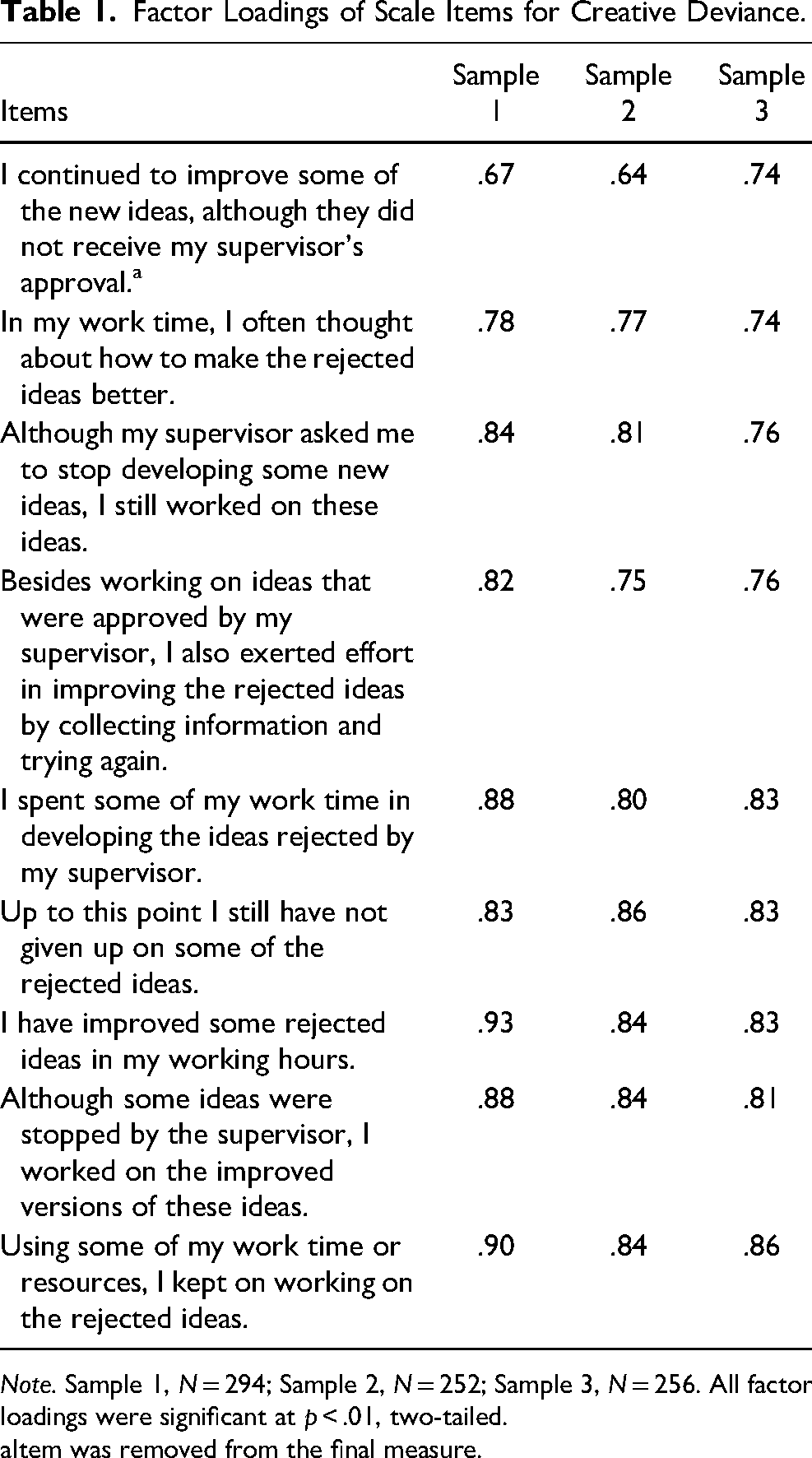
Note. Sample 1, N = 294; Sample 2, N = 252; Sample 3, N = 256. All factor loadings were significant at p < .01, two-tailed.
Item was removed from the final measure.
We further used Sample 1 to investigate the construct validity of the eight-item measure. Because creative deviance is an act of norm violation (Mainemelis, 2010), and norm violation has been found to be positively related to the dark triad personality traits (Machiavellianism, narcissism, and psychopathy) in previous research (Judge et al., 2006; Scherer et al., 2013; Zagenczyk et al., 2014), we expected dark triad personality traits to be positively correlated with creative deviance. Thus, we measured dark triad personality traits to test whether they are correlated with our measure of creative deviance.
Further, creative deviance can be triggered due to various leadership styles (Lin et al., 2016). Specifically, we expected that follower's perception that their leader enacts an autocratic leadership style would be positively associated with creative deviance, whereas, perception of a participative leadership style would be negatively associated with creative deviance. Autocratic leadership can cause reactance amongst employees whose ideas are not approved (Brehm & Brehm, 1981; Van Vugt et al., 2004), whereas participative leadership, which is marked by employees’ involvement in the collective decision-making process, is less likely to result in autocratic “idea rejection” and thus, might cause less reactance. The reactance against the supervisor's idea rejection can be the source of creative deviance. Therefore, we expected autocratic leadership to be positively related and participative leadership to be negatively related to creative deviance.
For the above reasons, we measured dark triad personality traits (Machiavellianism, narcissism, and psychopathy; a 12-item scale with four items for each of the above personality traits; dark triad measure validated by Jonason & Webster, 2010), autocratic leadership style (a 4-item scale validated by De Luque et al., 2008), and participative leadership styles (a 6-item scale from the empowering leadership measure validated by Arnold et al., 2000) to establish the convergent validity of the measure. The followers rated themselves on the dark triad and rated their leaders on autocratic and participative leadership styles. As shown in Table 2, the correlations of creative deviance with narcissism (r = .29, p < .01), Machiavellianism (r = .37, p < .01), and psychopathy (r = .41, p < .01) were positive and significant. Further, creative deviance had a positive relationship with autocratic leadership (r = .31, p < .01) and a negative relationship with participative leadership (r = −.16, p < .01). The results offer initial evidence of convergent validity.
Convergent Validity for Sample 1.
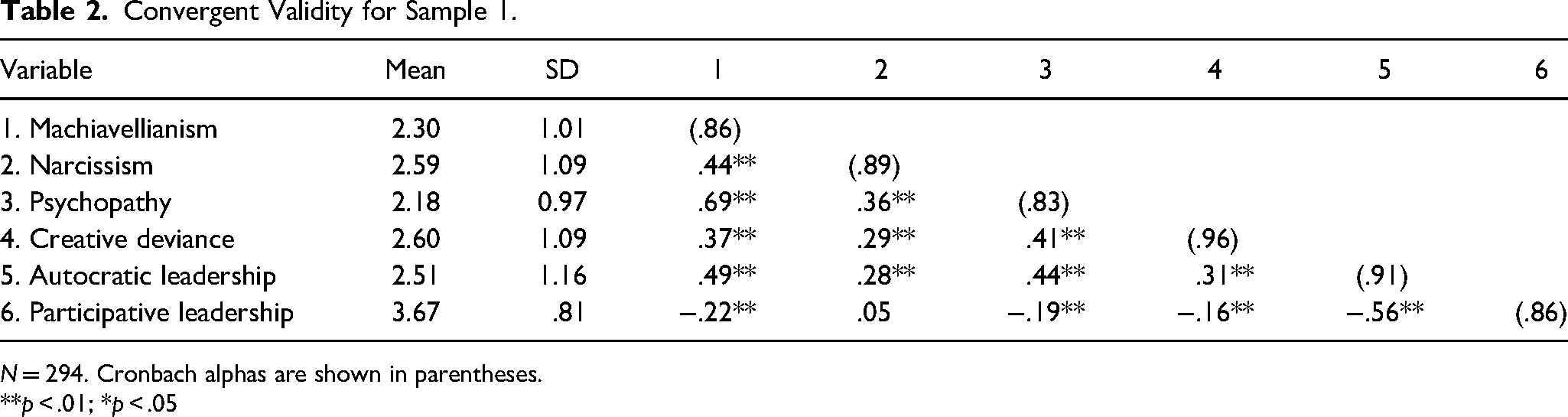
N = 294. Cronbach alphas are shown in parentheses.
**p < .01; *p < .05
To test the discriminant validity of the eight-item scale, we conducted CFA with separate models depicting six distinct factors (narcissism, Machiavellianism, psychopathy, autocratic leadership, participative leadership, and creative deviance), and five-factor models where we separately constrained creative deviance to load with items of one of the five other factors. The six-factor model was significantly better fit (χ2[390] = 886.62; CFI = .91; TLI = .90; RMSEA = .07; SRMR = .08) than the five-factor models (sample fit statistics: χ2[435] = 5915.16; CFI = .78; TLI = .75; RMSEA = .10; SRMR = .15) in which we loaded the items of creative deviance on one of the other five other latent constructs.
We further tested the convergent and discriminant validity of the eight-item measure with the orbiting constructs of bootlegging and constructive deviance. Bootlegging is defined as “the process by which individuals take the initiative to work on ideas that have no formal organizational support and are often hidden from the sight of senior management but are undertaken to produce innovations that will benefit the company” (Criscuolo et al., 2013, p. 1288). Constructive deviance is defined as the violation of some existing norms of an organization (e.g., to follow managerial orders) to conform to the hyper-norms with the intention of the organization's overall benefit (Warren, 2003). Both the above constructs have some similarities with creative deviance because they involve some form of norm violation with an intent to benefit the organization. Thus, we expected creative deviance to be moderately correlated with bootlegging and constructive deviance. At the same time, constructive deviance and bootlegging are also distinct from creative deviance. Specifically, in comparison to constructive deviance, creative deviance is not a positive or constructive form of deviance (although it can have positive outcomes) because it can lead to wastage of resources (Mainemelis, 2010). Moreover, bootlegging does not necessarily mean working on a rejected idea. Bootlegging involves working covertly on ideas without formal support from the organization, and bootlegged ideas are often informally supported by immediate leaders. Thus, we tested both convergent and discriminant validity of the creative deviance measure with constructive deviance and bootlegging.
Using validated scales, we measured bootlegging (a 4-item scale validated by Criscuolo et al., 2013) and constructive deviance (a 9-item scale validated by Galperin, 2012). As shown in Table 3, the correlations of creative deviance with constructive deviance (r = .68, p < .01) and with bootlegging (r = .37, p < .01) were significant. The results thus favored convergent validity in Sample 2. To test the discriminant validity of creative deviance from the above constructs, we conducted confirmatory factor analyses. Specifically, we tested separate models depicting three distinct factors (constructive deviance, bootlegging, and creative deviance), two-factor models where we separately constrained creative deviance to load with items of one of the two other factors, and a single-factor model where we loaded all the items on a single factor. The three-factor model was the best fit (χ2[186] = 295.19; CFI = .95; TLI = .95; RMSEA = .05; SRMR = .05). The two-factor models (χ2[188] = 612.45, CFI = .82, TLI = .80, RMSEA = .10, SRMR = .08; χ2 [188] = 432.08, CFI = .89, TLI = .88, RMSEA = .07, SRMR = .08) and one-factor model (χ2[189] = 748.36; CFI = .76; TLI = .74; RMSEA = .11; SRMR = .10) fit worse than the three-factor model.
Convergent Validity for Sample 2.
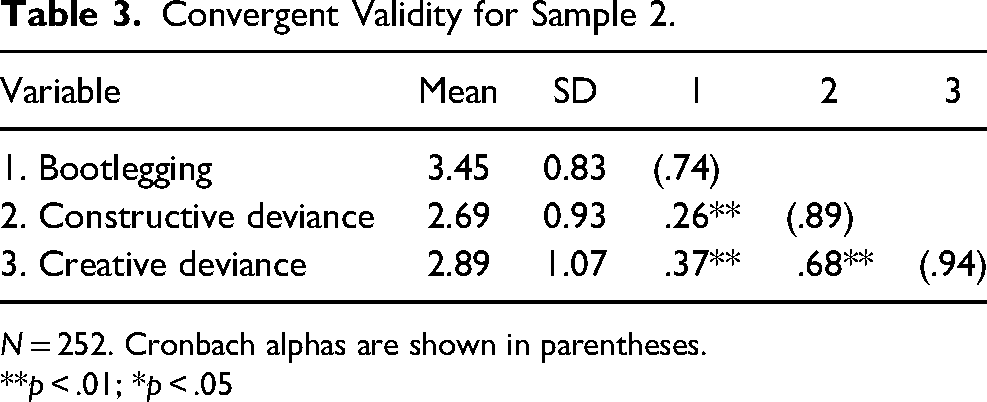
N = 252. Cronbach alphas are shown in parentheses.
**p < .01; *p < .05
We again validated the factor structure of the eight-item scale 2 using EFA and CFA. For EFA, maximum likelihood extraction was done with Promax rotation. As shown in Table 1, all eight items of the creative deviance scale loaded on a single factor for Sample 3. The eight items of the scale explained a total of 66.8% variance in the construct. The CFA also showed a good model fit for the unidimensional factor structure (χ2[20] = 19.88; CFI = .99; TLI = .98; RMSEA = .01; SRMR = .02). The convergent validity with creative behavior and workplace deviance was tested. As shown in Table 4, the correlation of creative deviance with creative behavior (r = .32, p < .01) and workplace deviance (r = .43, p < .01) were significant. The results favored convergent validity in Sample 3.
Convergent Validity for Sample 3.
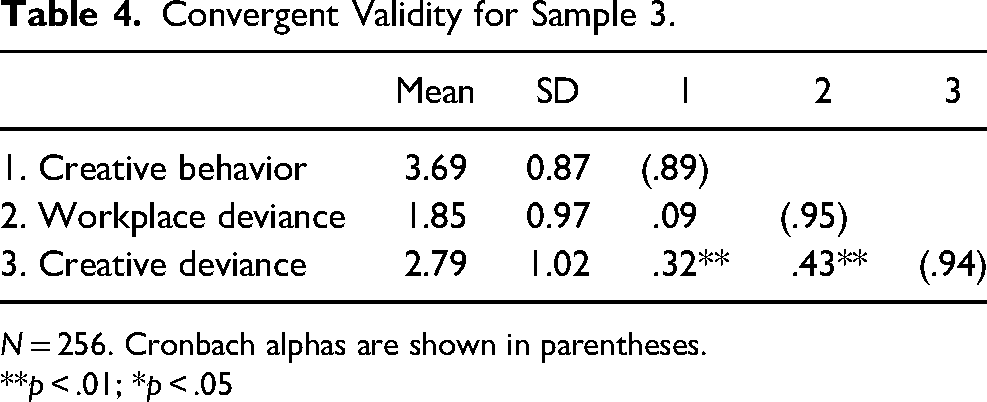
N = 256. Cronbach alphas are shown in parentheses.
**p < .01; *p < .05
Although creative deviance is likely to be correlated with creative behavior and deviance, it is different from the above constructs. Creative behavior is not always against norms whereas, creative deviance is always against the norm of following supervisory mandates. On the other hand, deviance is mostly aimed at harming the organizations or coworkers (Spector & Fox, 2005) whereas creative deviance is not aimed at harming the organizations, but instead is typically aimed to benefit the organization. To ensure that Lin et al.'s (2016) creative deviance scale shows discriminant validity from the above constructs, CFA was conducted to test the discriminant validity of the creative deviance scale. There were four separate models depicting three distinct factors (creative behavior, workplace deviance, and creative deviance), two-factor models where we separately constrained the creative deviance to load with items of one of the two other factors, and a single-factor model where we loaded all the items on a single factor. The three-factor model was the best fit (χ2[249] = 413.89; CFI = .95; TLI = .95; RMSEA = .05; SRMR = .05). The two-factor model (χ2[251] = 1223.99, CFI = .72, TLI = .69, RMSEA = .12, SRMR = .15; χ2[251] = 797.44, CFI = .84, TLI = .83, RMSEA = .09, SRMR = .09) and one-factor model (χ2[252] = 1631.61, CFI = .60, TLI = .56, RMSEA = .15, SRMR = .18) were worse fit than the three-factor model.
Discussion (Study 1)
In Study 1, we aimed to test the construct validity of Lin et al.'s (2016) creative deviance measure across a set of three separate samples. The results supported construct validity for the eight-item measure of creative deviance. As shown in Table 1, there was a similar factor structure of the scale across the three samples. The results for each sample supported convergent and discriminant validity. The study provided evidence that creative deviance is correlated, yet distinct from a variety of related personality types and related work behaviors (e.g., narcissism, psychopathy, Machiavellianism, autocratic leadership, participative leadership, bootlegging, constructive deviance, creative behavior, workplace deviance). Thus, we moved forward with testing Hypotheses 1 and 2 in Study 2, using the scale of Lin et al. (2016) that we validated in Study 1 (see Table 1).
Method (Study 2)
Study 2 examined whether psychological ownership has a positive relationship with creative deviance and whether informing leadership style attenuates this relationship. Study 2 was conducted as a vignette experiment. Online participants were presented with vignettes about a hypothetical company that develops creative online games, and they were asked to assume the role of an employee in this hypothetical company. Vignette manipulations included the construct definitions given in the extant literature on psychological ownership (Pierce et al., 2001) and informing leadership style (Arnold et al., 2000). The manipulation of psychological ownership through scenarios has been implemented successfully in earlier published research (e.g., Baer & Brown, 2012; Kirk et al., 2018; Shu & Peck, 2011). Similarly, in a recently published study, Dennerlein and Kirkman (2022) successfully manipulated empowering leadership (information leadership is a facet of empowering leadership—see Arnold et al., 2000) through vignettes. Thus, we chose electronic vignette methodology for our experimental study, creating our own vignettes, by drawing on our construct definitions.
Participants and Procedure
Two hundred one participants who worked a minimum of 20 h per week, in a variety of diverse jobs, were recruited from an undergraduate business program at a university in the southeastern United States. Participants were U.S. adults (above 18 years of age) and were offered extra credits by the course instructor for their participation in this study. The participants’ average work experience was 4.32 (SD = 2.53) years, and 43.8% of participants were female. We followed the recommendations from Aguinis and Bradley (2014) for the vignette study design. Specifically, our inclusion of participants representing diverse organizations, providing scenarios representing a creative work environment, and utilizing attention checks and manipulation checks ensured better quality data with improved internal and external validity.
We manipulated psychological ownership or PO (high/low) and informing leadership style or IL (high/low) in Study 2, and participants were randomly assigned to one of the four resulting conditions. Specifically, condition 1 was high PO and high IL, condition 2 was high PO and low IL, condition 3 was low PO and high IL, and condition 4 was low PO and low IL. Participants in all conditions were provided identical background details where they worked in a notional online gaming company—“Virtual World”—and had just received a decision from their respective manager to stop working on an idea related to the development of a video game.
The condition for high psychological ownership included the following quote: “You feel as if this organization is your own and you always say to your family and friends—‘this is my Virtual World.’ You have always felt personal ownership for Virtual World and you have a strong sense that it is your organization.” The condition for low psychological ownership included the following quote: “You do not feel as if this organization is your own. You have never felt personal ownership for Virtual World.” The following lines manipulated the high informing leadership style: “Your leader is effective in clearly communicating the goals, mission and strategic intent of the organization. Your leader did the same for this decision as well and effectively informed you of the discussions over your idea that happened in the top management team meeting.” The low-informing leadership style had the following quote: “Your leader is not effective in clearly communicating the goals, mission and strategic intent of the organization. Your leader did not communicate effectively for this decision as well and did not inform you of the discussions over your idea that happened in the top management team meeting.” Apart from the above lines manipulating the independent variable and moderator, the rest of the text in all conditions remained verbatim the same.
Measures
Results (Study 2)
A two-way between-subjects MANOVA was used to conduct the manipulation check with conditions (1, 2, 3, and 4) as the independent variable and scale scores of psychological ownership and informing leadership style as dependent variables. The multivariate effect of condition was statistically significant: Pillai's trace = .69, F (6,394) = 34.42, p < 0.01, Wilk's lambda = 0.42. The pairwise comparison analysis showed that psychological ownership scores were significantly higher in conditions 1 (Mean = 3.15, SD = .94) and 2 (Mean = 3.25, SD = .88) than conditions 3 (Mean = 2.19, SD = .88) and 4 (Mean = 2.20, SD = .89). On the other hand, informing leadership style scores were significantly higher in conditions 1 (Mean = 3.62, SD = .77) and 3 (Mean = 3.68, SD = .91), than conditions 2 (Mean = 2.25, SD = .82) and 4 (Mean = 2.03, SD = .99). Thus, it was confirmed that the manipulations worked.
Further, a 2 × 2 between-subjects ANOVA was conducted to test the effect of psychological ownership (0: Low, 1: High) and informing leadership style (0: Low, 1: High) on creative deviance. There was a significant main effect of psychological ownership on creative deviance, F(1, 197) = 5.61, p < .05, ɳ2 = .03. The average level of creative deviance in the high psychological ownership condition (Mean = 3.11, SD = .79) was higher than the average creative deviance level in the low psychological ownership condition (Mean = 2.83, SD = .91). Thus, Hypothesis 1 was supported.
The interaction of psychological ownership and informing leadership style was not significant in predicting creative deviance (F = .11, ns.). Hence, Hypothesis 2 was not supported, although we plotted the bar graphs to show the average of creative deviance scores at different levels of the manipulated variables (see Figure 2). Visual inspection of Figure 2 suggests that at the lower level of informing leadership, the high psychological ownership condition's creative deviance mean appears above the mean of creative deviance in the low psychological ownership condition. The same tendency appears at the higher level of informing leadership, however, the overall means of creative deviance at the high level of informing leadership are lower than in those at low level of informing leadership (although the effect is non-significant).
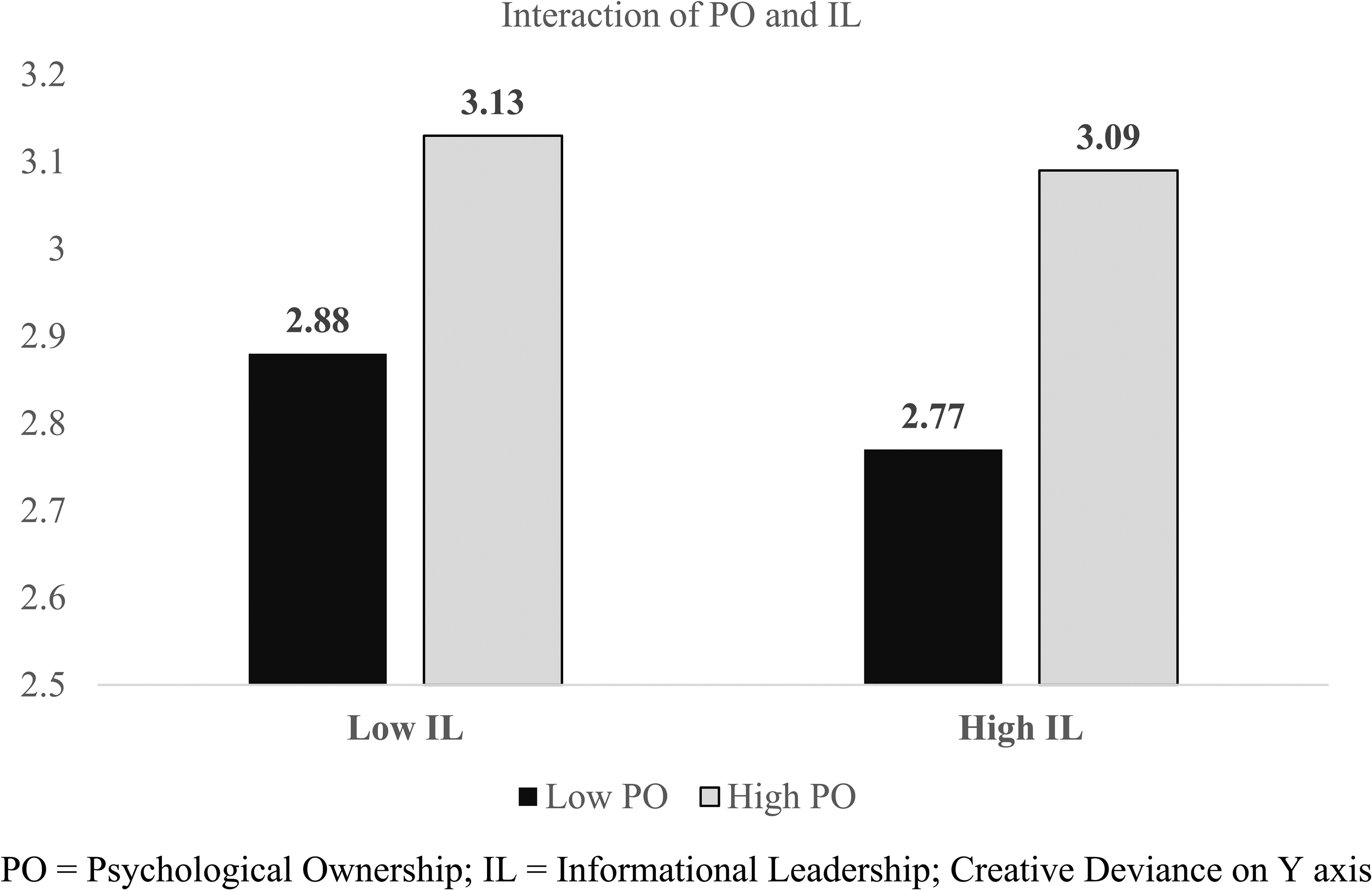
Interaction plot for creative deviance, Study 2. Note. PO = psychological ownership; IL = informational leadership; creative deviance on Y axis.
Discussion (Study 2)
The results from Study 2 provided support for our Hypothesis 1, although we did not find support for Hypothesis 2. The results showed that psychological ownership was related to creative deviance. Although the mean levels of creative deviance were quite close in the high and low psychological ownership conditions, they were significantly different from each other statistically. The use of experimental manipulations in Study 2 provided a means for enhancing the internal validity of inferences about our findings. To enhance external validity, we conducted field research in Study 3 and tested our full theoretical model.
Method (Study 3)
In Study 3, we conducted a two-wave field study with Time 1 and Time 2 surveys separated temporally by a gap of one month to minimize common method variance (Podsakoff et al., 2012). The sample was an organizational snowball sample collected through students at a large university in the southeastern United States. Students were allotted extra credit for providing an organizational contact willing to complete the Time 1 and Time 2 surveys. We collected the employee's name, company name, industry, and email addresses for each of the employees to ensure the veracity of the data. Students were instructed that the researchers would contact these individuals to validate their employment and willingness to participate in the study. In order to validate the identity of the respondents, we also checked the LinkedIn profiles of some randomly selected participants. The final sample consisted of 180 respondents (average work experience of 7.49 years, SD = 8.06; 51% females) who completed both surveys at Time 1 and Time 2. These respondents belonged to various organizations in varied industries, such as banking, telecom, fast-food restaurants, educational institutions, and others. Each student who participated in snowballing had a university given unique ID and all the respondents (whom students approached) in both surveys were asked to provide the unique ID of the student who approached them to fill the survey. We matched the Time 1 and Time 2 surveys through those unique IDs.
Measures
Results (Study 3)
Descriptive statistics and correlations for Study 3 are shown in Table 5. The correlation table shows that there were significant correlations between creative deviance and psychological ownership (r = .23, p < 0.01), psychological ownership and social undermining (r = −.17, p < .05), and creative deviance and social undermining (r = .20, p < 0.01). The above findings indicate the possibility of a mediating effect of creative deviance between psychological ownership and social undermining.
Correlations and Descriptive Stats, Study 3.
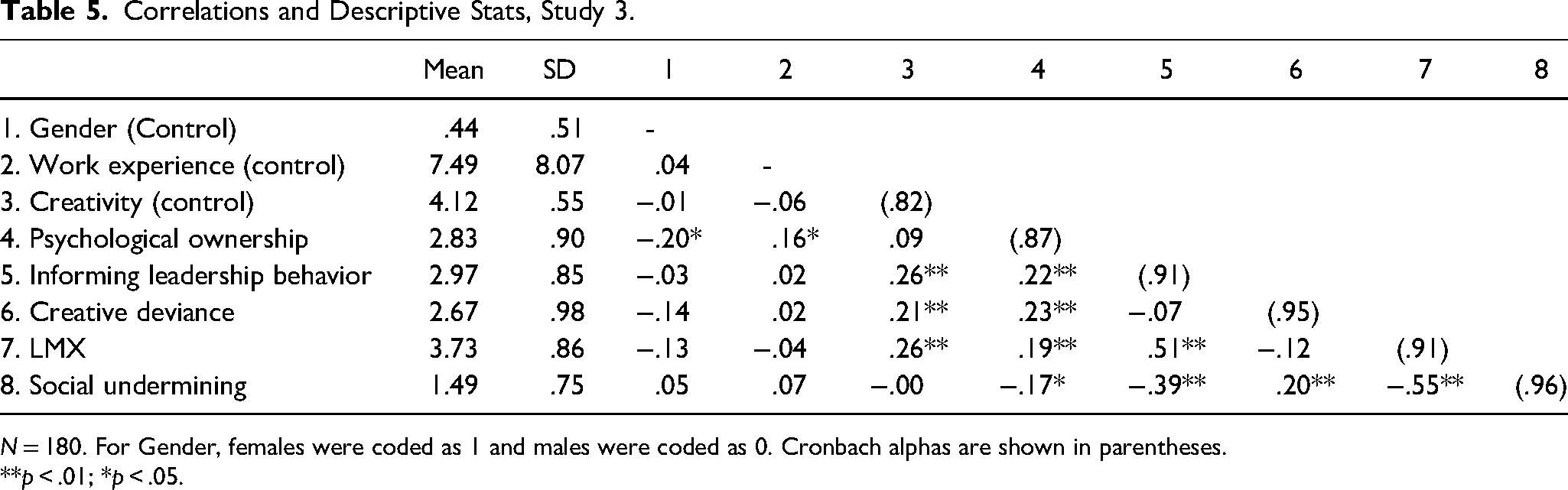
N = 180. For Gender, females were coded as 1 and males were coded as 0. Cronbach alphas are shown in parentheses.
**p < .01; *p < .05.
Model Testing
We first ran the measurement model with six latent factors (creativity, psychological ownership, informing leadership, creative deviance, LMX, and social undermining) in M Plus Version 8.6. Each of the latent variables (creativity, psychological ownership, informing leadership style, creative deviance, LMX, and social undermining) was regressed on the respective manifest variables (no parceling was used). We used the maximum likelihood indicator for the measurement model. The measurement model showed adequate fit to the data (χ2 (974) = 1586.14; CFI = .89, TLI = .88, REMSEA = .06, SRMR = .06). The alternate models showed a poor fit relative to the six-factor model (5-factor model sample stats: χ2(979) = 2078.32; CFI = .79, TLI = .78, REMSEA = .08, SRMR = .10; 4-factor model sample stats: χ2(983) = 3890.71; CFI = .45, TLI = .43, REMSEA = .13, SRMR = .22).
To test the hypotheses in our theoretical model, a path model syntax was run in M Plus V8.6. To specify the path model with the interaction (LMX×creative deviance), the interaction of the centered variables of LMX and creative deviance as well as that of psychological ownership and informing leadership were defined in the model command in M Plus. Creative deviance was regressed on psychological ownership, informing leadership and the interaction variable of psychological ownership and informing leadership. Creative deviance was also regressed on all of the control variables. Social undermining was regressed on all control variables, creative deviance, LMX, and the interaction variable of creative deviance and LMX, considering all the effects shown in our theoretical model. Moreover, using the model constraint command in M Plus, we calculated the direct, indirect, and total effects of psychological ownership on social undermining. The simple slopes were plotted for visualizing the interaction.
All the effect sizes for Study 3 are shown in Table 6. In Hypothesis 1, we proposed that psychological ownership would be positively related to creative deviance. Supporting Hypothesis 1, psychological ownership (b = .25, p < .01; 95% CI = [.09, .41]) had a positive relationship with creative deviance. In Hypothesis 2, we stated that informing leadership style would moderate the relationship between psychological ownership and creative deviance. However, the interaction of informing leadership style and psychological ownership did not significantly predict creative deviance (b = −.11, p = .17; 95% CI = [−.27, .05]). Thus, similar to Study1, Hypothesis 2 was not supported in Study 2.
Path Model Effects, Study 3.
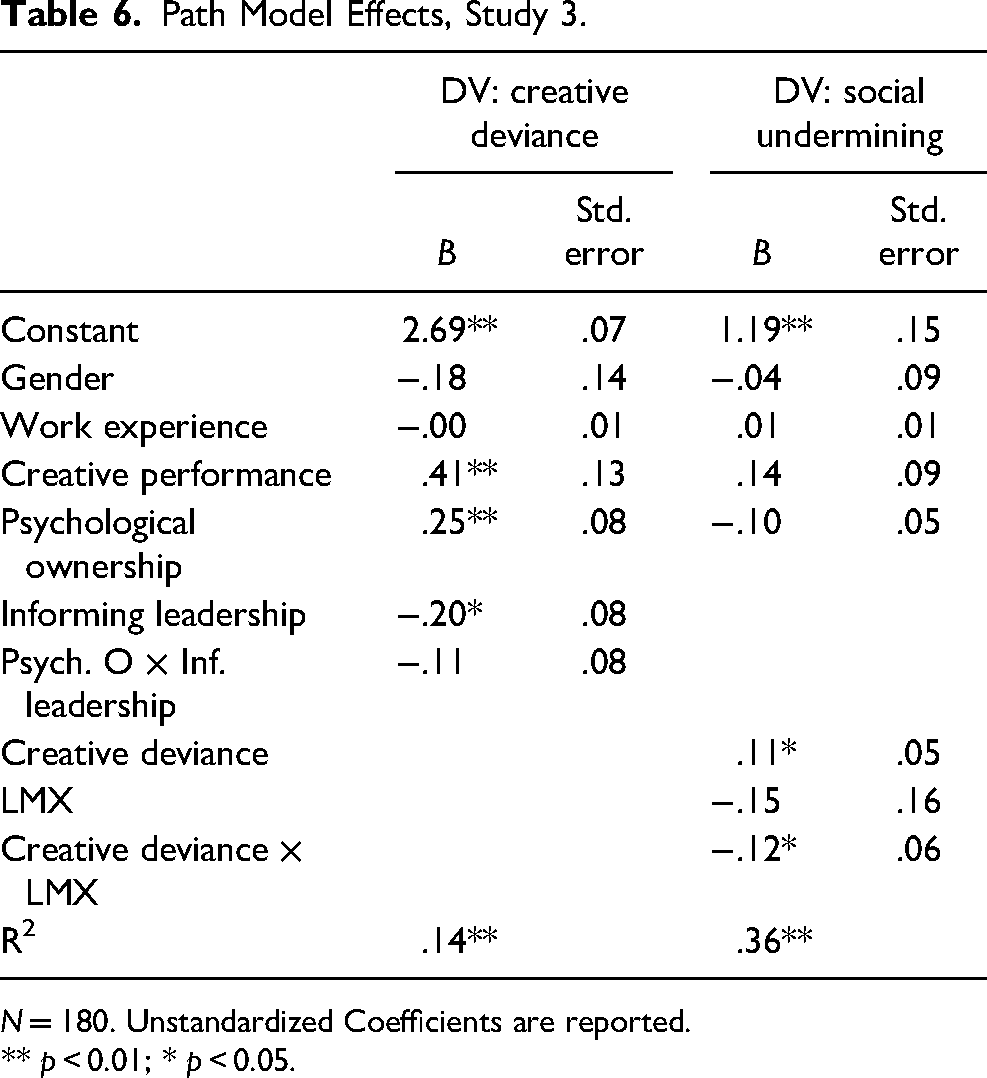
N = 180. Unstandardized Coefficients are reported.
** p < 0.01; * p < 0.05.
Recall that we hypothesized a positive relationship between creative deviance and experienced social undermining in Hypothesis 3a and the mediating role of creative deviance between psychological ownership and experienced social undermining in Hypothesis 3b. Supporting Hypothesis 3a, creative deviance had a positive relationship (b = .11, p < .05; 95% CI = [.02, .21]) with social undermining. Moreover, the indirect effect of psychological ownership on social undermining via creative deviance was significant (b = .04, p < .05; 95% CI = [.01, .09]), thus supporting Hypothesis 3b.
Finally, in Hypothesis 4, we proposed that LMX would moderate the relationship between creative deviance and social undermining. Supporting Hypothesis 4, the interaction effect of LMX (on the relationship between creative deviance and social undermining) was significant (b = −.12, p < .05; 95% CI = [−23, −.01]). We tested the direct effect of creative deviance on social undermining at low (−1 SD) and high (+1 SD) levels of LMX. The direct effect of creative deviance on social undermining was stronger (b = .20; p < .01; 95% CI = [.05, .35]) at low levels of LMX, whereas the effect became weaker and non-significant at a high level of LMX (b = −.01; p = .85; 95% CI = [−.14, .11])). We plotted the simple slopes (Aiken et al., 1991) to visualize the interaction effect at high, and low levels of LMX. The simple-slope plots (see Figure 3) conform to the hypothesized interaction effect. The simple slope tests showed that the slope at high level of LMX is significantly different than the slope at low values of LMX (Δb = .21; p < .01).
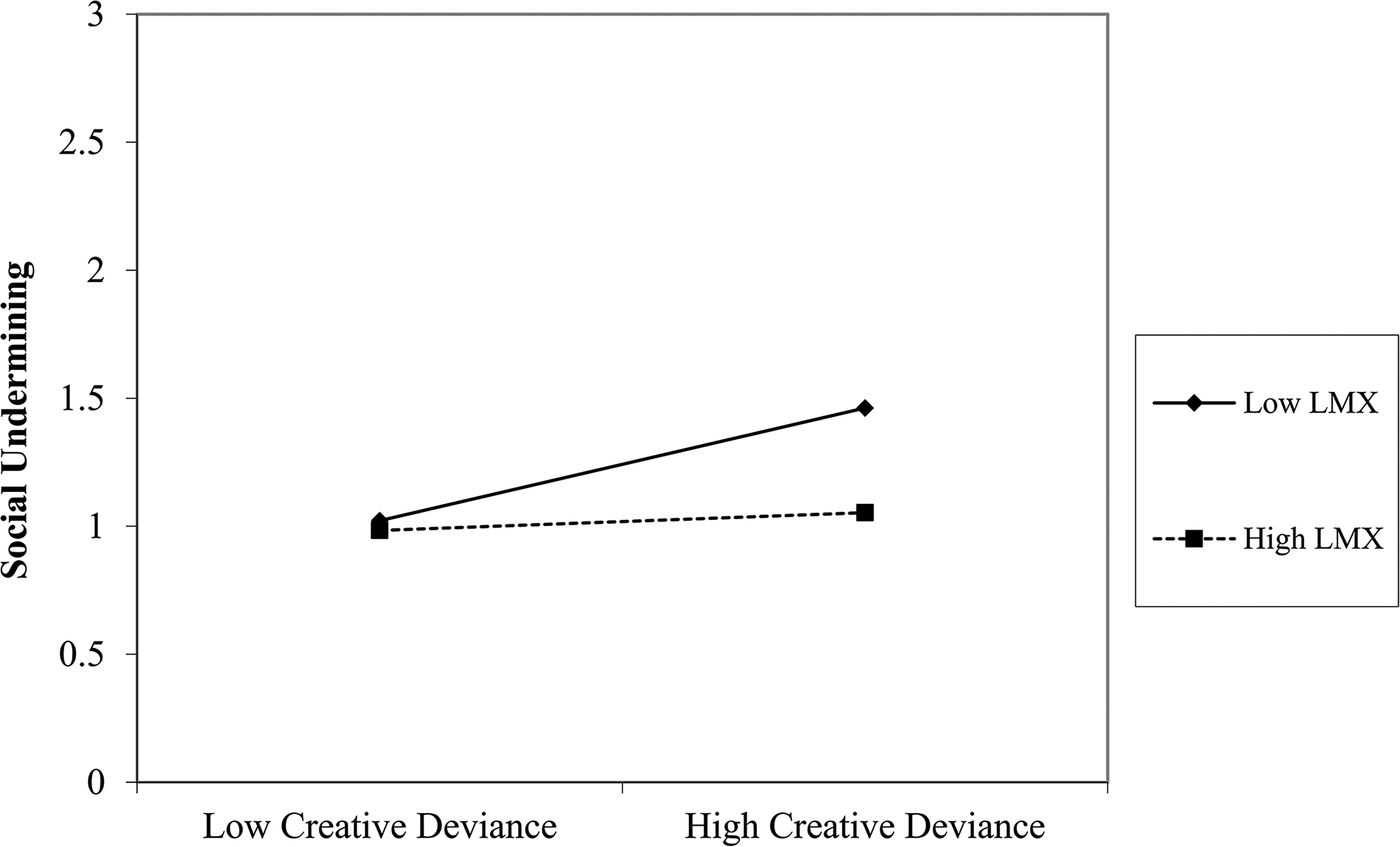
Interaction of creative deviance and LMX, Study 3.
We also tested the conditional indirect effects of psychological ownership at high (+1 SD) and low levels (−1 SD) of LMX. The indirect effect of psychological ownership on social undermining was not significant (b = .003, p = .84; 95% CI = [−.03, .03]) at the high level of LMX. On the other hand, at the low level of LMX, the indirect effect of psychological ownership on social undermining was stronger and significant (b = .06, p < .05; 95% CI = [.01, .10]).
Discussion (Study 3)
Study 3 provided evidence for the validity of our model in organizational settings except the interaction effect of informing leadership (which was also not found significant in Study 2). In line with our aims, Study 3 replicated the findings of Study 2, which was an experimental vignette study. In particular, we found that psychological ownership was positively associated with creative deviance. Creative deviance mediated the relationship between psychological ownership and employees’ perception of social undermining behavior by their supervisors. Finally, LMX moderated the effect of creative deviance on employees’ perceptions of supervisor social undermining. Study 3 further boosted the ecological validity of our research by investigating the mediating effect of creative deviance and the moderating effect of LMX among a diverse sample of employees from multiple organizations.
General Discussion
In the current research we aimed to contribute to the new and growing theoretical and empirical work on creative deviance. First, we wanted to explore and expand the nomological network of the construct of creative deviance. Second, focusing on MIPT, we aimed to explore the possible adverse social outcomes of psychological ownership and creative deviance on social undermining by the respective leaders. Finally, we also aimed to validate the scale from Lin et al. (2016) to measure creative deviance, in order to make it more accessible, valid and useful and to further encourage more studies on this important construct of creative deviance. Our studies highlight different aspects of these goals.
The findings from Study 1 demonstrated the convergent and discriminant validity of the measure of creative deviance. In Study 2 and Study 3, we aimed to better understand the antecedents, negative outcomes, and boundary conditions of creative deviance. The use of experimental manipulations in Study 2 addressed the internal validity of our inferences and supported the proposed antecedent of creative deviance, and the findings of Study 3 provided external validity evidence and supported our theoretical model (except for Hypothesis 2, which was not supported in Study 2 and Study 3). Based on psychological ownership theory, we expected that employees who felt more psychological ownership for their organization would engage in more creative deviance than employees with lower levels of psychological ownership. The findings from Study 2 and Study 3 showed that psychological ownership was positively associated with creative deviance, thus supporting our hypothesis. The empirical investigation of the nomological network of creative deviance is challenging because creative deviance is a low base rate phenomenon as our data shown in Studies 2 and 3 (Study 2: Mean = 2.97 on a 5-point scale, SD = .86; Study 3: Mean = 2.67 on a 5-point scale, SD = .98), which makes it difficult to capture the required variance in creative deviance to estimate its effects on the other variables. However, in the current research, we were able to establish psychological ownership as an antecedent and social undermining as an outcome of creative deviance.
Further, we note that our findings showed only a partial mediation effect of creative deviance between psychological ownership and social undermining, as the direct effect of psychological ownership was significant in the omnibus model. It is interesting to note that psychological ownership had a negative association with social undermining (b = −.17, p < .05; see Table 6), which means that psychological ownership in itself is not rated negatively by the supervisor and in general, is a positive trait. When psychological ownership leads to creative deviance, however, it is viewed negatively by the supervisor; in other words, the partial mediating effect of creative deviance allows for a significant positive association between psychological ownership and supervisor-inflicted social undermining.
Hypothesis 2, which proposed the moderating effect of the leader's informing behavior, was unsupported in both Study 2 and Study 3. There may be multiple reasons for the above findings. One reason could be the effectiveness of the leader's informing behavior. Although the scale we used in this study measures whether leaders inform their employees about the strategic intent behind their decision, it does not measure employees’ perceptions of how compelling the reason is and how convincing is the communication. The rationale behind the decision needs to be compelling enough to be accepted and needs to be convincingly communicated to the employee to significantly reduce the biased information processing of the management decision for idea rejection. However, it is possible in our samples that either the reason was not compelling, and/or the communication was not convincing enough. Second, the sample in Study 2 was undergraduate students which may have stronger attachment to their ideas because some research shows that younger people are more passionate about their creative ideas (Mumford & Gustafson, 1988). Finally, in Study 3, we did not measure whether the informing behavior was specific to the rationale behind the focal creative idea. It may be the case that the leader communicated management policies which were not related to the idea rejection at all. Thus, the biased information processing of the idea rejection could have prevailed even after the information sharing by the leader.
LMX moderated the effect of creative deviance on employees’ perception of social undermining by the supervisor. Creative deviance can spoil the relationship between the leader and the focal employee because the leader can process the creative deviance as insubordination from the employee (Shukla & Kark, 2020). However, positive LMX acts as a buffer against the harmful effect of creative deviance on manager-employee relationships. Further, a good relationship with the leader can also enhance the flow of information between leader and follower (Zhang et al., 2021). Further, at higher levels of LMX, managers may better understand their employees’ motivations and hence not view their creative deviance as insubordination. Thus, in the current research, we found that when the employees and leaders have better quality relationships, the effect of creative deviance on employee-experienced social undermining is weaker.
Implications for Theory
Our research has several implications for theory. First, our study contributes to psychological ownership theory (Pierce et al., 2001). Whereas prior research has primarily focused on the positive outcomes of psychological ownership (Dawkins et al., 2017; Pierce et al., 2003; Vandewalle et al., 1995), we expand the research on psychological ownership by investigating its possible negative consequences specifically in terms of social undermining. Our research integrates psychological ownership theory with MIPT (Kunda, 1990) by establishing that biased processing of information about their idea rejection can lead individuals with stronger psychological ownership to engage in creative deviance. Although earlier research has investigated the relationship between psychological ownership and motivated information processing (Scholten et al., 2007), our research is a novel attempt to empirically investigate the above relationship in the context of creative deviance. Thus, our research reinforces the connection between psychological ownership and motivated information processing in organizations and enriches the novel construct of creative deviance based on this theoretical integration.
Second, our research has implications for the literature on social undermining because it establishes the relationship between creative deviance and social undermining. There has been considerable research on how social factors (such as social position, social support, peer/supervisor inflicted undermining, and others) impact creativity (e.g., Amabile et al., 1990; Eissa et al., 2017). However, existing research sheds little light on the social sanctions that follow when the follower neglects the mandate of the leader to stop working on a creative idea. The current research contributes to the literature on social undermining by establishing motivated information processing as a theoretical basis for the relationship between creative deviance and social undermining. Moreover, the current research establishes manager-employee LMX as a boundary condition of the information processing bias. A good quality relationship with one's supervisor helps reduce biased information processing of the creative deviance which dampens the impact of creative deviance on the undermining behavior by the supervisor.
Third, our research contributes to the under-researched construct of creative deviance. Mainemelis (2010) introduced the concept of creative deviance over a decade ago; however, there has been little empirical research on creative deviance (cf. Lin et al., 2016). We provide validity evidence for a creative deviance scale that might generate more future research on this neglected construct. One of the reasons for the dearth of research on creative deviance may be the nascent stage of the theoretical development of this construct. By providing theory-based antecedents, outcomes, and boundary conditions of creative deviance, our research will help to address this conceptual gap. Moreover, our research shows the negative side of creative deviance, which is yet again an important contribution to the research on creative deviance. We expand the research on creative deviance by indicating that it can lead to the undermining of employees by their supervisors. By establishing the relationship between creative deviance and supervisor-instigated social undermining, we expand the work of Lin et al. (2016), who looked at the various emotional reactions of leaders to the creative deviance of their employees but did not shed light on the social sanctions, such as social undermining, by the leader as a reaction to a subordinate's creative deviance.
Finally, our study has implications for the literature on the theory of motivated information processing. Very few studies in the literature have investigated the possible negative effects of motivated information processing (cf. De Dreu et al., 2006). The current research applies the theory of motivated information processing to hypothesize the positive indirect relationship of psychological ownership and social undermining through creative deviance.
Implications for Practice
The current research also has some noteworthy implications for organizations. First, this research implies that leaders should be aware that they are more likely to undermine employees with whom they have lower LMX (in comparison to those with whom they have higher LMX) for the same creatively deviant behavior. For example, if two employees keep working on the same project after their leader asks them to stop working on it, the one who has a low-quality relationship with the supervisor may be undermined more harshly, thus leading to feelings of discrimination and unfair treatment. It is advisable for managers to refrain from socially undermining such employees and instead view the situation with more objectivity and to keep in mind the intent of employees behind creative deviance, which can be a positive intent for all employees.
Second, our research suggests that managers might want to anticipate which team members are more likely to exhibit creative deviance and how to judge such behaviors fairly. Thus, managers might want to anticipate that employees who have higher levels of psychological ownership can exhibit creative deviance, and such behavior may be guided by the intent of benefitting the organization. Because there are notable examples where employees have achieved significant, innovative breakthroughs while working on an idea that was initially not approved by the respective supervisor, it is worthwhile for managers to keep in mind that such employees may have a high sense of psychological ownership and an intent to benefit the organization, and thus consider carefully their decisions to punish employees who show creative deviance.
Third, the current research also informs organizations about the need for training managers on how to handle employees with higher levels of psychological ownership. Organizations need to realize that psychological ownership can have complex outcomes. Specifically, managers might become defensive when employees with high psychological ownership show creative deviance—and then socially undermine those focal employees. Managers might benefit from behavioral training on how to handle such defensiveness and how to manage employees who show high psychological ownership.
Finally, organizations can use this validated measure of creative deviance in their annual surveys to gauge employees’ level of creative deviant behavior. It might help top management be aware that some employees might have strong resentment about the rejection of their ideas. Human resource departments can develop strategies to handle such employees effectively and perhaps develop a process for reconsidering rejected ideas that might still have the potential to help the organization.
Limitations and Future Research
Although our research has important implications for theory and practice, it has some limitations that need to be addressed by future studies. First, the measures of creative deviance and social undermining were self-reported. The leaders’ reaction to creative deviance depends on whether or not it has occurred in the first place. When we measured self-rated creative deviance and the leaders’ social undermining reaction, the tacit assumption is that the leader was aware of the deviance. However, in certain cases that assumption might be wrong and the social undermining reported by the follower may be because of other behaviors apart from the creative deviance. Moreover, two followers may vary in how undermined they feel when receiving the same leader behavior based on their traits (e.g., resiliency or negative affectivity) and states (e.g., self-efficacy). This opens the possibility not only that traits and states should be investigated, but also that other-ratings may produce different results. Future research should test the model aggregating peer-ratings for creative deviance and the social undermining by the leader.
The second limitation is that our research only investigates two-time points in our multi-wave study and does not reflect on the possible temporal variance in creative deviance. Future research should attend to the temporal perspective of creative deviance by conducting longitudinal research to study its variation with respect to time.
Third, our research focused on one specific theory-driven antecedent and a single outcome of creative deviance. The nomological network of creative deviance is incomplete and unexplained in the absence of more outcomes of creative deviance. Because creative deviance has both positive (creative) and negative (deviance) components, it can potentially lead to various positive outcomes such as creative performance and innovation as well as adverse outcomes such as a waste of company resources. We strongly encourage future research to explore these outcomes of creative deviance and their respective boundary conditions.
Fourth, as described in the discussion section, there may be more antecedents of creative deviance that can be explained by some other theory than the theory of motivated information processing. For example, affective commitment towards external stakeholders might lead to creative deviance when the focal employee decides to listen to the customer over his/her supervisor. The theory of reactance (Brehm & Brehm, 1981) may offer other antecedents of creative deviance, for example, autocratic leadership. Because autocratic leadership can prompt subordinates to engage in deviant acts as retribution against the autocratic leader (Erdem, 2021), autocratic leadership may lead to the deviant act of ignoring the leader's mandate to stop working on an idea. Future research should thus investigate other theories and respective antecedents as well as boundary conditions for creative deviance.
Finally, the current research has investigated only a limited set of moderators. There may be other moderators of the relationship between creative deviance and social undermining. For example, the social skills of the focal individuals can improve their idea selling (Amabile & Pillemer, 2012) and thus, could potentially lead to the attenuation of undermining behavior. Similarly, other boundary conditions such as team structure (organic vs. mechanistic) could potentially influence the relationship between psychological ownership and creative deviance. Future research should thus investigate more boundary conditions between creative deviance and social undermining.
Furthermore, creative deviance, as well as ownership, may be related to culture, and within different organizational cultures (e.g., tight vs. loose, high vs. low power distance), as well as organizational climates (e.g., innovative, quality climate), it might play out differently. For example, in tight and high-power distance cultures (Gelfand et al., 2004), employees may fear risking an ego threat to the leader and thus, may be less likely to engage in creative deviance even at higher levels of psychological ownership. Similarly, an innovative climate may give employees more freedom and thus, can enhance the effect of psychological ownership on creative deviance. We recommend that future studies should explore these kinds of dimensions.
Conclusion
Creative deviance is a significant phenomenon in organizations. Still, it has received limited attention by organizational scholars. There is a need to further develop the nomological network of creative deviance and study its impact on the individual, group, and firm levels. Our study explores the individual-level antecedents and boundary conditions of creative deviance to establish a part of its nomological network. We hope this study prompts additional research to further explore this fascinating and complex construct.
Supplemental Material
sj-docx-1-jlo-10.1177_15480518231226093 - Supplemental material for Disobeying the Leader: Creative Deviance as a Mechanism Between Psychological Ownership and Social Undermining
Supplemental material, sj-docx-1-jlo-10.1177_15480518231226093 for Disobeying the Leader: Creative Deviance as a Mechanism Between Psychological Ownership and Social Undermining by Jigyashu Shukla, Rebecca Bennett, Robert Folger and Ronit Kark in Journal of Leadership & Organizational Studies
Footnotes
Acknowledgments
We are thankful to Dr. Sandra Robinson for her developmental feedback during the manuscript revision stages.
Declaration of Conflicting Interests
The authors declared no potential conflicts of interest with respect to the research, authorship, and/or publication of this article.
Funding
The authors received no financial support for the research, authorship, and/or publication of this article.

Supplemental Material
Supplemental material for this article is available online
Notes
References
Supplementary Material
Please find the following supplemental material available below.
For Open Access articles published under a Creative Commons License, all supplemental material carries the same license as the article it is associated with.
For non-Open Access articles published, all supplemental material carries a non-exclusive license, and permission requests for re-use of supplemental material or any part of supplemental material shall be sent directly to the copyright owner as specified in the copyright notice associated with the article.
