




Abstract
Despite the extensive interest in abusive supervision, there remains conceptual ambiguity surrounding it, specifically concerning the overlap between leaders’ actions and subordinates’ perceptions. Drawing from leadership categorization theory, we propose that authoritarian leadership activates subordinates’ anti-prototype of leaders and perceptions of more abusive supervision. Moreover, such a relationship is moderated by subordinates’ ideal and typical leadership schema, with the former representing individual preference and the latter representing the social norm. Using an experiment (N = 344) and a multi-wave field study (N = 249), we found that subordinates holding high ideal leadership prototypicality (e.g., my ideal leader is sensitive) and low typical leadership anti-prototypicality (e.g., other leaders are domineering) perceive more leadership anti-prototypicality and more abusive supervision when faced with authoritarian leadership. Our research enriches the existing literature on leadership by providing a cognitive perspective that explains how subordinates’ implicit leadership schemas play a role in the leadership perception process.
Keywords
Introduction
Abusive supervision, defined as “subordinates’ perception of the extent to which supervisors engage in the sustained display of hostile verbal and nonverbal behaviors, excluding physical contact” (Tepper, 2000, p. 178), is perceived as one of the most unfavorable and destructive types of leadership. Abusive supervision is linked to numerous detrimental consequences, including reduced employee well-being, diminished quality of work life, decreased organizational commitment, elevated turnover rates, and increased incidents of deviant behaviors (e.g., Fischer et al., 2021; Zhang et al., 2022). According to Tepper et al. (2007), the cost to U.S. corporations resulting from abusive supervision has been estimated at an annual total of $23.8 billion. Although abusive supervision has received widespread attention from both the academic and industrial worlds, there is some conceptual ambiguity about abusive supervision: it is the conflation of leaders’ behavior and subordinates’ evaluation. However, as noted by Martinko et al. (2017), abusive supervision literature usually focused on leaders and ignored the contributions that subordinates make to the dynamic process of leadership.
In other words, there are cases when faced with the same behavior, subordinates would interpret differently about whether their leaders’ behaviors are abusive or not (Fischer et al., 2021; Tepper, 2000). For example, in the military background where obeying leaders’ order is one the most important rules, leaders’ authoritarian behaviors would be considered common, and thus less abusive; but switching to another context, for example, in a relatively young and dynamic business team which emphasizes flat and democratic management structure, an authoritarian leader would be considered as more hostile and abusive (Duehr & Bono, 2006). People with different leadership schemas and in the different social context would attribute leaders’ behaviors differently. However, there is little research exploring the interplay of leaders’ behaviors and subordinates’ cognitive processes on abusive supervision. Such exploration is important because theoretically, it adds a new perspective of our understanding of how perception of abusive supervision may be formed, and practically, it reminds leaders to be cautious of their own behaviors. They should be aware of that in a world full of international cooperation, a certain leadership style, such as authoritarian leadership, which may be common in one culture or for one generation, might be interpreted more negatively when subordinates hold different leadership schemas.
Drawing from leadership categorization theory (Lord et al., 1984), the current study intends to investigate how leadership style and subordinates’ categorizations shape subordinates’ perception of abusive supervision. One leadership style that is closely related to abusive supervision is authoritarian leadership, which refers to an approach to leadership that emphasizes the use of authority to control subordinates (Cheng et al., 2004; Schaubroeck et al., 2017). Comparatively speaking, compared to authoritarian leadership, abusive supervision may be less likely to define because subordinates may interpret the same behaviors (e.g., public joking) as offensive or hostile differently (Fischer et al., 2021; Li et al., 2021).
Leadership categorization theory suggests that subordinates categorize leaders by implicitly comparing leaders to their cognitively representative attributes of a leader, i.e., leadership prototype (Lord et al., 1984). When the leaders match the subordinates’ positive prototype, they are appraised more favorably, and vice versa. We propose that authoritarian leadership, by activating subordinates’ leadership negative prototype (i.e., anti-prototype), gives rise to subordinates’ perception of abusive supervision. However, prototypes are individually held and can potentially vary among subordinates. Subordinates compare leaders in reality with their ideal prototypes and then categorize the leaders as effective or not. We posit that subordinates who hold higher expectations feel that authoritarian leadership is more intolerant and negative, and thus more abusive.
Additionally, according to the connectionalist model (Lord et al., 2001; Sherman, 1996), a recent development of leadership categorization theory, subordinates’ categorization is not only determined by their own ideals but is also influenced by social norms (Junker & Van Dick, 2014). Additional to ideal prototypes, subordinates also perceive typical leadership, which represents the average leadership of social acceptance or norms. Subordinates’ ideal prototypes embody their expectations and preferences for supervisor behavior, often aligning with personal tastes and objectives (Cialdini & Trost, 1998). Typical leadership prototypes are based on central tendencies, and reflect the recognized average leadership within a specific environment (Barsalou, 1985). For example, it is possible that a subordinate's ideal prototypical leader is humble or democratic, but the environment or culture conveys the information that a typical leader should be more dominant, and he or she accepts the role. Therefore, authoritarian leadership, subordinates’ ideal leadership prototypicality (ILP; e.g., my ideal leaders are sensitive), and typical leadership anti-prototype (TLA; e.g., leaders should be domineering) may interact with each other to influence subordinates’ leadership categorization process and serve as benchmark to perceive abusive supervision. The theoretical model is manifested in Figure 1.
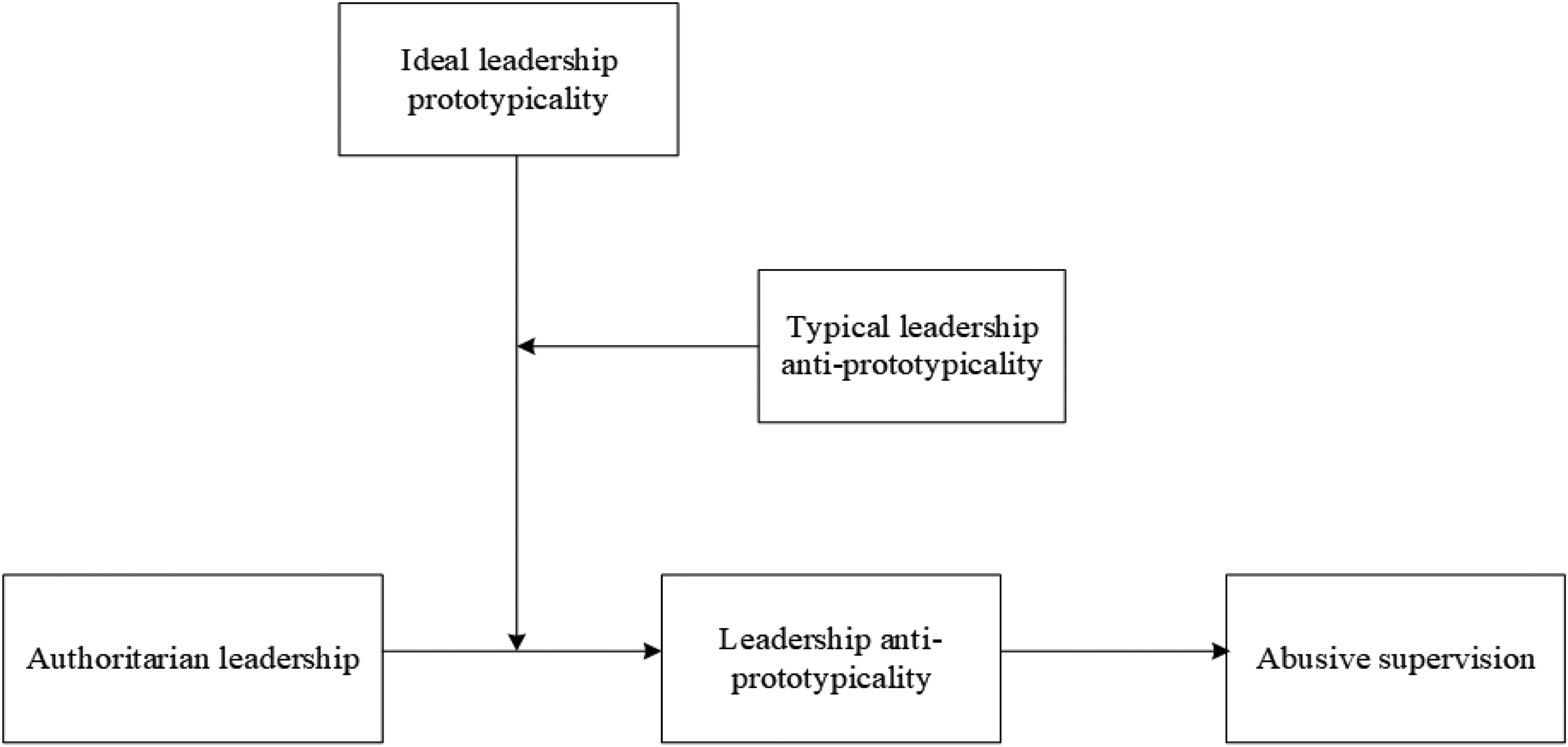
Theoretical model.
Our research makes three contributions to the current research. First, drawing on leadership categorization theory (Lord et al., 1984), we delineate the process of how authoritarian leadership may be perceived as abusive supervision. Prior research is limited to a positive relation between the two leadership, and we highlight the importance of subordinates’ cognition and interpretations of abusive supervision. Only by understanding subordinates’ interpretations can supervisors be more cognizant of their authoritarian leadership behaviors. Second, our research extends leadership categorization theory by simultaneously exploring subordinates’ ideal and typical leadership (anti-) prototypicality, which are largely neglected or mixed by previous research (e.g., Junker & Van Dick, 2014). Our study provides empirical evidence for the arguments and examines subordinates’ implicit leadership schema in a more subtle way.
The theoretical framework
Leadership categorization theory suggests that subordinates, through socialization and past experiences with leaders, develop implicit leadership prototypes, which are “dynamic cognitive knowledge structures used by individuals to process information regarding the managerial leadership” (Epitropaki & Martin, 2005, p. 659). These prototypes are implicitly activated to benchmark actual leaders and to eventually determine subordinates’ evaluation of and responses to their leaders (Epitropaki & Martin, 2005). Researchers have termed the universally welcome qualities of leaders as “prototypical” leadership (e.g., sensitivity) and unwelcome qualities “anti-prototypical” leadership (e.g., tyranny) (Epitropaki & Martin, 2004). Such categorizations would later influence subordinates’ perceptions of supervisors (Weick, 1995).
Authoritarian leadership, anti-prototypicality, and abusive supervision
The central tenet of leadership categorization theory is that supervisors’ attributes may activate subordinates’ leadership (anti-) prototypicality and further influence subordinates’ perceptions of their supervisors (Lord et al., 1984). Epitropaki and Martin (2004) reduced the attribute set of leadership (anti)-prototype of Offermann et al. (1994) to six factors, which is comprised of four prototypicalities (sensitivity, intelligence, dedication, and dynamism) and two anti-prototypicalities (tyranny and masculinity). Although leadership schemas are somewhat idiosyncratic to each subordinate, studies have shown that leadership (anti)-prototypes are relatively universalistic (Epitropaki & Martin, 2004).
According to leadership categorization theory, authoritarian leadership, characterized by its emphasis on supervisors’ absolute control and subordinates’ unquestioning compliance (Chen et al., 2014), is likely to activate subordinates’ anti-prototypical leadership perceptions of tyranny and masculinity. Typical forms of authoritarian leadership include severely punishing subordinates who do not listen to them or follow the rules, making unilateral decisions and keeping most of the employees away from the central decision area (Aryee et al. 2007). It fits leadership anti-prototypicality of characteristics of being domineering, selfish, and conceited. Thus, we propose that authoritarian leadership is more likely to activate subordinates’ anti-prototypical leadership perceptions.
Authoritarian leadership is positively related to leadership anti-prototypicality.
Furthermore, leadership categorization theory (Lord et al., 1984) states that subordinates appraise supervisors who fit leadership anti-prototypes more unfavorably. As one of the least favorable leadership styles among subordinates, abusive supervision is more likely to be perceived when subordinates’ leadership anti-prototypes are activated. Although abusive supervision is manifested by a plethora of observable behaviors, Tepper and other scholars admitted abusive supervision is a subjective evaluation that may vary across different subordinates or situations (Martinko et al., 2017; Tepper et al., 2017).
According to leadership categorization theory (Lord et al., 1984) and the literature on a broader concept of social information processing (e.g., Salancik & Pfeffer, 1978), subordinates selectively pay attention to and code environmental information that is highly relevant to them. Authoritarian leaders who fit the anti-prototype category are given the label of the category and stored in subordinates’ long-term memory together with this label (Phillips, 1984). Such impressions serve as benchmark to motivate subordinates to give selective attention to information that is identified with the selection mechanism. In other words, once leadership anti-prototypes are activated, subordinates become more sensitive to and seek congruent information that reinforces subordinates’ judgment and categorization. When asked to evaluate their supervisors’ authoritarian leadership, subordinates would use this label to retrieve the associated attributes and thus perceive more abusive supervision (Mackey et al., 2017; Martinko et al., 2011). Based on this argument, we propose the following hypothesis.
Leadership anti-prototypicality mediates the positive relation between authoritarian leadership and perceptions of abusive supervision.
Interactive effects of authoritarian leadership, ILP, and TLA on the leadership perception process
When integrating leadership categorization theory and the recent development of the connectionist model (Lord et al., 1984; 2001), leadership (anti-) prototypes show considerable stability but can be adjusted, as the activation of input may be connected to self- and higher-level constraints that change from situation to situation. Such constraints, according to Junker and Van Dick (2014), can be reflected in the norm of prototypes, which is represented by ideal vs. typical prototypes. Ideal and typical leader images are strongly related to each other but are not identical (Van Quaquebeke et al., 2014). Ideal prototypes are expectations about how subordinates would like supervisors to be or not to be (Cialdini & Trost, 1998). It can be quite extreme and is strongly related to subordinates’ personal tastes and goals, whereas a typical or central tendency-based leadership prototype reflects subordinates’ recognition of an “average of leadership” of the certain environment (Barsalou, 1985).
An attribute can be representative of a typical leader but can be seen as undesired for an ideal leader and vice versa. For example, Schyns and Schilling's (2011) study categorized 21 leadership attributes as typical but undesirable and 23 attributes as atypical but ideal. A relatively young subordinate who just graduated from school may hold higher ILP because their experiences may be drawn from books that sometimes idealize the leaders (Abdalla & Al-Hamoud, 2001). In a military environment, typical leaders are more likely to be masculine, domineering and loud. Such constraints reinforce the activation patterns that drive individuals’ perceptions and judgments about their supervisors (Duehr & Bono, 2006).
Previous literature usually pays more attention to ideal rather than typical leadership schemas (Zacher et al., 2015). Additionally, Van Quaquebeke and Van Knippenberg (2012) stated that subordinates’ perceptions of ideal leaders have a stronger moderating effect than typical leaders on leadership categorization. The current study follows prior research and first proposes the moderating effect of ILP between authoritarian leadership and the activation of leadership anti-prototypicality.
Epitropaki and Martin (2004, 2005) suggested that the same leader behavior may be interpreted differently depending on differences in the employee's ILP. The greater the supervisor represents subordinates’ ILP, the easier it is for the subordinates to recognize supervisors’ desirable qualities and categorize the supervisor into the positive prototype. Individuals tend to endorse leader characteristics that align with their ideal prototypes. Within the scenario, it seems reasonable to expect that subordinates who endorse higher ILP are more likely to feel dissonance and disappointment when authoritarian leaders display dominant and controlling behaviors that violate ideal leadership traits, and are more likely to categorize authoritarian leaders into anti-prototypes. Similar to our previous line of argument, we contend that individuals with high ILP are more likely to perceive the negative characteristics of supervisors and thus a higher level of abusive supervision. Based on these arguments, we develop the following hypothesis.
ILP moderates the positive relation between authoritarian leadership and leadership anti-prototypicality in a way that subordinates with higher ILP perceive a stronger relation between authoritarian leadership and leadership anti-prototypicality.
ILP moderates the mediating effect of leadership anti-prototypicality between authoritarian leadership and the perception of abusive supervision in a way that the higher ILP is, the stronger the mediating effect of leadership anti-prototypicality will be.
As noted by Junker and Van Dick (2014), subordinates’ indication of how far they endorse ILP, however, does not tell the whole story of how deeply they categorize and perceive leaders in reality. In addition to ILP, Barsalou (1985) proposed typical leadership prototypes, meaning that some prototypes or anti-prototype characteristics represent a descriptive norm (Cialdini & Trost, 1998). Additionally, as found by Dijksterhuis and Van Knippenberg (1998), exclusive idealized exemplars (e.g., Albert Einstein) evoke contrasting reactions in participants, but a typical schema (e.g., professors) facilitates participants in assimilating the characteristics (e.g., intelligent). Adapted to the leadership situation, those findings imply a three-way interaction of leadership behaviors, subordinates’ ideal and typical (anti)-prototypicality on subordinates’ categorization of leaderships.
However, most studies focus on ILP, and the impact of a negative prototype fit may be systematically underestimated (Junker & Van Dick, 2014). In some organizational contexts, it is relatively common for a leader to show anti-prototypicality, such as domineering, conceited, and pushy (Epitropaki & Martin, 2004, 2005; Lord & Maher, 2002). Such norms may be highly related to higher-level context. For example, in a culture of high-power distance, tyrant leaders seem to be common, and subordinates may normalize the anti-prototypicality, and such acceptance of normalized anti-prototypicality may attenuate the moderated negative effect of ILP on authoritarian leadership and leadership anti-prototypicality. Therefore, we propose a three-way interaction of authoritarian leadership, ILP and TLA.
Furthermore, we argue that the combination of high ILP and low TLA (i.e., their blend) will facilitate the mediating effect of the activation of leadership anti-prototypical between authoritarian leadership and abusive supervision. When subordinates expect their supervisors to be concerned and sensitive to subordinates’ needs and welfare and such expectations align with the social norm that typical supervisors are not supposed to be domineering or tyrannical, subordinates faced with authoritarian leadership will categorize supervisors into anti-prototypes, which would serve as benchmark to subsequently interpret supervisors’ domineering behavioral signs to be more abusive (e.g., Fulk et al., 1987).
TLA moderates the moderating effect of ILP between authoritarian leadership and leadership anti-prototypicality in a way that the positive relation between authoritarian leadership and anti-prototypicality is the strongest when ILP is high (vs. low) and TLA is low (vs. high).
TLA moderates the moderated mediating effect of leadership anti-prototypicality between authoritarian leadership and the perception of abusive supervision in a way that the mediating effect of anti-prototypicality is the strongest when ILP is high (vs. low) and TLA is low (vs. high).
Overview of studies
We conducted an experiment (Study 1) and a multi-wave field study (Study 2) to test our theoretical model. All participants were recruited from China because authoritarian leadership is relatively more common there. This context enables employees to better discern the differences between authoritarian leadership and abusive supervision. Compared to other Western countries with lower power distance, people in China may be less likely to consider authoritarian leadership as anti-prototypical. In Study 1, we tested the indirect effect of authoritarian leadership on abusive supervision through activation of the leadership anti-prototype and whether this mediating effect is moderated by subordinates’ ILP. This will help establish internal validity. However, its external validity may be questioned. In Study 2, we employed a multi-wave field study to establish the external validity of our full model, including two moderators of ILP and TLA. Altogether, these studies will provide complementary evidence for our theoretical model. The results of the current two studies have been uploaded to: https://osf.io/s2z84/
Study 1 method
Participants
We recruited 343 participants with the help of advertising by friends, laboratory colleagues, and classmates. Participation in the current study was voluntary and confidential, and participants were compensated 2.33 dollars. After removing those who answered the attention check item wrong (“please choose ‘strongly disagree’ for the item”), the final sample consisted of 334 participants. Of the participants, 31.8% were between 20 and 25 years old, 41.1% were between 26 and 30 years old, 18.5% were between 31 and 40 years old, and 30% were male. Participants were from various provinces of China. Specifically, approximately 13.6% of them hailed from Shandong province, while 12.8% came from the same province. Additionally, 6.5% were from Zhejiang province, 6.2% from Hubei province, 5.6% from Henan province, and 4.5% of the participants were from Beijing province. All the participants were full-time employees, 50.4% of the participants were employees, 28.0% were junior managers, and 15.2% were middle and upper managers or directors.
Design and procedure
In this experiment, participants were instructed to add the second author as friends through WeChat, the most popular social software in China. Participants provided informed consent. Approval for the study was obtained from the ethics committee of the authors’ university. All procedures used in this study adhered to the tenets of the Declaration of Helsinki. Prior to the formal experiment, participants were asked to complete questionnaires measuring their ILP and demographics.
Then, participants were randomly presented with material depicting a scenario in which they image their role as being A, who needs to work with and report to supervisor B (Liu). In the experimental group, supervisor B (Liu) was described as being strict, task-oriented, and dictatorial in the interactions with subordinates at work, whereas in the control group, supervisor B (Liu) was depicted as being open minded, equal and more caring for the subordinates at work. Each reading material consisted of four typical scenarios and was based on the concepts of authoritarian leadership and interviews with eight experienced employees who had more than 3 years of working experience.
The reading materials were previously tested among 120 students (mean age = 21.59; SD = 3.00) at the first author's university. Students were randomly assigned to read the two materials and then rated from 1 (“strongly disagree”) to 5 (“strongly agree”) on three items adapted from the scale of Chen et al. (2014) about authoritarian leadership of supervisor B (Liu). One example item was “I feel B is the kind of supervisor who needs subordinates to obey his or her constructions instructions completely” (α = .91). The result of t-test revealed that students in the experimental group felt higher authoritarian leadership (M = 4.17, SD = .98) than the control group (M = 2.14, SD = .90), t (120) = 11.88, p < .001, indicating that the material could successfully boost participants’ perceptions of authoritarian leadership.
Then, in the formal experiment, after reading the tested materials, participants were asked to choose whether the supervisor presented in the material fit the description of authoritarian leadership and to what extent the supervisors fit the characteristics of anti-prototype leadership, and to which extent they would rate the manager as being abusive.
Measures
Scales that were originally written in English were translated into Chinese following the translation and back-translation procedure (Brislin, 1970).
Ideal leadership prototypicality (ILP)
Was measured with the adapted implicit leadership scale of Epitropaki and Martin (2004). It consisted of 13 items. Participants indicated how each item was characteristic of their ideal leader on a scale from 1 (“not at all characteristic”) to 10 (“extremely characteristic”). Example items included the following: sensitive, dedicated, and intelligent. The Cronbach's alpha was .95.
Leadership anti-prototypicality
Was assessed with the 7-item anti-prototypical characteristics of the implicit leadership scale of Epitropaki and Martin (2004). Participants indicated how characteristic each item was of their perceptions of supervisor B on a scale from 1 (“not at all characteristic”) to 10 (“extremely characteristic”). Example items included being manipulative, domineering, and pushy. The Cronbach's alpha was .90.
Abusive supervision
Was measured by Mitchell and Ambrose's (2007) 5-item scale. Participants were asked to rate their perception of supervisor B from 1 (“strongly disagree”) to 5 (“strongly agree”). An example item was “he put me down in front of others”. The Cronbach's alpha was .83.
Study 1 results
Preliminary analyses
First, we conducted confirmatory factor analyses (CFAs) in Mplus 7.4 (Muthen & Muthen, 1998–2012) to examine whether measured scales represent distinct constructs. The hypothesized three-factor model exhibited a good fit (χ2(296) = 642.51, p < .001, RMSEA = .06, CFI = .95, TLI = .95, and SRMR = .04), which was better than alternative models. Further, descriptive statistics and correlations of the variables are shown in Table 1.
Means, Standard Deviations, and Correlations of the Focal Variables.
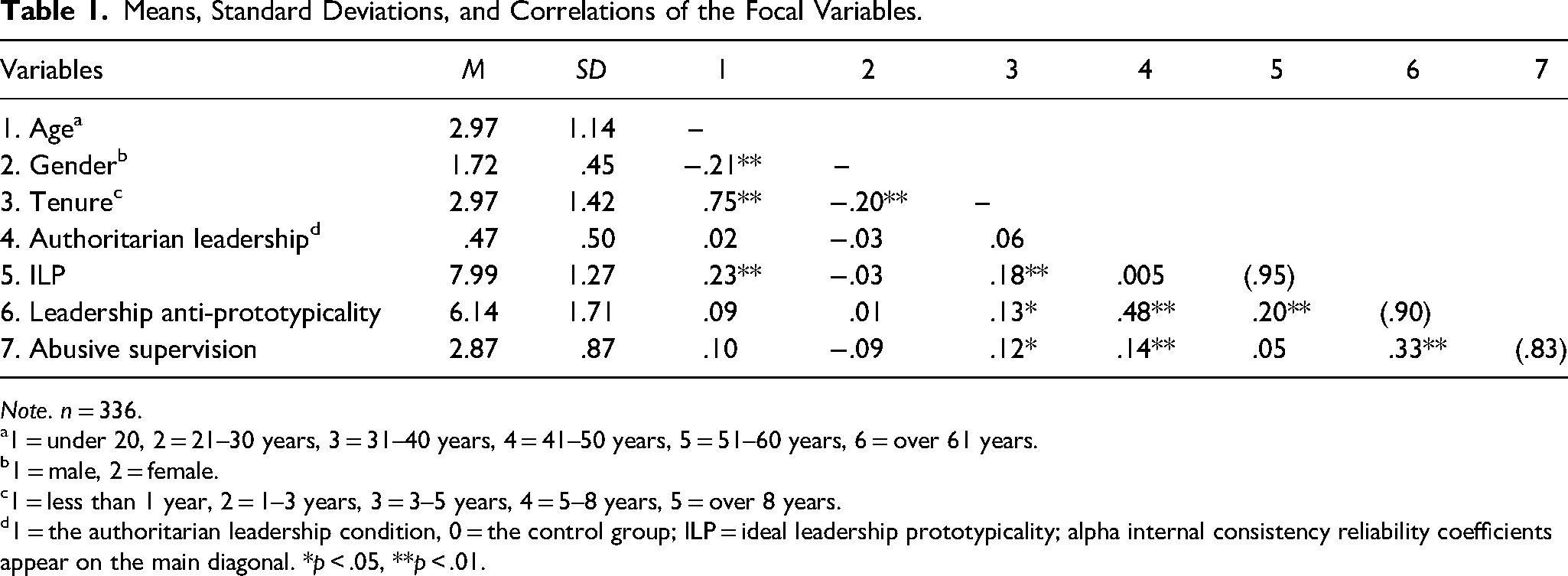
Note. n = 336.
1 = under 20, 2 = 21–30 years, 3 = 31–40 years, 4 = 41–50 years, 5 = 51–60 years, 6 = over 61 years.
1 = male, 2 = female.
1 = less than 1 year, 2 = 1–3 years, 3 = 3–5 years, 4 = 5–8 years, 5 = over 8 years.
1 = the authoritarian leadership condition, 0 = the control group; ILP = ideal leadership prototypicality; alpha internal consistency reliability coefficients appear on the main diagonal. *p < .05, **p < .01.
Hypotheses testing
Hypothesis 1 proposed that authoritarian leadership is positively related to leadership anti-prototypicality. The Independent Samples t-test results revealed that participants in the authoritarian leadership condition (M = 7.01, SD = 1.31) rated higher leadership anti-prototypicality than those in the control condition (M = 5.38, SD = 1.66), t (334) = 9.90, p < .001, Cohen's d = 1.10. Therefore, Hypothesis 1 was supported (see Table 2).
Means (SDs) of the Main Variables as a Function of Experimental Condition (Study 1).
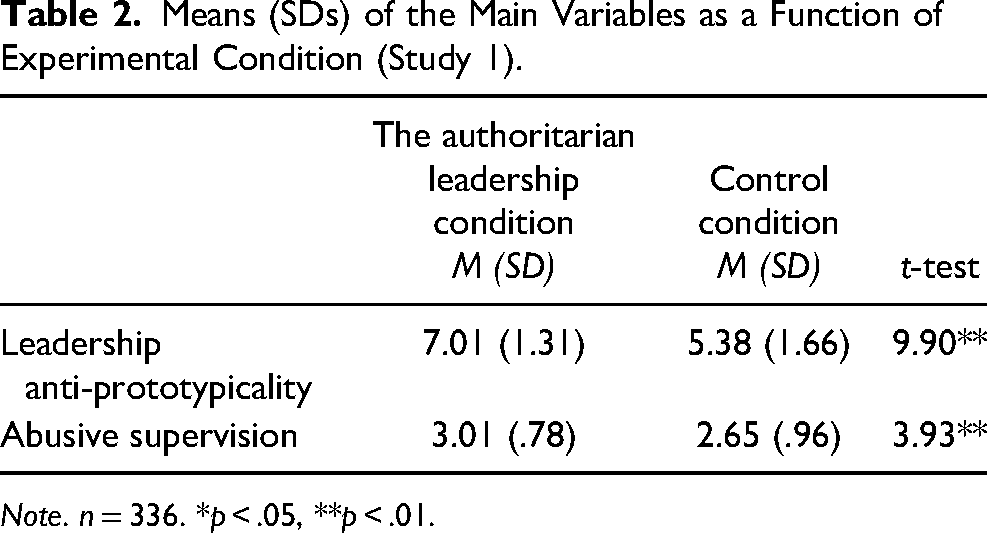
Note. n = 336. *p < .05, **p < .01.
Furthermore, as Hypothesis 2 posited that leadership anti-prototypicality mediates the positive relation between authoritarian leadership and abusive supervision, we conducted a mediating analysis with bootstrapping in Mplus 7.4 (Muthen & Muthen, 1998–2012) and found that the indirect effect of anti-prototype leadership characteristics was significant (estimate = .28, 95% confidence interval [CI] = .18, .40). The mediating model explained 12.3% of the variance in abusive supervision, supporting Hypothesis 2.
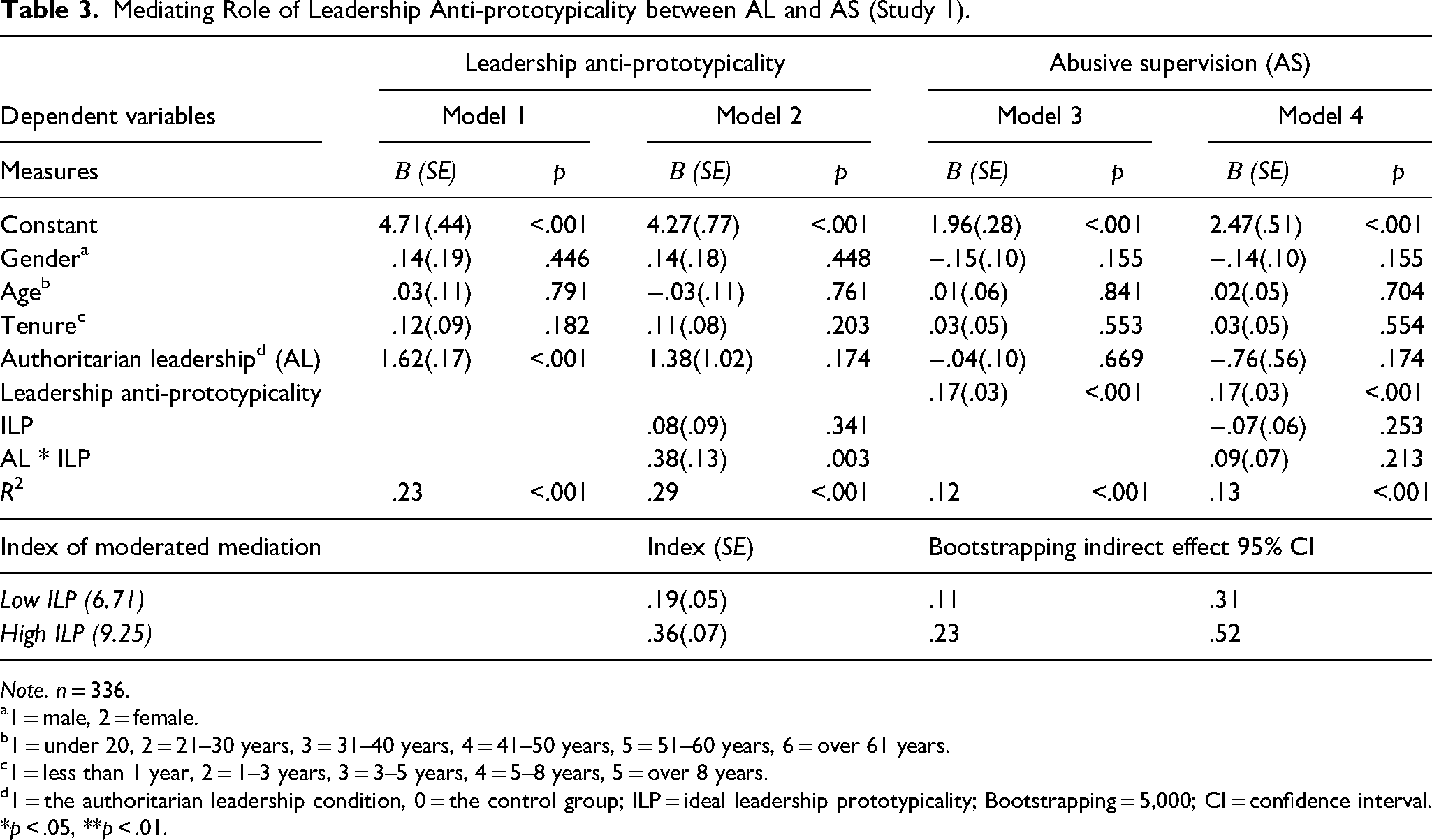
Additionally, Hypothesis 3 proposed the moderating effect of ILP between authoritarian leadership and leadership anti-prototypicality. We ran the moderated mediation model simultaneously. As shown in Table 3, Hypothesis 3 was supported (β = .38, p = .003, 95% CI = [.13, .63]), and the effect of authoritarian leadership on leadership anti-prototypicality was more positive for those who had higher levels of ILP (β = 2.09, 95% CI = [1.65, 2.54]) than for those with lower levels of ILP (β = 1.14, 95% CI = [.70, 1.58]) (see Figure 2). Furthermore, the results of the moderated mediating model showed that the mediating effect of leadership anti-prototypicality was significant (estimate = .06, 95% CI = [.02, .12]), and such a mediating effect was more positive for participants who endorsed higher ILP (estimate = .36, 95% CI = [.23, .52]) than those who rated lower on ILP (estimate = .19, 95% CI = [.11, .31]), supporting Hypotheses 3 and 4.
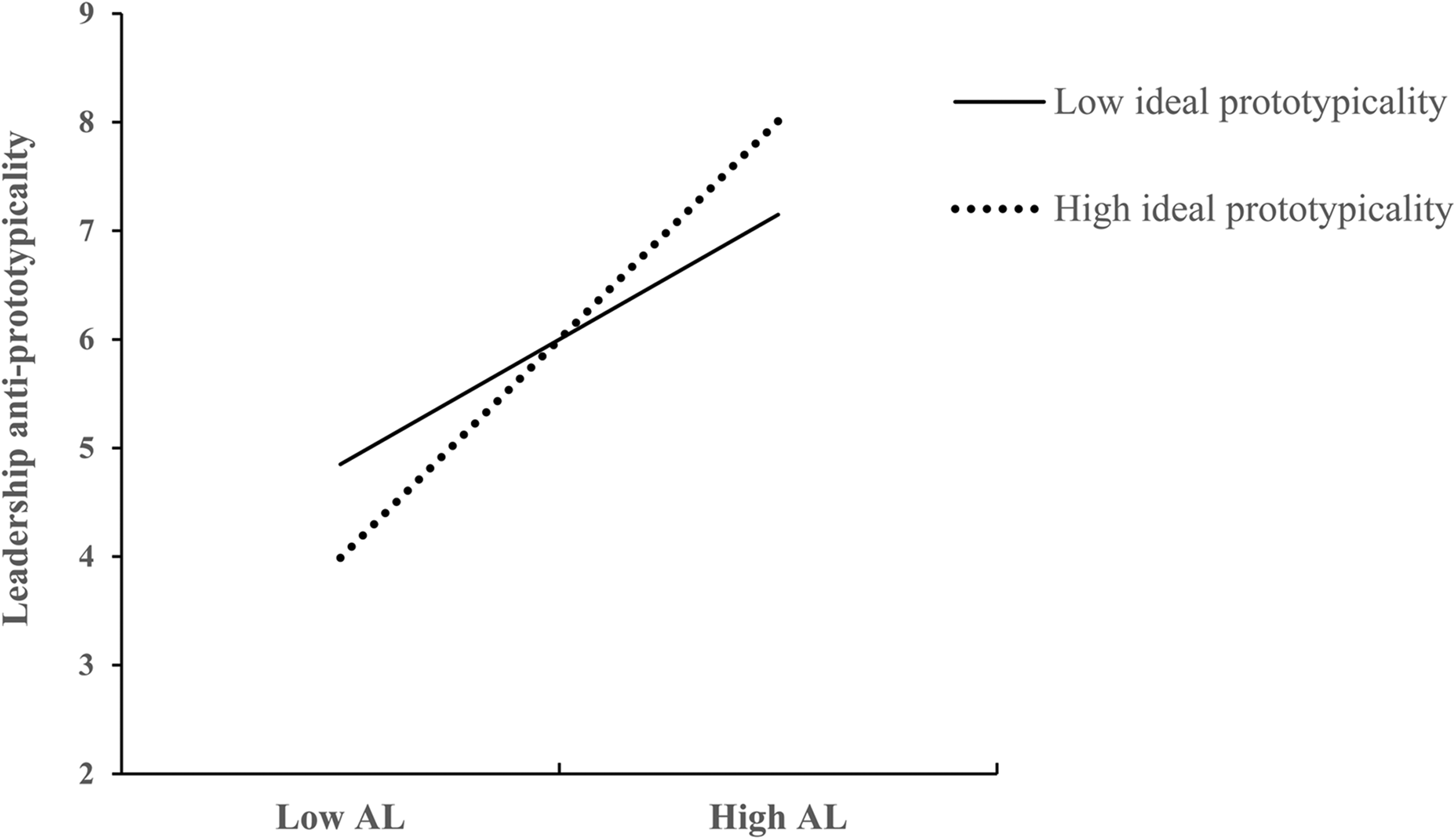
Interactive effect of AL and ILP on leadership anti-prototypicality (study 1). AL = authoritarian leadership; ILP = ideal leadership prototypicality.
Mediating Role of Leadership Anti-prototypicality between AL and AS (Study 1).
Note. n = 336.
1 = male, 2 = female.
1 = under 20, 2 = 21–30 years, 3 = 31–40 years, 4 = 41–50 years, 5 = 51–60 years, 6 = over 61 years.
1 = less than 1 year, 2 = 1–3 years, 3 = 3–5 years, 4 = 5–8 years, 5 = over 8 years.
1 = the authoritarian leadership condition, 0 = the control group; ILP = ideal leadership prototypicality; Bootstrapping = 5,000; CI = confidence interval. *p < .05, **p < .01.
In Study 1, we conducted an experiment that provided evidence for a positive relationship between authoritarian leadership and the perception of abusive supervision. This relationship was found to be mediated by participants’ activation of anti-prototypes, with their ILP moderating the process. While experiments are known for their strong internal validity, the external validity of these results remains uncertain. Moreover, as mentioned earlier, individuals’ activation of leadership (anti-)prototypes is not solely determined by their ILP; social norms also play a nuanced yet significant role in shaping preferences for a leader. Therefore, incorporating both ILP and TLA in a field study could contribute to a more comprehensive understanding of how authoritarian leadership may influence perceptions of abusive supervision.
Study 2 method
Participants and procedure
To replicate our results and further investigate the three-way interactions, we conducted Study 2. We collected multisource data at three time points through Credamo, an online data collection platform. Previous research has demonstrated that this platform has good validity (e.g., Gong et al., 2020; Zhou et al., 2022), as it follows strict participation procedures and has replicated research results conducted on M-Turk. Participants were informed about the purpose of the study and assured that their responses would be treated confidentially and anonymously at the beginning of the surveys. Each participant was compensated with 0.78 USD per survey.
At Time 1 (T1), we sent survey links to the employees to measure their supervisors’ authoritarian leadership, ILP, TLA, controlling variables. A total of 310 subordinates completed the T1 surveys. Approximately two weeks later (at Time 2 [T2]), we sent the online survey links to those who completed the T1 surveys. Employees were asked to rate their perceptions of supervisors’ leadership anti-prototypicality. A total of 288 subordinates (92.9% response rate) returned surveys. Another two weeks after T2 (at Time 3 [T3]), the third wave survey measuring their perception of abusive supervision was sent to the same employees. In total, 254 subordinates (88.2% response rate) completed the survey.
After matching each participant's three-wave data with an assigned unique code and removing 5 participants who answered the attention check items (i.e., “please choose 2 for this item”) incorrectly, the final sample comprised a total of 249 valid records, among which 51.8% were male. Approximately 53.0% were between 20 and 30 years old, 39.4% between 31 and 40 years old, and 5.2% between 41 and 60 years old. More than half of the participants (55.8%) worked in private companies, and 38.6% worked in state-owned companies. The majority of our participants (77.1%) obtained a master's degree. The average working tenure of our participants was 7.45 years (SD = 5.74).
Measures
Authoritarian leadership (T1)
Authoritarian leadership was measured using a 9-item scale developed by Cheng et al. (2004). Subordinates were asked to rate their direct supervisors’ authoritarian leadership from 1 (“strongly disagree”) to 7 (“strongly agree”). An example item was “My immediate supervisor asks me to obey his or her instructions completely”. The Cronbach's alpha in this sample was .86.
Ideal leadership prototypicality (ILP) (T1)
ILP was measured with the same scale applied in Study 1, with the Cronbach's alpha being .91.
Typical leadership anti-prototypicality (TLA) (T1)
TLA was measured with the adapted scale of Epitropaki and Martin (2004). Participants indicated to what degree they thought a typical leader was. Example items included being manipulative, domineering, and pushy. Cronbach's alpha was .87.
Anti-prototypical leadership (T2)
Anti-prototypical leadership was measured with the same scale measured in Study 1, and Cronbach's alpha was .90.
Abusive supervision (T3)
Perception of Abusive supervision was measured with the 15-item scale by Tepper (2000). Subordinates were asked to rate from 1 (“never”) to 5 (“very often”) how frequently their supervisors display abusive behaviors. An example item was “My supervisor put me down in front of others”. Cronbach's alpha was .91.
Control variables
We controlled demographics, including gender and age, as previous literature has shown that compared to males, females may be more sensitive to abusive supervision (Haggard et al., 2011), and elderly employees may form relatively realistic expectations for supervisors (Arnulf & Larsen, 2015). We additionally controlled initial abusive supervision (T1) and leader-member exchange (LMX) to test the effect of AL on AS (Maslyn & Uhl-Bien, 2001). We measured LMX with the 7-item scale of Scandura and Graen (1984) and measured abusive supervision with the 15-item scale of Tepper (2000). Cronbach's alpha was .88 for LMX, and .91 for abusive supervision.
Study 2 Results
Preliminary analyses
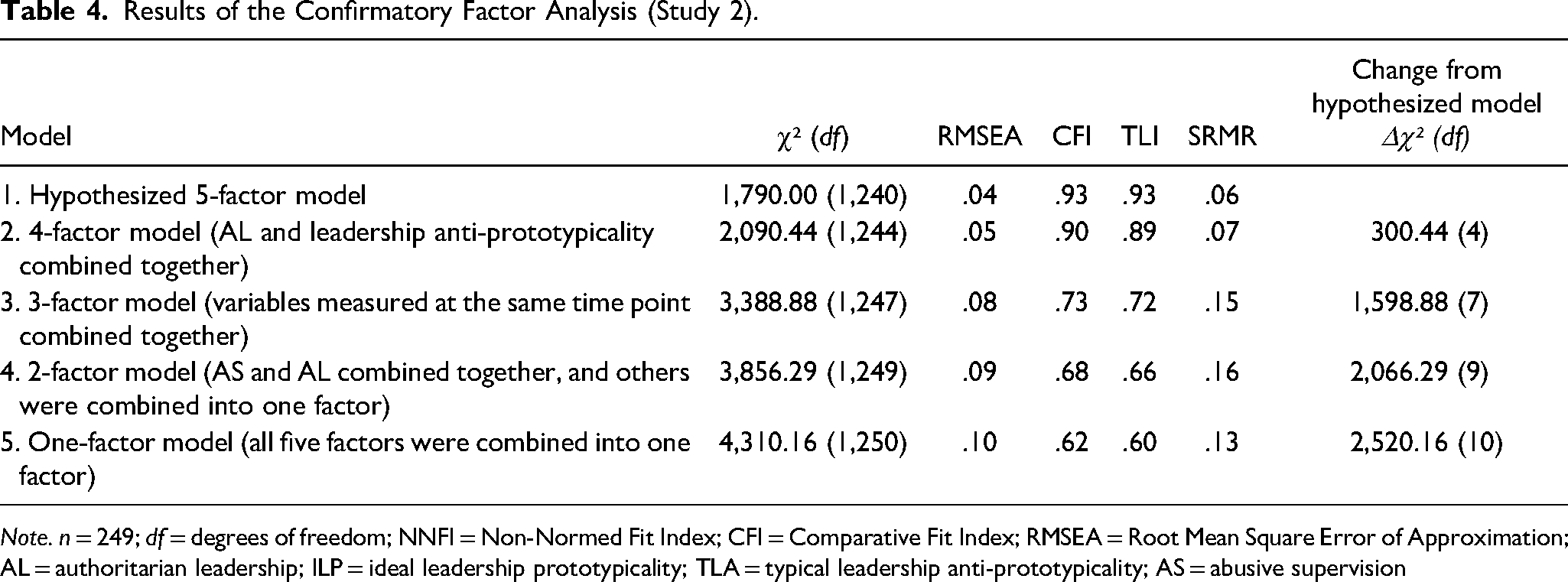
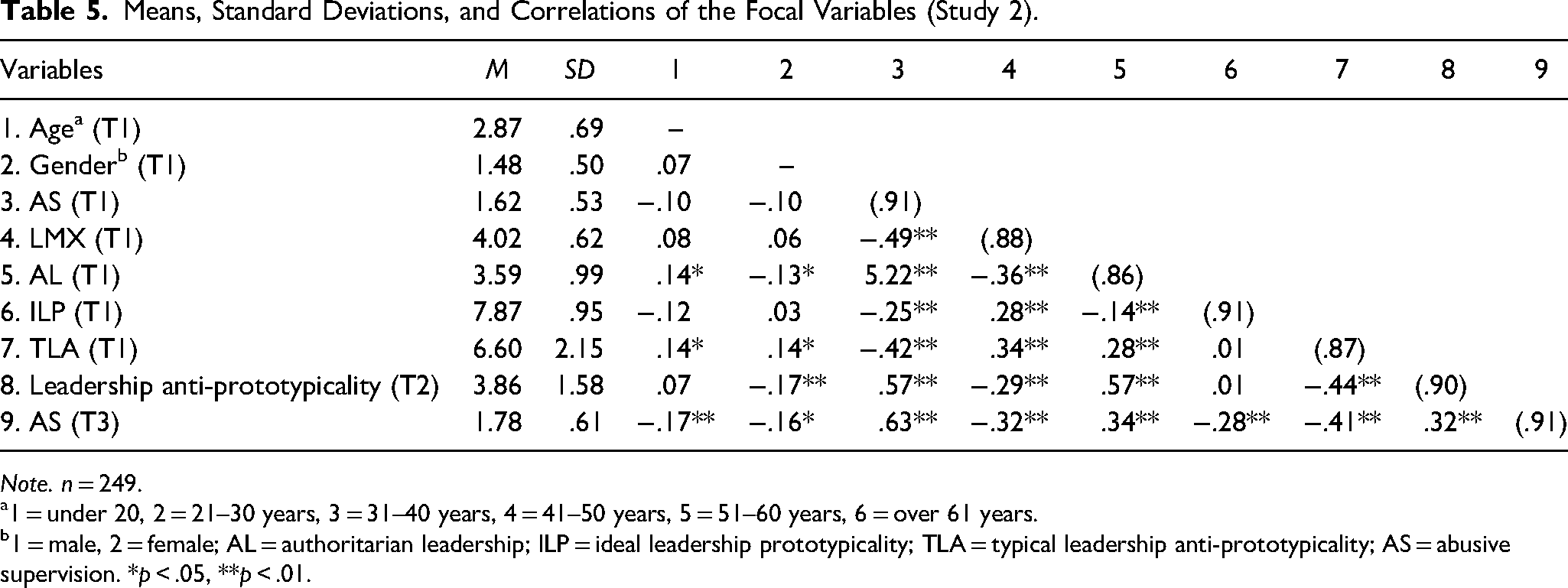
As shown in Table 4, CFA results showed that the hypothesized five-factor model exhibited a good fit (χ2(1,240) = 1,790.00, p < .001, RMSEA = .04, CFI = .93, TLI = .93, and SRMR = .06), and it fitted better than alternative models. Table 5 shows the means, standard deviations, and correlations among the studied variables.
Results of the Confirmatory Factor Analysis (Study 2).
Note. n = 249; df = degrees of freedom; NNFI = Non-Normed Fit Index; CFI = Comparative Fit Index; RMSEA = Root Mean Square Error of Approximation; AL = authoritarian leadership; ILP = ideal leadership prototypicality; TLA = typical leadership anti-prototypicality; AS = abusive supervision
Means, Standard Deviations, and Correlations of the Focal Variables (Study 2).
Note. n = 249.
1 = under 20, 2 = 21–30 years, 3 = 31–40 years, 4 = 41–50 years, 5 = 51–60 years, 6 = over 61 years.
1 = male, 2 = female; AL = authoritarian leadership; ILP = ideal leadership prototypicality; TLA = typical leadership anti-prototypicality; AS = abusive supervision. *p < .05, **p < .01.
We addressed common method issue by using the covariance method, in which we created a new construct, named common latent factor (Eichhorn, 2014). The result showed that the differences of standardized regression weights of constraint and unconstrained models were smaller than .20 for each latent variable (Afthanorhan et al., 2021). Therefore, we assume that the current results were not substantially contaminated by the common method bias.
Hypotheses testing
We conducted a path-analytic regression to test the hypotheses. In support Hypothesis 1, we found that authoritarian leadership and leadership anti-prototypicality were positively related (β = .80, p < .001). Hypothesis 2 was supported as the results of bootstrapping revealed that leadership anti-prototypicality mediated the positive relation between authoritarian leadership and abusive supervision (indirect effect = .10, 95% CI = [.05, .18]).
Hypothesis 3 proposed that ILP moderates the relation of authoritarian leadership with leadership anti-prototypicality, and we found that the hypothesis was supported (β = .21, p = .024). The relation was more positive when employees have higher levels of ILP (β = .98, p < .001) than lower levels (β = .57, p < .001) (See Figure 3). Similarly, in support of Hypothesis 4, we found that the moderated mediating effect of anti-prototype leadership was significant between authoritarian leadership and abusive supervision (indirect effect = .03, 95% CI = [.01, .06]), and this effect was more positive at higher levels of ILP (indirect effect = .13, 95% CI = [.07, .23]) than at lower levels (indirect effect = .07, 95% CI = [.03, .16]). Therefore, Hypotheses 3 and 4 were supported.
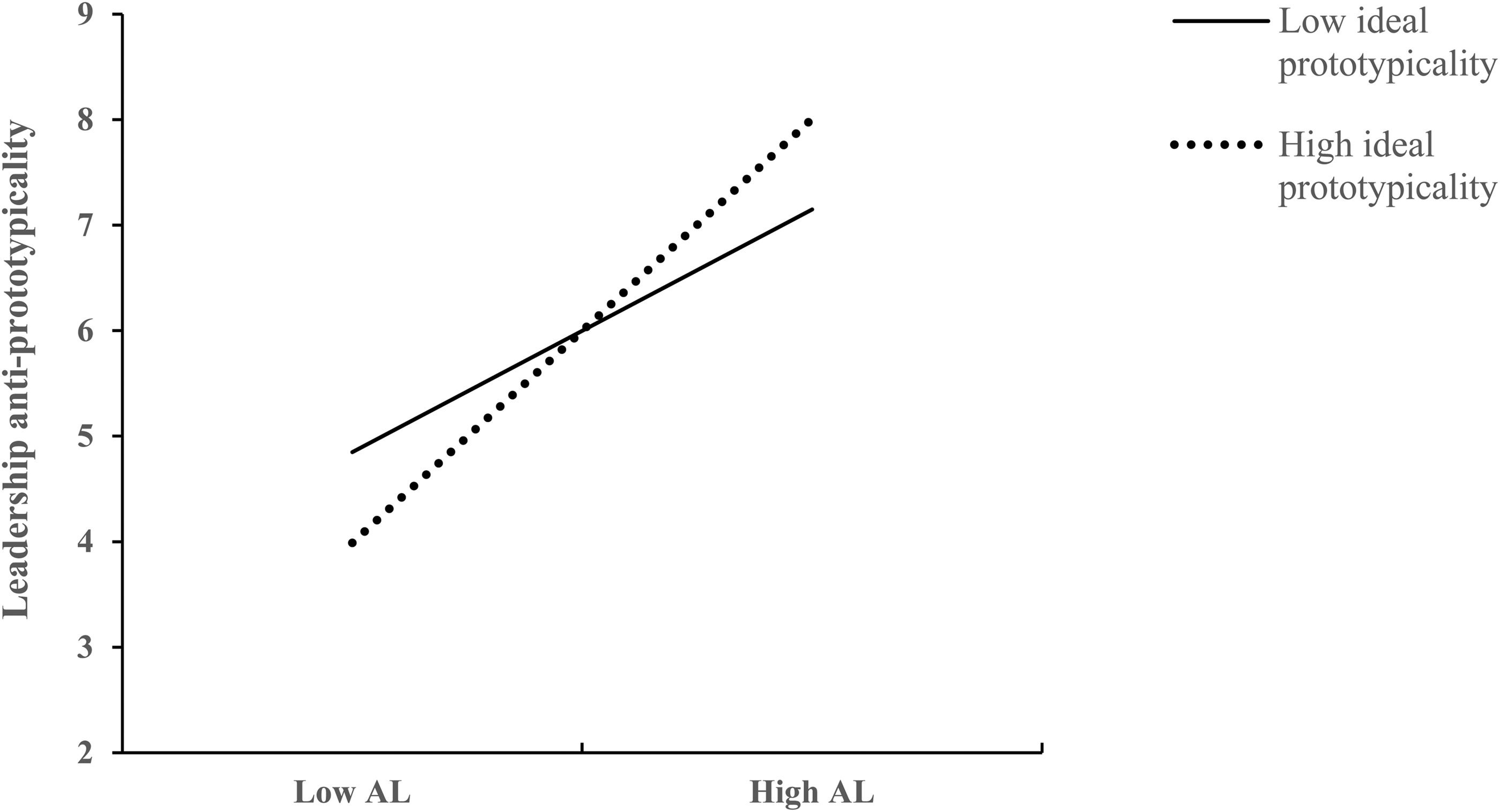
Interactive effect of AL and ILP on leadership anti-prototypicality (study 2). AL = authoritarian leadership; ILP = ideal leadership prototypicality.
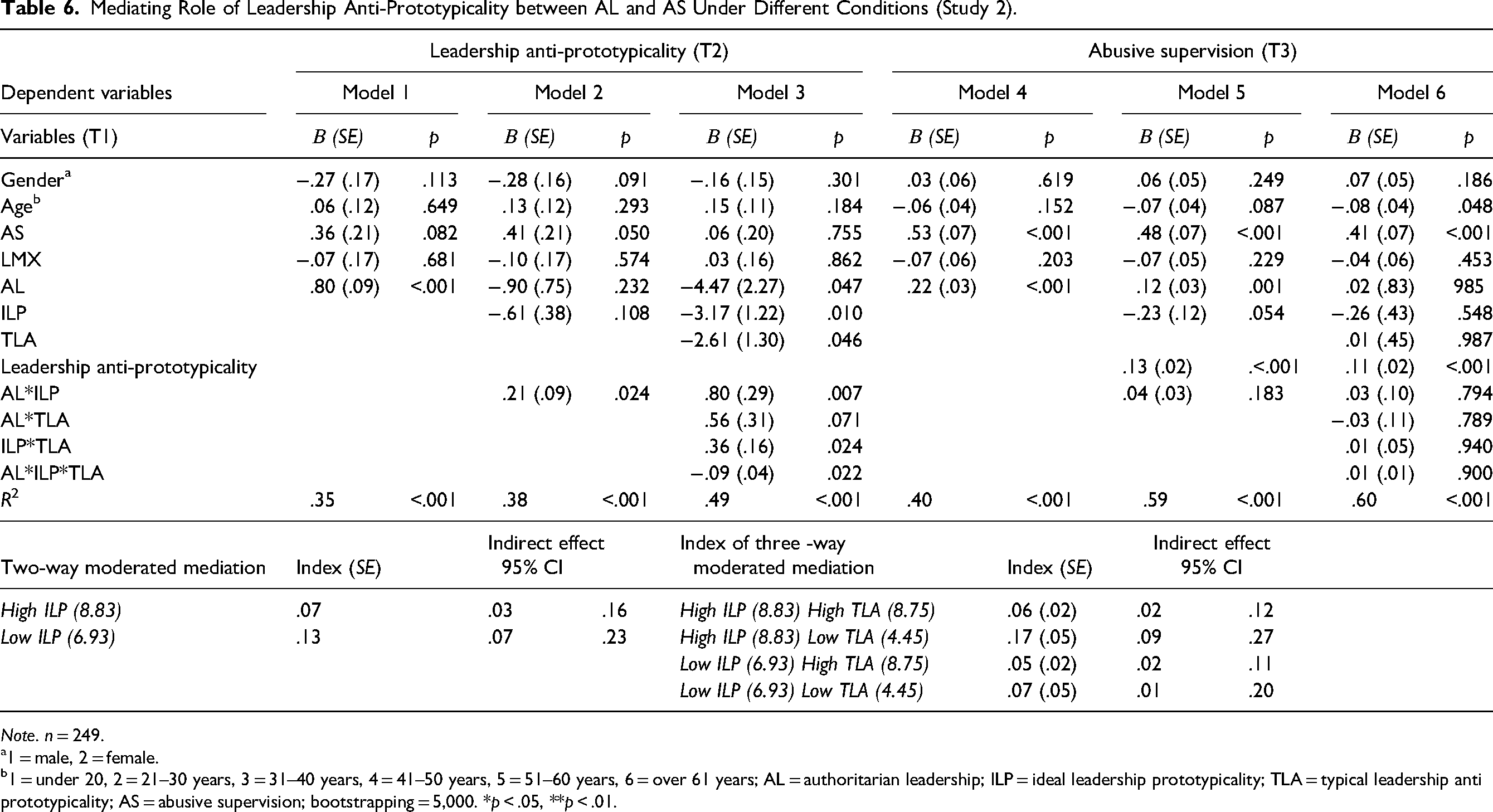
Additionally, as seen in Table 6, the three-way interaction of abusive supervision, ILP, and TLA on leadership anti-prototypicality was significant (β = −.090, p = .022). Simple slope tests (see Figure 4) indicated that for employees with high ILP and low TLA, the relation between authoritarian leadership and leadership anti-prototypicality was the strongest (β = 1.37, p < .001) compared to their counterparts with high ILP and high TLA (β = .47, p = .001) and to those with both low ILP and low TLA (β = .58, p = .004) and to those with low ILP and high TLA (β = .39, p = .009); thus, Hypothesis 5 was supported.
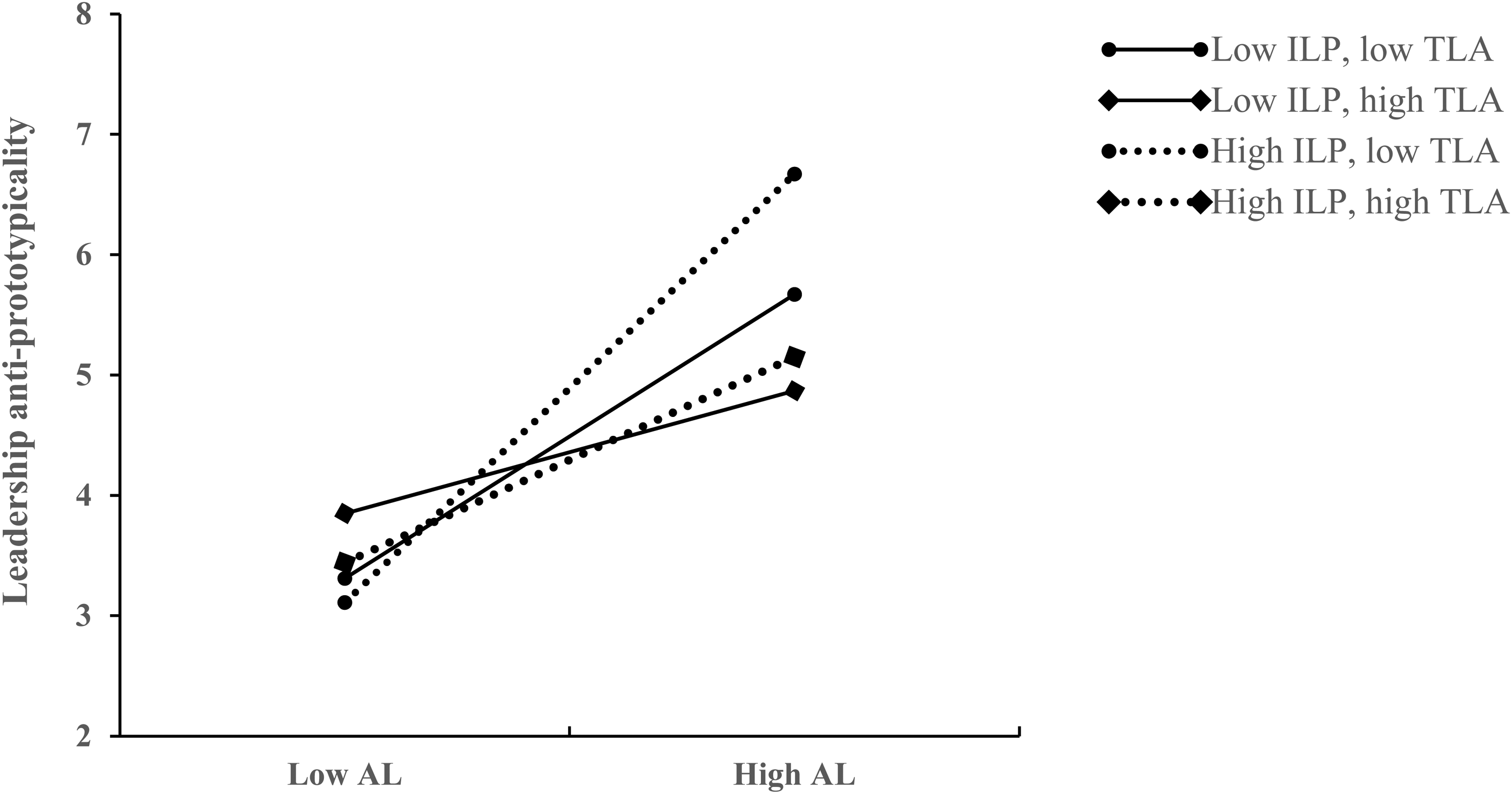
Three-way interactive effect of AL, ILP and TLA on leadership anti-prototypicality (study 2). AL = authoritarian leadership; ILP = ideal leadership prototypicality; TLA = typical leadership anti-prototypicality.
Mediating Role of Leadership Anti-Prototypicality between AL and AS Under Different Conditions (Study 2).
Note. n = 249.
1 = male, 2 = female.
1 = under 20, 2 = 21–30 years, 3 = 31–40 years, 4 = 41–50 years, 5 = 51–60 years, 6 = over 61 years; AL = authoritarian leadership; ILP = ideal leadership prototypicality; TLA = typical leadership anti prototypicality; AS = abusive supervision; bootstrapping = 5,000. *p < .05, **p < .01.
Lastly, as shown in Table 6, bootstrapping results revealed that the indirect effect between AL and AS was the strongest when ILP was high and TLA was low (indirect effect = .17, 95% CI = [.09, 27]), which was stronger than conditions when employees had low ILP and low TLA (indirect effect = .07, 95% CI = [.01, .20]), and with high TLP and high TLA (indirect effect = .06, 95% CI = [.02, .12]), and with low ILP and high TLA (indirect effect = .05, 95% CI = [.02, .11]). Therefore, Hypothesis 6 was supported.
Discussion
Across an experiment and a multi-wave field study, we found that authoritarian leadership activates subordinates’ leadership anti-prototypicality, which in turn is positively related to subordinates’ perception of abusive supervision. Subordinates with high ILP and low TLA perceive a higher level of anti-prototypicality of authoritarian leadership and a further higher level of abusive supervision. In particular, our findings suggest that subordinates apply their ideal and typical leadership schema to benchmark their supervisors, and such cognitive processes may influence their perception of abusive supervision.
Theoretical implications
Our research makes several theoretical contributions to leadership research. First, the current study contributes to the abusive supervision literature by adding subordinates’ dynamic cognitive process of authoritarian leadership (Nguyen et al., 2018). Although previous literature has established authoritarian leadership as an antecedent of abusive supervision (Fischer et al., 2021), but to our knowledge, there has been limited exploration of the underlying mechanisms involved. Such exploration is important because authoritarian leadership is often considered neutral, especially in Eastern countries, where leaders may simultaneously exhibit strictness and benevolence towards subordinates (i.e., Paternalistic Leadership; Pellegrini & Scandura, 2008); however, abusive supervision is comparatively more detrimental and thus negative. Our study found that authoritarian leadership can be interpreted as abusive through subordinates’ cognitive process that is activated by implicit leadership prototypes. Although authoritative leadership is generally less accepted in Western contexts and thus more prone to being perceived as abusive supervision (Kiazad et al., 2010), our findings indicate that even in China, such leadership styles can elicit subordinates’ leadership anti-prototypes. This, in turn, may relate to perception of authoritative leadership as abusive supervision.
Second, our studies respond to Martinko et al.'s (2013) call to investigate the detailed sense-making process from the perspective of subordinates and address Oh and Farh's (2017) call for connecting the perception of abusive supervision with actual behavior. As noted by Lord et al. (2020), leadership is a blend of leaders’ behavior and subordinates’ perceptions. However, previous research on abusive supervision has largely overlooked the latter aspect (Fischer et al., 2021). A recent study by Zuo (2023) has shown that supervisors’ negative feedback leads to the perception of abusive supervision and such relationship is moderated by subordinates’ attribution styles; while Wang et al. (2019) found that subordinates’ relations with supervisors may also relate to subordinates’ perceptions of abusive supervision. Drawing on leadership categorization theory (Lord et al., 1984), the current study contributes another perspective to this limited body of research, enhancing our understanding of how authoritarian leaders may be perceived as abusive.
Specifically, we explored leadership categorization theory (Lord et al., 1984) by investigating more subtle and detailed variations in subordinates’ implicit leadership schema. Specifically, the current study distinguished two types of leadership schema norms, ideal vs. typical leadership schemas, and empirically discovered that they interact with each other to explain the variation leadership perceptions. As noted by Junker and Van Dick (2014), most previous literature emphasizes ILP (Zacher et al., 2015), and only a few studies have concluded both ideal and typical leadership images (Van Quaquebeke et al., 2014). By including ILP and TPA as moderators, the current study provided a more comprehensive picture of how individual self and perceived contextual factors dynamically influence subordinates’ cognitive process of authoritarian leadership to abusive supervision.
Lastly, the current research is a mix of an experiment and field study, which helps ensure both internal and external validity and reduces the possibility of endogeneity in abusive supervision research (Fischer et al., 2021). According to the systematic review conducted by Fischer et al. (2021), a typical (91%) abusive supervision study is survey-based; however, a simple survey design cannot examine causal effects and is susceptible to endogeneity, including common method bias, reciprocal effects, and common causes (Podsakoff et al., 2012).
Practical implications
Our findings have important implications for managerial practice. First, although a previous study has suggested that authoritarian leadership could be effective in some urgent situations and could potentially improve productivity (Huang et al., 2015), our study findings suggested that authoritarian leadership is more likely to be perceived as abusive. Supervisors should be aware of subordinates’ cognitive process of leadership. They should know that authoritarian leadership can activate subordinates’ negative schema. Therefore, supervisors should try to avoid the negativity of authoritarian leadership, including absolute control and demanding unquestionable obedience (Guo et al., 2018). If supervisors need to be authoritarian on some occasions, they should use other remedies to compensate for the negative impression left in subordinates’ minds.
Second, organizations should also try to carry out some activities to narrow the gap between the leadership that supervisors intend to display and that which is perceived by subordinates. As found, authoritarian leadership may induce employees’ perception of abusive supervision, implying that more interactions between supervisors and subordinates are also needed. As an important context in which supervisors and subordinates work together, organizations should try to promote communication and understanding between them and arrange regular meetings to talk about leadership. For supervisors who cannot show proper leadership, organizations should also implement relative interventions such as leadership courses or training to introduce or share useful and critical leadership strategies and skills to reduce the negative effect of improper leadership (Dawkins et al., 2013).
Finally, employees should be aware of their ideal leadership prototype and the typical leadership in the current organization. They should take supervisors’ leadership into consideration when looking for a new job. When supervisors’ leadership is in line with employees’ ideal prototypes, there might be more positive perceptions and outcomes. Otherwise, there might be more perception bias, such as abusive supervision. Employees should also try to interact with their supervisors about their expectations of leadership and how they perceive their supervisors’ leadership, which may help to eliminate possible misunderstandings.
Limitations and future research
This study has some limitations that could provide suggestions for future studies. First, the current study focused on subordinates’ cognitive process and provided only one explanation of the mechanism between authoritarian leadership and abusive supervision. There might be alternative mechanisms that deserve further investigation. As illustrated by Fischer et al. (2021), when subordinates report abusive supervision, they might (1) regard specific behaviors as abusive and/or (2) elicit abusive supervision from their supervisors. The current study mainly takes the first perspective. However, there are possibilities that subordinates not only perceive more abusive supervision but also elicit supervisors’ abusive supervision during interactions after the activation of leadership anti-prototypicality. Future studies may benefit from simultaneously exploring two paths to obtain a clearer and more detailed comprehension of the relation between authoritarian leadership and abusive supervision.
Furthermore, both studies were conducted in China, a high-power distance context in which authoritarian leadership is generally perceived as more common and acceptable than in Western countries, including Nordic nations (Karakitapoğlu-Aygün et al., 2021). Future studies could test the model in Western countries or conduct cross-cultural studies to draw comparisons with these results. We hypothesize that similar results will persist with stronger effects, but there is a possible that individuals in Western countries may not differentiate between authoritarian leadership and abusive supervision. Additionally, subordinates’ ILP and TLA were measured at individual levels in the current study, and most people may observe the social norm of leadership to be less domineering as leadership examples are evolving (Obenauer & Kalsher, 2023). Future studies could collect group data to test whether different group's norms of leadership prototypes would play a moderated role.
Thirdly, although we conducted prior research to validate the manipulation material, we did not conduct the manipulation check in the formal experiment. In both the experimental and control groups, one item assessed whether the supervisor was authoritative. This item was more of an attention check instead of a manipulation check (Aronow et al., 2019). Therefore, future experimental studies should include manipulation checks in formal experiments. Additionally, we measured only participants’ preexisting ILP to test its moderating effect between authoritarian leadership and the activation of leadership anti-prototypicality and further perception of abusive supervision. However, our whole model predicted a three-way interaction between authoritarian leadership, ILP and TLA. Future experimental studies may consider either testing both ILP and TLA before the experiment or designing a 2*2 experiment to manipulate both authoritarian leadership and participants’ belief in TLA.
Lastly, our study explored the inconsistent situation of ideal prototypicality and typical anti-prototypicality of leadership. In other words, we constructed a particular situation where subordinates’ ideal or expectations for leaders (prototypicality) may not necessarily be shared by the social norm or typical schema of leaders (anti-prototypicality). Future studies may examine whether the consistency between subordinates’ ILP and TLP would make subordinates see authoritarian leadership more negative and abusive (Van Quaquebeke & Van Knippenberg, 2012). Recent research suggests that a supervisor's vision can mitigate the harmful effects of abusive supervision on leadership effectiveness (Fiset et al., 2019). Future studies could investigate whether combining authoritarian leadership with a clear vision or compassion for subordinates might also trigger positive leadership perceptions among subordinates, thereby reducing perceptions of abusive supervision.
Conclusions
Both supervisors’ behaviors and subordinates’ interpretations play important roles in the leadership process (Lord & Maher, 1991). However, previous literature on the antecedents of abusive supervision usually focused on supervisors’ and subordinates’ characteristics (Fischer et al., 2021). There is little research investigating subordinates’ cognitive process of abusive supervision. Drawing from leadership categorization theory (Lord et al., 1984), our research helps to provide a more comprehensive picture of how supervisors’ behaviors and subordinates’ ideal and typical leadership schema interact to influence subordinates’ cognitive process of abusive supervision.
Footnotes
Declaration of conflicting interests
The author(s) declared the following potential conflicts of interest with respect to the research, authorship, and/or publication of this article: The authors whose names are listed immediately below certify that they have NO affiliations with or involvement in any organization or entity with any financial interest (such as honoraria; educational grants; participation in speakers’ bureaus; membership, employment, consultancies, stock ownership, or other equity interest; and expert testimony or patent-licensing arrangements), or non-financial interest (such as personal or professional relationships, affiliations, knowledge or beliefs) in the subject matter or materials discussed in this manuscript.
Funding
The author(s) received no financial support for the research, authorship, and/or publication of this article.
Ethics approval
Approval for the study was obtained from the ethics committee of Beijing Normal University. All procedures used adhered to the tenets of the Declaration of Helsinki.
