




Abstract
The development of a leader identity is considered essential for leadership success. Underlying this identity work is the belief that the social identity of being a leader is positive—something that leaders both privately endorse and want publicly conferred by others. However, this process is complex for women leaders who are simultaneously navigating the identity work of being women in male-dominated leadership positions. We conducted a qualitative investigation of women in senior leadership roles to examine how they construct a leader identity by managing private and public endorsements of both a leader and a female identity. Our results indicate that women leaders engage in leader and gender identity work whereby they actively manage how they privately self-endorse and publicly allow others to endorse their leader and female identities using identity hybridization. In so doing, they mix and recombine elements of both their leader and gender identities to construct a coherent female leader identity. Doing so allows them to benefit from the complementarity of these identities, while mitigating the risks associated with publicly and privately endorsing these two identities in tandem. This approach to identity hybridization allows women leaders to maintain a sense of agency, effectiveness, and authenticity in the face of identity tensions.
“I never think about myself as a leader… I just do my job. … I really don’t think of myself in a leadership position.” (Leader 15, COO of a global healthcare organization)
Occupying a leadership role is considered a socially valued high-status position (Van Vugt, 2006), resulting in a host of positive instrumental and personal rewards (Magee & Galinsky, 2008). Not only do leaders reap extrinsic rewards such as respect and financial incentives (Li et al., 2018) but also intrinsic rewards by feeling positively toward belonging to a privileged social group, notably via the adoption of a leader identity. Leader identity is defined as the subcomponent of one's identity that relates to being a leader or how a person thinks of oneself as a leader (Day & Harrison, 2007). Research suggests that when leaders adopt a leader identity, they are more likely to seek out developmental experiences (Day & Sin, 2011), construct positive relationships with followers (Chang & Johnson, 2010), experience increased motivation to lead (Guillén et al., 2015), and be more effective transformational leaders (Johnson et al., 2012).
Given the range of positive outcomes associated with the construction of a leader identity, it is unsurprising that scholars have emphasized the importance of leadership identity as a central focus of recent scholarship (for review, see Epitropaki et al., 2017). Much attention has focused on how to construct a leader identity, where scholars advocate for an endorsement process in which individuals engage in leader identity “claims” that are then met with “grants” of that identity by others (DeRue & Ashford, 2010; Marchiondo et al., 2015). As described by Petriglieri and Stein (2012), endorsing a leader identity involves engaging in identity work (Sveningsson & Alvesson, 2003), where one exerts energy to resolve the intrapersonal and interpersonal incongruities between one's own self-views and the leader identity to which one aspires. Underlying this assumption is that individuals are willing to identify as a leader, where they view a leader identity as a positive and desired identity, one which they willingly endorse and perceive as a relevant self-descriptor (Lee-Cunningham et al., 2023).
The desirability to construct a leader identity may be impacted by other identities that individuals hold. Individuals have multiple, and possibly competing, identities within their self-concept (Brown & Toyoki, 2013; Wright et al., 2012), which can trigger identity conflict when there are discrepancies between “the values, beliefs, norms, and demands inherent in the identities” (Ashforth & Mael, 1989, p. 29). Leaders who hold identities that conflict with a leader identity may be less likely to see the leader identity as a desirable one, and this may be particularly true for female leaders. Leadership is traditionally associated with stereotypically masculine characteristics (Eagly & Johannesen-Schmidt, 2001; Eagly & Karau, 2002; Kark et al., 2012), and female leaders must contend with two salient identities, leader and woman, that are inherently asymmetric (Meister et al., 2017; Muhr, 2011).
While the process in which individuals construct a leader identity has remained largely gender-neutral in the literature, emerging research suggests that this process is different and more complex for female leaders, and therefore, requires further attention for several reasons (e.g., Karelaia & Guillen, 2014; Meister et al., 2017; Zheng et al., 2018a; Zheng et al., 2018b). First, social categorical identities such as gender and race are difficult to exit and are stickier than professional identities (Petriglieri, 2011; Thoits, 1983). The willingness for female leaders to engage in leader identity work must be considered in parallel with their gender identity, as that identity is visible and largely fixed. That is, the effects of gender may be particularly relevant for leader identity construction given the inherent conflicts between being a woman and being a leader (Guillaume & Pochic, 2009). Second, much of the research that examines the endorsement process of leader identity looks at individuals who are not yet in formal leadership roles but rather could emerge as leaders (e.g., Bartels & Wellman, 2023; Lee-Cunningham et al., 2023). However, it is also important to understand whether individuals in formal leadership positions wish to endorse and have endorsed to them a leader identity—even if they already hold a leader title. Third, while there continues to be momentum to promote and support women in leadership (Lee, 2018; World Bank, 2018), women continue to be underrepresented in senior leadership roles (Catalyst, 2022). If the construction of a leader identity is critical to the development and effectiveness of leadership as research suggests (Epitropaki et al., 2017), then it is imperative that scholars better understand how women identify as leaders and women at work to best support them.
These considerations provided the motivation for the current study. Using a qualitative investigation, we interviewed 33 females in senior leadership positions in North America. Our results suggest that female leaders are not necessarily willing to privately endorse and publicly receive endorsements from others of both their leader and gender identity. Rather, they engage in identity hybridization (Lam, 2020; Purchase et al., 2018) whereby they construct a “woman leader” identity by actively managing these private and public identity endorsements to benefit from the complementarity of their leader and gender identities, while mitigating the risks associated with the perceived identity conflicts as shaped by both self-narratives and structural characteristics. This identity construction process allows female leaders to maintain a sense of agency, effectiveness, and authenticity in the face of their identity tensions.
The findings from this research provide multiple meaningful contributions. First, this research helps advance the debate on how leader identity construction operates for female leaders (see calls for future research in DeRue & Ashford, 2010; Epitropaki et al., 2017). In particular, we add valuable insights about the public and private nature of this process, and how this is influenced by the role of individual agency. Second, our results contribute to the conversation on how female leaders identify as both women and leaders (e.g., Meister et al., 2017), thereby shedding light on how the identity construction process can be used by minority members as a strategic way to manage tensions among multiple identities (Doldor & Atewologun, 2021). Finally, our results provide implications about how leadership scholars and practitioners should emphasize the importance of leader and gender identity to current and aspiring leaders to allow for a more inclusive view of leadership identity development.
Construction of a Social Identity
The understanding of identity varies between disciplines; however, we subscribe to the definition of identity as the subjective knowledge, meanings, and experiences that ultimately define a person (Alvesson et al., 2008; Gecas, 1982; Meister et al., 2017). According to collective and social identity theory, people often define themselves and their relevant identities via their membership to specific social categories (Ashmore et al., 2004). The categories to which people belong can be based on ascribed characteristics, such as age, or on achieved states, such as occupation (Ashmore et al., 2004; Deaux, 1996; Sedikides & Brewer, 2001). People often belong to multiple social categories; thus, their self-concepts include multiple social identities (Ashforth & Mael, 1989; Tajfel, 1982; Thoits, 1983). In our research, we focus on two specific identities: one ascribed identity (woman) and one achieved identity (leader).
Developing one's identity requires individuals to engage in identity work, where they exert energy by crafting, upholding, and revising their identities (Snow & Anderson, 1987; Sveningsson & Alvesson, 2003). Individuals’ willingness to engage in identity work is determined by how they evaluate their social roles (Ashmore et al., 2004) such that the more positively they feel toward the social categories to which they belong, the more likely they are to engage in the work to adopt and endorse those identities (Blader & Tyler, 2009; Boons et al., 2015; Gecas, 1982). When evaluating how positively one feels about an identity, there are two interrelated aspects that a person considers: both their own personal judgment about the category and how they believe others would evaluate that same category (Ashmore et al., 2004; Crocker et al., 1994; Luhtanen & Crocker, 1992), denoted as private and public regard (Sellers et al., 1997). One's private and public regard for belonging to a social category is not always positively correlated (Crocker et al., 1994). This is particularly true among social groups that feel proud of their group membership yet recognize that others may evaluate that group negatively (e.g., identifying with a certain race, sexuality, or gender).
Constructing an Identity as a Woman and as a Leader
Constructing a leader identity, one that is inherently ambiguous in nature (DeRue et al., 2009), largely evolves through a series of social interactions (Bartel & Dutton, 2001) whereby individuals need to claim and see themselves as a leader while also have it endorsed and granted by others (DeRue & Ashford, 2010; Marchiondo et al., 2015). In so doing, those holding a leader identity tend to internalize it as a key part of their self-concept (DeRue et al., 2009). Underlying this identity process is the assumption that individuals see a leader identity as desirable and are willing to engage in the necessary identity work. However, depending on individuals’ evaluation of leadership and the behaviors, traits, and assumptions that they believe the role carries with it, some may not view this identity as desirable (Aycan & Shelia, 2019) or wish for “leader” to be a relevant and accurate self-descriptor (Lee-Cunningham et al., 2023).
While Lee-Cunningham and colleagues (2023) looked at why a leader identity may be undesirable among individuals who do not possess a leadership title, current leaders may also be unwilling to identify as leaders if their evaluation of the subjective knowledge, meanings, and beliefs associated with a leader identity are in tension with another social, salient identity such as gender (Karelaia & Guillén, 2014; Meister et al., 2017). As per role congruity theory, there is an incongruity between the categories of “woman” and “leader” (Eagly & Johannesen-Schmidt, 2001; Eagly & Karau, 2002; Kark et al., 2012) where women are expected to exhibit communal traits (e.g., kindness, empathy), which conflict with the agentic traits that leaders are expected to display (e.g., confidence, assertiveness) (e.g., Eagly & Carli, 2007; Zheng et al., 2018a). In addition, a leader identity is typically considered a positive personal identity and social designation (Ashford et al., 2009), whereas a female identity carries with it lower status and perceptions of decreased competency, particularly in the workplace (Ridgeway, 2001). The attributes associated with “an ideal” leader also suggest a full commitment to the role, whereas “ideal women” are denoted as caregivers and nurturers, implying responsibilities outside their work roles (Correll et al., 2007; Dumas & Sanchez-Burks, 2015). In other words, while female leaders hold two identities simultaneously, they are polarized (Meister et al., 2017).
Considering this, we wanted to investigate how women in leadership positions construct their female and leader identities. Given the juxtapositions separating the identities of “leader” and “woman,” do female leaders endorse both identities, not only privately in terms of seeing themselves as women and leaders but also publicly in terms of their desire for others to endorse their leader and gender identities? How do they navigate the competing tensions with respect to these two salient yet divergent identities?
Research Design
We used a grounded theory approach to address our questions, deriving primarily from an interpretivist perspective useful for understanding the lived experiences of a group of people (Charmaz, 1996; Glaser & Strauss, 1967, 2017). Similar to other leadership scholars exploring the notion of identity (i.e., Meister et al., 2017; Muir, 2014), we adopted a purposeful sample (Strauss & Corbin, 1990) by intentionally selecting participants who offer “knowledge from the ‘inside’” (Charmaz, 1996, p. 30) and provide the lived experiences of the group experiencing the phenomenon of inquiry (Klenke, 2016). We restricted our focus to experienced female leaders ideally suited to generate insights regarding how they experienced their leader and gender identities.
Context
Our sample included 33 women who were in senior leadership positions (holding titles such as CEO, Senior Vice President, Dean) and had at least ten years of leadership experience. To acquire our sample, we engaged in a variety of recruitment strategies. First, we worked with our faculty development officers, asking them to suggest senior female leaders who had previously worked with our respective faculties (e.g., had given a talk at the university). The development officers contacted leaders and helped to set up introductions. Second, we sent out emails to senior female leaders in our respective cities, introducing ourselves and our broad research questions and asking if we could set up an interview, resulting in a number of willing participants. Third, one of the authors was profiled in their university alumni newsletter for their research, in which the alumni newsletter also provided the contact information for the author for any women in senior leadership roles who may be willing to participate in an interview, which generated several participants. Finally, we used snowball sampling where at the end of our interviews, we asked participants if they knew of other women in senior leadership roles who may be willing to participate. We interviewed leaders from a multitude of industries, including banking, natural resources, education, and politics. The participants ranged in age from 38 to 70, and all were located within North America. Participants’ names have been replaced with participant numbers and any identifying information has been removed. The demographic and industry breakdown of participants is listed in Table 1.
Participants’ Demographic Information.
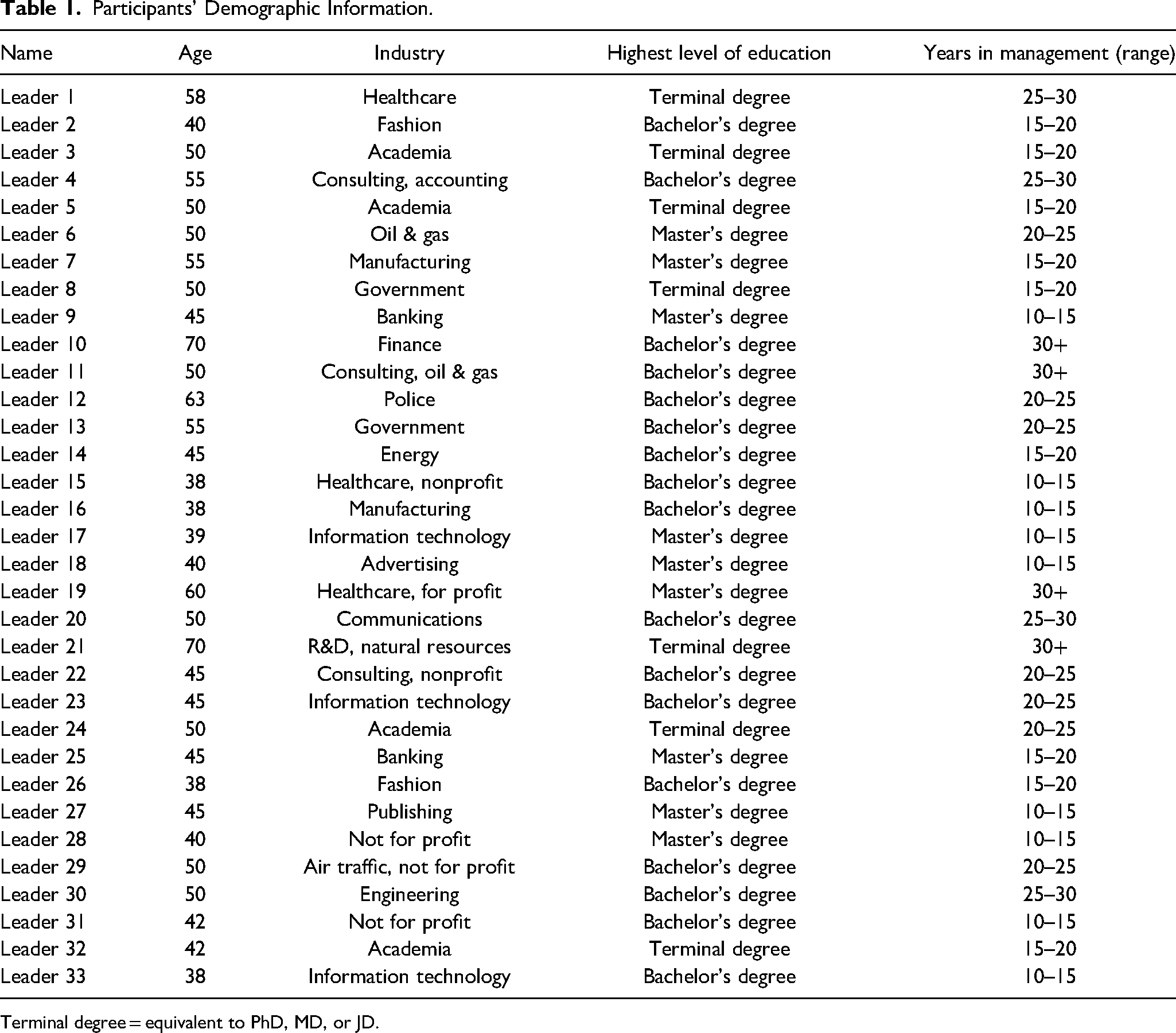
Terminal degree = equivalent to PhD, MD, or JD.
Data Collection
We conducted in-depth semistructured interviews with all participants. The interviews were conducted by both authors whereby we began our data collection by conducting interviews together, and once we felt aligned with the process, we conducted the rest of the interviews separately. However, we continued to meet to discuss emerging themes and other issues following each interview. We requested permission from participants to audio-record the interviews and all but one participant agreed, for whom we took extensive notes. All interview recordings were professionally transcribed. The interviews ranged from 45 to 170 min, with the average interview lasting 75 min. The interview guide included questions around major themes such as identifying as leaders at work, identifying as women at work, the challenges and joys of those identities, and their career trajectories. The interview guide is provided in Appendix. In addition to the transcribed interview data, we took notes on the participants’ nonverbal communication during each interview to provide us with further insights. All data were subsequently imported into NVivo, a software program for qualitative analysis.
Data Analysis
We employed a grounded theory approach by going back and forth between data collection, coding, and existing theoretical perspectives (Glaser & Strauss, 1967; Strauss & Corbin, 1990) to develop theory regarding female leaders’ processes of identifying as “a woman” and “a leader” in their work environments. Specifically, we drew on the Gioia method (Gioia et al., 2013) whereby our data analysis went through three stages of analysis that occurred iteratively, as is typical of this method (Langley, 1999; Locke & Golden-Biddle, 1997).
Stage 1—First-Order Analysis
In the first-order stage of our analysis, we stayed faithful to the participants’ own words, by identifying concepts and generating codes directly from the participant transcripts (Corbin & Strauss, 2008; Gioia et al., 2013). Both authors independently analyzed transcripts and made notes on observational data in steps. We first selected the same three transcripts to conduct open coding and then met in person to discuss our initial codes and potential themes. We reiterated this process throughout, with both authors independently conducting open coding and then meeting to discuss, analyze, and narrow the codes (and to come to agreements wherever any coding deviations occurred). We were continuously interviewing participants throughout these stages. We would use the emerging trends and insights from our analyzed data to make small adjustments to our interview protocols for subsequent interviews. Upon completion of the first stage of coding, we had approximately 90 first-order codes that emerged such as passion, leader expectations, motherhood expectations, guilt, and power, among others.
Stage 2—Second-Order Analysis
Next, we sought out similarities and differences among our first-order codes to develop second-order themes. Specifically, we identified themes that most related to identifying as a woman, as a leader, and the reasoning that our participants used to explain these narratives, narrowing down our original 90 codes to a more manageable 25 themes. For example, we combined codes referring to extreme, prototypical leadership expectations into a broader theme of ideal leadership norms, including power, work devotion, and long-hour expectations. To help provide plausible explanations for our findings in relation to our research questions during this stage, we engaged with the existing literature on gender and leader identity. We achieved theoretical saturation after 25 interviews at which point the codes and themes that emerged from additional interviews did not generate any new information (Glaser & Strauss, 1967). To confirm this saturation and to add further contextual nuance to our data, we conducted eight more interviews with women leaders.
Stage 3—Data Structure
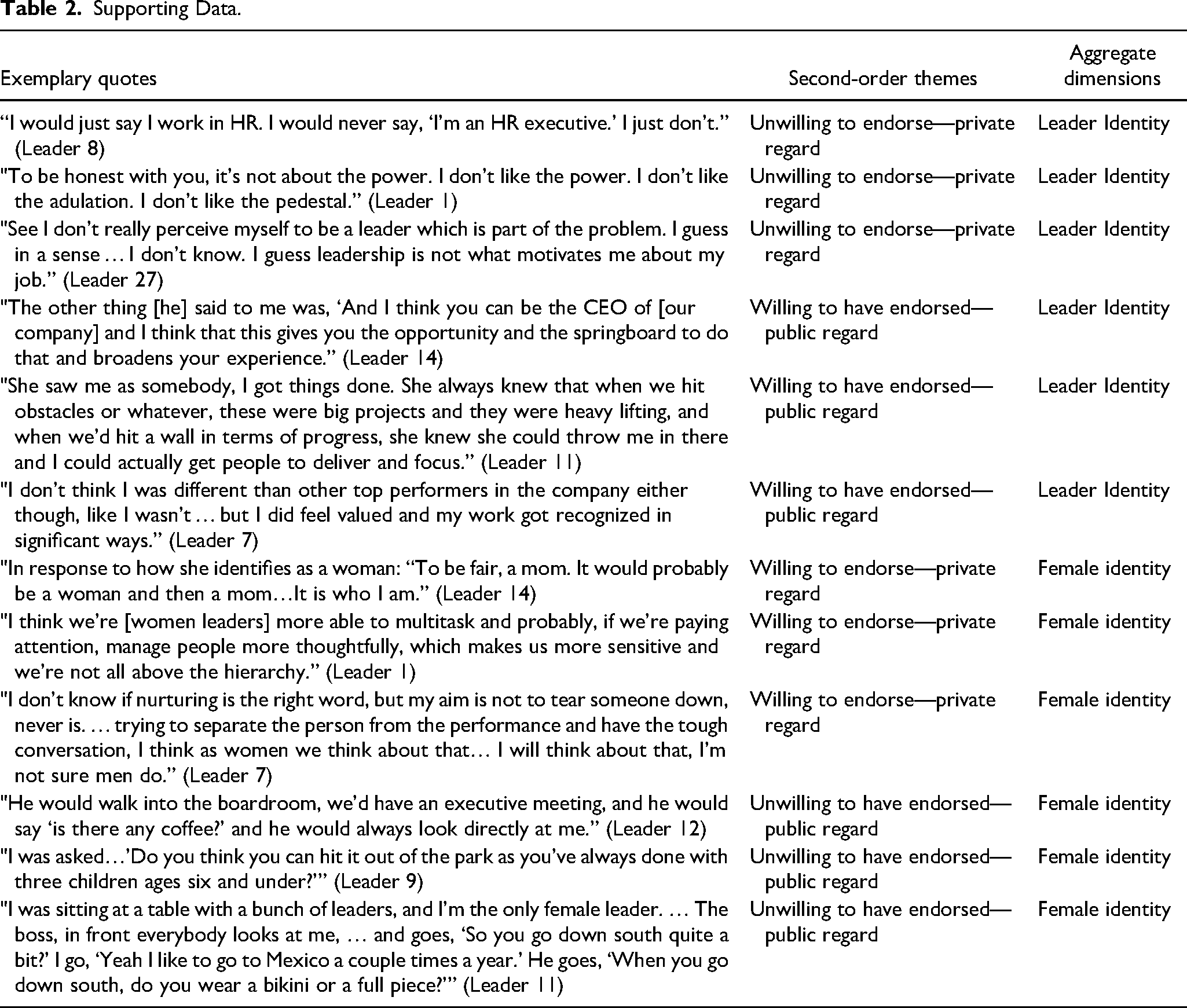
As a last step of analysis, we developed a data structure based on our emergent themes and the incorporation of theoretical perspectives by DeRue and Ashford (2010), Eagly and Karau (2002), and Karelaia and Guillén (2014) relating to leadership and gender identity, identity incongruency, and positive identities, respectively. Guided by this literature in conjunction with our research question, we were able to narrow down the coding of our data to four overarching themes—(1) public regard of leader identity endorsements, (2) private regard of leader identity endorsements, (3) private regard of female identity endorsements, and (4) public regard of female identity endorsements—centered around two aggregate dimensions of leader and female identities (see details in Table 2). Our data structure is depicted in Figure 1, illustrating the unrequited ways in which public and private endorsements were both desired and refuted by female leaders in the construction of a coherent identity. We shared this data structure with a subset of our participants to ensure they resonated with our findings (Corbin & Strauss, 2008; Patton, 2002); they agreed that this fit with their experiences.
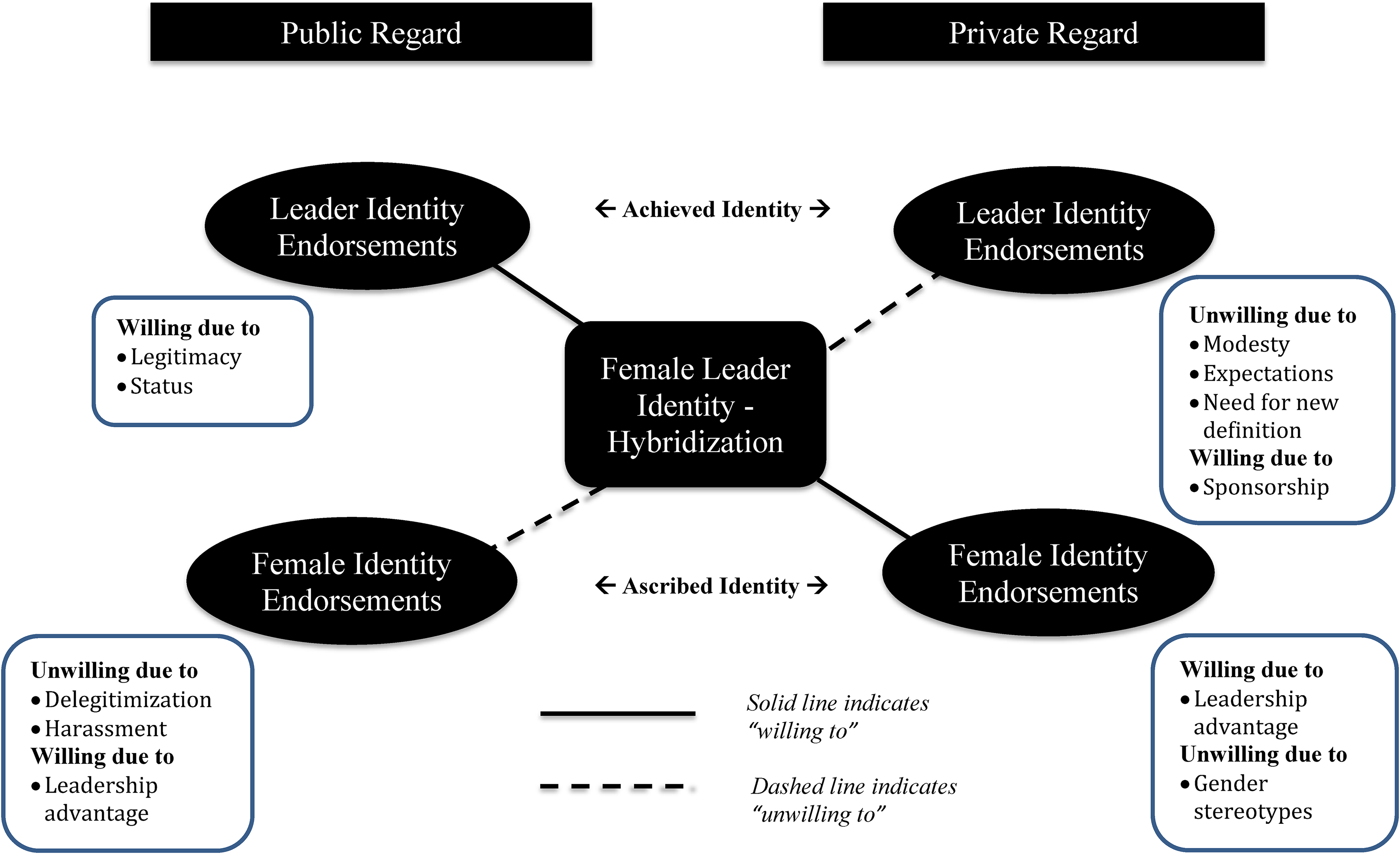
Female leader identity-hybridization.
Supporting Data.
Findings
Below we illustrate the narratives from our interviews that form the basis for our four main themes around public and private identity endorsements. We begin with a depiction of the willingness of female leaders to have others publicly endorse their leader identity, which was the most consistent theme of our data. Next, we explore female leaders’ beliefs around the desirability of privately endorsing a leader identity. We then present data outlining female leaders’ willingness to privately endorse their female identity, and we finish by presenting the findings associated with women's unwillingness to have their female identity publicly endorsed. Collectively, these themes offer insights into participants' construction of a female leader identity.
Leader Identity Endorsements—Public Regard
In line with literature on the importance of leadership endorsements for the construction of a leader identity (e.g., Day & Sin, 2011; Guillén et al., 2015), our participants welcomed and appreciated their leader identity being validated by others, especially other senior leaders in their organization who recognized their leadership potential. For example, Leader 20 described: My manager at the time would have asked me to take on responsibility to lead another team of people… It wasn't something I sought. It's not that I came in and said, “Oh, I really want to go into leadership.” It was more almost somebody else recognized that in me and made the suggestion and gave me the opportunity.
Through their stories about becoming and working as leaders of their organizations, these women recognized how important public endorsements were for their careers. As per Leader 8, “If I hadn't been encouraged or pushed, or if opportunities hadn't been given to me, I don't think I would be in this job right now.” Participants responded positively to these public leader endorsements, many suggesting that they would not have gone as far in their careers without others recognizing and sponsoring them. Indeed, the respondents also demonstrated positive nonverbal responses when discussing these acts by smiling and leaning forward, further emphasizing their appreciation of these leader endorsements for their leadership experiences (i.e., these nonverbal behaviors signal engagement and acceptance; Behoora & Tucker, 2015).
Leader Identity Endorsements—Private Regard
While our participants wanted to have their leader identity endorsed by others, in light of the many benefits such endorsements provided them as leaders, they largely expressed an unwillingness toward privately identifying as leaders. Despite the women holding formal leadership titles, they expressed discomfort with calling themselves leaders. A senior leader in publishing put it succinctly “See I don’t really perceive myself to be a leader, which is part of the problem, I guess.” (Leader 27) Another highly influential leader in the medical field demonstrated this unwillingness in response to a question of whether she had always planned on going into leadership: “Oh no, no, no, no, no, no, no” (Leader 1). She elaborated on this by describing how she recognized that her unwillingness to identify as a leader was in stark contrast to how others in her organization perceived her: I get that I have a lot of influence and power. But when I look in the mirror, I still see the 16-year-old awkward kid who didn't fit anywhere. Yet, I know that people look at me and go, “You have no idea what we all see.” I said, “That's correct. I do not know what you see.” My boss expects me to take on CEO within the next four years. I don’t want to. I, actually, have another girl in mind that I intend to bring on. I’m not, terribly, interested in that part of the job… I never, really, had a vision or plan to be a leader. (Leader 15)
Likewise, Leader 12 described her reluctance to personally endorse her leader identity, even in the face of leader identity endorsements by others, such as when she was promoted to one of the highest ranks within the police force. “I didn’t feel I was the person. I saw what a little bit of authority and power going to people's heads could do to them so I said I am not going down that road.”
Our participants’ unwillingness to privately endorse a leader identity was also captured in their nonverbal responses. Questions about identifying as a leader were often followed by long pauses or shifting in their seats as participants collected themselves before responding (i.e., these behaviors can be interpreted as signs of hesitation, defiance, and unwillingness; Fox Tree, 2002; Zhou & Zhang, 2008). Leader 15 explicitly described this nonverbal response by saying “By the way, every time I say leadership, I’m automatically doing air quotes with my fingers for some reason. I just don’t operate that way in my head.”
To help us understand why our participants expressed such aversion toward explicitly identifying as a leader, we asked them to explain. Three main reasons emerged from the data, which all centered around leader stereotypes. First, some of the women appeared unwilling to privately endorse a leader identity out of modesty or humility, whereby they downplayed their leadership success and eschewed the stereotypes of being confident or assertive of their position. Leader 1 put it succinctly “I think, that I probably am more shy and humble than a lot because as I say, it's not about me.” Several women suggested this modesty was related to their gender: I don’t know that I even see myself like [a leader]… I think that's how come I am so successful about it, I don’t know if my modesty or my ability to stay humble is the right word, but I’m just more engaged in the process and don’t even realize what I do. I’m aware enough to know that I’m the leader here, I just … I don’t know, I think this comes back to gender as well, I don’t really see myself as up here, I’m just here. I don’t know why. I don’t think I see myself here the way other people do. (Leader 16)
A second reason for our participants’ reluctance to identify as a leader appeared as a form of resistance against the onerous expectations implicitly expected given the stereotypes of leadership. Leader 13, an executive director in the public service, stated “I think more women would be more interested in roles, but when you see people in leadership roles who are killing themselves, who seem ragged…I don’t want it.”
Similarly, Leader 8 explained, I love my job. It's a spectacular job. But I’m tired of working this much, to be honest… Executive jobs are very demanding. When you add on top of that two teenagers, it's like…well, there's almost no moment where I have down time.
Finally, some of the participants spoke of the need for a new definition of leadership that they could more comfortably identify with. These women highlighted their discomfort with current leadership stereotypes and how they did not “fit” with those expectations. I think part of it is adjusting our perception of what leadership looks like… the expectation that senior leaders in organizations work all the time. If you’re not working all the time, then you’re somehow not living up to the role that you’re in. (Leader 13) I had capacity and interest to do more, so my ambition wasn’t really around going up the “leadership” ladder, but it was more about doing interesting, large projects to expand my horizons. For me anyways, if I don’t reframe it that way I’m going to start second guessing my every move, and I can’t afford to lose confidence. (Leader 11)
While this reluctance to refer to themselves as leaders was evident in most of our interviews, this was not so for every woman in our sample. Some did privately endorse their leader identity, but only when they had received excessive leadership acknowledgments from others, whereby this type of sponsorship over time made it hard for them to “deny” it. For example, Leader 9 illustrated this by indicating that it was not until she became the Vice President of a large financial institution that she felt comfortable with her identity as a leader. When asked whether she identified as a leader, she accordingly responded “Yes. Only after I got into this role. I mean now, yes. So, the last, I’d say the last two years.” (Leader 9) Similarly, the founder and CEO of an advertising company with numerous prestigious awards stated: The reason why I feel comfortable in saying, “Yes, I am a leader in this profession and in this industry and especially in this region” is because I have the credentials to back myself up. I’m not bragging. It's on paper, right? (Leader 18)
In summary, the main emergent theme regarding the private endorsements of a leader identity was that, with a few exceptions, most female leaders did not desire to do so, despite their formal roles as leaders in their organizational hierarchy. Instead, for three different reasons that were self-identified by the leaders, namely owing to humility, high expectations, and the need for a new leadership definition, these women actively avoided referring to themselves as leaders.
Female Identity Endorsements—Private Regard
A contrasting pattern of results emerged for the participants’ female identity at work, such that the majority seemed to strongly internalize their female identity and therefore were willing to privately endorse it. One respondent put it succinctly: If I said to you, “When you walk through this world, how do you identify? What's front and center? What's the first thing you think of yourself, how you identify?” I identify as a woman. I walk through the world as a woman. (Leader 16)
A main reason behind our participants’ willingness to personally endorse their female identity was because they saw this as an advantage to leadership. In particular, many participants outlined how women's natural tendencies toward communality made them better leaders. As Leader 3 highlighted: “Our female style, you know the caring style, is more important as a leadership style…it's our edge …people respond better to collaborating, caring, listening, trusting. Those are more female characteristics.” Similarly, another respondent described how being a woman meant she was more engaging and inclusive of others: “Engaging people, arriving at the solution. I think that's what women do better. … we're much more inclusive in getting people's opinions, but men don't necessarily.” (Leader 21).
Participants also suggested that drawing upon their gender made them more capable of making tough decisions. Specifically, by capitalizing on the empathic components of their female identity, they could make tough but respected decisions that were instrumental for leadership. As Leader 9 discussed: When I first came in… some decisions were hard in that I had to let go of about six people… I was extremely conscientious to ensure that they were dealt with the most respect possible. And that they were not walked out the door…prior to me with male leaders, they were walked out the door and it was quite dramatic and hard on everyone to see that lack of empathy.
It is important to note that a few participants shared a reluctance to privately endorse their female identity due to concerns about stereotypes of what it means to be a woman in leadership, which often came with some backlash. For example, Leader 6 explained how she was hesitant to privately endorse her gender as she worried it would make her appear too emotional as a leader saying “When I took leadership roles, I knew I had to do something different. I’d always have to take the emotions out of it. Women always seem to tie emotions to everything we do.” In a related fashion, Leader 32 indicated that she was not a “typical woman” in that she did not have “any kids or cats,” which made her feel different from other women. Leader 2 recognized that she had more of a “male leadership style” which she found to be a challenge for how she was perceived by others as a woman. Her company accordingly paired her up with a coach to help her “smooth those edges and make sure that I’m articulating my sensitivity or my consideration for who's on my team.”
Overall, our results indicate that while these women were aware that others may not perceive the female gender role as compatible with leadership (see more below), most of them believed the opposite to be true: Being a woman was something they embraced and saw as a strength to their leadership. Hence, most women privately endorsed this identity.
Female Identity Endorsements—Public Regard
While most of our participants were personally willing to endorse their female identity, they were much less willing to have their female identity endorsed by others in the workplace. This unwillingness stemmed from the interpretation that when our participants had their gender identity endorsed at work, it appeared as an attempt to delegitimize their leadership, often in the form of gender bias and harassment. For example, some women discussed their gender identity being publicly brought to attention as a means to doubt their leadership capabilities. Leader 12 offered the following illustration of her experience in an interview for a senior leadership role: He said, “Well, you know, you're a woman. How would you propose to get men on side with your leadership?” Very quickly I thought to myself if I were a man, would he be saying how do you expect to get women onside with your leadership? It wouldn't even be on his radar. That question wasn't asked of the men who were being interviewed.
Others talked about their female identity being endorsed by others through forms of benevolent sexism, that is, a positive attitude toward women that stems from stereotypes of them as weak and in need of protection (Glick & Fiske, 1997), primarily when their role as mothers became salient. These gender grants highlighted incompatibilities between their roles as mothers and leaders. For example, Leader 28 described: I really didn't realize it until I got my first official evaluation, and, in the evaluation, it was written down that until my children got to a certain age, I wasn't going to be able to grow in the organization because of my responsibilities.
Stories of overt hostile sexism were also shared, further illustrating why these women were unwilling to have their gender endorsed by others at work. Leader 26, an executive in the fashion industry said “I definitely quit one job specifically because the boss was an Italian male, and he snapped my bra.” Leader 18 described how incidents of sexual harassment were also common due to her gender: I've had a lot of those run-ins. You suck it up and do whatever because you know that if you go to your male boss and say, “Hey, that client he was grabbing my ass the whole night and trying to get me back to his hotel room.” It's not going to help things…Or you'd just be taken off that piece of business, until a more appropriate project came along.
While the above quotes suggest that the female identity endorsements were denied due to their negative nature (i.e., in the form of delegitimization and harassment), we also heard some stories about more positive female identity endorsements in the form of extra support or praise that were still denied, often for fear of being seen as receiving special treatment (e.g., being a “diversity hire”). For example, Leader 17 shared: I don’t want to have any thought of I got ahead because I am a woman like “oh well, we’ve got to check the boxes and someone needs to get a promotion and we better make it be a female”…I know at [my company], we have a lot of women groups and things that we do specifically for women but I don’t necessarily participate in them nearly as much as I should be.
In contrast, a couple of women were inclined to accept endorsements of their gender when the stereotypes of their gender supported their leadership. While these gender grants were uncommon in our data, and thus not sufficient to reflect a theme, we did find some preliminary trends that suggest women were willing to accept gender endorsements when the stereotypes associated with being women enhanced their leadership. For example, Leader 9 stated: “My boss said, you know it took a woman to do these little things like go home early on a Friday or bring in the chocolates…so more empathetic, more on the soft side of things, more considering other people's feelings or how would the staff feel about this, or more inclusive in group decisions.”
Overall, our participants recognized that endorsements of their female identity in the workplace could cost them in terms of their credibility as senior leaders, and therefore were predominantly unwilling for others to endorse their female identity, despite privately doing so.
Discussion
Developing one's leader identity is considered a critical part of leadership development (e.g., Day & Harrison, 2007; Lord & Hall, 2005), including a willingness to see the leader identity positively, both from private and public regard (Karelaia & Guillen, 2014). To identify as both a leader and a female, female leaders should correspondingly feel positively about both identities and also perceive that others see those identities favorably, meaning that those private and public regards should be positively correlated (Ashmore et al., 2004; Karalaia & Guillén, 2014). However, our results suggest that female leaders grapple with competing perceptions of their dual identities whereby how they privately view both their leader and gender identity are in tension with how they feel others view those same identities. As a result, they are unwilling to endorse both the public and private regards of a leader and female identity simultaneously, resulting in a dual-identity process that we call unrequited, defined as “not reciprocated or returned in kind” (Mirriam-Webster, n.d.).
We use our discussion to explore both the how and the why female leaders engage in this unrequited identity process. We propose that female leaders engage in identity hybridization to successfully reconcile the tension between public and private regarding their two contradictory and salient identities. We next propose that female leaders do so as a means to manage the risks associated with identifying fully with either identity. We draw from theories of ascribed versus achieved identities, status characteristics theory, and role congruity theory to further explain our results.
Reconciling Leader and Gender Identity Tensions via Identity Hybridization
As identified above, our female leaders approach their identities with seeming contradiction. They are willing to have their leader identity publicly endorsed by others, but mostly refrain from privately endorsing it to themselves, juxtaposed with a willingness to privately endorse their female identity, but a general unwillingness for others to publicly endorse it. This intricate approach suggests a process of identity work, from which we build off prior scholars (i.e., Ashforth & Schinoff, 2016; Brown, 2015; 2017; Watson, 2008) who examine identity work as an agentic act (Gecas, 1991). The female leaders in our study acknowledge their positive private regard toward their female identity, while noting that, at work, their gender is often used as a means to delegitimize their leadership, thus they are less willing to have it publicly endorsed. On the other hand, they do not wish to privately endorse a leader identity, as it does not align with how they internally see themselves, however, they recognize its power when publicly endorsed by others. This juxtaposition captures the dialectic between being motivated to capture aspects of two salient identities that are congruent with how they personally see themselves while also desiring to be afforded external legitimacy of their identities by others (Brown, 2017; Ibarra & Barbulescu, 2010).
This form of identity work is consistent with identity hybridization (Lam, 2020; Purchase et al., 2018), which involves the mixing of two different identities so that elements of both are encapsulated within one's self-space (Marotta, 2008; Purchase et al., 2018). Specifically, “it denotes the cognitive and behavioural tactics undertaken by individuals to negotiate their hybrid selves by selectively recombining identity resources of the associated social domains” (Lam, 2020, p. 841). In this case, female leaders take the “best parts” (Essers & Benschop, 2007, p. 62) of their leader and gender identities and engage in identity negotiation (Wright et al., 2012), selectively adopting and rejecting parts of their identities so that elements of both identities are encapsulated within their identity construction (Marotta, 2008; Purchase et al., 2018). Our participants, using identity hybridization, privately endorse their female identity but not their leader identity and allow others to publicly endorse their leader identity but not their female identity.
Identity hybridization provides female leaders a number of positive protective identity strategies that may prevent identity conflict from becoming a liability (Petriglieri, 2011). First, it enables the management of paradoxical tensions between their leader and gender identity via a blend of agency and communality (Zheng et al., 2018a) where women are able to select the stereotypes of both the leader and female identity that they felt positively toward. For example, participants identified that the communal stereotypes associated with being female such as being compassionate and cooperative were assets to the way they operated as leaders. Participants also accepted that the agentic stereotypes of a leader identity such as having power and influence that were afforded to them via public endorsements of a leader identity allow them to enact change and have influence in their work. Second, researchers have found that positive self-conceptions in one domain help to protect one's self-conceptions in a separate domain (Crocker & Wolfe, 2001). Thus, for women leaders, even if they do not feel positively toward both the public and private regard of the female and leader identities, they endorse elements of each which enables them to “blend” aspects of the two contradictory identities and feel more authentic (Karelaia & Guillen, 2014).
Overall, we have identified how female leaders are blending their two salient and contradictory identities using both the public and private regards of each via identity hybridization. While this builds on and extends previous work that examines how female leaders reconcile the tensions between their leader and gender identities (e.g Karelaia & Guillen, 2014; Meister et al., 2017; Zheng et al., 2018a; 2018b), we wanted to further explore both our data and the existing literature to find greater nuance in our findings. In other words, why do female leaders engage in this form of identity hybridization? We discuss this in our next section.
Identity Hybridization as an Identity Risk Management Strategy
Identity hybridization is a useful strategy for female leaders—it enables them to bring the best parts of their identities to light while minimizing the parts that would detract from effectively being who they are. Yet, this is not the typical leader identity construction process (DeRue & Ashford, 2010). Why, then, do female leaders engage in this form of identity hybridization? We suggest that they do so as an identity risk management strategy pertaining to the key and consequential differences in the identities of “leader” and “female,” both in terms of how those identities are afforded and what each identity prescribes.
First, we consider the nature of a gender identity as compared to the nature of a leader identity. A gender identity, particularly for women identifying and presenting as female as was the case for our participants, is the first thing that people see—it is an ascribed identity which is difficult to conceal or deny (Deaux et al., 1995). A leader identity, on the other hand, is more ambiguous in that it is an achieved identity (Ashmore et al., 2004), one that is subjectively and relationally defined whereby who owns such an identity may not be an agreed-upon concept (DeRue & Ashford, 2010). Recent findings suggest that some people may deny endorsing a leader identity as a means of preventing anticipated negative social and self-evaluations (Lee-Cunningham et al., 2023). To privately endorse a leader identity, one that is high-status, achieved, and possibly fleeting, could come with a risk of negative self-evaluation, particularly if female leaders attribute to that identity many of the stereotypes that violate their female identity (i.e., ambition and assertiveness). However, to receive public endorsements for a leader identity comes with little risk—it is relational in nature and is seen as a recognition of one's ability rather than a self-perception of one's competence (Hogg et al., 2012; Lee-Cunningham et al., 2023). While the above insights draw from research on individuals not yet in leadership roles, our work illustrates how such risk management practices can play out for actual leaders as well. That is, we find that public leader endorsements enable current female leaders to exert influence and enact change without the personal risks associated with privately endorsing a leader identity.
We also consider how identity hybridization mitigates the risks of female leaders’ ascribed identity where they deny public endorsements of female identity in the work domain but endorse their female identity in private. To privately deny one's female identity could be self-threatening and stress inducing for female leaders (Creswell et al., 2005; Haslam et al., 2009)—it is the identity they have had the longest, it has long-term role ties and is difficult to exit, consistent with what is termed an obligatory identity (Gallagher, 2016; Thoits, 2003). As we found with our participants, they largely endorse the positive stereotypes of how they themselves identify as women, recognizing many of the communal tendencies that support their leadership. These private endorsements can support an overall self-perception at work (Hogg et al., 2004) and indeed we noted that participants felt their gender identity created positive spillovers for their leadership (Rothbard & Ramarajan, 2009). However, while our participants viewed their gender identity as positive for their leadership, they recognized that the public regard for the female identity in the work domain can be perceived negatively for leaders (Eagly & Karau, 2002). As such, participants are less willing to have others publicly endorse their female identity. They recognize that a female identity carries with it lower status relative to the male identity in the work context (Ridgeway, 2001) and that when female leaders were endorsed publicly for their gender, it was often (though not always) done in a way to delegitimize their leadership. By engaging in identity hybridization, female leaders are able to mitigate threats to the self by having a positive private regard for the female identity while reducing the threats at work by denying others’ endorsements of their gender which often reflected a negative public regard.
Our research shows that this unrequited identity process of identity hybridization allows female leaders to have agency in how they negotiate the elements of their two salient identities that best support them as female leaders. It allows them to actively avoid calling themselves a leader, as that identity comes with expectations of displaying agentic traits and committed to the onerous demands of leadership, while simultaneously denying others the ability to emphasize their gender at work which threatens their legitimacy as a leader. Engaging in identity hybridization of these salient yet contrasting identities allows female leaders to be effective in their roles, giving female leaders the advantage of choosing which facets of their identities to adopt (Van Laer & Janssens, 2014) and transforming them into a useful narrative (Essers & Benschop, 2007). While this process does not necessarily conform with more general leader identity construction theories (DeRue & Ashford, 2010; Marchiondo et al., 2015), it is in line with more recent research on identity work for minority members as “an agentic tool to navigate or reconcile identity tensions” (Doldor & Atewologun, 2021, p. 897). Our research corroborates the importance of understanding the distinct ways in which minority members navigate the interplay of identities to construct a leader identity, paying particular attention to the public versus private domain of their social categories and how they are perceived.
Practical Implications
Our research offers important practical implications regarding the gendered nature of the leader identity development process. In particular, organizations should be careful not to offer a “one-size fits all” leadership identity development program. Promoting the idea that women need to identify as leaders to capitalize on the benefits of a leader identity ignores the potential risks associated with doing so. The women in our study were able to successfully function as leaders despite not personally endorsing a leader identity—or perhaps because they did not do so. While previous work on leader identity development has largely focused on nonleaders (e.g., Bartels & Wellman, 2023), members of minority groups who are in leadership positions and hold ascribed identities that are in conflict with a leader identity may require support for identity hybridization.
The leaders in our study credited much of their success to being publicly endorsed a leader identity. This mimics a form of sponsorship, whereby a leader's ability is recognized, validated, and advocated for (Ely et al., 2011; Ibarra et al., 2010). As women tend to be “overmentored and undersponsored relative to their male peers” (Ibarra et al., 2010, p. 82); our findings suggest that this is a critical opportunity to capitalize on the identity endorsements by others. Organizations who are looking for more women, and other minority group members whose ascribed identities conflict with a leader identity, to succeed in leadership roles should, therefore, encourage sponsorship to ensure they receive the public endorsements necessary for leadership.
Lastly, we theorize that women are unlikely to privately endorse a leader identity because of how they perceive “ideal leader” expectations. Since most organizations today hold implicit beliefs that leadership is inherently agentic (Ely et al., 2011) and requires full work commitment at all times, they are also likely to use language and to celebrate role models who support this masculine, 24/7 work culture (Padavic et al., 2020). By proactively and strategically redefining what leadership is, the types of behaviors that are celebrated, and what type of time commitment these positions require, organizations will be better positioned to help women perceive less of a disconnect about who they are as leaders, which may ultimately enable them to privately endorse a leader identity with less apprehension. For these reasons, we encourage organizations to consider how they can be more inclusive in how they think about, promote, and reward leadership.
Limitations, Future Research, and Conclusion
The qualitative design and context of our study bring with it limitations that offer important opportunities for future research. First, our sample included 33 rich interviews that reached theoretical saturation. However, as with all qualitative research, especially with smaller sample sizes and with the use of retrospective sensemaking, it is important to consider replicating and extending the findings using other methods and larger, more diverse samples that may offer more generalizable results moving forward. For example, a longitudinal survey study that examines the leader identity construction process of women leaders (e.g., who is endorsing their leader or gender identity?) as well as its impact (e.g., what are the benefits vs. costs of identity hybridization?) would be useful. Secondly, we recognize the need for research that includes the role of other salient identities. Depending on the compatibility of the leader identity to other importantly held and ascribed identities, such as a person's age, race, and sexual orientation, it is plausible that leaders will have different processes for identifying as a leader.
Thirdly, we explicitly asked our participants questions pertaining to identifying as a leader and as a woman, which could elicit concerns associated with imposing an awareness of identity that, in typical situations, may not be present (Alvesson & Empson, 2008). In addition, given that the authors both identify as female, we recognized that there may be demand characteristics associated with us as interviewers in asking explicit questions about gender and leadership. As such, we took special care asking participants explicitly to recall both positive and negative accounts of their leader and gender identities to mitigate these concerns. Relatedly, while there are scholars who argue that gender congruence between interviewer and interviewee can help to elicit the “real” experiences of other women (Hamberg & Johansson, 1999), it is also possible that our gender congruence influenced both the data collection process and the interpretation of our results. We attempted to mitigate this by establishing a nonhierarchical relationship in the interview and strived to be empathetic and create an open rapport as is deemed best practice for reducing these potential concerns (Doucet & Mauthner, 2008). However, as with all qualitative research, there are possible influences from our own identities that may have influenced the qualitative process that future research may address through other scientific methods as suggested above.
Conclusion
Our research provides important theoretical and practical implications about the unrequited identity process through which women leaders can sit within the disconnect of their leader and female identities using identity hybridization. The public and private regards associated with these two salient roles lead to a complex practice of adopting and celebrating certain aspects of their identities while evading others. Until such time that societal expectations associated with the role of leadership and of women at work evolve to be more compatible, this particular unrequited identity strategy may best enable female leaders to reap the benefits associated with being both a leader and a woman while limiting the drawbacks typically associated with these disparate identities.
Footnotes
Authors’ Note
Both authors contributed to this manuscript equally and authorship order is based on alphabetical order. The authors would like to gratefully acknowledge that this project was funded by a Social Sciences and Humanities Research Grant awarded to both authors. The authors would like to thank Dr. Anika Cloutier for her valuable feedback in support of this manuscript.
Declaration of Conflicting Interests
The author(s) declared no potential conflicts of interest with respect to the research, authorship, and/or publication of this article.
Funding
The author(s) disclosed receipt of the following financial support for the research, authorship, and/or publication of this article: This work was supported by the Social Sciences and Humanities Research Council of Canada, (grant number 430-2015-00735).
