




Abstract
In this study, we draw from moral exclusion perspective to theorize leader–member exchange (LMX) and subordinate goal orientation as antecedents of abusive supervision. In addition, we integrate LMX theory to propose LMX as a mediating mechanism through which goal orientation influences abusive supervision and consequently task performance. We tested our hypotheses through two cross-cultural multi-method studies. In a field study with South Korean employees (Study 1), we found that LMX and abusive supervision serially mediated the relationship between performance-prove goal orientation (PPGO) and task performance. In an online vignette study with American employees (Study 2), we found that LMX and learning goal orientation were negatively associated with abusive supervision. Furthermore, we found support that LMX mediated the relationship between all three dimensions of goal orientation (learning, performance-prove, and performance-avoid) and abusive supervision. Combing both studies, we found strong evidence that subordinates with high PPGO form positive relationships with their supervisors which elicit less supervisory abuse. Implications for management theory and practice are discussed.
Keywords
Since the introduction of abusive supervision construct by Tepper (2000), a myriad of empirical studies have examined its dysfunctional outcomes and different conditions in which it appeared (Mackey et al., 2017). More recently, researchers began to focus more on identifying the causes of abusive supervision based on three mechanisms: supervisors’ social learning (e.g., Kiewitz et al., 2012; Mawritz et al., 2012), self-regulation impairment (e.g., Burton et al., 2012; Muraven & Baumeister, 2000; Zhang & Bednall, 2016), and identity threat (e.g., Liang et al., 2016; Tepper et al., 2011; Wang et al., 2015). Despite the value of studying the antecedents of abusive supervision, little attention has been given toward the “subordinate provocation” perspective, which contends that abusive supervision is a reaction toward provocative subordinates who threaten supervisors’ identity (Aquino & Lamertz, 2005; Martinko et al., 2013). This perspective focuses on subordinate characteristics, behaviors, and attitudes that trigger abusive supervision (e.g., Lian et al., 2014; Liang et al., 2016; Tepper et al., 2011; Walter et al., 2015). Given the detrimental nature of abusive supervision, examining its antecedents can provide insights to practitioners who seek to abolish supervisory abuse (Tepper et al., 2017). Further, Mawritz and her colleagues (2017) advocated for future research to examine employee characteristics that elicit abusive supervision. Thus, this study seeks to shed light on why supervisors abuse certain subordinates by focusing on individual differences of the subordinates (goal orientations) and relational quality (leader–member exchange [LMX]).
We base our theoretical tenet on moral exclusion theory (Opotow, 1990b), which posits that individuals demonstrate hostility to others who reside outside their moral boundaries. In work context, supervisors resort to moral exclusion behaviors (abusive supervision) when subordinates are perceived as having negative utility, dissimilar, or in conflict with the supervisor (Opotow, 1995). Extending from the moral exclusion perspective, we predict that supervisors evaluate their subordinates’ utility based on their subordinates’ goal orientations (learning, performance-prove, and performance-avoid). Specifically, we predict approach orientations (learning and performance-prove) to trigger less supervisory abuse but predict avoid goal orientation (performance-avoid) to trigger more abuse. Along with subordinates’ utility perception, we predict LMX as an indicator of relational conflict that deters supervisors’ decision to engage in moral exclusion behavior. We further integrate LMX theory (Graen & Uhl-Bien, 1995) and moral exclusion theory (Opotow, 1990b) to demonstrate the interplay between these precursors of abusive supervision. Through the process of utility evaluation, the supervisors form moral boundaries regarding their subordinates (Opotow, 1990b). Much like the moral exclusion process, LMX development involves a process of competency (utility) evaluation, which determines the LMX quality with the focal subordinate. Given that utility assessment precedes the development of relational quality, we predict LMX to mediate the relationship between subordinate goal orientations and abusive supervision. Furthermore, we examine task performance as an outcome of abusive supervision. Moral exclusion theory states that moral exclusion behavior creates psychological distress, and research states that psychologically distressed individuals perform poorly on cognitive tasks (Baum et al., 1981; Opotow, 1990b). In other words, abusive supervision undermines subordinate task performance in work context. Taken together with the antecedents of abusive supervision, we predict that approach orientations (learning and performance-prove) exert a positive indirect influence on task performance via LMX and abusive supervision, while avoid goal orientation (performance-avoid) exerts a negative indirect influence on task performance via LMX and abusive supervision.
This research contributes to the literature in three ways. First, we add to the abusive supervision literature by introducing LMX and goal orientation as antecedents of abusive supervision. In contrast to the extant research, which identifies LMX as an outcome of abusive supervision based on a social exchange perspective (e.g., Haggard & Park, 2018; Xu et al., 2012), we provide a unique perspective suggesting LMX as an antecedent of abusive supervision based on a different theoretical lens (LMX theory). In terms of utility perception, we move beyond the extant research that mostly focuses on focal subordinates’ performance as an indicator of utility and demonstrate that subordinates’ individual differences such as goal orientation may also take part as an indicator of their utility. Second, we examine the interplay between the utility perception and relational quality based on integrating moral exclusion theory (Opotow, 1990b) and LMX theory (Graen & Uhl-Bien, 1995). Extant literature provides inconsistent findings on how these antecedents interplay. For example, Tepper and colleagues (2011) found relationship conflict as an antecedent of perceived performance, whereas Walter and colleagues (2015) found supervisor liking as a boundary condition on the relationship between perceived performance and abusive supervision. Through integrating two different theories, we demonstrate that perception of subordinate utility precedes the development of relational quality. Third, we contribute to goal orientation literature by demonstrating LMX and abusive supervision as an interpersonal mediating mechanism on the relationship between goal orientation and task performance. In doing so, our current research demonstrates how one indicator of subordinate utility (goal orientation) can influence another indicator of utility (perceived performance).
To test our hypotheses, we conducted two multi-method cross-cultural set of studies, one field study from South Korea and another online experiment study from United States. We demonstrate how subordinate individual difference and relational quality elicits abusive supervision and its negative consequences. In doing so, we offer a nuanced view on why supervisors abuse certain subordinates. Our conceptual model of Study 1 and 2 is depicted in Figure 1.
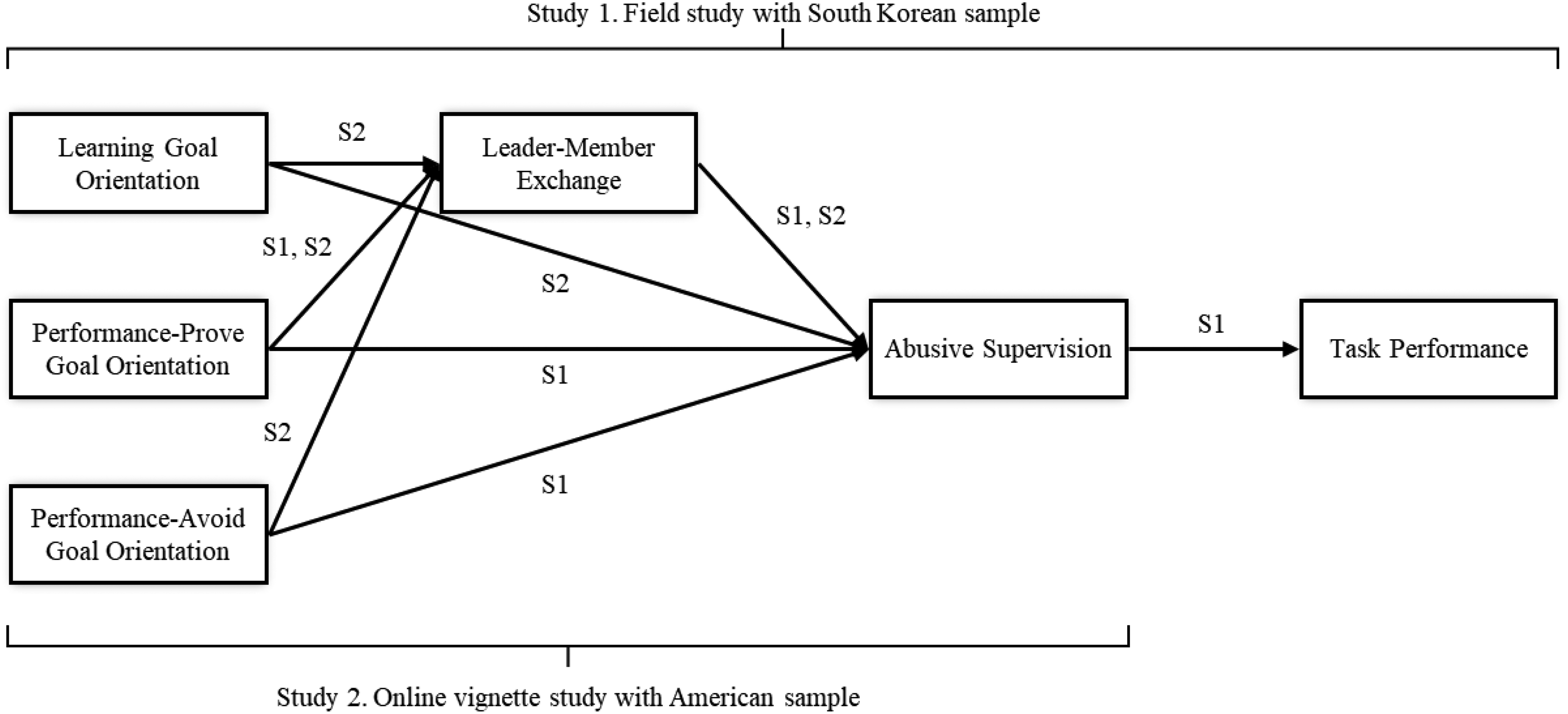
Conceptual model depicting findings from Studies 1 and 2.
Theory and Hypothesis Development
Abusive supervision is defined as “subordinates’ perception of supervisor's display of verbal and nonverbal hostile behavior” (Tepper, 2000, p.178). The stream of research provides numerous evidence that abusive supervision increases emotional exhaustion, workplace deviance, and work–family conflict and hinders job satisfaction, LMX, task performance, and organizational citizenship behaviors (e.g., Carlson et al., 2011; Kernan et al., 2011; Lian et al., 2012; Mackey et al., 2017; Mitchell & Ambrose, 2007; Schyns & Schilling, 2013; Tepper et al., 2006; Wheeler et al., 2013; Xu et al., 2012; Zellars et al., 2002). The general consensus of the literature is that abusive supervision has detrimental effects on employee outcomes and behaviors.
Although scholars have expanded the scope of abusive supervision literature through examining the antecedents of abusive supervision based on supervisors’ social learning or self-regulation impairment (see review by Tepper et al., 2017), these theories lack in clarity on explaining why certain subordinates trigger more supervisory abuse than others. To further understand the “subordinate provocation” perspective (e.g., Tepper et al., 2011), we draw from moral exclusion theory (Opotow, 1990b). Moral exclusion theory posits that individuals believe rules of justice are relevant for those only in one's scope of justice (Hafer & Olson, 2003). In other words, supervisors engage in abusive behaviors toward subordinates who reside outside of the supervisors’ moral boundaries. The moral boundaries are influenced by three types of precursors, i.e., perceived dissimilarity, relational conflict, and harmful utility of the target (Opotow, 1990b). Based on this perspective, we argue that subordinate goal orientations represent perceived utility, while LMX represents perceived relational conflict, both of which are responsible for determining the supervisors’ moral exclusion behavior.
LMX as Antecedent of Abusive Supervision
LMX refers to the quality of dyadic relationship between supervisors and subordinates (Dansereau et al., 1975). The LMX theory posits that supervisors and subordinates develop a unique dyadic relationship based on exchanging resources valuable to each of the parties (Graen & Scandura, 1987). Based on social exchange rationale, high LMX quality fosters feelings of mutual obligation and reciprocity, inducing a sense of loyalty, support, commitment, and trust (Cropanzano & Mitchell, 2005; Uhl-Bien & Maslyn, 2003). As such, a plethora of research have identified the positive effect of high LMX quality on employee outcomes, i.e., organizational citizenship behavior, job performance, organizational commitment, and job satisfaction (e.g., Anand et al., 2011; Gerstner & Day, 1997; Ilies et al., 2007; Martin et al., 2010; Schriesheim et al., 1998; van Breukelen et al., 2006).
The existing abusive supervision literature identifies LMX as an outcome of abusive supervision, stating that abusive supervision deters the development of high LMX quality (e.g., Haggard & Park, 2018; Xu et al., 2012). However, the bidirectional influence process of leadership suggests that social exchange relationships influence both supervisors and subordinates (Yukl, 2013), implying that LMX may influence supervisor behaviors. For example, leaders demonstrated more incivility toward followers with low LMX quality (Thompson et al., 2018), underscoring the role of LMX as predictor of negative interpersonal behavior. We propose that subordinates with high LMX quality may elicit less supervisory abuse because high LMX relationships entail positive utility, similarity, and less relational conflict. Individuals tend to be attracted to people who entail similar values and attitudes, which contributes to developing higher dyadic relationship quality (Byrne et al., 1971; Liden et al., 2016). In high LMX quality relationships, supervisors demonstrate high levels of trust in their subordinates’ abilities and their motivation (Brower et al., 2000) and therefore identify them as better performers (Dansereau et al., 1975).
In contrast, individuals who recognize dissimilarity are more likely to experience relationship problems because they hold fundamentally different opinions from their counterpart (Byrne et al., 1971). In work context, fundamental differences in opinion founded by perceived dissimilarity lead to disagreement on work-related goals and tasks (Harrison & Klein, 2007; Hobman & Bordia, 2006) and relationship conflicts (Jehn & Mannix, 2001; Mohammed & Angell, 2004). The symptoms of low LMX quality relationship entail relational conflict based on ineffective communication and misunderstanding (Paglis & Green, 2002). Therefore, supervisors are likely to perceive subordinates in low LMX quality relationship as poor performers (Dansereau et al., 1975). Consistent with the arguments of moral exclusion theory (Opotow 1990b), we expect subordinates with high LMX quality to receive less supervisory abuse because they demonstrate positive utility and less conflict. Thus, we present the following hypothesis:
Hypothesis 1: LMX is negatively associated with abusive supervision.
Subordinate Goal Orientations as Antecedents of Abusive Supervision
Goal orientation refers to an individual's tendency to work toward and achieve various goals in different situations (Payne et al., 2007; Vandewalle et al., 1997). Based on one's motives, Vandewalle et al. (1997) classified goal orientation into three dimensions: learning goal orientation (LGO), performance-prove goal orientation (PPGO), and performance-avoid goal orientation (PAGO). LGO is an approach orientation associated with an implicit view that attributes can be developed through effort and persistence (Dweck, 1999). Individuals with higher LGO seek to develop mastery through learning, placing effort, and acquiring new skills (Alexander & van Knippenberg, 2014; Gong et al., 2013). They tend to demonstrate adaptive response that drives them to enjoy and persevere in challenging situations and engage in problem-solving activities (Dweck & Leggett, 1988). Individuals with higher LGO have intrapersonal standards of competence, grounding their success based on their own improvements over time (Elliot, 2005). These qualities allow them to demonstrate competence in their in-role job performance (Janssen & Van Yperen, 2004). From the moral exclusion perspective, supervisors may perceive subordinates with higher LGO as having positive utility because they demonstrate optimal behavior and performance, which benefits supervisors. Thus, we predict subordinate LGO to be negatively associated with abusive supervision.
PPGO is defined as having a motivational goal to outperform others (Vandewalle et al., 1997). PPGO is an approach orientation based on the principle of social comparison that motivates individuals to compete and demonstrate performance superiority over others (Dietz et al., 2015). At work, employees with higher PPGO focus on normative competence to gain favorable judgment from others, including their supervisors (Elliot et al., 1999; Elliot & Church, 1997; VandeWalle et al., 2001). Supervisors perceive them as dedicated and competent (Lukacik & Bourdage, 2019) since employees with higher PPGO engage in impression management (self-promotion and exemplification) toward their supervisors. Van Yperen et al. (2014) found evidence of positive association between employee PPGO and non–self-report performance, lending support to the idea that supervisors perceive subordinates with higher PPGO as having positive utility. Thus, we predict subordinate PPGO to be negatively associated with abusive supervision.
Conversely, PAGO refers to focusing on avoiding demonstration of incompetence of oneself over others (Vandewalle et al. 1997). Unlike the two approach orientations mentioned above, PAGO is an avoid orientation that encourages employees to avoid failure and prefer situations where probability of failure is minimized through attainable goals (Silver et al., 2006). Research states that subordinates with higher PAGO demonstrate task withdrawal behaviors such as self-handicapping, off-task cognition, and task disengagement and display lack of interest and tenacity in a goal-directed endeavor (DeShon & Gillespie, 2005; P. Johnson et al., 2011). At work, their non-optimal behaviors may drive supervisors to perceive them as having negative utility. In line with our prediction, meta-analysis by Van Yperen et al. (2014) found negative relationship between PAGO and non–self-rated performance. Thus, we expect subordinate PAGO to be positively associated with supervisory abuse.
Hypothesis 2: Subordinate (a) LGO and (b) PPGO are negatively associated with abusive supervision, whereas (c) PAGO is positively associated with abusive supervision.
Subordinate Goal Orientations and LMX
The LMX theory states that leaders form different LMX qualities with their subordinates because employees demonstrate different levels of competence, motivation, and effort (Erdogan & Bauer, 2014; Graen & Uhl-Bien, 1995). In particular, supervisors’ perception of subordinates’ competence (utility) is a crucial determining factor of LMX development (Dulebohn et al., 2012). As mentioned earlier, each goal orientation results in different attitudes and behaviors that influence supervisors’ perception of subordinate utility. For example, LGO and PPGO are approach orientations that focus on attaining positive outcomes, such as task mastery and normative competence, respectively (Elliot & Harackiewicz, 1996). These approach orientations induce cognitive and affective processes (challenge construal, sensitivity to success-relevant information, and cognitive and affective immersion in the activity) that facilitate optimal task engagement (Depreeuw, 1992; Folkman & Lazarus, 1985; Wegner, 1994). Such processes drive individuals to seek feedback (Gong et al., 2017) that encourages social exchange process with their supervisors (W. Lam et al., 2007). Furthermore, individuals with higher approach orientations (LGO and PPGO) tend to demonstrate proactive behavior (Belschak & Den Hartog, 2010), as individuals with higher LGO perceive it as a potential opportunity to learn (Porath & Bateman, 2006), while individuals with higher PPGO perceive it as an opportunity to demonstrate their advantage (Belschak & Den Hartog, 2010). Although their motives might differ, the proactive behavior apparent in two approach orientations benefits the development of high LMX quality because leaders consciously or subconsciously remember subordinate's proactive behaviors to interpret subordinates’ performance (W. Lam et al., 2007).
Conversely, PAGO is focused on avoiding negative outcomes that involves self-protective processes (threat construal and anxiety-based preoccupation with self-presentational concern) that prevent optimal task engagement (Elliot & Harackiewicz, 1996). Employees with higher PAGO avoid seeking feedback because they believe the cost of seeking feedback outweighs the benefits (Gong et al., 2017). Furthermore, subordinates with higher PAGO are less likely to exhibit proactive behavior because they understand that proactive behavior is most visible to supervisors when they fail, which in turn increases the likelihood of receiving negative performance appraisals as a result (Belschak & Den Hartog, 2010). Based on the theory and relevant empirical findings, employees with higher PAGO may signal lack of commitment to the leaders, which in turn may deter the development of high-quality LMX relationship.
Hypothesis 3: Subordinate (a) LGO and (b) PPGO are positively associated with supervisors’ perception of LMX, whereas (c) PAGO is negatively associated with supervisors’ perception of LMX.
Subordinate Goal Orientations and Abusive Supervision: the Mediating Role of LMX
Thus far, we have reasoned that subordinate goal orientations and LMX quality represent utility and relational quality, which influence supervisors’ decisions to engage in supervisory abuse (Opotow, 1995; Tepper et al., 2011). On its own, moral exclusion theory is insufficient to explain which precursor is more likely than the other to be a more proximal antecedent of abusive supervision. Here, LMX theory merges nicely with moral exclusion theory to provide further explanation for how the interplay between the utility perception and relational quality affects abusive supervision. According to LMX theory, subordinates form high-quality LMX relationship with their supervisors if they demonstrate competence through successfully accomplishing given tasks (Graen & Scandura, 1987). This LMX development process implies that supervisors evaluate their subordinates’ utility before developing a certain level of relational quality. Given that we previously reasoned subordinates to form different LMX qualities with their supervisors based on their goal orientations, we predict LMX to mediate the relationship between goal orientations and abusive supervision. Specifically, we propose that subordinates with higher LGO or PPGO, who demonstrate positive utility, will develop high-quality LMX relationship, which in turn will trigger less abuse. Conversely, we propose that subordinates with higher PAGO will develop low-quality LMX relationship, which in turn will trigger more supervisory abuse, given that they demonstrate negative utility. Combining Hypotheses 1 and 3, we predict the following:
Hypothesis 4: Supervisors’ perception of LMX mediates (a) the negative relationship between subordinate LGO and abusive supervision, (b) the negative relationship between subordinate PPGO and abusive supervision, and (c) the positive relationship between subordinate PAGO and abusive supervision.
Goal Orientation and Task Performance: LME and Abusive Supervision as Mediators
Prior research on abusive supervision has well established a negative relationship between abusive supervision and task performance (e.g., Mackey et al., 2017; Zhang & Liao, 2015). Abused employees perceive their abusive supervisors as lacking in interpersonal justice (Aryee et al., 2007) and do not feel obligated to reciprocate, resulting in low-quality relationships with their supervisors (Reb et al., 2019). In addition, the abused employees are motivated to restore their sense of control through retributive behaviors, such as reducing work effort (Harris et al., 2007). Along with reduced work effort, abusive supervision depletes important resources required for employees to perform well and undermines employee's self-efficacy (Duffy et al., 2002). In line with prior research on the negative consequences of abusive supervision, Opotow (1990a) states that manifestation of moral exclusion behaviors lead to psychological distress of the victims. Subordinates who experience abusive supervision constantly ruminate (Liang et al., 2018) and experience depression and anxiety (Pyc et al., 2017). Psychological distress negatively affects individuals’ motivation and reduces effort (Hockey, 1997), hence leading to poor performance on cognitive tasks (Baum et al., 1981). Consistent with the theory and literature, we predict a negative relationship between abusive supervision and task performance.
Integrating the negative consequence of abusive supervision with Hypotheses 1–3, we predict that subordinates with approach orientations (LGO and PPGO) will trigger less abuse, because the performance contributions of subordinates with higher approach orientations (positive utility) benefit the supervisors. It is likely that these subordinates who experience less abuse will perform better since they will not be in as much psychological distress and will reap the benefits of having a better relationship with their supervisors. On the other hand, we predict that subordinates with avoid orientation (PAGO) will trigger more abuse because supervisors suffer when their subordinates demonstrate poor performance (negative utility). Inability to benefit from a positive relationship with their supervisors and experiencing psychological distress may further deteriorate the performance of the subordinates with avoid orientations.
Hypothesis 5: (a) Subordinate LGO and (b) subordinate PPGO are positively associated with task performance, whereas (c) subordinate PAGO is negatively associated with task performance via their effects on abusive supervision.
Hypothesis 6: (a) Subordinate LGO and (b) subordinate PPGO are positively associated with task performance, whereas (c) subordinate PAGO is negatively associated with task performance via their serial effects on LMX and abusive supervision.
Study 1: Method, Results, and Discussion
Sample and Procedures
The participants of the first study were from various South Korean firms. The interested participants were in supervisory position and received hard-copy surveys via mail. Each participant received two surveys with instructions, one for themselves and the other for one of their direct reports. The participants were instructed to randomly provide the survey to one of their direct reports. Once participants were finished with their surveys, they were instructed to place them in the sealed envelope and mail it to the provided address. The surveys included numbers that were used to match the dyadic data. Initial surveys were distributed to 269 full-time supervisor–subordinate dyads. We received 261 surveys, providing us with a response rate of 97%. Incomplete surveys and missing pair reduced our sample to 253 dyadic data. The final data consisted of employees from industries such as manufacturing (52.2%), retail (6.7%), financial (4.7%), IT (13.0%), service (10.3%), construction (2.8%), and others (10.3%). Of the responses gathered, 75.6% of subordinates and 86.0% of supervisors were male, and 92.7% of subordinates and 100% of supervisors had more than a Bachelor's degree. The average age of subordinates and supervisors were 37.3 years (SD [standard deviation] = 5.9) and 43.9 years (SD = 4.8), respectively.
Measures
We followed the translation procedure recommended Brislin (1980) to translate our survey items from English to Korean. Excluding demographic variables, all measures in this study were measured in a seven-point Likert-type scale (1, “strongly disagree”; 7, “strongly agree”).
Results of Study 1
Mean, SDs, and correlation results of Study 1 are provided in Table 1. We conducted a series of confirmatory factor analyses (CFA) with Mplus 8.8 (Muthén & Muthén, 2017) to ensure discriminant validity. The six-factor model initially showed satisfactory fit (χ2 (804) = 1,960.54, p < .001, comparative fit index [CFI] = .88, root mean square error of approximation [RMSEA] = .08, standardized root mean square residual [SRMR] = .06). Following Miller and his colleagues (1995), we allowed two pairs of abusive supervision items and one pair of task performance items to covary within the factor because the modification indices (MI) indicated a potential presence of common error variance in our data (MI >50). This enhanced our model fit (χ2 (801) = 1,716.04, p < .001, CFI = .91, RMSEA = .07, SRMR = .06) and exhibited better fit than the alternative model in which LGO and PPGO were collapsed into a single factor (Δχ2 (5) = 527.65, p < .001; χ2 (806) = 2,243.69, p < .001, CFI = .85, RMSEA = .08, SRMR = .07). Other alternative models such as a four-factor model where LGO, PPGO, and PAGO were collapsed into a single factor (Δχ2 (9) = 1,041.88, p < .001; χ2 (810) = 2,757.92, p < .001, CFI = .80, RMSEA = .10, SRMR = .09), a three-factor model (Δχ2 (12) = 2,381.25, p < .001; χ2 (813) = 4,097.29, p < .001, CFI = .67, RMSEA = .13, SRMR = .16) where goal orientations and LMX were collapsed into a single factor, a two-factor model (Δχ2 (14) = 3,278.65, p < .001; χ2 (815) = 4,994.69, p < .001, CFI = .57, RMSEA = .14, SRMR = .17) where goal orientations, LMX, and abusive supervision were collapsed into a single factor, and a single-factor model (Δχ2 (15) = 4,394.04, p < .001; χ2 (816) = 6,110.08, p < .001, CFI = .46, RMSEA = .16, SRMR = .18) all yielded weaker fit than our hypothesized model.
Means, Standard Deviations, and Correlations of Study 1 Variables.
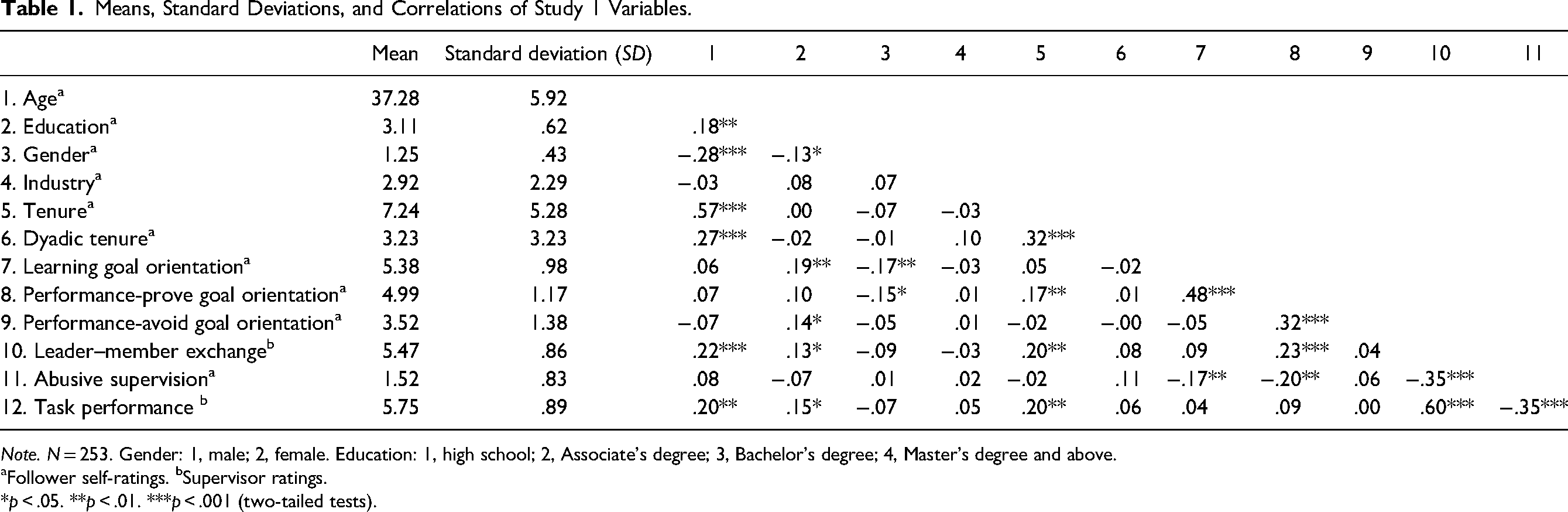
Note. N = 253. Gender: 1, male; 2, female. Education: 1, high school; 2, Associate's degree; 3, Bachelor's degree; 4, Master's degree and above.
Follower self-ratings. bSupervisor ratings.
*p < .05. **p < .01. ***p < .001 (two-tailed tests).
We tested Hypotheses 1–3 by conducting a structural equation modeling (SEM) using Mplus 8.8 (Muthén & Muthén, 2017). Figure 2 demonstrates the results of SEM. Our hypothesized model demonstrated an acceptable fit (χ2 (1035) = 2,041.66, p < .001, CFI = .90, RMSEA = .06, SRMR = .06). As shown in Figure 2, LMX had a negative relationship with abusive supervision (Hypothesis 1: b = −0.28, p < .001). While the relationship between LGO and abusive supervision (Hypothesis 2a: b = −0.02, ns) was not significant, subordinate PPGO (Hypothesis 2b: b = −0.11, p < .05) and PAGO (Hypothesis 2c: b = 0.09, p < .05) had a significant effect on abusive supervision. LGO did not have a significant effect on LMX (Hypothesis 3a: b = −0.08, ns), while PPGO had a significant positive effect on LMX (Hypothesis 3b: b = 0.20, p < .05). PAGO did not have a significant effect on LMX (Hypothesis 3c: b = −0.05, ns). Thus, Hypotheses 1, 2b, 2c, and 3b were supported.
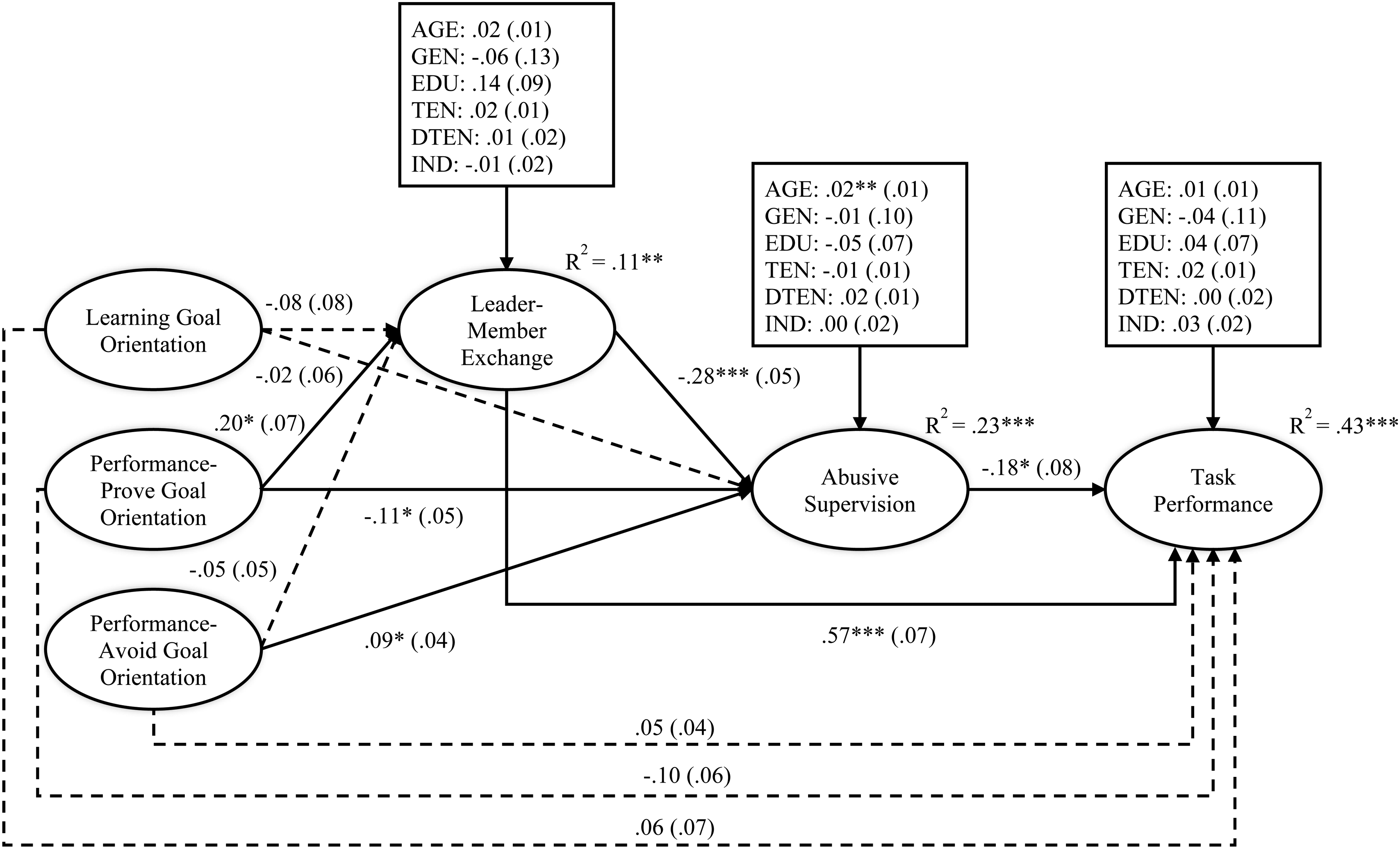
Structural equation modeling results of Study 1.
We performed bias-corrected bootstrapping with 5,000 resamples and constructed confidence intervals (CI) to test for indirect effects (MacKinnon et al., 2004). Table 2 demonstrates the results of indirect effects of Study 1. As can be seen from Table 2, subordinate LGO did not have a significant indirect effect on abusive supervision via LMX (Hypothesis 4a: estimate = .021, 95% CI [−.019, .082]). On the other hand, PPGO had a negative indirect effect on abusive supervision via LMX (Hypothesis 4b: estimate = −.055, 95% CI [−.130, −.015]). Subordinate PAGO did not have an indirect effect on abusive supervision via LMX (Hypothesis 4c: estimate = .013, 95% CI [−.011, .049]). Hence, Hypothesis 4b was supported. Hypothesis 5 proposes that goal orientations have a significant indirect effect on task performance via abusive supervision. Hypothesis 5 was not supported in that LGO (Hypothesis 5a: estimate = .003, 95% CI [−.015, .043]), PPGO (Hypothesis 5b: estimate = .019, 95% CI [−.001, .070]), and PAGO (Hypothesis 5c: estimate = −.016, 95% CI [−.050, .001]) did not exert a significant indirect effect on task performance via abusive supervision. Hypothesis 6 predicts a serial mediation where goal orientations exert an indirect effect on task performance via LMX and abusive supervision. As Table 2 shows, subordinate LGO (Hypothesis 6a: estimate = −.004, 95% CI [−.025, .002]) and PAGO (Hypothesis 6c: estimate = −.002, 95% CI [−.016, .001]) did not exert a significant indirect effect on task performance via LMX and abusive supervision. However, subordinate PPGO had a significant positive indirect effect on task performance via LMX and abusive supervision (Hypothesis 6b: estimate = .010, 95% CI [.000, .036]). Therefore, Hypothesis 6b was supported.
Indirect Effects on Abusive Supervision and Task Performance (Study 1).
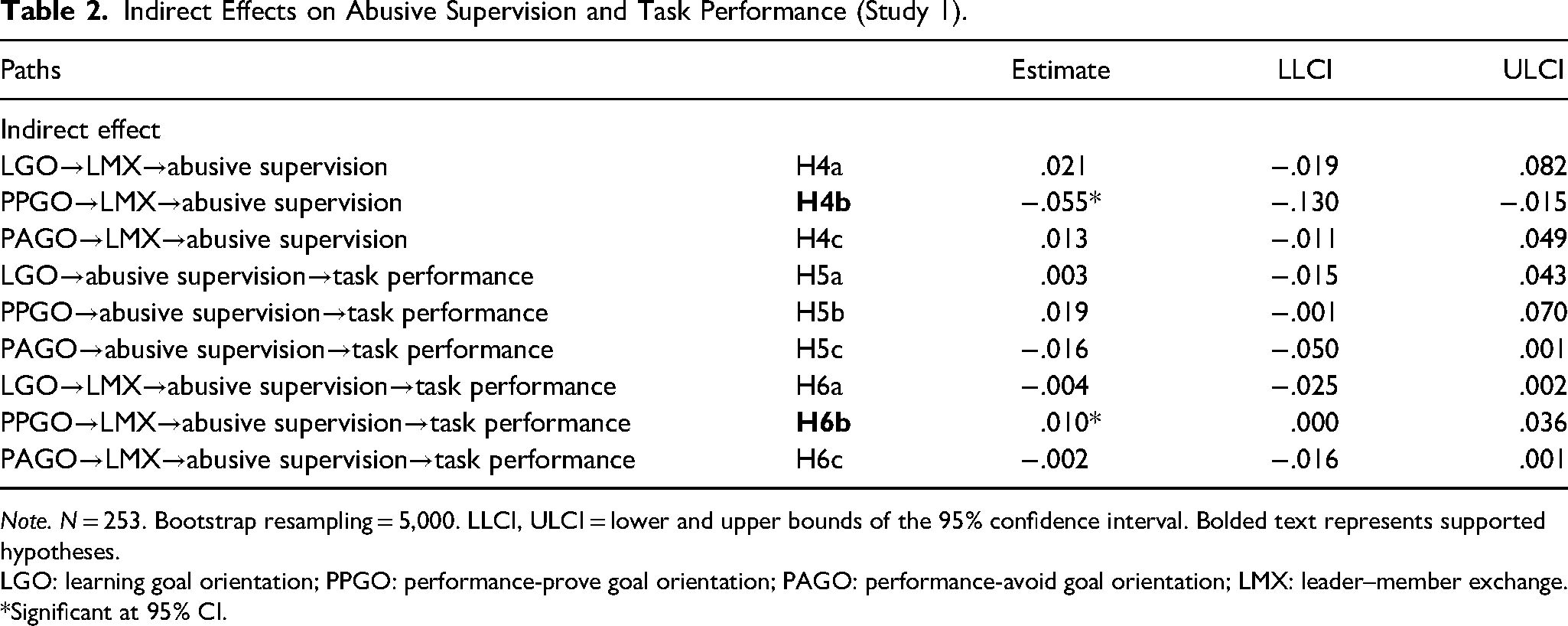
Note. N = 253. Bootstrap resampling = 5,000. LLCI, ULCI = lower and upper bounds of the 95% confidence interval. Bolded text represents supported hypotheses.
LGO: learning goal orientation; PPGO: performance-prove goal orientation; PAGO: performance-avoid goal orientation; LMX: leader–member exchange.
*Significant at 95% CI.
To assess whether common method variance (CMV) influenced our results (Podsakoff et al., 2003), we included an unmeasured latent method factor into our hypothesized model (Podsakoff et al., 2003). The alternative model with the inclusion of latent method factor yielded a well-fitting model (χ2 (1003) = 2,034.030, p < .001, CFI = .90, RMSEA = .06, SRMR = .06). However, when compared with the hypothesized model, it did not demonstrate a better fit (Δχ2 (32) = 7.63, ns). More importantly, the single unmeasured factor had an average standardized factor loading of .11, and the differences in standardized factor loadings between the model that includes the single unmeasured factor and the model without it were on average .039. These differences equate to an average of 4% of the variance of each item being accounted for by CMV. Thus, CMV was unlikely to be a problem in Study 1 (R. E. Johnson et al., 2011b; Podsakoff et al., 2012).
Discussion of Study 1 Findings
Consistent with our theorizing, LMX and subordinate PPGO was negatively associated with abusive supervision, whereas subordinate PAGO was positively associated with abusive supervision. Our mediation results indicate a more nuanced view of how goal orientation exerts influence on abusive supervision and in turn on task performance. Subordinate PPGO exerted a significant positive effect on task performance (estimate = .010, 95% CI [.000, .036]) via LMX and abusive supervision. This finding is not surprising given that subordinate PPGO was the only goal orientation that was significantly associated with LMX (b = 0.20, p < .05) and exerted significant indirect effect on abusive supervision via LMX (estimate = −.055, 95% CI [−.130, −.015]). On the other hand, subordinate PAGO was not significantly associated with LMX and did not exert a significant indirect effect on abusive supervision via LMX.
Contrary to our reasoning, LGO did not have a significant association with abusive supervision or any additional relevance in our mediation hypotheses. This finding was counterintuitive as prior meta-analyses found LGO to have stronger positive effect on other-rated performance than PPGO in work context (e.g., Cellar et al., 2011; Payne et al., 2007), which suggests positive utility. One possible explanation for this finding may be because the data was gathered from South Korean firms. Prior cross-cultural research found that individuals in Eastern cultures placed more emphasis on PPGO than LGO (Lee et al., 2003). Given that South Koreans have increased sensitivity toward hierarchical evaluation (Sanchez-Burks & Lee, 2007), they tend to demonstrate higher levels of self-promotion behaviors, especially toward supervisors compared with Americans (Krieg et al., 2018). Another limitation of this study is the cross-sectional design that limits causal inference. To address these limitations and constructively replicate the findings of Study 1, we conducted an additional study.
Study 2: Online Vignette Study
We designed an experimental study (see Figure 1) to replicate Study 1 and further strengthen our causal inference of the relationship between subordinate goal orientation, LMX, and abusive supervision using data from Western cultures (United States).
Participants and Procedure
Following Spencer and his colleagues’ (2005) experimental-causal-chain design, we collected two different samples, one sample (Experiment 1) to establish causal inferences between goal orientation and LMX and between goal orientation and abusive supervision and another sample to establish causal inference between LMX and abusive supervision (Experiment 2). In total, we recruited 280 participants (210 for Experiment 1 and 70 for Experiment 2) from the Prolific platform. Participants were prescreened to be full-time employees from the United States who hold supervisory positions and work for for-profit firms. We paid our participants 0.85 British pounds for completing our experiment. This is equivalent to 12.49∼14.40 British pounds per hour, which are more than Prolific’s suggested cost of 12 British pounds per hour. After eliminating 9 participants from Experiment 1 and 5 participants from Experiment 2 who failed to complete attention check items or were non-native English speakers, the final sample consisted of 266 full-time employees (201 for Experiment 1 and 65 for Experiment 2). The final sample for Experiment 1 was made up of 62.2% men, with an average age and tenure of 40.9 and 18.1 years, respectively. In Experiment 2, 64.6% of the participants were men, with an average age and tenure of 36.3 and 14.1 years. respectively.
Following extant research (e.g., Walter et al., 2015), we used a scenario to manipulate subordinate goal orientations in Experiment 1 and LMX quality in Experiment 2. The participants of Experiment 1 were randomly assigned to one of six conditions, which included LGO (high vs. low), PPGO (high vs. low), or PAGO (high vs. low) situations. Participants of Experiment 2 were randomly assigned to one of two conditions that included LMX (high vs. low) situations. In Experiment 1, participants were asked to imagine themselves as a supervisor in a hypothetical scenario that is described therein, and they were then asked to respond to a series of questions about the scenario. In line with Walter and his colleagues (2015), we adopted Meeker and her colleague's (1987) scenario that takes place in a hypothetical market research firm. The scenario explained that as a senior research assistant, the participants were responsible for supervising, monitoring, and evaluating the activities of junior research assistants, who were responsible for conducting telephone interviews. The scenario further explained that the participants witnessed individual differences among the junior research assistants and were randomly presented with descriptions of six different goal orientations. Following the scenario, the participants rated the quality of LMX they would have with the junior market research assistant and the possibility that they would engage in supervisory abuse toward the junior research assistant.
To test for the effect of LMX on abusive supervision in Experiment 2, we adapted a scenario (Tröster & Van Quaquebeke, 2021) that takes place in a hypothetical company. As supervisors, the participants were asked to imagine themselves in a situation where they were working with a subordinate in developing a new product for a company. The scenario described how the participants, as a supervisor, have known a certain subordinate for a considerable amount of time and that they have been cooperating ever since the participants became a supervisor. Following this passage, two LMX scenarios were presented at random, which detailed the quality of the relationship that participants had with the subordinate. The participants were then asked to rate how likely it was that they would behave abusively against the hypothetical subordinate.
Measures
In the first experiment, LMX was measured by Graen and Uhl-Bien's (1995) seven-item scale (α = .96). Abusive supervision was adopted from Tepper's (2000) 15-item scale. Following the prior experimental study (e.g., C. K. Lam et al., 2017; Walter et al., 2015) that examined the antecedent of abusive supervision, we excluded three items (“Invade his privacy,” “Lie to him,” and “Break promises”) from the 15-item scale, given that they do not fit the single situation scenario, which left us with a 13-item (α = .94) scale. In the second experiment, abusive supervision (α = .91) was measured again with the same 13 items that was used in the first experiment.
Manipulation Checks
After reading the scenario, participants were asked to assess how accurately the manipulated descriptions of their hypothetical subordinates represented goal orientation in Experiment 1 and LMX quality in Experiment 2. The scales used to assess the goal orientation (Vandewalle et al., 1997) and LMX (Graen & Uhl-Bien, 1995) were identical with scales used in Study 1. Participants who were in high LGO conditions perceived their hypothetical subordinate as higher in LGO (M = 6.75, SD = 0.40) than in low LGO (M = 1.47, SD = 0.85; p < .001) conditions. Participants in high PPGO conditions perceived their hypothetical subordinate as higher in PPGO (M = 6.36, SD = 0.62) than in low PPGO (M = 1.34, SD = 0.59; p < .001) conditions. Finally, participants in high PAGO conditions perceived their hypothetical subordinate as higher in PAGO (M = 6.76, SD = 0.49) than in low PAGO (M = 2.49, SD = 1.97; p < .001) conditions. Thus, participants’ perceptions of their subordinates’ goal orientation were successfully manipulated in Experiment 1. Participants in Experiment 2 perceived greater LMX quality under high LMX conditions (M = 6.34, SD = 0.52) than under low LMX conditions (M = 1.71, SD = 0.61; p < .001). As a result, we were also successful in manipulating participants’ perception of their subordinates’ LMX quality in Experiment 2.
Results of Study 2
To test for Hypothesis 1, we performed a t test and a bivariate regression examining the effect of LMX on abusive supervision with the data from Experiment 2. Before the analysis, high LMX was coded as 1 and low LMX was coded as 0. The t test results indicate that participants who were assigned with high LMX conditions reported on average lower abusive supervision (M = 1.11, SD = 0.20) than participants who were assigned with low LMX conditions (M = 1.87, SD = 0.73; t (63) = 5.81, p < .001). As can be seen in Table 3, the bivariate regression results revealed that high LMX was targeted to less abusive supervision (b = −0.76, p < .001), providing support for Hypothesis 1.
Regression Results and Mediation Analysis Results of Study 2.
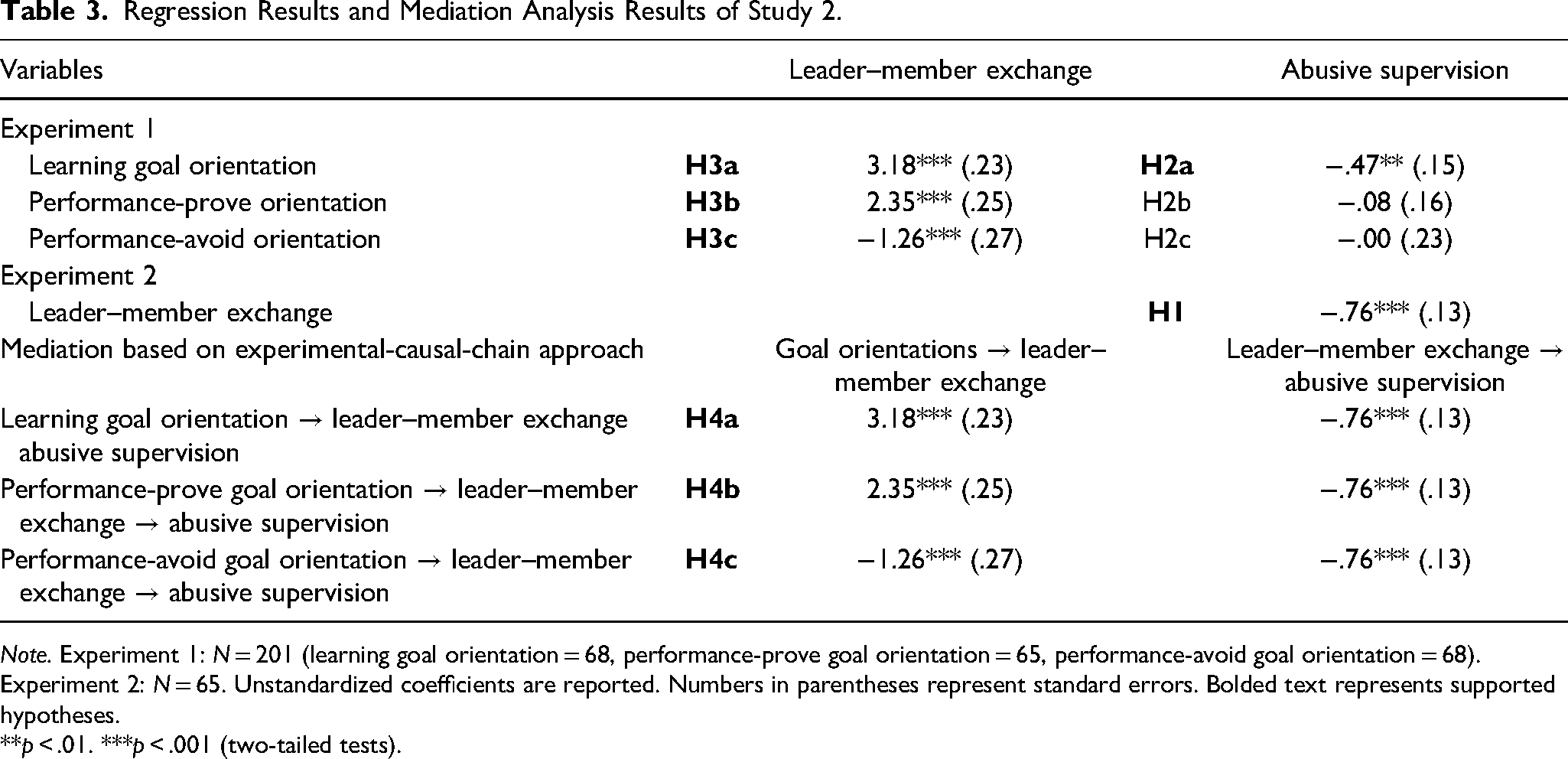
Note. Experiment 1: N = 201 (learning goal orientation = 68, performance-prove goal orientation = 65, performance-avoid goal orientation = 68). Experiment 2: N = 65. Unstandardized coefficients are reported. Numbers in parentheses represent standard errors. Bolded text represents supported hypotheses.
**p < .01. ***p < .001 (two-tailed tests).
Before the analysis, high goal orientations were coded as 1 and low goal orientations were coded as 0. Hypothesis 2 predicts a significant effect of subordinate goal orientation on abusive supervision. The t test results indicate that participants who were assigned with high LGO conditions on average reported a lower abusive supervision (M = 1.26, SD = 0.41) than participants who were assigned with low LGO conditions (M = 1.72, SD = 0.76; t (66) = 3.15, p < .01). The bivariate regression results in Table 3 were also in line with the t test results indicating a negative relationship between LGO and abusive supervision (b = −0.47, p < .01). Thus, Hypothesis 2a was supported. The t test results were not significant for subordinate PPGO given that participants assigned to high PPGO conditions (M = 1.51, SD = 0.63) reported a similar level of abusive supervision with participants who were assigned to low PPGO conditions (M = 1.59, SD = 0.68; t (63) = 0.52, ns). As shown in Table 3, the bivariate regression results on the relationship between PPGO and abusive supervision were not significant (b = −0.08, ns). Thus, Hypothesis 2b was not supported. The t test results indicate that participants who were assigned to high PAGO conditions (M = 1.62, SD = 1.10) rated a similar level of abusive supervision with participants who were assigned to low PAGO conditions (M = 1.62, SD = 0.84; t (66) = 0.01, ns). The regression results in Table 3 also did not demonstrate a significant relationship (b = −0.00, ns) between PAGO and abusive supervision. Hence, Hypothesis 2c was not supported.
Hypothesis 3 predicts a significant effect of subordinate goal orientation on LMX. The t test results on the relationship between LGO and LMX revealed that participants who were assigned with high LGO conditions on average reported a higher LMX (M = 5.46, SD = 0.92) than participants who were assigned with low LGO conditions (M = 2.28, SD = 0.97; t (66) = −13.86, p < .001). The bivariate regression results in Table 3 were also in line with the t test results indicating a positive relationship between LGO and LMX (b = 3.18, p < .001). Thus, Hypothesis 3a was supported. The t test results indicate that participants who were assigned with high PPGO conditions on average reported a higher LMX (M = 4.49, SD = 0.99) than participants who were assigned with low PPGO conditions (M = 2.14, SD = 1.02; t (63) = −9.43, p < .001). The bivariate regression results in Table 3 were also in line with the t test results indicating a positive relationship between PPGO and LMX (b = 2.35, p < .001). Hence, Hypothesis 3b was supported. The t test results on the relationship between PAGO and LMX revealed that participants who were assigned with high PAGO conditions on average reported a lower LMX (M = 3.13, SD = 0.99) than participants who were assigned with low PAGO conditions (M = 4.39, SD = 1.19; t (66) = 4.73, p < .001). The bivariate regression results in Table 3 were in line with the t test results, demonstrating a negative relationship between PAGO and LMX (b = −1.26, p < .001). Thus, Hypothesis 3c was supported.
To test for Hypothesis 4, we used experimental-causal-chain design to examine the mediating effect of LMX on the relationship between subordinate goal orientations and abusive supervision. Spencer and his colleagues (2005) state that there is evidence in support of mediation if the independent variable significantly affects the mediating variable and if the mediating variable significantly affects the dependent variable in two separate experiments. This is because the manipulation of both the independent variable and the mediating variable in different experiments creates temporal precedence, demonstrating a stronger inference about the causal chain of events (e.g., Pirlott & MacKinnon, 2016; Spencer et al., 2005). Thus, we integrate the results from Experiment 1 (Hypothesis 3, goal orientations–LMX) and Experiment 2 (Hypothesis 1, LMX–abusive supervision) to test for Hypothesis 4 (Pirlott & MacKinnon, 2016). As shown in Table 3, the significant results of Hypotheses 1 (b = −0.76, p < .001) and 3a (b = 3.18, p < .001) provide support for LMX mediating the relationship between LGO and abusive supervision. Hence, Hypothesis 4a was supported. Combining the results of Hypotheses 1 and 3b (b = 2.35, p < .001) revealed support for LMX mediating the relationship between PPGO and abusive supervision. Thus, Hypothesis 4b was supported. Hypothesis 4c was also supported given that the significant results of Hypotheses 1 and 3c (b = −1.26, p < .001) revealed evidence on LMX mediating the relationship between PAGO and abusive supervision.
Additionally, we compared the reliability measure of the first experiment and the second experiment to show that the LMX measured in the first experiment was identical to the variable that was manipulated in the second experiment. Given that the reliability measure of LMX from the first experiment (α = .96) and the second experiment (α = .98) was on a similar level, we can safely conclude that LMXs from the first and second experiments were two identical events (Wu & Zumbo, 2008).
Discussion of Study 2 Findings
In a controlled experimental setting, we found that LGO and LMX had a significant negative effect on abusive supervision, while PPGO and PAGO did not have a significant effect on abusive supervision. Conversely, all three goal orientations were found as antecedents of LMX. Specifically, LGO and PPGO had significant positive effect on LMX, whereas PAGO had a significant negative effect on LMX. Taken together, we found support that all three goal orientations exerted indirect effect on abusive supervision via LMX based on experimental-causal-design.
General Discussion
Although scholars are paying more attention to the causes of abusive supervision (Tariq & Weng, 2018; Tepper et al., 2011; Walter et al., 2015), there have been limited research on why supervisors abuse certain subordinates (Tepper et al., 2017). Integrating moral exclusion theory (Opotow, 1990b) and LMX theory (Graen & Uhl-Bien, 1995), we examined how follower goal orientation and LMX elicits supervisory abuse. Based on our cross-cultural field and experimental studies from South Korea and United States, we found subordinate PPGO and LMX as critical antecedents of abusive supervision (see Figure 1). Specifically, subordinates with high PPGO received less supervisory abuse because they tend to form high LMX quality relationships with their supervisors.
The inconsistent findings (see Figure 1) between our studies may be because of the cross-cultural differences between our samples. Research has shown that Eastern cultures place more emphasis on PPGO than LGO, while Western cultures place more emphasis on LGO than PPGO (Lee et al., 2003). The cultural differences that place emphasis on different dimensions of approach orientations were evident in our results. In Study 1 (field study with South Korean sample; see Figure 2), PPGO was positively associated with LMX (b = 0.20, p < .05) and negatively associated with abusive supervision (b = −0.11, p < .05), whereas LGO was not significantly associated with LMX (b = −0.08, ns) and abusive supervision (b = −0.02, ns). In Study 2 (experimental study with American sample; see Table 3), LGO was positively associated with LMX (b = 3.18, p < .001) and negatively associated with abusive supervision (b = −0.47, p < .01), while PPGO was positively associated with LMX (b = 2.35, p < .001) but was not significantly associated with abusive supervision (b = −0.08, ns).
Theoretical Implications
The current research contributes to the literature in several ways. First, drawing from moral exclusion theory (Opotow, 1990b), our study examined LMX as a crucial antecedent of abusive supervision. Research to date has mostly suggested LMX as a proximal outcome of supervisory abuse based on social exchange perspective. However, little is known about how relational quality affects supervisors’ moral consideration. We expand this line of thinking by suggesting that LMX, which represents relational quality, may be a critical determinant of supervisors’ moral exclusion behavior. The constructive replication of the negative effect of LMX on abusive supervision in both of our studies demonstrates the generalizability of this finding. Even though Study 1 used cross-sectional design, the replication that took place in our Study 2 validates our conclusion about the causal effect of LMX on abusive supervision.
Additionally, we contribute to the moral exclusion literature by providing a nuanced view of how subordinate utility and relational quality interplays. Starting with Tepper and his colleagues (2011), few researchers have examined the antecedents of abusive supervision through the lens of moral exclusion perspective (e.g., Tariq & Weng, 2018; Walter et al., 2015). However, researchers demonstrated inconsistent findings on the interplay between the antecedents of abusive supervision. For example, Tepper and his colleagues (2011) argued that perceived relationship conflict was an antecedent of perceived performance, while Walter and his colleagues (2015) argued supervisor liking, an indicator of personal relationship, as a boundary condition that moderated the relationship between perceived performance and abusive supervision. Integrating moral exclusion theory (Opotow, 1990b) with LMX theory (Graen & Uhl-Bien, 1995), we found evidence that relational quality (LMX) is a more proximal antecedent of abusive supervision than utility perception (goal orientations). Given that LMX mediated the association between PPGO and abusive supervision in both of our studies strengthens the generalizability of our argument regarding the mediating role of LMX. However, we advise caution in interpreting LMX as a mediating mechanism for LGO and PAGO, since we have only found supporting results in Study 2. Given that Eastern cultures value PPGO more than LGO, these inconsistent findings suggest that cultural variations in our samples influenced the outcomes (Lee et al., 2003). Future research needs to use field data from Western sample and/or experimental data using Eastern sample to further shed light on the cultural effect on our hypothesized model. In addition, researchers may examine boundary conditions that could assist subordinates with higher LGO to develop high-quality LMX relationship in Eastern culture or investigate other contextual influences that further impedes LMX development.
Second, this research further addresses the question of why supervisors abuse certain subordinates through examining subordinate individual differences. We further expand the abusive supervision literature, especially the “provocative subordinate” perspective by identifying subordinate goal orientations as antecedents of abusive supervision. Prior research has primarily focused on subordinates’ performance as an indicator of utility (Tariq & Weng, 2018; Tepper et al., 2011; Walter et al., 2015). Given that supervisors examine subordinate behaviors when evaluating their performance (W. Lam et al., 2007), we go beyond extant studies by theorizing that subordinates’ individual differences affect the extent to which supervisors perceive utility. Thus, this research demonstrates distinct value as it revealed that subordinate PPGO influences the extent to which subordinates receive abusive supervision. Future research should examine supervisors’ process of evaluating subordinates’ utility and whether there are other individual differences of subordinates, e.g., impression management motives and perfectionism, that may influence their utility perception.
Last, we contribute to goal orientation literature through identifying LMX and abusive supervision as a mediating mechanism on the relationship between goal orientations and task performance. Existing goal orientation literature has primarily focused on the self-regulatory process in explaining how employee goal orientation leads to task performance (Cellar et al., 2011). We further extend the literature by integrating LMX theory (Graen & Uhl-Bien, 1995) and moral exclusion theory (Opotow, 1990b) to provide a distinct interpersonal mechanism for understanding how employee goal orientations lead to task performance. Specifically, the subordinates with higher PPGO receive less supervisory abuse by maintaining a positive relationship with their supervisors and ultimately demonstrate higher performance. This finding is important from the moral exclusion perspective as well since it sheds light on the process of how one indicator of utility (goal orientation) can in turn influence another indicator of utility (perceived task performance) via abusive supervision. We encourage future researchers to use alternative theoretical lenses, particularly theories relevant to dyadic interactions, to uncover unique mechanisms that explain the effect of goal orientation on employee performance.
Practical Implications
The findings of this study present meaningful implication for practice. Given that our findings are in line with the broad consensus of the abusive supervision literature regarding its harmful effect, firms may decide to take necessary actions to increase awareness of the negative consequences of abusive supervision (Walter et al., 2015). Although this study did not examine specific methods of reducing abusive supervision, firms may set zero-tolerance policies and guidelines that could reduce supervisory abuse (Lian et al., 2012). In addition, our results highlight the benefits of having employees with higher PPGO. It may be fruitful for firms to consider hiring and promoting individuals with higher PPGO. Though this study measured subordinate goal orientations as a trait, goal orientation literature postulates that goal orientations can occur as a state condition (Vandewalle et al., 2019). The state goal orientation, unlike trait goal orientation, can be influenced by environmental factors. In particular, research states that supervisors’ goal orientation plays a key role in inducing state goal orientation of the subordinates (Dragoni & Kuenzi, 2012). This further emphasizes the importance promoting individuals with high PPGO since supervisors with higher PPGO can induce state PPGO of their subordinates (Dragoni & Kuenzi, 2012).
Limitations and Future Research
This study is not without limitations. First, Study 1 was conducted in South Korea with a cross-sectional design that limits causal inference. To strengthen our argument and generalizability, we conducted a second experimental study from sample collected in United States. This allowed us to demonstrate causal inference regarding the effect of goal orientations on LMX and the effect of LMX on abusive supervision. However, we found some inconsistent results regarding the impact of LGO and PAGO on abusive supervision. As mentioned above, one tentative explanation for the inconsistent findings may have been due to the cultural differences between the samples. Given that goal orientation has cross-cultural variances (Lee et al., 2003), future research should examine cultural differences as boundary conditions of the relationship between goal orientations and abusive supervision. The cross-sectional design of Study 1 also raises concerns about common method bias (Podsakoff et al., 2003). Thus, we used an unmeasured latent method factor technique and specified an alternative model to examine the influence of potential common method bias (R. E. Johnson et al., 2011b). As we included the latent common method factor into our hypothesized model, it did not demonstrate a better fit, which indicates that CMV had little effect on our results (see Study 1 results section for more detailed explanation). Nonetheless, we urge future research to conduct a longitudinal study that could alleviate concerns regarding common method bias.
Second, even though our theorizing was based on the moral exclusion perspective, some might argue that subordinates may perceive and react differently to supervisory abuse based on their difference in traits. For example, Wang and his colleagues (2015) have shown that personality-based variance in evaluations of abusive supervisions is somewhat independent of the supervisor behavior. In our context, individuals with high PPGO view negative feedback as especially devastating to their demonstration of competence and fear negative evaluations (VandeWalle et al., 2001). Thus, to demonstrate competence, individuals with high PPGO may report low level of supervisory abuse. However, our results indicated that subordinates with high PPGO were positively associated with supervisor-rated LMX. This implies that supervisors were perceiving these subordinates as competent. The serial mediation where PPGO exerted a positive indirect effect on supervisor-rated task performance also supports the notion that supervisors perceive subordinates with high PPGO as higher performers. Thus, we safely conclude that our theorized model is in line with “subordinate provocation” perspective (Tepper et al., 2017) rather than an outcome of perceptual bias. However, we call for future research to examine other individual differences or contexts that may influence subordinates to perceive less abusive supervision. Further, we urge future researchers to measure abusive supervision from a third person (colleague) to clearly assess the level of supervisory abuse.
Fourth, the self-reported intention to engage in abusive supervision in Study 2 may raise some concerns about socially desirable responses (Antonakis, 2017). Although it is prevalent in the abusive supervision literature to ask how likely the participant would engage in abusive behaviors when examining antecedents from the supervisors’ perspective (e.g., Camps et al., 2020; Karagonlar & Neves, 2020; Taylor et al., 2019; Walter et al., 2015; Watkins et al., 2019), research states that hypothetical situations can lead to “cheap talk” or socially desirable responses (Antonakis, 2017; Yagil, 2005). In future research, both creative and ethically defensible experiment design should be employed to enhance ecological validity. Furthermore, although we clearly instructed the participants to randomly distribute the survey to one of their direct reports, it is possible that the participants may have provided the survey to their direct reports who may provide socially desirable responses. We acknowledge that this possibility could exist given that our Study 1 mean (M = 1.52) of abusive supervision is slightly lower than the meta-analytic average mean (μ = 1.78) of abusive supervision by Mackey and his colleagues (2017).
Conclusion
Despite its limitations, this study enriches our understanding of the reason why supervisors engage in abusive supervision. Integrating moral exclusion and LMX perspective, we found that supervisors’ moral consideration to abuse subordinates hinges on the quality of LMX (relationship quality) and subordinate PPGO (utility perception). In particular, the replicated results from both of our studies found strong evidence that LMX quality mediated the effect of subordinate PPGO on supervisory abuse, demonstrating that utility perception and relational quality plays a crucial role in reducing abusive supervision. We hope our study contributes to understanding why supervisors abuse certain subordinates and urge future researchers to further examine antecedents and boundary conditions of abusive supervision.
Supplemental Material
sj-docx-1-jlo-10.1177_15480518231204489 - Supplemental material for Why Do Supervisors Abuse Certain Subordinates? Goal Orientation and Leader–Member Exchange as Antecedents
Supplemental material, sj-docx-1-jlo-10.1177_15480518231204489 for Why Do Supervisors Abuse Certain Subordinates? Goal Orientation and Leader–Member Exchange as Antecedents by Donghun Seo, Sunghyuck Mah and Seokhwa Yun in Journal of Leadership & Organizational Studies
Footnotes
Declaration of Conflicting Interests
The authors declared no potential conflicts of interest with respect to the research, authorship, and/or publication of this article.
Funding
The authors received no financial support for the research, authorship, and/or publication of this article.

Supplemental Material
Supplemental material for this article is available online.
References
Supplementary Material
Please find the following supplemental material available below.
For Open Access articles published under a Creative Commons License, all supplemental material carries the same license as the article it is associated with.
For non-Open Access articles published, all supplemental material carries a non-exclusive license, and permission requests for re-use of supplemental material or any part of supplemental material shall be sent directly to the copyright owner as specified in the copyright notice associated with the article.
