




Abstract
Creativity is a critical determinant of organizations’ abilities to compete and perform in rapidly changing and complex contexts. Though scholars have identified several contextual factors, such as leadership, that motivate employees’ creative performance, the psychological mechanisms and boundary conditions underpinning this relationship are relatively unknown. Drawing on social exchange theory, we propose that a proactive orientation, a psychological state rooted in the cognitive and behavioral process of setting a proactive goal and striving to achieve it, is a critical mechanism linking authentic leadership to employees’ creativity. Across two field studies of working professionals in Central Europe and the U.S., we show how authentic leadership fuels employees’ creative performance through a proactive orientation and introduce leader–member exchange (LMX) as an important moderator of this mediated relationship. In Study 1, using a sample of European manufacturing employees, we find support for the mediating role of a proactive orientation linking authentic leadership to creative performance, above, and beyond the effects of ethical leadership. In Study 2, using a sample of university staff, we replicate this finding and extend it by highlighting the moderating role of LMX on the authentic leadership-proactive orientation relationship.
Keywords
Creativity is a key determinant of organizations’ abilities to adapt and compete in a changing world (Baer, 2012; Kuehner-Hebert, 2013). According to the World Economic Forum, creativity is critical for employees to succeed as technology continues to rapidly advance and alter how we work (Whiting, 2020). In recognizing these trends, scholars have offered important insights into how organizations can generate better ideas by examining both individual and contextual factors (Parker & Collins, 2010; Parker et al., 2006) that positively impact employees’ creative performance, defined as the production of domain-specific, novel, and useful outcomes (Amabile, 1988; Ford, 1996). Individuals in organizations vary extensively in their levels of creative performance, and research has highlighted the vital role leadership can play in increasing such creative output (for comprehensive reviews, see George, 2007; Hughes et al., 2018; Lee et al., 2020; Shalley et al., 2004; Zhou & Hoever, 2014). Leaders drive employees’ creative performance through shaping the work environment, allocating resources, and assigning work tasks (Liden et al., 1997). Additionally, leaders have strong proximal influence on employees’ motivation (Kim et al., 2018), which prior research has established as a critical antecedent of organizational functioning and effectiveness (Cerasoli et al., 2014). Given the importance of creative performance in organizations, continuing to gain deeper understanding of how and under what boundary conditions leaders shape employees’ generation of creative ideas is critical for both scholars and practitioners alike.
Yet, despite the accumulated knowledge about the positive impact leadership can have on employees’ creativity, extant research has not adequately examined why and under what conditions leadership has this motivating effect on individuals’ willingness to engage in this cognitively demanding, extra-role behavior. From a conceptual perspective, this deficit is problematic, as theory building in this case requires understanding and testing the mechanisms and boundary conditions through which leadership influences follower creativity. Indeed, Liu et al. (2016) conducted an extensive meta-analysis of 191 samples examining the key antecedents of creativity, and surprisingly, identified only three motivational mechanisms that have been explored as potential psychological antecedents to employees’ creative performance: intrinsic motivation, creative self-efficacy, and pro-social motivation. Identifying alternative motivational mechanisms is thus critical to “… further advance our understanding of the distinctive role of different types of mechanisms in facilitating or constraining creativity” (Liu et al., 2016, p. 249) and thereby advance the creativity literature. We believe such work not only is essential to advance conceptual understanding of the mechanisms through which leadership wields its positive effects but also to provide managers with practical guidance on how they can increase followers’ creative output.
The first primary purpose of this paper is to better understand why leadership enhances employees’ creative performance. Guided by social exchange theory (Blau, 1964; Cropanzano & Mitchell, 2005), we examine a relatively unexplored and untested (in relation to creativity) psychological and motivational mechanism—a proactive orientation. A proactive orientation is described as a psychological state rooted in a self-initiated, future-oriented cognitive and behavioral process that consists of setting a proactive goal and striving to achieve it (Benson-Greenwald & Diekman, 2022; Grant & Ashford, 2008; Parker et al., 2010). Based on Parker et al.'s (2010) theory of proactive motivation and their definition of proactivity as a process, as well as emerging research highlighting its malleability (Batistič et al., 2016; Huang & Lin, 2016; Huang, 2017; Ouyang et al., 2019; Tims & Kooij, 2018), we contend that a proactive orientation can be contextually influenced through leader behavior and high-quality leader–follower relationships. By exploring how a proactive orientation at work may function as a psychological state, we also offer fresh perspective to the proactivity literature, which has examined proactivity as a more trait-like antecedent (in the form of proactive personality) (Bateman & Crant, 1993; Gong et al., 2012), moderator (Yagil & Oren, 2021), or outcome (in the form of proactive behavior; Parker et al., 2006; Schilpzand et al., 2018; Sonnentag, 2003). As a mechanism to creativity, the role of a proactive orientation has only thus far been conjectured (cf. Han et al., 2019). Thus, through our investigation, we aim to contribute by providing greater empirical and conceptual clarity into how leaders, through social exchange processes of reciprocity, bolster employees’ proactive orientation, and thereby spark their creative output.
In addition to the lack of understanding of the psychological mechanisms that motivate individual creativity, to date, extant research has focused predominantly on transformational leadership (Liu et al., 2016) as the driver of employees’ creative output. This is so despite the emergence of several other “newer genre theories of leadership” over the past 30 years (e.g., authentic, ethical, and servant) (cf. Hannah et al., 2014; Hoch et al., 2018) that would seem to logically promote positive social exchanges and thereby creative performance. Concomitantly, we lack adequate knowledge of whether and how leadership styles beyond transformational leadership influence creative performance and the mechanisms and boundary conditions through which they do so. Such understanding is necessary to advance the effective practice of leadership, informing leaders of what style(s) to employ to best foster creativity. This is critical given that employees routinely look to leaders for guidance, information, and behavioral cues, with different forms of leadership wielding differing effects (e.g., Wang & Rode, 2010).
Thus, our second intended contribution is to determine whether and how authentic leadership (AL) positively influences employees’ proactive work orientation and, thereby, creativity. We selected AL as the focal leadership style for our model due to its central relevance to proactivity. Specifically, we ground our assertions through combining the theory of proactive motivation with social exchange theory (Walumbwa et al., 2008, p. 94). To ground our assertions as to why AL should indirectly impact followers’ creative performance through the mechanism of a proactive orientation, we combine the theory of proactive motivation with social exchange theory (Blau, 1964; Cropanzano & Mitchell, 2005). We propose that when leaders engage in authentic actions, such as processing information in a balanced, forthright manner and fostering relational transparency with followers, they encourage, support, and otherwise provide positive social exchanges to their followers, building a sense of obligation in return to apply their full talents and strengths to their jobs. Further, AL involves moral perspective and pro-social treatment of others (Gardner et al., 2005), which should motivate employees to reciprocate such treatment by adopting an energized, proactive state that fuels them to seek out ways to solve organizational problems creatively and explore and consider new, creative opportunities.
Despite the intuitive application of such leadership to creativity, a recent meta-analysis of 100 independent samples from the authentic and transformational leadership literatures identified only four papers examining the linkage between AL and creativity (Banks et al., 2016), with none assessing proactivity as a mechanism (Rego et al., 2014; Ribeiro et al., 2020; Semedo et al., 2017; Xu et al., 2017; Zubair, 2015). Our focus on AL will not be without challenge. Various researchers have argued that AL theory has both methodological and theoretical limitations (e.g., Alvesson & Einola, 2019; Gardner et al., 2021; Gardiner, 2011). Avolio et al. (2018) have conducted recent empirical tests that we believe adequately address questions of construct validity, so for parsimony, we will not cover their research here. A repeated conceptual critique of AL is whether it simply creates positive emotions in followers and liking of the leader versus driving more tangible work outcomes (e.g., Mumford & Fried, 2014). Alvesson and Einola (2019, p. 385) went so far as to state that AL “may distract from what is required to align people and get tasks done.” Such assertions are largely empirical questions and need to be tested. As argued by Hollenbeck (2008), when there are such debates researchers should “shed light (and not just heat)” (pp. 20–21) on the questions being debated as we do here, assessing the effects of AL across two multilevel field studies on the critical workplace outcome of creative performance.
Other critiques of the AL construct concern its level of distinction from other leadership constructs (e.g., Gardner et al., 2021). Given that various leadership styles can potentially influence creativity, our study responds to leadership scholars’ calls to examine the incremental variance of leadership constructs when examining specific outcomes to understand their unique effects (Hoch et al., 2018; Lemoine et al., 2019). Here we control for ethical leadership for three primary reasons. First, ethical leadership research has focused heavily on social exchange theory to explain its effects (Brown & Mitchell, 2010), as we do here with AL. Second, since prior studies have found positive associations between ethical leadership (Brown et al., 2005) and creativity (Chen & Hou, 2016; Ma et al., 2013), we felt it was important to demonstrate the incremental value of AL beyond ethical leadership, thereby clarifying and constraining interpretation of its unique effects on creative performance. Third, since ethical leadership and authentic leadership both contain a moral dimension, it was important to demonstrate their discrimination both from a measurement modeling as well as a predictive validity perspective.
Finally, our third primary intended theoretical contribution is to identify a potential boundary condition for the effects of AL in our research model. Anchoring our model in proactive motivation and social exchange theories led us to theorize that leader–member exchange (LMX) (Liden et al., 1997) will moderate the effects of AL on employees’ proactive work orientation, and subsequent creative performance. When followers feel they have strong relational bonds, rooted in feelings of mutual respect, felt obligation, support, accountability, and trust (i.e., high LMX) with their leaders, we expect the social exchange relationship between AL and proactive work orientation will be strengthened. These bonds should reinforce and enhance employees’ willingness to reciprocate to their leader (Cropanzano & Mitchell, 2005) via creative performance. Thus, we theorize that LMX—the quality of the leader–employee relationship—operates as an important boundary condition for employees’ proactive orientation and creative performance, enhancing the impact of AL as an antecedent of employees’ proactive orientation. Accounting for LMX in the model when predicting creative performance, and thus followers’ differing levels of liking/attraction to the leader, will also allow us to empirically “shed light” (Hollenbeck, 2008) on arguments that AL largely creates only affective responses (Mumford & Fried, 2014).
We test our model across two multilevel field studies of working professionals in Central Europe (Slovenia, specifically) and the U.S. to ascertain whether the antecedents and consequences of leadership and proactive orientation vary across cultures, thus contributing to the growing empirical literature alluding to the cultural and cross-national generalizable outcomes of AL (Zhang et al., 2022). In Study 1, we examine proactive work orientation as a mediator between AL and creative performance, controlling for ethical leadership. In Study 2, we replicate this mediated relationship, while testing a more sophisticated, first-stage moderated mediation model in which LMX moderates the AL-proactive orientation relationship. In Study 2 we also take a multi-method approach, employing a different measure of AL than we used in Study 1.
Theory and Hypotheses
Authentic Leadership
Although the idea of authenticity has a long history, scholarly research applying authenticity to leadership specifically has only occurred in the past two decades. Scholars have articulated numerous definitions and conceptualizations of AL (see Gardner et al., 2011 for a comprehensive review and listing of definitions), making the study of this concept somewhat fragmented (Neider & Schriesheim, 2011; Sumanth & Hannah, 2014). However, consistent across all of these perspectives is a focus on the enhancement and development of employees’ values, motives, emotions, and goals and capitalizing on them for the benefit of the organization (Gardner et al., 2005).
Walumbwa et al. (2008, p. 94) define AL as “a pattern of leader behavior that draws upon and promotes both positive psychological capacities and a positive ethical climate, to foster greater self-awareness, an internalized moral perspective, balanced processing of information, and relational transparency on the part of leaders working with followers, fostering positive self-development.” The four italicized dimensions comprising AL in this definition have been confirmed in subsequent validation research, even across different measures of AL (Neider & Schriesheim, 2011; Steffens et al., 2016). Despite arguments to the contrary, empirical and theoretical research has also evidenced the discriminant validity of AL from other leadership styles, such as transformational, servant, and ethical leadership (Avolio & Gardner, 2005; Liu et al., 2015; Avolio & Mhatre, 2012; Avolio et al., 2018; Banks et al., 2016; Gardner et al., 2011; Lemoine et al., 2019; Walumbwa et al., 2008).
The first dimension, self-awareness, refers to the extent to which leaders are seen as knowing and understanding their inner strengths and weaknesses, motives, and feelings (Gardner et al., 2005). Such leaders are seen to practice deep introspection, gaining an understanding of their true selves and emotions (Ladkin & Taylor, 2010) and enabling them to project that they know and accept their values, feelings, identity, and motives (Avolio & Gardner, 2005; Ilies et al, 2005). Second, an internalized moral perspective involves leaders being seen as guided by internal moral standards and values, rather than external factors or pressures (Gardner et al., 2005), and as exhibiting those values to effect positive change in others (Cianci et al., 2014; Cooper et al., 2005).
Third, AL involves engaging in balanced processing, which refers to followers’ belief that their leader has the capacity and willingness to listen to follower input and conduct an unbiased analysis of all relevant information before reaching decisions (Walumbwa et al., 2008). This helps to signal leaders’ sense of security (or lack thereof) in their own qualifications, expertise, or status and inherent beliefs about the value of others (Avolio & Gardner, 2005; Sparrowe, 2005). Further, by involving followers in ideating and decision-making, AL promotes involvement and engagement (Hsiung, 2012; Wang & Hsieh, 2013). Finally, AL involves the leader demonstrating relational transparency by openly sharing information, motives, thoughts, and emotions with others, allowing others to see them for “who they really are” and what they believe (George, 2003). Importantly, transparency involves providing followers with greater information, promoting follower situational awareness.
We focus on AL as the focal leadership theory for three reasons. First, we suggest its components (e.g., balanced processing of information and relational transparency) are highly applicable for driving followers’ energizing, proactive orientation, and thereby creativity (Avolio & Gardner, 2005). Second, recent studies have shown only moderate positive levels of association between AL and employee creativity (Černe et al., 2013; Duarte et al., 2021; Li et al., 2014; Rego et al., 2012; Rego et al., 2014), suggesting other intervening and conditional factors are at work. We seek to advance this literature by introducing and testing mediating and moderating factors to increase theoretical and empirical understanding of AL's effects. Third, research on AL is still in its nascent stages, despite scholars’ heightened interest in this theory in recent years (see Gardner et al., 2011 for a review and Hoch et al., 2018 for a meta-analysis). The current framework can thus help expand the nomological network of constructs related to AL, linking it indirectly through a proactive orientation to creativity under varying conditions of LMX, helping to expand this emerging theory.
AL and Employee Creative Performance
As defined in the literature, creative performance has two essential components—perceived novelty and usefulness (Amabile, 1996). The extant literature and its comprehensive reviews (narrative and systematic) of George (2007), Shalley et al. (2004), Zhou and Hoever (2014), Hughes et al. (2018) , and Lee et al. (2020) all acknowledge the critical role of the work context in prompting and enabling employees to generate creative output. One of the key elements of the workplace context is leadership, and limited research has established tentative linkages between AL and employee creativity (e.g., Černe et al., 2013). While this line of inquiry has provided initial evidence of the direct link between AL and creative performance (e.g., Rego et al., 2012, 2014), it has neglected to consider the possible interplay of leadership styles predicting creativity and the motivational mechanisms behind these effects. To address these limitations, we first hypothesize a direct link between AL and creativity, followed by a discussion of how a proactive orientation and LMX help to explain and amplify, respectively, the impact of AL on followers’ creative performance.
We base our first hypothesis on social exchange theory (Blau, 1964; Cropanzano & Mitchell, 2005). When leaders practice behaviors aligned with the four dimensions of AL described above, we suggest followers will be both emboldened and motivated to reciprocate such positive leadership by engaging in their work more fully to contribute to the organization. Such contributions would be reflected in various performance domains, including creative performance. This positive effect is likely due first to the leader transparently sharing information with their followers and utilizing their followers’ ideas more frequently (Rego et al., 2012). Followers should thus feel a sense of involvement and as having input into the goals being pursued and the way work gets done and, further, feel that their ideas and input have instrumentality (Avery & Quiñones, 2002). Thus, by being relationally transparent with followers and considering their input in a measured, balanced way, leaders are more likely to cultivate a drive for reciprocity in followers, fueling their desire to give back in the form of good ideas (i.e., novel and useful solutions).
Further, leaders who behave authentically tend to project moral perspective and thus engage with followers in supportive, pro-social, and ethical ways (Cianci et al., 2014; Hannah et al., 2005). Such positive interpersonal treatment should increase followers’ desire to serve the leader in return (Eisenberger et al., 1990), by contributing ideas to improve the workgroup's performance. As followers observe their leader demonstrate service to both them and to the organization, normative influence should prompt them to follow suit and reciprocate creative effort on behalf of the organization (Bandura, 1977; Eisenberger et al., 1990). This logic complements existing studies reporting positive links between AL and creative performance (cf. Rego et al., 2014; Zubair, 2015; Semedo et al., 2017; Xu et al., 2017) and conceptualizes this relationship based on the social exchange perspective: Hypothesis 1: AL will be positively associated with follower creative performance.
Proactive Orientation as a Mediator Between AL and Creativity
Informed by social exchange theory (Blau, 1964; Cropanzano & Mitchell, 2005) and the theory of proactive motivation (Parker et al., 2010), we theorize that followers of authentic leaders will be more likely to enact creative performance because they feel energized and empowered, with a drive to reciprocate and contribute back to the leader and/or workgroup. This suggests followers will activate a higher level of proactive orientation that sparks the intrinsic drive to ideate and suggest new ways to improve the organization and/or their work. To better understand why a proactive orientation may serve as an important mediator in this way, recall that it can be conceptualized as a psychological state, rooted in a self-initiated, future-oriented cognitive and behavioral process that involves setting proactive goals and working to achieve them (Benson-Greenwald & Diekman, 2022; Grant & Ashford, 2008; Han et al., 2019; Parker et al., 2010).
Gardner et al. (2005) suggested that authentic leaders seek to promote their followers to also be authentic and bring and use their full talents and strengths at work. They do so in part through balanced processing—by not thinking they have all the “answers” and instead, allowing followers to determine to a greater extent how to approach their own work and granting them input into other work processes and decisions. Authentic leaders thus allow their followers to bring more of their whole selves to the workplace, including their portfolio of knowledge, strengths, and abilities (Gardner et al., 2005). When leaders promote their followers to engage authentically and somewhat independently in their work without micromanagement, followers should feel empowered to proactively employ their talents and strengths and apply them to the tasks of problem-solving and idea implementation (Crant, 2000; Parker et al., 2006).
With such freedom, however, comes accountability and responsibility, which should create a drive within followers to reciprocate the confidence and support their leader places in them by having a proactive orientation to deliver results in return (Aselage & Eisenberger, 2003). This is, in part, because when individuals are given the freedom to determine how work is done, there is a normative expectation that they must also underwrite and take greater responsibility for any failures than when they are merely “following orders” (Meyer & Parfyonova, 2010; Pearce & Gregersen, 1991). Thus, promoting followers to be authentic in their work should engender both intrinsic motivation and a normative expectation to develop a proactive orientation, leading to extra-role outputs, such as creative performance, to ensure success is met. Supporting this assertion, Ramamoorthy et al. (2005) found that when followers received support, fair treatment, and autonomy, they felt a proactive obligation to innovate, resulting in innovative work behavior. This logic is also consistent with Grant and Ashford's (2008) theorizing as to how proactivity can be fueled through various situational antecedents, including a sense of accountability and autonomy.
Further, creativity inherently imposes risk as new methods or ideas are experimented with and tested. Followers would be reluctant to assume the risks inherent in taking proactive initiative if they feel they work in a climate of fear (Ashkanasy, 2003) where shortcomings or failures will be punished. We described above that authentic leaders have higher moral perspective and thus act in supportive and pro-social ways (Cianci et al., 2014; Hannah et al., 2005). Coupled with their enhanced balanced processing, AL should reduce followers’ fear of the leader's reactions to failure and engender reciprocation (Eisenberger et al., 1990), thus promoting a proactive orientation. Fear reduction should also be promoted through leaders’ transparency (Gardner et al., 2005), enhancing followers’ situational awareness of what they ultimately need to achieve and removing fear of the leader having hidden agendas or undisclosed motives. Further, by minimizing expressions of inappropriate feelings (e.g., rants and anger) through their self-awareness (Kernis, 2003), leaders should embolden followers to be proactive at work and explore ideas more freely without fearing supervisors’ chastisement. Hypothesis 2: Proactive orientation mediates the relationship between AL and employees’ creative performance.
The Moderating Role of LMX on AL and Proactive Orientation
Although much of the research on AL has demonstrated its positive influence on various organizational phenomena, to date, important boundary conditions that may bolster or limit AL's effects have largely gone unexplored (Avolio & Mhatre, 2012; Gardner et al., 2021). Concerning somewhat similar leadership theories, studies have shown that transformational and ethical leadership styles fail to relate positively to beneficial organizational outcomes, such as citizenship behavior (Avey et al., 2011), commitment (Avolio et al., 2004) and even creativity (Wang & Rode, 2010), when particular boundary conditions are present (e.g., contextual or job-related). We propose that the effects of AL are similarly governed by certain boundary conditions, including LMX, that moderate its positive impact on employees’ proactive work orientation and subsequent creative performance.
It is important for us to clarify up front the modeling of LMX as an exogenous variable, following previous studies (e.g., Piccolo et al., 2008; Piccolo & Colquitt, 2006). 1 First, there are numerous factors known to drive higher LMX that are distinct from AL, including affect, expectations, contingent reward behavior, and a myriad of other factors (e.g., Wayne et al., 1997). Further, there is a potentially problematic assumption in the AL literature that by being open and transparent, disclosing one's weaknesses, expressing one's values, etc., leaders will be widely seen as being desirable and attractive leaders and will equally resonate across all followers. We know, however, that what constitutes “leadership” emerges through a social process and that followers play a key role in that process. Numerous individual differences influence how followers perceive, interpret, and make attributions regarding leaders’ behaviors (Piccolo et al., 2008; Piccolo & Colquitt, 2006; Shamir, 2007), and followers possess varying mental models as to what, in their minds, constitutes good leadership (Epitropaki & Martin, 2004; Foti & Lord, 1987; Lord et al., 1984). This suggests that just because a leader is transparent, for example, what they say will not positively resonate with all followers. When leaders engage in balanced processing and invite followers into decision-making processes, some followers may see them as being indecisive and/or lacking confidence. When leaders disclose their weaknesses, some followers may see them as being weak. When leaders reveal their values, those values will not be equally attractive to all followers. In other words, when leaders behave “true to themselves,” all followers will not necessarily like or respect the “self” that the leader projects. This suggests leaders’ authentic behaviors may not necessarily encourage a proactive orientation unless followers like, trust, respect, and have a positive working relationship with the leader. Thus, to accurately capture the extent to which leader “liking” and other aspects of relational quality may impact AL's influence on employees’ motivational, proactive state (Mumford & Fried, 2014), we account for this boundary condition through LMX ratings. LMX reflects the extent the follower likes, respects, and trusts and otherwise has a positive view of the leader and their relationship (Sparrowe & Liden, 1997).
When such a positive dyadic relationship exists, prior research suggests followers’ impetus to provide positive exchanges to the leader, and workgroup (as theorized in Hypotheses 1 and 2) is typically amplified (Sparrowe & Liden, 1997). In that sense, the empowering effect of AL on employees’ energizing and their proactive state should be enhanced by LMX. As individuals begin to form stronger social exchange relationships with their immediate supervisor (see Cropanzano & Mitchell, 2005 for a review of the social exchange literature), they are more apt to reciprocate the benefits they receive and more likely to match the support of a supervisor (Cropanzano & Mitchell, 2005). When followers have a strong, positive LMX relationship with their leaders, they seek to do more for them and help to make their organizations more effective (Cropanzano & Mitchell, 2005; Wayne et al., 1997).
On the other hand, however, if LMX is lacking, employees may respond neutrally or unfavorably to strong expressions of AL, since they have limited liking, approval, or respect for the leader's authentic self. Followers would thus hold the leader in less esteem and have lesser attraction to the leader, thus limiting the leader's influence (Hogg, 2001; Hogg et al. 1998; van Knippenberg et al. 2004; Zhang and Chen 2013). Indeed, as suggested by implicit leadership theory (ILT) (Epitropaki & Martin, 2004; Lord & Maher, 1993), different followers often perceive the same leader quite differently, depending on their perceptions of what an ideal leader should be and behave like. When followers see their leaders’ authentic expressions as incongruent with the mental image they hold of an ideal leader, that difference should manifest in lower levels of LMX (Epitropaki & Martin, 2004). This lower trust, respect, and liking for the leader, and thus feeling that less value is gained from interacting with the leader, should limit felt obligation to reciprocate to the leader in low-LMX relationships. In sum, the influence of an authentic leader who does not have a strong LMX relationship with a given follower should be less likely to activate that followers’ proactive orientation, thereby short-circuiting the pathway to higher creative performance. Hypothesis 3: LMX moderates the relationship between AL and a proactive orientation, such that higher levels of LMX increase a proactive orientation within employees.
Figure 1 illustrates the conceptual model and proposed hypotheses.
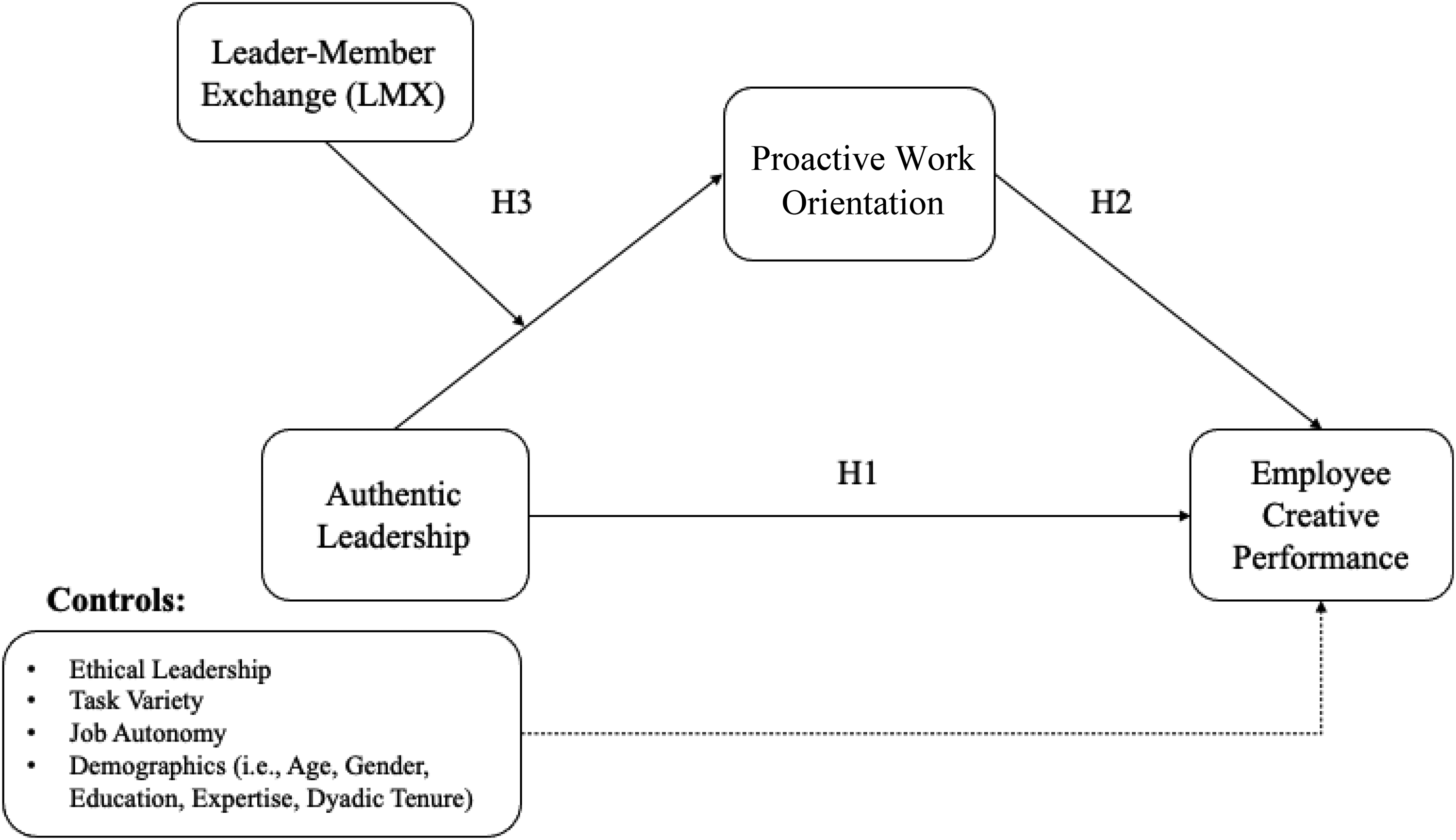
Conceptual model and hypotheses.
Study 1: Methods
Sample and Procedures
For our initial field study, we collected survey data from 171 employees and their 24 direct supervisors in a Slovenian manufacturing and processing company that produces highly customized bathroom equipment and accessories. Due to the personalized nature of products that the organization makes, employees are required to experiment and engage in divergent thinking and novel ideation to come up with creative solutions best suited for the client(s). Thus, this sample provided a useful setting to test our primary hypotheses.
To minimize common method bias, data were collected using two questionnaires—one for employees to assess their proactive orientation and their leaders’ perceived authenticity and another for supervisors to assess their employees’ creative performance. A translation-back translation procedure (Brislin, 1986) was used to convert the scales from English to Slovenian and back to English. Questionnaires included team and employee identification codes to guarantee employees’ anonymity, while allowing for the matching of supervisors to employees.
Work units were organized into 32 teams, ranging from two to 18 employees per team. The average number of responses per team was 12.56 employees. In total, 24 teams fully participated by providing both supervisor and employee responses, representing a 71.25 percent response rate of supervisors’ direct reports. Nearly 66 percent of participants were male and on average 28.7 years old (standard deviation [SD] = 5.89), with a mean work tenure of 5.52 years (SD = 4.57). Employees’ mean dyadic tenure with their supervisor was 3.97 years (SD = 3.61).
Measures
Unless otherwise noted, seven-point Likert scales ranging from 1 (“Strongly disagree”) to 7 (“Strongly agree”) were used in this study.
Authentic Leadership was measured using the AL inventory (ALI), a 16-item scale developed by Neider and Schriesheim (2011) (α = .94). Sample items include “My leader describes accurately the way that others view his/her abilities,” and “My leader is clearly aware of the impact he/she has on others.”
Employee Creative Performance was rated by direct supervisors and measured using the 13-item instrument developed by Zhou and George (2001) (α = .96). Sample items include “This employee…Comes up with new and practical ideas to improve performance” and “Searches out new technologies, processes, techniques, and/or product ideas.”
Proactive Orientation was measured using the four-item scale adopted by Detert and Burris (2007) (α = .78). The scale opened with a statement referring to employees’ work environment (“At work…”), and sample items include “If I see something I don't like, I fix it,” and “When I have a problem, I tackle it head on.”
Controls. We controlled for several demographic variables: age, gender, education, expertise (for which a proxy of years of work experience was used), and dyadic tenure (how long an employee has worked with their supervisor). As they may provide some indication of the creativity required for a given position (e.g., more experienced or educated employees may be assigned more complex or ambiguous tasks) as well as employees capabilities to meet those demands (Unsworth et al., 2005) and complement or replace the role of leadership in driving creative performance (Whittington et al., 2004; Chullen et al., 2010), we also controlled for task variety (α = .71) and job autonomy (α = .68) using items from Hackman and Oldham's (1980) job characteristics scale. As stated in the introduction, we also controlled for ethical leadership (α = .84), using Brown et al.'s (2005) 10-item measure to showcase the predictive power of AL above and beyond ethical leadership.
Study 1: Results
Table 1 provides descriptive statistics and correlations for all study variables. We began by observing the factor structure of the focal variables via a confirmatory factor analysis (CFA) using Mplus Version 7.3 with maximum likelihood estimation. Complementing the original conceptualization of AL as a higher order construct (Avolio & Gardner, 2005), previous studies have found support for combining the AL dimensions into a single factor and have applied it in their analyses, including measuring it with the ALI (Černe et al., 2014; Steffens et al., 2016). Thus, we followed this approach by using a single factor construct of AL. We conducted a CFA of the focal constructs (and ethical leadership to show it is distinct from AL) in our measurement model. The expected four-factor solution (AL, proactive orientation, creativity, and ethical leadership) displayed good fit with the data (χ2[804] = 1196.679, comparative fit index [CFI] = .92, root mean square error of approximation [RMSEA] = .05, standardized root mean squared residual [SRMR] = .095) 2 .
Study 1: Means, Standard Deviations, and Correlations.
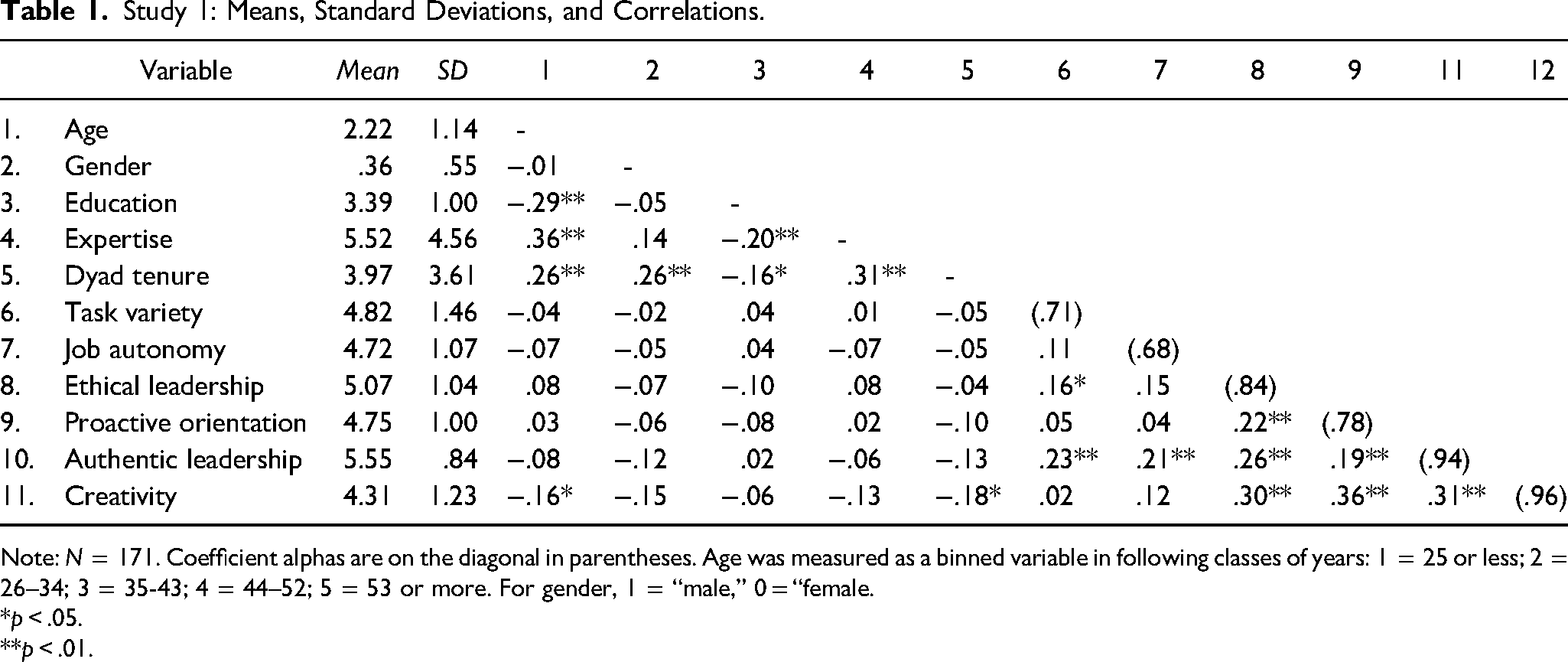
Note: N = 171. Coefficient alphas are on the diagonal in parentheses. Age was measured as a binned variable in following classes of years: 1 = 25 or less; 2 = 26–34; 3 = 35-43; 4 = 44–52; 5 = 53 or more. For gender, 1 = “male,” 0 = “female.
*p < .05.
**p < .01.
To appropriately analyze the effects of AL on followers’ creative performance, we used random coefficient modeling, given the nested structure of the data and the potential for independence assumptions to be violated since each supervisor assessed the creativity of multiple team members. We used hierarchical linear modeling (HLM) Version 7.0 (Raudenbush & Bryk, 2002) with restricted maximum likelihood estimation to test our hypotheses. AL was modeled at the individual level (Level 1), consistent with existing research that has modeled AL as employee-level perceptions (Walumbwa et al., 2008). More importantly, this decision was supported by our data. Low ICC(1, 16) scores (.03) and an insignificant amount of variance in AL perceptions attributed to group membership, obtained through ANOVA procedures, as well as low (ICC(2, 16) scores (.18), demonstrated that groups did not significantly differ from one another in their assessment of their supervisors’ AL.
The results from this random coefficient modeling analysis are presented in Table 2. In Step 1 (Model 1), we examined the intercept-only model. In Step 2 (Model 2), AL was entered along with our control variables and found to have a positive association with creativity (γ = .32, p = .002), thus supporting Hypothesis 1. Of the control variables that were included in this model, only age (γ = −.16, p < .05) and ethical leadership (γ = .28, p < .001) were significant predictors.
Study 1: Random Coefficient Modeling Results for the Effects of Authentic Leadership on Creativity.
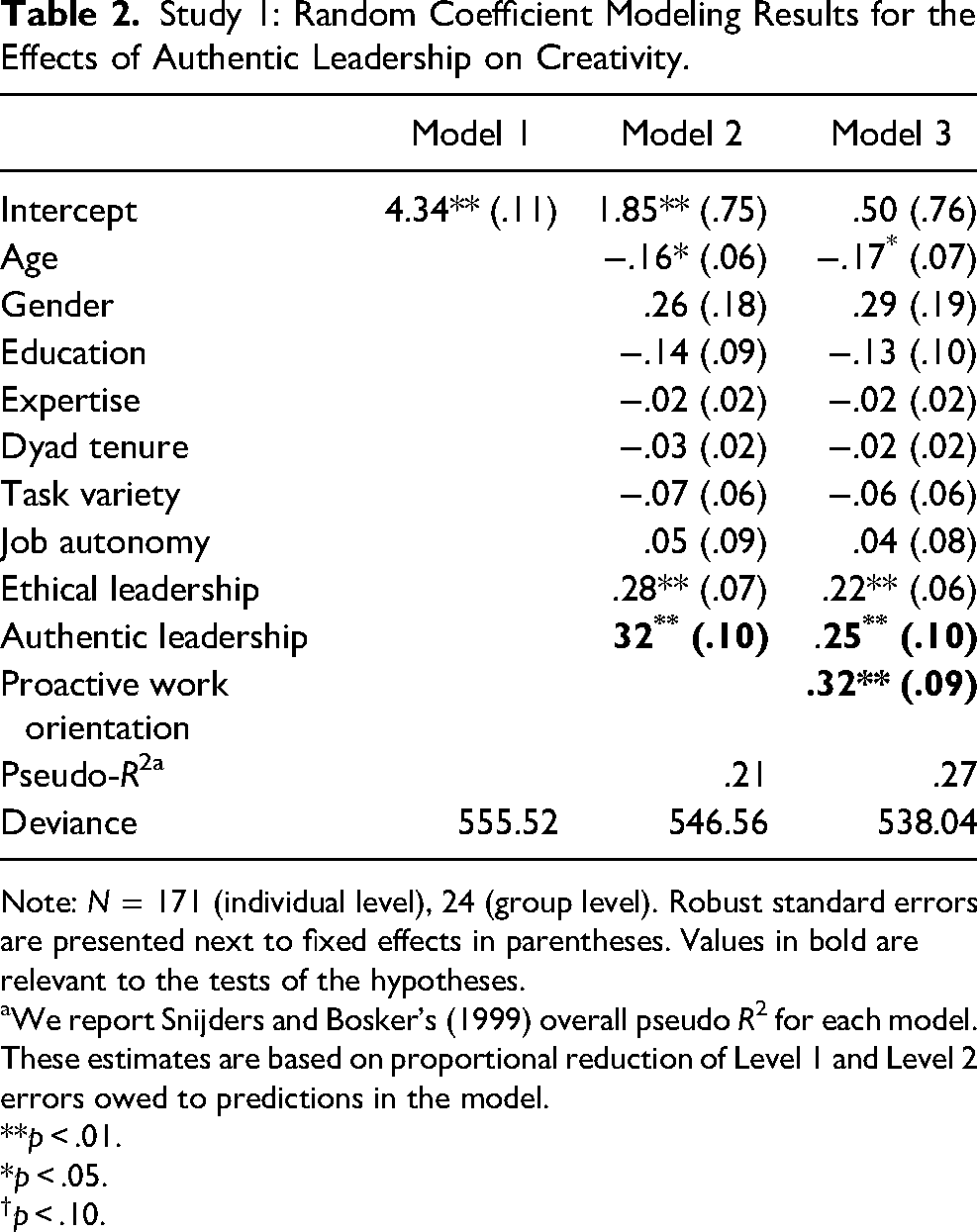
Note: N = 171 (individual level), 24 (group level). Robust standard errors are presented next to fixed effects in parentheses. Values in bold are relevant to the tests of the hypotheses.
We report Snijders and Bosker's (1999) overall pseudo R2 for each model. These estimates are based on proportional reduction of Level 1 and Level 2 errors owed to predictions in the model.
**p < .01.
*p < .05.
p < .10.
In Step 3 (Model 3), proactive orientation was added and found to be significantly and positively related to employee creativity (γ = .32, p < .001). Importantly, the inclusion of proactive orientation in the model also reduced the weight of the AL coefficient (γ = .25), albeit still significant at p < .01. In this model, ethical leadership also still predicted creativity, but to a lesser extent (γ = .22, p < .01). To examine the mediating role of proactive orientation on the relationship between AL and creativity, we ran 5,000 bootstrapped samples and examined the indirect effect using Hayes and Preacher's (2014) PROCESS macro (indirect effect size = .08 with 95% bootstrapped confidence intervals excluding zero: .0091 and .2345). These results provide support for Hypothesis 2, as proactive orientation partially mediates the relationship between AL and creativity 3 .
We also conducted a supplemental test by “flipping” the leadership constructs in the model such that ethical leadership was modeled as the primary predictor and AL as the control variable. We did so to assess whether proactive orientation mediated the effects of ethical leadership on creative performance, as it does for AL. This test can help distinguish the two leadership constructs based on differentiating their effects in their respective nomological networks. Our test showed that proactivity did not significantly mediate the ethical leadership–creativity relationship (indirect effect = .0518, standard error [SE] = .0369, lower level confidence interval [LLCI]: −.0016, upper level confidence interval [ULCI]: .1402).
Study 1: Discussion
In support of Hypotheses 1 and 2, this field study provides initial empirical evidence for the role of AL as a significant predictor of employees’ creative performance through the indirect, partially mediated effect of proactive orientation. This study offers promising initial evidence for our hypotheses while statistically accounting for the alternative explanation of ethical leadership. We next sought to constructively replicate these findings with a different sample (i.e., a sample of working professionals in another country) and extend the model by adding the proposed first-stage moderator (LMX). Taking a multi-method approach, we also used a different measure of AL and a different creative task as our dependent variable. In this follow-up study, participants generated creative ideas to help solve a simulated business problem relevant to their jobs, and multiple expert raters provided their assessments of individuals’ creative ideas. We thus used an additional and more robust measure of our dependent variable in Study 2.
Study 2: Methods
Sample, Design, and Procedures
We conducted Study 2 with 218 full-time staff employees (e.g., accounting, facilities, and administrative personnel) at a university in the U.S. Participants were offered $20 to come after working hours and complete a paper/pencil workplace survey in person. Participants’ mean age was 38.02 years (SD = 11.63). Approximately 59 percent of participants were male and averaged 16.13 years of work experience (SD = 11.5). Employees also worked with their supervisors an average of 2.84 years (SD = 3.33) (i.e., dyadic tenure). Five-point Likert scales ranging from 1 (“strongly disagree”) to 5 (“strongly agree”) were used in this study.
We introduced the study by explaining to participants that we were interested in studying how people solve business problems within the university. Participants were primed to think creatively by presenting them with a real-life work scenario relevant to their work experience at the university. Participants were then instructed to take 5–10 min to write down as many creative ideas they might have in response to the question: “What are some creative ways to reduce costs and expenses in your work unit (e.g., department)?” Example responses were “Implement a flexible work schedule (e.g., 4- and 10-h workdays),” and “Hire a temp to scan and index most of the documents we have in offsite storage instead of paying to have that stuff sit out there.” To triangulate findings across different measures compared to those used in Study 1 (Donald & Donald, 1959), we asked participants to provide their ratings of their immediate supervisor's AL, using the 16-item Authentic Leadership Questionnaire (ALQ) (Walumbwa et al., 2008; α = .93), and their perceptions of LMX, using Graen & Uhl-Bien's (1995) seven-item scale (α = .90). In addition, participants rated their levels of proactive orientation using the same four-item scale used in Study 1 (Detert & Burris, 2007) (α = .73). Participants also evaluated various controls: demographics (age, gender, and education), work experience, and dyadic tenure (both measured in number of months). Finally, participants again rated their supervisors’ ethical leadership using Brown et al.'s (2005) 10-item measure (α = .93) to replicate the unique predictive power of AL above and beyond ethical leadership found in Study 1.
To assess the creativity of the ideas that participants generated, we had two experts serve as independent raters. Rater #1 (Male) had 28 years of professional work experience (total), 16 years with the same current organization as participants and 16 years in a leadership/management role with this organization; Rater #2 (Female) had 19 years of professional work experience (total), 17 years with the same current organization as participants and 17 years in a leadership/management role with the current organization. Both were trained on the coding protocol and were provided with the definition of novelty and usefulness as core attributes of creative ideas (Amabile, 1983), and each rater was tasked with evaluating each participant's creative output on both dimensions on a scale from 1 (Low) to 7 (High). Both expert raters rated the first 20 ideas together with the aim of calibrating on the definitions and assessments, after which they assessed the remaining ideas independently. The two raters’ reliability (ICC[2,2] = .69) and agreement (rwg2 = .70) were within conventional guidelines (LeBreton & Senter, 2008). Thus, we aggregated both independent raters’ scores to form our dependent variable, creative performance.
Study 2: Results
Table 3 provides descriptive statistics and correlations for all Study 2 variables.
Study 2: Means, Standard Deviations, and Correlations.
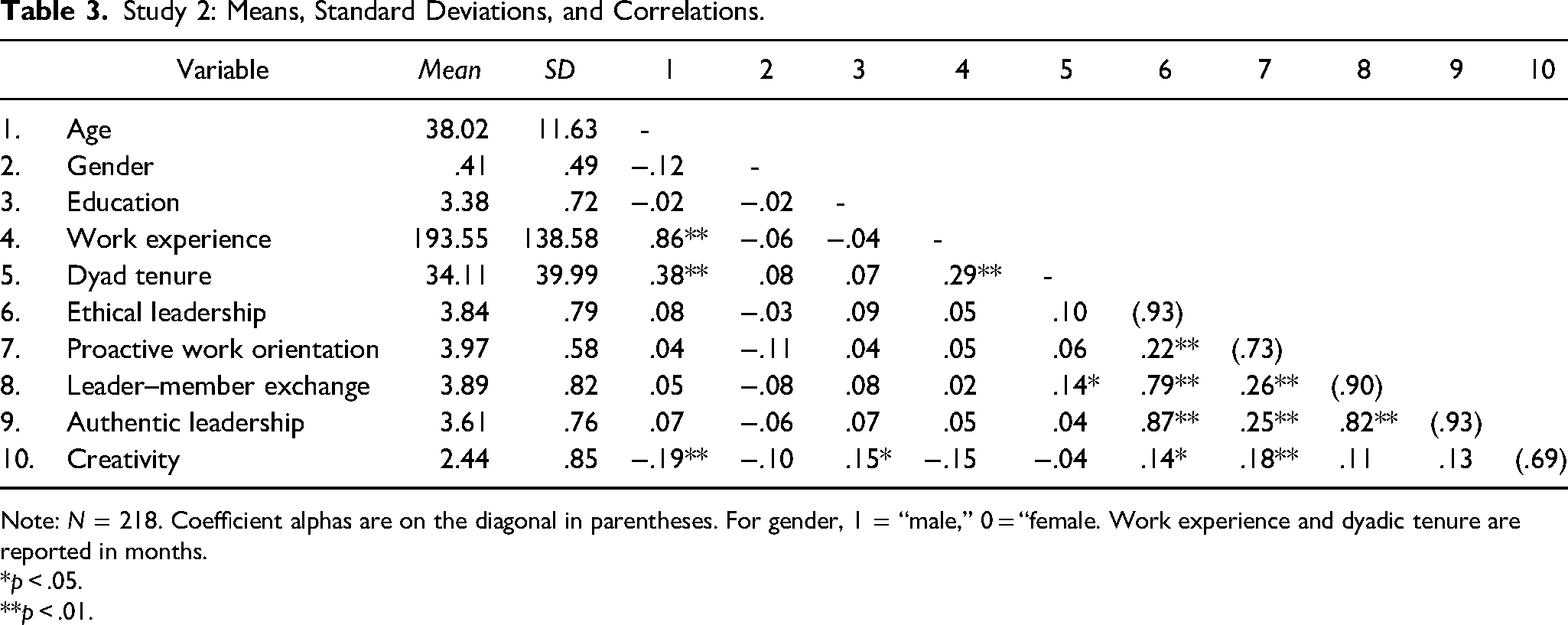
Note: N = 218. Coefficient alphas are on the diagonal in parentheses. For gender, 1 = “male,” 0 = “female. Work experience and dyadic tenure are reported in months.
*p < .05.
**p < .01.
As in Study 1, we treated AL as a single factor, in line with previous studies that have done so using ALQ as the measure (see Study 3 in Rego et al., 2012; Walumbwa et al., 2008). We first applied CFA procedures to test the factor structure of our data. The expected four-factor solution (AL, proactive orientation, LMX, and ethical leadership) fit the data well (χ2[610] = 967.32, CFI = .96, RMSEA = .04, SRMR = .05) 4 .
Next, to test Hypothesis 1, we ran ordinary least squares (OLS) regression, followed by mediation and moderated mediation tests using the PROCESS macro (Hayes, 2014) to test Hypotheses 2 and 3. After removing cases with too many missing variables, our final sample size was N = 180. OLS regression did not evidence a significant main effect of AL on employees’ creative performance (β = .15, p = .31). Thus, unlike in Study 1, Hypothesis 1 was not supported. We then examined the mediating role of proactive orientation on the relationship between AL and employees’ creative performance by running 5,000 bootstrapped samples and examining the indirect effect using Hayes’ (2014) PROCESS macro (Model 4). This test provided evidence of mediation, thus supporting Hypothesis 2 (indirect effect size = .07 with 95% bootstrapped confidence intervals excluding zero: .0055; .1904). Importantly, in Study 2, proactive orientation fully mediated the relationship between AL and creative performance, unlike the partial mediation found in Study 1.
To examine the first-stage moderated mediation model where LMX moderates the link between AL and proactive orientation, we again applied the PROCESS macro, using Model 7 in Hayes’ (2014) template file to test our hypothesis. Results supported Hypothesis 3: 95% confidence intervals around the index of moderated mediation excluded zero (index size = .0381 with 95% confidence intervals at .0034; .1077) and the significant indirect effect of proactive orientation on the relationship between AL and creative performance held only at high levels of LMX, not low (conditional indirect effect of AL on creativity size = .0586 with its 95% confidence intervals excluding zero: .0040; .1974). As predicted, we found a significant interaction between AL and LMX (b = .17, p < . 01) predicting proactive orientation (see Table 4 and Figure 2). Hypothesis 3 was thus supported.
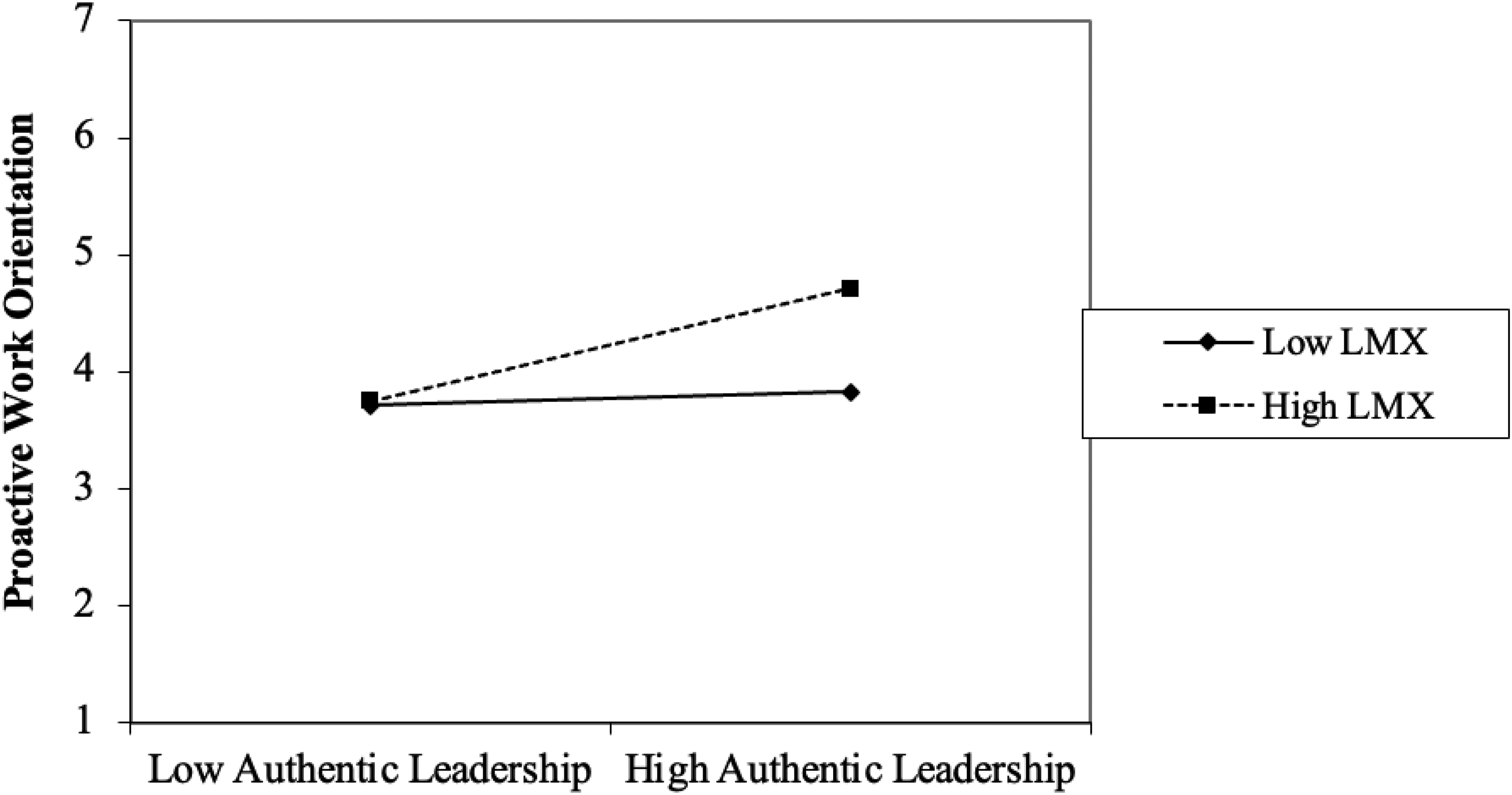
The interaction of authentic leadership and LMX on proactive orientation.
Study 2: PROCESS Model Results for Testing Moderated Mediation.
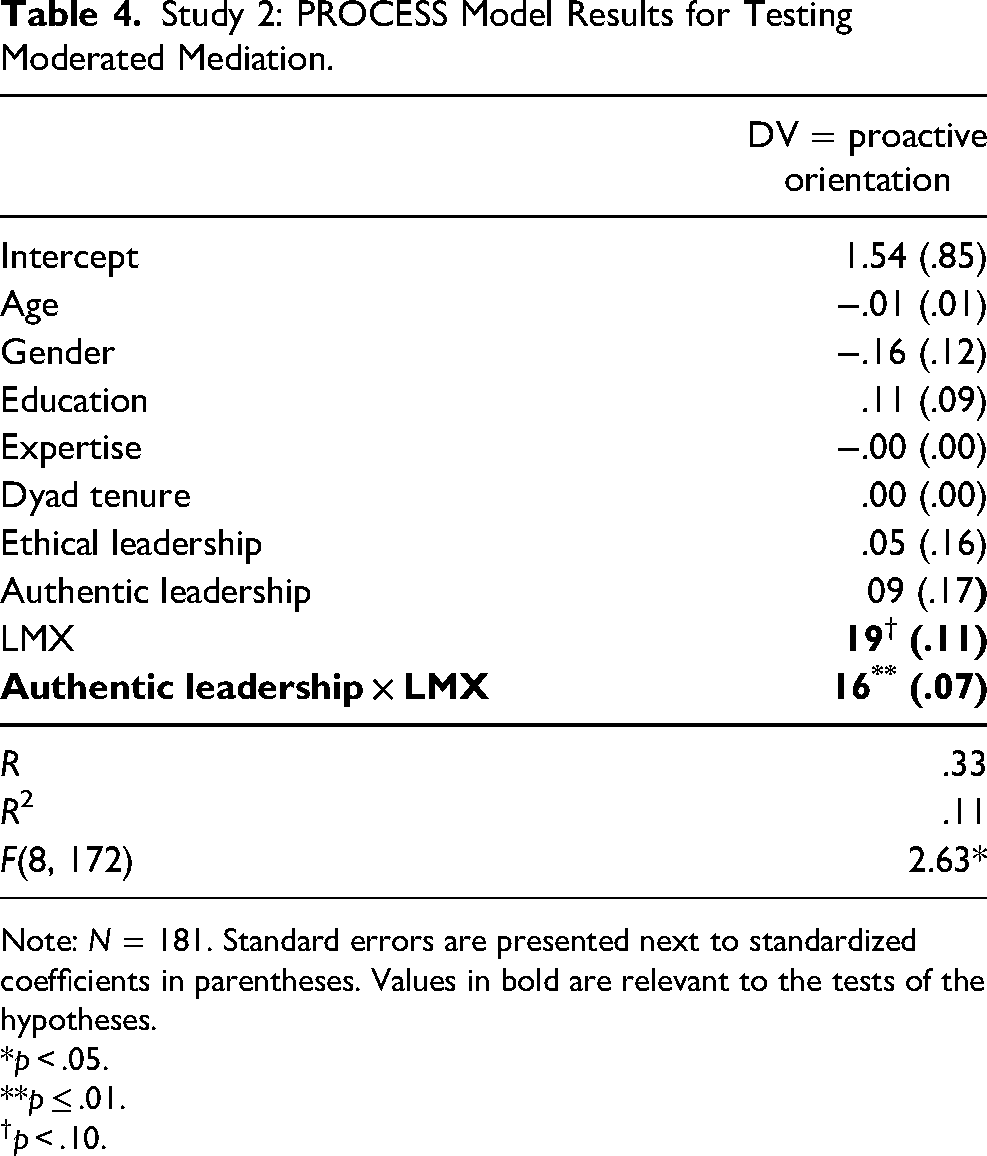
Note: N = 181. Standard errors are presented next to standardized coefficients in parentheses. Values in bold are relevant to the tests of the hypotheses.
*p < .05.
**p ≤ .01.
p < .10.
Finally, since prior studies (Chan & Mak, 2012; Wang et al., 2005) have indicated that LMX could also be modeled as an endogenous variable and potentially be fostered by certain leadership styles, we also conducted a supplemental analysis to test whether LMX operated as a mediator between AL and employees’ creative performance. Once again, we used Model 4 in Hayes’ (2014) template file and applied the PROCESS macro to test for mediation. The results of this supplemental analysis provided no significant evidence for mediation (indirect effect size = .02 with confidence intervals including zero −.0926, .1197), thereby providing support for our treatment of LMX as an exogenous variable in this model. 5
General Discussion
Creativity is a necessary ingredient for enhanced organizational effectiveness and a crucial step in the innovation process that aids productivity, organizational growth, and competitiveness. Consequently, understanding how leadership and leader–follower relationships can increase the organizational pool of novel and useful ideas offered by followers is vitally important. Yet, few studies have explored the underlying psychological mechanisms that help to explain why leadership drives the creative process nor considered the potential boundary conditions that may bolster or attenuate that effect.
Guided by social exchange theory (Blau, 1964; Cropanzano & Mitchell, 2005), we thus sought to focus on the mediating role of a proactive orientation in explaining the relationship between AL and employees’ creative performance. Results from a field sample of working professionals in Europe (Study 1) provided preliminary support for proactive orientation as a transmitter of the effects of AL on creative performance. A follow-up study of American working professionals (Study 2) engaged in a controlled creative output task established LMX as an important boundary condition through its bolstering of AL in promoting followers’ proactive orientation, and subsequent creativity. Using both a controlled and uncontrolled field setting, multisource measurement (i.e., leader and follower), and samples from the U.S. and Central Europe, these findings offer a useful launching point for future research deriving from the current model.
Theoretical Contributions
This paper seeks to make several theoretical contributions to the proactivity, creativity, and AL literatures. First, this research addresses calls for researchers to develop the nomological network of the proactivity construct further (Tornau & Frese, 2013). We do so by (1) focusing specifically on the malleable state of employees’ proactive orientation and (2) identifying a new antecedent (AL), outcome (creative performance), and condition under which it emerges (LMX). Anchored in social exchange theory (Spitzmuller & Van Dyne, 2013) and the theory of proactive motivation (Parker et al., 2010), proactive orientation provides an important explanatory mechanism as to why AL positively impacts employees’ creative performance, illuminating AL as a valuable tool for shaping creative performance. Doing so also demonstrates that a proactive orientation serves as an important, yet understudied, mediator linking leadership to employee creative performance. This research therefore addresses scholarly calls to identify additional motivational mechanisms that transfer the effects of AL on creative outcomes (Černe et al., 2013; Zhang et al., 2022) and complements recent research on leadership styles and approaches and the malleability of proactivity (Chen et al., 2018; Huang, 2012; Martin et al., 2013).
A second theoretical contribution we make is to add conceptual clarity around LMX as a boundary condition of the effects of AL on proactivity. We theorized and demonstrated in Study 2 that even leaders who engage in highly authentic actions may not reap positive effects on followers’ proactive orientation. It is only when leaders otherwise have a strong LMX relationship with a given follower, whereby the follower reports high levels of liking, respect, and trust in the leader, that the positive effects of AL occur. Grounded in social exchange theory, we theorized that not all followers would equally like, respect, or trust the “authentic self” a given leader brings to the workplace. And, under such lower-LMX relationships, followers will experience lower felt obligation and need to reciprocate with proactivity and creative responses in the workplace.
To understand this effect, we note the caution made by Hannah et al. (2014) concerning the “new genre” theories of leadership, such as AL; stating that “to properly specify theory, it is critical to distinguish the leader from enacted leadership…[and to not]…improperly anthropomorphize these theories and focus on a ‘type’ of leader” (p. 600). For example, the ALQ (Walumbwa et al., 2008) asks followers questions, such as the frequency with which the leader “Makes decisions based on his or her core values.” That observed behavior does not necessarily mean that the follower sees the leader as being moral. The leader's expressed core values may be more (or less) acceptable and attractive to different followers. Similarly, we noted earlier that the things a leader is transparent about could vary in attractiveness to different followers (e.g., a follower may not care for the ideas a leader expresses, or the “true self” they project). Thus, as LMX reflects the positive bonds and level of attractiveness followers hold toward their leader, it is an important factor that should be considered in future AL research. In this way, our approach addresses a recent critique of the excess positivity related to the study of AL (cf. Alvesson & Einola, 2019) by demonstrating how this empowering leadership style is crucially dependent upon the quality of leader–member interaction for employees to become energized and develop a proactive orientation.
Consistent with prior research that has modeled LMX as a moderator of the effects of transformational leadership (Aryee et al., 2012; Law & Wong, 1999; Piccolo et al., 2008; Piccolo & Colquitt, 2006), we modeled LMX as an exogenous variable in Study 2. Indeed, supplementary analyses in Study 2 showed that LMX did not mediate the effects of AL on creative performance, contrasting results of Xu et al. (2017). While LMX and AL covary, our CFA shows that they are empirically distinct, and as described in the theory section, LMX is driven by many other factors besides a leader's enacted leadership style (see Antonakis, 2017; Fischer et al., 2017). These reasons could explain in part why the effects of AL on creative performance do not transmit through LMX. Additionally, it is possible that LMX may simply not drive either a proactive orientation or creative performance, as the modest and insignificant correlations between these variables from Study 1 and 2, respectively, suggest.
Further, a supplemental goal of this research was to address select recent critiques of AL, its theoretical foundations, and its proposed effects. We first do so by heeding scholarly calls to take a multi-theory approach when empirically testing the influence of AL to assess its unique effects (Banks et al., 2016; Cooper et al., 2005; Hannah et al., 2014). Leadership researchers have typically empirically examined phenomenon through the lens of a singular leadership perspective (e.g., authentic), with few studies attempting to distinguish and discriminate the effects of different forms of leadership in the same investigation (Avolio, 2007; Cooper et al., 2005). To avoid this pitfall, we integrated three leadership constructs in the current model—two behavioral styles (AL and ethical leadership (Brown & Treviño, 2006) across both studies and one relational model (LMX) in Study 2. We controlled for the effects of ethical leadership (significant only in Study 1), given recent studies linking ethical leadership to creative outcomes (Chen & Hou, 2016; Ma et al., 2013), thereby demonstrating across both studies the unique effects of AL, beyond that of ethical leadership, on followers’ proactive orientation and subsequent creative performance. In this way, we contribute by refining the precision of our leadership theories, which has value for both scholars and practitioners seeking to use these leadership styles.
These results should also “shed light (and not just heat)” (Hollenbeck, 2008, pp. 20–21) on arguments that the outcomes of AL are merely affective in nature (Mumford & Fried, 2014) and may not contribute to meaningful work outcomes, such a creative performance (Alvesson & Einola, 2019). Indeed, our reported supplemental test in Study 2 showed that the effects of AL on creative performance are not mediated through LMX, of which liking/attraction is a core component.
Various critiques of the AL literature have centered on construct formulation and measurement. It is of note that the same original four dimensions of AL identified by Walumbwa et al. (2008) when creating the original ALQ were also identified and used by Neider and Schriesheim (2011) when they later created the ALI. Avolio et al. (2018) have also conducted recent empirical tests to reassess the construct validity of the ALQ. Notably, taking a multi-method approach, we found that our model replicated across our two studies using both measures. Additional validation research is, however, warranted on both the ALQ and ALI moving forward.
Finally, theory development is enhanced when leadership researchers demonstrate that different leadership predictors wield their effects through different mechanisms. This helps us better understand and differentiate leadership constructs based not only on their construct discrimination but, importantly, on their divergent predictive outcomes (Bass & Bass, 2009). Here in supplemental tests, we showed across both studies that proactive orientation mediated the effects of AL, but did not mediate the effects of ethical leadership, on creative performance. This should also inform the research on ethical leadership and creativity to consider other unique mediators beyond proactive orientation.
Practical Implications
Given the popularity of AL among practitioners (George, 2003; Smith, 2019), the current investigations have important implications for how managers choose to lead. While we find that AL stimulates employee creative performance through driving a proactive orientation, this effect is only enabled when accompanied by high levels of LMX. While outside the scope of this paper, this finding suggests that leaders should find ways to bolster the level of LMX they establish with followers (Carmeli et al., 2009). Yet, as noted earlier, follower individual differences, such as their ILTs, influence perceptions of their leaders and subsequent levels of LMX (Riggs & Porter, 2017), so some factors driving LMX are outside the influence of leaders. Assuming LMX is established with a follower, our results suggest that to bolster followers’ proactive orientation, leaders should behave in authentic ways (i.e., self-aware, relationally transparent, practice moral perspective, and open to new ideas).
This research also highlights the importance of employees’ proactive orientation in driving employees’ creative performance, a critical outcome for organizations. As proactive orientation stems from other contextual factors beyond leadership (Parker et al., 2006, 2010), managers should not only use AL but find multiple ways to increase their members’ proactive orientation to increase their organizations’ ability to generate the types of ideas that lead to breakthrough innovations. Further, since proactivity has been linked to numerous other important outcomes besides creativity, such as job performance (Glaser et al., 2015), social integration, role clarity, and job satisfaction (Wanberg & Kammeyer-Mueller, 2000), we suspect that by leading authentically, under conditions of high LMX, leaders may reap various additional benefits to the organization beyond creativity (Glaser et al., 2015; Wanberg & Kammeyer-Mueller, 2000).
Limitations and Future Research Directions
Although this study makes important contributions to both theory and practice, it is not without limitations. First, there are numerous antecedents to proactivity, both known and yet to be identified, besides AL (for overviews see Parker et al., 2006, 2010). Thus, while our two studies establish proactive orientation as a significant mechanism linking AL to follower creativity, our findings also raise the possibility that a proactive orientation may operate alongside other unmeasured motivational variables to yield creative performance. This is evidenced by the fact that proactive orientation operated not only as a partial mediator in Study 1 but also as a full mediator in Study 2. These different findings could also be driven by national or organizational culture or other sample differences. In our investigation, Sample 1 was Central European and from a manufacturing facility, while Sample 2 was U.S.-based and represented largely “white collar” knowledge workers. Thus, norms of behavior and proactivity may have differed across samples, as could have receptivity to an authentic form of leadership. Further, the need for and natural outcomes of a proactive orientation may have differed between the knowledge-based work environment versus the manufacturing-based context. Researchers should thus directly explore the antecedents and outcomes of a proactive orientation across various cultures.
The findings of partial mediation in Study 1, however, may also suggest that additional mediators are operating. We theorized here the importance of social exchange and reciprocity in motivating followers to respond proactively to acts of AL. Yet, it is also plausible that highly authentic leaders enhance other factors, such as followers’ self-determination (i.e., meet followers needs for competence, relatedness, and autonomy, Ryan & Deci, 2000) prompting them to generate novel and useful ideas. Researchers should thus consider other motivational and non-motivational mechanisms underpinning the relationship between AL and creative performance and explicitly measure them. Further, we did not directly measure the felt obligation to reciprocate we theorized the follower experiences. Our findings should thus motivate future research to test a serial mediation model including felt obligation or need to reciprocate (i.e., AL → felt obligation → proactive orientation → creative performance).
Although our study identified an important boundary condition of AL as it relates to followers’ proactive orientation (i.e., LMX), we did not test additional moderators that may also help to strengthen this association. Thus, moving forward, it will be important to extend beyond LMX and the increased social exchange that emerges within such dyads to include other individual, relational, and contextual factors that may moderate the effects of AL on followers’ proactive orientation and subsequent creativity. Exploring how other behavioral leadership styles (e.g., ethical, transformational, etc.) interact with these different predictors may also prove beneficial in providing greater theoretical insight into the contextual influences on individuals’ creative performance. Since ethical leadership is also a significant predictor in our Study 1, future research should continue to assess that relationship with creativity and possible mediators of that relationship.
Finally, although we controlled for several variables, including job-related factors (task variety and job autonomy in Study 1), basic demographics, work experience, and ethical leadership (in both studies), future research should refine the current model by modeling relevant individual characteristics (e.g., risk-taking propensity, general intelligence, trait proactivity, curiosity, and openness to experience) as predicting or moderating factors. In addition, although we sought to establish external validity by including two types of field studies (i.e., uncontrolled and controlled tasks), we recognize that AL may yield different effects, depending on the context studied. Since both of our studies were cross-sectional in nature, our ability to infer causality is limited. We thus encourage scholars to constructively replicate our findings with experiments and explore how AL may vary in different organizational settings, industries, and cultures.
Conclusion
As organizations continue to grapple with a rapidly changing business environment, harnessing the creative potential of their workforce will become increasingly important to ensure a competitive advantage. Our research suggests that firms can create the contextual conditions necessary to promote an emerging, proactive orientation in their employees by having leaders adopt an AL style and pairing it with a strong, relational bond with their followers (i.e., high LMX). In this way, organizations can motivate their employees to generate the creative solutions that will aid organizational functioning and effectiveness and spur opportunities for new innovations.
Footnotes
Acknowledgment
We would like to thank Elizabeth Nolan and Kevin Bender for their assistance during the research process.
Declaration of Conflicting Interests
The author(s) declared no potential conflicts of interest with respect to the research, authorship, and/or publication of this article.
Funding
His research was supported by the Slovenian Research Agency (Core project funding P5-0441, J5-2555 and J5-4574).
