




Abstract
This study aims to examine the effect of charismatic leadership on followers’ attitudinal, emotional, and well-being outcomes in a crisis setting. Combining leadership literature with Conservation of Resources and leader-follower distance theories, we propose that the effect of charismatic leadership on follower outcomes depends on the interplay between the follower's furlough status during the lockdown period and their Intolerance to Uncertainty (IU) dispositional characteristic. A cross-sectional study was conducted at two points in time: during the first lockdown (March–April 2020) and four months after the lockdown (August 2020). The final sample included 336 employees with data for both points in time (n = 199 continued to work during the lockdown, n = 137 were on furlough). The findings confirmed the study's hypotheses and revealed that charismatic leadership significantly contributed to employee outcomes only in the case of furloughed employees with low levels of IU and of continuously-employed employees with high levels of IU. It did not make a similar contribution in the edge cases—employees with low IU levels who continued to work during the lockdown or those with high levels of IU who were furloughed. This study provides novel insights into the relationship between charismatic leadership effectiveness and follower outcomes, and informs managers how to better adjust their leadership style to their followers in a crisis setting. The findings extend our knowledge about charismatic leadership by suggesting the mutual contribution of the distance dimension and employee dispositional characteristics as a boundary condition to charismatic leadership effectiveness.
Keywords
Introduction
The COVID-19 pandemic broke out unexpectedly and created health, economic, and psychological crises worldwide. While a crisis has an adverse impact on organizational functioning (Klein & Eckhaus, 2017), it is also proposed as a critical antecedent of charismatic leadership (House, 1977; Weber, 1947). Weber (1947) defines charismatic leaders as leaders with “divine gifts”, which are unique qualities that allow them to inspire their followers and motivate them to transcend the status quo in pursuit of striving for a new vision. These qualities are much needed during troublesome times such as the COVID-19 pandemic, when people are called on to act for the public good, sometimes at their own expense (Antonakis, 2021).
While charismatic leadership is perceived as possessing unequaled capabilities and constructive forces during ambiguous and stressful situations (e.g., De Hoogh et al., 2004; House, 1977), Klein and House (1995) have suggested that charisma resides not only in the qualities of the leader, but also depends on follower readiness to accept it. In fact, scholars have criticized the ultimately unidirectional relationship and romanticization of the leader's role (Meindl, 1995), suggesting that follower attributions may attenuate or even neutralize the positive impact of charismatic leadership on follower attitudes and organizational outcomes (e.g., De Vries et al., 1998; Wegge et al., 2022). For example, Wegge et al. (2022) demonstrated that charismatic leadership reduced the performance of participants with a high level of self-direction in a crisis context; this is because such followers have a strong need for autonomy and, as a result, less need for charismatic guidance. This idea stands on a par with the growing effort to revive the contingency leadership theory (Day & Antonakis, 2012; Oc, 2018; Sharma & Kirkman, 2015) and the cumulative body of research on the paradoxical effect of positive leadership styles (e.g., Judge et al., 2009; Sharma & Kirkman, 2015), which suggest that positive leadership styles are not ultimately advantageous across all organizational settings and different employee characteristics.
Following the above, we propose that follower dispositional characteristics can provide a more nuanced and balanced view of the impact of charismatic leadership, thus answering the call for adopting a more follower-centered perspective in the charismatic leadership literature (Uhl-Bien et al., 2014). Accordingly, the current study explores one of the followers’ critical characteristics that is highly relevant to crisis contexts: their level of intolerance to uncertainty (IU). This dispositional characteristic refers to the individual's negative beliefs about uncertainty and its consequences (Carleton et al., 2007). Previous research has shown it to be a strong predictor of a person's perception of and response to a crisis, and to contribute to the individual's well-being outcomes in the crisis context (Celik et al., 2021; Larsen et al., 2021; Maftei & Holman, 2022; Parlapani et al., 2020; Voitsidis et al., 2021).
Moreover, leadership's influence on followers does not occur in a vacuum. Leaders are “tenants of time and context” (Bryman et al., 1996, p. 355). Therefore, we cannot analyze the leader-follower dynamic in isolation from the context where this relationship occurs (Shamir & Howell, 1999). Specifically, in this study we focus on the employee's work status during the COVID-19 pandemic as an indicator of the distance between a leader and a follower (Antonakis & Atwater, 2002). We examine the distance based on employee work status; that is, whether the employee continued to work during the lockdown (close followers) or was furloughed (distant followers) and thus detached from the organization during the lockdown period. We propose that employee work status can play a critical role in understanding charismatic leadership effectiveness in crisis conditions.
Crises are relatively rare (Bass & Bass, 2008), hence the COVID-19 pandemic provides an opportunity for a real-time investigation of the effectiveness of a charismatic leader in such contexts. In the current study, based on the Conservation of Resources theory (COR; Hobfoll, 1988) and adopting the perception of charisma as a function of the interaction between three elements—leader qualities, follower characteristics, and contextual features (Klein & House, 1995)—we suggest that the interplay between follower characteristics (i.e., IU trait High: IU+; Low: IU-) and contextual features (i.e., being on furlough: FS+; or working regularly during the COVID-19 pandemic: FS-) serves as a boundary condition of the effect of charismatic leadership on employee attitudes, emotions, and well-being. Specifically, we propose that charismatic leadership's contribution to follower outcomes is more prominent in intermediate (i.e., FS-, IU+ or FS+, IU-) than in edge cases (i.e., FS-, IU- or FS+, IU+). This is because in the latter situation, followers either have enough resources to handle the crisis and thus are less susceptible to charismatic leadership (FS-, IU-), or their pool of resources is so drained that such leadership may not be sufficient to overcome their lack of means (FS+, IU+). To explore the proposed relationships, the current study focused on three dependent variables—psychological contract violation (i.e., the emotional distress and feelings of anger resulting from an unfulfilled psychological contract between employer and employee; Morrison & Robinson, 1997), emotional exhaustion (i.e., the draining of emotional resources and a feeling of being overloaded; Maslach et al., 2001), and job insecurity (i.e., employee perception of a potential threat to the continuity of their current job; Vander Elst et al., 2014)—as the emotional, well-being, and attitudinal indicators for charismatic leadership's effect. These specific variables were chosen based on their relevance to the COVID-19 pandemic (e.g., Ganson et al., 2021; Hwang et al., 2021; Wu et al., 2021) and downsizing (e.g., Arshad, 2016; Marques et al., 2014; Paulsen et al., 2005) contexts, and on leadership literature (i.e., Jiang & Lavaysse, 2018; Kaluza et al., 2020; Restubog et al., 2010). Moreover, previous studies demonstrated that these emotional, well-being, and attitudinal indicators are the key contributors to a variety of employees’ behaviors and organizational outcomes (e.g., Meyer et al., 2002; Morrison & Robinson, 1997; Swider & Zimmerman, 2010). For the study model, see Figure 1.
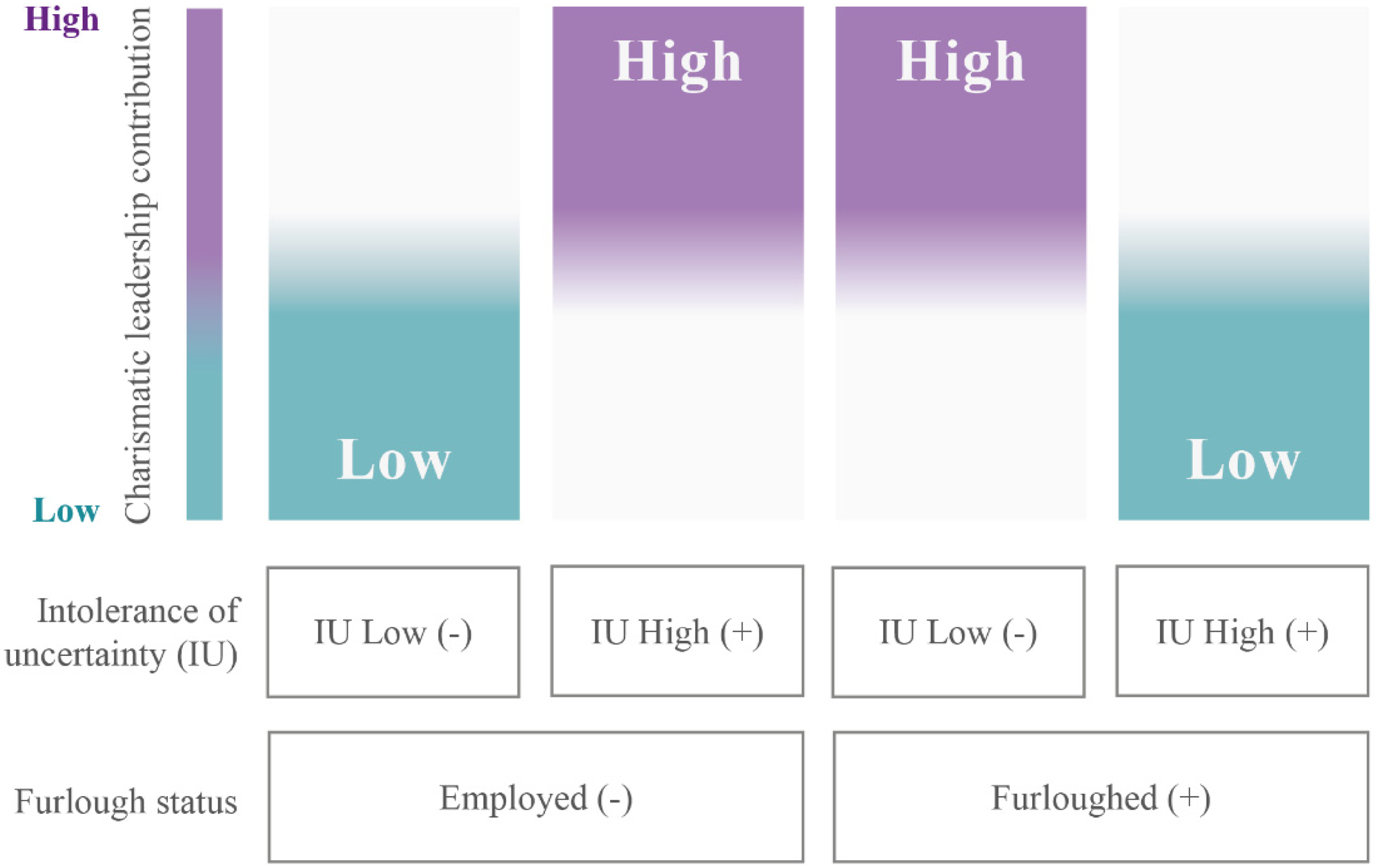
The study model.
Theoretical Framework
Charismatic Leadership's Role During a Crisis
The construct of charismatic leadership informs academic and practitioner attention in an attempt to understand leadership's effect on follower emotions, attitudes, and behaviors (Banks et al., 2017). This attention is required to remove the mystical aura from the charismatic leadership construct (Shamir, 1992) in order to provide a more rigorous and pragmatic definition. Accordingly, House (1977) presented a theoretical framework that outlined charismatic leadership's role in an organizational context. He suggested that charismatic leaders have the ability to motivate and influence their followers by inspiring a clear vision and radical behaviors, which in turn promote the belief that the leader is blessed with extraordinary capabilities, evoking strong emotional bonds that lead followers to high levels of compliance with a commitment to the leader's foresight. Later on, Shamir et al. (1993) added that charismatic leaders inspire their followers by implicating their self-concept and elevating their self-esteem through the communication of higher expectations and the promotion of followers’ self-confidence to achieve better outcomes.
One of the critical antecedents for charismatic leadership acceleration is a crisis (e.g., House, 1977; Klein & House, 1995). Indeed, charismatic leaders positively contribute to financial performance and to subordinates’ positive work attitudes only under uncertain and changeable environments (e.g., De Hoogh et al., 2004; Waldman et al., 2001). The need for charismatic leadership can be explained as a coping mechanism that followers employ under extreme conditions and high-stress levels (Devereux, 1955; Madsen & Snow, 1991). In situations of uncertainty, charismatic leadership serves as a self-preservation strategy that restores the followers’ sense of coping capability by linking themselves to a dominant and effective model (Madsen & Snow, 1991). From a psychoanalytic perspective, the leader acts as the followers’ “significant other” by ensuring their better future and possibilities to cope with stressful events and offering security during times of uncertainty (Kets de Vries, 1988). Thus, a crisis creates environmental contingencies in which followers increase their need for charismatic leadership to reassure and decrease their anxieties and fears (Wegge et al., 2022).
As research on the influence of charismatic leadership expands, the role of follower characteristics as a neutralizer of charismatic leadership's effect on follower outcomes receives more scholarly attention (e.g., Den Hartog & Belschak, 2012; Wegge et al., 2022). For example, Kets de Vries et al. (1998) suggested that a low need for leadership attenuated the contribution of charismatic leadership to employee attitudes such as job satisfaction and organizational commitment. Likewise, Wegge et al. (2022) found that although charismatic leadership encouraged followers to expend efforts in performing challenging assignments, this relationship was weakened by the employees’ self-direction trait. These two examples imply that charismatic leadership may have an affirmative effect, but only for those who need and desire that kind of leadership. However, despite some conceptual (e.g., Kets de Vries, 1988; Shamir & Howell, 1999) and empirical (e.g., De Hoogh et al., 2004; Waldman et al., 2001) evidence, it is not clear to what extent follower characteristics might affect the charismatic leader's contribution to follower outcomes in a crisis setting.
The COVID-19 pandemic provides an opportunity to understand how and whether charismatic leadership contributes to followers’ attitudinal, emotional, and well-being outcomes in a crisis context (e.g., Antonakis, 2021). The current study argues that in a crisis context, charismatic leadership is more effective in an intermediate condition, that is, when employees need the support and have the capability to be supported. To examine this argument we focus on the employees’ dispositional trait of intolerance of uncertainty (IU), arguing that IU bounds the contribution of charismatic leaders to their followers’ attitudinal (i.e., job insecurity), emotional (i.e., contract violation), and well-being (i.e., emotional exhaustion) outcomes.
Intolerance of Uncertainty
IU is a dispositional characteristic that refers to experiencing fear concerning the unknown future (Carleton et al., 2007). High IU provokes fear, worry, and anxiety, thus increasing a person's vulnerability and negatively impacting the quality of their decision-making process (Hillen et al., 2017). In the course of unexpected events, intolerant individuals demonstrate high activation of stress responses (Barling & Frone, 2017), perceive a lack of control over the situation (Endler et al., 2000), and use maladaptive coping strategies more frequently (Rettie & Daniels, 2021).
When faced with the unexpected COVID-19 pandemic, individuals who had high levels of IU showed emotional and mental distress, including higher levels of anxiety and depression (Reizer et al., 2021; Rettie & Daniels, 2021). The increase in stress among this group may have evolved from a drain on their beneficial resources, as explained by the Conservation Of Resources theory (COR; Hobfoll, 1988; Hobfoll et al., 2018). COR theory suggests that people are evolutionarily motivated to retain, foster, and protect necessary resources that are valuable for their survival. Resources can be tangible assets (e.g., a house, money), conditions (e.g., job security status), and also personal characteristics (Hobfoll et al., 2018; Baranik et al., 2019). According to COR theory, stress occurs when important resources are actually lost or perceived as having the potential to be lost, which forces individuals to “invest their available resources in order to protect against resource loss, recover from losses, and gain resources” (Hobfoll et al., 2018, p. 105). However, among vulnerable groups such as individuals with high levels of IU, the availability of resources is a priori relatively low because they perceive uncertain situations as highly stressful and upsetting, which leads to an inability to act (Buhr & Dugas, 2002). Moreover, IU is positively associated with worry (Dugas et al., 2001) and rumination (Satici et al., 2022), which demand an investment of additional resources to be dealt with (Baranik et al., 2019). Hence, the resources of people with high IU are depleted faster; furthermore, during unstable situations such as the COVID-19 pandemic, these individuals are more prone to a resource loss spiral, which increases their levels of anxiety (Reizer et al., 2021; Rettie & Daniels, 2021).
One strategy to reduce employee anxiety is to rely on the leader as a prominent organizational factor that creates meaning for employees (Smircich & Morgan, 1982) and structures their reality (Delegach et al., 2017), thereby affecting employee attitudes, emotions, and well-being (for meta-analytical findings, see Schyns & Schilling, 2013). Given intolerant individuals’ higher levels of stress and ambiguity, their feeling of environmental control loss can provoke them into searching for a leader who can calm their anxiety by guarantying a safe and stable future; i.e., they become more “charisma hungry” (Bass & Bass, 2008, p. 593) and reach a higher level of readiness to accept the authority of a charismatic leader (Devereux, 1955), compared to individuals with low IU. Thus, although individuals with lower levels of IU may benefit from charismatic leadership, people with higher levels of IU are more susceptible to charismatic leaders in a crisis setting.
Employee Work Status During the Pandemic
Following Klein and House (1995), in addition to follower characteristics, we further highlight the pivotal role of context in charismatic leadership outcomes. In our study, context is represented by employee work status during the COVID-19 pandemic. The COVID-19 pandemic generated enormous disruption, forcing organizations to quickly alter their workforce arrangements (McKibbin & Fernando, 2021). Many employees were forced to work remotely; some were fired, while others were furloughed. Furlough is defined as a reduction in working hours, from a few to an entire postponement of work. Furloughed employees are placed in a non-work status and do not receive payment or any economic or organizational benefits for the period of the leave (Mandeville et al., 2019). On the other hand, they are still considered part of the workforce and are expected to return to work as soon as the crisis passes. Hence, they are in limbo: still considered part of the organization, and at the same time, detached from it.
The furlough status represents a potential or actual threat to employee resources (Carnevale & Hatak, 2020) such as social conditions, organizational status, and financical means (Hobfoll et al., 2018). This potential or actual resource loss amplifies emotional exhaustion (e.g., Costa & Neves, 2017) and contributes to contract violation perception (Delegach et al., 2022). Moreover, while even expected organizational changes threaten employee resources and contribute positively to perceived job insecurity (e.g., Ito & Brotheridge, 2007), the lack of predictability and control during unforseable crises is associated with a heightened perception of job insecurity (Østhus, 2007; Probst & Lawler, 2006). This is especially so for furloughed employees, who face both a threat to and the actual loss of their jobs (Halbesleben et al., 2013).
Accrodingly, most research refers to furlough as a disruptive strategy that impairs employee job security, accelerates work-family conflict, and breaches the psychological contract between employer and employee (e.g., Baranik et al., 2019; Mandeville et al., 2019). In addition, furlough creates a physical distance between the employees and their employers that disrupts interaction frequency (especially in the case of Israel 1 ) and corresponds with the concept of leader-follower distance. Napier and Ferris (1993) defined distance between the leader and followers as a “multidimensional construct that describes the psychological, structural, and functional separation, disparity, or discord between a supervisor and a subordinate” (p. 326). The psychological dimension of distance refers to the degree of intimacy in social interactions between leader and follower and is based on perceived differences in rank, status, power, and social standing (Antonakis & Atwater, 2002). The structural distance dimension refers to the physical distance between the leader and follower due to organizational structure, the leader's span of control, and physical placement (Napier & Ferris, 1993). Finally, the functional distance dimension refers to the quality of the working relationships between leader and follower (Napier & Ferris, 1993). Thus, employees who continued to work during COVID-19 lockdowns experienced mainly the expansion of structural distance due to remote or shifting work arrangements.
Contrary to working employees, furloughed employees are in a more complex situation. During the furlough period, managers are prevented from requesting their employees to contribute to the organization or to work during the furlough period, and even from consulting with them about their organizational tasks and responsibilities. At the same time, since furloughed employees are still considered part of the workforce, their managers are expected to retain them by occasionally keeping them informed on their organizational status (Huffman et al., 2022) and by trying to minimize the loosening of the furloughed employees’ network ties with their peers in the organization (Ruiz-Palomino et al., 2022). Therefore, compared to employees who continued to work during COVID-19 lockdowns, furloughed employees experienced the expansion of distance in at least two dimensions—structural and functional—that resemble those of physical distance and perceived frequency of leader-follower interaction put forward by Antonakis and Atwater (2002).
The influence of distance on charismatic leadership effectiveness is still undetermined. While some scholars have argued that distance is a “necessary requisite” for the charismatic leader's influence (Antonakis & Atwater, 2002; Katz & Kahn, 1978), others suggest that it may neutralize the leadership effect (Kerr & Jermier, 1978) or that intervening factors, such as employee characteristics, may moderate the association between leader distance and its influence on the followers (Antonakis & Atwater, 2002).
Based on this inconclusiveness, we suggest that the relationships between charismatic leadership and employees’ attitudinal, emotional, and well-being outcomes, for employees who were furloughed or for those who continued to work during the lockdown period, depend on the employees’ receptiveness to this leadership style.
The charismatic leader's positive emotional displays, confidence, optimism, and enthusiasm (Bono et al., 2007) bust followers’ emotional and motivational resources, which buffer the latter's negative reactions to stress (LePine et al., 2016). These resources are valuable since their availability enables individuals to overcome obstacles and thereby attenuates their emotional exhaustion (Wright & Hobfoll, 2004). Moreover, the charismatic leader primes the followers’ level of self-esteem and collective identity (Shamir et al., 1993) and reinforces their sense of belonging to the organization (Epitropaki, 2003). This enhances the followers’ social identification with their workgroup and the organization (Epitropaki, 2013) and thus leads to lower levels of contract violation and job insecurity. The charismatic leader as the channel of resources is particularly essential for furloughed employees since he/she is a key source of information, and sometimes even the only connection between the individual and the organization. Thus, furloughed employees stand to benefit more from a charismatic leader than employees who continue to work in their positions, since the reservoir of resources for those on furlough is more depleted. However, given that charismatic leadership helps elevate followers’ self-esteem, self-confidence, and collective identity (Shamir et al., 1993), we suggest that it is crucial that employees attune themselves to this kind of leadership style and possess enough psychological availability to use affirmative communication with their leader. In this respect, employees who retained their work during COVID-19 (i.e., closer followers) preserved a relatively stable level of employment and functioning compared to furloughed employees (i.e., more distant followers). Among those in the first group, employees who were also characterized by a low level of IU experienced less worry (Laugesen et al., 2003) and felt less anxiety and stress (Greco & Roger, 2003); in other words, their resources were a priori less drained, which in turn reduced their readiness for charismatic leadership (Madsen & Snow, 1991). Therefore, such employees may have been less susceptible to the positive influence of charismatic leadership than those characterized by high IU levels who retained their work during the lockdowns.
On the other hand, for furloughed (i.e., more distant) employees, we propose inverse associations between charismatic leadership style and employee attitudinal, emotional, and well-being outcomes depending on the latter's IU level. The optimal interactional frequency between a leader and a follower is contingent on situational variables (Kerr & Jermier, 1978). In situations characterized by ambiguity and uncertainty, followers need more socioemotional interaction with their leader (Antonakis & Atwater, 2002). However, furloughs increase the extension of functional distance with the leader and consequently decrease the opportunity for leader support (Graen & Uhl-Bien, 1995) and the leader's ability to influence followers’ self-concept and motivation, which in turn may also contribute to the employees’ perceived loss of resources (i.e., developmental opportunities, status, and support; Hobfoll et al., 2018; Mandeville et al., 2019).
In addition, tolerance of uncertainty is a valuable personal resource, an aspect of the self linked to an individual's ability to successfully control and impact their environment (Hobfoll et al., 2018). Thus, furloughed employees who are also characterized by high levels of IU may face a resource loss spiral, which increases stress levels to the point that the charismatic leader's affirmative contribution is not enough or not perceived to exist due to functional distance, which cannot overcome said depletion. This progressive loss spiral undermines the employees’ coping abilities and drains their resources, a situation that spills over and generalizes into emotional exhaustion and negative context-free outcomes (Hakanen & Schaufeli, 2012), such as ruminations about job insecurity (Richter et al., 2020). Moreover, since psychological contract maintenance and re-building often require resource investment (Bankins, 2015; Tomprou et al., 2015), the depletion of resources is likely to erode the foundation of the psychological contract and to deepen the feeling of contract violation. In this respect, we suggest that high-IU employees furloughed during a COVID-19 lockdown were less capable of using adaptive coping strategies, such as relying on charismatic leadership, and this amplified emotional exhaustion, contract violation, and job insecurity.
To conclude, we posit that followers’ IU and employment status during lockdown jointly moderate the association between charismatic leadership and followers’ emotional, well-being, and attitudinal indicators after returning from the lockdown to regular work. Specifically, we suggest that charismatic leadership is more useful in intermediate conditions (FS+, IU- or FS-, IU+) compared to extreme conditions, either because the followers are less susceptible to charismatic leadership (FS-, IU-) or because they are overwhelmed and thus cannot embrace its “bright side” (FS+, IU+).
1–3:There will be a three-way interaction among charismatic leadership, furlough status, and IU on psychological contract violation (H1), emotional exhaustion (H2), and job insecurity (H3), such that:
The associations between charismatic leadership style and psychological contract violation (H1a), emotional exhaustion (H2a), and job insecurity (H3a) will be negative for furloughed employees with low levels of IU (FS+, IU–), while for furloughed employees with high levels of IU (FS+, IU+) the negative contribution of charismatic leadership style to employees’ outcomes will be weak or nonexistent. The associations between charismatic leadership style and psychological contract violation (H1b), emotional exhaustion (H2b), and job insecurity (H3b) will be negative for employees who worked during the lockdown and had high levels of IU (FS-, IU+), while for employees who worked during the lockdown and had low levels of IU (FS-, IU-) the negative contribution of charismatic leadership style to employees outcomes will be weak or nonexistent.
Methods
Sample and Procedures
Data for this research were part of a broader data collection effort implemented through a firm that provides online survey services. This firm has access to a comprehensive sample of employees in a variety of occupations and work roles. The criteria for participation in the study were: (1) over 21 years of age; (2) full-time employment prior to the COVID-19 pandemic; (3) had worked with their direct manager for at least six months, to allow the participant to become familiar with the leader's leadership style; and (4) participant tenure in the current organization of at least a year. The research protocol received the necessary approvals from the Institutional Review Board.
Stage 1 (time 1; T1) of the data collection process was conducted in March–April 2020 (the beginning of the first lockdown in Israel). The participants were asked to complete the online survey measuring the independent study variables—the evaluation of their direct manager's charismatic leadership style and their own intolerance of uncertainty. In addition, we collected information about the participants’ current employment status and demographics. Stage 2 of the data collection process (time 2; T2) was conducted in mid-August 2020, when the economy started to recover after the lockdown. We returned to participants who took part in Stage 1 and asked them to complete an additional online survey. In this stage, we collected the dependent variables—contract violation, emotional exhaustion, and job insecurity—and asked the participants to report their current employment status.
Four-hundred and ninety-nine individuals participated in Stage 1 of the data collection process, while 360 followed up in Stage 2 (i.e., attrition of 27.86%). Twenty-four participants remained on furlough also in Stage 2 or were fired from their organization. Thus, the final research sample was comprised of N = 336 who continued to work during the lockdown (n = 199) or returned to the organization after being furloughed during the first lockdown (n = 137). The final sample demographics are as follows: mean age was 43.49 years (SD = 11.60), 57.1% of the respondents were women, the mean seniority in the organization was 8.83 years (SD = 10.49), and the mean seniority with their current direct manager was 5.08 years (SD = 5.08). Sixty-three point one percent (63.1%) of participants worked in private sector organizations and 36.9% were employed in the public sector. Participants received a small honorarium for their participation.
Measures
The study scales were translated and back-translated into Hebrew to check the reliability of the translation. The study's independent variables were measured in Stage 1: Charismatic leadership style was measured using De Hoogh et al.'s (2005) 8-item Charismatic Leadership scale (sample item: “Has a vision and imagination of the future”; α = .89). A 7-point Likert scale was used to score responses ranging from (1): strongly disagree to (7): strongly agree. Intolerance of Uncertainty was measured using Carleton et al.'s (2007) 12-item Intolerance of Uncertainty short-form scale (sample item: “I should be able to organize everything in advance”; α = .91). A 5-point Likert scale was used to score responses ranging from (1): not at all characteristic of me to (5): entirely characteristic of me.
The study's dependent variables were measured at Stage 2: Feeling of psychological contract violation was measured using Robinson and Wolfe Morrison's (2000) four-item scale (sample item: “I feel extremely frustrated by how I have been treated by my organization”; α = .92). A 5-point Likert scale was used to score responses ranging from (1): strongly disagree to (5): strongly agree. Emotional exhaustion was measured using Wilk and Moynihan's (2005) four-item scale (sample item: “I feel burned out from my work”; α = .91). Participants were asked to assess the frequency of experiencing certain emotions over the previous weeks using a scale that ranged from (1): never to (7): almost every day. Job insecurity was assessed using the four-item Job Insecurity Scale proposed by Vander Elst et al.(2014), which captures employees’ cognitive and emotional perceptions of job insecurity (sample item: “I feel insecure about the future of my job”; α = .85). A 5-point Likert scale was used to score responses in a range going from (1): strongly disagree to (5): strongly agree.
Control variables. We controlled for employees’ organizational tenure and educational level since previous research has demonstrated negative associations between these constructs and job insecurity (e.g., Adkins et al., 2001; Näswall & De Witte, 2003) and emotional exhaustion (e.g., Dunford et al., 2012; Hwang et al., 2021; Qin et al., 2014). We also controlled for gender because prior research has suggested that it may be related to emotional exhaustion (e.g., Purvanova & Muros, 2010) and perceived contract violation (e.g., Stoner & Gallagher, 2010). Additionally, given that our research focuses on the contribution of leadership style to employees’ outcomes and the latter are likely to be influenced by how long the leader and the employee have worked together (Hu & Shi, 2015; Kark et al., 2015), we controlled for the length of the dyadic relationship between the leader and employee.
Results
First, we conducted the omnibus test of the hypothesized five-factor model. The results revealed the following fit indices: (χ2 = 924.45, df = 445, p < .001; CFI = .92; TLI = .92; SRMR = .06; RMSEA = .06), where CFI refers to the comparative fit index, TLI is a Tucker–Lewis index, SRMR refers to the standardized root mean squared residual, and RMSEA refers to the root mean square error of approximation. In addition, we examined three alternative models. The first model was a general model in which all items loaded on a single factor revealed a nonacceptable level of fit (χ2 = 3686.67, df = 455, p < .001; CFI = .49; TLI = .44; SRMR = .17; RMSEA = .15). The second two-correlated higher-order factor model examines the items’ loading according to the time of the questionnaire distribution. The items that were measured at the same time point were loaded on the same factor (i.e., the charismatic scale and IU items were loaded on one factor and the research's dependent variables were loaded on a different factor). The results of this model also demonstrated a nonacceptable level of fit (χ2 = 2699.10, df = 454, p < .001; CFI = .64; TLI = .61; SRMR = .15; RMSEA = .12). The third three-correlated higher-order factor model, where the charismatic leadership style items were loaded on the first factor, the IU items were loaded on the second factor, and the study's dependent variables were loaded on the third factor (χ2 = 1843,82, df = 452, p < .001; CFI = .78; TLI = .76; SRMR = .09; RMSEA = .10), also revealed a nonacceptable fit index. Table 1 presents the means, standard deviations, and correlations among demographic and research variables.
Means, Standard Deviations, and Correlations among the Study Variables.
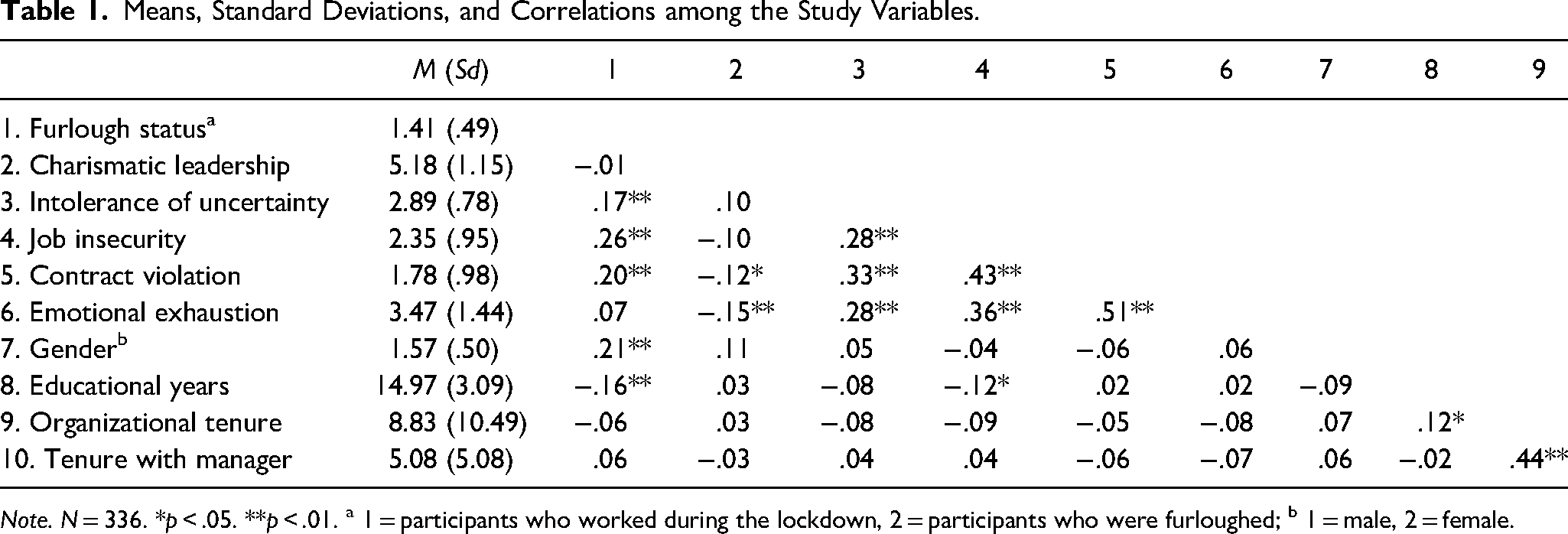
Note. N = 336. *p < .05. **p < .01. a 1 = participants who worked during the lockdown, 2 = participants who were furloughed; b 1 = male, 2 = female.
In order to test the research hypotheses, we applied the SPSS PROCESS macro to test the interactive effects (Hayes, 2013; Model 3). To estimate the hypothesized conditional relationships, we used a bootstrap procedure (Preacher & Hayes, 2004) with 95% bias-corrected confidence intervals (CIs) and 5,000 sampling replications. We mean-centered the study's independent variables to enhance the regression coefficients’ interpretability (Hayes, 2013). Table 2 presents the results of the conditional analyses. We controlled for participants’ gender, years of education, organizational tenure, and tenure with their direct manager in all our analyses.
Regression Results for Mediation and Conditional Indirect Effects.
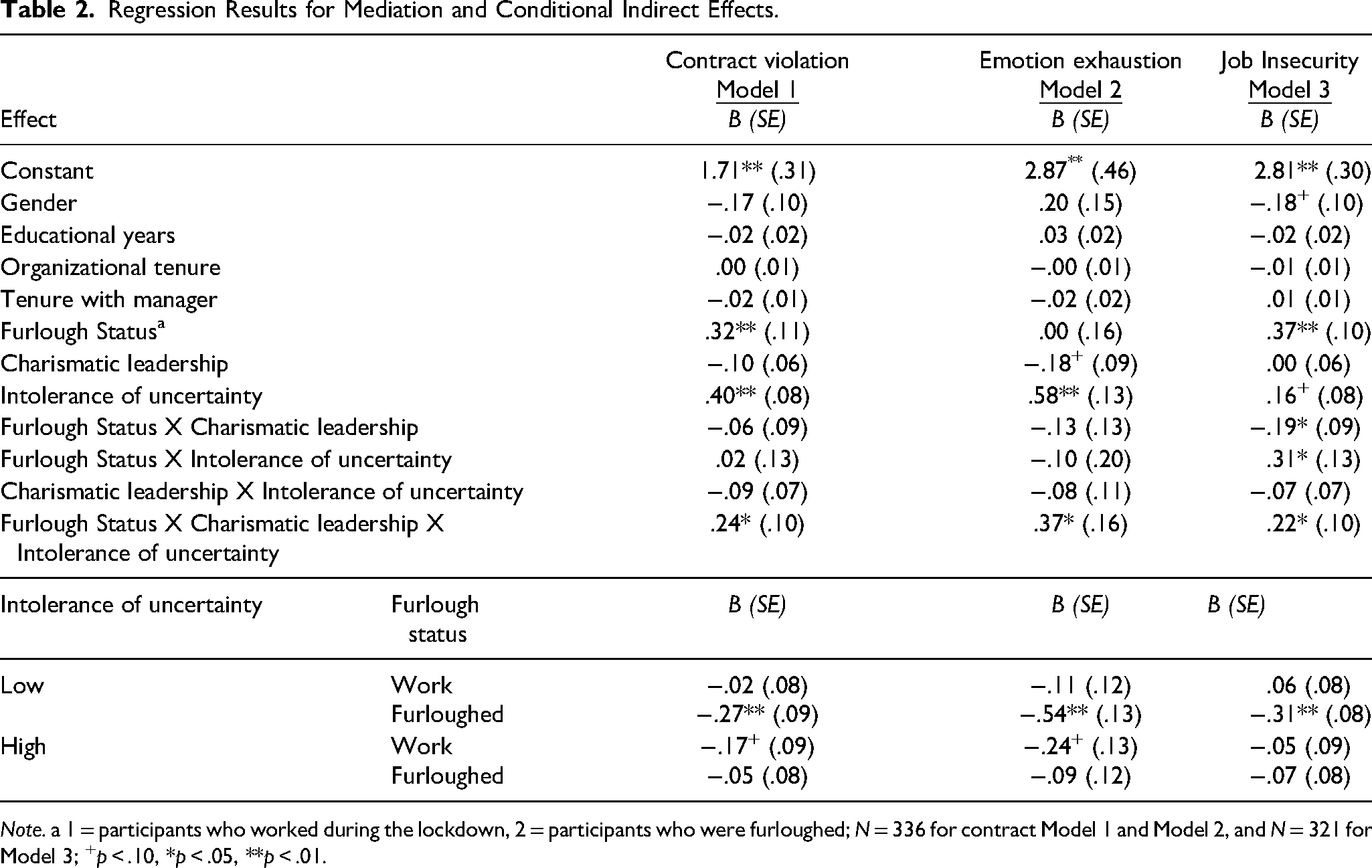
Note. a 1 = participants who worked during the lockdown, 2 = participants who were furloughed; N = 336 for contract Model 1 and Model 2, and N = 321 for Model 3; +p < .10, *p < .05, **p < .01.
The results demonstrated that the three-way interactions of furlough status, charismatic leadership, and IU on contract violation (F(11,323) = 6.70, p < .001), emotional exhaustion (F(11,323) = 5.20, p < .001), and job insecurity (F(11,309) = 6.71, p < .001) were significant. The interactions are depicted in Figures 2, 3, and 4. A further inspection of the interaction results revealed that the conditional effects were significant for furloughed participants with low levels of IU (FS+, IU-; b = −.27, p = .002; b = −.54, p > .001; b = −.31, p > .001 for contract violation, emotional exhaustion, and job insecurity, respectively), but not for those with high levels of IU (FS+, IU-; b = −.05, p = .55; b = −.09, p = .45; b = −.07, p = .39 for contract violation, emotional exhaustion, and job insecurity, respectively). Moreover, the conditional effects were marginally significant for participants who continued to work during the lockdown and had high levels of IU (FS-, IU+; although not significant at the traditional p < .05, the interactions were significant at b = −.17, p = .058; b = −.24, p = .069 for contract violation and emotional exhaustion, respectively), but not for those of them who had low levels of IU (FS-, IU-; b = −.02, p = .81; b = -.11, p = .37 for contract violation and emotional exhaustion, respectively). We conducted simple slope analyses (Aiken & West, 1991) that replicated the findings and demonstrated that negative effects of charismatic leadership style on psychological contract violation, emotional exhaustion, and job insecurity were apparent for participants who had a low IU and were on furlough (FS+, IU-; t = −2.99, p = .003; t = −3.80, p < .001; t = −3.62, p < .001 for contract violation, emotional exhaustion, and job insecurity, respectively) and for participants with a high IU who continued working in their organization (FS-, IU+; although not significant at the traditional p < .05, the results of the t-tests were significant at t = −1.66, p = .097; t = −1.80, p = .073 for contract violation and emotional exhaustion, respectively).
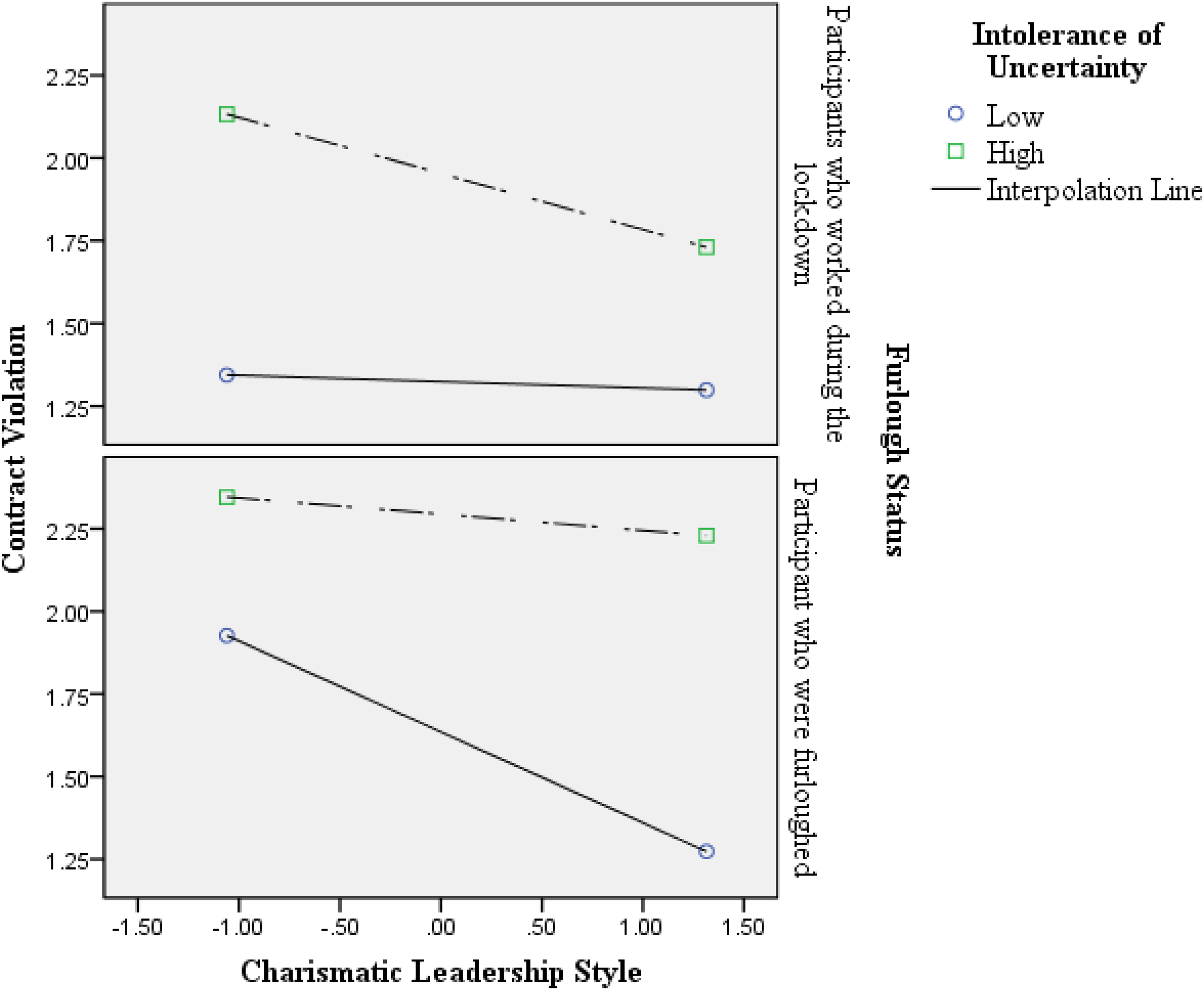
Interaction of charismatic leadership style, intolerance of uncertainty, and furlough status on psychological contract violation.
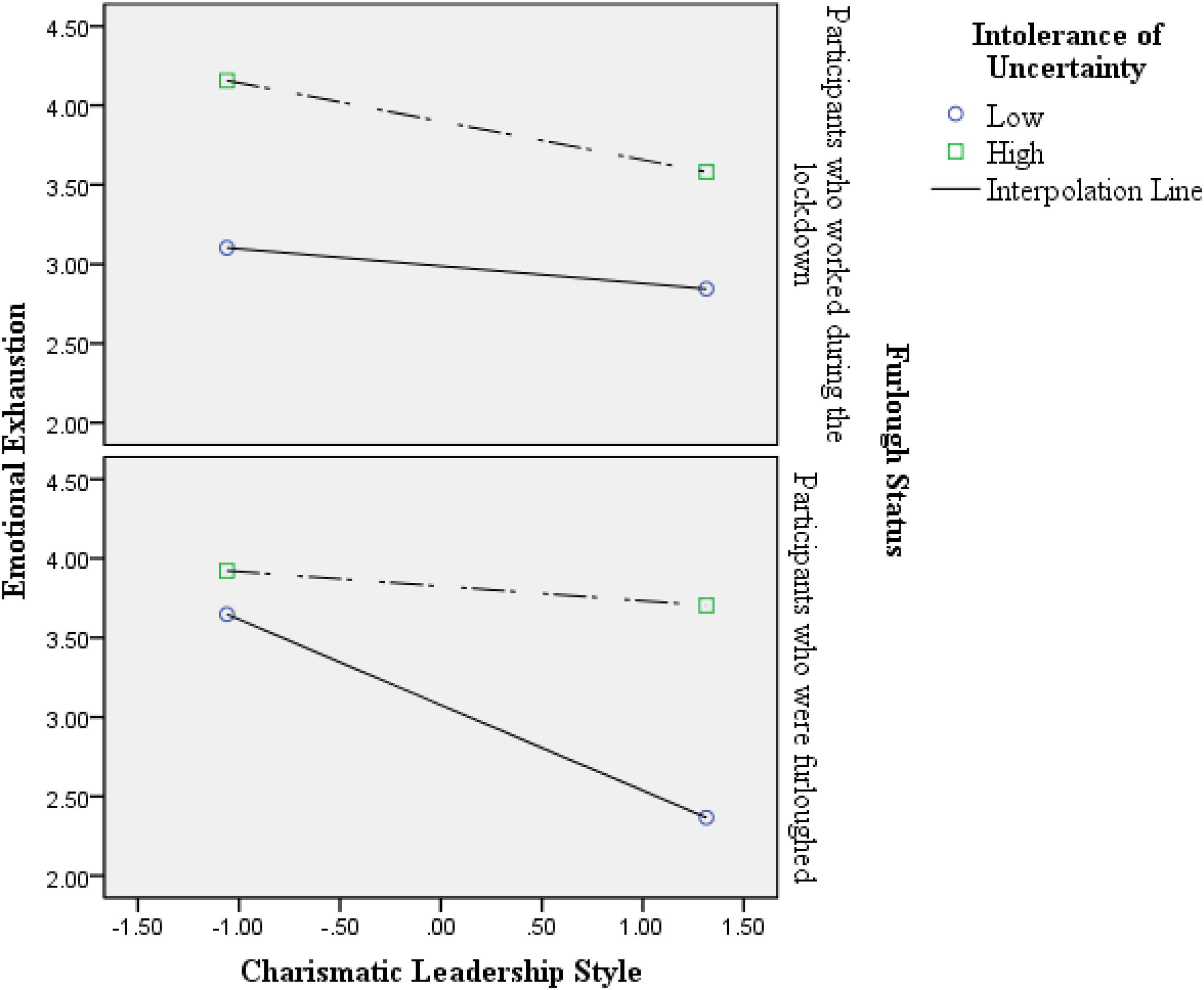
Interaction of charismatic leadership style, intolerance of uncertainty, and furlough status on emotional exhaustion.
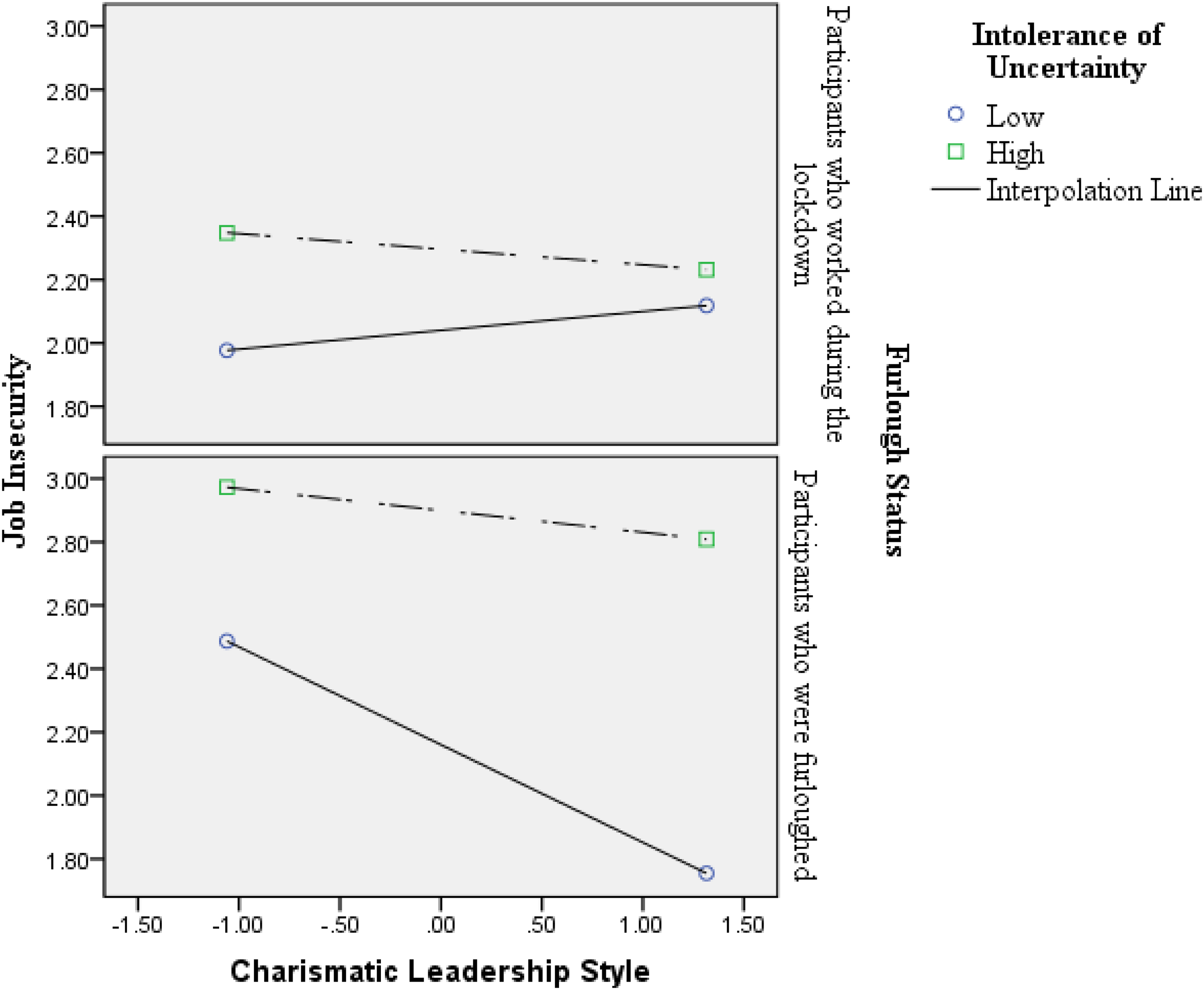
Interaction of charismatic leadership style, intolerance of uncertainty, and furlough status on job insecurity.
Discussion
The purpose of the current study was to investigate the contribution of charismatic leadership to employees’ attitudinal, emotional, and well-being outcomes during a crisis. Based on Klein and House's (1995) notion of charisma as a combination of leader qualities (“the spark”), follower readiness to accept charismatic influence (“flammable material”), and a charisma-conducive environment (”oxygen”), we suggested that the interplay between two potential moderators (i.e., employee work status as a contextual factor and IU as a trait characteristic) may offer a more expansive and nuanced understanding of these relationships. Indeed, the study results revealed that the relationships between charismatic leadership style and employee outcomes depend on the combination of furlough status and employees’ levels of IU. Specifically, we found a negative contribution of charismatic leadership to employees’ levels of job insecurity, contract violation, and emotional exhaustion for furloughed employees who had low levels of IU, and a negative contribution of charismatic leadership to employees’ levels of contract violation and emotional exhaustion for working employees who showed high levels of IU. Thus, following the study hypotheses, our results demonstrated that charismatic leadership in a crisis context makes more of a contribution to follower outcomes in situations of intermediate levels of stress (i.e., FS+, IU- or FS-, IU+) and less at the edges (i.e., FS -, IU- or FS+, IU+; see Figure 1). Explicitly, we did not find any significant contribution of charismatic leadership style to employee outcomes for employees who continued to work during the lockdown and had low levels of IU and for furloughed employees characterized by high levels of IU.
The results of the first group (FS-, IU-) corresponded with the previous literature and demonstrated that susceptibility to charismatic leadership depended on followers’ feelings of insecurity and ambiguity (Wegge et al., 2022). Thus, the employees who continued to work during the lockdown experienced less concern about an unpredictable future and felt less control loss and distress, which reduced their receptiveness to charismatic leadership.
A more interesting finding refers to the opposite extreme and includes the furloughed employees with a high level of IU (FS+, IU+). While this group was the neediest in terms of support and reassurance from their leaders, the results demonstrated that charismatic leadership did not significantly contribute to their feeling of psychological contract violation, their level of emotional exhaustion, and the degree of insecurity regarding their job. The explanation for these results is driven by the COR theory (Hobfoll, 1989; Hobfoll et al., 2018) and suggests that a furlough status diminishes the employees’ work stability, reduces their economic, psychological, and mental resources (Baranik et al., 2019), and expands their functional distance from the leader. If the furloughed employees also suffered from high IU, their perception of uncertainty may have increased their anxiety (McEvoy & Mahoney, 2012) and avoidance behaviors (Shapiro et al., 2020), and thus depleted their personal resources, creating a resource loss spiral in which their levels of stress increased even more (Hobfoll, 1989). The stress level may have become so intense that it blocked their emotional availability to be attuned to leadership messages and behaviors, as charismatic as the latter may be. These study findings may not only extend the COR theory by providing unique opportunities to better understand resource dynamics in the context of a crisis and its behavioral outcomes, but also respond to Hobfoll et al.'s (2018) call to advance the understanding of the interplay of different resources and their combined effect on individuals.
The current study also focused on the role of distance in leader-follower dynamics. Although the distance concept has been defined as a critical moderator of leadership's influencing process (Antonakis & Atwater, 2002), this concept is underexplored in the leadership literature (Antonakis & Jacquart, 2013). Even though several scholars believe that distance is essential to create an impact because intimacy between leader and followers may destroy the “aura of magic” (e.g., Katz & Kahn, 1978), some (e.g., Yagil, 1998) are less decisive and suggest that proximal charismatic leadership also has an affirmative influence on its followers, while others view distance as detrimental to leader-follower relationships (Kerr & Jermier, 1978). The functional distance created through the furlough experience may lead to adverse employee outcomes (Napier & Ferris, 1993) and undermine the leader's ability to motivate and inspire followers (Antonakis & Atwater, 2002). However, our study revealed that the effect of the distance dimension cannot be separated from the employees’ dispositional characteristics, which emphasizes the complicated connection between distance and charismatic leadership effectiveness. More studies are needed to explore follower traits as the basis for the leader effectiveness-distance dynamic.
The study results also corresponded with the emerging body of research that highlights the paradoxical effect of positive leadership styles, such as the contingency approach (e.g., Fiedler, 1978; House, 1971), the too-much-of-a-good-thing effect (TMGT; e.g., Pierce & Aguinis, 2013), and the “dark side” possibility of the positive leadership styles (e.g., House & Howell, 1992; Sharma & Kirkman, 2015). For example, Sumanth (2011) found that upward communication between inclusive leaders and their followers is characterized by high quantity but lower quality. Another study demonstrated that transformational leaders’ behaviors contribute to an increase in their emotional exhaustion and turnover intentions (Lin et al., 2019). In the context of charismatic leadership, the idea that it has a similar effect across all settings and employees has been criticized before (e.g., Judge et al., 2009; Wegge et al., 2022) and several scholars even suggested that under certain circumstances, charismatic leadership can arouse a negative impact on their followers (e.g., Fragouli, 2018; Yukl, 1999). In line with this, House and Howell (1992) proposed that this leadership style may intensify organizational risk and make the decision-making process more uncertain. The current study's results revealed that in a crisis context, charismatic leadership did not diminish its negative impact on edge-case employees’ emotional, well-being, and attitudinal outcomes. Thus, the current study contributes to this line of thought and suggests that the common notion that charismatic leadership is essential during crises should be considered with added caution. Like many other leadership styles, this socially desirable leadership characteristic can have positive, neutral, or negative effects depending on both the situation and the followers’ dispositional traits. However, only a scarcity of studies empirically explores the charismatic leadership effect during a crisis (e.g., Crayne & Medeiros, 2021; Williams et al., 2021). This scarcity offers an opportunity for future research to further develop an understanding of when and why charismatic leadership might not always be the best “fit” in crisis situations.
Managerial Implications
Our research indicates that followers differ in their susceptibility to charismatic leadership influence in a crisis setting. This susceptibility depends on the interplay between employee status and dispositional characteristics. Previous studies have revealed the adverse effect of furlough on employees’ attitudes and behaviors (e.g., Baranik et al., 2019; Mandeville et al., 2019); thus, furloughed employees are a critical group with whom leaders have to re-establish their contribution to organizational outcomes. Our findings suggest that in order to implement charismatic leadership's positive contribution, leaders need to ensure that the furloughed employees are tolerant of uncertainty. As such, organizations need to invest in followership interventions, such as mentoring and coaching programs, that help build up employee resilience to uncertainty (Boswell et al., 2013).
Additionally, the current crisis has given rise to the implementation of the furlough strategy. Furlough helps the organization save its economic resources and at the same time preserve its workforce. However, furlough also has a negative emotional impact on employees (Mandeville et al., 2019). Unfortunately, crises are inevitable in organizational life, and we can assume that the use of furlough will remain one of the accepted strategies for dealing with future crises. Thus, organizations that are forced to implement this strategy should inspect their employees’ IU dispositions to decide who will be furloughed. This follower characteristic may influence the organization's decision about workforce rearrangement in a crisis setting. Moreover, since furlough has garnered only limited attention in the literature, this study suggests novel insights into the contribution of leadership to furloughed employees. However, additional studies are needed to capture the full impact of this work arrangement on the employee-employer relationship.
The study also highlighted the “bright side” (Judge et al., 2009) of charismatic leadership in a crisis context, but only for intermediate-cases employees. Since organizational crises occur from time to time (Klein & Eckhaus, 2017), organizations should encourage and promote employees who are high in charisma into managerial positions, and above all, into crisis management roles. However, as Osborn et al. (2002) suggest, in crisis situations a subtle dialog between leaders and their followers is essential. This dialog requires the leader to give an interpretation of the crisis, formulate the meaning of success, and clearly define the process to overcome the crisis. These patterns of behaviors are more “mundane” and “managerial” than the charismatic aspects of leadership commonly emphasized in crisis contexts. Thus, charismatic leaders must include in their toolbox also managerial tools that may help them tap into the edge case employees, since this clear dialog may reduce the latter's feelings of uncertainty and ambiguity.
Limitations and Future Research
This research is subject to some potential limitations. First, the study results may be susceptible to same-source bias because all variables were collected from the study participants via online surveys. However, the study's design minimizes the potential for this bias given that we used the objective data as one of the study's independent variables and implemented a five months’ temporal separation between measuring the independent and dependent variables (T2). Using time lag and objective data variables can reduce the threat of common method variance (Podsakoff et al., 2003).
Second, in the current research we proposed that furlough status corresponds with the functional distance dimension. Although this assumption stemmed from the government's strict regulations regarding contact with furloughed employees, we did not explicitly examine the functional dimension construct. Future research may take this up to validate the correspondence. An additional weakness of the study is associated with the measurement of charismatic leadership. Although the charismatic leadership style continues to play a prominent role in leadership research (Antonakis et al., 2016), it evokes a bit of criticism due to its ambiguous conceptualization and overlapping structural composition (Antonakis et al., 2016; Van Knippenberg & Sitkin, 2013). Critics have suggested that scholars should go “back to the drawing board” and focus on measures of the constituents’ parts of charisma. However, these parts of charisma share a “meaningful core that makes them greater than the sum of their parts” (Sy et al., 2018, p. 68). Nevertheless, given this criticism, we recommend that future research makes use of objective measures of charisma (e.g., Fanelli et al., 2009, Jacquart & Antonakis, 2015, Mio et al., 2005) as well as the manipulation of charisma in experimental settings (e.g., Antonakis et al., 2011).
Finally, this research was conducted in Israel, which allows us to examine the most extreme furlough case, which could not be downgraded to part-time due to existing government regulations. Israeli culture is characterized by low power distance, and its citizens are less willing to accept inequality between the less powerful and more powerful members of society (Hofstede, 1980). The furlough status may expand the differences in organizational power distribution, resulting in more acute employee reactions compared to those of employees from cultures with a higher level of power distance. Future research may examine the study model in other cultural contexts.
Footnotes
Declaration of Conflicting Interests
The author(s) declared no potential conflicts of interest with respect to the research, authorship, and/or publication of this article.
Funding
The author(s) disclosed receipt of the following financial support for the research, authorship, and/or publication of this article: This study was funded by Heth Academic Center for Research of Competition and Regulation (grant number RA2000000666), and Ariel University (grant number 7496).
