




Abstract
This study examines how, why and when relative leader–member exchange (RLMX) influences absenteeism through the mediating effect of feelings of vigor, and the moderating role of unit-level leader–member exchange differentiation (LMX differentiation). Data collected from a Swiss retailer sample of 486 employees within 52 stores shows that RLMX is positively related to feelings of vigor, whereas feelings of vigor are negatively related to absenteeism. Also, RLMX has a stronger positive effect on vigor when LMX differentiation in the unit is high, and on absenteeism when differentiation in the unit is low. However, we found no evidence that the indirect influence of RLMX on absenteeism through feelings of vigor is moderated by unit-level LMX differentiation. The implications of these findings for research on LMX are discussed.
It is common, and even encouraged, for leaders to treat certain employees differently within teams or units (Graen & Uhl-Bien, 1995), so that some individuals have a better relative leader–member exchange (RLMX) relationship than others. Because differentiation determines the resources and rewards received from the supervisor and the relative standing of individuals in the group, individuals compare their actual leader–member exchange (LMX) level with average leader–subordinate LMX in the group (Tse et al., 2018; Zhao et al., 2019). While research on leader–member exchange has flourished over the past several decades (see the recent review by Martin et al., 2016), it has largely focused on examining how dyadic LMX affects individual-level outcomes, thus neglecting the social context in which LMX relationships are embedded (Venkataramani et al., 2010). This oversight is surprising, given that teamwork structures are prevalent in most organizations, and that social comparison is integral to organizational life (Buunk & Gibbons, 2007). Furthermore, existing RLMX research has largely focused on the positive consequences of a relative higher LMX standing, while overlooking the negative consequences of unfavorable comparisons (Tse et al., 2018). Research has revealed that RLMX plays a significant role in enhancing task performance and organizational citizenship behavior (Henderson et al., 2008; Hu & Liden, 2013; Vidyarthi et al., 2010). The determinant role of RLMX has led researchers to identify the potential mechanisms through which RLMX exerts it effect. The present study seeks to explore an overlooked motivational mediating mechanism, namely individual feelings of vigor. Since unfavorable LMX comparisons indicate that subordinates’ resources and support from the supervisor are lower than their colleagues’, we expect that their vigor at work will be lower. Vigor refers to a set of interrelated affective states (energy) experienced at work (Shirom, 2011; Shraga & Shirom, 2009). It is widely recognized that vigor is influenced by positive relationships at work (Owens et al., 2016; Shraga & Shirom, 2009), and that it is a key predictor of individual behavior (e.g., Carmeli et al., 2009; Schaufeli et al., 2009). Drawing mainly on the conservation of resources (COR) theory (Hobfoll, 1989, 2002) and social comparison theory (Buunk & Gibbons, 2007; Matta & Van Dyne, 2020), we propose that higher relative RLMX standing enhances vigor, which is in turn negatively related to absenteeism, while a lower relative RLMX standing depletes vigor, which in turn induces higher withdrawal behavior. Given the detrimental effects of absenteeism, it is not surprising that much work has been focused on its antecedents. In the Canadian economy, absenteeism costs $16.6 billion per year in lost productivity, or 2.4% of the gross annual payroll (Conference Board of Canada, 2014). In the United States, the estimated costs of absenteeism are about $202 billion per year (Goetzel et al., 2003).
Moreover, our understanding of contextual factors influencing the impact of RLMX is far from complete (Anand et al., 2016; Hu & Liden, 2013). We expect that reactions to RLMX will be influenced by LMX differentiation. This concept is defined as a process “by which a leader, through engaging in different types of exchange patterns with subordinates, forms different quality exchange relationships (ranging from low to high) with them” (Henderson et al., 2009, p. 519). LMX differentiation refers to the dispersion of LMX in a group and is recognized as having effects above and beyond individual-level perceptions of LMX or RLMX. In this study, we examine a particular type of LMX differentiation, namely LMX separation, which refers to dissimilarity, or disagreement, among group members regarding LMX relationships (Buengeler et al., 2021). LMX separation is at its lowest level when all members share similar perceptions of LMX quality and at its highest when there is a very high divergence in perceptions of LMX among team members (Harrison & Klein, 2007).
To date, RLMX and LMX differentiation have received very little attention from researchers (see exception: Henderson et al., 2009). We draw mainly on COR theory (Hobfoll, 1989) and the social comparison perspective (Buunk & Gibbons, 2007; Festinger, 1954; Wood, 1989) to explain the influence of RLMX on the social identity and social categorization perspectives (Tajfel & Turner, 1986), and on the recent LMX differentiation work by Buengeler et al. (2021) to explain the moderating role of LMX separation. This study proposes that reactions to higher RLMX will be more positive when LMX differentiation is high rather than low because high LMX differentiation elicits positive downward comparisons, which induce energizing emotions. Our conceptual model is shown in Figure 1.
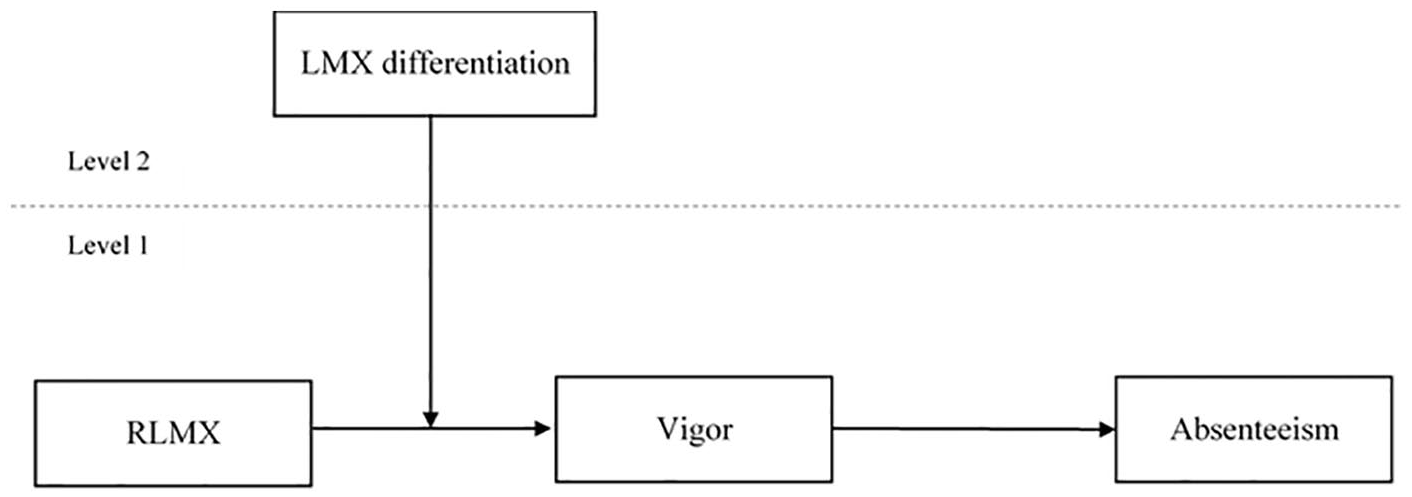
Theoretical model for the study.
This study has the potential to contribute to the literature in several ways. First, we extend LMX theory by investigating whether the social comparison process associated with LMX (RLMX) influences positive behavior through the motivational impact of vigor. Second, by integrating vigor as a mood state into the study of RLMX, we advance our understanding of affective mechanisms that explain why relative LMX standing affects withdrawal behaviors (Matta & Van Dyne, 2020). Third, by analyzing the impact of LMX differentiation on RLMX-outcome relationships, we help practitioners understand when RLMX fosters or impedes attendance at work. Fourth, our study contributes to the recent literature on vigor by proposing that RLMX is associated with higher or lower feelings of vigor according to the degree of LMX differentiation.
Theoretical Framework and Hypothesis Development
LMX and RLMX
LMX theory holds that leaders develop a differentiated relationship with employees who report directly to them (Liden et al., 2006) because of supervisors’ time and resource limitations (Bauer & Green, 1996). Differentiation is the norm rather than the exception in workgroups (Liden & Graen 1980; Matta & Van Dyne, 2020). Subordinates with high-quality LMX relationships receive several advantages, including formal and informal rewards as well as job resources, such as autonomy and emotional support (Loi et al., 2011). Conversely, in low-quality relationships, followers are relegated to the role of “hired hands” who do only what is required by their job description (Graen & Uhl-Bien, 1995). Prior research indicates that higher LMX quality is associated with several antecedents such as supervisor-similarity (e.g., values, personality, demographic characteristics) and job performance (Bauer & Green, 1996; Deluga, 1998). Despite this finding, LMX researchers have largely focused on the effect of the absolute level of dyadic LMX and have thus neglected the relative dimension. RLMX represents how the LMX level of an employee differs from the group LMX average (Epitropaki & Martin, 2013; Hu & Liden, 2013).
We argue that the effects of individuals’ relative LMX level may be different from those of their absolute LMX level. While absolute LMX informs individuals that they have a good dyadic relationship with the superior, RLMX informs individuals about their relative standing within the group. For example, the same person receiving a high level of LMX from two different supervisors might react differently depending on his or her position in the LMX relational hierarchy of each supervisor. This person might perceive more positively the situation in which he or she is treated better than his or her colleagues by the supervisor. Inversely, the situation in which the person is well treated but is in the supervisor’s “out-group” could be damaging. Conversely, a person may perceive to have a lower dyadic relationship with the superior but may nevertheless observe that he or she receives better treatment than the average. The theory of relative deprivation (Stouffer et al., 1949) may be enlightening in this regard. In his effort to model the principles of relative deprivation, Crosby (1976) asserted that “( . . . ) objective and subjective well-being are not isomorphically related, so that sometimes the better-off one is, the worse-off one feels subjectively” (p. 85). This assertion proposes in essence that RLMX can lead to consequences of its own, which differ from the consequences of absolute LMX even if these two concepts are interrelated. It is therefore necessary to study specific RLMX dynamics above and beyond LMX dynamics.
Our theorizing focuses mainly on the COR theory (Hobfoll, 1989), but also on relative deprivation (Crosby, 1976; Stouffer et al., 1949) and social comparison theories (Buunk & Gibbons, 2007; Festinger, 1954; Wood, 1989) to understand how RLMX may influence employee outcomes in the context of differentiation.
One of the central tenets of COR theory is that resources are critical to attain goals and can exist at personal and contextual levels. Personal resources may include knowledge, energy, and job performance, while contextual resources may include emotional and career support from supervisors. Another important assumption of COR theory is that people actively strive to obtain, retain, foster, protect, and utilize resources to help them achieve their personal and professional goals. Second, COR theory proposes that resources can generate other resources, and interactions between resources translate into outcomes over time. Hobfoll et al. (2018) proposed the notion of “resource caravan” to represent that resource loss or gain is frequently accompanied by a loss or gain in other complementary resources. For example, high RLMX employees may accumulate various complementary personal and organizational resources over time (e.g., career support and vigor), which enhance their capacity and motivation to attend work, while low RLMX employees are more likely to experience valuable resource loss over time.
We consider that resource loss or gain resulting from RLMX mechanisms is more salient than gains or losses resulting from absolute LMX because the notion of RLMX represents a combination of absolute LMX level and the social comparison it is associated with. In other words, RLMX level is a more accurate contributor to the “resource caravan” than absolute level of LMX. One reason is that a more favorable LMX standing may provide additional resources, such as a more positive self-image, a greater sense of superiority, and a higher perceived personal status (Tse et al., 2018; Zhao et al., 2019). For example, employees who develop a good relationship (high LMX) with their supervisor will react even more positively if they consider that they occupy an important place in this supervisor’s “in-group” and perceive themselves as elite members. On the other hand, employees who feel they have a high level of LMX with their supervisor, but who believe that they aren’t as close to the supervisor as their colleagues, might react negatively because this lower LMX standing may indicate inferiority. Both cases show the same level of LMX, but would lead to different outcomes in terms of resource gain or loss because of the social comparison process. Following COR theory, given the higher work-based resources of RLMX employees in comparison with other team members, their feelings of vigor would be higher and their absenteeism lower.
The mechanisms explained above are rooted in the social comparison paradigm that is inherent to teamwork. Because employees are embedded in teams, they are more likely to observe and make comparisons with other team members to assess their relative position in the social fabric. Given the natural predisposition for human beings to evaluate their relative social standing (Buunk & Gibbons, 2007), employees frequently scan their environment to form comparative judgments, by observing conversations or interactions in meetings between the leader and their peers, or by actively seeking information (Wood, 1989). In a team setting, members share the same authority figures, are exposed to similar organizational resources, and work interdependently on tasks; hence, they tend to compare the quality of their relationships with the supervisor (H. Liao et al., 2010). While team interdependence may vary, frequent interactions with other team members provide many opportunities to share information and to observe each other’s relationships with the leader (Hu & Liden, 2013).
Research has revealed that when people make comparisons, they engage in both upward and downward comparisons, and each of these directional comparisons may lead to different outcomes (Buunk & Gibbons, 2007; Spence et al., 2011). This body of research has proposed that upward comparisons with people better off than oneself would elicit negative affective outcomes, while downward comparisons with people worse off than oneself would produce energizing outcomes.
RLMX and Individual Feelings of Vigor
Vigor, which is considered one of the core components of engagement at work (e.g., Bakker & Demerouti, 2008), is defined as an internal affective state of an individual’s energy pool or reservoir (Little et al., 2011). In management literature, most of the research focuses on energetic activation, namely subjective activation due to a feeling of vigor, enthusiasm, or vitality, rather than an objective indicator of physical energy (Quinn et al., 2012). Viewed as a mood state and a personal resource, vigor is expected to be volatile and malleable, and a resource that can be either enriched or depleted by contextual stimuli (Hobfoll & Shirom, 2001; Shirom, 2004).
Drawing mainly on the COR theory (Hobfoll, 2002) and relational perspectives in the workplace (Dutton, 2003), we argue that higher RLMX increases the resources and positive emotions of subordinates, subsequently leading to more positive outcomes. According to COR theory, employees are motivated to accumulate, protect, and maintain valued resources in response to the environment. When resources are depleted or threatened, adverse outcomes ensue. Indeed, negative outcomes occur when individuals perceive that they do not have adequate resources to cope with a certain situation, when they are threatened with resource loss, or when they do not gain sufficient resources in return for their investment in resources (Hobfoll, 2002). Conversely, when resources are accumulated and protected, positive outcomes follow (K. J. Harris et al., 2011). These resources can take the form of condition resources (e.g., higher relative status), personal resources (e.g., self-esteem, resilience), object resources (e.g., material assets), or internal states such as vigor. Based on the COR perspective and the above arguments, we propose that RLMX acts as a prime source for the accumulation, replenishment, and protection of additional resources (Halbesleben & Wheeler, 2008), above and beyond resources provided by the level of LMX. Indeed, in organizations, the supervisor is probably the key provider of valuable resources (Loi et al., 2011; Wilson et al., 2010). Thus, those with high relative relationship quality are more likely to receive and accumulate interpersonal or organizational resources than their counterparts who have lower relative quality exchanges.
The relationship between RLMX and vigor has not been specifically studied in the literature. However, a positive relationship has been found between LMX and energizing relationships (Atwater & Carmeli, 2009; Owens et al., 2016), and between relational leadership and vigor (Carmeli et al., 2009). More specifically, theory and research have recognized that high relationship quality plays an influential role in invigorating the workplace (Carmeli et al., 2009; Dutton, 2003). Dutton (2003) argues that high-quality relationships at work may induce positive emotions such as joy and interest, which help increase individual capacity to act in the moment. According to Quinn (2007), “the higher the quality of the connection between two people. . .the more energy those people will feel” (p. 74). Energizing relationships produce a positive mood that fosters individual action and contribution within the organization (Quinn & Dutton, 2005), whereas de-energizing relationships create negative emotions leading to a reduction in task performance (Gerbasi et al., 2015). Dutton and Heaphy (2003) argued that when people engage in relational activities, energetic activation increases because they experience meaning, self-worth, empowerment and personal growth. In their qualitative study, Shraga and Shirom (2009) found that positive interactions with team members and with the supervisor (e.g., compliments or positive feedback from the supervisor, being appreciated, etc.) were the most frequent cause of vigor.
Based on these observations, we propose that RLMX is potentially linked to feelings of vigor above and beyond the effect of LMX. We argue that energization of people (vigor) could be better explained by the concept of RLMX rather than LMX because RLMX takes into account the social comparison process in the dynamic. For example, a high level of LMX combined with an upward comparison with colleagues who are better off than oneself would not lead to the same level of vigor than a high level of LMX combined with a downward social comparison with people worse off than oneself. Thus, because the supervisor has a limited amount of time, high RLMX team members, who normally have a closer interpersonal relationship with the leader than their counterparts, have more opportunities to experience positive and energetic interpersonal connections, as they have more frequent positive conversations with their leader than other team members.
A higher relative favorable exchange with a supervisor may contribute to fueling the “resource caravan” (Hobfoll et al., 2018), by inducing higher self-esteem and feelings of superiority, consequently energizing RLMX followers. The recent study by Yao et al. (2018) shows that being overpaid or treated better than the average is not demoralizing, rather it may be perceived as a satisfying and energizing event. Furthermore, the meta-analysis by Gerber et al. (2018) indicates that upward comparisons with people better off than oneself produce negative outcomes, such as low self-evaluation, whereas downward comparisons with people worse off than oneself elicit positive outcomes. For instance, Spence et al. (2011) found that upward comparisons were associated with decreased positive affectivity, while downward comparisons were associated with increased positive affectivity.
Thus, high RLMX team members, who receive more resources and consideration from the leader (e.g., support, loyalty), have a closer relationship with their supervisor, and are more likely to make downward comparisons, should experience a high feeling of vigor, whereas low RLMX team members, who are more likely to make upward comparisons, should experience lower vigor due to the lack of energetic resources. Moreover, unfavorable upward social comparisons may induce de-energizing feelings such as dissatisfaction, frustration and envy (M. M. Harris et al., 2008; Reh et al., 2018; Yao et al., 2018). Based on these findings, we anticipate that RLMX is positively related to vigor.
Mediating Role of Vigor in the Relationship Between RLMX and Absenteeism
Vigor is considered as an important energetic resource for both employees and organizations because it fosters employee well-being, health, job performance and proactive behavior (Carmeli et al., 2009; Little et al., 2011; Parent-Rocheleau & Tremblay, 2020; Shirom et al., 2008). However, the relationship between vigor and absenteeism has rarely been studied. Absenteeism is described as the failure to report to work as scheduled (Johns, 2002). This study focuses on time lost (total number of days of absence) rather than on frequency. Time lost is generally regarded as involuntary because the absence results from factors beyond the person’s control (e.g., illness, family problems; Darr & Johns, 2008), while frequency is regarded as voluntary (e.g., bad attitude). However, there is little support for the assumption that time lost measures of absenteeism are more reflective of illness than frequency measures (Johns, 2002), and that frequency measures are more reflective of bad motives than time lost measures (Johns & Al Hajj, 2016). As energy is closely related to motivational processes at work and is a sign of good health (Shirom, 2011), and as time lost absences are often explained by these factors (Darr & Johns, 2008; Johns & Al Hajj, 2016; Magee et al., 2017), it makes sense for our theoretical model to posit that the influence of RLMX on absenteeism will occur through the effect of vigor. We propose a partial mediation process, so we divided our hypothesis development into three parts (Hypothesis 2, Hypothesis 3, and Hypothesis 4).
In terms of the direct relationship between RLMX and absenteeism, two contrasting responses may occur. On the one hand, low RLMX employees are more likely to make upward comparisons to motivate them to change the situation. Displaying high work attendance is a visible commitment behavior that they may use to enhance their LMX standing. On the other hand, unfavorable upward comparisons are more likely to elicit envy and frustration among low RLMX team members, and to be blamed for their relative unfavorable treatment by superiors, decreasing their motivation to attend work (Matta & Van Dyne, 2020). Furthermore, high RLMX employees, who are more likely to make downward comparisons, may experience feelings of gratitude toward superiors, prompting them to engage in desirable behaviors that help superiors or the organization (Bartlett & DeSteno, 2006). Therefore, based on the above arguments, we expect that RLMX standing will be negatively related to absenteeism behaviors.
Given that we have hypothesized a direct relationship between RLMX and vigor, and between RLMX and absenteeism, the logic suggests that vigor would mediate the link between RLMX and absenteeism. Individuals who feel vigorous possess important personal resources that foster their capacity and motivation to be present at work. Vigorous employees are more likely to be motivated to come to work to reach their personal goals as well as to maintain and even improve their relative favorable LMX treatment. Furthermore, an important tenet of COR theory is that people are motivated to protect their actual resources. It is also possible that the fear of losing important resources, such as higher relative standing within the group, but which are not measured directly in the current study, encourages higher attendance at work. In contrast, low RLMX people lacking vigor will be less motivated to come to work because they are more likely to believe that they do not have enough energy to change or improve their situation. Furthermore, COR theory (Hobfoll, 1989) states that people are motivated to minimize net loss of resources to protect their current resources and gain new ones. Low RLMX employees with low vigor will seek to use coping mechanisms to avoid further personal resource depletion by physically withdrawing from work (Shirom, 2011), and thus consider using absences as recovery and replenishment mechanisms (Johns & Al Hajj, 2016). Supporting this view, vigor has been found to be negatively related to production deviance (i.e., coming to work late; Little et al., 2011).
Vigor has also been associated with improved physical health (Shirom et al., 2008), and in turn better health has been found to decrease absenteeism (Darr & Johns, 2008; Magee et al., 2017). Literature on work engagement has provided evidence that when employees lack emotional vigor, their energetic resources decrease, and their health suffers as a result (Shirom, 2004). Shirom et al. (2008) found a positive relationship between vigor and self-health through functional capacity. Consequently, when faced with setbacks, vigorous employees are less likely to be absent (Schaufeli et al., 2009). Indeed, there is widespread evidence that job engagement, a motivational construct consisting of a joint experience of vigor, dedication and absorption, is negatively related to absenteeism (e.g., Schaufeli et al., 2009; Shantz & Alfes, 2015; Soane et al., 2013). However, little is known about the influence of RLMX on absenteeism, and the role of vigor in these relationships.
In sum, we expect that vigorous employees will have fewer absences than less vigorous ones because the former have more energetic resources and want to protect them, prompting them to attend work. Several studies show that unfairness (De Boer et al., 2002) and organizational commitment (Meyer & Allen, 1997) are two important predictors of absenteeism. Therefore, we posit a partial mediation effect of perceived vigor due to the influence of other mechanisms on absenteeism.
Moderating Role of Unit-Level LMX Differentiation (ULMXSD)
We propose that the degree of LMX differentiation may foster the positive influence of RLMX. LMX differentiation has been generally defined as the degree or amount of within-group variations in the quality of the relationships that leaders maintain with their followers (Maslyn & Uhl-Bien, 2005). RLMX and LMX differentiation are two different constructs (Vidyarthi et al., 2016). While RLMX reflects the relative unique standing of each individual member in the team, LMX differentiation is a team-level construct that captures the variability in LMX relationships across the whole group.
High differentiation suggests that there is a broad range in the quality of LMX relationships within a team, varying from low to high. Research on the impact of LMX differentiation on individual outcomes reveals that this effect depends on certain LMX conditions. For example, Liden et al. (2006) found that LMX differentiation was more strongly related to individual performance for lower as opposed to higher LMX team members. Henderson et al. (2008), in contrast, found a positive relationship between RLMX and psychological contract fulfillment when LMX differentiation was high rather than low. These contrasting findings suggest two lessons: (a) the degree of LMX differentiation is a relevant contextual factor that influences the reactions of low and high RLMX team members and (b) reactions to low LMX and to low RLMX conditions are not similar when LMX differentiation occurs.
Based on the work of Harrison and Klein (2007), Buengeler et al. (2021) make an impressive effort in modeling the types of LMX differentiation as well as in examining the theories and measures associated with them. These scholars have highlighted three distinct forms of LMX differentiation in groups, namely LMX separation (i.e., “dispersion in LMX relationships within a group as disagreement or opposition regarding an opinion or position”), LMX variety (i.e., “dispersion in LMX relationships within a group as distinctiveness in kind, source, or category”), and LMX disparity (i.e., “dispersion in LMX relationships within a group as inequality in concentration of valued social assets or resources”). Based on this model, we examine in this study LMX separation, which captures group members’ dissimilarity about LMX and in-group and out-group categorization (Buengeler et al., 2021).
At its minimum level, LMX separation corresponds to a situation where all members of a team are similar in their level of LMX relationship. At its maximum level, LMX separation refers to a configuration where we find on the one hand a group of employees with high-quality LMX relationships (in-group) and on the other hand a group of employees with low-quality LMX relationships (out-group). This in-group and out-group division based on the quality of LMX relationships is central to the premise of LMX theory (Graen & Uhl-Bien, 1995). This separation can be associated with a process of social categorization (principle derived from identity theory; Tajfel & Turner, 1986), which implies that individuals identify with a subgroup according to certain members’ common and important attributes, in this case, the quality of their relationship with the leader (LMX). The higher and more visible the LMX separation, the more likely the social categorization (Sui et al., 2016). This perceived belonging to a social subgroup as opposed to another subgroup (high LMX or in-group vs. low LMX or out-group) contributes to forming the self-concept of its members in addition to defining and predicting their attitudes, behaviors, characteristics and statuses in the organization (Sui et al., 2016).
At the collective level, these relational boundaries within teams (“us” and “them”) are not desirable because a high LMX separation may elicit tensions and relational conflicts (Buengeler et al., 2021; Zhou & Shi, 2014) as well as reduce performance (Sui et al., 2016). We argue that high RLMX team members are more likely to experience energizing emotions, such as pride or gratitude, when LMX differentiation is high because this context signals that these employees are treated better than the other group by the leader. Employees may experience gratitude for better opportunities for personal growth, and pride for recurrent positive feedback and performance appreciation (Fehr et al., 2017; Kraemer & Gouthier, 2014) as well as for their privileged standing in the group. Such positive emotions are more likely to occur when there is high variability in the treatment received.
People who experience gratitude and pride are more likely to have fewer physical symptoms related to stress and higher subjective well-being (Emmons & McCullough, 2003; Kaplan et al., 2014). However, when all team members experience comparable LMX quality, the perceived RLMX advantage tends to have less value (H. Liao et al., 2010). According to COR theory, resources perceived as having low value have a weak energizing effect (Shirom, 2011). In respect to low RLMX team members, one could argue that a high degree of LMX differentiation may energize them because it may increase their optimism that their efforts and behaviors will allow them to become similar to others who are better off (Matta & Van Dyne, 2020). The negative effects of unfavorable comparisons on individual outcomes depend on whether employees believe they are different (contrast effect) or similar (assimilative effect) to their coworkers (Tse et al., 2018). Contrast effect occurs when individuals do not expect to obtain better LMX treatment in the future, whereas assimilative effect arises when individuals expect that their LMX will be similar to the high RLMX team members in the future. Higher LMX differentiation within the group indicates that their inferior status is more likely to be temporary and change in the future. Nevertheless, we maintain that their level of vigor will be lower than their high RLMX peers because they already receive lower energizing exchanges from their immediate superior. Not only do they have lower absolute exchanges with their leader and lower resources, their relative lower status within the group increases the probability of losing important additional resources, such as self-esteem and respect from others, and developing de-energizing emotions, such as frustration and pessimism. Based on the theoretical arguments described above, stating that high relative LMX may elicit more energizing emotions when LMX separation is high rather than low, we propose the following hypothesis:
The Conditional Indirect Effect of RLMX
Combining our previous hypotheses, we expect that part of the joint effect of RLMX and LMX differentiation on vigor will contribute to the prediction of employee absenteeism. Employees with high RLMX in a high LMX separation context are probably aware that they are among the in-group selected by the leader. Awareness of receiving better relative treatment, in a context of LMX relationship boundaries in a group when resources are allocated in a differentiated manner, is more likely to elicit higher feelings of vigor, and subsequently a stronger motivation to be present at work. However, when LMX separation is low, the energizing effect of RLMX on motivation to attend work will be lower. In respect to lower RLMX team members, deprivation theory (Bolino & Turnley, 2009) suggests that employees who receive fewer resources than the average in units when LMX differentiation in the unit is high are more likely to feel doubly deprived because not only are they prevented from receiving the adequate resources to perform their role from their leader but also this imbalance in the allocation of resources and rewards may lead to the perception of being unfairly treated and inferior, thus fostering negative affective and behavioral reactions (Erdogan & Bauer, 2010; Tse et al., 2018). Consequently, these higher relatively deprived team members who are prevented from feeling vigor would exhibit higher absenteeism when LMX differentiation in the group is high rather than low. This conditional indirect effect corresponds to the first-stage moderated mediation model (Hayes, 2013). We therefore posit the following hypothesis:
Method
Sample and Procedure
This study was conducted among cashiers in a Swiss grocery store chain. A letter from head office managers and the authors of the study was sent by the human resources department to store managers and all frontline cashiers to request their participation in a study on job attitudes and leadership. Participants were invited to fill the paper-pencil questionnaire during work hours. Every questionnaire was coded with an identification number to match employee responses with their absenteeism record. To ensure confidentiality, respondents were asked to insert the completed questionnaires into sealed envelopes and return them to the head office by internal mail. A total of 639 employees responded to the survey out of a possible 830. The overall response rate for this survey was 77%. There were respondents from the organization’s 52 stores. On average, the stores have 15 cashier employees. Respondents were on average 38 years old, had 8 years of service, and worked an average of 27 hours per week. Of these respondents, 30% worked full-time, 31% part-time over 3 days per week, and 39% part-time less than 3 days a week. All respondents were female. After dropping subjects with missing data, and those for which there was no absenteeism data, we obtained a sample of 486 respondents.
Measures
All items for substantive variables collected from employees were measured using a 7-point Likert-type scale ranging from 1 (strongly disagree) to 7 (strongly agree).
LMX and ULMX
LMX literature is dominated by two measures: The LMX-7 scale developed by Graen and Uhl-Bien (1995), and the multidimensional measure by Liden and Maslyn (1998), which consists of 12 items capturing four dimensions (contribution, loyalty, affect, and professional respect). These two measures have been found to be highly correlated (r = .91; Joseph et al., 2011). Furthermore, a recent meta-analysis (Martin et al., 2016) revealed that LMX measures did not moderate the relation between LMX and performance and counterproductive behavior, thus concluding that these measures tapped into the same overarching construct. Each store employee independently evaluated the quality of their relationship with their manager using the LMX-7 measure developed by Graen and Uhl-Bien (1995). A reliability analysis yielded an internal consistency coefficient of α = .93.
The ULMX variable was created with the aggregation of the stores’ mean level of LMX. The aggregation indices of LMX indicated sufficient between-store variance to justify aggregation to the group level (ICC1 = .18; ICC2 = .50; Rwg(j) = .64).
RLMX
Previous studies have usually measured relative LMX by subtracting the mean level from the individual level LMX score within the group member’s composite LMX (e.g., Henderson et al., 2008). However, as suggested by some scholars (Hu & Liden, 2013), “( . . . ) this approach may ignore the interdependence between LMX and team-level LMX and their interactions in assessing the effects of RLMX” (p. 143). Therefore, following Edwards (1994), outlined by Hu and Liden (2013), we treated RLMX as the incongruence between LMX and ULMX. The incongruence was assessed using polynomial regression (see analytical approach section).
ULMXSD
Consistent with Buengeler et al. (2021) and Harrison and Klein (2007), the level of LMX separation was measured using the within-group variance (SD) on the LMX-7 measure for each store.
Vigor at Work
In line with previous studies (e.g., Demerouti et al., 2012; Mauno et al., 2014; Reis et al., 2017; Steidle et al., 2017), vigor was assessed using the vigor subscale of the Ultrech Work Engagement Scale (Schaufeli et al., 2002). This scale includes three items to assess levels of energy and mental resilience (sample items: “At my work, I feel bursting with energy”; “When I get up in the morning, I feel like going to work”). The α reliability coefficient for this scale was .88.
Absenteeism
This variable was evaluated by the number of absence days, retrieved from company archive data. Sick leave data gathered from company records are clearly preferable as an outcome measure compared with data obtained from questionnaires or interviews (Schaufeli et al., 2009). For each individual, absences were calculated at the end of the year following the survey. As is usual in sickness absence research, a 1-year time interval was chosen to cancel out seasonal variability in registered absence (Steel, 2003). The mean absence duration per employee was 8.7 days.
Control Variables
We controlled for LMX mean because the overall quality of LMX within each store and LMX differentiation are frequently correlated (Erdogan & Bauer, 2010). Group size was controlled for, as this variable is correlated with independent and dependent variables (Nishii & Mayer, 2009), and was operationalized by the number of employees in each store. Finally, we controlled for age, seniority, and number of hours worked in a typical week, because these demographics and job characteristics may influence most of the variables. After some preliminary analyses, we decided to exclude unit size, as this characteristic was not related to any variables in the model.
Analytical Approach
Retail employees in this study were grouped within their stores, because each subordinate’s data was nested in the store leader. Hierarchical linear modeling (HLM) is especially recommended when researchers need to test cross-level relations, and when individual data are nested within units (Erdogan & Bauer, 2010; Heck et al., 2014). We used IBM SPSS multilevel modeling version 21 (Heck et al. 2014) to test cross-level hypotheses. We estimated null models using HLM without predictors to assess the significance of between-group variance (ICC1) for the dependent variable. In this sample, baseline analyses (ICC1) showed that 27% of the variance of vigor and 10.7% of the variance of absenteeism occurred between stores, suggesting significant intergroup variance in the dependent variable, and that HLM was appropriate. It should be noted that, in respect to absenteeism, this count data variable involves considerable zeroes, such that distributions may be positively skewed. For these reasons, we used a negative binomial model (Heck et al., 2014).
Similar to previous scholars (Hu & Liden, 2013; Vidyarthi et al., 2010), we treated RLMX as the incongruence between LMX and ULMX, and the parameter estimate of RLMX as the subtraction between the coefficients of LMX and ULMX.
We also tested for multicollinearity between LMX and ULMX to ensure this issue did not affect the interpretation of the analyses. According to Raykov and Marcoulides (2006), a variation inflation factor (VIF) value between two predictors greater than 1 and/or a condition index value greater than 15 signal the presence of multicollinearity between two predictors. VIF higher than 10 and/or condition index higher than 30 would for their part represent a serious risk of bias in the results due to multicollinearity. Our results reveal that multicollinearity between LMX and ULMX does not represent a serious risk of bias (VIF = 1.318; Condition index = 20.223)
To estimate the effect of RLMX, we used the polynomial regression technique and response surface methodology (Edwards, 1994; Shanock et al., 2010). In contrast to standard moderated regression analyses, polynomials allow us to assess the nonlinear and asymmetrical effects of a predictor such as RLMX (Richard et al., 2017). As the focus of our study is incongruence rather than congruence, namely whether the difference between LMX and unit-level LMX matters, we calculated the slopes of the surface with a3 = b1 − b2 and a4 = b3 − b4 + b5, where b1 is the beta for the individual LMX, b2 is the beta for the unit LMX, b3 is the beta for the individual LMX square, b4 is the beta for the cross-product of the individual LMX and unit-level LMX, and b5 is the beta for the unit-level LMX square. If a3 is positive and differs from 0, this indicates that the outcome is stronger when individual LMX > unit-level LMX (when I-LMX > ULMX, the values become positive, and when I-LMX < ULMX, the values become negative), than when unit-level LMX > individual LMX (when ULMX > I-LMX, the values become positive and when ULMX < I-LMX, the values become negative), and the slope of RLMX is linear. Following the recommendation by Edwards and Parry (1993), we centered all the predictors to reduce multicollinearity and facilitate interpretation.
We examined the significance of mediated relationships and conditional indirect effects using the block variable approach (Edwards & Cable, 2009). A block variable is a weighted composite score comprises the sum of the five polynomial coefficients multiplied with their relative effect on the mediating variable (Edwards & Cable, 2009). The block variable is then considered as the independent variable in the indirect effect tests, which were conducted with the PRODCLIN program developed by MacKinnon et al. (2007). This program produces asymmetric confidence intervals for indirect effect and has a more accurate evaluation of Type I error and more power than the Sobel test. To test the moderation effects of LMX differentiation to store level (ULMXSD), we estimated incongruence values at −1SD and +1SD using response surface methodology. Contrary to the interaction approach, response surface methodology can consider the potential asymmetrical and nonlinear effects at different levels of moderator (Richard et al., 2017).
To test the model fit, we used the 2Log-likelihood ratio. This deviance test is an indicator of how well the model fits the data and provides a more accurate estimate of variance differences (Bliese & Ployhart, 2002). Models with a larger deviance statistic show lower fit than models with a lower deviance statistic (Heck et al., 2014).
Results
Means and intercorrelations are reported in Table 1. Results of HLM analysis are presented in Tables 2 and 3.
Descriptive Statistics and Variables Intercorrelations.
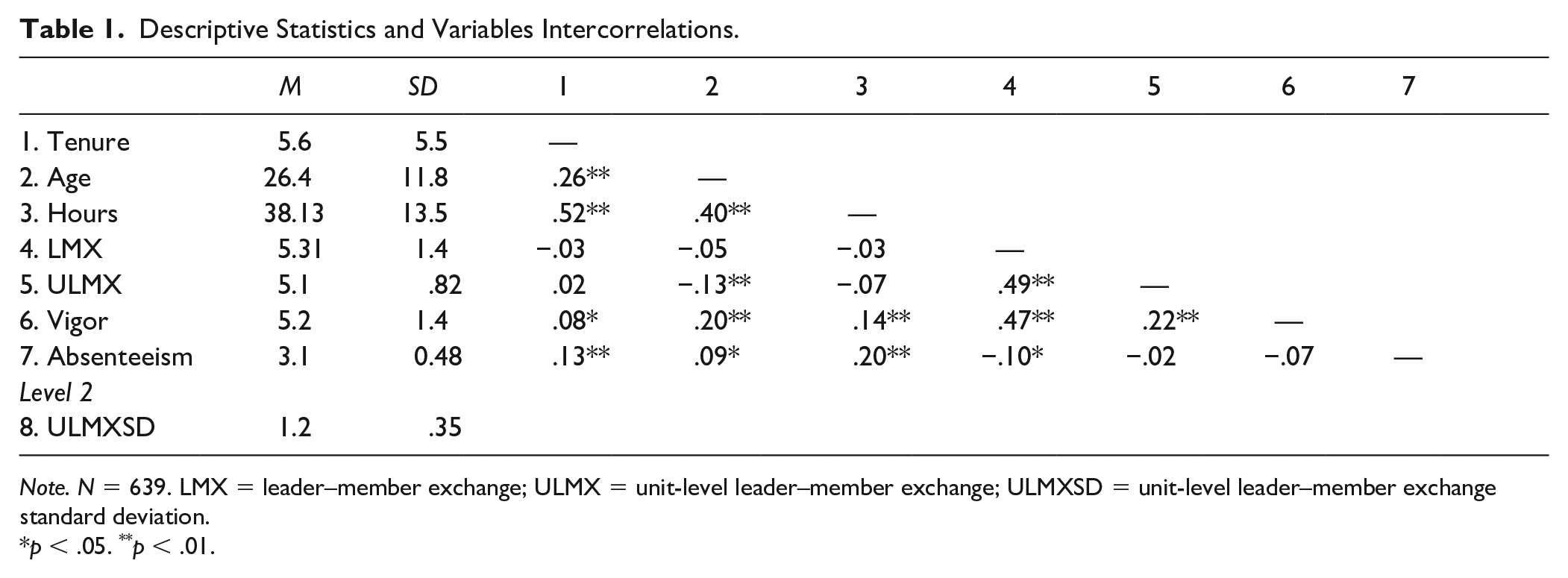
Note. N = 639. LMX = leader–member exchange; ULMX = unit-level leader–member exchange; ULMXSD = unit-level leader–member exchange standard deviation.
p < .05. **p < .01.
Hierarchical Linear Modeling Predicting Vigor.
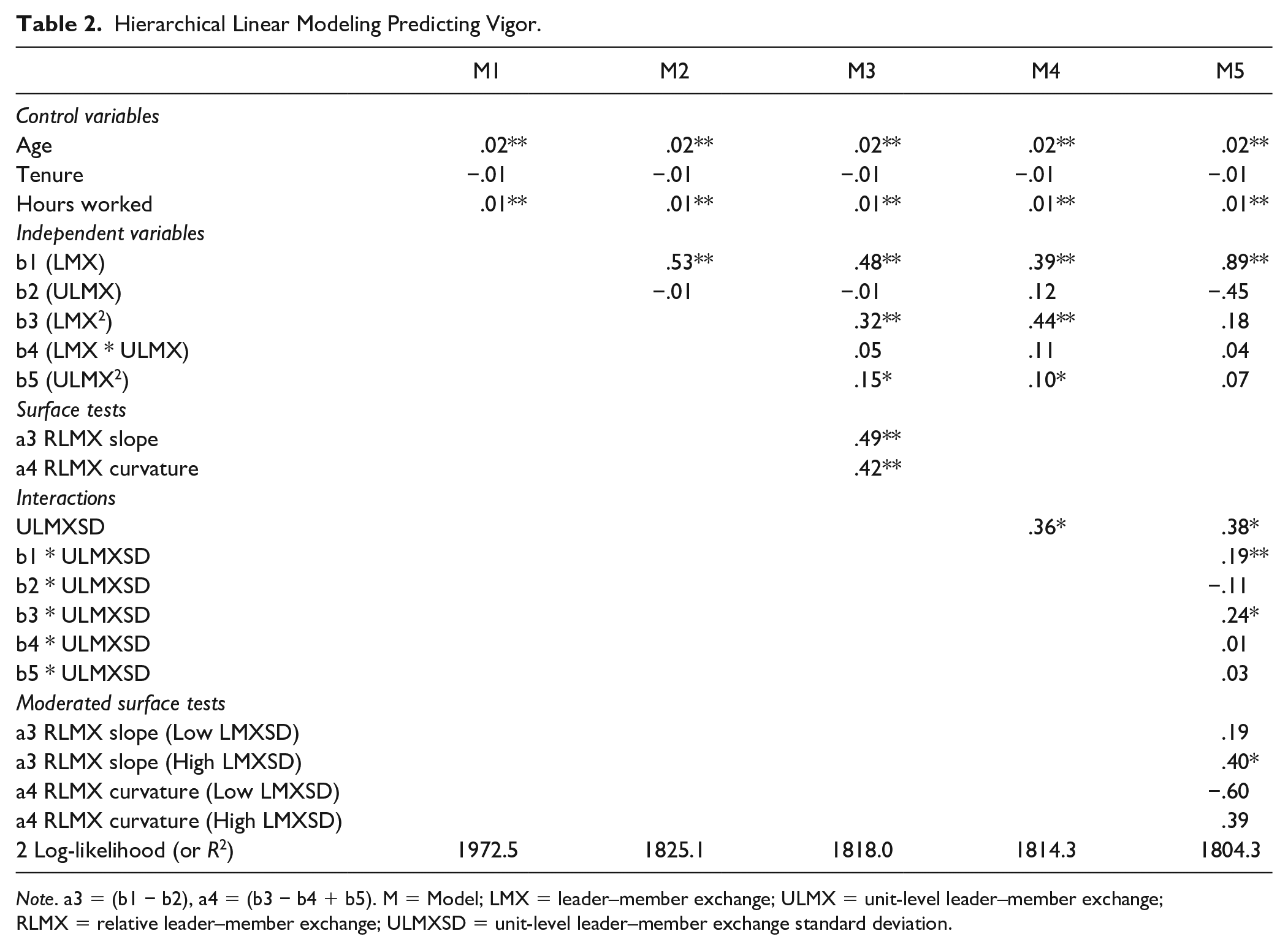
Note. a3 = (b1 − b2), a4 = (b3 − b4 + b5). M = Model; LMX = leader–member exchange; ULMX = unit-level leader–member exchange; RLMX = relative leader–member exchange; ULMXSD = unit-level leader–member exchange standard deviation.
Hierarchical Linear Modeling Predicting Absenteeism.
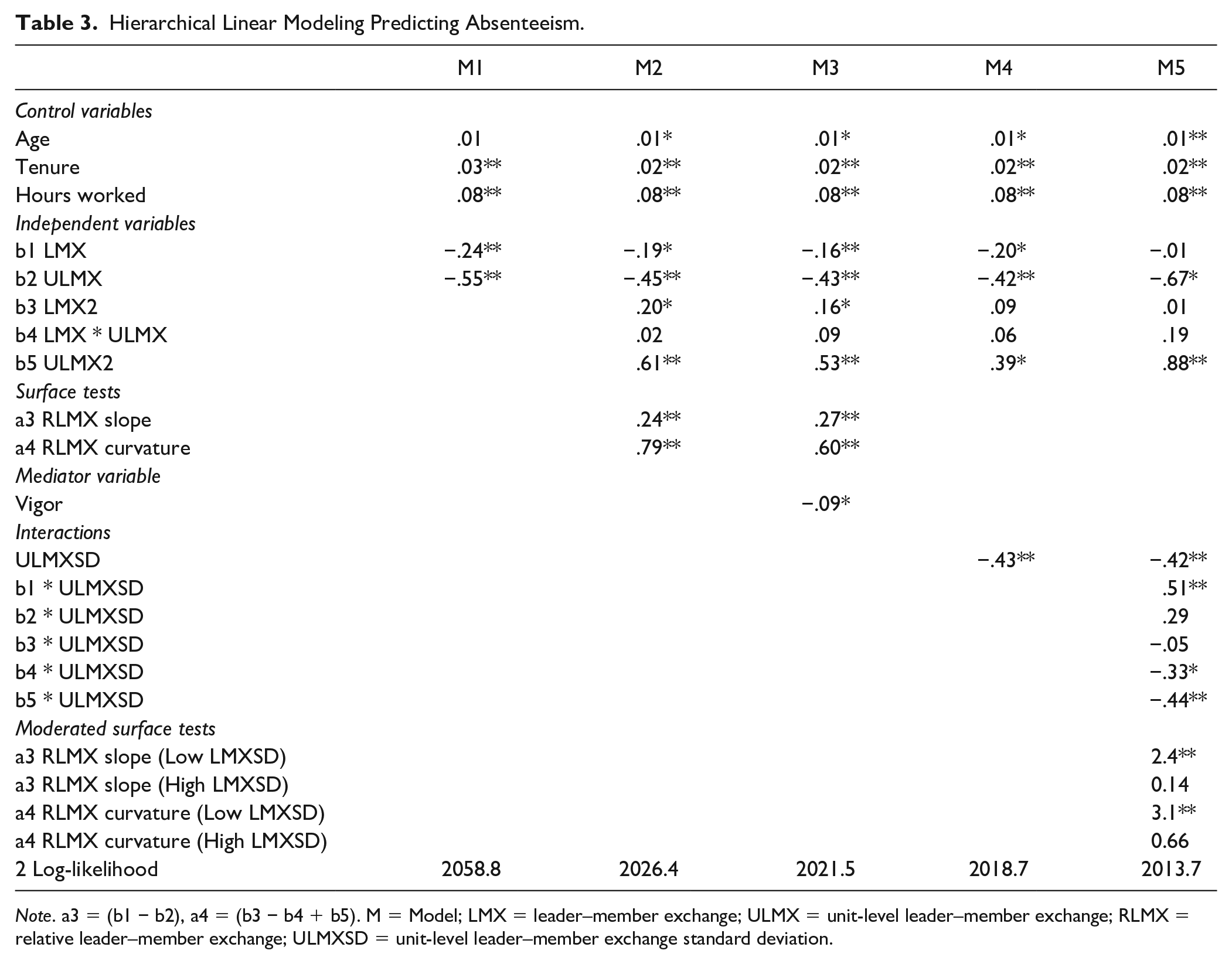
Note. a3 = (b1 − b2), a4 = (b3 − b4 + b5). M = Model; LMX = leader–member exchange; ULMX = unit-level leader–member exchange; RLMX = relative leader–member exchange; ULMXSD = unit-level leader–member exchange standard deviation.
Vigor as a Mediator
To show that employee vigor is higher when employee-rated LMX quality is higher than group average, rather than when employee-rated LMX quality is lower than group average, the slope of the incongruence line (difference between Point A and D) must be positive. Consistent with Hypothesis 1, RLMX was positively related to vigor (Table 2, Model 3, slope = .49, p < .01), above and beyond the main influence of LMX. To facilitate the interpretation of results, a graph of the three-dimensional response surface is displayed in Figure 2. This graph reveals that vigor was higher when LMX was higher than unit-level LMX (see triangle ABD), than when LMX was lower than ULMX (see triangle BCD). Figure 2 showed that team member vigor increases as it moves along the incongruence line, from low team member LMX and high unit-LMX (Point D), to high LMX and low unit-LMX (Point A). These results support Hypothesis 1. Indeed, vigor is higher when individual LMX exceeds ULMX (LMX > ULMX), than when ULMX is higher than LMX (ULMX > LMX).
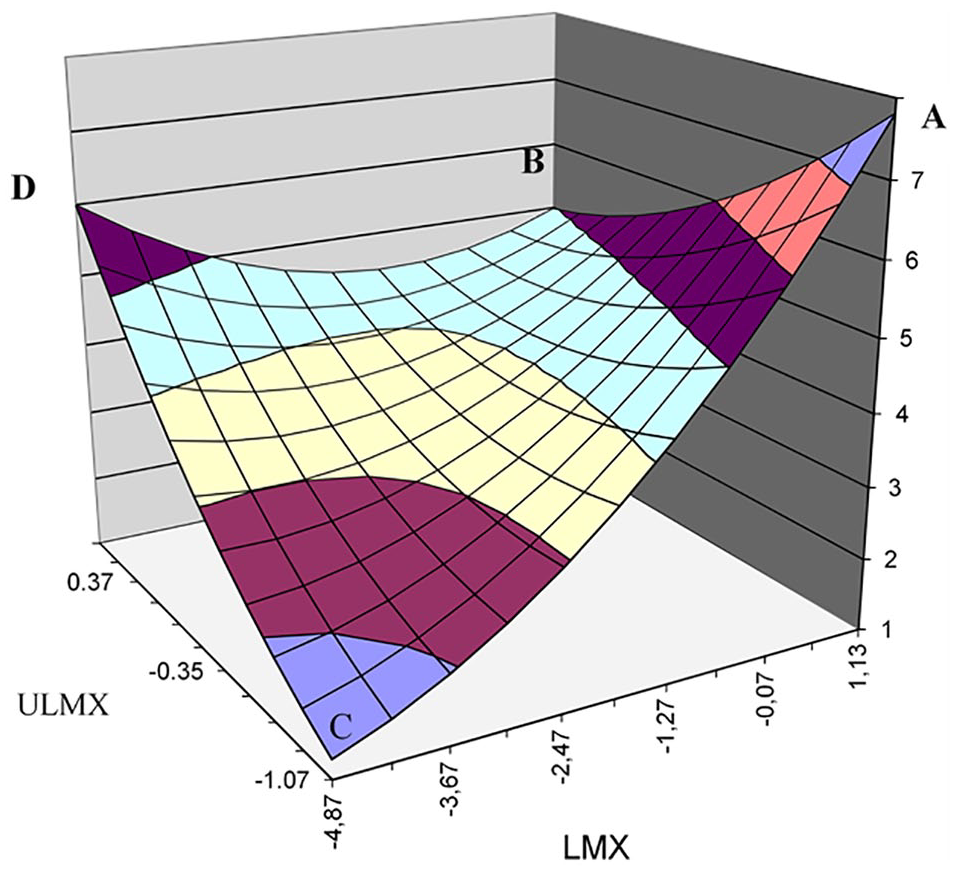
Surface graph of discrepancy between LMX and ULMX predicting vigor.
In Table 3, Model 2, we report the main effect of RLMX on absenteeism. To show that absenteeism is lower when employee-rated LMX is higher than LMX average in the group than vice versa, the slope of the incongruence line must be negative. Results indicate that the slope is positive rather than negative, indicating that RLMX was positively related to absenteeism (Table 3, Model 2, slope = .24, p < .01). To facilitate interpretation, we plotted the corresponding surface response in Figure 3. A closer visual examination of this figure indicates that absenteeism is higher when follower LMX is higher than ULMX (see triangle ABC), than when LMX is lower than ULMX (see triangle BCD). Thus, absenteeism increased when individual LMX ratings were higher than the unit’s LMX ratings, and the time lost in absenteeism decreased when their LMX ratings were lower than the unit-level ratings. As the positive relationship between RLMX and absenteeism was not expected, Hypothesis 2 was thus not supported.
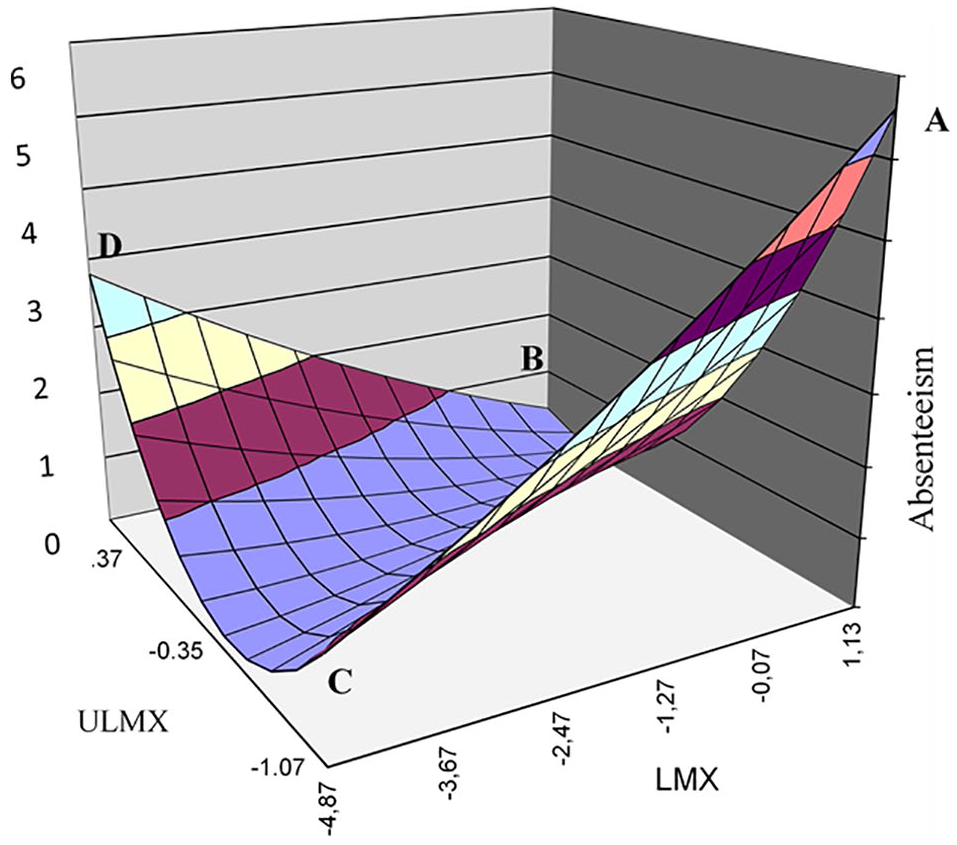
Surface graph of discrepancy between LMX and ULMX predicting absenteeism.
Hypothesis 3 proposed that vigor is negatively related to absenteeism. We found a negative link between individual vigor and absenteeism (Table 3, Model 3, b = −.09, p < .05) after controlling both for LMX and average LMX. These results provide support for Hypothesis 3. Hypothesis 4 predicted that vigor partially mediates the effect of RLMX on absenteeism.
The PRODCLIN tests conducted with the PRA block variable revealed that the indirect effect of RLMX on absenteeism through vigor was not significant (estimate = .32, p >.05). We therefore failed to find support for Hypothesis 4.
Unit-Level LMX Differentiation (ULMXSD) as a Moderator (Hypothesis 5)
Hypothesis 5 proposed that RLMX would be more positively related to vigor when ULMXSD was high, and less strongly related when ULMXSD was low. To show that vigor is higher when employee-rated LMX quality is higher than LMX average and LMX differentiation is high, the slope of the incongruence line to +1 SD must be positive. As shown in Table 2, Model 5, and illustrated in Figure 4b, at high LMX differentiation, the slope of the surface along the line value of incongruence (difference between Point A and D) was positive and significantly different than 0 (slope = .40, p < .05). Figure 4b reveals that the level of vigor decreases when RLMX is high and LMX differentiation is low, and shows that the vigor of RLMX members increases when LMX differentiation is high. This result indicates that a higher relative LMX status yields a higher level of vigor when LMX differentiation is high, and a lower level of vigor when LMX differentiation is low. However, at low LMXSD (see Figure 4a) the slope of the surface was not significant (slope = .19, p > .05). This result reveals that there is no significant difference in vigor for employees whose personal LMX values were greater than average LMX value compared with those whose values were lesser than LMX group average. Overall, the results support Hypothesis 5.
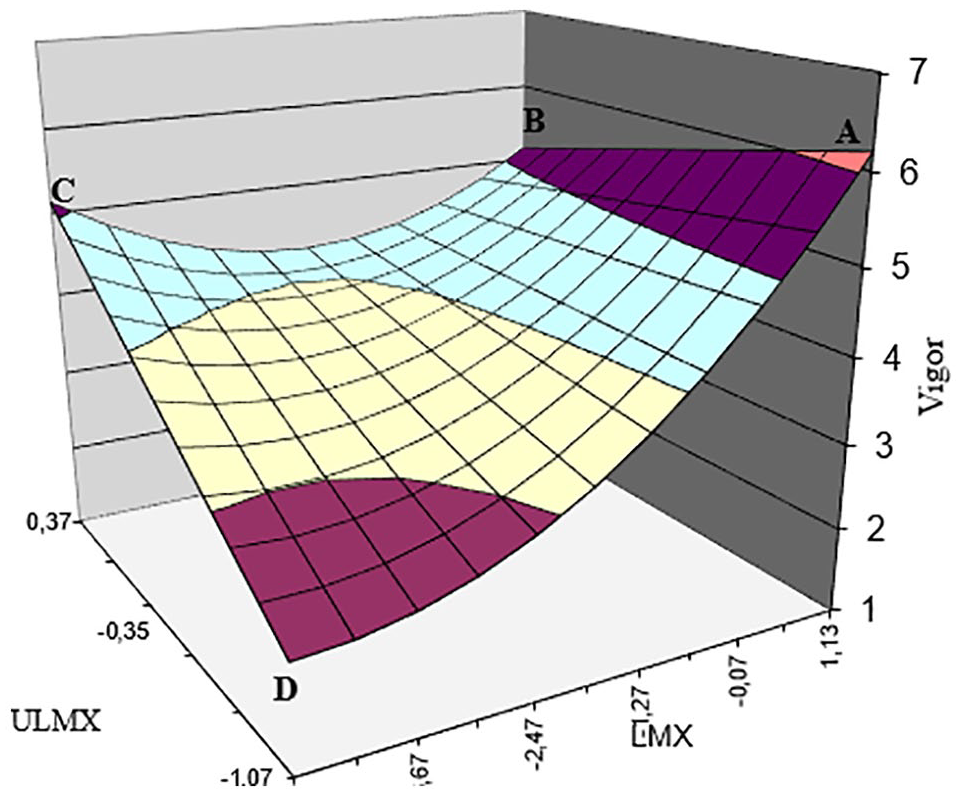
Surface graph of discrepancy between LMX and ULMX predicting vigor when ULMXSD is low.
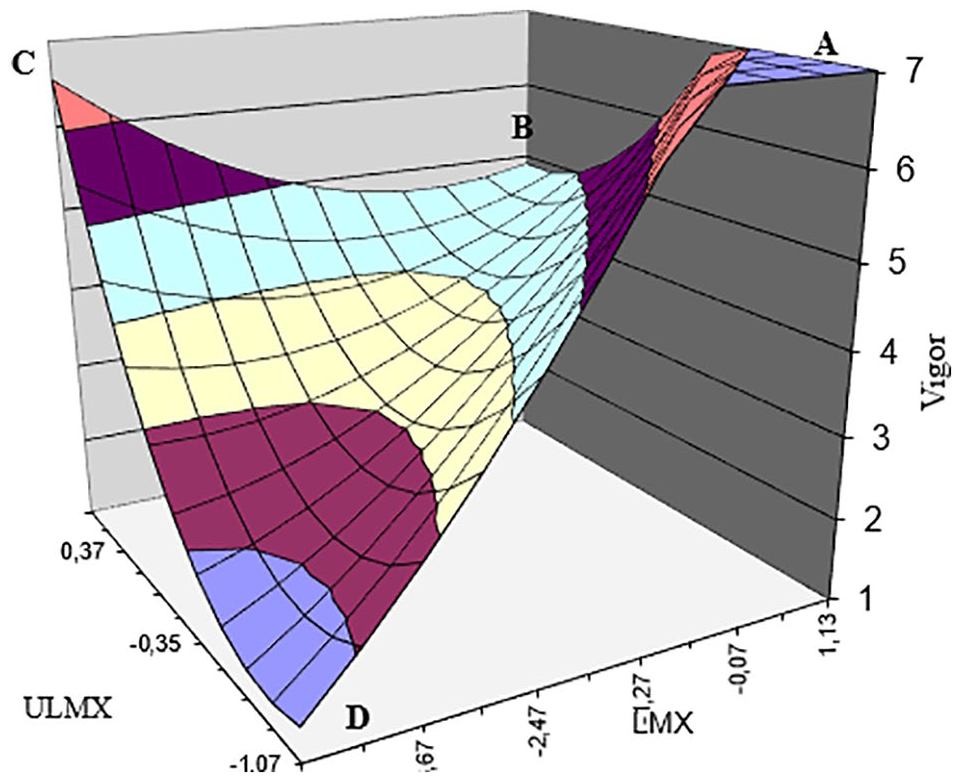
Surface graph of discrepancy between LMX and ULMX predicting vigor when ULMXSD is high.
We tested the moderating effect of LMX differentiation on the direct influence of RLMX on absenteeism (Model 5, Table 3). We expected that absenteeism would be lower when employee-rated LMX quality is higher than LMX average and LMX differentiation is high. If this is the case, the slope of the incongruence line to +1SD must be negative. As shown in Table 3, Model 5, at low LMX differentiation (−1SD), the slope of the surface along the incongruence line was positive and significantly different from 0 (a3 = 2.4, p < .01), whereas at high LMX differentiation, the slope was not significantly different than 0 (a3 = .14, p > .05). The results of the surface plot are presented in Figures 5a and 5b for RLMX and absenteeism at −1 SD ULMXSD (low) and +1SD ULMXSD (high). A closer visual examination of Figure 5a reveals that when LMX differentiation is low, absenteeism is higher when LMX is higher than ULMX (see triangle ABC), than when LMX is lower than ULMX (see triangle BCD). The significant positive curvature along the incongruence line at -1SD ULMXSD (a4 = 3.1, p < .01) indicates that absenteeism increases sharply when the level of employee LMX diverges from ULMX. At +1SD ULMXSD (high), neither the slope (a3 = .14, p > .05), nor the curvature (a4 = .66, p > .05) along the incongruence line was significant. A closer examination of Figure 5b indicates that when LMX differentiation is high, absenteeism does not vary along the RLMX incongruence axis (see triangle ABC vs. BCD). In other words, absenteeism is not lower when employee LMX is higher than ULMX when LMX differentiation within the group increases. These results suggest that a higher relative LMX status yields a higher level of absenteeism when LMX differentiation is low, while an advantageous LMX status does not exert any significant influence on presence at work when LMX differentiation is high.
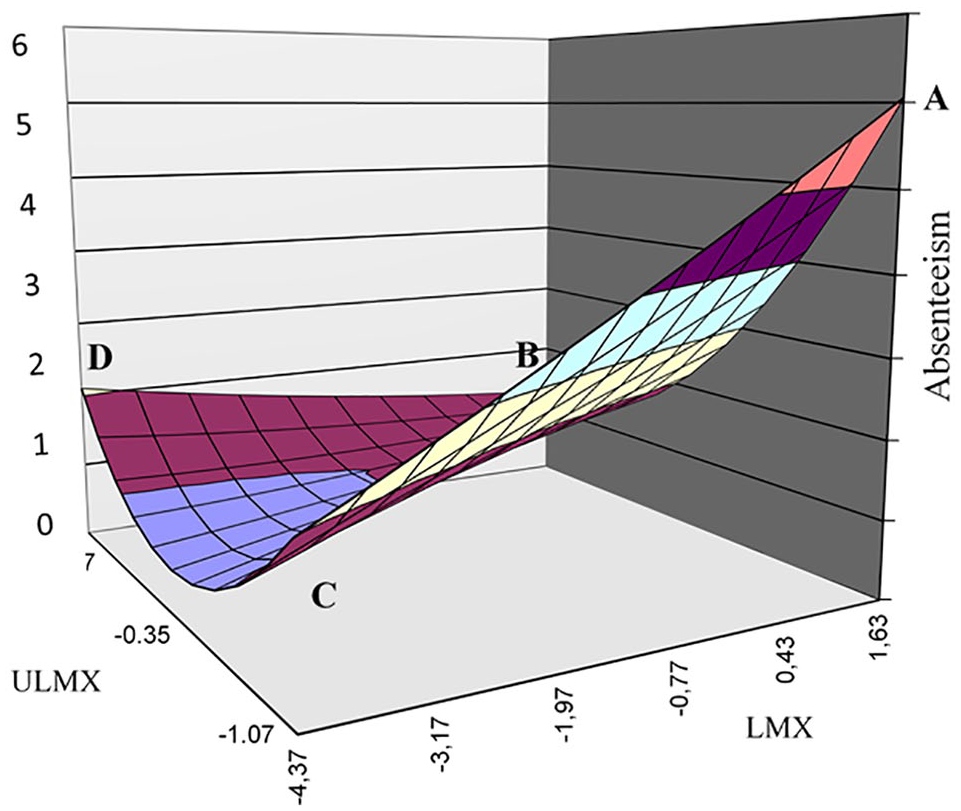
Surface graph of discrepancy between LMX and ULMX predicting absenteeism when ULMXSD is low.
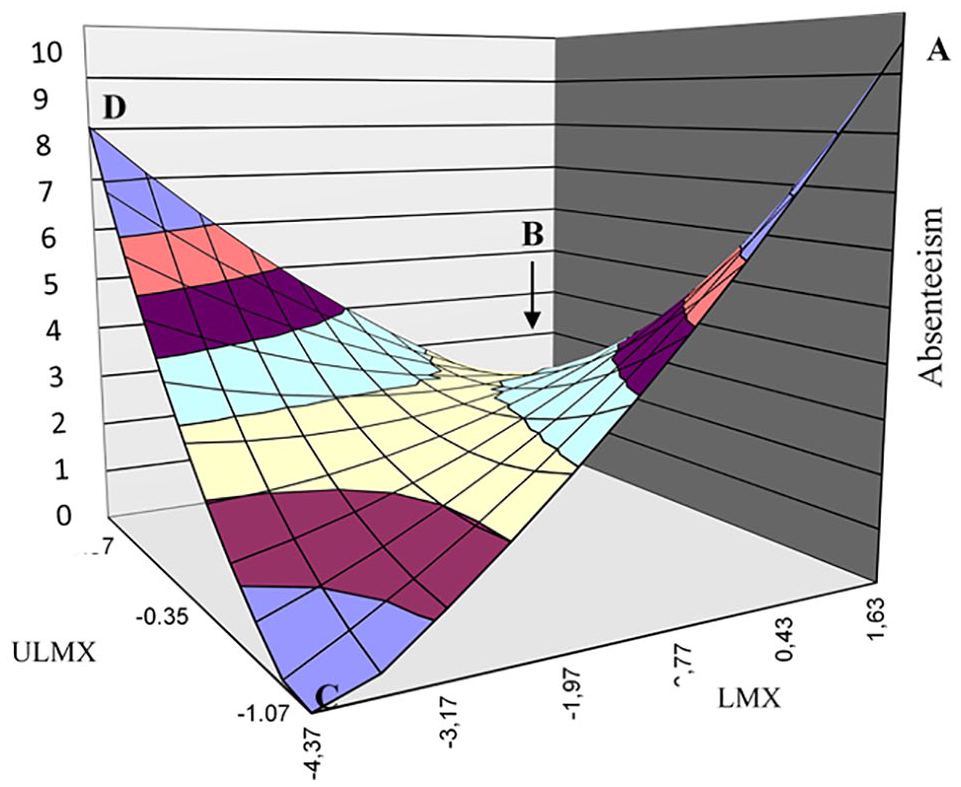
Surface graph of discrepancy between LMX and ULMX predicting absenteeism when ULMXSD is high.
Tests on Moderated Mediation Effects of ULMXSD (Hypothesis 6)
In respect to moderated mediation, we calculated the indirect effect of RLMX (block variable) on absenteeism through vigor at conditional values of moderator LMX differentiation. PRODCLIN results provide no evidence of moderated mediation (−1SD estimate = .06 p >.05 vs. + 1SD estimate = .70, p >.05). Hypothesis 6 was thus not supported. However, it is interesting to note that the average level of LMX in the group (ULMX) was found to have an indirect cross-level effect on absenteeism through vigor (estimate = −1.94; confidence interval [−.2.4, −1.4]).
Discussion
The purpose of this study was to explore how, why, and when RLMX is related to employee absenteeism. We advanced previous knowledge by testing a moderated mediation model in which unit-level LMX differentiation (separation) moderates the indirect relationships between RLMX and withdrawal behavior through vigor. In support of our hypothesis, RLMX is positively related to vigor, and the strength of this relationship is contingent on the LMX separation. Furthermore, this study reveals that a higher relative LMX elicits more absenteeism when LMX separation in the unit is low rather than high. By simultaneously analyzing LMX at multiple levels (micro LMX, meso RLMX, and macro ULMXSD), this study provides a broader contribution to the literature on these multifaceted and complex relationships between subordinates and their formal leader.
Theoretical Implications
Our study extends previous research on the effect of RLMX. According to this study, individuals’ responses to a quality relationship with their superior are not only shaped by their own dyadic LMX relationship but also by social comparisons with the average level of LMX in the group. Team member vigor is higher when their LMX exceeds the average LMX of their group rather than the inverse. The significant effect of RLMX above and beyond LMX suggests that LMX and RLMX are different constructs, and that ignoring RLMX may lead to model misspecifications. While a high positive dyadic relationship with a superior is highly valued, receiving more favorable treatment from the leader than other teammates is much better and more energizing. Our results contribute to recent work on social comparison theory (e.g., Matta & Van Dyne, 2020) and discrepancy theory (e.g., Yao et al., 2018) by suggesting that favorable comparisons with people who receive fewer resources or rewards may affect positive motivational outcomes such as vigor.
The present study also contributes to the literature on vigor by examining its implications for absenteeism. Consistent with previous work linking engagement and absenteeism that has used the Utrecht Work Engagement Scale (e.g., Schaufeli et al., 2009; Shantz & Alfes, 2015; Soane et al., 2013), our results show that employees who reported being vigorous were less absent at work. Indeed, this study is among the first to provide evidence that the feeling of vigor is negatively related to the duration of absenteeism. However, the hypothesis that vigor mediates the relationship between RLMX and absenteeism is not supported by our results. The strength of the direct path from RLMX to absenteeism in comparison with its indirect effect through vigor was unexpected.
A possible explanation is that some high RLMX members used their closer relationship with the leader to negotiate idiosyncratic work arrangements, such as more flexible schedules or paid/unpaid leaves to fulfill personal needs, leading to more absences. Others may have experienced “moral license syndrome.” According to this approach, good employees believe they have a license to engage in morally questionable behavior (Klotz & Bolino, 2013). It is possible that they took more days off, and thus more absence days, because they felt morally free and safe to engage in such counterproductive behaviors. This could be even more salient with certain types of leaders, like laissez-faire and permissive ones. Conversely, the higher attendance at work of low RLMX employees suggests that these individuals are more likely to make upward instead of downward comparisons, either because they expect that their LMX standing will become similar to actual “elite members” in the future, or because they view the standing of their RLMX coworkers as legitimate (Tse et al., 2018).
In response to the research call to identify contextual factors influencing reactions to RLMX (Hu & Liden, 2013; Kauppila, 2016), this study focused on the moderating role of LMX differentiation and, more precisely, of LMX separation (Buengeler et al., 2021). We found that the relationship between RLMX and vigor is stronger when LMX separation is high rather than low. This finding is consistent with the study conducted by Henderson et al. (2008), who found that RLMX was more positively related to perceived psychological contract fulfillment when LMX differentiation was high rather than low. Our findings are also consistent with our contention that RLMX has greater value and may elicit more energizing emotions when LMX separation is high. When LMX separation is low, the relative value of RLMX decreases accordingly (H. Liao et al., 2010), likely because feelings of gratitude and/or pride decrease as more people receive resources and rewards from the leader, and as the subgroups (in-group and out-group) are more visible. Furthermore, lower or decreasing LMX separation within the group may be experienced by high RLMX team members as a loss of status and power, increasing the “moral license” to take days off. These arguments are consistent with recent findings by Sieweke et al. (2017) showing that employees refrain from exhibiting positive behaviors when their internal pay standing decreases. Future research is needed to examine why low LMX separation influences RLMX outcomes.
Practical Implications, Limitations, and Future Research
The current study has implications for the optimization of employee vigor and positive behaviors. First, leaders are faced with a difficult dilemma: should they treat all team members equally in order to elicit positive behavior in a large number of people (with the consequence of demotivating high-performing employees), or should they differentiate by maintaining visible high-quality relationships with a select group of employees in order to earn their engagement, but at the cost of many team members reducing their performance and presence at work? The latter scenario is only viable if team members’ performance does not follow a normal distribution, and if RLMX members are actually star contributors whose performance is substantially above average (Aguinis & O’Boyle, 2014). Conversely, low LMX differentiation at dyadic and unit levels may be a viable solution when performance deviation in the team is very low, and when performance approximates the optimal threshold.
One of the implications for managers would be to be aware of the status of their relationships with each of their subordinates and to assess everyone’s perception of their RLMX. It would also be advisable to reduce the number of individuals who perceive themselves as being in a low-quality exchange relationship because the consequences of unfavorable comparisons can be damaging for individuals in terms of vigor. A possible solution may lie in combining RLMX with other positive leadership behaviors (e.g., individual consideration, empowerment, shared leadership, etc.), which could lessen the harmful effects of low RLMX. Further studies will be necessary to examine these possibilities.
Another practical implication is that this research underscores the importance of RLMX on vigor and work attendance. To foster vigor, leaders and organizations should particularly encourage low RLMX employees to reduce their consumption of caffeinated drinks and eat nutritious, energy-boosting foods (Maridakis et al., 2009). Organizations should promote sports activities and exercise to improve physical and emotional health (Shirom, 2011). Supervisors should encourage autonomy in when to take breaks (Kühnel et al., 2017) and daily respite activities (e.g., muscle relaxation) in order to elicit higher energetic activation (Steidle et al., 2017). To enhance vigor throughout the organization, leaders should adequately manage time pressure (Reis et al., 2017) and develop family initiatives, such as more flexible hours, to facilitate resource generation between work and family spheres (Moazami-Goodarzi et al., 2015).
This study has several strengths. First, data were collected from various sources (i.e., employees and company records), reducing the common method bias (Podsakoff et al., 2003). Second, we used a multilevel framework to examine the influence of variables in our theoretical model and polynomial regression to assess RLMX, rather than the simple difference of score between mean unit LMX and employee LMX (Anand et al., 2016).
As with any study, this one is not without limitations. First, generalization of our findings to other organizations and cultural environments may be restricted. While this limited sample of a single organization with multiple stores has the advantage of reducing the influence of extraneous variables such as human resources policies, it provides a conservative test of our theoretical model by reducing between-unit variance (Grizzle et al., 2009). Second, the cross-sectional design of our study precludes a hypothesis of causality. We may not rule out, for example, that LMX differentiation has a reciprocal causal influence on absenteeism, and even that absenteeism can affect the level of vigor. We also cannot rule out the possibility that vigor has a reciprocal influence on RLMX, and thus that more vigorous employees are those who benefit from a higher LMX standing. Future research with a longitudinal design should elucidate the direction of causality in the studied relationships and offer insight on how the relationship between vigor and presence at work may be sustained over time. The impact of leadership style on employee and team vigor should also be studied (i.e., does a transformational leader have a more positive effect on employee vigor than a servant leader or an ethical leader?). Other areas of research may include the study of mechanisms or moderators at the group level, such as shared vision and decentralization (Kauppila, 2016); the justice climate (Erdogan & Bauer, 2010); the role of emotions, such as how pride, gratitude, guilt and fear impact RLMX-vigor-performance relationships at individual and group levels (Kim et al., 2018; Matta & Van Dyne, 2020); and whether relative LMX standing includes an i-deal with the leader (C. Liao et al., 2017).
Conclusion
The objective of this study was to provide a better understanding of how, why and when RLMX influences employee attitudes and behaviors. Findings revealed that employees with higher RLMX experience a higher level of vigor but exhibit higher absenteeism than employees with a lower RLMX standing. Furthermore, high RLMX team members exhibit higher vigor when LMX differentiation (separation) is high, but lower attendance at work when LMX differentiation in their unit is low. This study sheds light on the complexity of leader–subordinate relationships where micro (LMX), meso (RLMX), and macro (ULMXSD) facets of leader–member exchange are simultaneously examined.
Footnotes
Declaration of Conflicting Interests
The author(s) declared no potential conflicts of interest with respect to the research, authorship, and/or publication of this article.
Funding
The author(s) received no financial support for the research, authorship, and/or publication of this article.
