




Abstract
By bringing team members with different cultural backgrounds together, teams in international business can benefit from cultural diversity and reach higher levels of performance. Cultural diversity also brings challenges, however, and diversity research has identified the need to consider moderating influences in the diversity–performance relationship. Team leadership should be particularly important in this respect and drawing on a theoretical analysis that puts an understanding of cultural diversity center stage, we propose that factors that reflect leaders’ experience with cultural diversity positively moderate the relationship between cultural diversity and team performance. We identify leader cultural background (local vs. foreign to the host culture) and leader team tenure as such factors. We predict that the influence of team nationality diversity (a form of cultural diversity) on team performance is more positive with a leader who is foreign to the host country than with a local leader, and with a leader with longer team tenure. In addition, we predict that the one moderating influence substitutes for the other, such that the effect of leader cultural background is stronger for leaders with shorter tenure with the team. Results from a survey of N = 66 teams (N = 336 individuals) from a multinational company support these hypotheses and inform our discussion of ways forward in the study of leadership and team diversity.
With growing internationalization and a shift of businesses to new markets, cultural diversity in multinational organizations is an issue of growing relevance to research and practice. Because work is increasingly organized in team-based ways (Ilgenet al., 2005; Mathieu et al., 2017), this growing internationalization invites a focus on the influence of team cultural diversity on team performance. Consistent with findings from research in team diversity more broadly (Guillaume et al., 2017; Williams & O’Reilly, 1998), research shows that team cultural diversity is a “double-edged sword” (Milliken & Martins, 1996) that has the potential to boost as well as disrupt team performance (as per the meta-analysis by van Dijk et al., 2012). The collaborative efforts of individuals with different cultural backgrounds can be disrupted by misunderstandings (Earley & Gibson, 2002) and intergroup biases that disrupt team performance (Kooij-de Bode et al., 2008). At the same time, cultural diversity may introduce diversity of information and perspectives from which the team may benefit in problem solving, decision making, and creativity and innovation, and thus ultimately in team performance (Ely & Thomas, 2001; Nederveen Pieterse et al., 2013). This double-edged nature of team cultural diversity puts a premium on an understanding of moderating influences preventing negative effects and promoting positive effects of team cultural diversity (van Knippenberg & Schippers, 2007). Team leadership should be a particularly important influence in this respect, because of team leaders’ ability to directly and adaptively interact with the team (van Knippenberg et al., 2013; cf., Hackman, 2002; Kozlowski & Bell, 2003).
In the current study, we draw on van Knippenberg et al.’s (2013) and van Knippenberg & van Ginkel (in press) theory of leadership and diversity that emphasizes the core role of leaders’ understanding of team diversity and the importance of learning from experience with diversity to develop this understanding. Drawing on this theoretical framework, we address a key issue directly following from that framework: identifying factors that reflect experience with cultural diversity and that therefore can be expected to exert a positive moderating influence on the relationship of team cultural diversity and team performance. Following van Knippenberg et al.’s (2013) analyses, we see experience with cultural diversity as foundational in developing leaders’ understanding of cultural diversity. We identify leader nationality (foreign to the country in which the team is located or from the host country) and leader tenure with the team as two factors reflecting experience with cultural diversity and argue that they are complementary moderating influences on the team cultural diversity–team performance relationship.
The unique contribution of our study lies in the fact that, by drawing on van Knippenberg et al.’s (2013) theory about the importance of learning from experience with (cultural) diversity, it complements earlier work that built on a leadership theory that was not specifically developed to capture the role of leadership in (culturally) diverse teams (e.g., transformational leadership, Kearney& Gebert, 2009—but see van Knippenberg & Sitkin, 2013; leader–member exchange; Nishii & Mayer, 2009; participative and directive leadership, Somech, 2006). Our point is not to argue against the value of such work drawing on “generic” leadership perspectives; rather, we contend that there is a value added in complementing such generic perspectives with a perspective specific to team diversity—and in this case specific to team cultural diversity—because this adds insights unique to cultural diversity that would not follow from such generic perspectives (cf., van Knippenberg, 2017a). By extension, our study also contributes to the study of leadership and diversity beyond the focus on cultural diversity. A direct implication of our analysis is that the same logic that leads us to focus on factors reflecting experience with cultural diversity should extend to other forms of diversity (e.g., gender diversity and functional background diversity). Identifying factors capturing leaders’ experience with those forms of diversity would point to moderating influences in the relationship of those forms of diversity with team performance. Thus, while the current findings are unique to team cultural diversity, they provide the building blocks to identify similar influences on the leadership of teams that are diverse on other attributes. As such, our study further develops a diversity-specific leadership theory that should not be limited to cultural diversity even when our findings are.
Theoretical Background and Hypotheses
Team diversity refers to the extent to which there are differences between team members on an attribute of interest—demographics (e.g., culture and gender), job-related attributes (e.g., functional background and education), traits (personality and ability), affect, or cognition (van Knippenberg & Schippers, 2007). Arguably the core finding in team diversity research is that diversity can have both positive and negative effects on team process and performance (van Dijk et al., 2012). The reasons for this are well understood. In an integrative theoretical framework, the categorization–elaboration model, van Knippenberg et al. (2004) describe how diversity has the potential to boost as well as to disrupt team performance. On the one hand, more dissimilar team members are likely to have more dissimilar information and perspective relevant to the task at hand, and by integrating these diverse perspectives more diverse teams can reach better decisions (Williams & O’Reilly, 1998), be more creative and innovative (van Knippenberg, 2017b), and perform better than more homogeneous teams (van Knippenberg & Schippers, 2007). On the other hand, however, dissimilarity may invite members to make a distinction between an ingroup of members similar to self (“us”) and an outgroup of members dissimilar to self (“them”) (Williams & O’Reilly, 1998). Such us–them categorizations can invite biases that favor ingroup over outgroup and that render members less willing to communicate and collaborate with dissimilar team members. To the extent that this occurs, such social categorization processes disrupt the information exchange and integration (i.e., elaboration; van Knippenberg et al., 2004) process that drives the positive performance effects of diversity, with poorer performance in more diverse teams as a result. Neither the positive effects nor the negative effects of diversity are automatically obtained; they are moderated by team member characteristics, task characteristics, and situational characteristics (Guillaume et al., 2017; van Knippenberg & Mell, 2016). This makes the study of moderating influences core to the study of the effects of team diversity on team performance (van Knippenberg & Schippers, 2007).
The double-edged nature of diversity is observed for a wide range of attributes (van Dijk et al., 2012), but is perhaps nowhere more salient than for cultural diversity. Within the international business context of our study, we use the term cultural diversity as it is often applied in international business to refer to diversity in nationality (which is not to deny within-nationality cultural differences; Ely & Thomas, 2001). Cultural differences are a well-known source of negative stereotypes and intergroup biases (Williams & O’Reilly, 1998). Moreover, as cultural diversity in international companies is invariably related to assignments in foreign countries, cultural diversity also comes with various problems of international team members adjusting effectively to the host culture, the people inside the host country, and the job (Black et al., 1991), and vice versa for host culture members to adapt to working with foreign nationals. At the same time, cultural diversity may be associated with valuable differences in knowledge, experience, and perspectives that may benefit team performance. This may hold especially in the context of international business, where working in different countries is likely to be associated with different experiences and with the acquisition of country-specific knowledge that can prove useful in addressing issues that cross national borders, as is inherent to international business. Accordingly, the challenge for multinational organizations is to manage team cultural diversity to prevent its potentially negative effects and promote its potentially positive effects (Earley & Gibson, 2002).
In this respect, team leadership arguably should assume center stage. Team leaders directly interact with the team and have considerable discretion in how they shape these interactions. As a result, they can be more adaptive and proactive in how they guide the team than more structural diversity management solutions such as human resources management practices targeted at diversity and inclusion that inevitably are more static and less adaptive (van Knippenberg et al., 2013; cf., Nishii et al., 2018; van Knippenberg et al., 2020). In their theoretical analysis of team leadership and team diversity that builds on the analysis laid down in the categorization–elaboration model, van Knippenberg et al. (2013) and van Knippenberg & van Ginkel (in press) proposed that team leadership should capitalize on this position of direct and adaptive interaction with the team to focus on actions tailored to their team's diversity. They argued that at the core of effective leadership of diverse teams lies an understanding of team diversity (team cognition referred to as diversity mindset) that reflects an appreciation of the benefits of a focus on exchanging and integrating diverse perspectives and of the challenges in collaborating with dissimilar others (cf., van Ginkel & van Knippenberg, 2012). Van Knippenberg et al. (2013) outlined how leaders can develop this understanding through experience with team diversity and can guide team members to develop a similar understanding to reap the performance benefits of diversity rather than to fall prey to diversity's potential disruptive effects. Importantly, their analysis also outlines that this does not concern a generic understanding of diversity but an understanding of diversity specific to a given diversity attribute. The leader's understanding of gender diversity may, for instance, be more developed than the leader's understanding of cultural diversity, and the leader's understanding of gender diversity would include gender-specific elements that do not apply to cultural diversity and vice versa.
van Knippenberg et al.’s (2013) analysis offered two important implications that we further develop in the current study. First, there is an important value added in identifying factors that reflect leader experience with diversity, because these factors can be expected to exert a positive moderating influence on the diversity–performance relationship. Second, considering such factors require an analysis specific to the diversity attribute of interest.
In the context of our focus on international business, we see factors specifically reflecting experience with cultural diversity primarily in leader cultural background (i.e., nationality; local host culture nationality vs. foreign nationality) and leader tenure with the team (i.e., which for more culturally diverse teams reflects more extended experience working with a culturally diverse team). In a nutshell, we argue that both leader foreign (as compared with local) nationality and leader team tenure reflect experience with cultural diversity and thus positively moderate the team cultural diversity–performance relationship. Moreover, we argue that there are diminishing returns on experience with cultural diversity such that the influence of leader cultural background is stronger with lower tenure.
Leader Cultural Background and Team Cultural Diversity
Even in international business with a company presence in multiple countries around the world, the typical situation is that the host culture/nationality in any given country is much more strongly represented in team composition (e.g., Tröster & van Knippenberg, 2012). An important way to think of a leader cultural background is thus in terms of whether the leader is “local” or “foreign”; whether the leader is from the host country (as defined by nationality) and typically sharing the cultural background of the majority of members in most teams within that country or from another country than the host country (as defined by nationality), and thus holding a minority group background from the perspective of most team members within the host country. This is a factor of increasing relevance as the number of “foreign” leaders in international business is growing (Staples, 2007).
We propose that all other things being equal, foreign leaders as compared with local leaders have more experience with cultural diversity as a result of their personal expatriate situation. Because most people in a host country are from the host country, both within the organization and in society more broadly, this inherently means that foreign leaders experience more cross-cultural interaction than local leaders. Having the experience does not equate to learning from experience; cross-cultural experience does not equate to an understanding of cultural diversity. That said, however, it is a reasonable assumption that one learns more about cultural diversity when one has more experience with cultural diversity than one has less experience with cultural diversity. Thus, it is a reasonable jumping-off point to state that foreign leaders are better positioned to develop an understanding of cultural diversity than local leaders. As a case in point, the expatriate literature has documented that learning from cross-cultural experiences is integral to expatriate effectiveness (Bashkar-Shrinivas et al., 2005; Hechanova et al., 2003; Mendenhall & Odou, 1985). This is also consistent with the notion that international assignments are important in developing cross-cultural competencies (Takeuchi & Chen, 2013; Tihanyi et al., 2000).
Such learning from cross-cultural experience should not be limited to learning about the host culture and the challenges people from one's own culture face within the host culture. Cross-cultural experience should make foreign leaders more attuned to the challenges of cross-cultural collaboration more broadly (Bird et al., 2010; Jokinen, 2005). For instance, realizing that host and own culture may invite different interpretations of the same event or have different interaction norms may make one also realize that other cultures may come to yet other interpretations or work from yet other norms. Foreigner leaders as compared with local leaders should thus have the advantage of being more attuned to a culturally diverse context as a result of their own experiences as a foreigner in the host country. Foreign leaders of culturally diverse teams may better understand the needs and experiences of team members with foreign cultural backgrounds—also when not the same as their own—than local leaders. Foreign leaders will also have ample experience interacting with host culture members as foreign nationals. This also better positions foreign leaders to support other foreign nationals on their team in functioning in interaction with host culture members than local leaders.
These skills speak to both sides of the double-edged sword of cultural diversity. Foreign leaders’ greater awareness of cultural differences and reactions to culturally dissimilar others in the host country may be important in defusing intercultural tensions between team members that may disrupt team performance in diverse teams and as such may diminish the potentially negative effects of cultural diversity. At the same time, by virtue of a greater awareness of the different perspectives associated with cultural differences and being better able to support culturally dissimilar team members in adjusting to the host culture and their work, they may also be instrumental in focusing the team on the learning opportunities and informational benefits that cultural diversity may introduce (cf., van Knippenberg et al., 2013), and thus stimulate the performance benefits from team cultural diversity. Therefore, we predict:
Leader Team Tenure and Team Cultural Diversity
The key element in our analysis is experience with cultural diversity. As per our Hypothesis 1 rationale, foreign leaders have an advantage over local leaders in this respect in that, all other things being equal, they have more cross-cultural experience. The culturally diverse nature of multinational organizations implies, however, that leaders also acquire experience with cultural diversity working with a culturally diverse team—and this should also hold for local leaders. Leading the team itself can be a source of cross-cultural experience and the longer the leader's tenure the more the leader accumulates such cross-cultural experience. Thus, we can also expect leader tenure with the team to be a positive moderating influence on the relationship between team cultural diversity and team performance.
Learning from experience means that as experience accumulates, one's learning accumulates. More experience leading culturally diverse teams—longer tenure with the team—should thus be associated with a better understanding of cultural diversity. The notion that over time people learn to better deal with cultural diversity is consistent with other diversity research. Harrison et al. (1998) argued that while initial responses to cultural differences may be based on cultural stereotypes and biases that can stand in the way of effective communication and collaboration, over time individuals may learn to look beyond the differences that are the basis for their stereotyped perceptions and learn to more effectively work together (cf., Chatman & Flynn, 2001; Earley & Mosakowski, 2000). Hambrick et al. (1998) likewise noted that with higher leader team tenure teams may form more trust and understanding for differences in values and beliefs within the team and have better cooperation and performance as a result. Thus, through experiences of leading diverse teams, leaders may develop awareness of and skills to manage cultural differences in their teams. Leader tenure with the team may thus be associated with a greater ability to prevent disruptive effects of cultural diversity and to stimulate synergetic performance benefits.
Leader Tenure Moderates Leader Cultural Background Effects
Foreign leaders are exposed to substantially more cross-cultural experiences than local leaders. As per the rationale for Hypothesis 1, they have more cross-cultural interactions than local leaders in the host country outside of the organization, within the organization at large, and likely also within the team, simply because host country nationals are likely to be the majority in all these contexts. As a result of this, we can expect that longer tenure with their team adds less to foreign leaders’ cross-cultural experience than to local leaders’ cross-cultural experience.
Put differently, we can expect diminishing returns in learning from cross-cultural experiences, and foreign leaders will reach this point of diminishing returns earlier in their tenure than local leaders. One can learn different things from different cross-cultural experiences. In addition, the repeated cross-cultural experience of the same, or similar, nature may also enhance learning as the repetition may help people to recognize patterns and reinforce learnings from earlier experience. Thus, as experience accumulates, so does learning. With growing cross-cultural experience, however, one will also increasingly find oneself in familiar cross-cultural experiences from which less additional learning is to be gained if any. As per Hypothesis 1 rationale, we can expect foreign leaders to reach this point earlier than local leaders. By extension, we can expect the positive influence of tenure with the team, as captured in Hypothesis 2 rationale, to be stronger for local than for foreign leaders.
Both foreign cultural background and tenure with the team are understood to moderate the relationship between team cultural diversity and team performance, because of the understanding of cultural diversity team leaders can be expected to have gained through their expatriate experience or through their tenure working with a culturally diverse team. Accordingly, the conclusion that leader tenure with the team adds less to such understanding of cultural diversity for foreign than for local leaders implies a three-way interaction of leader cultural background, leader team tenure, and team cultural diversity:
Method
Our empirical work is based on a survey drawn from a globally active European aviation group comprising more than 500 subsidiaries and affiliates worldwide. The company in the aviation sector operates in five business areas: passenger transportation; logistics; maintenance, repair, and overhaul; catering; and IT services. Global partnerships and bilateral joint ventures strengthen their business model internationally and enable the company to participate in global growth beyond their home markets. The firm employs people from about 150 countries and is represented in almost every country worldwide through their service businesses. A combination of hub-based and point-to-point products creates omnidirectional service offers from all home markets.
The airline industry is subjected to a lot of fluctuations in the current dynamic times and changing markets. Business processes, coordination at interfaces, and the decision making per se are getting faster and more complex. Therefore, creating effective teams with strong cultural expertise in working with partners in growth markets at short will be important in relation to international competition. As a result, knowing how to manage diverse teams in an effective way is a key success factor for the organization.
Sample and Procedure
To request participation in our survey, we gave company-wide presentations to executives to describe the study and its benefits. The initiative was also posted on the intranet and was explained by managers in their global group calls. In this process, potential respondents were only exposed to the broad brief of the study and not to more specific information regarding research questions and hypotheses.
Surveys were sent to 277 members of 68 teams and their team managers based at 37 different departments in 19 countries. Teams were working in a variety of professional groups, such as in-ground operations, sales, product and marketing, and human resources. In total, we received responses from 66 teams (97%). From these teams, we received responses from all 66 managers and 270 team members (i.e., the response rate of the 66 participating teams was 100%). Team members had 19 different nationalities and 132 were men and 138 women. On average, the age of team members was 39.69 years (SD = 10.17) ranging from 21 to 64 years. Mean job tenure was 12.00 years (SD = 9.60) with a minimum of 1 year and a maximum of 39 years. Team leaders were 43 men and 23 women and represented 19 different nationalities. Team leader age averaged 43.09 years (SD = 8.43) ranging from 25 to 62 years, with a mean tenure of 17.86 years (SD = 8.31) ranging from 2 to 42 years. All team members and leaders were employed full time.
Paper-based and online surveys in English and German were distributed to managers and team members who were invited to fill out the questionnaire. The survey was anonymous. Team leaders were asked to fill out a separate questionnaire on which to evaluate team performance. Twenty-one percent, 12%, and 9% of respondents were based in the United States, Russia, and Germany, respectively. Six percent were based in India and Indonesia. Three percent were located in Hungary, Greece, South Africa, Spain, Israel, Equatorial Guinea, United Kingdom, Nigeria, Vietnam, Eritrea, Lebanon, and Belgium.
Measures
Team Performance. To measure team performance, we used a questionnaire with nine items based on Hackman (1987). The scale for team performance consists of seven more specific items plus two items about the overall performance. The questions captured the conception of team effectiveness as being able to meet task challenges, completing work on time, being able to generally perform well, and effort of the teams. Sample questions are “The team often fails to fulfill their tasks on time” (reverse coded) and “This team is good in coming up with ways to complete their tasks.” The response scale ranged from 1 (“strongly disagree”) to 5 (“strongly agree”). The reliability of this scale was good; Cronbach's α = 0.75.
Leader Team Tenure. Survey participants were asked how long they had been working with their current team leader, stated in years and months. Leader team tenure was calculated as the mean of team members’ tenure with the leader. We adopted this approach in recognition of the fact that turnover of team members is a reality. This means that the leader's tenure in the current position will often be longer than the time spent working with the current team members. Because we did not have access to such turnover information (i.e., including the cultural background of those that had left the team during the leader's tenure in the position), we concluded that the current measure best captured the leader's experience working with the team and its current cultural diversity.
Team Cultural Diversity. Participants were asked to indicate their cultural background. The diversity literature suggests Blau's index of heterogeneity (Blau, 1977) for calculating diversity of categorical variables (Harrison & Klein, 2007): 1 − ∑(Pi)2, where Pi is the proportion of a team's members in the ith category.
Sixty-six percent of the teams were homogeneous, 9% were half from one culture and half from another, 3% had two team members from one culture, one from another, and one member from yet another, whereas 22% were completely heterogeneous. What this means is that the distribution of team compositions leans toward homogeneous teams, which is a reality of the research population and not unique to this company—in most if not all multinational companies, the host country nationality is likely to be by far the largest group (cf., Tröster & van Knippenberg, 2012).
Leader Cultural Background. To capture the leader’s cultural background, we used a dummy variable that indicates whether the leader has the host country nationality (1 = a local leader) or a different nationality (0 = a foreign leader). This measure does not take into account how culturally different the leader's home country is from the host country and in that sense results in a conservative test of our hypotheses should cultural distance matter. The reason for us to rely on this simple measure is that it is objective (i.e., has a legal basis in citizenship) as compared to inevitably subjective ways to capture cultural distance. Moreover, it is not clear what the most appropriate way to capture cultural distance would be. There are, for instance, different models of cultural values and it is not clear that one would be more appropriate than the other, whether using all or a subset of cultural values would be more appropriate, or whether multiple values should be used weighted or unweighted (cf., Tröster & van Knippenberg, 2012). We deemed potentially biasing this measure by the operationalization of cultural distance a risk to the validity of conclusions that simply rely on the local–foreign dichotomy does not carry.
Controls. Because leadership needs may be stronger for larger teams, we controlled for team size. We also controlled for the host country using three dummies representing the three countries with the largest representation with the survey—the USA, Russia, and Germany.
Results
Means, standard deviations, and correlations for study variables are shown in Table 1.
Descriptive Statistics and Intercorrelations for Study Variables. a
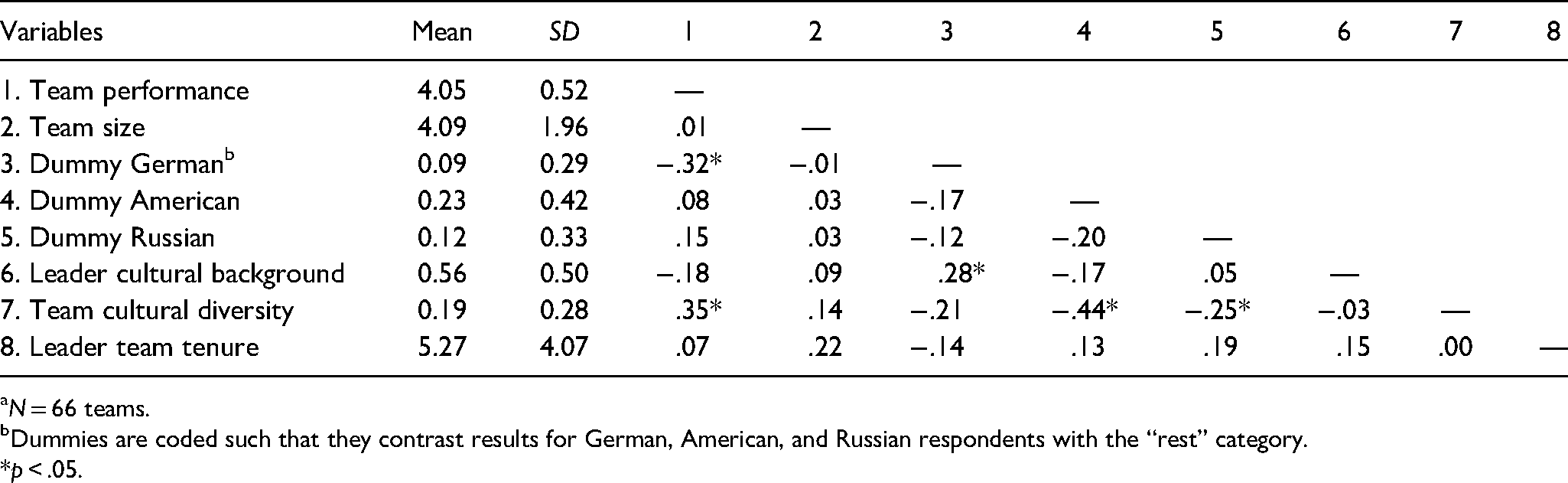
N = 66 teams.
Dummies are coded such that they contrast results for German, American, and Russian respondents with the “rest” category.
*p < .05.
Test of Hypotheses
Hypotheses were tested in regression analysis (see Table 2) using standardized variables for the interactions (Aiken & West, 1991). In the first step, the regression model included the control variables. Findings here do not speak to hypotheses tests but do show that teams in Germany tended to do worse. In the second step, we entered leader cultural background and scores for leader team tenure and team cultural diversity. The effect of team cultural diversity was significant (β = 0.21, p < .001). In the third step, we added the interactions between leader cultural background and team cultural diversity, leader cultural background, and leader team tenure, as well as the interaction between team cultural diversity and leader team tenure.
Results of Hierarchical Regression Analysis Predicting Team Performance.
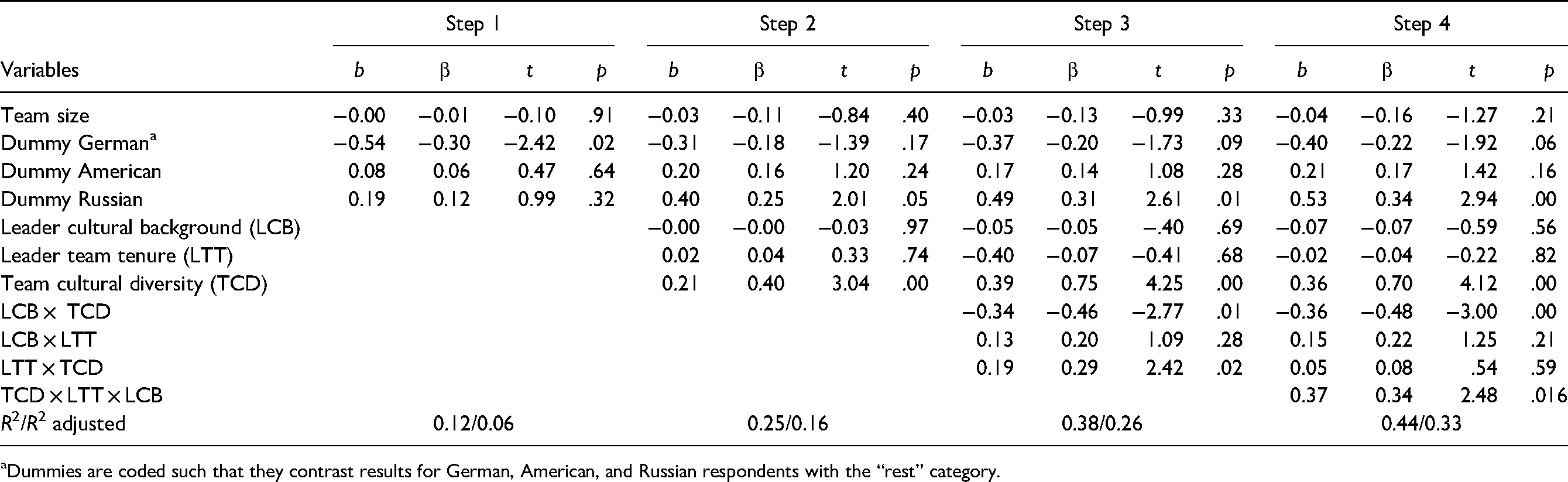
Dummies are coded such that they contrast results for German, American, and Russian respondents with the “rest” category.
The interaction between leader cultural background and team cultural diversity was significant (β = −0.34, p < .01) as was the interaction between leader team tenure and team cultural diversity (β = 0.19, p < .02). To understand the nature of these interactions, we performed a simple slope analysis (Aiken & West, 1991). Supporting Hypothesis 1, cultural diversity was positively related to team performance when the leader was foreign, b = 0.37, t = 4.11, p < .0001, whereas cultural diversity and team performance were unrelated when the leader was local, b = 0.03, t = 0.30, ns (see Figure 1). Supporting Hypothesis 2, cultural diversity was positively and more strongly related to team performance when the leader had high tenure (1 SD above the mean), b = 0.52, t = 3.59, p < .001, than when the leader had low tenure (1 SD below the mean), b = 0.26, t = 2.28, p < .03 (see Figure 2).
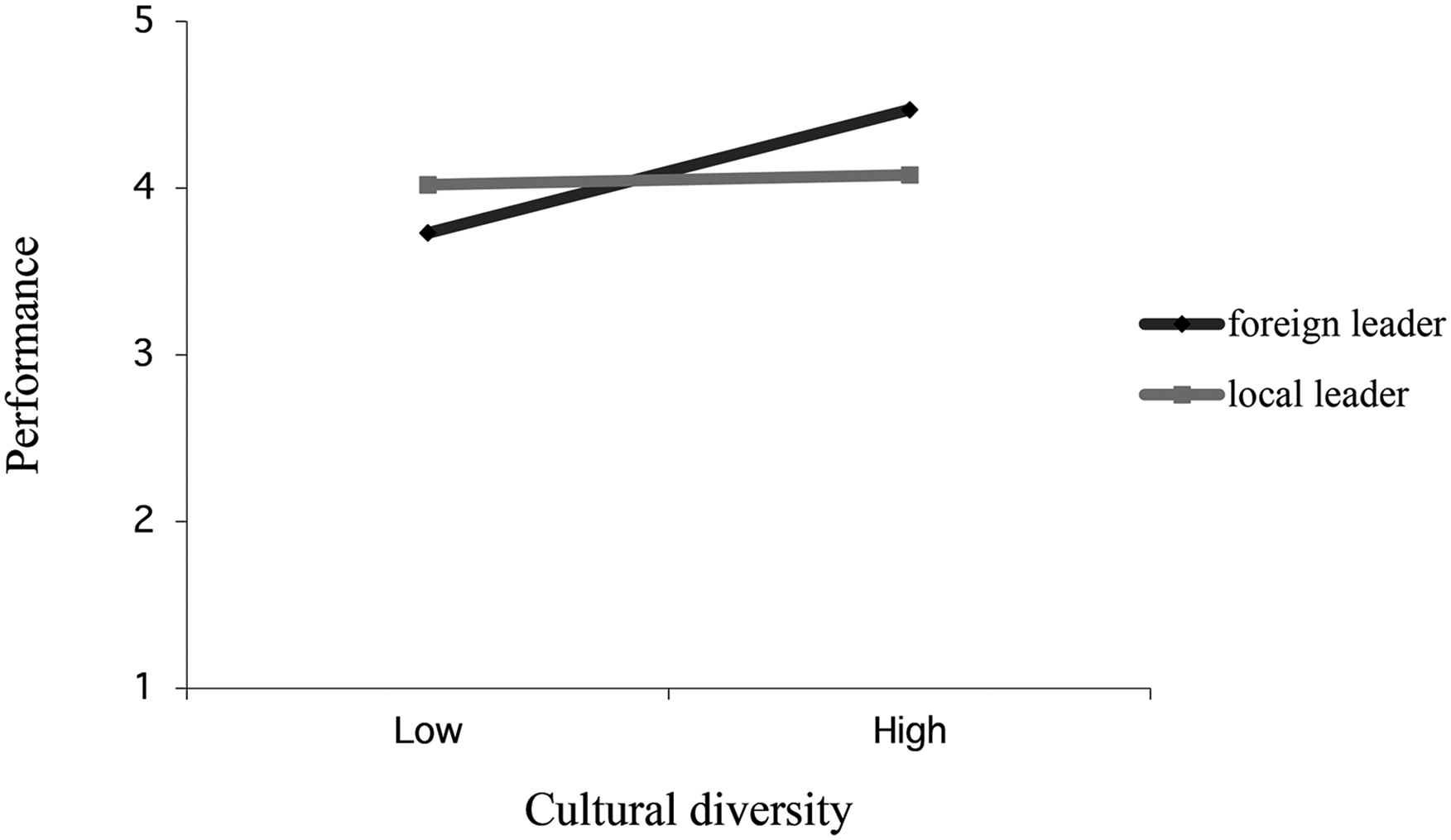
The interaction of team cultural diversity and leader cultural background.
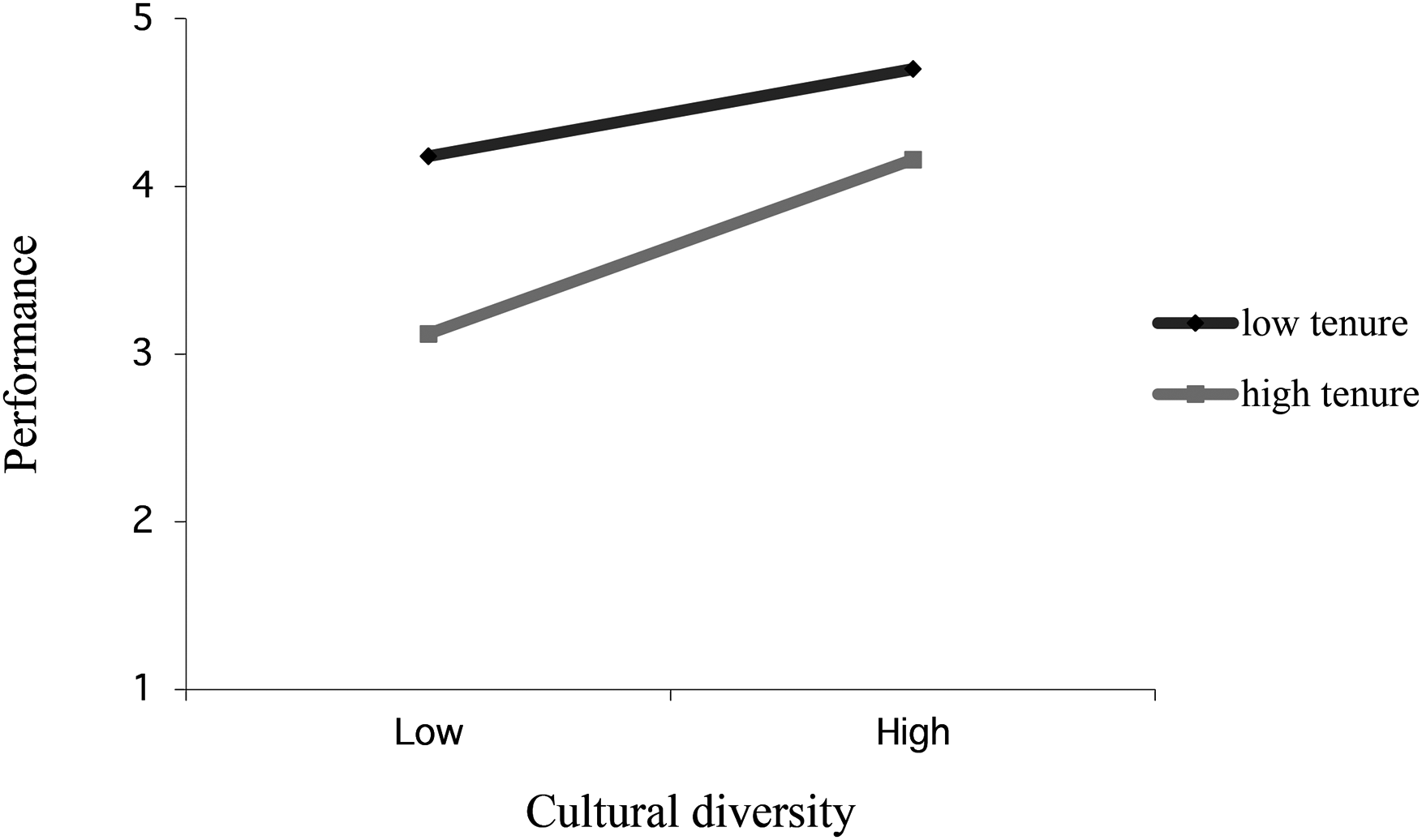
The interaction of team cultural diversity and leader team tenure.
In the final step, the three-way interaction term of leader cultural background and team cultural diversity and leader tenure was inserted. This interaction was significant, β = 0.37, p < .016 (see Figure 3). To establish the nature of this interaction, we conducted a simple slope analysis. Cultural diversity was positively related to performance when the leader was local and had higher tenure, b = 0.43, t = 3.27, p < .01, but was negatively related to performance when the leader was local and had lower tenure, b = −0.42, t = 2.44, p < .02. For foreign leaders, in contrast, cultural diversity was positively related to performance when the leader had lower tenure, b = 0.31, t = 2.72, p < .01, as well as when the leader had higher tenure, b = 0.41, t = 2.84, p < .01. This pattern of results supports Hypothesis 3.
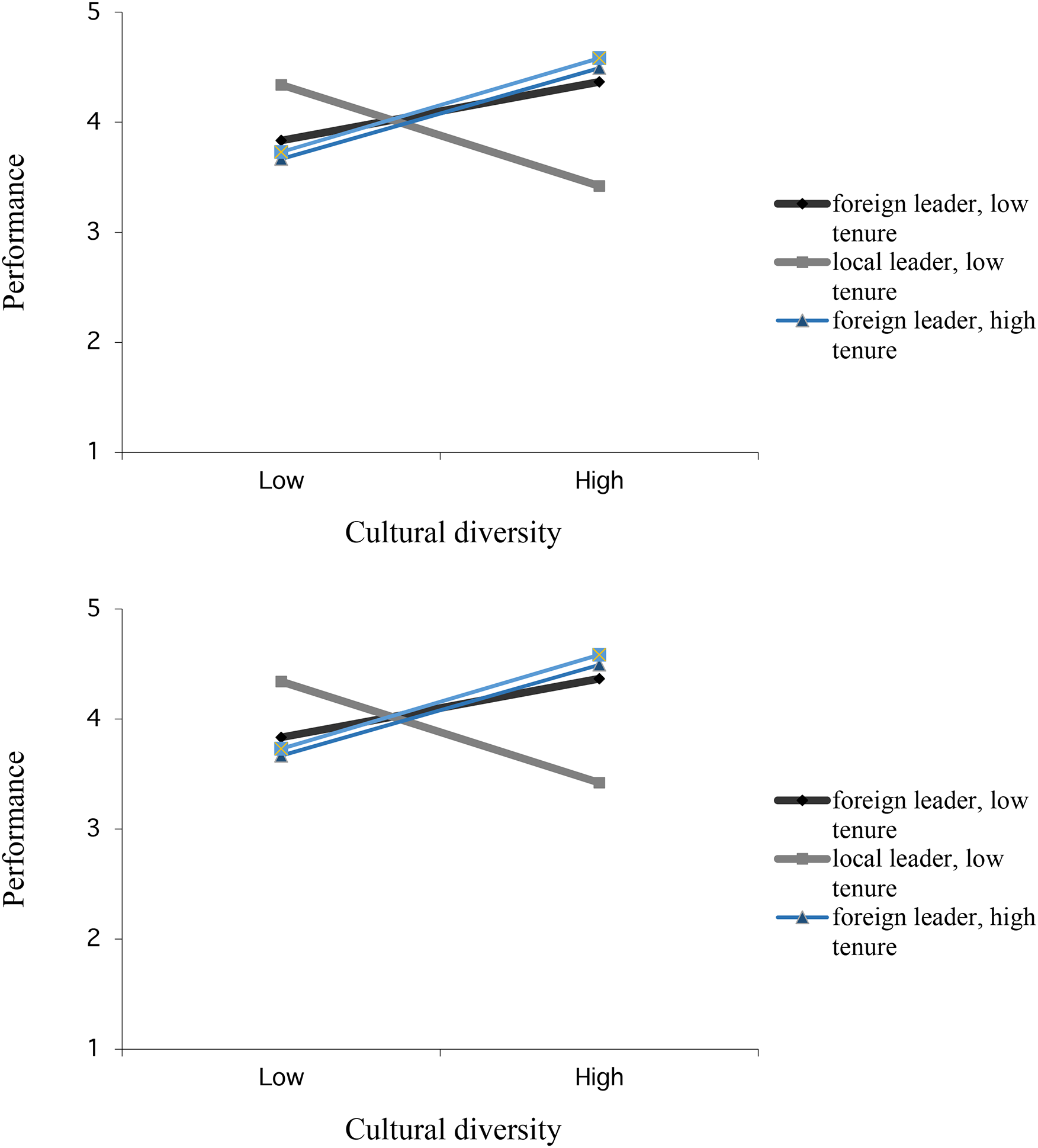
Interaction of team cultural diversity, leader cultural background, and leader team tenure.
Discussion
Theoretical analysis of leadership and diversity suggests that a key factor in leaders’ effectiveness in leading culturally diverse teams is the understanding of cultural diversity that leaders develop through experience with cultural diversity (van Knippenberg et al., 2013). Building on this analysis, we proposed that the relationship between team nationality diversity and team performance in international business is more positive with a foreign team leader as compared with a local team leader as well as with higher leader team tenure because both these factors reflect leader experience with cultural diversity. We further argued that there are diminishing returns in learning from experience with cultural diversity and that as a result the greater effectiveness of foreign over local leaders would be observed primarily for leaders with shorter team tenure. Our empirical analysis confirmed these two-way and three-way interaction hypotheses. Thus, our study constitutes a conceptual and empirical development of van Knippenberg et al.’s (2013) and van Knippenberg & van Ginkel (in press) diversity mindset theory of leadership and diversity. From this development follows a number of implications for theory and practice worth considering.
Theoretical Implications
In their theoretical analysis, van Knippenberg et al. (2013) emphasized that understanding of team diversity develops from experience with diversity and that such experience needs to be specific to the diversity attribute of interest (i.e., in the case of the current study, cultural diversity). They did not analyze how leaders would gain such experience, however. In that respect, our study develops and extends van Knippenberg et al.'s conceptual work by putting factors reflecting leader experience with cultural diversity center stage. We highlight three theoretical implications that follow from this focus on leader experience with cultural—more specifically, nationality—diversity.
The first issue to highlight is that our study is valuable in identifying two important ways in which leaders gain experience with cultural diversity, but that this by no means implies that there would not be other sources of experience worth considering. An obvious further development is to consider other ways in which leaders may gain experience with cultural diversity. One such factor is experiences abroad. A leader may be local, but when the leader has previous experience in an expatriate role (cf., the foreign leaders in our study), they may have gained cross-cultural experience in an earlier position. In a similar vein, leader tenure with the team may provide experience with cultural diversity, but leaders may also gain such experience through earlier assignments (i.e., in a sense a tenure effect, but not with the current team). More broadly exploring the potential sources of leader experience would be important to further develop the current analysis, because it would bolster the case that the communality between all the different ways to capture leader experience with diversity is indeed experience with diversity—and not some other factor that may covary with some of these factors. It would also be important because such knowledge would be highly actionable—an issue we revisit in considering the implications for practice below.
A second issue to highlight here is that experience should not be equated to learning from experience. Following van Knippenberg et al. (2013), the core argument underlying our analysis is that through experience with cultural diversity leaders develop an understanding of how to lead culturally diverse teams. Such an understanding of diversity does not automatically follow from experience, however. We may expect leaders to differ in the extent to which it does. For instance, there will be trait differences in the extent to which the leader is open to the experiences—as per the personality factor openness to experience—and the extent to which the leader is focused on learning from experience—as per the trait learning goal orientation (cf., van Knippenberg et al., 2004). What such traits have in common is an open-minded focus on learning and development, and we can expect that leaders scoring higher on these traits benefit more from experiences with cultural diversity. In a related fashion, learning from experience can also be guided by leadership development programs (cf., van Knippenberg et al., 2013). That is, by actively encouraging leaders to reflect on their experiences and learn from their experience, leadership development efforts may boost the extent to which leaders learn from experience with cultural diversity. Developing these propositions in future research would be important both because this would contribute to the further development of theory and because it would result in actionable knowledge for leader selection and development.
The third consideration we would highlight is that while the factors we considered are unique to cultural diversity, as per van Knippenberg et al. (2013), the underlying logic should not be. For other diversity attributes too it should hold that leaders can be more effective in leading teams that are diverse on the attribute of interest when they have developed their understanding of that diversity through experience with that diversity. An important further development of this analysis would thus be to apply the same logic to other forms of diversity (e.g., gender, age, and job-related attributes). In doing so, it would be important to recognize that not all forms of diversity will be equally salient (van Knippenberg et al., 2004) and that not all forms of diversity would as obviously invite a focus on learning to work with that form of diversity. Nationality diversity in international business may present a particularly salient form of diversity for which leaders will be readily aware that it poses challenges that they need to learn to meet. Thus, the present study context may reflect a situation in which leaders may have been more focused on learning from their experience with diversity than they perhaps would be in other contexts. For instance, would leaders be as focused on learning from experience with gender diversity or with diversity in sexual orientation? Based on the current data we can only speculate, but the implication of these considerations is that moderating influences such as leader traits or leadership development programs (as per the previous point) may be more important in stimulating learning for diversity attributes that less obviously invite a learning focus than we believe can be expected for nationality diversity in international business.
The importance of leader experience with cultural diversity is also underscored by our finding that cultural diversity was negatively related to team performance for local leaders with low tenure. This is consistent with the notion of cultural diversity as a double-edged sword (Milliken & Martins, 1996; van Knippenberg et al., 2004). It also underscores the need for organizations to find ways to provide individuals scheduled to take on leadership roles of more culturally diverse teams with cross-cultural experience—without such experience, cultural diversity may actually present an obstacle to team effectiveness.
Implications for Practice
We believe that an advantage of the current focus on leader experience is that it results in actionable knowledge: organizations can select on experience as well as focus on creating the opportunity for such experience in leadership development programs. The current evidence that indicators of leaders’ experience with cultural diversity (i.e., foreign national status and tenure with the team) position them to better lead the team suggests that organizations may also consider selecting on such experience. Multinational organizations may, for instance, focus on leaders’ expatriate experience and experience working with culturally diverse teams in selecting leaders for culturally diverse teams. In addition, organizations may focus on creating opportunities for leaders to have such experiences to develop their ability to lead culturally diverse teams. This may, for instance, include deciding about assignments abroad also with an eye on the development of individuals’ potential to lead culturally diverse teams. It may also include patience; recognizing that it takes time (cf., tenure with the team) to learn from experience with cultural diversity, organizations may also accept that leaders need the time to grow into the role of leading a culturally diverse team.
In considering the practical implications of the current findings, we may also cautiously move beyond the current data to recognize that developing leaders’ understanding of cultural diversity is also the domain of formal leadership development practices (van Knippenberg et al., 2013). As we outlined in considering the theoretical implications of our findings, it is reasonable to assume that people learn from experience, but it is also reasonable to suggest that leadership development practices may stimulate and support such learning from experience. Thus, more tentatively because this is not what our data speak to directly, the current analysis would also suggest that organizations may benefit more from creating the opportunity for (future) leaders to have experience with cultural diversity when their leadership development practices also stimulate and support learning from such experiences. This can, for instance, be done by educating leaders about the importance of an understanding of cultural diversity and by encouraging them to reflect on and learn from the experience of working with culturally diverse teams. Future research will have to speak to the merits of these suggestions, however.
Limitations and Future Directions
No study is without limitations, and the current study is no exception. A clear limitation is that while we built our analysis on the categorization–elaboration model (van Knippenberg et al., 2004) and the theory of leadership and diversity mindsets (van Knippenberg et al., 2013) that is rooted in the categorization–elaboration model, our study does not include the key mediating processes implied by this theoretical perspective. The categorization–elaboration model identifies team information elaboration (i.e., exchange and integration of diverse information and perspectives) as the core mediating process driving the performance effects of team diversity, and the theory of diversity mindsets identifies leaders’ cultural diversity mindset (i.e., understanding of team cultural diversity) as the cognition mediating the influence of leader experiences with cultural diversity in the diversity–performance relationship. Future research in these mediating processes would be particularly valuable in developing this analysis further.
Another limitation is that we relied on leader ratings of team performance. Because leader attributes (i.e., nationality and team tenure) are also predictor variables in our model, this is not ideal in that we cannot rule out the possibility that these variables also influence leader performance ratings. Clearly, in this respect, it helps that our predictor variables here are factual and not perceptual (i.e., we do not study percept–percept relationships), but another source of the team performance data than the leader would be value added.
In a related vein, we do not know what unmeasured variables leader attributes may covary with and which of those might also impact team performance. Likewise, we do not know which unmeasured variables may covary with team cultural diversity (e.g., other forms of diversity). Ideally, we would have a fuller set of controls to more firmly establish that the relationships observed can be attributed to the predictor variables.
We may also note that a large percentage of the teams in our study were culturally homogenous. This was not sampling bias but a reality of the research population. As per the argument that underlies our prediction that foreign leaders will have more cross-cultural experiences than local leaders, it is a reality of even most multinational organizations in international business that the host country dominates the make-up of the organization. Accordingly, team cultural diversity will be distributed such that there will be teams composed exclusively of host country nationals and culturally diverse teams will tend to have a larger number of host country nationals than foreign nationals. Thus, there is a restriction of range for team cultural diversity in the research population that inevitably translates to the range in the sample. The result of this is that our results cannot speak to how team performance is affected by cultural diversity at higher levels of cultural diversity or at lower levels of representation of host country nationals (e.g., all the homogenous teams are host country nationals only; there are no homogenous teams of foreign nationals). While this is not a shortcoming of the research per se in that it reflects the reality of the research population (cf., van Knippenberg, Dawson, West, & Homan, 2011), it does impose limitations on what our data can speak to.
Conclusion
The leadership of culturally diverse teams poses a challenge because cultural diversity can both be a disruptive influence and an asset to team performance. The current study adds to our understanding of this challenge by putting leader experiences with cultural diversity center stage. In doing so, it both extends theory about leadership, team diversity, and team performance, and yields actionable knowledge for practice. It also suggests clear avenues for future research to further develop and support these implications for theory and practice.
Footnotes
Declaration of Conflicting Interests
The authors declared no potential conflicts of interest with respect to the research, authorship, and/or publication of this article.
Funding
The authors received no financial support for the research, authorship, and/or publication of this article.
