




Abstract
The purpose of the present research was to investigate how leaders’ different types of pretraining motivation may influence transfer of leadership training. Drawing on self-determination theory, we examined the role of autonomous and controlled motivation for short- and long-term transfer in terms of employee-rated improvements of leaders’ need support. Data were collected in conjunction with a leadership training program that was aimed at increasing need support among municipality leaders (n = 20 leaders and their n = 323 employees), and surveys were sent to leaders and employees before training, posttraining, and 4 months after training. Bayesian multilevel modeling suggests that autonomous (Estimate = 0.17, 95% confidence interval [CI: 0.030, 0.329]) and controlled (Estimate = 0.08, 95% CI [0.013, 0.150]) premotivation among leaders are related to short-term improvements in need support. Although neither type of motivation had a credible long-term effect on transfer 4 months after the training, the 95% credibility interval indicate that the effect of autonomous motivation (Estimate = 0.13, 95% CI [−0.004, 0.269]) most likely is positive. Our study demonstrates the usefulness of using a theory-based multidimensional perspective on predictors of training transfer and on adding a temporal perceptive on their effects. Our study also points toward the importance of not only fostering autonomous motivation at work but recognizing the potential in controlled motivation.
Keywords
A recent meta-analysis suggests that leadership training leads to improvements in leader reaction, learning, transfer, and organizational results (Lacerenza et al., 2017). However, the range of effects varied considerably between studies, depending on factors related to the design, delivery, and implementation of the training. This suggests that there are important factors that help explain when and why leadership training is effective, and these factors need to be further examined (Avolio et al., 2009).
The transfer of training literature suggests that one factor that is important for training to be effective and for trainees to use the learned skills back at work (i.e., training transfer) is trainee motivation (Baldwin & Ford, 1988; Blume et al., 2010). Although not often examined as a predictor of leadership training, a large number of studies have demonstrated that trainees with higher motivation also exhibit higher levels of transfer after training (Blume et al., 2010). So far, however, training motivation has been considered a unidimensional construct, with higher levels suggesting higher motivation, without considering motivation to be a multidimensional construct (Gegenfurtner et al., 2009). Little is therefore known about how different types of motivation, such as autonomous and controlled motivation, may affect training transfer (Dysvik & Kuvaas, 2014).
The purpose of the present study is to examine how leaders’ different types of pretraining motivation may influence transfer of leadership training. We contribute to the existing literature in three important ways. First, we use models of transfer of training to understand factors that explain when and why leaders use trained skills back at work after attending leadership training. The rapprochement between the training and leadership development sciences has been called for (Barling et al., 2010), and it has been noted that advancements within the training literature are not necessarily implemented in the leadership literature and practice (Lacerenza et al., 2017). This lack of integration is unfortunate, although leadership training is unique in that sense that it focus on the development of interpersonal skills and the transformation of a third party (the follower), we believe that leadership training still has a lot in common with training in general. Our study responds to the call to integrate these lines of research by drawing from the training literature to shed light on leadership training effectiveness. Second, we answer recent calls to examine the multidimensional nature of factors that are known to predict training transfer, such as trainee motivation (Ford et al., 2018) to gain further insight into which types of motivation may increase training transfer. To achieve this, we use self-determination theory (SDT; Ryan & Deci, 2017), which differentiates types of motivation. Differentiating between different types of motivation is important, given that different types, for example autonomous and controlled motivation, both in theory and demonstrated in empirical research is related to different consequences (Deci et al., 2017). We thereby integrate models of transfer with SDT to understand the application of behaviors acquired at leadership training back at work, an integration that has been previously proposed by Dysvik and Kuvaas (2014) but not often empirically tested. Finally, we investigate how pretraining motivation is related to short- and long-term transfer. The majority of previous studies have only examined short-term transfer, and adding a long-term perspective, which allows for comparisons with short-term transfer, is an important advancement of transfer research (Ford et al., 2018).
Transfer of Leadership Training
Transfer may be defined as the extent to which trainees utilize the skills and abilities taught during training back at work (Baldwin & Ford, 1988; Blume et al., 2010). In the case of leadership training, transfer may represent the application of leadership behaviors taught during on-the-job training, reflecting the fact that an obvious goal of leadership training is to create a positive behavioral change in the leaders (Day, 2000). A number of studies have examined if leadership training transfers, and a recently published meta-analysis found that leadership training does transfer, but more so for skill-based outcomes compared with affective outcomes or job-performance gains (Lacerenza et al., 2017). This is in line with previous meta-analyses, which have shown that leadership training has a positive impact on leadership behavior across a wide range of theories, outcomes, leadership levels, and organization types (e.g., Avolio et al., 2009).
In addition to examine if leadership training transfers, Lacerenca et al. (2017) also examined training design characteristics that may influence the effectiveness of leadership training. They found that voluntary attendance, spaced training sessions, external instructors, multiple methods, feedback, and face-to-face programs displayed the strongest effect on transfer. However, according to the transfer of training literature, training design is not the only input factor that matters for training transfer (Baldwin & Ford, 1988; Blume et al., 2010). Another factor that is important to consider is trainee characteristics, such as trainee motivation (Alliger et al., 1997; Baldwin & Ford, 1988; Blume et al., 2010).
Training Motivation and Transfer
During the past decade, increasing efforts have been devoted to understanding the role of trainee motivation in the transfer of training (e.g., Gegenfurtner et al., 2009). Motivation may be referred to as the processes that accounts for an individual’s intensity, direction, and persistence of effort toward attaining a goal (Robbins & Judge, 2009). In studies of transfer, motivation has been conceptualized in different ways, including pretraining motivation, the motivation to learn, and the motivation to transfer, and they have all exhibited important relationships with training outcomes (Burke & Hutchins, 2007). For example, Facteau et al. (1995) found that pretraining motivation predicted transfer in a sample of managers employed in American state government. Furthermore, Massenberg et al. (2015) found that motivation to transfer mediated the relationship between support and training transfer among employees in the German car industry. These findings are in line with Blume et al.’s (2010) meta-analysis, which established trainee motivation as a significant predictor of training transfer.
Previous research on motivation and training transfer has, however, been criticized for at least two reasons. First, the majority of past studies have treated trainee motivation as a unidimensional construct, often measuring motivation with a single scale or item (Gegenfurtner et al., 2009). This is rather surprising, given that motivation has been recognized as a multidimensional construct (cf. Kanfer, 1990; Latham & Pinder, 2005; Ryan & Deci, 2017). This shortcoming has also been recognized in the wider transfer of training literature, and calls have been made to examine predictors of transfer from a multidimensional perspective (Ford et al., 2018). Second, studies of motivation and transfer have not been grounded in theories of work motivation (Gegenfurtner et al., 2009). This could partially explain why motivation in previous transfer research has been conceptualized as a unitary concept that varies in amount rather than in kind (Gagné & Deci, 2005; Kanfer, 1990). Building studies on theories of work motivation would aid our understanding of the multidimensional nature of motivation to transfer (Gegenfurtner, 2013), and one theory that has been suggested as being particularly useful in this regard is SDT (Gagné, 2014; Gegenfurtner, 2013).
Using SDT to Understand Training Motivation
SDT is a macrotheory of personality, development, and well-being that includes motivational concepts to illuminate phenomena across numerous domains, such as motivation at work (Gagné, 2014; Ryan & Deci, 2017). SDT postulates that people are inherently motivated to develop their interest and skills, to act out of volition and self-endorsement, and to connect with other people (Ryan & Deci, 2017). It offers a theoretical framework that can be useful for moving transfer research forward in that it contrasts different types of motivation: autonomous and controlled (Dysvik & Kuvaas, 2014).
Autonomous motivation incorporates intrinsic motivation and extrinsic motivation toward activities integrated and identified as important and in line with a persons’ values. It is integrated into a person’s sense of self and related to an experience of volition and self-endorsement (Ryan & Deci, 2017). Controlled motivation, on the other hand, includes external regulation where one’s behavior is driven by external rewards or punishments or by introjected regulation where one’s behavior is a function of avoidance, ego involvement, or contingent self-esteem. Controlled motivation includes the pressure to think, feel, and behave in certain ways (Ryan & Deci, 2017). In general, autonomous motivation has been related to more favorable outcomes than controlled motivation (Gagné & Deci, 2005), including enhanced well-being (Ng et al., 2012), performance (Cerasoli et al., 2014), and learning (Vansteenkiste et al., 2004). Distinguishing between autonomous and controlled motivation in relation to training is one way to address the multidimensionality of trainee motivation.
Within a training setting, Dysvik and Kuvaas (2014) suggested that trainees’ autonomous motivation should lead to increased transfer in terms of higher efforts to apply new skills after training. Controlled motivation, on the other hand, may increase training effort in the short term, but is likely to prevent effort in the long run (Dysvik & Kuvaas, 2014). For example, an autonomously motivated leader would engage in transfer because of an interest in the learning material at the training (Minnaert et al., 2011) and because applying new behaviors learned at training would offer new ways of identifying with activities and challenges at work (Pham et al., 2010). In contrast, a leader driven by controlled motivation would engage in using what was learned in the leadership training because of external factors, such as avoiding sanctions, to please his or her own manager or to receive awards (Kyndt et al., 2011). Consequently, an autonomous motivated leader will put more time and effort into learning and developing new skills at leadership training thereby increasing transfer compared with a leader that driven by controlled motivation, So far, few studies have empirically tested these assumption. One exception is a study by Gegenfurtner (2013), who studied autonomous and controlled motivation to transfer among trainees in an occupational health program. He found that autonomous, but not controlled, motivation to transfer predicted self-rated intention to transfer among employees. We add to this study by examining how pretraining motivation is related to actual transfer in a leadership training context. Building on SDT and the suggestion by Dysvik and Kuvaas (2014), we hypothesize that managers’ autonomous and controlled pretraining motivation will be related to short-term training transfer in terms of employee perceptions of improvements in leadership behavior immediately after the training.
Dysvik and Kuvaas (2014) also suggested that autonomous motivation may have long-term effects on transfer. This implies that an autonomously motivated leader, who find the learning material of the training interesting, and identifies with the training activities may continuously engage in developing the new skills developed during training also after training, thereby increasing transfer over time. To test this proposition, we examine how pretraining autonomous motivation is related to long-term transfer in terms of improvement in leadership behavior 4 months after the training ended and suggest the following:
Although controlled motivation potentially could have short-term effects on transfer (e.g., increase short-term training effort), it will most likely result in poorer long-term training outcomes (Dysvik & Kuvaas, 2014). However, given that there is no strong theoretical or empirical ground to formulate a hypothesis we will examine the relationship between controlled motivation and transfer over time for exploratory purposes.
Finally, based on SDT and empirical research suggesting that autonomous motivation is related to more favorable outcomes compared with controlled motivation (Gagné & Deci, 2005), we suggest the following:
Method
Participants and Procedure
This study was set in a midsized municipality in northern Sweden. The leadership training was conducted as a part of the municipality’s annual leadership development program, and the participants in this study were relatively newly employed (i.e., within the last 1-2 years) managers enrolled in this program. Participation in the training program was mandatory, whereas participation in the research study was voluntary.
Managers
Thirty-eight first-line managers employed in various sectors (e.g., child care, culture, education, elderly care, and leisure) were invited to participate in this study, and all agreed to take part. Of these, 21 managers were assigned to an experimental group, and 17 were assigned to a wait-list control group. Given the focus on pretraining motivation, only managers in the experimental group were included in this study. One manager in the experimental group quit his job during the training program; he and his employees were therefore excluded from the analyses. The participating managers (n = 20) were on average 42.5 (SD = 9.21) years old, were female in majority (80 %), had 6.5 (SD = 6.6) years of experience as a manager, and managed on average 24.2 (SD = 10.3) employees. Manager data were collected using a paper-and-pencil survey during the first session of the leadership training to assess pretraining motivation.
Employees
The participating managers’ employees were all invited to be part of the study. In total, 398 employees were invited to participate, and 323 employees accepted the invitation and responded to questionnaires at least once, rendering a response rate of 81%. The majority of the employees were female (78%), their mean age was 44.0 (SD = 11.9) years, and they had a tenure of 9.3 (SD = 8.3) years in the organization. Most of the employees worked full-time (62%), and around half of them had a university degree (51%).
Employee data were collected using a web-based survey administered before and after training. The pretraining survey (Time 1) was administered approximately 4 weeks prior to the first session (Time 2), and the posttraining survey (Time 3) was administered approximately 4 months after the pretraining survey. The follow-up survey (Time 4) was administered approximately 4 months after the posttraining survey.
Leadership Training
The content and design of the leadership training were based on previous recommendations for SDT-based leadership interventions (Su & Reeve, 2011), leadership training (Avolio et al., 2009), and previous successful SDT-based interventions (e.g., Cheon et al., 2012; Cheon et al., 2015). These recommendations suggest that (a) skill-based training with a focus on specific behaviors is more effective than theory-based training focused on cognitions and emotions for changing behaviors, (b) the training should focus on multiple elements of need-supportive behaviors, (c) training first-line managers is more effective than middle and higher management, (d) less-experienced managers show larger effects of training, and (e) supplemental activities between sessions can boost the effect of the intervention. All of these recommendations were incorporated as part of the leadership training program to facilitate learning and increases in need-supportive behaviors. We designed the training program in collaboration with an experienced leadership and organizational consultant with a PhD in psychology who also taught the program with the assistance of two leadership developers employed by the municipality. The leadership training program spanned a 5 months (October 2015-February 2016) and included two 2-day sessions 1 month apart and a third ½-day session approximately 3 months after the second session.
Part 1
The first session was a 2-day workshop. It included a presentation given by the consultant introducing SDT, the basic psychological needs at work, the different types of motivation, and the managers’ need-supportive motivating styles toward employees. Participants then had small group discussions, where, based on their own experiences, they tried to identify behaviors, contexts, people, and situations as need supportive or need thwarting. The participants then received feedback based on their employees’ ratings of the mangers’ need-supportive behaviors and the employees’ need satisfaction at work. The managers also formulated an action plan based on the feedback from the employees for how and when they could practice need-supportive behaviors at work. Finally, the participants received a copy of a book on need-supportive leadership at work (Söderfjell, 2012) to read before the second session.
Part 2
The second session was also a 2-day workshop, which was conducted approximately 4 weeks after the first session. First, participants discussed questions that had arisen from reading the book with one another. Following this initial activity, a brief repetition was provided to reiterate the tenets of SDT (i.e., basic psychological needs, motivation, and need support). The remainder of the second session focused on practicing need-supportive behaviors by performing skill-based training of specific behaviors. More specifically, the participants practiced using active listening, need-supportive communication of newly imposed rules and regulations, a need-supportive language when writing emails, role play involving being need-supportive in different situations that often occur at work, need-supportive feedback, and need-supportive feedforward (see Kluger & Nir, 2010, for an in-depth description of the feedforward interview protocol that was used as a template in the current study).
Part 3
The third session was a ½-day workshop conducted approximately 3 months after the second session. During the session, the participants again received feedback based on their employees’ ratings of the managers’ need-supportive behaviors and their need satisfaction at work. In addition, focus group interviews were conducted to evaluate the leadership training (see Tafvelin et al., 2019, for a summary).
Measures
Pretraining Motivation
Managers’ autonomous and controlled motivation to participate in the leadership training program was assessed using the Situational Motivation Scale (Guay et al., 2000) at Time 2. Autonomous motivation was measured with eight items; four items reflecting people’s situational (or state) intrinsic motivation (e.g., “Because I think that this activity is interesting”) and four items reflecting identified regulation (e.g., “Because I think that this activity is good for me”). Controlled motivation was measured with four items reflecting extrinsic regulation (e.g., “Because it is something that I have to do”) and toward a specific activity or behaviors. The stem item used in this study was “Why do you participate in this leadership training program?” Responses were given on a 7-point Likert-type scale, ranging from 1 (corresponds not at all) to 7 (corresponds exactly).
Transfer of Training
We measured transfer of training in terms of employees’ perceived changes in managers’ need support after training. Need support was assessed with the 12-item Need Support at Work Scale (Tafvelin & Stenling, 2018) at Time 1, Time 3, and Time 4. This instrument consists of three dimensions that capture employees’ perceptions of their managers’ autonomy support (four items), competence support (four items), and relatedness support (four items). Responses were given on a 5-point Likert-type scale, ranging from 1 (never/almost never) to 5 (always). The 12 items included in the Need Support at Work Scale are displayed in the Appendix.
Statistical Analysis
We used Mplus version 8.2 (Muthén & Muthén, 1998-2017) to estimate Bayesian multilevel path analyses. Compared with the commonly used maximum likelihood (ML) estimation, Bayesian estimation of multilevel structural equation models can produce more accurate and efficient parameter estimates when the between-level sample size is small (Depaoli & Clifton, 2015). Whereas ML estimation often requires between-level sample sizes of 50 to 100, simulation studies suggest that Bayesian estimation produces accurate estimates with much smaller between-level sample sizes (20 or fewer depending the parameter estimate of interest and prior specification; Hox & McNeish, 2020). Furthermore, the ability to incorporate prior information presents another advantage because Bayesian estimation with accurately specified informative priors will perform much better than other estimators, such as ML or restricted ML (Hox & McNeish, 2020).
The Bayesian multilevel models were estimated using two Markov chain Monte Carlo chains and 50,000 iterations. The first 25,000 iterations were discarded as burn-in, and the remaining 25,000 iterations were used to estimate the posterior distribution of the parameters. Chain convergence was assessed using the potential scale reduction factor (Brooks & Gelman, 1998) where a low (e.g., <1.05) and stable potential scale reduction factor was considered to be evidence of chain convergence. Model fit was evaluated using the posterior predictive p (PPP) value and its accompanying 95% confidence interval (CI). A PPP value around 0.50 with a 95% CI centering on zero was considered to be a well-fitting model, whereas a low PPP value and a 95% CI with a positive lower limit was considered a poor-fitting model (Asparouhov & Muthén, 2010). The deviance information criterion (DIC) was used for model comparisons and a lower DIC indicates a better-fitting model (Asparouhov et al., 2015). Parameter estimates were evaluated using the 95% credibility intervals. If the interval did not include zero, it was considered to be a credible and statistically significant parameter estimate (Zyphur & Oswald, 2015).
Latent mean centering (Asparouhov & Muthén, 2019) was used for the individual-level variables (i.e., need support), whereas team-level predictors (i.e., autonomous and controlled motivation) were grand–mean centered. With latent mean centering, the individual-level variable is decomposed into a latent between (i.e., team) and within (i.e., individual) part, which can be viewed as an implicit group-mean centering of the individual-level variable (cf. Lüdtke et al., 2008). Latent mean centering provides a clear separation of the team- and individual-level effects and provides more accurate estimates and standard errors compared with the traditional observed variable centering (Asparouhov & Muthén, 2019).
We relied on informative priors for the main parameters of interest, and all prior specifications used in this study are presented in Table 1. We hypothesized that the level of need support would be relatively stable across time, which was reflected in the prior specification of the autoregressive effect at the individual and team level (μβ = 0.70, SD = 0.32). In Models A1 and A2, we used informative priors for the effects of autonomous and controlled motivation at Time 3 and Time 4 based on Blume et al.’s (2010, p. 1080; see Table 1) meta-analytic estimates (ρ = 0.23, SDρ = 0.16) of the effects of motivation on transfer of training without same-source and same-measurement-context bias. In Models B1 and B2 for short-term transfer (effect at Time 3), priors were specified based on Dysvik and Kuvaas’s (2014) theoretical reasoning that autonomous and controlled motivation could have a positive effect on transfer, but that the effect of autonomous motivation is likely stronger. Hence, we specified priors suggesting that autonomous and controlled motivation would have a positive effect on transfer, but that the effect of autonomous motivation would be stronger (μβ = 0.40, SD = 0.22) than the effect of controlled motivation (μβ = 0.20, SD = 0.22). Based on Dysvik and Kuvaas’s (2014) reasoning about long-term transfer (effect at Time 4), we hypothesized a positive effect of autonomous motivation, as reflected by the prior specification (μβ = 0.40, SD = 0.22). Due to the lack of previous research and uncertainty about the long-term effect of controlled motivation on long-term transfer, we did not have a specific hypothesis about its effect and used the default noninformative prior specification. For the between-level variance parameters of the within-level variables (need support), we specified noninformative inverse-gamma prior distributions Γ−1 (˗1, 0; Models A1 and B1) and Γ1 (.001, .001; Models A2 and B2). We compared these two common noninformative prior specifications for between-level variance parameters and their impact on the results following current recommendations (Depaoli & Clifton, 2015). For the remaining parameters, we relied on the default noninformative prior specification in Mplus (see Muthén & Muthén, 1998-2017, p. 775, for a description of the default priors when Bayesian estimation is used). To examine the impact of the prior specifications, we also contrasted the results from the models with informative priors with results from a model with noninformative priors (Model C; cf. Depaoli & Van de Schoot, 2017). Reliability (i.e., omega coefficients [ω]) was estimated using the methods outlined by Geldhof et al. (2014) for single-level and multilevel models.
Prior Specifications.
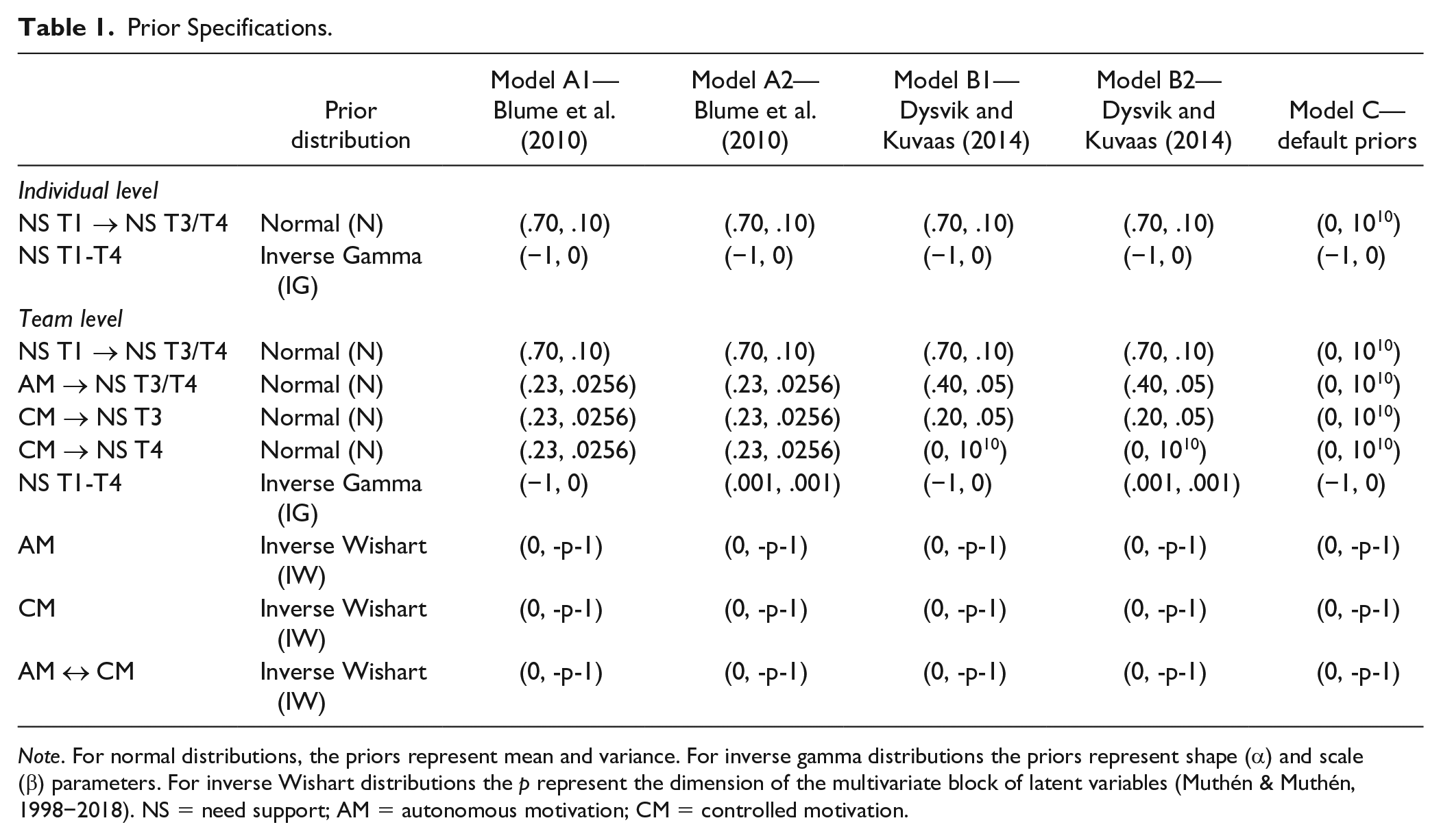
Note. For normal distributions, the priors represent mean and variance. For inverse gamma distributions the priors represent shape (α) and scale (β) parameters. For inverse Wishart distributions the p represent the dimension of the multivariate block of latent variables (Muthén & Muthén, 1998−2018). NS = need support; AM = autonomous motivation; CM = controlled motivation.
Results
Descriptive statistics, intraclass correlation coefficients, reliability estimates, and bivariate correlations are displayed in Table 2. Intraclass correlation coefficients of need support at Time 1, Time 3, and Time 4 were 0.09, 0.21, and 0.16, respectively. Reliability estimates (ω) ranged from .80 to .99. There was a strong correlation between employee-rated need support across the three time points at the team and individual level (rs ranging from .57 to .77). Correlations between employee-rated need support and managers’ autonomous and controlled motivation were too small to moderate.
Descriptive Statistics, Reliability Estimates, and Bivariate Team- (Above the Diagonal) and Individual-Level (Below the Diagonal) Correlations.
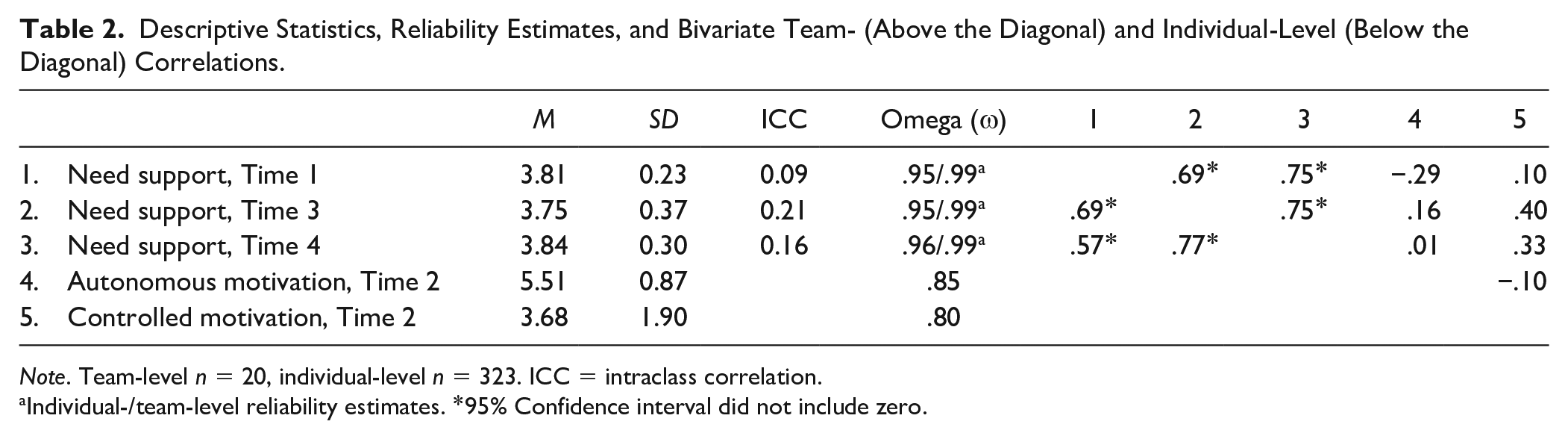
Note. Team-level n = 20, individual-level n = 323. ICC = intraclass correlation.
Individual-/team-level reliability estimates. ∗95% Confidence interval did not include zero.
Parameter estimates from the Bayesian multilevel models with different prior specifications are displayed in Table 3 and Table 4. Minor discrepancies were observed between the four models with informative priors (A1, A2, B1, and B2) on the magnitude of some parameter estimates; however, the overall pattern of results did not change as a function of the prior specification. When comparing the parameter estimates to the estimates in Model C with default priors (i.e., noninformative priors), the largest discrepancy was in the autoregressive path of need support; it was larger in Model C compared with the four models with informative priors (Models A1, A2, B1, and B2). In general, the parameter estimates were similar across the different models, and, as expected, the 95% CIs were narrower in the models with informative priors compared with Model C (with noninformative priors). The lower DIC in Model A2 and B2 indicated that they were the best-fitting models, which also suggests that the prior distributions for the between-level variance parameters had a greater impact on model fit than the prior specification for the regression coefficients. We will focus on the results from Model B2 at Time 3 and Time 4, but note that the all models with informative priors lead to the same conclusions, and the model fit of Model A2 was almost identical to Model B2.
Effects of Managers Autonomous and Controlled Motivation on Employee-Rated Need Support.
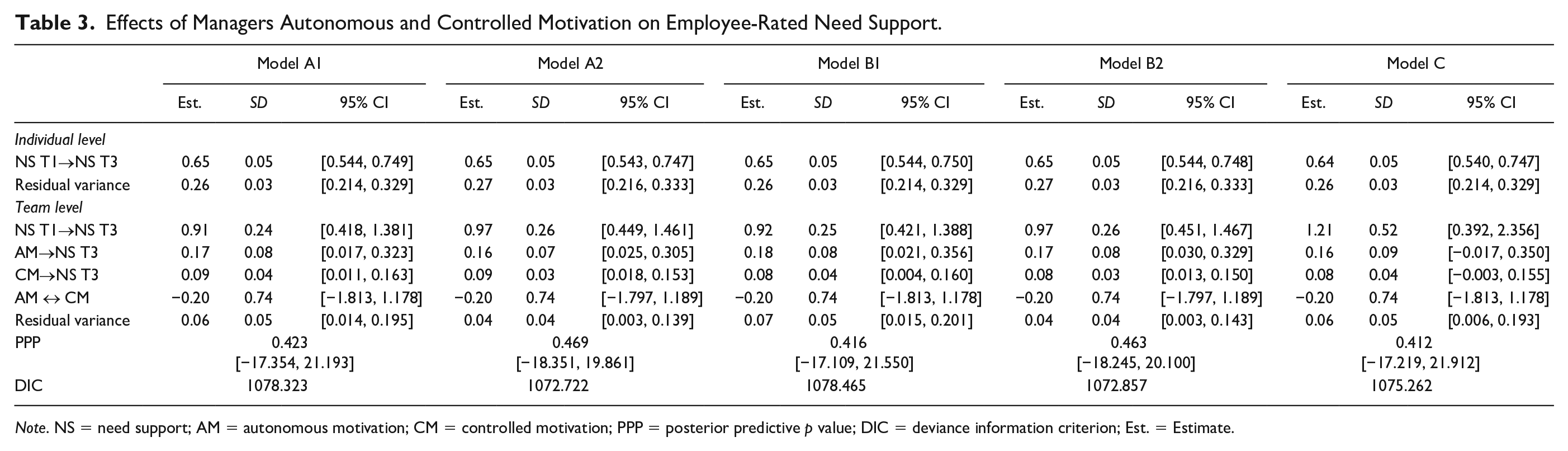
Note. NS = need support; AM = autonomous motivation; CM = controlled motivation; PPP = posterior predictive p value; DIC = deviance information criterion; Est. = Estimate.
Effects of Managers Autonomous and Controlled Motivation on Employee-Rated Need Support.
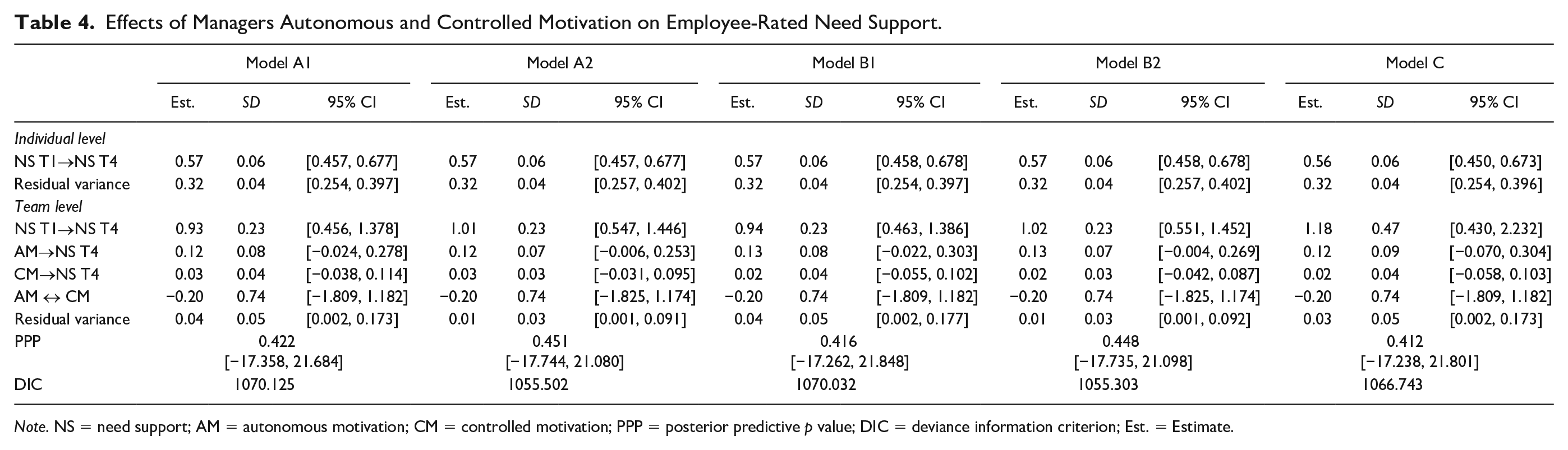
Note. NS = need support; AM = autonomous motivation; CM = controlled motivation; PPP = posterior predictive p value; DIC = deviance information criterion; Est. = Estimate.
As graphically depicted in Figures 1 and 2 and shown in Table 3, at Time 3, the autoregressive effects were relatively large at the team (Estimate = 0.97, 95% CI [0.451, 1.467]) and individual level (Estimate = 0.65, 95% CI [0.544, 0.748]), indicating a high degree of stability in need-supportive behaviors over time. Managers’ autonomous (Estimate = 0.17, 95% CI [0.030, 0.329]) and controlled (Estimate = 0.08, 95% CI [0.013, 0.150]) motivation both had a positive effect on employee-rated need support at Time 3, supporting Hypotheses 1a and 1b. The model explained 75.8% of the variance at the team level and 46.7% at the individual level. These results indicate that managers’ autonomous and controlled motivation to participate in the leadership training program were related to their employees perceiving them as more need-supportive at Time 3.
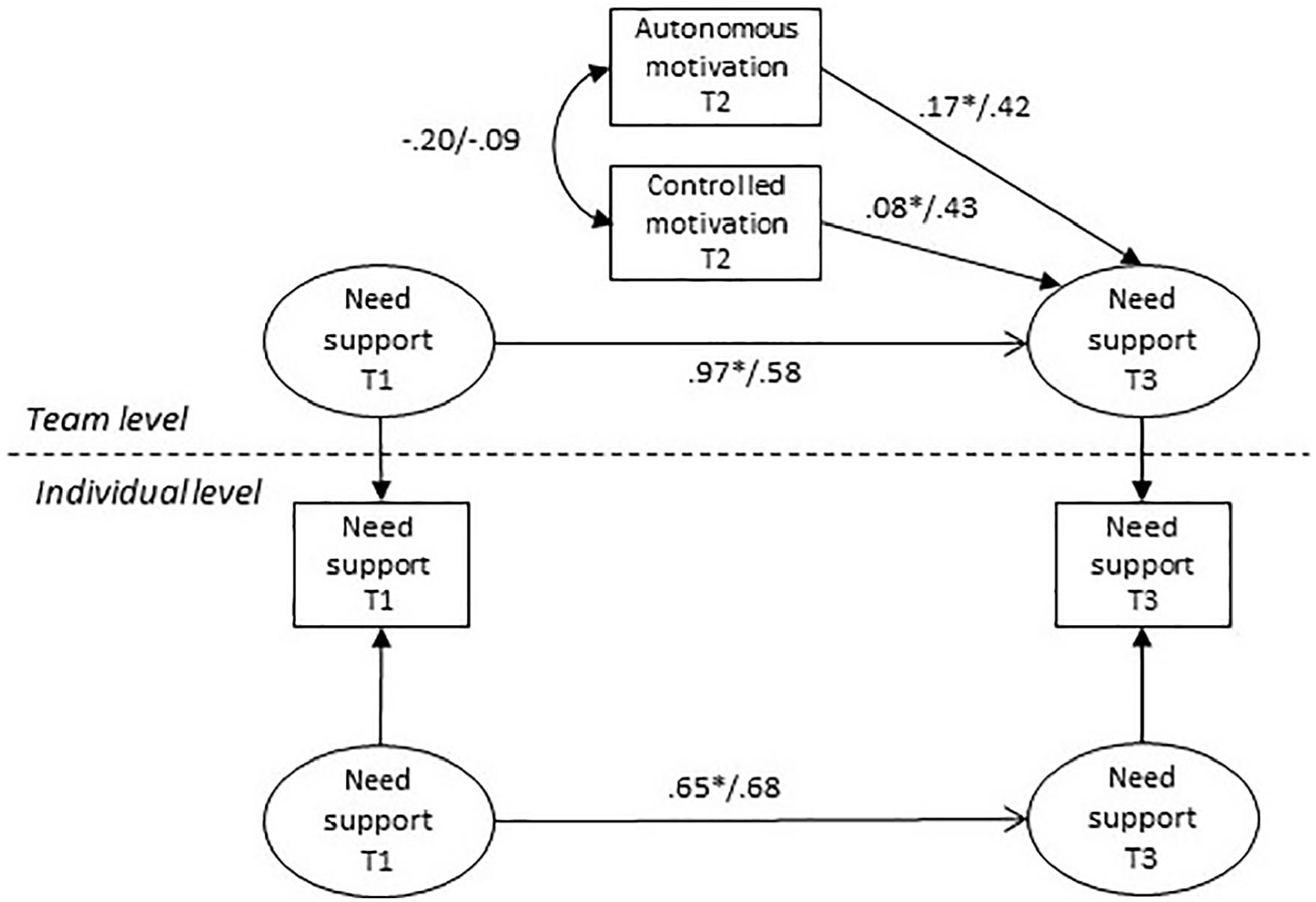
Autonomous and controlled motivation in relation to short-term transfer of leadership training measured by employee-rated need support (unstandardized/standardized estimates from Model A2).
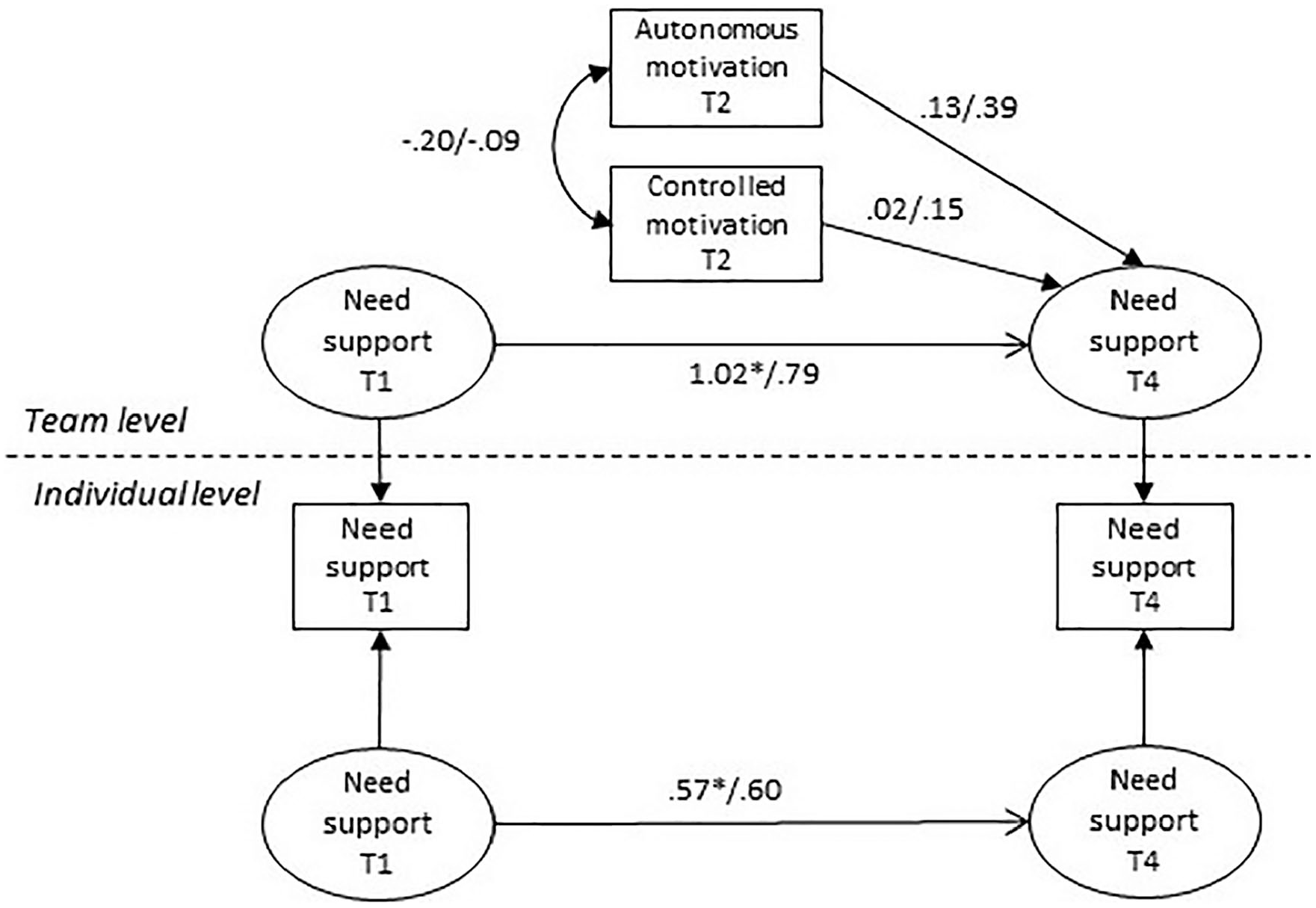
Autonomous and controlled motivation in relation to long-term transfer of leadership training measured by employee-rated need support (unstandardized/standardized estimates from Model A2).
As displayed in Table 4, the autoregressive effects were large also at Time 4 at the team (Estimate = 1.02, 95% CI [0.551, 1.452]) and individual (Estimate = 0.57, 95% CI [0.458, 0.678]) level. Autonomous motivation (Estimate = 0.13, 95% CI [−0.004, 0.269]) had a positive, but not credible effect on need support at Time 4, contradicting Hypothesis 2. Note, however, that the 95% CI borders on the zero point and indicate that the effect likely is positive. In addition, controlled motivation (Estimate = 0.02, 95% CI [−0.042, 0.087]) did not have a credible effect on need support at Time 4. The model explained and 89.5% of the variance at the team level and 36.0% at the individual level.
Although the effect of autonomous motivation on need support was stronger than the effect of controlled motivation on need support at Time 3 and Time 4, the difference in magnitude was not credible (Time 3, ΔEstimate = 0.092, 95% CI [−0.063, 0.260]; Time 4, ΔEstimate = 0.107, 95% CI [−0.046, 0.265]), contradicting Hypothesis 3.
Exploratory Analyses
Although previous findings suggest that both identified and intrinsic motivation generally lead to positive performance outcomes, for certain activities they may lead to different outcomes (Koestner & Losier, 2002). The differential effects of identified and intrinsic motivation have not previously been examined in relation to training transfer. Thus, we also conducted exploratory analyses separating intrinsic motivation and identified motivation and predicted need support at Time 3 and Time 4. The prior specification for intrinsic and identified motivation was the same as for autonomous motivation (as described in the Statistical Analysis section) and the same prior specification was used for controlled motivation as in the main analyses. The prior specification, descriptive statistics, and the results from these exploratory analyses are presented in the online supplemental material Tables S1 to S4. Similar to the main analyses, Models A2 and B2 displayed the lowest DIC and both models showed almost identical parameter estimates. However, here we report the results from Model B2. As seen in Table S3, controlled motivation had a credible short-term effect on need support at Time 3 (Estimate = 0.09, 96% CI [0.007, 0.165]), but intrinsic (Estimate = 0.08, 96% CI [−0.074, 0.237]) and identified (Estimate = 0.11, 96% CI [−0.051, 0.279]) motivation did not have a credible short-term effect. For long-term transfer we observed a credible effect of intrinsic motivation (Estimate = 0.14, 96% CI [0.005, 0.274]) on need support at Time 4, but identified motivation (Estimate = −0.01, 96% CI [−0.149, 0.138]) and controlled motivation (Estimate = 0.00, 96% CI [−0.071, 0.074]) did not have credible long-term effects on need support at Time 4.
Discussion
The present study examined the role of pretraining motivation for transfer of leadership training and extended previous leadership training research by using models of transfer to explain when and why leaders use trained skills back at work. We also added to the transfer of training literature by conceptualizing pretraining motivation as a multidimensional construct by drawing on SDT and contrasting short- and long-term transfer. Our findings suggest that both autonomous and controlled pretraining motivation are related to short-term transfer of leadership training. None of them had credible effects on long-term transfer, although the 95% CI indicate that the effect of autonomous motivation most likely is positive.
Our results support Hypothesis 1a, suggesting that autonomous pretraining motivation is a positive predictor of short-term transfer of leadership training. This means that leaders who attend leadership training for their own sake or because they find in interesting, important, and fun also apply their newly trained skills back at work. Our findings are in line with Gegenfurtner (2013), who found that autonomous motivation to transfer predicted intention to transfer among employees. Our study adds to his findings by demonstrating that pretraining motivation is related to actual transfer not only among employees but among leaders. Our findings are also congruent with theory and research on SDT, which have demonstrated in other fields that autonomous motivation is related to enthusiastic attendance, academic engagement, and deep study strategies among students in the health profession (Orsini et al., 2016), e-learning at work (Yoo et al., 2012), and the development of autonomy-support among teachers (Cheon et al., 2018 ). Autonomous motivation also had a positive effect on long-term transfer, however, the 95% CI crossed zero, thereby contradicting Hypothesis 2. Although this could be due to unique characteristics of our study such as the small improvements in need support, the 1-year time span between measures, or our focus on pretraining motivation, still, our findings do not fully support the suggestion by Dysvik and Kuvaas (2014) that autonomous motivation predicts transfer in the short and long run. Instead, our results suggest that autonomous pretraining motivation primarily is related to improvements in leadership behaviors just after the training and that the effect diminishes over time. Our study thereby suggests that the impact of autonomous motivation on transfer may be contingent on time, something previous cross-sectional studies (e.g., Gegenfurtner, 2013) have failed to detect. Though the long-term effect of autonomous motivation was not credible, the lower limit of the 95% CI fell just below zero. This suggests that also the long-term effect of autonomous motivation likely is positive and beneficial for training transfer. Future studies with larger samples or more precise prior specifications based on the accumulated evidence are warranted to further examine the long-term effect of the different types of motivation on training transfer.
Leaders’ controlled pretraining motivation was positively related to short-term transfer supporting Hypothesis 1b. We also explored the long-term relation and found that controlled motivation did not have a credible relation to long-term transfer. Our findings support the suggestion that controlled motivation may be beneficial for transfer in the short run but not the long run (Dysvik & Kuvaas, 2014). It, however, contradicts the only previous empirical study that found no significant relationship between controlled motivation and transfer (Gegenfurtner, 2013). The role of controlled motivation within SDT is somewhat ambiguous, with theory and research in general pointing toward the benefits of autonomous rather than controlled motivation (Gagné & Deci, 2005). Our findings, however, suggest that when it comes to leadership training programs, controlled pretraining motivation is also beneficial for a leader’s first attempt to apply trained skills at work. This implies that leaders who attend leadership training for reasons such as avoiding sanctions, pleasing their own manager, or receiving awards, also benefit from doing so. As is often the case at work, our leadership training program was mandatory. It is possible that this positively affected the role of controlled motivation in our study. The impact of voluntary or mandatory attendance policy for transfer of leadership training was examined in a recent meta-analysis (Lacerenza et al., 2017), which concluded that mandatory leadership programs had significantly stronger effects on organizational outcomes compared with voluntary programs, perhaps because of higher attendance. They also, however, speculated that mandatory programs may hamper training motivation, and future research is needed to further shed light on the role of controlled motivation for transfer of leadership training programs in general and depending on attendance policy in particular.
Hypothesis 3, suggesting that autonomous pretraining motivation would have a stronger impact on short- and long-term transfer compared with controlled motivation, was not supported. Both types of pretraining motivation predicted short-term transfer, and none had a credible effect on long-term transfer. Given that our leadership training program was mandatory, our findings add to the study by Curado et al. (2015), who found no difference in the role of autonomous and controlled motivation to transfer when course enrollment was mandatory among a sample of insurance employees. Our findings suggest that the same mechanism seems to operate among leaders who are enrolled in leadership training programs. Yet again, as our study is the first examining this in the context of leadership training, more studies are needed to determine where our results can be replicated. In all, our study demonstrates the benefits of studying training motivation from a longitudinal multidimensional perspective allowing for a more fine-grained understanding of how different types of motivation may impact transfer of leadership training in the short and long run.
In an effort to further tease out the potential benefits of autonomous motivation for transfer of leadership training, we performed additional exploratory analyses where we differentiated between two types of autonomous motivation; intrinsic and identified motivation. Intrinsic motivation consists of motives coming from the activity itself, such as interest, enjoyment, or fun, whereas identified motivation consists of motives in which people identify with the value and personal importance of an activity, such that the activity is beneficial or valuable (Ryan & Deci, 2017). We found that none of them had a credible effect on transfer in the short-term. In the long-term, however, intrinsic but not identified motivation had a credible effect on transfer. The lack of credible short-term effects is surprising given the notion in SDT that both forms of motivation generally yield positive performance outcomes (Ryan & Deci, 2017; Koestner & Losier, 2002). However, a higher degree of measurement error (i.e., lower reliability) in a variable is known to attenuate the effects involving that variable (Cole & Preacher, 2014). Thus, the low reliability estimate of the intrinsic motivation subscale suggests that the effect of intrinsic motivation on need support likely is attenuated. Concerning identified motivation, it has been argued that it may be more beneficial for long-term outcomes than short-term processes, given its focus on value and personal importance of an activity and its outcomes (Ryan & Deci, 2017; Koestner & Losier, 2002). Our results did not support this notion as identified motivation did not have a credible effect on need support in the short- or long-term. It might be that identified motivation is not a crucial type of motivation in relation to training transfer at work in and of itself, but it might still be important in combination with other types of motivation (e.g., intrinsic motivation). The findings of the long-term benefits of intrinsic over identified motivation is consistent with recent findings in other domains. For example, a study on the relation between student motivation and academic performance showed that, although both forms of motivation was beneficial for academic performance in the short-term, only intrinsic motivation positively predicted academic performance long-term (Liu et al., 2019). Future studies with larger samples of managers are needed to further tease out the unique, additive, interactional, or complementary effects of the different types of motivation on training transfer.
Implications
Studies on the role of autonomous and controlled pretraining motivation for transfer of leadership training have important implications for research and practice. From a research perspective, our study extends the leadership training and the transfer of training literature. Although a number of advancements have been made in the transfer of training literature to enhance our understanding of when and why training is transferred, this knowledge is seldom integrated in the leadership development literature (Barling et al., 2010; Lacerenza et al., 2017). Our study suggests that models of transfer are helpful in understanding the effectiveness of leadership training as well, and we call for more researchers in the leadership development field to draw on these findings in an effort to better understand when and why leadership training is effective and to help explain the often heterogeneous effects in previous leadership training research (Avolio et al., 2009). Our study also extends transfer motivation research by demonstrating the usefulness of not considering training motivation as a unidimensional but a multidimensional construct. By focusing on the total amount of training motivation and the type of training motivation, new avenues are opened that can be examined using theories such as SDT. This is in line with studies of for example leader developmental readiness, which suggest that leaders’ motivation to develop is multidimensional and a function of interest and goals, learning goal orientation, and developmental efficacy (Hannah & Avolio, 2010). Furthermore, our findings suggest that the impact of training motivation on transfer may be time sensitive and that additional research is needed to further develop a theory of time (Collins, 2006; Ployhart & Vandenberg, 2010) in relation to how trainee characteristics may be time dependent and play different roles during different parts of the transfer process.
For practice, understanding that leaders may have different types of motivation in relation to attending leadership training may be helpful in developing strategies or interventions to increase leader motivation before attending the training. To increase autonomous motivation before attending training, it may be beneficial to explain why the training is important (understanding the rationale), to acknowledge leaders’ opinions and ideals about the training (feelings acknowledge), and to provide leaders some degree of choice regarding the training activities (Gagné et al., 2000). To also promote controlled motivation, it may be helpful to have higher management support to make sure that managers are clearly communicating expectation to leaders attending the training. Knowledge that both types of pretraining motivation helps leaders learn and apply trained leadership behaviors at work is relevant for leadership trainers, who otherwise may consider leaders with mainly controlled motivation as lost causes. Our findings suggest that although these leaders are not solely there for their own sake or because they truly enjoy developing as a leader; they also benefit from training and apply new leadership behaviors at work.
Limitations and Future Research
Our study benefits from taking a SDT-based multidimensional perspective on training motivation and uses a design that allows us to examine short- and long-term transfer. Our study is, however, not without limitations. First, our sample of managers was limited in size for practical reasons; this size was based on the actual numbers of leaders enrolled in a leadership training program directed toward all newly recruited leaders in one specific municipality. As a consequence, the power at the between-level of analysis may has been hampered. Second, we only measured training motivation once, before the training. It is possible that managers’ motivation for attending the leadership training changed over time and that these changes influenced our results. Future research may measure training motivation during the training using other designs, such as diary studies that capture fluctuation and changes in training motivation more closely. Third, our choice of priors was limited to the information available, such as the meta-analysis of training transfer (Blume et al., 2010), which did not differentiate between different types of motivation or the opinions of experts in the field (i.e., Dysvik & Kuvaas, 2014). Despite this, our priors were seemingly a fairly good estimate of the effects. However, as more studies of training motivation differentiate between autonomous and controlled motivation, better information will become available.
In addition, past and present research on training motivation has focused on a number of different types of motivation, including pretraining transfer, motivation to transfer, and motivation to learn (Burke & Hutchins, 2007). In parallel, a growing number of studies focus on leader developmental readiness and motivation to develop (Avolio & Hannah, 2008; Hannah & Avolio, 2010; Reichard & Johnson, 2017). Future research may benefit from incorporating these lines of research and comparing different types of motivation by using an SDT perspective to get at fuller understanding of their role in the transfer process. Controlled motivation before training may be beneficial but controlled motivation to learn may hinder attempts to use trained skills back at work. Also, SDT may be used to examine not only trainee characteristics but other predictors of transfer, including training design and environmental factors. For example, if the training content is delivered in an autonomously supported fashion, compared with in a more controlled way, it may increase transfer. From a SDT perspective, it may also be of interest to examine if leaders’ autonomous and controlled motivation to develop during leadership training in turn affects employee motivation.
Conclusion
In conclusion, our study suggests that one factor that may explain why some leaders develop during training and others do not is pretraining motivation. We also demonstrated that by taking a multidimensional perspective on training motivation based on SDT, it is possible to examine more fine-grained hypotheses regarding what type of motivation is important for leaders to apply new skills at work. Finally, our study shows that the impact of training motivation on transfer is time contingent and that motivation may play a bigger role in transfer shortly after the training compared with changes in the long run. In sum, by adding a multidimensional time-contingent perspective on the transfer process, we may better understand why leadership training works for some but not for others.
Supplemental Material
SUPPLEMENTAL_MATERIAL_TABLES_S1-S4_AS_200923 – Supplemental material for A Self-Determination Theory Perspective on Transfer of Leadership Training: The Role of Leader Motivation
Supplemental material, SUPPLEMENTAL_MATERIAL_TABLES_S1-S4_AS_200923 for A Self-Determination Theory Perspective on Transfer of Leadership Training: The Role of Leader Motivation by Susanne Tafvelin and Andreas Stenling in Journal of Leadership & Organizational Studies
Footnotes
Appendix
Author’s Note
Andreas Stenling is also affiliated with University of Agder, Kristiansand, Norway.
Declaration of Conflicting Interests
The author(s) declared no potential conflicts of interest with respect to the research, authorship, and/or publication of this article.
Funding
The author(s) disclosed receipt of the following financial support for the research, authorship, and/or publication of this article: This work was supported by Vinnova under Grant 2013-02130 and Umeå University School of Education by a junior research grant to the first author.

Supplemental Material
Supplemental material for this article is available online.
Author Biographies
References
Supplementary Material
Please find the following supplemental material available below.
For Open Access articles published under a Creative Commons License, all supplemental material carries the same license as the article it is associated with.
For non-Open Access articles published, all supplemental material carries a non-exclusive license, and permission requests for re-use of supplemental material or any part of supplemental material shall be sent directly to the copyright owner as specified in the copyright notice associated with the article.
