




Abstract

OP-001
Exploring neural correlates of motor function and fitness in people living with multiple sclerosis
1University of Regina, Kinesiology, Regina, Canada
2University of Regina, Biology, Regina, Canada
3University of British Columbia, Physical Therapy, Vancouver, Canada
4University of British Columbia, Centre for Aging SMART, Vancouver, Canada
5University of Saskatchewan, Medicine, Saskatoon, Canada
OP-002
The training effect of tinkering activities on cognitive flexibility in community-dwelling older adults: an event-related potential studies
1National Taiwan University, Occupational Therapy, Taipei, Taiwan
2University of Tokyo, International Research Center for Neurointelligence (WPI-IRCN), UTIAS, Tokyo, Japan
OP-003
Sociodemographic, epidemiological, clinical and functional profile of individuals with parkinson’s disease attended in a brazilian rehabilitation center: multicentric study
1Sarah Rehabiliation Hospital, Neurorehabilitation, Belo Horizonte, Brazil
2Sarah Rehabiliation Hospital, Neurology, Belo Horizonte, Brazil
3FEDERAL UNIVERSITY OF MINAS GERAIS, Biology, Belo Horizonte, Brazil
Parkinson’s disease is the second most prevalent neurodegenerative disease in the world. In Brazil studies that characterize this population are scarce. This study investigated and described the sociodemographic, epidemiological, clinical and functional characterization of people with PD admitted for rehabilitation at the SARAH NETWORK of Rehabilitation Hospitals. A sample of 742 participants was selected. The mean age of patients at the time of admission was 64.1 (±65),mean age of diagnosis at 58.9 years (±11.2), mean PD duration of 5.3 (±) years. The sample consisted predominantly of men (n=447, 60.2%), retired (n=363, 48.9%), married or in a stable union (n=459, 61.9%), and 314 (42 .4%) and had between 5 and 11 years of education. Tremor was the most frequent first symptom, reported by 383 (51.6%) patients. Regarding the presence of comorbidities, a higher frequency of Systemic Arterial Hypertension (n = 385, 51.9%) and low back pain was diagnosed in (n=266, 35.8%). The majority of patients (n=396, 53.4%) were in HY stage 2.0 and were completely independent (SE > 80 points, n=561, 81.8%) According to the TUG classification, 175 (61.9%) were not at risk of falling. For T10m, 201 (65.5%) were community walkers. Most patients, n=331 (63.7%), did not present balance deficits according to BSE. For the MBT, 214 (78.1%) were non-fallers. Regarding treatment, the vast majority of individuals (79.7%) used Levodopa + Benserazide. Cognitive changes were present in the majority investigated, n= 330 (53.7%) according to the MMSE. The presence of depressive symptoms was found in 486 (75.1%) of patients in the six units surveyed and the main complaint of sleep disturbance reported was daytime drowsiness in 318 (42.9%) people. Through observation of the data found, it is possible to develop treatment strategies and health policies aimed at the needs of the Brazilian population with PD, as well as the strengthening and importance of rehabilitation as a treatment strategy.
OP-004
Exploring clinical progress in Guillain-Barré syndrome: a study of AMAN and AMSAN variants in an indian tertiary care hospital with emphasis on speech and swallowing
1NMC & BYL Nair Charitable Hospital, Audiology and Speech Therapy, Mumbai, India
OP-005
Benefits of MS Ballroom FitnessTM on balance, walking capacity, and well-being in multiple sclerosis – a randomized controlled trial
1The Danish MS Hospitals, Research, Ry City, Denmark
2Aarhus University, Public Health, Aarhus, Denmark
3The Danish MS Society, Copenhagen, Denmark
4Marquette University, Exercise Science Program, Milwaukee, WI, United States
OP-007
The effects of a 12-week training program on cognition and sleep quality in individuals with PD: preliminary findings of an ongoing RCT
1McGill University, Physical and Occupational Therapy, Montreal, Canada
2McGill University, Department of Kinesiology & Physical Education, Montreal, Canada
3McGill University, The Neuro (Montreal Neurological Institute-Hospital), Montreal, Canada
4McGill University, Translational Neuroimaging Laboratory, The McGill University Research Centre for Studies in Aging, Montreal, Canada
5University of Montreal, Psychology, Montreal, Canada
6University of Colorado, Neurology, Aurora, CO, United States
7University of Heidelberg, Department of Exercise, Training and Active Aging, Institute of Sport and Sport Science, Heidelberg, Germany
1. Cristini, J., et al. Phys Ther (2023).
OP-008
A head-to-head comparison of the effects of aerobic vs. resistance training on the six-minute walk test in people with multiple sclerosis – preliminary results from the MSBOOST trial
1Aarhus University, Public Health, Aarhus, Denmark
2The Danish MS Hospitals, Ry and Haslev, Denmark
OP-009
Exploring implementation preferences for building online mindfulness-based interventions for people with multiple sclerosis across Ontario
1University of Toronto, Toronto, Canada
2University Health Network, Toronto, Canada
3Unity Health, Toronto, Canada
4University of Guelph, Guelph, Canada
5North York General Hospital, Toronto, Canada
6Sunnybrook Research Institute, Toronto, Canada
OP-010
High intensity group exercise incorporating behaviour change to target physical activity in people with Parkinson’s disease: a randomised controlled trial
1University of Queensland, School of Health & Rehabilitation Sciences, Brisbane, Australia
2University of Queensland, UQ Centre for Clinical Research, Herston, Australia
OP-011
Are we providing older persons after brain injury the same care as younger persons? A retrospective population-based study
1University Health Netwrok, KITE | Toronto Rehab, Toronto, Canada
OP-012
Are older adults with SCI receiving the right care at the right time? A care quality evaluation study
1University Health Netwrok, KITE | Toronto Rehab, Toronto, Canada
OP-013
Self-reported body function and daily life activities 18 months after COVID-19: a nationwide cohort study
J. Seljelid1, A. Palstam1,2, K. Stibrant Sunnerhagen1,
1University of Gothenburg, Institute of Neuroscience and Physiology, Gothenburg, Sweden2Dalarna University, School of Health and Welfare, Falun, Sweden3Swedish National Transport Research Institute, Gothenburg, Sweden
OP-014
Cost efficiency of specialist inpatient rehabilitation following major trauma: a cohort from analysis from the UK national clinical database comparing different levels of dependency
1Northwick Park Hospital, UK Rehabilitation Outcomes Collaborative, London, United Kingdom
2Woodlands Health, Post-acute and Rehabilitative Care, Singapore, Singapore
3King’s College London, Dept of Palliative Care Policy & Rehabilitation, London, United Kingdom
OP-015
Cost efficiency of specialist inpatient rehabilitation following major trauma: a comparison by different types of injury from the UK national clinical database
1Woodlands Health, Post-acute and Rehabilitative Care, Singapore, Singapore
2Northwick Park Hospital, UK Rehabilitation Outcomes Collaborative, London, United Kingdom
3North West London Hospitals University Healthcare NHS Trust, Regional Hyperacute Rehabilitation Unit, Northwick Park Hospital, London, United Kingdom
4King’s College London, Dept of Palliative Care Policy & Rehabilitation, London, United Kingdom
OP-016
Overcoming medication-related barriers in specialised inpatient neurorehabilitation
1Cumbria, Northumberland, Tyne and Wear NHS Foundation Trust, Newcastle upon Tyne, United Kingdom
OP-017
Long-term outcomes of community-based intensive care treatment following early neurological rehabilitation – results of a multicentric German study
1Ludwigs-Maximilians University Munich, Neurology, Munich, Germany
2University Medicine Greifswald, Greifswald, Germany
3University Medicine Greifswald, Greifswald, Germany
4University of Greifswald, Greifswald, Germany
5Schoen Clinik Bad Aibling, Bad Aibling, Germany
6Hospital for Neurological Rehabilitation, Burgau, Germany
7Hospital for Neurological Rehabilitation, Rhön-Clinic, Bad Neustadt a. d. Saale, Germany
8BDH-Clinic Hessisch Oldendorf, Institute for Neurorehabilitation Research, Associated Institute of Hannover Medical School, Hessisch Oldendorf, Germany
9Statistical Consulting StaBLab, Department of Statistics, LMU Munich,, Munich, Germany
10University of Greifswald, Institute for Neurorehabilitation and Evidence-Based Practice, “An-Institut”, Greifswald, Germany
OP-018
Defining and conceptualising financial capability in adults with acquired cognitive impairment
1University of Queensland, School of Health and Rehabilitation Science, Brisbane, Australia
OP-019
An implementation evaluation of the driving and dementia roadmap in alzheimer society organizations
1University of Warwick, Medicine, Coventry, United Kingdom
2University of Toronto, Toronto, Canada
OP-020
Prevalence of hyponatremia in spinal cord injury patients
1Oxford University Hospitals, Oxford Centre of Enablement, Oxford, United Kingdom2Stoke Mandeville Hospital, National Spinal Injuries Centre, Aylesbury, United Kingdom3University of London, Health Service Research, London, United Kingdom
OP-021
Clinical and health outcomes after severe acquired brain injury: a prospective cohort study
1Monash University, Neuroscience, Melbourne, Australia
2Alfred Health, Melbourne, Australia
3King’s College London, Cicely Saunders Institute, London, United Kingdom
4Peninsula Health, Melbourne, Australia
5Eastern Health, Melbourne, Australia
6Flinders University, Adelaide, Australia
7University of Sydney, Sydney, Australia
OP-022
Understanding the barriers and facilitators of brain injury healthcare services: a qualitative study
1University of British Columbia, Vancouver, Canada
2University of Victoria, Victoria, Canada
3CGB Centre for Traumatic Life Losses, Victoria, Canada
OP-023
Association between global outcomes and presence of depression in the first 6 months after a traumatic brain injury
1University of Texas, Physical Therapy, San Antonio, TX, United States
2University of Texas, Rehabilitation, San Antonio, TX, United States
3University of Texas, Neurology, San Antonio, TX, United States
OP-024
Digital participation in traumatic brain injury: the results of a scoping review about assessment tools for computer mediated communication
1Ludwigs-Maximilians University Munich, Deutsche Philologie, Munich, Germany
OP-025
Exercise-induced symptom exacerbation in moderate-to-extremely severe traumatic brain injury
1Epworth HealthCare, Physiotherapy, Richmond, Australia
2University of Melbourne, Physiotherapy, Parkville, Australia
3Epworth HealthCare, Rehabilitation, Richmond, Australia
OP-026
Long-term follow-up of older adults with traumatic brain injury: preliminary results from the uppsala long-term outcome in older adults with traumatic brain injury study (U-LOTS)
1Uppsala University, Medicine, Uppsala, Sweden
2Lund University, Health Science, Lund, Sweden
OP-027
Evidence-based review of randomized controlled trials of interventions for the management of behavioural issues in individuals with moderate to severe traumatic brain injury
1Parkwood Institute, Physical Therapy and Rehabilitation, London, Ontario, Canada
2Western University, Nursing, London, Ontario, Canada
3University of Toronto, Toronto, Canada
OP-028
Exploring social support dynamics after traumatic brain injury: a mixed methods approach
1University of British Columbia, Rehabilitation, Vancouver, Canada
2University of British Columbia, Occupational Therapy, Vancouver, Canada
OP-029
Identifying appropriate patients in acute care for a brain injury rehabilitation unit using a referral toolkit
1Fraser Health Authority, Rehab Network, Surrey, Canada
2Health Authority, Rehabilitation, Vancouver, Canada
However, the majority – 54% – of referrals for this rehabilitation unit were unsuitable, resulting in inappropriate utilization of these limited numbers of beds. Subsequently, the Fraser Health Rehabilitation Network created and implemented a Brain Injury Rehabilitation Unit Referral Toolkit.
OP-030
Post-concussive headache: a retrospective review of 50 consecutive patient headache histories and physical exams supporting specific post-traumatic headache subtypes
1Concussion Care Centre of Virginia, Brain Injury Medicine, Henrico, VA, United States
2Concussion Care Centre of Virginia, Physical Therapy, Henrico, VA, United States
OP-031
A systematic review of exoskeleton use in human spinal cord injury (SCI) rehabilitation and their impact on non-motor complications
1St George’s University of London, London, United Kingdom
2St George’s Hospital, London, United Kingdom
Studies including active powered exoskeleton (HAL), passive powered exoskeletons (ReWalk, Ekso, H-MEX, Atlante, Indego, SuitX Phoenix and Rex Bionics) and a passive stationary exoskeleton (Lokomat). Functional outcomes examined were measurements of continence, pain and QoL.
OP-032
Quantifying unilateral central facial palsy
1Aarhus University, Hammel Neurorehabilitation Centre and University Research Clinic, Aarhus, Denmark
2Aalborg University, Department of Architecture, Design and Media Technology, Aalborg, Denmark
(1) Jesper Fabricius et al. (2021) Assessment and rehabilitation interventions for central facial palsy in patients with acquired brain injury: a systematic review, Brain Injury, 35:5, 511-519.
OP-033
Outcomes from virtual and in-person interdisciplinary mTBI rehabilitation: a pilot study
1Western University, Physical Therapy, London, Ontario, Canada
2Western University, Kinesiology, London, Ontario, Canada
3St. Joseph’s Health Care London, Rehabilitation, London, Ontario, Canada
OP-034
Long-lasting efficacy of radial extracorporeal shock wave intervention and conventional rehabilitation through tele-rehabilitation strategies for stroke survivors
1Carol Davila University of Medicine and Pharmacy Bucharest, Physical Therapy and Rehabilitation, Bucharest, Romania
2Elias Emergency University Hospital, Physical Therapy and Rehabilitation, Bucharest, Romania
3Polytechnic University, Automatic Control and Industrial Informatics Department, Bucharest, Romania
OP-035
Combining a multidimensional dance-based rehabilitation program with a digital experience-based motivational support: the Dancerex Rehabilitation Experience Digital Therapeutics (DT-x)
1University of Milano-Bicocca, Department of Human Sciences for Education, Milan, Italy
2IRCCS Carlo Gnocchi Foundation, Milan, Italy
3IRCCS Centro San Giovanni di Dio Fatebenefratelli, Brescia, Italy
4IRCCS Centro Neurolesi "Bonino-Pulejo", Messina, Italy
Digital therapeutics (DTx) is a new class of therapy based on by high-quality software programs to prevent, manage, or treat a medical disease. Although rehabilitation is an important player in Chronic Neurological Diseases (CNDs), only a few people in need have currently access to rehabilitation care. Moreover, the issue of treatment adherence remains an open issue.
The aim is to design and develop a new DTx (DANCE REhabilitation Experience-DTx) which combines a multidimensional dance-based program with a holistic experience-based motivational support delivered through an applied game.
A randomized, double-blind, controlled trial enrolling 192 patients with CNDs (including Multiple Sclerosis and MCI at risk of Alzheimer’s Disease) from three rehabilitation Institutes (IRCCS) in Italy will be conducted. Participants will be randomly assigned to DANCEREX-DTx treatment, or Multidimensional dance-based program (active comparator) or Educational program (no treatment). Groups will be assessed at the baseline, after intervention, and one year from enrolment.
Treatment adherence, a measure of patient-relevant structural and procedural effect, will be the primary outcome. Quality of life and cognitive and motor performance outcomes will be collected in addition to surrogate measures (neuroimaging and neurobiological) and user experience data.
We expect that DANCEREX-DTx, combining sensory-motor stimulation, music and cognitive engagement, will be a feasible and effective approach for CNDs since the early stages of the disease. Moreover, this DTx will be able to reduce motor, cognitive and psycho-behavioural symptoms and promote changes in the biomolecular substrate and connectivity. The integration of the rehabilitation program into the videogame-based motivational support will be crucial for the transition from rehabilitation as a task to rehabilitation as an experience, enhancing patients’ adherence and engagement when carrying out intensive treatment at home.
OP-036
Newro LOGICS© – Probably world’s first rehab management software - is a customized ERP application software with sets of productivity programs for enhancing & optimizing functional recovery based on learnings from Artificial Neural Networks (ANN) to treat damaged Biological Neural Networks (BNN)
1PRS Neurosciences & Mechatronics Research Institute (PNMRI), Functional Neurosciences - neuromodulation & neuro rehabilitation, Bengaluru, India
OP-038
Eye tracking of older people with executive and visuospatial function problems during balance training using non-immersive virtual reality
1Clinica Alemana, Physical Therapy and Rehabilitation, Santiago, Chile
2Universidad del Desarrollo, Physical Therapy, Santiago, Chile
1. Nagy B, Czigler I, PLoS One. 2020;15(5).
2. Taylor ME, Lord SR, Close JCT. 2017;25(4):397-406.
3. Ebaid D, Crewther SG. Sci Rep. 2020;10(1):020-66773.
OP-039
Efficacy of a new virtual reality-based serious game for the rehabilitation of unilateral neglect in patients with acquired brain injury
1University of Lausanne, Faculty of Biology and Medicine, Lausanne, Switzerland
2MySpace Lab, Neuroscience, Lausanne, Switzerland
3Lausanne University Hospital (CHUV), Service of Neuropsychology and Neurorehabilitation, Lausanne, Switzerland
4MindMaze, Lausanne, Switzerland
OP-040
Telerehabilitation after stroke: pyramid review findings
1HAWK University of Applied Sciences and Art, Hildesheim, Germany
2Brandenburg University of Technology, Therapy Science, Cottbus-Senftenberg, Germany
1. Classification of digital interventions, services and applications in health: a shared language to describe the uses of digital technology for health, 2nd edition. Geneva: WHO; 2023
2. Borgetto, B., Tomlin, G.S., et al. (2019). Evidenz in der Gesundheitsversorgung: Die Forschungspyramide. In: Haring, R. (eds) Gesundheitswissenschaften. Springer
OP-041
Dynamic changes in corticospinal tract morphology and motor recovery following stroke: a longitudinal diffusion tensor tractography study
1Korea University Anam Hospital, Physical Therapy and Rehabilitation, Seoul, South Korea
2Korea University College of Medicine, Brain Convergence Research Center, Seoul, South Korea
3Korea University College of Medicine, Biomedical Sciences, Seoul, South Korea
OP-042
Impact of blood flow restriction on neuromotor control and proprioception using a robotic technology: insights from healthy adults and implications for Parkinson’s disease
1University of Eastern Piedmont "A. Avogadro", Health Science, Novara, Italy
2Azienda Ospedaliera SS. Antonio e Biagio e Cesare Arrigo, Dipartimento Attività Integrate Ricerca e Innovazione (DAIRI), Alessandria, Italy
3University of Catanzaro "Magna Graecia", Department of Medical and Surgical Sciences, Catanzaro, Italy
4University of Catanzaro "Magna Graecia", Research Center on Musculoskeletal Health, Catanzaro, Italy
OP-045
Effect of tDCS concurrent with VR-based robot on hemiplegic upper limb function after ischemic stroke: a randomized controlled study
1Nanjing Medical University, Rehabilitation, Nanjing City, China
Interventions: Fifteen sessions of treatment(20 min/day and 5 sessions/week for 3 weeks).
Main Outcome Measure(s): The Fugl-Meyer assessment upper limb scale(FMA-UL) and action research arm test(ARAT)were used to assess upper limb function. Activities of daily life(ADL)were evaluated by the modified Barthel index(MBI). Cortical excitability was monitored by functional near-infrared spectroscopy(fNIRS). All outcomes were measured before and after treatment.
OP-046
Effects of tDCS on neural markers of hierarchical auditory prediction in individuals with moderate to severe traumatic brain injury
1University of Chile, Physical Therapy, Santiago, Chile
OP-047
Efficacy of two-sites sequential ripetitie transcanial magnetic stimulation to reduce neuropsychiatric symptomatology after cerebral lesions, a case report
1Civic Hospital, Istituite of Clinical Neuroscience of Southern of Switzerland, Lugano, Switzerland
2University of Lugano, Biomedical Sciences, Lugano, Switzerland
OP-048
Boot camp: upper limb recovery for people with chronic stroke
1University of South Australia, Innovation, IMPlementation and Clinical Translation (IIMPACT) in Health, Adelaide, Australia
OP-050
Simulating therapy-induced recovery in bilingual aphasia via computational modeling and machine learning approaches
1Boston University, Speech, Language, and Hearing Sciences, Boston, MA, United States
2University of Texas, Computer Science, Austin, TX, United States
3University of Barcelona, Cognition, Development and Educational Psychology, Barcelona, Spain
4University of Barcelona, Neuroscience, Barcelona, Spain
5Institut d’Investigació Biomèdica de Bellvitge (IDIBELL), Cognition and Brain Plasticity Unit, Barcelona, Spain
A current challenge of bilingual aphasia rehabilitation is selecting which language promotes better direct gains and cross-language generalization (CLG). Computational models can be used to address this issue by simulating therapy outcomes in both languages and recommending the optimal language for therapy. In this study, we compare model simulated data and patient data from 48 Spanish-English bilingual persons with aphasia (BPWA) as part of a RCT (Peñaloza et al., 2020). Half received therapy in the model recommended language and half received therapy in the language opposite of the model recommendation. A community detection analysis (CDA) clustered BPWA into 5 clusters with similar pre-stroke proficiency and post-stroke impairments (Carpenter et al., in prep.). We then compared therapy outcomes for the patient data and model simulated data across these 5 clusters. For direct therapy gains, we found that results from both the patient and simulated data revealed that mild (Clusters 3 and 5) and mild-moderate (Cluster 2) BPWA significantly improved over time regardless of whether the language was recommended or not, while very severe BPWA (Cluster 1) displayed negligible gains over time irrespective of the model recommendation. Critically, for both datasets we found that BPWA with moderate deficits (Cluster 4) who received therapy in the recommended language made significantly larger gains over time compared to those who received therapy in the model opposite language. For CLG, we found that for both the patient data and model simulated data very mild BPWA (Clusters 3 and 5) showed significant gains over time. The model simulated data also predicted CLG from Cluster 2, but this was not observed in the patient data. These findings highlight that (i) BPWA recover differently depending on their clinical profile, (ii) the model accurately simulated treatment outcomes across clusters of BPWA, and (iii) the model was most effective for BPWA with moderate deficits.
OP-051
Aerobic exercise interventions for promoting cardiovascular health and mobility after stroke: a systematic review & Bayesian network meta-analysis
1McMaster University, Rehabilitation, Hamilton, Canada2McGill University, Physical and Occupational Therapy, Montreal, Canada3Jewish Rehabilitation Hospital, Montreal Center for Interdisciplinary Research in Rehabilitation, Memory and Motor Rehabilitation Laboratory (MEMORY-LAB), Feil and Oberfeld Research Centre, Laval, Canada4University of Calgary, Medicine, Calgary, Canada5McMaster University, Deptarment of Health Research Methods Evidence and Impact, Hamilton, Canada6McMaster University, Kinesiology, Hamilton, Canada
OP-052
Stroke rehabilitation in India: assessment based on WHO STARS guidelines
1All India Institute of Medical Sciences, Physical Therapy and Rehabilitation, New Delhi, India
2NRS Medical College, Physical Therapy and Rehabilitation, Kolkata, India
3CMC, Physical Therapy and Rehabilitation, Vellore, India
Handa, G., Hazra, S. & Chalageri, P.H. WHO Systematic Assessment of Rehabilitation Situation (STARS): A systematic review on the status of stroke rehabilitation in India. Curr Phys Med Rehabil Rep (2023). https://doi.org/10.1007/s40141-023-00418-2
OP-053
The taxonomy of “digital health interventions” and their sub-groups in the synchronous digital therapeutic rehabilitation of stroke patients – a scoping review
1HAWK University of Applied Sciences and Art, Hildesheim, Germany
1 Classification of digital health interventions. Geneva: World Health Organization; 2018(WHO/RHR/18.06). Licence: CC BY-NC-SA 3.0 IGO.
OP-054
Effect of a virtually-delivered behaviour change program that includes grasp feedback from a wearable device on upper limb activity after stroke: an RCT
1University of British Columbia, Vancouver, Canada
2University of Manitob, Winnipeg, Canada
3University of Toronto, Toronto, Canada
4University of Calgary, Calgary, Canada
5Sunnybrook Health Sciences Centre, Toronto, Canada
6Dalhousie University, Halifax, Canada
7ETH Zurich, Zurich, Switzerland
8University of Manitoba, Winnipeg, Canada
9Western University, London, Ontario, Canada
OP-055
Cognitive deficits in stroke rehabilitation – insights from indian physiotherapists
1St. John’s Medical College Hospital, Bangalore, India, Physiotherapy, Bengaluru, India
OP-056
Life after a severe stroke – outcomes at hospital discharge and after 3 months
1University of Gothenburg, Neuroscience, Gothenburg, Sweden
OP-057
Stroke disrupts structural connectivity of oculomotor cortical network
1University of British Columbia, Physical Therapy, Vancouver, Canada
2University of British Columbia, Graduate Program in Rehabilitation Sciences, Vancouver, Canada
3Aarhus University, Neurology, Aarhus, Denmark
4Aarhus University, Medicine, Aarhus, Denmark
OP-058
Bridging the gap: an updated review of translational stroke rehabilitation research
1University of Tasmania, Physiotherapy, Launceston, Australia
2University of British Columbia, Vancouver, Canada
3University of British Columbia, Vancouver, Canada
4University of British Columbia, Vancouver, Canada
5Rehabiliation Research Program, GF Strong Rehabilitation Centre and The Centre for Aging SMART, Vancouver Coastal Health Research Institute, Vancouver, Canada
6Singapore Institute of Technology, Health and Social Sciences Cluster, Singapore, Singapore
7Department of Physiotherapy, Singapore General Hospita, Singapore, Singapore
8Lancaster University, Lancaster, United Kingdom
OP-059
White matter hyperintensities modify relationships between corticospinal tract damage and motor outcomes after stroke
1Simon Fraser University, Gerontology, Vancouver, Canada
2University of Southern California, Los Angeles, CA, United States
3Stanford University, Stanford, CA, United States
4Monash University, Melbourne, Australia
5University of Melbourne, Melbourne, Australia
6Emory University, Atlanta, GA, United States
7São Paulo State University, São Paulo, Brazil
8University of California, Los Angeles, CA, United States
9University of British Columbia, Vancouver, Canada
OP-060
Functional profiles of 103,969 persons admitted for in-patient rehabilitation after a stroke over 14 years in Canada
1McGill University, Physical and Occupational Therapy, Montreal, Canada
2McGill University, Centre for Outcomes Research and Evaluation, Montreal, Canada
3McGill University, Medicine, Montreal, Canada
OP-061
Evaluating neural mechanisms of Prism-based visuomotor adaptation
1Emory University, Neuroscience, Atlanta, GA, United States
2Emory University, Rehabilitation, Atlanta, GA, United States
Support:NIHT32NS096050, NIHNINDS1F31NS131020 & NIHNICHD1R01HD095975
OP-062
Stroke inpatient rehabilitation environments: aligning building construction and clinical practice guidelines through care process mapping
1Florey Institute of Neuroscience, Melbourne, Australia
2University of Western Sydney, New South Wales, Australia
3Florey Institute of Neuroscience, Melbourne, Australia
4Swinburne University of Technology, Melbourne, Australia
5University of South Australia, Adelaide, Australia
6Australasian Health Facility Guidelines, Australasian Health Infrastructure Alliance, New South Wales, Australia
7University of Melbourne, Melbourne, Australia
OP-063
Enhancing stroke inpatient rehabilitation environments: exploring design options and their impact on the stroke care process
1Florey Institute of Neuroscience, Melbourne, Australia
2University of Western Sydney, New South Wales, Australia
3Florey Institute of Neuroscience, Melbourne, Australia
4Swinburne University of Technology, Melbourne, Australia
5University of South Australia, Adelaide, Australia
6Australasian Health Facility Guidelines, Australasian Health Infrastructure Alliance, New South Wales, Australia
7University of Melbourne, Melbourne, Australia
OP-064
International recommendations for early mobility training after mild-moderate intracerebral haemorrhage – outcomes from the Protocols for Early Mobility Training team (PEMTeam)
1Florey Institute of Neuroscience, Heidelberg, Australia
2Western Health, Melbourne, Australia
3University of Western Sydney, The MARCS Institute for Brain, Behaviour and Development, Sydeny, Australia
4Federal University of Alagoas, Medicine, Arapiraca, Alagoas, Brazil
5Trondheim University Hospital, Trondheim, Norway
6University of Melbourne, Parkville, Australia
7The George Institute for Global Health, Sydney, Australia
8University of New South Wales, Sydney, Australia
9Macquarie University, Macquarie Park, Australia
10ACU, Sydney, Australia
11StrokeEd Collaboration, Sydney, Australia
12Fiona Stanley Hospital, Murdoch, Australia
13Christian Medical College & Hospital, Ludhiana, India
14Barwon Health, Geelong, Australia
15Austin Health, Heidelberg, Australia
16Putra University, Putra, Malaysia
17St James’ Hospital, Dublin, Ireland
18Clinical Design & Innovation Heal Service Executive, Dublin, Ireland
19University of Alabama, Birmingham, AL, United States
20Birmingham VA Medical Center, Birmingham, AL, United States
21St John of God Midland Public and Private Hospitals, Midland, Australia
22Roberto Santos General Hospital, Stroke Unit, Salvador, Brazil
23São Paulo State University, Botucatu, Brazil
24Consumer Partner, Sydney, Australia
25UMass Chan Medical School, Worcester, MA, United States
26Consumer Partner, Melbourne, Australia
27Singapore Institute of Technology, Singapore, Singapore
28Singapore General Hospital, Singapore, Singapore
29Lund University, Malmö, Sweden
30Skane University Hospital Lund, Malmö, Sweden
31Hospital Canselor Tuanku Muhriz, Universiti Kebangsaan, Kuala Lumpur, Malaysia
32Saolta University Health Care Group, Mayo University Hospital, Castlebar, Ireland
OP-065
Discrepancy between upper limb capacity and performance after stroke: what is the impact of cognition?
1Luzerner Kantonsspital, Neurocenter, Lucerne, Switzerland
2University of Minnesota, Physical Therapy, Minneapolis, MN, United States
3University of Bern, ARTORG Center for Biomedical Engineering Research, Bern, Switzerland
4University of Bern, Neurology, Bern, Switzerland
OP-066
Lateropulsion resolution and outcomes up to one year post-stroke: a prospective, longitudinal cohort study
1University of Notre Dame Australia, Fremantle, Australia
2Edith Cowan University, Joondalup, Australia
OP-067
Cost-effiectiveness analysis of the use of wearable robotic exoskeletons for rehabilitation post-stroke and spinal cord injury in Singapore
1National University Hospital, Singapore, Singapore
2Alexandra Hospital, Singapore, Singapore
OP-069
Constraint induced therapy: lessons learned from 35 years of research development and future implications
1University of Alabama, Physical Therapy, Birmingham, AL, United States
OP-070
Intermittent theta burst stimulation modulates mirror visual feedback for hemiplegic upper limb recovery after stroke
1Polytechnic University, Rehabilitation, Hong Kong, Hong Kong
OP-071
Increasing lateral weight shift may not improve biomechanics of walking after complex brain injury
1South Australia Health, SA Brain Injury Rehabilitation Service, Adelaide, Australia
OP-072
Rehabilitation needs in patients with neuroinvasive West Nile Virus infection: a retrospective evaluation
1University of Padua, Neurorehabilitation, Padua, Italy
2University of Padua, Microbiology and Virology Unit, Padua, Italy
3University of Padua, Department of Molecular Medicine, Padua, Italy
OP-073
Enhancing stroke recovery through transcutaneous auricular vagus nerve stimulation: a novel approach to improving walking and balance
1University of South Australia, Adelaide, Australia
2University of Western Australia, Perth, Australia
OP-074
Bilateral proximal arm transplantation: functional results at three years
1Lyon Civil Hospitals, Physical Therapy and Rehabilitation, Saint-Genis-Laval, France
2Neuroscience Research Center, Team Trajectoires, Lyon, France
3Lyon Civil Hospitals, Upper limb orthopedic surgery, Hôpital Edouart Herriot, Lyon, France
4Lyon Civil Hospitals, Urology and transplantation surgery, Hôpital Edouart Herriot, Lyon, France
5Lyon Civil Hospitals, Transplantation, nephrology and clinical immunology, Hôpital Edouart Herriot, Lyon, France
OP-075
Development of a multi-sensor approach to examine heart rate response to free-living walking: a launch point to clinical application
1University of Waterloo, Kinesiology, Waterloo, Canada
2University of British Columbia, Physical Therapy, Vancouver, Canada
OP-076
Investigating the user experiences of stroke survivors and physiotherapists with an omnidirectional treadmill-based virtual reality rehabilitation game: protocol for a mixed-methods feasibility study
1Dalhousie University, Physiotherapy, Halifax, Canada
2Nova Scotia Health Authority, Halifax, Canada
3Dalhousie University, Computer Science, Halifax, Canada
4University of British Columbia, Physical Therapy, Vancouver, Canada
5McGill University, Montreal, Canada
6Dalhousie University, Health and Human Performance, Halifax, Canada
OP-077
iAssessments: a user-friendly digital ecosystem of clinical assessments for neurorehabilitation
1Lake Lucerne Institute, DARTLab, Vitznau, Switzerland
OP-078
Telehealth self-management support in early stroke rehabilitation: a feasibility randomized controlled trial
1University of Washington, Rehabilitation, Seattle, WA, United States
2University of Illinois, Occupational Therapy, Chicago, IL, United States
OP-079
The use of markerless motion capture (MMC) system and machine learning for kinematic assessment in patients with stroke
1Polytechnic University, Rehabilitation, Hong Kong, Hong Kong
OP-080
Adaptation of emotional state and standing balance measures after repeated exposure to a virtual postural threat during quiet standing
1University of British Columbia, Kinesiology, Vancouver, Canada
This study explores the connection between changes in emotional states and standing balance following repeated exposure to virtual postural threats using Virtual Reality (VR). Certain changes to standing balance are more strongly associated with the emotional response to threat. VR has proven to be useful for studying threat-related postural control changes associated with fear and anxiety. However, the relationship between the changes in emotional states and standing balance after repeated exposure to a virtual postural threat is unknown. Individuals wore a head-mounted display (HMD) to experience standing at low and high heights within a virtual lab environment. Five wearable motion trackers were used to provide a first-person view of their avatar"s real-time movement to improve the sense of presence. Twenty-nine young adults completed seven consecutive 90s standing trials at virtual HIGH height (3.2 m). Three 90s standing trials were performed at virtual LOW height (0.8 m) before and after the HIGH height condition. The emotional state was assessed using self-report and electrodermal activity measures, and balance was assessed using forceplate-derived center of pressure (COP). The emotional response of individuals increased significantly during the first high trial and decreased during subsequent trials. During the first high trial, individuals demonstrated a higher mean power frequency of COP adjustments, which decreased to the baseline at the end of the high trials. The results suggest that some standing balance changes are associated with the attenuation of emotional states in VR. Based on preliminary data, it appears that, on average, individuals required 3 to 4 repeated exposure trials at the virtual HIGH condition before emotional responses adapted to near baseline levels. The study enhances our understanding of how emotions, virtual environments, and postural control interact and provides important insight into the time-course of virtual height adaptation.
OP-081
Examining the validity of wrist-based heart rate monitor across different skin tones
1University of British Columbia, Physical Therapy, Vancouver, Canada
2The Centre for Aging SMART, Rehabilitation, Vancouver, Canada
OP-082
Therapists and stroke patients’ perspectives on videoconferencing and computer devices for delivery of virtual rehabilitation
1University of British Columbia, Vancouver, Canada
2McMaster University, Hamilton, Canada
OP-083
Factors influencing stroke survivor experiences and adherence to telehealth delivery of constraint induced movement therapy programs: the ReCITE study
1St Vincent’s Health Network Sydney, Allied Health Research Unit, Darlinghurst, Australia
2Australian Catholic University, Health Science, North Sydney, Australia
3Waikato Hospital, Physiotherapy, Hamilton, New Zealand
4St Vincent’s Health Network Sydney, Rehabilitation, Darlinghurst, Australia
5University of New South Wales, Medicine, Sydney, Australia
6The StrokeEd Collaboration, Sydney, Australia
7University of Sydney, Medicine, Camperdown, Australia
8Monash University, Neuroscience, Melbourne, Australia
9Alfred Health, Occupational Therapy, Melbourne, Australia
10Arm’s Reach Occupational Therapy, Bristol, United Kingdom
11Harrison’s Training, Wiltshire, United Kingdom
12St Vincent’s Health Network Sydney, St Vincent’s Hospital Melbourne & Australian Catholic University, Nursing, Sydney, Australia
OP-084
TATheN – Remote physiotherapy, occupational, and speech and language therapy in acute stroke patients
1Unfallkrankenhaus Berlin gGmbH, Klinik für Neurologie mit Stroke Unit und Frührehabilitation, Berlin, Germany
2HAWK Univercity of Applied Sciences and Art, Hildesheim, Germany
3Vivantes Auguste-Viktoria-Klinikum, Berlin, Germany
TATheN has investigated the technical feasibility of standardised therapeutic assessments in a remote setting and their acceptance by therapists and acute stroke patients to close the gap in the otherwise proven "proof of treatment" of telerehabilitation.
Teletherapeutic services improve patient care in the exchange about and with patients.
A follow-up study is needed to clarify the limitations and opportunities for therapists in the care of acute stroke patients.
OP-085
Optimal resistance exercise training parameters for stroke recovery: a systematic review and meta-analysis
1McMaster University, Rehabilitation, Hamilton, Canada
2University of British Columbia, Physical Therapy, Vancouver, Canada
3Community Member, Hamilton, Canada
4Community Member, Kitchener, Canada
5Community Member, St. Catharines, Canada
6McMaster University, Kinesiology, Hamilton, Canada
7McMaster University, Health Research Methods, Evidence & Impact, Hamilton, Canada
8St Joseph’s Healthcare Hamilton, Hamilton, Canada
9University of Johannesburg, Health Science, Johannesburg, South Africa
OP-086
Unlocking the restraint – development of a behaviour change intervention to increase the provision of modified constraint-induced movement therapy in stroke rehabilitation
1Edith Cowan University, Health Science, Joondalup, Australia
2South Metropolitan Health Service, Rehabilitation in the Home, Fremantle, Australia
3Neurotherapy OT Services, Perth, Australia
4North Metropolitan Health Service, Sir Charles Gaidner Osborne Park Health Group, Nedlands, Australia
OP-087
Aerobic exercise recommendations to optimize best practices in care after stroke: AEROBICS 2024 update
1McMaster University, Rehabilitation, Hamilton, Canada
2Dalhousie University, Halifax, Canada
3University of Kansas Medical Center, Kansas City, KS, United States
4University of Cincinnati, Cincinnati, OH, United States
5University of British Columbia, Vancouver, Canada
6University Health Network, Toronto, Canada
7McGill University, Montreal, Canada
8St. Joseph’s Care Group, Thunder Bay, Canada
OP-089
Predictors of treatment gains in a phase 3 stroke recovery trial of vagus nerve stimulation
1University of California, Neurology, Los Angeles, CA, United States
2California Rehabilitation Institute, Los Angeles, CA, United States
3UC Irvine, Irvine, CA, United States
4MicroTransponder Inc, Austin, TX, United States
OP-090
A randomized controlled trial comparing HIIT vs. MICT on corticospinal excitability in chronic stroke: does intensity matter?
1McGill University, Physical and Occupational Therapy, Montreal, Canada
2McMaster University, Rehabilitation, Hamilton, Canada
3University of British Columbia, Physical Therapy, Vancouver, Canada
4Dalhousie University, Physiotherapy, Halifax, Canada
5McGill University, Neurosurgery, Montreal, Canada
OP-091
Aerobic minutes and step number remain low in inpatient stroke rehabilitation
1Western University, Physical Therapy, London, Ontario, Canada
2Western University, Graduate Program in Physical Therapy, London, Ontario, Canada
3University of British Columbia, Centre for Aging SMART, Vancouver, Canada
4University of Toronto, KITE Research Institute University Health Network, Toronto, Canada
5Université Laval, Québec, Canada
6University of Central Lancashire, Preston, United Kingdom
7Sherbrooke University, Sherbrooke, Canada
8University of Saskatchewan, Saskatoon, Canada
9University of Calgary, Calgary, Canada
10University of Alberta, Edmonton, Canada
11University of British Columbia, Centre for Chronic Disease Prevention and Management, Vancouver, Canada
12Bruyère Research Institute, Ottawa, Canada
13University of British Columbia, Vancouver, Canada
OP-092
Telehealth assessments for individuals with aphasia: a systematic review
1University of Western Ontario, Health Science, London, Ontario, Canada
OP-094
Availability of dysphagia assessment procedures and/or protocols for 2–6-year-old children with paediatric traumatic brain injury in the acute care setting
1Stellenbosch University, Pretoria, South Africa
OP-095
Should I Stay or Should I Go? A pilot feasibility study on music-based cognitive training for adults with MDD
1University of Toronto, Music, Toronto, Canada
2Concordia University, Creative Arts Therapies, Montreal, Canada
3St. Michael’s Hospital, ASR Suicide and Depression Studies Unit, Toronto, Canada
OP-096
The development of a multisensory group for the treatment of people in a prolonged disorder of consciousness: a case series
1STEPS Rehabilitation Ltd, Speech and Language Therapy, Sheffield, United Kingdom
OP-097
Understanding the population with severe disorders of consciousness related to work accidents: insights from a neurorehabilitation center in a developing country
1Hospital Mutual de Seguridad, Santiago, Chile
2University of Chile, Physical Therapy, Santiago, Chile
3Faculty of Health, University of Santo Tomás, Occupational Therapy, Puerto Montt, Chile
OP-098
Dissociation between proximal and distal body part mental representation before and after bilateral arm transplantation
1Lyon Civil Hospitals, Hôpital Henry Gabrielle, Saint-Genis-Laval, France
2Claude Bernard University, CNRS, INSERM Neuroscience Research Centre, Lyon, France
3Claude Bernard University, CNRS, INSERM Neuroscience Research Centre, Lyon, France
4Lyon Civil Hospitals, Hôpital Henry Gabrielle, Saint-Genis-Laval, France
5Claude Bernard University, CNRS, INSERM Neuroscience Research Centre, Lyon, France
6Lyon Civil Hospitals, Hôpital Édouard Herriot, Service de Transplantation, Néphrologie et Immunologie clinique, Lyon, France
7Polyclinique Orthopédique de Lyon, Chirurgie de la main et du membre supérieur, Lyon, France
8Lyon Civil Hospitals, Hôpital Édouard Herriot, Service d’Urologie et de Chirurgie de la transplantation, Lyon, France
OP-102
Temporal changes in corticospinal tract integrity and motor recovery after stroke
1Korea University Anam Hospital, Physical Therapy and Rehabilitation, Seoul, South Korea
2Korea University College of Medicine, Physical Therapy and Rehabilitation, Seoul, South Korea
3Korea University College of Medicine, Brain Convergence Research Center, Seoul, South Korea
OP-103
The effect of motor rehabilitation on brain perfusion in Parkinson’s disease
1IRCCS Carlo Gnocchi Foundation, CADiTeR, Milan, Italy
All patients underwent a motor evaluation with the 6-minute walking test (6MWT) and an MRI examination before (T0) and after (T1) rehabilitation. MRI (3T Siemens Prisma) included: 1- a T1 weighted 3D sequence [0.8 mm3 resolution]; 2- an axial multi-delay pseudo-continuous arterial spin labeling (pCASL) sequence for brain perfusion [ 3.5 mm3 resolution]. pCASL raw data were corrected for movement and distortions. Perfusion maps were computed and calibration was performed using a voxel-wise approach, to derive quantitative CBF maps. CBF maps were normalized to MNI standard space, and a functional connectivity atlas (2) was used to extract regional average CBF values from 2 ROIs representing the somatomotor and dorsal attention resting state networks. Statistical analyses were computed with Jamovi 1.8.2 with p < 0.05 as the significance threshold.
OP-104
Enhancing stroke lesion detection and segmentation through nnU-net and multi-modal MRI Analysis
1University Hospital Rennes, Physical Therapy and Rehabilitation, Rennes, France
2University of Rennes, Empenn Team, Rennes, France
OP-105
Trunk importance in the assessment of spontaneous movements development using wearable technology
1University of Chile, Kinesiology, Santiago, Chile
OP-106
A systematic review of exoskeleton use in human spinal cord injury (SCI) rehabilitation and their impact on functional mobility outcomes
1St George’s University of London, London, United Kingdom
2St George’s Hospital, London, United Kingdom
Active powered exoskeleton (HAL), passive powered exoskeletons (ReWalk, Ekso, H-MEX, Atlante, Indego, AIDER and HANK) and a passive stationary exoskeleton (Lokomat) were examined in acute and chronic SCI. Functional outcomes used were 6 minute walk test (6MWT) distance and 10 metre walk test (10MWT) speed. Some studies examined outcomes with the exoskeleton and some without after a period of exoskeleton rehabilitation.
OP-107
Therapeutic interaction provided by a humanoid robot acting as therapeutic assistant for arm rehabilitation after stroke
1University Medicine Greifswald, Neurorehabilitation Research Group & Institute for Neurorehabilitation and Evidence-based Practice, Greifswald, Germany
2University Medicine Greifswald, Neurorehabilitation, Greifswald, Germany
3University of Rostock, Computer Science, Rostock, Germany
Platz et al., DOI: 10.3389/frobt.2023.1103017
OP-108
Understanding digital technology usability for neurorehabilitation at home: a realistic review with expert consultation
1University of Montreal, École de réadaptation, Montreal, Canada
OP-110
Balancing act: integrating new technologies and philosophical principles in neurorehabilitation
1Lyon Civil Hospitals, Physical Therapy and Rehabilitation, Lyon, France
2Claude Bernard University, Lyon, France
OP-111
Quality of life and its correlates among parents of children diagnosed with cerebral palsy: an observational cross-sectional study
1Jordan University of Science and Technology, Rehabilitation, Irbid, Jordan
OP-112
Spasticity management model for low and middle income countries based on current world health organization initiatives
1World Rehabilitation Alliance, Geneva, Switzerland
OP-113
Delphi analysis: anatomy and BoNT-A injection training for spasticity and dystonia
1Thomas Jefferson University, Rehabilitation, Philadelphia, PA, United States
2Rigshospitalet (National Hospital), Neurology, Glostrup, Denmark
3University of Lübeck, Institute of System Motor Science, CBBM, Luebeck, Germany
4Hotel Dieu Shaver Health and Rehabilitation Centre, St. Catharines, Canada
5Georgetown University, Neurology, Washington, DC, United States
6Main Line Health, Rehabilitation Associates of the Main Line, Paoli, PA, United States
7Rutgers New Jersey Medical School, Physical Therapy and Rehabilitation, Newark, NJ, United States
8University of Texas, Rehabilitation, San Antonio, TX, United States
9University of British Columbia, Medicine, Vancouver, Canada
OP-114
Rehabilitation approaches for children with spinal muscular atrophy: a scoping review
1University of British Columbia, Occupational Therapy, Vancouver, Canada
2British Columbia Children’s Hospital, Occupational Therapy, Vancouver, Canada
3BC Children’s Hospital, Physiotherapy, Vancouver, Canada
4British Columbia Children’s Hospital Research Institute, Brain, Behaviour, & Development Theme, Vancouver, Canada
5University of British Columbia, Department of Pediatrics (Div. Developmental Ped), Vancouver, Canada
OP-115
Correlation of communication function with gross motor function in children with cerebral palsy
1Superior University, Physical Therapy and Rehabilitation, Lahore, Pakistan
Cerebral palsy is defined as a group of disorders of the development of movement and posture. It causes restrictions in different activities that are credited to non-progressive unsettling influences. These disturbances occur in the fetal brain that is developing. It is the commonest disorder that causes disability in children. It is associated with deficits in gross motor abilities, speech and intellectual abilities as well as manual abilities. (1) But there is no documented data on associative relationship between functional communication with gross motor classification system. The objective of the current study is to determine the correlation between communication function with gross motor function in children with cerebral palsy due to shortage of evidence on this topic. Majority were male participants (72%), 28% were female participants Mean age was found 8 years with SD 2.77. 38.1% were Quadriplegic CP children, 26.3% were Diplegic CP and 15.3% were Hemiplegic CP. 62.3% were having Speech impairment along with CP, 17.8% were having Seizure episode, and 16.9% were having Cognitive impairment. Chi square test to find association between Gross Motor Function Classification Framework (GMFCS) Level and Communication function classification system levels P value indicates that there is significant association between Gross Motor Function Classification Framework (GMFCS) Level and Communication function classification system levels. Conclusion The result of the study indicates that there is significant association between Gross Motor Function Classification Framework (GMFCS) Level and Communication Function Classification System (CFCS) levels. CP children who have motor impairment also have communication problems. Their ability to communicate may be related to gross motor functioning either by the location of the lesion in brain or the associated physical limitations.
OP-116
Pain in patients with spasticity: patient characteristics from the adult spasticity international registry (ASPIRE) study
1Hospitals del Mar i l’Esperança, Barcelona, Spain
2Vivantes Klinikum Spanda, Berlin, Germany
3Brooks Rehabilitation, Jacksonville, FL, United States
4MS Biostatistics, Clermont, FL, United States
5AbbVie, Medical Affairs, Chicago, IL, United States
6AbbVie, Global Medical Affairs, Rome, Italy
7Duke University, Durham, NC, United States
This sub-analysis describes patient (pt) demographics and clinical characteristics at baseline in pts suffering from spasticity-related pain from any etiology using data from the ASPIRE study.
ASPIRE, an international, multicenter, prospective observational registry study (NCT01930786), examined onabotulinumtoxinA (onabotA) utilization and effectiveness in patients with spasticity over 2 yrs. Limited real-world data is available assessing pain in this pt population.
This sub-analysis includes data from adult pts with spasticity-related pain at baseline (evidenced by NPRS>0) who received≥1 treatment with onabotA for spasticity, regardless of prior treatment with botulinum toxin(s). Assessments at baseline included pain from NPRS measurement and Disability Assessment Scale for upper limb (UL) and lower limb (LL) spasticity.
Of 730 pts enrolled in ASPIRE, 494 reported pain at baseline (NPRS>0) and were included in this analysis. Pts with pain at baseline had a mean (SD) age of 54 (15.4) yrs and were predominantly female (57%) and Caucasian (76%). Most pts were previously treated with onabotA (62%), with a mean (SD) time from prior treatment of 7.7 (14.9) months. Stroke was the most frequently reported etiology in 56% of pts, followed by multiple sclerosis (17%), and cerebral palsy (11%). The most common UL spasticity presentations in pts at baseline included clenched fist (63%) and flexed elbow (62%). The most common LL spasticity presentation was equinovarus foot (72%) 35% of pts were treated for LL, 25% for UL, and 41% for both UL and LL. Mean baseline pain was 5.4, and most pts (65%) had a baseline pain score ≥ 5. Scores on DAS pain subscale at baseline were reported as none or mild by 65% of pts (UL) and 59% (LL); moderate or severe scores were reported by 35% of pts (UL) and 41% (LL).
Baseline characteristics in pts with spasticity-related pain at baseline (with NPRS>0) provide important information about individuals seeking onabotA treatment for spasticity.
OP-117
Effect of oral neuromuscular training on decannulation and swallowing in patients with acquired brain injury: a randomized controlled pilot study
1Aarhus University, Hammel Neurorehabilitation Centre and University Research Clinic, Aarhus, Denmark
Setting: Sub-acute inpatient neurorehabilitation hospital
Eligibility criteria: ≥18 years, ABI, cuffed tracheostomy tube at admission, Fiberoptic Endoscopic Dysphagia Severity Scale - DK (FEDSS-DK) ≥4 at admission, able to adhere with the intervention
Sample size: A power calculation based on Hägglund et al. (2019) revealed that the study required at least 22 participants. To account for withdrawal from the study, the goal is to enroll 26 participants.
Control: The control group received usual training of swallowing function
Intervention: The intervention group received training with an IQoro® oral screen (MYoroface AB, Sweden) three times of five minutes on weekdays for four weeks, as an add-on to usual training of swallowing function.
Outcomes: The primary outcome is time until decannulation from a cuffed tracheostomy tube. Secondary outcomes are swallowing function assessed with Fiberoptic Endoscopic Evaluation of Swallowing (FEES), and daily amounts of saliva above the cuff.
OP-118
Feasibility of a randomized controlled trial of cognitive behavioural therapy for functional cognitive disorder after concussion
1University of British Columbia, Psychology, Vancouver, Canada
2University of British Columbia, Rehabilitation, Vancouver, Canada
3University of British Columbia, Psychiatry, Vancouver, Canada
4Havard Medical School, Neurology and Psychiatry, Cambridge, MA, United States
5University of British Columbia, Occupational Therapy, Vancouver, Canada
OP-119
Employment outcomes and predictors following spinal cord injury in Australia: a population-based cross-sectional study
1Griffith University, Hopkins Centre, Brisbane, Australia
2Princess Alexandra Hospital, Rehabilitation, Brisbane, Australia
3University of Sydney, Sydney, Australia
4John Walsh Centre for Rehabilitation Research, Kolling Institute of Medical Research, Royal North Shore Hospital, Sydney, Australia
5South Australian Spinal Cord Injury Service, Central Adelaide Local Health Network, Adelaide, Australia
6University of Adelaide, Health Science, Adelaide, Australia
7Victorian Spinal Cord Service, Austin Health, Melbourne, Australia
OP-120
Long term effect of the Possover laparoscopic implantation of neuroprosthesis (the Possover LION procedure) in individuals with spinal cord injury
1Central Hospital Unit, Neurology, Viborg, Denmark
2Central Hospital Unit, Spinal Cord Injury Centre of Western Denmark, Department of Neurology, Viborg, Denmark
3Aarhus University, Aarhus, Denmark
4Central Hospital Unit, Department of Surgery, Viborg, Denmark
5Central Hospital Unit, Department of Surgery, Viborg, Denmark
6Aarhus University, Department of Hammel Neurorehabilitation and Research Centre, Department of Clinical Medicine, Aarhus, Denmark
OP-121
Telerehabilitation of post stroke upper limb dysfunction with a brain-computer interface controlled FES system: a proof of concept and feasibility study
1Sheffield Teaching Hospitals NHS foundation trust, Neurology, Sheffield, United Kingdom
2University of Sheffield, Neuroscience, Sheffield, United Kingdom
OP-122
Treatments of fatigue after spinal cord injury: a systematic review and meta-analysis
1University of British Columbia, Physical Therapy, Vancouver, Canada
2Vancouver Coastal Health, Centre for Aging SMART, Vancouver, Canada
3Instituto de Investigación Biomédica de Málaga (IBIMA), Málaga, Spain
4University of British Columbia, Medicine, Vancouver, Canada
5GGZ ingest Mental Healthcare Services, Amsterdam, Netherlands
6Amsterdam University Medical Center, Department of Psychiatry, Faculty of Medicine, Amsterdam, Netherlands
7Parkwood Institute, Parkwood Institute Research, London, Ontario, Canada
8Western University, Physical Therapy and Rehabilitation, London, Ontario, Canada
9Lawson Health Research Institute, London, Ontario, Canada
10St. Joseph’s Health Care Pain Management Program, London, Ontario, Canada
11Vancouver Coastal Health, Centre for Aging SMART, Vancouver, Canada
12University of British Columbia, Occupational Therapy, Vancouver, Canada
13International Collaboration on Repair Discoveries (ICORD), Vancouver, Canada
14University of British Columbia, Physical Therapy and Rehabilitation, Vancouver, Canada
OP-123
The temporal evolution from “bad-news” to “life-changing” communication to SCI persons
1Rehabilitation Hospital, Spinal Unit and Severe Acquired Brain Injury, Motta di Livenza, Italy
2Niguarda Hospital-University Milano Bicocca, Spinal Unit-NeuroUrology Center, Milan, Italy
3Montecatone Rehabilitation Institute, Spinal Cord Injury Center, Montecatone, Italy
4University of Padua, PM&R Department & Medical School, Padua, Italy
OP-124
Effectiveness of robot-assisted training in adults with Parkinson’s disease: a systematic review and meta-analysis
1IRCCS Carlo Gnocchi Foundation, Cochrane Rehabilitation, Milan, Italy2University “La Statale”2.Department of Biomedical, Surgical and Dental Sciences, Milan, Italy
OP-125
Gaze stabilization in persistent postural-perceptual dizziness measured with a novel VR assessment tool
1Jewish Rehabilitation Hospital, Research, Laval, Canada
2McGill University, Physical and Occupational Therapy, Montreal, Canada
P-001
Embedding sexual health practice across the continuum of stroke rehabilitation
1St. Joseph’s Health Care London, London, Ontario, Canada
2Parkwood Institute, Parkwood Institute Research, London, Ontario, Canada
3Western University, Nursing, London, Ontario, Canada
4London Health Science Centre, Emergency Medicine, London, Ontario, Canada
P-002
Urodynamic study in patients with urinary incontinence following stroke
1National Institute of Mental Health & Neuro Sciences-NIMHANS, Dept. of Neurological Rehabilitation, Bengaluru, India
P-003
Anthropometric factors affecting cardiovascular responses to postural sway and other discrete counterpressure maneuvers
1Simon Fraser University, Biomedical Physiology and Kinesiology, Burnaby, Canada
2Royal Centre for Defence Medicine, Research and Clinical Innovation, Birmingham, United Kingdom
3King’s College London, School of Cardiovascular Medicine and Sciences, London, United Kingdom
Many neurological conditions impact the autonomic nervous system, with impairment to blood pressure control. Accordingly, a common comorbid condition that complicates neurorehabilitation is syncope (fainting), which negatively impacts quality of life and increases injury risk. Physical counterpressure maneuvers (CPM) are a common intervention to terminate impending syncope by enhancing venous return through skeletal muscle pumping. However, approximately one-third of patients report difficulty employing CPM due to practical barriers such as mobility impairment.
We evaluated cardiovascular responses to novel discrete movements that hold promise as accessible CPM.
Following supine rest, participants (N=26, 12 female, age 29±1.4 years) performed a baseline stand (BL) on a force platform, followed by three randomized trials of discrete movement (exaggerated anterior-posterior sway, AP; toe clenching, TC; rhythmic gluteal clenching, GC). Non-invasive beat-to-beat cardiovascular outcomes (systolic arterial pressure, SAP; stroke volume, SV; cerebral blood flow velocity, CBFv) were measured continuously. Sympathetic drive was measured as the low frequency peak in the SAP power spectrum (LF SAP).
Both AP and GC improved SAP (BL:+2±2mmHg, AP:+11±2mmHg, p<0.001; GC:+10±2mmHg, p<0.001) and blunted orthostatic reductions in SV (BL:-25±2%; AP:-15±2%, p<0.001; GC:-18±2%, p<0.001) compared to BL, while TC had no effect. Only AP improved orthostatic reductions in CBFv (BL:-29±3%, AP:-22±3%; p=0.021) and reduced LF SAP (BL:60±4%, AP:43±4%; p=0.007). Those with greater BL orthostatic deficits experienced larger enhancements in SAP (R=-0.4, p<0.001), SV (R=-0.3, p=0.003), and CBFv (R=-0.5, p<0.001) during CPM.
AP produced robust cardiovascular responses and may be a viable CPM to bolster against syncope. Muscle pumping during AP reduced reliance on sympathetically-mediated vascular responses, which may be particularly beneficial for patients with neurological causes for syncope.
P-004
Autonomic dysfunction and it complete correction with use of intrathecal autologous BMC (bone marrow concentrate with about 10% stem cells) + movement therapy + neuromodulation in 9 patients with spinal cord injury (SCI), 1 patients with M. Parkinson (MP) and 2 with cerebellar atrophy typ C (CA)
1AZ SwissClinic AG, Lucerne, Switzerland
Autonomic dysfunction (AD), also known as dysautonomia, refers to a group of conditions that result from damage to the nerves that manage everyday body processes. (Fig.1) These nerves are part of our autonomic nervous system, which controls unconscious or involuntary actions and impaired sensations.
Autonomic dysfunction can have many causes, including degenerative neurological diseases like MP and CA or traumatological like SCI.
Symptoms can be widespread and might include: Anosmia; Salivary gland dysfunction; Vision problems; Temperature control - People cannot sweat, do not differentiate between cold and warm; Impaired sensation: This might include numbness, tingling, weakness, pain, remapping; Dysphagia; Problems with heart rate and blood pressure; Digestive problems; Urinary issues: This might involve frequent urination, urinary incontinence, or difficulty starting to urinate; Anorectal dysfunction, constipation; Sexual problems: erectile dysfunction; vaginal dryness or difficulty achieving orgasm.
AD is a prevalent health problem that remains underdiagnosed, undertreated, underappreciated and underrated across healthcare systems. The reason of this is failing of complete correction of AD. Treatment for AD typically involves only managing symptoms.
It would be presented a new therapy method with use of intrathecal autologous BMC (Bone Marrow Concentrate) with about 10% stem cells) + Movement Therapy + Neuromodulation which can completely correct AD.
Bodziony J, Hassanzadeh H. (2021), Combination of intrathecal autologous BMC (Bone Marrow Concentrate) with 5days robotic movement therapy + Electric Muscle Stimulation (EMS) +intravenous modulation + intensive physiotherapy improve trunk control and completely recover sensibility in patients with chronic SCI. European Congress of Neurorehabilitation, Berlin 8–11.12.2021, eP1-84 Neurologie & Rehabilitation, December | 27 | ISSN 0947-2177
P-006
Feasibility, acceptability, and potential impact of a hybrid telerehabilitation program on cardiovascular dysautonomia in Parkinson’s disease
1Sherbrooke University, Sherbrooke, Canada
2Centre de Recherche sur la Vieillissement, Sherbrooke, Canada
3Centre Intégré Universitaire de Santé et de Service Sociaux de l’Estrie-CHUS, Médecine, Sherbrooke, Canada
4Université du Québec, Rimouski, Canada
P-007
Modulating vascular responses during urodynamic assessment using transcutaneous spinal cord stimulation
1University of British Columbia, Medicine, Vancouver, Canada
2International Collaboration on Repair Discoveries (ICORD), Medicine, Vancouver, Canada
3University of British Columbia, Division of Cardiology, Vancouver, Canada
4University of Birmingham, School of Sport, Exercise and Rehabilitation Sciences, Birmingham, United Kingdom
5GF Strong Rehabilitation Centre, Spinal Cord Program, Vancouver, Canada
P-008
Comparing vascular function in people with spinal cord injury and their able-bodied counterparts: a systematic review and meta-analysis
1University of British Columbia, Medicine, Vancouver, Canada
2International Collaboration on Repair Discoveries (ICORD), Medicine, Vancouver, Canada
3University of British Columbia, Division of Cardiology, Vancouver, Canada
4University of Birmingham, School of Sport, Exercise and Rehabilitation Sciences, Birmingham, United Kingdom
5GF Strong Rehabilitation Centre, Spinal Cord Program, Vancouver, Canada
P-009
Prevalence of orthostatic intolerance in Long COVID: a multicentre observational study
1University of Leeds, Academic Department of Rehabilitation Medicine, Leeds, United Kingdom
2Imperial College London Hospitals NHS Trust, London, United Kingdom
3University of Leeds, Leeds Institute of Data Analytics, Leeds, United Kingdom
4NIHR LOCOMOTION (LOng COvid Multidisciplinary consortium Optimising Treatments and servIces acrOss the NHS) STUDY, Leeds, United Kingdom
P-010
Autonomic dysreflexia, dysfunction and the relation to level of neurological injury – a case series and comprehensive review of the literature
1Aarhus University, Aarhus, Denmark
2Central Hospital Unit, Neurology, Viborg, Denmark
P-011
Development of an integrated digital twin model for monitoring and predicting therapy progress in neurological patients using ICF-based documentation and therapy devices data
1tech2people, Vienna, Austria
The Abilitate app represents an innovative solution for precise documentation and monitoring of neurological therapy progress. It harmonizes the World Health Organization’s International Classification of Functioning, Disability, and Health (ICF) standards with established outcome measures like the Berg Balance Scale, Scale for the Assessment and Rating of Ataxia (SARA), Modified Ashworth Scale (MAS), and Motion Range Tests (MRT).
Our distinctive approach seamlessly integrates data from therapy devices, including exoskeletons and physical therapy robotics, into the patient documentation process. This integration forms dynamic digital twin models for each patient, encapsulating their functional impairments per the ICF framework and therapy session measurements. This comprehensive dataset offers a holistic view of a patient’s therapy journey.
The Abilitate app streamlines documentation from a patient’s arrival at the therapy center, simplifying anamnesis and ensuring therapists have access to real-time patient profiles. Additionally, therapists benefit from visualization and analysis tools to track therapy progress, facilitating informed decision-making and personalized treatment planning.
Beyond documentation, our goal is to develop predictive models using machine learning and data analytics. These models aim to forecast a patient’s response to specific therapeutic interventions, optimizing treatment strategies and improving patient outcomes.
In conclusion, the Abilitate app signifies a paradigm shift in neurological patient care. It provides a comprehensive platform for documenting impairments, leveraging therapy device data, and constructing digital twin models for therapy progress assessment and prediction. This innovation empowers therapists with valuable insights, ultimately enhancing patient care and quality of life.
P-012
Increased risk of fracture after amputation: a Korean nationwide study
1Samsung Medical Center, International Health Center, Seoul, South Korea
2Samsung Medical Center, Medicine, Seoul, South Korea
3Soongsil University, Statistics and Actuarial Science, Seoul, South Korea
4Severance Hospital, Family Medicine/Executive Healthcare Clinic, Seoul, South Korea
P-013
Long-term Outcomes following brain TUmorS (LOTUS): nationwide register-based research on social and health adversities in Danish individuals with primary brain tumors and their spouses
1Aarhus University, Hammel Neurorehabilitation Centre and University Research Clinic, Aarhus, Denmark
2REHPA, the Danish Knowledge Centre for Rehabilitation and Palliative Care, Nyborg, Denmark
3Rigshospitalet (National Hospital), Copenhagen, Denmark
4Central Hospital Unit, Viborg, Denmark
P-014
Extracting prognostic features from electronic medical records using named entity recognition algorithms for stroke outcome prediction
1National Taiwan University, Physical Therapy, Taipei, Taiwan
2National Taiwan Normal University, Computer Science, Taipei, Taiwan
3National Taiwan University, Computer Science, Taipei, Taiwan
4National Taiwan University Hospital, Neurology, Taipei, Taiwan
5National Taiwan University Hospital, Physical Therapy and Rehabilitation, Taipei, Taiwan
6National Taiwan University, Center for Artificial Intelligence and Rehabilitation, Taipei, Taiwan
7National Taiwan University, Neurobiology and Cognitive Science Center, Taipei, Taiwan
8National Taiwan University, Graduate Institute of Brain and Mind Sciences, Taipei, Taiwan
We thank Grant # MOST 110-2634-F-002-032, ROC, for funding and the Center of Intelligent Healthcare at NTUH for providing the data.
P-015
Hierarchical logistic regression in validating stroke outcome prediction models constructed by named entity recognition algorithms-extracted prognostic features from electronic medical records
1National Taiwan University, Physical Therapy, Taipei, Taiwan
2National Taiwan Normal University, Computer Science, Taipei, Taiwan
3National Taiwan University, Computer Science, Taipei, Taiwan
4National Taiwan University Hospital, Neurology, Taipei, Taiwan
5National Taiwan University Hospital, Physical Therapy and Rehabilitation, Taipei, Taiwan
6National Taiwan University, Center for Artificial Intelligence and Rehabilitation, Taipei, Taiwan
7National Taiwan University, Neurobiology and Cognitive Science Center, Taipei, Taiwan
8National Taiwan University, Graduate Institute of Brain and Mind Sciences, Taipei, Taiwan
We thank Grant # MOST 110-2634-F-002-032, ROC, for funding and the Center of Intelligent Healthcare at NTUH for providing the data.
P-016
Identifying biological sex using raw, resting state EEG data combined with deep learning networks
K. Thanjavur1, R. Suvvada2, J. Burma3, J. McLeod4, J. F. Dunn3, A. Babul1, J. Smirl3,
1University of Victoria, Dept. of Physics and Astronomy, Victoria, Canada
2IIT Kharagpur, Kharagpur, India
3University of Calgary, Calgary, Canada
4University of British Columbia, Rehabilitation, Vancouver, Canada
5University of British Columbia, Physical Therapy, Vancouver, Canada
P-017
TBI and long-term outcomes; prevalence of depression after 10 years
1Sheffield Teaching Hospitals, Osborn Neurorehabilitation Unit, Department of Rehabilitation Medicine, Sheffield, United Kingdom
2University of Sheffield, School of Health and Related Research (ScHARR), Sheffield, United Kingdom
3Sheffield University Management School, Institute of Work Psychology, Sheffield, United Kingdom
P-018
Revolutionizing neurorehabilitation: integrating SMART technologies with POISE for precision and patient-centric care
1PRS Neurosciences & Mechatronics Research Institute (PNMRI), Functional Neurosciences - neuromodulation & neuro rehabilitation, Bengaluru, India
2SVRGA Tech Pvt. Ltd, Mysuru, India
P-019
SMART neurorehab – objectifying subjective data with C2C® SEFA® and FIL® – a web-based tool. C2C = Coma 2 Community in brain injury & Cot 2 Community in SCI. SEFA – Self Evaluation of Functional Abilities in neuro patients. FIL = Functional Independence Level
1PRS Neurosciences & Mechatronics Research Institute (PNMRI), Functional Neurosciences - neuromodulation & neuro rehabilitation, Bengaluru, India
P-020
Qualitative and quantitative investigation of stroke survivors’ experience with, and attitude towards brain-controlled exoskeletons for motor rehabilitation
1Charité, Berlin, Germany
P-021
The effect of meditation techniques on the training with Brain-Computer-Interfaces
1FH Kärnten, Villach, Austria
P-023
Brain computer interface treatment for lower extremity rehabilitation in stroke patients
1g.tec medical engineering, Research, Schiedlberg, Austria
P-024
Merging sensorimotor brain-computer interfaces with transcranial alternating current stimulation – perspectives towards non-invasive bidirectional BCIs
1Charité, Berlin, Germany
P-025
Multiple sclerosis gait rehabilitation with brain computer interface treatment
M. Sebastian-Romagosa1, W. Cho1, R. Ortner1,
1g.tec medical engineering, Research, Schiedlberg, Austria
P-026
Collaborative design approach for upper limb rehabilitation after stroke using virtual reality and brain-computer interfaces
1Escola Superior de Saúde do Instituto Politécnico de Setúbal, Setúbal, Portugal
2Instituto Superior Técnico, Universidade de Lisboa, Lisbon, Portugal
P-027
Feasibility of a home-based EEG neurofeedback intervention to reduce chronic neuropathic pain, a cohort clinical trial
1East Kent University NHS Hospital, Centre for HealthNeuro-Rehabilitation Service Study, Canterburry, United Kingdom
P-028
BeamBCI: the Berlin adaptable modular brain-computer interface (BCI) software
1Charité, Clinical Neurotechnology Laboratory, Department of Psychiatry and Neurosciences, Berlin, Germany
P-029
Nonverbal cognitive function influence on aphasia recovery after stroke
1Korea University Anam Hospital, Physical Therapy and Rehabilitation, Seoul, South Korea
2Korea University College of Medicine, Biomedical Sciences, Seoul, South Korea
3Korea University College of Medicine, Brain Convergence Research Center, Seoul, South Korea
P-030
Speech rate and pause characteristics of primary progressive aphasia
1Yonsei University Coilege of Medicine, Graduate Program of Speech Pathology, Seoul, South Korea
2Yonsei University College of Medicine, Neurology, Seoul, South Korea
3Yonsei University, Department of English Language & Literature, Seoul, South Korea
P-031
Using fNIRS to examine the impact of skill and goal-based training on resting state functional connectivity in adults with dyslexia
1University of Alberta, Edmonton, Canada
P-032
A virtual motor speech group for patients with progressive ataxia: evaluation of a pilot
1UCLH - The National Hospital for Neurology and Neursosurgery, Therapies Department, London, United Kingdom
P-033
How can healthcare providers tailor their communication to improve health outcomes in communicatively vulnerable patients? Results from the Health Outcomes and Language (HOLa) scoping review of knowledge syntheses for patients with neurological disorders
1University of British Columbia, Vancouver, Canada
2University of Greenwich, London, United Kingdom
3University of Calgary, Calgary, Canada
4University of Manitoba, Winnipeg, Canada
5McGill University, Montreal, Canada
P-034
Testing the hypotheses of lexical retrieval for sentence production
1All India Institute of Speech and Hearing, Mysuru, India
P-035
Rehabilitation of chronic alexia with agraphia: a single-case study
1All India Institute of Speech and Hearing, Mysuru, India
2Terna Physiotherapy College, Navi Mumbai, India
P-036
Does rehabiltation improve patient outcomes following COVID-19?
1Liverpool University Hospitals NHS Trust (Cheshire & Merseyside Rehabiltation Network), Physiotherapy, Liverpool, United Kingdom
P-037
Feasibility, acceptability, and potential impact of a hybrid cardiopulmonary telerehabilitation program for people with long-term COVID-19: a pilot study
1Sherbrooke University, Sherbrooke, Canada; 2Research Center on Aging - CIUSSS de l’Estrie-CHUS, Sherbrooke, Canada
P-038
A new way of life, trying to figure out life after severe COVID-19
1University of Gothenburg, Department of Clinical Neuroscience, Institute of Neuroscience and Physiology, Gothenburg, Sweden
2Sahlgrenska University Hospital, Physical and Occupational Therapy, Gothenburg, Sweden
3University of Gothenburg, Department of socialwork, Gothenburg, Sweden
4Sahlgrenska University Hospital, Neuroscience, Gothenburg, Sweden
5Dalarna University, School of Health and Welfare, Dalarna, Sweden
P-039
Evaluation of the quality of current COVID-19 resources developed for individuals with spinal cord injuries: a scoping review
1University of British Columbia, Rehabilitation, Vancouver, Canada
2Spinal Cord Injury British Columbia, Vancouver, Canada
3University of British Columbia, Occupational Therapy, Vancouver, Canada
P-040
Has the COVID-19 pandemic increased the prevalence of the language disorder in children?
1Daejeon Eulji Medical Center, Eulji University, Rehabilitation, Daejeon, South Korea
P-041
Effectiveness of biopsychosocial interdisciplinary rehabilitation treatment of post-COVID condition
1Adelante Rehabilitation Centre, Rehabilitation, brain injury, Hoensbroek, Netherlands
2Maastricht University, Rehabilitation Medicine Research School CAPHRI, Maastricht, Netherlands
3Zuyderland, Rehabilitation, Heerlen, Netherlands
4Zuyd University of Applied Sciences, Research Centre for Assistive Technology in Care, Heerlen, Netherlands
5Maastricht University, Medicine, Maastricht, Netherlands
P-042
Efficacy of functional electrical stimulation cycling vs cycling after critical COVID-19: preliminary results of a randomized controlled trial
1Université Claude Bernard Lyon 1, Saint Genis Laval, France
Mateo et al., 2021. 10.1016/j.rehab.2021.101516.
P-043
Lessons learned from functional electrical stimulation during cycling for rehabilitation of patients with long COVID-19 symptoms
1Lyon Civil Hospitals, Hôpital Henry Gabrielle, Saint-Genis-Laval, France
2Claude Bernard University, CNRS, INSERM Neuroscience Research Centre, Lyon, France
P-044
The Impact of COVID-19 on patient outcomes during in-patient rehabilitation
1Walton Centre, Liverpool, United Kingdom
2Broadgreen Hospital, Liverpool, United Kingdom
P-046
Neuropsychological follow-up in long COVID: is cognitive rehabilitation relevant?
1Sarah Rehabiliation Hospital, President, Brasilia, Brazil
P-047
A living systematic review & network meta-analysis of interventions for post COVID-19 condition
1McMaster University, Toronto, Canada
2University of British Columbia, Vancouver, Canada
Reviewers will work independently and in duplicate to screen search records and collect data from eligible trials, including trial and patient characteristics and our outcomes of interest, and assess the risk of bias of eligible trials. Our outcomes of interest will include fatigue, pain, post-exertional malaise, quality of life, physical function, changes in education or employment status, cognitive function, and recovery. For each outcome, we will perform a frequentist random-effects network meta-analysis. We will appraise the certainty of evidence using the GRADE approach for network meta-analysis. We will update our living network meta-analysis bi-annually in the first year and quarterly thereafter, as more trials are completed and published.
P-048
A systematic review of observational studies addressing harms of pacing, CBT, and exercise for patients with ME/CFS
1McMaster University, Toronto, Canada
2University of British Columbia, Vancouver, Canada
Working independently and in duplicate, reviewers will screen search records and collect data from eligible trials, including trial characteristics, patient characteristics, intervention characteristics, and outcomes of interest. Our outcomes of interest will include response to treatment, sleep quality, quality of life, physical function, cognition, anxiety, trial dropout, crashes following exercise, POTS episodes, and adverse events requiring hospitalization.
P-049
Influenza vaccination mediated SARS-CoV-2 peptides – induced inflammatory response
1Third Affiliated Hospital of Sun Yat-Sen University, Rehabilitation, Guangzhou City, China
Severe acute respiratory syndrome coronavirus 2 (SARS-CoV-2) infection causes a persistent illness that increases the risk of coinfection with other pathogens. Vaccination is a promise strategy in preventing SARS-CoV-2 infections. Here, we investigate the cross-protection of the influenza vaccine to SARS-CoV-2 spike protein-specific immune response. Our data indicate enhance activation-induced marker (AIM) in influenza vaccination (IV) treated CD4+ T cells upon stimulated with spike protein peptide pools. In contrast, the fraction of other immune cell subtypes included CD8+ T cells, monocytes, NK cells and dendritic cells are not changed between IV treated and the control PBMCs following ex vivo spike protein peptides stimulation. However, the anti-viral and anti-inflammatory cytokine responses to spike protein peptides stimulation are still enhanced in PBMCs from IV immunized mice. Decreased expression of pro-inflammatory IL-1β, IL-12p40 and TNF-α is associated with inhibited level of histone acetylation in PBMCs from IV treated mice. These data support that influenza vaccination could have potential to prevent SARS-CoV-2 infection or influenza coinfection.
P-050
NX210c peptide: a promising drug candidate for blood-brain barrier repair in amyotrophic lateral sclerosis
1Trinity College Dublin, Smurfit Institute of Genetics, Dublin, Ireland
2Axoltis Pharma, Lyon, France
3Synvivo, Huntsville, AL, United States
4Flocel, Cleveland, OH, United States
5Godfrin Life-Sciences, Caluire-et-Cuire, France
Recent works show that blood-brain barrier (BBB) leakage represents a disease-driving feature of amyotrophic lateral sclerosis (ALS), as shown by the reduction of tight junction proteins and the increased BBB permeability in animal models and in patients. Here, we screened the effect of a subcommissural organ-spondin-derived peptide (NX210c) known to be beneficial in the SOD1G93A mouse model of ALS, on BBB integrity in vitro and in vivo.
Mouse endothelial cell (EC) monolayers (bEnd.3) and human BBBs (EC, astrocytes, pericytes) in static or microfluidic conditions, were treated with NX210c (1-100 μM), or its vehicle (water). In mouse EC, NX210c induced a transient increase in occludin levels after 24h treatment (+37%, 100 µM; WB). Claudin-5 levels were also increased after 24h (+43%, 100 µM) and 72h (immunocytochemistry). Accordingly, NX210c decreased by half the permeability to a 40 kDa-FITC-Dextran and increased transendothelial electrical resistance (TEER). In the human static BBB model, NX210c increased by 30% the TEER at 100 µM after 3 and 5 days. NX210c also increased TEER in the human 3D dynamic BBB model at 100 µM after 4h, and reduced the permeability to a 4 kDa-FITC-dextran.
3- and 21-month-old mice were treated intraperitoneally with NX210c at 10 mg/kg or its vehicle for 5 days once a day and brains collected at day 6. NX210c restored aging-induced reduction of claudin-5 and occludin levels in the cortex and/or hippocampus. This is in alignment with positive signals of BBB repair after repeated intravenous injections of NX210c in elderly healthy volunteers in a phase 1b clinical trial, including significant sreduction overtime of the release of claudin-5 and NfL in the plasma.
By reducing BBB leakage, NX210c is a promising drug candidate for modifying ALS course. These results among an extensive preclinical package, added to clinical trials showing a good safety profile and pharmacodynamic effects, support the clinical development of NX210c in ALS.
P-051
NX210c drug candidate peptide improves motor function and prolongs survival in the SOD1G93A mouse model of amyotrophic lateral sclerosis
1Axoltis Pharma, Lyon, France
2University of Helsinki, HiLife, Helsinki, Finland
3University of Eastern Finland, AI Virtanen Institute for Molecular Sciences, Kuopio, Finland
4Godfrin Life-Sciences, Caluire-et-Cuire, France
NX210c is a short cyclic peptide derived from the subcommissural organ-spondin that displays in vitro beneficial effects on several aspects of ALS pathogenesis such as on blood-brain barrier permeability and neuronal death induced by glutamate excitotoxicity. Therefore, the aim of this study was to evaluate the therapeutic effect of NX210c in the SOD1 mouse model of ALS.
Female SOD1G93A mice were treated daily with intraperitoneal injections of vehicle or different doses of NX210c (2.5, 5 or 10 mg/kg) from 90 days old. The static rods test was performed every other week to evaluate motor deficits. Briefly, mice were placed with their back facing the clamped end of the rod. The orientation time to turn back and the travel time to walk the 60 cm back to the edge of the rod were recorded (= total time). The smaller the rod diameter, the harder the task. The clinical score was evaluated twice a week to determine overall survival.
The orientation, travel and total times during the static rods test were higher in SOD1G93A mice compared with WT mice from 16 weeks old until disease end-stage (p<0.001). A dose-dependent improvement of motor performances was observed in SOD1 mice treated with NX210c. More particularly, the peptide at 10 mg/kg reduced ALS-induced increased orientation and travel times from 16 weeks old (WT: 1.3s and 3.2s, vehicle SOD1: 24.5s and 26.6s and 5.4s, NX210c SOD1: 2.6s and 4.8s for orientation and travel times, respectively; p<0.01) until disease end-stage on the largest diameter rod. Although no effect of NX210c at the lowest doses (i.e., 2.5 and 5 mg/kg) was observed on the overall survival of SOD1G93A mice (p>0.05), the median survival of SOD1 mice treated with NX210c at 10 mg/kg was increased by 11 days compared with that of vehicle-treated SOD1 mice (vehicle SOD1: 143d, NX210c SOD1: 154d, p<0.01).
Overall, NX210c is a new promising drug candidate and its solid preclinical package supports the clinical development of NX210c in ALS patients.
P-052
Disruptions of gut microbiota are associated with cognitive deficits of preclinical Alzheimer’s disease: a cross-sectional study
1Nanjing Medical University, Rehabilitation, Nanjing City, China
2Nanjing Medical University, Rehabilitation, Nanjing City, China
P-053
A comprehensive analysis of factors influencing family meeting participation in cognitive rehabilitation in dementia
1Asan Medical Center, Rehabilitation, Seoul, South Korea
The patient’s age, gender, diagnosis, guardian, number of received CR were investigated. MMSE, Global Deterioration Scale (GDS), Activities daily living (ADL), instrumental ADL (I-ADL) and other values associated the cognition were measured at the start of treatment and end or current time of the treatment.
P-054
Case report: prospective clinical characterization and progression of a patient with laminopathy undergoing targeted physical therapy
1Universidad del Desarrollo, Instituto de ciencias e innovación en medicina, Santiago, Chile
2University of Chile, Kinesiology, Santiago, Chile
Laminopathies is a type of muscular distrophy caused by mutations in the LMNA gene with a wide spectrum of clinical manifestations. This conditions are characterized by skeletal and cardiac muscle involvement with overlapping phenotypes, including limb-girdle muscular dystrophy type 1B, autosomal dominant Emery-Dreifuss muscular dystrophy, and a form of congenital muscular dystrophy. (Maggi L., 2016). Besides clinical examination, the diagnostic tools include complementary studies such as creatine kinase, electromyography, histological findings, and muscle MRI. Currently, there is limited evidence on the functional progression of this pathology and there is a lack of effective physiotherapy programs based on evidence to support it.
Case: 35-year-old woman with a five-year history of progressive generalized weakness, gait alteration and difficulty in manipulating and gripping common objects. Tests performed showed an elevation of Creatine Kinase, a nonspecific pattern suggestive of myopathy in the electromyography, a normal echocardiogram and electrocardiogram. Genetic study reported a pathogenic variant of the LMNA gene.
The patient is referred for an evaluation and to receive physical therapy. The application of the whodas 2.0 questionnaire in combination with Barthel scale, North Star Ambulatory Assessment Scale and Muscular Dystrophy Functional Assessment Scale, is proposed to establish the patient baseline functional level. Monthly surface electromyography is proposed to quantify the variation in motor unit recruitment. Recommendations on treatment of laminopathies remains palliative and supportive. A passive stretching physical therapy programme should be instituted early (Nigro V., 2011). Under this premise, physical therapy based on general mobility, flexibility, moderate intensity strength training and balance work in different positions will be performed in this patient for a period of 6 months associated with the previously mentioned evaluations.
P-055
Evolution of physical abilities and performance in daily life activities in adults with muscular dystrophy
1University of Chile, Kinesiology, Santiago, Chile
2University of Chile, Kinesiology, Santiago, Chile
P-056
Acute effects of balance and combined balance exercise are superior to aerobic exercise on cognitive functions in patients with dementia
1Hacettepe University, Physical Therapy and Rehabilitation, Ankara, Turkey
2Hacettepe University, Health Science, Ankara, Turkey
3Yüksek İhtisas University, Physical Therapy and Rehabilitation, Ankara, Turkey
P-057
Student-led mall-walking program in older adults with dementia: a pilot study
1University of Mount Union, Department of Physical Therapy, Alliance, Ohio, United States
2Ontario Tech University, Faculty of Health Sciences, Oshawa, Ontario, Germany
P-058
Auditory neuropathy spectrum disorder in Brown-Vialetto-Van Laere Syndrome
1Isfahan University of Medical Sciences, Audiology, Isfahan, Iran
P-059
Could different types of exercise have different cognitive and physical effects on dementia?
1Yüksek İhtisas University, Physical Therapy and Rehabilitation, Ankara, Turkey
2Hacettepe University, Health Science, Ankara, Turkey
3Hacettepe University, Physical Therapy and Rehabilitation, Ankara, Turkey
P-060
Dual-task walking speed in older people with cognitive decline
1University of West Bohemia, Pilsen, Czech Republic
2Palacký University Olomouc, Neurology, Olomouc, Czech Republic
1. Laske C, Sohrabi HR, Frost SM, et al. Innovative diagnostic tools for early detection of Alzheimer’s disease. Alzheimers Dement. 2015;11(5):561-578.
2. Bridenbaugh SA, Kressig RW. Motor cognitive dual tasking: early detection of gait impairment, fall risk and cognitive decline. Z Gerontol Geriatr. 2015;48(1):15-21.
P-061
Kinematic analysis of Chinese handwriting among patients with mild cognitive impairment, Alzheimer’s disease, and healthy controls
1National Taiwan University, Occupational Therapy, Taipei, Taiwan
2Taipei City Hospital, Neurology, Taipei, Taiwan
P-062
Tocotrienol-rich fraction (TRF), a vitamin E for therapeutic supplementation of insulin resistance of type 2 diabetes mellitus (T2DM) associated with neurodegenerative diseases using a transcriptomic profiling approach
1Putra University, Biomedical Sciences, Serdang, Malaysia
2University of Malaysia, Biomedical Sciences, Wilayah Persekutuan Kuala Lumpur, Malaysia
P-063
Comprehensive dementia neurorehabilitation in rural areas: integrating digital app-based therapies and structuring daily routines with stage-based recommendations
1Manastik, Technology, Pune, India
Multidisciplinary Rehabilitation
P-064
Participant and caregiver experiences of an activities of daily living-focused cognitive stimulation program (CS-ADL) for individuals with mild-to-moderate dementia
1University of Galway, Occupational Therapy, Galway, Ireland
2Health Service Executive, Primary Care, Trim, Ireland
P-065
Phytochemicals as potential mitigators of degenerative diseases: a comprehensive review
1University of Benin Teaching Hospital, Benin, Nigeria
P-066
Evaluation of cognitive impairment in patients with cerebral small vessel disease by eye tracking technique
1Xiangya Hospital of Central South University, Changsha, China
P-067
An innovative view to conciousness, awareness and hope following Coma-SSIMS program
1SPARSH Physiotherapy and Rehab Clinic, Keshod, India
P-068
Intravenous lidocaine in the treatment of sepsis-associated encephalopathy, a retrospective cohort study
1The Second Xiangya Hospital, Changsha, China
To investigate the efficacy of intraoperative intravenous lidocaine in the treatment of sepsis-associated encephalopathy (SAE). A total of 165 patients diagnosed with SAE from May 2021 to February 2023 were enrolled. 55 patients were included in the lidocaine group and 110 patients were included in the control group. Patients in lidocaine group were injected with lidocaine 1.5 mg/kg intravenously and continued to be pumped with lidocaine 1.5 mg/kg/h until the end of surgery. General information, past history, infection site, APACHE II score, SOFA score, GCS score, Laboratory tests, anesthetic drug, operation time and length of ICU stay were collected. The outcome measure was the prognosis of SAE.
P-069
Electrophysiological screening to assess critical illness polyneuropathy (CIP) and myopathy (CIM) in patients with severe acquired brain injury: a prospective observational study in intensive rehabilitation unit
1Neurorehabilitation Unit, Section of Brain Injury Rehabilitation, Hospital-University of Padua, Padua, Italy
2Institute for Biomedical Research and Innovation (IRIB), National Research Council, Mangone, Italy
3S. Anna Institute, Crotone, Italy
4IRCCS Centro Neurolesi "Bonino-Pulejo", Messina, Italy
5University of Padua, Neuroscience, Padua, Italy
P-072
Emerging consciousness pathway in New Zealand: reflecting on the past, present, and planning for the future
1ABI Rehabilitation, Neurorehabilitation, Auckland, New Zealand
Data collected over a five period that looked at length of stay, services received and outcomes relating to functional gain and discharge destination informed the development of the ECS clinical pathway and programme. This has since been established with its own funding stream. The ECS programme is based on international best practice with information developed for families (Giacino, 2018).
Over the past seven years (2016-2022) ABI has served 82 people through the ECS programme. 73 (89%) people emerged from MCS. Of these, 40 (55%) were discharged home.
The ECS cohort differ in ethnicity, age, gender and mechanism of injury make up to what we typically see in the moderate to severe brain injury cohort within our service.
Implementing these changes have positioned NZ in a stronger position to assess and deliver rehabilitation to those presenting in an ECS. A better understanding of the cohort requiring this service will assist in planning continued service development.
P-073
An important factor affecting early rehabilitation of patients with severe consciousness disorders – hydrocephalus
1Renji Hospital Affiliated to Shanghai Jiaotong University School of Medicine, Rehabilitation, Shanghai, China
P-074
Defining self-awareness: a concept analysis of online awareness for adults with neurological conditions
1Alfred Health, Melbourne, Australia
2University of Queensland, Brisbane, Australia
3Monash University, Melbourne, Australia
4Mercy University, New York, NY, United States
P-075
Rehabilitation for impaired self-awareness: the contribution of feedback mechanisms in the early phase post-brain injury
1Alfred Health, Melbourne, Australia
2University of Queensland, Brisbane, Australia
3Monash University, Melbourne, Australia
P-076
Supporting family of patients suffering from acute stroke: a feasibility study for the SAFIR-E interdisciplinary intervention
1Lausanne University Hospital (CHUV), Neuroscience, Lausanne, Switzerland
P-077
Adherence to standardized assessments by physical therapists in stroke patients using a complexity-based model for categorizing rehabilitation (CMCR) at the Clínica Alemana Temuco, Chile
1Frontera University, Departamento de Especialidades Médicas, Facultad de Medicina, Temuco, Chile
2Clinica Alemana Temuco, Servicio de Medicina Física y Rehabilitación, Temuco, Chile
3Padre Las Casas Health Care Complex, Neurology Unit, Temuco, Chile
P-078
A case of femoral arter pseudoaneurysm during rehabilitation for ischemic stroke
1Istanbul Aydın University School of Medicine, PRM, Istanbul, Turkey
2Istanbul Aydın University School of Medicine, Radiology, Istanbul, Turkey
P-079
Advancing neurorehabilitation strategies for head and neck nerve damage: a review, evaluation, and proposal of innovative approaches
1Creighton University, Medicine, Omaha, NE, United States
Neurorehabilitation plays a pivotal role in addressing deficits resulting from head and neck nerve damage, a condition with multifaceted implications for individuals’ functional abilities and quality of life. The intricate network of nerves in the head and neck region is susceptible to various injuries, including trauma, surgical procedures, or neurological disorders. Such damage can lead to deficits in sensory, motor, and autonomic functions, posing significant challenges to affected individuals. This research aims to contribute to the evolving landscape of neurorehabilitation for head and neck nerve damage deficits by synthesizing existing knowledge, evaluating current interventions, and proposing novel approaches. A literature search was conducted using the PubMed database to identify relevant articles for this review. The search strategy involved a combination of Medical Subject Headings (MeSH) terms and keywords related to the neurorehabilitation of head and neck nerve damage. Key terms included "neurorehabilitation," "head and neck nerve damage," "electrical stimulation", and related variations. Articles were included if they were written in English, published in peer-reviewed journals in the last 5 years, and focused on neurorehabilitation strategies for head and neck nerve damage. Recent advances in neurorehabilitation techniques offer promising avenues for mitigating deficits associated with head and neck nerve damage. Cutting-edge interventions encompass a spectrum of approaches, including sensory retraining, neuromuscular electrical stimulation, and biofeedback. Despite significant progress in the field, there remains a need for comprehensive and evidence-based rehabilitation protocols tailored to the specific nuances of head and neck nerve damage. Notably, further innovations are warranted in mechanical devices for the neurorehabilitation of head and neck nerve injuries, as the majority of existing therapies are predominantly electrical in nature.
P-080
ICF focused goal setting for inpatients attending rehabilitation medicine settings-introducing SMARTI3EM
1Active Care Group, Bristol, United Kingdom
2Klinik Bavaria, Clinical & Cognitive Neurorehabilitation, Kreischa, Germany
Personal factors are not classified in the ICF due to social and cultural variability associated with them. Yet we postulate that this variability can prove advantageous. We present a new strategy for undertaking goal setting based on personal factors of the ICF Model. Aptly named as SMARTI3EM; Specific, Measurable, Achievable, Realistic, Timely, Interesting, Individualised, Innovative, Empowering and Manageable; we describe a system whereby goals formulated to recruit patient"s cognitive and physical engagement will likely help enhance neuroplasticity.
P-081
Do transdermal opioids work on the maladaptive plasticity of shoulder pathologies in patients with moderate-severe acquired brain injury (ABI) and traumatic brain injury (TBI)?
1Active Care Group, Neurorehabilitation, Bristol, United Kingdom
2Klinik Bavaria, Clinical & Cognitive Neurorehabilitation, Kreischa, Germany
3Shahid Beheshti University, Rehabilitation, Tehran, Iran
The maladaptive plasticity refers to the plasticity along the sensory pathways from the peripheral to central nervous system, which may contribute to the generation, development, and maintenance of neuropathic pain, disruption of the function and may cause unfavourable rehabilitation outcomes. We postulate that use of transdermal opioid can be effective pain intervention which helps in prevention of pain syndromes, maladaptive plasticity, and assists with physical rehabilitation and interventions. We wish to undertake a RCT. This is a scoping systematic review as a first step.
P-082
Early inhospital rehabilitation for trunk control and functionality in the stroke unit
1Centro Lescer, Physiotherapy, Madrid, Spain
2Hospital Nuestra Señora del Rosario, Neurology, Madrid, Spain
We decided to assess stroke patients from the Stroke Unit at "Hospital Nuestra Señora del Rosario" who received early multidisciplinar neurorehabilitation (MDR) from Centro Lescer targeted towards functionality and trunk stability.
P-083
Clinical outcome following early decannulation of severe acquired brain injury patients: a retrospective cohort study
1Rigshospitalet (National Hospital), Department of Brain and Spinal Cord Injury, Glostrup, Denmark
2Herlev Hospital, Department of Neurology, Neurovascular Research Unit, Herlev, Denmark
P-084
Functional recovery in acute stroke patients with or without post-stroke fatigue
1Kangwon National University College of Medicine, Rehabilitation, Chuncheon-si, South Korea
P-085
Review of mobility outcomes for transfemoral amputees at West Midlands Rehabilitation Centre
1West Midlands Rehabilitations Centre, Birmingham Community Healthcare Trust, Rehabilitation, Birmingham, United Kingdom
2West Midlands Rehabilitations Centre, Birmingham Community Healthcare Trust, Rehabilitation, Birmingham, United Kingdom
Inclusion Criteria: Patients who had TFA from 1st of January 2017 to 31st of December 2017.
Outcome measures: 1) Special Interest Group in Amputee Medicine (SIGAM) grades at 2 and 5 years. 2) Mortality at 5 years.
Overall mortality at 1 year was 21.05% and 43.15% at 5 years. Overall mortality for dysvascular patients was 57.97 % (40 patients died out of 69) and 26.92 % (7 patients died out of 26) in non-vascular patients:
P-087
Clinical outcomes correlation of postoperative eeg and physiotherapy in hemispherotomy (epileptic surgery)
1All India Institute of Medical Sciences, Neurology, Neuro Sciences Centre, New Delhi, India
Total of 200 individuals who underwent epilepsy surgery.
Post operative outcome parameters: Seizure outcome, Functional outcome (MMT)
P-088
The efficacy of neurofeedback therapy in patients with epilepsy: a systematic review
1Christ(Deemed to be University), Psychology, Bengaluru, India
P-089
Caregiver burden in children with epilepsy in Maharashtra, India: determinants and impact
1Bombay Hospital and Medical Research Center, Neurology, Mumbai, India2NMC & BYL Nair Charitable Hospital, Physiotherapy, Mumbai, India3Epilepsy Foundation, Mumbai, India
P-090
Effect of tele-yoga on refractory epilepsy patients: a randomized controlled trial utilizing WHOQOL-BREF
1Bombay Hospital and Medical Research Center, Neurology, Mumbai, India
2NMC & BYL Nair Charitable Hospital, Physiotherapy, Mumbai, India
3Epilepsy Foundation, Mumbai, India
P-091
Exploring the quality of life in prisoners with epilepsy: an observational study
1Bombay Hospital and Medical Research Center, Neurology, Mumbai, India
2NMC & BYL Nair Charitable Hospital, Physiotherapy, Mumbai, India
3Epilepsy Foundation, Mumbai, India
P-092
Road traffic accidents among drivers with stroke or epilepsy: a Swedish nationwide study
1University of Gothenburg, Institute of Neuroscience and Physiology, Gothenburg, Sweden
2Swedish National Transport Research Institute, Gothenburg, Sweden
P-093
An observational, cross-sectional and monocentric study assessing psychological and cognitive features as main predictors of psychological well-being in stroke survivors
1IRCCS Carlo Besta Neurology Institute, Neurology, Public Health and Disability Unit, Milan, Italy
2IRCCS Carlo Besta Neurology Institute, Cerebrovascular Unit, Milan, Italy
P-094
Enhancing clinical decision making via the use of the International Classification of Functioning, Disability and Health (ICF) model
1Liverpool University Hospitals NHS Trust (Cheshire & Merseyside Rehabiltation Network), Physiotherapy, Liverpool, United Kingdom
P-095
Relationship of health condition and personal factors with the participation of adults with physical disabilities: analysis with structural equation modeling
1Sarah Rehabiliation Hospital, Physical Therapy, Belo Horizonte, Brazil
2Federal University of Minas Gerais, Ciência da Reabilitação, Belo Horizonte, Brazil
3Sarah Rehabiliation Hospital, Physical Therapy, Salvador, Brazil
4Sarah Rehabiliation Hospital, Physical Therapy, Rio de Janeiro, Brazil
P-096
The communication needs of people with primary progressive aphasia linked to the World Health Organization’s International Classification of Functioning, Disability, and Health
1University of British Columbia, Audiology and Speech Therapy, Vancouver, Canada
P-097
Characterizing stroke survivorship: interactions between the WHO-ICF impairment, activity and participation domains and their impact on perceived stroke recovery
1Singapore General Hospital, Rehabilitation, Singapore, Singapore
2Ministry of Health Holdings, Singapore, Singapore
3SingHealth Community Hospitals, Singapore, Singapore
In addition, perceived stroke recovery correlated with the NIHSS (-.467), MBI (.501), LIA (.491) and the CIQ [all, p < 0.01). Age, gender and marital status were not associated with PSR. In multivariate regression analysis, the CIQ score was significantly associated with the PSR (p = 0.014), but not the NIHSS, MBI or LIA.
P-098
Functional results of obturator neurotomy in 23 ambulatory and non-ambulatory adult subjects
1University Hospital of Toulouse, Physiological Explorations, Toulouse, France
2Clinique des Cèdres, Neurosurgery, Cornebarrieu, France
3University Hospital of Toulouse, Physical Therapy and Rehabilitation, Toulouse, France
4University Hospital of Toulouse, Gait Analysis Laboratory, Toulouse, France
Obturator neurotomy results in functional improvement in ambulation, hygiene, dressing, and posture and can be offered to patients with troublesome adductor overactivity. The use of a motor nerve block is recommended to define relevant goals before the surgery.
P-099
Development of a new tool for the systematic description of lower limb clearance during the swing phase of gait after stroke: the ToulGaitViz
1University Hospital of Toulouse, Physiological Explorations, Toulouse, France
2University Hospital of Toulouse, Physical Therapy and Rehabilitation, Toulouse, France
3University Hospital of Toulouse, Gait Analysis Laboratory, Toulouse, France
The ToulGaitViz could be easily used in clinical practice to extract relevant kinematic data from the origin of shortening default and the weight of compensations.
P-100
Kinematic biomarkers of limb shortening and compensations in hemiparetic subjects: a systematic review
1University Hospital of Toulouse, Physiological Explorations, Toulouse, France
2University Hospital of Toulouse, Physical Therapy and Rehabilitation, Toulouse, France
3University Hospital of Toulouse, Gait Analysis Laboratory, Toulouse, France
To improve kinematic description of gait abnormalities, we propose a list of kinematic biomarkers relevant to systematically describe limb shortening, compensations and toe clearance.
P-101
Kinematic measures from mono-ocular camera-based pose estimation for the assessment of upper limb movement quality after stroke – a methods comparison study
1Lake Lucerne Institute, DARTLab, Vitznau, Switzerland
2ETH Zurich, RELab, Zurich, Switzerland
3cereneo Foundation, Vitznau, Switzerland
4cereneo Foundation, Weggis, Switzerland
5University of Zurich, Department of Neurology and Clinical Neuroscience Center, Zurich, Switzerland
6ETH Zurich, Campus for Research Excellence and Technological Enterprise (CREATE), Future Health Technologies, Singapore-ETH Centre, Singapore, Singapore
[1] G. Kwakkel et al., doi:10.1177/23969873231191304
[2] G. Kwakkel et al., doi: 10.1177/1747493019873519.
[3] M. Alt Murphy et al., doi: 10.3791/57228.
P-102
Developing personalized augmented feedback for gait rehabilitation: a co-design process
1Lake Lucerne Institute, DARTLab, Vitznau, Switzerland
2ETH Zurich, RELab, Zurich, Switzerland
3cereneo Foundation, Vitznau, Switzerland
4cereneo Foundation, Weggis, Switzerland
5University of Zurich, Department of Neurology and Clinical Neuroscience Center, Zurich, Switzerland
6ETH Zurich, Campus for Research Excellence and Technological Enterprise (CREATE), Future Health Technologies, Singapore-ETH Centre, Singapore, Singapore
P-103
Understanding stimulation parameters for transcutaneous spinal cord stimulation in research involving persons living with spinal cord injuries: a scoping review
1Western University, Nursing, London, Ontario, Canada
2London Health Science Centre, Emergency Medicine, London, Ontario, Canada
3Parkwood Institute, Parkwood Institute Research, London, Ontario, Canada
4Western University, Health Science, London, Ontario, Canada
5St. Joseph’s Health Care London, Physical Therapy and Rehabilitation, London, Ontario, Canada
6University of Alberta, Faculty of Kinesiology, Sports, and Recreation, Edmonton, Canada
P-105
Intensive rehabilitation in a rapid-onset dystonia-parkinsonism. a single-case study design
1Centro Europeo de Neurociencias, Madrid, Spain
There is a significant lack of information on the appropriate rehabilitation intervention for RDP, beyond the non-specific recommendations for treatment through physiotherapy, occupational therapy and speech therapy. Therefore, it is necessary to develop studies that provide possible intervention strategies.
P-106
Effect of different types of electrical stimulation on postural control in stroke patients: a systematic review
1October 6 university, Physical Therapy, Sohag, Egypt
2Misr University for Science and Technology, Department of Physical Therapy for Neuromuscular Disorders and its Surgery, Faculty of Physical Therapy, Giza, Egypt
3Benha University, Physical Therapy, Benha, Egypt
4Sohag general hospital, Physical Therapy, Sohag, Egypt
5Beni-Suef University, Department of occupational therapy National institute of longevity elderly sciences NILES, Beni-Suef, Egypt
6Ahram Canadian University, Physical Therapy, Giza, Egypt
P-107
Effect of neuromuscular electric stimulation on gait speed and lower-extremity function of patients with stroke after botulin toxine injection: a randomized controlled trial
1Borghi Foundation, Neurorehabilitation, Brebbia, Italy
2Borghi Foundation, Neurorehabilitation, Brebbia, Italy
P-108
Neuro muscolar electrostimulation of the hand in post-COVID syndrome
1Borghi Foundation, Neurorehabilitation, Brebbia, Italy
The global pandemic of coronavirus disease 2019 (COVID-19) has revealed a surprising number of extra-pulmonary manifestations of(SARS-CoV-2) infection. NMES can be used to induce a muscle contraction when it is difficult or impossible for the person to achieve this voluntarily thereby allowing effective exercise and the strengthening of muscles observed that usual programs for amyotrophy couldn"t provide any muscular contraction.
Arm extensor muscles because they provide help to the control of the trunk in sitting and standing position
intrinsic muscles because of their severe ipotrophy.
We applied those parameters of frequency
Amyotrophy frequency 30-40 hz 250us
Study frequency 1-2hz 250us
Triangular stimulation 0,2 hz 250us
Muscle contraction have been detected by visualization and a biofeedback emg device
After two months of high intensive stimulation, and physiotherapy, muscle normal excitability seemed to be restored.
About hand intrinsic muscle, t triangle impulse resulted best parameters.
P-109
Early therapeutic exercise in post-cardiac arrest brain injury: 8-week intervention
1Centro Lescer, Physiotherapy, Madrid, Spain
Outcome measures were assessed at the beginning and end of the exercise program. We used the 5 time sit to stand (5TSTS), Berg balance scale (BBS), FAC and 6 minute walk (6MWT). The therapeutic exercise program lasted 8 weeks and included Pilates, Lokomat training, aquatic exercise and specific core stability exercises.
P-110
Surface EMG clinical applications for neurorehabilitation
1Centro Europeo de Neurociencias (CEN), Physiotherapy, Madrid, Spain
Surface electromyography (sEMG) is a specific assessment tool dedicated to the study of muscle action potentials. Its use is extended in the research, both for gait analysis, movement patterns of the upper limb and muscle synergies during balance tasks. Also biofeedback with EMG is a recommended treatment technique in neurorrehabilitation for different aspects related to the impairment. However, the clinical application is scarce, with technical and formative barriers. We present here the neurophysiological basis of EMG analysis and different clinical applications, both screening assessment and treatment in neurorrehabilitation.
P-111
What is taught to physiotherapy students about assessment of people with neurological conditions? Curricula survey of Australian programs
1Flinders University, Physiotherapy, Adelaide, Australia
2Flinders University, Rehabilitation, Adelaide, Australia
Five common themes identified: expectations, scaffolding, context, complexity, and clinical reasoning.
P-112
Brain power hour: experiences in a physical activity and recreational walking program for adults with acquired brain injury
1University of Regina, Faculty of Kinesiology and Health Studies, Regina, Canada
2Saskatchewan Brain Injury Association, Saskatoon, Canada
P-113
Measures used in physiotherapy assessment of people with neurological conditions in Australia: a national survey of clinical practice
1Flinders University, Physiotherapy, Adelaide, Australia
2Flinders University, Rehabilitation, Adelaide, Australia
P-114
Dancing their way
1Narayana R N Tagore Hospital, Physical Therapy and Rehabilitation, Kolkata, India
The American Dance Therapy Association (ADTA) defines dance movement therapy (DMT) as "the psychotherapeutic use of movement as a process that promotes the emotional, social, cognitive, and physical integration of the individual". In the past decade, dance movement therapy has been explored especially in Neurodegenerative diseases, multiple sclerosis, cerebral palsy, traumatic brain injury, osteoarthritis etc. The neurorehabilitative benefits are both motor and non-motor. Apart from improvement in dynamic balance and spatial perception, the audio-visual stimuli enhance sensory-motor integration. New movements and choreography help in improving cognitive flexibility and working memory. DMT has been seen to delay dementia by improving the concentration of neurotrophic factors. The serotonergic and dopaminergic systems that regulate mood and motivation may be positively modulated by the rhythmic and social characteristics of dance.Research has shown the environmental enrichment provided by DMT to improve the quality of life in mild to moderate Parkinson"s disease. DMT can be comparable to any other structured exercise program in terms of musculoskeletal functions and body composition. The author shares her experience of dance movement therapy in Neurorehabilitation and the scopes with Indian dance forms.
P-115
Paired neurologic music therapy and transcranial direct current stimulation for upper extremities following stroke
1University of Toronto, Music and Health Science Research Collaboratory, Faculty of Music, Toronto, Canada
2Washington State University, Department of Kinesiology & Educational Psychology, Pullman, WA, United States
3University of Toronto, Faculty of Music, Faculty of Medicine, Institute of Medical Sciences, & Rehabilitation Science Institute, Toronto, Canada
P-116
Co-creation of a danced version of the Graded Repetitive Arm Supplementary Program (GRASP) for stroke rehabilitation
1University of Montreal, Montreal, Canada
2Center for Interdisciplinary Research in Rehabilitation, IURDPM, Montreal, Canada
3University of British Columbia, Physical Therapy, Vancouver, Canada
4Vancouver Coastal Health, Centre for Aging SMART, Vancouver, Canada
5University of Eastern Finland, Department of Social Sciences, Kuopio, Finland
6University of Montreal, Rehabilitation, Montreal, Canada
P-117
Claw toe deformity: unique case and implications for management
1Catholic University, Rehabilitation, Seoul, South Korea
EMG showed normal sensory nerve conduction but reduced CMAP amplitude in the left extensor digitorum brevis (EDB). Sensory evoked potentials were normal, while motor evoked potentials showed a double peak waveform in the left tibialis anterior. Ultrasound revealed a hypoechoic lesion within the left EDL muscle, confirmed by contrast-enhanced MRI.
P-118
The strength of associations between ultrasound measures of upper limb muscle morphology and isometric muscle strength
1International Collaboration on Repair Discoveries (ICORD), Vancouver, Canada
2University of British Columbia, Experimental Science, Vancouver, Canada
3University of British Columbia, Physical Therapy and Rehabilitation, Vancouver, Canada
P-119
Comparative study of transcranial direct current stimulation (tDCS) and Conventional Physiotherapy for motor recovery of upper extremity on ischemic stroke patients
1All India Institute of Medical Sciences, Neurology, Neuro Sciences Centre, New Delhi, India
Statistically significant difference in score between the two groups was also statistically different (p 0.050). After the interventional therapy, the mean FMA-UE score improved than that of the baseline values. The mean score of group A was found to be 38.91 with the standard deviation of 20.31, whereas group B had mean score of 33.42 with standard deviation of 19.88. the difference between theses scores of the two groups was not found to be statistically significant (p 0.393).
Key Words: Stroke, tDCS, , Motor Recovery, Hand Function
P-120
Impact of transdisciplinary rehabilitation in patients with icu-acquired weakness at Clínica Alemana Temuco
1Clínica Alemana Temuco, Servicio de Medicina Física y Rehabilitación, Temuco, Chile
2Frontera University, Departamento de Especialidades Médicas, Facultad de Medicina, Temuco, Chile
P-121
Development and feasiblity of a new tool – Rehabilitation Oculomotor Screening Evaluation (ROSE) – in acquired brain injuries
1Jewish Rehabilitation Hospital, Research, Laval, Canada
2McGill University, Physical and Occupational Therapy, Montreal, Canada
P-122
Effects of intensive impairment-oriented arm rehabilitation for chronic stroke survivors – an observational cohort study
1University Medicine Greifswald, Neurorehabilitation Research Group & Institute for Neurorehabilitation and Evidence-based Practice, Greifswald, Germany
2Hand and Occupational Therapy Outpatient Service Laborn, Munich, Germany
P-123
Steps to follow: developing a model for individualized self-training programs based on the Bobath concept towards personal goal achievement in people with chronic stroke
1Zentrum für Physiotherapie und Rehabilitation, Neurorehabilitation, Haan, Germany
2St. Vincent`s Hospital, Neurorehabilitation, Melbourne, Australia
3BodyWorkspace Oasis, Neurorehabilitation, Tokyo, Japan
P-124
Gait and balance improvement with dual-task treadmill training, in an atypical parkinsonism – multisystem atrophy type: case study
1Alcoitão School of Health Sciences, Cascais, Portugal
P-125
Predicting daily life accelerometry measures: are clinical or robotic assessments effective predictors?
1Université Laval, Rehabilitation, Québec, Canada
2Université Laval, Department of Mechanical Engineering, Québec, Canada
Individuals with hemiparetic cerebral palsy (CP) tend to use their more affected (MA) arm less frequently than they would be able to (i.e., developmental disregard), but the factors influencing the use of their MA arm during activities of daily living (ADLs) remain unclear.
P-126
Investigating the impact of neurologic music therapy on motor performance and cascade effects in children with autism: a pilot study
1University of Toronto, Music and Health Research Collaboratory, Faculty of Music, Toronto, Canada
2University of Toronto, Medicine, Toronto, Canada
P-127
Effects of robot-assisted gait consisted of high-intensity interval exercises on cardiopulmonary function and walking ability amoing individual with chronic stroke
1Asan Medical Center, Rehabilitation, Seoul, South Korea
P-128
Dry Needling vs Botulinum Toxin Type A in the management of lower limb spasticity following stroke: a controlled proof-of-concept trial
1McGill University, Physical and Occupational Therapy, Montreal, Canada
2European University of Valencia, Health Science, Valencia, Spain
3University of Zaragoza, Health Science, Zaragoza, Spain
4University of Antwerp (ANT), Physical Therapy and Rehabilitation, Wilrijk, Belgium
5University of Antwerp, Health Science, Turnhout, Belgium
6McGill University, Neurosurgery, Montreal, Canada
P-130
Effect of proprioceptive neuromuscular facilitation (PNF) on body balance: a systematic review protocol with meta-analysis
1Universidade Federal do Espirito Santo, Vitoria, Brazil
A non-fatal fall can lead to a condition of psychomotor regression responsible for psychological, postural, and gait dysfunction in the elderly, with balance impairment as a risk factor. Proprioception is crucial for balance control as it integrates sensory signals to determine body position and movement in space¹. PNF (Proprioceptive Neuromuscular Facilitation) patterns include three-dimensional directions proposed to enhance muscle performance². The objective is to assess the effects of PNF on body balance (BB). Inclusion criteria: randomized controlled trials in any population, with the primary treatment being PNF compared to another intervention, placebo, or no intervention, and studies assessing immediate, short, medium, or long-term effects on static or dynamic balance, along with complete studies published in any scientific journals. Searches were conducted in the SPORTDiscus, PUBMED, Cinahl, Embase, PEDro, and Central databases. 3 independent reviewers analyzed the texts and reached a consensus on any discrepancies. Methodological quality of the studies was analyzed using PEDro scale. Statistics were conducted using the Review Manager 5.3, with a value to reject null hypothesis set at 0.05. The analysis involving 11 studies and 338 individuals showed a significant effect of PNF on improving BB, compared to no intervention in the short and medium term, higher in the subgroup of neurological patients. However, PNF did not exhibit superior effects to other interventions in the short/medium term in an analysis involving 12 studies and 450 individuals. Sub-analyses revealed that in neurological patients, the effect of other interventions was significantly greater than PNF. PNF can be used in clinical practice when the goal is to improve static or dynamic balance. ¹HAN J., et al. Assessing proprioception: a critical review of methods. Journal of Sport and Health Science, 2015; ²ADLER SS, BECKERS D, BUCK M. PNF in Practice. 4th ed. Berlin: Springer-Medizin; 2014.
P-131
Upper limb kinematic measures of neurologic impairment using computer vision: a clinical feasibility case series
1University of Kentucky, Lexington, KY, United States
1. Cramer, S.C., et al., Predicting Functional Gains in a Stroke Trial. Stroke, 2007. 38(7): p. 2108-2114.
2. Needham, L., et al., The development and evaluation of a fully automated markerless motion capture workflow. Journal of Biomechanics, 2022. 144: p. 111338.
P-132
Motor adaptation of walking in response to split-belt training post-stroke: a comparative case study exploring the impact of fear of falling
1University of British Columbia, Physical Therapy, Vancouver, Canada
P-133
Association between lower limb dexterity and functional performance in older adults
1Ramaiah Medical College Hospital, Physiotherapy, Bengaluru, India
P-134
Is protein supplement effective in promoting rehabilitative outcome in brain tumor patients?
1Yonsei University College of Medicine, Department of Hospital Medicine, Yongin, South Korea
2Jeju National University, Rehabilitation, Jeju, South Korea
3Yonsei University College of Medicine, Department and Research Institute of Rehabilitation, Seoul, South Korea
Anthropometric features and functional assessments were assessed before and after the intervention. Functional assessments comprised of Timed Up and Go test, the 6-minute walk test, the isokinetic quadriceps muscle strength test, and the grasp power.
P-135
Activity but not quality of life is improved after an intensive multidisciplinary rehabilitation in 42 patients with genetic degenerative ataxia: a retrospective study
1Lyon Civil Hospitals, Saint-Genis-Laval, France
2Université Claude Bernard, Lyon, France
3Neuroscience Research Center, Team Trajectoires, Lyon, France
P-136
Opening the black box of self-directed exercise after stroke: a realist review
1The University of Bradford, Health Science, Bradford, United Kingdom
2Lancaster University, Lancaster, United Kingdom
Phase 1 involved identifying stakeholder theories about SDE (UL) from the literature. We searched Embase, CINAHL, PEDro, PsycINFO, Epistemonikos, TRIP database, trade journals and Google.
Phase 2 involved testing these theories, refining, refuting, or confirming them using empirical evidence.
As an iterative process, an area of focus was developed based upon theories found and stakeholder consultation. This further explored the contexts and mechanisms that supported /constrained those that are difficult to engage in SDE.
P-137
Observational assessment of movement quality in people with stroke – development and psychometric testing of a new scale
1University of Gothenburg, Clinical Neuroscience and Rehabilitation, Gothenburg, Sweden
P-138
Implementation of cognitive-motor dual-task training in Day Centre Program in patient after acquired brain injury: pilot study
1Charles University, Rehabilitation, Prague, Czech Republic
P-139
Vibration-induced postural reactions: scoping review on parameters and populations studied
1UQAC, Health Science, Chicoutimi, Canada
P-140
Identification of deficits in referent control variables during reaching movements in people with stroke
1University of Montreal, Neuroscience, Montreal, Canada
2Center for Interdisciplinary Research in Rehabilitation, Montreal, Canada
3McGill University, Physical and Occupational Therapy, Montreal, Canada
Many people with stroke have persistent sensorimotor deficits in their upper limbs (UL). Understanding neural control mechanisms underlying UL deficits may be crucial for improving recovery and therapeutic effectiveness. Underlying motor deficits can be explained by the referent control theory that describes movement as a virtual shift of the limb from one position to the other (referent limb position). This theory suggests that the nervous system shifts the referent limb position at which muscles begin to be recruited depending on the deflection of the actual limb position from the referent one. Previous studies have shown that during reaching movements with reversals in direction, actual and referent positions can intersect resulting in minimization of all muscle activity (EMG minima). Our objective was to determine if UL deficits are related to a change in the referent control of pointing movements in people with stroke. Healthy and subjects with stroke (aged 50-65; UL Fugl-Meyer: 46-59 pt) performed reaching tasks in 3 directions with reversals with their non-dominant/affected UL while holding a fixed length handle. Tasks were done with max. elbow extension. In subjects with stroke, the task was repeated when elbow movement was restricted to a joint range in which there was no spasticity. EMG activity of 8 arm muscles was recorded using wireless electrodes. The number and positions of EMG minima, defined as <5% of max activity in all muscles, were determined. In healthy subjects, 2 EMG minima were present in most tasks at ~61-86% of the reaching extent. In subjects with stroke, there were fewer EMG minima with more variable locations especially in the angular zone in which spasticity was present. Subjects with stroke present a deficit in the specification of the UL referent position during reaching movements. By determining post-stroke deficits in the referent control of UL movements, new therapies may be found for improving UL movements in people with stroke.
P-141
Impact of an INTensive motor rehabilitation programme integrating advanced technology for adults with chronic central neurological disease (INTeRAcT): protocol of a randomized controlled phase III trial
1KU Leuven - University of Leuven, Rehabilitation, Leuven, Belgium
2AZ Herentals, Medicine, Herentals, Belgium
3Vrije University (VUB), Public Health, Brussels, Belgium
4Vrije University (VUB), Brussels Institute for Teacher Education, Brussels, Belgium
5To Walk Again, Department of rehabilitation Sint-Elisabeth hospital, Herentals, Belgium
6University College London, Department for Clinical and Movement Neuroscience, Institute of Neurology, Londen, United Kingdom
7University of Hasselt, Rehabilitation, Hasselt, Belgium
The primary outcome measure is independence in activities of daily living, measured by the Functional Independence Measure (stroke) or Spinal Cord Independence Measure (SCI). Secondary outcomes are Goal Attainment Scaling, Fatigue Severity Scale, Borg Rating of Perceived Exertion, Canadian Occupational Performance Measure, and EQ-5D-5L. Change from baseline will be estimated based on a multivariate ANOVA model.
P-142
Designing post-stroke upper limb motor interventions to optimize recovery: an international qualitative study
1University of Melbourne, Physiotherapy, Carlton, Australia
2Epworth Healthcare, Physiotherapy, Richmond, Australia
3Austin Health, Physiotherapy, Heidelberg, Australia
4Monash University, Medicine, Clayton, Australia
5University of Melbourne, Medicine, Carlton, Australia
6University of Melbourne, The Florey, Heidelberg, Australia
P-143
Enhancing upper extremity strength: blood flow restriction exercise for individuals with spinal cord injury
1University of Birtish Columbia/ ICORD, Orthopaedics, Vancouver, Canada
P-144
Acute effect of ankle proprioceptive training on motor cortex excitability: a pilot study
1Labo BioNR, Chicoutimi, Canada
2Université du Québec à Chicoutimi, Health Science, Chicoutimi, Canada
3Institut d’Ingénierie de la Santé (2IS), Amiens, France
4Centre Intégré de Santé et Services Sociaux du Saguenay—Lac-Saint-Jean, Saguenay, Canada
P-145
The impact of hand function training with a novel device in a sample of chronic stroke patients
1McMaster University, Hamilton, Canada
2IRegained Inc., Sudbury, Canada
3Rotman Research Institution, Toronto, Canada
4IRegained Inc., Cambridge, Canada
The hand and fingers play a crucial role in performing activities of daily living and if impaired, may negatively impact a person"s quality of life. The current study used a novel passive hand function training (HFT) device, called the MyHand System, in chronic stroke patients with hemiparesis. This HFT device is designed to target neuroplasticity through a personalized exercise prescription focused on repetitive individual and multi-finger grasping exercises. The primary objective of this study was to compare the changes in motor function before and after a training program consisting of fifteen, 1-hour HFT sessions using the MyHand System over a three-week span. A total of 9 chronic stroke patients aged 56.22±18.71 (3.00±2.78 years post-stroke) participated in this study. The training sessions focused on improving active finger range-of-motion, strength, and fine motor skills, using an individualized exercise prescription involving gamified visual feedback. All training and assessment sessions took place at the same location. Changes in hand function pre- and post-intervention were tested using three assessments: Chedoke Arm and Hand Activity Inventory-9 (CAHAI-9), Box and Block Test, and Hand Dynamometry. The Wilcoxon Signed Ranks Test was used to determine the significance of within-subject changes of the CAHAI-9, Box and Block, and Dynamometry. Significant improvements pre/post were found for: CAHAI-9 (Z=-2.673, p=0.004), Box and Block (Z=-1.826, p=0.034), Tripod Pinch (Z=-1.892, p=0.029), and Lateral Pinch (Z=-2.254, p=0.012). Changes in grip strength were not significant (Z=-1.404, p=0.08). The CAHAI-9 score met the minimal clinically important difference criteria (MCID=7.2). Results from this study indicate that the MyHand System is a feasible method to increase manual dexterity of the hand and impact upper limb function in chronic stroke patients. To increase the statistical power and generalize findings, future studies should use a larger sample size.
P-146
A new hand rehabilitation robot: safety, accuracy and durability
1UOEH, Rehabilitation, Kitakyushu, Japan
Significant challenges remain in improving upper limb function after stroke and other neurologic disorders. Robotic upper limb functional training has made great strides in the last 10 years. Recently, many finger-type robots have been developed that can move the fingers directly, and devices that use soft exoskeletons such as gloves to perform not only passive finger movements but also assisted movements have been reported. In the acute phase, when time is scarce, ease of use is required in addition to safety. EsoGLOVE is a hand-shaped training support robot. A lightweight display with a touch screen is connected by a cable to a pneumatic glove, allowing passive and assisted movement of the hands. We have confirmed and will report on the safety, accuracy and durability of EsoGLOVE, which was introduced at our university.
P-147
Speed training improves motor performance of the paretic arm in chronic stroke survivors: the FAST randomized clinical trial
1USC, Biokinesiology, Los Angeles, CA, United States
2Moss Rehabilitation, Research, Elkins Park, PA, United States
3Casa Colina, Research, Pomona, CA, United States
Despite the prevalence of upper extremity limitations after stroke, effective rehabilitation parameters are unknown. Upper extremity actions in stroke survivors are slow with multiple sub-movements, compatible with poor feedforward control. Theories of error-based learning predict that fast, but not slow, movements generate large errors that provide the necessary signal for retraining feedforward controllers.
P-148
Measurement and rehabilitation of finger motor control after stroke
1Insitute of Psychiatry and Neuroscience of Paris (Inserm U1266), Paris, France
2Université Catholique de Louvain, Brussels, Belgium
3Université Paris Cité, Paris, France
P-149
Intervention protocol to improve balance and gait in Miller Fisher syndrome – a case study
1Alcoitão School of Health Sciences, Physical Therapy, Alcabideche, Portugal
P-150
A neuroplasticity based approach: updating traditional neurorehabilitation models to include evidence based neuroplasticity principles
1University of Alabama, Physical Therapy, Birmingham, AL, United States
P-152
Empowering patients with chronic stroke using the MindMotion GO: a real-world high-dose home-training program to improve rehabilitation access
1MindMaze, Lausanne, Switzerland
2ETH Zurich, Department of Rehabilitation and Human Performance, Zurich, Switzerland
3Lake Lucerne Institute, Vitznau, Switzerland
4Icahn School of Medicine at Mount Sinai, Department of Rehabilitation and Human Performance, New York, NY, United States
5cereneo Foundation, Neurorehabilitation, Weggis, Switzerland
6ETH Zurich, Health Sciences and Technology, Zurich, Switzerland
P-153
Altered basal ganglia network topology associated with auditory-motor synchronization in parkinson’s disease
1University of Toronto, Music and Health Science Research Collaboratory, Toronto, Canada
2Wake Forest University School of Medicine, Department of Radiology, Winston-Salem, NC, United States
3University of Toronto, Baycrest, Toronto, Canada
4University of Toronto, Medicine, Toronto, Canada
Auditory-motor synchronization (AMS) effectively addresses gait, upper limbs, and speech motor rehabilitation in people with Parkinson’s disease (PD). Predictable auditory cues optimize movement patterns while reducing the brain’s reliance on dopaminergic (DA) responses in the ventral striatum of healthy young adults (HY), albeit exact mechanisms for the reduced DA uptake require further investigation.
AMS was investigated using network science methods applied to fMRI data from 14 HY (age 22-37, 7 F), and to EEG-fNIRS data from 15 HY, 15 adults with PD and 15 controls. Our finger-tapping tasks were, (1) self-paced (SP), starting with a <10 s presentation of 1 Hz or 2 Hz tones to allow subjects to self-pace their taps, and (2) Sync, in which subjects tapped in synchrony to 1 Hz or 2 Hz tones. With fMRI data around the basal ganglia network (BGN), we performed a community structure and connectivity analyses at the voxel-wise network resolution, and mixed-effects multivariate regression (MEMR) analyses at the regions-of-interest (ROIs) network resolution. With EEG-fNIRS data, brain networks generated using EEG intracranial source-space reconstruction will be analyzed using the MEMR framework to test our hypotheses within EEG frequency bands with integrated fNIRS features.
Our community structure and connectivity analyses resulted in the BGN having statistically higher spatial consistency (p = 0.017) and more functional connections with the sensorimotor network in Sync vs SP. Our MEMR analyses demonstrated within the BGN that the probability (p = 0.0112) and strength (p = 0.064) of connections between higher efficient regions were significantly greater in Sync vs SP. Our EEG-fNIRS results are underway.
Network science methods using fMRI with HY demonstrated that AMS altered the BGN topology in its whole-brain context. Our EEG-fNIRS findings will further advance our understanding of neural mechanisms underlying clinical applications of AMS in people with PD.
P-155
Evaluating the efficacy of pre and post epidural stimulation with the TYMO balance board on postural control and physiological function among chronic SCI patients: a case study
1Galgotias University, Physiotherapy, Delhi, India
2Galgotias University, Physiotherapy, Greater Noida, India
Spinal Cord Injury (SCI) is a debilitating condition characterized by impaired motor function, postural control, and physiological deficits. Emerging interventions, such as Epidural Stimulation (ES) and the TYMO Balance Board, have shown promise in enhancing the recovery prospects for individuals with chronic SCI. This case study investigates the efficacy of pre and post-ES in conjunction with the TYMO Balance Board as a therapeutic approach to improve postural control and physiological function in chronic SCI patients.
Several studies have shown that ESCS can be used to identify the functional distribution of the lumbosacral posterior roots.They found that the motor responses were topographically organized, with the proximal muscles of the lower limb being activated by stimulation of the rostral roots, and the distal muscles being activated by stimulation of the caudal roots. Hofstoetter et al(2021)
P-156
Boostering motor imagery to improve gait in patients with Parkinson disease and freezing of gait
1University of Genoa, Department of Neuroscience, Rehabilitation, Ophthalmology, Genetics and Maternal Child Health (DINOGMI), Genoa, Italy
2IRCCS Ospedale Policlinico San Martino, Genoa, Italy
3University of Trieste, Department of Life Sciences, Trieste, Italy
4University of Genoa, Department of Experimental Medicine (DIMES), Section of Human Physiology, Genoa, Italy
P-157
Combined therapeutic effects of repetitive botulinum toxin a injections, tendon transfer surgery, and occupational therapy for severe upper limb spasticity
1The Jikei University School of Medicine, Tokyo, Japan, Rehabilitation, MInatoku, Japan
2National Center Hospital, National Center of Neurology and Psychiatry, Tokyo, Japan, Department of Physical Rehabilitation, Kodairashi, Japan
3National Center Hospital, National Center of Neurology and Psychiatry, Tokyo, Japan, Department of Orthopedic Surgery, Kodairashi, Japan
We present a case where significant functional improvement was observed in severe upper limb spasticity following repetitive Botulinum toxin A therapy (BoNT-A), tendon transfer surgery, and occupational therapy for residual hand joint impairments.The patient was a 24-year-old male who developed left upper limb paralysis after surgery for intractable epilepsy, which later progressed to chronic spasticity, prior to intervention, spasticity was particularly pronounced in the hand joint, resulting in restricted dorsiflexion. A total of 4 BoNT-A injections and rehabilitation were performed, resulting in a 2-point improvement in spasticity and Fugl-Meyer assessment (FMA). Because wrist dorsiflexion limitation remained, tendon transfer surgery was performed, and her active dorsiflexion of the hand joint improved to 20 degrees. At 8 weeks post-surgery, the FMA score improved to 52 points. These results suggest the potential for improving upper limb function through a combination of treatment approaches for severe upper limb spasticity.
P-158
New ways of treatment for childhood autism: are we moving in correct direction?
1KIRC, Neuro, lviv, Ukraine
All 3 groups (2,3,4) showed improvement in comparison to control. The most visible decrease in autistic traits happened in groups 2 (55.8 ATEC score before and 48.9 after), (p<0.01) and 4 (57.5 before and 49.6 after), (p<0.01). In group 3 autistic symptoms were less manifested as well but not statistically significant to control group data (p>0.05).
P-159
Comparing the efficacy of digital upper-limb mirror therapy with unimanual versus bimanual training post-stroke: a preliminary study
1Chang Gung University, Occupational Therapy, Taoyuan, Taiwan
2Linkou Chang Gung Memorial Hospital, Physical Therapy and Rehabilitation, Taoyuan, Taiwan
P-160
Online GRASP (graded repetitive arm supplementary program) – a service evaluation
1Aneurin Bevan University Health Board, Community Neurological Rehabilitation Service, Pontypool, United Kingdom
GRASP is an arm and hand exercise program that can supplement traditional therapy, completed independently at hospital or home.
GRASP has been shown to support the improvement in arm and hand functional outcomes in Stroke patients, however, has limited impact on social isolation and feelings of abandonment after stroke. Moreover, there is limited information regarding the effectiveness of this program when delivered in an online format.
The objectives of this study are to determine whether the formation of an online GRASP group is an effective approach to supporting functional arm recovery after Stroke and improve patient wellbeing. The overarching goal is to improve the Early Supported Discharge (ESD) pathway of stroke rehabilitation and the rehabilitative journey towards self-management.
Stroke survivors in the ESD and patients from the Acquired Brain Injury Team with arm impairments were invited to participate in the online group. Patients attended twice weekly for 8 weeks. 22 patients were recruited and 15 completed the course and consented for their data to be used. Data assessment focused on pre and post Arm Activity Measure A (ArmA) and Arm Activity Measure B (ArmB). 5 of 15 participants completed the post nine-hole peg tests (9HPT). No comparative study were undertaken.
92% of participants improved ArmA and ArmB scores and 33% showed significant improvement on the 9HPT. Focus group feedback showed very strong support for the continuation of the group beyond 8 weeks. Participants reported improved; peer support, social interaction, reduced isolation, and improved speech.
In addition to functional improvements, the online GRASP approach gave patients a sense of purpose and improved motivation to continue with their rehabilitation, optimising patient wellbeing. An added benefit is that this approach is cost and time effective for providers. Future directions will include expanding opportunities for referrals from inpatient and outpatient centres.
P-161
Increased cortical activity during sensory reweighting of postural control in Parkinson’s disease
1University of Kansas Medical Center, Physical Therapy and Rehabilitation, Kansas City, KS, United States
P-162
From plaster to pixels: digitizing jules froment’s medical masterpieces, 3D scanning and printing of medical statuettes for education on neurological disorders
1Lyon Civil Hospitals, Physical Therapy and Rehabilitation, Lyon, France
2Lyon Civil Hospitals, Lyon, France
P-163
Application of respiratory rehabilitation in respiratory peripheral system diseases
1Nanjing Medical University, Rehabilitation, Nanjing City, China
Through comprehensive measures such as exercise training, nutritional intervention, psychological support and education, respiratory rehabilitation can improve the function of chronic respiratory diseases complicated by cardiovascular and blood diseases, muscle atrophy, osteoporosis, immune decline, psychological disorders and other respiratory peripheral system diseases, and then relieve the symptoms of dyspnea, improve cardiorespiratory endurance, and improve the quality of life. This paper reviews the mechanism of action and clinical application of respiratory rehabilitation in various respiratory peripheral diseases complicated by chronic respiratory diseases, expands the scope of application of respiratory rehabilitation, and provides more choices for both doctors and patients.
[1] Spruit MA, Singh SJ, Garvey C,et al. An official American Thoracic Society/European Respiratory Society statement: key concepts and advances in pulmonary rehabilitation. Am J Respir Crit Care Med. 2013 Oct 15; 188(8):e13-64.
[2] Holland AE. Pulmonary rehabilitation for chronic obstructive pulmonary disease: has it peaked? [J]. Respir, 2019, 24(2) : 103-104.
[3] Jin L, An W, Li Z, Jiang L, Chen C. Pulmonary rehabilitation training for improving pulmonary function and exercise tolerance in patients with stable chronic obstructive pulmonary disease. Am J Transl Res. 2021; 13 (7) : 8330-8336.
[4] Figueiredo RIN, Azambuja AM, Cureau FV, Sbruzzi G. Inspiratory Muscle Training in COPD. Respir Care. 2020; 65 (8) : 1189-1201.
[5] Shen M, Li Y, Ding X, Xu L, Li F, Lin H. Effect of active cycle of breathing techniques in patients with chronic obstructive pulmonary disease: a systematic review of intervention. Eur J Phys Rehabil Med. 2020; 56 (5) : 625-632.
[6] Zheng Zeguang, Hu Jieying, Liu Ni. Research progress of respiratory rehabilitation therapy in 2017[J]. Chinese Journal of Practical Internal Medicine, 2018, 38(05): 393-396.
P-164
MSCanRehab: accelerating Multiple Sclerosis rehabilitation research and care through a multi-site multidisciplinary collaborative network
1University of Saskatchewan, Rehabilitation, Saskatoon, Canada
2Queen’s University, Rehabilitation, Kingston, Canada
3University of Saskatchewan, Physical Therapy and Rehabilitation, Saskatoon, Canada
4McGill University, Physical and Occupational Therapy, Montreal, Canada
5University of Ottawa, Interdisciplinary School of Health Sciences, Ottawa, Canada
6The Ottawa Hospital Research Institute, Cognitive Health in Multiple Sclerosis Research lab, Ottawa, Canada
7Memorial University of Newfoundland, Medicine, St. John’s, Canada
P-165
Building bridges between evidence and practice: establishing a Canadian Multiple Sclerosis (MS) rehabilitation knowledge mobilization strategy
1University of Saskatchewan, Rehabilitation, Saskatoon, Canada
2University of Toronto, Medicine, Toronto, Canada
3University Health Network - Toronto Rehab Institute, Toronto, Canada
4University of Saskatchewan, Physical Therapy and Rehabilitation, Saskatoon, Canada
P-166
IPAC-MS: individualized access to physiotherapists for behavioural coaching to support increased physical activity (PA) levels in previously inactive individuals living with multiple sclerosis (MS)
1University of Saskatchewan, Rehabilitation, Saskatoon, Canada
2University of British Columbia, Physical Therapy and Rehabilitation, Vancouver, Canada
3University of Saskatchewan, College of Pharmacy and Nutrition, Saskatoon, Canada
4University of Saskatchewan, Neurology, Saskatoon, Canada
5University of Saskatchewan, Community Health and Epidemiology, Saskatoon, Canada
6University of Saskatchewan, Physical Therapy and Rehabilitation, Saskatoon, Canada
P-167
NeuroSask: Active and Connected – virtual programming for people with a neurological condition
1University of Saskatchewan, Rehabilitation, Saskatoon, Canada
2University of Saskatchewan, Physical Therapy and Rehabilitation, Saskatoon, Canada
3University of Saskatchewan, College of Pharmacy and Nutrition, Saskatoon, Canada
4University of Saskatchewan, Neurology, Saskatoon, Canada
P-168
Results from a 6-month extension study for individualized physiotherapy and physical activity behavioural coaching in multiple sclerosis (IPAC-MS)
1University of British Columbia, Physical Therapy and Rehabilitation, Vancouver, Canada
2University of Saskatchewan, Physical Therapy and Rehabilitation, Saskatoon, Canada
3University of Saskatchewan, College of Pharmacy and Nutrition, Saskatoon, Canada
4University of Saskatchewan, Neurology, Saskatoon, Canada
5University of Saskatchewan, Community Health and Epidemiology, Saskatoon, Canada
6University of Saskatchewan, Rehabilitation, Saskatoon, Canada
P-169
Participants perspectives of the individualized physiotherapy and physical activity behaviour coaching in multiple sclerosis (IPAC-MS) intervention
1University of British Columbia, Physical Therapy and Rehabilitation, Vancouver, Canada
2University of Saskatchewan, Physical Therapy and Rehabilitation, Saskatoon, Canada
3University of Saskatchewan, Neurology, Saskatoon, Canada
4University of Saskatchewan, College of Pharmacy and Nutrition, Saskatoon, Canada
5University of Saskatchewan, Rehabilitation, Saskatoon, Canada
P-171
Tailored follow-up for persons with multiple sclerosis to optimize physical functions, health and employment: a prospective single-blinded randomized controlled trial. A protocol
1Nordland Hospital Trust, Physiotherapy, Bodø, Norway
2Nord University, Nursing and Health, Bodø, Norway
Two informational videos for participants and employers covering MS and work adaptations as well as optimizing function and physical activity. A hospital-based physiotherapy session and a digital meeting with a public employment consultant to identify work-related barriers, to be followed up during the intervention period.
Six weeks of tailored group physiotherapy (indoor and outdoor exercises/physical activity) and self-training.
Six weeks of digital-supported physical activity.
Assessments at baseline, week 9, 16 and 52. Outcome measurements:MS Work Difficulties Questionnaire-23, ActiGraph wGT3x-BT monitors, European Quality of Life 5-Dimension, Fatigue Severity Scale, MS Walking Scale-12, Mini Balance Evaluation Systems Test, Trunk Impairment Scale, and AccuGait Optimized force platforms. Intention-to-treat analysis employing descriptive statistics, non-parametric tests, correlation, regression analyses, and mixed models to determine potential between-group differences over multiple measurements. Work-related data collected at baseline and week 52 will be obtained from the National Labor and Welfare Register for health economic analyses.
P-172
The six spot step test is superior in detecting walking capacity impairments compared to short- and long-distance walk tests in persons with multiple sclerosis
1MS Hospitals in Denmark, Ry and Haslev, Skanderborg, Denmark
2Aarhus University, Public Health, Aarhus, Denmark
3University of Southern Denmark, Department of Regional Health Research, Odense, Denmark
P-173
Multiple sclerosis therapies rather than medications
1Hashemite University, Neurology, Zarqa, Jordan
2Alexandria University, Neurology, Alexandria, Egypt
3University of Oran 1 Ahmed Ben Bella, Neurology, Oran, Algeria
4Al-Azhar University, Neurology, Cairo, Egypt
P-174
Female issues faced by women with multiple sclerosis
1Health Sciences Centre, Winnipeg, Canada2UCL, London, United Kingdom
P-175
Optimizing ambulation in multiple sclerosis patients with hip flexor weakness: an interdisciplinary approach involving orthotics, physiatry, and biomedical engineering
1University of British Columbia, Medicine, Vancouver, Canada
2Canadian Association of Neuro-Orthopaedics for Spasticity Consortium, Vancouver, Canada
P-176
Understanding health challenges and rehabilitation practices in multiple sclerosis in a resource limited setting: cross-sectional study for development of a mobile health application for rehabilitation of relapsing multiple sclerosis
1Post Graduate Institute of Medical Education and Research, Neurology, Chandigarh, India
2Post Graduate Institute of Medical Education and Research, Chandigarh, India
3Punjabi University, Patiala, India
P-177
Effects of fatigue on motor skill acquisition in people with multiple sclerosis
1University of Regina, Faculty of Kinesiology and Health Studies, Regina, Canada
P-178
Self-management skills following 2 weeks of multidisciplinary rehabilitation in persons with multiple sclerosis – preliminary findings from The Danish MS Hospitals Rehabilitation Study II
1The Danish MS Hospitals, Research, Ry City, Denmark
2Aarhus University, Public Health, Aarhus, Denmark
P-179
Fatigue moderates the relationship between fear of falling and physical functioning among persons with multiple sclerosis
1University of Michigan, Physical Therapy and Rehabilitation, Ann Arbor, MI, United States
2Vanderbilt University Medical Center, Department of Orthopaedic Surgery, Nashville, TN, United States
P-180
Pulsed high-frequency stochastic color light stimulation improves visual acuity in patients with optic neuritis
1University of Erlangen-Nuremberg, Clinical Neuroplasticity, Bischofswiesen, Germany
P-181
Effects of trunk rehabilitation on balance, gait, fall and community mobility in patients with multiple sclerosis: a randomised clinical trial
1King Abdulaziz University, Dschidda, Saudi Arabia
P-182
Procyanidin B2 protects astrocytes from H2O2-induced oxidative damage through Nrf2/HO-1 and Akt/Stat3 signaling pathways
1Shanxi University of Chinese Medicine, Jinzhong, China
P-183
Dynamics of visual-spatial search in patients with neglect syndrome after two types of group-based rehabilitation
1Lomonosov Moscow State University, Psychology, Moscow, Russian Federation
2Research Centre of Neurology, Institute of Neurorehabilitation and Recovery Technologies, Moscow, Russian Federation
3Federal Scientific Center of Psychological and Multidisciplinary Research, Laboratory of Counseling Psychology and Psychotherapy, Moscow, Russian Federation
4Pirogov National Medical and Surgical Center, Moscow, Russian Federation
P-184
The colours of neglect
1Claude Bernard University, Centre de Recherche en Neurosciences de Lyon, Lyon, France
2ENS, PSL Research University, Département d’Etudes Cognitives, Paris, France
3Sorbonne Université,, Sciences, normes, démocratie (SND), UMR 8011,, Paris, France
P-185
Development of an online visual scanning treatment for visuo-spatial neglect post-stroke: a single-case study series
1Dalhousie University, Halifax, Canada
P-186
Resting-state functional MRI and motion analysis characteristics in patients with isolated REM sleep behavior disorder
1IRCCS San Raffaele Scientific Institute, Neuroimaging Research Unit, Milan, Italy
2University of Genoa, Neuroscience, Genoa, Italy
3Vita-Salute San Raffaele University, Milan, Italy
4IRCCS San Raffaele Scientific Institute, Sleep Disorders Center, Milan, Italy
5IRCCS San Raffaele Scientific Institute, Neurorehabilitation, Milan, Italy
6IRCCS San Raffaele Scientific Institute, Neurosurgery and Gamma Knife Radiosurgery Unit, Milan, Italy
7IRCCS San Raffaele Scientific Institute, Department of Rehabilitation and Functional Recovery, Milan, Italy
8IRCCS San Raffaele Scientific Institute, Neurology, Milan, Italy
9IRCCS San Raffaele Scientific Institute, Neurophysiology Service, Milan, Italy
P-187
Neural correlates of bradykinesia in Parkinson’s disease: a kinematic and FMRI study
1IRCCS San Raffaele Scientific Institute, Neuroimaging Research Unit, Milan, Italy
2University of Genoa, Neuroscience, Genoa, Italy
3Vita-Salute San Raffaele University, Milan, Italy
4IRCCS San Raffaele Scientific Institute, Department of Rehabilitation Functional Recovery, Milan, Italy
5Khymeia S.R.L, Padua, Italy
6IRCCS San Raffaele Scientific Institute, Neurology, Milan, Italy
7IRCCS San Raffaele Scientific Institute, Neurorehabilitation, Milan, Italy
8IRCCS San Raffaele Scientific Institute, Neurophysiology Service, Milan, Italy
P-188
Non-invasive novel spinal cord functional evaluation using fNIRS: insights from complete traumatic injuries
1Catholic University of Chile, Biomedical Imaging Center, Santiago, Chile
2Trainfes, Translational Research Unit, Santiago, Chile
3Metropolitan University of Technology, Department of Informatics and Computing, Faculty of Engineering, Santiago, Chile
4Monash University, Department of Medical Imaging and Radiation Sciences, School of Primary and Allied Health Care, Faculty of Medicine, Nursing and Health Sciences, Melbourne, Australia
5Universidad Diego Portales, Facultad de Medicina, Lab. Neurociencia Traslacional, Santiago, Chile
P-189
Neuroimaging indicators of post-stroke spasticity
1McGill University, Neuroscience, Montreal, Canada
2Jewish Rehabilitation Hospital, Centre for Interdisciplinary Research in Rehabilitation, Laval, Canada
3McGill University, Neurosurgery, Montreal, Canada
4McGill University, Montreal, Canada
5St Mary’s Hospital, Montreal, Canada
6McGill University, Physical and Occupational Therapy, Montreal, Canada
7Jewish General Hospital, Montreal, Canada
8University of Montreal, Neuroscience, Montreal, Canada
Stroke is a main cause of disability and post-stroke spasticity affects up to 60% of stroke survivors, limiting their recovery and functional independence. Accurate early detection of spasticity may be hampered by limitations in current clinical measures. Better detection of spasticity may help to decrease the impact of spasticity by the administration of earlier tailored treatments.
Our objective was to determine the relationship between stroke lesion location, descending tract integrity, and changes in spinal cord motoneuronal excitability using a novel measure, the Tonic Stretch Reflex Threshold (TSRT), on the development of spasticity in people with acute stroke. We hypothesized that greater stroke-related damage in the brain and descending cortico- and reticulospinal tracts would be associated with the development of a larger angular zone in which spasticity is present in the affected muscles.
Individuals were admitted into the study within one week of their stroke and assessed weekly for 12wk to evaluate sensorimotor deficits and spasticity in elbow flexors and/or ankle plantarflexors (TSRT; Modified Ashworth Scale [MAS]; etc.). Brain and spinal cord scans were done 6wk post stroke using anatomical and diffusion Magnetic Resonance Imaging (MRI). Manual lesion delineation of MRI scans was done with the FSL program, and diffusion data analysis of the reticulospinal and corticospinal tracts was done using the Spinal Cord Toolbox.
Preliminary results indicate that the TSRT is more sensitive for the early detection of spasticity than the MAS, and that there is a correlation between the reticulospinal tract radial diffusivity of the and the level of spasticity identified by the TSRT.
By improving accuracy in predicting who will develop spasticity after a stroke, more tailored treatments may be created to minimize the impact of spasticity on recovery and increase the functional independence in those living with stroke.
P-190
Menstrual cycle phase modulates causal connectivity in the resting-state brain: implications for clinicians and researchers
1University of British Columbia, Rehabilitation, Vancouver, Canada
2Sardar Patel Institute of Technology, Electronics and Telecommunication Engineering, Mumbai, India
3University of British Columbia, Physical Therapy, Vancouver, Canada
4Djavad Mowafaghian Centre for Brain Health, Vancouver, Canada
5Centre for Addiction and Mental Health, Toronto, Canada
6University of British Columbia, Pediatrics, Vancouver, Canada
7University of British Columbia, Vancouver, Canada
P-191
Enhancing our understanding of neural mechanisms underlying tool use performance: a comparative analysis of apraxia patients and healthy older adults
1Technical University of Munich, Chair of Human Movement Science, Munich, Germany
2Technical University of Munich, Department of Neuroradiology, TUM-Neuroimaging Center, Munich, Germany
P-192
Triadic and dyadic taxonomy of body representation: an analysis of brain mapping studies
1Alcoitão School of Health Sciences, Physiotherapy, Cascais, Portugal
P-193
Effects of musical mnemonics on the behavioural mechanisms and associated neural synchronization of memory performance in persons with amnestic mild cognitive impairment
1University of Toronto, Music and Health Sciences Research Collaboratory, Toronto, Canada
Amnestic Mild Cognitive Impairment (aMCI) is a neurological disease characterized as a pathological disorder of cognitive impairment, primarily in memory function, and the prodrome of Alzheimer"s Disease (AD). Cognitive rehabilitation has become a primary approach for intervention for this population, with a considerable number of studies demonstrating the older adult brain to be capable of plastic changes. Memory training which induces neuroplasticity demonstrates potential benefits. Specifically, studies find music-assisted learning to be an effective aid for verbal memory, though focusing primarily on AD, neglecting aMCI. The present study intends to determine whether this influence of musical mnemonics is apparent in this transitional stage between healthy aging and AD. The study protocol is reciprocal to that of Thaut et al., 2014, involving the administration of an ordered word-list task while participants simultaneously undergo electroencephalography (EEG) recording. This within-subject paradigm will measure behavioural differences in memory recall of an ordered word list, presented either sung as a musical mnemonic, rhythmically spoken, or spoken. EEG will be used for noninvasive task-related imaging, with high temporal resolution of the brainwave measures. Time-frequency analyses will determine the effects of musical mnemonics, as an aid in verbal memory, on neural synchronization. Anticipated results are that older adults with aMCI will exhibit improved verbal learning and short-term memory of an ordered word list using musical mnemonics, with significantly increased bilateral topography, and increased learning-related alpha band coherence for memory recall in the musical mnemonic conditions. A proactive approach to early interventions for aMCI is needed to prevent deterioration in cognition. Fewer AD cases will have a positive domino effect on our public health system, creating more space and availability for resources and clinicians.
P-194
Towards the future of neuroimaging: development of an ultra-low field MRI with a pump-probe-type optically pumped magnetometer
1Kyoto University, Open Innovation Institute, Kyoto, Japan
P-196
A systematic review of vestibular stimulation in post-stroke visual neglect
1East Kent University NHS Hospital, Neurorehabilitation, Canterburry, United Kingdom
2University of Kent, Psychology, Canterburry, United Kingdom
This systematic review used the Participants, Interventions, Comparisons, Outcomes (PICO) model[39] to design our research question and search strategies.
CENTRAL, PubMed, WHO ICTRP, PsychINFO, and CINAHL were searched. OpenGrey was used to search for grey literature, whilst Latin American and Caribbean Health Science Literature (LILACS) and the African Index Medicus (AIM) were searched for non-English sources.
Reviewer Manager 5.4 software was used to carry out statistical analyses to determine treatment effects
For meta-analyses, heterogeneity was visually assessed by looking at the forest plots and considering the extent to which the 95% CIs overlapped. The I2 statistic was also considered.
Forest plot displaying effect sizes and confidence intervals for individual studies which applied contra-lesional CVS showed improved Cancellation scores post-CVS.
Vestibular rehabilitation and motion-based stimulation resulted in increased scores post-stimulation in all studies assessed.
P-197
Correlation between cortical excitability and functional changes after combined bilateral neuromodulation therapies in stroke patients
1Universidad Francisco de Vitoria, Experimental Science, Madrid, Spain
2University, Fisioterapia, Terapia Ocupacional, Rehabilitación y Medicina Física, Madrid, Spain
3Hospital Beata María Ana, Madrid, Spain
P-198
Transcutaneous spinal cord stimulation (ARCEX therapy) is safe and effective at improving upper extremity function following spinal cord injury – presented on behalf of the Up-LIFT and LIFT Home Principal Investigators
1University of Alberta, Edmonton, Canada
2Glenrose Rehabilitation Hospital, Alberta Health Services, Edmonton, Canada
P-199
Observational practice enhances learning of a novel bimanual action when compared with tDCS over primary motor cortex: new evidence from brain causal connectivity and behaviour
1University of British Columbia, Rehabilitation, Vancouver, Canada
2Sardar Patel Institute of Technology, Electronics and Telecommunication Engineering, Mumbai, India
3University of British Columbia, Neuroscience, Vancouver, Canada
4University of British Columbia, Biomedical Engineering, Vancouver, Canada
5McGill University, Neuroscience, Montreal, Canada
6Djavad Mowafaghian Centre for Brain Health, Vancouver, Canada
7University of British Columbia, Kinesiology, Vancouver, Canada
8University of British Columbia, Vancouver, Canada
9University of British Columbia, Physical Therapy, Vancouver, Canada
P-200
Phobiomodulation therapy on Alzheimer’s: multifaceted impact beyond beta-amyloid mitigation
1Vielight Inc., Toronto, Canada
P-201
Neurorehabilitation with photobiomodulation, focusing on traumatic brain injury
1Vielight Inc., Toronto, Canada
P-202
TDCS neuromodulation to enhance cognitive and lower limb rehabilitation in corticobasal degeneration: a case report
1Universidad Francisco de Vitoria, Experimental Science, Madrid, Spain
2Universidad Rey Juan Carlos, FIsioterapia, Terapia Ocupacional, Rehabilitación y Medicina Física, Madrid, Spain
3Hospital Beata María Ana, Unidad de Daño Cerebral, Madrid, Spain
4Universidad Autónoma de Madrid, CSEU La Salle, Madrid, Spain
P-203
Repetitive transcranial magnetic stimulation improves cognitive outcomes in patients with persistent post-concussion symptoms
1University of Calgary, Neuroscience, Calgary, Canada
2University of Calgary, Radiology, Calgary, Canada
3Dalhousie University, Halifax, Canada
P-204
Moderate intensity exercise to increase neuroplasticity in chronic stroke
1University of South Australia, Innovation, IMPlementation and Clinical Translation (IIMPACT) in Health, Adelaide, Australia
2Flinders University, Adelaide, Australia
P-205
Effect of transcranial direct current stimulation and pharyngeal electrical stimulation on postacute dysphagia: the randomized controlled, double blinded pes-norest trial
1Schoen Clinik Bad Aibling, Dysphagia, Speech and Language Departement, Bad Aibling, Germany
P-206
Translation of transcranial magnetic stimulation into speech-language pathology practice: a survey
1University of Adelaide, Adelaide, Australia
2South Australian Health and Medical Research Institute, Adelaide, Australia
3University of South Australia, Adelaide, Australia
P-207
Impact of electric field magnitude in the left DLPFC to changes in intrinsic functional connectivity by transcranial direct current stimulation
1Seoul National University Hospital, Rehabilitation, Seoul, South Korea
P-208
Neuromodulation treatment on target sites improves social cognition in mild cognitive impairment patients: a randomized clinical trial
1Civic Hospital, Istituite of Clinical Neuroscience of Southern of Switzerland, Lugano, Switzerland
2University of Lugano, Biomedical Sciences, Lugano, Switzerland
P-209
Effects of posterior parietal cortex and cerebellum anodal transcranial direct current stimulation on ankle tracking visuomotor adaptation in healthy young adults
1National Taiwan University, Physical Therapy, Taipei, Taiwan
2National Taiwan University, Graduate Institute of Brain and Mind Sciences, College of Medicine, Taipei, Taiwan
3National Taiwan University Hospital, Physical Therapy and Rehabilitation, Taipei, Taiwan
4National Taiwan University, Center for Artificial Intelligence and Robotics, Taipei, Taiwan
5National Taiwan University, Neurobiology and Cognitive Science Center, Taipei, Taiwan
6National Taiwan University Hospital, Neurology, Taipei, Taiwan
7National Taiwan University, Department of Biomechatronics Engineering, College of Bio-Resources and Agriculture, Taipei, Taiwan
This research was supported by Grant # NSTC 111-2813-C-002-265-B, ROC.
P-211
Effects of low intensity focused ultrasound stimulation combined with functional electrical stimulation on upper extremity motor symptoms in Parkinson disease
1Krembil Research Institute, University Health Network, Toronto, Canada
P-212
Intermittent theta-burst stimulation of left superior parietal cortex enhances motor retention of new skills in healthy subjects
1Geneva School of Health Sciences, HES-SO University of Applied Sciences and Arts Western, Physiotherapy, Geneva, Switzerland
2La Tour Hospital, Physiotherapy Department and Motion AnalySwiss Olympic Medical Center, Meyrin, Switzerland
3University Hospital of Geneva, Neurosurgery, Geneva, Switzerland
4University of Geneva, Faculty of Psychology and Educational Sciences, Geneva, Switzerland
5University Hospital of Geneva, Neurorehabilitation, Geneva, Switzerland
P-213
The effect of sensory-based priming technique using repetitive peripheral magnetic stimulation on corticomotor excitability in neurologically healthy individuals
1Al Majma’ah University, Physical Therapy, Majma’ah, Saudi Arabia
2University of Illinois, Physical Therapy, Chicago, IL, United States
P-214
Transcranial direct current stimulation for post-stroke upper extremity motor recovery: an updated meta-analysis
1University of Minnesota, Neurology, Minneapolis, MN, United States
2Capital Medical University, Neurology, Beijing, China
3Duke University, Neurology, Durham, NC, United States
Transcranial direct current stimulation (tDCS) has been emerging as a promising adjunctive tool to reduce post-stroke upper extremity motor impairment. However, trial results have been inconsistent. Chhatbar et al. (2016) conducted a meta-analysis of randomized sham-stimulation-controlled clinical trials between 1980-2014 that only included Fugl-Meyer Upper Extremity Scale (FM-UE) as the measurement of motor impairment. We aimed to conduct an updated meta-analysis by including additional trials since 2014 using the same criteria to test whether positive results still hold. We conducted a PubMed and Embase search using the terms "(tDCS) AND (stroke)) AND (sham)) AND (motor)) AND (improvement) AND (Fugl)" from January 1, 2014- October 1st 2023. There were 61 initial records. After screening for randomized, double blinded, sham-controlled trials using the FM-UE with >5 stimulation sessions, 16 studies remained. Seven additional studies were included from the meta-analysis Chhatbar et al. resulting in a total of 23 studies. The primary outcome was the mean change in the FM-UE (baseline to post-intervention). PEDro and JADED scores were collected to assess the quality of included trials. 14 out of 23 studies had sufficient extractable data from the manuscript to be included in the meta-analysis. 228 subjects underwent tDCS. 230 underwent sham stimulation. Meta-analysis favored the active stimulation group by a standard mean difference [95% CI] of 0.50 [0.13-0.86], z=2.67, p=0.008. Heterogeneity was measured as I2=68% with P<0.001. The mean (SD) PEDro and JADED scores for the included studies was 9.9 (1.2) and 4.5 (0.7) respectively. In this updated meta-analysis, there is evidence to support the positive effect of tDCS in reducing post-stroke motor impairment. The presence of statistical heterogeneity is indicative of variation between trials in the magnitude of sample estimates or the relative benefit of active stimulation group.
P-215
Electric field simulation and appropriate electrode positioning for optimized transcranial direct current stimulation of stroke patients: an In Silico model
1Seoul St.Mary’s Hospital College of Medicine, The Catholic University of Korea, Rehabilitation, Seoul, South Korea
2Institute for Basic Medical Science, Catholic Medical Center, The Catholic University of Korea, Seoul, Republic of Korea, Seoul, South Korea
3St. Vincent’s Hospital, College of Medicine, The Catholic University of Korea, Seoul, Republic of Korea, Rehabilitation, Suwon, South Korea
4National Traffic Injury Rehabilitation Hospital, Gyeongki-do, Republic of Korea, Rehabilitation, Gyeongki-do, South Korea
5Catholic University of Korea, Rehabilitation, Bucheon, South Korea
Transcranial Direct Current Stimulation (tDCS) has benefits for motor rehabilitation in stroke patients, but its clinical application is limited due to inter-individual heterogeneous effects. Recently, optimized tDCS that considers individual brain structure has been proposed, but the utility thereof has not been studied in detail. We explored whether optimized tDCS provides unique electrode positions for each patient and creates a higher target electric field than the conventional approach. A comparative within-subject simulation study was conducted using data collected for a randomized controlled study evaluating the effect of optimized tDCS on upper extremity function in stroke patients. Using Neurophet tES LAB 3.0 software, individual brain models were created based on magnetic resonance images and tDCS simulations were performed for each of the conventional and optimized configurations. A comparison of electrode positions between conventional tDCS and optimized tDCS was quantified by calculation of Euclidean distances. A total of 21 stroke patients were studied. Optimized tDCS produced a higher electric field in the hand motor region than conventional tDCS, with an average improvement of 20%. The electrode montage for optimized tDCS was unique to each patient and exhibited various configurations that differed from electrode placement of conventional tDCS. Optimized tDCS afforded a higher electric field in the target of a stroke patient compared to conventional tDCS, which was made possible by appropriately positioning the electrodes. Our findings may encourage further trials on optimized tDCS for motor rehabilitation after stroke.
P-216
Additional effects of sequential cerebellar rTMS on inhibitory rTMS over M1 in stroke patients
1Samsung Medical Center, Department of Physical and Rehabilitation Medicine, Center for Prevention and Rehabilitation, Heart Vascular Stroke Institute, Seoul, South Korea
2Sungkyunkwan University, Health Sciences and Technology, Seoul, South Korea
P-217
Preliminary impact of activity-based therapy and transcutaneous cervical spinal cord stimulation on tactile touch sensations in cervical spinal cord injury: three case reports
1Toronto Rehabilitation Institute, The KITE Research Institute, Toronto, Canada
2Toronto Rehabilitation Institute, KITE Innovations and Rehabilitation Clinics, Toronto, Canada
1. doi: 10.14336/AD.2014.1105
2. doi: 10.1109/TNSRE.2018.2834339
3. doi: 10.1177/1545968397011004
P-218
Effects of sequential cerebral and cerebellar rTMS in stroke patients
1Samsung Medical Center, Sungkyunkwan University School of Medicine, Physical Therapy and Rehabilitation, Seoul, South Korea
P-219
Microvascular decompression to ditch the twitch: a case report of hemifacial spasm in acute rehabilitation
1Montefiore Medical Center, Physical Therapy and Rehabilitation, New York, NY, United States
2New York Institute of Technology College of Osteopathic Medicine, New York, NY, United States
3Burke Rehabilitation Hospital, White Plains, NY, United States
P-220
Growing into adulthood with Duchenne Muscular Dystrophy: the process of transition
1IRCCS Carlo Besta Neurology Institute, Dipartimento di Neuroscienze Pediatriche, Milan, Italy
2IRCCS Carlo Besta Neurology Institute, U.O Neurologia, Salute pubblica e Disabiltà, Milan, Italy
3Universitätsklinikum Freiburg, Freiburg, i.Br., Germany
4Deutsche Gesellschaft für Muskelkranke, Freiburg, i.Br., Germany
5Parent Project APS, Rome, Italy
6CHU Sainte-Justine Montréal, Montreal, Canada
7CanChild – McMaster University, Hamilton, Canada
8Muscular Dystrophy, Toronto, Canada
P-221
The role of intensive neurorehabilitation in Friedreich Ataxia
1IRCCS Medea, Neurorehabilitation, Conegliano, Italy
P-222
Predicting rehabilitation outcomes in patients with Guillain-Barré syndrome (GBS) using the Early Rehabilitation Barthel Index (ERBI) – results from a German retrospective study
1University of Witten/Herdecke, Neurology, Witten, Germany
2Niederrhein University of Applied Science, Health Science, Krefeld, Germany
3RehaNova Neurological Rehabilitation Clinic Cologne, Neurorehabilitation, Cologne, Germany
P-223
Effect of proprioceptive neuromuscular facilitation (PNF) on muscle function: a systematic review
1Universidade Federal do Espírito Santo, Serra, Brazil
Cardiovascular diseases account for approximately 40% of age-related conditions, and their prevalence increases with age1. Aging and the decline in cardiorespiratory fitness, leading to physical inactivity, contribute to the dysfunction of skeletal muscle2. The progressive loss of muscle mass and strength with age plays a considerable role in limiting exercise capacity3. The objective of this study was to evaluate the effects of Proprioceptive Neuromuscular Facilitation (PNF) on muscle function (MF). Searches were conducted at SPORTDiscus, PUBMED, Cinahl, Embase, PEDro, and Central databases. Two independent reviewers extracted data to investigate the effect of PNF on MF. The inclusion criteria for studies were: randomized controlled trials (RCTs) in any population; studies where the primary treatment was PNF compared to another intervention, placebo, or no intervention; studies that assessed the immediate, short, medium, or long-term effects of the intervention on muscle function, whether measured by strength, electromyographic activity, hypertrophy, or muscle power; and complete studies published in scientific journals in any year and any language. This review included 66 studies involving 2,511 participants, and the results indicate that PNF can be used in clinical practice when the goal is medium-term strength gain. However, there was no significant effect on power, endurance, and electromyographic activity. Future RCTs could compare PNF techniques to establish the most effective method for motor control and muscle activation in patients with a loss of these abilities. References: ¹FRANCESCHI C, et al. The continuum of aging and age-related diseases: common mechanisms but different rates. Front Med, 2018; ²FAJEMIROYE JO, et al. Aging-induced biological changes and cardiovascular diseases.2018; ³CRUZ-JENTOFT AJ, et al. Sarcopenia: European consensus on definition and diagnosis: report of the European Working Group on Sarcopenia in Older People. Age Ageing, 2010.
P-224
Psychosocial interventions for people with amyotrophic lateral sclerosis and motor neuron disease and their caregivers: a scoping review
1Dankook University, Cheonan-si, South Korea
P-225
Objective assessment of muscle fatigue in the back and lower extremities in adult spinal deformity patients before and after spinal correction surgery
1Kameda-Daiichi Hospital, Rehabilitation, Niigata, Japan
2Kameda-Daiichi Hospital, Niigata spine surgery center, Niigata, Japan
3Kameda-Daiichi Hospital, Devision of Neurophysiology, Niigata, Japan
4Kameda-Daiichi Hospital, Devision of Radiology, Niigata, Japan
P-226
Neurophysiological dysfunctions in polio patients with post-polio syndrome: a descriptive study
1Rigshospitalet (National Hospital), Department of Clinical Neurophysiology, Copenhagen, Denmark
2Statens Serum Institut, Department of Epidemiology Research, Copenhagen, Denmark
3Specialized Hospital for Polio and Accident Victims & Accident Victims Denmark, Retired, Roedovre, Denmark
4Specialized Hospital for Polio and Accident Victim, Roedovre, Denmark
5University of Southern Denmark, Psychology, Odense, Denmark
6Næstved-Slagelse-Ringsted Hospitals, Neurology, Slagelse, Denmark
P-228
Relationship between laboratory findings and polyneuropathy in haemodialysis patients
1Baskent University, Physical Therapy and Rehabilitation, Istanbul, Turkey
2Baskent University, Physical Therapy and Rehabilitation, Adana, Turkey
3Baskent University, NEPHROLOGY, Adana, Turkey
4NHS, NHS, United Kingdom
P-229
Innovation to communicate using low cost technology for ALS patients
1ALS Care & Support Foundation, New Delhi, India
P-231
The use of alcohol neurolysis for management of upper limb spasticity in patient with amyotrophic lateral sclerosis
1Sengkang General Hospital, Rehabilitation, Singapore, Singapore
Amyotrophic lateral sclerosis (ALS) is a fatal motor neurone disease. The mainstay of management involves maximising the quality of life including management of spasticity and spasticity-related pain. The prevalence of spasticity in ALS is variable across different studies but may be reported up to 80% of patients. Currently there is no clear guidelines for management of spasticity in ALS. Treatment options usually include oral agents such as tizanidine or baclofen, or use of botulinum toxin injection for focal spasticity. This case report shares the use of alcohol neurolysis in management of upper limb spasticity in a patient with ALS.
P-233
Neuroscience at the crossroads of pathogenesis and salutogenesis: unveiling epistemic opportunities in sleep medicine research
1TU Berlin, MTEC / Charité Berlin, Berlin, Germany
Within the contemporary medical research landscape, there is a pronounced emphasis on investigating disease genesis, diagnosis, and treatment—the pathogenetic approach. In contrast, research on promoting and maintaining health, termed by Aaron Antonovsky as salutogenesis, receives comparatively less attention [Lindström 2005].
The tension between patho- and salutogenesis as research paradigms in medical research subject of scientific theoretical reflections within medical philosophy [Hucklenbroich 2021].
A comprehensive literature review unveils sleep research as a fruitful philosophical case study with direct practical relevance to sleep research and, thus, for neurorehabilitation.
On the one hand, sleep deprivation and disorders contribute to pathological changes, inducing an allostatic overload on the nervous system. This, in turn, hampers brain neuroplasticity and may lead to mental disorders. Additionally, insufficient sleep is linked to a compromised immune system [Palagini 2022]. On the other hand, recent studies demonstrate that removing toxic substances, such as beta-amyloids (Aβ), occurs during sleep—a process crucial for maintaining nervous system health [Semyachkina-Glushkovskaya 2023].
This study conveys a conceptual framework for the multi-layered epistemic potential of promoting patho- as well as salutogenetic research in sleep and general neuroscientific research. For research practice, this entails the necessity to cultivate a profound self-understanding and actively position each research project within the dynamic interplay between patho- and salutogenesis.
Hucklenbroich, P. (2021). Die Begriffe von Krankheit und Gesundheit [. . .]. In Philosophie der Medizin (pp. 137-179). Brill mentis.
Lindström, B., & Eriksson, M. (2005). Salutogenesis. J of Epidemiology & Community Health, 59(6), 440-442.
Palagini L. et al. Sleep, insomnia and mental health. J Sleep Res 2022;31:e13628.
Semyachkina-Glushkovskaya, O et al. (2023). Brain Waste Removal System and Sleep [. . .]. International Journal of Molecular Sciences, 24(4), 3221.
P-234
Acute arm cycling effects on response to lower limb spinal paired associative stimulation
1University of Regina, Faculty of Kinesiology and Health Studies, Regina, Canada
P-235
Characterizing the relationship between inter-neuronal activation in the primary motor cortex (M1) and clinical motor outcome measures after stroke
1University of British Columbia, Neuroscience, Vancouver, Canada
2University of British Columbia, Rehabilitation, Vancouver, Canada
3University of British Columbia, Physical Therapy, Vancouver, Canada
P-236
The night time movement index measured by the under-mattress sensor can be a useful index that reflects the effectiveness of inpatient rehabilitation
1Fujita Health University, Community-Based Rehabilitation with Robotic Technology, Toyoake, Japan
P-237
Determining the corticospinal, intracortical and motor function responses to transcranial alternating current stimulation of the motor cortex in healthy adults: a systematic review and meta-analysis
1Exercise Neuroplasticity Research Unit, Monash University, Physiotherapy, Melbourne, Australia
P-238
Exploring brain activity during a buttoning task in healthy young adults: a functional near infrared spectroscopy investigation
1University of British Columbia, Rehabilitation, Vancouver, Canada
2Centre for Aging Smart, Rehabilitation, Vancouver, Canada
3University of British Columbia, Physical Therapy, Vancouver, Canada
4University of British Columbia, Occupational Therapy, Vancouver, Canada
5BC Children’s Hospital Research Institute, Vancouver, Canada
P-239
Characteristics of limb position senses with different measurement methods in healthy adults
1Seoul National University Hospital, Rehabilitation, Seoul, South Korea
2Seoul National University College of Medicine, Rehabilitation, Seoul, South Korea
3Seoul National University College of Medicine, Department of Human Systems Medicine, Seoul, South Korea
4Seoul National University, Interdisciplinary Program in Bioengineering, Seoul, South Korea
5Seoul National University Hospital Biomedical Research Institute, Institute of Innovative Medical Technology, Seoul, South Korea
P-240
Vestibular-evoked balance responses adapt with repeated exposure to height-related postural threat
1University of British Columbia, Kinesiology, Vancouver, Canada
2Temple University, Department of Bioengineering, Philadelphia, PA, United States
3Temple University, Department of Health and Rehabilitation Sciences, Philadelphia, PA, United States
The intricate link between anxiety, vestibular function and postural control can be investigated in disorders like postural dizziness (Balaban 2013) or in healthy young adults through exposure to threatening conditions. Standing at the edge of an elevated surface elicits a fear of falling as well as changes in standing balance (Adkin & Carpenter 2018) and facilitation of vestibular responses (Horslen et al. 2014). Subjects show reduced anxiety and standing balance adaptations with repeated exposure to height (Zaback et al. 2021), but it is unknown whether vestibular responses also adapt. This study investigated how vestibular-evoked balance responses vary following repeated exposure to height-related postural threat. 23 healthy young adults completed a series of 90s standing trials at LOW (0.8m) and HIGH (3.2m) heights while receiving stochastic vestibular stimulation (SVS; 2–25 Hz, ±4.5 mA). Emotional and arousal state was assessed using self-report questionnaires and electrodermal measures. Medial gastrocnemius (MG) and soleus (SOL) electromyographic activity and horizontal ground reaction forces (GRF) were recorded to assess vestibular-motor coupling (quantified by coherence and cumulant density) and gain between SVS-SOL, SVS-MG and SVS-GRF. Results show an increase in all dependent measures at first exposure to height. Following a block of 10 consecutive HIGH trials, emotional and arousal state reduced back to near baseline levels and significant adaptation of the SVS-MG and SVS-GRF coherence and gain was observed. For cumulant density, only the MG medium latency peak and GRF short latency peak showed significant adaptation. Limited adaptation was seen in SVS-SOL, suggesting a muscle-specific response. The observation of vestibular-evoked balance response adaptation to repeated height exposures provides insight into how the vestibular system contributes to threat-related changes in standing behavior and the potential benefits of exposure therapy interventions.
P-241
Cog-First: a new tablet-based cognitive assessment tool for brain injured patients. A pilot study on Canadian population
1Frontlab, Paris Brain Institute (ICM), CNRS UMR 7225, INSERM U1127, Paris, France
2University of British Columbia, Vancouver, Canada
3PRM Department, GH St Louis Lariboisière F. Widal, Paris, France
4Paris University, Paris, France
5SBT Group, Paris, France
6Lariboisière Hospital, Neurosurgery, Paris, France
P-242
English translation and cultural adaptation of Cog-First: validation of a French tablet-based tool into the English clinical setting
1Frontlab, Paris Brain Institute (ICM), CNRS UMR 7225, INSERM U1127, Paris, France
2University of British Columbia, Vancouver, Canada
3PRM Department, GH St Louis Lariboisière F. Widal, Paris, France
4Paris University, Paris, France
5SBT Group, Paris, France
6University of British Columbia, Vancouver, Canada
7Lariboisière Hospital, Neurosurgery, Paris, France
P-243
Adding cognitive and psychological assessment for patients with Cerebral Amyloid Angiopathy
1IRCCS Carlo Besta Neurology Institute, Neurology, Public Health and Disability Unit, Milan, Italy
2IRCCS Carlo Besta Neurology Institute, Cerebrovascular Unit, Milan, Italy
P-244
Anxiety and depression predict the overall disability, independently from the Expanded Disability Status Scale, in patients with Multiple Sclerosis
1IRCCS Carlo Besta Neurology Institute, Neurology, Public Health and Disability Unit, Milan, Italy
2IRCCS Carlo Besta Neurology Institute, Neuroimmunology and Neuromuscular Diseases Unit, Milan, Italy
P-245
Solution focused hypnotherapy and memory retrieval in post-traumatic retrograde amnesia: a case study
1STEPS Rehabilitation Ltd, Research and Development, Sheffield, United Kingdom
P-246
Exploring music as mnemonics and brain plasticity in individuals at risk of developing Alzheimer’s disease
1University of Toronto, Music and Health Research Collaboratory (MaHRC), Toronto, Canada
2Taipei Medical University, Brain and Consciousness Research Center, Taipei, Taiwan
P-247
Take Charge After Stroke (TACAS): a process evaluation of implementation in a stroke support service
1University of Auckland, Auckland, New Zealand
P-249
Cognitive function and fatigue before and after transsphenoidal surgery in pituitary adenoma patients: a prospective longitudinal study
1University of Gothenburg, Neuroscience, Gothenburg, Sweden
2Sahlgrenska University Hospital, Rehabilitation, Gothenburg, Sweden
3University of Gothenburg, Department of Internal Medicine and Clinical Nutrition, Gothenburg, Sweden
4Sahlgrenska University Hospital, Medicine, Gothenburg, Sweden
5Sahlgrenska University Hospital, Neurosurgery, Gothenburg, Sweden
6AstraZeneca, Late-stage Clinical Development, Cardiovascular, Renal and Metabolism (CVRM), BioPharmaceuticals R&D, Mölndal, Sweden
7University of Gothenburg, Wallenberg Centre for Molecular and Translational Medicine, Gothenburg, Sweden
8University of Gothenburg, Centre for Person-Centred Care (GPCC), Gothenburg, Sweden
9University of Gothenburg, Institute of Health and Care Sciences, Gothenburg, Sweden
P-250
The screening visual complaints-acquired brain injury questionnaire (SVC-ABI): confirmatory factor analysis and clinical utility
1University of Groningen, Clinical and Developmental Neuropsychology, Groningen, Netherlands
2Royal Dutch Visio, Centre of expertise for blind and partially sighted people, Huizen, Netherlands
P-251
Signaling visual complaints following acquired brain injury: development and validation of a screening instrument
1University of Groningen, Clinical and Developmental Neuropsychology, Groningen, Netherlands
2Royal Dutch Visio, Centre of expertise for blind and partially sighted people, Huizen, Netherlands
P-252
A good "old" paper puzzle – an important part of cognitive rehabilitation therapy
1University First MHAT “St. Joan Krastitel”, Neurology Clinic, Sofia, Bulgaria
2Medical University of Sofia, Medical College ”Y. Filaretova”, Sofia, Bulgaria
3Barchester Healthcare Ltd, Senior Social Media Executive, Barchester, Bulgaria
4Lifecycle & Shadow IT Assurance Manager – Vodafone Group, ___, United Kingdom
In Group-1 a neurorehabilitation program was consisted of standard and CRT of emotion recognition, problem-solving training, mnemonic strategies and arrangement of puzzles between 50 and 500 pieces. In Group-2 cognitive training was represented only by activities with paper puzzles (50-1000 pieces). All participants completed an average of 90 hours" cognitive rehabilitation exercises. Outcomes were evaluated at discharge and 6 months later.
P-253
Acuhypno: a new therapeutic approach in rehabilitation
1STEPS Rehabilitation Ltd, Research and Development, Sheffield, United Kingdom
P-254
The dynamic balance control of older adults with cognitive impairment under dual-task walking: a cross-sectional study
1Nanjing Medical University, Rehabilitation, Nanjing City, China
2Nanjing Medical University, Rehabilitation, Nanjing City, China
3Nanjing Medical University, Rehabilitation, Nanjing City, China
4Nanjing Medical University, Zhongshan Rehabilitation Branch, Nanjing City, China
Under dual-task walking, significant differences between the NC and SCD groups were found for the COM-COP IA (P = 0.014), COM–COP angular velocity (P = 0.019), RCIA (P = 0.043), COM velocity(P = 0.024).Meanwhile, significant differences between SCD and MCI groups were found for COM-Ankle inclination angles (P = 0.043). However, there were no differences in those parameters under single task walking.
P-255
’Talk and Chalk’: initial efficacy of a virtually administered emotion regulation intervention for anger after brain injury
1University of British Columbia, Occupational Therapy, Vancouver, Canada
2Bangor University, School of Psychology and Sport Science, Bangor, United Kingdom
3Brainkind, UK, Burgess Hill, United Kingdom
4Swansea University, Faculty of Medical, Life and Health Science, Swansea, United Kingdom
5Arden University, Psychology, Coventry, United Kingdom
P-256
A systematic review of rehabilitation programs for cancer related cognitive impairment: different programs at different times?
1University Hospital Rennes, Rennes, France; 2Claude Bernard University, Lyon, France
P-257
EURECA study: evaluation of remediation programs for patients with CRCI (Cancer Related Cognitive Impairment) in the aftermath of breast cancer
1University Hospital Rennes, Rennes, France; 2Claude Bernard University, Lyon, France
P-258
Taking control of your functional cognitive disorders workbook: novel neuro-behavioral therapy treatment introduction & pilot data presentation
1Northwestern University, Psychiatry & Behavioral Sciences
Ken & Ruth Davee Dept of Neurology, Chicago, IL, United States
2VA Maryland Healthcare System, Baltimore, MD, United States
3VA Providence, Providence, RI, United States
4Brown University, Providence, RI, United States
5University of Edinburgh, Psychiatry, Edinburgh, United Kingdom
P-259
Interplay of motor learning and spatial memory: a cognitive perspective
1Universidad de Santiago, Kinesiology, Santiago, Chile
2University of Chile, Servicio de Medicina Física y Rehabilitación, Santiago, Chile
3University of Chile, Departamento de Neurociencias, Facultad de Medicina, Santiago, Chile
P-260
Enhancing motor learning through cognitive training
1Universidad de Santiago, Kinesiology, Santiago, Chile
2University of Chile, Servicio de Medicina Física y Rehabilitación, Santiago, Chile
P-261
The effect of dance on brain structure and function in elderly patients with mild cognitive impairment: a systematic review
1Suzhou University, Affiliated Dushu Lake Hospital, Suzhou City, China
2Nanjing Medical University, Department of Radiology, Nanjing City, China
3Nanjing Medical University, Department of Rehabilitation, Nanjing Drum Tower Hospital Clinical, Nanjing City, China
4Nanjing Medical University, Rehabilitation, Nanjing City, China
5Nanjing Medical University, Rehabilitation, Nanjing City, China
P-262
Experiences of cognitive behavioral therapy for functional cognitive disorder after concussion
1University of British Columbia, Rehabilitation, Vancouver, Canada
2Rehabilitation Research Program, GF Strong Rehabilitation Centre, Centre for Aging SMART, Vancouver, Canada
3University of British Columbia, Psychology, Vancouver, Canada
4University of British Columbia, Psychiatry, Vancouver, Canada
5Massachusetts General Hospital, Harvard Medical School, Neurology and Psychiatry, Boston, MA, United States
6University of British Columbia, Occupational Therapy, Vancouver, Canada
P-263
The detection of mild cognitive impairment based on the natural language processing
1The Second Xiangya Hospital, Rehabilitation, Changsha, China
P-264
Prior exposure to environmental enrichment protects against learning and memory deficits caused by sepsis-associated encephalopathy
1China-Japan Friendship Hospital, Rehabilitation, Beijing, China
Sepsis-associated encephalopathy (SAE) is one of the most serious complications of sepsis and obviously impairs the learning and memory ability. Our previous studies have shown that environmental enrichment (EE) is capable of increasing the learning and memory ability of SAE rats. However, this positive effect is palliative rather than preventive. Therefore, the present study aimed to investigate the possibly positive effect of prior exposure to EE on learning and memory ability of SAE rats and its related mechanisms. Our results showed that the SAE-induced impairment of learning and memory could be alleviated by prior to EE. In addition, prior exposure to EE decreased the levels of pro-inflammatory cytokines and oxidative stress, while increased the levels of anti-inflammatory cytokines and antioxidant properties in the hippocampus. Moreover, pre-exposure to EE also showed the ability to downregulate the pro-brain-derived neurotrophic factor (proBDNF) level, while upregulate the mature BDNF (mBDNF) level in the hippocampus. In conclusion, these results indicated that EE is neuroprotective when applied prior to SAE, resulting in an alleviated learning and memory impairment caused by SAE through enhancing antioxidant and anti-inflammatory capacities, and mature BDNF level.
P-265
The CAREPa-Re® framework for rebooting the brain® – clinical reasoning and management in functional neurosciences
1PRS Neurosciences & Mechatronics Research Institute (PNMRI), Functional Neurosciences - neuromodulation & neuro rehabilitation, Bengaluru, India
P-266
Introducing the REHABABILITY INDEX (RI) – the neurorehabilitation astrologer
1PRS Neurosciences & Mechatronics Research Institute (PNMRI), Functional Neurosciences - neuromodulation & neuro rehabilitation, Bengaluru, India
P-267
Latin American survey for therapists and neurologists who care for patients with multiple sclerosis
1Clinica Alemana, Physical Therapy and Rehabilitation, Santiago, Chile
2Universidad del Desarrollo, Physical Therapy, Santiago, Chile
3Hospital Ramos Mejía, Buenos Aires, Argentina
P-269
Adaptive gait stimulation algorithm for central neurological conditions. Steps towards a more ecological adoption
1Trainfes, Translational Research Unit, Santiago, Chile
2Catholic University of Chile, Biomedical Imaging Center, Santiago, Chile
3Metropolitan University of Science Education, Kinesiology, Santiago, Chile
One of the key elements of a succesful neuromotor therapy is about the question of what is the appropiate dosage for a specific objective. Of course this depends on several things, mostly due to the pathology and the systemic impairments that the person faces. In general, the most repeated factor is the intensity, how many repetitions can the patient do in order to achieve a functional goal. Sometimes, achieving that number is not possible in face-to-face sessions alone, so the therapist must find ways to keep the patient exercising with as few compensation as possible to relearn that movement.
Home-based rehabilitation is a powerful option to increase frequency of exercises, therapy adherence, amount of training per week, and self-confidence. Home-exercise using FES is an option which can help reduce the sequelae of sensorimotor disorders and lends itself as an exciting way for people suffering from various conditions to exercise their muscles. Nevertheless, how FES systems deliver activation of different muscles is critical. In this closed loop algorithm can be facilitated up to six different muscles in different and concurrent patterns.
For sagital and frontal planes, the inertial unit compare the actual movement with a reference. The farther away from the reference, the greater the intensity of the stimulus, reaching only the pre-configured parameters on each muscle by demand of each step. In order to do this in an efficient way, the algorithm process the previous steps and calculates the activation timing for the first stage of the next step. Also based on the previous steps, it adapts in speed and ground slope.
In this work we demonstrate changes in different clinical test for stroke population using the systems in ecological enviroments. What helps in stroke may not suits the demand in other conditions such as SCI or CP, so we proposed changes on this adaptative systems to learn about this behivors and facilitate them in a more organic way.
P-270
From knowledge to practice: a nationwide study on spinal cord injury rehabilitation views among Indian physiotherapists
1St. John’s Medical College Hospital, Bangalore, India, Physiotherapy, Bangalore, India
P-271
The relationship between playing mahjong and the execution function of switching: a pilot study
1Polytechnic University, Rehabilitation, Hong Kong, Hong Kong
2The Education University of Hong Kong, Psychology, Hong Kong, Hong Kong
3University of Hong Kong, Department of Social Work and Social Administration, Hong Kong, Hong Kong
4Polytechnic University, Centre for Aging SMART, Hong Kong, Hong Kong
5Polytechnic University, Mental Health Research Centre, Hong Kong, Hong Kong
Tse, Z. C. K., Chau, B. K. H., Yeung, M. K., Cao, Y., & Shum, D. H. K. (2022, December 14-17). The relationship between playing mahjong and working memory: A pilot study [Poster presentation]. 12th World Congress of Neurorehabilitation, Vienna, Austria.
P-272
Unveiling mobility hurdles: a comprehensive analysis of stroke survivors in india using the mobility disability scale
1St. John’s Medical College Hospital, Bangalore, India, Physiotherapy, Bangalore, India
2Manipal College of Health Professions, Physiotherapy, Manipal, India
P-273
The effect of music therapy on cognition in neurorehabilitation – a pilot randomized controlled trial
1PERKESO, Music, Melaka, Malaysia
2St Andrew’s Community Hospital, Inpatient Therapy Services, Singapore, Singapore
3University of Malaysia, Music, Kuala Lumpur, Malaysia
P-274
Impact of WFNR mentorship programme in developing countries – a case scenario
1Surya Neuro Centre, Neurology, Mumbai, India
2NG Hospital, Neurology, Coimbatore, India
3BG Hospital, Neurology, Tiruchendur, India
4NMC & BYL Nair Charitable Hospital, Physiotherapy, Mumbai, India
5Dr D Y Patil College of Physiotherapy, Physiotherapy, Pune, India
P-275
Rhythm interactive special enablers (R.I.S.E) – a collaborative community engagement program
1University of Malaysia, Music, Kuala Lumpur, Malaysia
2University of Malaysia, Social and Preventive Medicine, Kuala Lumpur, Malaysia
3Music Mart PJ, Kuala Lumpur, Malaysia
P-276
Living with neurological injury in Mauritius: sociocultural barriers and enablers
1University of Derby, Psychology, Derby, United Kingdom
2Canadian Association of Neuro-Orthopaedics for Spasticity Consortium, Vancouver, Canada
3Macquarie University, Psychology, Sydney, Australia
4Mauritius Ministry of Health and Wellness, Health Promotion and Research, Port Louis, Mauritius
5University of British Columbia, Medicine, Vancouver, Canada
P-277
Changes in functional independence after inpatient rehabilitation in patients with spinal cord injury: a simultaneous evaluation of prognostic factors
1University of Social Welfare and Rehabilitation Sciences, Tehran, Iran
injury with the same AIS grade in functional improvement (P < 0.05), while there was a significant difference between AIS groups with the same level of injury only at upper and middle cervical lesions (P < 0.05).
P-278
Effect of functional electrical stimulation on neuromechanic variables during gait in persons with stroke
1Catholic University of Chile, Health Science, Santiago, Chile
2Metropolitan University of Science Education, Santiago, Chile
P-279
Perineal hygiene practices among women stroke survivors in India
1Manipal College of Health Professions, Manipal Academy of Higher Education, Physiotherapy, Manipal, India
In the qualitative interview, participants, reported to various barriers and facilitators for the perineal hygiene maintenance. Barriers and facilitators experienced by participant differ according to their impairment, family support and environmental factors. Participants reported that they feel uncomfortable discussing their perineal hygiene practices with their doctors.
P-280
Navigating the landscape of neurorehabilitation devices: a comprehensive analysis of market dynamics, trends, and opportunities in India
1Kalam Institute of Health Technology, Visakhapatnam, India
2Andhra Pradesh MedTech Zone (AMTZ), Executive Director – Kalam Institute of Health Technology, Visakhapatnam, India
3WISH Foundation, . . ., . . ., India
4Government of India, Artificial Limb Centre, Andhra Pradesh MedTech Zone (AMTZ), Senior Scientist, ICMR, . . ., India
P-282
The early stroke rehabilitation systems gaps
1Isfahan Neurosciences Research Center (INRC), Isfahan, Iran
P-283
Effectiveness of custom made rehabilitation programs across spectrum of deficits in chronic stroke: a case series
1TEAM Phsyiotherapy Services, Neuro Physiotherapy, Pune, India
The Rehabilitation programs for motor stroke involved intense muscle strengthening exercises. Neuromuscular electrical stimulation for training the patients for near normal movements, prevent compensations and facilitate correct movement patterns. Functional electrical stimulation was used to train correct gait patterns. Mirror therapy and CIMT was used to train functional movements. The sensory stroke case was given sensory re-education. For trunkcal control,protocol focusing on correct activation of trunk muscles ,teaching the patient how to use the stabilizer and mobilizer components of movement improving the motor control thereby facilitating biomechanically correct movements. The participant with cognitive affection was consulted with Neuropsychologist for cognitive rehabilitation and to give strategies to the physiotherapists how to cue the patient more effectively during therapy sessions to help the patient understand the movement patterns and functional mobility in a safe way and practice it in home environments.
The outcome measures used were the Fugl Meyer Assessment Scale, gait speed, Berg balance scale, Nottingham sensory Profile, FIM scale. All the above outcomes showed significant changes post 90 rehabilitation sessions of 60 mins each.
P-284
Mathematical modeling and statistical analysis in neurorehabilitation: a path towards enhanced recovery
1Polytechnic University, Pure and Applied Science, Abule Egba, Nigeria
Neurorehabilitation is a critical field of study that focuses on improving the lives of individuals with neurological disorders and injuries, such as stroke, traumatic brain injury, and spinal cord injury. This research project delves into the intersection of mathematics, statistics, and neurorehabilitation to develop innovative strategies for optimizing the rehabilitation process.In recent years, there has been a growing recognition of the role that mathematical modeling and statistical analysis can play in understanding and improving neurorehabilitation outcomes. This study seeks to bridge the gap between the mathematical sciences and the healthcare domain, with a specific focus on the application of mathematical models and statistical techniques to assess and enhance the effectiveness of neurorehabilitation interventions.
P-285
Hand Rehabilitation Syrebo-patients with hand dysfunction caused by stroke, brain injury, cerebral palsy, hand trauma, orthopedic surgery, etc.
1VCH, Rehabilitation, New Westminster, Canada
2Syrebo, Rehabilitation, Shanghai, China
P-287
Practice of integrated treatment in the management of stroke
1Ayurgreen Hospital, Research and Development, Edappal, India
2Ayurgreen Hospital, Edappal, India
P-290
The outpatient rehabilitation setting in the multidisciplinary care of the patient with glioblastoma undergoing neurosurgery
1"Ca’ Foncello" Hospital, Spinal Cord Unit, Treviso, Italy
2University of Padua, Department of General Psycology, Padua, Italy
3Istituto Oncologico Veneto IOV-IRCCS, Department of Oncology, Padua, Italy
4University of Padua, Department of Neuroscience, Neurorehabilitation Unit, Padua, Italy
5University of Padua, Section of Brain Injury Rehabilitation, Neurorehabilitation Unit, Padua, Italy
P-291
Morphologic Evaluation of the Fascicular Architecture of the C7 Nerve Root
1Medical University of Vienna, Clinical Laboratory for Bionic Extremity Reconstruction, Vienna, Austria
2Medical University of Vienna, Division of Anatomy Centre for Anatomy and Cell Biology, Vienna, Austria
3Medical University of Vienna, Department of Plastic, Reconstructive and Aesthetic Surgery, Vienna, Austria
Gu YD, Zhang GM, Chen DS, Yan JG, Cheng XM, Chen L. Seventh cervical nerve root transfer from the contralateral healthy side for treatment of brachial plexus root avulsion. J Hand Surg Br. 1992 Oct;17(5):518-21. doi: 10.1016/s0266-7681(05)80235-9. PMID: 1479244.
Terzis JK, Kokkalis ZT. Selective contralateral c7 transfer in posttraumatic brachial plexus injuries: a report of 56 cases. Plast Reconstr Surg. 2009 Mar;123(3):927-938. doi: 10.1097/PRS.0b013e31819ba48a. PMID: 19319057.
P-292
Randomised Evaluation of Early v Late cranioplasty: a pilot study
1University of Cambridge, Rehabilitation, Cambridge, United Kingdom
2Cambridge University Hospital NHS Foundation Trust, Rehabilitation, Cambridge, United Kingdom
3University of Cambridge, Neurosurgery, Cambridge, United Kingdom
4Cambridge University Hospital NHS Foundation Trust, Neurosurgery, Cambridge, United Kingdom
P-293
Changes in health-related quality of life among patients with stroke in the first months after discharge from hospital to home – a longitudinal cohort study
1Hammel Neurorehabilitation Centre, Hammel, Denmark
2Aalborg University, Aalborg, Denmark
3Leiden University, Leiden, Netherlands
4Aarhus University, Aarhus, Denmark
P-294
External validation of a dynamic prediction model for upper limb function after stroke
1Aarhus University, Aarhus, Denmark
2University Medical Center Rotterdam, Rotterdam, Netherlands
3Silkeborg Regional Hospital, Silkeborg, Denmark
Patients were assessed at 2 weeks, 3 months, and 6 months after stroke with the Action Research Arm Test (ARAT), Fugl-Meyer Motor Assessment upper limb (FMA), and Shoulder Abduction (SA) Finger Extension (FE), (SAFE) test.
Prediction accuracy at 6 months was examined for three categories of ARAT (0-57 points): mild (48-57), moderate (23-47), and severe (0-22). Two individual predictions of ARAT scores at +/- 6 months post-stroke were computed based on, respectively, baseline (2 weeks) and 3-month ARAT, FE, SA values. The absolute individual differences between observed and predicted ARAT scores were summarized.
P-295
Brain function tests: empowering rehab clinicians, patients & caregivers in brain injury rehab: novel evaluation tools for assessing the functional abilities in brain injured patients
1PRS Neurosciences & Mechatronics Research Institute (PNMRI), Functional Neurosciences - neuromodulation & neuro rehabilitation, Bengaluru, India
P-296
Spinal cord function tests – empowering the rehab clinician, patient & caregivers in SCI rehabilitation: novel evaluation tools for assessing the functional abilities in SCI
1PRS Neurosciences & Mechatronics Research Institute (PNMRI), Functional Neurosciences - neuromodulation & neuro rehabilitation, Bengaluru, India
P-297
Clinical upper limb outcome measures and sensor-based arm use metrics: Concurrent validity and responsiveness across recovery phases after stroke
1Lake Lucerne Institute, Vitznau, Switzerland
2KU Leuven - University of Leuven, Rehabilitation, Leuven, Belgium
3cefir | center for interdisciplinary research, Vitznau, Switzerland
4University of Zurich and University Hospital Zurich, Neurology, Zurich, Switzerland
5Valens Clinics, Rehabilitation Center Triemli Zurich, Zurich, Switzerland
6cereneo Foundation, Vitznau, Switzerland
7Luzerner Kantonsspital, Neurocenter, Lucerne, Switzerland
P-298
Profiling daily life performance recovery in the early subacute phase after stroke using a graphical modeling approach
1Luzerner Kantonsspital, Neurocenter, Lucerne, Switzerland
2ETH Zurich, Chair for Mathematical Information Science, Zurich, Switzerland
3University of Bern, ARTORG Center for Biomedical Engineering Research, Bern, Switzerland
4University of Bern, Neurology, Bern, Switzerland
J Am Heart Assoc. 2023;12:e030472. DOI: 10.1161/JAHA.123.030472
P-299
Supporting equity in symptom score reporting: development of a picture based version of the SP-36 limitations of activity domain for rehabilitation medicine
1University of British Columbia, Medicine, Vancouver, Canada
P-300
Using ultrafast and conventional Doppler imaging for the assessment of intramuscular vascularity
1University of British Columbia, Medicine, Vancouver, Canada
2International Collaboration on Repair Discoveries (ICORD), Medicine, Vancouver, Canada
3Polytechnic University, Rehabilitation, Hong Kong, Hong Kong
4Polytechnic University, Health Technology and Informatics, Hong Kong, Hong Kong
5Cardiff University, Health Science, Cardiff, United Kingdom
P-301
Using ultrasound elastography to assess exercise-induced changes in musculoskeletal tissue biomechanical properties: a systematic review and meta-analysis
1University of British Columbia, Medicine, Vancouver, Canada
2International Collaboration on Repair Discoveries (ICORD), Medicine, Vancouver, Canada
3Polytechnic University, Rehabilitation, Hong Kong, Hong Kong
4Glasgow Caledonian University, Department of Physiotherapy and Paramedicine, Glasgow, United Kingdom
5Polytechnic University, Health Technology and Informatics, Hong Kong, Hong Kong
P-302
Does vitami D 25 (OH) influence early knee osteoarthritis?
1EHS, Physical Therapy and Rehabilitation, Ras Al Khaimah, United Arab Emirates
Furthermore, Results of independent t test shows that Age (p value= .000), and BMI (p value= .001), there are statistically significant differences in means between the groups with Age showing a significant difference even after accounting for unequal variances. However, for Vitamin D (p value= .140), there is no statistically significant difference in means, and the assumption of equal variances is also met which means that the population variances of the both selected groups are not significantly different from each other for their vitamin D level.
Therefore, the findings of this analysis support the well-established understanding that age is a significant risk factor for knee osteoarthritis. As individuals grow older, the likelihood of developing knee osteoarthritis increases substantially.
P-303
Unlocking rehabilitation insights: designing a data dashboard for quantitative analysis of rehabilitation activity data
1Clinical Neuropsychology Services, Manchester, United Kingdom
2University of Manchester, Psychology and Mental Health, Manchester, United Kingdom
3University of Essex, School of Health and Social Care, Essex, United Kingdom
P-304
Making systematic change: implementing a digital solution to measure outcomes
1Clinical Neuropsychology Services, Manchester, United Kingdom
2University of Manchester, Psychology and Mental Health, Manchester, United Kingdom
P-305
EXALT ergometer: bridging clinical needs and technological innovation for lower extremity rehabilitation
1Research Center on Aging - CIUSSS de l’Estrie-CHUS, Sherbrooke, Canada
2Sherbrooke University, Sherbrooke, Canada
P-306
Recovery rates of Berg Balance Scale in stroke patients. A retrospective study
1Centro Lescer, Physiotherapy, Madrid, Spain
Patients with associated diseases such as cancer, spinal cord injury, metabolic encephalitis, dementia, head trauma, infectious diseases and vascular malformations were excluded with a result of 349 patients with a stroke. Then we separated patients from ischemic and he morrhagic and removed
those patients that after the ischemic stroke had an hemorrhagic onset (19 patients). With an ending result of 210 ischemic and 120 hemorrhagic stroke patients.
P-307
The difference between people with and without chronic nonspecific low back pain in postural balance tasks
1Inner Mongolia Medical University, First Clinical Medical College, Hohhot, China
2Inner Mongolia Medical University, Physical Therapy and Rehabilitation, Hohhot, China
P-308
Investigating the impact of patient-reported outcome measures in audiology outside the clinical environment
1University of Alberta, Rehabilitation, Edmonton, Canada
The study"s broader implications are discussed in relation to "To What Extent Does an Online Home-Based and Patient-Derived Outcome Increase Patient Empowerment and Long-term Success with Hearing Rehabilitation?"
P-309
Inter and intra-rater reliability of the gross motor function classification system applied by physical therapy students
1PUCE, Physiotherapy, Quito, Ecuador
Cerebral Palsy (CP) is the most frequent movement disorder in children. For the functional classification of this condition, standardized guidelines like the GMFCS have been established, it evaluates the activities of daily living based on the child’s functional limitations. The role of the physical therapist is to evaluate the levels of the GMFCS presented by children with CP depending on their functional capacity and to be able to pigeonhole said capacity in the corresponding level.
Damiano DL, Longo E.Early intervention evidence for infants with or at risk for cerebral palsy:an overview of systematic reviews.Dev Med Child Neurol.(2021) 63(7):771–84
P-310
Innovative balance assessment in real-world clinical settings: a protocol development study using markerless motion capture
1University of Alberta, Rehabilitation, Edmonton, Canada
2Leading Edge Physical Therapy, Edmonton, Canada
P-311
GoPro-based mobility assessment: bridging the gap between technology and clinical practice for functional mobility evaluation
1Sherbrooke University, Sherbrooke, Canada
2Centre de Recherche sur le Vieillissement, Sherbrooke, Canada
P-312
Transcranial direct current stimulation (tDCS) in individuals with severe craniobrain injury in the subacute phase: feasibility study
1Universidade Federal do Espírito Santo, Vitória, Brazil
Traumatic brain injury (TBI) is one of the main causes of disability and mortality in young adults, and current scientific evidence shows that cognitive impairment is one of the main limiting factors in post-TBI patients¹ ². Non-invasive brain stimulation has been studied for use as a complementary therapy, however, its application in individuals with severe TBI in the subacute phase is challenging³. The objective of this study was to determine the feasibility, in terms of recruitment, intervention and measurement of the application of a protocol of transcranial direct current stimulation (tDCS) for a randomized controlled clinical trial, in patients who suffered severe TBI in the subacute phase. This is a prospective, single-group feasibility study with a pre-test, post-test and follow-up in which subjects with severe TBI who had a Glasgow Coma Scale (GSE) score < or = 8 on the admission or at some point during hospitalization, were included in the study. The protocol included daily tDCS sessions, and feasibility was measured by examining recruitment, intervention, and assessments. The final sample consists of eight individuals, all male, with a mean age of 37.5 years. The satisfaction and adherence of participants and family members does not seem to be an obstacle to the intervention, with the organization and hospital management being the most difficult factor. This study may serve as an aid for researchers to investigate, through a randomized controlled clinical trial, the efficacy of neurostimulation in patients with TBI in the in-hospital subacute phase. ¹BRUNS, J., JR.; HAUSER, W. A. The epidemiology of traumatic brain injury: a review. Epilepsia, v. 44, n. s10, p. 2-10, 2003; ²DEWAN, M. C. et al. Estimating the global incidence of traumatic brain injury. J Neurosurg, p. 1-18, 2018; ³MAAS, A. I. R. et al. Traumatic brain injury: integrated approaches to improve prevention, clinical care, and research. Lancet Neurol, v. 16, n. 12, p. 987-1048, 2017.
P-313
Don’t trust everything you see. Even salt looks like sugar
1Baylor College of Medicine, Physical Therapy and Rehabilitation, Houston, TX, United States
2OrthoAlabama Spine and Sports, Physical Therapy and Rehabilitation, Birmingham, AL, United States
P-314
A new approach to the management of neuropathies and pain from neurorehabilitation
1European Center of Neuroscience, Madrid, Spain
Periodic assessments were made in different spheres. For the deficit of the body functions, the S-LANSS scale and a self-applied pain calendar, surface electromyography, goniometry and grip dynamometry were used. The upper limb activity and function were assessed through the Box and Block Test, the Nine Hole Peg Test and the Manual Ability Measure 36. Other specific and relevant objectives for the patient were measured with the Goal Attainment Scale.
The motor rehabilitation treatment consisted of pain managing, strength training, motor control and mass task-oriented practice, combined with functional electric stimulation, electromyographic real time feedback, robotic therapy and telerehabilitation of intensity and duration appropriate to the patient that varied according to the structural and functional capacities along the process.
Results obtained showed a global improvement of the patient, obtaining in most of the assessments normative data.
P-315
Testing sensorimotor processing with tendon vibration and transcranial magnetic stimulation in subacromial impingement syndrome
1UQAC, Health Science, Chicoutimi, Canada
2CHUM, Physiatrie, Montreal, Canada
3UQTR, Anatomie, Trois-Rivières, Canada
P-316
Canadian physicians use of corticosteroids for complex regional pain syndrome: a cross-sectional survey of physician practice patterns
1University of British Columbia, Vancouver, Canada
2University of British Columbia, Vancouver, Canada
P-317
Caudal epidural injection in adolescent patient with linezolid-induced peripheral polyneuropathy
1Keimyung University, Rehabilitation, Daegu, South Korea
P-318
Test-retest reliability of a new qualitative pain assessment model: preliminary results of the WORDSforPAIN project
1University of Florence, Experimental Science, Florence, Italy
2University of Florence, Department of Humanities, Florence, Italy
3IRCCS Carlo Gnocchi Foundation, Florence, Italy
4University of Florence, Master of Science in Rehabilitation Sciences for Heath Care Professions, Florence, Italy
5University of Florence, Physical Therapy and Rehabilitation, Florence, Italy
P-319
Comparison of the effects of botulinum toxin doses on nerve regeneration in rats with experimentally induced sciatic nerve injury
1Dongguk university, Rehabilitation, Goyang, South Korea
P-320
Transcranial magnetic stimulation in central post-stroke pain: a systematic review
1Changi General Hospital, Rehabilitation, Singapore, Singapore
P-321
Practice approaches of physical therapists in managing psychosocial problems in people with Parkinson’s disease
1University of Nevada Las Vegas, Interdisciplinary Health Sciences, Las Vegas, NV, United States2University of Nevada Las Vegas, Physical Therapy, Las Vegas, NV, United States
P-322
Physical therapists’ understanding of psychosocial problems in people with Parkinson’s disease
1University of Nevada Las Vegas, Interdisciplinary Health Sciences, Las Vegas, NV, United States
2University of Nevada Las Vegas, Physical Therapy, Las Vegas, NV, United States
P-323
Effect of an intensive, structured, and progressive physiotherapy intervention on PD patients – a pilot study
1Deenanath Mnageshkar Hospital, NeuroPhysiotherapy, Pune, India; 2TEAM Phsyiotherapy Services, Neurophysiotherapy, Pune, India
Participants were screened at 0, 4th and 8th week using: Unified Parkinsons disease rating scale, Mini BESTest, Gait speed: 10m walk test, Time to do 5 times sit to stand -5xSST(functional LE strength), Sit to stand repetitions in 30 sec.(Endurance)
Participants in experimental group were given a structured, intensive, and targeted exercise programme, progressed timely according to patient"s abilities. Participants in control group were asked to follow their regular exercise routine.
P-324
Temporal coordination of head, trunk, and feet during 360-degree turning in Parkinson’s disease
1Oregon Health Science University, Neurology, Portland, OR, United States
2University of Chile, Physical Therapy, Santiago, Chile
Correlations show that the PD participants who started with their lumbar segment(caudo-cephalic) had better global cognition (MoCA, r=0.37, p=0.006) and Balance (miniBESTest, r=0.31, p=0.03), and participants who began with their head(cephalo-caudal) had longer PD duration (r=0.28, p=0.03).
P-325
Use of Metronome as auditory cue to promote chewing in oral dysphagia in Parkinson’s disease: a case study
1All India Institute of Speech and Hearing, Mysuru, India
2Terna Physiotherapy College, Navi Mumbai, India
P-326
Cognitive flexibility training can improve postural function in people with Parkinson’s disease
1University of South Dakota, Biomedical Sciences, Vermillion, SD, United States
2University of South Dakota, Physical Therapy, Vermillion, SD, United States
P-327
Domain-specific and global changes in King’s Parkinson’s Pain Scale (KPPS) after Transcranial Direct Current Stimulation (TDCS) over M1 in Parkinson’s disease patients
1King Juan Carlos University, Physical and Occupational Therapy, Madrid, Spain
2Universidad Francisco de Vitoria, Experimental Science, Madrid, Spain
3Brain, Action and Skill Laboratory (BAS_Lab), Institute of Neuroscience (Cognition and Systems Division), Brussels, Belgium
P-328
Effects of transcranial direct current stimulation (tDCS) on pain modulation in individuals with parkinson’s disease (PD) in "Off" state: a crossover pilot study
1King Juan Carlos University, Physical and Occupational Therapy, Madrid, Spain
2Universidad Autónoma de Madrid, Centro Superior de Estudios Universitarios La Salle, Madrid, Spain
3Brain, Action and Skill Laboratory (BAS_Lab), Institute of Neuroscience (Cognition and Systems Division), Brussels, Belgium
4Hospital Infanta Leonor, Madrid, Spain
5Universidad Francisco de Vitoria, Experimental Science, Madrid, Spain
P-329
Comparison of cognitive orientation to daily occupational performance and conventional occupational therapy in Parkinson’s disease: a randomized clinical trial
1Tehran University of Medical Sciences, Occupational Therapy, Tehran, Iran
2Mashhad University of Medical Sciences, Occupational Therapy, Mashhad, Iran
3Arak University of Medical Sciences, Epidemiology, Arak, Iran
P-330
Prevalence of non-motor symptoms in Brazilians with Parkinson’s disease
1Sarah Rehabiliation Hospital, Neurorehabilitation, Belo Horizonte, Brazil
2Federal University of Minas Gerais, Biology, Belo Horizonte, Brazil
P-331
Metric properties of inertial sensor-derived measures during the execution of UPDRS motor items in subjects with Parkinson disease: a systematic review
1University of Florence, Experimental Science, Florence, Italy
2IRCCS Carlo Gnocchi Foundation, Florence, Italy
3University of Florence, Department of Neuroscience, Psychology, Medication Area and Child Health, Florence, Italy
For articles examining the metric properties of IMU in PD. Conference proceedings, review articles, non-wearable IMUs, no English full text were excluded. Research results were uploaded to Rayyan and duplicates removed. Two researchers independently screened the results by title/abstract and full text, to select eligible studies. Data extraction is ongoing, as well as quality appraisal of included article using the Cosmin checklists. Data from different studies will be pooled, when possible, by conducting meta-analyses for each metric property.
P-333
The protective role of cardio-respiratory fitness in Parkinson’s disease
1McGill University, Physical and Occupational Therapy, Montreal, Canada
2McGill University, Department of Kinesiology & Physical Education, Montreal, Canada
3McGill University, The Neuro (Montreal Neurological Institute-Hospital), Montreal, Canada
4McGill University, Translational Neuroimaging Laboratory, The McGill University Research Centre for Studies in Aging, Montreal, Canada
5University of Montreal, Psychology, Montreal, Canada
6University of Colorado, Neurology, Aurora, CO, United States
7University of Heidelberg, Department of Exercise, Training and Active Aging, Institute of Sport and Sport Science, Heidelberg, Germany
1. Petzinger, G. M., et al. Lancet Neurol (2013).
2. Cristini, J., et al. Phys Ther (2023).
P-334
Exploring the influence of reaction time on postural stability among patients with Parkinson’s disease: a cross-sectional study
1Akkara Foundation, Occupational Therapy, Kasaragod, India
2Tamil Nadu Dr. M.G.R. Medical University, Occupational Therapy, Coimbatore, India
Paunikar Vaishali M, Shastri N, Baig M. Effect of Parkinson"s disease on audiovisual reaction time in Indian population. Int J Biol Med Res. 2012;3(1):1392-6.
P-335
Motor effects of combining bilateral repetitive transcranial magnetic stimulation and EEG-guided neurofeedback in Parkinson’s disease: a pilot randomized, four-arm controlled trial
1Francisco de Vitoria University, Brain Injury and Movement Disorders Neurorehabilitation Group (GINDAT), Institute of Life Sciences, Madrid, Spain
2Francisco de Vitoria University, Experimental Science, Madrid, Spain
3Hospital Beata María Ana, Brain Damage Unit, Madrid, Spain
4Université Catholique de Louvain, Brain, Action and Skill Laboratory (BAS-Lab), Institute of Neuroscience (Cognition and Systems Division), Brussels, Belgium
5CSIC, Center for Automation and Robotics, Madrid, Spain
P-336
Investigation of deviations in aging trajectories across difference brain regions in Parkinson’s disease
1National Yang Ming Chiao Tung University, Digital Medicine and Smart Healthcare Research Center, Taipei, Taiwan
2National Yang Ming Chiao Tung University, Institute of Brain Science, Taipei, Taiwan
3Taipei Veterans General Hospital, Medicine, Taipei, Taiwan
4National Yang Ming Chiao Tung University, Brain Research Center, Taipei, Taiwan
P-337
Monitoring patients with Parkinson’s disease: translational validation of an approach based on smartwatches
1Sherbrooke University, Génie électrique et génie informatique, Sherbrooke, Canada
2Research Center on Aging - CIUSSS de l’Estrie-CHUS, Sherbrooke, Canada
3Sherbrooke University, Département de chirurgie, service d’orthopédie, Sherbrooke, Canada
4Rutgers University, Kinesiology, Newark, NJ, United States
5UQAM, Département des sciences de l’activité physique, Montreal, Canada
6CRIUGM, Montreal, Canada
P-338
Digital measurement of ocular microtremor in Parkinson’s disease: reliability and clinical validation evidence
1Northumbria University, Sports, Exercise and Rehabilitation, Newcastle upon Tyne, United Kingdom
2Gateshead Health NHS Foundation Trust, Gateshead, United Kingdom
3Northumbria Healthcare NHS Foundation Trust, North Shields, United Kingdom
4Northumbria University, Computer Science, Newcastle upon Tyne, United Kingdom
5Oregon Health Science University, Portland, OR, United States
Ocular microtremor (OMT) is a fixational eye movement linked to brainstem activity. OMT frequency is 70-80Hz in healthy adults and research suggests it is reduced neurological diseases like Parkinson"s Disease(PD) making it a potential biomarker.
22 PwPD participated in a home-based assessment of cognitive (Montreal Cognitive Assessment, MoCA), motor (motor section of the Unified Parkinson"s Disease Rating Scale, UPDRS-III) and OMT measures (3 readings taken for each eye). PwPD completed a reliability assessment of OMT frequency at the same time of day, exactly one week after their initial assessment. Interclass correlation coefficients (ICC) were used to assess test-retest reliability of the iTremor ONE. Pearsons correlations were used to compare baseline OMT frequency to the clinical rating scales.
Average OMT frequency was 65.42Hz (SD 4.3) in the right eye, 64.42Hz (SD 4.9) in the left, and 64.948Hz (SD4.4) for both eyes together. The iTremor ONE reliably measured OMT in PwPD. OMT frequency had excellent agreement in the right, left and both eyes (ICC .940, ICC .925, ICC .921 respectively). OMT frequency was positively correlated with MoCA (r =.657, p= .001), negatively with UPDRS-III score (r=-.450, p=.041), highlighting that reduced OMT relates to worse cognitive ability and disease severity in PwPD.
The iTremor ONE provides a reliable measure of OMT in PwPD, and OMT is associated with cognition and disease severity in PwPD. Preliminary findings encourage research with a larger cohort to confirm current findings.
P-339
Physiotherapy after Subthalamic Nucleus Deep Brain Stimulation in patients with Parkinson’s disease: a Delphi consensus study on safety and efficacy
1University of Milan, Health Science, Milan, Italy
2Washington University, Neurology, St. Louis, MO, United States
3IRCCS INM Neuromed, Neurology, Pozzilli, Italy
4University of Toronto, Neurology, Toronto, Canada
5Krembil Research Institute, Toronto, Canada
6CRANIA Center for Advancing Neurotechnological Innovation to Application, Toronto, Canada
7KITE, University Health Network, Toronto, Canada
8UCL Queen Square Institute of Neurology, Department of Clinical and Movement Neurosciences, London, United Kingdom
9University of Florida, Neurosurgery, Gainesville, FL, United States
10Sunnybrook Health Sciences Centre, Sunnybrook Health Sciences Centre, Toronto, Canada
11Harquail Centre for Neuromodulation, Toronto, Canada
12University of Toronto, Department of Surgery, Toronto, Canada
13Medical University, Neurosurgery, Hannover, Germany
14Charité, Neurology, Berlin, Germany
15Humboldt University Berlin, Berlin, Germany
16Charité, Berlin, Germany
17DZNE, German Center for Neurodegenerative Diseases, Berlin, Germany
18Humboldt University Berlin, Berlin, Germany
19University of Toronto, Neurosurgery, Toronto, Canada
20Grenoble Alpes University, Neurology, Grenoble, France
21University of Florida, Department of Neurology, Norman Fixel Institute for Neurological Diseases, Gainesville, FL, United States
22Heinrich-Heine University, Department of Neurology, Center for Movement Disorders and Neuromodulation, Duesseldorf, Germany
23Institute of Clinical Neuroscience and Medical Psychology, Heinrich-Heine University, Duesseldorf, Germany
24Maastricht University, Neurosurgery, Maastricht, Netherlands
25University Hospital of Marburg, Neurology, Marburg, Germany
26University of Cologne, Department of Stereotactic and Functional Neurosurgery, Cologne, Germany
27University Hospital Würzburg, Neurology, Wuerzburg, Germany
1. Limousin, P. et al. Nature Reviews Neurology 2019 15:4 15, 234–242 (2019)
2. Duncan, R. P. et al. Pilot and Feasibility Studies 4, 1–7 (2018)
3. Cosentino, C. et al. Movement disorders : official journal of the Movement Disorder Society 35, 523–536 (2020)
4. Hsu, C.-C. et al. Practical assessment, research, and evaluation 12, 10 (2007)
P-340
Neural correlates of balance in Parkinson’s disease: a systematic review
1Northumbria University, Sports, Exercise and Rehabilitation, Newcastle upon Tyne, United Kingdom
2Northumbria University, Psychology, Newcastle upon Tyne, United Kingdom
3Rush Medical College, Chicago, IL, United States
4Oregon Health Science University, Portland, OR, United States
P-341
The role of life-long exposure to stimulating activities in explaining the gap between brain changes and telerehabilitation response in Parkinson’s disease
1IRCCS Carlo Gnocchi Foundation, Milan, Italy
2Università Cattolica del Sacro Cuore, Milan, Italy
P-342
Assessing patient recognition of symptoms and knowledge about Parkinson’s disease at Hospital Canselor Tuanku Muhriz
1University Technology MARA (UiTM, Nursing and Health, Bandar Puncak Alam, Malaysia
2Hospital Canselor Tuanku Muhriz, Medicine, Kuala Lumpur, Malaysia
P-343
Effects of an incremental gait training on a treadmill and a customized virtual reality rehabilitation protocol, first results from the VIRTREAD-PD study: a randomized controlled trial in persons with PD
1University of Florence, Experimental Science, Florence, Italy
2IRCCS Carlo Gnocchi Foundation, Neuromotor Research Unit PROMISE@LAB, Florence, Italy
3University of Florence, Neurosciences, Psychology, Drug Research and Child Health, Florence, Italy
4IRCCS Carlo Gnocchi Foundation, Nanomedicine and Clinical Biophotonics, LABION, Milan, Italy
5Azienda Ospedaliero Universitaria Careggi, Parkinson Unit, Neuromusculoskeletal and Sense Organs Department, Florence, Italy
P-344
Dysphagia: the experience of people with Parkinson’s disease
1University of Alberta, Rehabilitation, Edmonton, Canada
P-347
Relationship between tactile perception and quality of upper limb movement in children with hemiplegic cerebral palsy
1National Taiwan University, Occupational Therapy, Taipei, Taiwan
2Chang Gung University, Department of Occupational Therapy and Graduate Institute of Behavioral Sciences, Taoyuan, Taiwan
P-348
Journey of a five year old from hypoxic ischaemic encephalopathy sequalae to home
1Narayana R N Tagore Hospital, Physical Therapy and Rehabilitation, Kolkata, India
A five-year-old child without any known co-morbidity was found cyanosed and unresponsive at home. He was immediately taken to the hospital, cardiac arrest was suspected and a prolonged cardiopulmonary resuscitation was followed by mechanical intubation. After a turbulent, intensive care course and a prolonged disorder of consciousness, a Physiatrist supervised, neuro rehabilitation program was started. Physiotherapy, occupational therapy, a speech swallowing pathologist, and a child psychologist were involved. Post-decannulation, the patient showed a transient improvement in all domains. However persistence of stridor and worsening of functionality led to the re-exploration of causes. Huge adenoids were found to be the culprit. Post adenoidectomy, complications were noted and a neurorehabilitation program was innovated and customized at every stage. Simultaneously a large section of the society came forward with philanthropic intentions to help the family. The child showed remarkable improvement and was discharged in an ambulatory state with improved speech and cognition. A supervised home program followed and over a period of 6 months, the child was ready to return to school. This case is an example of inter departmental liaison and uniqueness of a successful paediatric rehabilitation of an apparently near dead patient.
P-349
Discovering the untold story: the experiences and support needs of parents caring for children with cerebral palsy in Saudi Arabia: work in progress
1Queen’s University, Rehabilitation, Kingston, Canada
2Qassim university, Rehabilitation, Buraydah, Saudi Arabia
3Queen’s University, Nursing, Kingston, Canada
P-350
Theory-driven exergame-based rehabilitation program to improve reaching movements of children with cerebral palsy: a design consideration
1Georgia State University, Physical Therapy, Atlanta, GA, United States
Virtual rehabilitation appears to be a useful tool for providing beneficial and motivational rehabilitation conditions. Approaches to promoting motor learning have attracted considerable attention in recent years. Cerebral palsy is the most common physical disability in childhood and causes activity limitations that are attributed to non-progressive disorders that occurred in fetal or infant brain development. Therefore, many affected children often present with substantial deficits in upper limb movement capabilities. One of the main objectives of cerebral palsy rehabilitation is to improve the reach characteristics of patients and, thus, obtain the highest possible level of movement coordination capacity. As previous studies indicate a relationship between reaching and coordination, this article proposes a rehabilitation program for cerebral palsy that targets upper limb coordination deficiencies to improve reaching in children with cerebral palsy. Currently, available cerebral palsy rehabilitation programs lack a viable, theory-based model consistent with widely accepted motor learning principles and theories in rehabilitation. To address this gap, we developed a set of virtual reality games specifically for cerebral palsy rehabilitation and ordered according to an established two-dimensional motor skill classification taxonomy. We argue that the following "exergame"-based rehabilitation program guarantees individualized motor learning progression and coordination in a learning environment that allows for variable practice and, therefore, optimizes progressive reaching execution capacity. The development of the virtual reality game and the validation of this project are under development and will be completed as a doctoral thesis.
P-351
Effectiveness comparison of therapist-based and Kinect-based bimanual intensive training on upper limbs kinematics in children with unilateral cerebral palsy
1National Taiwan University, Occupational Therapy, Taipei, Taiwan
2Taipei Veterans General Hospital, Neurological Institute, Division of Cerebrovascular Diseases, Taipei, Taiwan
P-352
Rhythm and dance can improve motor and cognitive skills in children with cerebellar dysfunctions
1University Hospital of Lille, Department of Pediatric Neurology, Lille, France
2University of Lille, Psychology, Villeneuve d’Ascq Cedex, France
3Université Paris 8, 3UMR 7023 CNRS, Paris, France
4Hôpital Salengro, Service de neurophysiologie clinique, Lille, France
5University of Lille, Unité INSERM 1171, Lille, France
6University of Montreal, Psychology, Montreal, Canada
7International Laboratory for Brain, Music and Sound Research (BRAMS), Montreal, Canada
P-353
Management of spinal deformity and oblique pelvis in unilateral cerebral palsy
1Medicine Faculty Saad Dahleb University, Physical Therapy and Rehabilitation, Alger, Algeria
During their monitoring, we noted the development of an oblique pelvis associated with scoliosis. The therapeutic attitude was a program of flexibility and spinal traction with brace for the first patient, while consisting of unilateral shorts for the second.
Conservative treatment proves important by allowing the stabilization of the spinal deformity and that of the pelvis by correcting posture during walking.
P-355
Effectiveness of individualized multicomponent intervention for sensory food aversion feeding disorder (SFAFD) in children: case series
1Akkara Foundation, Occupational Therapy, Kasaragod, India
2Tamil Nadu Dr. M.G.R. Medical University, Occupational Therapy, Coimbatore, India
Suarez MA. Multicomponent treatment for food selectivity in children: Description and case report. Nutri in Clinical Practice. 2015 Jun
P-356
Structure of the gastrocnemius fascia in idiopathic toe-walking in children with sensory integration disorder: sonographic findings
1Siloé Rehabilitation Center, Viña del Mar, Chile
2Teletón Rehabilitation Institute, Valparaíso, Chile
3Frontera University, Medicine, Temuco, Chile
4Neuro Anku Rehabilitation Center, Occupational Therapy, Villa Alemana, Chile
5Valparaíso University, Neuro sciences PhD, Valparaíso, Chile
6Gustavo Fricke Hospital, Imagenology, Viña del Mar, Chile
P-357
Gluthatione’s influence on gene expression in children with autism spectrum disorder
1Binawan University, Nutrition, Jakarta, Indonesia
Autism Spectrum Disorder (ASD) is a neurodevelopmental disease that impacts communication, conduct, and social interaction. Several studies indicate that alterations in gene expression may be crucial in the development of ASD. Glutathione, a naturally occurring antioxidant, plays a key function in controlling sulfur metabolism and healing oxidative damage in cells. According to some study, children with ASD have lower amounts of glutathione in their systems, which might influence gene expression and contribute to ASD symptoms. The purpose of this literature review is to assess the effect of glutathione on gene expression in children with ASD. Various literature sources, including scientific publications done on people and experimental animals, were investigated. These findings suggest that giving glutathione to animals with ASD increases the expression of genes involved in synaptic function. According to the findings of this literature review, glutathione may have a crucial role in treating ASD symptoms through modulating gene expression. However, further study is needed to assess the efficacy and safety of utilizing glutathione in children with ASD in a more thorough and bigger sample size. Further research into the influence of glutathione on gene expression in children with ASD might lead to a better understanding of ASD pathophysiology and the potential of glutathione as a therapeutic target to alleviate ASD symptoms.
P-358
Efficacy of low level laser therapy for treating autism spectrum disorder
1Private Practice, Vadodara, Gujarat, India
We used red, infrared, and violet lasers. Subjects received treatment with cold laser for primitive reflexes during each session, which lasted for an hour. Each participant received ten sessions.
A checklist was created to check which symptoms due to retained reflexes were present in each participant. A software was generated which calculated the percentage of symptoms present, associated with each reflex. Parents of the participants filled out the checklist at baseline and after ten sessions.
Student’s t test was used to compare the significant improvement in percentages of the symptoms in pre and post treatment values of reflex integration.
Leisman G, Machado C. Effects of Low-Level Laser Therapy in Autism Spectrum Disorder. Adv Exp Med Biol. 2018 ;1116:111-130.
P-360
Exploring hypoxic and ischemic brain injury: observational insights and treatment approaches in indian children with cerebral palsy
1Bharati Vidyapeeth (Deemed to be University), School of Audiology and Speech Language Pathology, Pune, India
P-361
Motor planning of upper extremity in children with unilateral cerebral palsy
1National Taiwan University, Occupational Therapy, Taipei, Taiwan
2Shuang Ho Hospital, Taipei Medical University, Physical Therapy and Rehabilitation, New Taipei, Taiwan
P-362
Animal-assisted intervention for walking and balance training partenered with a rehabilitation dog for children living with cerebral palsy: a mixed methods case series
1University of Saskatchewan, Rehabilitation, Saskatoon, Canada
2University of Saskatchewan, Saskatoon, Canada
P-364
The impact of central-peripheral combined magnetic stimulation on fine motor function in children with spastic hemiplegia
1Xuzhou Medical University, Rehabilitation, Xuzhou, China
P-365
The efficacy of kinect-based bimanual intensive training program: daily motor functions in children with unilateral cerebral palsy
1National Taiwan University, Occupational Therapy, Taipei, Taiwan
P-366
Effectiveness of the intensive and distributed bilateral intensive training for children with unilateral cerebral palsy
1National Taiwan University, Occupational Therapy, Taipei, Taiwan
P-367
NX210c peptide: a promising drug candidate for the treatment of Parkinson’s disease
1Axoltis Pharma, Lyon, France
2Neuro-Sys, Gardanne, France
3Godfrin Life-Sciences, Caluire-et-Cuire, France
Parkinson"s disease (PD) is characterized by the accumulation of α-synuclein and blood-brain barrier (BBB) disruption, thereby contributing to the loss of dopaminergic neurons in the substantia nigra. Here, we have evaluated the effect of a subcommissural organ-spondin-derived peptide (NX210c) on PD progression using in vitro and in vivo rat models.
Primary rat dopaminergic neurons were exposed for 48h to human α-synuclein and treated simultaneously with NX210c (100, 250, 500 µg/mL) or its vehicle (water), or to 6-OHDA and then treated for 2h with NX210c or its vehicle. Neuronal survival, neurite growth, microglial activation and/or α-synuclein aggregation were evaluated by immunocytochemistry.
Sprague Dawley rats were subjected to an injection of AAV1/2-hA53T-α-synuclein or an empty AAV (control) in the substantia nigra, and treated 2 days later with NX210c at 2.5, 5 or 10 mg/kg and then once a day for 41 days. Rats were sacrificed on D42 to measure dopamine levels (LC-MS/MS), dopamine transporters (autoradiography), and α-synuclein aggregation (ELISA) in the striatum.
NX210c reduced α-synuclein-induced neurite network retraction, neuronal death and microglial activation in dopaminergic neuron cultures, when applied in parallel of α-synuclein regardless of the dose used. Dopaminergic neurons were also protected from 6-OHDA when post-treated for 2h with NX210c at 500 µg/mL, likely due to the decrease in α-synuclein aggregation (-71%, p=0.004, n=4-5).
In vivo, daily treatment with NX210c at 5 mg/kg significantly increased dopamine levels and its transporters in the striatum compared with that of untreated PD rats (n=9-11, p<0.05. No effect was observed at 2.5 and 10 mg/kg. In this model, NX210c did not reduce α-synuclein aggregation (p>0.05).
NX210c is a promising drug candidate for reducing neuropathological changes in PD, notably the loss of dopaminergic neurons and the leakage of the BBB.
P-368
NX210c drug candidate peptide promotes functional recovery and repair in a rat cervical clip-compression model of spinal cord injury
1Axoltis Pharma, Lyon, France
2University Health Network, Krembil Research Institute, Toronto, Canada
3University of Toronto, Medicine, Toronto, Canada
4Godfrin Life-Sciences, Caluire-et-Cuire, France
5University of Toronto, Neurosurgery, Toronto, Canada
More than half of spinal cord injuries (SCI) occur at the cervical level, leaving patients with partial to total loss of autonomy. Regaining arm/hand and bladder functions are the most important priorities for cervical SCI patients, yet with no satisfying therapeutic solutions. NX210c is a 12-aa peptide derived from a glycoprotein involved in axonal guidance during brain development, which is under preclinical and clinical development (Axoltis Pharma). The aim of this study was to evaluate the efficacy of NX210c to promote functional recovery and tissue repair in a cervical SCI model.
Adult female Wistar rats were subjected to a C6/C7 clip compression-contusion injury and treated once daily with intraperitoneal injections of NX210c (8 mg/kg) or its vehicle from 4h or 8h post-injury (n=16-17/group). Sham rats received a laminectomy with vehicle treatment from 4h post-injury (n=12). Neurobehavioral tests were performed for up to 8 weeks post-injury, and rats were then sacrificed for histological assessments.
Early administration of NX210c at 4h increased forelimb grip strength from 3 weeks post-injury (p<0.05) and improved several static and dynamic aspects of locomotion including interlimb coordination (i.e., regularity index or base of support of the forelimbs; CatWalk). When delaying first administration to 8h post-injury, NX210c promoted weight gain, accelerated bladder control recovery from 14 to 9 days post-injury, and improved trunk balance (inclined plane) from 1 week post-injury (p<0.05). Using histology (n=6/group), we demonstrate that NX210c reduced the cavity size and protected both white and gray matter when injected from 8h post-injury (p<0.05).
NX210c improves motor function, bladder control, and white matter preservation, with more benefits observed at the later initial injection timepoint. This study constitutes a strong proof of concept for the use of NX210c as an innovative treatment for patients suffering from acute SCI.
P-369
Donepezil and memantine combined in the treatment of Alzheimer’s disease
1Unidep, Pato Branco, Brazil
2Univesity, Pato Branco, Brazil
P-370
Does the intramuscular injection of Botulinum Neurotoxin-A induce muscular weakness in adult-onset neurological patients with focal spasticity? A systematic review
1Epworth Healthcare, Physiotherapy, Richmond, Australia
2University of Melbourne, Physiotherapy, Melbourne, Australia
3Neurological Rehabilitation Group, Physiotherapy, Melbourne, Australia
P-371
Survey of canadian physiatrists’ view on therapeutic value of medical cannabis
1University of Manitoba, Winnipeg, Canada
2Dalhousie University, Halifax, Canada
3University of New Brunswick, Fredericton, Canada
4Health Sciences Centre, Winnipeg, Canada
P-372
Awareness of the vestibular system in neurorehabilitation: a scoping review
1Hospital Garcia de Orta, Lisbon, Portugal
2Escola Superior de Saúde Atlântica, Physiotherapy, Barcarena, Portugal
3Egas Moniz School of Health & Science, Physiotherapy, Monte da Caparica, Portugal
4Centro Hospitalar Universitário Lisboa Central, Lisbon, Portugal
5Escola Superior de Tecnologia de Saúde de Lisboa - Instituto Politécnico de Lisboa
, Physiotherapy, Lisbon, Portugal
6Escola Superior de Saúde - Instituto Politécnico de Setúbal, Physiotherapy, Setúbal, Portugal
7Escola Superior de Saúde de Alcoitão, Physiotherapy, Alcabideche, Portugal
8Joaquim Chaves Saúde, Lisbon, Portugal
9University of British Columbia, Vancouver, Canada
10University of British Columbia, Vancouver, Canada
P-373
Effects of cognitive task complexity and type on dual-task interference during obstacle negotiation in people with chronic stroke
1Polytechnic University, Rehabilitation, Hong Kong, Hong Kong
2University of British Columbia, Medicine, Vancouver, Canada
3International Collaboration on Repair Discoveries (ICORD), Medicine, Vancouver, Canada
P-374
Network analysis of drawing behavior facilitates the detection of perceptual atypicalities in mothers of autistic children
1University of Alberta, Rehabilitation, Edmonton, Canada
2Shahid Beheshti University, Institute for Cognitive & Brain Science, Tehran, Iran
P-375
A novel technique for evaluating vestibular perception of rotation while standing
1University of British Columbia, Kinesiology, Vancouver, Canada
Both central and peripheral vestibular deficits can contribute to an altered perception of self-motion (Staab et al. 2013). Assessments of vestibular perception are often performed while subjects are seated and rely on minimum detection thresholds, otolith function (i.e. subjective postural/visual vertical), or induced perceptions of head rotation via sinusoidal physical or electrical stimulation (Peters et al. 2015). This highlights a gap in the field of vestibular perception when stimulation is not uniform, and subjects are not seated. Therefore, we developed a novel technique to assess vestibular perception while standing using unpredictable whole-body physical rotations in the yaw plane. Nine healthy young adults stood with their eyes closed on a custom-built rotating platform while being rotated in the yaw plane. Each subject experienced 4 different pseudorandom platform rotations (±30°, 0.03-0.15Hz) that lasted 113s. A handheld rotary dial was used to track perceived rotation of the platform, while inertial measurement units (IMU) were used to track head position relative to the neck and platform. Coherence, gain, and phase analyses were conducted on potentiometer signals from the rotary dial and platform. Results show a strong coupling between perceived and actual platform rotation, averaged across all frequencies, in both coherence (0.63) and gain (0.91). IMU data also revealed a strong coupling between the head and neck in the yaw plane to platform rotation. Average phase (7.1°) and phase lag (310ms) of the perceived versus actual platform rotation was similar to what has been previously reported in this frequency range (8.5°, 400ms; Peters et al. 2015). Future work using this protocol will be conducted on older adults, and in a state of postural threat. Assessing vestibular perception of whole-body rotations can provide novel insight into the vestibular mechanisms that may contribute to balance deficits associated with aging and neurological disorders.
P-376
Baseline scores and diagnostic accuracy of the Oxford Visual Perception Screen
1Durham University, Psychology, Durham, United Kingdom
2University of Oxford, Oxford, United Kingdom
3University of Newcastle, Newcastle upon Tyne, United Kingdom
P-377
Evaluation of an interactive educational workshop on knowledge and understanding of mental capacity, mental health and medico-legal aspects in relation to the legal system in Bangladesh and a comparision with UK statutory laws for disability
1East Kent University NHS Hospital, Neurorehabilitation, Canterburry, United Kingdom
2University of Kent, Health Service Research, Canterburry, United Kingdom
3Swansea University, Psychology, Swansea, United Kingdom
4Birmingham and Solihull Mental Health NHS Foundation Trust, Forensic Medicine, Birmingham, United Kingdom
5Bangladesh Judicial Service Commission, Dhaka, Bangladesh
6Centre for Policy Development, Sociology, Dhaka, Bangladesh
7University of Kent, Psychology, Canterburry, United Kingdom
1.https://www.ncbi.nlm.nih.gov/pmc/articles/PMC8554921/pdf/S2056474021000015a.pdf
2.NoMad: Implementation measure based on Normalization Process Theory. [Measurement instrument] http://www.normalizationprocess.org
P-378
A trans-sectorial clinical pathway for persons with severe neuro-disabilities – qualitative research to assess its appropriateness and practicality
1University Medicine Greifswald, Neurorehabilitation, Greifswald, Germany
2Schoen Clinik Bad Aibling, Bad Aibling, Germany
3University of Regensburg, Neurology, Regensburg, Germany
4Terapy Center, Burgau, Germany
5University Medicine Greifswald, Neurorehabilitation Research Group & Institute for Neurorehabilitation and Evidence-based Practice, Greifswald, Germany
The teams named numerous healthcare-related barrier observations, expressed negative clinical care observations, and consequently a more negative expectation reflection regarding the care situation in the community.
With regard to observations made in the context of their own project interventions expressions mostly indicated intervention success. Nevertheless, negative expectation reflections on the implementation of the CP prevailed in terms of both medical aspects and concerning networking.
1 Platz et al. BMC Neurology 2022; 22:290. doi: 10.1186/s12883-022-02814-y. https://drks.de/search/en/trial/DRKS00027326
P-379
Vocational rehabilitation for coloradans living with traumatic brain injury
1Colorado State University, Occupational Therapy, Centennial, CO, United States
Gormley, M., Devanaboyina, M., Andelic, N., Røe, C., Seel, R. T., & Lu, J. (2019). Long-term employment outcomes following moderate to severe traumatic brain injury: A systematic review and meta-analysis. Brain Injury, 33(13–14), 1567–1580.
Wehman, P., Targett, P., West, M., & Kregel, J. (2005). Productive Work and Employment for Persons With Traumatic Brain Injury: What Have We Learned After 20 Years? The Journal of Head Trauma Rehabilitation, 20(2), 115–127.
P-380
Optimising self-efficacy and self-management during interactions within community rehabilitation and support services for people with progressive neurological conditions
1Teesside University, School of Health and Life Sciences, Durham, United Kingdom
P-381
Prevalence of depression and anxiety among adults in Diu – a cross-sectional study
1IIPHG, Public Health, Gandhinagar, India
P-382
Educating competent health care professionals through hybrid education: a case illustration on student outcome comparison
1Creighton University, Occupational Therapy, Omaha, NE, United States
Hybrid education has increasingly become an instructional norm in higher education including health care professions. Through a case study illustration in occupational therapy, this poster presentation reports the findings of a series of research studies that examined and compared student learning outcomes between traditional face to face and hybrid programs. The authors of the studies hypothesized there is no difference on the student learning outcomes between face to face and hybrid education. The findings of the series of studies on student learning outcome comparison support the hypothesis. For instance, in the earliest study, using a retrospective, between-group comparison method, a total of 94 entry level OTD students from hybrid pathway in Alaska (13 students) and face to face pathway in Omaha (81 students) participated in the study. Results of the study revealed no significant difference on the students" learning outcome variables including students" GPA at the end of each academic year, overall cumulative GPA, Level II fieldwork performance, grade on the NBCOT practice exam and final NBCOT pass rate. Findings of a series of studies conducted by the author and colleagues support the results of the study. Taken together, these findings are consistent with previous research studies suggesting that hybrid program is an effective way in post-secondary professional education. Results of the study will provide guidance to occupational therapy programs in curriculum design, content delivery and program refinement/development, particularly in the rural or remote areas.
This presentation focuses on the effectiveness of hybrid education, discusses lessons learned in hybrid healthcare professional education and shares best practices in hybrid education through the rich history in hybrid education at a university in the Midwest of USA.
P-384
Assistive technology intervention for dementia care: a six-month experience
1Taipei Medical University, Physical Therapy and Rehabilitation, Taipei, Taiwan
(Acknowledgement: sponsored by Taiwan NSTC 112-2627-M-038-001-)
P-385
Prognostic indicators, impact of medical and vocational rehab and workplace related factors on Return to Work (RTW)
1Private Practice "Neurology & Rehabilitation", Therapy Center Hardpark, Fuerth, Germany
2Claros-Salinas/Schupp/Thomas GbR, Suesel, Germany
P-386
Overview of randomized controlled trials of moderate to severe traumatic brain injury: a systematic review
1Parkwood Institute, Physical Therapy and Rehabilitation, London, Ontario, Canada
2University of Toronto, Toronto, Canada
P-387
Sex differences in individuals enrolled in randomized controlled trials of moderate to severe traumatic brain injury
1Parkwood Institute, Physical Therapy and Rehabilitation, London, Ontario, Canada
2University of Toronto, Toronto, Canada
P-388
Overview of randomized controlled trials of post stroke upper extremity rehabilitation conducted in in low and middle-income and high-income countries
1Parkwood Institute, Physical Therapy and Rehabilitation, London, Ontario, Canada
2University of Calgary, Neuroscience, Calgary, Canada
3Neurorehabilitation Unit, Hospital Ciudad de Telde, Las Palmas, Telde, Spain
P-389
What do you do when there are gaps in peer-reviewed evidence? Insights from the Canadian guideline for rehabilitation of adults with moderate to severe traumatic brain injury
1University Health Network, Research, Toronto, Canada
2University of Toronto, Toronto, Canada
P-390
Effects of transsectoral long-term neurorehabilitation for patients with acquired brain injury
1P.A.N. Zentrum für Post-Akute Neurorehabilitation, Berlin, Germany
2Center for Stroke Research, Charité – University Medicine, Berlin, Germany
P-391
AMBER: a device for hand motor and cognitive rehabilitation. Development and proof of concept
1Universidad Francisco de Vitoria, Experimental Science, Madrid, Spain
2Universidad Antonio de Nebrija, Madrid, Spain
3CSIC-UPM, Centro de Automoción y Robótica, Madrid, Spain
4University, Fisioterapia, Terapia Ocupacional, Rehabilitación y Medicina Física, Madrid, Spain
5Universidad Politécnica de Madrid, Madrid, Spain
6Hospital Beata María Ana, Madrid, Spain
P-392
Facial expressions of older adults during interactions with a tabletop robot
1Sherbrooke University, Department of Electrical and Computer Engineering, Sherbrooke, Canada
2Research Center on Aging - CIUSSS de l’Estrie-CHUS, Sherbrooke, Canada
3Interdisciplinary Institute for Technological Innovation (3iT), Sherbrooke, Canada
P-393
Observing physiotherapy practice with stroke patients to inform the development of lower-limb soft wearable exoskeletons for rehabilitation of mobility
1University of the West of England, Bristol, Bristol, United Kingdom
P-395
Test-retest reliability and concurrent validity of IMU sensor-based kinematic metrics during upper limb exercises in stroke patients
1Erasmus MC, Rehabilitation, Rotterdam, Netherlands
2Amsterdam University Medical Center, Amsterdam, Netherlands
3Universiteit Twente, Enschede, Netherlands
P-396
Determinants of implementation of an overground powered exoskeleton locomotor training program for individuals with a spinal cord injury: perceptions of clinicians and managers
1Cirris, CIUSSS-CN, Québec, Canada
2Université Laval, Psychology, Québec, Canada
3Université Laval, École des sciences de la réadaptation, Québec, Canada
P-397
Lifeglov – the next generation soft robotic device for stroke rehabilitation: patient involvement & co-design of the Lifeglov prototype
1NHS Lothian, Therapy Services, Edinburgh, United Kingdom
Lifeglov user feedback session: 1.1. Verbal introduction by Bioliberty"s engineers; 1.2. Questionnaire on the lived experience of stroke rehabilitation ; 1.3. User testing: donning and doffing; perceived usefulness in stroke recovery and feedback on the control of the device
Software user feedback: Usability testing interviews (participant + interviewer + scribe) to assess prototype design and develop user insights
P-398
Family goals related to robotic walking and feasibility of use in the community for children with impaired mobility
1Alberta Children’s Hospital, Calgary, Canada
2University of Calgary, Calgary, Canada
The Canadian Occupational Performance Measure (COPM) was used to establish goals for each participant. Parents gave a Performance score and Satisfaction score for their child before and after 12 weeks of robotic walking. Feasibility was captured by the amount of robotic walking. The median change scores (25th-75th percentile) are reported for each outcome. Statistical differences in COPM scores were tested with the Wilcoxon signed-rank test.
P-399
Enhancing recovery in stroke patients through robotic-assisted therapy
1Ayurgreen Hospital, Physiotherapy, Edappal, India
P-400
Emg-based control of a low-cost robotic feeding device for quadriplegic individuals: a preliminary study
1Sherbrooke University, Electrical engineering, Sherbrooke, Canada
2Interdisciplinary Institute for Technological Innovation (3iT), Sherbrooke, Canada
3Research Center on Aging - CIUSSS de l’Estrie-CHUS, Sherbrooke, Canada
P-402
Development of a soft/rigid hybrid exoskeletal upper-limb rehabilitation robot system for patients with stroke: a result of pilot usability test
1Seoul National University Bundang Hospital, Rehabilitation, Seongnam-si, South Korea
2Seoul National University, Mechanical Engineering, Seoul, South Korea
3National Rehabilitation Center of Korea, Rehabilitation, Seoul, South Korea
4Neofect, Advanced Technology Research Team, Seongnam-si, South Korea
P-403
A deep learning model for predicting joint torque from mechanomyogram
1New Jersey Institute of Technology, Biomedical Engineering, Newark, NJ, United States
2Northwestern University, Biomedical Engineering, Chicago, IL, United States
3Shirley Ryan AbilityLab, Chicago, IL, United States
P-404
High-intensity naturalistic sensorimotor robotic neurorehabilitation: first clinical usability results
1University of Bern, ARTORG Center for Biomedical Engineering Research, Bern, Switzerland
2Delft University of Technology, Cognitive Robotics, Delft, Netherlands
3Erasmus Medical Center, Rehabilitation, Rotterdam, Netherlands
We conducted a mixed-method usability study to collect qualitative and quantitative data from seven therapists and seven stroke inpatients in the Department of Neurology, University Hospital Bern, Switzerland, using standardized questionnaires and semi-structured interviews.
P-405
Examining differences in treatment between robot – assisted therapy and conventional occupational therapy for post-stroke individuals
1---, Kfar- Saba, Israel
P-406
Robot-assisted gait training plus conventional rehabilitation after cerebral toxoplasmosis infection: a case report
1St. Luke’s Medical Center, Physical Therapy and Rehabilitation, Quezon City, Philippines
P-407
Impact of overground robot-assisted gait training on quality of life, depression and anxiety in chronic complete spinal cord injury (SCI): a case report
1Alexandra Hospital, Singapore, Singapore
P-408
Effects of a technology-assisted and task-oriented arm-hand training (ReHab-TOAT) in chronic stroke: a randomized controlled clinical trial
1Adelante Rehabilitation Centre, Rehabilitation, Hoensbroek, Netherlands
2Adelante Rehabilitation Centre, Center of expertise in rehabilitation and audiology, Hoensbroek, Netherlands
3Maastricht university, Department of Rehabilitation Medicine, Care and Public Health Research Institute, Maastricht, Netherlands
4Zuyd University of Applied Sciences, Research Centre for Nutrition, Lifestyle and Exercise, Faculty of Health, Heerlen, Netherlands
P-409
Reliability of the robotic brace for dynamic trunk support system for trunk control function assessment in patients with spinal cord injury
1Peking University first Hospital, Rehabilitation, Beijing, China
P-410
Classification of spasticity patterns of the upper limb in patients with multiple sclerosis: observational study
1University of Verona, Department of Neurosciences, Biomedicine and Movement Sciences, Verona, Italy
2Neurorehabilitation Unit, University Hospital of Verona, Verona, Italy
P-411
Living with spasticity during the COVID-19 pandemic. A qualitative study of patient, carer and physician experiences
1University of Kent, Health Service Research, Canterburry, United Kingdom
2East Kent Hospitals University NHS Foundation Trust, Neurorehabilitation, Canterburry, United Kingdom
3Kent and Medway NHS and Social Care Partnership Trust, Psychiatry, Maidstone Kent, United Kingdom
4King Edward VI Five Ways School, Birmingham, United Kingdom
5University of Kent, Psychology, Canterburry, United Kingdom
This study provides insight into the impact of the COVID-19 pandemic on out-patient spasticity services and suggests there is scope for improving system and service delivery through the allocation of research funding to support lessons learnt.
P-412
A 5-year retrospective cohort of individuals receiving botulinum toxin type a for post stroke spasticity
1Western University, Nursing, London, Ontario, Canada
2London Health Science Centre, Emergency Medicine, London, Ontario, Canada
3Parkwood Institute, Parkwood Institute Research, London, Ontario, Canada
4St. Joseph’s Health Care London, Physical Therapy and Rehabilitation, London, Ontario, Canada
5Western University, Physical Therapy and Rehabilitation, London, Ontario, Canada
P-413
Predictors of spasticity 3-6 months post stroke: a 5-year retrospective cohort study
1Western University, Nursing, London, Ontario, Canada
2London Health Science Centre, Emergency Medicine, London, Ontario, Canada
3Parkwood Institute, Parkwood Institute Research, London, Ontario, Canada
4St. Joseph’s Health Care London, Physical Therapy and Rehabilitation, London, Ontario, Canada
5Western University, Physical Therapy and Rehabilitation, London, Ontario, Canada
P-414
Intervention based on FES and splinting for treating the non-neural hyper-resistance of the hand joints in a person with incomplete spinal cord injury
1Fesia Clinic, Physiotherapy, San Sebastián, Spain
2Fesia Technology, San Sebastián, Spain
3University of the Basque Country (UPV/EHU), Department of Physiology, Leioa, Spain
P-415
Neuromuscular electrical stimulation as a spasticity reduction tool before functional hand and gait training in two persons with stroke
1Fesia Technology, San Sebastián, Spain
2University of the Basque Country (UPV/EHU), Department of Physiology, Leioa, Spain
3Fesia Clinic, Physiotherapy, San Sebastián, Spain
P-416
To pump or not to pump? An evaluation using temporary intrathecal device coupled with goal attainment scaling to assess the indication and predict outcome of intrathecal baclofen therapy
1Lausanne University Hospital (CHUV), Neuroscience, Lausanne, Switzerland
The most challenging part in intrathecal baclofen treatment (ITB) is to predict if it will result in a functional gain for the patient or not. This can be an issue mainly for patients with high functional level (i.e. patients with gait function), patients extremely disabled (in which trunk tone reduction might reduce the ability to effectively sit in a wheelchair). To overcome this problem, some Authors have developed ITB tests with an implanted temporary catheter connected to an external pump, however, one difficulty remains in objectively describe outcomes in patients who are extremely heterogeneous. In this case-series we will report our first series of seven patients in which we evaluated outcomes of using Goal Assessment Scaling. The test was performed over 5 days. One patient (n°4) had severe post-lumbar puncture syndrome that required a blood-patch after catheter removal, and this complication severely impacted patient’s functional level during the test. However we considered the goals as not attained, and he refused a second test. Patient 5 did not reach the planned goals, showing even more difficulties in gait (with preserved speed), and a reduction in function in his upper extremities. The test was considered as negative and he was not candidate to pump implantation. Patient 7 attained the first goal but not the second; since he lost his ability of performing a therapeutic gait (within parallel bars) he preferred wait before further pump implantation even if he judged his test as positive for the main goal. There were no other complications during testing. The other four patients underwent definitive ITB pump implantation, which was started at the dose used at the end of the test. Our case series shows that ITB testing with an external pump is feasible and safe and, combined with GAS evaluation, allows an objective evaluation for the indication on subsequent pump implantation.
P-417
Diagnostic nerve blocks. A retrospective analysis of 2020-2022
1Lausanne University Hospital (CHUV), Neuroscience, Lausanne, Switzerland
2Institutiton de Lavigny, Lavigny, Switzerland
Diagnostic nerve blocks are used to discriminate contracture from hypertonia in patients with spasticity or to identify the role of different muscles in a specific pattern or functional problem. There are several descriptions of their effect on lower limb (mainly tibial nerve block), but less evidence is available on other nerves (of upper and lower extremity). We describe here a retrospective analysis of a cohort of patients who underwent diagnostic nerve blocks between 2020 and 2022. Chart review of patients with disabling spasticity referred to the spasticity clinic of our University Hospital. Blocks have been always performed by ultrasound and EMG-Stim guide. All nerves have been blocked with lidocaine 2%, with a maximal dose per session of 200 mg. Blocks have been classified as diagnostic (when the aim was to rule out contracture) or functional (to assess the possible functional improvement with subsequent botulinum toxin treatment or selective neurotomy). We collected the complete data for 43 patients and 74 blocks. Upper extremity: 20 blocks on 10 patients, 9 diagnostic and 11 functional. Among the 9 diagnostic blocks, 2 of them (22%) pointed out a muscle contracture. All functional blocks allowed to an improved function (either passive or active). All patients have been evaluated and filmed before and after the block. Lower extremity: 56 blocks on 33 patients. Over 21 diagnostic blocks, 7 (33%) showed a contracture. Among 35 functional blocks, 6 of them (17%) did not led to an improvement of function. No side effects have been noted. Nerve blocks are safe and effective to rule out spasticity over contracture, but also to assess functional improvement, even in the upper limb. Most patients who clinically seems to have contracture (even at the upper extremity) have severe hypertonia.

P-418
Effectiveness of abobotulinumtoxinA in adults with lower limb spasticity: top line results from the AboLiSh observational study
1MossRehab Jefferson Health, Elkins Park, PA, United States
2MedStar Health, Washington and Georgetown University School of Medicine, Washington, DC, United States
3London North West University Healthcare NHS Trust, London, United Kingdom
4Ipsen, Boulogne-Billancourt, France
5Centro de Medicina de Reabilitaçãode Alcoitão, Estoril, Portugal
P-419
Effects of muscle shortening maneuver on a child with cerebral palsy: a case report
1University of Florence, Experimental Science, Florence, Italy
2Azienda Usl Toscana Centro, Department of Allied Health Professions, Unit of Functional Rehabilitation, Prato, Italy
P-420
A retrospective cohort analysis of cryoneurolysis for upper extremity spasticity in patients with cerebral palsy
1Western University, Health and Rehabilitation Sciences, London, Ontario, Canada
2Vancouver Island Health Authority, Victoria, Canada
3Canadian Advances in Neuro Orthopedics for Spasticity Consortium, Kingston, Canada
4University of British Columbia, Vancouver, Canada
P-422
Moving casting into clinical practice: a knowledge translation proposal
1Vancouver Coastal Health, Professional Practice, Vancouver, Canada
2GF Strong Rehab Centre, Vancouver, Canada
Although a few stroke clinical practice guidelines have recommended the use of casting to manage contracture after ABI, most clinicians at Vancouver Coastal Health (VCH) do not use this intervention. As such, a few trained physical and occupational therapists joined to form a casting team with the goal of moving casting into clinical practice.
P-423
Repeated Botulinum toxin A injections for a period of two years in stroke patients – effect on muscle stiffness, goal attainment and functional outcome
1Sunnaas Rehabilitation Hospital, Spasticity clinic, Bjørnemyr, Norway
2Sunnaas Rehabilitation Hospital, Research, Bjørnemyr, Norway
3Rigshospitalet (National Hospital), Neurology, Copenhagen, Denmark
4Rigshospitalet (National Hospital), Brain and Spinal Cord Injury, Copenhagen, Denmark
5Innlandet Hospital, Physical Therapy and Rehabilitation, Ottestad, Norway
P-424
Reduction of pain in spasticity patients naïve and non-naïve to OnabotulinumtoxinA treatment: results from the aspire study
1Vivantes Klinikum Spanda, Berlin, Germany
2Hospitals del Mar i l’Esperança, Barcelona, Spain
3Duke University, Durham, NC, United States
4MS Biostatistics, Clermont, FL, United States
5AbbVie, Medical Affairs, Chicago, IL, United States
6AbbVie, Global Medical Affairs, Rome, Italy
7Brooks Rehabilitation, Jacksonville, FL, United States
J Rehabil Med. 2017;49(8):659-66.
P-425
Initial validation of structured patient self-reports on three treatment-relevant symptoms of upper limb spastic movement disorders (UL-SMD) after stroke
1KABEG Gailtal-Klinik, Neurorehabilitation, Hermagor, Austria
2Sigmund Freud Private University, Psychology, Vienna, Austria
3Vivantes Klinikum Spandau, Neurology, Berlin, Germany
4Vivantes Klinikum Spandau, Neurorehabilitation, Berlin, Germany
Modified Ashworth Scale (mAS) data for muscle tone, Medical Research Council Scale (MRC) for voluntary movements and Spasticity Associated Arm Pain Scale (SAAPS) were assessed by experienced therapists (ET).
Statistic validity was tested using percentage agreement, sensitivity and specificity.
Sensitivity was sufficient for MRC in all three segments (elbow, wrist, fingers) and specifity was higher in the more detailed questionnaires. There was low sensitivity for muscle tone (ET) and muscle stiffness (PSR) in elbow, and moderate sensitivity in wrist and finger. Due to the small number of individuals with pain, sensitivity for SAAPS was acceptable only for the detailed questionnaire on finger pain / discomfort.
P-426
Cryoneurolysis and quadriplegia: a case report on pain and spasticity management
1University of Victoria, Victoria, Canada
2University of British Columbia, Vancouver, Canada
3Vancouver Island Health Authority, Victoria, Canada
P-428
Long-term effect of the selective tibial neurotomy for the treatment of the spastic foot evaluated by a patient goal-centered approach
1University hospital of Neurology, Neurosurgery, Lyon, France
2University hospital of Neurology, Neurorehabilitation, Lyon, France
P-429
An innovative approach to treating spastic and contractures shoulder: combining percutaneous cryoneurolysis and percutaneous needle tenotomy. A case series
1Vancouver Island Health Authority, Physical Therapy and Rehabilitation, Victoria, Canada
2Canadian Advances in Neuro-Orthopedics for Spasticity Consortium, Kingston, Canada
3University of Poitiers, Médecine Physique et de Réadaptation - CHU Poitiers, Poitiers, France
4PRISMATICS Lab, CHU de Poitiers, Poitiers, France
Scobie J, Winston P. Case Report: Perspective of a Caregiver on Functional Outcomes Following Bilateral Lateral Pectoral Nerve Cryoneurotomy to Treat Spasticity in a Pediatric Patient With Cerebral Palsy. Front Rehabil Sci. 2021;2:719054.
P-430
Spasticity interventions in cerebral palsy for people with and without intellectual disabilities – a comparative analysis
1Powys Teaching Health Board, Therapy, Brecon, United Kingdom
2Swansea University, Health Science, Swansea, United Kingdom
Spasticity in People with Intellectual disabilities are under-recognised and undertreated, particularly amongst those with severe and profound intellectual disabilities.
The use of BTX-A injections and ITB has shown positive outcome even in participants who had a very long-standing spasticity and are wheelchair dependent.
P-431
Multisite treatment in upper and lower limb with percutaneous cryoneurolysis for hemiplegia in long standing refractory post stroke spasticity
1University of Poitiers, Médecine Physique et de Réadaptation - CHU Poitiers, Poitiers, France
2PRISMATICS Lab, CHU de Poitiers, Poitiers, France
3Vancouver Island Health Authority, Physical Therapy and Rehabilitation, Victoria, Canada
4Canadian Advances in Neuro-Orthopedics for Spasticity Consortium, Kingston, Canada
Winston P. Cryoneurotomy as a Percutaneous Mini-invasive Therapy for the Treatment of the Spastic Limb. Arch Rehabil Res Clin Transl.
Winston P. Analysis of side effects of cryoneurolysis for the treatment of spasticity. Am J Phys Med Rehabil.
P-432
Reduction of lower limbs spasticity after suppression of intravesical noxious stimulus evidenced by gait analysis
1Lyon Civil Hospitals, Physical Therapy and Rehabilitation, Lyon, France
P-433
Ultrasound image guided injection of botulinum toxin for the management of spasticity: a Delphi study to develop a international scope of practice, competency, and a governance framework
1London North West University Healthcare NHS Trust & King’s College London, Regional Hyper-acute Rehabilitation Unit & Department of Palliative Care, Policy and Rehabilitation, London, United Kingdom
2Cardiff University, Health Science, Cardiff, United Kingdom
3Cardiff University, Health Science, Cardiff, United Kingdom
In round 1, open-ended questions were posed relating to (i) potential scope of practice for "ultrasound imaging in spasticity management"; (specifically relating to ultrasound image guided injection of Botulinum Toxin) (ii) education/competency and (iii) governance considerations. In round 2, respondents were asked to rate their level of agreement with the statements generated.
P-434
Exercise therapy for the improvement of muscle strength and function of upper extremity in adults with cervical spinal cord injury: a systematic review with network meta-analysis
1IRCCS Carlo Gnocchi Foundation, Cochrane Rehabilitation, Milan, Italy
2University “La Statale”, 2. Department of Biomedical, Surgical and Dental Sciences, Milan, Italy
3IRCCS Istituto Ortopedico Galeazzi, Milan, Italy
P-435
The role of the corticospinal pathway in the recovery of voluntary movement with epidural spinal cord stimulation in individuals with chronic, severe spinal cord injury
1University of Alberta, Edmonton, Canada
2Glenrose Rehabilitation Hospital, Alberta Health Services, Edmonton, Canada
P-436
Success is a journey: pilot implementation of the Ideal Care Pathway for traumatic spinal cord injury
1University Health Network, KITE Research Institute, Toronto Rehabilitation Institute, Toronto, Canada
2Home and Community Care Support Services, Ontario, Canada
3Vista Centre Brain Injury Services, Ottawa, Canada
4St. Joseph’s Care Group, Thunder Bay, Canada
5Hamilton Health Sciences, Hamilton, Canada
6Parkwood Institute Research, London, Ontario, Canada
7Health Sciences North, Sudbury, Canada
P-437
Determinants of the practice of adapted sports and physical activity in individuals with spinal cord injury: a 20-year retrospective study
1Sarah Rehabiliation Hospital, Physical Therapy, Belo Horizonte, Brazil
2UFMG - Federal University of Minas Gerais,, Physical and Occupational Therapy, Belo Horizonte, Brazil
P-438
A case of spinal cord injury secondary to spontaneous intracranial hypotension
1Singapore General Hospital, Rehabilitation, Singapore, Singapore
P-439
Adaptive outdoor physical activities for adults with mobility disability: a scoping review
1University of British Columbia, Rehabilitation, Vancouver, Canada
2University of British Columbia, Kinesiology, Vancouver, Canada
3University of Illinois, Department of Disability and Human Development,, Chicago, IL, United States
4RAD Recreational Adaptive Society, Invermere, Canada
P-440
Exploring the effect of functional electrical stimulation (FES) cycling paired with repetitive transcranial magnetic stimulation (rTMS) to improve lower extremity function following incomplete spinal cord injury (iSCI)
1University of Western Ontario, Health and Rehabilitation Sciences, London, Ontario, Canada
P-441
Experiences and perceptions of yoga from people with spinal cord injury, yoga therapists and clinicians
1University of British Columbia, Rehabilitation, Vancouver, Canada
2Université Laval, Rehabilitation, Québec, Canada
P-442
Comparison of the energetic and physiologic impact of seated vs standing active arm passive leg exercise for people with spinal cord injuries
1BCIT, Applied Research, MAKE+, Burnaby, Canada
2University of British Columbia, Medicine, Faculty of Occupational Science and Occupational Therapy, Vancouver, Canada
3International Collaboration on Repair Discoveries (ICORD), Vancouver, Canada
P-444
Quntifying pelvic floor muscle function and rehabilitation effect using transvaginal near infrared spectroscopy
1University of British Columbia, Vancouver, Canada
P-445
Using heart rate variability to predict autonomic dysreflexia triggered by bladder distention
1University of British Columbia, Physical Therapy and Rehabilitation, Vancouver, Canada
2University of British Columbia, International Collaboration on Repair Discoveries, Faculty of Medicine, Vancouver, Canada
3University of Washington, Rehabilitation, Seattle, WA, United States
4University of Calgary, Medicine, Calgary, Canada
5Vancouver Coastal Health, GF Strong Rehabilitation Centre, Vancouver, Canada
Spinal cord injury (SCI) can lead to autonomic dysreflexia (AD). This condition is characterized by sudden episodes of high systolic blood pressure (≥20 mmHg above baseline), often triggered by bladder distension. Individuals with sensory-complete SCI may not sense their bladder fullness until AD occurs, leading to severe complications. Predicting AD episodes is crucial to create preventative interventions, but predicting AD episodes has proven challenging due to their sudden and imperceptible nature. Heart rate variability (HRV) is a noninvasive tool that measures the beat-to-beat autonomic control of the cardiovascular system. This study aims to develop an algorithm for AD prediction by monitoring HRV changes during urodynamics (UDS) when bladder distention occurs.
We included 24 participants with chronic motor-sensory complete SCI above T6 that underwent UDS, while monitoring their blood pressure and heart rate using high-resolution electrocardiography (ECG). HRV metrics, such as the standard deviation of normal-to-normal heart cycles (SDNN), were calculated in 60-second windows from the start to finish of UDS. The maximal sympathetic stimulation moment (SDNN nadir) was used to predict AD events through receiver operating characteristic (ROC) curve analysis.
Results showed a gradual decrease in SDNN preceding AD events (31.1±15.9 ms) compared to the start of UDS (44.5±23.2 ms, p<0.05). During AD, there was a significant increase in SDNN (66.7±37.9 ms). Using the SDNN nadir, AD events were predicted within an average of 3.4 minutes before blood pressure zenith (sensitivity=66.7%, specificity=87.5%, area under the curve=81.1%, SDNN threshold≤39.46 ms).
This pioneering study employs HRV to predict AD episodes, offering significant clinical implications. The algorithm can be integrated into wearable devices for real-time prediction. Moreover, it can complement interventions, such as transcutaneous spinal cord stimulation, to prevent AD.
P-447
Autonomic dysreflexia exacerbates bone loss after spinal cord injury in rats
1Peking University Third Hospital, Rehabilitation, Beijing, China
P-448
Impact of autonomic severity of spinal cord injury on the hypoxic ventilatory response
1Simon Fraser University, Biomedical Physiology and Kinesiology, Burnaby, Canada
2International Collaboration on Repair Discoveries (ICORD), Vancouver, Canada
The neurological consequences of spinal cord injury (SCI) are extensive, and predispose to sleep apnea with recurrent hypoxic exposure. While respiratory muscle paralysis may impair responses to hypoxia, the additive impact of injury to autonomic pathways on responses to hypoxia is unclear.
We characterised the hypoxic ventilatory response (HVR; rise in minute ventilation [VE] per % decrease in blood oxygen saturation [SpO2]) and decline (HVD; rate of diminishing VEmax response following HVR) in people with SCI, considering autonomic completeness of SCI.
We tested individuals with SCI (autonomically-complete n=7, 37±14yrs; autonomically-incomplete n=8, 39±10yrs) and healthy controls (n=12, 34±13yrs). Autonomic completeness was defined by lesion level (>T7), low frequency systolic arterial pressure variability (LFSAP; <1mmHg2), and plasma noradrenaline (<0.56nM). Participants underwent isocapnic hypoxic (PETCO2≅42mmHg, PETO2=50mmHg) end-tidal forcing for 10 minutes with continuous measurement of SpO2, tidal volume (VT), and respiratory frequency (RF). HVR was determined until VEmax, and HVD from VEmax to 10min.
All groups desaturated similarly (85.2±2.8%; p=0.56) at the time of VEmax (180±68s; p=0.21). HVR was lower in autonomically-complete SCI than control (0.33±0.17L/min/% vs 0.88±0.56L/min/%; p=0.03). VEmax was correlated with LF SAP (R=0.43, p=0.03) but not lesion level, and lower in autonomically-complete SCI than control (12.7±3.6L/min vs 22.4±8.5L/min; p=0.04), driven by a smaller VT (0.86±0.27L vs 1.28±0.36L; p=0.05) rather than lower RF (15±6bpm vs 17±4bpm; p=0.37). Those with autonomically-incomplete SCI produced a similar HVR (0.71±0.70L/min/%; p=0.54) and VEmax (17.6±8.4L/min; p=0.33) as controls. HVD was similar between all groups (p=0.74).
The autonomic contribution to the blunted HVR may reflect altered chemoreceptor responses, and/or habituation to sleep apnea. Assessing autonomic injury with respiration during SCI rehabilitation is paramount.
P-449
Cure in the context of communicating progress in spinal cord injury research in traditional news and social media
1University of British Columbia, Medicine, Vancouver, Canada
P-450
Life-changing diagnosis: patients’ perspective on the prognosis disclosure of SCI
1ORAS Regional HUB Spinal Cord Injury/Brain Injury Center, Motta di Livenza, Italy
2Spinal Unit-NeuroUrology Center, Niguarda Hospital-University Milano Bicocca, Milano, Italy,, Milan, Italy
3Montecatone Rehabilitation Institute, Montecatone, Italy
4University of Padua, PM&R Department & Medical School, Padua, Italy
P-451
Risk of fracture among patients with spinal cord injury: a nationwide cohort study in South Korea
1Samsung Medical Center, Seoul, South Korea
2Soongsil University, Seoul, South Korea
3Healthcare System Gangnam Center, Seoul, South Korea
4Seoul National University College of Medicine, Seoul, South Korea
5Severance Hospital, Seoul, South Korea
P-452
Unmet healthcare needs in spinal cord injury: an Australian cross-sectional study
1Griffith University, Hopkins Centre, Brisbane, Australia
2Princess Alexandra Hospital, Rehabilitation, Brisbane, Australia
3University of Sydney, Sydney, Australia
4John Walsh Centre for Rehabilitation Research, Kolling Institute of Medical Research, Royal North Shore Hospital, Sydney, Australia
5South Australian Spinal Cord Injury Service, Central Adelaide Local Health Network, Adelaide, Australia
6University of Adelaide, Health Science, Adelaide, Australia
7Victorian Spinal Cord Service, Austin Health, Melbourne, Australia
P-453
Dysreflexic dilemma: do we need a revised definition for autonomic dysreflexia?
1Simon Fraser University, Biomedical Physiology and Kinesiology, Burnaby, Canada
2Spinal Cord Injury British Columbia, Vancouver, Canada
3GF Strong Rehabilitation Centre, Vancouver, Canada
4Mayo Clinic, Physical Therapy and Rehabilitation, Rochester, MN, United States
5University College London, London, United Kingdom
Neurological injury following spinal cord injury (SCI) is associated with autonomic dysreflexia (AD), a condition unique to individuals with high-level (≥T6) SCI affecting autonomic pathways. AD is defined as a rise in systolic arterial pressure (SAP) of >20mmHg in response to sensory stimuli below injury level. This definition provides a simple, inexpensive, accessible clinical tool for use during rehabilitation and return to the community.
Mitigating AD is a key priority for improving quality of life after SCI, and AD is associated with significant morbidity and mortality. The exact cause of AD-related harm is unknown, and may not be reflected in the current diagnostic criteria. Using a partnered approach, we provide commentary on the benefits and limitations of the current definition for AD and propose considerations for future research.
A SAP increase of 20mmHg is relatively small and likely well-tolerated, especially given the high prevalence of resting hypotension after SCI. Accordingly, additional criteria for AD, including a higher SAP criterion, or incorporation of AD duration, magnitude, and concurrent heart rate (HR) responses have been proposed. Given the pathophysiology of AD, bradycardia during suspected AD may discriminate AD from physiological responses (such as stress, exercise, or discomfort) where increased blood pressure is accompanied by unchanged or increased HR. Consideration of associated symptoms may also be helpful, but is complicated by "silent" AD where the absence of symptoms may not imply the absence of AD, or convey a reduction in risk.
The current definition of AD is a simple tool that can readily be adopted for clinical and research use. However, potential misidentification of AD contributes to a mixed body of research and clinical uncertainty. Additional consideration is needed to determine whether alternate quantification would increase sensitivity and specificity to detect AD, or improve prediction of risks associated with AD.
P-454
Activation of the pelvic floor muscles during Lokomat- and Ekso-assisted walking in controls and people with motor-complete spinal cord injury
1University of British Columbia, Kinesiology, Vancouver, Canada
2Vancouver Coastal Health, International Collaboration on Repair Discoveries (ICORD), Vancouver, Canada
3University of British Columbia, Anesthesiology, Pharmacology, and Therapeutics, Vancouver, Canada
P-455
Variability and potential mechanisms of altered spinal reflexes after incomplete spinal cord injury as assessed with the soleus H-reflex
1University of British Columbia, Kinesiology, Vancouver, Canada
2International Collaboration on Repair Discoveries (ICORD), Vancouver, Canada
3University of Victoria, Exercise Sciecne, Physical and Health Education, Victoria, Canada
4University of Alberta, Neuroscience and Mental Health Institute, Edmonton, Canada
5University of Alberta, Biomedical Engineering, Edmonton, Canada
6University of Alberta, Physical Therapy, Edmonton, Canada
P-456
Peripheral mechanism of stroke rehabilitation
1Nanjing Medical University, Rehabilitation, Nanjing City, China
2Nanjing Medical University, Rehabilitation, Nanjing City, China
Stroke has a high rate of disability and mortality, and can leave various functional impairments. The goal of rehabilitation for stroke patients is not only to prolong life, but also to improve their quality of life. The rehabilitation mechanism for stroke patients not only focuses on the directly damaged brain tissue, but also includes the nerves, cardiovascular and cerebrovascular system, respiratory system, muscles, bones, metabolism, immune system, and mental health that are not directly damaged. These peripheral mechanisms of stroke rehabilitation should also receive high attention. These mechanisms interact and promote each other, jointly driving the patient’s recovery process. This article reviews the relevant peripheral mechanisms of stroke rehabilitation based on relevant domestic and international literature.
P-457
Comparative analysis of Prism adaptation and mirror therapy in unilateral neglect management following stroke: an experimental study
1NMC & BYL Nair Charitable Hospital, Physiotherapy, Mumbai, India
2Bombay Hospital and Medical Research Center, Neurology, Mumbai, India
3Epilepsy Foundation, Mumbai, India
P-458
Exploring the significance of family-based rehabilitation: a qualitative study among caregivers of stroke survivors
1Bombay Hospital and Medical Research Center, Neurology, Mumbai, India
2NMC & BYL Nair Charitable Hospital, Physiotherapy, Mumbai, India
P-459
A systematic review of randomized controlled trials of post-stroke upper extremity rehabilitation in low-middle-income and high-income countries and within different regions of high-income countries
1Parkwood Institute, Physical Therapy and Rehabilitation, London, Ontario, Canada
P-460
A systematic review of female participation in randomized controlled trials of post-stroke upper extremity rehabilitation in low to middle-income countries and high-income countries in different world regions
1Parkwood Institute, Physical Therapy and Rehabilitation, London, Ontario, Canada
2University of British Columbia, Physical Therapy, Vancouver, Canada
3University of Toronto, Toronto, Canada
P-461
Female enrollment in randomized controlled trials of post stroke lower extremity rehabilitation over 50 years
1Parkwood Institute, Physical Therapy and Rehabilitation, London, Ontario, Canada
2Western University, Physical Therapy, London, Ontario, Canada
P-463
The fear of falling between disability and psychology in stroke patients: observational study
1University of Verona, Department of Neurosciences, Biomedicine and Movement Sciences, Verona, Italy
2Neurorehabilitation Unit, University Hospital of Verona, Verona, Italy
P-464
Gait and Balance Recovery Study (GABARES), a proposal of a new predictive algorithm on stroke recovery: single-centre prospective observational study
1University of Verona, Department of Neurosciences, Biomedicine and Movement Sciences, Verona, Italy
2Neurorehabilitation Unit, University Hospital of Verona, Verona, Italy
3IRCCS Sacro Cuore Don Calabria, Rehabilitation, Negrar, Italy
P-466
Quantifying movement in moderate intensity multimodal circuit training for stroke individuals
1Federal University of Sao Carlos, Physiotherapy, Sao Carlos, Brazil
P-467
Interventions to change movement behaviors after stroke: a systematic review and meta-analysis
1Federal University of Sao Carlos, Physiotherapy, Sao Carlos, Brazil
P-468
Upper limb rehabilitation in (sub)acute stroke in West African low-income countries: an observational prospective study focusing on dose and content
1Hasselt University, REVAL, Hasselt, Belgium
P-469
Implementation of goal setting in rehabilitation in people with stroke
1Hasselt University, REVAL, Hasselt, Belgium
P-470
Adrift in space: gaps in assessing proprioception after stroke
1University of Victoria, Motion and Mobility Rehabilitation Laboratory, School of Exercise Science, Physical and Health Education, Victoria, Canada
2Australian Institute of Health Innovation, Macquarie University, Centre for Healthcare Resilience and Implementation Science, Sydney, Australia
3University of Technology Sydney, Discipline of Physiotherapy, Graduate School of Health, Faculty of Health, Sydney, Australia
4University of Montreal, Centre for Interdisciplinary Research in Rehabilitation of Greater Montreal (CRIR), Montreal, Canada
5University of New South Wales, Neuroscience Research Australia, Sydney, Australia
P-471
Revealing the unseen: clinician perceptions on improving spatial neglect assessment for stroke survivors
1University of Victoria, Motion and Mobility Rehabilitation Laboratory, School of Exercise Science, Physical and Health Education, Victoria, Canada
2Australian Institute of Health Innovation, Macquarie University, Centre for Healthcare Resilience and Implementation Science, Sydney, Australia
3University of Technology Sydney, Discipline of Physiotherapy, Graduate School of Health, Faculty of Health, Sydney, Australia
4University of Technology Sydney, Discipline of Speech Pathology, Graduate School of Health, Faculty of Health, Sydney, Australia
5University of Manchester, Psychology and Mental Health, Manchester, United Kingdom
6Edinburgh Napier University, Department: Healthcare Technology Innovation and Assessment in the School of Health and Social Care, Edinburgh, United Kingdom
P-472
Effect of a sensorimotor exercise regime for upper limb deficits in the in-hospital phase after a supratentorial stroke (SMULS)
1Christian Medical College & Hospital, Neurology & Physiotherapy, Ludhiana, India
2MAHE, Manipal, India
P-473
Assessing stroke rehabilitation guidelines in LMICs – a systematic review of quality and scope
1Christian Medical College & Hospital, Neurology & Physiotherapy, Ludhiana, India
2Northumbria University, Newcastle upon Tyne, United Kingdom
3University of Rwanda, Physiotherapy, Kigali, Rwanda
4St Stephens Hospital, New Delhi, India
5Sarah Rehabiliation Hospital, Brazil, Brazil
6MAHE, Manipal, India
P-474
Motor rehabilitation after stroke: European Stroke Organisation (ESO) consensus-based definition
1Amsterdam University Medical Center, Department of Rehabilitation Medicine, Amsterdam Movement Sciences, Amsterdam Neuroscience, Amsterdam, Netherlands
2Northwestern University, Department of Physical Therapy and Human Movement Sciences, Chicago, IL, United States
3Amsterdam Rehabilitation Research Centre, Reade, Department Acquired Brain Injuries, Amsterdam, Netherlands
4University of Auckland, Medicine, Aotearoa, New Zealand
5KU Leuven - University of Leuven, Rehabilitation, Leuven, Belgium
6University of Gothenburg, Department of Clinical Neuroscience, Institute of Neuroscience and Physiology, Gothenburg, Sweden
7University Hospital of Zurich, Neurology, Zurich, Switzerland
8cereneo Foundation, Vitznau, Switzerland
9International University of Catalonia, Physiotherapy, Barcelona, Spain
10University Hospital Mostar, Department of Neurology, Stroke Unit, Mostar, Bosnia And Herzegovina
11University of Patras, Physiotherapy Department, School of Health Rehabilitation Sciences, Patras, Greece
12CHU de Toulouse, Service de médecine physique et réadaptation, Toulouse, France
13Northumbria University, Department of Sport, Exercise and Rehabilitation, Faculty of Health and Life Science, Newcastle upon Tyne, United Kingdom
14Newcastle University, Stroke Research Group, Population Health Sciences Institute, Faculty of Medical Sciences, Newcastle upon Tyne, United Kingdom
15Manipal Academy of Higher Education, Centre for Comprehensive Stroke Rehabilitation and Research, Manipal, India
16Manipal Academy of Higher education, Department of Physiotherapy, Manipal College of Health Professions, Manipal, India
17Vrije University (VUB), Rehabilitation Research Group, Faculty of Physical Education and Physiotherapy, Brussels, Belgium
18Alma Mater University of Bologna, Department of Biomedical and Neuromotor Sciences, Bologna, Italy
19IRCCS Azienda Ospedaliero-Universitaria di Bologna, Occupational Therapy, Bologna, Italy
20Sahlgrenska University Hospital, Physical and Occupational Therapy, Gothenburg, Sweden
P-475
A 4-week Home GRASP program including sensor-based feedback enhances perceived and actual upper limb performance in the chronic phase after stroke
1KU Leuven - University of Leuven, Rehabilitation, Leuven, Belgium
2Luzerner Kantonsspital, Neurocenter, Lucerne, Switzerland
3University of Zurich and University Hospital Zurich, Department of Neurology and clinical Neuroscience Center, Zurich, Switzerland
4Center for Neurology and Rehabilitation, Cereneo, Vitznau, Switzerland
P-476
Characterization and understanding of the mechanisms of balance disorders in a seated position following a stroke
1University Hospital Rennes, Physical Therapy and Rehabilitation, Rennes, France
Van Nes IJW, Nienhuis B, Latour H, Geurts ACH. Posturographic assessment of sittingbalance recovery in the subacute phase of stroke. Gait Posture. oct 2008;28(3):507-12.
P-477
Contribution of Hemineglect, lateropulsion and motor impairment on balance disturbance in a right stroke population with acquired standing: a cross-sectional study
1University Hospital Rennes, Physical Therapy and Rehabilitation, Rennes, France
Tyson SF, Hanley M, Chillala J, Selley A, Tallis RC. Balance disability after stroke. Phys Ther. janv 2006;86(1):30-8.
Berg K, Wood-Dauphinee S, Williams JI. The Balance Scale: reliability assessment with elderly residents and patients with an acute stroke. Scand J Rehabil Med. mars 1995;27(1):27-36.
P-478
Feasibility and benefit of early vocational rehabilitation for people with stroke: a randomized controlled trial
1Monash University, Neuroscience, Melbourne, Australia
2Alfred Health, Melbourne, Australia
3University of Leeds, Leeds Institute for Clinical Trials Research, Leeds, United Kingdom
4Edith Cowan University, Perth, Australia
5University of Nottingham, Nottingham, United Kingdom
P-479
A study on genetic polymorphism affecting short-term functional outcomes in acute stroke patients
1Catholic University, Rehabilitation, Seoul, South Korea
P-480
Feedback-based mall-walking program for improving community ambulation post-stroke: a case series
1University of Mount Union, Department of Physical Therapy, Alliance, Ohio, United States
2University of Mount Union, Department of Exercise Science, Alliance, Ohio, Canada
P-482
Exploring the feasibility of speed as an intensity measure in post-stroke high-intensity treadmill training
1University of Illinois, Neuroscience, Chicago, IL, United States
2University of Illinois, Physical Therapy, Chicago, IL, United States
3University of Illinois, Rehabilitation, Chicago, IL, United States
4University of Illinois, Neurology and Rehabilitation, Chicago, IL, United States
P-483
Clinician perspectives on wearable sensor use to guide activity counselling during stroke rehabilitation at home
1University of British Columbia, Physical Therapy, Vancouver, Canada
2University of Waterloo, Kinesiology, Waterloo, Canada
P-484
Transformation but not generation of motor images is disrupted following stimulation over the inferior parietal lobe: implications for motor imagery in stroke rehabilitation
1University of British Columbia, Psychology, Kelowna, Canada
2Dalhousie University, Physiotherapy, Halifax, Canada
3University of British Columbia, Kinesiology, Vancouver, Canada
P-485
SocialBit: A novel smartwatch sensor to detect social interaction frequency in stroke survivors
1Brigham and Women’s Hospital, Neurology, Boston, MA, United States
2University of North Carolina at Charlotte, Charlotte, NC, United States
3University of Connecticut, Farmington, CT, United States
4Spaulding Rehabilitation Network, Boston, MA, United States
5University of Southern California, Los Angeles, CA, United States
6University of Arizona, Tucson, AZ, United States
P-486
Investigating the acceptability of modified constraint-induced movement therapy among stroke survivors and carers: a qualitative study
1Edith Cowan University, Health Science, Joondalup, Australia
2South Metropolitan Health Service, Rehabilitation in the Home, Fremantle, Australia
3North Metropolitan Health Service, Sir Charles Gaidner Osborne Park Health Group, Nedlands, Australia
P-487
Exploring the views of people with stroke regarding aerobic exercise participation during inpatient and outpatient rehabilitation: a qualitative study
1University of Toronto, Rehabilitation, Toronto, Canada
2KITE-Toronto Rehabilitation Institute, Toronto, Canada
3Sunnybrook Research Institute, Evaluative Clinical Sciences, Toronto, Canada
4McMaster University, Rehabilitation, Hamilton, Canada
5University of Toronto, Physical Therapy, Toronto, Canada
6University of Manitoba, Public Health, Winnipeg, Canada
P-488
Measuring flow experience during therapy in neurorehabilitation – the flow state scale for rehabilitation tasks: a new flow experience questionnaire for stroke patients
1Luzerner Kantonsspital, Neurozentrum, Lucerne, Switzerland
2University of Bern, Psychology, Bern, Switzerland
3University of Bern, ARTORG Center for Biomedical Engineering Research, Bern, Switzerland
4Bern University Hospital, Neurology, Bern, Switzerland
Manuscript accepted by American Journal of Occupational Therapy AJOT
P-489
Characterizing arm recovery in people with severe stroke (CARPSS): a project update
1University of Melbourne, Physiotherapy, Melbourne, Australia
2Florey Institute of Neuroscience, Melbourne, Australia
3University of British Columbia, Physical Therapy, Vancouver, Canada
4Gerontology Research Centre, Simon Fraser University, Department of Gerontology, Vancouver, Canada
5University of Western Ontario, Physical Therapy, London, Ontario, Canada
6Washington University School of Medicine in St. Louis, Program in Physical Therapy and Neurology, St. Louis, MO, United States
P-490
Bilateral performance of a drinking task improves movement kinematics of the affected arm after stroke
1Methodist Rehabilitation Center, Jackson, MS, United States
P-491
The association of interlimb coordination and temporal symmetry with walking function and motor impairment after stroke
1University of Illinois, Physical Therapy, Chicago, IL, United States
P-492
Change leadership: fostering effective change in an existing community stroke program to better align with Canadian stroke best practice guidelines
1Winnipeg Regional Health Authority, Community Stroke Care Service, Winnipeg, Canada
P-493
Exercise beliefs, barriers and facilitators: a survey of community-dwelling people after stroke involved in the Falls After Stroke Trial
1Macquarie University, Macquarie Park, Australia
2University of Canberra, Canberra, Australia
3University of Sydney, Sydney, Australia
1. Dean C, et al. Int J Stroke. 2021 Dec;16(9):1053-8
P-494
Vagus nerve stimulation paired with upper limb rehabilitation using the Vivistim System® in a home environment: preliminary findings from a post-market study
1MicroTransponder, Austin, TX, United States
2Consultant, Mooresville, NC, United States
3Concierge Neurologic Therapy, Mamaroneck, NY, United States
4Moxie OT, Chicago, IL, United States
5Collage Rehabiliation Partners, Haslet, TX, United States
P-495
Development and evaluation of robot-assisted serious games for upper limb sensorimotor impairments after stroke
1KU Leuven - University of Leuven, Rehabilitation, Leuven, Belgium
2KU Leuven - University of Leuven, Movement Control & Neuroplasticity, Leuven, Belgium
P-496
Effects of mirror therapy proceeding augmented reality in stroke rehabilitation: a study protocol
1National Taiwan University, Occupational Therapy, Taipei, Taiwan
2National Taiwan University Hospital, Physical Therapy and Rehabilitation, Taipei, Taiwan
P-497
The effect of robot-assisted therapy combined with mirror therapy on motor and daily functions, and self-efficacy in stroke
1Chang Gung University, Department of Occupational Therapy & Graduate Institute of Behavioral Science, Taoyuan, Taiwan
P-498
A case-series evaluation in the development of an exposure-based cognitive behavioral therapy based intervention for the rehabilitation of walking post-stroke
1University of British Columbia, Physical Therapy, Vancouver, Canada
2Western University, London, Ontario, Canada
3University of British Columbia, Psychology, Vancouver, Canada
4GF Strong Rehabilitation Centre, Vancouver, Canada
5University of British Columbia, Occupational Therapy, Vancouver, Canada
P-499
Virtual reality and cognitive rehabilitation: an experimental study
1Meenakshi Academy of Higher Education & Research, Occupational Therapy, Chennai, India
Pre test was administered .Intervention protocol included specific functional tasks and exer games through use of immersive technology. Each session lasted for 45 minutes. The duration Of training was 3 months. The sessions were held every alternate days of a week by a trained clinical therapist.
Overall improvement was noticed in functional performance following training using VR.
Virtual reality serves as a promising technology in cognitive rehabilitation by occupational therapists.
P-500
Can 3DfUS reliably measure Tibialis Anterior Muscle Echo-intensity in stroke patients and healthy controls?
1University Hospitals Leuven, Leuven, Belgium
2KU Leuven - University of Leuven, Rehabilitation, Leuven, Belgium
1. DOI: 10.1002/mus.25716
P-501
Experiences of family caregivers of stroke survivors in Burkina Faso: a qualitative study protocol
1University of Montreal, Rehabilitation, Montreal, Canada
2Sainte-Justine University Hospital Research Center, Marie Enfant Rehabilitation Center, Montreal, Canada
3Laval University, Rehabilitation, Québec, Canada
4Center for Interdisciplinary Research in Rehabilitation and Social Integration (Cirris), Québec, Canada
P-503
The setting of high intensity targets results in improved functional and locomotor outcomes for inpatient stroke rehabilitation
1NYU Langone Health, Physical Therapy, New York, NY, United States
2New York University Langone Health Orthopedic Hospital
Rusk Institute of Rehabilitation, Physical Therapy-Inpatient Rehabilitation, New York, NY, United States
P-504
Muscle activation in body weight transition during gait using functional electrostimulation in people with stroke
1Trainfes, Translational Research Unit, Santiago, Chile
2Metropolitan University of Science Education, Kinesiology, Santiago, Chile
3Catholic University of Chile, Biomedical Imaging Center, Santiago, Chile
4Catholic University of Chile, Kinesiology, Santiago, Chile
P-505
Pre-exercise training upregulates irisin to promote the transmission of astrocyte mitochondrias to neurons to alleviate neurological dysfunction in mice with cerebral infarction
1Third Affiliated Hospital of Sun Yat-Sen University, Guangzhou City, China
P-506
Effects of Robot-assistED rehabIlitation vs occupational therapy on the Recovery of funCTion of the upper limb after a Stroke (REDIRECT): a randomized controlled study protocol and preliminary data
1University of Florence, Experimental Science, Florence, Italy
2IRCCS Carlo Gnocchi Foundation, Florence, Italy
P-507
Fitness training for non-ambulatory stroke survivors living at home: intervention development and feasibility testing
1Glasgow Caledonian University, School of Health and Life Sciences, Glasgow, United Kingdom
2University of the HIghlands and Islands, Inverness, United Kingdom
3University of Edinburgh, Edinburgh, United Kingdom
P-508
Effects of swing timing differences between a cane and a paretic lower limb on walking speed in hemiplegic patients
1Fujita Health University, Rehabilitation, Toyoake, Japan
2Hokkaido University Hospital, Rehabilitation, Sapporo, Japan
3Fujita Health University Hospital, Rehabilitation, Toyoake, Japan
4Fujita Health University, Rehabilitation, Toyoake, Japan
P-509
The lifetime of a walk: survival curve analysis of walking patterns after stroke
1Emory University, Physical Therapy and Rehabilitation, Atlanta, GA, United States
2Upstate Medical University, Nursing, Syracuse, NY, United States
3Clarkson University, Mathematics, Potsdam, NY, United States
P-510
Knowledge, attitude and practice (KAP) of neurologists towards stroke neuro-rehabilitation in India
1BG Hospital, Neuroscience, Tiruchendur, India
2Surya Neuro Centre, Mumbai, India
3Kokilaben Hospital, Rehabilitation, Mumbai, India
4NG Hospital, Department of Neurology & Neurorehab, Coimbatore, India
P-511
Repeated Transcranial Magnetic Stimulation (rTMS) combined with human umbilical cord mesenchymal stem cell therapy improves neurological outcomes in ischemic rats by reducing the panoptosis of neurons in the subacute phase of cerebral infarction
1Third Affiliated Hospital of Sun Yat-Sen University, Rehabilitation, Guangzhou City, China
P-512
Self-reported sleep disturbances more than one year after stroke and its determinants
1Lund Univeristy, Health Science, Lund, Sweden
P-513
Effects of a 6-week lateral treadmill oscillation walking (TOW) training on balance and gait functions in chronic stroke survivors
1University of Texas, Kinesiology and Health Education, Austin, TX, United States
2St. David’s Medical Center, Austin, TX, United States
P-514
Examining the effects of dance on physical and psychosocial function in chronic stroke
1University of Toronto, Toronto, Canada
2Toronto Rehabilitation Institute, Toronto, Canada
P-516
Safety and feasibility of high-intensity interval training in post-stroke individuals: a systematic review
1Glasgow Caledonian University, School of Health and Life Sciences, Glasgow, United Kingdom
P-518
Effect of chronic physical exercise prior a stroke on acquired morphological damage and functional impairments in an animal model
1University of Chile, Medicine, Santiago, Chile
2University of Chile, Faculty of Medicine, Dept of Neuroscience, Santiago, Chile
Stroke is one of the leading causes of death and disability worldwide, with 1/3 of the survivors suffering different degrees of disability, and the lack of effective treatments. On the other side, brain activity and plasticity, attention, learning, and memory can be improved with physical exercise, which is known to increase brain-derived neurotrophic factor levels (BDNF), suggesting a potential role in motor function recovery after stroke. Nevertheless, it is still unclear the specific role of physical exercise in preventing ischemic brain damage and, at the same time, facilitating motor recovery. Therefore, we propose that chronic physical exercise (4 weeks) before an ischemic insult protects against acquired morphological and functional damage.
Sprague-Dawley adult rats will perform voluntary physical exercise for 28 days on a running wheel. Afterward, a stroke will be induced by ET-1 administration on M1 of the preferred forelimb. Motor behaviour and acquired neurological impairments will be analysed and correlated with histological and immunohistochemical analysis. It is expected that physical exercise will reduce lesion size and neurological impairments after stroke, along with a reduced neuroinflammation, and an augmented angiogenesis and plasticity on M1, assessed by Iba-1, CD31 and BDNF immunoreactivity respectively.
The results provided by this research will help us to broaden our knowledge about the role of physical exercise over cerebral function, providing evidence about its potential protecting role against ischemic damage. All of this will help promote even further physical exercise programs and a better understanding of how specific effects of exercise could help to develop new therapeutic approaches to ameliorate ischemic damage and promote motor rehabilitation.
P-519
Exploring white matter tract involvement in alien hand syndrome following stroke: diffusion tensor imaging study
1Korea University Anam Hospital, Physical Therapy and Rehabilitation, Seoul, South Korea
2Korea University College of Medicine, Brain Convergence Research Center, Seoul, South Korea
3Korea University College of Medicine, Biomedical Sciences, Seoul, South Korea
P-521
Factors related to prognosis after rehabilitation for stroke following cardiac surgery
1Asan Medical Center, Rehabilitation, Seoul, South Korea
P-522
A new reflex-based treatment of the claw hand in chronic stroke patients. A proposal for a new rehabilitation robot design
1Luzerner Höhenklinik Montana AG, Rehabilitation, Crans Montana, Switzerland
P-523
Exploring new ways of defining risk and determinants of post-stroke cognitive decline
1Florey Institute of Neuroscience, Melbourne, Australia
2National University of Singapore, Singapore, Singapore
3University of Michigan, Ann Arbor, MI, United States
4University of Oxford, Oxford, United Kingdom
5Monash University, Medicine, Melbourne, Australia
Cognitive impairment following stroke occurs in up to 80% of patients and contributes to post-stroke disability. Stroke is associated with accelerated rates of structural brain-aging which precedes cognitive decline and dementia. Despite recent evidence describing cognition after stroke, the longer-term trajectories of cognition remain unclear, as do the risk and determinants of post-stroke cognitive decline. Processing speed, attentional impairment and executive dysfunction are common in the acute post-stroke period, with some evidence of improvement at 3-months post-stroke. Stroke survivors are also reported to have reduced spatial, attention, and processing abilities; and greater declines in memory, attention/processing speed, orientation and executive ability following recurrent stroke. Older age, fewer years of education, history of vascular and cardiac events, mood dysfunction, race and sociodemographic factors may modify the risk of post stroke cognitive decline.
The purpose of this session is to describe the risk and determinants of cognitive changes post-stroke, from an imaging, neuropsychological and sociodemographic perspective. In addition, we aim to describe methods of prediction and characterization of individual cognitive trajectory after stroke, and the factors associated with these trajectories. Findings from these areas may aid us in identifying potential mechanisms of post-stroke cognitive decline and have implications for high-risk groups to target with current or new interventions.
P-524
Examining sex differences in relationships between subjective and objective measures of upper extremity motor impairment in a sample of stroke survivors
1University of British Columbia, Physical Therapy, Vancouver, Canada
2University of British Columbia, Djavad Mowafaghian Centre for Brain Health, Vancouver, Canada
P-525
Development and feasibility of first- and third-person motor imagery for people with stroke living in the community
1Polytechnic University, Rehabilitation, Hong Kong, Hong Kong
2University of Western Sydney, Health Science, Penrith, Australia
3University of Kelaniya, Ragama, Sri Lanka
4Southern Cross University, Health Science, Gold Coast, Australia
P-526
Prevalence of people presenting with upper limb weakness within the first week post-stroke is shifting
1University of Melbourne, Physiotherapy, Carlton, Australia
2University of Melbourne, Medicine, Carlton, Australia
3Florey Institute of Neuroscience, Stroke, Heidelberg, Australia
P-527
Effects of handrail use during treadmill walking on abnormal gait patterns and spatiotemporal parameters in patients with hemiparesis
1Fujita Health University, Rehabilitation, Aichi, Japan
2Hokkaido University Hospital, Rehabilitation, Hokkaido, Japan
3Fujita Health University hospital, Rehabilitation, Aichi, Japan
4Fujita Health University, Rehabilitation, Aichi, Japan
5Fujita Health University, Aichi, Japan
P-528
Power training for Stroke Recovery (POWER): an interim analysis of a feasibility trial
1McMaster University, Rehabilitation, Hamilton, Canada
2McMaster University, Kinesiology, Hamilton, Canada
3McMaster University, Physical Activity Centre of Excellence, Hamilton, Canada
4Community Member, Hamilton, Canada
5McMaster University, Health Research Methods, Evidence & Impact, Hamilton, Canada
6St Joseph’s Healthcare Hamilton, Hamilton, Canada
7University of Johannesburg, Health Science, Johannesburg, South Africa
P-529
How does the therapeutic alliance relate to self-management in community stroke rehabilitation? Exploring the views of healthcare professionals
1University of Manchester, Psychology and Mental Health, Manchester, United Kingdom
2University of Manchester, Psychology and Mental Health, Manchester, United Kingdom
3University of Manchester, Centre for Biostatistics, Division of Population Health, Health Services Research & Primary Care (SHS | FBMH), Manchester, United Kingdom
P-530
Capacity of the paretic upper extremity in unimanual vs. bimanual tasks and its relationship with daily life use after stroke
1Laval University, Rehabilitation, Québec, Canada
2Center for Interdisciplinary Research in Rehabilitation and Social Integration (Cirris), Québec, Canada
3McGill University, Physical and Occupational Therapy, Montreal, Canada
4Center for Interdisciplinary Research in Rehabilitation, Montreal, Canada
P-531
Arm-hand BOOST therapy to enhance upper limb recovery after stroke: clinical, health economic and process evaluation
1KU Leuven - University of Leuven, Rehabilitation, Leuven, Belgium
2Jessa Hospital, Physical Therapy and Rehabilitation, Herk-de-Stad, Belgium
3Vrije University (VUB), Public Health, Brussels, Belgium
4Vrije University (VUB), STIMULUS research group, Brussels, Belgium
P-532
Cardiac source of ischemic stroke may be associated with worse patient outcome upon discharge: a pilot study from southern Armenia
1National Institute of Health, Neurosurgery, Yerevan, Armenia
2"Davidyants Polyclinics" Primary Healthcare Center, Yerevan, Armenia
3"Somnus" Sleep and Movement Disorders Center, Yerevan, Armenia
4Erebouni Medical Center, Department of General Neurology and Stroke, Yerevan, Armenia
5Goris Medical Center, Department of Internal Medicine, Goris, Armenia
P-533
Self-reported physical activity and determinants in people after mild to moderate stroke
1Lund University, Health Science, Lund, Sweden
P-534
Myoelectric pattern recognition combined with virtual reality and serious gaming for upper limb rehabilitation in stroke: a qualitative study
1University of Gothenburg, Neuroscience, Gothenburg, Sweden
2Center for Bionics and Pain Research, Gothenburg, Sweden
3Bionics Institute, Melbourne, Australia
4Sahlgrenska University Hospital, Section of Neurocare, Gothenburg, Sweden
5Sahlgrenska University Hospital, Physical and Occupational Therapy, Gothenburg, Sweden
P-535
Stroke rehabilitation. A mixed method study evaluating a novel physiotherapy intervention and patients’ experiences
1Nordlandssykehuset HF, Physiotherapy, Bodoe, Norway
2UiT The Arctic University of Norway, Health Science, Tromsø, Norway
3UiT The Arctic University of Norway, Medicine, Tromsø, Norway
4Nord University, Nursing and Health, Bodø, Norway
P-536
Motor and neurophysiological changes after ischemic conditioning in individuals with chronic stroke: a pilot trial
1University of Illinois, Physical Therapy, Chicago, IL, United States
P-537
The role of the insula in emotional processing – data from patients following stroke
1University Medicine Greifswald, Diagnostic Radiology and Neuroradiology, Greifswald, Germany
Klepzig et al., 2023; Brain communications, 5(3), fcad144
Witt et al., 2023; European Journal of Neurology, 30(6), 1706-1711.
P-538
Vision rehabilitation: case reports on 2 subacute stroke patients presenting with diplopia
1Alexandra Hospital, Rehabilitation, Singapore, Singapore
P-539
Intravenous cerebrolysin concentrate for post-stroke oral apraxia: case reports
1International St. Mary’s Hospital, Catholic Kwandong University College of Medicine, Rehabilitation, Incheon, South Korea
P-540
Developing best practice statements for orthotic intervention supporting mobility recovery following stroke: the OTIS study
1University of Nottingham, Centre for Rehabilitation and Ageing Research, Nottingham, United Kingdom
2University of Newcastle, Population Health Sciences Institute, Newcastle upon Tyne, United Kingdom
P-541
Stakeholder engagement in codesign of stroke interventions is perceived as valuable and worthwhile
1University of Melbourne, Physiotherapy, Parkville, Australia
2Western Health, Physiotherapy, Melbourne, Australia
3Florey Institute of Neuroscience, Stroke Theme, Heidelberg, Australia
4The Royal Melbourne Hospital, Physiotherapy, Parkville, Australia
5Consumer Representative, Melbourne, Australia
6Edith Cowan University, Health Science, Perth, Australia
7University of Newcastle, School of Health Sciences, College of Health, Medicine and Wellbeing, Newcastle, Australia
8University of Melbourne, Melbourne School of Health Sciences, Parkville, Australia
Quantitative survey responses were analysed descriptively. Open-ended responses to survey questions were thematically analysed by two researchers following Braun & Clarke"s approach to thematic analysis.
Four main themes were generated from the data. 1) All respondents valued codesign and the lived experience perspective, including learning from others, collaboration and teamwork. 2) All respondents wanted to improve outcomes for stroke survivors and produce an intervention that was clinically useful and feasible. 3) The codesign workshops provided a respectful atmosphere with opportunity for open discussion. 4) All respondents valued participation in the process – it provided the opportunity to a) reflect on their own physical activity participation/clinical practice, b) "give back" and share knowledge, and was an enjoyable experience.
P-542
Standardized assessment tools in clinical practice guidelines for stroke rehabilitation worldwide: a scoping review
1University of Toronto, Physical Therapy, Toronto, Canada
2University of Toronto, Rehabilitation, Toronto, Canada
3University of Heidelberg, School for Therapeutic Sciences, Heidelberg, Germany
4University of Manitoba, Public Health, Winnipeg, Canada
5University of Ibadan, Physiotherapy, Ibadan, Nigeria
P-543
Effect of higher walking doses on post-stroke physical activity: a secondary analysis
1University of British Columbia, Physical Therapy, Vancouver, Canada
2Vancouver Coastal Health, Centre for Aging SMART, Vancouver, Canada
3University of Toronto, Medicine, Toronto, Canada
4University of Calgary, Department of Clinical Neurosciences and Hotchkiss Brain Institute, Calgary, Canada
5University of Manitoba, Department of Internal Medicine, Winnipeg, Canada
6University of Calgary, Department of Physiology and Pharmacology and Hotchkiss Brain Institute, Calgary, Canada
7University of British Columbia, Medicine, Vancouver, Canada
P-544
Advancing stroke rehabilitation: adding home exercises with functional electrical stimulation on off-clinical days to boost functional gains
1University of Illinois, Rehabilitation, Chicago, IL, United States
2TRAINFES Center, Physical Therapy, Metropolitana, Chile
3Pontificia Universidad Católica, Departamento de Cs. de la Salud, Santiago, Chile
4University of Illinois, Physical Therapy, Chicago, IL, United States
P-545
Testing the association between upper-limb motor impairment and motor imagery-related brain activation after stroke
1University of British Columbia, Kelowna, Canada
2University of British Columbia, Vancouver, Canada
P-546
Personalizing brain stimulation for stroke recovery with individual brain dynamics
1University of British Columbia, Psychology, Kelowna, Canada
2University of British Columbia, Physical Therapy, Vancouver, Canada
3Northumbria University, Sport, Exercise and Rehabilitation, Newcastle upon Tyne, United Kingdom
Pairing contralesional motor cortex repetitive transcranial magnetic stimulation (M1-rTMS) with rehabilitation shows promise to improve stroke recovery by enhancing motor learning associated plasticity. Yet, response to this intervention is varied, in part because no work has tested how M1-rTMS modulates brain connectivity at an individual level, nor assessed individual changes in network characteristics.
P-547
Arm-hand boost therapy during inpatient stroke rehabilitation: results from a phase II randomized controlled trial
1Jessa Hospital, Physical Therapy and Rehabilitation, Herk-de-Stad, Belgium
2KU Leuven - University of Leuven, Rehabilitation, Leuven, Belgium
P-548
Value-based partnering with consumers and clinicians to co-design a cardiorespiratory exercise program for non-ambulatory stroke survivors: a qualitative study
1Monash University, Neuroscience, Melbourne, Australia
2University of Western Sydney, MARCS Institute for Brain, Behaviour and Development, Penrith, Australia
3Alfred Health, Melbourne, Australia
4Deakin University, Melbourne, Australia
P-549
Examining longitudinal changes in spatiotemporal characteristics of preferred- and fast-paced walking in chronic stroke up to 24 months
1University Of Waterloo, Kinesiology, Waterloo, Canada
P-550
AI (Artificial Intelligence) determination of functional ambulatory category of stroke patients
1Seoul Metropolitan Government Boramae Medical Center, Rehabilitation, Seoul, South Korea
2Medi-in Hospital, Paju-si, South Korea
3SASANG Smart Hospital, Busan, South Korea
4Seoul National University, Rehabilitation, Seoul, South Korea
5Hanyang University, Rehabilitation, Seoul, South Korea
P-551
Exploring the link between post-stroke depression and walking speed in adults with chronic stroke
1University of Illinois, Chicago, IL, United States
P-552
Exploratory investigation into cognitive fatigue following a stroke: a study on patients’ experiences
1Dalhousie University, Halifax, Canada
P-553
Feasibility of high intensity gait training in subacute stroke during inpatient rehabilitation: results from a pilot quality improvement project
1Villa Medica Rehabilitation Hospital, Montreal, Canada
P-554
Case study to demonstrate that significant progress can be achieved in movement rehabilitation in brain injury patients in the chronic phase of recovery and up to 12 years post injury
1Reset Rehab, Bristol, United Kingdom

P-555
The long-term retention and transfer effects of single session of overground perturbation training on functional domains among patients with chronic stroke
1University of Illinois, Physical Therapy, Chicago, IL, United States
2University of Illinois, Rehabilitation, Chicago, IL, United States
P-556
Feasibility and effects of a novel game-based biofeedback interface for stroke gait retraining
1Emory University, Rehabilitation, Atlanta, GA, United States
P-557
A novel threshold matrix framework to quantify post-stroke neurophysiological recovery
1University of Auckland, Auckland, New Zealand
P-558
Occupational engagement, arm use, environmental features and its relationship amongst stroke survivors in an acute stroke unit
1Singapore General Hospital, Occupational Therapy, Singapore, Singapore
P-559
Enhancing occupational therapists’ and interns’ perceptions of GRASP for upper-extremity hemiparesis: an implementation science study using an educational module
1Chang Gung University, Department of Occupational Therapy and Graduate Institute of Behavioral Sciences, Taoyuan, Taiwan
2Chang Gung Memorial Hospital, Physical Therapy and Rehabilitation, Chiayi, Taiwan
P-560
One year evaluation of functional results of intensive day rehabilitation programme using CIMT
1Charles University, Rehabilitation, Prague, Czech Republic
The functional evaluation of upper limb (MFS - Modified Frenchay scale, Jebsen Taylor test and Motor activity log) as well as FIM were done at the beginning and at the end of the programme. After finishing the programme patients were controlled 1, 3,6 months and 1 year using the same tests.
The results are very promising and confirm the effectiveness of the program, but very precise indication is necessary.
KWAKKEL, Gert, et al. Constraint-induced movement therapy after stroke. The Lancet Neurology, 2015, 14.2: 224-234
P-561
REMOBI & AIDEAL innovations for improving eye movements, functional visual field, reading and quality of life following a stroke
1ORASIS - EAR, Eye Analytics & Rehabilitation, Paris, France
P-562
Examining the relationship between upper extremity motor recovery and unilateral changes in arterial and intramuscular blood flow among people with chronic stroke: a cross-sectional study
1University of British Columbia, Medicine, Vancouver, Canada
2International Collaboration on Repair Discoveries (ICORD), Medicine, Vancouver, Canada
3Polytechnic University, Rehabilitation, Hong Kong, Hong Kong
4Polytechnic University, Health Technology and Informatics, Hong Kong, Hong Kong
P-563
Effect of physical exercise on falls in people with stroke: a systematic review and meta-analysis
1Polytechnic University, Rehabilitation, Hong Kong, Hong Kong
P-564
EEG connectivity as a marker of motor recovery after stroke
1University of Chile, Physical Therapy, Santiago, Chile
P-565
Lunch date versus peg tube procedure
1Baylor College of Medicine, Physical Therapy and Rehabilitation, Houston, TX, United States
P-566
Understanding the prevalence of and factors influencing fatigue in stroke survivors in Singapore
1Singapore Institute of Technology, Health and Social Sciences, Singapore, Singapore
P-567
Use of bilateral upper limb outcome measures in stroke survivors: a systematic review
1Singapore Institute of Technology, Health and Social Sciences, Singapore, Singapore
P-568
Physical exercise recovers the FUNDC1-dependent MAMs after ischemic stroke
1Third Affiliated Hospital of Sun Yat-Sen University, Rehabilitation, Guangzhou City, China
P-569
Exercise preconditioning protects autophagy-lysosomal pathway via lung-derived FNIP1 in acute ischemic stroke
1Third Affiliated Hospital of Sun Yat-Sen University, Rehabilitation, Guangzhou City, China
P-570
Profiling speech, language, and feeding impairments in a young child with Phelan Mcdermid Syndrome – a case study
1NMC & BYL Nair Charitable Hospital, Audiology and Speech Therapy, Mumbai, India
Speech and language phenotype in Phelan-McDermid (22q13.3) syndrome. Brignell, A., Gu, C., Holm, A. et al. 8th December 2020, European Journal of Human Genetics.
Consensus recommendations on communication, language and speech in Phelan-McDermid syndrome. Monica Burdeus-Olavarrieta, Julián Nevado, Sabrina van Weering-Scholten, Susanne Parker, the European Phelan-McDermid syndrome consortium, Ann Swillen. 2023, European Journal of Medical Genetics.
Characterisation of the clinical phenotype in Phelan-McDermid syndrome. Burdeus-Olavarrieta, M., San José-Cáceres, A., García-Alcón, A. et al. 2021, Journal of Neurodevelop Disorders.
P-571
Assessment and intervention of speech and swallowing in a young adult with lateral medullary syndrome – a case study
1NMC & BYL Nair Charitable Hospital, Audiology and Speech Therapy, Mumbai, India
2. Ji R, Schwamm LH, Pervez MA, Singhal AB. Ischemic stroke and transient ischemic attack in young adults: risk factors, diagnostic yield, neuroimaging, and thrombolysis. JAMA Neurol. 2013 Jan;70(1):51–7.
Fonarow GC, Reeves MJ, Zhao X, Olson DM, Smith EE, Saver JL, et al. Age-related differences in characteristics, performance measures, treatment trends, and outcomes in patients with ischemic stroke. Circulation. 2010 Feb 23;121(7):879–91.
Jang SH, Kim MS. Dysphagia in Lateral Medullary Syndrome: A Narrative Review. Dysphagia. 2021 Jun;36(3):329–38.
Norrving B, Cronqvist S. Lateral medullary infarction: prognosis in an unselected series. Neurology. 1991 Feb;41(2 (Pt 1)):244–8.
P-572
Effect of neuromuscular electrical stimulation along with traditional swallowing therapy in a young patient with lateral medullary syndrome: a case study
1NMC & BYL Nair Charitable Hospital, Audiology and Speech Therapy, Mumbai, India
Banik, A. A., &Hattiangadi, G. A. (2020). Transcutaneous electrical neuromuscular stimulation (TENS) along with traditional dysphagia therapy in patients with posterior stroke: A case study. Indian Journal of Otolaryngology and Head and Neck Surgery: Official Publication of the Association of Otolaryngologists of India, 72(3), 279–283.
Howard, M. M., Block, E. S., Mishreki, D., Kim, T., & Rosario, E. R. (2023). The effect of sensory level versus motor level electrical stimulation of pharyngeal muscles in acute stroke patients with dysphagia: A randomized trial. Dysphagia, 38(3),943–953.
Zhang, M., Tao, T., Zhang, Z.-B., Zhu, X., Fan, W.-G., Pu, L.-J., Chu, L., & Yue, S.-W. (2016). Effectiveness of neuromuscular electrical stimulation on patients with dysphagia with medullary infarction. Archives of Physical Medicine and Rehabilitation, 97(3), 355–362.
P-573
Development and validation of FEES tutorial for students of speech-language pathology in India
1All India Institute of Speech and Hearing, Mysuru, India
2Terna Physiotherapy College, Navi Mumbai, India
P-574
Use of rTMS and tDCS improves swallowing in a brainstem stroke patient with cricopharyngeal spasm: a case study
1All India Institute of Speech and Hearing, Mysuru, India
2Terna Physiotherapy College, Navi Mumbai, India
P-575
Systematic review of behavioral swallowing interventions in persons with ataxic etiologies
1University of Ottawa, Rehabilitation, Ottawa, Canada
2Bruyère Research Institute, Ottawa, Canada
3The Ottawa Hospital Research Institute, Neurology, Ottawa, Canada
4University of Ottawa, Brain and Mind Research Institute, Ottawa, Canada
P-576
Comparing the use of the Munich dysphagia test for Parkinson’s disease (MDT-PD) in an inpatient neurorehabilitation and an outpatient neurologist setting
1Gailtal-Klinik Hermagor, Neurorehabilitation, Hermagor, Austria
Demographic data.

A total of 130 PwPD participated. Hoehn & Yahr stages were very variable in all groups and ranged from 1 to 4.
All questionnaires were analysed on the web application www.mdt-parkinson.de (1), which provides advice on the interpretation of the results and offers different recommendations for management.
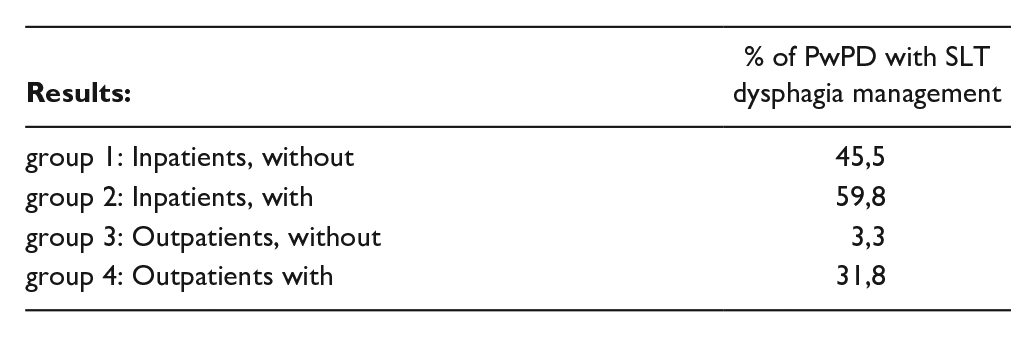
SLT dysphagia management included clinical investigation, training the structures related to swallowing, giving advice to PwPD and their carers on managing swallowing difficulties.
(1) Web application for analysis: mdt-parkinson.de
P-577
Understanding the Implications of Single-use Rhinolaryngoscopes for FEES Procedures on SLP Workflow
1Ambu USA, Health Economics & Outcomes Research, Market Access, Columbia, MD, United States
P-578
Delayed cough reflex and cough effectiveness in patients with significant dysphagia: an observational study
1Gachon University Gil Hospital, Rehabilitation, Incheon, South Korea
P-581
The relationship between swallowing oral hesitation and cognition in frontal lobe stroke
1Department of Rehabilitation Medicine, Seoul National University Hospital, Rehabilitation, Seoul, South Korea
2Hanyang Guri Hospital, Rehabilitation, Guri, South Korea
P-582
iSpeak: a digital companion for speech assessment
1Lake Lucerne Institute, DARTLab, Vitznau, Switzerland
2cereneo Foundation, Vitznau, Switzerland
3cereneo Foundation, Weggis, Switzerland
P-583
Integrating artificial intelligence for enhanced data management in neurological patient care
1NMC & BYL Nair Charitable Hospital, Physiotherapy, Mumbai, India
2Bombay Hospital & Medical Research Center, Mumbai, India
3NMC & BYL Nair Charitable Hospital, Occupational Therapy, Mumbai, India
The Study explores the integration of Artificial Intelligence (AI) techniques in the field of data management for neurological patients, aiming to improve diagnostic accuracy, treatment planning, and overall patient outcomes. Neurological disorders encompass a diverse range of conditions, each presenting unique challenges in data acquisition, processing, and interpretation. Traditional methods of data management often struggle to handle the complexity and volume of information generated from various imaging modalities, genetic studies, and clinical assessments.
This research investigates the application of AI algorithms, including machine learning, deep learning, and natural language processing, in streamlining the processing and analysis of neurological patient data. By leveraging AI-driven approaches, healthcare providers can enhance their ability to accurately diagnose conditions, predict disease progression, and tailor treatment strategies to individual patient profiles. Moreover, AI-powered tools facilitate the integration of diverse data sources, allowing for a holistic understanding of the patient’s condition.
The study highlights several key applications of AI in neurological data management, including automated image analysis for radiological studies, predictive modeling for disease progression, and personalized treatment recommendations based on genetic and clinical data. Additionally, the implementation of AI-driven decision support systems shows promise in optimizing clinical workflows, reducing diagnostic uncertainties, and improving resource allocation in healthcare settings.
In conclusion, this research underscores the transformative potential of integrating AI in the data management of neurological patients. The adoption of AI-driven solutions has the potential to revolutionize clinical practice, enabling more precise diagnoses, personalized treatment plans, and improved patient outcomes in the realm of neurological care. The findings of this study offer valuable insights for healthcare practitioners, researchers, and policymakers seeking to harness the full potential of AI in neurology.
P-584
How to increase the dosage and quality of exercise at home? Retrospective real world analysis of a neurorehabilitation digital-based protocol for people with stroke
1Trainfes, Translational Research Unit, Santiago, Chile
2Catholic University of Chile, Biomedical Imaging Center, Santiago, Chile
3Metropolitan University of Science Education, Kinesiology, Santiago, Chile
P-585
Teleneurorehabilitation program (virtual reality) for patients with balance disorders: descriptive study
1Clinica Alemana, Physical Therapy and Rehabilitation, Santiago, Chile
2Universidad del Desarrollo, Physical Therapy, Santiago, Chile
Alcock L, O"Brien TD, Health Care Women Int (2018) 39:1366–1380. doi:10.1080/07399332.2018.1499106
Mileti I, Taborri Sensors (Switzerland) (2020) 20: doi:10.3390/s20010063
Agrawal Y, Ward BK. J Vestib Res Equilib Orientat (2013) 23:113–117. doi:10.3233/VES-130498
P-586
Effect of sociodemographic variables on functional recovery of the paretic arm after applying constraint induced movement therapy in remote versus face-to-face modality
1Frontera University, Rehabilitation, Temuco, Chile
2Catholic University, Temuco, Chile
P-587
What do therapists think about data from wearable technology for stroke rehabilitation?
1University of Montreal, Rehabilitation, Montreal, Canada
2Center for Interdisciplinary Research in Rehabilitation, IURDPM, Montreal, Canada
3University of Montreal, Medicine, Montreal, Canada
P-590
Remote assessment and interventions of bilingual and multilingual people with primary progressive aphasia (PPA): a mini review of literature
1Euro Mediterranean University of Fez (UEMF), Fez, Morocco; 2Moravian University, Philadelphia, PA, United States
Primary progressive aphasia (PPA) as a neurodegenerative disease with linguistic presentation has been described extensively in mono-lingual and English-speaking patients. However due to the heterogeneity of clinical presentations of PPA as well as the neurotypical underpinnings of its variants, there is a need to investigate the culturally and linguistically diverse (CALD) population for whom there is no consensus on care or asessment. To address this gap, the current review aims to identify the assessment and intervention protocols used remotely for this population.
A literature review was conducted between September and October 2023. A literature search was conducted for articles published in English that addressed tele-assessment and tele-rehabilitation for multilingual people with primary progressive aphasia (MPW-PPA) in the field of Speech Language Therapy or Pathology.
A total of 21 full-text studies were assessed for eligibility. Based on the inclusion and exclusion criteria, six articles were included in this scoping review. Factors that contributed to the successful delivery of remote-based assessment and interventions were described in terms of technological medium and modality of intervention. This scoping review has demonstrated an urgent need for setting up telerehabilitation for the benefit of MPW-PPA. However, the selected studies used mostly single case or survey, which limits the generalizability and comparability of the findings.
This review maps the current paucity of literature on remote-based assessment and therapy in MPW-PPA. There is a huge need for future research to include people from CALD population and to describe them in terms of demographic, socio-linguistic, neuropsycho-linguistic, socio-cultural and clinical variables. In order to bridge the digital gap, technological devices should be made available to diverse MPW-PPA as well as their caregivers in order to optimize the therapeutic alliance and outcomes.
P-591
A review of tools for telerehabilitation of acquired neurogenic language disorders in Arabic
1Euro Mediterranean University of Fez (UEMF), Fez, Morocco
2Moravian University, Philadelphia, PA, United States
Aphasia is an acquired neurogenic language disorder that typically occurs following stroke. While the majority of evidence-based interventions has been widely tailored for English-speakers, there has been a growing interest in implementing empirical studies about non-pharmacological therapies in non-Indo-European languages including Arabic-speakers with aphasia (ASWA). Recently, the standardization of these approaches in Western languages follow the Rehabilitation Treatment Specification System (RTSS). Thus, this scoping review aimed to map a comprehensive characterization of RTSS in ASWA.
A literature review was conducted in August 2023. We searched articles published in English from 2000 to 2023 in PubMed, Web of Science and Scopus databases that addressed the telerehabilitation of acquired neurogenic language disorders in ASWA. A total of 89 articles has been identified. Based on the inclusion criteria, 5 suitable studies were selected. Factors that contributed to the successful delivery of rehabilitation were described in terms of treatment targets, ingredients and mechanism of action (MOA) per the rehabilitation treatment specification system (RTSS).
There are a number of intrinsic and extrinsic factors to take into account when delivering and tailoring specific rehabilitation approaches for ASWA, including lack of theoretical framework and evidence-based approaches; restricted availability and accessibility of technological medium; limited literacy and numeracy prior to stroke and lack of RTSS core components. Despite the paucity of selected studies, they focused on neuromodulation techniques using TDCs (n=1) and telerehabilitation (n=2).
This review showed the urgent need to implement an evidence-based approaches in telerehabilitation of acquired neurogenic language disorders in Arabic. In this cotext, RTSS framework should be used in developing, comparing, delivering and tailoring specific non-pharmacological therapies in people with aphasia.
P-592
Balance telerehabilitation for people with Parkinson’s disease: the TelePD trial
1Oregon Health Science University, Portland, OR, United States
P-593
Added value of telerehabilitation to provide intensive upper limb training during the chronic phase of stroke recovery: the stroke survivor’s perspective
1University of Montreal, École de réadaptation, Montreal, Canada
2McGill University, Montreal, Canada
P-594
Preferred technology-based solutions for meeting the needs of young adults with stroke in australia: a cross-sectional study
1University of Tasmania, Health Science, Launceston, Australia
2University of Tasmania, Medicine, Burnie, Australia
3University of Tasmania, Nursing, Launceston, Australia
4University of British Columbia, Physical Therapy, Vancouver, Canada
P-595
A qualitative study of individuals with acquired brain injury and program facilitators experiences in virtual ABI community support programs
1University of British Columbia, Vancouver, Canada
2Brain Injury Association of Peel and Halton (BIAPH), Mississauga, Canada
3University of Toronto, Toronto, Canada
P-597
Tele-assessments for upper extremity motor function in stroke rehabilitation – a systematic review
1ZHAW Zurich University of Applied Sciences, School of Health Sciences, Institute of Occupational Therapy, Winterthur, Switzerland
2University of Zurich, Medicine, Zurich, Switzerland
3University of Zurich, Neurology, Zurich, Switzerland
4Care Home City of Winterthur, Winterthur, Switzerland
5Klinik Adelheid, Zug, Switzerland
1. Sharififar S, Ghasemi H, Geis C, et al. Telerehabilitation service impact on physical function and adherence compared to face-to-face rehabilitation in patients with stroke: A Systematic Review and Meta-Analysis. PM&R 2023; pmrj.12988.
2. Sauerzopf L, Luft A, Frey S, et al. Remotely Assessing Motor Function of the Upper Extremity after Stroke: A Systematic Review of Validity and Clinical Utility of Tele-Assessments [Unpublished manuscript].
P-598
Clinical efficacy of cognitive stimulation in aged subjects with mild and moderate cognitive impairment
1S. Anna Institute, Research, Crotone, Italy; 2University of Catanzaro "Magna Graecia", Nurology, Catanzaro, Italy
All remote treatments (TR) provide a direct, bidirectional, online connection; the therapist at the rehabilitation center sets up exercises in the virtual environment on the patient’s computer and can always check and modify the exercises as they are performed. Cognitive stimulation (CS) was delivered for 1 h/d, 5 t/w, for 4 consecutive weeks. The Cognitive Module enables activities related to the treatment of neurological disorders afferent to the cognitive sphere.
Cognitive assessment: MDB; TMT; B.A.D.A.; 15 Rey words; BDI-II; STAI; SF-36; CBI. Clinical assessments were administered blinded, before and after treatments.
Contrada, M., Arcuri, F., Tonin, P., Pignolo, L. Cerasa, A. (2021). Stroke Telerehabilitation in Calabria: A Health Technology Assessment. Frontiers in Neurology, 12.
P-599
NeuroRehabilitation OnLine (NROL): description of a multidisciplinary group telerehabilitation innovation for stroke and neurological conditions using the TIDieR checklist
1East Lancashire Hospitals NHS Trust, Burnley, United Kingdom
2Lancaster University/ East Lancashire Hospitals NHS Trust, Lancaster, United Kingdom
3University of Central Lancashire, Preston, United Kingdom
4Cambridge University Hospital NHS Foundation Trust, Lancaster, United Kingdom
P-601
Understanding physical therapists’ perspectives and attitudes towards artificial intelligence in healthcare and rehabilitation: qualitative study
1King Abdulaziz University, Physical Therapy, Jeddah, Saudi Arabia
2King Saud bin Abdulaziz University for Health Sciences, Jeddah, Saudi Arabia
3University of Birmingham, Birmingham, United Kingdom
4Princess Nourah bint Abdulrahman University, Riyadh, Saudi Arabia
P-603
Developing ROSIA (Remote Rehabilitation Services For Isolated Areas): the EU ROSIA pre-commercial procurement project, results of phase 1 and 2
1National Rehabilitation Hospital, Dublin, Ireland
P-604
Improving neuro telerehabilitation accessibility and features: OpenTera, an open-source software platform
1Research Center on Aging - CIUSSS de l’Estrie-CHUS, Sherbrooke, Canada
2Sherbrooke University, Sherbrooke, Canada
P-605
Benefits and challenges of a regional NeuroRehabilitation OnLine (NROL) innovation
1East Lancashire Hospitals NHS Trust, Burnley, United Kingdom
2Lancaster University/ East Lancashire Hospitals NHS Trust, Lancaster, United Kingdom
3University of Central Lancashire, Preston, United Kingdom
Patient outcomes and feedback were positive, with benefits of peer support reported. Service data indicate increased access and capacity for therapy, allowing patients with similar presentations to receive more targeted group-based interventions. Staff benefits include professional development and networking opportunities. Organisational advantages include staff delivery efficiencies (staff:patient ratio=0.4) and reduced travel time and costs (saved >40,000 driving-miles). NROL does not suit everyone (withdrawal rate~18%).
Challenges exist around staff capacity for session delivery, referrer engagement, cross-organisation communication, and differences in infrastructure and governance across provider organisations.
P-606
Digital therapeutics for knee joint recovery after total knee replacement surgery: a reliability and validity study
1Sunmoon University, Asan-si, South Korea
2University, Physiotherapy, Asan-si, South Korea
P-607
An automated assessment based on deep learning pose estimation technology for upper extremity motor function following stroke
1Chang Gung University, Occupational Therapy and Graduate Institute of Behavioral Sciences, Taoyuan, Taiwan
2Chang Gung University, Computer Science, Taoyuan, Taiwan
3New Taipei Municipal Tucheng Hospital, Neurology, New Taipei, Taiwan
4Chang Gung Memorial Hospital, Physical Therapy and Rehabilitation, Chiayi, Taiwan
P-608
Ballistic resistance training improves mobility more than usual physiotherapy intervention following traumatic brain injury: a randomised controlled trial
1University of Melbourne, Physiotherapy, Richmond, Australia
2Sydney School of Health Sciences, Medicine, Sydney, Australia
3Institute for Musculoskeletal Health, The University of Sydney, Sydney, Australia
4School of Health and Behavioural Sciences, University of the Sunshine Coast, Sippy Downs, Australia
5University of Melbourne, Melbourne, Australia
6La Trobe University, Melbourne, Australia
7Epworth Healthcare, Melbourne, Australia
8University of Sydney, Sydney, Australia
P-609
Evidence-based review of randomized controlled trials of interventions for mental health management post moderate to severe traumatic brain injury
1Parkwood Institute, Physical Therapy and Rehabilitation, London, Ontario, Canada
2Western University, Nursing, London, Ontario, Canada
3University of Toronto, Toronto, Canada
P-610
Are you doing the best to care for people after they have sustained a traumatic brain injury (TBI)? How Living Clinical Practice Guidelines ensure best practice care and resources are at your fingertips
1University Health Network, Toronto Rehabilitation Institute, Toronto, Canada
P-611
Development of the first clinical practice guideline for intimacy and sexuality following moderate to severe traumatic brain injury (INTIMASY-TBI)
1University Health Network, Toronto Rehabilitation Institute, Toronto, Canada
2Rehabilitation Hospital of Indiana, Indianapolis, IN, United States
3University of Illinois, Chicago, IL, United States
4University of Pennsylvania, Philadelphia, PA, United States
5University of Montreal, Montreal, Canada
6Indiana University, Indianapolis, IN, United States
7Baylor College of Medicine, Houston, TX, United States
P-612
What is the impact of living with a traumatic brain injury and how can co-production of a resource with traumatic brain injury survivors be achieved?
1University of Kent, Health Service Research, Canterburry, United Kingdom
2East Kent Hospitals University NHS Foundation Trust, Neurorehabilitation, Canterburry, United Kingdom
3Kent and Medway NHS and Social Care Partnership Trust, Psychiatry, Maidstone Kent, United Kingdom
Data collected regionally by the Kent Public Health Observatory shows that the number of hospital in-patient admissions for traumatic brain injury (TBI) in Kent and Medway (K&M) increased from 3645 in 2016 to 4295 in 2019 and the latest national data figures published by a UK charity show that Head Injury hospital admissions have increased by 3%, which suggests that this is a public health issue.The regional increase in incidence of TBI is a driver for this research because an increased number of admissions for head injury in K&M means that there will be more survivors, confronted by long term health challenges, who may need to access health and care services as a direct result of TBI exposure.Stage 1-To identify what are the long-term health issues experienced by survivors of moderate TBI (mTBI) and severe TBI (sTBI)?What do we know about how mTBI and sTBI survivors experience and manage their recovery journeys?Stage 2-To identify what kinds of resources are used and might be of value to access by survivors of mTBI and sTBI?How do mTBI and sTBI survivors experience taking part in a "co-production" process? Stage 1-Qualitative study with semi-structured interviews by telephone.10 interviews with survivors & 5 with primary care-givers.University of Kent Ethical Committee approval on 21/1/2022.Data analysis used the One Sheet of Paper thematic approach.Results:16 themes identified in TBI survivor data:Survivorship, life changes, long term health impacts,impact on family,relationships, employment,education,hobbies, resources and coping strategies, recovery journeys, broken care system, non-visible disabilities,achievements, ongoing challenges, beyond survivorship, ideas for resource co-design.10 themes identified from care-giver data.Conclusion:Survivors and their care givers identified complex diverse impacts on health and their social lives, alongside of describing resources used to alleviate and improve specific challenges.These findings will enable Stage 2 in 2024
P-613
Recovery from paroxysmal sympathetic hyperactivity after severe traumatic brain injury following the administration of bromocriptine medication: a case report
1Daejeon Eulji Medical Center, Eulji University, Rehabilitation, Daejeon, South Korea
2National Health Insurance Service Ilsan Hospital, Physical Therapy and Rehabilitation, Goyang, South Korea
P-614
Demonstrating that inpatient rehabilitation following acquired brain injury provides value for money. Adaptation of the UK cost-efficiency model for Australia
1Monash University, Neuroscience, Melbourne, Australia
2Alfred Health, Melbourne, Australia
3Flinders University, Adelaide, Australia
4University of Sydney, Sydney, Australia
5King’s College London, Cicely Saunders Institute, London, United Kingdom
P-616
Naturalistic psychedelic use for TBI symptom management: findings from the global psychedelic survey
1University of Victoria, Psychology, Victoria, Canada
2Institute on Aging and Lifelong Health, Victoria, Canada
3University of Victoria, Medicine, Victoria, Canada
4University of California, UCLA Center for Cannabis and Cannabinoids, Department of Psychiatry and Biobehavioral Sciences,, Los Angeles, CA, United States
5SABI Mind, Calgary, Canada
[1] Osmond et al. (2023). https://doi.org/10.1001/jamanetworkopen.2023.16383
[2] Ross et al. (2016). https://doi.org/10.1177/0269881116675512
P-617
Post-traumatic brain injury psychosis and the role of an interdisciplinary brain medicine clinic: a case report
1University of Toronto, Medicine, Toronto, Canada
2University of Toronto, Department of Psychiatry, Toronto, Canada
P-618
Combined pharmacologic and nonpharmacologic interventions for sexually disinhibited behaviors following traumatic brain injury: a case series
1McGovern Medical School at UT Health, Houston, TX, United States
2TIRR Memorial Hermann, PM&R, Houston, TX, United States
3Memorial Hermann Health System, Houston, TX, United States
4TIRR Memorial Hermann, Neuropsychology, Houston, TX, United States
P-621
Influence of off-hour hospital admission on short-term mortality after traumatic brain injury according to age group
1Chonnam National University Hospital, Department of Emergency Medicine, Dong-gu, Gwangju, South Korea
P-622
Predictors of return to work in the first year after severe traumatic brain injury: a prospective, observational cohort study
1Universidade Federal do Espirito Santo, Center for Health Sciences (Centro de Ciências da Saúde), Vitória, Brazil
Survivors of severe Traumatic Brain Injuries (sTBI) encounter challenges returning to work (RTW), considered a primary goal by the World Health Organization in the TBI rehabilitation.¹ There are approximately 5.5 million sTBI cases annually², and 50% of these individuals fail to RTW in long term. Several studies have explored predictors of employment status after sTBI, but the investigations have only taken place in High-Income Countries. Studies assessing the trajectory of RTW and its predictive factors at Low/Middle-Income Countries as Brazil are limited. The objective of this study is to investigate clinical and sociodemographic factors associated with RTW 6 and 12 months after sTBI. Individuals with sTBI admitted to the reference trauma hospital in 1 year period were considered, and the inclusion criteria were sTBI diagnosis, age >18 years old and an employed status before trauma. 135 individuals were included, and 97 individuals completed the 12-month follow-up. RTW was observed in 23.7% of the participants, 6 months after sTBI, and 32.9% at 12 months. Physical aggression (PA) as the cause of injury, length of Mechanical Ventilatory Support, and high level of education (HLE) were associated with a higher probability of RTW 6 months after sTBI. At 12 months after trauma, PA as the cause of injury, ISS score, performance of decompressive craniectomy, job security, and a HLE were associated with a higher probability of RTW. According to this study, most patients with sTBI don"t return to work one year after the injury. Disability and cognitive impairments are the primary factors that contribute to the challenges faced by these individuals in reintegration at social life. Reference: ¹ Yue JK, et al. Predictors of six-month inability to return to work in previously employed subjects after mild traumatic brain injury: A TRACKTBI pilot study. J Concussion. 2021. ² Dewan MC, et al. Estimating the global incidence of traumatic brain injury. J Neurosurg. 2018;1-18.
P-623
Predictor of long-term functional outcome after severe traumatic brain injury
1Universidade Federal do Espírito Santo, Vitória, Brazil
Traumatic brain injury (TBI) is the main cause of disability worldwide1-2, leading to long-term (L-T) incapacities or limitations in social life. Most prediction models for functional outcome after TBI come from developed countries. But sociocultural and clinical factors may differ in Low/Middle-income countries, leading to variations in recovery rates and predictive factors. There are no studies that have followed these individuals and assessed the L-T trajectory of functional recovery after hospital discharge in Brazil. Our goal was to investigate clinical and sociodemographic factors associated with functional outcome 1 year after severe TBI (sTBI). 172 individuals with sTBI admitted to the reference trauma hospital in Brazil, between May/21 to May/22 were enrolled. Only 145 patients completed 1 year follow-up. In this study, patients with sTBI presented a high level of disability at hospital discharge, wich may be explained by the high in-hospital mortality rate (>50%). After 12 months, 26% of the individuals achieved full recovery and 22% achieved good recovery. Although, disability and mortality were still considerably high in this population 1 year after the injury. In multivariate analyses, independent predictive factors for an unfavorable L-T outcome were advanced age, length of stay on mechanical ventilation, education level and ISS scores. Our findings suggest that while clinical and physiological parameters appear to be associated with short-term hospital mortality, socioeconomic factors such as age and education play a significant role in long-term functional recovery after hospital discharge. ¹Areas FZ, et al. Predictors of Hospital Mortality and the Related Burden of Disease in Severe Traumatic Brain Injury: A Prospective Multicentric Study in Brazil. Front Neurol. 2019; ²Carteri, RBK; Silva, RA. Traumatic brain injury hospital incidence in Brazil: an analysis of the past 10 years. Rev Bras Ter Intensiva. 2021.
P-624
Success is a journey: pilot implementation of the Ideal Care Pathway for traumatic brain injuries
1University Health Network, KITE Research Institute, Toronto Rehabilitation Institute, Toronto, Canada
2Central Acquired Brain Injury Collaborative, Toronto, Canada
3Community Networks of Specialized Care – Central East, Toronto, Canada
4Home and Community Care Support Services, Ontario, Canada
5Vista Centre Brain Injury Services, Ottawa, Canada
6Hull-Ellis Concussion and Research Clinic, Toronto, Canada
7Toronto ABI Network, Toronto, Canada
P-625
Attentional blink post-concussion: association with fear-avoidance constructs and implications for intervention
1Simon Fraser University, Psychology, Burnaby, Canada
P-626
Hemispheric hyperfunction syndromes post traumatic brain injury
1University of Central Florida, Neurology, Orlando, FL, United States
P-627
Rapid, Accurate, and Cost-Effective (RACE) analysis of blood biomarkers for concussion diagnosis and prognosis: prior traumatic life events correlate to initial symptom severity
1University of Calgary, Neuroscience, Calgary, Canada
2University of Calgary, Hotchkiss Brain Institute (HBI), Calgary, Canada
3University of Calgary, Emergency Medicine, Calgary, Canada
4University of Calgary, Biomedical Engineering, Calgary, Canada
P-628
Upper limb pointing movement performance in individuals with concussions
1University of Texas, Physical Therapy, San Antonio, TX, United States
2University of Texas, Rehabilitation, San Antonio, TX, United States
P-629
Fingolimod protects against inflammation by inhibiting NF-ƘB signaling pathway after traumatic brain injury in mice
1Seoul National University Hospital, Rehabilitation, Seoul, South Korea
Traumatic brain injury is one of the leading causes of morbidity and mortality throughout the world. Its increasing incidence, and its fundamental role in the development of neurodegenerative disease, proves that TBI is especially concerning disease. Despite extensive preclinical and clinical studies, researchers have yet to identify a safe and effective neuroprotective strategy. FTY720 acts as a functional antagonist of S1P1 receptors. A total of 52 adult mice were subjected to controlled cortical impact, CCI, or sham injury which underwent craniotomy only. And CCI mice were subjected to high dose fingolimod, low dose fingolimod, or normal saline for control.In the behavioral assessments, fingolimod treated mice showed significantly improved motor performances in Neurological severity score, rotarod tests, cylinder tests, and openfield tests, compared with control mice. Particularly, MSD multiplex immunoassay showed a trend for pro-inflammatory cytokines IL-1B and IL-6 to decrease and anti-inflammatory cytokine IL-10 in high dose fingolimod treated group compared with the control group in the hippocampus. The levels of NF-ĸB, quantified by WB, was significantly decreased in the high dose fingolimod treated group in the cerebral cortex compared with the control group.
In this study, both high and low dose fingolimod exhibited immunomodulatory effects on neuroinflammation in experimental TBI. Since the safety was approved previously by FDA, Exploring new therapeutic uses of fingolimod for TBI treatment could lead to safe, affordable and timely new treatment options And The dose and therapeutic window should be considered before using fingolimod to treat clinical TBI.
P-630
Extended reality-based exposure and cognitive behavioral therapy (CBT) for job interview skill and anxiety management of autistic adults: a pilot and feasibility study protocol
1University of Alberta, Rehabilitation, Edmonton, Canada
2University of Alberta, Medicine & Dentistry - Pediatrics, Edmonton, Canada
P-631
Older drivers with cognitive impairment show slower take-over performance during automated driving
1University of Kansas Medical Center, Physical Therapy and Rehabilitation, Kansas City, KS, United States
2University of Kansas Medical Center, Kansas City, KS, United States
P-632
Bilateral parietal cortex activation in stroke patients with unilateral spatial neglect during virtual prism adaptation
1Korea University, Department of Electronics and Information, Sejong, South Korea
2Korea University, Interdisciplinary Graduate Program for Artificial Intelligence Smart Convergence Technology, Sejong, South Korea
3Seoul National University Bundang Hospital, Rehabilitation, Seongnam-si, South Korea
4Delvine Inc., Seoul, South Korea
P-633
Exploring perspectives of occupational therapists and people with traumatic brain injury on the potential use of virtual reality in practice for occupation-based cognitive intervention
1University of Queensland, School of Health and Rehabilitation Sciences, Brisbane, Australia
2Surgical Treatment and Rehabilitation Service (STARS), Education and Research Alliance, Brisbane, Australia
3Prince Charles Hospital, Allied Health Research Collaborative, Brisbane, Australia
4Princess Alexandra Hospital, Metro South Hospital and Health Service, Brisbane, Australia
5Royal Brisbane and Women’s Hospital, Metro North Health, Brisbane, Australia
P-634
Identifying key stakeholder goals and priorities for cognitive neurorehabilitation using virtual reality to inform co-design of future applications
1University of Queensland, School of Health and Rehabilitation Sciences, Brisbane, Australia
2Prince Charles Hospital, Allied Health Research Collaborative, Brisbane, Australia
3Surgical Treatment and Rehabilitation Service (STARS), Education and Research Alliance, Brisbane, Australia
4Surgical Treatment and Rehabilitation Service, Metro North Health, Brisbane, Australia
5Princess Alexandra Hospital, Metro South Hospital and Health Service, Brisbane, Australia
6Royal Brisbane and Women’s Hospital, Metro North Health, Brisbane, Australia
7University of Queensland, Recover Injury Research Centre, Brisbane, Australia
P-635
Development of a behavioural biomarker for cognitive impairment through navigation experiments
1University of British Columbia, Biomedical Engineering, Vancouver, Canada
2University of British Columbia, Djavad Mowafaghian Centre for Brain Health, Vancouver, Canada
3University of British Columbia, Vancouver, Canada
4McGill University, Montreal, Canada
P-636
Improvement of active elbow extension with short-term error augmentation training in stroke survivors
1McGill University, Neuroscience, Montreal, Canada
2Ben-Gurion University, Industrial Engineering and Management, Beer Shiva, Israel
3Ben-Gurion University, Physical Therapy, Beer Shiva, Israel
4McGill University, Physical and Occupational Therapy, Montreal, Canada
Stroke leads to lasting problems using the upper limb (UL) in everyday activities. While rehabilitation depends on motor learning, UL recovery remains less than ideal. Implicit learning may lead to better outcomes than explicit learning. Error augmentation (EA) is a feedback modality based on implicit learning, which has been used in patients with stroke resulting in improved precision and speed of UL reaching movements. However, accompanying changes in UL movement patterns were not reported. Post-stroke patients may use compensatory shoulder and trunk movements to improve reaching success. To achieve better UL motor recovery, emphasis can be placed on training movement patterns that were present before the stroke. The study objective is to increase the range of active elbow extension during a functional reaching task in patients with stroke with short-term training using EA feedback of the elbow extension range.
A reaching training program was created in virtual reality to provide a challenging and motivating environment promoting implicit motor learning. Adults with chronic stroke (n = 24) trained reaching 3x in 1 wk (150 trials/30 min x 3) with or without EA feedback. EA encouraged greater elbow extension during reaching by making the elbow appear to move less than in reality. Pre- and post-training outcomes were assessed clinically and kinematically using a standardized test reaching task. These included UL joint and trunk kinematics, endpoint precision, speed, smoothness and straightness as well as the size of the active reaching zone during training. Results show that both groups improved UL, trunk and endpoint kinematics. Subjects who trained with EA feedback had greater changes in the size of the active reaching zone compared to those who trained without EA feedback. Results will inform the design of effective personalized training protocols using EA feedback for people with post-stroke UL deficits.
P-638
Effects of virtual reality game-based exercise on functional fitness in community-dwelling elderly adults
1National Health Research Institutes, National Center for Geriatrics and Welfare Research, Yunlin, Taiwan
2Taipei Medical University, Taipei, Taiwan
P-639
Clinical potential of virtual reality based task for post-stroke neuro-rehabilitation of distal upper extremities: a pilot study
1Indian Institute of Technology Delhi, Biomedical Engineering, New Delhi, India
2All India Institute of Medical Sciences, Neurology, New Delhi, India
3All India Institute of Medical Sciences, Department of Psychiatry, New Delhi, India
4All India Institute of Medical Sciences, Biomedical Engineering, New Delhi, India
P-640
Virtual reality in cognitive rehabilitation: neural mechanisms from fMRI research
1University Hospital Aachen, Division of Clinical Cognitive Sciences, Aachen, Germany
2University Hospital Aachen, Brain Imaging Facility, Aachen, Germany
3Ruhr-University Bochum, Institute of Cognitive Neuroscience, Bochum, Germany
4Research Center Jülich, Institute for Neuroscience and Medicine (INM-4), Juelich, Germany
P-641
Virtual reality navigation serious game for spatial orientation training of people living with Alzheimer’s
1University of Manitoba, Biomedical Engineering, Winnipeg, Canada
We have developed a new virtual reality navigation game with a focus on strengthening spatial orientation while being enjoyable; the game uses gadgets that are easily accessible, and easy to use even for people with Alzheimer’s. These are crucial for the game to be used for rehabilitation in Alzheimer’s population.
Performance pre and post-training on a spatial assessment developed and validated by our research group, VRN-House, and the BRN game score are used as the main outcome measures.
P-642
Investigating the effects of a novel virtual reality intervention using music-based mirror therapy on upper limb motor function in chronic stroke – a protocol paper
1Flinders University, College of Science & Engineering, Adelaide, Australia
2Flinders University, Medical Device Research Institute, Adelaide, Australia
3Flinders University, Nursing and Health, Adelaide, Australia
4University of South Australia, Allied Health & Human Performance, Adelaide, Australia
P-643
Flow experience during immersive virtual reality training in patients with stroke with neglect or apraxia
1University of Bern, ARTORG Center for Biomedical Engineering Research, Bern, Switzerland
P-644
A case report of a stroke patient with moderate hemiplegia who underwent upper extremity functional training using an immersive virtual reality device
1Hyogo Medical University, Rehabilitation, Nishinomiya, Japan
P-645
A novel virtual reality glove system with integrated vibro-tactile feedback for Parkinson’s disease: a usability study
1University of Bern, ARTORG Center for Biomedical Engineering Research, Bern, Switzerland
2Technical University Delft, Delft, Netherlands
3Sensoryx AG, Zurich, Switzerland
PL-001
Development and content validation of the Pediatric Dizziness Index (PDI)
1MGH Institute of Health Professions, Department of Physical Therapy, Boston, United States
2Simmons University, Department of Physical Therapy, Boston, United States
Finally, content validity index (CVI) was calculated (CVI >0.8 indicated good content validity).
PL-004
Recognising syndrome of the trephined in neurorehabilitation: a case series
1Singapore General Hospital, Rehabilitation, Singapore, Singapore
Case two was a 32-year-old male who was admitted for traumatic brain injury. He required right-sided DC. Three months after TBI, he developed weakness in his left hand. CT brain showed midline shift to the right.
Case two underwent cranioplasty 2 months later and had good recovery within 2 days post- surgery. He regained full strength in his left hand was able to resume work.
1. Arai N et al. Progress in rehabilitation medicine. 2022;7:20220008.
2. Ashayeri K etal. Neurosurgery. 2016;79(4):525-34.
3. Di Rienzo A et al. Neurosurgical Review. 2020;43(1):323-35.
PL-005
Meeting the Unmet Need: A vision for equitable access to sexual and reproductive health for persons with Spinal Cord Injury/Disorder (SCI/D)
1GF Strong Rehabilitation Centre, Vancouver, Canada
2Blusson Spinal Cord Centre, Vancouver, Canada
3University of British Columbia, Vancouver, Canada
A high-level provincial action plan, utilizing a hub and spoke model, was developed by the steering committee and included these five goals: increased awareness of SHR; equitable access to specialized services at appropriate times; operational continuity and service enhancement; health provider education and training program; multi-year funding for innovation, research, and translation.
PL-006
Enhancing Cognitive Inhibition in Older Adults Through Exergame
1Nanyang Technological University, LILY Research Centre, Singapore, Singapore
2University of British Columbia, Department of Electrical and Computer Engineering, Vancouver, Canada
3Nanyang Technological University, School of Computer Science and Engineering, Singapore, Singapore
PL-007
ADL+: A novel ai-driven approach to prevent cognitive decline in older adults
1Nanyang Technological University, LILY Research Centre, Singapore, Singapore
2Tan Tock Seng Hospital, Institute of Geriatrics and Active Ageing, Singapore, Singapore
PL-008
Automated clock drawing test for early dementia risk assessment
1Nanyang Technological University, LILY Research Centre, Singapore, Singapore
2Nanyang Technological University, Alibaba-NTU Singapore Joint Research Institute, Singapore, Singapore
3Alibaba Group, n/a, China
PL-009
Pediatric traumatic brain injury: the effects of anxiety and depressive disorders
1Case Western Reserve University, Communication Science and Disorders, Cognitive Science, Department of Psychological Sciences, Cleveland, OH, United States
In the United States, an estimated 475,000,000 children sustain a traumatic brain injury each year. Traumatic brain injury (TBI) or concussion is a form of brain injury from either direct or indirect force to the head. TBI affects several aspects of neurological functioning. It is important to measure psychosocial disturbances (anxiety/depression) and executive functioning after the injury as they impact quality of life.
This project investigates if there is a relationship between higher rates of psychological disorders and executive functioning disorders among traumatic brain injury patients who have access to formal return-to-school programs compared to children who do not have access to formal return-to-school services. It is hypothesized that more pediatric TBI patients without formal return-to-school services will be significantly correlated to an increased likelihood of reporting psychological disorder and executive functioning disorder post-injury compared to children who do receive formal return-to-school services. A secondary analysis of data collected as part of the School Transition after Traumatic Brain Injury (STATBI) study was conducted. STATBI is a longitudinal study that uses primarily parent-proxy reports for a variety of outcome measures. Children recovering from TBI (5-18 years at age of injury) with access to BrainSTEPS (Strategies Teaching Educators, Parents, and Students) educational support program in the state of Pennsylvania, and children recovering from TBI in the state of Ohio without access to BrainSTEPS services were recruited. Assessments included pre-injury function, time of study entry (baseline), three months post-injury, six months post-injury, and twelve months post-injury. These assessments include the Child Behavior Checklist (CBCL) which measures emotional and behavior disturbances in adolescents as well as the Behavior Rating Inventory of Executive Functioning (BRIEF) which measures deficits in executive functioning. The analysis used in this project did not find differences for CBCL scores; however, more detailed analysis are needed to consider interaction of site, time point, and injury severity.
These results underscore the importance of mixed-methods research as quantitative measures could potentially miss changes that youth with TBI report in qualitative interviews. Future research should consider additional factors that might influence post-TBI outcomes, such as individualized interventions, social support systems, or differing recovery trajectories across diverse populations.
Project Mentor: Professor Angela Ciccia, Department of Psychological Sciences, Case Western Reserve University
PL-010
Development of a prehabilitation approach for surgeries in pediatric patients with cerebral palsy
1Dalhousie University, Medicine, Halifax, Canada
2IWK Health Centre, Halifax, Canada
3Queen’s University, Faculty of Health Sciences, Kingston, Canada
PL-011
The importance of nutritional supply in the acute phase of stroke: the cohort study
1Pusan National University Yangsan Hospital, Department of Rehabilitation Medicine, Yangsan, South Korea
2Pusan National University Yangsan Hospital, Biomedical Research Institute, Yangsan, South Korea
3Pusan National University School of Medicine, Department of Rehabilitation Medicine, Yangsan, South Korea
PL-012
Effect of memantine in chronic post-stroke aphasia: a case report
1Cleveland Clinic Foundation, Department of PM&R, Cleveland, OH, United States
2AIIMS Nagpur, Department of PM&R, Nagpur, India
PL-013
Repetitive peripheral magnetic stimulation in a traumatic spinal cord injury patient with cervical radiculopathy – a case report
1Hualien Tzu Chi Hospital, Buddhist Tzu Chi Medical Foundation, Department of Physical Medicine and Rehabilitation Medicine, Hualien, Taiwan
PL-014
Effects of 8 weeks of FES-Cycling on post-stroke patients: preliminary results
1Université de Bourgogne, Inserm CAPS U1093, Dijon, France
2Kurage, Lyon, France
3Institute of Technical Sciences of SASA, Belgrade, Serbia
4SSR Val Rosay, Saint-Didier-au-Mont-d’Or, France
5Rehabilitation clinic Dr Miroslav Zotovic, Belgrade, Serbia
6Université Grenoble Alpes, Inserm HP2 U1300, Grenoble, France
PL-015
Brain wellness, beyond all boundaries: from idea to implementation
1UBC Centre for Brain Health, BC Brain Wellness Program, Vancouver, Canada
As our population ages, there is an increased need for prevention and accessible care. Symptoms of many disorders of ageing can be prevented or mitigated with modification of lifestyle factors. Lifestyle-based research and programs have been emerging as effective adjunct therapies for a variety of neurological conditions. Research indicates positive effects of exercise and movement-based interventions on dementia, PD, MS, stroke, and healthy agers. Recently, creative expression activities such as mindfulness, art therapy, music, improvisation and gardening have been examined showing positive impacts on brain health and mental well-being. While many lifestyle-based programs involve singular interventions, some more recent therapies have shown the promising results of combining treatments, and have shown the positive impact of multimodal lifestyle interventions on specific populations.
We believed that a program which could cater to several neurological conditions, healthy agers and care partners alike could mitigate effect of participants comparing their current state of condition to those who have progressed further along, and could enhance feelings of community, through engagement with others of varying conditions and health qualities. We also believed that successful engagement is contingent on accessibility and removing or reducing barriers including financial and geographic. Overall, a lifestyle intervention with a multimodal nature, diverse participant pool, and online accessibility would be ideal for older adults, enhancing the current health care system and addressing the inequities in the aging experience as well as the needs of the underserved.
The British Columbia Brain Wellness Program (BCBWP), demonstrates the feasibility and effectiveness of a province wide online and in-person multimodal lifestyle intervention-based program. Our program is tailored to individuals with a wide variety of neurological conditions, their care partners, and healthy agers. Through an interconnected three-pillar structure of program delivery, research, and education, we provide programs and classes based on current scientific literature, conduct various research projects on these programs and cycle the research back to improving program delivery as well as dispersing the knowledge in a comprehensible manner to the public and to our participants.
Since opening in October 2019, the BCBWP has had remarkable growth and success. We have conducted in excess of 1200 individual assessments, supported over 800 active participants per semester and have a participant base that now exceeds 2000 individuals. The development history, mission, structure and content of the program as well as highlights from feedback surveys and participant focus groups will be shared, demonstrating the positive impact of our program on participants and encouraging the opportunity for this model of intervention to be replicated and expanded in other communities.
PL-016
Artificial intelligence powered functional electrical stimulation walking for gait rehabilitation after stroke
1Kurage, Lyon, France
2Université de Lyon, ENS de Lyon, CNRS, Lyon, France
3Centre de Soins de Suite et de Réadaptation du Val Rosay, Lyon, France
4Institute of Technical Sciences of SASA, Belgrade, Serbia
This retrospective study aims to assess gait improvement in post-stroke patients using the NeuroSkin© system during regular rehabilitation.
Intervention: 30-minute sessions, at least weekly for 4 to 6 weeks.
Assessment Metrics: 10mWT, 6mWT, TUG, and NFAC score.
Device: NeuroSkin© is an AI-powered real-time gait monitoring and correction system for walking rehabilitation. It integrates the following components:
Garment embedded with dry electrodes targeting six muscle groups: Gluteus Maximus, Quadriceps, Hamstrings, Tibialis Anterior, Fibularis, and Gastrocnemius. 7 Inertial Measurement Units; 10 Ground Reaction Force sensors Cloud-based AI-driven real-time Clinical Gait Analysis incorporated into a microcomputer positioned on the back of a vest worn by the patient.
PL-017
Using Radionuclide Ventriculoperitoneal shunt scintigraphy for patient with suspicious shunt malfunction
1Hualien Tzu Chi Hospital, Department of Nuclear Medicine, Hualien, Taiwan
2Neuro-Medical Scientific Center, Hualien Tzu Chi Hospital, Department of Neurosurgery, Hualien, Taiwan
3Tzu Chi University, Medicine, Hualien, Tajikistan
4Hualien Tzu Chi Hospital, Department of Physical Medicine and Rehabilitation Medicine, Hualien, Taiwan
PL-019
Connective tissue and skeletal muscle function. Implication for neurorehabilitation
1Policlinico Gemelli, Neurorehabilitation department, Rome, Italy
2Cattolica del Sacro Cuore University, Rome, Italy
1. Dietz V et al. Spastic movement disorder: impaired reflex function and altered muscle mechanics. Lancet Neurol 2007
2. Gracies J.M. Pathophysiology of spastic paresis: paresis and soft tissue changes. Muscle nerve, 2005
3. Stecco A et al. Peripheral mechanisms of spasticity and treatment implications. Current Physical Medicine and Rehabilitation Reports 2014
4. Peter P. Purslow The Structure and Role of Intramuscular Connective Tissue in Muscle Function. Front. Physiol., 2020