



Abstract

In the course of trying to extend the results presented in this paper with a larger data set, we discovered that the sources of Upper Extremity Fugl-Meyer (UEFM) scoresheets used in the analyses were incorrectly described due to clerical errors. First, Table 1 is partially incorrect. The studies from which the data were drawn included studies 34, 35, 38 as described, but did not include 31, 32, 33, or 37. Rather, UEFM scoresheets from two studies that were not listed in Table 1 (1,2) were included in the original analysis. Second, the UEFM scores were described as coming from 319 participants, but they actually came from 106 participants, some of whom were evaluated at multiple timepoints to produce the 319 UEFM measurements.
To determine whether these mistakes affected the analyses presented in Figure 2, we created Supplemental Figure 1 using only the baseline UEFM evaluations. We analyzed the baseline UEFM evaluations from the 106 individuals included in the original paper. We also analyzed an expanded data set comprised of 153 baseline UEFM evaluations from the references included in Table 1 (31-36, 38) plus (1,2) (Note: the data file for reference 37 had been lost). The results were consistent with the original Figure 2 (see paper), although the magnitude of the “dips” observed between UEFM bin 30-34 and bin 35-39 for the fraction scoring 2 for the extension and flexion synergies decreased (Supplemental Figure 1).
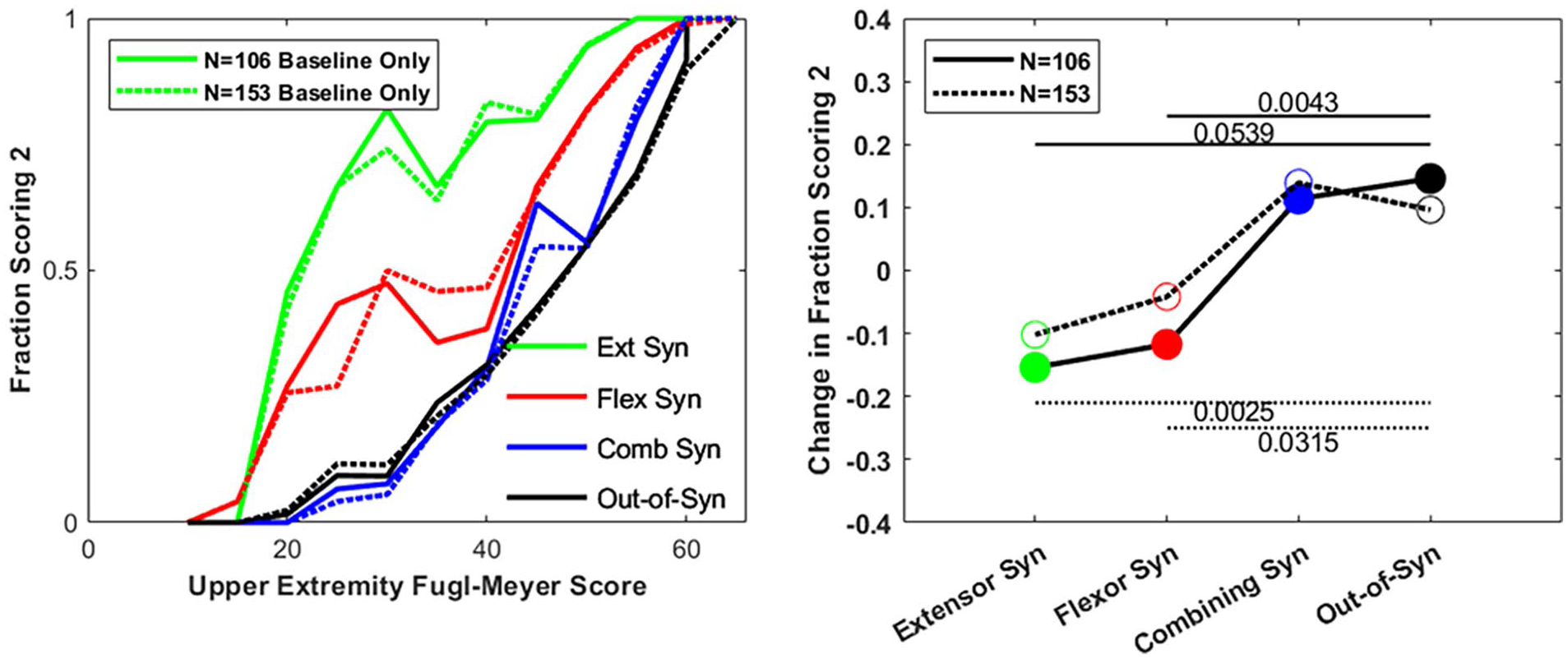
Replication of the analyses presented in Figure 2 from the original paper using only the baseline evaluations from the participants included in the original study (N = 106, solid lines, references 34, 35, 38 in the paper plus references 1 and 2 below), or the baseline evaluations from an expanded data set including more participants (N = 153, dashed lines, references 31-38 in the original paper plus references 1 and 2). In the figure at the right, p values for the same statistical comparisons presented in the original paper are shown (U test). Change in Fraction Scoring 2 is defined as the difference for fraction scoring 2 compared between UEFM bin 30-34 and bin 35-39.
The Change in Fraction Scoring 2 for the flexion synergy still remained significantly less when compared to out-of-synergy, now appearing as a more subtle flattening in slope rather than a dip. However, the Change in Fraction Scoring 2 for the extensor synergy did not. This suggests that the extensor “dip” observed in the original paper may have arisen due to study-specific factors, such as the way the study evaluator scored the extensor synergy. The correlation results shown in Figure 3 in the original paper (i.e. the other main result of the paper) remain consistent when tested with the larger dataset. The Journal Editor, a Data Integrity Officer of the authors’ institution and the Vice Chancellor for Research of the authors’ institution confirm that these changes do not affect the overall conclusions of this study.
The authors apologize for the inadvertent error.
1. Friedman N, Chan V, Reinkensmeyer AN, Beroukhim A, Zambrano GJ, Bachman M, et al. Retraining and assessing hand movement after stroke using the MusicGlove: Comparison with conventional hand therapy and isometric grip training. J NeuroEngineering Rehabil. 2014;11(1).
Inclusion criteria: Age >18 years, single ischemic, intracerebral, or hemorrhage stroke, chronic (> 6 months post stroke), UEFM 34-62, BBT 1-55; Exclusion criteria: No significant pain or instability on the affected side, no severe contracture of the upper extremity, no severe sensation deficit, no concurrent severe medical problems, no severe cognitive disfunction, not participating in other therapy, no visual deficits and no severe neglect or apraxia.
2. Sanders Q, Chan V, Augsburger R, Cramer SC, Reinkensmeyer DJ, Do AH. Feasibility of Wearable Sensing for In-Home Finger Rehabilitation Early After Stroke. IEEE Trans Neural Syst Rehabil Eng Publ IEEE Eng Med Biol Soc. 2020 Jun;28(6):1363–72.
Inclusion criteria: Age > 18 and < 80, 1-10 weeks post-stroke, UEFM 15-62, BBT>3 and BBT affected size < 80% BBT non-affected size; Exclusion criteria: No concurrent severe medical problems, no significant pain or instability on the affected side, no severe contracture of the upper extremity, no severe apraxia, no severe sensation deficit, no severe cognitive disfunction, not currently pregnant, not able to perform the experimental task.
Footnotes
Acknowledgements
The authors would like to thank Dr. Juan Perez for his assistance with the data analyses required for this corrigendum.