




Abstract
Fibromuscular dysplasia (FMD) is considered a rare blood vessel disorder; however, there has been a growing number of diagnosed cases suggesting a possible higher prevalence than initially thought. Many FMD patients are asymptomatic and the FMD is often accidently discovered and identified in more than one blood vessel. 1
Fibromuscular dysplasia can be found anywhere in the body but is mostly seen in the renal and carotid arteries. Fibromuscular dysplasia most commonly affects women from early to late adulthood but can occur at any age and affect both genders. The risks of FMD include but, are not limited to, stenosis, aneurysms, and dissections. 2
In this case report, a 77-year-old female reports a history of headaches, dizziness, and hyperlipidemia as well as being a previous smoker. A computed tomography scan showed possible FMD in the renal arteries. Ultrasound of the renal and carotid arteries was completed and demonstrated elevated velocities in the right distal renal artery (Panel A) and bilateral distal internal carotid arteries (Panel B, C) with beaded appearances of the arteries.
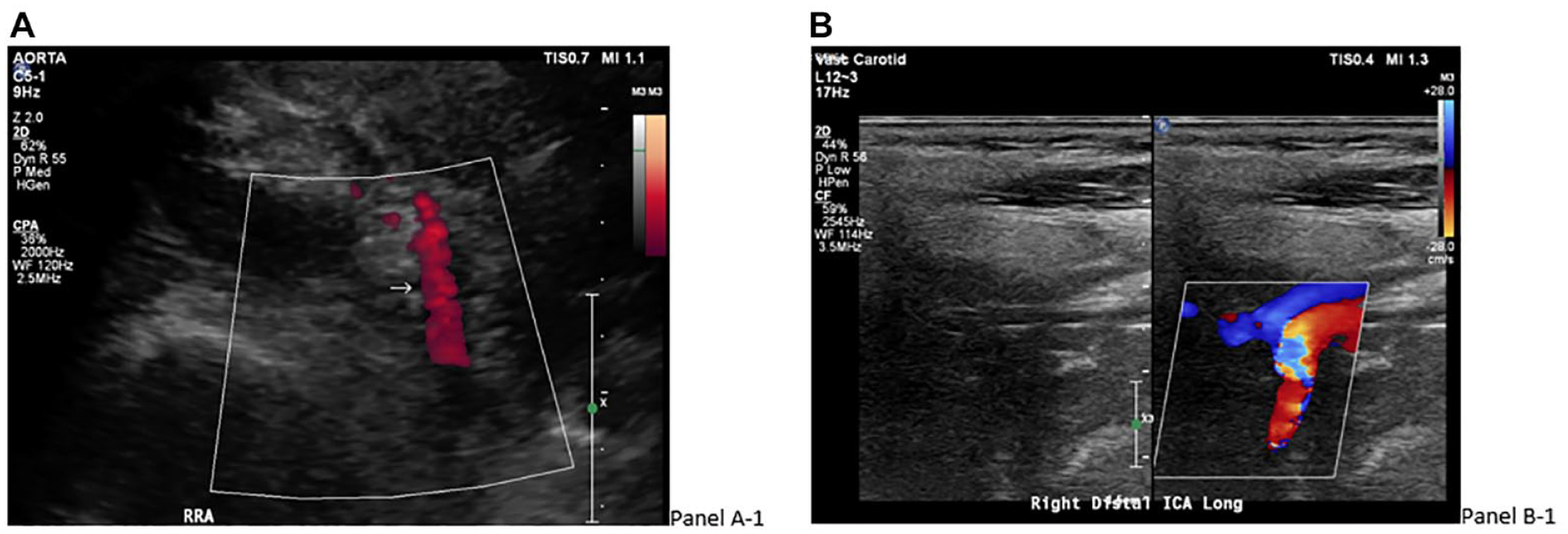

There is no diagnostic criteria for cerebrovascular or renal FMD since flow characteristics are different from patients with true atherosclerosis. For the ultrasound report, the findings were stated as, “there are elevated velocities in the distal internal carotid arteries bilaterally with a beaded appearance of the vessels which may be consistent with findings of fibromuscular dysplasia. There are also elevated velocities in the mid and distal right renal artery segments with a beaded appearance which may be consistent with findings of fibromuscular dysplasia.”
It is important to categorize a stenosis in arteries with suspected FMD cautiously since this may not be diagnostically accurate because FMD does not usually involve inflammation or plaque.
Research studies and data regarding FMD are continuously growing with many questions still unanswered. The evaluation of FMD by vascular ultrasound continues to be a safe, effective, and low-cost diagnostic examination that provides useful data and is an essential role in the surveillance and diagnosis of patients with FMD.
Footnotes
Declaration of Conflicting Interests
The author declared no potential conflicts of interest with respect to the research, authorship, and/or publication of this article.
Funding
The author received no financial support for the research, authorship, and/or publication of this article.