



Abstract
Recent literature highlights the role of community participation in reconstruction for sustainable peacebuilding, yet studies show limited integration of community empowerment into theoretical frameworks. This study examines community-driven reconstruction (CDR) in rural Aden and urban Marib, Yemen, during liminal periods before stable peace. Using a grounded theory approach, this study analyses data from 40 semi-structured interviews across these two post-conflict contexts to address the research questions: How are local communities empowered to drive reconstruction in post-conflict settings? What do CDR efforts reveal, compared to top-down interventions, about community empowerment and development in wartime Yemen? What do these two case studies reveal, from a comparative perspective about empowerment, especially in a wartime context? Four conceptual categories emerged as key drivers of empowerment: indigenous knowledge, local governance, social acceptance and aligning personal and community interests as key drivers of empowerment. This model offers a framework for understanding how community-led physical reconstruction fosters social cohesion and sustainable recovery in post-conflict settings, offering strategies for empowerment in similar contexts.
Introduction
Community empowerment is vital for sustainable peacebuilding (Bajon, 2022), but its integration into theoretical frameworks remains limited. The conflation of empowerment and participation highlights this oversight (Kamruzzaman & White, 2018). Top-down approaches, shaped by international security priorities (Menocal, 2011) or technocratic state-building agendas (Smith et al., 2020), often neglect the complexity of the post-conflict environment (Piccolino, 2015). For example, Iraq and Afghanistan have prioritised external strategic objectives over the needs of local communities and context-specific solutions (Evans & Barakat, 2012). The emergence of illiberal actors in reconstruction has produced exclusion and fragile outcomes that diverge from liberal peacebuilding (Abboud, 2021). Ethnographic studies show that local inequalities and challenges in reconstruction are often overlooked by high-level, top-down frameworks (Baines & Gauvin, 2014).
These findings underscore the need for reconstruction efforts grounded in the lived experiences and aspirations of affected communities. Local communities have the ability to rebuild without outside help, drawing on their indigenous knowledge and social connections, which reflects their resilience and agency (Weinstein, 2005). Accordingly, this study addresses the critical questions: How are local communities empowered to drive post-conflict reconstruction? What do community-driven reconstruction (CDR) efforts reveal, compared to top-down interventions? What do these two case studies reveal, from a comparative perspective about empowerment, especially in a wartime context? It pursues two objectives: first, to examine how various local practices in a post-conflict context enable CDR, and second, to develop a grounded model based on rural and urban case studies that explores empowerment dynamics and provides theoretical insights.
Using constructivist grounded theory (GT), this study presents a novel social model identifying factors promoting or hindering community empowerment to drive reconstruction after a conflict. Four key factors were identified: Indigenous knowledge, local governance, social acceptance, and aligned interests, which empower communities to lead reconstruction efforts in post-conflict Yemen. It offers a framework to guide research and inform policies on empowering communities for cohesive and sustainable recovery in post-conflict settings. The article proceeds as follows. The background and case study contexts section provides an overview of Yemen’s conflict and introduces the case study settings. This is followed by the research design and methodology section, which outlines the study’s design and methods. The subsequent findings from the case studies section synthesises results from both cases. The model development and theoretical framework of empowerment section details the model development process and presents the proposed theoretical framework. The conclusion discusses the study’s findings, limitations, generalisability, and directions for future research.
Context and Background of Yemen
Yemen's history of instability predates the 1990 unification of North and South Yemen. Despite financial and political challenges, the two regions formed the Republic of Yemen, aiming for regional stability and cohesion. However, unification was fraught with economic and political crises, pushing the country to the brink of collapse by 1991 and culminating in the 1994 civil war (Stephen, 2012). Grievances in the south over land confiscations and dismissed southern officials fueled the rise of the Southern Movement, Al-Hirak. Simultaneously, the Sa’adah conflict (2004–2010) in the north caused widespread displacement, infrastructure damage, and social disruption (Boucek, 2010). A decade later, the 2011 “Revolution of Change,” inspired by regional uprisings, was led by youth, the Joint Meeting Parties (JMP) coalition, and the Houthis (Al Iriani et al., 2020). Rather than uniting the nation, however, the revolution deepened political divisions. Both Al-Hirak and the Houthis participated in the National Dialogue Conference (NDC) in an attempt to address grievances, but elite self-interest undermined the process. President Hadi's six-state federal proposal was rejected due to inadequate consultation (Forster, 2017). This fragility, in 2015, allowed the Houthis and Saleh's loyalists to seize Sana’a, forcing President Hadi to flee to Saudi Arabia. In response, the Saudi-led coalition launched a military campaign to counter Houthi advances and curb Iranian influence (Jones et al., 2021). The coalition imposed a blockade and conducted an aerial campaign. A fragile truce brokered by the UN in April 2022 suspended military actions, facilitated humanitarian aid, and reopened limited flights (Crisis Group, 2022).
Although conflict continues in some regions, Aden and Marib, key to this research, are in a post-conflict phase marked by reduced violence and renewed local governance, reinforcing grassroots leadership traditions and enabling CDR efforts. Yemen's tradition of local participatory development began in the 1970s with the rise of Local Development Associations (LDAs), which mobilised community resources to address service and infrastructure gaps, especially in rural areas. Operating independently of central authorities, LDAs established a legacy of local responsibility that persists today. As Al-Saidi (2021) notes, this history continues to legitimise community-led initiatives during post-conflict and state fragmentation. A recent study (e.g., Orkaby & Al-Ahmadi, 2025) shows that these models still shape post-war reconstruction, with donors like the World Bank historically supporting such bottom-up approaches.
Aden Case Study
The Aden Governorate, located on the northern coast of the Gulf of Aden, includes eight districts surrounding AlTawahi Harbour. Known for its secular and egalitarian social fabric, Aden's identity is shaped more by villages and urban centers than tribal affiliations (Bonnefoy & Poirier, 2009). Its colonial and postcolonial legacy fostered a unique collective memory influenced by cultural diversity (Суворов, 2021). Fishing cooperatives and early civic associations, dating back to the 1920s, laid the foundations for community-led development. These expanded after 1990 through Civil Society Organisations (CSOs), which advanced welfare and local activism. However, recent conflicts have disrupted these structures, intensifying resource competition. The 2015 influx of 3,600 IDPs further strained services like water and sanitation (Elayah et al., 2024). These shifts highlight both the challenges and potential of rebuilding empowerment through revived civic infrastructure.
In Aden, the economic and governance issues are influenced by ongoing political tensions between the internationally recognised government (IRG) and the Southern Transitional Council (STC), a key actor within the Southern Movement al-Hirak. The Riyadh Agreement, signed in 2019, aimed to integrate STC forces into the IRG and unify governance in southern Yemen (Radman, 2020). However, the implementation of the agreement has been partial and contested, contributing to overlapping authorities, fragmented service delivery, and ambiguous legitimacy. These conditions directly influenced interviewees’ perceptions of who holds responsibility for economic hardship and shaped how they navigated intergroup and institutional relations.
The 2020 flood exacerbated these challenges, causing extensive damage in an already resource-limited environment (UNOCHA, 2020). By 2022, humanitarian needs had increased significantly, with 66% of the population in severe need. COVID-19 added further strain, worsening food insecurity and disease outbreaks (OHCH, 2022). After the 2022 ceasefire, local communities, CSOs, and INGOs launched reconstruction efforts focusing on resilience and livelihood recovery (Crisis Group, 2022). Collaborations, including the Saudi Development and Reconstruction Programme, have rehabilitated housing and revitalised infrastructure to support IDPs, returnees, and host communities (SDRPY, 2021). Local community-led initiatives, including road repairs and school reconstruction, reflect active participation in recovery efforts (Albaadani et al., 2025).
Marib Case Study
Marib, located in Yemen's rural north, around 173 km northeast of Sana’a, contrasts with urban Aden. This region is home to the Bakil tribes, whose communities are unified by shared heritage, traditions, and geographic affiliations. While tribal structures are central to governance in Marib (Al-Dawsari, 2012), religious institutions also play a subtle but significant role. Local imams and preachers often serve as moral authorities and informal mediators (Gaston & Al-Dawsari, 2014). Unlike Sana’a, where religious political groups hold institutional power, Marib's religious landscape is more fragmented and less politicised. Here, religious influence operates social norms and local dispute resolution, contrasting with the more institutionalised role of Zaydi religion in Sana’a (Elayah & Verkoren, 2020).
Its economy mainly relies on livestock and agriculture. In 2015, the conflict transformed Marib into a haven for IDPs from northern and western Yemen, largely due to STC's refusal to host northern IDPs in Aden (Al-Salsalehi, 2021). Its population increased from 40,000 to over 1.5 million due to IDPs, who comprise 70% of its residents (IOM Yemen, 2020). Many IDPs lack social networks, relying instead on tribal support, highlighting the importance of strengthening social capital. CSOs expanded from 90 to 160 to meet service demands, unlike restricted areas under Houthi control (Balghaith, 2022). Conflict has severely damaged infrastructure, worsening humanitarian conditions and limiting access to healthcare, further exacerbated by COVID-19 (Council, 2020). Since 2022, the ceasefire has laid the foundation for reconstruction and fostered local ownership of recovery processes, such as restoring infrastructure to improve economic opportunities, particularly for women and youth (UN-Habitat, 2021).
Research Methodology
This study uses GT to develop a substantive model of empowerment in post-conflict Yemen, addressing gaps in existing frameworks. GT has evolved into three main versions due to methodological and epistemological differences: the Glaserian version, which maintains a positivist stance and emphasises objectivity and emergence (Åge, 2011), the Straussian version, which incorporates more structured coding procedures (Heath & Cowley, 2004) and the constructivist version by Charmaz (2014), which acknowledges subjectivity and co-construction of meaning. This study adopts Charmaz's version for its emphasis on symbolic interactionism, participant perspectives, and interpretive flexibility. However, it integrates Glaser's constant comparison method as the core analytical tool, ensuring that emerging theoretical insights are grounded in the data while remaining sensitive to the constructivist orientation of the research.
A Case study combined with GT explores complex social issues, enhances knowledge, and supports theory development (Woodside & Wilson, 2003). It helps create theoretical frameworks applicable to new settings (Lauckner et al., 2012). Using open-ended questions, this study adopts a relativist framework, recognising empowerment as shaped by unique backgrounds and post-conflict challenges. Theoretical sampling refines the model by targeting data that fills gaps, clarifies categories, and explores concept relationships . This process continued until theoretical saturation; no new patterns or insights emerged (Heath & Cowley, 2004). Consistent themes across rural and urban data enhanced reliability, with findings from the first case study enriching the analysis of the second.
Coventry University approved the ethical application for remote fieldwork on June 30, 2021 (reference number P114707) due to COVID-19 and security concerns. Participant selection combined purposeful sampling to target individuals with relevant experiences and snowball sampling to broaden reach, capturing diverse perspectives from youth, men, women, leaders, and internally displaced persons (IDPs). Semi-structured interviews were conducted in Aden over eight months (October 2021–May 2022) and in Marib over a year (October 2022–September 2023). Two pilot interviews, one male and one female, assessed the interview guide and practical aspects. Interviews, lasting 30–40 min, were digitally recorded with participant consent. Ethical protocols were explained at the start, with consent given verbally or in writing. Participants had ten days to raise concerns, with no response taken as consent. Confidentiality and anonymity were upheld. Interviews were conducted in Arabic and translated into English, prioritising meaning over literal phrasing, with a portion of transcripts reviewed by an Arabic-speaking PhD student for accuracy. The analysis draws on 40 interviews (19 from Aden 21 from Marib).
We used memo writing and coding to identify themes in community empowerment. This study follows the memo process in three stages, as outlined by Adu (2019): (a) initial memos captured reflections and preliminary codes; (b) analytical memos identified themes and data gaps; and (c) integrated memos consolidated codes and refined the emerging model. This iterative process enables constant comparison of data, codes, and categories, ensuring alignment with participant perspectives and guiding the transition from analysis to manuscript drafting (Charmaz, 2014).
Initial Coding
For the Aden case study, we began initial coding by analysing the transcribed interview, followed by Charmaz's (2014) line-by-line approach, allowing for close engagement with participants’ language and meanings. Thus, the analysis was guided by Charmaz's (2014) questions: how processes developed, how participants engaged, and what changes occurred. Using a Word document, we manually created 71 initial codes by categorising text segments into nodes and maintaining openness to various meanings and labelled codes. Codes were developed by comparing data fragments, which fostered an open approach to emergent patterns (Charmaz, 2014). This method deepened understanding of participants’ experiences in CDR. As coding progressed, we refined codes, reaching theoretical saturation when new insights ceased, and data supported robust theoretical codes (Charmaz, 2014). Following a similar approach to the Aden case study, the analysis of Marib case involved a review of 19 remotely semi-structured interviews. The transcripts were analysed line-by-line to identify emerging concepts. During initial coding, we intentionally approached Marib's data without constraining it to the codes identified in the Aden case study, allowing new insights to emerge freely. This process resulted in the identification of 77 initial codes capturing the unique dimensions of the Marib context while maintaining analytical rigor. The constant comparison method requires analysing the codes’ patterns from the Aden case study alongside those from Marib case study to advance the analysis. Therefore, the next section details both case studies and the processes of focus coding and theoretical categories.
Focus Coding and Theoretical Categories
Focused coding, the second major phase of data analysis, involves a more selective and conceptual approach than initial line-by-line coding, and organises initial codes into broader categories (Charmaz, 2014). After establishing analytical directions, initial codes were refined and regrouped to capture more conceptual insights. Throughout this process, we compared data with data and code with code to ensure consistency. Guided by Charmaz's (2014) questions: what do we observe, what patterns emerge from initial codes, what is the data's central idea, what relationships exist between concepts, and are there any gaps in the data? Thus, in Aden, the analysis identified four focus codes: neighborhood watches, lack of skills, sharing arrangements, and managing intergroup tensions. These codes were then linked to the main categories, indigenous knowledge and local governance, which are then linked to the theoretical theme “collective efficacy,” which refers to a community's shared capacity to work together to address common challenges (Ntontis et al., 2020).
Additionally, two focus codes were identified: Sense of belonging and responsibility. These codes were linked to the main category of accepting and inclusion, which are then linked to the theoretical theme “shared identity,” which refers to individuals’ perception of themselves as part of a group united by shared experiences, particularly during crises or disasters (Drury, 2018). Finally, two more focused codes were identified: Bonding and bridging trust and relation. These codes were linked to the main category of aligning interests, which are then linked to the theoretical theme “collective action,” which refers to small groups that can effectively self-organise and manage collective resources.
In Marib, the theoretical saturation of initial codes marked the beginning of the focused coding process. This involved a two-step approach: first, identifying Marib's unique focus codes without confining the analysis to predefined categories, and second, constant comparison to refine thematic insights. This led to core categories consistent with Aden's case study: Indigenous knowledge, local governance, acceptance and inclusion, and aligning personal with community interests. The category includes two focus codes: Mediation and negotiations, and unskilled workers. The local governance category encompasses two essential focus codes: cash and food for work, and armed groups and smuggling, which are seen as either motivating or demotivating factors for establishing inclusive local governance. The accepting and inclusion category encompasses two aspects: Sense of belonging and sense of responsibility, similar to the Aden case. The aligning interest category encompasses both personal and community interests, highlighting how individuals are empowered through vertical and horisontal relationships that support meeting these interests collectively.
In this phase, the constant comparison method was expanded to Marib's data to refine core categories across both case studies. By comparing Marib's focus codes with those from Aden, common theoretical categories were identified. Charmaz (2014) and Glaser and Strauss (1967) highlight that the constant comparison method allows researchers to clarify and enrich each category's properties. Initially, it appeared that the codes from Aden and Marib were organised under different labels, suggesting distinct coding systems. However, further examination indicated these differences were semantic rather than conceptual. For example, in Aden, indigenous knowledge is grouped into two focus codes: neighborhood watches and lack of skills. Marib's codes, however, organise all related codes under focus areas: mediation, negotiation, and unskilled workers. The constant comparison indicated that these focus codes were linked with collective efficacy. Similarly, intergroup tensions function as a dimension of social barriers that can impact collaborative efforts. Additionally, a lack of skills links directly to indigenous knowledge, showing that setting up inclusive local governance was shaped by capacity-building efforts.
As another example, in Marib, the collective action defined as the interaction among individuals supporting both personal and community goals, was organised through trust and relationships. The use of relationships aligns with findings from the Aden case study, where both bonding and bridging relationships were similarly identified as critical for mobilising collective action and meeting diverse personal and community interests. These theoretical connections between focus codes across both case studies suggest the need for further refinement to capture the interrelations accurately. Although the codes were labelled differently, the research objectives for both studies are aligned, and using common core categories supports the integrity of the data analysis. Thus, both case studies ultimately centered on the same four main categories: Indigenous knowledge, local governance, social acceptance, and aligning personal and community interests. Then, these categories generate broader analytical theoretical themes such as “collective efficacy,” “shared identity,” and “collective action,” as outlined in Table 3.
List of Theoretical Categories That Emerged from the Focus Codes Analysis of the Aden and Marib Case Studies.
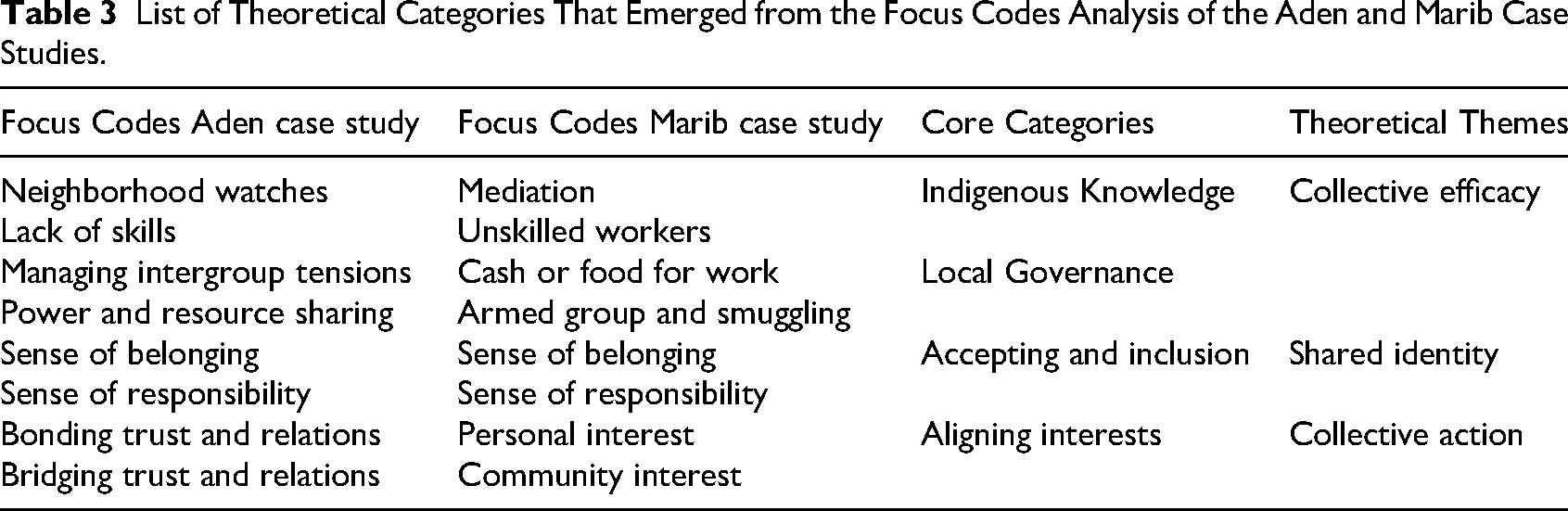
The following subsections explore these categories that emerged within each theme and examine the variations in codes’ patterns and their intensities across the case studies.
Interpreting the Emergent Categories
Indigenous Knowledge
Indigenous skills and knowledge emerged as a crucial factor in empowering post-conflict communities, with participants often applying culturally rooted practices to address challenges. Hiwasaki et al. (2014) highlight the role of indigenous knowledge in enhancing resilience, and Raeburn-Gibson (2022) observes its role in self-recovery in Syria. The liberal peacebuilding model often marginalises local communities despite their valuable knowledge (De Dardel et al., 2006). Communities with strong local expertise and self-efficacy transitioned more effectively than those reliant on external aid. For example, in Aden, civic associations and cultural diversity nurtured local knowledge despite political fragmentation. In contrast, Marib's tribal networks and women's roles in conflict mediation strengthened social capital. In both contexts, local knowledge addressed recovery needs and reduced barriers like women's tokenism, fostering community investment and social acceptance.
Barakat (2003) asserts that labor needed for CDR activities can range from unskilled to skilled labor. Unskilled workers were often reluctant to join in CDR. Eight in Aden and six in Marib were excluded for lacking skills, highlighting how abilities shape inclusion, as Fallov (2010) notes. The lack of skills negatively impacts social acceptance and undermines inclusive local governance efforts, echoing McInerney's (2010) observation that a lack of knowledge and skills is common in post-conflict situations, particularly among vulnerable groups. Nevertheless, peer learning emerged as a solution, with skilled individuals teaching others. This aligns with Hara's (2009) “communities of practice” concept, illustrating how informal knowledge-sharing promotes engagement and adaptation. Pre-existing skills and experiences differed between the case studies due to variations in social norms and practices. For instance, in Marib, water disputes were resolved through open dialogue led by tribal leaders. By contrast, Aden lacked such mechanisms and relied on local authorities and sometimes aid providers for managing central water tanks and dispute resolution. The variation aligns with Dasgupta and Beard's (2007) emphasis on culturally rooted local knowledge.
While culturally rooted approaches can strengthen participation through shared values and experiences, they also risk enabling elite capture (Mansuri & Rao, 2012). In Marib, tribal customs foster collaboration but concentrate authority with elders, marginalising youth and women. In Aden, shared urban identities promote cooperation, yet powerful factions sometimes dominate resources. Such cultural proximity shapes resource management and conflict resolution, underscoring the need for inclusive governance that ensures vulnerable groups, especially women and IDPs, are fully represented.
Local Governance System
This dynamic of cultural proximity shaping power distribution prompted both Marib and Aden to develop governance systems for CDR to counter exclusion risks. These systems included written agreements, clearly defined responsibilities, and fundraising protocols. Community committees were central to these efforts, formed through traditional tribal methods in Marib, where prior governance experience was limited, and through more democratic processes in Aden. This underscores the importance of indigenous skills in strengthening local governance and recognising traditional practices as tools for empowerment (Themnér & Utas, 2016). For example, in Marib, the inclusion of IDPs in local governance was facilitated through a signed agreement directly addressing risks and ensuring respect, dignity, and participation in CDR. Conversely, in Aden, the STC prevented the collective integration of northern IDPs (Forster, 2017). The contested implementation of the Riyadh Agreement created a lack of clear political authority in Aden. Participants described this as “absent government” or “double institutions,” which complicated community efforts to mobilise resources. These dynamics complicate community efforts to mobilise resources and shape how power, identity, and responsibility are understood in post-conflict recovery.
In Marib, tribal structures filled gaps left by state institutions, enabling cooperation and conflict resolution, and governance of reconstruction. These mechanisms were adapted in reconstruction to establish rules for working together and ensure local security, making separate security committees unnecessary. This mirrors Somalia, where tribal systems adapted to ensure security in the absence of formal governance (Anguko, 2015). However, in Aden, lacking both a tribal system and the collapse of security institutions, facilitated communities to form security committees to fill the governance vacuum, similar to Kenya, where “vigilante groups” that managed micro-level security in the absence of state authority (Ayiera, 2017).
Beyond governance structures, the nature of social bonds within and between groups also shapes recovery dynamics. Bowles (2006) indicates that group membership significantly influences interactions, with conflict often strengthening bonds within groups while weakening connections with inter-groups. In Marib, the tribal system fosters security but may not represent all community interests equally, aligns with concerns raised by Casey et al. (2011) call for equitable legal frameworks to empower communities. Therefore, this article argues that post-conflict communities have addressed inward-focused group bonds by promoting social acceptance and inclusion, as illustrated in the next section.
Social Acceptance and Inclusion
Building on community-led efforts to include IDPs, this section highlights the critical role of women's and ex-combatants’ inclusion in fostering social acceptance and strengthening collective recovery. Both case studies revealed that women, previously symbolically involved, became active participants in reconstruction when their skills and contributions were valued. Traditional gender roles shifted due to post-conflict legacies, such as men's injuries, casualties, which enabled women in Marib to assume roles in conflict resolution and, in Aden, to work in public roles like policing and healthcare. Gurses et al., (2020) argue that post-civil war dynamics provide opportunities for women's engagement in society. This study supports that perspective, showing how educated IDPs women introduced new cultural norms, fostering greater acceptance of women's roles in reconstruction. Local men increasingly recognised women's contributions, with women in IDPs camps often mediating access to essential services and addressing community educational needs.
Economic change was a key motivator for women's participation, with five women in Aden and four in Marib citing employment opportunities as their primary driver. Women were particularly active in reconstructing schools and health centers, where they secured jobs, while showing less interest in projects like roads. World Bank (2017) similarly notes that women's engagement in community development is often linked to clear economic benefits. This study adds that building shared identity and social cohesion could further strengthen women's engagement. Despite increased women's participation, half of the participants in both cases stressed the need for central government support through legal frameworks to sustain women's involvement. This concern stems from the tendency of post-war societies to revert to pre-war values (Demeritt et al., 2014). Initiatives like women's quotas in Aden and designated roles for women in Marib often primarily aimed at securing NGO funding, reflecting concern about tokenism in local governance (Bakonyi et al., 2015).
In both Marib and Aden, a powerful sense of community belonging shaped identity and motivated participation in reconstruction. This belonging reinforces self-concept, obligation, and cohesion (Nowell & Boyd, 2014). Studies show that rebuilding efforts often fail without it; for example, Kim and Cho (2019) argue that public engagement requires a shared sense of responsibility. In both cases, CDR reflected this collective identity. However, some groups, such as ex-combatants or those showing conflict-related behaviors like aggression, were often excluded, seen as lacking a sense of community, which undermined trust and cooperation in local governance. Similar challenges in Guatemala and Timor highlight how post-conflict trauma undermines public trust ( Von Kaltenborn Stachau, 2008). Addressing these issues, identity-based approaches have proven effective in fostering unity and collaboration (Ratanakosol et al., 2016). For instance, communities used shared symbols like “Aden Beautiful” to build a common identity, incorporating those with behavioral shifts into the local governance system. This aligns with Ntontis et al. (2020) findings on shared identity's role in enhancing cooperation and social support. Furthermore, communities adapted their strategy to consider personal interest during the reconstruction efforts, as illustrated in the next section.
Aligning Personal Preferences with Community Goals
In both cases, high poverty levels led people to prioritise personal needs over community goals. Watkins (2005) suggests that effective local participation requires addressing underlying inequalities and barriers within target communities. Economic pressures were distinct: in Marib, dependence on agriculture made land disputes the main reconstruction challenge, while in Aden, population density, unpaid state salaries, smuggling and armed recruitment created competing incentives that pulled people toward short-term personal gain. (Collier & Sambanis, 2002) observation that war fuels trade in smuggled goods aligns with these findings. This distinction highlights how local economic realities not only shaped empowerment differently in each region but also produced varying tensions between individual priorities and collective needs. Some participants, especially the unemployed, joined reconstruction activities expecting tangible benefits. Hoffman and High-Pippert (2010) suggest that aligning individual goals with collective action is crucial.
In practice, communities in both cases organised fundraising for food distribution to address immediate needs. A similar approach was seen in Nicaragua, where women's organisations established food distribution networks for their communities (Demeritt et al., 2014). However, these examples also reveal a persistent tension: while addressing urgent needs can unite people, it risks reinforcing individual-interest framing unless paired with a long-term collective vision.
In contrast to those driven by personal interests, communities in Aden and Marib demonstrated increased cooperation and solidarity after experiencing conflict. This “post-traumatic growth” (Henson et al., 2021) fostered trust and identity that balanced economic self-interest, though in Aden its impact was more fragile given the ongoing pull of the war economy. Calvo et al. (2020) noted an increase in in-group cooperation in post-war, though this differs from Hager et al.'s (2019) observation of reduced cooperation with both in-group and out-group members post-conflict. Langer et al. (2017) argue that economic factors like quality of life contribute to social cohesion, but trust, cooperation, and identity are more fundamental. Overall, the findings highlight the need to balance personal and community interests to foster social acceptance and inclusive local governance.
Empowerment in Post-Conflict Communities
The previous analysis compared the main categories from both case studies, highlighting variations in focus codes and concepts, which provided preliminary insights into the emerging model. The next analytical phase will use theoretical themes to explore relationships with main categories and establish how these relate to the empowerment model, as Figure 1 brings these relationships together to clarify the model that has emerged.
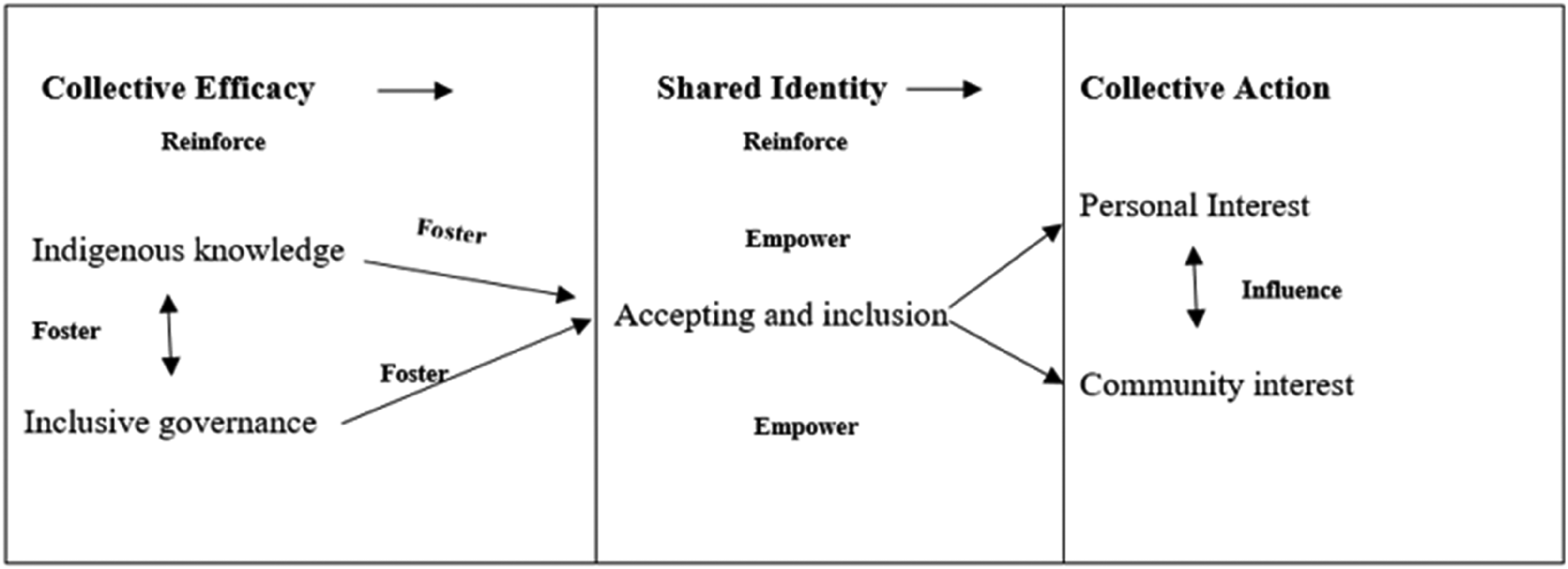
Model of empowerment in post-conflict communities.
The proposed model in Figure 1 synthesises the four focus categories: Indigenous knowledge, local governance, social acceptance and inclusion, and aligning personal and community interest, demonstrating their dynamic in empowering community in post-conflict settings. According to Urquhart (2013), integrative diagrams illustrate conceptual linkages in an emerging model. The model positions collective efficacy, shared identity, and collective action as mutually reinforcing domains, with acceptance and inclusion acting as the central bridge. On the left of Figure 1, collective efficacy emerges from the interaction between indigenous knowledge and inclusive local governance. Indigenous knowledge fosters inclusive governance by empowering members through shared skills and collaboration, while inclusive governance fosters empowerment by involving diverse members in decision-making. In Marib, tribal dispute resolution traditions were adapted into CDR, fostering legitimacy while maintaining cultural familiarity. In Aden, community committees revived neighborhood-based decision-making, later linked to CDR. These practices not only improved services but also reduced the risk of elite capture by promoting transparency, such as open public discussion on CDR activities. Ohmer (2016) links collective efficacy to social capital and cohesion. Somasundaram et al. (2023) claim that collective efficacy can reduce post-traumatic stress, and Barceló (2021) observed that war experiences can strengthen civic engagement and collective action.
At the model's center, shared identity developed when acceptance is enacted in practice. It shows how “Indigenous knowledge” and “Inclusive governance” foster “acceptance and inclusion” in CDR. Thus, relationship of “Fostering” between collective efficacy and shared identity was evident as inclusive practices encourage individuals to participate in decision-making, fostering shared identity. In both Marib and Aden, initiatives that brought together diverse groups, former combatants, displaced persons, and women, in cooperative tasks such as water distribution or neighborhood rebuilding demonstrated this. These efforts helped reduced help reduce violence based on group identity (Desrosiers, 2015). For former fighters, joining these activities gave them a chance to use their leadership and organising skills for the community, changing how they see themselves from soldiers to helpers. Johnston and Taylor (2018) and Henson et al. (2021) link collective efficacy to enhance social identity and motivation for engagement. Participants in this study emphasised how inclusive governance fostered acceptance and inclusivity, even for individuals exhibiting survival-driven behaviors, promoting collaboration based on a shared identity.
On the model's right, collective action depends on aligning personal interest with community interest, facilitated by acceptance and inclusion. Mansuri and Rao (2004) indicate that community cohesion is strengthened when personal motivations intersect with collective goals. In both cases, food rations and financial support met basic needs and enabled vulnerable families to join CDR, while volunteer teachers received community payments as appreciation. Fearon et al. (2015) found that the CDR enhances collective action through both direct effects, expected private or collective benefits. Hoffman and High-Pippert (2010) also suggest that bridging the gap between individual preferences and collective action is key to successful community initiatives. However, the model also highlights the challenge of fairness, as compensation disparities can lead to exclusion and conflict. By integrating acceptance and inclusive governance, the model offers mechanisms to mediate such tensions, promoting equitable engagement.
While existing empowerment frameworks, for example, Alsop et al. (2006) emphasise individual agency, this study extends the discussion by examining how collective empowerment unfolds through CDR during wartime. Similarly, Ostrom's (2010) collective action theory informs our understanding of how communities overcome barriers to cooperation in weak or absent state conditions. The local initiatives observed in Marib and Aden reflect not only recent responses to war and institutional vacuum but also a deeper cultural memory of self-managed development, consistent with the LDA model that shaped Yemen's rural development landscape for decades. The findings illustrate a hybrid model of community empowerment that complements but also departs from classical models such as participatory model (Channell, 2000). While empowerment is often framed as a product of formal institutions or aid mechanisms (CSIS & AUSA, 2002), this study shows how informal authority, trust, and shared hardship can generate powerful collective agency in the absence of external support.
Overall, Figure 1 captures the complexity of empowerment in post-conflict settings by showing how fostering indigenous knowledge and inclusive governance builds collective efficacy, which, through acceptance and inclusion, strengthens shared identity and ultimately aligns personal and community interests to sustain collective action. The model's strength lies in its dynamic, reciprocal relationships, while critically acknowledging challenges of fairness, exclusion, and survival-driven motivations that must be managed through inclusive, culturally sensitive governance.
Conclusions
This study developed an empirical grounded model identifying factors that motivate and hinder empowerment in CDR in Aden and Marib governorates, Yemen. Key themes emerged, including indigenous knowledge, local governance, social acceptance, and alignment of personal and community interests. Rather than adhering to a single explanation, it integrates multiple theoretical paradigms, including LDAs (Orkaby & Al-Ahmadi, 2025), participatory models (Channell, 2000), and aid mechanisms (CSIS & AUSA, 2002). It uniquely contributes by showing how Yemen's tribal structures, fragmented governance, and ongoing conflict shape CDR, highlighting the key role of traditional practices, trust-based local systems operating independently from national strategies. For instance, indigenous knowledge aligns with local and indigenous knowledge for community resilience (Hiwasaki et al., 2014), while local governance corresponds to decentralisation and local governance after conflict (Jackson, 2016). Social acceptance agreed with changing attitudes and behaviors essential for stability after conflict (Wilke & Chivvis, 2011). The alignment of personal and community interests reflects incentive-based theories of participation (Gram et al., 2019). These factors are synthesised into the empowerment model, highlighting the interplay between collective efficacy, shared identity, and collective action that can serve as foundational mechanisms for empowering communities. Case studies demonstrate how local actors negotiate space within or outside the frameworks of top-down aid. While international organisations often introduce formal structures and funding, locally driven efforts reveal adaptive, trust-based systems rooted in historical precedent and local legitimacy. This study does not dismiss the potential contributions of top-down interventions; rather, it highlights that such approaches are more effective when they recognise, engage with, and support CDR efforts.
Unlike countries such as Afghanistan, where CDR was implemented through a coordinated national strategy, e.g., the National Solidarity Programme (Beath et al., 2015), Yemen's CDR efforts remain fragmented. Aden and Marib operate with considerable autonomy and have pursued localised reconstruction efforts, often in the absence of coherent national frameworks. This decentralised and conflict-fragmented landscape shapes how community empowerment unfolds and should be considered when interpreting the relevance of findings for other contexts. However, both governorates have also attracted increasing foreign funding over the past decade, particularly through international stabilisation initiatives and programs framed as creating “Zones of Stability,” a recurring theme in US State Department support. These external efforts interacted with local initiatives but did not replace them; rather, local actors often adapted them to fit community priorities and realities.
Although this study of CDR offers important insights, it faced limitations such as remote data collection due to security and COVID-19 restrictions, a small sample size, and a focus on a limited group of participants. Future research should involve more participants, include diverse stakeholders, cover additional regions, and use mixed methods for clearer, more comprehensive results. This study also opens avenues for future research to evaluate and adapt the model across different post-conflict settings. Comparative and longitudinal studies are needed to assess its applicability and long-term impact on community empowerment, governance, and peacebuilding.
The model offers conceptual insights that can inform adaptation in other conflict-affected settings, particularly where local agency and decentralised reconstruction efforts are central. Drawing on Walsham's (1995) four forms of analytical generalisation—concept development, model generation, actionable implications, and rich insight—the model seeks to enhance its broader applicability beyond the original case. Following Urquhart's (2013)approach to analytical abstraction, the model has been developed at a higher conceptual level so that it can speak to wider post-conflict contexts, like Ukraine and Gaza, rather than being limited to micro-level case-specific findings. Walsham's (1995).
Accordingly, the model introduced main concepts: collective efficacy, shared identity, and collective action, as crucial in post-conflict recovery. In Syria, fostering shared identity through inclusive governance could help rebuild fractured communities. In Lebanon, collective efficacy may empower marginalised groups and encourage collaboration across sectarian divides. In Gaza and Ukraine, these findings provide actionable insights for recovery efforts, helping strengthen social cohesion, resilience, and local ownership of reconstruction. Moreover, this model offers a practical framework that policymakers and NGOs can use to design inclusive, locally-led recovery programs which prioritise community empowerment, leverage indigenous knowledge, and strengthen social cohesion. Applying this model can improve the effectiveness and sustainability of reconstruction efforts in conflict-affected settings.
Footnotes
Acknowledgments
We would like to acknowledge the contribution of the internal review at the Centre for Peace and Security for their invaluable assistance in writing, technical editing, language editing, and proofreading. Finally, we extend our thank to all those who participated in the interviews.

Ethical Considerations
This study was approved by the Ethics Committee at the Centre for Peace and Security, Coventry University, on June 30, 2021 (reference number P114707) for conducting remote fieldwork research.
Consent to Participate
All participants in this study provided informed consent, both verbally and in writing. Data protection measures included storing information on a password-protected computer affiliated with Coventry University, with access limited to the main researcher.
Funding
The authors received no financial support for the research, authorship, and/or publication of this article.
Declaration of Conflicting Interests
The authors received declared no potential conflicts of interest with respect to the research, authorship, and/or publication of this article.
Author Biography
Khaled Alosaimi is an independent researcher. He holds a PhD from Coventry University and a Master's in Monitoring and Evaluation from Gothenburg University. He has worked with NGOs in Yemen as a consulatent. His work explores social identities, decentralisation, and everyday peace to foster sustainable recovery in fragile, conflict-affected communities.