




Abstract
Reconciliation is one of the most important rhetoric elements giving strength to the peace discourse in Colombia. The term belongs to the set of overarching principles that underpin the paradigmatic fields of peacebuilding and development. It is rooted in the everyday and influences how people think and act in post-conflict situations. This paper adds to the literature on reconciliation as a multidimensional phenomenon. Drawing on Q methodology, we present a systematic avenue for reaching a situated understanding of the term. Based on 198 participants’ rankings of 30 images related to reconciliation, socio-demographic data and additional comments given by the participants, we specified and modeled five perspectives on reconciliation. These were relevant for Colombians at a specific moment in time. In the pre-electoral situation of 2021, shaped by public discontent, political factors influenced divergent views on reconciliation. Our study shows that different discursive communities share viewpoints that are historically bound.
Introduction
The paradigms underlying the fields of peacebuilding and development witnessed heated debates in the last decades, swinging largely between the poles of modernisation/liberal peace and decolonial options. Whatever the concrete political positions and strategies, the key concepts in these fields owe their justification to overarching moral principles and operate within a set of anthropological premises and normative assumptions. These ideas are not produced and reproduced in academic spheres out of touch with everyday life, but rather deeply connected to peoples’ experiences and viewpoints.
Below the surface of discursive contestations, there is the often overlooked idea of reconciliation. It is a term that comes into play when people think about how to break the cycle of violent conflict, unjust social order and poverty, evoking “sentiments of longing for what we have lost or what we want to achieve in a new society” (Van der Merwe, 2023, p. 1). Although reconciliation is an organising term in the field of politics, it remains imprecise, multi-layered, and somehow indeterminate. It is appropriated by different actors for different purposes in different contexts (Bloomfield, 2006; Oettler & Rettberg, 2019; Özerdem & Podder, 2015). Catherine Lu distinguishes between three related forms of reconciliation: existential, interactional, and structural reconciliation, with the latter responding “to the alienation that arises from the social and political practices and structures that mediate agents’ activities and relations” (Lu, 2017, p. 183). In general, recent debates on reconciliation highlight the dimension of structural transformation as an “important part of, and perhaps even precondition to, collective and communal reconciliation” (Taylor et al., 2016, p. 84). Reconciliation debates now encompass a wide range of perspectives and dimensions and connect to recent conceptualisations of decolonisation, positive peace, and transformative justice (Gready & Robins, 2014; Nagy, 2013). This paper contributes to the body of knowledge on reconciliation as a bridge term. Reconciliation carries multiple and measurable layers of meaning and calls for transformative visions that would connect the paradigmatic fields of development, peacebuilding, and transitional justice. Reconciliation carries multiple and measurable layers of meaning and calls for transformative visions that would connect the paradigmatic fields of development, peacebuilding, and transitional justice.
The complexities of Colombia's drive for peace bring up particularly relevant insights into the narrative of reconciliation. Colombia is a country that has been plagued by armed conflict, drug trade-related violence, massive human rights violations, and displacements for decades. Although a landmark peace accord between the Colombian government and the Revolutionary Armed Forces of Colombia—People's Army (FARC-EP) was signed in 2016, new and old armed actors such as the National Liberation Army (ELN), FARC-EP dissident groups, and paramilitary and criminal groups compete for filling the void left by FARC-EP in some parts of the country. Land ownership, illicit crops, and drug trade remain the main obstacles to peace (Rettberg, 2020), and multiple expressions of violence impact daily life.
But Colombia also stands out as a country of local peacebuilding, post-conflict reconstruction, and social movement activism for positive peace, with the protest cycles of 2019 and 2021 drawing on a decade-long history of mobilisations for a more just society. Peacebuilding in Colombia has been and continues to be a tough voyage, with ups and downs along the way, bitter defeats and substantial advances (Bouvier, 2009; Diaz Pabon, 2018; McFee & Rettberg, 2019). As in many other countries around the world, reconciliation is one of the most important rhetoric elements giving strength to the peace discourse. The nexus between peace and reconciliation was not only highlighted in the 2016 peace agreement (Gobierno Nacional y las FARC-EP, 2016), but also promoted recently by the Colombian truth commission (CEV) in its final report. The term “reconciliation” appears throughout the text, connected to diverse goals and processes, including a transformation of “language, the mind and the heart” (CEV, 2022, p. 119). These quotes show that the CEV and more specifically, the scholar activists involved in the activities of the CEV, uttered a holistic state-of-the-art understanding of reconciliation.
Looking at the Colombian context of protracted violence, we wanted to know what Colombians think about reconciliation: which discursive communities
1
share which perspectives on reconciliation? Our research combines a conceptual and empirical interest in recapturing situated meanings of reconciliation. In this paper, we offer a new methodological avenue for conceptualising reconciliation, making use of a lesser-known approach to examine complex subjective viewpoints and attitudes
The purpose of the next section is to make readers familiar with the challenge of defining reconciliation. We directly connect the presentation of the theoretical framework to the description of the q-methodological procedure because we can best demonstrate the rationale behind Q by showing how the broad theoretical debate is condensed to a concourse and a Q item set. Section “The Q Route” introduces Q methodology in more detail and briefly describes the design and implementation of our study. Section “Results: Common and Divergent Perspectives on Reconciliation” then turns to the results, describing five different perspectives on reconciliation that emerged from our data, as well as diverse hopeful, neutral and pessimistic views on the future of reconciliation in Colombia. Section “Discussion” takes these results to reflect on the nuances our project added to the conceptual debate on reconciliation, and the concluding section comes back to reconciliation as a policy challenge and the fine-grained responses it requires.
From Theoretical Framework to Concourse to Q Sample
Q methodology is a tool for examining (political) subjectivity by mapping groups of individuals with similar views on a topic, idea, or concept (factors) (Brown, 1993; Watts & Stenner, 2012). For the study of reconciliation, it is an excellent choice because it neither formulates a specific theoretical point of view nor suggests a concrete constellation of actors, but conversely seeks to map and condense precisely this diversity. The question is then which conceptual elements are considered important by the participants, how and in which combination. The first step in the elaboration of a Q study consists in identifying the so-called concourse on the topic under study. This term refers to the “flow of communicability” (Brown, 1993, p. 94) that comprises all relevant aspects of media, academic, and everyday discourses on a certain topic (Van Exel & de Graaf, 2005), and usually contains statements, but also objects, photos, drawings, pieces of art, and even musical selections (Brown, 1993; Van Exel & de Graaf, 2005).
In theoretical terms, we do not presume a research gap: instead, there is a treasure trove of rich and relevant literature that serves as our most essential starting point (and we apologise for having cited but a few works). There have been various valuable efforts to systematise the field, also due to the growing insight that interpretations differ across cultures and contexts (Cole et al., 2022; Kelly, 2021; Lambourne, 2014; Maddison, 2017; Nadler, 2012). Our q-methodological study builds on previous explorations of the conceptual field and draws on a multidimensional typology of the academic debate on reconciliation, as proposed by Rettberg and Ugarriza (2016) and Oettler and Rettberg (2019). This typology is based on the systematic review of more than 400 articles and books and shows that the facets of reconciliation include different levels, conditions, practices, attitudes, and axes of reconciliation. The main function of this typology is to reduce the discursive complexity and to make it more manageable. It is not a theory of reconciliation but an attempt to categorise key dimensions of the academic debate on reconciliation.
In identifying the concourse for our study and selecting items for our Q sample, we paid particular attention to concepts such as truth, trust, and forgiveness (Bar-Tal & Bennink, 2004) and the “relationship-oriented process” (Bloomfield, 2006, p. 11) of reconciliation that includes various mechanisms (Bar-Siman-Tov, 2004; Bloomfield, 2006; Lederach, 2010), e.g., transitional justice institutions or peacebuilding measures, as well as a diverse set of actors. Reconciliation as a set of collective practices occurring after periods of violent conflicts (Bloomfield, 2005; Huyse & Salter, 2008) is often framed as “political reconciliation” (Maddison, 2015; Verdeja, 2013). Within the field of social psychology, debates tend to highlight psychological needs and the obstacles to achieving cooperation, contact, forgiveness, and trust (Mukashema & Mullet, 2013; Mullet et al., 2021) as well as practices of conflict resolution and intergroup reconciliation (Nadler, 2012; Staub, 2006). With regard to Colombia, there are various psychological studies on the nexus between forgiveness and reconciliation (Castrillón-Guerrero et al., 2018; Cortés et al., 2015, López-López et al., 2013) and on socio-emotional dimensions (Alzate et al., 2009). The ACDI/VOCA Reconciliation Barometer aims at detecting systematically the meanings of reconciliation in Colombia (Rettberg et al., 2021).
In general, how one conceptualises reconciliation depends much on the vantage point from where one sees it. Recent debates have emphasised spatiality (Harrowell, 2018), temporality (Mueller-Hirth & Rios Oyola, 2019), and the multi-level nature of reconciliation (Clements & Lee, 2021). Other vantage points include dynamics of reconciliation in multicultural, multi-identity, and immigration societies (Bollaert, 2019; Shimizu & Bradley, 2016). Moreover, a debate on postcolonial contexts has been developing, particularly after the Truth and Reconciliation Commission of Canada published its report in 2015. In this vein, the question of temporality is becoming more pertinent, and debates on decoloniality add to the complexities of reconciliation (Maddison et al., 2016; Santamaría, 2020; Watene & Palmer, 2020). These contributions take the critique of reconciliation a step further (Aikman, 2021; Maldonado-Torres, 2016), even bringing in the prospects for “structural reconciliation” (Kang, 2021; Lu, 2017; Nuti, 2020).
Addressing the concept of reconciliation from a multifaceted perspective that acknowledges the wide spectrum of possible approaches, our study takes a unique look at shared viewpoints and controversial issues. It became clear from the outset that one of the main challenges was to narrow down this complex conceptual field to a concourse – and a Q-item set. Based on the multidimensional academic debate on reconciliation, we reviewed formal and informal sources related to the Colombian context such as newspapers, opinion blogs, and social media, collecting 178 images. Since we had to conduct our study online due to the pandemic, we decided to use images in order to make the Q sorting experience more interesting and accessible. In a time-consuming process that involved diverse feedback loops and pre-tests, we reduced the concourse to a Q sample of 30 items (Dziopa & Ahern, 2011).
3
Addressing the concept of reconciliation from a multifaceted perspective that acknowledges the wide spectrum of possible approaches, our study takes a unique look at shared viewpoints and controversial issues.
Our Q sample includes, to mention but a few examples, the well-known photo of the 2016 ceremony of the signing of the peace accord between FARC-EP and president Santos in Cartagena, the iconic drawing of a peace dove, and the drawing of a priest hearing a kneeling person's confession. Other images left more room for interpretation, like the photo of a huge bridge between mountains. According to the participants in our pre-tests, possible interpretations include “conditions and goals of reconciliation,” interregional connection, development, rural reform, structural change. Another example is the photo of a non-elite classroom setting, with possible interpretations spanning from “interaction,” “education,” “inter-generational transmission,” “identity” and “memory” to “hope” and “values.” Due to space limitations, we could not present the complete Q-item set here, but it is available at our data repository (Stahl et al., 2022). From an ethical perspective, online research on sensitive issues is challenging. We constantly thought through the implications of presenting the mosaic of images we selected and we learned from comments provided within various feedback loops (Oettler et al., 2024).
The Q Route
Most Q projects rely on Q sorts, socio-demographic questionnaires, and semi-structured interviews. The core Q-methodological data collection method is Q sorting. This is the process in which study participants arrange the items on a symmetric scale from “most” to “least,” e.g., from “most relevant” to “least relevant” (Brown, 1993, p. 101). We opted for a forced and rather steep distribution from − 4 to + 4 (see Figure 2) (van Exel & de Graaf, 2005). The participants were asked to look at 30 pictures related to reconciliation and to rank order them (without time limit) into a meaningful formation according to the degree the considered them representative for reconciliation in Colombia (Figure 1).
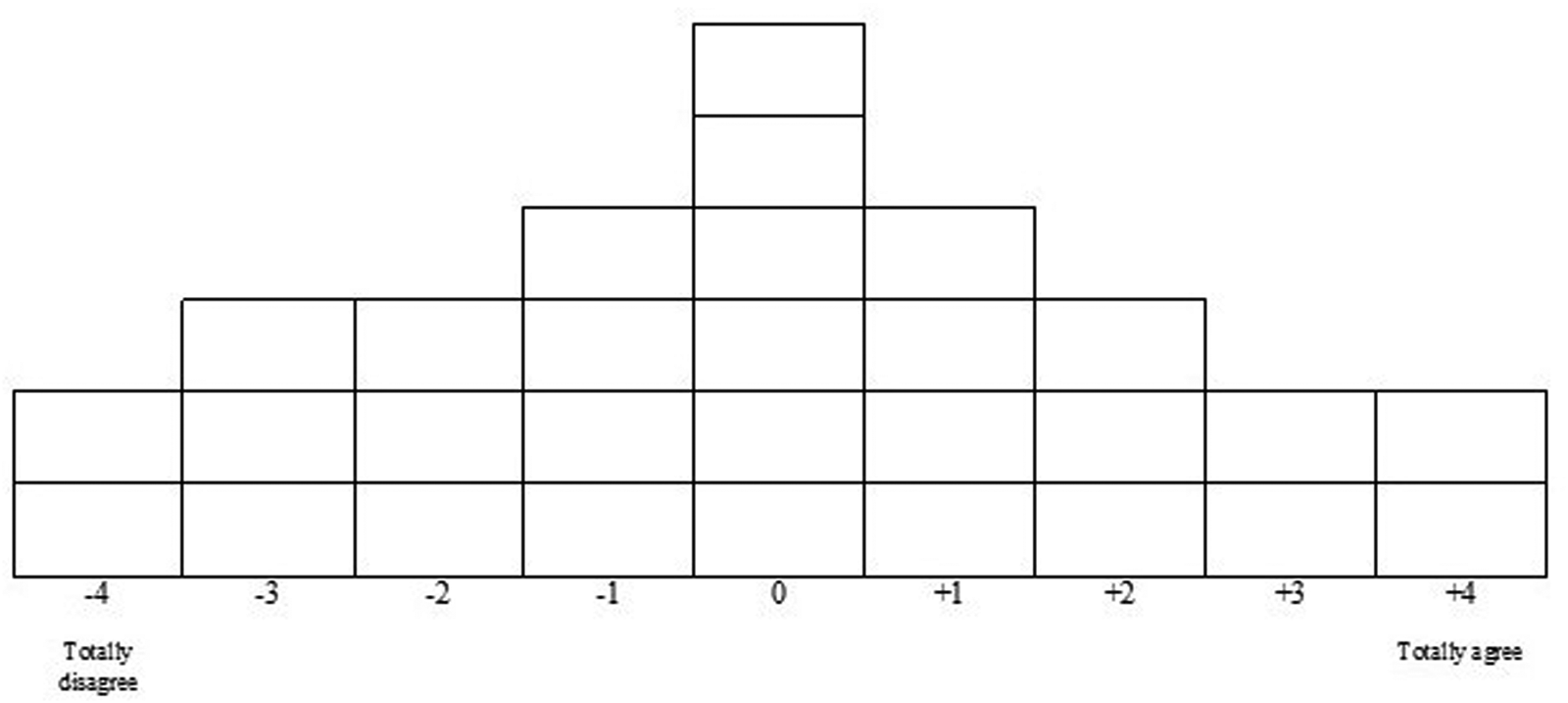
Template for the arrangement of Q sorts with 30 items, ranging from − 4 to + 4, source: own elaboration.
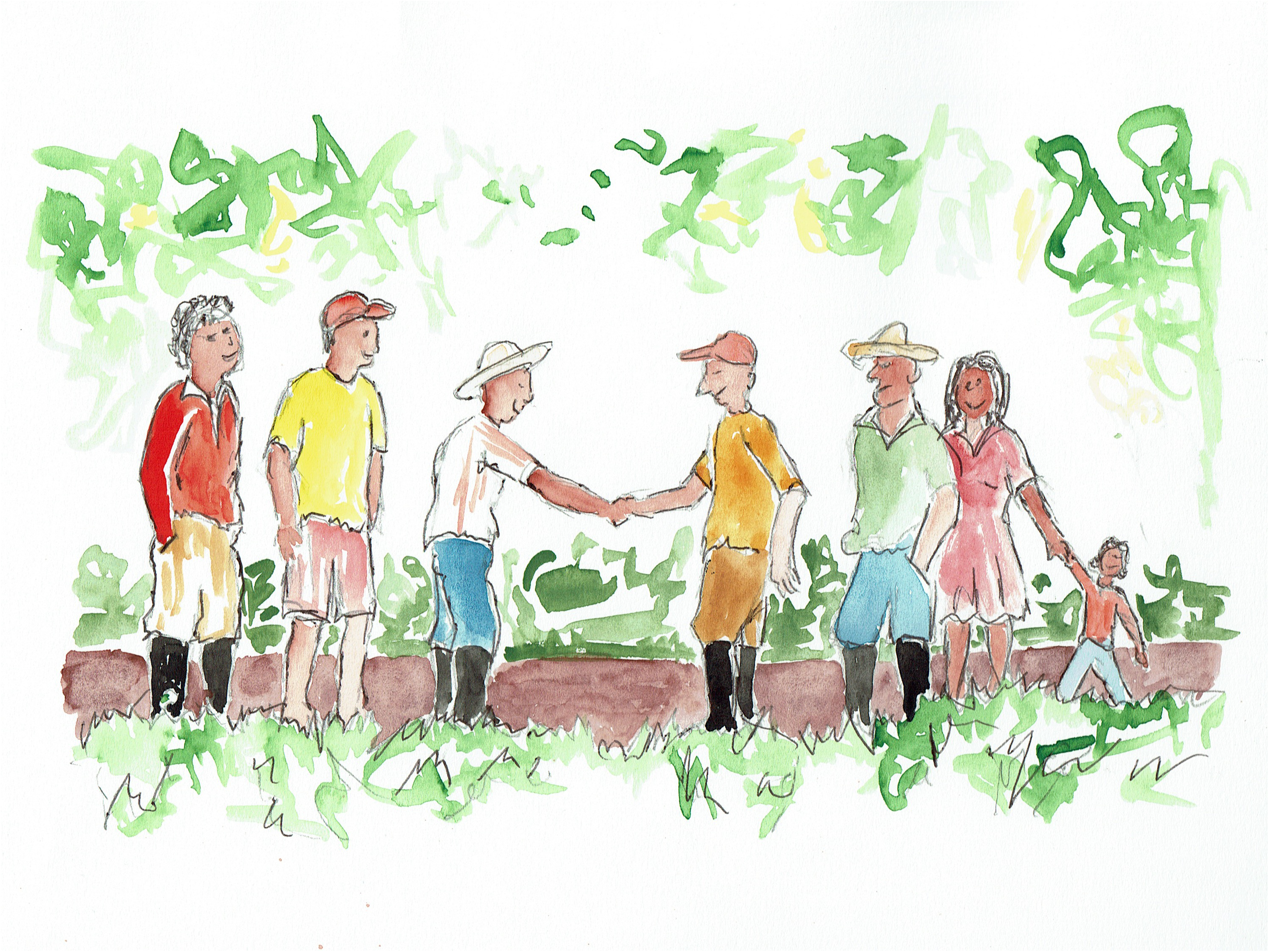
Handshake in a rural area, source: Anika Oettler.
Following the Q sorting exercise, participants were invited to fill out a socio-demographic survey and to respond to five questions about their experience during the Q sorting exercise, images that caught their attention, issues not represented in the images and about their opinion regarding the future of reconciliation in Colombia. They could voluntarily reply to our questions in the survey or via text or voice message on WhatsApp. Offering an option for oral response seemed to be important in a country with large sectors of the population having low literacy skills. All steps were explained in the survey.
We conducted our study online, relying on Q Method Software (https://qmethodsoftware.com) and dedicated much energy to explaining the procedure. We realised several pre-tests and we produced an instructional video. 4 Since generalisation in statistical terms is not an objective of q-methodological studies, small participant samples (p-samples) suffice (Brown, 1980). We strove for a p-sample representing as much diversity as possible. An initial snowball sampling was followed by purposive sampling focused on rather hard-to-reach groups such as entrepreneurs, members of the military or former guerrilla members as well as those marginalised due to class, ethnicity, and geographic location. Regarding both steps of sampling, we relied on our broad academic and civil society networks in Colombia. The survey was open from October to mid-December 2021, 400 people started the Q sorting, 198 completed it, 201 filled out the socio-demographic survey and 58 left a comment. During this period, we were available for support and feedback.
All Q sorts were correlated with each other (Brown, 1993) and factor analysed. This means that groups (factors) of similar Q sorts were mathematically identified (Brown, 1980). We used Ken-Q Analysis to conduct factor analysis (https://shawnbanasick.github.io/ken-q-analysis/). Following a multi-loop analytical process, we decided for a five-factor solution applying Centroid Factor Analysis and Varimax Rotation 5 . According to statistical criteria (Watts & Stenner, 2012), 6 all solutions with two to eight factors were relevant. For each solution, a varying number and composition of Q sorts was assigned to each factor and a factor array was constructed. The latter is a Q sort that would correlate by a hundred percent on the factor and sets the basis for factor interpretation (van Exel & de Graaf, 2005). In discussing each solution, we considered various criteria, moving back and forth from individual Q sorts to factor array, the interpretation of images, the socio-demographic data, and the comments left by the participants assigned to a specific factor, which served as “ex-post verification of the interpretation, and as illustration material” (van Exel & de Graaf, 2005, p. 10).
In addition to the Q methodological process, we conducted a qualitative analysis of all comments, based on a Grounded Theory approach including elements of qualitative content analysis (Corbin & Strauss, 2015; Mayring, 2000).
Results: Common and Divergent Perspectives on Reconciliation
Notwithstanding our efforts to reach participants in more remote and rural areas, almost half of the participants are from Bogotá (43%). However, our study includes participants from 21 of 33 departments. The full socio-demographic profile can be found on the data repository (Stahl et al., 2022). The age range is wide, 52% of the participants identify as women, and the vast majority of participants (77%) have a university degree or even a postgraduate degree. It is notable that only 44% of the participants profess a belief or religion.
Concerning security, only 16% of the participants had not experienced any security problem in their neighborhood within the 12 months prior to participating in the survey. Among the most frequently experienced crimes were thefts (69%), drugs (33%), domestic violence (25%), and homicides (20%). Thirty-seven % stated that they or someone in their family had experienced victimisation during the armed conflict, and 11% affirmed that they or someone in their family had played an active role in the armed conflict. A large majority considers that it is necessary to forgive those who were violent actors in the context of the armed conflict and almost all of them believe that it is important to reconstruct and learn about the truth.
Before we delve into the five viewpoints, it is worth having a closer look at the total sample of 198 Q-sorts. Data analysis revealed common views on reconciliation in Colombia, but also dissensus.
7
With respect to consensus, images related to the interpersonal and generational dimensions were considered most representative for reconciliation. Two of the five images with highest means reflect a generational dimension: they are related to childhood. In addition, four of the five images with highest means have a strong bodily component, such as handshakes and hugs (for example Figure 2). These visual representations of interaction also show the lowest standard deviations. Though, there is a high degree of consensus. With respect to consensus, images related to the interpersonal and generational dimensions were considered most representative for reconciliation.
With regard to divergent views, it is notable that there is a clear dissensus on images related to the peace process. For instance, we used the famous photo of the signing ceremony of the peace treaty in Cartagena, Colombia, in 2016. It shows the handshake between the former president Juan Manuel Santos and the former guerrilla leader Rodrigo Londoño, alias Timochenko. Both are dressed in white, as well as several politicians and international leaders who had played a role in the facilitation of the peace process and who are applauding in the background. This image has a high standard deviation. As a razor-thin majority of voters had rejected this peace accord in the 2016 plebiscite, Colombians were divided on the prospects for peace. Not surprisingly, our results testify to this polarisation of public opinion.
Five viewpoints on reconciliation
The five-factor solution, which includes 118 assigned q-sorts, shows the same overall picture. Correlations (p < 0.05) are highest between factor C and factor D (0.589) and between factor B and factor C (0.540), which means that there are significant aspects of common understanding. Correlations are lower between factor A and factor B (0.359), factor A and factor C (0.480), factor A and factor D (0.481), and factor B and factor D (0.343). The perspectives on reconciliation overlap, and this overlap mirrors opinions that are widely shared. Nevertheless, each factor provides a viewpoint on certain aspects or dimensions of reconciliation. Correlations are lowest between factor E and all other factors (0.056; 0.277; 0.21; 0.105). Factor 5, though, seems to represent a more distinguished point of view.
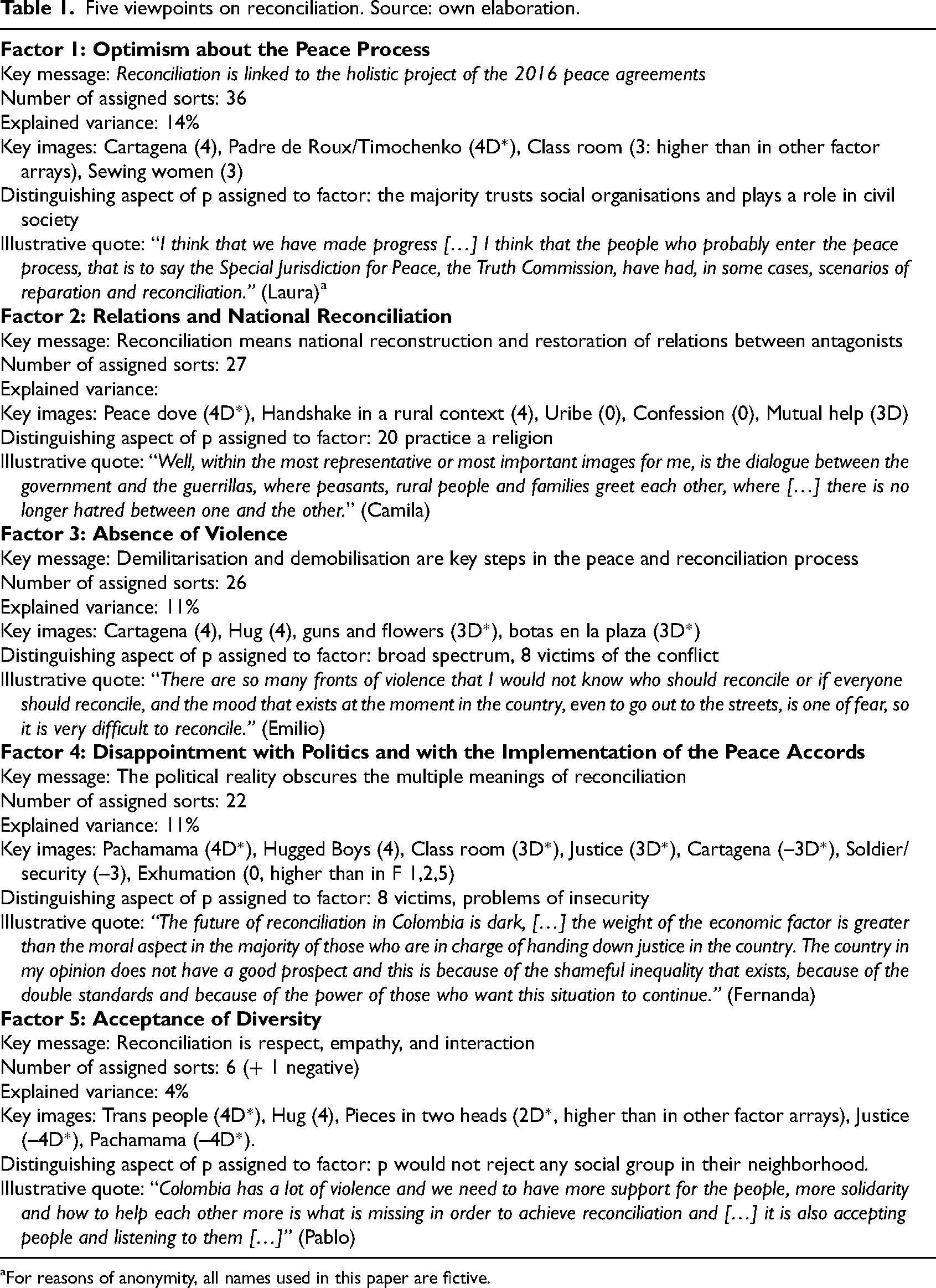
We will now turn to the results of factor interpretation (see Table 1). It is important to note that each factor interpretation rests on a complex and holistic examination of statistical features, images, assigned Q sorts, and additional quantitative and qualitative data from questionnaires and written or oral comments. In the following, we will not provide a full account of the five viewpoints but rather concentrate on the aspect of consensus and dissensus.
Five viewpoints on reconciliation. Source: own elaboration.
aFor reasons of anonymity, all names used in this paper are fictive.
Discourse is situated in time and space (van Dijk, 2010; Wodak & Forchtner, 2018), and the discourse on reconciliation is no exception. Five years after the signing of the landmark peace agreement between the Colombian government and FARC-EP guerrillas, the record was mixed, the accord had “raised expectations that could not easily be satisfied” (Nussio, 2020), and dissatisfaction grew amidst ongoing violence. Or, as the Foundation Ideas for Peace put it, president Duque was to hand over a country “trapped between peace and war” (Fundación Ideas para la Paz, 2022) after the 2022 elections. In the second half of 2021, the year we conducted our study, the truth commission (CEV) moved into its final phase. In October 2021, the Constitutional Court granted an extension of 7 months, so the CEV was expected to launch its final report in June 2022. With the 2022 elections beginning to appear on the horizon, the political atmosphere got dense. While a vast majority of Colombians were pessimistic about the future, suspicious of politics or dissatisfied with the peace process (Nussio, 2020), social and political mobilisation was rising. The negative impact of the pandemic on social well-being, especially for the young and female population (Borda, 2021), was among the causes that brought protesters onto the streets. The results of our study mirror this specific context in which our participants were situated.
In quantitative terms, the most prominent viewpoint within our participant sample represents support for and optimism regarding the peace process. This is reflected in the factor array as well as in many of the comments. Taking into account the composition of our p-sample, this support for the peace process is not surprising. The participants assigned to this factor have a high level of education and a considerable number of them play an active role in civil society and trust non-governmental organisations. Furthermore, ‘structural reconciliation’ in the sense of a positive peace (Kang, 2021) appears to be highly relevant. This observation is reflected by several images related to structural issues positioned at the positive side of the factor array (Navarrete Guzmán, 2019). In contrast to other factors (B and E), reconciliation is perceived less as an everyday practice at the interpersonal level, but rather as a complex concept that depends on socio-political conditions. ‘Structural reconciliation’ in the sense of a positive peace (Kang, 2021) appears to be highly relevant.
Factor B, the second largest factor, focuses on social relations in various senses. Images showing interactions at intergroup and interpersonal levels stand out. Reconciliation is then understood as an action or rapprochement between two antagonistic people or groups, as David states: “Reconciliation requires building bridges between people who were previously in opposing positions.” But from this perspective, reconciliation is more than that. There is a strong desire for the construction of a united nation “among all Colombians.” Rettberg describes this as “challenges in terms of (r)establishing constructive and productive social relations among all members of society which leverage and generate sustainability for the other political and economic changes that countries must undertake, once they commit to a transition to peace” (Rettberg, 2014, p. 221). While this corresponds to a basic understanding of reconciliation as restoration of social relations (Bloomfield, 2006), it goes a step further as these social relations are seen as a precondition for broader political change. Related to that, concepts such as territory, reconstruction of the country, and homeland pop up in several comments assigned to this factor. Hence, factor B points to the importance of national reconstruction and reconciliation, supported by all members of society.
Structural changes, the peace process, and national reconciliation are key for reconciliation in Colombia, at least according to the perspectives of factors A and B. Is this sufficient? The answer is no, from factor C. In a country marked by multi-layered forms of violence, as Emilio underlines, reconciliation is intrinsically linked to the absence of violences, in plural. The images related to these themes carry various meanings and thus may be difficult to interpret for the participants. Nevertheless, their comparatively high position, in contrast to the factor arrays of other viewpoints, suggests that disarmament and security are crucial for reconciliation. 8 The social profile of participants assigned to this factor speaks for itself and points to the reasons to emphasise security and disarmament. In comparison to the other factors, these persons are most affected by the armed conflict since almost one third consider themselves as victims or as relatives of victims. This goes hand in hand with the results of the plebiscite on the peace treaty in 2016. In the regions most affected by the armed conflict, more people voted in favor of the peace agreement since it promised an end to it. Moreover, several interviewed persons are human rights activists who are more likely to reject any form of violence. To conclude, factor C is most salient in stressing the need to end the armed conflict as well as violence in its multiple forms.
Similar to the perspective of factor A, the peace accords prove to be a central theme in factor D. Yet, it is not an optimistic or hopeful perspective. The respondents are disappointed by politics and the poor implementation of the peace accords and have strong negative emotions towards politicians, particularly the former right-wing president Álvaro Uribe Vélez. While trust in institutions and organisations is high in viewpoint A, participants assigned to factor B reject most images related to institutions or personalities associated with the peace process. Compared to all other factors, these images ended up at the lowest positions. Hence, the political reality obscures the possibility of reconciliation—a point we will come back to in the next section.
Although structural aspects are important for the persons assigned to this factor, it seems that they only have faith in reconciliation at micro and interpersonal levels. Possibly, the positive side of the factor array represents an ideal, but not the reality, of reconciliation in Colombia. It shows images of interpersonal affection or collaboration, but also of structural issues. Some interviewed persons mention small everyday practices. In sum, this perspective has a strong political dimension, similar to factor A, but it also resonates with the idea of national reconciliation of factor B.
Despite being the smallest factor and resembling the other viewpoints in some aspects, factor E adds another considerable nuance: Reconciliation needs a culture of acceptance. For the respondents, this means respect, solidarity, equality, helping others, and accepting diverse gender identities. This goes hand in hand with physical or empathetic interpersonal interaction, which resonates with factor B. Possibly, this perspective is an expression of a culture of acceptance that has already become a lived reality: almost all persons assigned to this factor do not reject any social group in their neighborhood. Moreover, and in line with factor C, patterns of militarisation and violence are rejected, and photos with state actors in the post-conflict period are among the lowest rated images. It is likely that, similar to the perspectives of factor D, these low ratings relate to the poor implementation of the peace agreement and the general political situation. As Laura points out, “there are many enemies of reconciliation because their interests are threatened, and for example, the return of land led to new massacres, and justice does not shine.” Finally, this positive notion of reconciliation as a culture of acceptance coincides with a sceptical view regarding militarisation and institutions.
Commenting on reconciliation's future
A closer look at the 58 comments allows for drawing an additional picture as they include opinions on the future of reconciliation in Colombia. In general, the comments point to the interconnected nature of interactional and structural reconciliation. More pessimistic participants highlight the obstacles to reconciliation, referring to the political landscape in Colombia and structural problems (see factor D). Many respondents perceive corruption, political distrust, and a political lack of interest or even opposition to reconciliation processes. This is reflected in the 2018–2022 government's failure to comply with the peace agreement: “The signature of the peace documents has been just that, protocol signatures” (María). Participants highlight structural problems, particularly social inequality, but also poverty and the lack of education, work opportunities and justice. Some also mention chronic violence, as it exists in diverse forms in Colombia (see factor C).
A second group of participants has a more optimistic view, pointing to strong collective and political connotations of reconciliation. Some participants see a potential for change due to the persistent commitment of citizens and local initiatives. There is a call for a commitment from all Colombians, but with a focus on the role of young people and future generations (see factor D). “As we young people participate more in these processes there is more hope to believe in reconciliation” (Ricardo). Not surprisingly, the participants consider the signing of the 2016 peace agreement important, and they perceive related reconciliation efforts such as the establishment of transitional justice institutions as inspiring signs of hope. The participants consider the signing of the 2016 peace agreement important, and they perceive related reconciliation efforts such as the establishment of transitional justice institutions as inspiring signs of hope.
Discussion
Our data hint to the existence of different discursive communities, with overlaps as well as opposing and complementary views. The holistic assessment and clustering of subjective perspectives on reconciliation confirmed the multidimensional nature of reconciliation, and the comments indicate that our respondents considered the Q item set as representing the range of relevant dimensions of reconciliation. However, it was surprising that the dimension of “existential reconciliation” (Lu, 2017) played a rather minor role (if any). What was highly visible in our data was the overall importance of interpersonal and intergroup dimensions of reconciliation, or, to use another of Lu's terms, interactional reconciliation. Looking at the 198 Q sorts, we found the prominent position of the handshake image in a rural setting (Figure 2) to be one of the most revealing aspects. The symbolism of the handshake is strong because it has a plurivocal but clear meaning that refers to reconciliatory acts asserting trust, compassion or even just a deal. The handshake remains, for most participants, an iconic representation of reconciliation. The perception of the meaning of reconciliation combines normative aspects (what reconciliation should be, ideal practices such as collective work, solidarity, tolerance and empathy) and the evaluation of the current situation (what is perceived as the reality of the country, such as distrust, polarisation and social inequality). The perception of the meaning of reconciliation combines normative aspects (what reconciliation should be, ideal practices such as collective work, solidarity, tolerance and empathy) and the evaluation of the current situation (what is perceived as the reality of the country, such as distrust, polarisation and social inequality).
Reconciliation is a floating and situated concept. Although there are some underlying shared ideas across the sample, there are different perspectives that are situated and strongly connected to the perception of social reality and of the evaluation of policy. While the five presented viewpoints do not differ in terms of the significance of interaction, they do so regarding the positive or negative evaluation of the implementation of the 2016 peace accords. In mirroring the pre-electoral historical moment of 2021, our results confirm the interconnectedness of interactional and structural dimensions of reconciliation. According to Lu, structural reconciliation “involves constructing a social/political order that establishes rights and duties that allow agents to exercise their moral and political agency, in a set of background conditions that ensure the social bases of respect and dignity in their institutional relations and structural conditions” (Lu, 2017, p. 38). Youth and future generations serve as symbols of hope, while the peace agreement and the correspondent narrative around reconciliation have rather lost this function for some participants.
Many of these findings are not surprising, but they confirm existing knowledge. What we did not expect, however, was the low visibility of three aspects, Catholicism (Suárez & Ernesto, 2018), intrapersonal dimensions of reconciliation, and the impact of chronic violence. This observation points to the strengths and weaknesses of our study. First, our p-sample appears to be limited to rather urban, educated, white-mestizo contexts. It turned out to be hard to reach people online in remote and rural areas. The composition of our p-sample, though, may have led to excluding many voices and, for instance, understandings of reconciliation as decolonisation or as a religious practice centered on confession and forgiveness. Although generalisations regarding the wider Colombian society were not sought, it is crucial to highlight that the limitations of our p-sample imply that the factors reflect a certain fragment of public opinion, while excluding voices of hard-to-reach groups. Second, there is interpretative space around images (Oettler et al., 2024). In a non-pandemic situation, we would have opted for conducting face-to-face interviews or focus groups, and the importance of doing so is one of the most important methodological lessons learned.
Conclusion
This study adds to the existing body of knowledge on reconciliation as a “composite idea” (Rettberg, 2021, p. 10). Reconciliation refers to multiple and interrelated layers of collective action (Clements & Lee, 2021; Maddison, 2015). A major challenge in defining reconciliation “relates to the evolution of the definition in that the objective can move conceptually as the phenomenon undergoes mutations” (Flechas Buriticá, 2023, p. 139). We offered a broad range of possible layers of meanings of reconciliation to our participants, and in line with a recent representative study on reconciliation in Colombia (Rettberg et al., 2021, p. 16), many participants highlighted the political responsibility for generating structural preconditions for reconciliation (Kang, 2021; Lu, 2017). It is perhaps not surprising, but nonetheless remarkable how clearly the implementation of the peace agreement and the dimension of social change were evoked. “Reconciliation does not occur in a vacuum” (Rettberg et al., 2021, p. 14), and our results mirror the socio-political situation of 2021. It is perhaps not surprising, but nonetheless remarkable how clearly the implementation of the peace agreement and the dimension of social change were evoked.
Although peace, reconciliation and harmony are ethical postulates that are likely to find favor, many scholars and practitioners perceive reconciliation as a broad and naïve kind of blueprint for a better world. Yet, despite the diversity of critique, it is a concept rooted in the everyday. As such, it bridges everyday life and rather abstract notions of peacebuilding, and it underpins a deeper understanding of the peacebuilding-development nexus. It is not a novel conclusion that we need a context-sensitive and flexible approach to key concepts in the fields of development and peace and conflict studies. In that way, we tried to contribute to pushing the academic debate a step further. Instead of claiming to reimagine the field in order to find a new universalistic conception of reconciliation, we embarked on a new methodological avenue, specifying and modeling key features of reconciliation that were relevant for Colombians at a specific moment in time. In the pre-electoral situation of 2021, shaped by public discontent, calls for the implementation of the 2016 peace accords were at the surface of the reconciliation discourse. This shows that reconciliation policies and measures in the overlapping fields of development, peacebuilding, and transitional justice must be both context-sensitive and change-sensitive. In applying Q methodology, we tried to broaden the picture, making it even sharper, and hope that our study will be another corrective to the oversimplification and idealisation (or blanket rejection) of concepts in science and politics.
Footnotes
Acknowledgements
We would like to thank the following institutions and people, without whom we would not have been able to realise this research. We gratefully acknowledge the financial support by the German Foundation for Peace Research DSF. Our most sincere thanks to Angelika Rettberg who has accompanied this investigative journey from the beginning with her ideas, knowledge, and practical contributions. We would also like to thank Shari Kohlmeyer, Juan Camilo Pulido Riveros, and Madeleine Rubiano López for supporting us in conducting the study and analysing the qualitative data. Many thanks to our colleagues who, at different stages of the research, provided valuable comments regarding the selection of images, the design of the Q survey and this text: Kristina Birke and the great team of FESCOL, GIZ's ProPaz, Christopher Cohrs, Sabine Kurtenbach, Antje Röder, and Till Schlosser. Thanks to Sharbel Lutfallah of Q Method Software for the valuable technical support and to Steven Brown and the international Q community for providing insights and practical advice. Finally, our special thanks go to those who provided us with images for our study: The Commission for the Clarification of Truth, Coexistence and Non-Repetition (CEV), Lorena Carillo, Museo Q, Camila Acosta Alzate, and CODHES who provided us with the photo of the mural “Leader Life,” by social leaders of Bajo Cauca under the coordination of the artist Tatiana Saavedra.
Declaration of Conflicting Interests
The authors declared no potential conflicts of interest with respect to the research, authorship, and/or publication of this article.
Funding
The authors disclosed receipt of the following financial support for the research, authorship, and/or publication of this article: This work was supported by the Deutsche Stiftung Friedensforschung.
