




Abstract
Unequal access to education and employment inequalities were major issues that led to the Sierra Leone civil war from 1991 to 2002. Many educational practices were introduced to the country in the direct aftermath of the war to bring more positive changes such as education opportunities and reconciliation. However, by using the social constructionist approach in our analysis, we found that infrastructural issues were neglected by researchers and practitioners which had a long-term negative effect on local residents. In particular, transportation poverty became a major issue in preventing the delivery of peace education practices and teaching pedagogies by preventing regular travelling from urban to rural areas. Consequently, more inequalities could be found in areas of social services. This study suggests that peace education initiatives should consider whether these promoted practices will generate different forms of inequalities.
Keywords
Introduction
After the 2002 Sierra Leone civil war, various peacebuilding initiatives emerged, integrating political, economic, and social domains. These included collaborative efforts between external and internal stakeholders, like the Peace Education Kit. (Bretherton et al., 2003, 2010). Peace education has the potential to build self-sustained positive peace, this argument has gained support in both academic research and practice. Many studies (Harris et al., 2010; Salomon, 2002, 2006) also showed that the limitations of peace education can hardly bring long-term effects since most educational practices focus on education rather than providing actual changes in recipients’ behaviours or attitudes. However, many weaknesses, including limited teaching capacity, may prevent the effectiveness of peace education. This study used two methods: documentary research to examine Sierra Leone’s peace education constitution and online interviews with key personnel to assess the impact of transportation underdevelopment on peace education promotion. Before discussing Sierra Leone’s peace education constitution, the paper explores the theory of peace education and the factors behind the civil war in the country. This paper argues that the process of promoting peace education was partly compromised by the poor development of transportation infrastructure. A clear correlation exists between deficient transportation infrastructure and the disparity in educational standards between rural and urban areas. Subpar transportation infrastructure also stands out as a significant contributor to educational inequalities, alongside enduring social factors like class and gender distinctions. (Smith, 2011). Hence, this paper introduces the distribution of peace education and discusses how transportation issues prevented its delivery. It is also worth stating that the lack of progress in transportation infrastructure has hindered the advancement and development of social services in general. In particular, this situation underscored the persistent deficiencies in Sierra Leone's provision of resources in both education and healthcare provisions. This brought attention to the unresolved challenges within the country, where peace education had proven ineffective or insufficient in addressing the existing issues.
The collected data were analysed based on the social constructionist approach which concluded that transportation poverty can generate more social grievances, such as inequalities and gaps in education and healthcare. Collier and Hoeffler's (2004) work on ‘Greed and Grievance in Civil War’, is relevant here. During conflicts, ‘greed’ signifies combatants’ motivation driven by opportunistic factors, in seeking alternative sources of income, through cost-benefit analyses. ‘Grievance’, on the other hand, suggests that individual's rebel in response to issues such as inequality, discrimination, and authoritarian rule. In Sierra Leone Civil war, since inequalities were identified as a major issue that led to the outbreak of civil wars in the sub-Saharan African continent, and the injustice of the provision of social service in 1990s was considered as the same driver that caused human tragedy in 2014, peace education is far from enough in dealing with post-conflict chronic weaknesses such as educational inequalities. Peace education practices have to cooperate with other relevant peacebuilding initiatives in order to promote long-lasting peace.
Methodology
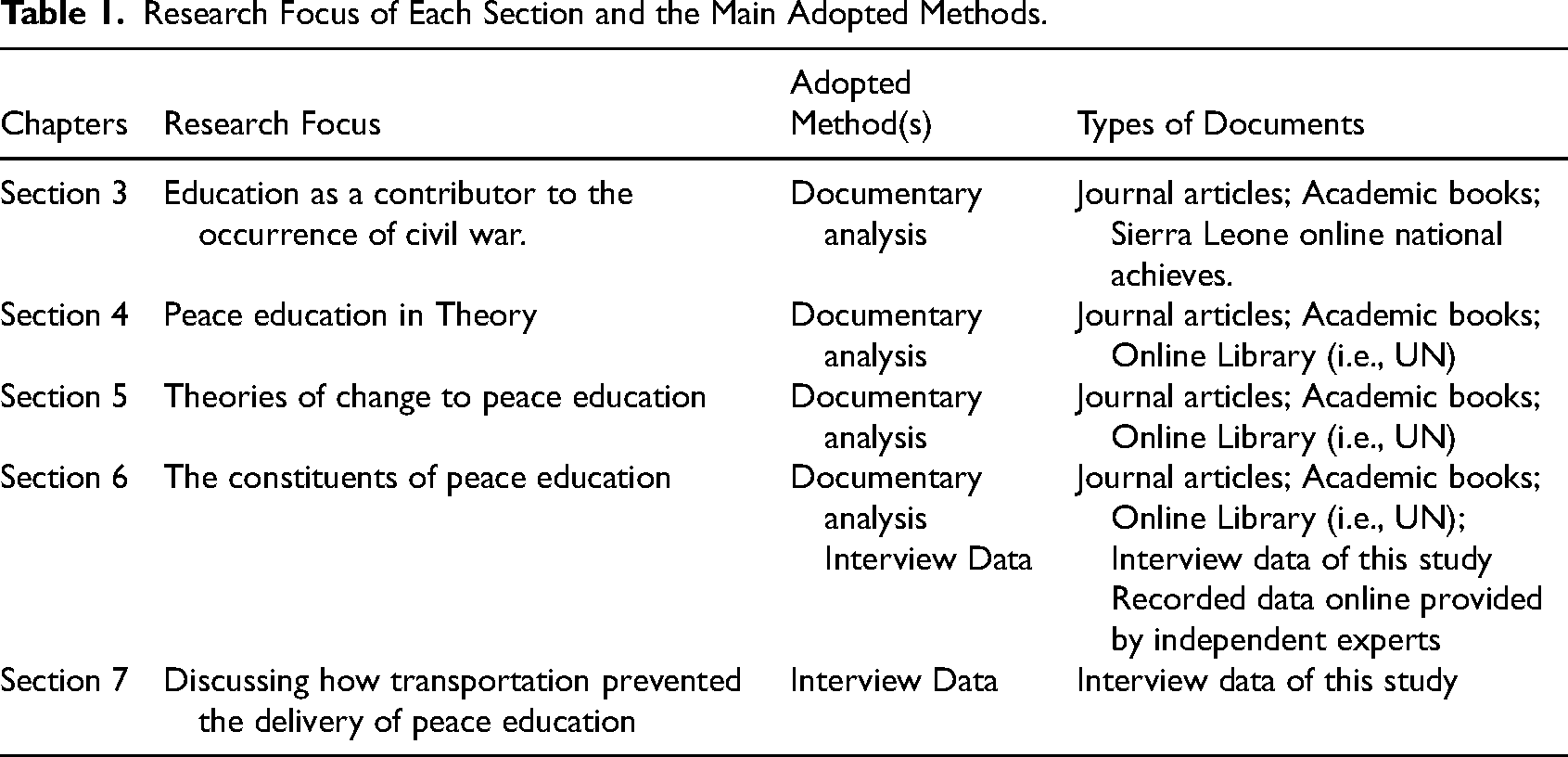
This section presents the methodological framework employed in the empirical investigation of the Sierra Leone context. Presented in Table 1 is a comprehensive exposition of the principal research focal points, the methodological modalities embraced, and the genre of documents encompassed within each chapter.
Research Focus of Each Section and the Main Adopted Methods.
A qualitative research design, specifically, a social constructionist approach was utilised when analysing data from the study. The key intention of social constructionism revolves around addressing the following inquiries: (a) the basis of knowledge; (b) the nature of reality; and (c) the manner in which individuals comprehend their realities through experiential lenses (Slater, 2017). Through the lens of social constructionism, the civil war can be construed as social in nature, given that the conflict’s genesis is fundamentally rooted in socially constructed notions of disparity between the privileged and poor of society. Notably, this disparity manifested in restricted access to educational and employment opportunities for the underprivileged, with the younger demographic facing unemployment or resorting to agricultural labour.
In the context of this research, social constructionism is seen as a sociological theory of knowledge exploration. Its focal point lies in scrutinising the barriers of transportation hindering the attainment of peace. Here, the theory of peace education and theories of change serve as the theoretical framework through which the underdevelopment of transportation is examined. It sheds light on how peace education influenced the comprehension of the crisis, and the peace education practices in Sierra Leone have been largely prevented by the lack of transportation attainments.
The adopted methods, namely, the virtually conducted face to face interview and documentary data analysis answered the different research questions through the guidance of the Social Constructionist approach. In particular, the basis of knowledge asked about the reasons that led to the occurrence of civil war in Sierra Leone and the structure of peace education, especially the involved actors, contents, and delivery methodology to its recipients. The nature of reality of this study will briefly mention the importance of education in responding to the underlying sources of conflict. How individuals comprehend will provide readers with an understanding of why transportation infrastructures are especially important for peace education implementation in war-affected societies (Slater, 2017). The virtually conducted face-to-face interviews from January 2021 to May 2021 with 12 informants, among other aspects, it centres on measuring promotion efforts and addressing the challenges posed by insufficient transportation infrastructure development, a commonly overlooked area by practitioners and scholars in the field. A total 12 interviews were conducted exclusively via Zoom, Teams, or Skype. This study adhered to British Educational Research Association (BERA) guidelines (BERA, 2011). The 12 informants were practitioners actively involved in advancing peace education. None of them had a history of being former combatants. A theory behind the methodology of the social construction is that the basis of knowledge is identified as ‘Language and Knowledge’, language refers to both spoken and written language, and communications through both ways can bring knowledge into existence. Knowledge can ultimately become a dynamic force that will lead to the appearance of peace and the absence of violence. This also uncovers the fundamental idea of peace education, to bring positive changes and peace through language and communication. Therefore, peace education is a way that could be used as a tool (language) to affect their way of thinking (construction of knowledge) and behaving (making sense of experience). Therefore, how transportation poverty became a pitfall and limitation during peace education efforts, including promoting education capacity and teaching quality will be discussed thereafter (Slater, 2017).
The rationale behind selecting Sierra Leone as the case study of this empirical inquiry emanates from its suitability as a post-conflict situation in peace education. Foremost, the educational landscape assumes significance as a potential catalyst that could have contributed to the outbroke of the conflict. Subsequently, the conflict-induced issues significantly disrupted educational endeavours. Consequently, the imperative of peace education emerged as pivotal in the reconstitution of the educational framework and the cultivation of a peaceable culture. Finally, while the recurrence of civil war has been averted, Sierra Leone continues to face multiple post-conflict challenges, notably socio-economic disparities and destitution, which pose continuous threats to the consolidation of the prevailing tranquillity (UNESCO, 2011). However, very few studies have focused on the issue of underdevelopment infrastructures, or transportation poverty and its deleterious effects.
Before discussing which factors of underdeveloped transportation infrastructures have prevented the implementation of peace, the following sections will focus on the theoretical perspectives on liberal peacebuilding and empirical peace-related educational practices.
Education as a Contributor to the Occurrence of Civil War
The 1991–2002 conflict had a catastrophic effect on national development in Sierra Leone. In this section, I will discuss multiple factors which led to the civil war identified in country. Numerous studies have shed light on the vulnerability of state administration during the civil conflict (Keen, 2005; SLTRC, 2004a). Keen (2005, p. 34) asserts that, ‘while the rebel incursion seemed to threaten the government’s stability, Sierra Leone's government was already in the throes of collapse’. Conversely, findings from the Sierra Leone Truth and Reconciliation Commission (SLTRC) concluded that the emergence of rebel group Revolutionary United Front (RUF) in 1991 set the stage for the unavoidable conflict (SLTRC, 2004a). In this context, I contend that the ‘Crisis of Youth’ signifies those grievances rooted in social inequalities, encompassing factors such as education and employment. Firstly, the ‘shadow state’ was created to favour and benefit the political elites and incumbents by disseminating social services such as healthcare and education to maintain their dictatorship (Reno, 1995; Richards et al., 2003). Creating a shadow state is cheaper and more effective compared to democracy. In this case, education became the main role in the creation of grievances and inequalities among youth. Sierra Leone, often considered the ‘Athens of West Africa’, never established a mass education system; instead, it was primarily distributed to the descendants of the privileged minority, as noted by Hilliard in 1957. Consequently, educational resources were concentrated in Freetown. In 1936, over 50% of children in Freetown were enrolled in school, while less than 3% of children in the hinterlands had access to education. By 1954, enrolment in the hinterlands had increased to 8%, but in Freetown, the rate increased to 85%, as observed by Hilliard in 1957. Although, independence saw an expansion in the provision of education under the dictatorship of President Siaka Steven, education declined, and inequalities widened as education became a means of favouring political groupings in search of a power base. The gaps between the ‘privileged’ and ‘poor’ had been widened due to the uneven developments in the in the economy, education, and social services area as well as the creation of a shadow state. The national system, which was not only limited to education, collapsed under the strain of corruption, economic crisis, weak governance and political patronage.
This had a disproportionate negative impact on the Sierra Leonean youth. Richards (1996) argued that the Crisis of youth in Sierra Leone facilitated the growth of the RUF and prolonged the conflict. Young people in rural and mining regions had limited access to education since independence. However, as the patrimonial state system faced resource constraints, biased development policies in rural areas marginalised these youth further. This led to frustration as they sought ‘modernised’ education but found limited opportunities for advancement. Consequently, the RUF prioritised education and employment for the young population in their agenda. In particular, unmet expectations and unequal opportunities to access education and employment were targeted as contributing factors to the civil war. Many young people dropped out of the education system. Others who had completed their schooling struggled to find jobs and returned to their villages taking on farming jobs. This generated resentment among young people. (Keen, 2005). Providing education opportunities and offering jobs as a member of the rebel group became a potent alternative during the formation of rebel group RUF. Young people who were politically aware (Smith, 2011), and received partial education were more dangerous than those who were illiterate. Since education failed to meet expectations and job opportunities were limited, problems such as poverty and radicalisation resulted as factors that could lead to civil war (Smith, 2011).
External factors also played an important role in fuelling and extending the conflict. For example, the key leaders of RUF were trained in Libya under the leadership of Charles Taylor’s radicalisation projects (Abdullah, 1998). With the increasing number of students’ droppingout of formal education, partially and uneducated youth sought survival in various informal sectors. The RUF rebel group appeared as an attractive option, as mentioned earlier by Abdullah (1998) There were many interactions between dropout students, who were regarded as ‘middle-class intellectuals’, and uneducated lumpen proletarian youth during this pre-war era. Both were facing the same pressures that emerged from the existing power politics and accompanied inequalities. Abdullah (1998) argued that with an incomplete understanding of the radical contexts, the half-educated dropouts and non-educated lumpen youth started to collaborate gaining a political consensus among them. Keen (2005) mentioned that many of the recruited youths were forced to join, but the situation clearly reflected the anger and dissatisfaction towards the education system and students’ awareness of the positive outcomes associated with education, forcefully contributed to the civil war (Keen, 2005). As Smith (2011) highlighted the Sierra Leone civil war emerged within the context of globalisation, but the country can hardly fully access to the globalisation in terms of its politics and economy. Thus, any analysis of the conflict must therefore pay attention to the ‘complexity of aspiration, frustration, desperation, incentive, violence and poverty within Sierra Leone’. Education as a factor that led to the war, was an ‘accomplice to rebellion’ (Wright, 1997, p. 20) and a ‘visible target’ (Paulson, 2006, p. 339).
This section briefly examines the pre-war conditions that contributed to the Sierra Leone civil war. It highlights how unequal access to education and limited employment prospects served as significant factors, acting as a central argument of this study. This inequality in pre-war education has fuelled broader grievances across the nation. The Sierra Leonean civil war distinguishes itself from other sub-Saharan conflicts like those in Rwanda and Kenya, as it lacked religious or ethnic disputes among citizens (Alwy & Schech, 2004). Instead, the conflict was catalysed by a shadow state engineered by national elites, resulting in the neglect of crucial social services including education and culminating in state collapse. Unusual for conflicts in this context, Sierra Leone's political system had a severe impact on its educational system, uniting educated and non-educated youth under the RUF, which finally triggered the civil war (Gberie, 2005). This analysis underscores education and social services’ pronounced role in Sierra Leone's history and society. In the aftermath of conflict, crucial educational peace programs were imperative to forge peace and eliminate negative educational aspects. Subsequent sections will provide the analysis of peace education, encompassing conflict and peace norms, and the potential positive transformations facilitated by peace education from a theoretical perspective.
Peace Education in Theory
Peace education is a contested concept, open to many interpretations based on human needs. Peace education programmes can be different from each other in accordance with the adopted curriculum, contexts, objectives, and ideologies (Danesh, 2006). Peace education can be categorised into multiple subfields, such as international education, human rights, education, and education in emergencies. Peace education also became a generic umbrella for various fields; it has numerous definitions for different populations in different places to accommodate various viewpoints (Danesh, 2006). In general, the definition of peace education is different in terms of different forms of violence, different social-political contexts (Salomon, 2006), and the desired aims and changes (Salomon, 2002). Betty Reardon (1988, 1997), as a leading US peace education expert, has analysed more than 100 peace education guides during the 2000s. She argued that there was an absence of precise guides and standards for what shall be included in peace education. However, nine areas are worth mentioning that characterised peace education in the twentieth Century. They include cooperation, non-violence, conflict resolution, social justice, international resources, human rights, environment, and cross-cultural understanding. These areas have cognitive, attitudinal, and behavioural components for implementation (Reardon, 1988, 1997).
Reardon (1988, 1997) saw peace education as an approach to developing human attitudes which would enable humans to behave as global citizens and transform human conditions through developing and transforming current social structures. Her ideas highly influenced the following decades of peace education practices, which are related to eliminating the underlying causes of conflict by changing recipients’ behaviours or skills through formal or non-formal approaches. This set of ideas, arguing about the transforming role of peace education, is closely related to theories of change which will be discussed later. Roughly speaking peace education has seven related forms of education including: International Education; Human Rights Education; Development Education; Conflict Resolution Education; Environmental Education; Civic education; Education in emergencies.
These approaches in practice complement each other and could be combined in both formal and non-formal practices. They are purposeful and dominate short-and long-term goals including understanding peace concepts, security and future; addressing fears; providing information about war behaviour; promoting intercultural understanding; educating peace as a process; promoting social equity, respecting life; and managing conflicts (Harris, 2002). Different forms and goals explained the philosophy behind peace education. In particular, these goals can be found in the adoption of the mixed methods of peace education. Sometimes these goals are inseparable but, on most occasions, different programmes tend to set their own goals based on their desired changes, urgent issues that need tackling or the root causes of war (Harris, 2002). We can find that peace education is clearly intertwined with theories of change. In particular, peace education in Sierra Leone is underpinned by various theories of change, which guide practitioners in fostering positive transformations. These theories include Individual Change Theory, Healthy Relationships and Connections Theory, and Public Attitudes Theory, which focus on personal shifts, dismantling divisions, and altering public perceptions to promote peace (Church & Rogers, 2006).
The realm of theories of change encompasses changes that work to eradicate the root causes of civil conflict, illustrated by the subsequent categories: the Withdrawal of Resources for War Theory; the Reduction of Violence Theory; and the Root Causes and Justice Theory, which facilitates the emergence of peace when constructing peace education curricula.
The theories of change also underscore the significance of elites in the formulation of peace education. This is encapsulated in two distinct changes: the Political Elite’s Theory and the Institutional Development Theory which focuses on curriculum designers to embed democratic practices within stable and dependable national institutions and human rights standards, thus fostering peace. Finally, the Economic Theory posits that citizens’ decision-making often aligns with economic gains and shifts towards peace when the economic incentives associated with conflicts are transformed.
The categories above discussed baselines to monitor whether the previously set objectives were aligned with the conducting practices. However, some specific changes including behaviours, practices, attitudes, skills, processes, and status here are named as types of change (Church & Rogers, 2006, p. 18). Educational practices in general can fit within more than one change, thus, theories of change and types of change can come together to set some specific changes (Church & Rogers, 2006). Theories of change in Sierra Leone mainly focus on achieving the healthy relationships and connections theory; individual change theory; and public attitudes theory, while among these theories of change, types of changes such as attitudes, behaviours, knowledge, and skills were set as the goals within theories of change to reach positive changes among citizens (Church & Rogers, 2006). Based on the root causes of the conflict, this paper will discuss and analyse the underdevelopment of physical transportation that has prevented the country from achieving equality of peace education during its implementation. Before this discussion, I will briefly introduce 12 main peace education practices in Sierra Leone.
The Constituents of Peace Education
Sierra Leone, located in West Africa, has a population of around eight million people (World Population Review, 2023). The civil war from 1991 to 2002 had a significant negative impact on the country's development, pushing it into the low-income category with a rank of 181 out of 191 nations on the Human Development Index (2023). International donors often categorised Sierra Leone as a fragile state, highlighting its challenges and weaknesses. (Human Development Index, 2023; OECD, 2011). Challenges within the nation, such as escalated recruitment after the initial incursion in 1992, further exacerbated these underlying issues (SLTRC, 2004c).
Post-war education in Sierra Leone was marked by shortages of materials, inadequate teaching staff, and unfavourable school conditions (Betancourt et al., 2008; Maclure & De 2009; Paulson, 2006). Consequently, education reform became essential to address these challenges and rejuvenate the education system after the civil war.
Education reform in Sierra Leone was launched during the civil war in the early 1990s with broad implementation from 1997 to 2006, centring around the 1995 education policy (Samura, 2013). The system stipulated the length of education, particularly, 6 years primary, 3 years junior primary, 3 years secondary, and 4 years for bachelor study. This reform attempted to promote children's, youths’, and adults’ education opportunities and address widespread illiteracy which prevented human emancipation and national development during the process of building long-lasting peace (Samura, 2013). Efforts were made within the national curriculum to align it with the objective of advancing peacebuilding. A notable endeavour involved integrating peace education into formal schooling. The SABABU project contributed to this initiative by developing a peace education toolkit designed for primary and Junior Secondary School levels (World Bank, 2003). The toolkit, crafted in 2002, resulted from collaborative efforts among external and internal consultants, the MOEST and the World Bank (Bretherton et al., 2003). However, the recommendations proposed by the SLTRC to implement human rights education plan did not concretely integrate into the curriculum. The attempt to integrate the history of the civil war into the national curriculum across Sierra Leone by SLTRC failed to succeed (SLTRC, 2004b). The transformation in education policy represented the effort to address the very underlying sources of the Sierra Leone national conflict and the demand to promote the Education for All movement advocated by the UN (UNESCO, 2008). The education sector was once again being reshaped after the war through the 2001 Act which attempted to promote access to education among the citizens. This transformation highlighted a growing focus on education for both children and adults, encompassing formal and non-formal vocational community training for adults, and emphasising the critical role of peace education (Matsumoto, 2018).
Thus, peace education became intertwined with formal education and became a major subject at the university level. For example, subjects related to peace and conflict became popular, and programmes that could empower women's social status exemplified by Civic Education for Women were promoted during the 2000s (Matsumoto, 2018). Peace education became prevalent in the country, it included 12 main programmes, whereas 18 actors included its national educational institution, external government agency, regional actor, Non-governmental Organisation, and International Organisation were involved in this progress. These 12 main programmes will be introduced below.
Category One: Formal Peace Education Practices in Sierra Leone
The Peace Education Kit was designed by Bretherton et al. (2003, 2010) as an immediate response in the aftermath of conflict (Tables 2–3). Through the adoption of the community-based approach, the kit was set to achieve reconciliation, peace, and challenge education inequalities at the grassroots level.
Peace Education Kit.

International Education and Resource Network of Sierra Leone.

Peaceful Schools International – Sierra Leone.

Rapid Response Education Programme.

the Rehabilitation of Basic Education Project.

Complementary Rapid Education for Primary Schools.

Emerging Issues.

The EI project was implemented from 2007 to 2008. It is designed for teachers to develop their behaviours and teaching methods in order to support peace education and related programmes from the primary level to the secondary level (Nov elli, 2011). The EI covered multiple methodologies and professional approaches towards peace education, including but not limited to theories of education, teachers as agents of behavioural and attitude change, and classroom and student management (Higgins & Novelli, 2018). The EI was identified as a leading flagship course produced and a well-designed model by the UN and INEE (Higgins & Novelli, 2018). The distribution of EI allowed teachers to address democracy, gender equality, environment, health, and human rights issues through the provision of a learner-centred pedagogy to students of the class (Baxter, 2012). During the interviews, I found that the EI has been distributed unevenly across Sierra Leone. So, teachers have to travel to developed cities to be trained and obtain teaching materials. The pitfalls of this will be discussed later.
Category Two: Non-Formal Peace Education Practices in Sierra Leone
None-Formal Peace Education Programmes.
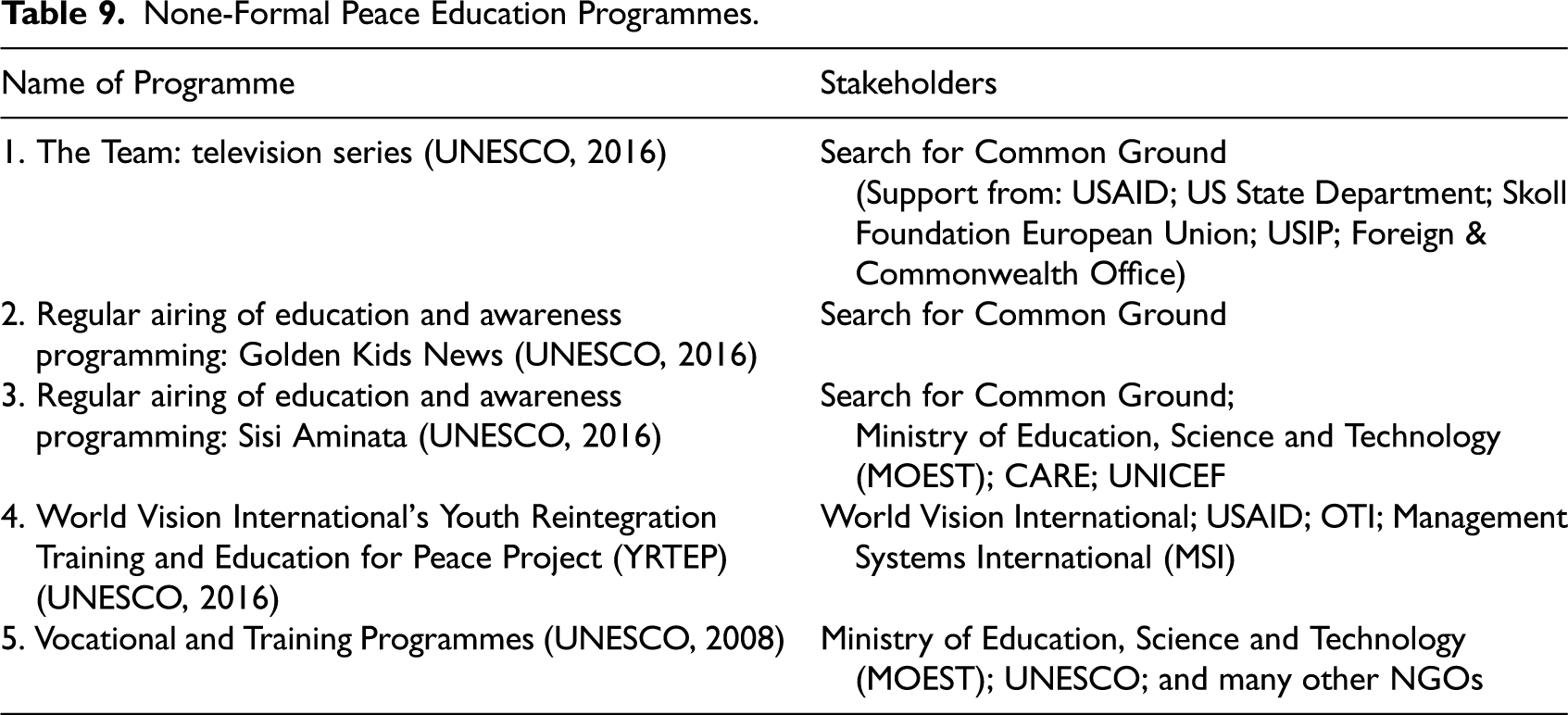
It is also important to mention the promotion of Vocational and Non-formal Education for Adults to re-establishing education trajectory in the aftermath of conflict. Through collaboration with the Ministry of Education, Youth and Sports, the UNESCO-sponsored Vocational Literacy Project was implemented across the country. Promoting vocational non-formal education among adults especially those who were illiterate has been emphasised during the post-conflict era. The 2004 Population and Housing Census Report on Education and Literacy reports that around 60% of Sierra Leone citizens were illiterate with 50% of men and 70% of women illiterate (UNESCO, 2008). Learning materials around numeracy, literacy, life skills, and community education were developed based on peace education (UNESCO, 2008). The purpose of these short-term vocational training courses was trying to equip recipients with equivalent skills for employment (Matsumoto, 2018). As a result, there were nearly 600 vocational- and training-type programmes running in Sierra Leone in the 2000s, including literacy, vocational skills to employment and primary education (Ekundayo-Thompson et al., 2006).
To summarise, this section introduced the nature of peace education in Sierra Leone through the analysis of various document archives. While there were formal and non-formal peace education initiatives, this analysis found that there was an absence of a universally conducted programme implemented across the country. What's more, free peace education in higher education has been largely ignored. The collaborations among 18 internal and external stakeholders also stressed the diverse nature of peace education which consequently highlighted a lack of coherent teaching pedagogy and standalone textbooks for recipients in Sierra Leone, therefore, the teaching quality and effectiveness can hardly be ensured under a diverse nature (Kanyako, 2016). The descriptions above all uncover that formal peace education programmes had more emphases compared to non-formal ones. Exemplified by programmes like CREPS, as an accelerated programme, it targeted children from 10 to 16 (Ellison, 2014). The RREP only allowed children from 10 to 14 to participate located in more developed provincial cities, such as Freetown, Markeni, or Port Loko. Non-formal educational programmes are only limited to children and youth. In particular, using football playing as a method to reconcile and deliver peace (Ellison, 2014). TV and drama programmes seemed available for all citizens but were less accessible to people who lived in poorer areas without radio satellites. 1 The argument made here is the provision of both formal and non-formal programmes tend to be implemented in relatively wealthy areas, and children and adults living in less developed marginalised regions, especially the generation who pushed for greater education opportunities during the pre-war era have been neglected by peace education initiatives. The absence of a peace education programme for adults highlighted the marginal status of adult education. Only short-term vocational education programmes were available for them. In Sierra Leone, the aim was to promote peace education through a community-based approach either by trainers travelling to various communities or by appointing teachers at the grassroots level to receive training. However, the process has been prevented due to the underdevelopment of transportation infrastructure. This will be discussed in the following section.
Discussing how Transportation Prevented the Delivery of Peace Education
One of the crucial elements that prevented the achievement of peace education is lack of financial and human resources. Sierra Leone was and now still identified as a weak and vulnerable state that suffered from partial democracy, low economic performance, lack of social services, and human rights abuses. Corruption could also be found during the past two decades, especially when the state was trying to reconstruct the country in the 2000s (Higgins, 2020). The lack of financial resources also led to the unequal distribution of teaching materials across the country (Bockarie, 2002; Brock-Utne, 1996; Higgins, 2020).
Experts and practitioners involved in this study, argued that peace education failed to be implemented across the country in a systematic matter as there was an absence of a unified textbook. Education on peace became optional even though youth and children urgently needed access to this resource. Where there are limited resources to promote peace educational programmes, the outcomes tended to be hindered.
2
Transportation underdevelopment, an often-overlooked factor, arguably worsened the inadequate and unequal distribution of peace educational materials. Transportation underdevelopment, an often-overlooked factor, arguably worsened the inadequate and unequal distribution of peace educational materials.
The provision of training opportunities for teachers was also an issue. Exemplified by the EI projects (Higgins & Novelli, 2018), the training opportunities were offered by the peace education kit designed by Bretherton et al. (2003, 2010), as well as many training opportunities given to teachers at the grassroots level delivered by some learning centres conceived by external actors with teaching credentials, the inadequate level of the country's road infrastructure hampered attempts to provide training opportunities for teachers of good quality
3
. Not all the teachers could get training opportunities because of the low development of transportation.
4
Transportation poverty was a key factor hindering teaching capacity development and leads to teaching disparities between urban and rural areas. For example, the Peace Education Kit was supposed to be a nationally distributed programme designed for primary and secondary children. Trainers in theory travel to local areas to teach local teachers how to use the kit. However, trainers were unavailable to travel to some remote areas due to limited travelling methods. According to informants of this study, organisations like UNICEF as well as local government held training courses, so that teachers at the grassroots level could travel to cities like Freetown to be trained and bring peace education material back to their communities. Transportation prevented teachers from training.
5
Moreover, due to time and funding constraints, these teachers were less likely to be trained on a regular basis. Informants described that teachers would use the materials they gained without any updates. This study revealed that transportation poverty should be defined as a significant contributor to educational inequalities other than social class inequalities and gender inequalities.
This study revealed that transportation poverty should be defined as a significant contributor to educational inequalities other than social class inequalities and gender inequalities. In order to search for better self-development chances, well-trained teachers were usually based in developed areas which fuelled further grievances for youth in the rural areas. On this occasion, we discovered that many peace education programmes were aimed at fighting against education inequalities by providing youth in Sierra Leone with more education opportunities, and hence, employment abilities. However, it is very unfortunate to find that the unsystematic developed peace education programmes have generated more inequalities between developed urban areas and underdevelopment urban areas. Programmes like iEARN SL, use ICT and other modern technologies in selected schools in Freetown exacerbate differential access to education opportunities. Compared to urban areas, children and youth in rural areas were dependent on reading and writing materials gained from teachers who received training in developed cities. Regional differences enhanced by transportation underdevelopment subsequently enlarged the gap ranging from inequalities, injustices, and differences. 6
The emergence of ‘okada’ (motorbike taxis) in the aftermath of the conflict sparked debates. Okadamen were initially seen as a means to bridge the transportation gap between rural and urban areas, playing a vital role in post-war reconstruction and gaining reliance, especially in remote regions. The debates revolved around whether the consistent use of okadamen could truly enhance education delivery in these remote areas. Peace educators in rural regions pointed out that motorbike taxis were not always available in certain places, limiting the mobility of practitioners and trainers visiting grassroots levels. Safety was a concern, and it became logistically challenging for groups of trainers to reach these communities using motorbike taxis, considering their numbers. 7 While okadamen served as a convenient mode of travel for citizens, their potential impact on education delivery was unknown, since there is limited discussion regarding the impact of okada on the promotion of peace education, particularly in terms of its role in facilitating mobility.
The finding here also indicates some failed theories of change and types of change. Although informants from this study have argued for the success of changing recipients' attitudes and behaviours, they noted the lack of such changes in rural areas. For example, the teaching pedagogies and the lack of accessible peace education resources were reinforced by a poor physical transportation infrastructure and issues ranging from the economic to the social as key factors preventing the development of peace education and education in general in the aftermath of the civil war. In other words, poorly developed public transportation was the issue that contributed to the lack of changes in rural areas as well as for those residents at the poor grassroots level. Transportation poverty should be identified as an issue that has hindered the progress and outreach of peace education, but it has not been given sufficient emphasis Although informants from this study have argued for the success of changing rec ipients’ attitudes and behaviours, they noted the lack of such changes in rural areas.
As we discussed above, insufficient and unequal provision of education as a public service can lead to state collapse and civil war. Here the inadequate provision of educational resources enlarged by poor development of transportation was argued as a factor that can exacerbate ongoing socio-economic tensions and reignite sentiments of youth disenfranchisement.
Conclusion
This main purpose of this study is to analyse to what extent the underdevelopment of transport infrastructures has undermined the promotion of peace education in Sierra Leone. To answer this research question, by using the social constructionist approach, we have discussed how education has contributed to the occurrence of civil war, and why education as a component of social care services may connect to the concept called ‘shadow state’, which finally caused state collapse. Following this, the study mainly focusses on the main theoretical framework: peace education. We have discussed what is peace education by looking at the relevant educational concepts and main goals. These goals mentioned previously can fit into theories of change – a concept which help practitioners to check the achieved changes and failed changes. Furthermore, we moved to the constitution of peace education in Sierra Leone, a particular focus was given to formal peace education practices. During this investigation, we found out that formal education with the assistance of external stakeholders were promoted in a very unsystematic way – as a result, many children out of selected regions have been largely excluded, young people over 18 years old have limited access to free formal peace education programmes, even in higher education. Underdevelopment of transportation played a central role in contributing to these educational inequalities. In particular, poor transportation prevented teachers at the grassroots level to access training opportunities. During the post-conflict era, teachers were facing various challenges not only limited to teaching content or pedagogies. Ample evidence indicated that they were provided with minimal training opportunities as mentioned above and hence have constantly had to play catch-up. But the transportation issues prevented them to attain those limited opportunities.
Meanwhile trainers had difficulties travelling to local areas to provide guidance or introduce new teaching pedagogies. The Ebola pandemic demonstrated that transportation issues prevented the delivery of healthcare services. Therefore, transportation poverty is connected to social inequalities and may have enlarged the gap between rural and urban regions, which had been consistently neglected by researchers and practitioners of the field. Education itself is far from a panacea to resolve the post-conflict weaknesses and should be promoted together with other development method. Three recommendations can be offered here.
1: Enhance Transportation Infrastructure. 2: Implement Ongoing Teacher Training and Follow-ups. 3: Engage Civil Society and Local Government in Peace Education
This study highlights the link between educational disparities and transportation infrastructure, revealing that an underdeveloped transport system obstructs the distribution of peace education. It underscores the concentration of educational resources in developed areas. To achieve education equity in rural regions, we must invest in and improve transportation links, particularly through public transportation initiatives, to expand educational opportunities for marginalised communities.
Continuous training and follow-up support for teachers are essential to maintain the quality of peace education. This was evident in the comparison of rural, provincial, and urban areas. First, training opportunities enabled teachers to adapt to evolving teaching methods and content. Second, regular training in marginalised regions is an effective means of enhancing teaching quality. Lastly, consistent follow-ups bolstered teachers’ dedication to peace education.
To promote community-based peace education, local governments and civil societies must assume an integral role. They can provide training and awareness initiatives that bring children and adults together. Based on these insights, central government should decentralise power, allowing local governments to coordinate training, monitoring, and evaluation processes. This engagement of local governments and civil societies supports the implementation of the second recommendation, which involves follow-ups and training for local educators.
Footnotes
Declaration of Conflicting Interests
The author(s) declared no potential conflicts of interest with respect to the research, authorship, and/or publication of this article.
Funding
The author(s) received no financial support for the research, authorship, and/or publication of this article.