




Abstract
The triple-nexus was introduced as a conceptual framework to link humanitarian aid, international development, and peace initiatives. However, the peace component was largely undefined, and there was little consideration as to how these components might be integrated within programs. In this article, we revisit the nexus with a focus on how the peace component can best be integrated with resilience programs in conflict contexts. Specifically, we draw from qualitative fieldwork in Burundi, the Democratic Republic of the Congo, Myanmar, and South Sudan, to analyze how local communities are using integrative peace/conflict approaches to enhance resilience in contexts with ongoing violence. We develop a typology of peace/conflict approaches, identify challenges to peacebuilding within the framework, and propose locally led processes for rethinking the nexus for protracted conflicts. We maintain that a hyper-local approach to community problem-solving is where the peace component of the triple-nexus can be most effective in fragile contexts.
Introduction
The triple-nexus was introduced as a conceptual framework in 2016 to link humanitarian aid, international development, and peace initiatives. However, whereas the initial model saw the three separate components as complementing each other, there was little consideration as to how they might be integrated within programs. Further, the peace component was largely undefined, leading to some concern over how it might be operationalized in humanitarian contexts. Finally, since the framework was developed, there has been increased interest in rethinking international aid work in terms of new norms like localization and building resilience.
In this article, we thus seek to revisit the nexus with a focus on how the peace component can best be integrated with resilience programs in conflict contexts. Rather than examining how the nexus components work in parallel, we focus instead on programs that have adopted an integrative approach, incorporating conflict/peace elements in humanitarian and development programs. Specifically, we draw from qualitative fieldwork in Burundi, the Democratic Republic of the Congo (DRC), Myanmar, and South Sudan, conducted via the International Non-Governmental Organization (INGO) Christian Aid Ireland, 1 to analyze how local communities are using integrative peace and conflict approaches to enhance resilience in contexts with ongoing violence. We develop a typology of peace/conflict approaches that complement resilience work, identify challenges to peacebuilding within the framework, and propose locally-led processes for rethinking the nexus for protracted conflicts. We maintain that a hyper-local approach to community dispute resolution is where the peace component of the triple-nexus can be most effective in fragile contexts.
Background: The Triple-Nexus
The humanitarian-development-peacebuilding (HDP) framework, or “triple-nexus,” was introduced at the United Nations in 2016 as a “new way of working” for donors and aid agencies to better address multi-faceted challenges in fragile contexts (Guterres, 2016). The nexus concept was not new, as the triple-nexus approach built on previous double-nexus models that emerged in the 1990s, including earlier linkages of aid and development (Longhurst, 1994) and peacebuilding and development (McCandless, 2021; United Nations, 1992). According to McCandless (2021), the push for integrating all three strands developed as practitioners recognized the “intertwining nature of violent conflict and fragility, poverty, inequality, and crisis” (p. 133).
While the HDP approach was seen as necessary by some for breaking down the sectors’ silos (Barakat & Milton, 2020), some practitioners have viewed the triple-nexus model with skepticism. First, there have been concerns over development and peace priorities threatening the impartiality of humanitarian mandates. As Guinote (2018) writes, “the purpose of humanitarian action is to save lives, minimize suffering, and protect the dignity of people … wherever and whoever they may be.” If this commitment to neutrality shifts to accommodate the priorities of other parts of the nexus, or is even perceived by conflict actors as being politicized, Guinote argues that some groups may be left out of reach, such as those less favored by authorities. Tronc et al. (2019) make a similar argument: “In many operational environments, the perceived legitimacy of humanitarian actors’ aims and activities is tenuous. The ‘triple nexus’ can only succeed if … linkages do not lead to the perception … that humanitarian action has been subsumed by a political agenda” (p. 27).
Similar concerns center on interactions with state governments. As Macrae (2012) notes, “humanitarian and development arenas represent distinct approaches and principles: humanitarians work around governments and systems, while development is focused on working through them” (quoted in Howe, 2019, p. 3; emphasis added). Guinote (2018) likewise emphasizes that development “aims to strengthen the State [sic] and its institutions,” whereas humanitarian action is necessary “precisely in that space where the needs of people and the priorities or capacity of the State [sic] are not entirely aligned.” (Development of state institutions does not encompass all development work, which can also include livelihood and agriculture programs. However, Christian Aid Ireland and many other INGOs often classify these activities as resilience or capacity-building programs rather than “development.”)
Unease around working with the state has extended to concerns about peacebuilding morphing into securitization or even militarization (Garcia, 2022), through the deployment of UN peacekeeping missions, or via cooperation with police or state militaries. This is partly because, as Barakat and Milton (2020) note, the peace category is the least clearly defined and understood component of the nexus, with peacebuilding potentially including both the “soft” and “hard” sides of conflict management. As Garcia (2022) writes, “the redefinition of peace away from human security and justice towards stabilization and hard security has blurred the waters of development assistance and lies at the core of several civil society organizations’ unease towards adding peace as part of their humanitarian interventions” (p. 2).
Finally, another concern regarding the triple nexus is the fact that many traditional humanitarian and development organizations, including many local community partners, do not have the mandate or the expertise to work on peace (Garcia, 2022, p. 3). Indeed, the triple-nexus framework developed parallel to the localization agenda, which emerged in 2016's World Humanitarian Summit with the aim of centering local actors in humanitarian programs. Though well-intentioned, as Garcia (2022) notes, this risks “pushing [local] agencies to develop multisectorial interventions … without fully grasping the added value of integrated interventions” (p. 3). This means that interventions may not be as effective as envisioned, while at the same time potentially overburdening local staff. There have also been concerns regarding how local organizations should prioritize between humanitarian, development, and peace objectives if operating with limited staff and resources (Oxfam, 2019).
Some scholars and practitioners have proposed approaches for overcoming these concerns. For example, Garcia (2022) suggests that “reframing peace around human security” (p. 1) can steer the nexus away from conceptions of militarized security, and also help practitioners think about peacebuilding as an organically integrated component within the triple nexus, rather than as a bolt-on to existing aid or development programs. Garcia (2022) also recommends adaptive programng—such as flexible work plans and nonlinear theories of change—to give agencies agility to respond to crises and emphasize different parts of the nexus as appropriate. Howe (2019) likewise argues that the triple-nexus components need not be equal in each context, with one or two components often requiring the majority of resources. McCandless (2021) has also called for more “inter-paradigm learning” to enable agility among and between the components (p. 143). Our findings in this article affirm these suggestions and also inform our recommendations for increasing attention to integration, localization, and resilience across the nexus.
Violence, Peace, and Resilience
In this article, we use the HDP nexus as a framework for examining the interlinkage of local peacebuilding and resilience in “chronic conflicts,” characterized by protracted cycles of violence. It is thus important to clarify what we mean by violence, peace, and resilience in the context of the triple-nexus. Specific types of violence can vary widely within and between different country contexts. In some cases, violence can be severe but acute; in other cases, violence may be less spectacular but more sustained. Violence may also manifest as a result of so-called “fragile” states. As McCandless (2021) notes, the concept of fragility “historically focused on the state's lack of capacity, will, and/or legitimacy to carry out expected functions” (p. 143), but has recently come to encompass the (in)ability of the state to “manage, absorb, and mitigate” risks (OECD, 2020, p. 17). In these cases, including those in our study, there may be periods of violence triggered by resource competition, power struggles, insurgencies, cross-border pressures, or other often unpredictable factors.
Like violence, peace can manifest in different forms. Galtung (1969) famously differentiated between negative peace—the absence of direct violence—and positive peace—the presence of social justice and equality (p. 183), linking development and peace theory (183) years before the formal conceptualization of the nexus. Peace approaches have traditionally focused on addressing direct violence, as perhaps best summarized in the UN's 1992 Agenda for Peace, which specified four forms of action for securing peace: (1) preventative diplomacy; (2) peacemaking, or action to bring conflicting parties into a peace agreement; (3) peacekeeping, or the deployment of UN military and civilian personnel to conflict areas; and (4) peacebuilding, or “action to identify and support structures which will … strengthen and solidify peace in order to avoid a relapse into conflict.”
As Reychler (2010) notes however, the term peacebuilding has broadened and now “tends to cover all activities undertaken before, during, or after a violent conflict to prevent, end, or transform violent conflicts to create the necessary conditions for sustainable peace.” As such, peacebuilding “involves concurrent activities by many people in different sectors, at several levels, in different time-scapes” (Reychler, 2010). Indeed, in our research, traditional peacebuilding dovetailed with other types of conflict interventions and accommodations. These included conflict sensitivity—assessing how programs could impact or be impacted by conflict dynamics; conflict prevention—fostering positive relations around shared interests to avert conflict or violence; and conflict resolution—mediating disputes and reconciling from past hostilities. (Conflict sensitivity is now considered good practice across all programming by Christian Aid Ireland and most other INGOs, but we include it in our discussion of conflict/peace approaches since it is often the first step in developing linkages between peace and humanitarian/development initiatives.)
The initiatives that we observed aimed to integrate conflict analysis and peacebuilding in “resilience programs.” In our research, we (and Christian Aid Ireland) adopt the European Commission's definition of resilience as “the ability of an individual, a community or a country to cope with, adapt and recover quickly from the impact of a disaster, violence or conflict” (European Commission; see also Kindra, 2013). Regarding the triple-nexus, resilience programs are distinct from but closely related to both humanitarian aid and sustainable development, typically focused on bolstering community responses to acute or chronic crises. Resilience has been identified as a “core tenet of international development” that is “central to resolving challenges of capacity building, integral development, and governance” (Runde & Savoy, 2014). And Barrett & Constas (2014) have advanced a theory of “development resilience” that highlights “the avoidance of and escape from chronic poverty over time in the face of myriad stressors and shocks” (p. 14625).
Resilience initially emerged in the humanitarian context as a framework for coping with natural disasters, and it can be a difficult notion to promote in response solely to violence (Keelan & Browne, 2020). However, it can be useful as a bridging concept between the components of the nexus, with humanitarians tending to focus on absorptive and adaptive capacities, and peacebuilders focusing on transformative capacities (McCandless, 2021, p. 142; McCandless & Simpson, 2015, p. 3). While resilience is sometimes measured in objective terms (such as access to basic services, assets, and networks), measurements have recently extended to include subjective self-reporting relating to community or household abilities to anticipate, absorb, adapt to, or transform from a challenge or crisis (Jones & d’Errico, 2019). Both types of measurement can be useful; the former relies more on quantifiable indicators, while the latter (which we used in the research) refers to individuals’ or communities’ perceptions of their capacities and vulnerabilities.
Nevertheless, the concept of resilience is still typically determined by external researchers, NGOs, or donors. As discussed further below, incorporating more local ownership of identifying resilience indicators may be one way to improve the efficacy of the nexus in conflict settings. While there has been increased focus in the INGO sector on localization (Mac Ginty & Richmond, 2013; Randazzo, 2016)—by involving national and local partners in decision-making—this often occurs more in the implementation stage than in conceputalizing resilience from the outset. Just as Mac Ginty (2012; Mac Ginty & Firchow, 2016) has shed light on “everyday peace indicators” as grassroots complements to top-down approaches of peacebuilding, this same approach could be expanded to resilience when operationalizing the triple-nexus. In this article, we look at models that are doing this by working with local communities via conflict analyses and participatory assessments to better identify local capacities, vulnerabilities, and priorities.
Methodology
The research consisted of a comparative case study of programs implemented by Christian Aid Ireland in Burundi, DRC (South Kivu), Myanmar (Rakhine), and South Sudan (Northern Bahr El Ghazal). (See Appendix A in online supplementary for country case study details.) The locations were selected by Christian Aid Ireland as cases with different types of sustained violence compounded with ongoing humanitarian needs. We undertook initial fieldwork in 2018 with follow-up visits to Burundi, DRC, and South Sudan in May 2022. We were unable to return to Myanmar in 2022 for follow-up fieldwork due to unrest in the country, but we conducted interviews and focus groups remotely with NGO staff and implementing partners.
The specific programs that we observed were part of Christian Aid Ireland's Integrating Conflict Prevention into Resilience (ICPR) approach, designed to integrate aid, development, and peacebuilding in conflict contexts to strengthen communities’ resilience to both humanitarian and violence-related challenges. The ICPR consists of three main stages. First, following a macro conflict analysis, implementing partners conduct a local conflict analysis, including formal and informal information gathering, to identify the perceived root causes of issues in communities. Second, local partners work with community members to implement a Participatory Vulnerability and Capacity Assessment (PVCA), a “town hall” style gathering where communities identify challenges and outline resources and plans for addressing one or more of those challenges. Third, partners provide mentoring and accompaniment to support local communities in implementing the action plans that they developed.
Research methods included participant-observation of the aforementioned steps, as well as focus group discussions (FGDs); semi-structured interviews with local NGO staff, 2 community partners, and community beneficiaries; and key informant interviews (KIIs) with local stakeholders. The purpose of the FGDs was to understand how local communities perceived and responded to the integration of conflict analysis and peacebuilding in resilience programs, particularly the extent to which they felt more resilient to potential conflict-related threats. We conducted a total of 43 FGDs with 740 participants, including local community leaders, program participants (sometimes referred to as beneficiaries), and implementing partner staff (local community-based organizations that work with Christian Aid). FGD organization and sampling was organized by implementing partner organizations in consultation with us as the researchers. FGDs included men and women, various age groups, and people from potentially marginalized backgrounds such as persons with disabilities and internally displaced persons (IDPs). We also conducted 50 semistructured interviews with NGO staff and partners, and 24 KIIs with local staff of other INGOs and embassies. (See Appendix B in online supplementary for a full breakdown of FGDs and interviews.)
Notes from the FGDs, interviews, KIIs, and observations were transcribed and thematically coded by the researchers to identify representative ideas within each country’s context. We combined inductive and deductive approaches, first coding for specific themes around peacebuilding, conflict analysis, and resilience, and then identifying additional themes that emerged (such as institutional trust, governance, and local capacities). We then compared the thematic findings across the four case studies to identify the most representative elements as well as outliers. We found that the peace component was operationalized in different ways in different contexts, and was most effective in building resilience and addressing conflict at the hyperlocal level.
Unpacking the Peace Component
Our research indicated that there is no single way to integrate peace and conflict work in humanitarian, development, or resilience programs, even within the umbrella context of a single INGO. The implementation depends on the local conflict context, including the conflict dynamics, severity, and timeline; the needs and capacities of local communities; and the skill sets and resources of implementing partners. In this section, we outline three broad approaches to including a conflict/peace component in resilience programs, which we identify as (1) conflict sensitivity, (2) conflict prevention, and (3) conflict resolution, all informed by ongoing conflict analysis (see Figure 1). We note that these are not fixed or linear categories, with each including elements of the others, and with many programs incorporating aspects of each approach at different times. We also note that no single approach is inherently “better” than the others.
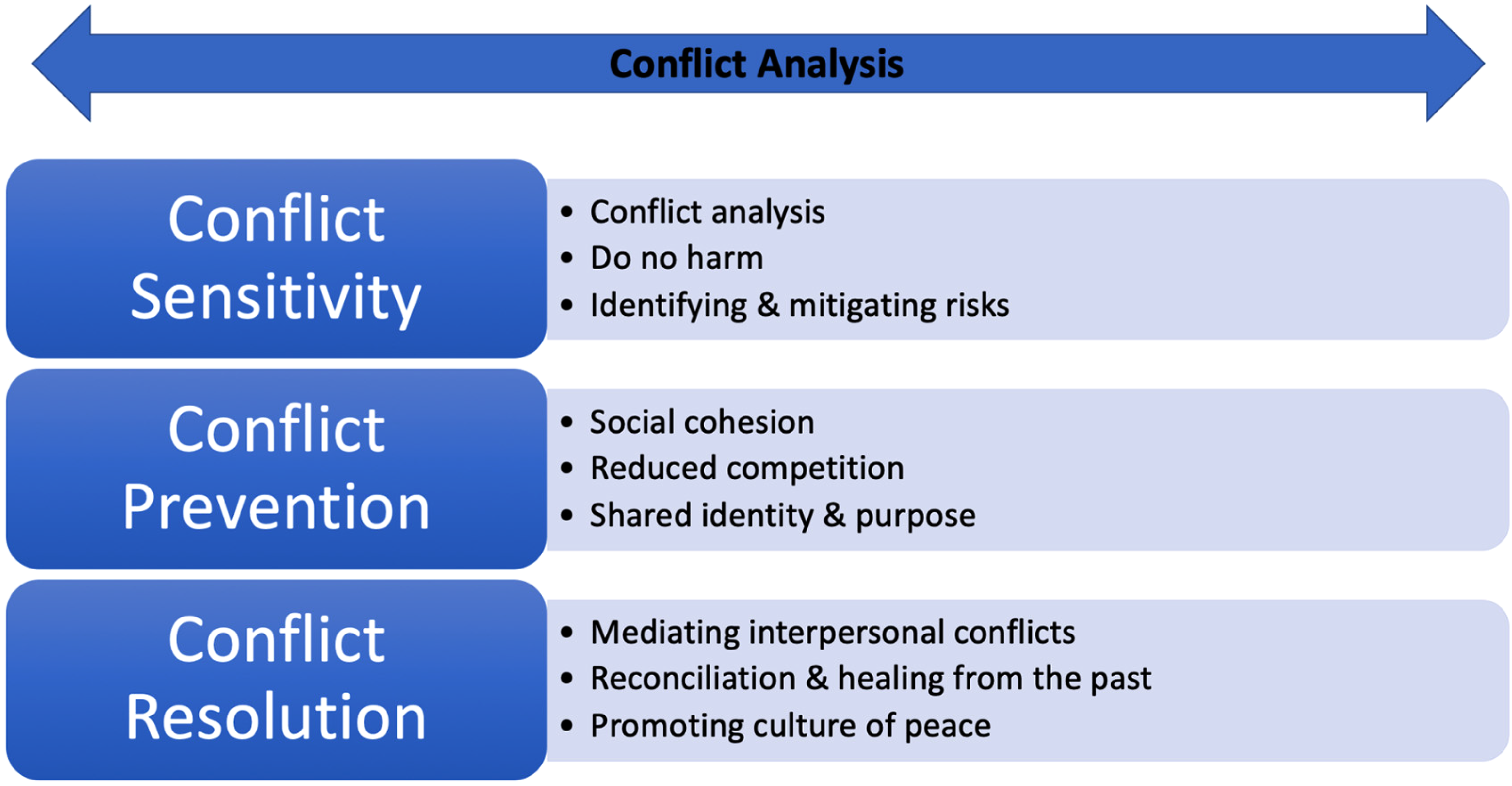
Typology of conflict and peace approaches in resilience programs.
Conflict Sensitivity
The first approach we observed is a conflict sensitivity approach, which includes conducting local-level conflict analyses; minimizing conflict exacerbated by aid and development programs; and mitigating risks to aid and development programs caused by conflict dynamics. The conflict-sensitive approach is now expected across all initiatives—humanitarian, development, and peacebuilding—and at minimum seeks to ensure a “do no harm” approach across programs.
Conflict analysis
The first step in the conflict sensitivity approach, and indeed in all the approaches, is conducting a conflict analysis. Traditionally, conflict analyses have consisted of macro-level assessments by national offices, external agencies, or consultants. Recently, however, there has been a shift to local-level conflict analyses that draw from the knowledge and insights of community contact points, committees, and local partners.
Indeed, a valuable development within Christian Aid Ireland's ICPR approach has been shifting the conflict analysis process away from the external consultant model and situating it at the community level. In each of the countries studied, Christian Aid country staff provided training and capacity building to local partners to equip them with conflict analysis skills to not only identify conflicts, but also to analyze their perceived root causes, using tools such as community mapping and “problem trees.” Our research indicated that most partners agreed that the conflict analysis process itself was helpful for planning the implementation of humanitarian, development, and peacebuilding programs in communities. For example, in Mawenge (DRC), the conflict analysis identified a long-standing conflict between neighboring communities that partners were then able to mediate in the PVCA. In Burundi, the conflict analysis helped partners identify specific issues faced by women in the community to ensure those concerns were heard in the PVCA. Our research indicated that most partners agreed that the conflict analysis process itself was helpful for planning the implementation of humanitarian, development, and peacebuilding programs in communities.
Do no harm
A key objective of the conflict sensitivity approach is to abide by a “do no harm” ethos, to ensure that aid and development programs do not further exacerbate conflicts. There are two main ways in which tensions may be avoided with this approach. The first is through cultural sensitivity, or ensuring that programs are in line with religious and cultural norms. In Burundi for example, partners had planned a domestic livestock project in which households would receive pigs to help build sustainable livelihoods. However, in meeting with community members for the conflict analysis, they learned that there were many Muslims in the community who could not consume pork due to their religious beliefs. The partner organizations thus decided to provide goats instead of pigs to avert a potential conflict.
The second main area that requires a conflict-sensitive approach is resource scarcity and competition. A persistent challenge in aid work is determining where to implement programs when so many communities are in need. Such decisions have serious implications, even at the hyper-local level, as echoed by participants in all the case studies. In South Sudan for example, where water is scarce, the construction of a borehole was welcomed by the community, but also caused tensions with surrounding villages that do not have direct water access. Community members tried to mitigate this by having a “water major” to regulate the use of the borehole, but they admitted that the only real solution would be to have more water access points throughout the area.
In Myanmar, Christian Aid and partners have long adapted programs in efforts to minimize inter-communal conflict in the state of Rakhine, namely by ensuring that programs reach both IDP and host communities, and both Rohingya and Rakhine (Arakanese) ethnic communities. After the mass expulsion of Rohingyas in 2016, many aid groups focused their attention on the displaced Rohingya communities. However, they found that those interventions actually increased hostility towards the Rohingya IDPs unless paired with comparable programs in neighboring communities.
In Burundi, partners noted that conflicts can also emerge within communities when some members are selected to participate in livelihood programs or receive aid while others are left out. As partners explained, they sometimes only have the resources to assist 80 people, when 1,000 need help. They try to mitigate potential conflicts by first working with local committees to help identify who is most in need of support. They then invite the entire community together at the start of the program to explain the criteria and why some were selected. Finally, they aim to include those who were not initially selected in the next round of programs.
Mitigating risks
Conflict analyses are helpful for considering which conflict dynamics may affect or impair the delivery of all HDP initiatives, so that programs can be designed to mitigate those obstacles and have enough flexibility to respond to them. In Myanmar for example, since the 2021 coup, it has been nearly impossible for partner staff or community members to receive travel authorizations from the military government. As such, partners shifted from livelihood trainings to other forms of support, such as food delivery, to avoid confrontations with the state and to provide for basic needs that had become increasingly acute. In South Sudan, the seasonal movement of Sudanese migrants was recognized as a potential trigger point for South Sudanese residents who had experienced cross-border raids in the past. Though the current migrants were not posing a direct threat to the South Sudanese villages, the communities recognized the potential tensions and worked with government officials to mediate the situation. In sum, local conflict analyses conducted at the community level increased resilience by enhancing conflict sensitivity, forecasting obstacles, and encouraging more flexibility across HDP programs.
Conflict Prevention
The second broad approach to peacebuilding that we observed is indirect conflict prevention through resilience programs that reduce resource competition, enhance social cohesion, and provide a sense of purpose and identity.
Reducing resource competition
We heard many times that “without poverty, there would be no conflict,” and the widely known saying, “a hungry man is an angry man.” We do not subscribe fully to these assessments; poverty exists in many places without armed conflict (and vice versa), and many of the macro conflicts in the case study countries are stoked by elites with ample resources. Nevertheless, at the local level, competition for limited resources was the cause of many community tensions, with land disputes being among the most cited conflicts across the case studies, as well as competition for water.
In South Sudan, this included disputes between herders over grazing land for cattle and conflicts between herding and farming communities for land access. These tensions have worsened due to a range of factors, such as politicians and elites instigating conflicts by moving livestock into opposition members’ territories, as well as climate change reducing the availability of land for planting or grazing (Chin-Yee, 2019). Communities in DRC also cited conflicts with elite-backed armed groups seizing control of land and resources, while in Burundi, there are often conflicts when former refugees return home to find their land in use by someone else. For most community members in rural areas, land ownership is not about power or prestige, but rather ensures access to means of survival, as well as often preserving ancestral ties. For most community members in rural areas, land ownership is not about power or prestige, but rather ensures access to means of survival, as well as often preserving ancestral ties.
Resilience programs do not solve these conflicts, but they can ameliorate some of the impact by supporting agriculture and livestock cultivation, and also providing other forms of livelihood support through vocational trainings and Village Savings and Loan Associations (VSLAs) that support small business initiatives. Having access to a sustainable livelihood decreases resource competition and enhances resilience at both the individual and community levels, thus preventing conflict and creating synergy across components of the nexus.
Social cohesion
Another indirect benefit of resilience programs is the fostering of community cohesion, especially in interethnic areas, that can prevent a return to violence. This was particularly notable in Burundi. Violence had broken out in the past between members of different ethnic groups and members of different political parties, particularly during the 2015 elections. However, community members active in the agriculture and VSLA programs said they would not succumb to such violence in the future after working together around a shared objective. As one participant stated, “Here we are working on different projects together. It would be hard for someone to come and tell us that we are different and should be divided.” Likewise, another participant commented, “If people are working together on one project, they are more united, even when tensions come.” Community members stated that even if tensions escalated again at the national level, their community would be able to withstand them due to their increased cohesion.
Resilience initiatives can also foster a sense of shared identity that supersedes ethnic divides and helps prevent conflict. One community member described this as becoming more “ethical citizens,” stating: “We used to wonder about other people's ethnicity or political party. Now we all see each other as Burundians, and we feel the need to contribute to the country's development.” There are of course some who remain set in their ideology, and community leaders acknowledged that changes in mindset can take time. But there was general consensus that bringing people together around joint activities had helped make the communities more resilient to external provocations or potential ethnic violence. Partners described a similar dynamic in Rakhine state in Myanmar, where relations between the Rohingya and Rakhine/Arakan ethnic groups had improved at the local level through joint teacher trainings, livelihood initiatives, and shared water points. By fostering peacebuilding organically through shared resilience initiatives, this model is different from typical approaches that see peace and resilience activities as parallel but separate programs. There was general consensus that bringing people together around joint activities had helped make the communities more resilient to external provocations or potential ethnic violence.
Purpose/identity for marginalized groups
Resilience programs can also foster an individual and collective sense of purpose, especially for marginalized groups such as widows, orphans, and IDPs. As one female VSLA participant in Burundi stated, “Before we felt unwanted and undervalued in the community, but now we feel everyone has value.” Others in the community affirmed that they had overcome previous harmful stereotypes of IDPs whose return to the village is often considered a likely source of conflict. As one returnee described, “We returnees felt like an imposition, and we were treated as people who start conflict, but now we try to find solutions together for the problems in the village. Now we don’t bring any conflict to the community.” The VSLA, along with the farming committee, established economic generating activities in which previously marginalized community members were able to participate, reversing the previously held view that returnees are potential sources of instability. In sum, when informed by local conflict analyses—and designed with an eye to inclusion—resilience programs can prevent conflict by reducing resource competition, enhancing social cohesion, and tempering biases towards marginalized groups, thus strengthening all components of the nexus.
Conflict Resolution
The third broad approach that we observed consisted of conflict resolution initiatives run in conjunction with resilience programs with the specified aim of peacebuilding at the community level, largely informed by ongoing local conflict analyses. In the Christian Aid context, this usually included the establishment of community “peace committees,” with members trained in mediating interpersonal conflicts. The precise roles of the committees varied by context but included efforts to mediate local conflicts before they escalated, (re)establish community-based conflict resolution processes lost during wartime, and promote a culture of peace.
Mediating conflicts
Local partners worked with peace committee members, including local leaders, to identify existing mediation structures and provide additional skills and resources to resolve conflicts in the community before they escalated. Typical local issues included disputes over land borders and water access, as well as domestic conflicts and gender-based violence, and interpersonal conflicts such as unpaid debts. Using a mediation-based approach, peace committee members usually first met with the conflict parties separately to hear their grievances, then brought them together to find a solution or compromise that was acceptable to both parties.
Committee members and beneficiaries attested that this approach was different and more effective than going to government authorities for two main reasons. First, the “win-win” approach was more likely to actually resolve a conflict, rather than a sometimes arbitrary ruling declaring one person right and one person wrong, in which cases conflicts often festered. Second, the peace committees’ mediation services were available to all community members without charge, while government authorities often required fees or bribes. (In most communities we engaged with in South Sudan, DRC, and Burundi, local authorities also appreciated the mediation programs for resolving conflicts at the community level and freeing up the judiciary to deal with criminal cases such as rape, murder, or serious theft.)
Community members and authorities also noted that, in conflict contexts characterized by frequent violence and arms proliferation, even seemingly simple conflicts could quickly escalate and become more serious if not resolved through community mediation. As a local Christian Aid staff member in South Sudan commented, “Conflicts can lead to violence or loss of life because of people taking revenge. Instead of seeking redress from the court system, they take the law into their hands, so it's a payback cycle. So the peace committees can help mediate a kind of reconciliation.” Local level mediation was thus seen as a bulwark to preventing conflicts from escalating into larger-scale violence, thus enhancing resilience capacity across the nexus.
Re-establishing reconciliation
Another aim of the peace committees cited in both DRC and Burundi was to re-establish the traditions of community-based conflict resolution processes lost over years of violence. Whereas mediation focused on current or ongoing conflicts, reconciliation practices emphasized healing from the past. As one local Christian Aid staff member in DRC stated: We have been struggling with over twenty years of war, and the traditional mechanisms have deteriorated. It's a good opportunity to say, let's start again with what we were doing before instead of resorting to violence. So much was lost during the war, we lost the social trust. We have had bad governance and war that destroyed our systems—now the peace committees can help us reintroduce to our communities how to solve conflicts in a peaceful way.
This staff member referenced the traditional gacaca processes in Rwanda as an example. The system had deteriorated during the war, but was reintroduced after the genocide in 1994 to help with transitional justice at the community level. Similarly in Burundi, the bashingantahe process was used since pre-colonial times to settle disputes, and some local staff felt it could serve as a model for other locally led conflict resolution efforts.
Local Christian Aid staff in both Burundi and DRC (who were often from conflict-affected groups themselves) noted that they were not simply re-booting the previous models, but also trying to improve them. For example, the new models prioritized inclusion as a key element, whereas many of the traditional models were led by male elders, with little or no space for direct participation from women or members of other marginalized groups such as IDPs or persons with disabilities. Some staff expressed hope that drawing on the foundations of the traditional processes would not only help resolve new conflicts but even foster reconciliation opportunities for community members to heal from the war. This was especially true in Burundi where communities were intermixed with people from different ethnic groups and political parties who found themselves on opposite sides of the violent conflict in 2015 but later reconciled to live together. One of the values of the traditional approaches was the sense of local ownership over the processes, rather than being seen as externally imposed justice mechanisms.
Promoting a culture of peace
Direct peacebuilding interventions also included sensitization with community members to foster a culture of peace. For example, beneficiaries in the DRC noted that the peacebuilding trainings helped prevent violence in the community by introducing dialogue strategies and raising awareness on the indirect impacts of violence. Many also noted the positive effects of gender sensitivity training in reducing gender-based violence, and others cited the benefits of local media campaigns designed to discourage violence and counter misinformation or incitement.
While focused on the local level, Christian Aid staff also noted the potential of “scaling up” mediation and dialogue processes to regional and national levels. As a staff member in Burundi commented: There has been improvement in people being willing to talk about conflict and peace, which they didn’t before. For communities to sit and meet and talk about issues—this is half the equation. They used to not talk about conflict, so it would intensify and escalate at all levels—domestic, community, national. Peacebuilding efforts have brought protagonists together to talk about small things, local things—so we hope it can scale up to the meso or national levels.
Likewise, a staff member in South Sudan stated, “We need to tie good local level practices to the national level. We need both—the local and national levels. We need to look at good local-level processes and try to bring them to the national level.”
Staff members were realistic that scaling up mediation skills is difficult, but they agreed that conflict analysis and facilitation skills are important to cascade horizontally at the local level. Indeed, even though the peacebuilding approaches we have outlined here may not change the macro-level dynamics of chronic conflicts, they still have value in the day-to-day lives of people living in communities within those broader conflict contexts. In other words, integrating the peace component of the nexus directly into programs will not solve the broader conflicts, but it can improve the resilience of communities by enhancing conflict sensitivity, fostering social cohesion, and mediating local disputes. However, these positive outcomes are not automatic and are subject to several caveats.
Challenges and Caveats
While integrating peace and resilience components can have many advantages, our research underscored several key caveats that need to be considered when determining if and how to integrate conflict sensitivity, conflict prevention, and/or conflict resolution initiatives across the HDP nexus, especially in chronic conflict situations. These include local context, governmental/institutional support, and realistic theories of change regarding resilience.
Context
The different approaches to integrating conflict/peace into resilience programs all have value, but some are more feasible and appropriate in some contexts than others. As expected, the model of conflict resolution through direct peacebuilding was most effective in low-intensity conflicts and/or conflicts at relatively calmer points in the conflict cycle. For example, the peace committees were most active in Burundi, where direct violence has decreased since the election unrest of 2015, and in parts of DRC with relative calm. In contrast, peacebuilding initiatives were most difficult to implement in areas with active armed conflict or severe government repression. For example, in Myanmar, where discussion of conflict is prohibited by the state, and where movement is highly restricted, direct peacebuilding programs are nearly impossible to implement. However, partners were still able to engage in meaningful conflict sensitivity reflections and to observe social cohesion benefits from programs. Importantly, levels of poverty did not necessarily decrease the feasibility of peacebuilding programs. In South Sudan for example, even communities facing severe poverty were still willing and able to engage in conflict resolution processes. While there is a case to be made for allotting resources first to humanitarian needs, most partners saw the two as mutually reinforcing.
It should be noted that conflict dynamics can vary considerably even within localities. For example, within the territory of Kalehe in DRC, the areas where the programs were implemented were considered relatively peaceful by participants, but they pointed out that armed conflict was still common in the nearby mountainous areas. Likewise, in South Sudan, the project area of Northern Bahr El Ghazal was relatively calm during the time of the fieldwork, but violent conflict was escalating in other parts of the country. These examples underscore the importance of conducting locally-based conflict analyses in addition to macro analyses when planning and implementing programs. Some regions may benefit more from one approach than another in the same country, and even some communities may need approaches different from others within the same region. Indeed, local conflict analyses are crucial in enabling resilience programs to be agile and adaptable in adjusting to changing conflict dynamics. Local conflict analyses are crucial in enabling resilience programs to be agile and adaptable in adjusting to changing conflict dynamics.
Institutional Backstops
For communities engaging in mediation and conflict resolution, nearly all had “back-up” support from at least one local governmental authority or institution with whom they liaised. To be sure, there was little trust in the national government in most of the case study countries, but nearly all the peace committees referenced relying on local authorities to assist them with handling serious conflicts such as violent crime. Authorities included the local courts in South Sudan, the local police in DRC, and the local administration in Burundi. These kinds of institutional backstops can be helpful for giving local committees legitimacy and ensuring a process for accountability for conflicts beyond their scope.
However, working with authorities can be difficult if not impossible in fragile contexts. In Myanmar for example, following the 2021 coup, neither communities nor NGOs wanted to engage with government institutions that they saw as illegitimate. In other situations, it is difficult to work with authorities when they are seen as driving the conflict through active stoking of tensions or through incompetence or neglect. In DRC for example, many view political elites as partly responsible for the conflict through their opportunistic support of competing armed groups, while in Burundi, the previous government's crackdown on the opposition was seen as a central instigator of the violence. Perceptions of authorities can also change quickly; in South Sudan, the current central government generally supports the state of Northern Bahr El Ghazal, but if the party in power shifts in future elections, the local administration could change and cause more tensions in the region.
It can be difficult to thread the needle between necessary and effective engagement on the one hand and legitimizing autocratic regimes on the other. Working with authorities can be contentious, especially for practitioners coming from a humanitarian background concerned with issues of neutrality, as mentioned previously. Yet engagement does not necessarily mean endorsement, and it is neither feasible nor desirable to avoid working with authorities completely in HDP programs. Indeed, many communities reported positive interactions with certain state institutions, especially at the local level, and such engagement can improve those specific institutions and the broader rule of law. These experiences again underscore the need for both micro as well as macro conflict analyses, and flexible program implementation to allow for variation at the community level.
Being Realistic About Resilience
One of the goals of the triple-nexus approach is to enhance community resilience. Resilience is a laudable goal, but our research indicates that the concept of resilience as applied to community responses to natural disasters differs from that of responses to sustained violence or armed conflict. As such, the concept may need some rethinking to better apply to local communities in conflict contexts.
In our focus groups, we asked questions to gauge to what degree communities felt they could anticipate/prevent violent conflict, absorb/cope with violent conflict, and adapt to or recover from violent conflict. Using tools such as local conflict analyses and PVCAs, and the approaches mentioned above, most communities reported improved capacities to anticipate and prevent violent conflicts through sensitivity raising and mediation. But most were realistic about the fact that they did not have the means to absorb or adapt to widescale violent conflict. The one exception was Burundi, where, as noted above, community members felt their social cohesion had developed enough that they could withstand national-level divisions and provocations. But in both South Sudan and DRC, it was clear that communities felt they had no choice but to flee if faced with an armed attack.
It is thus unclear how communities might be expected to demonstrate resilience, as it is currently defined in the sector, in the face of broader armed conflict. A simple change might be to focus on the anticipatory part of the resilience definition when working in contexts of armed conflict, rather than the absorption or adaptation elements. It would be unethical to expect communities to “get used to” conflict, or to view them as less than resilient for their inability to do so, especially in the face of macro conflict dynamics beyond their control (see Keelan & Browne, 2020). However, local level analyses and interventions can assist communities in mediating conflicts within their control, such as those at the local level, as well as better prepare for potential broader tensions.
Conclusions and Takeaways
Three key takeaways emerged across the case studies for rethinking the triple-nexus in general, and the peace component particular, in chronic conflicts. First, more consideration should be given to integrative models that embed conflict and peace components within rather than alongside humanitarian, development, and resilience programs. Most beneficiaries in protracted conflicts do not distinguish between HDP needs, and most partners found that peacebuilding and resilience initiatives were mutually reinforcing. It is true that the integrative approach may require more diverse skill sets among implementing partners, and donors and INGOs should be careful in not overburdening local practitioners. But our research indicated that most local partners and communities were already engaged in organic processes of local conflict analysis and, at times, peacebuilding, that provided foundations for further peace/conflict initiatives to be developed within humanitarian and development programs.
Second, community-led processes across the HDP nexus are essential for analyzing conflict, developing resilience, and building peace. As noted above, the “local turn” (Mac Ginty & Richmond, 2013) in both development and peacebuilding is not new. The past decade has seen the development of more equitable partnerships between many international and national agency offices, and even within-country, organizations like Christian Aid are committed to working through local implementing partners. This is a start, but it was clear from our research that the most effective conflict/peace interventions were those at the hyper-local level, focused on community-level problem-solving in a given village or refugee camp. This local-level emphasis can be challenging for conflict practitioners (including ourselves), who are accustomed to seeking large-scale transformational changes or “conflict resolution” in the broader sense. However, the hyper-local approach can prevent resolvable disputes from escalating, while also addressing some of the concerns of humanitarian actors towards the triple-nexus, regarding violations of neutrality or mission creep in more macro-level peace or development agendas. It was clear from our research that the most effective conflict/peace interventions were those at the hyper-local level, focused on community-level problem-solving in a given village or refugee camp.
Third, more attention should be given to the concept of resilience as a bridging concept between the HDP components of the nexus, with particular attention to local definitions and perceptions of resilience. Traditional resilience indicators, both objective and subjective, may not be appropriate and/or comprehensive for all communities, especially those in contexts of ongoing conflict. Rather, instead of trying to measure “absorptive” or “adaptive” capacities to respond to violence, practitioners might focus instead on how different communities see themselves as resilient (or not). The triple-nexus can provide a helpful framework for identifying interrelated HDP needs and capacities, and for understanding which components need to be prioritized in a given context to maximize resilience.
In sum, an integrative approach to the triple-nexus has potential for merging often-siloed aspects of aid, development, and peacebuilding for more pragmatic problem-solving. In conflict zones in particular, the peace component can provide a useful framework for enhancing conflict sensitivity, conflict prevention, and even conflict resolution across HDP activities, while also fostering cross-nexus elements like resilience and human security. But such benefits are not automatic, and the same integrated nature that makes the nexus compelling also makes it complicated. In conflict areas especially, context matters immensely, requiring local-level focus with community-led conflict analyses and decision-making, coupled with institutional support and backstops, and enabled by flexible program parameters. In this way, the triple-nexus is less of a static model and more of an ever-changing and evolving organism that will look different in each place it is deployed. While this arguably makes the triple-nexus difficult for scholars to study and evaluate, its value is that it can and should be shaped and employed as practitioners and—crucially—community members best see fit.
Supplemental Material
sj-docx-1-jpd-10.1177_15423166231200210 - Supplemental material for Rethinking the Triple-Nexus: Integrating Peacebuilding and Resilience Initiatives in Conflict Contexts
Supplemental material, sj-docx-1-jpd-10.1177_15423166231200210 for Rethinking the Triple-Nexus: Integrating Peacebuilding and Resilience Initiatives in Conflict Contexts by Julie M. Norman and Drew Mikhael in Journal of Peacebuilding & Development
Footnotes
Declaration of Conflicting Interests
The authors declared no potential conflicts of interest with respect to the research, authorship, and/or publication of this article.
Funding
The authors received no financial support for the research, authorship, and/or publication of this article.

Notes
Supplemental material
Supplemental material for this article is available online.
Author Biographies
References
Supplementary Material
Please find the following supplemental material available below.
For Open Access articles published under a Creative Commons License, all supplemental material carries the same license as the article it is associated with.
For non-Open Access articles published, all supplemental material carries a non-exclusive license, and permission requests for re-use of supplemental material or any part of supplemental material shall be sent directly to the copyright owner as specified in the copyright notice associated with the article.
