




Abstract
Debates over localisation in transitional justice and peacebuilding have been characterised by the assumption that more equitable relationships between local and international actors allow for more effective and just interventions. Critical scholarship has in turn cautioned over the use of reified conceptions of the ‘local’ and ‘international’, emphasising each as contested sites. Through a network analysis of transitional justice event data in Cambodia, we ask: what are the roles and influence of Cambodian actors, and what might their positions tell us about the relationships between international and local groups? We find that event data shows strong local representation within the transitional justice community. However, representation is not synonymous with influence. Our data demonstrates an uneven distribution of network positions within both local and international groupings. This illustrates the need for greater attention to the role of individual biographies that advantage certain individuals to shape transitional justice interventions.
Introduction
The ‘local turn’ and ‘localisation’ agendas in the adjacent fields of peacebuilding and transitional justice have sparked substantial debate among scholars and practitioners alike. Transitional justice – a field that lays claim over the question of what must be done after experiences of atrocities and conflict – has increasingly situated ‘locality’, local ownership and local knowledge as a means to build more meaningful and effective justice interventions that are predicated on more equitable relationships between local and international actors. Yet the promises of localisation agendas have been questioned. Critics have cautioned that ideas of ‘locality’ and localisation lack clear definitions (Leonardsson & Rudd, 2015); overstate and present simplified binaries of ‘international’ and ‘local’ (Schierenbeck, 2015); and provide romanticised accounts of locality that can conceal significant asymmetries of power at work within any given local context (see Kochanski, 2020 on transitional justice). Such critiques raise significant empirical questions about the composition of local engagement with transitional justice processes and query the treatment of locality as a singular site and space. In turn, they invite further analyses that explore the normative implications of claims for localisation and the inequalities at play within and between ‘international’ and ‘local’ actors in transitional justice and peacebuilding.
This article takes the case of Cambodia to consider the social structures and hierarchies that can work within localisation processes in transitional justice. Established in 2006, the Extraordinary Chambers in the Courts of Cambodia (ECCC) – an ‘internationalised’ UN-backed mechanism within Cambodia's domestic court system – has anchored a wider local ecosystem of transitional justice activity, advocacy and outreach. The case, therefore, offers an instructive lens through which to consider questions of local engagement with international actors and agendas. Tasked with the prosecution of ‘senior leaders’ and those deemed ‘most responsible’ for the crimes perpetrated by the Khmer Rouge ‘Democratic Kampuchea’ regime (1975–1979) the ECCC has occupied a novel position within the wider landscape of transitional justice. It has been argued to represent a new model in international criminal law because of its ‘hybrid’ structure, including appointing both international and Cambodian judges in key adjudicative chambers (Meijer, 2004). The hybrid model implemented at the ECCC has been a point of significant debate. On the one hand, critics contend that the location of the tribunal within Cambodia's court system was a means for the Royal Government of Cambodia (RGC) to retain political control over proceedings (Ciorciari & Heindel, 2014). On the other hand, more sanguine justifications of the ECCC model have invoked key arguments at work in ‘localisation’ debates, particularly around building local judicial capacity and the increased salience of proceedings for affected communities (Scheffer, 2008). Moreover, although a principally retributive mechanism, the ECCC has further provided innovative avenues for victim participation and reparations for victim's groups. These have been argued as key successes of the ECCC process and, notably, the development of these provisions gestures to the promises made in favor of localisation agendas because they have been driven by the involvement of local civil society organisations (Sperfeldt & Oeung, 2019) – often in collaboration with a diverse range of international actors. Cambodia, therefore, presents an instructive context through which to examine the dynamics of differentiated and heterogenous international and local involvement in transitional justice because it has anchored a community and networks that have shaped the form and content of ‘justice’.
Localisation agendas in transitional justice are premised on the idea that relationships between international and local actors are – and can be – based on equitable interplays of expertise, knowledge, access and resources. The aims of the article, through an innovative network analysis of transitional justice events held between 2006 and 2018 in Cambodia, are therefore to examine homophily (the tendency of actors and groups with shared attributes to hold ties with each other compared to other groups) centrality (those actors occupying structurally important positions within the network), and potential influence (actors occupying structural positions denoting relative prestige and power). We therefore ask:
What do network positions tell us about the relationships between – and relative influence of – international and local actors within transitional justice processes in Cambodia?
What do network positions and relationships reveal about how local and international groups are constituted, as such, in the case at hand?
Our findings show that the data presented from events around the ECCC demonstrates, on the surface, an equitable network structure in relation to non-Cambodian and Cambodian actors in terms of representation. However, representation does not straightforwardly equal influence. Rather, our data raised important outstanding questions about individuals occupying structurally significant positions in the network who were of both non-Cambodian and Cambodian backgrounds, opening important questions about the role of individual biography in network hierarchy and prestige. We argue that this raises further questions for research on locality and the development of transitional justice mechanisms more broadly because biography provides a window to analyse both the ‘local’ and ‘international’ factors that shape access and influence in transitional justice interventions.
Transitional Justice, Localisation, and the Question of Networks
Transitional justice is a key field that lays claim over questions of what must be done after experiences of atrocity and conflict. Transitional justice was coined to describe the ‘dilemmas’ and ‘trade-offs’ thought to characterise transitions away from authoritarian rule in Latin America in the 1980s and 1990s, such as Argentina, Chile and Ecuador (Arthur, 2009). In those formative cases, transitional justice was principally oriented to the aims of democratisation and establishing the rule of law, self-authorised as the “handmaiden of liberal transitions” (Sharp, 2015, p. 150). Since then, transitional justice has rapidly expanded and proliferated in its aims and scope. In the 1990s, the field consolidated around several (competing) metanarratives, with prosecutions cast in opposition to more ‘victim centred’ approaches, that is, truth seeking, reconciliation and restorative justice (Moon, 2009). Since 2000, while largely dominated by law, the field has expanded and come to encompass an intertwined scholarship and practice around a range of social, legal and political approaches to redressing past harms (Zunino, 2019). These include (but are not limited to): civic reform, reparation and compensation (Moffet, 2017), memorialisation (Barsalou & Baxter, 2007), and education (Cole, 2007). The growth and ‘normalisation’ of transitional justice has also been accompanied by increased bureaucratisation and professionalisation (Teitel, 2015), visible in the (mobile) networks of international organisations that are able to diagnose and prescribe transitional solutions (Jones, 2020).
Like the adjacent fields of peacebuilding and development, transitional justice practice and research has become concerned with issues of localising intervention. Like peacebuilding and development, the field has similarly struggled to precisely define and situate ‘locality’ (Kochanski, 2020). Initial interest was oriented to the role of legal mechanisms that respond to experiences of violence and harm, and their resonance among the communities that they seek to redress. In the 1990s, the ICTY and ICTR – both formative moments in the entrenchment of transitional justice – were established in jurisdictions away from those communities affected by the violence at hand. A sense of ‘top down’ and remote redress is argued to undermine the salience of proceedings for the societies that they are meant to address, a problem that still attends to the ongoing ‘distant’ work of the ICC (Clark, 2018). Yet questions of locality extend beyond the domicile of redress efforts and often stand in tension with the assumption that international ‘expertise’ should be transferred to local contexts. Locally situated ‘grassroots’ approaches, that include and draw on the resources of networks of social, cultural and religious groups, have been argued to mitigate the limitations of more state-centric approaches (Arriaza & Arriaza, 2008). Domestic civil society organisations, in particular, are often seen as an avenue to ‘localise’ transitional justice (Volčič & Simić, 2013); civil society has been conceptualised more broadly as a key stakeholder and site of expertise within transitional justice.
Others have cautioned that sensitivity to local contexts can still easily be co-opted within the templates and repertoires of top-down international transitional justice (Shaw et al., 2010). Local knowledge is still often treated as tacit and informal in relief of the technical and ‘expert’ knowledge of external international actors (Piquard, 2022). Broader risks are implicated around the ‘epistemic appropriation’ of knowledge and experiences of the global south to the north that can depoliticize those experiences in Anglophone activism and scholarship (notably, this is a problem that is conditioned by the networks of transitional justice; see An-Na‘im, 2013). The space created through localisation agendas can embed hierarchies of knowledge that reproduce racial and gender inequalities, especially as global south ‘local contexts’ are situated as objects of analysis rather than sites of knowledge production themselves, or ‘local’ staff are appointed to international organisations in ‘tokenistic’ ways (Haastrup & Hagen, 2021). And, as we highlight, senior roles within local organisations are often occupied by those individuals with relatively privileged access to international networks of credibility and expertise. Identifying what defines the ‘local’ within transitional justice networks remains vexed because reified conceptions of the local as a singular site, particularly when treated as a synonym for culture, further risk forms of cultural essentialism and tokenism (Bargués-Pedreny & Mathieu, 2018).
In this respect, even as attempts have been made to ‘localise’ transitional justice, outstanding questions remain about the relationships between international and local actors, and the basis on which those relationships are constituted. Jones notes how transitional justice can be seen as an ‘epistemic community’, in which relationships (between international and local actors) are materially and discursively structured to elevate ‘more technical, quantifiable, and mobile forms of knowledge’ that ‘… implies a dominance of certain “ways of knowing” and their supposed objectivity’ (2020, p. 3). Jones’ analysis invites an appreciation of how ideas around the ‘international’ and ‘local’ refer to necessarily differentiated and contested domains, and that any attempt to ‘… revive or render visible the “local” in transitional justice is still an act of those with epistemic privilege seeking to give back power to those whose voices have been marginalised’ (2020, p. 7).
Transitional justice is a networked field that produces knowledge about how best to redress past harms. It conceptualises and intervenes on (and therefore effects) ‘locality’ as valuable through both a technical question of efficacy (i.e., the salience and resonance of interventions for their beneficiaries) and normativity (i.e., that interventions are more ‘just’ by virtue of local participation and involvement). Local actors, and particularly locally embedded civil society activists and professionals who are thought to occupy a privileged role in navigating and brokering social, political and cultural milieus, are situated as key players on these terms, implicating the need to differentiate power relations within and between international and local agents. Even as attempts have been made to ‘localise’ transitional justice, outstanding questions remain about the relationships between international and local actors, and the basis on which those relationships are constituted.
The ECCC as a Networked Mechanism
The Extraordinary Chambers in the Courts of Cambodia (ECCC) were established in 2006 following an agreement between the Royal Government of Cambodia (RGC) and the United Nations. The ECCC was tasked with the prosecution of ‘senior leaders’ and those deemed ‘most responsible’ for crimes perpetrated under the Democratic Kampuchea (or Khmer Rouge) regime in Cambodia between 1975 and 1979, a period in which 1.7 million people died of hunger, disease or were executed in Cambodia. The ECCC delivered guilty verdicts against three former Khmer Rouge figures, including recognition for the crime of genocide against Cambodia's ethnic minority communities. Following those verdicts, the ECCC awarded ‘collective and moral’ reparations to formally recognised ‘civil party’ victims groups, principally delivered in the form of NGO and donor led projects. In September 2022, the Supreme Court Chamber upheld the conviction of the final surviving defendant against the appeal, marking the conclusion of the ECCC's judicial process.
The composition of the ECCC is the product of fraught negotiations between the RGC and the United Nations that took place in the late 1990s and early 2000s. The resultant ‘hybrid’ structure represented an ‘internationalised court’ at work within Cambodia's existing judicial system that incorporated both international and national judicial personnel. The role of ‘locality’ has therefore been implicated in the structure of the ECCC since its inception. The benefits of the ECCC model have been argued to include building local judicial capacity within local legal networks (Ryan, 2015), professional and legal skills transfer, and acting as a ‘model court’ to encourage international standards and the rule of law in Cambodia (Ciorciari & Heindel, 2014). At the same time, local engagement – ensuring the salience of proceedings for Cambodian communities – was a key rationale for embedding the ECCC in Cambodia's court system (Scheffer, 2008), a commitment that continued in the widespread and intensive outreach and public education efforts that accelerated in (principally NGO-led and donor-funded) initiatives around victim participation from 2007. We see here the ‘local’ positioned as a recipient of (networked) internationalised expertise, and as the conduit to target civic engagement with international support while, conversely, Hughes and Elander have noted that the ‘international’ is invoked and configured as a distinctive referent point to discipline local legal standards (2021). Outstanding questions remain in terms of the dynamics and equitability of the relationships between international and local actors that have been at play.
Over the 16-year life cycle of the ECCC, local actors played a significant role in driving and shaping the work of the ECCC. In the early phases of the ECCC, networks of civil society groups conducted both advocacy for the court and adopted more ‘confrontational’ court monitoring practices (Killean, 2018, chapter six). Principally led by NGOs, and often reliant on international funders and networks of local public education, museum and heritage organisations, ECCC outreach strategies have been heralded as a key success of the court (Hughes et al., 2018). The latter phases of the work of the ECCC have seen a more central focus on the role of victim participation and awarding reparations. Both victim participation and reparations were emergent features of the ECCC, unanticipated in its original formulation, and again largely driven by the advocacy and work of civil society networks and figures, and their ECCC representatives (Killean, 2018). A long history of international aid in Cambodia, and the presence of donor staff around ECCC initiatives specifically, served to ‘projectify’ these processes as a managerialist logic was integrated into judicial outcomes and increasing the number of actors involved (Sperfeldt & Hughes, 2020).
Network Analysis and Transitional Justice Events
To examine the equitability of localisation within the Cambodian transitional justice community we opted to conduct a social network analysis (SNA) of transitional justice events held between 2006 and 2018 in Cambodia. Our analysis was based on data derived from attendees to events related to the development and work of the ECCC between 2006 and 2018.
Social Network Analysis
SNA is a theoretical and methodological approach which can be used to explore the relational structure of a given group or community which may gauge more or less equitable or egalitarian outcomes and structures. SNA is associated with quantitative analysis (based on graph theory), but there is also a strong tradition of qualitative (and mixed method) research. The quantitative tradition is associated with tracing structure, whereas more qualitative approaches are used to understand processes and meanings within networks. In both approaches, key issues in network research are power and prestige and how these relate to the position of actors within a network. SNA has been consistently used by researchers to investigate and uncover signs (or lack) of hierarchy and inequality within communities (Broom & Tchilingirian, 2022), and therefore lends itself as a tool to analyse power and influence within Cambodia's transitional justice community.
What Constitutes a Network?
In SNA a relationship (and therefore network) can be defined as any edge or tie between two or more actors (the nodes in a network visualisation) based on any conceivable relationship (e.g., friendships, co-citations, shared funders, attending the same school etc.). Usually, network analysis focuses on of person-to-person, group-to-group or person-to-group relationships. For the purposes of our analysis, co-attendance at events formed the basis of the networks being studied. In all visualisations and in our analysis a node represents a single event attendee. Any two attendees at the same event we recorded as having a tie with each other.
Why Study Events and Attendees?
Transitional justice is a field populated by contrasting epistemic communities who hold differing conceptions of ‘justice’ and claims to expertise and credible knowledge (Jones, 2020). To begin mapping the field of transitional justice we turned to the public ‘interventions’ made by actors within this community (Eyal & Buchholz, 2010), which can take the form of a number of ‘products’ such as papers, books, reports or events. Each intervention is a vestige of the wider context in which it was developed and intended to influence (Baert, 2012; Tchilingirian, 2021). Events are a particular form of intervention. Unlike knowledge inscribed in books and reports, events are forums where knowledge is ‘enacted’ (Freeman & Sturdy, 2014) through oral presentations, live discussions and informal communication. These meetings can be a source of in-group consolidation which bind and bring coherence to epistemic communities or advocacy coalitions (Medvetz, 2006). Through conferences, workshops and events are widely seen as important sites in the production of academic, policy and activist knowledge (Freeman, 2019), they tend to be neglected in the wider social scientific study of knowledge production (Trøst Hansen & Ren, 2020). Studies of academic conferences note how attendance correlates with professional prestige (Soderqvist & Silverstein, 1994). Similarly, studies of event attendance have been used to investigate how certain policy discourses are privileged within academic and policy communities (Baird, 2017) or understand the impact of gender and ethnicity on knowledge production (Khoo-Lattimore et al., 2019). In this article, we use events about the ECCC and its work to explore the roles and representation of Cambodians within the community.
Event Selection and Data Collection
Our initial methodological task was to draw a coherent boundary around the transitional justice research and advocacy community. As no established database of key events in the life of the ECCC exists, we sought to create a list of events. This list was created through the following process: First, we conducted a web search of organisations who have worked on, or are working in, research, advocacy, and training related to transitional justice in Cambodia and/or the ECCC. Second, only organisations with (a) functioning websites and (b) who held publicly available archives of their events in English were included. We can note, here, that availability of data drawn from the websites of Cambodian NGOs is a limitation of the current approach; organisations may lack capacity and, on occasion, NGOs seen to be critical of the RGC have had their websites shut down. Moreover, the analysis of this paper begins with English-language pages of websites, which we recognise offers only a partial view of the network; we envisage further research that will consider how representation and localisation agendas were impressed on Khmer language pages. These initial steps led to a provisional long list of events. After reviewing an organisation's events archive, we excluded all events that were not focused on Cambodia's experience of transitional justice or the ECCC. This also included events where Cambodia or the ECCC were used as case studies in a wider discussion or comparison with other transitional justice cases. This process left us with 16 events. We then reviewed the public records of each event and only included events with at least one named attendee.
To ensure the relevance and validity of our sample we asked academic researchers and NGO workers with substantial experience and knowledge of the ECCC (both from Europe and Cambodia) to check this list, and whether events were missing or if the list seemed incorrect. An overview of each event can be found in Table 1.
Events.
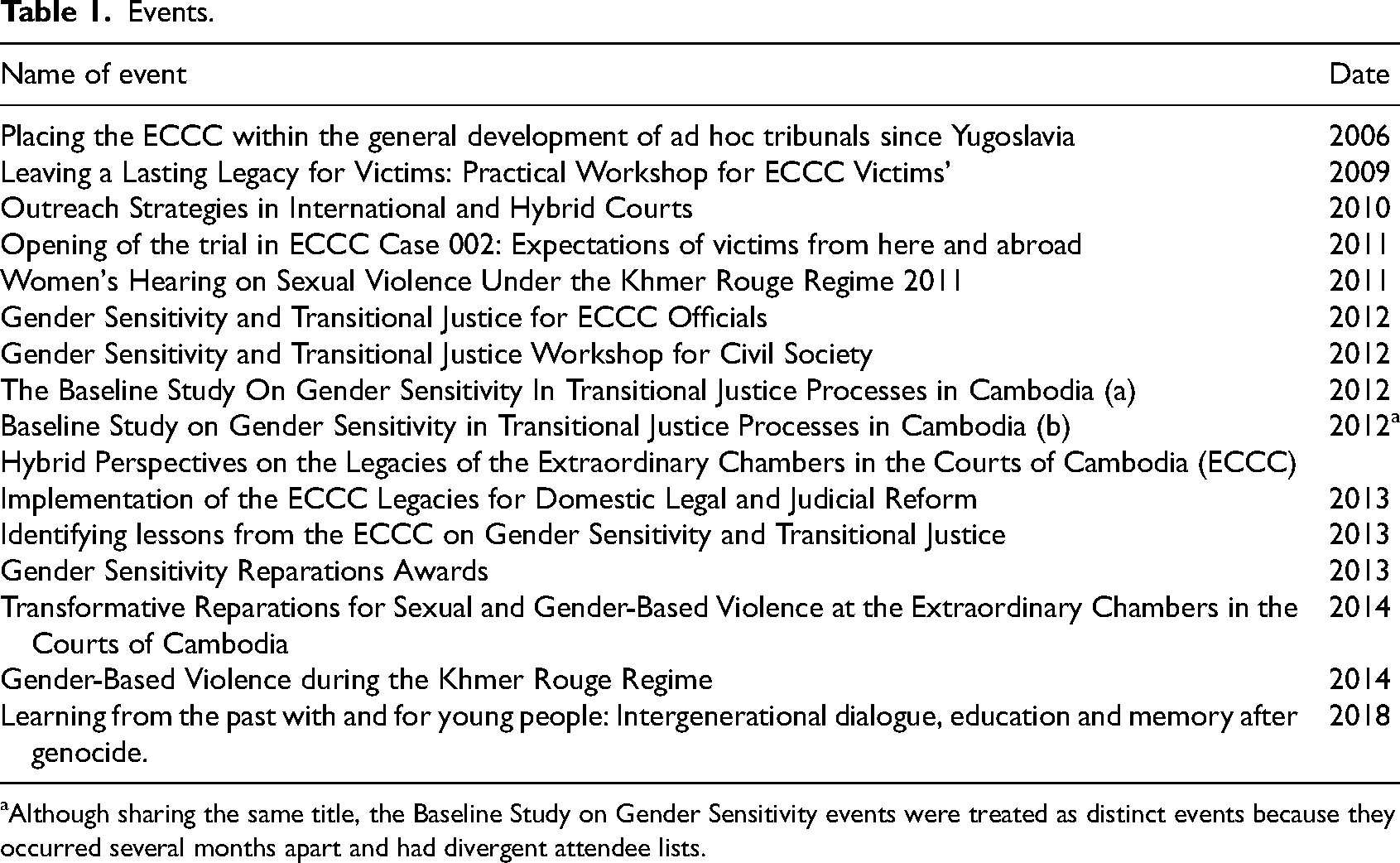
Although sharing the same title, the Baseline Study on Gender Sensitivity events were treated as distinct events because they occurred several months apart and had divergent attendee lists.
Once the list was finalised, we created individual databases for each event which listed the event's name, the year it was held, and all published attendees. In general, the events were characterised by a blurring of the boundary between scholarship and practice, a tendency at work in the wider field of transitional justice. From the 16 events, we were able to identify 383 individual attendees. Rather than generalising to a wider population, our analysis focuses on the relationships between each of the 383 individual attendees who contributed to the discussion, promotion and advocacy for transitional justice in Cambodia.
To inform our analysis of locality basic demographic data was collected for each attendee. The names of each attendee were reviewed by members of the research team. This included a native Khmer speaker and a researcher with experience of the Khmer language as well as over 10 years of field experience in Cambodia. Attendees were classified as being either ‘Cambodian’, or ‘non-Cambodian’. This initial coding was checked against publicly available biographical information including published biographies, CVs and organisational websites and promotional materials. For this article, the identities of attendees have been anonymised. Each node was attributed a unique identification and is presented in this article as either ‘Cam’ or ‘NonCam’. The ‘raw’ data of events and attendees (including attributes) were uploaded to UCInet 6 (Borgatti et al., 2002) to create relational datasets for network analysis. All analysis was conducted in UCInet and all network visualisations were created using Netdraw (Borgatti, 2002). Our exact analytical procedures and findings are detailed in the following section.
Analysis and Findings
Of the 383 actors identified, 222 (58%) were recorded as Cambodian and 161 (42%) were recorded as being non-Cambodian. However, the greater number of local actors does not automatically equate with equality between local and non-local actors or prove the existence of power imbalances that favour Cambodian representation. To explore issues of equitability within the network, we measured the level of homophily amongst the community and evidence of particular actors holding structurally important positions.
Homophily
A key issue for understanding localisation is whether Cambodian and non-Cambodian actors attend the same events and are engaging across the local/international divide. This is achieved by studying homophily: the tendency for a network to be organised around similar attributes (e.g., nationality) and for actors and groups with shared attributes to hold ties with each other compared to ‘outgroups’. One way of measuring homophily or heterophily within a network is the use of the Engineering Index (EI) (Borgatti et al., 2013). An EI score can range between 1 (complete heterophily) and −1 (complete homophily). The EI Index can be applied to different levels within a network. Here we focus on the whole network and group level.
The whole network indicated a slight tendency towards homophily (EI = −0.096). Group-level EI scores indicate that Cambodians shared more ties – and attended more events – with other Cambodians (EI = −0.217), whereas non-Cambodians formed more ties with Cambodians. A degree of caution should be employed when interpreting the EI index. This is because the measure is sensitive to group size. Because the data analysed here is primarily derived from events within Cambodia and there are more Cambodians in the network, there is obviously a greater chance for Cambodians to attend the same events. Furthermore, these events were often conceived as opportunities to give Cambodian's a ‘voice’ or visibility (see e.g., Killean, 2018, chapter six), and thus it is likely that more Cambodians were recorded as attending events.
Centrality
The above analysis is helpful for describing the global characteristics of the network. In what follows we use measures of network centrality to identify whether there are any privileged or key actors within the network. This is done through focusing on the centrality of individual nodes and comparing the difference in centrality between Cambodian and non-Cambodian actors.
Network centrality refers to a variety of measurements that identify the ‘structural importance’ of a node within a network (Borgatti et al., 2013, p. 174) and is often conflated with notions of power, prominence or prestige (Ward et al., 2011) as – in comparison to isolated or less central nodes – central nodes can influence the wider network (Faul & Tchilingirian, 2021, p. 770). Here, we apply degree and betweenness centrality. A node's degree of centrality is measured by calculating the number of ties it holds within a network. In this article, a node with a high degree centrality indicates an individual has attended multiple events – and shares ties with a large number of other actors – suggesting a high level of activity within the community. However, the structural importance of a node does not necessarily correlate with a high degree centrality (Robins, 2015, p. 26). For example, a node that brokers between other nodes – or communities – are seen as holding an advantageous position. By connecting disparate actors, brokers can potentially disrupt or rewire the flow of information or resources within a group, sometimes for personal or particular gain, or for the wider benefit (Obstfeld, 2005). Such opportunities are afforded by the position within the network, not simply by the number of connections held. A common measure for the brokerage is betweenness centrality which calculates the extent to which a node falls along the shortest path between other nodes (Borgatti et al., 2013, p. 185) (Figure 1).
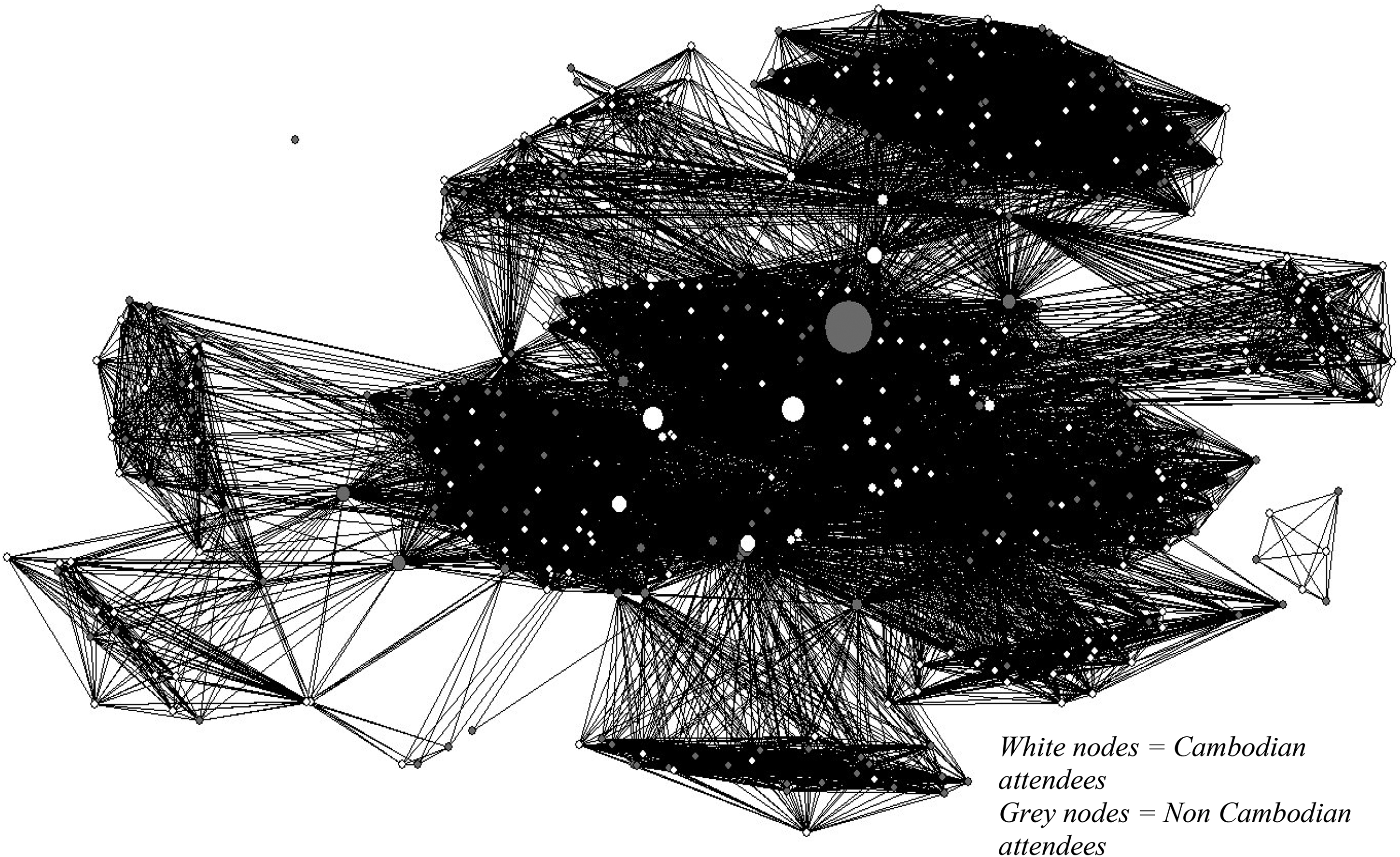
Visualisation of all recorded attendees (nodes size based on degree centrality).
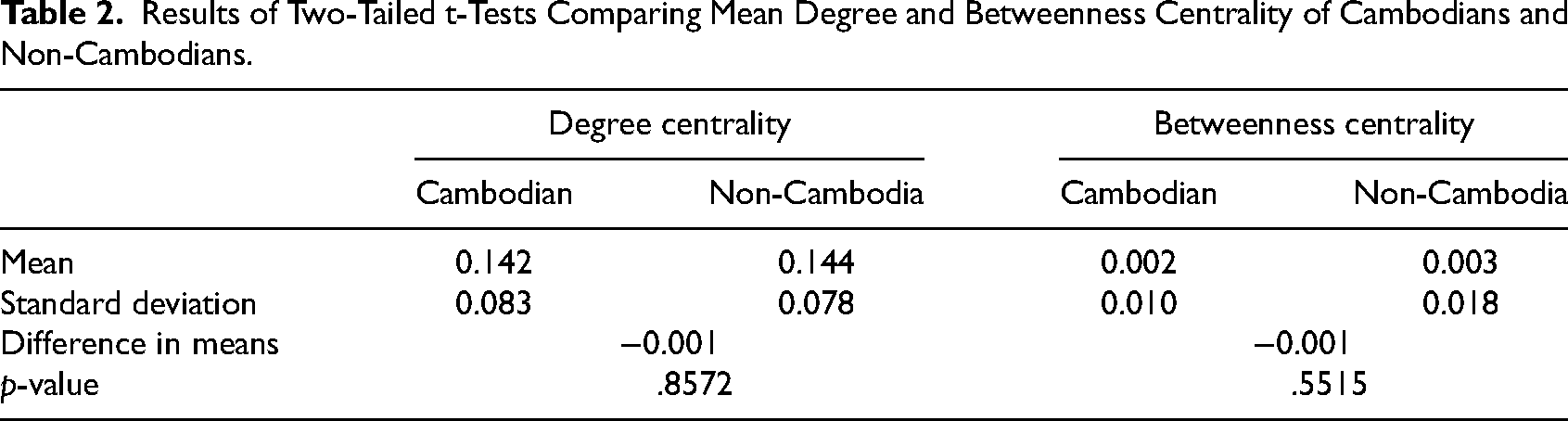
Two-tailed t-tests were used to compare the difference in the mean degree and betweenness centrality scores of Cambodians and non-Cambodians. As the results displayed in Table 2 suggest, there is very little difference in the mean degree and betweenness centralities of both groups. Whilst the Cambodians on average have slightly lower centrality scores, these are not statistically significant.
Results of Two-Tailed t-Tests Comparing Mean Degree and Betweenness Centrality of Cambodians and Non-Cambodians.
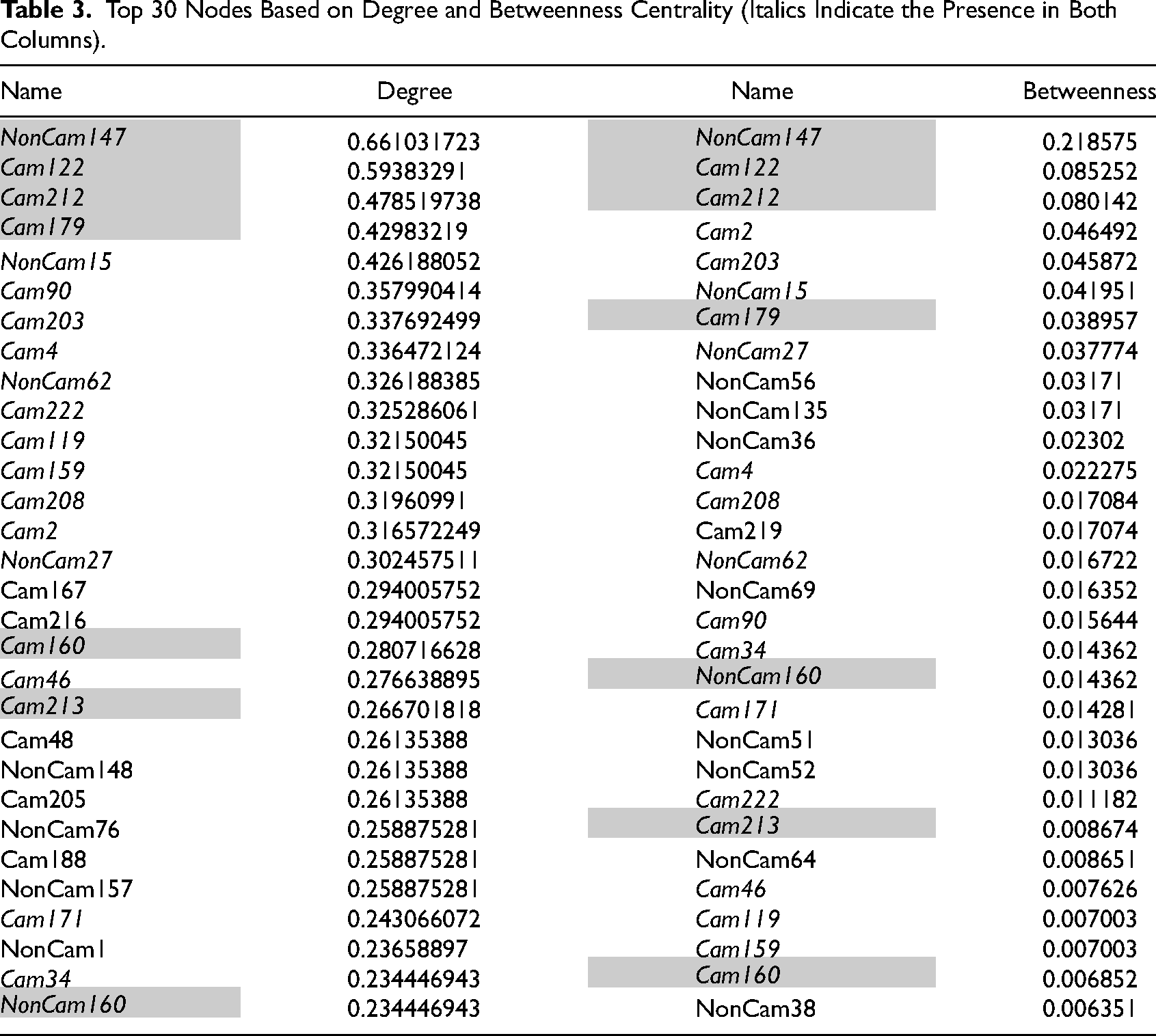
Whilst the average centrality scores of Cambodians and non-Cambodians do not differ greatly, we do see greater Cambodian representation in the most central positions within the network. When we consider the centrality of individual nodes, it there are a greater number of Cambodians in the top 30 for degree centrality (n = 21) and betweenness than non-Cambodians (n = 9, degree; n = 13, betweenness) with higher degree and betweenness centrality (n = 17) scores are in the majority (see Table 3).
Top 30 Nodes Based on Degree and Betweenness Centrality (Italics Indicate the Presence in Both Columns).
Prestige and Event Production
Whilst the whole network records attendance at an event, being an attendee of multiple events does not necessarily equate with importance or prestige. An individual might attend multiple events as an interested audience member. This would equate to a high centrality score. However, being an attendee is a qualitatively different experience from being the attendee who is billed as a keynote speaker or is a discussant on a panel. The latter underscores that a community (or at least those with editorial and curatorial status) regard the contributions of these actors as holding particular importance due to their embodied knowledge or cultural capital (Freeman & Sturdy, 2014) or share similar opinions, interests and goals (Baird, 2017). Similarly, attendees can also be organisers or people who have made a contribution to the design or theme of an event. This role is likely to denote a level of autonomy and influence and a different status from simply attending an event. In sum, we take having a publicly defined role at an event as being a record of intellectual input into an event which marks out the individual from other attendees and can indicate influence, prestige or importance via their role in facilitating an event.
To capture this difference in attendee status each node was assigned a code to indicate if they were publicly recognised as being either: a speaker (including keynote, single speaker, panellist or chair), a facilitator (meaning having an acknowledged role in organising or supporting an event) or as providing direction to the intellectual contribution of an event in the form of acknowledgement in the text of the event record.
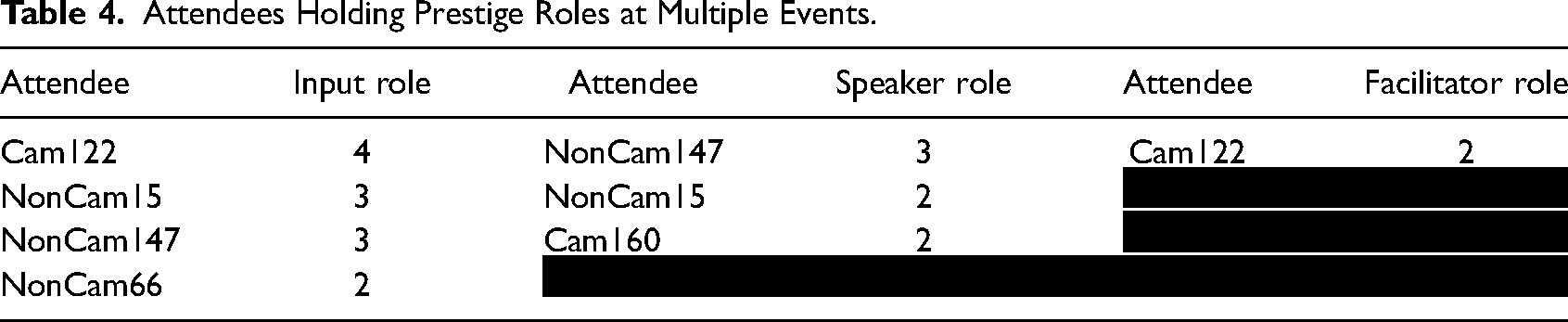
Speakers: Fifty-seven attendees were named as speaking at an event with slightly more of these speakers being Cambodian (n = 32) than non-Cambodian (n = 25). Facilitators: Twenty-one of the attendees were identified as facilitating events. Again, there were more Cambodians taking facilitator roles (n = 12) compared to non-Cambodians (n = 9). Input: Forty-eight attendees were noted as having some form of intellectual input into an event. There was nearly complete equality between Cambodians (n = 26) and non-Cambodians (n = 25).
Both Cambodian and non-Cambodian actors held prestigious roles at multiple events. However, non-Cambodians held more speaker and input roles across multiple events (see Table 4).
Attendees Holding Prestige Roles at Multiple Events.
Discussion
What do network positions tell us about the relationships between – and relative influence of – international and local actors within transitional justice processes in Cambodia?
Our first concern was to examine the ties made between and within groups of local and international actors. In terms of homophily (and heterophily), Cambodian actors demonstrate higher homophily; that is, they are likelier to share ties with other Cambodian actors. Given the location of all the event data in Cambodia, higher Cambodian homophily is not surprising. However, given that critical themes at work in the literature suggest that transitional justice networks can be dominated by international actors at the exclusion of local actors (Schierenbeck, 2015), and high overall network homophily (i.e., a network that is organised around shared attributes), it is notable that non-Cambodians demonstrate greater heterophily than Cambodian counterparts. In other words, we see international actors are likelier to make ties with local counterparts than vice versa. This might be reflective of the often transient involvement of international actors in transitional justice, where the work of episodic projects necessitates the establishment of more (potentially fleeting ties) in the short term, whereas domestic networks tend to become entrenched and self-reinforcing.
Our second concern was to consider the relative influence of actors within each group. Our findings show that, by measures of representation and network centrality, the occupation of important network positions appears, superficially, equitable between international and Cambodian actors. Critical accounts of localisation agendas tend to caution that ideas around local empowerment, participation and ownership can often conceal the dominance of persistent ‘top down’, international influence (Shaw et al., 2010), or that the treatment of locality as a site of technical and programmable practice can limit genuine local engagement with transitional justice and peacebuilding. Our findings do not rebut these claims. However, as we see from literature on transitional justice in Cambodia, where victim participation, civil society leadership in the development of reparations initiatives, and public education and outreach about the ECCC have all been highlighted as successes of the process (Hughes et al., 2018; Killean, 2018; Sperfeldt & Hughes, 2020), it makes sense that our data reflects strong Cambodian representation and, at least, positions with the potential for influence within the transitional justice community.
Yet this finding requires caution. What is also apparent is the uneven distribution of structurally significant positions within each category. Specifically, on measures of centrality and our indicators of influence, we see particular key roles – in terms of brokerage and prestige – that are occupied by the same individuals. This applies to both Cambodian and international actors. Further thought is required to understand the power dynamics hinted at in the uneven occupation of more central and influential roles within each group. We know that, at different phases of the work of the ECCC, certain individuals have occupied high-profile public roles in advocacy around the ECCC (see e.g., Benzaquen-Gautier, 2019, p. 144). In our data, particularly influential individuals are visible in ‘clusters’ of events and relationships that seem to point to their entrepreneurial attributes and network relationships that enable the leveraging of resources and/or attention. In our data, we see this in measures of centrality and betweenness, which show that certain individuals repeatedly occupy structurally significant positions (see Table 3), and in indicators of influence and prestige (see Table 4 and Figures 2 to 4). On measures of centrality and our indicators of influence, we see particular key roles – in terms of brokerage and prestige – that are occupied by the same individuals.
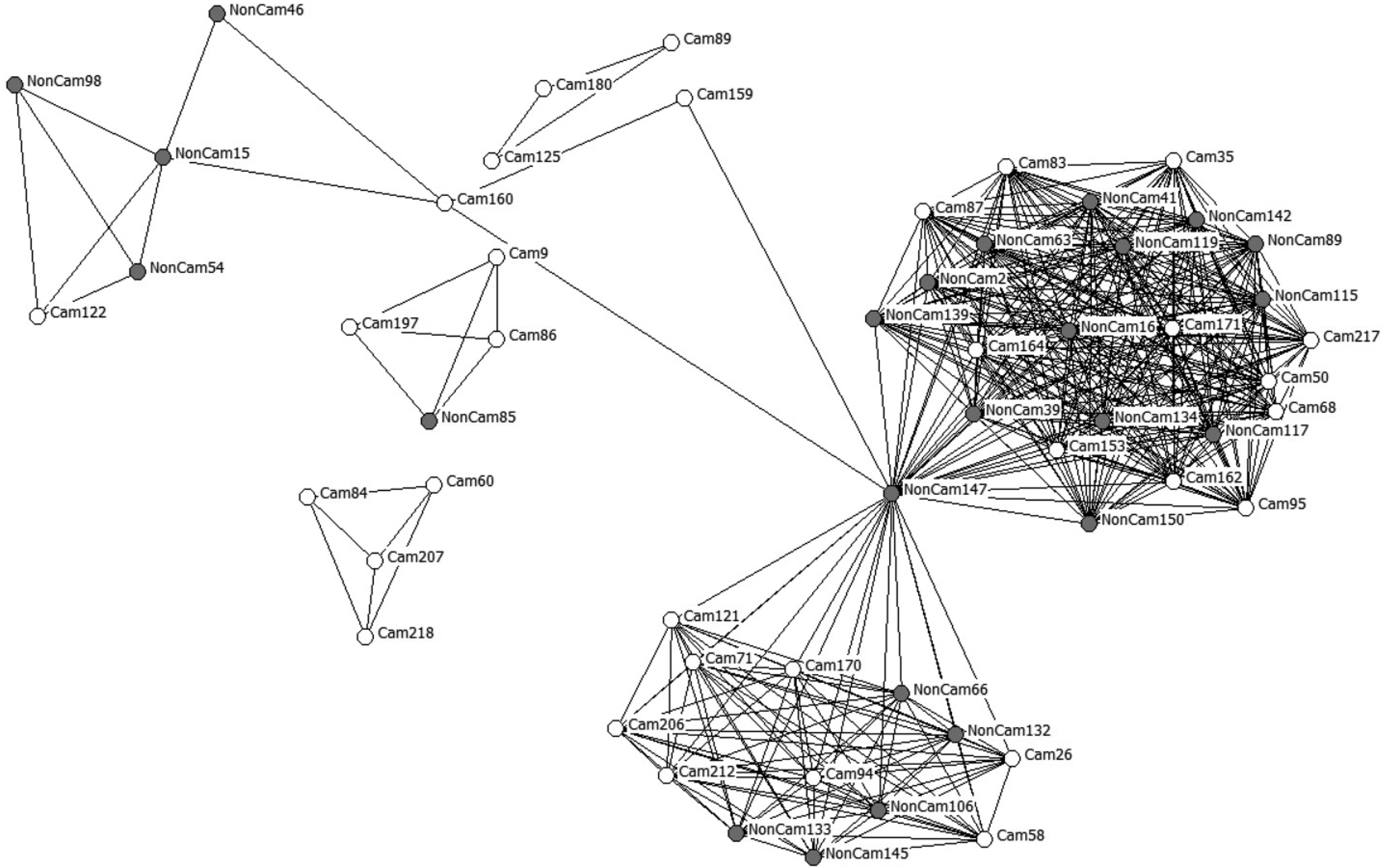
Visualisation of speakers at multiple events.
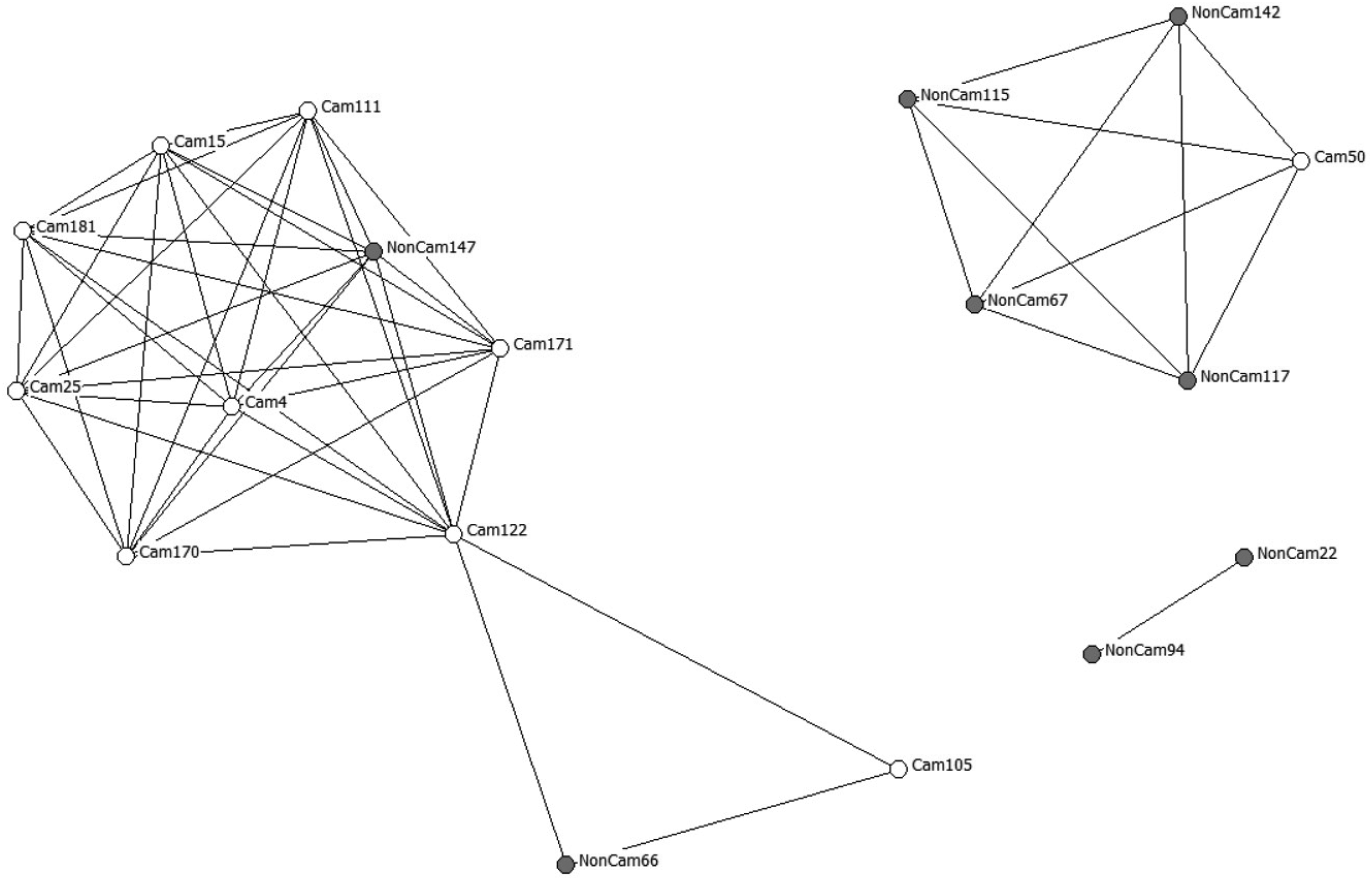
Visualisation of attendees recorded as facilitating multiple events.
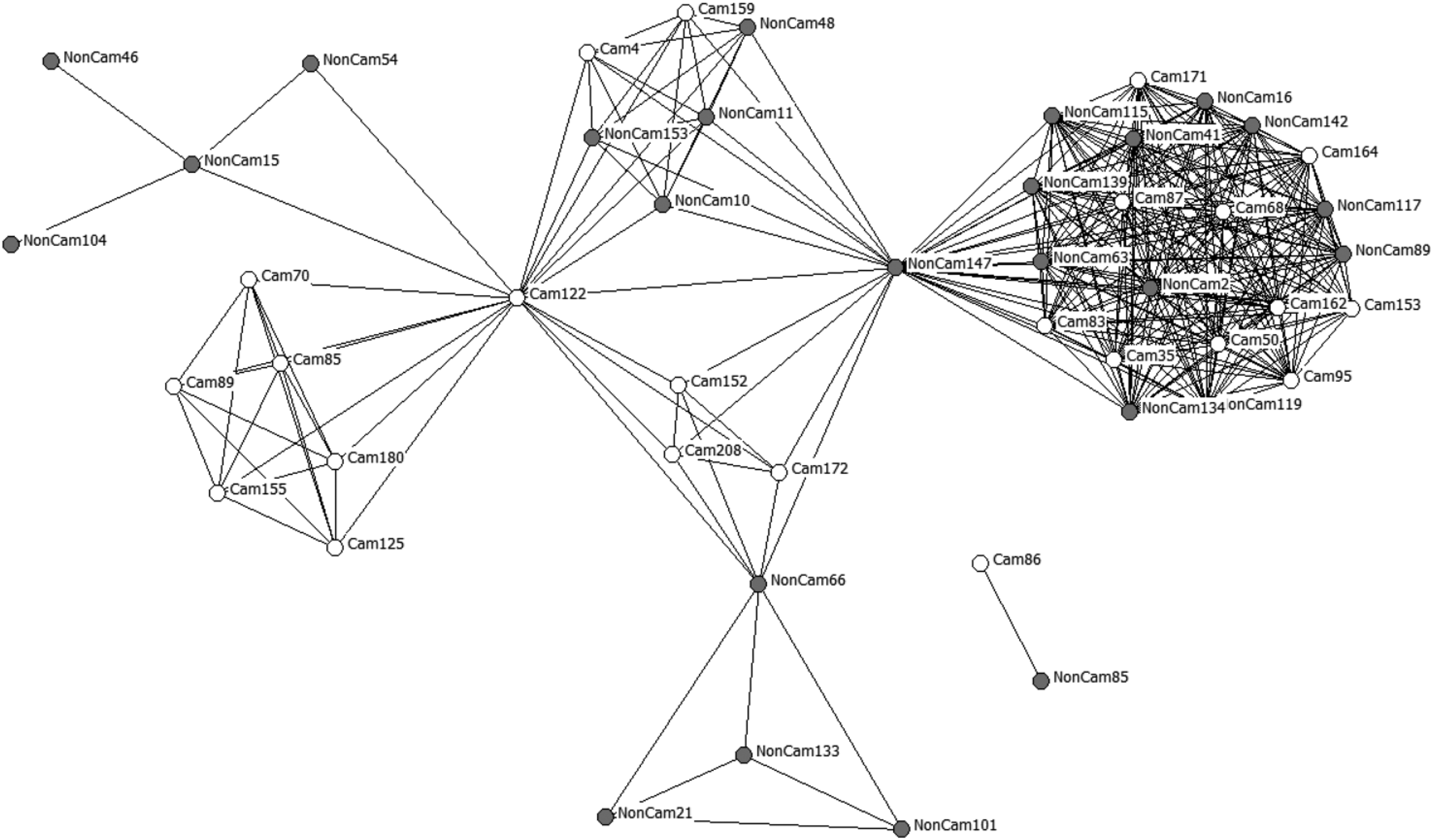
Visualisation of attendees recorded as providing intellectual or practical input to an event.
What do network positions and relationships reveal about how local and international groups are constituted, as such, in the case at hand?
Recognising the uneven distribution of significant network positions within both local and international groups obliges consideration of how individuals gain influence in these contexts. Closer attention to the four individuals occupying positions of highest influence (Table 4) points to the need for greater attention to the role of individual biography in shaping transitional justice ‘moments’. In terms of background, the most influential two non-Cambodian actors are characterised by their professional mobility, both geographically and especially across the (porous) boundaries of academia and practice in human rights and transitional justice. Both have worked at larger international organisations and have occupied prestigious practice-focused country postings across Southeast Asia; each has occupied positions and training at leading US, European and Australasian universities; and each can be seen to draw on these reservoirs of professional and academic credibility and experience in shaping event priorities: specifically, we see the presence, influence – and, indeed, likely capacity to attract funding – of these individuals at clusters of separate events on gender-based violence and reparations. For the two most influential Cambodian actors, we see backgrounds characterised by less international mobility, but rather longstanding career trajectories in Cambodian civil society (one with a focus on advocacy, the other drawing from a background in media and public relations). Both have occupied civil society roles working on past and present transitional justice agendas that have been sustained through close relationships with international organisations and donors, particularly ECCC public engagement, victim participation and reparations work. Notably, these are also agendas that have not come into conflict with the priorities of the RGC (and most significantly, RGC objections to a wider universe of politically sensitive prosecutions than those pursued to date). In this case, biographically, influential local actors appear to be those best able to negotiate productive relationships with international agendas, while navigating the specific challenges and constraints of local political life. Recognising the significance of biography within a transitional justice network has important implications. In the first instance, this reminds us of the need for researchers to disaggregate the composition of ‘local’ and ‘international’ within transitional justice and peacebuilding work that is oriented to localisation agendas – and to take seriously the constitution of each in practice – and highlights network analysis as a potentially fruitful tool for doing so. This is important for several reasons. Firstly, the key brokerage and prestige roles that we have identified are not neutral positions. They are able to shape transitional justice debates and practice; and those positions must also be understood to potentially reflect certain attributes and relationships that allow or dictate their centrality and influence. This matters because it further demonstrates that arguments around localisation and the ‘local’ need to be sensitive to the uneven power positions at work within and across both international and local groupings. Secondly, while recognising the role of biography helps to avoid overly reified conceptions of local and international (see Schierenbeck, 2015), it further opens up more focused questions about the structurally significant factors that advantage certain individuals within transitional justice networks and communities. In other words, as we attend to individual biography in shaping transitional justice we have a window to see how both immediately local and wider international inequalities might intersect and operate to allow access to shape agendas and policies in different ways for different people. Biographically, influential local actors appear to be those best able to negotiate productive relationships with international agendas, while navigating the specific challenges and constraints of local political life.
Our analysis highlights the ‘special status’ of certain attendees, their centrality, prestige and importance because such network positions enable influence in the way that transitional justice processes are authored and shaped, and thereby the form and content of ‘justice’ that can be delivered. Two issues remain in question in this approach. Forms of speakership themselves can be further differentiated. Around the ECCC (and all transitional justice processes), speakership at events can reflect positions of intellectual or professional expertise; they might also reflect privileged positions from which to speak about experiences of transitional justice cases, such as survivorship. These are two distinctive registers and criteria from which authority to speak about and shape transitional justice events (and processes) are derived.
Furthermore, a focus on speakership might in itself underplay the significance of attendance in its own rights. The events at hand in our data are not simply seminars or didactic meetings: people attend to be seen, to further their own goals, and to ‘network’. We know, too, that networks will always entail and implicate specific and complex cultural politics; in Cambodia specifically, for example, invitations just to attend civil society events is thought to confer forms of status and public prestige (Sok & Abe, 2019), and that only a minority have utilised the transitional justice and development programs (Sperfeldt & Hughes, 2020). Similarly, being an event organiser – and funder – may denote a level curatorial power and the ability to determine the relevance and ‘worthiness’ of local and international knowledge (and therefore actors) to make public interventions on the development of transitional justice. This aspect of event attendance underscores the need for further research into forms of ‘hidden influence’ within the community.
Further cautionary reflections are required. In the first instance, our analysis is principally quantitative and can only superficially grasp the interplays at work within the network that might sustain or elevate positions of influence and prestige. To do so, further in-depth qualitative work is requisite. Secondly and relatedly, our analysis has focused on ‘public interventions’ as they are recorded in event data (as attendance, speakership, and acknowledgement of influence or support). These are not unbiased or complete accounts of an event and tend to require and include forms of ‘quiet diplomacy’ that cannot be grasped in our analysis. There are potentially missing data and, more importantly, we must reflexively consider how and where our data is produced; for researchers aiming to explore transitional justice, peacebuilding and development networks through an examination of events, there is a need to recognise that public event data is a representation – and means of positioning the legitimacy – of an organiser. Further analysis is needed to understand the diversity of relationships (between funders, organising parties, and boards, to name a few) at work.
Conclusion
‘Localisation’ agendas in transitional justice assume that more just and effective interventions are possible by virtue of local involvement and ownership. Such assumptions are premised on the idea that relationships between international and local actors are – and can be – based on equitable interplays of expertise, knowledge, access, and resources. Yet, as visible in Cambodia, transitional justice networks tend instead to be characterised by hierarchy and inequalities within groups of both local and international actors. As we have demonstrated, SNA is a fruitful methodological approach for exploring such hierarchies because it can map the way power and influence is embedded in relationships of actors between institutions, knowledge, and practice. In doing so, we hope to have provided a blueprint for further research in peacebuilding, development and transitional justice that might consider, for example, inequalities in networks around, for example, funding, bibliographic and citational communities, professional mobility and beyond.
While our findings in this paper echo recent calls to disaggregate the composition of local and international groupings (Kochanski, 2020), we have further highlighted the need to take seriously the role of individuals and their backgrounds in securing important network positions in transitional justice networks. For researchers interested in localisation – or peacebuilding and transitional justice more broadly – a focus on ‘networked biographies’ promises analyses that see how individual backgrounds tend to intersect with – and complicate – wider structural axis of inequality that are the more common focus of research on inequality in these fields e.g., gender, ‘race’, and nationality. Importantly, a focus on biography further allows scope for understanding how individuals actively navigate and negotiate both local and international opportunities and constraints in order to secure influence. Our analysis suggests that issues and sources of professional credibility, expertise, and resources each play a role and that further attention to questions of biography and life history will be needed to build the story of transitional justice communities and networks, especially as they change over time. In other words, further research into the intellectual world of individual network members in transitional justice and peacebuilding is vital – who do they turn to for advice or who has influenced their practice and understanding of their field? A focus on biography further allows scope for understanding how individuals actively navigate and negotiate both local and international opportunities and constraints in order to secure influence.
Footnotes
Acknowledgements
We would like to thank Rachel Killean for her comments on an early draft of this paper. Thanks also to Elliot Rose for his assistance with data management.
Declaration of Conflicting Interests
The author(s) declared no potential conflicts of interest with respect to the research, authorship, and/or publication of this article.
Funding
The author(s) received no financial support for the research, authorship, and/or publication of this article.
