




Abstract
Fostering legitimate authority has become a priority of the international peacebuilding and development community, notably in fragile states and conflict-affected settings. Yet, how peacebuilding and development interventions feed into legitimation practices of public authorities remains underexplored, let alone how interveners can strategize on this. Analysis of programs to support land registration in Northern Uganda brings out how interventions not just enhance the legitimacy of targeted authorities. Often unintentionally, they impact on struggles for legitimacy between different state and nonstate authorities and change their relative legitimacy. They do so by redistributing land governance roles and responsibilities; stimulating certain practices of land governance; and contributing to the discussion on legitimacy assessments. The conclusion argues for more sensitivity to legitimation effects of peacebuilding and development interventions.
Keywords
Introduction
Legitimate authority—or the extent to which those that are in a position of authority are accepted by those they govern—has become an important concern of the international peacebuilding and development community. Legitimate authority is expected to enable the exercise of power through consent rather than coercion (OECD, 2010, p. 7). Voluntary compliance with leadership's decisions and regulations (even those not liked by those that are governed) is expected to reduce the costs of governance and makes services provision easier and more effective. Poor legitimacy, on the other hand, deprives the state of people's support, prohibits the state from acting (Bellina et al., 2009), and may predisposes it to revert to repression (Brinkerhoff et al., 2012). A loss of legitimacy is considered a major explanation for state failure and violent conflict (Goldstone, 2008; Rotberg, 2003).
(Re-)establishing legitimate state authority has thus become a priority of multilateral statebuilding and peacebuilding interventions in fragile and conflict-affected settings. This is notably to be achieved through strengthening the state's capacity to provide services (Lemay-Hébert & Mathieu, 2014; McLoughlin, 2014). Also, many international NGOs consider that they have a role to play in enhancing the legitimacy of local state and nonstate authorities. Some include nurturing legitimate authority as an explicit ambition of their peacebuilding and development programs. Others expect that (re-)establishing legitimate authorities helps assure aid effectiveness and sees contributions to peace and development merely as positive side-effects.
Organizations working at the interface of peacebuilding and development for long assumed that enhancing the state's potential to provide citizens with security, development, rule of law, participation, and accountability would result in better appreciation of that state (OECD, 2010). However, this relationship between service provision and legitimacy is not self-evident (Brinkerhoff et al., 2012). Although the provision of services may enhance the state's “output” legitimacy, it may also be seen to enhance state control, to pacify citizens, to prioritize certain groups, or to consolidate patronage (see McLoughlin, 2014). Moreover, the mechanisms at play are ambiguous (Bellina et al., 2009; Mallett et al., 2015). For instance, positive perceptions of the actions of one civil servant or agency do not necessarily extrapolate to the legitimacy of government as a whole (Brinkerhoff et al., 2012). State legitimacy tends to depend on subjective assessments and on context-specific expectations of authority. Especially in conflict-affected settings, there tends to be disagreement about whose rule to accept and how to evaluate the performance of rulers (Gippert, 2016; von Billerbeck & Gippert 2017).
Even less clear is how interventions by peacebuilding and development organizations to enhance the performance of public institutions actually impinge on legitimation practices, let alone how interveners can strategize on this (McLoughlin, 2014; Teskey et al., 2012). This paper engages with this latter puzzle. It presents the findings of a 2019-research project on interventions by peacebuilding and development organizations to enhance local land governance capacity in the Acholi and Teso subregions in Northern Uganda. The choice for analyzing land-related interventions was informed by our experience that issues of legitimacy strongly manifest themselves around land governance and its reform (Kobusingye, 2018; Maiyo, 2018; Van Leeuwen, 2017). How local state authorities in sub-Saharan Africa deal with land issues has important consequences for their appreciation and acceptance among citizens (Lund & Boone, 2013). Through land-governance practices, authorities may demonstrate their goodwill and capacities in service delivery, or instead feed distrust, perceptions of structural (ethnic) bias by the state, and even conflict.
Inspired by literature on the “grounded” (Clements, 2014), context-specific nature of legitimacy, the project explored prevailing dynamics and practices of legitimation of state and customary authorities in Northern Uganda, and how government reforms and interventions by international peacebuilding and development organizations affected these. The aim was also to explore how interveners may better take legitimacy into account. Ethnographic fieldwork and a series of workshops with practitioners demonstrated how peacebuilding and development interventions do not just enhance the legitimacy of particular authorities. Instead, our research brings out how interventions feed into competition for legitimacy between different stakeholders: particularly not only between state and customary authorities but also between men and women, and between state and development organizations themselves. Many of these impacts are unintentional and unforeseen. The conclusion thus makes the case for more sensitivity to how peacebuilding and development interventions play into competition for legitimacy and ends with some questions that might help interveners to assess such effects.
Analysing Legitimation Practices and Intervention
Normative understandings of legitimacy tend to describe legitimacy as an attribute of public institutions (Suddaby et al., 2017), which derives from some generic or universal “sources” (see McCullough, 2015). Legitimacy of public institutions is then seen to result from, for instance, their responsiveness to citizen concerns (“input legitimacy”), how decisions are taken (“throughput legitimacy”), and achievement of goals in line with citizen interests (“output legitimacy”) (Schmidt, 2013). In contrast, our analysis starts from an empirical, or “grounded” (Clements, 2014) understanding of legitimacy, which emphasizes its context-specific and dynamic nature. It considers legitimacy as an outcome of a process of legitimation that evolves in the daily interaction between citizens and their authorities (see e.g., Beetham, 2013; Duyvesteyn, 2017; Gilley, 2006; Roos & Lidström, 2014). From such an understanding, legitimacy should be studied inductively, by exploring how in a particular setting the acceptance of authority is influenced by locally evolving values, beliefs, and experiences with the practice of authority; and is embedded in particular history and institutional legacies (e.g., Lamb, 2014). Such an understanding highlights the constructed nature of legitimacy and the importance of perceptions. “Sources” of legitimacy are only effective to the extent that relevant constituencies consider them as such (Bellina et al., 2009). For instance, whether services provision contributes to state legitimacy may depend on prevailing expectations of what the state should provide, on subjective assessments of the fairness of services provision, or on whether people attribute the benefits they experience to the state (McLoughlin, 2014). How legitimacy is evaluated also depends on historically grown understandings of leadership and statehood, of rights and obligations of citizens and authorities toward each other, and of authorities’ legitimate reach of power, including the use of violence (Hansen & Stepputat, 2001; Hirblinger, 2015). Legitimacy judgments may rapidly change through particular events, or through citizens’ daily experiences with those in power. For instance, effective service delivery, or democratization of institutions does not automatically coincide with higher appreciation: citizens may develop new or incrementally higher expectations of their authorities (McLoughlin, 2014).
Legitimacy is relational, and both authorities and citizens are involved in its ongoing reformulation and reassessment.
Legitimacy is relational, and both authorities and citizens are involved in its ongoing reformulation and reassessment. People's perceptions of legitimacy may result from rationales provided by powerholders themselves, while powerholders may strategically conform to changing expectations. Legitimacy is not only about discourse but also about practice. In addition to people's normative assessments of their authorities, what matters is empirical legitimacy: the extent to which people act in accordance with their assessments of their leaders and so demonstrate consent (Beetham, 2013). Furthermore, if legitimacy is in the eyes of the beholder, legitimacy assessments might substantially differ between citizens and their authorities, or the international development community (Gippert, 2016; Lister, 2003). Although citizens may have ideas about the meanings of legitimacy that differ from those of their leaders, they may also differ amongst themselves in how they assess their leaders (see Lamb, 2014). This might particularly be the case in societies divided by violent conflict.
The constructed nature of legitimacy implies that legitimacy might be influenced through the so-called practices of (de)legitimation, which we understand as more or less deliberate attempts to conform to, or change legitimacy beliefs and assessments (Bexell, 2014; Tallberg & Zürn, 2019). Practices of (de)legitimation have been particularly explored in International Relations literature, which for instance analyses the deliberate practices in global governance of naming and shaming; or efforts of donors to discipline recipient states to conform to international standards of human rights and accountability (Bäckstrand & Söderbaum, 2018; Bellina et al., 2009; Vaara & Tienari, 2008). Likewise, institutional and management scholars discuss ways of repairing “legitimacy gaps.” These include not only strategies to improve performance but also efforts to influence public perceptions and expectations, propagation of certain values, or interpretation of an institutions’ activities and identity (Bridwell-Mitchell & Mezias, 2012; Suchman, 1995). As mentioned above, statebuilding literature particularly considers how legitimation is a matter of supporting democratization and enhancing the capacity of the state to deliver basic goods and services, elections, and meeting the basic needs of citizens (Dagher, 2018; Lemay-Hébert & Mathieu, 2014).
How external interventions to strengthen local authorities may impact local legitimation practices has not yet been extensively studied; let alone how interveners may strategically engage with local legitimation practices (see McLoughlin, 2014; Teskey et al., 2012). Some insights are provided by work on conflict sensitivity (e.g., Wallace, 2011). This literature underscores that development assistance—notably institutional strengthening (Eickhoff & Mueller, 2017)—may have legitimation effects. It may, for instance, endorse violent or unjust governments, leaders, or institutions. It may also uplift the role and standing of peace-minded individuals and organizations, and nurture legitimate practices of governance, including transparency, participation, and accountability. An important lesson from this literature is that interventions may have unintended consequences for legitimacy, which may nonetheless affect their acceptance, sustainability, and contribution to building peace. As we will see in the below case study, interveners might deliberately engage in acts of (de-)legitimation, for instance by prioritizing certain authorities, propagating certain criteria for assessing legitimacy, or endorsing efforts by different public authorities to convince people of their legitimacy. Yet, frequently their engagement has unintended legitimation and delegitimation effects, and our case study underscores the important consequences of these.
Interventions not only enhance the legitimacy of certain authorities but also impact struggles for legitimacy between authorities, by changing their relative legitimacy.
The paper particularly contributes to the literature by highlighting how interventions shift the relative legitimacy of different authorities. Literature on legitimacy tends to focus on the dyad of citizens and their leaders, and relations of legitimacy developing between these two groups of actors. However, in our research, we are inspired by writings from political anthropology on institutional multiplicity. Particularly in fragile and conflict-affected settings, diverse state and nonstate institutions play complementary and sometimes parallel roles in governing the lives of citizens (Di John, 2008; Von Benda-Beckmann, 2008). Legitimacy is often contested among those different authorities. Each of them brings along with their own ideas about legitimate norms, rules, and practices of governance, and by their performance try to convince citizens of their legitimacy, and delegitimize others (Hagmann & Péclard, 2010). In this institutional competition, citizens play a vital role in endorsing certain norms, practices, and institutions, thereby legitimizing them (Von Benda-Beckmann, 2008). Such institutional multiplicity and competition and how it reallocates authority between diverse (non)state authorities have particularly been studied around land governance in sub-Saharan Africa (Hagmann & Péclard, 2010; Lund & Boone, 2013). This institutional competition is also a key dynamic of local legitimation practices in Northern Uganda. Awareness of contestation for legitimacy among different state and nonstate authorities helps to better understand the legitimation effects of peacebuilding and development interventions. As we show in the case study, interventions not only enhance the legitimacy of certain authorities but also impact struggles for legitimacy between authorities, by changing their relative legitimacy.
Support to Land Certification and Legitimacy Struggles in Northern Uganda
Establishing legitimate land governance constitutes a key challenge for post-conflict peacebuilding and development in northern Uganda. In the Acholi and Teso regions, state legitimacy is contested and was an important factor in the insurgency of the Lord's Resistance Army (see Saito & Burke, 2016). Weak governance structures, tensions between customary and statutory authorities and the rules they apply, as well as the legacy of a North-South divide originating in colonial times (see Allen & Vlassenroot, 2010; Kandel, 2016), create a situation in which state and nonstate authorities compete for authority and legitimacy. The complexity of “legitimacy” possibly most strongly manifests itself around the Ugandan land governance system and government attempts to reform it. Many rural dwellers feel insecure about their land rights, due to long-term war-related displacement and conflicting claims on land, large-scale land concessions by the government, and lack of clarity about the status of customary tenure (Mabikke, 2011). This leaves space for both customary and state authorities to compete with each other about who is in charge of land governance and what rules apply, and to search for support for their claims amongst local landowners (see Kobusingye, 2018).
The extent to which the Ugandan state and its bureaucracy have managed to reduce tenure insecurity is questionable. State presence, including effective institutional structures for land administration, is limited in these regions due to legacies of violent conflict, and their peripheral location. Land dwellers, therefore, incur high costs to obtain titles. Conversely, people have limited confidence in statutory land governing institutions, which are believed to be involved in irregular land acquisitions by larger commercial landowners, investors, political elites, or particular communities. Many people in the Acholi region believe the war and related displacement created conditions for state institutions and political elites to appropriate their land (Kobusingye, 2018). Many residents in Teso region, who practice mixed farming, believe the same about the migration of neighboring pastoralist communities into their ancestral lands (Muchunguzi, 2013).
Customary institutions claim they may better protect local land than state actors, as they are closer to local people than the state, have knowledge of the local context, and conform to local norms. Yet, their actual capacities have reduced. In Acholi, past settlement patterns and land ownership were organized along with clan structures, and clan leaders and family elders had important roles in granting user rights to families, and resolving disputes. Yet, war-related displacement and social disintegration have reduced the involvement of clan leaders in land administration and increased commoditization of land and individualization of land ownership. Meanwhile, the legitimacy of clan leaders has declined as a result of unclear lines of succession, corruption, and irregular land sales under their authority. It is precisely for such reasons that statutory land administrators claim that they can do a better job. Similarly, in Teso, the centrality of clan structures has gradually decreased in importance over time. Clans in Teso are even less consolidated than in Acholi and are further subdivided into numerous subclans with overlapping and contested claims of autonomy, hierarchy, and authority. Consequently, some clans only consist of a few families. Nonetheless, in both settings, there is still a significant local endorsement of customary leadership, particularly when clan leaders are younger, well-educated, and behave morally.
Since 1995, the Ugandan government has implemented a series of important land reforms to address tenure insecurity and the so-called “historical injustices” in the land sector. These reforms notably promote the formalization of tenure, decentralization of land administration, and the legal recognition of customary tenure as a category of ownership. They enable the acquisition of collective family or individual Certificates of Customary Ownership (CCOs) for land under customary tenure, and a simplified procedure for acquiring land titles; both facilitated through decentralized government bodies, the so-called “Local Councils” or LCs. Decentralization also recognizes customary authorities and their role in (collectively) managing land and dispute resolution; while customary leaders can be elected as members into the Local Councils. Yet, the implementation of the reforms has been limited. The amount of land titles given out by these decentralized bodies remained low, as few people could afford the costs of the procedure (which still included detailed surveying and/or demarcation of the land), or feared potential implications, such as taxation (see e.g., Van Leeuwen, 2014; 2017). The number of CCOs given out was even more limited. After a few inconclusive pilots around the year 2000, they were never systematically propagated by the state and were at times discredited by state officials (see LEMU, 2008). Moreover, for the decentralized land administration, the provision of titles was more lucrative (Van Leeuwen, 2014). It should also be noticed that the reforms effectively restrict customary arrangements: customary authorities need to conform to state legislation; while rather than customary authorities, the statutory Local Councils administer the CCOs.
Over the last few years, a number of peacebuilding and development organizations have engaged in programs to enhance local capacities for land services provision, notably the acknowledgment of customary land ownership. In this paper, we explore the experiences of two of such organizations: the Dutch NGO ZOA that operates in Acholi subregion, and whose mandate ranges from relief and peacebuilding to land rights and food security; and the German development organization GIZ that works in Teso subregion, which specializes in rural development, reconstruction and peacebuilding, and local governance and civil society. The ambitions of their programs were two-fold: enhancing local tenure security to reduce hunger and poverty, and help resolve conflict and contribute to long-term stability; and building state administrative capacities and so reestablish local administration in Northern Uganda.
Capacity Building and the State's Output Legitimacy
During our study, interviews and workshops made clear that intervening organizations’ support for decentralized land certification particularly contributed to the “output” legitimacy of the state and local government, notably by enhancing state presence and service delivery. Although legislation that provided for the CCOs had come into force already in 1998, few certificates were issued before ZOA and GIZ got involved. The procedure was either not developed or was still relatively expensive due to the on-demand system of providing CCOs, while wealthier people preferred to acquire individual titles instead. Working through local land administration units, the project interventions enhanced the state's service delivery, increasing availability and lowering the costs of access. A broad range of state and civil society institutions were involved in awareness creation. The implementing capacity of local government was enhanced through the training of the so-called Area Land Committees (ALCs), supplying land demarcation and administration equipment, facilitating field visits, and providing training in conflict resolution. In Teso, ALC representatives accompanied the demarcation teams and hence became more “visible.” The issuing of the first certificates in Teso by the president of Uganda and in Acholi by the minister of Land also contributed to the legitimacy of the central government.
The land certification interventions studied promoted specific methods and practices of land governance which had an impact on “throughput” legitimacy of various institutions.
Moreover, the land certification interventions studied promoted specific methods and practices of land governance which had an impact on “throughput” legitimacy of various institutions. By working with and implementing the project through local authorities, both programs entrenched financial transparency and accountability mechanisms. The program structure regulated the hiring of personnel, financial planning, administrative procedures, and how costs for land services were paid. Our findings show that these changes tended to pay off in terms of increasing the legitimacy of individual state administrators as well. Interviews and observations in the field showed that regular payment of allowances for ALC members for instance ensured they were more regularly and longer in their offices and were more efficient in responding to and processing citizens’ applications. Field officers responsible for public awareness, dispute resolution, and demarcation were more committed, demonstrated high levels of participation, and covered more households than was previously the case. Officials and residents alike voiced their appreciation for the inclusiveness of statutory bodies involved in demarcation and dispute resolution, including women, people with disabilities, and youth. Furthermore, the use of new technologies including GIS-mapping, production of digital records, and physical maps to accompany CCOs strengthened citizens’ trust and confidence in the process. This consequently strengthened the legitimacy of statutory land administration.
However, both projects not only legitimized but to some extent also delegitimized the state as a service provider. To local people, international support for the state also implied that the local government was not in the driver's seat. In Teso, citizens understood that the project would not only have been possible without state endorsement but also recognized the important leadership role of intervening organizations, which sometimes overshadowed the state. In Acholi, the leading position of ZOA in the project fed into existing notions that the state was doing little for the people in Acholi: “Legislation has been in place since 1998. Only when ZOA came did something start to happen.” People perceived that they got their CCOs as a result of ZOA service delivery. As such, the program effectively legitimized the intervener in its role as a service provider, to the disadvantage of the state and led to some competition between state and intervener. For instance, during the public issuance of CCOs, which were fully organized and funded by the interveners, state representatives pointed out that their endorsement of the project had been essential for success.
To some extent, such “attribution bias” was the result of the ways in which interveners implemented their programs (cf. McLoughlin, 2014). The visibility of ZOA seemed to take away credits from the state. For instance, local ALC members, tasked with the demarcation of land at the subcounty level, were transported in ZOA cars during the demarcation process. To community members, this confirmed prevailing notions that the international organization was in charge of certification, rather than the state. In contrast, in Teso, T-shirts worn by the ALC-members during demarcation were printed with logos of both the government and the development organization, and the collaborative nature of the program was recognized. Hence, interventions did not just delegitimize state institutions but boosted the legitimacy of intervening organizations themselves. Interveners thus turned out to be stakeholders in the institutional competition that developed around the land reform program.
Moreover, while the use of new technologies contributed to citizens’ appreciation of the project and of the state administration, key interviewees cautioned on the volatile nature of this appreciation and warned that citizens’ expectations and demands might increase (cf. McLoughlin, 2014). For instance, intervening organizations used advanced standards for digitalization, to capture coordinates and actual acreage of the land. According to state legislation, a sketch map of the land including some significant physical features sufficed. This raised concerns about whether the government would be able to maintain these standards once the project came to an end. There were also concerns that should the ALCs revert to analog and manual systems for demarcation and registration of plots, citizens might think the state was conducting substandard work, thereby again decreasing the legitimacy of state land administration. Furthermore, local government surveyors were concerned that GIZ, ZOA, and other development organizations used different cartographic systems and software. This might impede a seamless transition to a unified national land registration system, hence undercutting the confidence in state land administration currently built.
The Changing Roles and Delegitimation of Customary Institutions
Support for decentralized land certification worked out quite differently for customary institutions. In both Acholi and Teso regions, interventions seemed to reinforce the declining role of customary authorities in land governance. Thereby they aligned to a trend initiated by the Ugandan state to attribute more power to the state in land governance (see Kobusingye, 2018; Maiyo, 2018; Van Leeuwen, 2014/2017). The 1998 Land Act provides for customary land to be governed according to local norms and by customary institutions. At the same time, it vests responsibility for the procedure of registering CCOs to the decentralized state administration. Even if customary authorities participate in the procedure, this diminishes their land governance responsibilities. Moreover, the highly formalized processes involving digital registration and photographic identification, capturing of signatures and biometric data, and legalization of beneficiaries of CCOs required expertise that customary institutions do not avail of. And although customary institutions remain important in dispute resolution, dissatisfied parties can still appeal to formal courts, which further decreases the importance of customary dispute resolution. These changes increased competition between state and customary institutions. State institutions such as the ALC and District Land Board tended to operate independently of customary authorities, and could issue CCOs without their involvement. In Teso sub-region, for instance, it was not mandatory for customary authorities to be part of inspection and demarcation teams. Consequently, some customary authorities warned local people of the dangers of CCOs and discouraged them from applying for these.
While the intervening organization envisioned that these new structures would integrate state and customary leadership, they instead effectively replaced customary institutions.
Even if development organizations were convinced of the valuable contribution of customary institutions, their interventions shifted the division of roles, responsibilities, and relative legitimacy of state and customary institutions. In Acholi, ZOA worked primarily with statutory structures, specifically the (subcounty) ALCs and the District Land Boards in the demarcation and inspection of land and issuing of CCOs. Disputes about land were dealt with by newly established local-level dispute-resolution committees, which were set up with support from ZOA. While the intervening organization envisioned that these new structures would integrate state and customary leadership, they instead effectively replaced customary institutions. The inclusion of customary leaders in dispute resolution teams remained limited. Likewise, in Teso, customary leaders were not explicitly included in the process of demarcation nor in the dispute resolution teams. Neither were they necessarily included in awareness-raising activities, an exercise assigned to local NGOs with a track record of community engagement. Although clan structures were presumed to have extensive experience in solving land disputes, we observed that these were often inactive or lacked legitimacy due to a record of favoritism, corruption, or ineffectiveness. In both projects, village dispute resolution teams were freshly reconstituted, without consideration of traditional dispute resolution structures.
Moreover, interventions did not only contribute to shifting land governing responsibilities from customary to state institutions but they also affected relations of authority within the customary domain. Tentatively, it seems that in Acholi the program reinforced decision-taking power of family heads over land vis-à-vis that of their sons or extended clan members. In the past, land was only conclusively allocated when the family head died, or when young men got married and started their own families. However, due to a combination of factors, including formal education, (post)conflict displacement, and election in local councils, youngsters had gained influential roles in land governance. Some youngsters even forced their fathers to allocate them land (see also Kobusingye, 2020). In such settings, the CCO procedures reinstated the power of the family heads in granting permission for subdivision, allocation, and registration of (parts of) family land to youngsters. Family heads were even less restrained by the clan leaders in how they allocated land. Certification equally had mixed outcomes for women in Acholi. For land owned by smaller family units—for instance, several brothers—the names of sisters and wives could be included on the CCO. However, in cases of land held by extended families or clans, the names of female family members were not included in the certificate. Likewise, in some cases, certificates only included the name of the family head, excluding children and spouses, which reaffirmed the notion that family heads should be in charge of the land.
In Teso, the process notably reinforced the role of the family in land governance, to the disadvantage of the clan. According to custom, sons may be allocated land when they marry or get children, but tend not to ask their fathers for a share of the family land before those moments. Intervening organizations and local authorities encouraged families to take advantage of the demarcation exercise to subdivide land among their children to avoid future individual costs. This effectively increased youth access to and control over land within the family and promoted the inclusion of widows, daughters, and orphans in the process, thereby enhancing land rights of previously marginalised groups. The idea of subdividing land among children during demarcation generally found acceptance. It resonated with preexisting customary provisions for women, according to which some land was set aside for girls in case their marriage failed, and was thus considered legitimate. Furthermore, interviewees pointed out that since the CCO granted custodial rights to family heads, subsequent transactions no longer required permission from the extended family and clan leadership as was the practice before. Customary land was thus transformed into family land—from custodianship by the family to ownership—and hence land was likely to be more easily sold. Even if the clan might still play a role in prohibiting sales to nonclan members, this oversight role was likely to be further eroded.
The Legitimacy of the CCOs and Statutory Land Governance
Finally, international support for localized land certification also has a significant impact on the legitimacy of the CCOs themselves. By extension, this had both positive and negative implications for the legitimacy of statutory land governance. Local people interviewed had come to consider the CCOs as a solution to perennial conflicts arising from uncertainty over boundaries, ownership, and certainty of rights. The services offered within these projects established clarity about land ownership and boundaries, and so were seen to prevent disputes. The process was also seen as inclusive: women, youth, and people with disabilities were all represented in the dispute resolution teams. Interviewees experienced mapping itself as a participatory exercise, in which boundary demarcation was conducted in the presence of neighbors who physically held the mapping equipment in their hands, while others dug holes and planted trees for boundary marking. These procedures contributed to the confidence in the CCOs, and their capacity to help reduce future land disputes. Not surprisingly, several political leaders in the communities where the projects were implemented were eager to be associated with these projects, underscoring their role in bringing them to the communities.
Although land demarcation and issuance of CCOs received overall support because it was seen to solve and prevent boundary issues between neighbors, the project was less effective regarding disputes within families. Moreover, in some localities, vulnerable groups such as widows and orphans continued to be excluded from the certificates or were dispossessed. Even if this resulted from local conventions on women land rights, perpetuation or tolerance of these practices in the new land administration process negatively affected the assessment of the program by some of the women interviewed. They pointed out that in the promotion of the CCOs, it had been underscored that it would also help increase women's tenure security; a promise which was not always fulfilled.
Furthermore, questions and doubts remained about the government's intentions with the CCOs. Citizens’ endorsement of the CCOs did not by extension result in the endorsement of the state. Among some interviewees, the promotion of CCOs fed suspicions about ulterior intentions of the state. In Acholi, the state was historically seen as a land grabber (Kobusingye, 2018), and this impression persisted at the time of fieldwork. Respondents expressed fear that certification might be used as a basis for levying taxes. In Acholi, some opposition politicians advised their constituents not to participate in the demarcation exercises. Interviewees expressed concerns that digital data captured during registration may become accessible to unauthorized persons, including potential land-grabbers. Concerns were also raised about the legal value of CCOs, and the extent of protection they provided, compared to leasehold and freehold titles. In both Acholi and Teso, interviewees questioned to what extent people voluntarily participated in the project. It emerged that in some cases, community members went along with not because they had confidence in the system. Instead, they did not want to be left out of the process out of fear of what might happen if they did not get a certificate. Reportedly, the message given by some ALCs was that if you did not join now, you would not get another chance. In some instances where neighbors failed to agree, ALCs and the dispute resolution committees imposed their proposals for settling boundary disputes, for example, by threatening that wrangling neighbors would have to go to court and spend a lot of time and money. In Teso, demarcation and certification were only provided for those that applied for a CCO. Interviewees worried about what this would imply for the tenure security of those that did not participate in the project. Those numerous limitations undercut the legitimacy of statutory land governance.
Finally, interventions in Acholi and Teso not only reconfigured the legitimacy of local state and customary authorities but they also both legitimized and delegitimized intervening organizations themselves. In Acholi, as discussed above, residents were grateful to the implementing agency ZOA for doing what the state had promised—but failed—to do since the 1998 Land Act: providing more security for customary land. The process used by ZOA was seen as transparent and participatory. However, since the project was implemented in a limited number of subcounties within Acholi and Teso regions, this raised suspicions of discrimination or lack of commitment from the intervening organizations and discontent in adjacent communities that were not included in the projects. Furthermore, in both regions, the project was limited to rural subcounties and deliberately excluded urban areas as these had more complex physical planning regulations, a comparatively vibrant land market, and more individualized land ownership. Nevertheless, urban dwellers did express disappointment about their exclusion from the project. In some cases, interviewees also noticed that promises about protecting women's land rights had not been fulfilled, which resulted in disappointment in the peacebuilding and development organizations.
Legitimation Practices in Settings of Institutional Multiplicity
Empirical findings bring out diverse ways in which interventions in the field of land governance both enhance and decrease the legitimacy of local state and nonstate authorities. Interviews and workshops identified three particular dynamics that we like to highlight. First, interventions directly helped establish new responsibilities for certain leaders and institutions and enabled them to fulfill these satisfactorily through institutional strengthening. Interventions notably enabled state institutions’ functioning and execution of certain tasks, through capacity-building, or providing offices, transport, and finances. Support for local land registration increased the institutional and implementing capacity of local government, thereby enhancing “output legitimacy”. But support also contributed to the presence and visibility of the state and to people's perception that the state is “closer to us”. This did not necessarily result in more state legitimacy. Instead, this resulted in fears for increasing state control and taxation among some interviewees. Second, interventions also promoted (and discouraged) certain methods and practices of land governance and thereby enhanced “input” and “throughput” legitimacy; notably by strengthening accountable and inclusive governance. Our findings illustrate, for instance, how interventions advanced inclusion of women both in land governance institutions and in the certificates. Third, interventions played a role in feeding local debate on norms, expectations, and conventions of public authority, and on how their legitimacy is to be assessed. For instance, interveners promoted particular notions of what “good” land governance looks like. A grounded understanding of legitimacy that focusses on developing perceptions and appreciation of the performance of local public authorities, helped to bring out these dynamics of legitimation.
Support also contributed to the presence and visibility of the state and to people's perception that the state is “closer to us”.
Yet, institutional strengthening, the promotion of certain land governing practices and the propagation of criteria for legitimacy, did not just enhance the legitimacy of specific authorities. These interventions also fed into the institutional competition and played into legitimacy struggles between and among state and nonstate authorities, and even the intervening organizations themselves. First, institutional strengthening contributed to a shift in the division of roles and responsibilities for land governance. Fieldwork in Acholi and Teso shows how, by working primarily with statutory structures or establishing their own dispute resolution structures and ignoring existing ones, interveners decreased the responsibilities and legitimacy of customary land administration. This resonated with ongoing practices of the state in disqualifying customary land governance (see Van Leeuwen, 2017). Second, interventions did not just normalize certain practices of governance, but effectively favored certain institutions over others. During land registration, for instance, “ownership” was limited to immediate family members only, thereby excluding extended family and clan leadership, thus diminishing their oversight roles in land allocation. Likewise, some of the changes in methods (digital tools) and rationale of land governance (the bureaucratization of land administration) promoted through intervention effectively enhanced state authority. Third, interveners purposefully or unconsciously propagated certain norms of (gender)equality and the need for youth inclusion in managing family land that differed from local or customary notions. Thereby they undercut the legitimacy of customary institutions and propagated the state as principal agent in land governance (e.g., Hirblinger, 2015; Van Leeuwen, 2014, 2017). Alternatively, in several instances, the engagement of interveners resulted in them gaining legitimacy at the cost of state institutions.
Many of these reconfigurations in the relative legitimacy of different institutions were unintentional. While interveners might have had the ambition of strengthening both state and customary institutions, interventions effectively endorsed state control of land governance. They ratified the notion that in the end, the (local) state should be responsible for land tenure administration, and not customary authorities; and that household heads should be in charge of their lands rather than clan leaders. They normalized a bureaucratization of land governance, and inclusion of citizens into the “system of the state,” hence making not only land but also the citizens residing on the land “legible” to the state through the capture of personal information and data. Likewise, we observed instances of how interveners unwittingly increased their own legitimacy at the cost of that of the local state. This was the case when credits for services provision were attributed to interveners, even if state representatives had played an important role in their realization (cf. McLoughlin, 2014). This resulted, for example, from the use of interveners’ logos and project vehicles. In some instances, interventions propelled a shift in legitimacy that was unforeseen or even contrary to their intentions. Where the CCOs reaffirmed the notion that family heads should be in charge of the land, this reduced the opportunities for sons and daughters to be included in land governance or precluded the inclusion of female relatives on certificates for family land. Furthermore, interventions may be opportunistically appropriated as part of struggles for legitimacy. In some of the communities where the projects were implemented, political leaders appeared to take credit for the CCO projects, in the hope of gaining votes, at the expense of their counterparts from communities or administrative regions outside the project areas.
Conclusion
How peacebuilding and development interventions precisely impinge on local legitimation practices remains underexplored. In this paper, from a “grounded” understanding of legitimacy, and inspired by literature on conflict sensitivity, we analyzed how this worked out in programs to strengthen local land registration in conflict-affected Northern Uganda. In a situation where legitimacy is contested among different state and nonstate authorities, interventions not only just enhance the legitimacy of certain authorities but also unintentionally change their relative legitimacy.
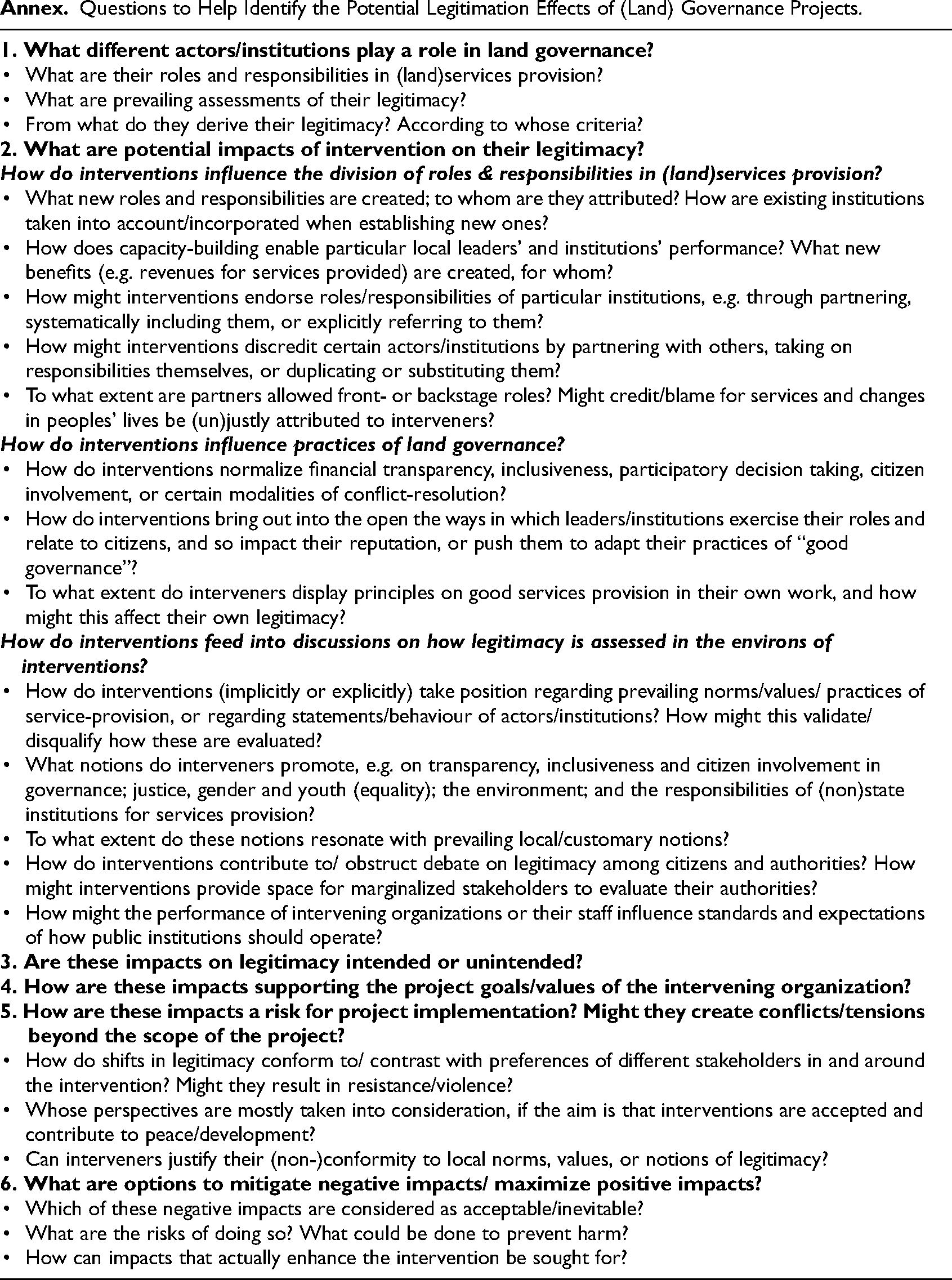
These findings provide a rather discomforting answer to the question of how peacebuilding and development interventions can deliberately impact the legitimacy of land governing institutions: in practice, this may be very difficult, due to the limited predictability of the outcomes of legitimacy struggles. At the very least, however, the findings underscore the urgency for intervening organizations to become more sensitive to the actual (de)legitimation effects of their interventions, and how their interventions feed into the relative legitimacy of different local institutions. To nurture such sensitivity, at the start of programs, interveners should better document their legitimacy assessments, and their rationales for working with certain actors (and their exclusion of others), and for conforming to certain conventions, (customary) norms, and values, or not; and think through how their choices might create tensions. Documenting this at the start enables reflection throughout the project cycle on choices made, helps monitor legitimation effects, and prevents unintended outcomes. In a series of workshops that we organized as part of the research project, in discussion with peacebuilding and development practitioners, we arrived at a series of questions that might be helpful for such an assessment (see Annex to this paper). Hopefully, such a more systematic collection of experiences will also result in more realistic expectations of the contributions of peacebuilding and development programs to (re)establishing legitimate authority.
Footnotes
Acknowledgments
Field research for this paper was conducted as part of the research project “Grounded Legitimacy—strengthening local land registration in conflict-affected Northern Uganda,” which was commissioned and financed by the Ministry of Foreign Affairs of The Netherlands through WOTRO Science for Global Development of the Netherlands Organisation for Scientific Research (NWO-WOTRO), under project number W 08.400.181. The authors wish to thank the research partners GIZ and ZOA for their commitment to the project. The authors are particularly grateful for the willingness of interviewees in Nwoya and Teso to share their experiences and insights. We are also grateful to David Betge and Corita Corbijn, and anonymous reviewers for comments on earlier versions. Any mistakes are ours.
Declaration of Conflicting Interests
The author(s) declared no potential conflicts of interest with respect to the research, authorship, and/or publication of this article.
Funding
The author(s) disclosed receipt of the following financial support for the research, authorship, and/or publication of this article: This work was supported by the Security and Rule of Law (SRoL)—Applied Research Fund 2016 WOTRO (grant number W 08.400.181).

Author Biographies
Questions to Help Identify the Potential Legitimation Effects of (Land) Governance Projects.
|
What are their roles and responsibilities in (land)services provision? What are prevailing assessments of their legitimacy? From what do they derive their legitimacy? According to whose criteria? |
|
What new roles and responsibilities are created; to whom are they attributed? How are existing institutions taken into account/incorporated when establishing new ones? How does capacity-building enable particular local leaders’ and institutions’ performance? What new benefits (e.g. revenues for services provided) are created, for whom? How might interventions endorse roles/responsibilities of particular institutions, e.g. through partnering, systematically including them, or explicitly referring to them? How might interventions discredit certain actors/institutions by partnering with others, taking on responsibilities themselves, or duplicating or substituting them? To what extent are partners allowed front- or backstage roles? Might credit/blame for services and changes in peoples’ lives be (un)justly attributed to interveners?
How do interventions normalize financial transparency, inclusiveness, participatory decision taking, citizen involvement, or certain modalities of conflict-resolution? How do interventions bring out into the open the ways in which leaders/institutions exercise their roles and relate to citizens, and so impact their reputation, or push them to adapt their practices of “good governance”? To what extent do interveners display principles on good services provision in their own work, and how might this affect their own legitimacy?
How do interventions (implicitly or explicitly) take position regarding prevailing norms/values/ practices of service-provision, or regarding statements/behaviour of actors/institutions? How might this validate/disqualify how these are evaluated? What notions do interveners promote, e.g. on transparency, inclusiveness and citizen involvement in governance; justice, gender and youth (equality); the environment; and the responsibilities of (non)state institutions for services provision? To what extent do these notions resonate with prevailing local/customary notions? How do interventions contribute to/ obstruct debate on legitimacy among citizens and authorities? How might interventions provide space for marginalized stakeholders to evaluate their authorities? How might the performance of intervening organizations or their staff influence standards and expectations of how public institutions should operate? |
|
|
|
|
|
How do shifts in legitimacy conform to/ contrast with preferences of different stakeholders in and around the intervention? Might they result in resistance/violence? Whose perspectives are mostly taken into consideration, if the aim is that interventions are accepted and contribute to peace/development? Can interveners justify their (non-)conformity to local norms, values, or notions of legitimacy? |
|
Which of these negative impacts are considered as acceptable/inevitable? What are the risks of doing so? What could be done to prevent harm? How can impacts that actually enhance the intervention be sought for? |