




Abstract
Research suggests that International Organizations (IOs) are getting more involved in efforts to mitigate and adapt to climate-related security risks in different parts of the world. However, there is still a limited understanding of how discourse and action on climate security develop and diffuse in and across different institutional settings in various policy fields and geographical contexts. This article aims to contribute to advancing the research agenda by outlining an analytical framework that helps structure comparison across IOs along three key dimensions: (a) discursive framing; (b) institutional design; and (c) policy actions. To illustrate how the framework can be used in empirical analyses the article discusses findings from previous research. This is not only relevant to highlight the framework’s analytical usefulness as it also shows the relevance of these research findings for practitioners and decision-makers engaged in efforts to enhance the role of IOs in global governance of climate security—and across the humanitarian-development-peacebuilding nexus.
Keywords
Introduction
An increasing number of world leaders are acknowledging the adverse effects of climate change on human lives and societies. The United Nations (UN) Secretary General, António Guterres, has described climate change as “a direct existential threat,” which unmitigated will lead to “disastrous consequences for people and all the natural systems that sustain us” (UN, 2018). The sixth assessment report from the Intergovernmental Panel on Climate Change (IPCC) concludes that “human-induced climate change is already affecting many weather and climate extremes in every region across the globe” and that the evidence of observed changes in extremes such as heat waves, heavy precipitation, droughts, and tropical cyclones, as well as their attribution to human influence, has strengthened since the previous report (IPCC, 2021, p. 8). Frequent media reports about extreme weather events illustrate the dire situation, and no region is unaffected. The adverse effects of climate change are no longer seen as a problem that will materialize in a distant future nor mainly a challenge for those already vulnerable (WMO, 2021).
A fundamental characteristic of climate-related risks to human lives and societies is that they are transnational. Droughts, water shortages, floods, extreme weather events, and sea level rise often affect several countries in a certain region at the same time. The transnational character is not just linked to geophysical connectedness and exposure through, for instance, shared water basins and coastlines, but it also involves the transnational flow of goods, finance, and people (Adger et al., 2009; Hedlund et al., 2018). It might therefore seem self-evident that the better states and local communities are at coping with and mitigating climate impacts, the greater the chances that the adverse effects on human security and societal stability will be alleviated and not “spill over” across state borders. Cooperation among states is pivotal for increasing global and regional capacities to adequately respond to climate-related security risks as well as other transnational problems (Birkmann & von Teichman, 2010).
Previous research suggests that International Organizations (IOs), both at global and regional levels, are getting more involved in efforts to mitigate and adapt to climate-related security risks (Conca et al., 2017; Scott, 2015). These efforts include policy development on prevention and preparedness, early warning systems, and information sharing, as well as enhancing crisis management and relief capabilities (Busby, 2021). But it cannot be assumed that only because there is a perceived need for increased international cooperation on climate-related security risks there will be adequate global and regional responses to manage and reduce such risks. Diverging priorities, organizational inertia, or even outright denial of the adverse effects of climate change in certain contexts might be the factors that hamper efforts at developing global responses to climate-related security risks (Barnett & Finnemore, 2004). Moreover, the tendency of IOs to seek to depoliticize their role in shaping global responses might also be a problem to the extent that this practice of depoliticization might favor certain ways of framing global challenges, which in turn might make IOs less responsive to the perceived needs and lived experiences of peoples and societies most heavily exposed to the negative effects of climate change (Louis & Maertens, 2021). However, the degree and extent of these types of problems need to be studied empirically.
When it comes to research on why, how, and with what consequences IOs address climate-related security risks, and particularly the role of global and regional IOs in this regard, a review of the literature demonstrates that this emerging research agenda is still dominated by single-case studies (Dellmuth et al., 2018). While such studies are essential for providing in-depth understandings of important organizations such as the UN, the European Union (EU), and the African Union (AU), there is a growing need for systematic comparisons across IOs in order to assess the extent to which global responses to climate-related security risks are adequate and, possibly more importantly, to identify urgent needs and potential synergies at global and regional levels.
This article aims to contribute to advancing the research agenda by outlining an analytical framework that helps structure comparison across IOs along three key dimensions: (a) discursive framing, or the way in which IOs frame “climate security” in official discourse; (b) institutional design, or the organizational setting in which IOs work on climate security; and (c) policy actions, or the activities and measures taken by and within the IOs to respond to climate-related security risks in practice. By IOs, we refer to formal intergovernmental, multilateral, and bureaucratic organizations created to promote cooperation among states (Martin & Simmons, 2012). According to this definition, IOs include both interstate bodies (e.g., ministerial councils) and supranational bodies (e.g., secretariats), whose relative decision-making power is determined by institutional design and varies across IOs. Other IOs are technical international agencies with specialized mandates and resources that can operate at both global and regional levels of governance. We draw on this broad definition of IOs, without denying that there are important differences between them in terms of power, autonomy, mandates and resources vis-à-vis states and other important economic actors (Tallberg et al., 2016; Young, 2011). To be sure, a too broad definition might create analytical and methodological problems if fundamental properties of IOs are misrepresented. Nevertheless, we argue that it is important to keep the definition broad at this early stage of the research agenda, since our framework seeks to capture and compare deliberate actions undertaken by IOs to manage or reduce climate-related security risks (George & Bennett, 2005).
Our framework is meant to initiate and guide empirical analysis, and it is devised to mainly explore descriptive questions (how and what) rather than explanatory questions (why and under what conditions). This is a deliberate choice since the research agenda on global governance of climate security is still in its infancy and systematic empirical comparisons across larger sets of IOs constitute a much-needed contribution to the field. Conducting empirical comparative studies to answer a set of similar questions is thus an important first step to allow for explanatory questions to be asked at a later stage. The framework is partly derived from insights gained from our previous research on IOs in Africa, Asia, and Europe (see e.g., Bremberg, 2018; Krampe & Mobjörk, 2018; Mobjörk et al., 2016). As a way of showing how the framework can be used in empirical analyses, we discuss findings from our research, primarily for illustrative purposes. This is not only relevant for highlighting the analytical usefulness of the framework, but also to show the relevance of these research findings to practitioners and decision-makers interested in enhancing the role of IOs in global governance and climate security, as well as related critical areas of research and practice affecting the future of climate security, such as the humanitarian-development-peacebuilding (HDP) nexus.
The article proceeds as follows. In the next section, we discuss the evolving research on climate security governance mainly in the fields of International Relations (IR), Critical Security Studies, and Global Environmental Governance. The subsequent section is the main part of the article, where we present the analytical framework and aim to show its usefulness by discussing findings on IOs in Africa, Asia, and Europe. In the final section, we suggest possible ways forward for advancing our knowledge on the burgeoning research and practice of governing climate security challenges.
Climate Security in Global Governance: An Emergent Research Agenda
How, when, and where climate change causes security risks has been debated among academics and policy-makers for several decades now. In fact, the notion that climate change threatens to cause catastrophic outcomes for humanity at a scale “second only to nuclear war” played a significant part in the late 1980s, and in the establishment of the UN Framework Convention on Climate Change (UNFCCC) in 1992 (Allan, 2017; Oels, 2012). The UNFCCC can be seen as one of the first global responses to climate change as a security risk in broad terms. Early on, the debate among academics and policymakers included a broad range of conceptions of security risks and challenges that climate change might pose (Barnett, 2003). However, the most debated were traditional security concerns involving the potentially adverse effects of climate change on peace and stability, primarily in fragile states (see e.g., Schubert et al., 2007).
In recent years, more comprehensive understandings of climate security have emerged that emphasize how climate change simultaneously spans several dimensions of security, ranging from human and societal security to state security and international peace (see e.g., Adger et al., 2014; Barnett et al. 2010). Discussing climate change and security in more comprehensive terms also means that the interconnections, and possible trade-offs, between different dimensions of security need to be acknowledged. The multidimensional character of climate change and security implies that IO responses should cover and ideally integrate diverse, yet possibly interlinked, policy areas (Brodén-Gyberg & Mobjörk, 2021; Matthew, 2014). But research on the global responses to climate-related security risks has often been limited to a focus either on different issues, areas such as water or food security, or specific policy areas such as development, migration, or disaster risk reduction (see e.g., Brauch et al., 2009). The conclusion can be made that researchers have been relatively successful in “making policy audiences aware of the potential security impacts of climate change [but despite] some fledgling efforts to address climate security concerns, what policymakers are supposed to do with awareness of the risks is less clear” (Busby, 2021, p. 191).
Also, few comparative studies have been carried out across different IOs on global and regional levels (for a few exceptions, see Conca, 2015; Depledge & Feakin, 2012; Maertens & Hardt, 2021; Oels, 2013). Instead, single-case studies dominate the nascent research agenda on global climate security governance. This is not surprising, given that the agenda is still very much in its infancy. Single-case studies have been crucial for acquiring new knowledge, not least by providing rich descriptions of various ways in which notions of climate-related security risks have moved into the realm of certain IOs’ discourses and practices. Nonetheless, there is now a need to develop comparative studies that are able to span boundaries between and within IOs across policy areas, and identify commonalities and differences in how IOs develop their approaches. The latter is likely to be of particular importance for advancing knowledge on the efficiency and effectiveness of global responses to climate-related security risks as the research agenda moves forward (Young, 2011). In addition, since climate-related security risks are often transnational and multifaceted, measures taken by one IO in one policy area might have implications for other areas and other IOs across the climate change-HDP nexus. Hence, such interconnectedness needs also to be considered when global responses are analyzed and assessed. This is key to reducing the risks of maladaptation (Magnan et al., 2016), as well as improving the likelihood of achieving the Sustainable Development Goals (Boas et al., 2016).
Discourse analysis has been one predominant analytical approach in research on global governance and climate security. Within this strand of research, a substantial number of studies have used the framework of securitization to explore how certain IOs frame climate change in security terms and what this implies for shaping policy options (Baldwin et al., 2014; Hartmann, 2010; Methman & Rothe, 2012). Important contributions have been made on securitization as process and on the different framings of climate security (Detraz & Betsill, 2009; McDonald, 2013; Oels, 2013; Trombetta, 2014). This has been important to critically examine how notions of climate security enter the policy agenda of different IOs (Trombetta, 2008; Scott, 2015). Nevertheless, this research tends to stop at analyzing discourse and seldom engages with IO responses in practice (for an exception, see Oels, 2013).
Another strand of research has emerged from studies applying diverse governance frameworks. This research has, for instance, explored the theme of “integrated governance” (Birkman & von Teichman, 2010; Floyd, 2015; Kelman, 2015), often suggesting that integrated approaches enable learning processes, shared understandings of concepts, and improved expert knowledge across policy areas (McBean, 2011; Schipper et al., 2016). This research has also identified obstacles for such types of integration, such as diverging objectives and conflicting timeframes (Matthew, 2014). Governance responses also seem to be influenced by how an IO’s mandate is interpreted (Martin, 2012; Scott, 2015). Some comparative studies have sought to explore the question of how the framing of security impacts IOs’ responses across a small number of cases (Depledge & Feakin, 2012; Oels, 2013). However, there are few studies that systematically seek to compare IOs’ responses across larger sets of cases. In our view, this is an important argument for further promoting comparative analysis of IOs’ responses to climate-related security risks, while at the same time seeking to account for the practice of depoliticization that is inherent to the technocratic approach to governance that is pervasive in many IOs (Louis & Maertens, 2021).
Analytical Framework for Cross-Organizational Comparisons
As previous research has shown, there are multiple ways of framing security in the context of climate change, such as human, community, state, international, or ecological security (Dalby, 2009; McDonald, 2018). Inspired by Hajer’s (1995, 2006) and Schmidt’s (2008) approaches to discourse and institutional change, we suggest an explorative approach in analyzing IOs’ responses to climate-related security risks as a basis for our analytical framework. Similar to Hajer (1995), we do not assume that all IOs necessarily are characterized by having coherent and distinct views in terms of how they frame climate security. Instead, any single IO might entail diverse framings, which might even be contradictory or incoherent across an organization. This means that analyses should be open to examining different notions of security within a single organization as well as across organizations (Schmidt, 2008). Such analyses ask questions on referent objects and implicit understandings of security, besides examining concretely which climate-related security risks are in focus (e.g., food security, water security, migration, peace, and conflict).
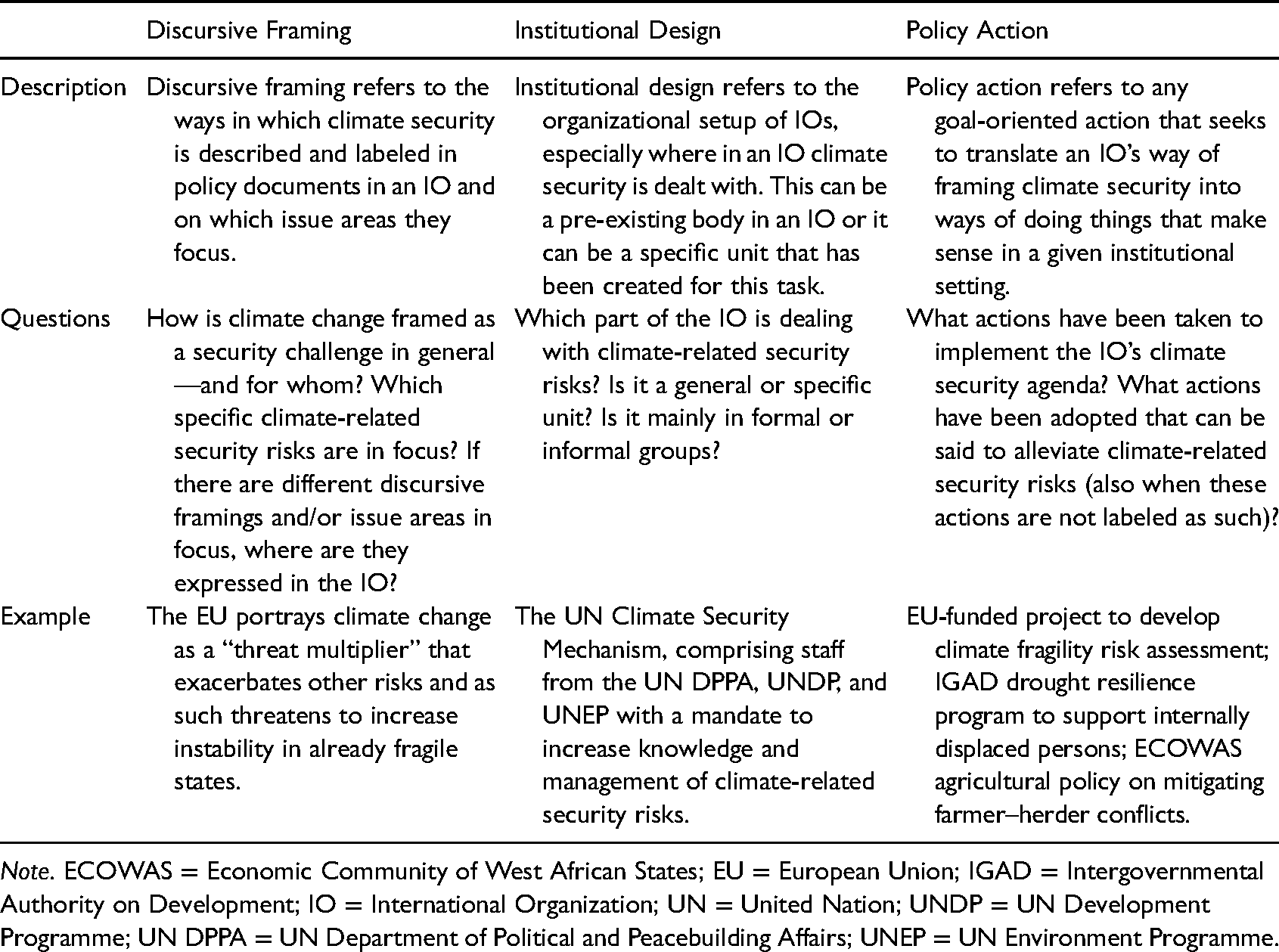
Recognizing the dynamic relationship between discourse and institutional change, our analytical framework invites researchers to systematically explore linkages between various understandings of security and how they may influence or shape IOs’ actions and practices. Neither discourse nor institutional arrangements develop in isolation. Instead, institutional change occurs over time and is partly explained by actors’ ideas and discourses, as well as the effects of actions that are undertaken. Schmidt (2008, p. 312) argues that the formal institutional setting may also impact when and where a specific discourse succeeds as “different forms of discourse may be emphasized in different institutional settings.” Here, power structures and in particular, institutional arrangements may be important. As Hajer (1995) argues, discourse analysis and institutional analysis offer different ways of looking at institutions, institutional arrangements, and change. Our analytical framework builds on this understanding and rests on three interlinked “building blocks”: (a) discursive framing, (b) institutional design, and (c) policy action (see Table 1).
IOs and Climate Security.
Note. ECOWAS = Economic Community of West African States; EU = European Union; IGAD = Intergovernmental Authority on Development; IO = International Organization; UN = United Nation; UNDP = UN Development Programme; UN DPPA = UN Department of Political and Peacebuilding Affairs; UNEP = UN Environment Programme.
Discursive Framing
The first building block of the framework draws inspiration from discourse analysis and starts from the insight that political responses to climate-related security risks are to a large extent influenced by the ways in which actors perceive security more generally. This means that the framework directs attention to questions about how climate change is framed as a security challenge and for whom, and also what specific climate-related security risks are in focus in a given IO. The framework also sets focus on the interactive process in which discourses are translated into policies and actions (Hajer, 1995; Schmidt, 2008). It is through processes of coordination among policy actors within and across IOs, as well as via communication with political actors and the broader public, that IOs develop their discursive framings of climate-related security risks. Such framings may entail competing notions of climate security, and different framings may exist not only between different IOs, but also within a single organization. This possible heterogeneity illustrates both the multifaceted characteristics of climate security as a societal challenge and the features of the political struggle that are always at play in defining anything as a security risk to someone or something. It is therefore imperative to carefully examine the evolution of policy discourse when analyzing IOs’ constructions of, and responses to climate-related security risks. In addition, it is crucial to start from the assumption that climate security may be defined and understood differently in different organizational settings, and in varying geographical and political contexts. Likewise, particular IOs may have mandates in different policy areas, and different conceptualizations may therefore exist within the organization at the same time, depending on the policy area.
Insightful findings from previous research point to the need for paying close attention to the discursive framing of climate-related security risks in IOs and their related actions. For example, when North Atlantic Treaty Organization (NATO) acknowledges climate change as a security risk to human societies it can be said to be securitizing climate change. However, this framing has not led to any significant changes in NATO policies, since the organization does not assign itself a leading role in addressing climate change (Bremberg, 2018; NATO, 2010; 2022). The EU, on the other hand, refers to climate change as a “threat multiplier” to peace and security, and it has done so consistently since the mid-2000s as a way to legitimize its external actions (Bremberg et al., 2019; EU, 2008, 2016; Youngs, 2015; Zwolski & Kaunert, 2011).
The mandate of the Association of Southeast Asian Nations (ASEAN) includes the promotion of peace and stability, but climate change is not mentioned in relation to this core mandate. Instead, the ASEAN Declaration on Environmental Sustainability 2007 brings out the threats posed by climate change and asserts that ASEAN should add this dimension to its climate change strategy (ASEAN, 2007). Only by 2012 does ASEAN more explicitly integrate climate security concerns in its discourse, through the Singapore Resolution on Environmental Sustainability and Climate Change, which describes climate change as undermining livelihood conditions and development (ASEAN, 2009; Krampe & Mobjörk, 2018).
Previous research shows that some discursive framings in IOs in Africa, Asia, and Europe focus more on climate change as a threat to peace and security than on how climate change is undermining prosperity and development. Importantly, there are divergent framings within these IOs. In the EU, the “climate change as threat multiplier” framing still dominates, although there are indications that the EU has recently started to move beyond this framing (see e.g., EU, 2021). Early on, the Economic Community of West African States (ECOWAS) focused on the risks climate change poses to the region’s security, and it identified environmental degradation as a structural factor in violent conflict (ECOWAS, 2008). That climate change undermines peace and security is also highlighted by IOs such as the AU (2015), the Intergovernmental Authority on Development (FAO & IGAD, 2019) and the South Asian Association for Regional Cooperation (SAARC). Overall, however, the predominant focus in these organizations tends to be impacts on peacebuilding, livelihood conditions, and development. The AU is among the few organizations that has an explicit climate security discourse linked to its core security and peacebuilding discourse (Aminga, 2020).
An interesting observation is that the discursive framings of climate change seem to depend on whether the locus of climate challenges predominantly occurs outside or within the territories of the member states. The EU views climate change primarily as a security risk for other, more vulnerable, regions of the world, which could indirectly present security challenges for the EU. The EU thus assigns itself a role as an important partner to countries and organizations in Africa and Asia, and might thereby overlook the risks posed by climate change within the EU (Remling & Barnhoorn, 2021). This tendency can be contrasted with African and Asian IOs who focus on how climate change is affecting societies in their own geographical contexts. The impact of disasters also plays a key role in the IOs’ framing of the types of risks posed by climate change. Impacts on food security and agriculture are emphasized by ASEAN, the AU, and ECOWAS, while SAARC specifically highlights sea level rise and IGAD stresses the impacts of drought. Both IGAD and ECOWAS also specifically discuss conflicts between herders and farmers. According to the findings from our previous research, IOs in Asia and Africa seem to acknowledge the broader scope of climate-related security risks compared to the EU.
Institutional Design
The second building block of the analytical framework focuses on the institutional design of IOs, through which the climate security agenda is strategically and practically implemented. Institutional design refers to the organizational setup of IOs that determines how decisions are made and how roles are assigned (Hooghe & Marks, 2015). This includes where in the IO climate security is a matter of concern; for instance, whether it is dealt with in already existing bodies within the IO or if specialized units have been given a specific mandate to carry out work on climate security. If the latter is the case, then it becomes relevant to ask where in the IO this unit sits and if it has been provided with additional resources. Here, again, the analysis must seek to adequately capture diversity within organizations. Climate security might be discussed in several locations and in different ways within a single IO. Hence, it is relevant to explore and make visible the institutional locations where climate security challenges are dealt with in an organization, the different roles and responsibilities assigned, as well as how bridge-building between different bodies within a particular organization takes place. In addition, whether the organizational setup is shaped by different discursive framings (which relates to the first building block of the framework) is also worthy of attention. Empirically, the analysis should not only be limited to formal roles and responsibilities, but should also seek to include informal groups of practitioners, to the extent that they exist, since such spontaneous constellations can be instrumental in advancing new policy actions (Westerwinter et al., 2021).
Previous research has identified several bodies in different IOs as being particularly important for advancing discourse. While it is understandable that different bodies within an organization can be developing responses to climate security more or less simultaneously (since the risks are many and need to be addressed in multiple areas), coordination and collaboration across subdivisions of an organization is not always easy to achieve (Brodén Gyberg & Mobjörk, 2021). Thus far, few IOs seem to have developed a function or unit with the overarching goal of coordinating analysis or response vis-à-vis climate-related security risks. A recent example of institutional change is the UN Climate Security Mechanism. Established in November 2018, it aimed to fill an institutional gap within the UN with regard to assessing and mitigating climate-related security risks (Smith et al., 2019).
Previous research suggests that in ASEAN, SAARC, and IGAD there have been several institutional initiatives to enhance the work of the organizations, such as establishing centers for disaster management or working groups on climate change. The operational capacities of these initiatives seem, however, to have been hampered for a variety of reasons. In the case of ASEAN, it is suggested that the key reason is that ASEAN’s strongest pillar, the Political Security Community, is not involved in the work on climate change (Krampe et al., 2018). In SAARC, the most relevant work occurs at the bilateral level, and there are ongoing debates as to whether the member states’ concerns for sovereignty hampers the efficiency of the organization in addressing climate-related security risks (Krampe & Mobjörk, 2018). IGAD, on the other hand, has advanced its work on climate security by connecting two units: the Conflict Early Warning and Response Mechanism and the IGAD Climate Prediction and Application Centre. The practice of partly outsourcing the work to external actors has been identified in previous research (see e.g., Gustafsson, 2016) and this could facilitate the application of the necessary expertise. However, most of the work of IGAD thus far has focused on information sharing rather than implementing concrete actions.
In contrast, the climate security discourse in the AU has recently been advanced through its influential Peace and Security Council. The AU has adopted a mainstreaming approach, which means that no single body is tasked with leading its work on implementing the African Peace and Security Architecture (APSA) Roadmap, which highlights climate change as one of the cross-cutting issues in peace and security. Notably, the AU has recently given new life to its Interdepartmental Taskforce on Conflict Prevention (IDTFCP), thereby increasing collaboration and coordination between different departments on climate-related security risks (among others). In co-convening the IDTFCP, the Conflict Prevention and Early Warning Division and the AU Department of Rural Economy and Agriculture have invited representatives from various AU departments and divisions to establish and institutionalize a “climate cluster” (Aminga & Krampe, 2020).
Policy Action
The third building block of the framework focuses on the actions taken to implement the climate security agenda, and the measures adopted to alleviate climate-related security risks, that is, how IOs translate their notions of climate security into policy actions. These actions might target different policy areas and could for example include knowledge provision, risk assessment, collaboration, funding mechanisms, and programing. In general, this could be any action that translates policy discourse into ways of doing things that make sense in a given institutional setting of a given organization. There is also a close relationship between the second and third building blocks of our framework; a change in an IO’s institutional design, seen as a policy action, is something that analytically belongs to the third building block, but the result—the unit, body, or group—can be said to be a part of the institutional design (i.e., the second building block). In recognizing this, the framework combines elements of discursive institutionalism with insights from practice-based approaches in IR (see e.g., Adler & Pouliot, 2011; Bicchi & Bremberg, 2016). The underlying assumption here is that social practices are embedded in discourses, but that practices, understood as general classes of action, are not limited to any specific enactment and are not necessarily the embodiment of specific discourses.
Thus, studying the day-to-day routines and standard operating procedures of an organization enables the researcher to analyze whether, how, and/or to what extent discursive framings are translated into policy actions. The focus here is as much on inductively mapping the organizational practices on which officials in certain IOs draw to make certain policy actions possible, as it is on exploring whether the need to come up with responses to climate-related security risks has spurred the emergence of new organizational practices or reshaped old ones. For example, a key finding in a study on the EU’s responses to climate-related security risks is that a community of practice is emerging on climate security, but it is characterized by overlapping and conflicting organizational practices relating to climate diplomacy, development, and security and defense, which to a large extent shapes the translation from policy discourse (e.g., European Council conclusions) to policy actions (e.g., making the EU’s conflict prevention and early warning system “climate sensitive”) (Bremberg et al., 2019). This means that we should not necessarily assume that not only coherent institutional designs necessarily favor certain policy actions, but also institutional incoherence might be compensated for by more informal modes of governance.
Previous research also suggests that there are multiple frameworks aimed at supporting activities linked to specific climate-related security risks, such as disaster management in SAARC and ASEAN (Krampe et al., 2018; Lian & Bhullar, 2011) or drought resilience in IGAD (Krampe & Mobjörk, 2018). A more overarching framework on climate security has been adopted by the EU and there is an emerging discourse on climate security in the AU. Developing early warning and risk assessment are mentioned by several IOs as important policy actions for mitigating climate impacts and strengthening resilience. Actions to enhance risk assessments can support the identification of key risks and subsequently provide advice on priorities. However, many initiatives seem to focus on specific aspects of climate security, such as an EU-funded project that aims to develop climate fragility risk assessment (Bremberg et al., 2019), a drought resilience program in IGAD to support internally displaced persons (FAO & IGAD, 2019) and an agricultural policy in ECOWAS on mitigating farmer–herder conflicts (UNOWAS, 2018).
An interesting finding from our previous research of high relevance for the questions of how and what policy actions are undertaken by IOs is that many organizations are dependent on external donors in order to develop activities and implement policies. The AU, ECOWAS, IGAD, and SAARC are all highly dependent on external donors in order to develop policy actions in practice. The dependency of many regional organizations on EU funding calls for further scrutiny of how, and to what extent the EU’s (and other major donor organizations) framing of climate security influences decisions on the types of projects that receive funding. Indeed, the EU occupies a rather unique position as a potential shaper of global responses to climate-related security risks, as a result of its comparatively large development and humanitarian aid programs. As noted above, African and Asian organizations generally acknowledge a broader range of climate-related security risks than the EU. Donor dependency could reduce the ability of organizations to develop their own priorities and actions (Krampe et al., 2018). This seems currently to happen to certain extent within the AU (Aminga & Krampe, 2020). It is therefore important to further explore issues of flexible funding and local ownership in relation to the development of policy actions.
Conclusions
In this article, we argue that there is a need for systematic comparisons across IOs in order to assess the extent to which global responses to climate-related security risks are adequate and, possibly, more importantly, to identify urgent needs and potential synergies between IOs at global and regional levels. As a step toward fostering comparative studies, this article outlines an analytical framework to help guide qualitative research on heterogeneous sets of IOs in order to capture similarities and difference across cases. We have discussed findings from our research on IOs in Africa, Asia, and Europe, and we think that there are opportunities to conduct comparative work that includes IOs from other regions as well. Although our framework is designed to primarily help in answering descriptive questions, we believe that studies such as the ones discussed here serve to advance the research agenda on global responses to climate-related security risks also by way of presenting hypotheses and suggesting explanations based on empirical work. For instance, the observation that the EU discursively frames climate change as a “threat multiplier” that exacerbates security risks in already fragile states combined with the fact that the EU is one of the world’s largest development aid donors invites further research on power asymmetries between IOs and how this shapes global responses. Such issues are critical to explore since they may help in identifying whether some actions on climate-related security risks taken (rather than others) might unduly favor certain countries and communities at the expense of others. Power relations among member states within IOs might also affect how and what responses are developed (Drezner, 2008). But before effects can be studied in relation to observed outcomes, we need to have a sense of where to look for theoretically interesting cases, and comparative case studies provide a sound basis for that purpose. For instance, based on the above discussion on the possible adverse effects of donor dependency, we think that the role of multilateral development banks, such as the World Bank, African Development Bank, Asian Development Bank, and European Investment Bank, in shaping global and regional responses to climate-related security risks merit further examination.
Another type of explanatory question that could be investigated based on findings from comparative studies relates to the effects of organizational cultures on the shape of global responses to climate-related security risks. We know for instance that the performance of IOs might be negatively affected by internal cultures that favor “pathological” actions that are not in line with officially declared aims and targeted policy goals (Barnett & Finnemore, 2004, p. 8). In the discussion above, we point to how different IOs have setup various types of units and institutional arrangements that vary in terms of resources and mandates. These include expert working groups and centers that aim to advance the work of IOs in relation to climate-related security risks. Interestingly, none of these entities seem to have been given a central position within the IOs’ organizational hierarchies (albeit perhaps more so in the EU and the AU than in others). The example of the UN Climate Security Mechanism suggests that climate security benefits from having an “institutional home” within IOs, as it ensures that more adequate resources are allocated, and different parts of the organization are interlinked (cf. Born et al., 2019). Still, it remains an empirical question as to what extent any such initiative will achieve its intended goals.
Finally, the important yet inherently difficult question of how IOs could develop adequate global responses to climate-related security risks depends ultimately on what is deemed necessary, desirable, and feasible. Answering such questions necessarily entails trade-offs between perceived costs and benefits between different countries and communities. We nonetheless see great potential for addressing the question of under what conditions adequate global responses develop by way of combining results from comparative case studies on IOs with notions of democratic governance, which emphasize that the likelihood of making adequate decisions within IOs increases to the extent that such organizations maximize capacities for participation as well as opportunities for sharing knowledge (Stevenson, 2016). To conclude, further research is needed to increase our knowledge on why, how, and with what effects IOs are contributing to addressing and mitigating growing climate security challenges.
Footnotes
Declaration of Conflicting Interests
The authors declared no potential conflicts of interest with respect to the research, authorship, and/or publication of this article.
Funding
This publication is a deliverable of MISTRA GEOPOLITICS, which is funded by MISTRA – the Swedish Foundation for Strategic Environmental Research.
