



Abstract
The mine action sector has struggled to demonstrate the socioeconomic benefits of mine clearance. Previous academic studies have made important contributions but have been limited in offering in-depth discussions of causal pathways. This paper seeks to fill that gap. It proposes a new framework, the Mine Clearance and Peacebuilding Synergies (MPS) framework that combines the Humanitarian Mine Action Peacebuilding Palette, the Mine Action- Sustainable Development Goals (SDGs) framework and theoretical considerations from the Infrastructure as Peacebuilding framework to interrogate this interaction. Using Somaliland's post-conflict reconstruction as a case study, we analyze qualitative and quantitative data to map both the direct and indirect benefits of mine clearance in relation to infrastructure development. We find that mine clearance can influence both economic and physical reconstruction through its impact on dominant economic sectors as well as critical strategic infrastructure, including ports and roads, and demonstrate the synergies therein with an array of SDGs.
Keywords
Introduction
The study of post-conflict recovery and reconstruction in Somaliland has focused mainly on statebuilding (Balthasar, 2012; Bradbury, 2008; ; Ingiriis, 2021 Renders & Terlinden, 2010;; Walls & Elmi, 2012;), and bottom-up hybrid approaches to peacebuilding, to explain associated processes and outcomes. Widespread mine contamination was a consequence of the conflicts and as such immediate humanitarian responses and longer-term developmental concerns are connected to mine action. Somaliland provides a basis for understanding mine action beyond technical interventions that dominate humanitarian responses, to social, economic and political realities that are more apparent over time. It also presents an opportunity to refine conceptual and methodological tools required to do so, as is undertaken in this paper. This is a pivotal case for examining the role of mine clearance in post-conflict reconstruction as it is due to achieve mine free 1 status and thus offers a globally significant case study for understanding the ways in which clearance interacts with longer-term peacebuilding and development priorities.
Somaliland, a self-governing territory since 1991, when it seceded from greater Somalia, is an important research site because of its pervasive mine contamination and associated socioeconomic impacts (Landmine Monitor, 1999; Njeri, 2016). Its mine action program, which has been led by local, national, and international actors including Humanitarian Mine Clearance Pioneer Corps (HMCPC), HALO Trust, MAG UK and Danish Demining Group since 1991, is unique given that its status as a self-governing entity is not internationally recognized (Njeri, Forthcoming, 2021).
A 2003 Landmine Impact Survey of four regions in Somaliland 2 found 357 mine-impacted communities (Survey Action Centre, 2004). Contamination is due to the Ogaden war (1977–1978), where mines were laid by all warring parties. The Somaliland National Movement (SNM) also laid mines along the borders to protect their own bases in this period (PHR, 1992, p. 15). Mines were laid for other reasons, including to protect refugee camps, and defend strategic roads and tracks (Njeri, 2020; Omaar et al., 1993). During the Somali Civil War (peak activity 1988–1991), the Somalia National Army (SNA), indiscriminately laid mines in Somaliland's 3 main cities, in pastoral and agricultural lands and near waterholes, roads and former military installations (Omaar et al., 1993). Mines were also laid during clan skirmishes in 1992–1994, as well as during border disputes with Puntland between 1994–1996 (Landmine Monitor, 1999).
This paper has two aims. The first is to introduce the Mine Clearance and Peacebuilding Synergies (MPS) framework to guide analysis of the influence of mine clearance on longer-term development processes and outcomes. This is necessitated by the thinness of theoretical and conceptual development in the field of mine action due to its foundations as a largely technical and practitioner-based field. The framework extends Jennings et al. (2008) Humanitarian Mine Action Peacebuilding Palette that utilized the Utstein Study's ‘peacebuilding palette’ 4 as a starting point in examining how mine action contributed to peacebuilding. This was to demonstrate how the various elements of humanitarian mine action have important and tangible political, socioeconomic, justice and rehabilitation ramifications, in addition to the more obvious security gains (Smith, 2004). Thus, the proposed framework combines with insights from the Mine Action-Sustainable Development Goals (SDGs) framework and theoretical considerations from the Infrastructure as Peacebuilding framework. 5
The paper's second aim is to examine the interactions between mine clearance and development with attention to economic and physical reconstruction. The paper analyzes primary qualitative data from fieldwork over 2017–19 in Somaliland and Kenya and secondary quantitative data from the only remaining mine clearance agency in Somaliland, the HALO Trust. This mixed-methods approach enables analysis of the interactions between mine clearance and socioeconomic factors across geographical spaces, rural, peri-urban and urban contexts.
This article is focused on the longer-term interactions between economic and physical reconstruction and mine clearance. It is a significant contribution given that the literature on the socioeconomic impacts of clearance is dominated by short-term analyses and attention to humanitarian concerns. The data-driven analysis enables a mixed-methods approach in a context that has seen little engagement with primary data due to limited availability. The paper also contributes to the literature on theorizing and conceptualizing the SDGs.
The article that follows first examines how mine clearance and mine action have interacted with development concerns over time. Second, it maps conceptual debates on mine action, mine clearance and peacebuilding and offers the MPS Framework as a contribution to this body of work. Third, it presents the methodological approach that has been used. Fourth, it deploys the MPS Framework to understand and explain how mine clearance interacts with economic and physical reconstruction with reference to infrastructure development and SDGs in Somaliland. In doing so it analyzes new qualitative data using thematic analysis and quantitative data using inferential and descriptive statistics. The final section concludes by setting out the wider significance of this contribution.
Interactions Between Mine Action and Development
Mine action is considered a highly technical activity and the engineering lens has been central to analysis of technological interventions to support clearance. This is demonstrated by academic scholarship that reflects a predominant focus on clearance and clearance technologies (Gader et al., 2001; Hussein & Waller, 2000; Shao et al., 2018; Smith, 2003; Xiang & Sabatier, 2003). As such, it is narrowly acknowledged as enabling the attainment of many peacebuilding objectives (Bryden, 2005; Jennings et al., 2008; Njeri, 2016). There is also reticence to link mine action to development as demining organizations note tensions between technical efficiency and more long-term developmental impact (Keeley et al., 2019).
Scholarship on the implications of mine clearance tends to focus on shorter time periods
Because mine action programmes frequently occurred in complex and unstable settings with short-term mandates, humanitarian emergency response perspectives dictated programming.
Mine action may suggest a limitation in its scope however scholars and practitioners are increasingly recognizing its broader reach across time. As such humanitarian mine clearance is noted in some quarters as being significant across immediate post-conflict, peacebuilding, reconstruction, and development contexts (Bryden, 2005; Hauge, 2004 Roberts & Frilander, 2004;). In fact, within the practice community and in the emerging academic literature, mine action has been acknowledged as interlinked with other peacebuilding activities even while the evidence has remained mainly anecdotal (Forster, 2019; Harpviken & Roberts, 2004; Harpviken & Skaešra, 2003; Njeri, 2016). There have been calls by donors for greater synchronization between mine action and development and assertions that clearance ‘is a clear precursor to development’ (O’Reilly et al., 2012, p. 16).
There are challenges in analyzing the longer-term interactions between mine clearance, peacebuilding and development. These include the limited NGO-academia research collaboration that could offer valuable data and evidence that is otherwise difficult to access (Collodi & Gillhespy, 2019; Green, 2017). Attempts to examine the influence of mine clearance on development include the use of impact assessments. These techniques have not been applied systematically in evaluations and largely local studies do not provide information that can be extrapolated to the wider community. Focus has been on quantitative cost–benefit analyses which Harpviken et al. (2003) describe as limited by the challenges of determining criteria for assessment, comparing interventions of different scales, accessing reliable data in resource-constrained countries and monetizing nonmarket outcomes. Such economic analyses have been preferred by donors because they present benefits in terms of a sole figure (Harpviken et al., 2003). However, they have been limited in securing local engagement from beneficiaries.
Moving towards qualitative research approaches, the Geneva International Centre for Humanitarian Demining (GICHD) proposed a Sustainable Livelihoods (SL) approach for analyzing how mine action facilitates socioeconomic recovery. Studies on Afghanistan using this approach confirmed links between demining, humanitarian, social, and economic benefits. However, sustained benefits were contingent on additional investment either by the households, the community (collectively) or development agencies (Paterson et al., 2013).
While there has been a lack of attention to the longer-term implications of mine clearance, Chiovelli et al. (2018) link demining to longer-term infrastructure development in Mozambique. This study finds a strong positive correlation between economic activity and clearance of the transportation networks and trade hubs. Significantly, the study suggests that increasing focus on infrastructure development as a key outcome of mine action has the potential to multiply impact. This highlights the particular significance of infrastructure and development as linked to demining which is central to this paper.
Conceptualizing Mine Action Within Peacebuilding and Development
The conceptualization of mine action has been informed by several factors including the normative framing through the mine ban movement, the intrinsic values of mine action as an activity and the institutionalization of mine action within the work of the UN and the International Committee of the Red Cross, among others. The UN through the ‘Agenda for Peace’ explicitly called for the challenges of the presence of landmines to be addressed within a peacebuilding agenda (Boutros-Ghali, 1992; Cahill, 1995). Thus, landmines were reframed as a humanitarian, rather than a military and security issue, linked to peacebuilding reform.
Calls for integration of mine action within peacebuilding and development were initiated during the Bad Honnef conference in Germany that developed the 1999 Guidelines for Mine Action Programmes from a Development-Oriented Point of View (GIBL, 1999). This framed mine action as a key component within peacebuilding and development and its integration within national and local processes.
Conceptualizing Mine Clearance, Peacebuilding and Development
There have been two concrete attempts to conceptualize the linkages between mine action, peacebuilding and development. First the Humanitarian Mine Action Peacebuilding Palette links long-term developmental processes beyond outcomes, recovery and humanitarian concerns to mine clearance. These processes include economic and physical reconstruction, as constituent parts of long-term peacebuilding. A main challenge is its articulation of mine clearance as a security-focused activity due to its placement within the security quadrant as separate and distinct from developmental processes within the socioeconomic quadrant of the Palette, see Figure 1. 6
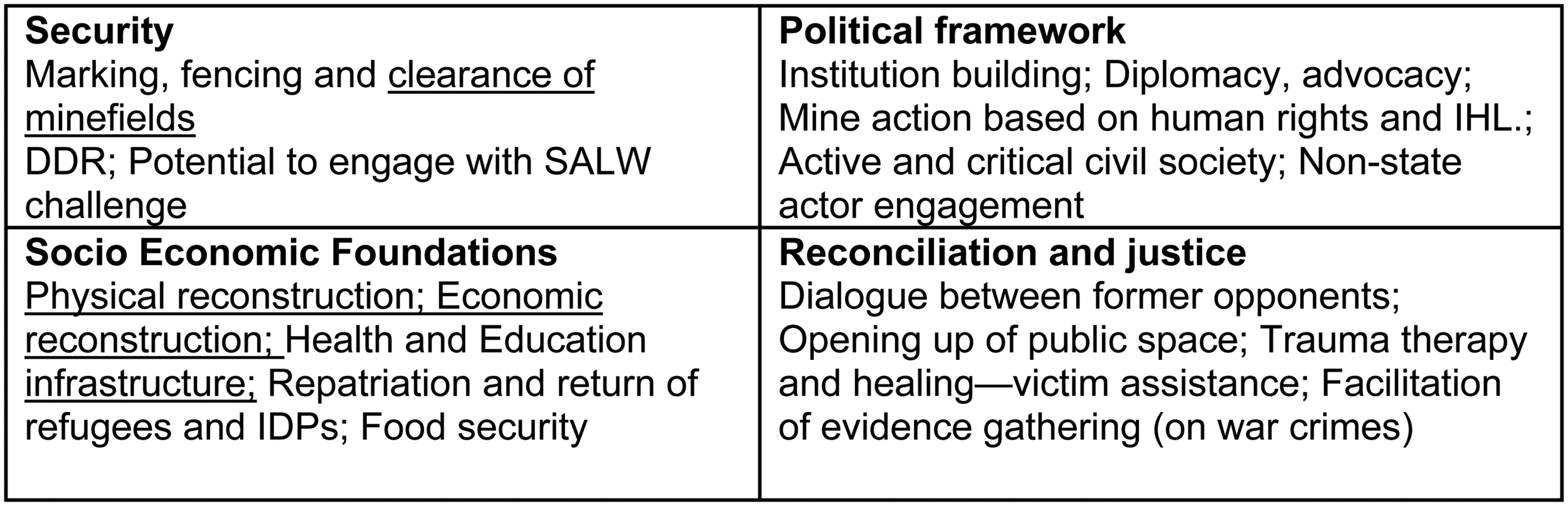
Humanitarian Mine Action Peacebuilding Palette.Source: Adapted from (Jennings et al., 2008).
Second the Mine Action- SDGs framework links mine action to identifiable post-2015 SDGs (GICHD & UNDP, 2017), see Figure 2. It has been important for maintaining the significance of mine action, and therein mine clearance, to development, with emphasis also on infrastructure-related SDGs including, building infrastructure (SDG 9), building housing, settlements, transport (SDG 11), removing blockages and physical constraints to amenities (SDG 3,4,6), access to economic markets (SDG 1, 2). It is, however, driven mainly by outcomes, with limited attention to the complexities and indeed contradictions that underpin interactions between mine clearance and development processes. These can include where
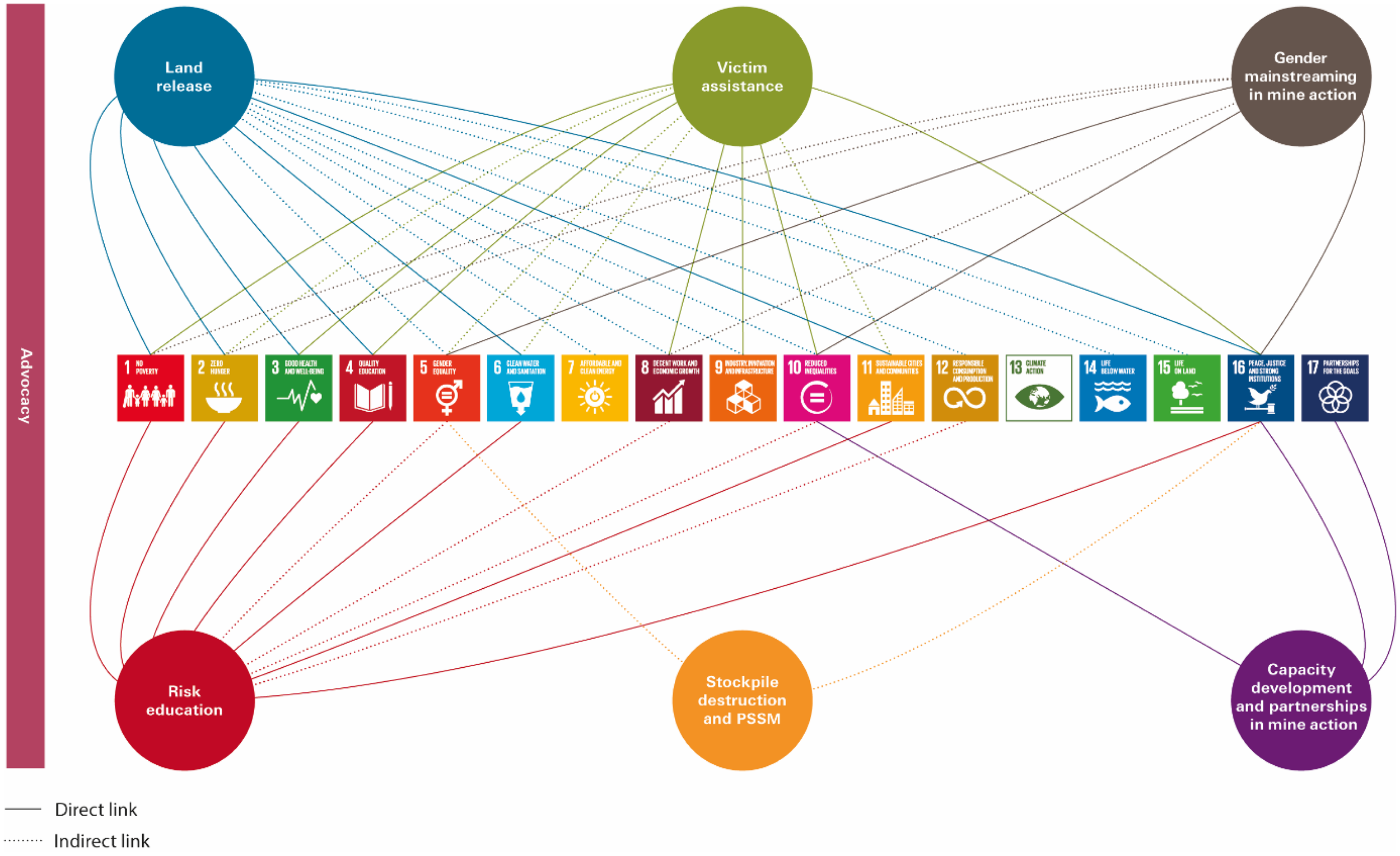
Mine Action- SDGs framework. Source: GICHD and UNDP (2017).
as is discussed later in the paper. Part of this challenge is linked to the criticisms that are leveled at the SDGs’ limitations in engaging with complex political economy factors (Fukuda-Parr & Mcneill, 2019; Weber, 2017).
The Infrastructure as Peacebuilding framework pays attention to the materiality of peacebuilding through infrastructure (Bachmann & Schouten, 2018). Its conceptual rooting is linked to the state and its centrality and functionality, on the one hand. This draws also on Mann’s (1984) notion of infrastructural power, in the state's ability to implement its decisions in its territory. On the other hand, is infrastructure's potential transformative role in facilitating physical, social and economic connectivity across communities and societies as a basis for building peace.
Synergies between the Humanitarian Mine Action Peacebuilding Palette, the Infrastructure as Peacebuilding framework and the Mine Action-SDGs framework reinforce the importance of infrastructure to peacebuilding. Together these frameworks offer the basis for our analysis through a conceptual extension of the Palette, see Figure 3. Ideas on paradigm extension offer guidance for this in the need to present new scientific problems that should attract other scientists while maintaining elements of the paradigm in its original form (Masterman, 1970). We retain the Palette's attention to long-term peacebuilding as physical and economic reconstruction, even beyond recovery. This new framework moves beyond the Palette's rooting in a security-development dichotomy by examining the interdependencies between clearance, economic as well as physical reconstruction as it centers the significance of infrastructure in both aspects. Synergies between the Humanitarian Mine Action Peacebuilding Palette, the Infrastructure as Peacebuilding framework and the Mine Action-SDGs framework reinforce the importance of infrastructure to peacebuilding.
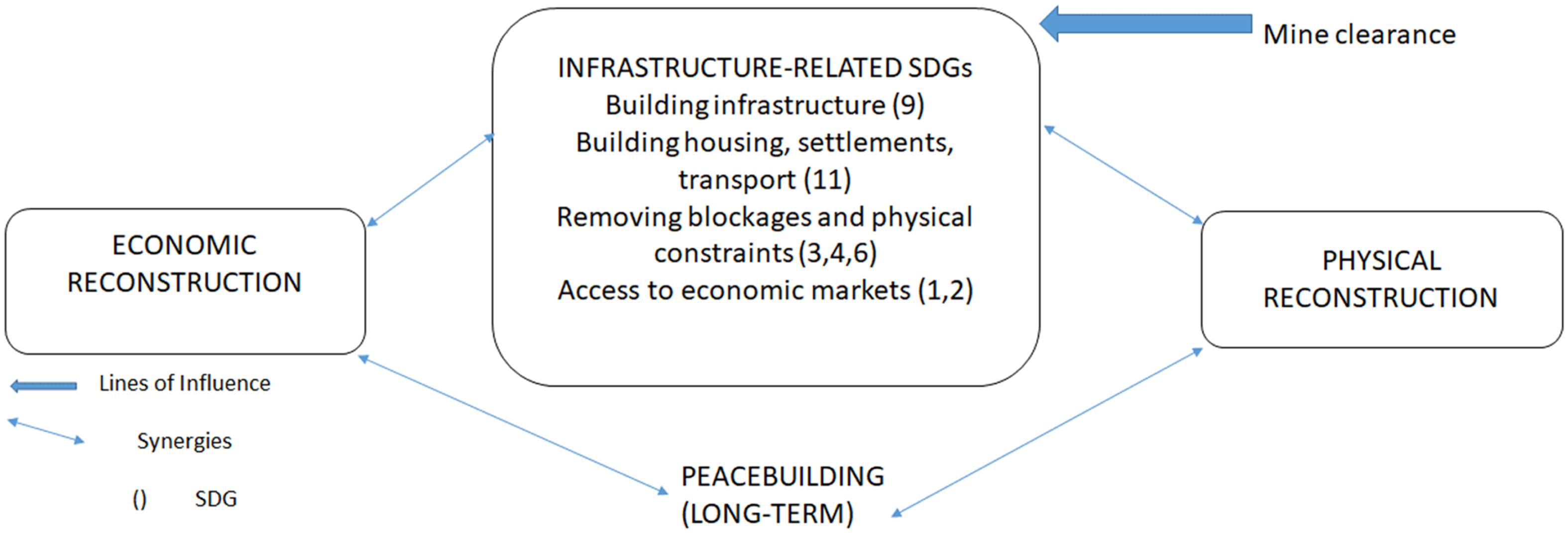
Mine Clearance and Peacebuilding Synergies Framework. Source: ©Authors.
Against this background, this paper proposes the MPS Framework, see Figure 3. It proceeds cognisant of mine clearance as an element of mine action.
This analytical framework does two things. First it identifies and interrogates the assumed trajectory, lines of influence, from mine clearance to infrastructure-related SDGs (from the Mine Action- SDGs Framework). 7 Second it considers and examines the synergies between the infrastructure-related SDGs and economic as well as physical reconstruction that are also synergised with long-term peacebuilding. This is reinforced by our prioritization of ‘infrastructure as peacebuilding’ and economic and physical reconstruction, that are key elements of the socioeconomic foundation quadrant (from the Palette) and focus on long-term peacebuilding (as interlinked with development).
This concern with infrastructure is timely and relevant. Infrastructure is returning to the fore of the global development agenda, after periods in the proverbial wilderness that saw greater attention to institutional and social development programs (Bachmann & Schouten, 2018; Ikpe, 2020a). UNOPS (2020) notes the increasing significance of infrastructural development beyond humanitarian phases and into the longer-term. The Somaliland government considers infrastructural development, to be key to its national development priorities, highlighting its support to economic and physical reconstruction activities within prominent economic subsectors of livestock, agricultural cultivation, trade and commerce (MoNP&D, 2011b). It especially distinguishes how investments in transport, communication, water and energy underpin wider development priorities across agriculture, trade, commerce and job creation.
This contribution deepens understanding of the material outputs of peacebuilding by emphasizing the influence of structural factors and dynamics (Bachmann & Schouten, 2018; Ikpe, 2020b). It moves beyond the key contribution on infrastructure and mine clearance, Chiovelli et al. (2018), by addressing important infrastructural concerns beyond transport, including water and energy. Through its synergies and lines of influence, it centers complexity in its analysis by examining the dynamics that underpin interactions between mine clearance, peacebuilding and development. In doing so, it advances beyond academic research and evaluation reports that have attempted a linkage between clearance and reconstruction but faltered on in-depth discussion of a causal pathway (See for example Cameron et al., 2010; Durham, 2016; Durham et al., 2011; Lundberg, 2006).
Deciphering Evidence from Somaliland
This paper adopts a mixed-methods approach that integrates quantitative and qualitative methods for analyzing primary qualitative and quantitative data. The study analyzes primary data from 19 interviews and two focus group discussions (FGD) in Hargeisa and Nairobi in January and July 2019 and June 2018. This discussion is complemented by the integration of descriptive and inferential quantitative analysis of survey data from the HALO Trust to reflect the impact of clearance on affected communities. All research rigorously followed the research ethical approval processes at the lead research institution, King's College London.
The study's interviewees were identified and selected through snowball sampling with initial inquiries to mine clearance actors including local and international NGOs, researchers, government officials and later inquiries to interviewees. Interviewees included politicians and ministers, academics, civil servants, civil society organizations, affected communities, mine clearance operators as well as UN and African Union representatives (in Nairobi). This approach was suitable for drawing on ideas and experiences of specific and difficult to reach actors across time as it addressed the fluidity of knowledge in this space.
Research questions and objectives were presented to a convened working group comprising government policy actors, practitioners and academics. Comments from the working group were utilized in the preparation for semi-structured interview questions and prompts, snowball sampling and sourcing of secondary data. Questions covered mine clearance prioritization across time and space, interaction between clearance, politics, economic, cultural and social factors as well as peace and reconciliation, mine contamination, strategic infrastructure, local and international political economy dynamics.
Qualitative data was analyzed using thematic analysis as outlined by Braun and Clarke (2006). The data was coded across 35 titles that cover: topics related to the interaction between mine contamination, clearance and physical infrastructure such as land access and use for road rehabilitation, transport and transport infrastructure including airports and ports, energy and water systems (SDGs 6, 7, 9, 11); topics related to economic reconstruction including land access and use, land prices, reconstruction of settlements, trade, cultivation, livestock rearing and natural resources (SDGs 1,2,8,10,11,12); topics related to environmental concerns around vegetation management (SDG 15) and topics related to trust in land, mobility, safety and security (SDG 16) and partnerships between the state, mine clearance operators and intergovernmental bodies including the UN (SDG 17). There is recognition that SDGs are not mutually exclusive but reinforce one another as do the themes that emerge in the data.
Analysis of the data generated four themes for interrogating the interlinkages between mine clearance, economic and physical reconstruction with attention to infrastructure-related SDGs. The themes that emerged from the data are: contamination, clearance, economic development and infrastructure; clearance and temporality; clearance and spatiality; and clearance, infrastructure and physical reconstruction.
The study also analyzes quantitative survey data from the HALO Trust on the direct and indirect beneficiaries of mine clearance activities in the regions of Woqooyi Galbeed and Sahil, over the period 2014–18 using inferential and descriptive statistical methods. The quantitative data set was generated by HALO through its post-clearance land use surveys with 1318 respondents. These regions were also the most contaminated by landmines, as well as being the most important for dominant economic activities, livestock and agricultural production, and trade with the presence of the Berbera Port which is the main trade post. HALO Trust notes that the bulk of the clearance in these regions was undertaken over 1999–2018.
Deploying the MPS Framework: Clearance, Reconstruction and Infrastructure
With reference to Figure 3, we use the MPS Framework for analysis in two parts. First, we discuss how clearance influences and interacts with infrastructure and related SDGs and the synergies with economic reconstruction (and therein long-term peacebuilding). Second, we discuss how clearance influences and interacts with infrastructure and related SDGs and the synergies that are identifiable with physical reconstruction (and therein long-term peacebuilding). Discussions pay attention to priority economic sectors and activities including agriculture (livestock and cultivation), natural resources, commerce and trade as well as strategic and smaller-scale infrastructure that support these.
Influence and Synergies: Clearance, Economic Reconstruction and Infrastructure
Agriculture is a key context in Somaliland within which to examine the interworking of mine clearance and development. 8 Agricultural cultivation is important because of its potential effect on pro-poor priorities. It is predominantly rain-fed and focused on grain production for subsistence and animal feed with trade mainly in fruits and vegetables as well as (watermelon) exports (MoNP&D, 2011a). About 25% of the population depends on agricultural cultivation economic activities for their livelihood, this includes farming households as well as urban and peri-urban households that participate in pluriactivity and commerce especially in the vegetable and fruit subsector (MoNP&D, 2011a, p. 57). Livestock is a very significant sector and contributes 60% of GDP, livestock trade constitutes 80% of export earnings and customs duties comprise 85% of central government revenue (MoNP&D, 2016; World Bank & International Finance Corporation, 2012).
Clearance and agricultural development
The Mine Clearance Peacebuilding Synergies Framework shows that clearance is synergised with a strengthened agricultural sector in support of economic reconstruction.
Strengthening agricultural development and access to social amenities, including water and education facilities has informed mine action and clearance (Elliot, 2000, Gildestad, 2005). Agricultural producers are noted as benefitting from an increased sense of safety. From Figure 4 survey respondents in Sahil and Woqooyi Galbeed reported benefits from mine clearance in relation to access to grazing lands and farmlands for cultivation and livestock development. There is the potential for mine clearance to support the removal of blockages and physical constraints with implications for SDGs 3,4 and 6. It can also support access to farms and grazing lands, as well as livestock development and agricultural outcomes with implications for SDGs 1 and 2. The Mine Clearance Peacebuilding Synergies Framework shows that clearance is synergised with a strengthened agricultural sector in support of economic reconstruction.
The influence of clearance on agricultural lands is pertinent in and around Hargeisa due to farming activity in the area (MoNP&D, 2011b). 10 Beyond the earlier mentioned increased sense of safety, there is evidence of expanded cultivation due to land access following mine clearance in peri-urban and rural contexts. ‘Orchards and khat [are] being cultivated in formerly mined lands in the countryside’. 11 In addition, improving performances and expanded cultivation of wider crop varieties including fruits and vegetables rely extensively on access to irrigation facilities. This is prioritized by the government so that while it is illegal to have enclosures of rural land for pastoral or other rain-fed agriculture it is permitted for irrigated farms, where there are no obstructions to roads, livestock movement or wells (Birch, 2008). Mine clearance can thus support expanded cultivation for relevant urban markets with implications for SDGs 1, 2 and 11 and potentially support irrigation infrastructure for SDG 9 alongside synergies with a strengthened agricultural sector in support of economic reconstruction with reference to the MPS Framework. From this analysis mine clearance is linked to agricultural development in different ways by various constituencies. Agricultural producers are attentive to improved safety and members of the political class note the significance of access to cleared lands.
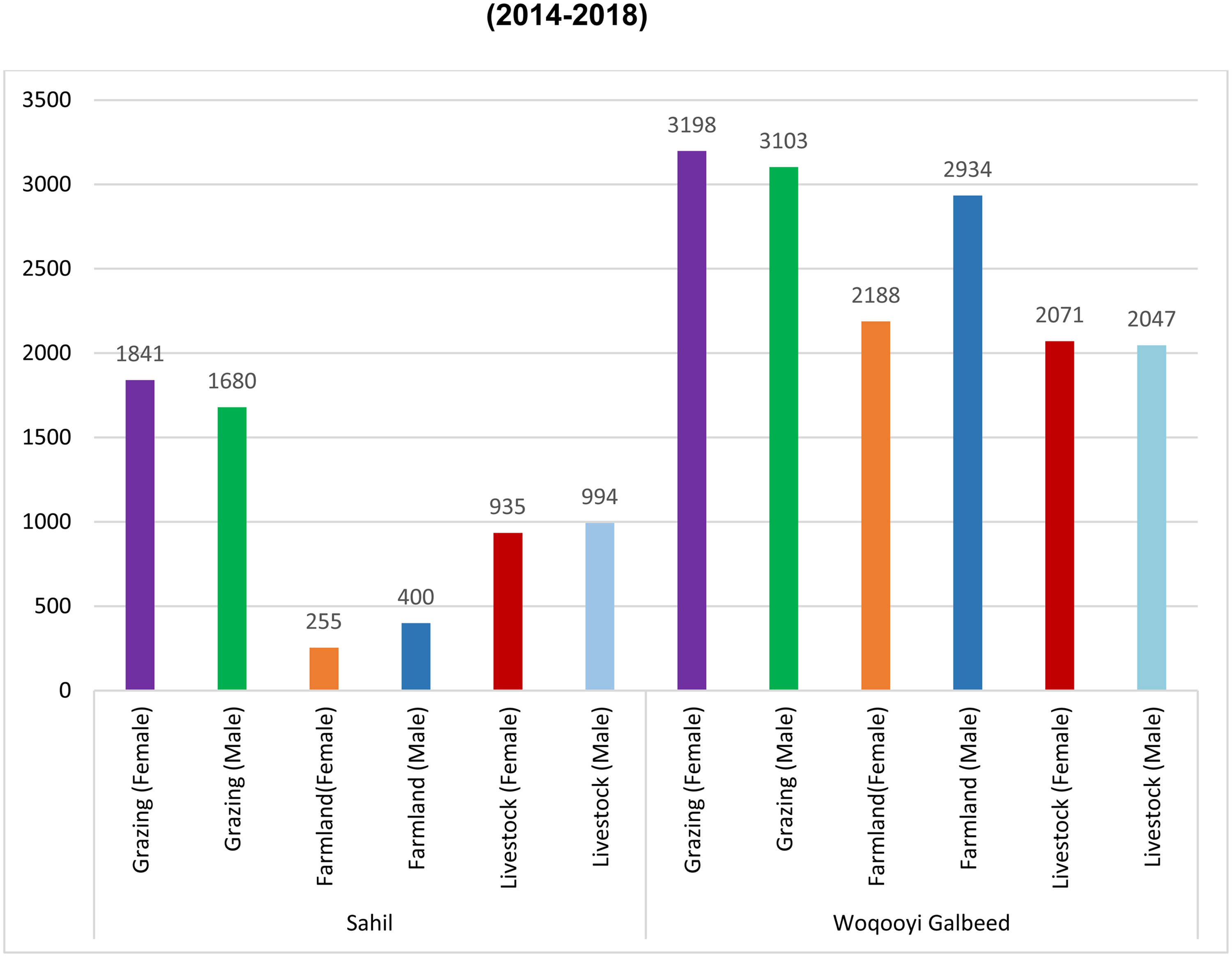
Mine clearance beneficiaries: Livestock, Farmland and Grazing (2014–2018). Source: ©HALO Trust Data.
Clearance and fuel resources
Natural resource endowment is a strategic concern within which infrastructure can enhance developmental processes and outcomes. Mining is prioritized as a contributor to growth, poverty reduction and economic diversification (MoNP&D, 2011b, p. 23). Clearance-related activities have influenced the development of the petroleum sector. An interviewee notes that ‘Oil and gas exploration is an area that has been a state priority for mine clearance. Some people are jointly employed by the state and HALO having been trained … support residual risks ahead of infrastructural needs. HALO has been consulted by certain exploratory firms that are interested’. 12 Private firms have also carried out surveys on behalf of foreign capital interests. Petroleum exploring firm, Genel oil, had surveys undertaken by private actors on expanses of land as well as access roads. 13 Mine clearance and related activities are considered significant to related infrastructural development in support of SDG 9 and transport in relation to SDG 11, given the synergies with increased capital inflows and the possible strengthening of the sector's contributions to economic reconstruction with reference to the MPS Framework.
Notably, government officials connect clearance to corporate social responsibility (CSR) projects such as the development of road infrastructure for the communities in which these firms are invested. 14 Clearance thus influences the building of transport infrastructure with implications for SDG 11. In accordance with the MPS Framework, the synergies are with economic reconstruction with regards to how foreign capital negotiates its relationship with its host community. In essence clearance and related activities appear to focus on infrastructural needs in assuring foreign capital of the physical safety of its investments, infrastructural and otherwise, as well as building relationships with communities. Nevertheless, the extent to which the fuel resource sector will support economic reconstruction relies on a host of critical factors. These include the complexities around Somaliland's non-recognized status and potential tensions around ownership and control of resources with Somalia and the capacity to manage substantial foreign exchange inflows (Bamberger & Skovsted, 2016; Pegg, 2018). Furthermore, physical infrastructure investments through CSR (including roads) by petroleum companies in some contexts, including Nigeria and Angola, have been criticized as having limited impacts due to failures to prioritize host community needs, lack of coordination with the host governments and underperforming vis-à-vis expectations (Eweje, 2007; Frynas, 2005).
Influence and Synergies: Clearance, Physical Reconstruction and Infrastructure
The clearance of infrastructure, including roads and water points, is a key priority in the post-conflict period for humanitarian and developmental purposes. An interviewee notes ‘post-conflict time was when mine clearance was most important - roads, water points, access to amenities - impacting movement of people, trade and logistics’. 15 In addition, nomadic pastoralists abandoned much needed seasonal wells due to (suspected) mine contamination. 16 The dual role of infrastructure as part of the long-term development agenda as well as in the immediate post-conflict emergency response has been highlighted by Harpviken et al. (2003). Clearance can imply removing blockages and physical constraints as well as enabling trade and transport for SDGs 3, 4, 6, 1, 2 and 9 and synergies with physical reconstruction with reference to the MPS Framework.
However, the interaction between clearance and infrastructural development is not always straightforward due to contestations that constrain rebuilding. The interaction between clearance and infrastructural development is not always straightforward due to contestations that constrain rebuilding.
For instance, certain groups (clan-based) appear to prioritize limiting access to amenities for other groups. 17 In addition, amenities such as wells may not be rebuilt on cleared land due to a breakdown in trust between the community and its surroundings. An interviewee notes the damage to a community's sociocultural relationship of trust with land that results from contamination. 18 Yet the construction of wells is an essential part of the livestock ecosystem and disruptions to this system have escalated conflict dynamics in some instances. 19 These critical perspectives emerge cross-sectionally from Somaliland's political class and civil society.
Strategic infrastructure is a core element of development priorities in Somaliland. In terms of budgetary priorities, roads constituted the most significant infrastructural commitment for the government as the top spend for the infrastructural development budget pillar at $245 M and civil aviation constituted the third highest infrastructural commitment for the government at $44.4 m in 2011 (MoNP&D, 2011b, p. 10, 327).
The influence of mine clearance on rebuilding transport infrastructure including roads, and the synergies with physical reconstruction are pertinent with access to economic markets and implications for SDGs 1,2 and 11, in line with the MPS Framework. Mine clearance has been a significant factor for road reconstruction. 20 An interviewee notes that ‘when we were working on the Hargeisa-Berbera road, we found a mine, a complete one; and we stopped and called HALO Trust’. 21 Another interviewee explained that during road rehabilitation in Berbera ‘The main road and the fencing along Berbera airport, two mines - one complete and one looked as though it had exploded. Work stalled for several hours’. 22 An interviewee reports that in building the Hargeisa- Kalabaydh road, ‘when they started, they hired a team from the Minister of the Defence, when [it was] rehabilitated they were told of ERWs [explosive remnants of war] - so they called the National Demining Authority to come and clear… this caused a huge delay, they started [the road rehabilitation] at 200 km instead of Km 1’. 23 It is notable that this work has been possible, albeit delayed, only after further surveys and clearance. Reflections on the significance of clearance in this context are shared across public and private sector actors.
Cleared roads yield benefits across social, economic, and political spheres. In Somaliland, this has been significant for improved access to markets. Opening of roads around Hargeisa is linked to expanded economic activities in the dominant livestock sector. In the Tonn area, the development of roads by clan groups has yielded land purchases for dairy activities. ‘Because of the opening of roads, the land around Hargeisa is being purchased to be used for dairy activities such as bringing 30–50 litres of camel milk into the city. Camel milk is a delicacy and can then be obtained’. 24
Road clearance has been influential for opening access to the Berbera port for livestock trade. 25 Here we see the importance of clearance enabling access to markets and the potential impacts on SDGs 1 and 2, respectively, and the synergies with physical reconstruction in line with the MPS Framework. The Berbera Port is significant to Somaliland's strategic role in the Horn of Africa vis-à-vis the Middle East and Asia. Port expansion has been pursued in collaboration with the United Arab Emirates’ DP World and the Ethiopian government. Materiality speaks to international political economy dynamics through infrastructure. This is with reference to the Gulf's attempts at economic, political and security influence in the Horn (Khan, 2018) as well as Ethiopia negotiating broader economic and political reach in the region and beyond for its rapidly growing economy (Cannon & Rossiter, 2017; Stepputat & Hagmann, 2019). In a related vein, an interviewee notes that clearance is significant for sustaining the interest of foreign capital in port development in the region as well as ensuring the safe expansion of economic activities including international trade and land purchases. 26 There is potential for Somaliland's ally building and therein negotiation for recognition through this initiative. Ethiopia, a regional power, has not formally recognized Somaliland but there have been established diplomatic missions in both capitals (Rudincová, 2016).
Other factors beyond contamination influence road rehabilitation such as the availability of finance and social factors including the priorities of clan groups. 27 An interviewee explains that ‘whenever roads are being built there need to be some surveys- so this continues to be an essential factor- quite often it may be the government that is paying for this’. 28 The priorities that are articulated by particular clan groups have influenced the dynamics associated with rehabilitating the Odewayne road that connects Hargeisa with Burao. 29 The constituencies that benefit from road clearance through trade can be influenced by the interplay across social, political and economic factors of how clan groups organize, interact and access resources. For instance, around Baligubadle and Hargeisa, cleared roads can also be accompanied by contestations around ‘those that can set up service industries to serve passing trade based on clan associations’. 30 The significance of wider political, economic and social factors is reinforced by the political class as well as bureaucrats. The links between mine clearance and physical reconstruction are not always direct as they operate within a context of important, influential and interlinked economic, social and political dynamics. Analyzing these links must be embedded in an understanding of these realities from various perspectives.
Conclusion
Post-conflict reconstruction in Somaliland provides scholars with a critical basis for examining the pathways through which mine action, peacebuilding and development intersect towards socioeconomic transition. The long-term engagement of mine clearance with infrastructure development within core economic sectors offers an ideal locale for an interrogation of this relationship. Especially so within a context of increased scholarly attention as well as high-level policy concerns with the significance of infrastructure to peacebuilding. This paper addresses a long-standing knowledge gap for mine action and peacebuilding scholars, practitioners and policy stakeholders seeking to cogently demonstrate the linkages between mine action, peacebuilding and development in its complexities. In doing so it highlights the importance of shifting beyond the short-term humanitarian focus of mine clearance to the place of infrastructure in longer term economic and physical reconstruction and therein peacebuilding concerns. This should encourage further interrogation of the temporal dichotomies between humanitarian and development processes as well as the influence of donor funding cycles on research and potential collaborations across epistemic communities of academia and practitioners.
This paper fills a conceptual gap by contributing the MPS framework which shows how mine clearance can influence economic and physical reconstruction as key components of peacebuilding and development. It offers a conceptual lens for analyzing contexts such as Angola and Cambodia that engage in mine clearance as a corollary to development where value for money has become a rallying call for financing these activities. Demonstrating how mine clearance can play a critical role in influencing both economic and physical reconstruction as with the impact on dominant areas of agricultural cultivation, livestock, mining as well as strategic infrastructure including ports and roads and the synergies therein with an array of SDGs, makes this an important framework for such analyses. Attention to the ways in which economic, social, political and cultural factors impinge on these processes offers a critical lens for a more complete interrogation of these contexts.
On a final note, due to its non-recognized status, Somaliland introduces important dimensions to understanding international political and economic dynamics. Mine action has been a significant context within which it negotiated a degree of (informal) recognition, through participation and compliance within international institutional settings. This includes relevant mine action organizations and systems based on pragmatic humanitarian needs that have increasingly transitioned to developmental concerns across the peacebuilding trajectory. There is scope for continued examination of the extent to which such negotiation might be extended given Somaliland's emerging strategic importance in the Horn and links to the Middle East and Asia. Understanding how it might utilize its location as a confluence of the interests of key Global South actors to further its ambition for recognition is a notable concern for further research.
Footnotes
Acknowledgments
The authors are grateful to Nasra Jama Abdillahi and Dr Damilola Adegoke for research assistance. We are grateful to all interviewees and focus group participants that took their valuable time to interact with and provide us with knowledge and critical insights for our research. We are grateful for all the incredible support as well as the access to data from HALO Trust in Somaliland. We are grateful to Ayan Mahamoud, MBE, Dr Edna Adan and a host of colleagues, for all the time and support they offered to us during our field research. We are grateful to all participants at conferences at Mansoor Hotel, Hargeisa, King's College London, London Business School and European Conference on African Studies, University of Edinburgh that provided valuable feedback to earlier versions of this paper.
Declaration of Conflicting Interests
The author(s) declared no potential conflicts of interest with respect to the research, authorship, and/or publication of this article.
Funding
The author(s) disclosed receipt of the following financial support for the research, authorship, and/or publication of this article: This work was supported by the Global Challenges Research Fund-Engineering and Physical Sciences Research Council grant (number: EP/P02906X/1) and an Economic and Social Research Council NGO IAA Award.
