




Abstract

What kind of peace can be established after a protracted conflict? How do marginalised groups, such as war widows, navigate through decades of hardship, and how do they understand peace in their everyday lives? This briefing sheds light on these questions through the lens of a group of war widows’ lived experiences of the conflict in Aceh, Indonesia, and their perceptions of how peace plays out in their lives. Our contribution is mainly empirical. We show how war widows use a “peace as no war narrative” and how this seems to work in tandem with what they call an “uneconomic peace.”
The province of Aceh has been ravaged by a nearly 30-year conflict between armed separatist rebels (Gerakan Aceh Merdeka [GAM]) and Indonesian government forces (GoI). The rebellion and counterinsurgency caused widespread suffering for the majority of the province’s population, and it severely damaged infrastructure and productive assets (Human Rights Watch, 2003). Widespread violence against civilians took place, including sexual violence against women. Additionally, the death and disappearance of Acehnese men put a particularly heavy burden on Acehnese women, and thousands of women were widowed (Lee-Koo, 2012).
In 2005, the Helsinki Memorandum of Understanding formally brought an end to the conflict, and researchers seem to agree that there is strong support for peace (Barrion et al., 2013). In fact, it is argued that Aceh is perhaps the best example in Asia of the transformation of a protracted violent conflict into sustainable peace (Hillman, 2012). However, we have limited knowledge about how war widows, who are perceived as an “invisible group of women” (United Nations Division for the Advancement of Women [UNDAW], 2001), have navigated this transformation, and in particular, little is known about how they understand peace in Aceh today, some 15 years after the signing of the peace agreement.
Our research engages with scholarly discussions about how peace and conflict scholars need to enhance their understanding and explanations of diverse manifestations of peace (Jarstad et al., 2019). Indeed, to date, peace and conflict studies have devoted more attention to conflict than to peace (Gleditsch et al., 2014). Many researchers lean on the work of Galtung (1969) and take their starting point in his definition of, and distinction between, negative and positive peace, meaning absence of direct violence or absence of structural violence. Researchers argue for a more nuanced conceptualisation of peace that captures the many real-world situations that actually exist between the two categories. This briefing can be read as an exploration of peace grounded in local contexts as it emphasises bottom-up narratives of peace (Richmond, 2009). Our intention is to explore how peace is understood by a particular group: war widows. Their voices are rarely heard, and it is argued that widowhood is one of the most neglected of all gender and human rights issues (UNDAW, 2001, cited in Owen, 2011, p. 616). This is noteworthy because war widows have crucial roles in peacebuilding and development processes as sole supporters of families. We note that there are surprisingly few research studies that specifically explore how war widows navigate the complex process from conflict to peace in developing countries. The limited literature that exists on widowhood primarily focus on widows in relation to the First and the Second World Wars (Brück & Schindler, 2009).
Life Histories Reveal Persistent Vulnerabilities and Hopes for Locally Grounded Peace
The protracted conflict in Aceh created a high number of war widows, and it even changed the demographic profile of several villages. In this study, we focus on one particular village, Desa Cot Keng. This village was hit particularly hard by the conflict and has received attention in print media due to the high number of war widows. We conducted interviews with 16 war widows in December 2019, 1 and the respondents were chosen based on their experience of having lost their husbands during the conflict. For some of the women, the fate of their disappeared husbands remains unknown. In addition, two interviews were conducted with key informants with an extensive knowledge about the conflict.
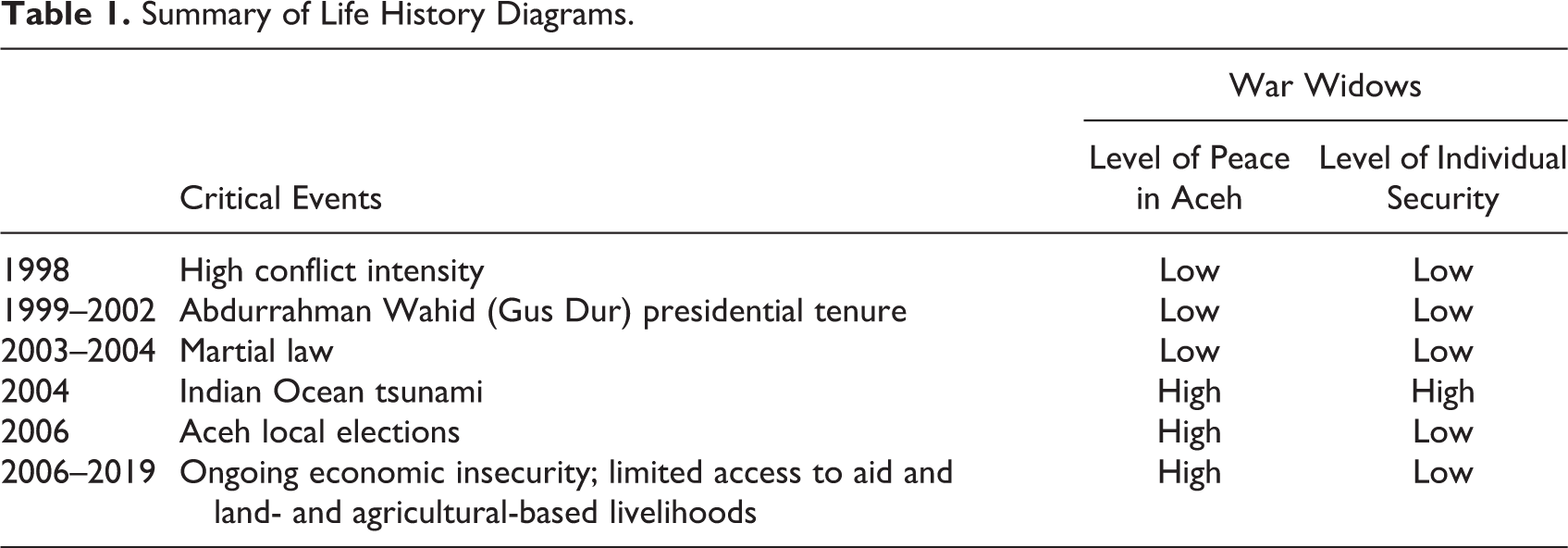
We know that the establishment of peace is a dynamic process that usually spans decades; hence, this suggests a long-term perspective. We used life history diagrams as a methodological and analytical tool (Söderström, 2020) to capture variations over time. The 16 focus-group participants were asked to draw an estimation of the level of peace in Aceh and their level of individual safety and security (ranging from 0 to 100). The diagrams took their starting point in 1998, the year that marked the fall of President Suharto and Indonesia’s first steps towards becoming a democracy (several attempts to negotiate peace in Aceh were launched at that point). The diagrams revealed well-defined highs and lows over the course of participants’ lives and facilitated a visual comparison of events. Table 1 summarises the main events discussed by the participants and their estimated levels of peace on a societal level and individual safety and security.
Summary of Life History Diagrams.
Absence of Massive Violence as a Minimum Criteria for Peace
The war widows in Desa Cot Keng described how they have endured decades of hardship and experienced low levels of individual safety and security. Their life histories revealed striking evidence of their persistent vulnerability, spanning from their own childhood to their adulthood, raising their own children during an ongoing conflict. The citation below is one example of how peace was conceived of in relation to repeated cycles of GoI violence and individual insecurity: I lived in Pesantren (Islamic Boarding School) at that time, and soldiers came in a crowd from Medan. We, the students at Pesantren, could only observe them and it felt unsafe until 2004. I got married in this conflict situation and I had a child in 2002. At the time my baby was born, the conflict was still ongoing. No, there was no peace and not safe at all. (War widow 1, Desa Cot Keng, 2019)
2
At that time, we the villagers, couldn’t leave our house after 18.00 in the afternoon. Even when we were sick and needed help, we had to report to Meunasah (prayer room), which had become a temporary military post in our village. (War widow 7, Desa Cot Keng, 2019) Hmmm…the Tsunami, Pak,
3
if it wasn’t for the Tsunami, maybe we wouldn’t be here today. Because of the earthquake and the tsunami many people died and therefore we had peace. The agreement was signed because foreigners came to Aceh, wasn’t it, Pak? It was the UN Pak…. (War widow 1, Desa Cot Keng, 2019)
Peace as a Reflection of Economic Conditions
We know from previous studies that widows often are forced to endure both social and economic marginalisation. In our interviews, they spoke almost entirely about their economic struggles, while their social hardships were not discussed to the same extent. They have, to use their own words, experienced 14 years of “uneconomic” peace, that is, an economically insecure peace. This is how one person put it: Yes, there is no economic peace. In 2005-2006, we the victims, received aid. We received money. Currently, we do not get the money anymore…. Moreover, I heard someone came here and said that we would receive IDR 50 million per person again. But that is so far only a rumour. (War widow 1, Desa Cot Keng, 2019) The daily grocery price increases every day, Pak…it’s not worth selling. After we sell our commodities, I cannot afford to buy daily goods or groceries for my family. It is just too expensive. (War widow 7, Desa Cot Keng, 2019) Officially, we have a sense of peace. No more war, I hope. But the government should pay attention to us, the elderly, we have no more power to empower ourselves. Our health is deteriorating but still we must work on the fields for our economy. (War widow 14, Desa Cot Keng, 2019) …Most of the funds were used to build infrastructure and we criticized it. Women were translated into numbers. For example, the funds allocated money for women to buy household appliances. Honestly, that’s not what we desired. We demanded that women could engage in for example saving and loan cooperatives so they can empower themselves. (Key informant 2, Jakarta, 2019)
Footnotes
Declaration of Conflicting Interests
The author(s) declared no potential conflicts of interest with respect to the research, authorship, and/or publication of this article.
Funding
The author(s) disclosed receipt of the following financial support for the research, authorship, and/or publication of this article: This study has been supported by Riksbankens Jubileumsfond.
