




Abstract
The uprisings connected to the Arab Spring have thus far failed to produce social change. The dynamics of these uprisings instead generated a number of trends that are likely to continue to destabilise the Arab world and prevent peace and development. Prevailing trends in the post-Arab Spring era include the prevalence of counter revolutions, widespread violence and armed conflicts, new patterns of alliances, external interventions and thriving proxies, raising sectarian politics, ineffective governance, terrorism, and migration. While these trends have a negative impact on people’s basic demands for socio-economic and political stability and development, they will provide and shape the foundations for other revolutions in the future. To avoid future revolutions and civil wars and stimulate peace and development in the MENA region, those driving patterns of instability will need to be altered.
Over 9 years have passed since the Arab Spring, a historical event offering a chance for long-held popular ambitions to change stagnant authoritarian regimes and socio-economic conditions in underdeveloped the Arab world; few of these aspirations have been met. While some long-standing leaders were toppled, the unleashed aspirations of the 2011 youth popular uprisings have fallen short in bringing lasting change. Unfortunately, the uprisings resulted in brutal civil wars in Syria, Yemen, and Libya, while dictatorship was restored in Egypt with its first democratically elected president, Mohamed Morsi, dying in prison. Despite failures elsewhere, Tunisia has proven to be an inspiring case for revolutions and management of post-revolts democratic transition. Nonetheless, the Arab world needs another Tunisia in order to create momentum for democratic transitions in the region. Most recently, two uprisings in Algeria and Sudan were successful in toppling their dictators, but their democratic transitions to peace, stability, and development remain long and uncertain.
The paper argues that the failure of Arab Spring revolutions to produce change has generated a number of evolving trends that are likely to continue to destabilise the Arab world and prevent peace, stability, and development. Prevailing trends in the post-Arab Spring era include the prevalence of counter revolutions, widespread violence and armed conflicts, new patterns of alliances at national, regional and international levels, external interventions and thriving proxies, an increase in sectarian politics, ineffective governance, terrorism, and migration. While these trends negatively affect people’s basic demands for socio-economic and political stability and development, they are likely to shape the foundations for other revolutions in the future. To avoid future revolutions and civil wars, those patterns driving instability will need to be altered.
While literature on Arab Spring generally looks at specific cases individually, this article takes a holistic approach by identifying emerging trends in the region that are likely to shape the immediate future of the region. Unlike the general understanding about the Arab Spring ending with a failure, the article warns that it is only a phase that produced patterns that are shaping the foundation for more revolutions to come and thus a continuation of the Arab Spring later.
Arab Spring Revolt
Various Paths to Non-Democratic Ends
Having begun with the aim of regime change or at least altering the political status quo, Arab Spring revolutions have gone through rocky routes of transitions and transformations that have, at least to present, ended with ultimately non-democratic outcomes. Only Tunisia stands as a success story of Arab Spring, as it has embraced democratic measures for transitions despite challenges.
In Egypt, capitalising on growing anger against the ruling of the Muslim Brotherhood, the military carried out a coup on July 3, 2013, overthrowing the democratic transition and removing the post-revolt elected president Mohammed Morsi. The military rode a wave of protests against the rule of the Muslim Brotherhood and has fastened their iron grip through campaigns of violent crackdown against Muslim Brotherhood members and others against the coup, conducting mass arrests and suspending the constitution (Hauslohner et al., 2013). Egypt is now ruled by a new phase of an old order, returning in a more repressive and authoritarian version than that of former president Hosni Mubarak. It should be noted that in their 1 year in power, even the post-revolution government, run by the Muslim Brotherhood, failed to implement good governance and was unsuccessful in building partnerships with other political factions in Egypt. Still, the military coup crushed both the Muslim Brotherhood and the embryonic democratic process that was evolving in Egypt.
As the 2013 coup in Egypt introduced the first successful counterrevolution, it presented a turning point for post-revolution politics in the region. In Libya, General Khalifa Haftar was emboldened to launch a military campaign to defeat the rival Islamist coalition, and with external support pushed Libyan post-Gaddafi transition to collapse and civil war (Lynch, 2016, p. 159). This later turned into a pattern, as other transitions in the region started to experience similar setbacks.
Yemen’s first consensus government after the overthrow of President Ali Abdullah Saleh led to the election of President Abdu Rabu Mansoor Hadi, who faced a coup by former president Saleh in alliance with the Houthis armed group in September 2014 (Ghobari, 2014). This move effectively overthrew the political transition and its significant achievement of an inclusive national dialogue conference that offered hope for peace and development in Yemen. It has also thrown the country into prolonged civil war with military intervention from a Saudi-led coalition. The Houthi-Saleh alliance broke down in December 2017 when Saleh was killed by his ally after days of armed clashes in Sanaa (Browning, 2017).
In Syria, regime repression of the uprisings since 2011 provoked a violent path of the revolution. With regional and international interventions, the country slid deeply into prolonged most complicated bloody civil war—which others argue is also a proxy war—that has consolidated the regime’s power and promoted its brutality with the use of chemical weapons, as well as barrel bombs against both revolutionaries and civilians (Lynch, 2016, p. 159).
Uprisings across Arab countries have shared two main characteristics of being limited in scope and demanding reform that leads to development rather than regime change. They weathered the storm either through carrot and stick policies like in the Gulf, while others used the elected or assigned authorities like parliament in Kuwait or prime minister in Jordan as scapegoats for popular grievances; as a consequence, those institutions, not the regimes, faced popular anger (Gelvin, 2013, p. 251). Nonetheless, almost all of these regimes later fastened their grips, and autocratic practices were furthered under the pretext of preventing similar post-Arab revolutions’ gloomy ends. Such endings across several post-Arab Spring settings undermined revolts and demonstrated the extent to which they had failed to bring long-lasting change. Further, they showed how the undermining forces of counterrevolutions have been producing destruction, instability, and deteriorated living environments for people throughout the Middle East.
Major Drivers of Transitions Failure
In the following section, we consider how democratic transitions have failed to produce peace and development in the region.
Unaddressed Socio-Economic Demands
Instead of prioritising addressing the major socio-economic demands of revolts, post-revolution periods drifted to contentious politics and competitive interests, frustrating the high expectations of the public. Political actors have shifted their focus away from economic policymaking to identity-based issues (Cavatorta, 2015, p. 9), such as women’s rights, the role of religion in political life, and the protection of minorities, ultimately leaving these needs unaddressed. In the post-Arab Spring era, popular indignation and desire for a better life merged with a parallel unrest associated with the factional fighting, and student militancy brought daily disorder and instability (Bayat, 2017, p. 211). Unceasing disorder with a worsening a security situation for all citizens and poor economic conditions created disenchantment with the very idea of revolution, thereby bolstering the position of counterrevolutionaries. The counterrevolution was further facilitated by the absence of accountable and empowered governments as one of the necessary conditions for a genuine transition (Cavatorta, 2015, p. 8).
Such realities promoted a mood in favour of order, a desire for creating stability, and support for a resolute, even repressive leader under several slogans such as “to save the revolution,” “saving the nation,” or restoring security and stability. These phrases served as pretexts to justify repression (Bayat, 2018, p. 211). Under General Sisi in Egypt, General Haftar in Libyan, Houthis leaders in Yemen, and Bashar Al-Assad in Syria, the same slogans have been used in efforts to stymy the revolutions and democratic demands. One of the most common public discourse and intimidation that post-Arab Spring despots have been using and dedicating to silence their people has been either people face state disintegration of the type seen in Syria or experience authoritarian leadership. Positioning the government as the main barrier to chaos has succeeded in some places where people continue to tolerate dictatorship to avoid the risks of civil war.
Revolutionaries’ Antagonistic Politics
Revolutionary forces in post-revolution periods abandoned the united goal of change and instead turned back to mobilising contentious politics, thereby reducing the prospects of a moving forward to democratic outcome. The heterogeneous nature of the anti-regime movements meant that members of these movements shared only a desire for regime change. As a result, once this happened, they quickly divided into contentious factions. This dynamic prevented revolutionary forces from forming a new government that could replace incumbent regimes and provoked enduring cleavages such as the secular–Islamic split which undermined the unity of purpose in agitating for democratisation, and enabled the deep state to recover (Hinnebusch, 2014, pp. 20, 21). In other cases like Libya, revolutionaries failed to build a state after the collapse of the Qaddafi regime, and Libya became so divided that many became interested in keeping the status quo. Reintegration of ex-combatants failed to attract more than 5,000 out of almost 200,000 in its first year (Fraihat, 2016, p. 28). Even those who turned to join the transition to reintegration were seen as having failed in the militia business.
Brutal and Determined Counterrevolutions
It is generally understood that democratic consolidation requires that political regimes distance themselves from threats of authoritarian regression (Bakis & Jülide, 2015, p. 39). On the contrary, in the Arab Spring, countries and post-revolution ruling regimes resorted to oppressive authoritarian measures to consolidate their power. This includes but is not limited to harsh crackdown and brutal violence against opponent voices and movements. The battle of the Arab Spring became about regime survival. Not many analysts expected the level of brutality that regimes have used against their citizens calling for change in order to survive. The Assad regime’s alleged use of chemical weapons and barrel bombs to obliterate political opponents led to hundreds of thousands killed, more injured, and massive destruction and population displacement. These developments sealed the fate of the Arab uprisings ahead (Aras & Richard, 2016, p. 8). The same applies to Libya and Yemen, where repression and exclusion continue to dominate.
Lack of Capacity for Change
Post-revolution political forces lacked experience in governing and managing transitions to democratic change. They also lacked experience in inclusive politics, a condition necessary to avoid fragmentation of political power and rivalry with other political and social forces. Egypt’s Muslim Brotherhood moved from prisons to presidency lacking sufficient experience in and to deliver governance and political partnership while in power. Their political practice had been confined to underground political activities and the dispensing of social services in the community (Falk, 2016, p. 5). This lack of experience in governance led to failure of maintaining consensus and delivery of services, as fierce competition over the control of state institutions has prevented the consensus necessary to reform them (Asseburg & Heiko, 2016, p. 5). The Muslim Brotherhood’s lack of experience led to failure in governance and alienation of potential partners in the political process.
The success of the Tunisian democratic transition has been ascribed to political maturity and competence of its political forces that were generally tolerated and managed to negotiate transformation of their conflicting ideologies—Islamists and secularists—into collaborative and complementary leadership (Stepan, 2016, p. 2). In Egypt, post-revolution fragmentation of political forces resulted after the failure of the incompetent ruling Muslim Brotherhood to approach governance away from its exclusionary mindset (al-Anani, 2015, p. 7).
External Players
Regional politics have undoubtedly weakened the Arab revolutions. As regional rivals Saudi Arabia and Iran, pushed by fears of democracy, insecurity, and loss of influence, employed covert and overt interventions to empower counterrevolutions. The competitive interference of regional powers (Iran, Saudi Arabia, UAE, Qatar, and Turkey), seeking rival goals, contributed to the reversal of democratic transitions in states experiencing uprisings. In Egypt, for instance, Saudi Arabia and the UAE supported the overthrow of the elected president Morsi, propping up the return of military rule with offer of US$8 billion in aid (Peel & Saleh, 2013), while Qatar and Turkey supported Morsi. The same dynamic emerged in Yemen and Libya, where Gulf Cooperation Council (GCC) countries and Iran supported rival actors (Islamists, military, and leftists), bolstering them to hasten implementation of anti-democratic governance (Hinnebusch, 2018, p. 2).
Regional involvement in post-Arab Spring countries has sabotaged democratic transitions and consolidated status quo authorities. We see this dynamic most clearly through Russia and Iran’s role in crushing the Syrian revolution and ultimately reinforcing Assad’s dictatorship. Equally important, the West supported the military coup in Egypt, favouring a “strong man” who could serve their interests over supporting democratic values that were crystallising in the region. The United States, for instance, gives US$1.3 billion a year to the military government in Egypt, but allocated just US$166 million to democratic Tunisia in 2015 (Stepan, 2016, p. 12). Further, in Yemen, a democratic transition reached a significant stage of achieving inclusive national dialogue but was ultimately undermined by an incremental coup without adequate international support to the interim government, which led to civil war. International involvement in Libya also ended at a critical moment, leaving the country unaided to face the fate of civil war (Cavatorta, 2017, p. 5).
It is difficult to make sense of the economic policy decisions of newly elected Islamist parties in Tunisia and Egypt without noting the pressure from international markets constraining the choices that elected officials can make. Moreover, Western actors being increasingly proved themselves to be more concerned about security than promoting democracy or human rights. The West restricted support for democracy to the technical, and this assistance is nowhere near as aggressive as it was in the past. Western governments therefore tend to fund projects that have a “democratic” component but are no longer funding genuine opposition movements or activities to shake authoritarian domestic arrangements.
Emerging Trends and Implications
The Prevalence of Counter Revolution
Counterrevolutions in the form of civil war and the return of autocracy have so far scored significant gains against revolutionary forces seeking reform and change. This trend, which arguably began in Egypt in 2013, is likely to continue, as international interventions have increasingly shaped formal and informal networks of interests and patronage, connecting external anti-revolution forces to domestic counterrevolutionaries. In Egypt, authoritarianism through counterrevolution returned in an even more oppressive form. The 2015 parliamentary elections, with a 22% turnout, brought mainly pro-Sisi and pro-Mubarak elites to the legislature, and military officers took control of seventeen of the 27 governorates. The regime also jailed some 40,000 political prisoners, many of them supporters of the ousted Morsi (Aboulenein & Knech, 2015). Syria, after more than 8 years, still faces the regime’s brutal counterrevolutionary wave against oppositions who were left unaided and crushed in most of Syria where regime forces advanced (Philips, 2018). It is therefore unlikely that the opposition will take a meaningful role in the next phase of Syria and that the reconstruction process will be shaped, led, and implemented by the regime forces.
Although Yemen’s transition was once described as a model of peaceful transition for the region (Friedman, 2013), a counterrevolution led by former regime in alliance with Houthi armed group has sparked civil war. The government of President Hadi was removed, thereby blocking the transition at the concluding stage of a national dialogue and constitution drafting. The state today is shattered by conflict into multiple autocratic repressive de facto authorities, some in areas held by the internationally recognised government of president Hadi (Della et al., 2017, p. 169). Key military figures of former President Saleh’s government, accused of killing hundreds of peaceful protesters in 2011 and of implementing the coup in 2014, have returned to lead major military brigades supported by UAE. Such positions are likely preparing them for a key role in decision-making in post-war Yemen.
Political conditions in the majority of Arab countries have worsened compared with the pre-Arab Spring years. All indictors of political freedom and social justice have receded, as autocratic rule has been reinforced after the Arab Spring (Economist Intelligence Unit [EIU], 2017). When asked whether the citizens of their home country were free to criticise their government without fear of retribution, 37% of the Arab public said this was impossible to do. Indeed, in some countries, such as in Palestine and Sudan, majorities expressed the view that they were not free to openly criticise their own governments without fear, 59% and 68%, respectively (Arab Opinion Index, 2018). Oppressive acts and restrictive policies and abuses by authorities damage trust between people and those authorities, thereby pushing people to oppose coercive governmental institutions that are meant to protect citizens. This dynamic has spurred a lack of security and thriving instability, products of failed governance. Further violent responses and violations of human rights by authorities fuel outrage, discontent, and rising patterns of resistance that include potential protests, riots, rebellions, and defections. Resulting unrest prevents proper functioning of the state, worsening political and socio-economic conditions.
Hybrid Conflicts and Proxy Battles and Actors
With high levels of intervention and the establishment of proxies, the region is increasingly punctuated by conflicts marked by the involvement of multiple state, nonstate local, and external actors split among contending coalitions in each context. These multiple circles of conflicts have spurred insecurity and instability and delayed the building of peaceful environments to enable recovery and development. For example, in Syria, opposition militias fight the regime, while both the regime and opposition fight against a terrorist actor that controls substantial territory. Additionally, conflict has resulted from the armed effort by the Syrian Kurdish minority to achieve de facto statehood. The intervening actors have diverse goals that are often at cross-purposes and confused by shifting and contradictory priorities: anti-Assad at first, then anti-Russian and anti-Iranian, then pro- and anti-ISIS as well as pro- and anti-Kurdish, and, not to be overlooked, pro- and anti- Shiites, and pro- and anti-Sunni (Falk, 2017, p. 8).
The same principle of division applies in Yemen, where a Saudi-led coalition backing the Hadi government leads a fight against Iran-allied Houthi armed group. These rivals also have battles with Al-Qaeda in the Arab Peninsula. Both the Muslim Brotherhood-linked Islah and Salafi forces, fighting against Houthis, are competing for dominance. Meanwhile, UAE-backed southern secessionist fighting with the government against Houthis are also fighting against government forces in the south over secession demands there. While domestic actors fight Houthi forces alongside Saudi and Emirati troops, they fight against expansionist ambitious and behaviour of both allies as well. Similarly, in Egypt, multiple forces fight; General Haftar in the East fights the West, while several conflicts exist within the Tripoli, and all parties fight ISIS as well.
Emerging New Regional Alliances
As dramatic changes continue to alter the geopolitics of the Arab world and make clearer the absence of regional order, the post-Arab Spring era has witnessed shifting and multilayered alliance formations. New regional alliances have emerged along the new lines of conflict. Iran’s gains in Syria have exacerbated fears within Saudi Arabia, which sees itself as further encircled by Iranian influence (Fraihat, 2020, p. 44). As Iran’s Houthis allies controlled power in Yemen, the regional order was further rebalanced in Iran’s favour, which in turn has pushed Saudi Arabia to search for regional alliances to balance the regional order. This dynamic led to major changes in the political scene across the Middle East. In the past, the Middle East was split among two major axes: the “axis of resistance” that comprised Iran, Syria, and Lebanese Hizbullah, and the “Moderate Arab States” like the GCC, Egypt, and Jordan. In the post-Arab Spring region, three major alliances have been formed: 1—Saudi Arabia, the UAE, Egypt, the United States, and to a certain extent Israel. 2—Turkey and Qatar after the 2017 blockade of Qatar. 3—Iran, Syria, and Iraq, along with nonstate actors like Houthis and Hizbullah (Fraihat, 2018). This arrangement is depicted in Figure 1.
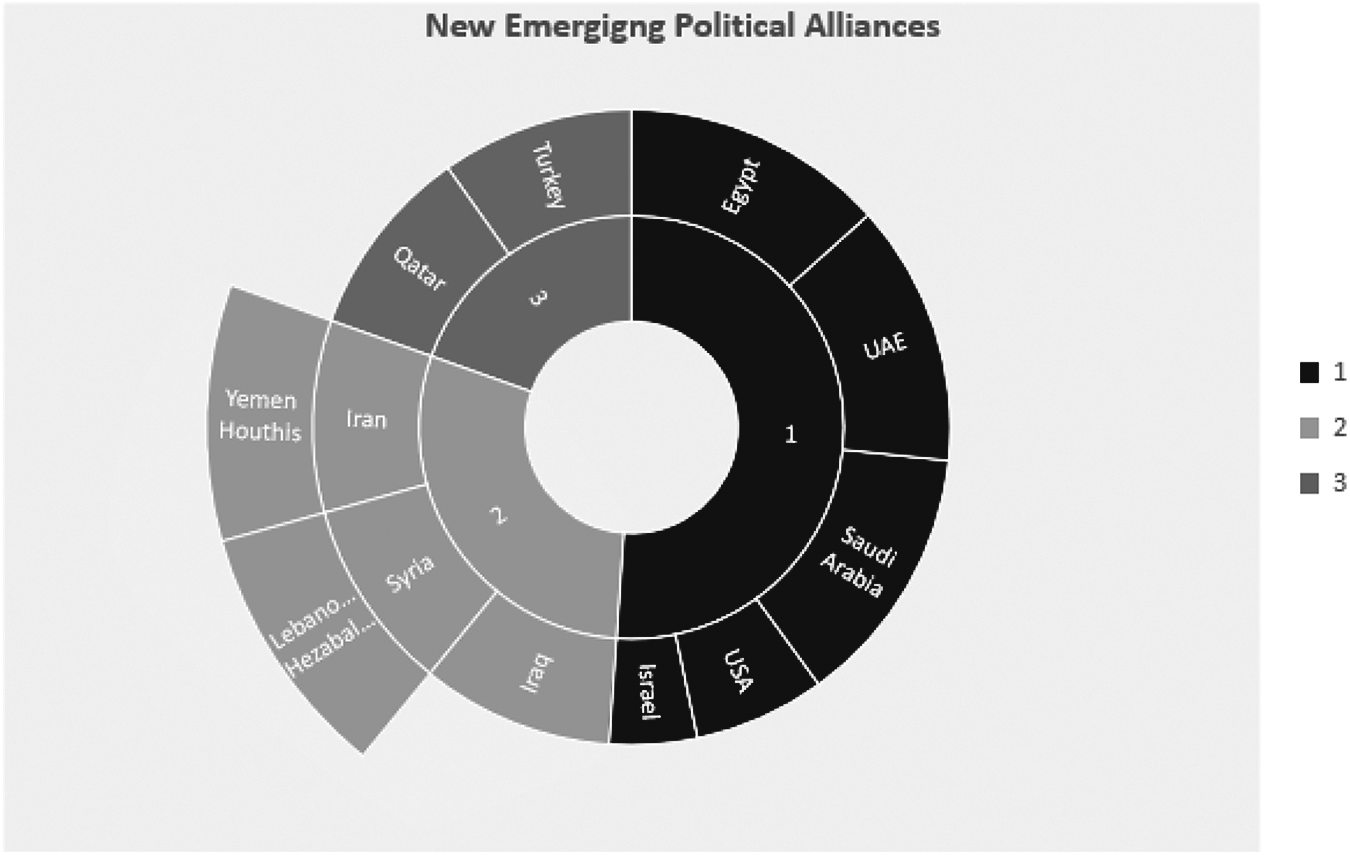
Newly formed salient axis of political alliances.
Sectarian Politics
The state of autocracy and war has fragmented the community and empowered non-state identities. With power vacuums and fragile states, sects have become empowered in post Arab revolutions. With its problematic exclusionary politics, sectarianism has been predominantly defined as the Sunni-Shia rivalry, yet these divisions have evoked other sectarian battles against other religious minorities.
The sectarian wave is perhaps best illustrated by Syrian civil war, wherein the Shia Alawite Assad regime is backed by sectarian Shiite allies Iran and Hezbollah. One devastating result has been the sharp rise of Sunni terrorist group ISIS and associated shocking events, from the enslavement of hundreds of Yazidi women in Sinjar (Wehrey, 2018, p. 39) to the carnage of at least 1,500 Shia soldiers in Tikrit and of hundreds of Sunni tribesmen in Syria and Iraq.
Meanwhile, in Yemen, Shia-affiliated Houthi armed groups took over the power after starting a war with the removed government. A Saudi-led coalition intervened against the Iran-backed Houthis, supporting the exiled government and other sectarian opponents including raising Salafi groups. Salafi groups in Egypt, Yemen and Libya have become more powerful in the post-Arab Spring, as an outcome of the increase in sectarian politics.
Sectarian mobilisation has ramped up in a sphere conducive to such mobilisation due to the creation of proxy wars between an Iranian-led network of Shi’a proxy movements and regimes in Lebanon, Syria, Iraq, and Yemen on one hand, and Saudi-led Sunni proxies and allies in the region. As Shia movements became empowered in Iraq, Yemen, and Syria, voices of Shia in Bahrain and Saudi Arabia also grew louder. Public solidarity along sectarian lines in the Arab world has become more prevalent. For instance, when the Saudi government executed Shi’a cleric Nimr al Nimr in late 2015, Arab and Iranian Shi’a protests erupted across the Arab world, even in Lebanon, where he was virtually unknown (Abdo, 2017, p. 144). This does not imply, however, that the underlying cause of Iran-Saudi rivalry is sectarian. Nonetheless, both Iran and Saudi Arabia use sectarianism to serve their political agendas in certain arenas (Fraihat, 2020, p. 57). It is no coincidence that Iran’s allies of armed militias in Iraq, Yemen, Syria, and Lebanon are all Shia. By the same token, by explaining Iranian expansion in terms of sectarian prisms, Saudi Arabia can justify its mobilisation again Tehran. Moreover, rising sectarianism extends to the struggles of Christian minorities in Iraq, Egypt, and Syria. Christian and other religious minorities are facing attacks and their numbers are dwindling as many leave elsewhere. In Egypt, Coptic Christians have suffered many attacks, particularly since the ouster of Egyptian President Muhammad Morsi in 2013, with many churches and Christian businesses having been targeted and destroyed (Byman, 2014, p. 5).
Terrorism
Although terrorism in the Middle East certainly predates the Arab Spring, in the post-Arab Spring era, it has taken different trajectories, especially after the removal of ISIS structures from Mosel in Iraq and Raqqa in Syria. Although some policy makers argue that ISIS has been crushed, it is important to note that ISIS was militarily defeated but not completely destroyed. That is, ISIS the organisation was defeated but the phenomenon of violent extremism survived and probably became stronger. The “defeat” of ISIS in Mosel and Raqqa in fact helped it go back to its original clandestine terrorism business, rather than governance and services delivery work which is what the organisation tried to do. One major reason for the split of ISIS from Al-Qaeda was that the latter refused to become involved in governance and insisted on continuing to exist as a secretive organisation conducting covert operations. Abu Baker al-Baghdadi, the founder of ISIS, opposed this approach, left Al-Qaeda, and declared the Islamic State in Iraq and Sham (ISIS). Again, the defeat in Mosel and Raqqa in fact helped ISIS goes back to its origin. In the post-Arab Spring period, ISIS and other violent extremist groups remain active in diffuse parts of the entire region.
With the flow of money, weapons, and fighters, extremist forces continue to thrive, especially in the war-torn countries of Syria, Yemen, Iraq, and Libya. From civil wars, external interventions, political violence, and sectarian politics to the destabilisation of governments and rise of authoritarian rule, the rise of terrorism is facilitated. Indeed, the Islamic State continues to operate in large parts of Iraq and Syria. Yemen’s conflict has allowed al-Qaeda in the Arabian Peninsula (AQAP) and other affiliated militants to expand. So, in the Middle East, jihadists’ expansion appears to be a product of instability rather than its primary driver (International Crisis Group [ICG], 2016). Extremism in the Sinai Peninsula increased intensely after the military coup in 2013 and the resulting crackdown on freedoms in Egypt under the presidency of Abdel Fattah el-Sisi; the rise in terror was marked by the deadliest attack in the peninsula’s history, which left more than 300 people dead (Dewan, 2017). Even in Tunisia, a suicide attack in Tunis in October 2018 sent an alarm about the existent extremism threat (Bajec, 2018).
This trend is present in many Arab countries, with those that experienced blocked political transitions the most affected. In 2015, in Egypt, deaths from terrorist attacks jumped to 663, and in 2016, there were 293 terrorist deaths. This surge contrasts starkly with 2 years preceding the Arab Spring when there was only a single death from terrorism in Egypt, and in the years immediately after the 2011 protests, during which terrorist activity remained low, with 47 deaths recorded in 2011 and 2012. Syria, Libya, and Yemen have also witnessed a rise in deaths from terrorist attacks. In 2015, deaths peaked at 454 in Libya and 2,768 in Syria. Likewise, Yemen has seen a hike from 47 deaths in 2009 to 1,517 in 2015. Iraq, which was at war prior to the Arab Spring, has seen the peak of deaths by terrorist attacks from 2,500 in 2009 to nearly 10,000 in 2014 and 2016. While Tunisia had the lowest scores in terms of impact, out of the 10 countries most affected by terrorism worldwide in 2016, 4 are Arab countries, 3 of which witnessed revolutions and blocked transitions: Iraq, Syria, Yemen, and Libya. The same countries were also featured in 2015 with inclusion of Egypt (GTI, 2017). Figure 2 shows the rising impact of terrorism in terms of death scores in the five Arab countries most impacted by Arab Spring and its next ends.
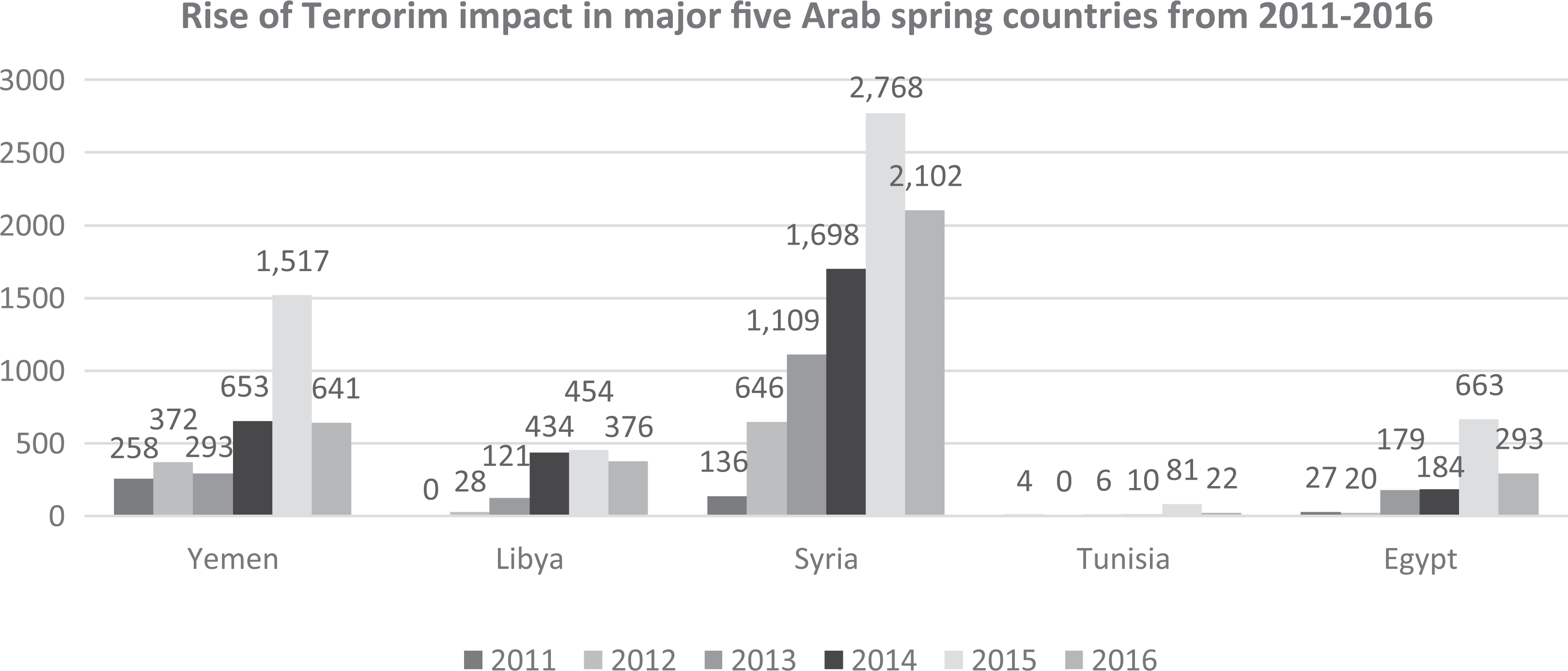
Increasing terror wave in highly Arab Spring affected states. Note. Authors’ calculations and drawings based on data from annual reports of Global Terrorism Index 2011–2016.
Increasing Migration
Amidst shifting realities, people of the region are given the difficult choice of unbearable living conditions and accepting dictatorships or engaging in brutal and destructive ongoing violent conflicts. Neither of these choices is acceptable to many, which has encouraged the search for a third option by looking for a new environment outside their home countries through migration, particularly to Europe. In 2013, 21.9 million migrants left Arab countries, while only about 8 million migrants were coming from the Arab world when the revolts first erupted late 2010 and 2011 (IOM, 2015). In 2014, more than 170,000 migrants landed in Italy alone, almost 4 times the number in 2013 (as the Middle East and North Africa Annual Report (2014) by IOM concluded). The year 2015 saw the highest levels of forced displacement since World War II, and by the middle of 2015, the world hosted 15.1 million refugees, a 45% increase than 3.5 years ago—most of them from Africa to the Middle East and South Asia according to Global Migration Trends launched by IOM (2016).
The migration context in the Middle East and North Africa is characterised by three patterns: forced migration and internal displacement, irregular migration flows, and movement of (regular and irregular) labour migrants. However, internal displacement and the creation of refugees have been more dominant and challenging crises in the Arab world and abroad. Rising violence, authoritarianism, and instability, alongside deteriorating socio-economic conditions, social exclusion, alienation, and social inequality are drivers behind this trending flux. In addition, an unprecedented level of unemployment has emerged in the face of growing populations and the failure of the international community to address conflicts, violence, and human rights violations in these countries (Metcalfe, 2015).
Figure 3 demonstrates the rising trend of these migration patterns in the Middle East and North Africa (MENA) in 3 years of 2012, 2014, and 2016. The increase observed from 2014 explains the relations between this surge and the shift of democratic transitions that drifted to either autocracy or war in major Arab spring countries.
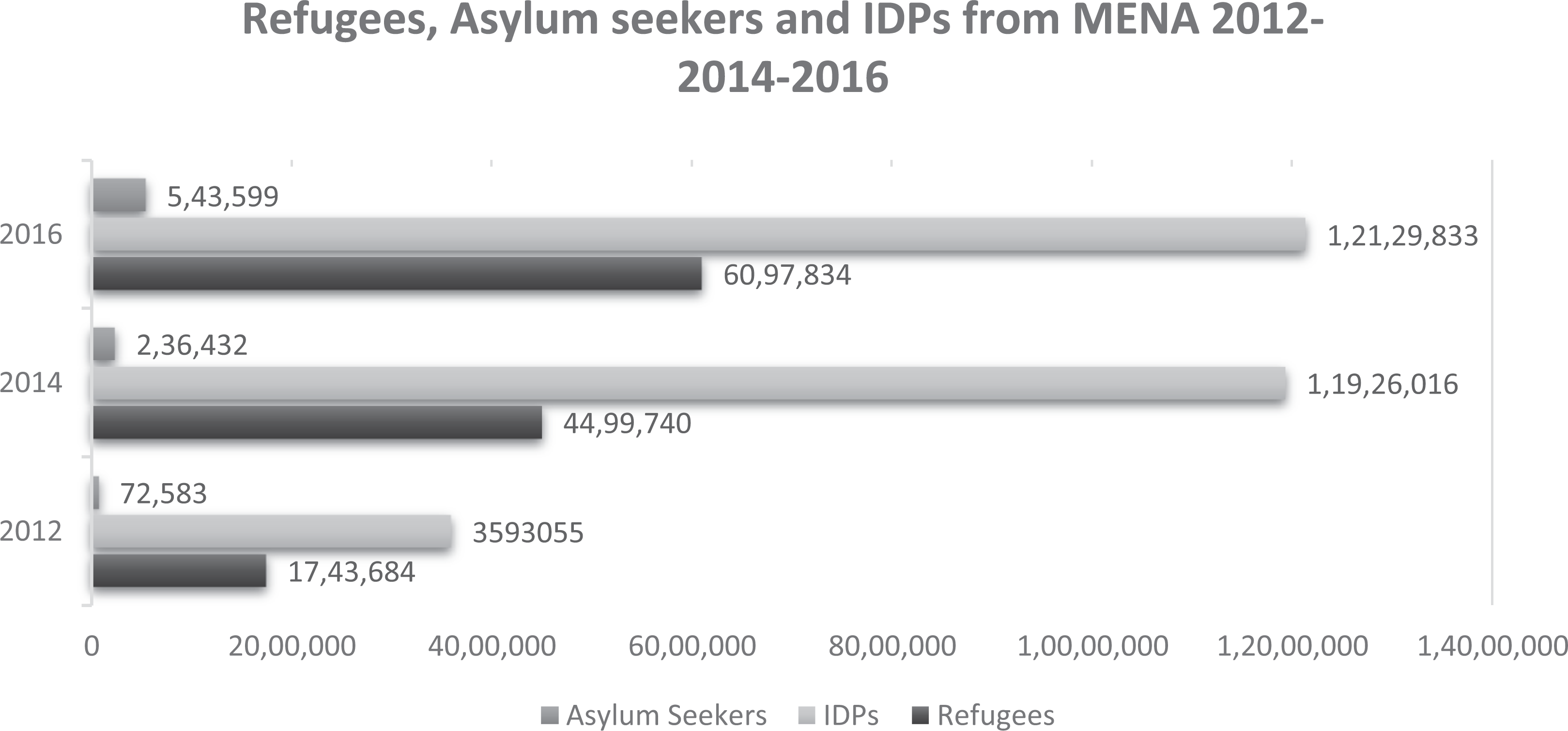
Trending types of migrations within and from the MENA. Note. Authors’ calculations and drawings based on figures from annual reports of UNHCR (2012, 2014, 2016).
Figure 4, detailed by country, further illustrates that the trajectories of violence and autocracy after the Arab Spring pushed the wave of refugees from these countries. The comparison between 2012 and 2016 revealed that the flow of these migrant patterns was much lower during the transition in 2012 and the outset of revolutions. Moreover, Tunisia, which embraced democratic procedures to tackle its transitions, has reversed results: with more migrants flow from the country in 2012, but much less movement in 2016.
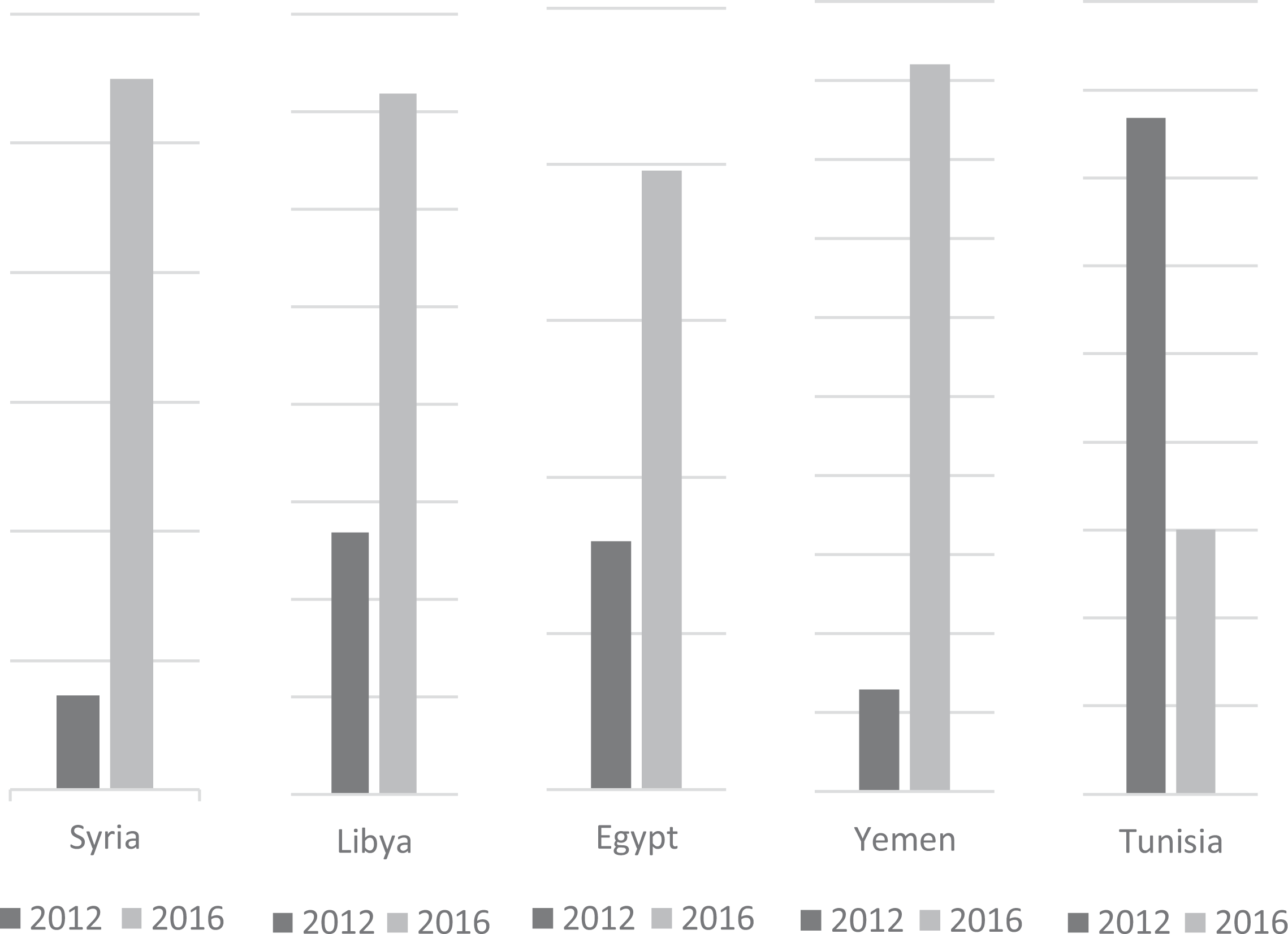
Refugees in Arab Spring most affected contexts 2012–2016. Note. Authors’ calculations based on data from country reports published by UNHCR (2012, 2016).
In terms of numbers, immigration from the Arab world peaked in 2016 when the Syrian revolution entered one of its bloodiest times since 2011. In the coming years, the problem of immigration will be exacerbated in two ways: (a) though unlikely to sustain the 2016 peak, new numbers of refugees will continue to target Europe as they find living under emboldened dictatorships difficult to tolerate, and revolting again in the near future is unrealistic; (b) the state of refuge for those in Europe or North America will be sustained not only because they have better opportunities abroad but also because no inclusive post-conflict reconstruction is taking place at home. The Assad regime already sent a message discouraging migrants from returning by issuing law 10 that allows the state to confiscate their properties if Syrians who left the country return to claim it.
Impunity and Lack of Accountability for Abuses
As post-Arab Spring politics has emboldened Arab autocrats to rule with an iron fist, lack of accountability and good governance will likely be the default outcome for this new emerging political system. The Assad regime is emerging as an absolute and unquestionable leader for Syria, with unprecedented effects on the Syrian population. As of 2018, at least 511,000 people had been killed, and nearly two million more had been wounded (Specia, 2018). Further, over 5.6 million refugees and 6.6 million internally displaced in Syria since 2011, the largest internally displaced population in the world (UNHCR, 2018).
The Egyptian regime likewise brought back repression and authoritarianism at even higher levels than those under Mubarak. The world witnessed how an Egyptian court in March 24, 2014, in a mass trial and just after a single session, issued 528 death verdicts against imprisoned protesters from the Muslim Brotherhood. Just one day later, on March 25, following a single session without defence lawyers, an Egyptian judge said he would issue verdicts in a new mass trial of 683 political prisoners within a month (Michael, 2014).
Emerging actors in Yemen are said to be responsible for hundreds of reported and verified cases of violating human rights against civilians through, for example, extrajudicial executions, arbitrary detention, and forceful disappearance of thousands of civilians, hundreds of whom were tortured, with tens of prisoners having died as a result of cruel torture. Numerous incidents have been documented from UAE-managed prisons southern Yemen with hundreds in prison and forcefully disappeared, many of whom have died under torture, alongside Houthi de facto authorities’ oppression in Yemeni against hundreds of civilians, extrajudicial executions. Lack of accountability is a very dangerous dimension of post-Arab Spring politics, which encourages corruption that perpetuates grievances, conflict, and instability. Featured as non-inclusive and dictatorial, exacerbating existing and creating new grievances, the emerging political order in the post-Arab Spring Arab world carries the seeds of another revolution. In other words, the Arab Spring will return, though no one can expect when and how.
Cross-Cutting Ramifications Stability and Development
In the post-Arab Spring sociopolitical settings of affected countries, a set of challenging dynamics have emerged around governance and authorities’ relations to citizens. The exploitation of sectarianism by authoritarian regimes to consolidate their rule by promoting social cleavages, oppression of people’s voices by brutal violence, systematic abuses of human rights, restricted political and social freedoms, absent rule of law, lack of accountability, and widespread patterns of corruption. Furthermore, dynamics of the post-Arab Spring era have included high levels of instability, threats of violence, and large-scale conflicts as a result of undermined social contract and unresponsive or collapsed governance, in addition to unprecedented external interventions of different types. Unaddressed demands of the revolts that emerged in 2011 calling for dignity, human rights, and improved social, political and economic conditions have been evolving over the past 9 years. There have also been prolonged crises of high youth unemployment, high poverty rates, and political and social exclusion, which contributed to the rise of protests in 2011, and are still present in 2019 in Iraq, Egypt, and Jordan. Reactionary oppression from authorities will never resolve these grievances, but instigate further political unrest and vulnerability of people, especially youth, to recruitment by violent entities and radical groups. Exacerbation of exclusion, inequality, and oppression is fuelled by ongoing violent conflicts and the expansion of oppressive governments. The inability or unwillingness to address the roots of the 2011 protests has undermined human development, security, and chances for building a peaceful and development-enabling environment alongside social, political, and economic progress.
Examining the links between conflict, insecurity, and development, it has been found that societies become more vulnerable to conflict and insecurity when there is no equitable access to justice or economic opportunities (McCandless & Rogan, 2013). The 2030 Agenda for Sustainable Development, adopted in 2015, emphasised that the condition of inclusiveness is necessary for sustainable peace and human development. The principle recommendation to meet the 2030 Agenda’s imperative is therefore fighting all types of inequality. In light of this, exclusion is a driver for tensions in the society, instability, violence (Abdellatif et al., 2019, p. 5). Concrete manifestations of the implications those issues bring about are prolonged civil conflicts, deteriorated security, and reversed development. Devastation is a massive issue across post-Arab Spring countries that have witnessed armed conflicts with external interventions, as is the case of Syria, Libya, and Yemen. Thousands of people have been killed and maimed, millions have been displaced internally and externally, and thousands youths have been exploited and recruited along the rival lines of internal wars. These are lost human capital assets in one way and future security and stability threats for those recruited in violent groups.
Beyond this physical and humanitarian damage, civil conflicts have also devastated many Arab economies. Indeed, at times of civil conflict, annual GDP per capita declines as a result of the destruction of capital stock and reduction of production (Collier, 1999, p. 12). This considerably diminishes potential growth and development to create better living conditions for the people of those MENA countries. For example, up to 2016, the total loss of Syria’s GDP was estimated at US$226 billion, 4 times of its GDP in 2010; meanwhile, the restoration of Libya’s infrastructure is estimated to cost about US$200 billion (World Bank 2016). Further, a slowdown in economic growth has existed in the MENA region since 2014; in 2019, MENA’s real GDP growth is estimated at 0.6%, substantially lower than 1.2% in 2018 (World Bank 2019.4). Lower levels of growth were seen in countries that had experienced Arab Spring protests (World Bank, 2014). A considerable drop in economic growth has been aided by a less efficient financial market in the region as a result of post Arab Spring developments. Indeed, bank profitability decreases in parallel to increase levels of banking risks, and more suffocating borrowing constraints hindered capital accumulation and impeded opportunities of economic growth (Arayssi et al., 2019, p. 3).
In other Arab Spring countries that were not hit by civil wars, ineffective political governance and authoritarian rule keep intensifying people’s discontent and unrest. Political governance institutions are also stimulating drivers of economic growth (Blackburn & Forgues-Puccio, 2010). Prior to Arab spring, the rule of law was proved to have positively influenced growth in MENA during 2007-2010. Moreover, civil unrest in MENA countries reduces their economic growth and dynamics of Arab spring have also harmed macroeconomic, burdened the budget balance and increased the public debt (Arayssi et al., 2019, pp. 3, 7). Overall, the regionally and internationally emerging alliances of powers are also driving other implications for peace and development in the MENA with double impact on those Arab Spring affected countries where interactions of those alliances are inflicted in national power and politics dynamics. The World Bank (2019, p. 11) stated that tensions in the MENA region are expected if they continue to disrupt region’s economic stability. These tensions include recent attacks on Saudi oil facilities in September and oil tankers, as well as the United States’ increasing sanctions on Iran’s economy.
To sum up, these interlinked issues help to undermine existing powers and facilitate devastation of political and socio-economic progress, equitable access to social services, chances, and justice. This dynamic, in turn, makes it more difficult to build peace and security, necessary conditions for development.
Conclusion
The Arab Spring has been a missed opportunity for the Arab world to bring about change to its stagnant political systems. At present, Tunisia has been the exception to general failure, which has raised concerns about the sustainability of the relative Tunisian success. Sustainability is challenged both on the domestic level—mainly by serious economic challenges—and externally by Arab autocratic regimes that will not allow democracy to prosper in the region for the threat it will bring to them. The missed opportunity of the Arab Spring to produce change has led to the emergence of new trends that will shape politics of the region. Prevailing counter-revolutions will continue to push for the full restoration of tyrannical regimes, a trend that regional and international players would keep supporting for a “perceived stability” that presumably serves their interests.
Proxy wars will continue to thrive in the Arab world as another leading trend in shaping the politics of the region. This dynamic can be seen in countries like Syria, Yemen, Libya, Iraq, and others. Flourishing proxy wars are directly linked to the abundant availability of patron states who are driven by their belief that the world order is moving into multipolarity. Sectarianism will continue to be a trend as long as the rivalry between Iran and Saudi Arabia exists. This rivalry is not expected to come to an end any time in the near future. Both parties have used sectarianism as a convenient tool to advance their political agendas, and with that chaos and instability have been reinforced in the region.
Youth who started these revolutions will find emigrating outside the region as an acceptable alternative to living under tyranny again. Therefore, migration is expected to be another leading trend in the region. Some of those youth who remain within states with diminishing political and economic opportunities may turn to terrorism as a channel to express their anger against the system. Terrorism came to exist at least in part due to political repression. With the centralisation of power within the state after the defeat of most Arab Spring uprisings, repression is likely to consolidate giving a new way for terrorism to prosper.
These political trends will continue yet will also provide the foundation for other revolutions in the future, as this level of tyranny and corruption is unsustainable. People are being silenced now because regimes in power continuously warn that the alternative to tyranny will be the chaos of the Arab Spring. Such chaos, however, could at least lead to change, but tyranny will undoubtedly lead to the repression, corruption, and political stagnation that they previously revolted against in the first place. In other words, while the Arab Spring uprisings seem to have failed to produce change at this time, they have planted the seeds for new revolutions in the future. To avoid another wave of bloody revolutions in the future, Arab autocrats have an opportunity to engage in significant and deep political reform to avoid this outcome again in the future. This can be achieved through a state run inclusive national dialogue that leads to a new social contract. Reforms should include the institution of a law that regulates the formation of political parties, establishing of a multi-party system, and adoption of strict and transparent measures to combat rampant corruption. For royal systems, taking steps that lead to the establishment of constitutional monarchies is the way forward.
Tunisia’s economy, the major challenge to its sustainable success, must be supported to maintain an inspiring model for democratic and peaceful transition in the region. Robust development agenda urgently needed for the region to give youth a hope and shun terrorism and illegal immigration. The West must abandon its long-standing policy of supporting dictatorships and the illusion that a strongman can serve their interest and bring about stability. Encouraging deep reform and peaceful change is the long-term interest of everyone. Finally, with an incompetent and marginalised Arab League, a conflict resolution and intervention framework needs to be created to facilitate dialogue and respond to current and future violent conflicts in the region.
Footnotes
Authors’ Note
This article was originally presented in the Interpeace Governing Board meeting on December 5–6, 2018, in Tunisia.
Acknowledgment
The authors would like to thank the board for their excellent feedback that contributed to further development of this article.
Declaration of Conflicting Interests
The author(s) declared no potential conflicts of interest with respect to the research, authorship, and/or publication of this article.
Funding
The author(s) received no financial support for the research, authorship, and/or publication of this article.