




Abstract
This paper investigates the functions, downsides, and limitations of empathy in chaplaincy care. Data were collected from 20 humanist chaplains working in health care, prison, and military settings using semi-structured interviews. According to the participants, empathy is at the heart of their profession but has disadvantages as well. The analysis yields seven major functions of empathy with corresponding downsides and limitations: (1) to connect, (2) to understand, (3) to guide, (4) to acknowledge, (5) to motivate, (6) to inspire, and (7) to humanize. We argue for a need to “talk about empathy” since despite its importance and challenges, there is little professional and academic discussion about empathy in chaplaincy care. We hope that the findings of this study can function as starting points for the discussion and thus contribute to the ongoing professionalization of chaplaincy care. To that end, we propose three topics for further reflection and conversation.
Background
Empathy is often highlighted as a key notion in religious and nonreligious chaplaincy (Baard, 2017; Bauck, 2017; Capretto, 2015; Handzo et al., 2008; Hogue, 2010; Montonye & Calderone, 2010; Parameshwaran, 2015; Pembroke, 2019; Savage, 2019; Underwood, 1985; Zondag, 2007). The quality of being empathetic is listed as a desirable trait or requirement in chaplains’ job profiles. Empathy is mentioned in their professional standards, and it appears in the case studies, narratives, and columns of practicing chaplains. Furthermore, empathy is represented in questionnaires that measure clients’ satisfaction with chaplaincy (Winter-Pfändler & Morgenthaler, 2011). Empathic listening emerged as one of the eight most common nonreligious core activities of chaplains in a large qualitative study into the interventions of chaplains working in a health care setting (Handzo et al., 2008). It was practiced in 71.6% of the 30,995 investigated visits (ibidem, p. 44). According to this study, the practice of empathy is so common that it was excluded from the final analysis to “avoid severe bias in the reported numbers” (ibidem, p. 44).
Despite the assumption that empathy is a key element of chaplaincy care, little systematic research exists into the functions and limitations of empathy in this profession (Smit, 2015). This knowledge gap is problematic since empathy is a complex and controversial concept as well (Bloom, 2016; Prinz, 2011), and its contribution to good care or moral behavior is not self-evident. For example, care ethicists have criticized empathy for having potential flaws such as the risk of projection or its tendency to be distorted by prejudices and biases (Hamington, 2017).
At present, a growing number of chaplains acknowledge the need for chaplaincy research as a means to encourage further professionalization, improve chaplaincy care, justify the added value of chaplaincy, gain more insight into what it is that chaplains actually do, and to better understand what constitutes good chaplaincy care (Damen et al., 2018, 2020; Fitchett, 2002, 2017; Fitchett et al., 2014; Jankowski et al., 2011). Our study responds to this call for research by generating a model of empathy's functions in relation to the core pillars of humanist chaplaincy.
We chose to focus on humanist chaplains since research into humanist chaplaincy is relatively scarce and since empathy is explicitly mentioned as a key concept in the Professional Standard of Dutch humanist chaplaincy (Bolsenbroek et al., 2019). Humanist chaplaincy is an equivalent of spiritual or pastoral chaplaincy. Humanist chaplains provide nonreligious or secular chaplaincy care based on humanistic values, such as our shared humanity and connectedness, solidarity, dialogue, autonomy, dignity, and responsibility. In the Netherlands, humanist chaplaincy forms a small but unique profession of caregivers who work in a wide range of settings, including prisons, the military, universities, (psychiatric) hospitals, nursing homes, and rehabilitation centers. Empathy has been mentioned as a core concept in Dutch humanist chaplaincy theory (Alma, 2006; Bru, 2008a; Duyndam, 2018; Hoogeveen, 1991; IJssel, 2007; Mooren, 1999; Praag, 1978) but its functions, downsides, and limitations have not been systematically analyzed.
In this paper, we investigate the functions and disadvantages of empathy that chaplains perceive in their daily care practices, and we explore how these functions relate to the core or pillars of humanist chaplaincy. Thus, we aim to contribute to the theory and professional practice of chaplains. We argue for the need to talk about empathy and provide various building blocks for this discussion based on our findings.
Functions and Limitations of Empathy in the Field of Care
In this section, we describe four main functions and limitations of empathy in the field of care. This selection builds on a previously published review article by the authors into the functions and limitations of empathy in care practices (Van Dijke et al., 2018).
First, empathy has a relational function. According to the literature, empathy is a relational construct and a crucial component of helping and caring relationships (Bru, 2008b; Douglas, 2012; Mercer & Reynolds, 2002; Reynolds & Scott, 1999; Rogers, 1975). Professional caregivers draw on empathy to address their clients’ needs in a concerned way and to promote their clients’ well-being. Research suggests that empathy lowers defenses, contributes to a climate in which care receivers express their needs more freely, promotes trust, helps caregivers to be more perceptive of individual differences, and to be more responsive to clients’ unique needs (Reynolds & Scott, 1999). On the downside, research indicates that empathy tends to be biased toward people who are close to the empathizer, who belong to the same social group, or with whom one can identify more easily based on similarities (Batson, 2011, 2014; Hoffman, 2001, 2014; Maibom, 2014; Meyers, 1994; Noddings, 2010a, 2010b; Oxley, 2011; Prinz, 2011). People are more reluctant or less able to empathize with people who are part of a different group or who are “strange” to them. This widely acknowledged drawback is referred to as the “familiarity bias” (Hoffman, 2001).
Second, empathy serves an epistemic or knowledge function. According to academic literature, empathy is one of the most important ways to gain insight into others’ situation and experiential world from their point of view (Hamington, 2017; Meneses & Larkin, 2012; Oxley, 2011; Rogers, 1975; Stueber, 2016; Vetlesen, 1994). Consequently, empathy may foster an understanding of what people are going through, what is at stake for them, and what they need. The epistemic function of empathy is, however, fundamentally limited, as it may be impossible to understand the other's experiences fully and accurately through empathy (Bru, 2008b; Hamington, 2017; Noddings, 2013; Sevenhuijsen, 2014; Tronto, 1993). Moreover, people tend to overestimate their ability to accurately understand others (Ickes, 1993). Inaccurate empathic understandings may lead to mismatch, care that is out of tune with the other's individuality or needs (Goossensen, 2014).
Third, empathy has a motivational function (Batson, 2011, 2014; Maibom, 2014; Slote, 2007). When empathy is grounded in concern, research indicates that this empathic concern may promote altruistic or helping behavior (Batson, 2011). This means that people are more willing to help others when they empathize in a concerned way with what people are going through. Batson (2014), one of the most prominent researchers on the topic of empathy and altruism, argues, however, that altruistic behavior is not the same as moral behavior. For example, when grounded in an inaccurate or wrongful understanding of the other's needs, empathy-induced altruistic actions could cause suffering or do more harm than good.
Fourth, empathy has a normative function. It helps caregivers to be more aware of what values are at stake for their clients and to recognize situations that call for a moral response (Oxley, 2011). Thus, empathy functions as a moral perception (Blum, 1994; Hamington, 2004; Vetlesen, 1994). Moreover, it has been suggested that empathy may guide moral behavior. For example, according to the care ethicist Slote (2007), actions that are grounded in empathy tend to be morally better actions than those that convey little empathy. Others argue, however, that empathy is morally neutral and not good in itself (Hoffman, 2001). Since empathy can be inaccurate, self-referential, or distorted by biases and prejudices, it does not guarantee morally good behavior or good care and it cannot be the sole basis for morality. Therefore, empathy needs to be guided and corrected by principles, values (Oxley, 2011), professional dialogue, and reflection to promote moral behavior or good care.
Methods
Research Design
An inductive qualitative approach was used to investigate the young and largely unexplored domain of humanist chaplaincy and the functions and limitations of empathy in this profession (Birks & Mills, 2015; Grossoehme, 2014). Since theory development is our primary goal, we chose an approach that is inspired by grounded theory methodology but without following all its tenets to the letter (Birks & Mills, 2015). Grounded theory provides systematic procedures for qualitative research that help to build a theory that is firmly grounded in the data. In chaplaincy research, it is one of the preferred methods because of its clear and systematic approach (Grossoehme, 2014).
Participants
This study was assessed by The Medical Ethical Review Committee Utrecht, who confirmed that the Dutch Medical Research Involving Human Subject Act (WMO) does not apply, as our investigation does not concern medical scientific research and as the humanist chaplains participated in their capacity of professionals and were not required to follow behavioral rules or procedures as referred to in the WMO. Therefore, this study did not require official approval by a Medical Ethical Review Committee.
The participants were purposefully selected through a combination of variation and theoretical sampling (Boeije, 2010; Patton, 2002). To capture a wide range of experiences and views, chaplains were recruited from a variety of health care, prison, and military organizations. The field of health care included hospitals, nursing homes, mental hospitals, rehabilitation centers, and addiction treatment centers. The number of research participants in each field is proportionally in line with the number of persons working in that field (Table 1). We chose an even number of men and women. Their ages ranged from the late 20s to mid-60s.
Data are provided by the Dutch Humanist Organization, February 14, 2017.
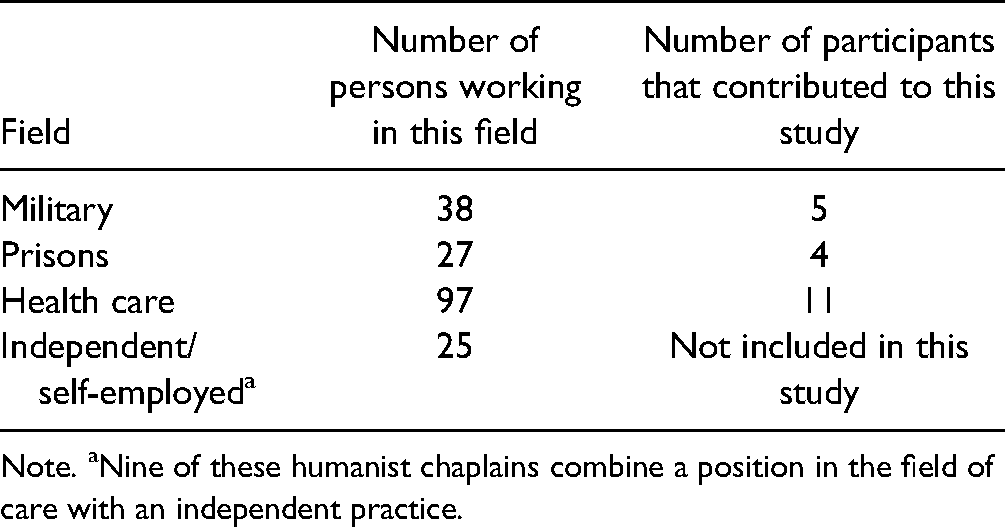
Note. aNine of these humanist chaplains combine a position in the field of care with an independent practice.
The participants had at least 1 year of work experience in humanist chaplaincy. They were educated at the University of Humanistic Studies (since 1989) or its predecessor, the Humanist Training Institute (since 1964). In the Netherlands, this is the only education program available for humanist chaplains. Consequently, the participants share a similar theoretical and professional background. In the later stages of the research process, theoretical sampling was used to recruit participants whom we assumed to be knowledgeable, articulate, and who could reflect on key topics that emerged during the data analysis.
Data Collection
Semi-structured interviews were conducted by the first author, a female PhD student who previously worked as a qualitative researcher. She has been educated at the University of Humanistic Studies, which was known to the participants. The semi-structured approach allowed the participants relative freedom and flexibility to express their views and bring forward new ideas, while at the same time providing guidance and focus to the interviews (Grossoehme, 2014; Patton, 2002). The intent of the interviews was to gather rich, detailed, and in-depth insights into participants’ understandings and experiences of empathy in their daily care practices. Potential participants were contacted by e-mail or phone to invite them and schedule an interview. The chaplains who were approached responded enthusiastically: each of them considered the topic to be relevant and readily agreed to participate. Only one chaplain declined participation due to time constraints.
The participants provided written informed consent. Before each interview began, they were reminded of the nature and purpose of the research. The chaplains were asked for permission to record the interview and were reassured that their names and those of their clients would not be mentioned in the research products and that identifying characteristics of both the participants and their clients would be changed to protect their anonymity.
The interviews took place at a quiet spot at the workplace of the participants (16) at the university (2) or at the home of the participant (2). Those participants who were visited at their workplace offered the researcher a touring and provided background information. The interviews lasted approximately 90–120 min and were audiotaped and transcribed verbatim by the first author. After each interview, the questions were reviewed and finetuned. Data were collected until a high degree of saturation was reached and no substantial new categories and themes emerged (Saunders et al., 2018).
Data Analysis
Grounded theory is an inductive, qualitative research approach characterized by an iterative process of data collection and concurrent analysis (Birks & Mills, 2015). The analysis started early in the research process. Coding and analysis were conducted by the first author using the data analysis software Atlas.ti 7.5 (Friese, 2014). After the first eight interviews were coded and analyzed, they were discussed within the research team. Discussing perspectives on the coding process and the data analysis helped to clarify and enrich the emerging concepts and theory.
The interview data were analyzed in accordance with the three levels of grounded theory: initial or open coding, intermittent coding, and advanced coding, moving from lower to higher-level concepts (Birks & Mills, 2015). A method of constant comparison was applied to analyze the data. In the more advanced coding stages, seven distinct themes were uncovered through the process of contrasting and comparing the main categories that emerged from the analysis. Each theme consists of a main function and one or more related drawbacks and limitations. These emerging themes are described in the results section.
Memos were developed alongside the coding process to guide the analysis and record the thought process of the researcher. Tables, concept maps, and other visual representations of the emerging theories were used to support the analysis and to visualize the relationship between code groups (Friese, 2014). These visual displays, which were created both digitally and manually on paper, were particularly helpful to grasp the relationship between the functions of empathy and the three core pillars of humanist chaplaincy. The storyline technique was used to support the analysis and to integrate the data into an emerging theory (Birks & Mills, 2019).
Early outcomes of the study were presented at a research seminar at the University of Humanistic Studies. About twelve members of the seminar provided detailed feedback and advice. Member checking was conducted by inviting one of the participants to closely read the research findings and provide feedback, which resulted in minor changes to the analysis.
Results
In the first section, we present three pillars of humanist chaplaincy. In the second and third sections, we discuss the importance, functions, and limitations of empathy according to humanist chaplains. In the fourth section, we present a model that brings together the three pillars of humanist chaplaincy in relation to the functions of empathy.
The Pillars of Humanist Chaplaincy
This section outlines the three pillars of humanist chaplaincy that emerge from the interview data and that represent the core of the profession. When citing the participants, we refer to their field to provide context: P for Prison, M for Military, and H for health care.
Establishing a Caring Relationship Based on Trust and on Being Faithfully Present
Chaplaincy care emerges as relational care. The participants explain that they aim to make “real contact” or a “real connection” and, if possible, to build an authentic and durable caring relationship: “The final goal [of chaplaincy] is present from the start: making contact” and “We have been educated to make contact with every client.” (R2H) According to the participants, clients often express that they feel lonely in what they are going through and many of them are vulnerable, marginalized, and lack a supportive network. Being faithfully present as a fellow human being is a vital part of their profession:
Many participants explicitly mention the so-called “presence approach” as a core and a foundation of their work: “First and foremost, I want to be close to people and nothing more than that. Just being there and seeing what happens. And that, again, is the presence theory.” (R6H) Presence is a relational approach that centers around “being attentively there” for clients, particularly for those who are vulnerable, marginalized and who may be experienced as challenging or difficult people by caregivers (Baart, 2006). In the Netherlands, presence is one of the main approaches in chaplaincy care (Smit, 2015). The participants also mention the importance of being genuine and trustworthy. In their experience, vulnerable clients are particularly sensitive to these qualities.
Supporting Meaning-Giving and Guiding Transformation Processes
When questioned about the core of their profession, the participants mention meaning-giving as their primary concern: “The aim of the conversation is meaning-giving (…), helping people to articulate their thoughts, to put into words what they consider to be important.” (R15H) Another chaplain explains: “My specialties are meaning-giving and questions of life.” (R12H) In addition to meaning-giving, several participants mention guiding transformation and acceptance processes as the main concern as well: “Transformation takes time (…) my goal is to help people find peace of mind.” (R6H)
Chaplains provide existential or spiritual care for clients who have lost their sense of meaning and purpose, often because of life-changing experiences. Some participants use the metaphor of “journeying together” or of “walking alongside the other” to characterize their professional role: “Well, this is how I picture it: I walk along with someone on their path of life. Often when the other goes through a life-changing experience.” (R2H) According to the interview data, the main existential and spiritual concerns of clients include: (1) Existential struggles, particularly those concerning death, grief, and a variety of losses such as the loss of health, independence, or future perspective; (2) Relational challenges include family issues such as a divorce, family disputes, or estrangement; (3) Emotional issues such as anxiety, loneliness, sadness, or anger; and (4) Spiritual and religious struggles such as fear of a punishing god or a loss of faith.
Humanization on an Individual, Interpersonal, and Institutional Level
The third pillar of humanist chaplaincy involves contributing to humanization processes, which may take place on different levels. On an individual level, chaplains aim to acknowledge their clients as fellow human beings and as unique and dignified individuals. Asked to explain the attitude of humanist chaplains, a participant describes it as “being open to the other and being a fellow human being.” (R2H) Another participant explains the essence of chaplaincy: “To me, it comes down to being a fellow human, to approaching the other based on your humanity.” (R4H)
On an interpersonal level, chaplains try to connect clients, to bring them together. This may happen through group sessions in which basic human experiences and existential life themes are explored by the participants. A prison chaplain explains: “By showing the humanity of others, I invite them to think outside of the booth from time to time.” (R9P) A nursing home chaplain expresses: ‘As a chaplain, I try to bring people together. In group sessions, they discuss different topics. For example, we talked about homosexuality. Not a topic people normally discuss in a nursing home. A man said: “My brother died of aids.” A mother told the group: “my daughter is gay. I am glad I can share that now. I feel relieved.” You help people to discuss topics that they would not discuss otherwise. That is why I think that group work is really important. It may connect people and help to improve mutual trust.’ (R15H)
On an institutional level, chaplains contribute to the humanization of the organization through a variety of tasks, ranging from providing education or training to offering moral deliberation sessions. Many participants express that they aim to be present to staff by giving them advice, guidance, and support. A chaplain recalls: “What I did for years, was offering meditation sessions for care staff to enhance their sensitivity.” (R6H) Another chaplain explains: “I try to make room for that humanity [in the organization] and to ensure that the whole human is being seen.” (R12H)
The Importance of Empathy
Empathy emerges as a core concept and a vital element of chaplaincy care. Several participants explain that they could not practice chaplaincy without empathy. In their opinion, empathy is not a singular trait of chaplaincy, but it is present from the moment chaplains meet a client. ‘I think it is a core concept. I could not do my work without it, and I would not want to.’ (R5H)
‘To me, empathy is a guide. In my opinion, if you are no longer able to empathize with people, there is not much left. In any case, it is a core of my work. Of what use would I be without empathy?’ (R6H)
‘I could not do this job without empathy. I could not connect with the person in front of me without empathy. I absolutely could not (…) I wonder if you can be a chaplain without experiencing empathy. I cannot imagine that it is possible.’ (R14M)
‘I really think it is a basic ingredient, like respect. You cannot do without it. It is like breathing.’ (R18M)
Our research indicates that empathy is important because it performs a myriad of key functions related to the core of chaplaincy care. These functions will be presented in the following section.
The Functions, Downsides, and Limitations of Empathy
When speaking about the importance of empathy, the participants often mention one or more empathy functions in the same breath. Each of the participants discusses empathy downsides, limitations, and challenges as well. A few of them concede that they struggle with empathy daily. Based on the analysis of the interviews, seven main functions and corresponding downsides or limitations can be identified. The functions are: (1) to connect, (2) to understand, (3) to guide, (4) to acknowledge, (5) to motivate, (6) to inspire, and (7) to humanize. They will be described in more detail below.
To Connect
As mentioned in the previous section, humanist chaplaincy care emerges as relational care. Establishing true contact and—if possible—a faithful and trusting relationship is at the core of chaplaincy. Humanist chaplains try to include everyone, to “be there” for all clients who desire existential care, particularly those who are vulnerable, lonely, and isolated.
The data yield three ways in which empathy may support the connection or relationship between client and chaplain. First, participants point out that the quality of being empathetic may attract people. According to them, clients appear to “sense without words” that the chaplain is an empathetic person who will take a genuine interest in their experiences: “I only had to sit at a table with a cup of coffee and in no time, people would trickle in and come to me. I really think that has to do with empathy.” (R6H) Second, empathy is a way to connect with people, as it is a form of contact in itself: “To me, empathy is about contact, about connection (…) It happens between people.” (R18M) Third, empathy contributes to a trusting relationship, as engaging with the client's experiences promotes trust and sharing: ‘(…) the priority in chaplaincy is a relationship of trust. (…) I think empathy plays a role in this. (…) I think that this role is that you understand the other person and you show it, and the other is going to trust you.’ (R3P)
Chaplains mention drawbacks and limits as well regarding empathy's function to connect people. The connection function may be impeded when chaplains cannot relate to their clients’ situation or experiences. Two problems emerge in the data. First, chaplains may “relate too much.” (R1P) This can happen when chaplains share a comparable situation or experience with the client. Because of this, empathy may take the shape of overidentification or projection, which is not a form of true or genuine empathy according to the participants: ‘My brother had just died of the same illness. (…) I was projecting my own sorrow and my own images onto the patient. (…) I cried constantly. I put words into their mouth (…) And all the time I thought that I did well with these patients, that I had an extra antenna.’ (R20H)
Second, chaplains may “relate too little” (R1P) to the other's experiences, for example, because they experience little common ground or familiarity with clients or with their situation. Chaplains self-observe that they tend to empathize more easily with people that they experience as relatable: “The ability to empathize is very sophisticated, but it is also very ingroup/outgroup. That is tricky: the ability to empathize is restricted or one can block with whom one wants to empathize.” (R9P) The participants use the word “likable” to refer to clients who are friendly, accessible, and with whom they share similarities: “I think that I have a fairly broad spectrum of people with whom I can empathize naturally. And of course, with some people it is easier because of likability.” (R6H) When chaplains experience clients as “far away”, “miles apart” or different, they find it more difficult to relate and to empathize with their clients’ experiences. In these situations, participants concede that they must “work hard” and actively search for common ground to enable empathy.
To Understand
Another main function of empathy is helping chaplains understand clients’ experiences and thus support the process of meaning-giving. Chaplains draw on empathy to gain insight into clients’ experiences and into the meaning of these experiences: “[The role of empathy] is to understand how the other experiences his situation.” (R2H) This helps chaplains to understand what is at stake and to determine their clients’ existential and spiritual needs. At the same time, the practice of empathy may help clients to better understand themselves as well.
According to the participants, empathy is particularly helpful when trying to sense or understand experiences that are difficult to grasp, that are indescribable, and that clients cannot verbalize (yet): “Sometimes people have crossed a certain point. They talk about experiences that you can only reach through empathy.” (R4H) An example is the experience of dying. Chaplains felt that they need empathy to understand extra-ordinary experiences that are—at least initially—beyond words and that resist understanding: ‘What you want to share is so subtle. There are no words for it. So, you may use other words, metaphors. (…) Well, for that you need empathy. If you want to understand each other but there are no words to describe it yet, you need empathy.’ (R7H)
Chaplains emphasize, however, that empathic understanding is inherently imperfect and that one cannot assume to fully understand what the other experiences: “Empathy means being able to understand the other - or at least trying to understand - and at the same time realizing that you can never fully understand the other.” (R14M) According to the participants, one can only attempt to approach an understanding of what the other is going through. This limitation is, again, most apparent when clients share experiences that are extraordinary and thus difficult to relate to. For example, a chaplain tells the story of a client who committed war crimes. She finds it difficult to relate to these crimes: ‘In terms of empathy, I can imagine some of it, but what situation she was truly in, what she has been through and what she had to do (…) is alien to me. So, in that sense, I can hardly imagine what it means for her.’ (R6H)
Chaplains consider making assumptions or jumping to conclusions a serious risk: “The danger of empathy is that you assume that you understand each other, but you are actually talking past each other.” (R10H) This happens when chaplains project or when they overestimate their empathic abilities and the potential of empathy to know the other. They feel that they need to be constantly aware of their quick judgments and interpretations. Consequently, chaplains evaluate whether their understanding is accurate, and they need to critically reflect on their assumptions.
To Guide
Empathy's guidance function emerges as a third main function. The importance of this function relates to a key characteristic of humanist chaplaincy: chaplains must “work with what is present” as they often start “empty-handed” for a variety of reasons. First, humanist chaplains do not have religious texts or an extensive tradition of rituals, metaphors, and images to turn to and they do not work according to a specific methodology. Second, chaplains regularly meet people of whom they have little background information. Third, many clients go through life-altering experiences, which means that their existential needs and mental states can fluctuate between visits. What is relevant today, may be insignificant or forgotten a week later. Therefore, chaplains feel they must focus on the current situation and on the clients’ present struggles and needs. The participants explain that one of the main functions of empathy is to guide them in this: ‘Our profession is about empathy, about attunement. You do not know beforehand what you can mean for someone. I try to enter a conversation with an open attitude, and I try to discover what is important for someone during the conversation and respond to that. I think that is empathy.’ (R12H)
Three subthemes emerge that represent the diverse ways in which empathy guides chaplains. First, empathy gives direction to the conversation. It helps chaplains to understand what is important in the eyes of the client and needs to be addressed. As such, empathy provides guidance. Second, an important part of chaplaincy consists of encouraging clients to focus on their inner world and verbalize their experiences. Empathy helps chaplains to sense whether a certain word or metaphor is “right” or appropriate: “You play with words: ‘which words fit you?’ The more empathic you are, the better they fit.” (R3P) Third, empathy helps chaplains to attune and finetune their actions and responses: “If I am not empathetic, I cannot give a meaningful response to the other, as I cannot attune to the other in that situation.” (R2H). Additionally, empathy helps chaplains to sense what tone of voice to use, when to hold back or when to speak up.
Empathy's guidance function is, however, not self-evident as empathy is associated with a loss of direction as well. According to the participants, one of the main risks of empathy is that of losing touch with one's own (moral) position and perspective. This may happen, for example, when chaplains are compliant and “move endlessly along” with their clients. Consequently, they may get lost in the client's world and lose the ability to provide guidance and to give a meaningful and attuned response. Several participants, particularly those working in the military or in prisons, mention that their clients are not interested in a chaplain who only listens and is a “yes-person.” These clients value chaplains for their unique and independent outlook and perspective: “It has literary happened to me that my clients thought: ‘Of what use is that man?’ After three conversations, they think: ‘No, I have had it.’ (…) I was too understanding, too compliant.” (R3P) Moreover, when chaplains lose touch with their moral values, they are no longer able to distinguish between empathic understanding and moral approval. Several participants explain that understanding the other is fundamentally different from complying with the other's behavior. In their view, staying in touch with oneself and one's own moral and professional position or worldview is essential to empathy's guidance function.
To Acknowledge
Being acknowledged as a unique and valuable human being is an important, existential function of empathy and emerges as one of its major humanizing qualities. Chaplains work with clients who are often vulnerable and marginalized and who may feel lonely, unacknowledged, or misunderstood. Sometimes, they cannot share what they are going through with their loved ones. Clients may feel the urge to be calm, strong, and positive for their friends and family as they do not want to place a burden on them. Other clients feel they have been treated unjustly in their lives. Affirmative and genuine relationships in which their feelings are acknowledged and validated are particularly important for them.
According to the participants, feeling acknowledged is valuable in itself and may improve clients’ sense of existential well-being. By expressing empathic understanding and emotions, people feel validated: “Empathy means giving words to [their experiences] (…) If the client recognizes these words, they feel acknowledged. You would feel the same: it is a fantastic feeling.” (R3P) Acknowledgment can also be experienced when clients sense that they have made an emotional impact on the chaplain: “It is a great feeling for someone who suffers, (…) to hear that it has resonated.” (R16H) Experiencing the chaplain's commitment to truly listen, to empathize and to be genuinely affected by the other's situation may be a form of acknowledgment in itself.
One of the potential problems of empathy in relation to the acknowledgment function is that chaplains may be tempted to feign empathy in some situations. For example, when they cannot engage with their clients’ experiences. According to the participants, genuine empathy is based on a sincere attempt to make contact, to listen attentively, and to deeply engage with what clients are going through: “Empathy has to do with truly listening, truly hearing and wanting to hear what the other wants and means.” (R4H) Participants note that vulnerable clients are particularly sensitive to insincerity and feigned empathy. A prison chaplain explains: “Especially people in detention, who have often been damaged by life, know exactly whether you try to understand them.” (R19P) Feigned or superficial empathy may harm the relationship and add suffering: “Superficial empathy can have a very false effect. It can make you move away from the other, instead of bringing you together.” (R10H) As a result, clients may feel abandoned or more alone instead of feeling acknowledged.
To Motivate
Participants explicitly mention that empathy helps to motivate them to be in a caring relationship, to act in a caring way, and to be fully present for their clients. When chaplains empathize with their clients, being present and providing care feels less like an obligation and comes more naturally: “If it [the process of empathy] is successful (…) you like to do something for the other. You are pleased to do it, instead of feeling obliged to.” (R1P) This motivational function is most apparent in those situations in which empathy is seriously challenged or entirely blocked, and chaplains notice a loss of motivation. Chaplains observe that they tend to keep conversations shorter or more superficial when empathy is absent. They may feel less motivated to visit these clients, to ask deeper questions, or to hold lengthy conversations. In a few instances, they had to let go of a “difficult” client and stop the counseling process. Chaplains confide that they must turn to their professionalism to be there for these clients.
Manipulation is another drawback. Clients may use empathy to “move” chaplains, to influence their behavior. Some chaplains mention that they feel manipulated when clients try to deliberately appeal to their empathy to “get things done” or to gain their attention: “A group of clients exists that can be manipulative. I have the impression that some clients are not sincere with me or that they use me. They play into my emotions to get things done.” (R2H) Empathy is also limited when clients fake or exaggerate emotions for selfish reasons, as chaplains feel they cannot trust that these clients express themselves in a genuine way. Chaplains confide, however, that they usually give their clients the benefit of the doubt and that manipulation appears to be a rare occurrence.
To Inspire
Empathy may inspire and energize chaplains and clients. According to the participants, experiencing empathy is a source of joy and inspiration, which contributes to personal meaning-giving and happiness. As a participant enthusiastically exclaims: “On the whole, empathy is the joy of life!” (R16H). Chaplains learn from their clients and experience empathy as a source of meaning giving: “The client may enrich my world as well. That has to do with empathy (…) it is like reading an enjoyable book or watching a good movie: it broadens your perspective.” (R1P) Empathic conversations in which both chaplain and client are very engaged, can be inspiring and energizing for both. For example, a chaplain vividly remembers a client who was left severely disabled after an accident. One day, the client wanted to celebrate a happy moment: ‘He wanted to share his joy (…) he was so happy. I shared in his joy for half an hour. I totally resonated with his happiness. (…) It was such a beautiful experience. (…) Of course, he suffered a lot, but happiness was just as present. It really was a beautiful life lesson to me.’ (R4H)
Chaplains emphasize that sharing in joyous moments like these can be as important and meaningful as sharing in their clients’ hardship.
On the downside, empathy can be energy-intensive and overwhelming. This is the case when empathy is challenged or concerns experiences of hardship, suffering, and hopelessness: “If you are not careful, you run completely empty. After an hour you are totally exhausted. Really. Completely worn out. Then you have to spend at least an hour to recover.” (R6H) This tendency to run on empty may occur when chaplains cross their own boundaries: “I think it is the pitfall of every chaplain to go beyond your limits. So, in that sense, it is very nice to have a large empathic ability, but it can also be your downfall.” (R4H) Some participants experience their empathic abilities as burdensome. In their experience, being empathetic means one is confronted with heavier conversations and thus with more suffering. Therefore, chaplains feel they need to build more resilience as their empathic abilities develop over time: “Your sensitivity grows. Because of this, you experience more pain, so you have to train your resilience.” (R7H) Consequently, self-care, personal development, and a supporting organization and colleagues are essential for the professional practice of empathy.
To Humanize
Empathy serves a key function in contributing to humanization processes on an individual, interpersonal, and institutional level. On an individual level, empathy has an innate humanizing quality as it is understood as an ability “that makes us human” and that is grounded in “our shared humanity”. Empathy helps chaplains to be aware of the humanity of the other and to acknowledge the other as a fellow human being. On an interpersonal level, chaplains draw on empathy to encourage mutual understanding and to connect people. They may, for example, ask their clients to shift to another's perspective. On an institutional level, chaplains draw on empathy in several ways to help promote humanization processes. In some organizations, chaplains are actively involved in the education, coaching, and support of caregivers. Those chaplains that educate or train staff often include empathy exercises. Additionally, many of these participants mention that they actively encourage caregivers to be sensitive to what people are going through. For example, some try to evoke empathy by asking thought-provoking questions that invite staff to experience the situation from a client's point of view: ‘And then I said [to this caregiver] something that always gets to me when I feel challenged myself: “Just imagine lying there like that” To me, that one sentence is all that it takes to make me realize… “Just imagine lying there like that”.’ (R5H)
An attempt to contribute to a more empathic and humane environment can be burdensome if chaplains have little or no “empathy allies.” Some participants experience the work environment as little supportive, particularly those working in a prison or military setting: “It is something I struggle with daily. There is no room for being human in here. There is no room for sadness, pain or for celebrating the joy of life.”(R14M) Chaplains are, however, careful not to be judgmental or to come across as moralistic and thus alienate or irritate their colleagues. In some institutions, chaplains notice a negative or provoking attitude toward them by staff members: “(…) as if they see me as some sort of moralist that they just need to kick.” (R11M) Some of the participants mention that they feel isolated or marginalized and have to “walk on eggs”. To a lesser extent, these problems are mentioned in health care settings as well. Because of these struggles, some chaplains feel restricted in their abilities to contribute to a humane organization.
A Model of the Functions of Empathy
The model in Figure 1 represents the three pillars of humanist chaplaincy in relation to the seven main functions of empathy. It is purposefully composed to illustrate the interrelatedness of the pillars and empathy functions without describing a hierarchy to them, as these functions complement each other. For instance, expressing one's empathic understanding makes the client feel acknowledged, which in turn may contribute to the quality of the caring relationship. Conversely, having a good relationship with clients may encourage them to be more open and expressive which may, in turn, enhance empathic understanding.
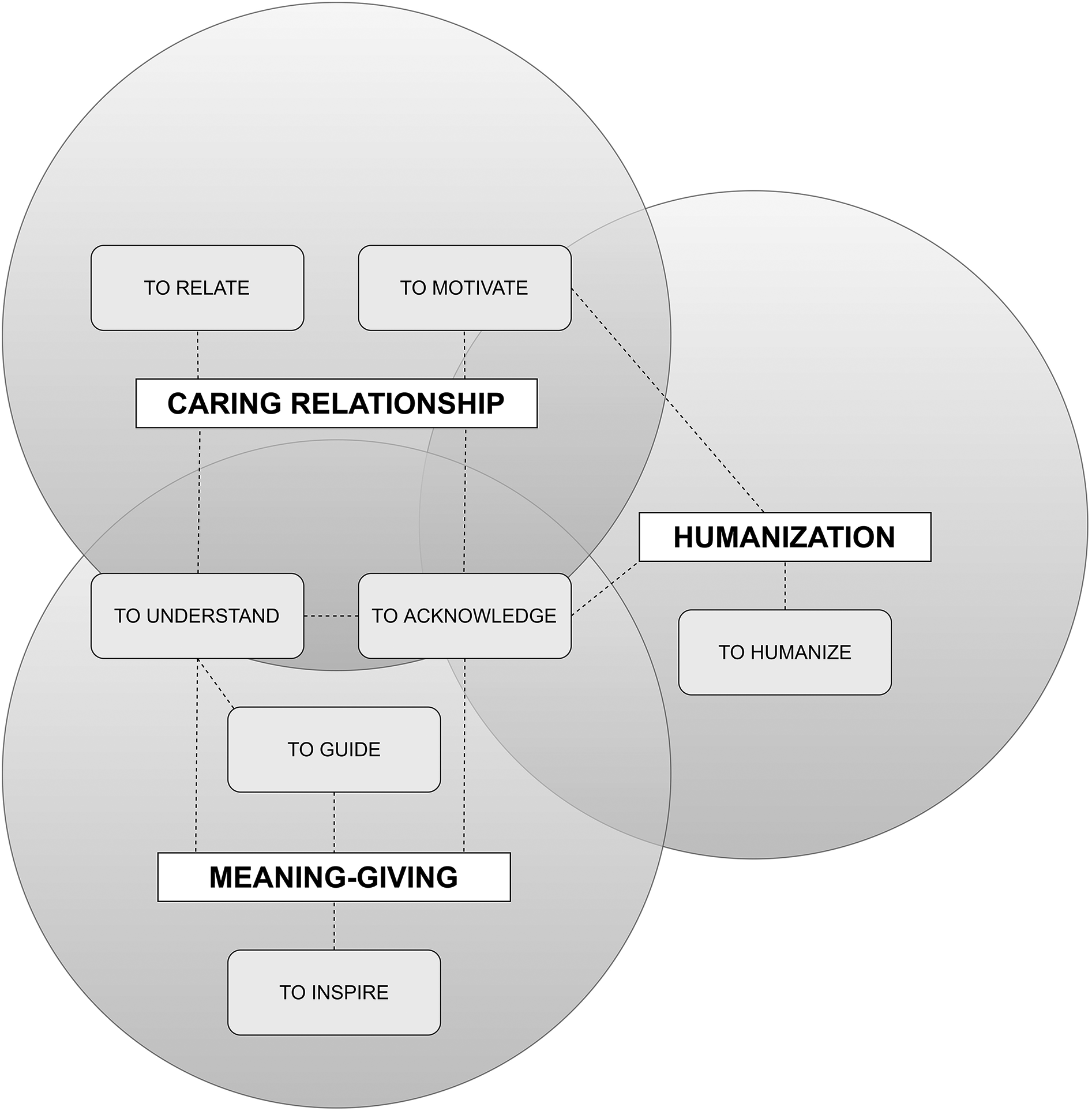
A model of the core functions of empathy in relation to the pillars of humanist chaplaincy.
Discussion: “We Need to Talk About Empathy”
The current research suggests that empathy is at the heart of humanist chaplaincy care. Empathy performs a myriad of key functions that relate to the core of their care practices. Some of these functions have been noted in previous studies, particularly empathy's contribution to improving relationships, motivating caring behavior, and better understanding the other's personality, situation, experiences, and needs (Batson, 2011; Oxley, 2011; Reynolds & Scott, 2000). The originality of the present study lies in providing new and more detailed insights into these empathy functions within the context of humanist chaplaincy care. For example, the data indicate that empathy not only contributes to existing relationships, but that the quality of being an empathic person may attract clients and may encourage them to reach out to the chaplain. Another example concerns the knowledge function of empathy. According to the participants, empathy is particularly helpful in grasping experiences that are difficult to articulate, such as the experience of dying. Thus, empathy helps them to grasp experiences that are beyond words.
New or lesser-known functions emerged as well, such as empathy's function to humanize. Humanist chaplains use their empathic knowledge and sensitivity to contribute to humanization processes. In health care literature, this humanizing quality of empathy has been acknowledged by several authors (Pedersen, 2010; Rosenthal et al., 2011; Shapiro, 2008). Educating empathy in health professions is considered to be an important way to humanize health care (Hanna & Fins, 2006; Hojat, 2016). Our findings suggest that humanist chaplains may contribute to these humanization processes. Although humanist chaplains are modest about their role and influence, one might argue that they function as “empathy ambassadors” in the organization. Not only through the empathy education of staff, but also by contributing to an atmosphere in which empathy may flow more easily between people and in which empathic relationships may flourish.
The present research confirms that empathy suffers from several disadvantages and limitations as well. Some of these have been mentioned in previous studies, particularly the risks of projection or overidentification (Meyers, 1994; Noddings, 2013), empathy fatigue (Stebnicki, 2007), and empathy biases (Fourie et al., 2017). The data provide further evidence for the claim that empathy can be biased: people tend to empathize more easily with people who belong to their group, to people who are present, and to those with whom they share similarities (Hoffman, 2001).
Despite these challenges and drawbacks, chaplains underscore the importance of empathy. They explain that they must “work hard” and draw on their professional skills, training, and humanist values to overcome empathy challenges and to deal with empathy drawbacks and limitations (authors, forthcoming).
The Need to Talk About Empathy
Since empathy is so central to humanist chaplaincy, being aware of empathy's limitations and downsides should be an essential element of the ongoing professionalization of chaplains. Participants remark, however, that empathy is hardly a topic of conversation in their field. One of them explains that talking about challenged empathy is uncommon and appears to be taboo: ‘How often are you honest enough that you cannot do it. Have I reflected on that? Was there room for it in conversations with colleagues? In my experience, you cannot always talk with colleagues about the doubt, the uncertainty, and the inability to empathize. It is a sort of taboo.’ (R4H)
Another reason for the lack of professional discussion may be that empathy tends to be taken for granted. Humanist chaplain Elly Hoogeveen (1991) explains that the concept of empathy is often presented as a capacity that chaplains can always count on and that can be educated, practiced, and controlled. According to her, empathy, and the quality of being empathetic appear to be self-evident. In Hoogeveen's experience, however, empathy can be an intense, daily struggle. Humanist psychologist Rogers (1975) seems to agree as he calls empathy “an unappreciated way of being” that does not receive the attention that it deserves. Like Hoogeveen, he argues that being empathetic is subtle, complicated, and not always valued in the right way. An insight that has been underscored by the participants in our study as well.
In this discussion section, we propose to give empathy a more prominent place on the agenda of those occupied with chaplaincy research and with the practice, education, and professionalization of chaplains, and to further investigate and discuss its functions, practices, complexities, and challenges. This could help to strengthen the profile of chaplains, further improve the quality and professionalization of chaplaincy care, and contribute to chaplaincy theory and education. In the following section, we attempt to provide building blocks for this discussion based on our research findings. We propose three topics for reflection and discussion that we consider to be particularly relevant and urgent for the professional practice of empathy. These topics, respectively, refer to an individual, an interpersonal, and an institutional level of empathy practice.
Personal Empathy Strengths and Pitfalls and how to Address Them
What does empathy mean to me, how do I practice empathy and what are my empathy strengths and personal pitfalls or limits?
The participants in our study mention diverse ways of empathizing with their clients. Each of them brings forward personal pitfalls and limitations as well. For example, some tend to lose themselves, others struggle with prejudices and some participants notice they feel challenged when trying to empathize with people who differ profoundly from themselves. A chaplain expresses that the interview has inspired her to reflect some more on her empathic capacities: ‘As it turned out several times during the interview, I try to empathize with the other by increasing my knowledge and insight. My knowledge about the life he has behind him, the choices he has made (…) That certainly helps to learn to understand my client better, but it is fundamentally different from understanding the other through feeling. And perhaps that is what empathy is, that you approach, support, comfort, guide the other in a feeling.’ (R8H)
This participant realizes she mainly empathizes in a cognitive way, which may reflect on the emotional guidance and support that she has to offer her clients. Reflection processes like these can be valuable as they provide chaplains with insights into the way they empathize, into their strengths but also into the capacities that they need to further develop.
Challenged Empathy and Challenging Behavior
Which clients do I find difficult to empathize with and for what reasons? How does challenged empathy or challenging behavior affect me and my care and in what ways do I respond to these challenges?
Like other professional caregivers, chaplains meet clients who exhibit behavior that is experienced as difficult or challenging. Research indicates that the perception of behavior as challenging may impact both the quality and quantity of caregiving. Challenging clients provoke negative emotions in their caregivers (Wanless & Jahoda, 2002) which in turn may affect the professional's willingness and motivation to help these clients (Zijlmans et al., 2012). Research indicates that professionals engage in fewer interactions with challenging clients or that they distance themselves from their clients (Baillie, 1996; Whittington & Burns, 2005). These findings correlate with the experiences of the participants. Some participants critically self-observe that when empathy is seriously reduced, this may impact their motivation, and they tend to visit a client less often. This causes tension and inner struggles, as chaplains consider it their task to be present and not abandon people. Chaplains work with clients who are vulnerable and who may have been abandoned by many others. They remark that it is part of the chaplain's professional standard, values, and professional approach to remain faithful and not give up: “I didn‘t get a single sign that what I did actually helped. And then it is a matter of endurance: I will still visit her. And I am going to sit there. And I am going to ask: “how are you doing?” (R4H). As a result, chaplains may find themselves torn between a commitment to be present to clients that they cannot empathize with and an inability to provide good chaplaincy care because of this reduced empathy.
The Cost of Empathy: Burnout and Empathy Fatigue
What do I need from the organization and from colleagues to practice empathy and how do I address the risk of empathy fatigue?
As our study indicates, empathy may come at a cost. Chaplains engage with experiences that can be distressing, painful, and unsettling. Empathy fatigue and the closely related concept of compassion fatigue are urgent topics in health professions (Sinclair et al., 2017). In chaplaincy care, empathy fatigue has not been studied extensively. Compassion fatigue or empathy burnout is known to result from being continuously exposed to people who are suffering (Hotchkiss & Lesher, 2018; Stebnicki, 2007). Another risk factor is a lack of support from the organization or feeling impeded by the system (Hotchkiss & Lesher, 2018). According to studies, organizational support and interdisciplinary collaboration are key factors in preventing empathy and compassion fatigue (Hotchkiss & Lesher, 2018). The participants in our study explicitly mention the importance of “empathy allies” within the organization. Chaplains are, however, known to work in a relatively isolated position with little opportunities to share, collaborate, or discuss experiences with direct colleagues (Best et al., 2020). Therefore, it is of interest to further discuss and investigate the topic of empathy burnout in chaplaincy care.
Limitations
The study has several limitations. First, as researchers affiliated with the University of Humanistic Studies, we are aware that biases are probable. The personal experiences and theoretical background of the first author may interact with the chaplain's stories and may influence the interpretation of the findings. By being aware of these potential biases as a research team, we tried to handle this bias with integrity by reflecting on our position and by asking critical questions. This limitation may at the same time have been an advantage, as the first author's knowledge of the profession of humanist chaplaincy helped her to establish trust and rapport during the interviews.
Second, although this study focuses on the practices of humanist chaplains, the findings may resonate with other ordinations as well. An indication for this resonance is that several chaplains’ columns and papers on the internet discuss empathy as an ambiguous concept that holds both functions and limitations, as demonstrated by some of their titles: “Empathy: How it Helps and How it Hurts”’ (Dietrich, 2018) and “The Push and Pull of Empathy”(Blair, 2017). This accords with the findings of this study, which describe empathy as an important but challenging practice. Future research is recommended to validate this resonance and to further explore the functions and limitations of empathy among a more diverse group of chaplains.
Third, since this research is based on self-reports, it is unknown whether clients agree with the empathic nature of chaplaincy care or whether they evaluate chaplains as empathic and experience it as a unique or distinguishing feature of chaplaincy care. Further research is needed to investigate the experience and reception of empathy by the chaplains’ clients.
Conclusion
In this paper, we examined the functions, downsides, and limitations of empathy from the viewpoint of 20 humanist chaplains. Our study underscores the importance of empathy and clarifies the functions and limitations of empathy in humanist chaplaincy care. According to the participants, empathy is at the heart of their profession as it performs a myriad of functions related to the three pillars of humanist chaplaincy care. The findings indicate that empathy is not an isolated aspect of chaplaincy. Instead, empathy is interwoven with its practice. On the downside, empathy suffers from drawbacks and limitations that need to be addressed. Based on our findings, we argue that there is a need to further discuss and explore empathy's functions, disadvantages, and limitations in this field. We hope that our research findings, the theoretical model, and the three reflection topics presented in this paper can inspire and structure this discussion.
Footnotes
Acknowledgements
We would like to express our gratitude to the humanist chaplains who participated in this research for taking the time and effort to be involved in our study and for sharing with us their experiences and their perspectives on empathy and chaplaincy care.
Declaration of Conflicting Interests
The author(s) declared no potential conflicts of interest with respect to the research, authorship, and/or publication of this article.
Funding
The author(s) received no financial support for the research, authorship and/or publication of this article.
