




Abstract
This spiritual-psychological exegesis continues to expand the gallery of biblical combat veteran types by shedding light on a new biblical combat character. Gideon from the Book of Judges was an experienced combat veteran and military commander. The findings include the proposal of a new categorical type of a combat veteran who illustrates both spiritual integrity and resilience. The article engages in conversations of what the findings may mean for pastoral care and their connections to theology.
Introduction
Military chaplaincy, pastoral and spiritual care, and counseling have long played an important role among veterans, their families, and relatives within military contexts and/or congregations (Lindsay et al., 2016). Additionally, spiritual and religious elements or dimensions in both the understanding and treatment of moral injury (MI), as presented by both Shay (2002, 2003) and later Litz and colleagues (2009), and post-traumatic stress disorder (PTSD), as defined in the Diagnostic and Statistical Manual of Mental Disorders/DSM by the American Psychological Association (APA, 2013) have received increasing attention over the last decade, especially from a clinical perspective (Harris, Park, Currier, Usset, & Voecks, 2015; Koenig et al., 2017; Wortmann at al., 2017). Furthermore, research within the pastoral, spiritual and religious field(s) has also taken on challenges that MI and PTSD pose in various ways through myriad perspectives (Doehring & Ramsay, 2019; Drescher & Foy, 2008; Graham, 2017; Moon, 2019; Rambo, 2010; Stallinga, 2013). These amassed efforts have resulted in a growing spiritual/religious (S/R) toolbox that can, among other things, be utilized in pastoral and spiritual care and counseling.
As part of the wider expansion of this S/R toolbox, a number of case studies of combat veterans within the Bible were recently presented in this journal (Grimell, 2018a, 2018b) through contemporary theories of MI (Shay, 2002, 2003; Litz et al., 2009) and PTSD (in DSM-5 by the APA, 2013). Through psychological exegesis, four case studies from the Books of Samuel were analyzed, which in turn gave rise to four combat veteran types: Saul, David, Joab, and Uriah. All types had their specific features. One reason to approach veterans in the Bible in this way was the shortage of psychological perspectives and discussions of how war, combat, and killing affected these biblical characters in their behaviors and psychological wellbeing (cf. McDonald, 2017). This was a true shortcoming that asked for more psychological focus to widen the understanding of how the reality of war may have affected these biblical figures.
New light was shed on biblical combat veterans through this hermeneutical endeavor. The results of this psychological exegesis are intended, for instance, to facilitate pastoral care and counseling and hold the potential to connect real-life experiences of care receivers and family to biblical stories and pastoral theology. It may be both relieving and comforting for veterans and significant others to know how different biblical veteran characters handled their darker war selves and deplored actions, their potential MI and/or spiritual injuries (SI) in relation to God and others, their commitment to military purpose, loyalty to unit and battle buddies, and their difficulties in readjustment after war zone deployment (Grimell, 2018a).
This article develops the gallery and symbolic universe of biblical combat veteran types through a spiritually integrated psychological exegesis, integrating a new combat character with a special reference to spiritual integrity that may work in the service of preventing actions and/or events that could evolve into SI and/or MI. During this analysis we will consider Gideon in the Book of Judges. He was explicitly described in the biblical narrative as a mighty warrior and was appointed to command troops amid war zone deployment and combat. As a military commander he was reflective, careful, skillful, and fierce. Yet Gideon is perhaps best known as one of the judges in the Book of Judges. Gideon’s character reveals further nuances in the ways in which the Bible presents combat veterans, and his case is complementary to the existing biblical combat veteran types. Thus, this article will further broaden and detail what the Bible has to say about war and veterans through a contemporary and hermeneutical spiritual lens.
Conceptualization of SI and Spiritual Integrity
SI and MI may occur and evolve in similar ways, but MI affects the ethical domain of individuals and their perceived transgressions of personal moral codes amid deployment. In contrast, SI impacts explicit S/R dimensions such as God, divine beings, and explicit religious faith, among other things. Nonetheless, it is hasty to conclude that MI does not have S/R dimensions or vice versa. In fact, some researchers argue the use of spiritual language and practices should be encouraged for the treatment of MI given its underlying spiritual dimension (Nash & Litz, 2013). Even so, SI may occur as a result of cultural and/or personal moral transgressions. SI and MI are interrelated yet different, and I wish to make a distinction between the two while suggesting that SI includes an existing and exercised faith in God and/or a sacred or transcendent understanding of life whereas MI does not necessarily include this precondition to a perceived transgression that may evolve into an SI or MI.
Berg (1992) is a forerunner and pioneer in the elaboration and development of the concept of SI. He has described SI as the effect of an event that has damaged an individual’s relationship with God, self and/or others, and has alienated that person from that which gives meaning in life. Over the years, Berg (2011) has developed a scale of eight SIs (guilt, anger/resentment, sadness/grief, lack of meaning/purpose in life, despair/hopelessness, feeling that life or God has been unfair, worry over religious doubt or disbelief, fear of death). This model clearly intersects with MI on aspects such as guilt, anger, and sadness (cf. Bryan et al., 2016; Litz et al., 2009; Wortmann et al., 2017). Yet SI emphasizes the S/R dimensions of an inner injury inflicted upon the self and thus complements a too narrow bio-psycho-social model and understanding of humans with the potential of a holistic bio-psycho-social-spiritual model for humans and thus veterans (Berg, 2016; Grimell, 2019a; Smith-MacDonald, Morin, & Brémault-Phillips, 2018). SI also closely relates to terms such as “soul wound,” “soul injury,” and “soul repair” (Brock & Lettini, 2012; Tick, 2005).
In addition to Berg’s (2011) SI scale, Exline, Pargament, Grubbs and Yali (2014) have developed a more validated and reliable religious and spiritual struggles scale that focuses on the experiences of struggle in S/R aspects of life. This scale provides a more comprehensive, reliable, and concise measurement tool by covering six domains of S/R struggle: divine, demonic, interpersonal, moral, doubt, and ultimate meaning. All these domains can be utilized to investigate MI and SI, but the moral domain, which focuses on wrestling with attempts to follow moral principles and on worry or guilt about one’s perceived offenses, is particularly promising for the investigation of spiritual and/or moral distress among veterans. Although these scales are quantitative tools, they still present the types of spiritual struggles that can accompany SI. Furthermore, they suggest a close interrelatedness between SI and MI.
A pastoral theological perspective of SI suggests such an injury may develop through a violation of a sacred nexus within a person, which can damage a person’s sense of strong connectedness with the whole of creation, God and/or a transcendent dimension (Sippola, Blumenshine, Tubesing, & Yancey, 2009). Such a type of injury with an S/R implication does not heal easily, and its potential recovery is more profound than merely psychological and/or cognitive adaptation. In turn, such a recovery is not only a matter of personal development and growth because it includes another dimension, for instance, God. Experiencing God’s forgiveness, renewed dialogue, and/or reconciliation with self and/or others may be a prerequisite to soul repair (Brock & Lettini, 2012; Doehring & Ramsay, 2019; Liebert, 2019).
This, in contrast, suggests that for a S/R combatant, it is of utter importance to try to uphold the spiritual life to maintain spiritual integrity soundness throughout military service and deployment. Some researchers suggest combatants with a religious faith may be more vulnerable to violations of personal moral codes (Koenig et al., 2017). This can of course be debated, yet spiritual activities such as, but not limited to, prayer, religious rituals, Godly dialogue, protection by angels, thoughtfulness and reflections, commitment to relationships, forgiveness, and justice may all operate in the service of S/R integrity and resilience. Maintenance of spiritual integrity before, during, and after deployment through spiritual activities may guide a service member or veteran in ways that may prevent perceived events of transgression(s) from happening, or at least assist a thoughtful and reflective, perhaps even slightly critical, mindset that may help navigate actions and meanings prior to and amid military service and deployment.
Method
A rather recent shift in the field of Bible studies has made psychological discussions and perspectives of the biblical narratives more visible (Rollins, 1999). The emergence of psychological approaches to biblical texts partly follows from the expanding influence of psychology on Western culture in general (Kille, 2001, 2002). Yet there is no conceptually unified approach to psychological exegesis, and this situation has instigated the emergence of varying psychological perspectives. However, the psychoanalysis paradigm has held an influential position in psychological exegesis and the long tradition of Freudian criticism that has reconsidered texts to carve out concealed desires, motives, and hidden neurotic conflicts of the author, and/or the author’s characters, and/or in our own minds. This spiritually integrated psychological exegesis resonates with what Rashkow (2006) describes as “examining the minds of the author’s characters” (p. 450).
The method employed in this article was based on a close re-reading of the story of Gideon within the Book of Judges through the conceptualization of SI and integrity. The conceptualization was utilized as a lens during the reading with the potential to sift out and highlight relevant content within the story of Gideon. The subsequent step was to specifically investigate and spiritually psychologically reflect upon the character of Gideon, which spurred the next step of developing a new biblical combat veteran type in the light of the findings.
The motives for selecting Gideon include recognizing that he was explicitly described in the biblical narrative as a warrior and a military commander before, during, and after the war that he was such a pivotal player in, which resulted in liberation from the oppression of invaders. The validity of the analysis is because the biblical story itself claims Gideon is a warrior and commander and therefore a combat veteran. The story of Gideon contains war-related and spiritually relevant details for this analysis. In the past, Gideon has much more often been referred to as a judge instead of a heavy-combat veteran.
But most significant to this investigation is that Gideon was described in the context of war as well as in the context of civilian life before and after his deployment. This is crucial because the culturally expected behaviors and actions in combat contradict starkly the expectations of society on how to function as a civilian member. Again, this has relevance for the spiritual psychological interpretation of Gideon’s life. Although aggressive and brutal behavior in combat could be explained by stress and the need to survive extreme life-and-death situations, dysfunctional behaviors in civilian society and life (e.g., aggression, destructive and/or reckless behavior, mood swings, depression) may suggest potential indications of combat trauma and psychological wounds (Grimell, 2018a). An SI may also develop as a transgression of Godly instructions, which can result in the perception of a silent God (Grimell, 2018b).
The results of the analysis, including interpretational comments, are presented as one short story that revolves around the main character Gideon, to highlight key findings.
The Story of the Warrior Gideon
The context during Gideon’s active duty was set by the wrongdoings of the Israelites in the eyes of God. The Israelites struggled for 7 years amid successive invasions and raids from the east that were so oppressive the Israelites prepared shelters for themselves in mountain clefts, caves, and other geological and geographic strongholds. Whenever the Israelites planted their crops, Midianites, Amalekites, and other eastern peoples invaded the country. The Israelites cried out to God for help. However, God said he had rescued the people many times, yet they had not listened to him and continued to worship the gods of the Amorites.
One day Gideon was threshing wheat in a winepress to keep it from the Midianites when the Angel of God appeared and greeted him as a mighty warrior. Gideon replied in a reflective way by asking why all these troublesome things had happened if God really was with them. The Angel of God turned to Gideon and said to go in the strength he had and save Israel from Midian. Again, Gideon replied cogently by asking how he could save Israel when his clan was the weakest in Manasseh and Gideon was the least in his family. The Angel of God replied that he would be with Gideon in combat to ensure the death of the enemies. Gideon displayed further caution by asking for a sign that this truly was a divine calling and assignment. Gideon had yet to realize he was speaking directly with God, and so he wished for the Angel to stay while he prepared an offering to set before him. Gideon presented the offering, and the Angel convinced Gideon that he was indeed the Angel of God. This realization filled Gideon with fear that he would die because he had seen the Angel of God face to face, but God assured him he would not. On this spot Gideon built an altar.
Throughout this dialogue with God, Gideon demonstrated a contemplative and cautious mindset. This was logical because he was the least of the weakest clan. Yet Gideon was a powerful warrior who had just been appointed by God, so it could very well have been expected that Gideon would have cast himself into battle to prove himself and illustrate his worthiness. Even so, he did not, perhaps because he was already an experienced warrior and had a deeper understanding of the implications of war. Gideon instead engaged in spiritual and religious activities, which included building an alter and offering upon it, to further confirm and understand the calling to make war.
That same night God gave Gideon instructions to tear down his father’s altar to Baal and cut down the Asherah pole beside it, then build a proper altar (to God) and use the wood of the Asherah pole to conduct a burnt offering. Gideon accomplished the mission, but because he was afraid of his family and the townspeople, he did it at night rather than in the day. To be afraid is a very normal emotion for any task that can result in death, and again Gideon illustrated his cautious mindset by minimizing his exposure. After this the people of his village conducted an investigation and discovered Gideon was responsible. The townspeople wanted to kill Gideon and addressed this plea to his father. However, Gideon’s father disapproved, the crowd was discouraged, and Gideon won the name Jerub-Baal (which is Hebrew and could mean “let Baal contend” or “to defend”). Gideon defended God.
In the meantime, the enemies joined forces, crossed the Jordan River, and built their camp in a valley while the Spirit of God called upon Gideon to summon troops. He sent messengers throughout Manasseh, calling them to arms, and into Asher, Zebulun, and Naphtali, so they too joined in meeting the invaders. This organization of troops suggests that Gideon, despite being the least of the weakest clan, was considered an efficient military commander worthy of following.
Gideon reflected about the developing military campaign and was not fully convinced about the calling and successes promised by God. He pleaded again for a new sign and thus engaged in a new complex S/R dialogue with God amid deployment yet prior to the military assault. Gideon placed a wool fleece on the threshing floor and said that if there was dew only on the fleece and all the ground was dry the next day then he would know God intended to save Israel by his hand. Gideon rose early the following morning; he squeezed the fleece and wrung out the dew—it released a bowlful of water. Yet Gideon was not fully convinced by this sign and requested another. He asked God not to be angry with him. God was not angry, and another divine sign was given. Throughout this religious dialogue God demonstrated both a large degree of patience and a willingness to guide and assure Gideon about this war mission.
Gideon had organized a large troop that could stand up to the invaders. Yet God thought it was too many warriors and could not deliver Midian into their hands. God felt it would boost Israel’s self-confidence if they perceived that their own strength had saved them. So, Gideon followed God’s instructions to decrease the numbers, and after two selective rounds only 300 service men remained to confront the large enemy troops of the Midianites. Gideon sent the rest of the Israelites home and kept the 300, who took over the provisions and trumpets of the others. Gideon made sure that his remaining troop was well equipped.
That night God instructed Gideon to get up and attack the Midian camp. He suggested that if Gideon was afraid to attack, he should to go to the camp with his servant Purah and listen to what the enemy soldiers were saying. Afterward, he would be encouraged to attack the camp. Here, God illustrated a proactive approach and intervened before any response from Gideon. Gideon followed God’s advice and went out on a reconnaissance patrol with Purah. Gideon heard a dream from an enemy soldier that was interpreted by another enemy soldier as a successful military attack by Gideon. When Gideon heard the dream and its interpretation, he bowed down and worshiped, again exercising prayer.
Gideon returned to his own military camp and gave orders dividing the 300 men into three companies; he placed trumpets and empty jars with torches inside in the hands of all of them. Then he carefully instructed them into a well-directed attack utilizing a smart strategy in the night. Gideon and the 100 men with him reached the edge of the enemy camp at the beginning of the middle watch, just after they had changed the guard. The three companies blew the trumpets and smashed the jars. Grasping the torches in their left hands and holding in their right hands the trumpets, they blew their trumpets and shouted. While each man held his position around the camp, all the enemies ran, crying out as they fled. When the 300 trumpets sounded, God caused the men throughout the enemy camp to turn upon one another. In his assault strategy Gideon illustrated a well-thought approach to battle and combat that corresponded to his previous night mission in his hometown, with minimum exposure and maximum surprise.
The enemy army fled and Gideon called reinforcements that captured and killed two enemy leaders. Yet the reinforcements were very upset that Gideon had not summoned them in the previous attack. Gideon defused the situation by asking what he had accomplished compared to them. At this, their resentment against him subsided. In this situation Gideon demonstrated humble and effective leadership that maintained operational focus for all.
Attacks on the fleeing enemy army continued. Gideon and his 300 men, exhausted yet keeping up the pursuit, crossed the Jordan River. As Gideon reached new areas, he pleaded to local officials to give his troops bread. They declined in impertinent ways as if Gideon had already defeated the enemy army. Gideon promised that once he returned from the campaign, he would punish them. This is very important because here Gideon had a choice. He could have killed the officials and taken what he wished to increase the operational capacity and status of his exhausted troops. Instead, he respected their position to deny the troops bread but promised that when he returned (after an expected successful military campaign) they would pay the price for their unwillingness to cooperate and for their impertinence. Gideon demonstrated a type of leadership where he accepted the situation as it was; he had not yet defeated his enemies. Therefore, he avoided any transgressions of personal moral and/or other moral codes that could have resulted in a potential MI and/or SI event.
Gideon continued the pursuit by following the route of the nomads to finally attack the unsuspecting enemy army. Again, he used the element of surprise. The kings fled, but were captured by Gideon. The army was defeated. Gideon returned from the battlefield via the areas where the officials had denied his troops bread. Gideon punished the local rulers and elders as he had promised to do. Gideon again displayed his intact personal moral code when he, upon hearing their confessions of having killed his siblings, decided to execute the captured kings.
As Gideon’s troops returned from the battlefield and transitioned from war zone deployment to civilian life, the Israelites asked Gideon to rule over them because they felt he had saved them. But Gideon explained that neither he nor his son would rule over them; only God would rule over them. Again, Gideon’s thoughtful S/R identity as well as his humble combat veteran identity was illustrated. He was a defender of God. He had maintained his spiritual integrity by spiritual activities throughout deployment and combat. Gideon had not been seduced by any military success and/or power. He was a service man.
Gideon had only one request: each of them would share an erring (in gold) from their plunder. They did, and Gideon made the gold into a simple ephod (a measure of approximately 20 kilograms), which he placed in his town. But it became a snare instead, as all of Israel prostituted themselves and worshiped it there. It is somewhat difficult to interpret the purpose behind Gideon’s creation of the ephod. Perhaps his intent was to preempt the creation of another golden calf or god, and/or perhaps the purpose of the ephod was to symbolize the victory that God had granted.
In Gideon’s lifetime the land enjoyed 40 years of peace. After military service Gideon returned home to live out his years. He had many wives and 70 sons of his own. This development suggests he reintegrated well into civilian society and life, and the story reveals no signs of spiritual, moral, and/or psychiatric wounds in the aftermath of military service.
Gideon died at an old age and was buried in the tomb of his father. No sooner had Gideon died than the Israelites again prostituted themselves to the Baals. In addition to forsaking God once again, they also failed to show any loyalty to Gideon (or his family) despite his service.
A New Type of Combat Veteran
Through this spiritually integrated psychological exegesis, a new categorical type of combat veteran has emerged within the symbolic universe of the already mentioned biblical combat veteran types. In this case it is not a matter of suggesting a Biblical character who may illustrate a diagnosis such as PTSD, SI, MI, or battle-related internal scarring, but instead a quest to demonstrate a combat veteran who, within the Book of Judges and through a spiritual-psychological lens, emerges over the narrative to suggest a specific spiritual robustness and integrity. The psychological exegesis can tentatively decode the mind of a biblical combat veteran character by utilizing spiritual theory (or other psychological theories) as long as there is relatively detailed information about actions, behaviors, and expressions in war as well as in civilian life, as is the case with this character (Grimell, 2018a, 2018b). The claim here is not that this exegesis is necessarily the correct spiritual-psychological interpretation, but instead to suggest that Gideon sustained an approach and mindset to war and combat which worked in the service of spiritual integrity and resilience over his life. Another psychological paradigm could suggest a different form of spiritual and/or psychological interpretation. But given that Gideon should be considered a heavily experienced combat veteran, it can be a plausible explanation that his resilience and robustness was related to both spiritual activities and his spiritual and moral integrity. It seems reasonable from a contemporary outlook to suggest that combat veterans during biblical times coped and handled their war zone deployment and battle experiences in a variety of ways. Moreover, the Bible testifies in its own language to the timeless implications of war and warfare among different military characters. In the light of these findings a new type of biblical combat veteran is illustrated by Gideon and will be further elaborated. For the sake of clarity, the Gideon type is not necessarily equivalent to Gideon in the Book of Judges but rather a theoretical development and categorization of the character.
The Gideon Type
Those contemporary veterans who could be understood as fitting the Gideon type have a personal faith and explicit S/R relationship to God and/or divine/transcendent beings. They engage in and benefit from spiritual activities such as prayer, religious rituals, Godly dialogue, protection by angels, thoughtfulness and reflections, commitment to relationships, forgiveness, and a solid understanding of ethics, morals, and justice. Through their beliefs and activities, they can tap into S/R sources and traditions.
A Gideon type does not rush into things without forethought. This type has cultivated a reflective mindset and a cautious approach, especially to war and combat. A Gideon type does not take unnecessary risks and is instead eager to design smart tactics. Additionally, they embrace their emotions, even fear, as a natural and integrated part of service that ultimately may include killing and death.
A Gideon type generally engages in dialogue (with themselves, others, the world, spiritual traditions, God) and hosts the capacity to accept another viewpoint or perspective even if it includes sacrifice. This ethical robustness and capacity to accept otherness assists them in navigating the complexities of war zone deployments, and it helps to earn respect from troops, superiors, and others.
Those who are understood as fitting the Gideon type have also a humble approach to life and do not strive for power, positions, recognition, or reputation. A Gideon type has a clear understanding of themselves, place in the world, and path. In other words, a Gideon type has a clear sense of personal identities and allows for several significant identities to exist and live side by side in real life. Even if one identity may be more articulated, for instance amid deployment, others are allowed to exist and even thrive. This implicates that a Gideon type is rooted in several social arenas or domains of life that also support them amid transition from military to civilian life. A Gideon type can tap into a variety of communities (e.g., military, S/R, family, friends, civilian workplace), which can further assist their reintegration into civilian life and society.
Yet it is important to say the Gideon type is not without flaws; actions can be misinterpreted and/or misused as with Gideon and the golden ephod.
The combination of these features operates in the service of maintaining S/R resilience and integrity while assisting this type to navigate before, during, and after military service and war zone deployment. But it is important to remember the Gideon type presented here is built as a theoretical categorization of a biblical character (a sort of Weberian ideal type), which implicates that real-life cases may be more complex and/or connect in shifting degrees to this type. Not all criterions may be met in real life, yet a service member or veteran may have an experience that resonates with this type or they may feel some sort of deeper connectivity.
Discussion
The gallery of biblical combat veteran types has thus been expanded with the Gideon type. This type complements the gallery with content and outcome (for details of the previous types see Grimell, 2018a, 2018b). An illustration of the current gallery is presented below (Figure 1).
The gallery of biblical combat veteran types.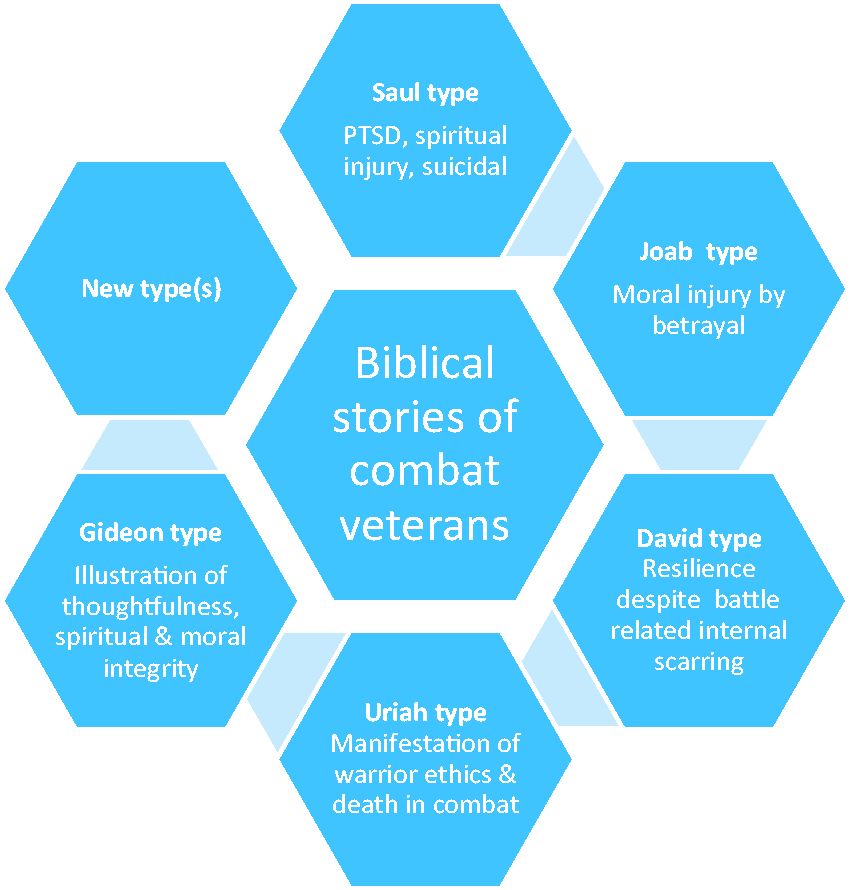
Although the other veteran types (i.e., Saul, David, Joab, Uriah) are understood as theoretical categorizations built upon the biblical combat characters that include “combat wounds” and trauma amid and in the aftermath of military service, the Gideon type can also serve as an identity model prior to military service and deployment to war zones. There are several features of this type that could be cultivated on a personal level by military personnel, especially in cases where explicit religious faiths are prevalent.
Recent experience and research within the Canadian Armed Forces suggests spiritual activities or practices (e.g., prayer, meditation, rituals), in combination with explorations of meaning, purpose, existential questions, and relationships to name but a few, facilitate movement towards recovery, reconciliation, and restoration among psychologically wounded service members and veterans (Smith-MacDonald et al., 2018; cf. Currier, Drescher, Holland, Lisman, & Foy, 2016). In addition to this it is suggested that S/R practices that facilitate grounding (e.g., meditation and contemplation) can become a source of comfort that then enables participants to remain grounded during a recovery process. Another take on this approach to recovery and resilience is to proactively exercise spiritual practices amid service and war zone deployments as a way to assist and support spiritual and moral integrity throughout active duty, much as Gideon nurtured in his continued conversations with God. Additionally, research indicates that it is important to uphold other non-military identities (e.g., as a husband/wife/partner, father/mother, even activities and hobbies) amid military service to support and promote wellbeing and health, and eventually assist transition from military to civilian life (Beder, 2012; Moore, 2012). Reintegration into civilian society may generate emotional turmoil, identity issues, and feelings of estrangement from civilian society (Grimell, 2019b; Lifton, 1992). To sustain one’s toeholds into the civilian domains throughout active duty suggests it is important to include civilian relationships into a committed military life, and to commit to making these relationships thrive. One must allow these identities to have space and time in the self as well. Life-giving relationships outside of the military context may prove to be of great value to wellbeing in the aftermath of military service. Such relationships may work as another spiritual depth of life (Grimell, 2018c).
Programs that proactively encourage deeper existential reflections, with spiritual connotations, have already been launched, for instance within a North American context, and manifest an important development (Pargament & Sweeney, 2011). However, in general such programs are not rooted within explicit S/R domains or sacred traditions. Therefore, a role model such as the Gideon type may prove to be particularly useful for service members who already have, or have had, nurtured S/R traditions. The Gideon type may be utilized in the formation of a well-functioning military identity that can be suggested to contain biblical wisdom that resonates well with contemporary research.
Yet, an exegesis such as this provides us with a certain lens through which a multi-layered biblical text can be filtered for a specific spiritual psychological purpose. A lens such as this, however, distances the biblical exegesis from some of its traditional richness to give new findings room to emerge (Grimell, 2018a). This loss may be perceived as a shortcoming or even as a simplification of the exegesis, but nevertheless it brings new perspective(s) to the front, which may be useful in pastoral care, counseling, and/or the development of a well-functioning military identity. Together with traditional and/or alternate exegesis, the endeavors to bring tentative knowledge about spiritual and psychological implications of war zone deployment among biblical combat veterans may reach even deeper insights with further relevance for contemporary service members, veterans, and their significant others within S/R traditions.
In combination with a growing S/R toolbox, current research on combat veterans struggling with combat wounds suggests that spiritual and religious dimensions may prove to be a neglected yet promising route to healing and recovery (Brémault-Phillips et al., 2017; Edwards, 2018; Koenig et al., 2017; Wortmann, et al., 2017). This implicates that religious leaders and pastoral and spiritual caregivers have an important role in assisting veterans in need of care and guidance (Graham, 2017; Kinghorn, 2012; Nieuwsma et al., 2013; Sippola et al., 2009). It has been suggested that it may be beneficial for clinical workers or teams and S/R caregivers to cooperate or collaborate in various ways, mainly because clinical teams, such as psychologists, psychiatrists, social workers, nurses, and/or physicians are trained in secular traditions and therefore often lack sensitivity, knowledge, and experience rooted within S/R traditions (Bobrow, Cook, Knowles, & Vieten, 2013; Smith-MacDonald et al., 2018). A result of this is that the spiritual dimension of a human may be omitted or neglected amid secular bias; the S/R toolbox may be wholly forgotten. It is therefore suggested, especially within a military context, that clinical teams should be interdisciplinary and always include a chaplain with S/R expertise. This has been advocated by Smith-Macdonald and colleagues (2018) and put to practice with promising results within a Canadian context. A chaplain with S/R expertise can properly promote as well as recognize and address spiritual dimensions and practices that work in the service of wellbeing and health. A chaplain can, with order words, utilize wisdom, knowledge, experience, and rituals from sacred traditions and an S/R toolbox, not only when the rumination of a combat wound has already developed into a MI but also preemptively in promoting and assisting the cultivation of spiritual integrity and resilience. In turn, such a take will resonate to a holistic biopsychosocial-spiritual model and understanding of humans, including service members and veterans (Tick, 2005; Grimell, 2019a; Smith-MacDonald et al., 2018).
Concluding Remarks
The biblical combat veteran types should be seen as another aid in the S/R toolbox that can be utilized in pastoral care and counseling. Up to this point research data that connect biblical stories of war zone deployment and biblical combat veterans with contemporary theories and real-life experiences have been scant. Hopefully, this growing gallery of veteran types is a step towards both improvement and enriched pastoral and hermeneutical interest in such combat-related biblical endeavors.
Pastoral care givers are known as agents of hope who are supposed to be able, among other things, to draw from sacred traditions and the Bible in their efforts to provide care and counseling (Capps, 1995, 2001). Hope can be illustrated and interpreted in many subjective ways, and some examples when considering biblical combat veteran types may be: (a) these types can be traced back to the Bible, so there are/can be traces of God within these stories from which the types have been built (one must always be careful with such claims); (b) a troublesome personal situation due to a combat wound can be connected to biblical combat types (and characters) that may have different meanings yet increase a sense belonging to a wider and timeless holy community of veterans who in solidarity share such burdens; (c) research shows there is potential for recovery and healing via the S/R toolbox and spiritual practices; and (d) a type such as Gideon illustrates that hope exists even amid a calling to military service and war zone deployment; it is possible to exercise spirituality and shape a military identity simultaneously so that spiritual and moral integrity is maintained. This can provide hope for spiritual individuals who feel called to service and/or their significant others.
A remaining shortcoming in the gallery of biblical combat veterans is the lack of a female veteran type. A reason for this shortcoming is the selection criterion of the biblical combat veterans (e.g., explicit biblical descriptions as warriors/military commanders, rich details of their experiences, actions, and behaviors amid both active duty and civilian life). Because females were not usually seen as warriors from a cultural and gender-specific perspective in biblical stories, examples are difficult to find. Perhaps the criteria can be widened to consider, for instance, Deborah and/or Jael as characters who at least to some extent shared the life of regular biblical combat veterans. This remains to be further examined. Additionally, future research is encouraged to advance the understanding of how the Bible can be utilized in pastoral care and theology in the interest of service members, veterans, and their significant others.
