




Abstract
The emergence of the ‘post-truth’ era has highlighted the urgent need for robust educational strategies (Barzilai & Chinn, 2020; Bell, 2017; Peters, 2017). Transformative educational approaches are uniquely positioned to address these challenges, as they not only build on existing knowledge but also entail a fundamental shift in core ontological and epistemological beliefs (Mezirow, 2018[2006], p. 116). It is essential, however, that such initiatives align with democratic values, uphold the pursuit of truth as a core educational aim, and are conceptually validated through empirical research. To this end, this paper reviews evidence from a mixed- methods retrospective case study that, while tentative, indicates the validation of a conceptualisation of transformative learning that includes the test of truth (Roux, 2025). The findings suggest that this distinct learning phase may encompass multiple forms of epistemic reasoning, specifically those related to correspondence and coherence theories of truth.
There is widespread recognition of the importance of robust educational responses to the ‘post-truth’ situation which has emerged in recent years (Barzilai & Chinn, 2020; Bell, 2017; Peters, 2017). The concept of ‘post-truth’ denotes ‘circumstances in which objective facts are less influential in shaping public opinion than appeals to emotion and personal belief’ (Oxford Dictionaries, 2016), and the impact of this phenomenon has been labelled as an ‘epistemic crisis’ with serious implications for democratic societies (Hoggan-Kloubert & Hoggan, 2023, p. 4). The rapid advancement of digital technologies and the recent advent of generative artificial intelligence (GenAI) has further exacerbated post-truth issues relating to misinformation and disinformation (Roux, 2025). Whether the issue is deepfakes, or the willing acceptance of blatant lying in politics, or the increased distrust or denial of science, or the use of education as a misappropriated tool for economic ends or ideological enculturation, we must find ways to avoid the Orwellian implications of this cultural moment (Peters, 2017).
Given the central role that education plays within democratic society, this situation requires educators and researchers to consider theories of truth and associated learning and teaching approaches afresh for the times in which we live (Bridges, 2019; Munn et al., 2023; Peters, 2017; Sinatra & Lombardi, 2020). Research has demonstrated that attempts to correct misconceptions through exposure to accurate information have limited effect when a learner’s personal identity and worldview are implicated (Nyhan & Reifler, 2019). Educational initiatives that draw upon transformative learning theory are particularly relevant because such learning experiences do not simply build upon previous learning but involve shifting core ontological and epistemological assumptions and beliefs as part of the process (Mezirow, 2006, 2018, p. 116). It is assumed, at least in Merizow’s conceptualisation, that there is a truth-value towards which such learning processes ideally lead. He states: Transformative learning is defined as the process by which we transform problematic frames of reference (mindsets, habits of mind, meaning perspectives) – sets of assumption and expectation – to make them more inclusive, discriminating, open, reflective and emotionally able to change. Such frames are better because they are more likely to generate beliefs and opinions that will prove more true or justified to guide action (p. 116).
The explication of what, precisely, makes certain beliefs and opinions ‘more true’ is not provided by Mezirow in a way that easily aligns with the philosophical presuppositions upon which the learning theory rests; constructivism, humanism and social critical theory (Cranton & Taylor, 2012). He draws heavily upon the work of Dewey and Habermas (Fleming, 2018) who both held pragmatist convictions of truth, albeit with individual differences. Dewey argued that ‘truth and falsity are properties of that subject-matter which is the end, the close, of the inquiry by means of which it is reached’ (Dewey, 1941, p. 176). Habermas similarly focused on the epistemic work of justification through discourse, and like Dewey, was aware of the conceptual limitations of this process driven approach. Habermas for instance acknowledges that truth cannot be defined or authorized simply in terms of our justifications, for ‘a proposition is agreed to by all rational subjects because it is true; it is not true because it could be the content of a consensus attained under ideal conditions’ (as cited by Fultner, 2019). Ultimately, a context-transcendent logic is required to authorise truth claims, and in a previous paper (Roux, 2025) I highlight a way of incorporating both correspondence and coherence theories of truth to this end. This approach aligns well with the realist intuitions of both Dewey and Habermas, however shifts the defining features of truth beyond the limited realm of inter-subjective agreement or pragmatic relations, thereby mitigating the risks associated with false consensus or dependence on a priori categories of what works (Bridges, 1999).
The goal of this excursus is to strengthen the philosophical underpinning of transformative learning theory is ways that make it both ethically accountable as an educational approach suitable for participatory democracy, and applicable to the post-truth situation in which we live. In my previous paper (Roux, 2025), this is explicated through the development of axiological, ontological, and epistemological foundations that are geared towards the pursuit of truth as a core educational aim. The purpose of this follow-on paper is to move from theory building to theory testing and towards conceptual validation on the bases of empirical support. The paper is structured as follows. First, an overview of the conceptual model is provided. This is followed by a summary of the research design, focus, and limitations, before a discussion of findings. Finally, the implications of the study and possible directions for future research are explored.
A Reconceptualisation of Transformative Learning That Includes The Test of Truth
Figure 1 (below) depicts the main features of this reconceptualisation of transformative learning, albeit via a simplistic reduction of complex and integrated learning processes and outcomes expounded in existing literature. Transformative learning is presented as an analytic metatheory, where ‘Transformative learning refers to processes that result in significant and irreversible changes in the way a person experiences, conceptualises, and interacts with the world’ (Hoggan, 2016a, p. 71; emphasis in the original). A reconceptualisation of transformative learning that includes the test of truth.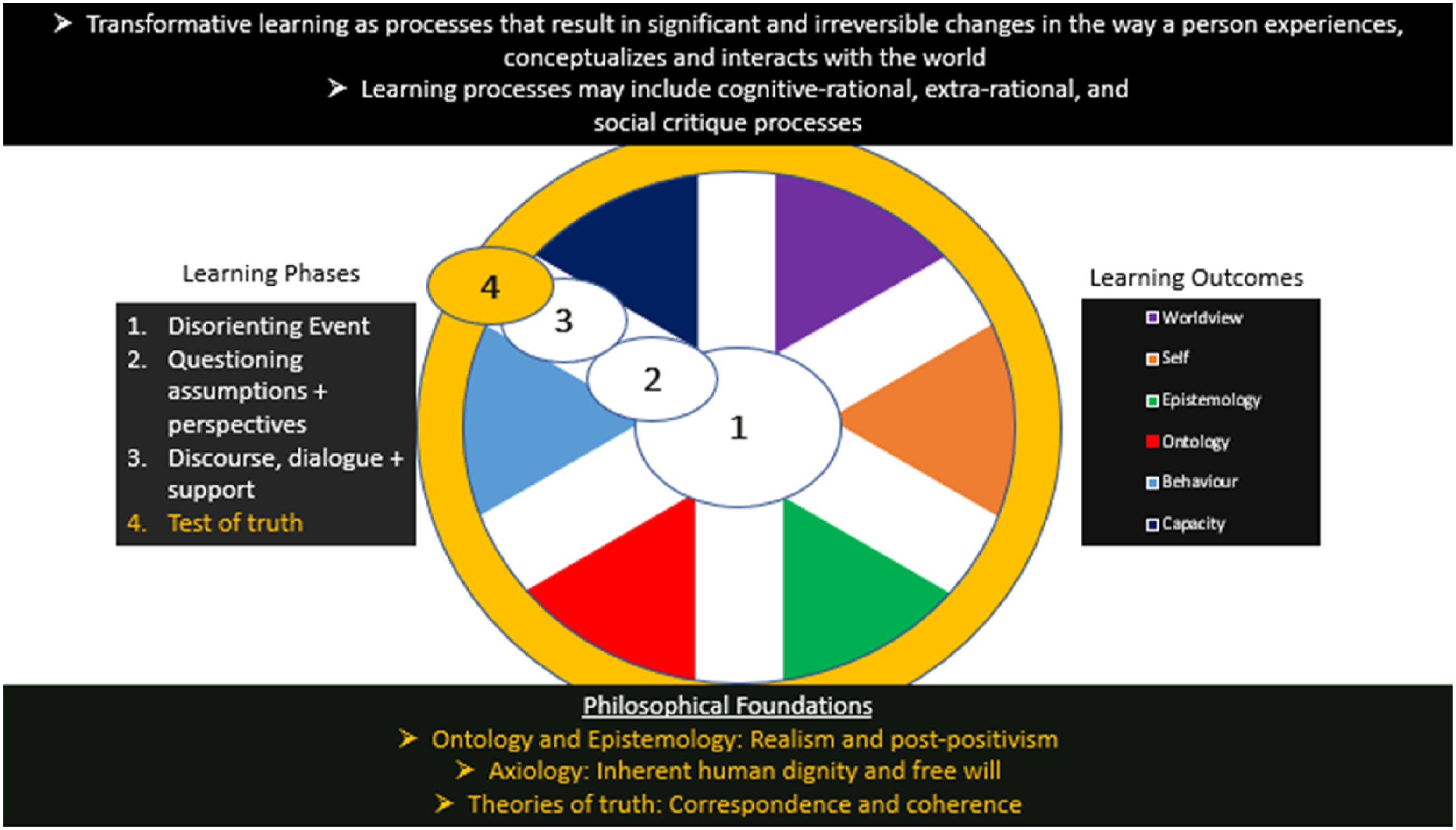
This reconceptualisation also draws on the three-phase learning model proposed by Cranton (2016), which is not considered linear, or final, for learning may recur as needed (in alignment with the notion of lifelong learning). This approach simplifies Mezirow’s ten-phase model (1991) (also referred to as the cognitive-rational approach) and broadens it to include the extra-rational and social-critique approaches as advocated by Stuckey and colleagues (Stuckey et al., 2013, 2022). The learning phases include; 1: Disorienting event; 2: Questioning assumptions and perspectives; 3: Discourse, dialogue and support (Cranton, 2016, pp. 46–60). This conceptual framework, however, also includes a distinct fourth phase: the test of truth, which will be further explained below. The list of possible learning outcomes included in the model are based on Hoggan’s (2016b) review of relevant literature within the field of transformative learning, and include changes to a learner’s worldview, epistemology, ontology, self, behaviour, and capacity (p. 70). Finally, Hoggan’s criteria of depth, breath and relative stability (p. 78) are also adopted as limiting factors in the determination of a transformative learning experience.
With regard to philosophical underpinning, this approach to transformative learning makes a shift away from the political goals of social critical theory and the relativist foundations of constructivism and humanism which are predominant in extant scholarship (Cranton & Taylor, 2012). Instead, this reconceptualisation is predicated on axiological convictions of inherent human dignity and free will, a realist ontology and a post-positivist epistemology. Whilst an objective nature to reality is assumed, this reconceptualisation rejects foundationalism and the idea of an objective or detached observer and assumes that knowledge can only be understood through particular frames of cognitive reference (Cohen et al., 2013).
These theoretical shifts also allow us to incorporate an adaption to transformative learning that is both philosophical and experiential: the test of truth. In alignment with a realist ontology, a post-positivist epistemology, and a long-standing tradition in analytic philosophy, the test of truth can be grounded in both correspondence and coherence theories of truth. Definitionally, this implies that the truth of any inference ‘consists in its agreement with (or correspondence to) to reality and its coherent fit within a consistent set of beliefs’ (Haynes, 1996, p. 189). In this manner, the test of truth is included as an evaluation criterion of both the correspondent and coherent qualities of new or revised ideas, and related values and beliefs. Critically, the focus of the test of truth is only on the quality of epistemic reasoning, not on the acceptance or rejection of any specific truth claim or on the attainment of any specific learning outcome.
This approach also recognises that the quality of epistemic reasoning may be influenced by a range of inhibiting and enabling factors. Learning experiences are always context-bound and learners can be influenced by a range of elements, whether personal, communal, or circumstantial. Examples include but are not limited to – the perception of social and emotional pressure or support, health, relative comfort and safety, desperation or motivation, access to reliable information, personal bias or positionality, and the cognitive ability or time to comprehend the issues at hand.
Positioned within the fallibilist tradition, this reconceptualisation asserts that new or revised ideas, and related values and beliefs should be considered provisional and revisable. This is not to undermine the formation of strong convictions, but to underscore the importance of intellectual humility, and of maintaining an open mind. In this manner, the transformative process may be ongoing, and lifelong, as the learner continues to consider alternative perspectives, seek new corresponding evidence and explore more coherent explanations.
Research Paradigm, Methodology, and Methods
The above-described adaptions to transformative learning theory were tested as part of a PhD research project about student leadership development in Australian higher education (Roux, 2022). The study focused on the experience of participants at the National Student Leadership Forum (NSLF). The forum was recently renamed National Leadership Forum (https://www.nationalleadershipforum.org.au/), however, for the purposes of this paper the moniker NSLF will be maintained to align with the time period of the study. The ‘forum’ as is it colloquially referred to has been operating annually since 1997 and has become one of the nation’s preeminent leadership development initiatives. The immersive four-day event generally hosts a group of about 150 diverse participants from universities around Australia, as well as neighbouring countries such as Papua New Guinea, New Zealand, Philippines, Samoa, Fiji, and Tonga. The NSLF is hosted in part at Parliament House in Canberra, and includes a wide range of experiential and service-learning initiatives, as well as activities that allow for a diversity of views, personal narrative building, and reflection.
Based on a pragmatist research paradigm, this study sought to establish the ‘best’ approach for addressing a particular set of research questions (Creswell, 2007, pp. 43–44). Two of the research questions which are immediately relevant to this article are: Q1: Why, in retrospect, did some former student delegates perceive the NSLF experience as personally transformative? Q2: What did these students’ learning processes and outcomes of the NSLF experience reveal about contemporary transformative learning?
This study employed the participant-selection variant of explanatory sequential design methodology as outlined by Creswell and Plano Clark (2007) (See Figure 2 below). This design was chosen for the following reasons. First, the two-phase interactive (quantitative à qualitative) process is both procedurally efficient and flexible as it allows for ‘emergent approaches’ where the second (qualitative) phase can be adapted based on what was learnt in the first (quantitative) phase (p. 72). This emergent feature was employed for this study, as the questions for the semi-structured interviews were adapted in response to the survey data. Second, this methodology places priority on the second (qualitative) phase instead of the initial (quantitative) phase (p. 86). This suited the study, because it allowed for in-depth discussion around why learners navigated the phases of learning as they did, and whether or not they employed certain criteria in their decision-making around new or revised ideas and related values and beliefs. In this manner, the concept of a test of truth can be evaluated against the data as the findings provide insight into the manner with which participants naturally engaged in epistemic processes that align with theories of truth like correspondence, coherence, pragmatist or consensus. Explanatory sequential design based on Creswell and Plano Clark (2007, p. 69).
A mixed-methods retrospective case study was chosen in order to incorporate both quantitative and qualitative data in a complementary fashion (Howe, 1988). Non-probability purposive sampling was employed to provide a ‘maximal chance’ (Punch, 2009, p. 252) at gaining insight into the transformative experience of former student delegates who participated in the NSLF. Of the various types of case studies available, a collective instrumental approach was chosen to address the limitation of generalisability (p. 121). The ‘instrumental’ (Stake, 1994, pp. 236–238) element of this case study refers to the fact that a particular event (the NSLF) was chosen in order to examine a specific phenomenon described as ‘transformative learning’ along with its related concepts. The ‘collective’ (pp. 236–238) element of this approach refers to the fact that the instrumental case (the NSLF) was extended to several instances to ‘learn more about the phenomenon, population or general condition’ (Punch, 2009, p. 119). Hereby, a small degree of representation may be achieved through the inclusion of participants at the same annual event across varied instances ranging between the years 1998 and 2018. However, given that purposive sampling was employed to investigate a particular phenomenon which was context bound to this specific forum, the findings of the transformative nature of students’ experience with regard to the NSLF are best considered as groundwork for future studies to build on. Further, it should be clearly stated that the study does not intend to correlate general participation at the NSLF event with the occurrence of transformative learning. Rather, using purposive sampling, the study seeks to better understand 1; why the event was transformative for certain individuals, and 2; how these particular learners perceived the process of their transformation.
A second limitation of the study involves the method of case study and the complexity of personal testimony. In relation to transformative learning, is has been argued that the lived experience is almost certainly more nuanced in the moment, as compared to later recollections which can be qualified with layers of meaning, values and intensity (Roessger et al., 2017). These qualifications to personal memories, however, can also be seen from a positive perspective, for participants may not have been able to process their experience effectively in the moment, nor comprehend how it might impact on them in the long term. Furthermore, there is a certain value to the construct validity of the research design when hindsight is afforded – namely, the capacity to observe the depth, breadth, and relative stability relating the impact of the learning activity.
Quantitative data were acquired through the adaptation and use of Stuckey, Taylor, and Cranton’s Transformative Learning Survey (2013). The main purpose of using this method was to elicit learner perceptions and to provide indications of change that could be further explored though a semi-structured interview (Cranton & Hoggan, 2012). The reasons for using this pre-existent survey were two-fold. First, it is a validated survey that was contiguous with the conceptual framework and the focus of this project, as it was designed to gain insight into learners’ perceptions of personal change and obtain an indication of the types of learning processes that occurred (Stuckey et al., 2013). Second, it also included two open-ended questions that could be adapted, allowing students to describe their experience at the NSLF through qualitative means. Participants could select the NSLF group from a drop-down menu, and Figure 3 (below) shows how the open-ended questions were written in alignment with the conceptual framework and to gain insight into the student’s experience at the NSLF (Research Question 1) and the learning processes and outcomes associated with it (Research Question 2). Screenshot of the two open-ended survey questions.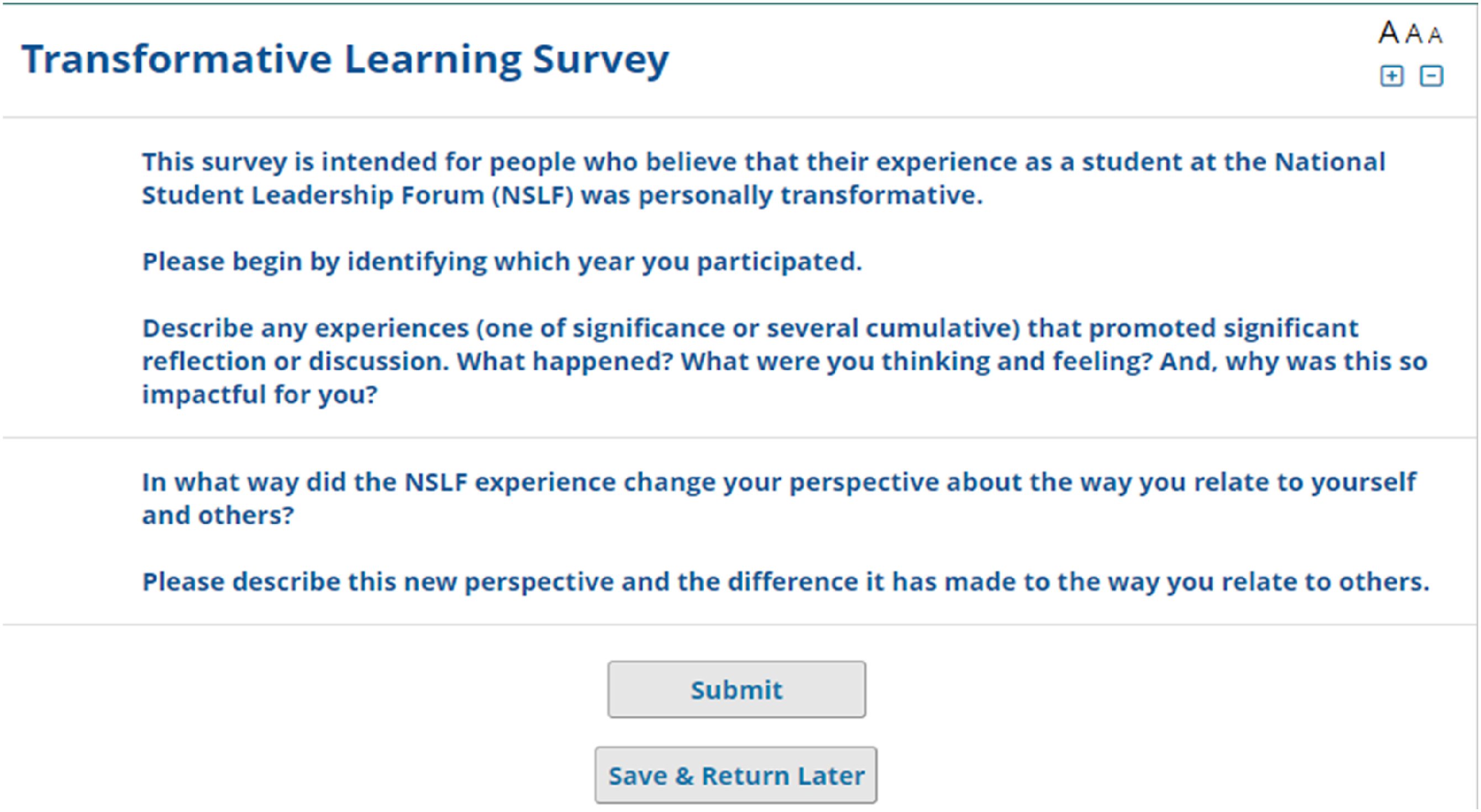
Access to research participants was achieved with the support of the NSLF board, who were pleased to assist the study by emailing the entire database of former students. In the event that insufficient participants were obtained via the recruitment email, the board also provided a shortlist of 300 individuals (with current contact details) representing each of the 20 years of the event. The recruitment email invited former delegates to complete the survey and participate in an interview if they regarded their NSLF experience as personally transformative – defined as ‘resulting in significant and irreversible changes in the way a person experiences, conceptualizes, and interacts with the world’ (Hoggan, 2016a, p. 71). Further a rationale for the study along with relevant practical and human ethics approval information was provided (University of Southern Queensland Human Ethics Approval Number: H20REA243). Through a combination of the broader database and the shortlist, 20 former delegates were recruited, including 11 males and 9 females from a range of backgrounds, ethnicities, and worldviews.
After administering the survey, qualitative data were acquired through semi-structured interviews via Zoom. A key component of the semi-structured interviews was the use of narrative as a means for learners to make sense of themselves and their experience through articulating their story (Cranton & Hoggan, 2012). A thematic analysis was performed using a prespecified coding schema (Punch, 2009) based on the transformative learning processes as depicted by Stuckey and colleagues (Stuckey et al., 2013, 2022), the learning phases as depicted by Cranton (2016), and the learning outcomes as depicted by Hoggan (2016a).
Discussion of Findings
Although there are a range of other important findings that relate to the student experience, the findings represented in this discussion are limited in the following ways. First, given that the learning processes and outcomes adopted by the proposed reconceptualisation of transformative learning have already been well established in literature, the focus will be predominantly on data relating to the novel and distinct fourth learning phase, the test of truth. This entails that this section will not provide an exhaustive analysis of each participants learning processes and outcomes. Second, although the semi-structured interviews provided a great opportunity to explore these components in some detail, due to limited interviewing time, not all learning process and outcome codes or operational measures (depth, breath, and relative stability) could be fully investigated for each of the participants. Third, given that this case study focused on a single kind of learning event, it would be expected that certain process and outcome codes would be represented much more frequently than others. This does not detract from the value of the typological framework, but rather reinforces its flexibility to a variety of learning contexts.
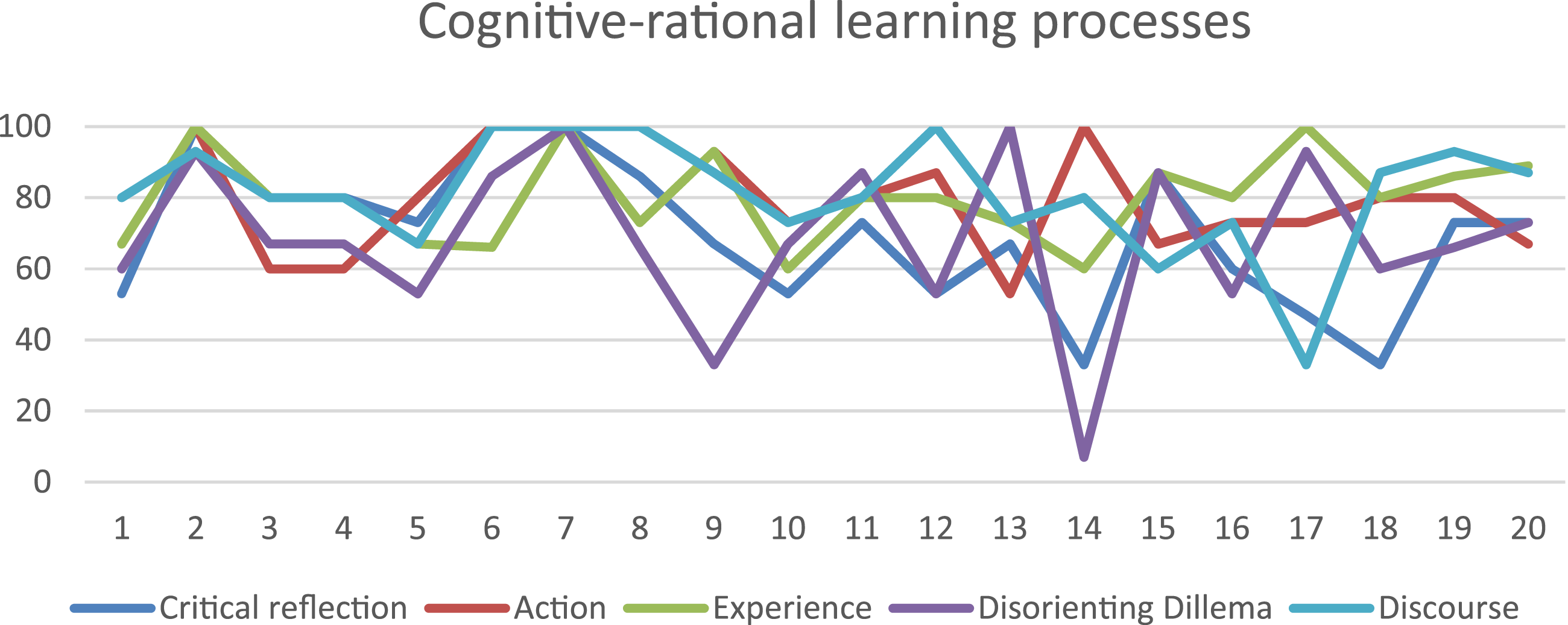
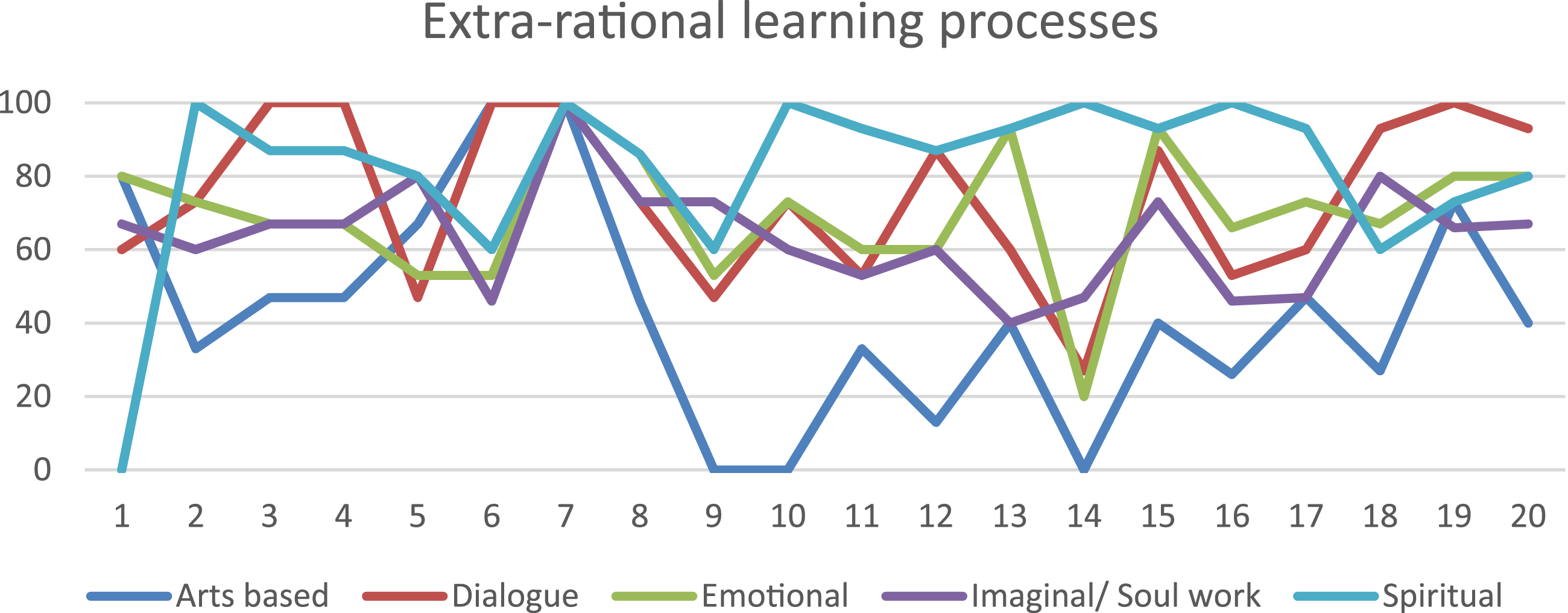
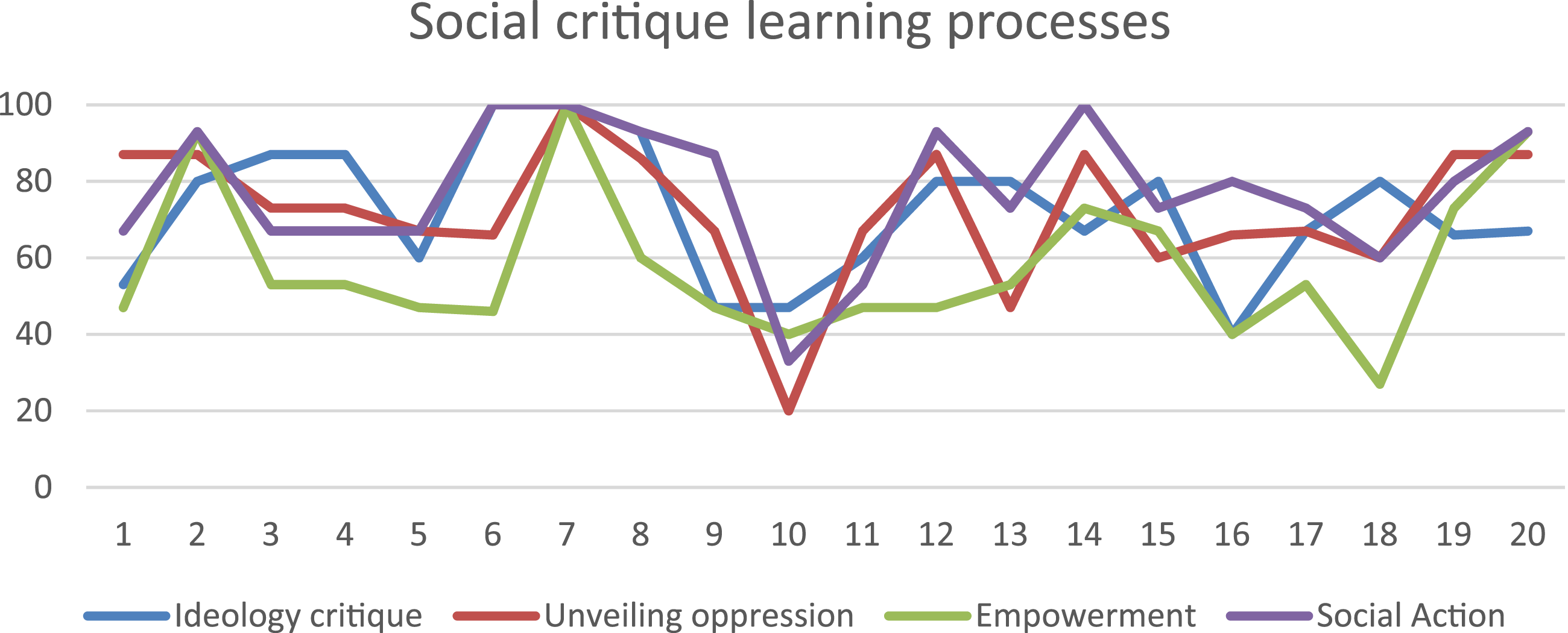
In alignment with the research design, quantitative data was collected and organised in the first phase and in a manner appropriate to inform the qualitative second phase. The survey scores are indicated on a scale of 0 as a minimum to 100 as a maximum (Figure 4). These figures indicate the degree to which participants relate their experience to particular transformative learning processes at the NSLF (e.g. cognitive-rational, extra-rational, or social critique) (Stuckey et al., 2013). The data were tabulated and graphed (See Figures 5–7 below), helping to clarify which learning processes were consistently higher or lower for participants in the study. This provided a statistical reference point to guide the interviews and also demonstrates the wide variety of learning processes in which participants were engaged, giving strong support to the integrated paradigm of learning processes that was adopted in the conceptual framework of the study. Collated and tabulated quantitative data exported from transformative learning survey. Line chart of participant scores of cognitive-rational learning processes. Line chart of participant scores of extra-rational learning processes. Line chart of participant scores of social critique learning processes.
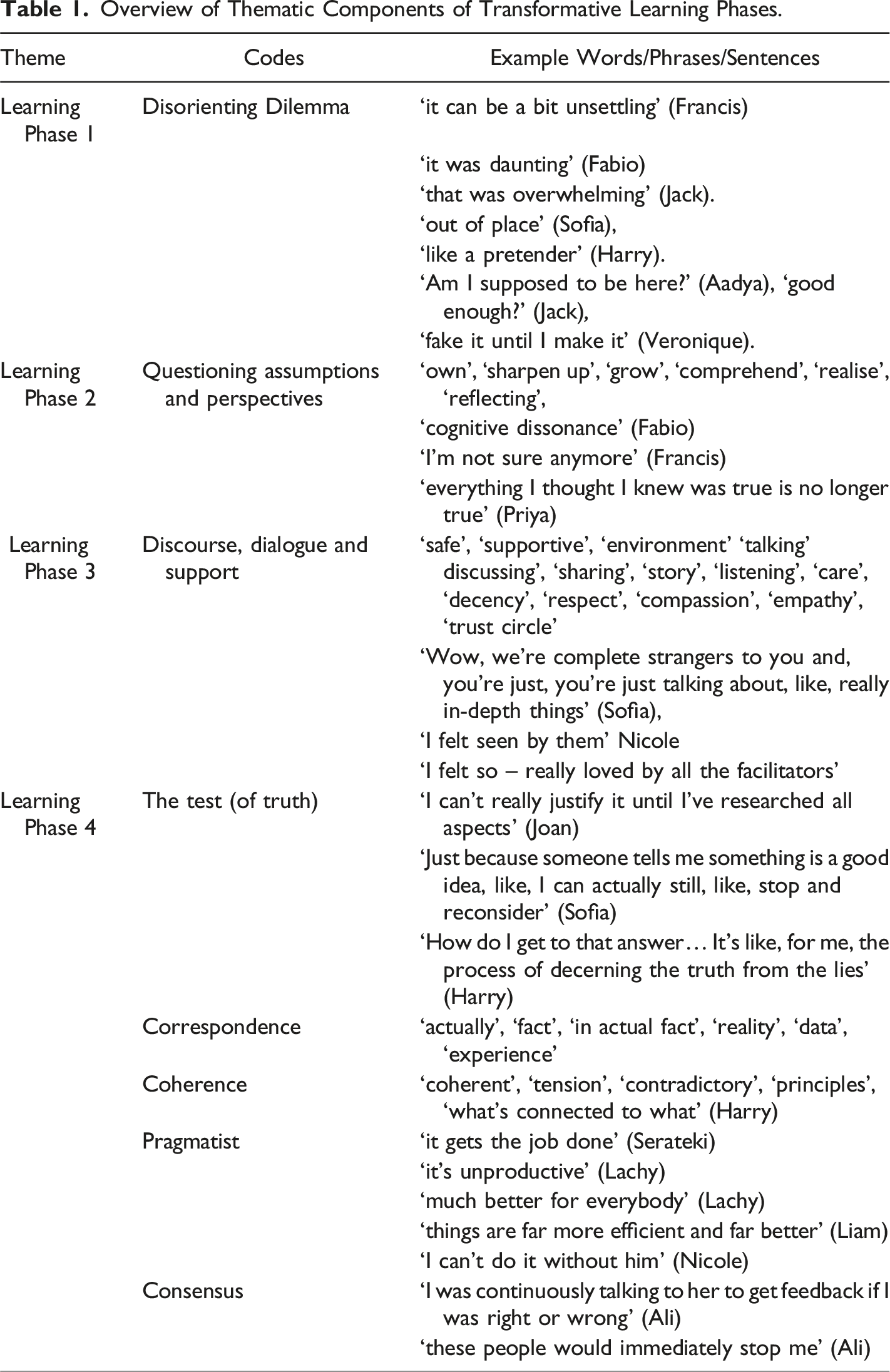
Overview of Thematic Components of Transformative Learning Phases.
Phase 1: Disorienting Dilemma
This phase is described by Mezirow (2018) and Cranton (2016) as the first phase in the learning journey. There were a range of words and phrases used by participants in describing the arrival day that depicted the beginning of a learning experience similar to what may be conceptualised as a disorientating dilemma (Mezirow, 1991) or a dislocation (Greene, 1971). Throughout the interviews, it became apparent that the first day, which included arriving at the grand setting of a five-star hotel, exposure to the heart of national leadership at Parliament House, and inclusion into a large group of specially selected and seemingly impressive delegates dressed in formal and cultural attire made an instant impact on many of the delegates. In evaluating the transcript data, repeated phrases and certain descriptive words seemed to indicate that the setting may have influenced the students’ disposition towards learning, rather than being an explicit point of reflection in and of itself. In other words, the impact of the arrival day at the NSLF had a disorientating effect, creating a sense of introspection and critical self-awareness.
Some participants described an uncomfortable and unfamiliar feeling, with words like ‘unsettling’ (Francis), ‘daunting’ (Fabio), and ‘overwhelming’ (Jack). Others used phrases like ‘out of place’ (Sofia) or ‘like a pretender’ (Harry) to describe their feelings on the first day. Others reflected on how they critically questioned themselves, asking ‘am I supposed to be here?’ (Aadya) or am I ‘good enough’ to be here (Jack), while another stated, ‘at the beginning I was like, Oh, maybe I kind of like have to “fake it until I make it”’ (Veronique). The fact that a large number of former student delegates (though not all) explained their experience in ways that align with existing literature on disorientation gives strong support for this distinctive phase as presented in the conceptual framework.
Phase 2: Questioning Assumptions and Perspectives
This second phase is presented by Cranton (2016) as part of an integrated paradigm of transformative learning that can involve a range of different learning processes as advocated in literature. This retrospective case study provides supporting evidence for this integrated approach to learning, as both the survey and interview data depicts multiple different ways in which students began questioning their assumptions and perspectives.
For most students, this phase commenced after the initial disorientation of arrival and occurred in the small group setting. Participants reflected on this experience using words and phrases like ‘my mind was being blown into a million pieces… everything I thought I knew was true is no longer true’ (Priya), ‘I didn’t realise how conflicted my whole outlook was’ (Harry), ‘Like am I just wasting my time? I was like, “I’m not sure anymore”’ (Francis), or ‘I was starting to realise, like, “hey, this isn’t actually how I feel about it. These aren’t my thoughts that I’m saying; these are someone else’s thoughts”’ (Beth). It is important to note that although a linear progress or clear distinction between phases 2 and 3 was not obvious, the logical progression of these phases is not contradicted by any data in this case study.
Phase 3: Discourse, Dialogue, and Support
The third phase in Cranton’s (2016) model is also based on the integration of various approaches in literature. This case study provides multiple examples of how former student-delegates engaged in discourse, dialogue, and support, and how such activities occurred most frequently in the small group settings.
The students repeatedly described the role and behaviour of the leaders in creating a powerful culture, how they found themselves freely expressing their vulnerabilities and emotions, and how they explored their own personal narratives and questioned their mostly deeply held values and beliefs. Examples in the participant descriptions of this experience included ‘the facilitators are ensuring that the environment in which those stories are told is a safe one’ (Paul), ‘Wow, we’re complete strangers to you and, you’re just, you’re just talking about, like, really in-depth things’ (Sofia), and ‘once you do share, once one person shares, it softens it up even further and invites more sharing and more interaction’ (Jack). Reflecting on the NSLF as a whole, one participant said, ‘but the most important time was the small group for me. The other stuff was just a bit of a bonus. For my small group, that was my zone, and that’s where I learnt the most about myself’ (Nicole).
Phase 4: The Test of Truth
The theme the test of truth (see Table 1) included the general code the test, which was created prior to analysing the data to test this component of the conceptual framework against the collected data. The aim was to analyse whether participants would make implicit or explicit reference to a phase of testing their ideas (which underpin values and beliefs) against the criterion of truth. More specific codes were also developed to explore how students approached this test in relation to the notions or theories of truth found in literature; Correspondence, Coherence, Pragmatist, and Consensus (Bridges, 1999). It should be noted that some participants used multiple ways of testing the truth-value of new or revised ideas, and related values and beliefs, and therefore their data matched multiple of the above stated codes.
Code: The Test of Truth
The interview extract below indicates how Joan approached ideas that conflicted with her own. Joan: So I need to know, like all sides, like all opinions, to then solidify my own opinion. Like I might have an idea, but it's like, oh, I can't really justify it until I've researched all aspects. And then when I've spoken to other people and gathered their opinions and either agree or disagree, that helps shapes… helps solidify my own because I'm like, OK, I really don't agree with what you're saying, then I know that what I'm thinking is the right thing to me.
In this interview, Joan explained how she evaluates the validity her own arguments as well as counterarguments to test that her thinking is the ‘right’ thing to her. The use of concrete language such as ‘right’ thinking is indicative of her evaluation of the warranted nature of certain propositions. The phrase ‘right thing for me’ could be indicative of a relativist perspective of truth, however, when questioned about her approach to the warrants of alternatives views, she clarified, ‘There are things that I think are open to interpretation, but some things are either yes or no… it depends on what the subject is’. For Joan, there is a critical evaluative phase in the journey in which she submits ideas to the process of research and reflection to ensure that she understands the fundamental issues at hand, as well as alternative views on the matter. Once she has undergone this exercise, she then feels she can ‘solidify’ her opinion in a justified manner. Sofia shared a similar learning phase in her interview: Sofia: Just because someone tells me something is a good idea, like, I can actually still, like, stop and reconsider. And then when I do, like I want to make sure that it's a decision that I'm making… because that's what I believe is valuable. And not just like because someone said I should. When I think about it, like I know there are things that I won't negotiate on, but when a new idea is presented, like, I'll make sure I take the time to kind of think over it and figure out an opinion. I think I feel overwhelmed if there's, like, too much of that. Like if someone keeps, like, pushing an idea and I go, I haven't had time to kind of think about where I stand on it or like do the research myself.
Sofia described a phase of working through ideas until she felt comfortable adopting them as her own or otherwise rejecting them. She explained how ensuring the value of certain beliefs requires time for careful deliberation, to ‘think over it’, and to ‘figure out an opinion’ and if necessary to ‘do the research myself’. These statements are a clear indication that Sofia is concerned that her convictions are rational and based on research. Although she did not refer to the word truth, the importance of a process that allows her to make well-grounded decisions is clearly implied.
The following interview with Nicole depicts a similar learning phase of assessing the warrants of various perspectives. When she struggled to find words to explain this, I repeated what I heard from her to check I was interpreting her correctly. Her response is telling: Nicole: And so, I think I realised that I wasn't, you know, because I used to think of myself as like a really bad person, because I was experiencing all these bad emotions, they were experiences, they were emotions I was told were bad and I think that... It’s really hard, it's really hard to answer. Researcher: Can I tell you what I'm hearing, maybe that'll help? Nicole: Yeah, go for it. Researcher: Ok, so there were parts of you that, like you said, you were volatile and angry at times and there were emotions that you thought were bad for whatever reasons. And then you're in an environment where people started to say positive things about you and affirming your nature. Nicole: Yeah. Researcher: And affirming maybe even some of those emotions. And now you’re starting to think maybe these ideas of myself are actually not true ideas of me, and I can let them go. Is that what you're telling me? Nicole: Yes, that's what I'm telling you. And I think you've helped me understand myself.
This conversation with Nicole was revealing because it demonstrated the natural way in which way she tested her ideas against the criterion of truth. When she was presented with an alternate perspective, she eventually became convinced that it actually made more sense of how things are. When she recognised the validity of the new perspective, it allowed her to ‘let go’ of her previous ideas about herself, precisely because she now believed they were ‘not true ideas’ and therefore they no longer passed the test. The following interview with Harry revealed a similar learning phase, although he incorporated the word truth explicitly. Harry: Like I had the answer written down on the page. But then and I just thought, OK, I got the answer. And then when I thought about it, I was like, oh, I never actually did any of the working. How do I get to that answer… It's like, for me, the process of discerning the truth from the lies.
In this interview, Harry explained how a fundamental part of the NSLF experience for him was testing his ideas by examining them critically and he explained how this phase explicitly involved ‘discerning the truth from the lies’. The following conversation with Bobby is another example of a participant explicitly referring to the notion of truth as part of their learning journey. Bobby: The [NSLF] experience awakened a hunger for truth in my own life of my past and present experiences. What did I think of that? How has that shaped me, what did I learn or observe in it? It was not an overnight change but I learnt to love questions.
Bobby described how the experience ‘awakened a hunger for truth’. That phrase is important because truth is positioned as the aim of a learning journey, or an appetite that needed satiating. Examining what she thought about certain things or exploring how and why certain things shaped her were valuable precisely because they led to her discovering something true. The specific nature or notion of truth are now explored in greater detail.
Code: Correspondence
This code is based on the correspondence theory of truth, which holds that a proposition ‘P’ is true if and only if ‘P’ corresponds with an actual state of affairs (Bridges, 1999, p. 601). The test of truth on this theory therefore consists of critically evaluating the degree to which an idea corresponds with reality. When a person is convinced that an idea satisfactorily matches external reality, then the test is passed and the new or revised idea, and related values or beliefs are adopted.
Paul provided a detailed explanation of how he processed his beliefs in relation to lived experiences, and how data are based on practical reality: Paul: But what we believe about ourselves, and about other people, comes from our experience and how we interpret that experience and hold onto them. So inside our brain somewhere, we've amassed this huge database of experiences and our feelings are the short circuit of that, right. So first, I have to be honest about what I believe and how I got there, right…and then the second thing… is to change what you believe, you have to forgive, right. And forgiveness is this process of saying - my data set for what I believe is bad - I got a bad data set. You know, actually, if I look at my data set, I've got a data set of men in authority that is dominated by this one character, my dad, who's actually a bad example of men in authority, he's not the norm, right? He's actually a terrible example. So my experience of men in authority is warped. I have a very biased sample, and what I need to actually do is give up, get rid of, throw away the experience that I have. I'm not going to wait around for justice. I'm not going to wait around for it to be put right. I'm going to say, actually, that's a bad it's a bad set of data. And fathers are not like that, right.
In this interview, Paul unpacked his internal thought processes with remarkable insight. He explained how the first stage of adopting a new perspective or belief was to acknowledge how you gained your initial perspectives in the first place. The goal of such critical self-reflection is to understand what ‘database of experiences’ have informed said perspectives, and then as a second phase, to test these perspectives against a more reliable data set with a bigger sample size. He describes how his single example (his father) was inadequate because it was not representative of ‘the norm’, and therefore it is ‘biased’ and ‘warped’. As a result, the ideas associated with this ‘terrible example’, don’t pass the test of truth because ‘actually…fathers are not like that’. Paul thereby concluded that he needed to ‘give up’, ‘get rid of’ and ‘throw away’ that experience as a reference point for truth about men in authority.
In the following interview extract, Ali explained a similar realisation: Ali: Like I, you know, I wanted to do this, but you know how our culture is… I never dared to step out of that boundary. And this is something that I learnt in, ah, you know, within this forum… is the cultural barrier becomes so great it becomes like a Mexican wall, you know. So, it's physically in your mind. But actually, there's nothing.
Ali explained how at the forum he realised that due to his cultural background he had erected a barrier in his mind that limited what he could do. But then he realised that this barrier was purely psychological, and that ‘actually’ there was ‘nothing’ and therefore he should act according to reality. Priya similarly explained how her perspective changed when confronted with a different reality: Priya: I was actually really shocked because I was like, oh, I thought these people (politicians) just kind of standing in their lanes and didn't want friends and didn't talk to each other because that's what the media tells you. The media tells you that they're always bickering and fighting. But, actually, they had this really shared value and actually outside of suits and outside of Parliament House, they were just normal people who were dads who felt inspired to help people.
Priya reflects on her realisation that the narrative of parliamentarians that she previously believed based upon media coverage did not ‘actually’ reflect the politicians she met face to face at the forum. This ‘shocked’ her because what she previously thought to be true did not match reality. Multiple other participants described how they ended up feeling comfortable adopting new or revised ideas because of the way these ideas mapped onto their experience of actual reality.
Cumulatively these extracts support the finding of experimental studies in cognitive science, in that people have a natural inclination to make assertions in alignment with their convictions regarding the objective facts of external reality (Turri, 2013). The evidence of this study suggests that even when participants’ views could be internally justified, they seemed to intuitively test their beliefs against, and default to, external reality as they now perceived it, even when it was difficult to do so. This aligns with the conceptual framework, which positions the test of truth regarding the correspondence theory as a distinct and integral phase of the transformative learning journey.
Code: Coherence
This code is based on the coherence theory of truth which holds that a proposition ‘P1…Pn’ is true if and only if they represent an internally coherent, consistent, and comprehensive set of ‘mutually implicative and supportive propositions’ (Bridges, 1999, p. 603). The test of truth on this theory therefore consists of critically evaluating the degree to which an idea coheres with a person’s pre-existing set of ideas. When a person is able to make sense of an idea and is satisfied that it is not inherently contradictory but has explanatory power, then the test is passed and the new or revised idea, and related values or beliefs are adopted. In the following extract, Lachy described this phase of sense-making and how he ended up adopting a new perspective on the function of forgiveness: Lachy: Yeah in terms of criteria, and I mean there is a tension between forgiveness and justice. I am someone who believes quite stringently in principles of egalitarianism, equality of opportunity, but also you know, justice… I think, those principles matter there, and so, when those things come into tension. Um, there is a deliberate sense that tension exists. Part of the strange world we live in requires having a capacity to accept these contradictory positions or realities or principles and the tensions between them and being able to live with those.
The interview with Lachy revealed how he sought to address the tension between ideas that implicate each other in ways that are not easily reconcilable. He maintained that the principles of ‘egalitarianism, equality of opportunity’ and ‘justice’ must stand; however, he also concluded that in ‘the strange world’ we live in, somehow, we have to allow for ‘forgiveness’ and learn to live with the tension. In this way, Lachy is able to reconcile, to his own satisfaction, both ideas (albeit with tension) into a coherent worldview. This was not necessarily because they are well aligned, but rather because our messy world necessitated both. When asked why he now believed that it was so important to incorporate forgiveness into his life and worldview when it does not appear immediately logically coherent, he provided an explanation that appealed to a pragmatic notion of truth. This is further explored in the next code: Pragmatist. However, it is revealing to note that although a coherence approach was central to this phase of learning, ultimately the inclusion of a new idea, was based upon its pragmatic (and therefore also correspondence) quality not its coherence quality.
The following extract from the interview with Harry also depicts the critical role of testing and establishing coherence as part of the learning journey. Harry: So, it's just, like, lifting up the kind of the hatch and just seeing like an absolute mess of wires and being, like, I don't know what's connected to what and I don't know what this does at all, Like, what is this good for. It was pretty devastating in a sense. It's like. For me, the process of decerning the truth from the lies with the things that were truth and the things that had authenticity and had power like positive power in my life, the things where I clearly could see it describes you, that's how I got there. Like that's the working of that. Like that's why I'm that way because of X, Y and Z.
In this candid interview, Harry explained the painful experience of realising that his ideas, and related values and beliefs did not pass the test of coherence. It was like a ‘mess of wires’, and he had no idea ‘what’s connected to what’ or even ‘what is this good for’. He explained that the transformation occurred as he began to explore these internal elements in order to understand them better. He described this phase as a process of ‘discerning the truth from the lies’. Specifically, the truths were the elements of him that had ‘authenticity’ and that he could establish legitimate connections to them, they made sense ‘because of X, Y and Z’.
Several other participants used similar words and phrases associated with the coherence theory of truth to describe how they adopted a new perspective. Nicole for instance said ‘it was the first time I was able to go, okay… I've had these experiences happen in my life and that's caused me to feel this way, and that's why I'm having these responses. It makes sense’. Beth reflected ‘I can kind of step back and be like, OK, I appreciate why you're reacting this way. It's not how I want to react. And I don't think it's healthy that you react that way. But I understand the things you've gone through and why you're doing this’. In both of the above cases, it wasn’t until Beth and Nicole were able to comprehend the coherence of their own, or another person’s view that they were willing to settle their own mind on the issue at hand.
Code: Pragmatist
This code is based on the pragmatist theory of truth, which holds that a proposition ‘P’ is true if and only if it ‘works’ in practice (Bridges, 1999, p. 605). The test of truth on this theory therefore consists of critically evaluating the degree to which an idea has pragmatic value. When a person is able ascertain that an idea will be net positive in application, then the test is passed, and the new or revised idea, and related values and beliefs are adopted. This approach ultimately relies on a correspondence theory of truth (Bridges, 1999; Dewey, 1941); however, the emphases clearly rest on the pragmatic outcomes associated with a particular proposition. As alluded to earlier, Lachy’s interview revealed that he ultimately adopted a belief in the importance of forgiveness for pragmatic reasons. Reflecting on the story of forgiveness shared by one of the guest speakers, he stated: Lachy: I think there's a sense in which he saw unforgiveness as unproductive. And the act of forgiving enabled him to move forward and do these incredible things in the world for the good of other people, as well as himself – it has to be said. It's so much better for everybody… That seemed to be part of the story that I found quite inspiring.
The use of the descriptive word ‘unproductive’ in direct association with the word ‘unforgiveness’ is striking. This pragmatic emphasis within Lachy’s decision making is further highlighted through phrases like ‘forgiving enabled him to move forward’, and ‘it’s so much better for everybody’. In combination with his ability to make sense of it in terms of coherence with his other values and beliefs, Lachy actively incorporated the value of forgiveness in his life and states ‘I have tried to work harder since that forum to be more effective at forgiving’.
Edward similarly said in relation to the notion of Servant Leadership that was presented that the forum that he ‘thought it might be useful in a number of ways’ and that he would ‘give it a go’. Setareki also became convinced to adopt the model of Servant Leadership for pragmatic reasons. When asked why he believed it was a good thing to adopt this principle, he stated ‘basically, because it gets the job done, as opposed to merely being authoritative’.
In the interview with Priya, she described how she realised that a ‘bunch of things [always] that I thought, like, wasn’t actually working’. When her previous ways of thinking didn’t pass this pragmatic test, she became open to other ideas. She said, ‘that’s why I decided to shift, and I started to be ok with changing my belief system or my values’. Nicole similarly reflected on a shift in her belief system, which occurred some years after her experience at the forum: Nicole: And it actually felt for the first time it felt like, oh, ok, I've kind of got grounds to do this. Like, I actually understand why I'm doing it now, because I've just got all of this junk in my life that I actually need to get out of my system, and I can't do that without him (Jesus).
Nicole’s use of the phrases ‘grounds to do this’, and ‘I actually understand why’ in direct association with her ‘need’ to get the junk out of her life and her perceived dependence upon Jesus to do so, is indicative of a pragmatic element to the decision-making phase of her learning journey. Liam also appealed to the pragmatic component of personal authenticity in the workplace when he said ‘things are far more efficient and far better and far more enlivening for everyone. When you when you're all in sync… when your voice isn’t filtered’. Beth similarly reflected on the pragmatic quality of authenticity and transparency by stating ‘I think it’s hugely made my relationships’.
Based on the survey and interview data, it is clear that the pragmatic approach to truth was a key component to testing the quality of certain idea, and related values and beliefs for many of the participants. Although it was often connected to both the coherence and correspondence approaches, the notion of something being worth adopting because it works has a distinct presence in the data.
Code: Consensus
This code is based on the consensus approach to truth. This view holds that a proposition ‘P’ is true if and only if there is universal agreement among a relevant population (Bridges, 1999, p. 605). The test of truth on this theory therefore consists of critically evaluating the degree to which relevant people are agreeable to a certain proposition. When a person is able to ascertain that most relevant people consent to the proposition, then the test is passed and the new or revised idea, and related values and beliefs are adopted. It should be noted that these propositions ultimately still require a logical appeal to either correspondence or coherence (Bridges, 1999). Ali provided the following explanation of why he felt comfortable to adopt a new perspective: Ali: And I was feeling comfortable. Everything was vibing. And I was like, this must be right…So and I was continuously talking to her (new friend) to get feedback if I was right or wrong. But I knew from the way I talk to people within the [NSLF] and… how I behaved in those scenarios, I was like, this must be right. Because if anything was wrong, these people would immediately stop me and say no, because there was no barriers there.
Ali’s use of the phrase ‘this must be right’ in direction association with the words ‘I was talking to her’ and ‘these people would immediately stop me’ is indicative of a consensus approach in which relevant people are agreeable to his new perspective. Ali was the only participant out of 20 who demonstrated the test of truth through this kind of reasoning; however, his deliberations were also highlighted earlier as part of the correspondence code, when he reflected on a mental barrier that was not actually existent in reality. This again reinforces the way that participants naturally used multiple approaches to truth in order to test the quality of new or revised ideas, and related values and beliefs.
The evidence outlined above illustrates the learning phases and epistemic processes that were associated with the experience of the NSLF for these individuals. The impact of this was ‘life changing’ (Aadya) and ‘hugely transformative’ (Paul). One said, ‘It was the biggest or best thing that I’ve ever done’ (Ali), and another exclaimed, ‘it absolutely changed the direction of my life’ (Bobby), while another similarly stated, ‘if I hadn’t been to that first forum…I’d be in a completely different position now, I couldn’t even predict’ (Sofia).
Implications and Conclusion
The findings of this study provide empirical evidence that can be considered tentative, yet indicative towards the validation of the proposed reconceptualisation of transformative learning that includes the test of truth (Roux, 2025). The data indicates that this distinct fourth phase of learning may involve multiple forms of epistemic reasoning, specifically relating to correspondence and coherence approaches to truth, and that these can work synergistically and are not mutually exclusive.
When considered in conjunction with the theoretical concepts proposed in the preceding paper (Roux, 2025), the findings give valuable insight to educators and researchers who seek to support the facilitation of transformative experiences suitable for participatory democracy. Further, in relation to issues relating to the post-truth situation, and the ‘epistemological chaos’ that surrounds public issues like elections (Michelson, 2019, p. 142), this study also provides concrete direction for the advancement of the concept of an ‘ethical knower’, by outlining a criterion for assessing the truth-value of ideas, and related values and beliefs. By providing clarity on these issues, this framework can support the learner in taking ‘responsibility for her own epistemological practices, that is, for the ways in which she attends to, receives, and processes information and the habits of mind with which she decides what is true’ (p. 150).
There is, however, a significant caveat to these findings that needs to be addressed. Whilst the study highlights that these particular participants naturally engaged in a verification process to test the truth-value of certain ideas, this does not necessarily imply that the learners employed sufficient epistemic reasoning to avoid adopting false ideas. Indeed, it is possible that these leaners, like anybody else, may have engaged in what social psychologists call motivated reasoning (Haidt, 2012). In this manner, individuals may choose to adopt views based upon what they want to believe, and subsequently rationalise why they are justified in doing so. The challenge, therefore, in the facilitation of transformative learning is to provide a safe and supportive context that can both foster students’ motivation to embrace virtuous habits of mind, and to develop the capacity to engage with alternative perspectives through robust and reliable epistemic processes (Barzilai & Chinn, 2020). In light of the various critical issues associated with the post-truth situation and the ubiquitous presence of increasingly sophisticated technologies, the reclamation of the pursuit of truth in education, and the implementation of concrete strategies to support robust learning seems evidently more important than ever.
Whilst the results of this study are significant and offer a valuable increment of development to the coherence and relevance of this field of inquiry, the implications of the study for conceptual validation are still limited in several ways. Firstly, the results are based on a relatively small number of participants, and the research questions focus solely on the experience and perspectives of the learner within a particular learning context. Secondly, although this was a mixed methods study, the design relied largely upon qualitative data to validate the novel innovation of the test of truth as a distinct learning phase. Further investigation into this reconceptualisation of transformative learning would benefit from larger studies, different learning environments and methodologies that include the perspectives of expert practitioners. A delphi study, for example, could employ quantitative methods to seek valid and reliable consensus (Chia-Chien & Sandford, 2007), and thereby further support the connection of sound theory to practice in the post-truth era in which we live.
Footnotes
Declaration of Conflicting Interests
The author(s) declared no potential conflicts of interest with respect to the research, authorship, and/or publication of this article.
Funding
The author(s) disclosed receipt of the following financial support for the research, authorship, and/or publication of this article: This work was supported by University of Southern Queensland (USQ Postgraduate Award Scholarship).
