




Abstract
Our current cultural climate is marked by a convergence of pressing issues, including the rise of the post-truth situation, which has recently been described as an epistemic crisis (Hoggan-Kloubert & Hoggan, 2023). This conceptual paper outlines why adult education institutions must reclaim the pursuit of truth as undergirded by rationality, autonomy, and pluralism as a core educational aim and presents a particular pedagogical conceptualisation for doing so. It is proposed that transformative approaches are uniquely positioned to address some of the issues associated with the post-truth situation; however, to be both applicable and accountable within participatory democracies, such efforts also need to be philosophically coherent, practically ethical, and incorporate opportunities for students to critically evaluate ideas, and related values and beliefs against the test of truth. To this end, a reconceptualisation of the axiological, ontological, and epistemological foundations for transformative learning is presented.
Introduction
The place of truth in education has long been contested with debates spanning across a wide spectrum of philosophical and pedagogical concern. If we conceptualise knowledge as a form of justified true belief, as is common in the traditions of analytic philosophy that emphasise rationality and empirical evidence, then it naturally follows that a fundamental aim of education should include the rigorous pursuit of relevant true beliefs (Haynes, 1996; Winch & Gingell, 1999). But the various difficulties in establishing what exactly constitutes a true belief, and why someone may or may not have the right to claim knowledge of it, has resulted in some pragmatist and post-modern scholars moving away from the notion of truth altogether, emphasising the epistemological Principle of Uncertainty and the fundamentally subjective nature of knowledge (Bridges, 2019; Haynes, 1996; Horsthemke, 2019; Rorty, 1999). Further, there remain questions around predetermined notions of truth and issues of indoctrination, and how educators may teach facts or strongly held ideas, and related values and beliefs without inappropriately predetermining learning outcomes (Hoggan & Hoggan-Kloubert, 2023).
Aside from these philosophical and pedagogical concerns, there is also a clear movement away from truth within our broader society. The Oxford Dictionary’s word of the year for 2016 was ‘post-truth’, which is defined as ‘relating to or denoting circumstances in which objective facts are less influential in shaping public opinion than appeals to emotion and personal belief’ (2016). The purpose of this conceptual paper is to outline why adult education institutions must reclaim the pursuit of truth as undergirded by rationality, autonomy, and pluralism as a core educational aim and to present a particular pedagogical conceptualisation for doing so. It is proposed that transformative approaches to educational initiatives are uniquely positioned to address some of the issues associated with the post-truth situation; however, to be both applicable and accountable to society, such efforts also need to be philosophically coherent, practically ethical, and incorporate opportunities for students to critically evaluate ideas, and related values and beliefs against the test of truth as a distinct phase in the transformative learning process. To this end, a tentative reconceptualisation of the theoretical foundations for transformative learning is presented, with a view for concept validation through further research.
The paper is presented in three parts. First, the post-truth situation is outlined, and the relevance of the pursuit of truth in educational theory and practice is highlighted. Second, transformative learning is proposed as a pedagogical method uniquely positioned to address the post-truth situation; however, several inadequacies in existing theory are presented. Third, a reconceptualisation of transformative learning is provided, explicitly focussing on axiological, ontological and epistemological precepts that align with the pursuit of truth as a core educational aim within democratic societies. Finally, the paper concludes with a brief review of the main argument and its implications for educators, educational leaders, and researchers.
The Post-Truth Situation
Our current cultural climate is marked by a convergence of pressing issues, including the rise of the post-truth situation, which Hoggan-Kloubert and Hoggan (2023, p. 4) recently described as an “epistemic crisis.” They outline a number of critical issues that unfurl across democratic societies when “truths” are treated as infinite and evidence is countered with “alternative facts” (p. 3). The fundamental issue with alternative facts, however, is not simply the production of misinformation or disinformation but the willing reception and proliferation of it as people struggle to ascertain (or lack a desire to ascertain) what is true or most accurate (Barzilai & Chinn, 2020; Pomerantsev, 2019; Wight, 2018). Misinformation here refers to inaccurate information that does not necessarily reflect an intention to deceive, while disinformation relates to inaccurate content that is shared with the intention to manipulate or harm (Wardle & Derakhshan, 2017).
Although such issues have certainly been part of the human story throughout history, our information-rich and hyperconnected societies have seen a dramatic shift in these social trends (p. 107). One of the major factors that have contributed to this phenomenon is the “truth carrying capacity” of social media platforms, which have a propensity to create echo chambers through algorithms that select news sources that may reinforce existing prejudices (e.g. political or racial) and thus compromise the capacity for moral thinking (Peters, 2017, p. 564). Peters argues that this “digital turn” has become a “burning issue for education at all levels,” and he highlights the need to revisit notions or theories of truth and accounts of epistemic justification as we seek to prepare students for productive citizenship in participatory democracy (p. 565).
The post-truth situation has been further complicated by the recent advent, rapid uptake, and exponential growth of various generative artificial intelligence (GAI) tools. ChatGPT, for example, is a large language model (LLM) that has been trained on an enormous corpus of data from the internet. It can instantaneously generate information about almost any topic in natural language and other formats as directed by custom conversational prompts (Gilson et al., 2023; OpenAI, 2023; Shen et al., 2023). In regard to the post-truth situation, there are reports of GAI tools already being used for malicious purposes through the creation of disinformation (Erzberger, 2023). Further, tools such as OpenAI’s text to video model Sora (https://www.openai.com.sora/) can generate simulated, hyper-realistic physical world in motion outputs through simple user prompts. As the prevalence and increasingly multimodal capacity of these tools brings us to an inflection point in society, and in education (Cotton et al., 2023; De Carvalho, 2023; Hamilton et al., 2023; Sullivan et al., 2023), it is imperative that we revisit our underpinning philosophies, research, and pedagogical methods to maintain the societal value of our institutions.
A recent study found that attempts to correct misconceptions through exposure to accurate information may not be enough to counteract adherence to alternative facts, especially in situations where personal identity or worldview may be threatened (Nyhan & Reifler, 2019). The COVID-19 pandemic is a poignant example of the issues that can arise between seemingly irreconcilable differences in perspectives. But what ultimately makes a particular perspective valid, distorted, or otherwise? And what is the applicability of adult education to this climate? How can we foster students’ motivation in such a way that they are inclined to genuinely investigate alternative perspectives, engage in robust and reliable epistemic processes, and embrace virtuous habits of mind (Barzilai & Chinn, 2020)?
This scenario lends itself particularly well to educational initiatives that involve transformative learning, because such learning experiences do not simply build upon previous learning but involve shifting core ontological and epistemological assumptions and beliefs as part of the process (Mezirow, 2018[2006]). Such approaches will need to be transparent to students and accountable to the public, require the development of rigorous methods of critical thinking, and actively address contemporaneous issues that have surfaced with the rise of the post-truth situation (Chinn et al., 2020).
There has been a wide range of valuable suggestions for how educational institutions might actively mitigate the above-described problem with students (Barzilai & Chinn, 2020); however, a part of this response must surely also include the interrogation of our own epistemological foundations and the language we (researchers, educators, and educational leaders) use to teach, communicate, or challenge established claims (Bell, 2017). Part of the reason for this article is to engage in what Chinn et al. (2020) call deep epistemological disagreement, which can lead to productive inquiries and contribute to the process of sound knowledge building. Perhaps as some scholars have suggested (Sinatra & Lombardi, 2020), a silver lining of the post-truth situation can be the cultivation of a willingness to engage in productive questioning, prompting the critique of established authorities, sources, and associated knowledge claims, and thereby strengthening our academic enterprise and contribution to society.
Transformative Learning
In the scholarship of transformative learning, there are particular theories that assume a truth towards which the learning process leads. For instance, according to the most cited scholar, Jack Mezirow, transformative learning can be described as: the process by which we transform problematic frames of reference (mindsets, habits of mind, meaning perspectives) – sets of assumption and expectation – to make them more inclusive, discriminating, open, reflective and emotionally able to change. Such frames are better because they are more likely to generate beliefs and opinions that will prove more true or justified to guide action (Mezirow, 2018[2006], p. 116).
The evaluative criteria for what makes certain beliefs and opinions more true or justified to guide action are essential to both the establishment of a coherent theory and the practical facilitation of a transformative learning process. Yet, such criteria are not well explicated in existing literature. There have also been objections to the coherence of both the philosophical (Fuhr et al., 2017) and theoretical (Hoggan, 2016a, 2016b; Howie & Bagnall, 2013; Newman, 2012) underpinning of transformative learning theory. Yet, despite these concerns, and the complaint that much of the extant research is “redundant with a deterministic emphasis while overlooking the need for more in-depth theoretical analysis” (Taylor & Cranton, 2013, p. 33), the theory has received widespread intrigue and adoption across various disciplines in higher education (Hodge, 2018; Nohl, 2014; Taylor, 2008).
Given the epistemic issues facing our culture in this post-truth situation, Hoggan-Kloubert and Hoggan (2023) contend that in adult education, “we must insist that Truth exists and honestly strive to approximate it as best as we can” (p. 4). Rather than dismissing modern or post-modernist perspectives for their respective weaknesses, they focus on important strengths and propose a way of leveraging the lessons of history for navigating the times in which we live. They list a set of incisive considerations for an epistemology that is positioned after post-modernity and includes rationality, autonomy, and pluralism (p. 4). Before we can explore the application of these positions to transformative learning theory, we first need to examine the existing philosophical foundations. According to editors of the Handbook of Transformative Learning (Cranton & Taylor, 2012), these include Constructivism, Humanism, and Social Critical Theory.
Constructivism has been interpreted in a variety of ways; however, within the educational paradigm, it can be generally understood as a “claim that knowledge is not discovered and that the ideas [that] teachers teach do not correspond to an objective reality” (Murphy, 1997, p. 3). Cranton and Taylor (2012) argue that if indeed there are universal truths and constructs independent to our knowledge, it would be the goal of education to find those truths (p. 5). Mezirow also states that “there are no fixed truths” (2012, p. 73); however, this statement is problematic, for the negative proposition is itself a truth claim about reality. And if Mezirow’s denial is true, then logically it follows that the proposition itself is false (Robertson, 1996). This issue of incoherence is compounded by Mezirow’s (1996) assertion that “reflective learning becomes transformative whenever assumptions or premises are found to be distorting, inauthentic, or otherwise invalid” (p. 6). But who ultimately has the privilege of implying that someone else’s view is so-called distorted? As opposed to the relativist ontology of constructivism, a realist ontology could move the contestation of ideas beyond value judgements of one socially constructed view pitted against another and shift the focus towards an evaluation of the facts in relation to the world as it is (Cranton, 2016).
Although Cranton defends the constructivism that underpins Mezirow’s transformative learning theory, she argues that “we do not want to fall into the trap of saying that all opinions and beliefs are equally good and acceptable” (p. 22). Instead, she argues that we should refer to “unquestioned or unexamined rather than…distorted habits of mind” (p. 23). This solution, however, does not solve the theoretical impasse regarding ontological relativism and the determination of supposedly ‘good’ or ‘acceptable’ beliefs. This is because if there can be no correspondence of belief to objective reality (because there is no objective reality) and no objective truth (because truth claims are relative to conceptual schemes), then all beliefs, whether or not they are questioned or examined, are ultimately and equally relative, regardless of how persuasively they are constructed (Bunge, 2001). The contestation of ideas, which is fundamental to deliberative democracy, requires pedagogies that involve learning processes that support a critical examination of why, precisely, something does or does not constitute a ‘good’ or ‘acceptable’ belief.
Although there have been numerous interpretations of humanism over the centuries, the Handbook of Transformative Learning (Cranton & Taylor, 2012) refers to the list of humanistic notions as described by Elias and Merriam (1994). These include human nature is inherently good; individuals are free and autonomous and thus are free to make major personal choices; the human potential for growth and development is virtually unlimited; self-concept plays an important role in growth and development; individuals have an urge towards self-actualisation; reality is defined by each person; and individuals have a responsibility to both themselves and others (p. 6).
The assumptions outlined above provide some helpful foundations for the progression of transformative learning theory in our post-truth situation; indeed, Hoggan-Kloubert and Hoggan (2023) appeal for “pluralism within humanistic bounds” (p. 13). There are however some inadequacies with the philosophical underpinning of this articulation of humanism. The proposition that reality is defined by each person is inconsistent with Mezirow’s (2018[2006], p. 117) formulation of transformative learning as a metacognitive epistemology of evidential (instrumental) and dialogical (communicative) reasoning (Habermas, 1981; Mezirow, 2018[2006]). Within this framework, assertions are “validated by empirically testing contested beliefs regarding the truth of an assertion – that something is as it is purported to be” (evidential reasoning) (p. 115). The intent, qualifications, truthfulness, and authenticity of assertions are also evaluated in order to arrive at best judgements (dialogical reasoning) (p. 115). The notion that reality is defined by each person is therefore consistent with the latter form of reasoning, but not the former, which assumes an objective reality outside a person’s subjective perception (Bohman & Rehg, 2017; Ewert, 1991).
The third philosophical influence that undergirds transformative learning theory is critical social theory. This educational approach has the goal of critiquing and changing society as a whole (Cranton & Taylor, 2012). Brookfield (2012) argues that to avoid a problematic focus on Self, scholars need to direct attention to the need for adults to learn to challenge dominant ideology, uncover power, and contest hegemony. In reference to the work of Antonio Gramsci (1971) and Max Horkheimer (1982), Brookfield (2012, p. 138) denotes that critical theory concerns itself with the kinds of learning required to establish democratic socialism, dismantle capitalism, and build “a qualitatively new form of society that is organised around collective, cooperative and interdependent values.”
There is a fine philosophical line to navigate in this terrain because of the potential harms of education, specifically if our practice crosses into the realm of coercion, manipulation, or indoctrination (Hoggan & Hoggan-Kloubert, 2023; Siegel, 2004). Mezirow himself has reservations on this front, highlighting the need to safeguard against educational over-reach on the basis of our ideological propensities and to ensure that we critically evaluate all relevant perspectives, including our own, lest our educational endeavours become “the rationalisation of a vested interest, to give it the appearance of cause” (Mezirow, 2018[2006], p. 120). As is the case with constructivism and humanism, the assumptions of social critical theory, though helpful in some ways, may not be the best primary paradigm to guide transformative learning processes, precisely because it runs the risk of equating transformative learning with a specific kind of political learning in which the learning outcomes are predetermined.
Transformative Learning in Pursuit of Truth
To address these apparent inconsistencies in the philosophical underpinning of transformative learning theory, this article will now apply Hoggan-Kloubert and Hoggan’s (2023) generic epistemic pillars of rationality, autonomy, and pluralism specifically to a set of philosophical considerations for transformative learning theory. The goal is to establish a framework of axiological, ontological, and epistemological foundations that aligns with the pursuit of truth as a core educational aim and positions transformative learning as a pedagogical option that can address fundamental issues pertaining to the epistemic crisis outlined above.
The foundational precepts listed below were chosen to support the pursuit of truth, predominantly, as opposed to other worthy educational aims, such as the cultivation of beauty or goodness. Further, although a teleological substructure regarding human nature and natural order would be beneficial in grounding these precepts, for the purpose of this paper, the focus is on the pragmatic value in presenting precepts that are both minimally controversial and maximally oriented towards education within participatory democracies.
Axiological Foundations
Inherent Human Dignity
The first belief that anchors this conceptualisation of transformative learning is the view that all human beings are inherently and inalienably free and equal in dignity and rights and are endowed with reason and conscience as articulated in the Universal Declaration of Human Rights (United Nations, 1948). This baseline ontological conviction informs the value of inclusion, which insists that all people may participate in the peaceful discussion of ideas, without distinction of any kind. For pragmatic reasons, this approach to human dignity rests upon a reasonably universal consensus, and it is critical to explicitly reinforce it, not least for the sake of the vulnerable and disempowered, but also for the establishment of general principles and policies regarding the ethical praxis of transformative approaches to adult education.
Although it is recognised that ideal speech conditions are very difficult to establish (Habermas, 1981), effort should be made towards informed discussion that allows all voices to be equally heard, for no voices should be intentionally privileged nor oppressed (Mezirow, 2018[2006]). This view aligns with the epistemic principles of autonomy and pluralism as defended by Hoggan-Kloubert and Hoggan (2023), for it positions the individual, inherently, as a person and subject to be respected in their own right, and as a central part of educational processes and the deliberative action of democratic society, rather than an object or simply a member of a group of some variety.
Free Will
The second belief is that human beings are generally capable of voluntarily discussing ideas with free will and creative agency within social environments (Cohen et al., 2013). This conviction informs the value of discursive communication and the cultivation of personal reflexivity (Giesinger, 2010) and aligns with the epistemic principles of rationality, autonomy, and pluralism as espoused by Hoggan-Kloubert and Hoggan (2023).
Again, the explicit inclusion of this axiological assumption is important, for it is not universally accepted in educational scholarship (see, for instance, Dahlbeck, 2017; Kornblith, 1983), yet it is my contention that it underpins the social function of rational deliberation, acts of justice in society, and validates the pluralism of competing arguments as a democratic safeguard against false consensus (Bohman, 1994). Further, it positions human intelligence in a starkly different light as compared to the algorithmically determined processes of GAI systems. It also has implications for individual and social notions of epistemic responsibility, where a person or group hold a degree of praiseworthiness or blameworthiness for the justification of their beliefs (Corlett, 2008; McHugh & Davidson, 2020; Roux, 2021).
In this manner, the framework attempts to advance the notion of an ethical knower (Michelson, 2019), whilst also highlighting the important role of the educator in guiding the learning process, carefully, and ethically, towards truth as best as it can be approximated. The emphases on rigorous and ethical decision making and the need for individuals to take ownership and accountability for their ideas, and related values and beliefs also align with Mezirow’s (2018[2006], p. 116) determination that certain frames of reference are actually “better” than others, controversial as that may be.
Ontological and Epistemological Foundations
As opposed to the relativist ontology of constructivism, I propose a shift to a realist ontology for transformative learning, which assumes an objective nature to reality. With this position, it is supposed that objects have an independent existence apart from individual cognition (bib_burrel_and_morgan_1979Burrel & Morgan, 1979). A realist ontology necessarily requires a shift in epistemology, for although the concepts are distinct, they are also distinctly interrelated. If we approach knowledge through a post-positivist lens, we can maintain the notion of objective external reality (as per realism), yet reject foundationalism and the idea of an objective or detached observer, by assuming that knowledge can only be understood through particular frames of cognitive reference (Cohen et al., 2013). Critically, although we may abandon the belief that we can know definitively when we have reached the truth, it does not follow that we should abandon its pursuit, or the notion of truth itself (Phillips, 1993).
By adopting this framework, the learner is positioned as ideally moving towards a recognition of reality as it is, lest they settle for ideas that are distorted or uninformed at best, or delusional and destructive at worst. Situated within the fallibilist tradition, convictions of reality in this view are not considered absolute truths but rather sets of highly fallible inferences that should be critically evaluated and slowly adopted (Hammersley, 2008). This philosophical position aligns with Hoggan-Kloubert and Hoggan’s (2023) proposition that although rationality is necessarily “bounded” (p. 9), we can and should still embrace the goal of moving further away from untruths and closer to reality.
The act of truth seeking in this paradigm is not envisioned as a cold and logical process, detached from context, emotion, spirituality, imagination, or personhood. Rather it is understood that as the learner considers new ideas, and how these ideas might inform their values and beliefs, they are concurrently having a liminal experience, traversing a threshold of meaning (Berger, 2004). The experience can be both wonderous and precarious as learners explore the limits of their knowing and decide whether or not to try and stretch their understanding further (Roux, 2021). It is also important to note that the philosophical shift to a realist ontology for transformative learning is not idealising concrete facts, as if we have the ability to comprehend things completely. Rather, realism entails the fundamental conviction that there is more to reality than we have dreamt of or thought about in our philosophies (Arrington, 1996).
This epistemological position raises the obvious rejoinder – if truth cannot be objectively known, then why include it as an educational aim in the first place? Perhaps the pursuit of not-false beliefs is ultimately more defendable (Hufton, 2001). Yet, this view suffers from the perennial flaw that one cannot claim that something is not-false, without simultaneously believing that claim to be true (Bridges, 2019). In this sense, the pursuit of truth is unavoidable precisely because accounts of reality and truth are inextricable, and we fail to recognise this within educational theory and practice at our own peril (Pring, 2005).
These changes to the philosophical foundations of transformative learning theory resolve the aforementioned tension within constructivism (Cranton, 2016) and the use of the term “distorted” as applied by Mezirow (1996, p. 6). In line with Siegel (1988), upon whom Mezirow, 2018[2006]) also draws, this article considers critical thinking as more or less equivalent to the ideal of rationality. This view of critical thinking requires adequate epistemic foundations to undergird principles of rational evaluation such as the nature of a warranted belief and the relationship between justification and truth (Siegel, 1996). This leads us to the final epistemological adaption to transformative learning theory, which is both philosophical and experiential: the test of truth.
The Test of Truth
Based upon the ontological and epistemological foundations outlined above, the test of truth is included in this conceptualisation to more adequately explicate the warrants of new or revised ideas, and related values and beliefs in transformative learning theory and to actively address problems associated with the post-truth situation and the arrival of GAI. At this point, it is important to clarify a few terms as they will be used in the remainder of this article. The term proposition relates to the ideas or statements we believe or judge to be true (Ewing, 2012, p. 54). The truth-value, that is, the truth or falsity of such propositions (Williamson, 2005), is not determined in reference to an independent entity or mental state, for propositions are not true in and of themselves, but only in relation to what they stand for (Ewing, 2012, p. 54). Propositions are therefore sometimes called the ‘primary bearers of truth or falsity, since sentences are derivatively true or false in virtue of expressing the proposition that they do’ (King, 2013). Assertions are then a speech-act by which a proposition is presented or claimed as true (Weiner, 2011). Any assertion which fails to be true is ipso facto liable to criticism (Glanzberg, 2023), and therefore truth consequently functions as the norm of assertion (Turri, 2013).
Experimental studies in cognitive science have demonstrated that people intuitively avoid making false assertions (i.e. assertions not based on fact), even when such assertions could be well justified by available evidence (p. 289). In other words, when it comes to the test of truth, our natural inclination is to appreciate the need for internal sense-making; however, our actions will generally be determined by what we believe to be the objective facts of external reality.
A central issue that repeatedly surfaces in literature about the test of truth is the problem of comparison and the view of truth as a monolithic concept. Before proposing a path forward for transformative learning theory, I will briefly summarise the dilemma. Correspondence theories of truth are most often associated with metaphysical realism, whereas coherentist theories are most often associated with metaphysical relativism (Young, 2018). The fundamental tenet of truth, qua correspondence, is that a proposition “P” is true if and only if “P” corresponds with an actual state of affairs (Bridges, 1999, p. 601). Consequently, truth exists independently of personal beliefs, existing solely in relation to reality (Marian, 2020). For instance, the personal belief that there is a lion behind the bush is true only if it corresponds to the fact that there actually is a lion behind the bush in external reality. Experientially, when a learner becomes convinced that an idea satisfactorily matches external reality, then the test of truth is passed, and the new or revised idea, and related values and beliefs are adopted.
The comparison problem relates to how a person can make an accurate proposition about something external to themselves such as a lion, when propositions by nature consist of culturally constructed language (Bridges, 1999, p. 610), which is not a copy, nor has it any resemblance to the actual lion to which it refers. How does one transcend oneself to access external reality? This problem is compounded when attempts are made to express the reality of abstract mathematics, logic, or morality (p. 610) for the words and symbols we use “are not in the least bit similar to the things that they represent” (Ewing, 2012, p. 55). Herein, we run into the problem of circularity, as Bridges (1999, p. 602) explains: “a proposition is true if it corresponds to a fact - but what is a fact, if not a state of affairs represented by a true proposition”. Thomas Kuhn (1970), upon whom Mezirow, 2018[2006]) draws, is particularly dubious of the positivist approach to neutrality of observation language and argues for the “intimate and inevitable entanglement of scientific observation with scientific theory” (Kuhn, 1978, p. 267). By contrast to correspondence theory, the logic of coherence theory does not revolve around objective (or positivist) propositions regarding external reality but focuses instead on the way ideas fit together within a larger system.
The basic premise of truth qua coherence is that a proposition is true only if it represents an internally coherent, consistent, and comprehensive set of mutually implicative and supportive propositions (Bridges, 1999, p. 603). Experientially, when a learner can make sense of an idea and is satisfied that it is not inherently contradictory but has explanatory power, then the test of truth is passed, and the new or revised idea, and related values and beliefs are adopted. But without any reference to external fact or objective reality, what is to stop a proposition from being true in the sense that it is internally coherent with other held propositions in a conceptual scheme, yet it contradicts external evidence? Or what happens when two internally consistent (based on respective conceptual schemes) yet mutually incompatible views are presented? Without any correspondence to reality, each view will ultimately be true, yet contradictory in essence and therefore false from each relative perspective (Howe, 1988). Herein lies the problem of circularity once again. In coherence theory, propositions are true because they cohere with a pre-existing set of interpretive propositions. New ideas are accepted only if they cohere with existing views, which renders the worldview effectively unfalsifiable unless a person chooses to deconstruct and reconstruct their entire set of beliefs every time is it contradicted by a new idea. But why would a person accept a contradictory idea and subsequently revise their worldview in the first place? And what quality would give a new idea its truth-value, especially if it is not supported by previously held beliefs? Furthermore, although coherence theory provides a framework for internal justification, it presupposes a truth independent of the theory itself (Ewing, 2012), for what can underpin the notion of coherence apart from an appeal to the truthfulness of certain laws of logic (Bridges, 1999)?
Due to these inherent issues in determining truth, some scholars have moved towards a pragmatist conception of truth (Dewey, 1941; James, 1975; Schiller, 1966). There are important differences in their respective approaches to pragmatism; however, for the sake of relevance to our educational context, this article will focus briefly on John Dewey’s contributions. He denies that coherence could guarantee truth (White, 1943, p. 178) and states that he holds a “correspondence theory of truth” (1941, p. 178). However, Dewey also rejects the positivist epistemic grounds upon which propositions can correspond to an event without assuming a “mysterious and unverifiable doctrine of pre-stablished harmony” (p. 178). Consequently, he argues that propositions about data are not cases of knowledge but a means of attaining it as the possible meaning of the data is established through a process of reasoning (p. 180). But for Dewey, the distinction between “true” and “false” ultimately lies in the relationship between propositions and relevant occurrences (p. 182).
Because truth, it seems, cannot be known objectively or absolutely, pragmatists like Dewey are content to shift the focus instead to observed consequences, that is whether something “works” (Ewing, 2012, p. 56). In this approach, “P” is true only if it “works” in practice (Bridges, 1999, p. 605). For instance, my belief that turning the knob on my oven will increase the temperature is true if the action has the desired effect (p. 605). Experientially, when a learner can ascertain that an idea will be net positive in application, then the test of truth is passed, and the new or revised idea, and related values and beliefs are adopted. This theory however encounters a range of objections. First, it conflates truth with functionality and thereby mistakenly reverses the logic, which is otherwise relatively sound (Ewing, 2012). For instance, while true beliefs in general work better than false beliefs (excepting, of course, false positives), it does not follow that the practical application is what makes them true (p. 56). Rather, a belief will generally work if it is first true, and the truth-value can consequently be determined by something other than pure functionality, namely its correspondence to reality (Bridges, 1999).
The final approach to truth that must be briefly examined for transformative learning theory relates to Jürgen Habermas (1996) whose work also influenced Mezirow, 2018[2006]). In the consensus conception of truth, “P” is true only if there is universal agreement or among a relevant population (Bridges, 1999, p. 606). Experientially, when a learner is able to ascertain that most relevant people consent to the notion, then the test of truth is passed, and the new or revised idea, and related values and beliefs are adopted. In this regard, truth is effectively relegated to the notion of agreement, which some scholars contend is the best we can do given the nature of socially constructed beliefs (Guba, 1992). Although the practical application of this makes sense in social environments, the question of why certain beliefs are deemed more warranted than others still requires a logical appeal to either correspondence and or coherence. For instance, in a courtroom, the jury can find agreement based upon victim statements and the evidence presented (Bridges, 1999). In this manner, consensus is “always a secondary principle to an independent imperative which has to do with establishing the truth of the matter on a different set of criteria” (p. 606). Although the value of this approach to democratic function and social reasoning as applied by Habermas (1996) is evident (Bohman, 1994; Bridges, 1999), technically a consensus theory relies upon presuppositions of truth, specifically those grounded in coherence and correspondence theories.
With this background, we can suggest a test of truth for transformative learning undergirded by a post-positivist epistemology that enables us to move beyond monolithic concepts of truth and the problematic dualisms of positivism or constructivism, or objective and subjective approaches to the development of knowledge. By shifting from an either/or approach to a both/and approach, we can logically ground the test of truth epistemically in both correspondence and coherence theories and thereby diffuse the problems of comparison and circularity. According to the long-standing tradition in analytic philosophy, this means that the truth of any inference “consists in its agreement with (or correspondence to) to reality and its coherent fit within a consistent set of beliefs” (Haynes, 1996, p. 189).
Transformative Learning Processes and Outcomes
Much has been written about the various learning processes, or possible learning outcomes which may occur as part of a transformative experience (e.g. Fuhr et al., 2017; Kwon et al., 2021; Taylor & Cranton, 2013; Washburn, 2021), with new positions and critiques still regularly emerging (e.g. Carrillo, 2023; De Witt et al., 2023; Friedman, 2022). Hoggan (2016a, p. 58), for instance, states that the theory “is used to refer to almost any kind of learning outcome, and therefore has strayed from its theoretical foundation.” Howie and Bagnall (2013) go even further and claim that transformative learning has such a “telling array of inadequacies as a theory of learning, in spite of which it has been widely accepted and adopted: an apparent anomaly that is explicable through seeing the theory as a conceptual metaphor” (p. 832). In different ways, both Hoggan (2016a) and Howie and Bagnall (2013) build upon the critique of Newman (2012) who argues that so-called transformative learning is actually just good learning, with the terms overlapping to effectively mean the same thing (emphases in the original).
In recognition of the theoretical inadequacies and a lack of clarity in describing learning outcomes, Hoggan (2016b) proposes that transformative learning should not be considered a specific learning theory but rather as an analytic metatheory that includes a broad range of similar phenomena (p. 63). Hoggan then advances a method for establishing a common language or typology for learning outcomes that can be associated with the phenomenon of transformative learning (pp. 63–64). It is logical, as Hoggan suggests, that we can only reasonably begin discussing relevant learning processes once we what have established clarity around what outcomes constitute transformative learning in the first place.
This conceptual framework will henceforth adopt the redefinition of transformative learning as proposed by Hoggan, which is based upon the range of learning outcomes portrayed in research literature: “Transformative learning refers to processes that result in significant and irreversible changes in the way a person experiences, conceptualises, and interacts with the world” (p. 71; emphasis in the original). These changes can affect a person in relation to their worldview, epistemology, ontology, self, behaviour, and capacity (p. 70). Further, Hoggan suggests the criteria of depth, breath, and relative stability (p. 78) as limiting factors that qualify learning experiences as transformative, rather than simply “good learning” (Newman, 2012, p. 36). Accordingly, this paper will hereafter refer to Mezirow’s specific approach to transformative learning, as cited earlier (Mezirow, 2018[2006]), as perspective transformation (Hoggan, 2016a emphasis in the original).
With this definition and criteria in mind, we now turn our attention to the learning processes advocated in literature, and how these might be evaluated in relation to the test of truth and the learning outcomes described above. Cranton and Taylor (2012a) argue that although there is rich complexity in various perspectives, there are also fragmentations, and a tendency to think in dualisms such as individual or group, and rational or extra-rational processes (p. 3).
Based upon a review of the diverse theoretical perspectives in literature, and a call from scholars to seek a more integrative and unified theory (Cranton & Taylor, 2012b, p. 213), Stuckey and colleagues integrate the three dominant conceptions of transformative learning whilst also separating learning processes from learning outcomes (p. 213). The first perspective described by Stuckey and colleagues (2013, p. 213) is the cognitive-rational process (Mezirow, 1991). This view of the learning process is constructivist and universal and ‘emphasizes rationality, critical reflection, and ideal conditions for discourse’. The second approach is described as an extra-rational process (Dirkx, 1998; Lawrence, 2012; Tisdell, 2000) that “emphasizes the emotive, imaginal, spiritual, and arts-based facets of learning, those that reach beyond rationality” (Stuckey et al., 2013, p. 213). The third formulation is the social critique perspective (Brookfield, 2000; Freire, 1970), and this view “emphasizes ideological critique, unveiling oppression, and social action in the context of transformative learning” (Stuckey et al., 2013, p. 213).
According to Stuckey and colleagues, the learning processes described above may vary according to context and personalities; however, the integrated model operates on the assumption that the learning outcomes are sufficiently similar to qualify as transformative – that is, the learner is “developing a more inclusive, discriminating, and permeable worldview” (2013, p. 213). Such transformation can be seen in learners acting differently, having deeper self-awareness, having more open perspectives, and experiencing a shift in worldview (p. 217). This view of learning outcomes, however, is not adequately aligned with the definition and criteria of transformative learning as proposed by Hoggan (2016a).
In addition to a lack of clarity around learning outcomes, it is important to note that the cognitive-rational learning process (Mezirow, 1991) included by Stuckey and colleagues (2013) implicitly involves a critical reflection of knowledge and the discernment of the truth-value of alternative solutions. This component of epistemic cognition (Kitchener, 1983) is not explicitly incorporated into the learning process, nor is an explication of relevant theories of truth provided. In regard to the extra-rational process which allows for learning through symbols, images, stories, and myths by stressing the way of mythos over the way of logos (Cranton, 2016; Dirkx, 1997), it is unclear what activity a learner must undergo in order to evaluate which extra-rational propositions might actually be better and therefore worth adopting. In other words, although the way of mythos can be helpful in extending beyond cognitive-rational processes, a criterion for assessing the warrants of new of revised ideas, and related values and beliefs, is still necessary to mitigate against the way of logos being fundamentally contradicted, and that distorted, delusional, or destructive views are not easily adopted. In a similar vein, although the social critique process may be helpful in guiding the learning journey in some ways, it is critical that assumptions inherent in this approach, along with new evidence or perspectives are also critically evaluated as part of the learning experience. It is for this reason that the conceptual framework which is depicted in Figure 1 below incorporates the test of truth as an explicit evaluation of both the correspondent and coherent qualities of new or revised ideas, and related values and beliefs, regardless of which learning processes the learner engages in. Note that the focus of the test of truth is on the quality of epistemic reasoning, not on the acceptance or rejection of any specific truth claim or on the attainment of any specific learning outcome. This is a critical safeguard against the risk of indoctrination, and a key strategy for fostering democratic citizenship in alignment with the epistemic principles of rationality, autonomy, and pluralism (Hoggan-Kloubert & Hoggan, 2023). A conceptualisation of transformative learning that includes the test of truth.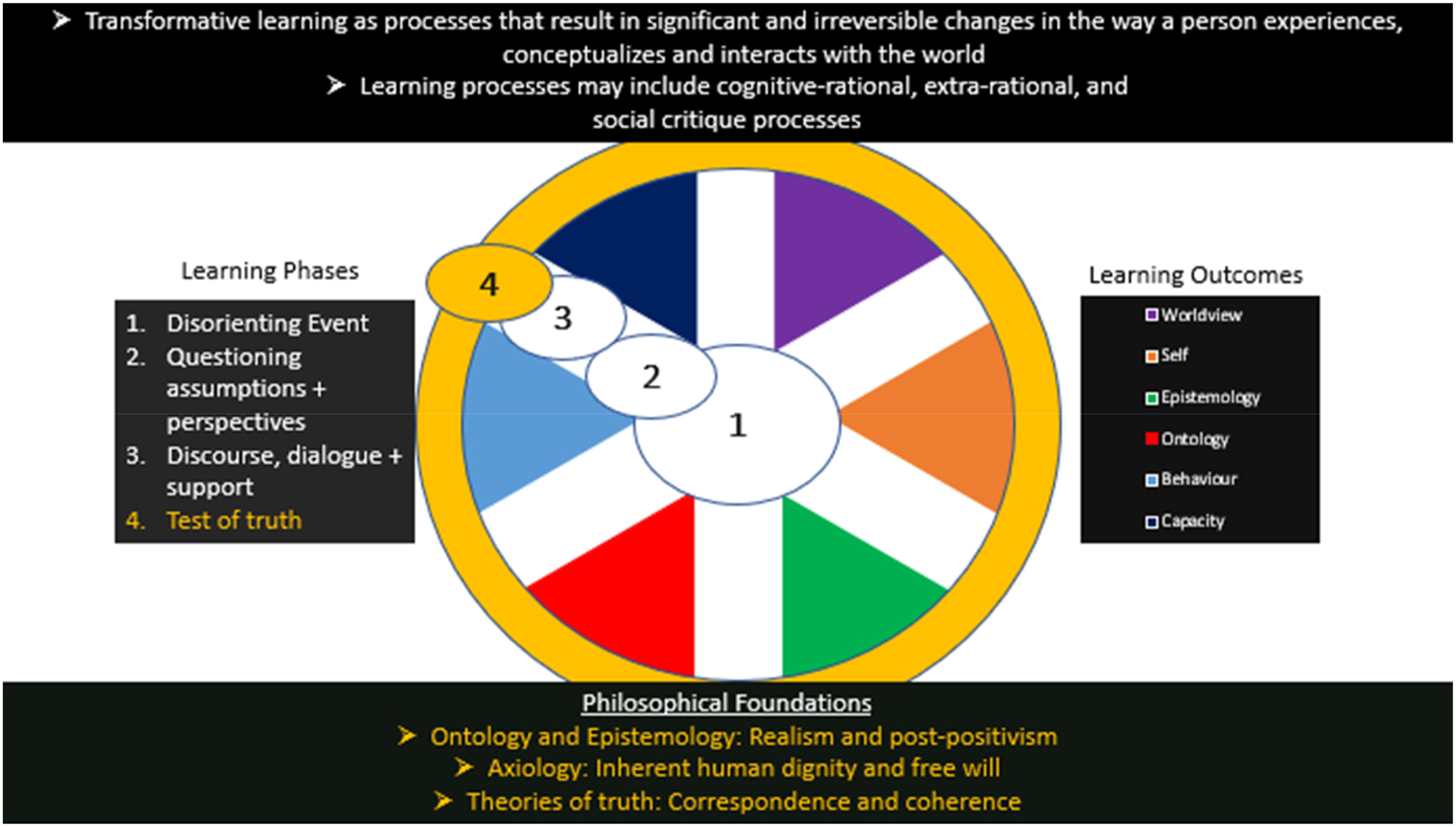
Although the phases of learning in this conceptual framework are not strictly linear, and can recur as needed (in alignment with the notion of lifelong learning), the three-phase model proposed by Cranton (2016) is adopted (see Figure 1). This approach simplifies the original ten-phase model described by Mezirow (1991) and broadens it to include alternative perspectives, including the extra-rational and social critique approaches mentioned above. The phases include 1: Disorienting event; 2: Questioning assumptions and perspectives; and 3: Discourse, dialogue, and support (Cranton, 2016, pp. 46-60); however, this conceptual framework also includes a fourth phase: the test of truth. The specific learning outcomes (see Figure 1) are based on Hoggan’s (2016b) review of relevant literature within the field of transformative learning.
Although this visualisation is a simplistic reduction of various complex and integrated learning processes and outcomes, it is intended to depict the main features of a conceptualisation of transformative learning that includes the test of truth. The positioning of the test of truth on the outer rim of a wheel with various spokes represents the criticality of this distinct learning phase, regardless of which learning processes predominated, and which learning outcomes were obtained.
Conclusion
The inclusion of the test of truth in this conceptual framework hereby provides an explicit criterion for evaluating the particular qualities that warrant new or revised ideas, and related values and beliefs as “more true” as Mezirow, 2018[2006], p. 116) desires. It is however essential to note that this does not necessarily entail that learners will naturally employ sufficient epistemic reasoning to avoid adopting false beliefs. Learning experiences are always context-bound and open to a range of factors that can negatively impact epistemic reasoning. These include but are not limited to perception of social and emotional pressure, health, hunger or desperation, lacking or inaccurate information, personal bias, or an inability to comprehend the issues at hand due to time pressure or cognitive limitations. The role of the educational institution, educator, or facilitator of learning in this situation is to provide a context that actively mitigates, where possible, the risks to robust epistemic reasoning. An essential component of this includes effective role modelling and the cultivation of a safe environment (Cranton, 2016) that ethically supports learners to engage in the process, if they are so inclined.
Given that this conception is positioned within the fallibilist tradition, new or revised ideas, and related values and beliefs should be considered provisional and revisable. The point is not that the learner should refrain from adopting strong convictions, but that they should acknowledge that there may be more to learn and therefore maintain an open mind. In this manner, the transformative process may be ongoing, and lifelong, as the learner continues to consider different perspectives, seek new corresponding evidence, and explore more coherent explanations.
These adaptions to transformative learning theory provide a tentative framework, that requires conceptual validation through empirical studies. Furthermore, additional theoretical development may also strengthen the framework and thereby support its applicability to researchers, educators, and educational leaders in actively responding to issues associated with the post-truth situation. It is my contention that even though the pursuit of truth in this conceptualisation may only ever end in approximation, the explicit focus on truth should be a central educational feature in this cultural moment, nonetheless.
Footnotes
Declaration of Conflicting Interests
The author(s) declared no potential conflicts of interest with respect to the research, authorship, and/or publication of this article.
Funding
The author(s) disclosed receipt of the following financial support for the research, authorship, and/or publication of this article: USQ Postgraduate Award Scholarship.
