




Abstract
Twenty-first century transformations have taken place within the framework of globalisation of the economy, the spread of information technology and global migration resulting in increased cultural diversity in many societies. This qualitative study investigated perspective transformation in 18 research students, from Australia, Hong Kong SAR, and Sweden, participating in an international online course by using Mezirow’s theory of perspective transformation and Kiely’s six forms of transformative change (intellectual, moral, political, cultural, personal, and spiritual). The approach to learning facilitated global networking and a commitment to support growth in the students’ research practice. Validating the link between research students’ learning experiences and perspective transformation theory encourages educators to develop future online educational materials to promote cognitive flexibility and reflexivity and increase students’ cultural awareness to inform their research practices.
Twenty-first century transformations have taken place within the framework of globalisation of the economy, the spread of information technology and global migration resulting in increased cultural diversity in many societies. Hence, the progress of societies is measured not as industrial societies, but as knowledge or information societies. Thereby, connecting to one’s culture and global knowledge is an invaluable social service, regardless of ethnicity, income, education, or age. Clifford and Montgomery (2015) argued that envisioning the purpose of higher education is now more important than ever not least as higher education institutions can be arenas for highlighting the challenges of global inequalities. Increasing evidence suggests that international and cross-cultural experiences positively impact personal and professional development as well as students’ understanding of self as global citizens. However, committing to overseas international exchange is not always viable for students due to financial and personal reasons. This gives rise to the value of internationalisation at home (IaH) approaches that will withstand the reduction in student mobility while enabling the provision on international and intercultural learning experiences (Saravanan, 2020).
Internationalisation at Home (IaH) is a concept where learning purposively incorporates cultural encounters (i.e. persons from different cultural contexts) into its curriculum to interact formally and informally; thus, facilitates intercultural and international dimensions into curriculum and learning activities without students leaving their home universities (Wächter, 2003). The IaH activities can be organised as campus-based initiatives during workshops or seminars (Soria & Troisi, 2014) or as online cross-cultural webinars (Carlson et al., 2019; Leung et al., 2021). With the global access to Information and Communication Technologies (ICT), innovative ways of collaborative learning have emerged, suggesting educational opportunities at a lower cost irrespective of the physical location. ICT enables virtual IaH, which can increase access and create an efficient learning process.
Kiegaldie et al. (2022) presented collaborative online learning (COIL) as co-created; sharing syllabi and teaching between two or more international faculties, emphasising experiential and collaborative learning with students engaging with international peers. COIL can thereby facilitate partnerships, increase cultural competence and global awareness (Kiegaldie et al., 2022). This is further stressed in an article by Munoz-Escalona et al. (2022) arguing the importance for academics to educate students to become comfortable in a multicultural space and understand cultural differences, which are significant aspects for enhancing societies’ wellbeing. For research students this might be specifically important as research studies are usually conducted at national levels but with the objective to be globally relevant, transferable, and understood (Leung et al., 2017). It is therefore vital to develop opportunities for cross-cultural experiences that challenge research students to think beyond their current view of self and inform new ways to critical think about how to conduct research.
Mezirow’s Theory of Perspective Transformation as a Conceptual Framework
Mezirow’s theory of perspective transformation is regarded as seminal work that contributed to the most robust theoretical explanation of learning in literature focused on transformative learning (Hoggan et al., 2017). Appreciating that the subsequent decades of work have resulted in a metatheory of perspective transformation (Hoggan, 2016), Mezirow’s theory has proven to be a great asset to the research and scholarship in the field of adult education. Moreover, given it has provided a sound theoretical base for understanding, this learning phenomena enable learning and change on both an individual and collective level (Hoggan et al., 2017).
Mezirow (1994) presented two paths toward perspective transformation: (1) a set of progressive transitions in related meaning schemes; (2) a sudden reversal in figure and ground. Both provide profound insight into the premises or presuppositions of oneself, which can distort or limit understanding (triggered by a disorientating dilemma) and involve a broader view of the origin (Mezirow, 1994). As such, it involves changing the nature and consequences of assumptions (Mezirow, 1994).
Perspective transformation may be at an individual, group or collective level and occurs in response to an externally imposed disorientating dilemma to describe how leaners construe, validate and reformulate the meaning of their experience (Mezirow, 1990). The main goal of transformative learning is for learners to develop more valid meaning perspectives for interpreting experience and guiding actions involving ‘a critique of previously unexamined premises regarding oneself’ (Mezirow, 1990, p. 22). Further, Mezirow suggested that learning occurs by expanding present frames of reference, learning new frames of references, and by transforming points of view or habits of mind. Thereby, to understand transforming points of view and habits of mind, the interpretations learners assign to events are necessary to make meaning of their experiences.
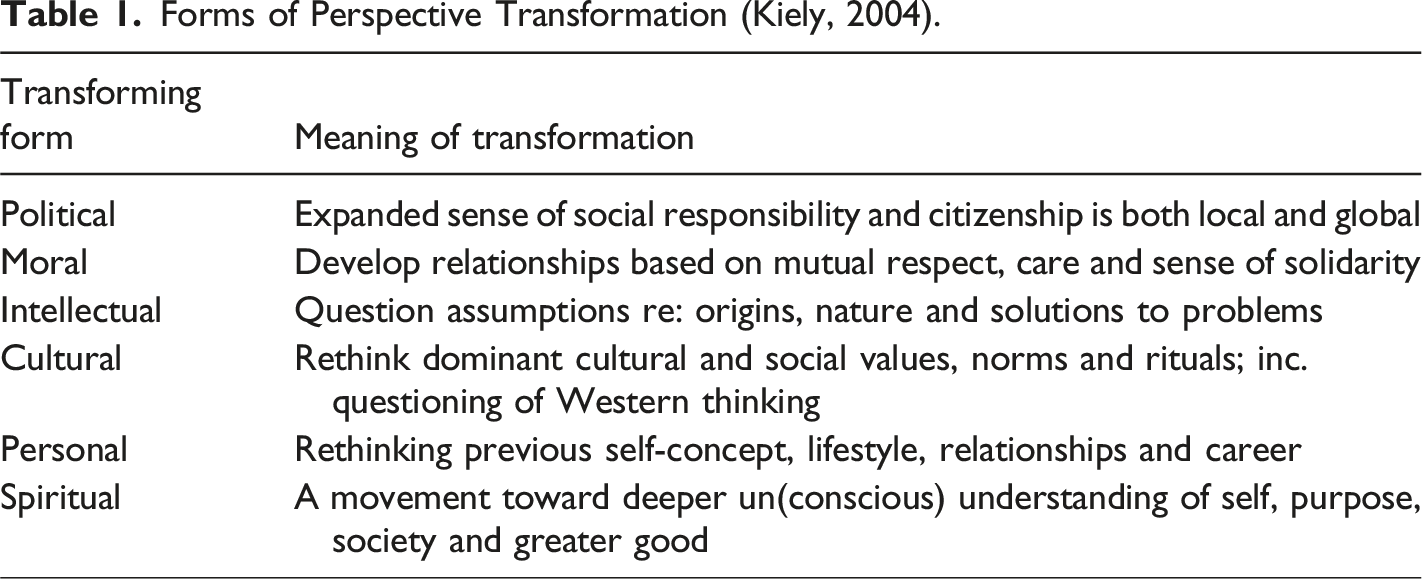
Forms of Perspective Transformation (Kiely, 2004).
Chandra et al. (2022) also described how transformational learning helped students gain awareness of collective held social and cultural frames of reference; leading them to reflect and consider alternatives to explain how individual’s often taken-for-granted frame of reference can be challenged to become more inclusive and reflective. Thus, universities are encouraged to facilitate learning opportunities that may enhance students’ cultural sensitivity, greater awareness of personal bias, and enable a shift in worldviews (Leung et al., 2021; Lie Ken Jie et al., 2022; Walters et al., 2017).
Given this premise, the current study aims to explore aspects of perspective transformation related to cultural awareness in a cross-cultural cohort of research students participating in an IaH activity. The study explored the research question:
Which forms of perspective transformation did research students experience after participating in an internationalisation-at-home activity conducted as a cross-cultural course?
Methodology
This is a qualitative, explorative study using written postings as data by research students during a cross-cultural web-based course. Data were deductively analysed using Kiely’s six forms of perspective transformation (2004). While different outcomes of perspective transformation were previously described by Kiley (2004), we elaborate on its application to higher degree research students participating in an online IaH activity.
Context of the Study
Based on principles for IaH, we developed the online course ‘Cultural Awareness in Health and Social Care Research’ for higher degree research students, which focused on cultural awareness in health and social care research. The course took place in three countries: Australia, Hong Kong and Sweden.
The purpose of this course was to broaden and deepen students’ understanding of cultural awareness, to critically appraise research and the research process in health and social sciences. Underpinned by the IaH pedagogy (Chan et al., 2017), the course consisted of five synchronous and asynchronous learning opportunities. Preparation for participation in the interactive webinars was via pre-readings of scientific articles focusing on different aspects of cultural awareness that aligned with intended learning objectives of each session.
Participants met fortnightly for a webinar that was approximately 1 hour in duration. Each webinar focused on specific aspects of cultural awareness relevant to the research process, such as identifying the way culture influences research objectives, research questions and design, principles for recruitment, sampling of participants, analysis, and ethical research practices. The webinars were facilitated by academics from the three universities in each country. Real time discussions were followed by specific questions posed at the end of each webinar to prompt individual critical reflection and reasoning of issues. All students posted their responses on a discussion board in a closed Facebook group. In addition, students were allocated to mixed international peer learning groups of six students, based on their research topics and/or research methodologies. Over the duration of the course, the peer learning groups met to discuss their learning and creating a multi-media group presentation on a topic of their choosing, aligned with the course intended learning outcomes.
Participants
Research students at three universities in Australia, Hong Kong, and Sweden were invited to participate in the elective web-based cross-cultural course. The inclusion criteria were (1) being a full- or part-time research student enrolled in health and social care science research education programs and (2) meeting levels of English as dictated upon admission to participating universities. This resulted in a total of eighteen participants (six students from each university) all participating in programs requiring a thesis as the final exam. Altogether, they were a diverse cohort in terms of age (range 26–56 years), nationality, gender (14 women and four men), and previous professional experience (e.g. registered nurse, dentist, and social worker).
Data Collection
Data was collected from students’ responses to two open ended questions (created by the course faculty) after each webinar on the discussion board: (1) What was the single most enlightening, surprising, or disturbing thing you reacted to from this week’s webinar and/or readings, and why? (2) What question(s) or single idea or concept remains unclear in your mind? The questions represented fundamental questions to empower students to reflect on their cultural biases. Questioning of this sort, as Kiely (2004) states, may encourage students to ‘do something about it’ (p. 7). It was made clear to students that their responses to these questions were not part of the course assessment but an important element of their learning experience.
Students were asked to keep their postings rather short between 150–300 words, as a guideline only, thus averaging 170 words per posting. Students were purposefully not provided with detailed guidelines for posting beyond making a request for them to all answer the two questions. Not enforcing word limits, frequency expectations or imposing detailed instructions for engaging in the discussion board aimed to minimise the likelihood of students feeling overwhelmed and detract from their preparedness to engage. These responses were personal reflections with students drawing on content discussed in the webinars, course readings and past experiences to offer detailed, authentic accounts.
As the responses were captured via a discussion board format, participants extended their critical reflection by considering the views of their peers and engaging in active dialogue resulting in a discussion post thread. The individual posts and interaction among students on the discussion board for the duration of the course provided examples and explanations of their experiences.
Data Analysis
Directed content analysis was used for this study given it is regarded as being most appropriate to use when existing theory or prior research about a phenomenon would benefit from further description with the aim to validate or extend a theoretical framework (Hsieh & Shannon, 2005). For the current study, directed content analysis was guided by Kiely’s (2004) six forms of perspective transformation. This was done to gain new perspectives of transformative learning by focusing on certain aspects instead of the entirety of transformative learning (Mälkki & Green, 2014).
The directed content analysis involved the following steps: First the postings were read by the first and last author to gain an initial impression of participants’ experiences in the course. Second, the text was then sorted into categories corresponding to the six forms of perspective transformation and participants’ quotes were selected supporting each of the categories. Third, the first and the last author conducted a second reading of all the postings to check if any text had been missed. The final step included a review by all authors and a discussion to agree on the final findings. Further, to formalise the deductive approach, a holdout sample of data (a discussion thread in response to end of webinar questions), was not included into the initial data analysis (Hyde, 2000) but used to test the tentative findings and then for finalising findings.
Strategies of Rigour
We followed recommendations by Kitto et al. (2008) concerning interpretative rigour, procedural rigour, and reflexivity. To establish interpretative rigour the research team continually assessed findings to ensure it was grounded in the data and accurately represented the participants’ descriptions and experiences. To further minimise risk for bias we used not only independent coding by the first and last author but also used several subsequent rounds of team coding and discussion which in turn facilitated researcher reflexivity ensuring that data corresponded to Kiely’s six forms of perspective transformation.
Procedural rigour was achieved by detailing information on the IaH pedagogy, the participants, and how we collected data. Further, we addressed reflexivity related to our positions as researchers by clearly stating to participating students, that we were not to engage in the discussion board or comment on postings as this was designed to be a space solely for peer interaction.
Ethical Considerations
The institutional research ethics committees of all three universities (anonymous) approved this study. Verbal and written consent of students in the study was completely voluntary and explained their right to withdraw at any time with no negative repercussions. This was particularly important to the researchers, given some were participants’ research supervisors and researchers were sensitive to hierarchical positions with students.
The students were made aware that the postings would be used as data sources for research. To enable researchers to utilise the content of the students’ posts as qualitative data, it was essential that these were created without any form of intervention from the researchers (Merriam & Tisdell, 2015). It was also stressed that allowing the researchers to use students’ postings was voluntarily. At any time, students could ask that their postings were to be omitted; however, this option was not requested by any student. Thereby, all students that took part in the course allowed us to use their postings.
Findings
This study illustrates how each participant described instances of transformation through their posts, which was interpreted as experiences of at least one of the six types of perspective transformation as parts of an emerging global consciousness (Kiely, 2004). Participants’ reflections are interrelated and used to exemplify the connection between perspective transformation theory and the online learning experience.
Political Transformation
Kiely (2002) explains characteristics of political transformation in terms of increased global consciousness. Similarly, our study participants reflected on how engagement in the research course expanded their understanding of themselves beyond their initial identification as belonging to a discipline, a university, and their country; to being a member of an active global community with a shared desire to connect to peers and develop their understanding of culture relative to the research process. This expanded sense of citizenship was clear for all participants demonstrated by a willingness to educate peers on their country’s major health challenges. The need to question individual’s understanding of citizenship, particularly relative to culture was apparent: In our country we still struggle to grasp our own culture and indigenous population let alone have international cultural awareness which saddens me, we have so much work to do. (Participant 4)
The social responsibility embedded into political transformation came to the fore with a participant sharing: We as humans are inclined to sort individuals into boxes constructed out of religion, ethnicity, language and gender… could it be that the huge variety is too much for us to handle? Is global diversity overwhelming and does it make us feel insecure? We have to be fearless about cultural differences. It is time to call on all our courage to face the challenge of cultural diversity by being brave. (Participant 5)
Moral Transformation
One characteristic of moral transformation is described by Kiely (2002) as increased sensitivity to diverse cultural perspectives. For the participants in our study this can be illustrated by the development of affiliations with peers from other countries in a sensitive, respectful manner over time led to introspection where one’s own approach to engagement with others was considered: If we experience the world (and every issue within it) either black or white, it becomes difficult to see different ways of being in different cultures…. If we experience the world from the point of view that there is no right path (truth), but several descriptions of veracity, it might invite us to not see differences in cultures, instead the various descriptions of how we exist in the world. (Participant 7)
The development of working relationships from other higher degree students led participants to observe: We need to explore, understand and widen our cultural competence before comparing, evaluating or observing to see that normality differs… knowledge should be taken with respect and dignity. (Participant 3)
An example of this moral sensibility was looking for ways to connect with peers who were challenged by access because of their country’s technology infrastructure challenges.
Intellectual Transformation
Intellectual transformation describes how participants question the status quo and challenges assumptions of previous knowledge (Kiely, 2002). In the current study, participants started to reflect on their own understandings of the construct of cultural awareness relative to their research topic and knowledge of the research process: ‘This course has opened up our minds in way of thinking, critically analysing and understanding’(Participant 9).
The activities embedded into the online course, designed to encourage and challenge students’ understanding of their approach to engagement with research embodied intellectual transformation with a participant acknowledging: I’ll often take my own experience as the reference point for everyone else without even thinking which I now realise is unreasonable and very narrow sighted. (Participant 1)
The questioning of assumptions and understanding of how contextual, cultural factors can shape and influence research problems was consistent in participants reflections. The connection between educational pedagogy, course content and creation of a positive learning environment speaks to influencing intellectual transformation with a participant sharing: I love the ‘learning by doing’ method of this course – that we learn about cultural diversity, awareness, and competence by staring it in the face together. (Participant 3)
Cultural Transformation
Given the course had specific intended learning outcomes designed to increase participants level of cultural awareness, it is not surprising yet still important to confirm that all participants demonstrated cultural transformation explained by Kiely (2002) as a recognition of social and cultural capital. A considerable volume of evidence in participants reflections across the course affirmed this type of transformation as the complexity and conviction increased as the course progressed. This growth is exemplified by a participant in the final week of the course sharing their thoughts in one posting It is interesting when you are a member of the dominant culture that your culture is invisible to you – you take it for granted. It is only when you are no longer part of the dominant culture that you become more conscious of yourself and your own culture. (Participant 11)
The course enabled participants to consider their own cultural norms and consider how their values and ideologies fit after engaging with peers who may not share their reality: When analysing one’s individual culture we may in fact be investigating several cultures within the one the individual. We use categorisations of specific phenomenon like; beliefs, attitudes or behaviours and put them into folders to make things clearer when really, people in groups may vary in many ways. (Participant 6)
The participants may not necessarily have changed their understanding of their own culture but have a raised consciousness of the importance of having their newfound understandings of culture manifest in their research practices.
Personal Transformation
The re-evaluation of an individual’s identity and choices was apparent from participating in this course as it resonated with Kiley’s (2002) description of personal transformation as increased confidence and sense of direction. One example was revealed in a posting by one participant sharing a revised aspiration in view of his/her learnings: My ambition is to be accepting, curious and respectful toward my fellow human beings in the spirit of being culturally competent. (Participant 7)
Moreover, personal learning journeys were captured by each participant in reflections across the duration of the course. This process was quite powerful as one participant shared: Over the years my understanding for research traditions and methods has been hiding in plain sight. It is right here in front of me, but I’m used to moving in a defensive crouch position, so I felt unprepared to stand up straight and declare who I am… I am going to strive to become a proud researcher who can master qualitative, quantitative and mixed methods. (Participant 5)
The impact of the online learning course on personal transformation was evident in a variety of ways with a participant sharing: I will not deny my feeling of vulnerability at times in putting myself ‘out there’ however that has been a learning experience and heightened my awareness of language and nonverbal skills. (Participant 2)
Spiritual Transformation
A significant shift in a participant’s spiritual frame of reference, which according to Kiely (2002) is characterised by a movement towards deeper understanding and reflection, was illustrated by the following citation: This course has given me new perspectives. It doesn’t make sense to me yet, but the new perspectives and the feeling I have about it is hard to explain. The feeling is deeper in dimension, it almost feels ‘organic’. (Participant 5)
The inability to articulate exactly what the new perspective was spoke to a progression toward a deeper unconscious understanding of self.
Indeed, the search for a level of spirituality in experiences was identifiable in one participant’s reflection mid-course: The example in today’s webinar illuminates similarities in human beings as it comes to existential questions and not just cultural differences …from words into action, from my head into my heart – a long way to go? (Participant 8)
As participants engaged with the curriculum, each other, and faculty, they were re-examining their understanding of self. The course enabled spiritual transformation by facilitating deeper meaning and understanding of themselves, their research, and their role in their current social structures as well as newfound self-understandings in view of their learnings from participation in the course.
Discussion
This study affirms the role that learning experiences have in enabling professional and personal growth and development, which in turn creates a fundamental shift in research students’ understanding of their lives. The cross-cultural course was not designed to purposefully construct a learning experience that would result in perspective transformation. However, it subscribed to the notion of configuring learning experiences that assisted learners to examine their meaning with the knowledge that this may be productive for themselves, and an opportunity to be confronted with their own praxis and thus engage in change (Clifford & Montgomery, 2015).
The use of six transforming forms described by Kiely (2004) enabled an increased understanding of various ways that research students experienced perspective transformation by participating in the cross-cultural course. However, we acknowledge that we cannot predict how the students will use these new ways of perspectives in their future research work. Therefore, we cannot confidently state that this IaH course has resulted in how Hoggan (2016) described transformative learning as significant or irreversible changes in the way individuals conceptualise and experience their world. Still, Mezirow’s (1990) theory of perspective transformation was suitable to recognise and understand the assumptions that students reconsider and amend their engagement in this form of learning.
Our students’ perspective transformations came through an iterative process: participants engaged with concepts through pre-readings, then after each webinar, re-examined their own attitudes and beliefs, and progressed to collaborating with their peers and contributing to discussion forums. An example of cultural transformation can be seen when student engagement with peers led to changes in their own values and ideologies, which in turn affected the research process. Thereby, our findings align to Mälkki (2011) who argued that the social context aids reflection as it allows for alternative thoughts to be tested and discussed if the atmosphere is supportive. Moreover, Leung et al. (2017) concluded that when students worked as critical friends their individual experiences contributed a collective desire to identify similarities and differences in their research cultures.
Practical Implications
Mezirow (2003) asserted that critical reflection is vital in adult education and needs to be combined with critical discourse where individuals use their peers’ experiences to justify their own assumptions. Unlike previous traditional postgraduate research courses, our IaH approach builds on changing attitudes of culture, not merely knowledge of it, through student collaboration rather than through didactic guidance by instructors. As such, this knowledge guides authors’ continuing development of similar courses. Indeed, authors assert that the key to perspective transformative learning, as an essential attribute of researchers, is the ability to reflect on experiences to improve practice (Cahusac de Caux et al., 2017; King et al., 2022).
Reflective practice is identified in educational literature as the ability to purposely explore personal experience, beliefs, or knowledge to increase understanding, promote personal growth and improve professional practice (Cahusac de Caux et al., 2017). This learning experience encouraged students in our study to focus on their awareness of known cultural commonalities and diversities and engage with international peers in reflective processes to challenge their own assumptions and beliefs through gaining the perspective of others.
Whilst the findings are presented as individual dimensions that capture specific perspective transformation, it is valuable to also consider the transforming forms in a collective (relational) way to acknowledge that participants may have had experiences that encompass one or more transforming forms. For example, a participant may have shared insights into one learning experience that attests to collectively having personal transformation and spiritual transformation. These practical implications of the study findings challenge faculty to create educational experiences that will enable student agency and incorporate strategies into the curricula that will empower students to collectively manage the change in attitudes and behaviours that comes from experiencing perspective transformation.
Working with their peers facilitated an openness to transformation which initiated students’ shifting worldview. This is comparable to how Cahusac de Caux et al. (2017) presented learning communities to promote higher order thinking enabling students to increase their capability to verbalise their internal reflective thinking which leads to improved analysis and organisation of ideas. Hullender et al. (2015) presents the idea that such a move from lower cognitive ways of thinking to a more critical analysis of a situation by confirming that various perspectives and positions exist, increases the possibility that a more transformative experience might occur. Indeed, Mälkki (2010) argued that the social context of peer learning groups support reflection by creating space for discussing alternative interpretations and challenging what is already known and perceived given that there is a safe and accepting atmosphere in a group. The latter study found that dialogue among peers and with community service partners played a significant role in the learning process (Mälkki, 2010).
Limitations
It is unrealistic to assume that taking action to transform one’s lifestyle will be a smooth or straightforward process for the transformed mind (Kiely, 2004). As the students in this program volunteered to participate, they have signalled that they were not content with stability and standardisation and were prepared for change by virtual engagement through their involvement in the course. In other words, our findings may not be transferable to other students, who may not have similar preparedness.
The long-held view that the success of online discussion boards is dependent on the level of participation, degree of reflection, learning styles and length of post (Kay, 2006) resonated with this course as there was variation in the length and depth of posts from participants’ responding to the two open ended questions after each webinar. Our study found that participation in the IaH activity conducted as a cross-cultural online course enabled perspective transformation. However, the generalisation of the relationship between each participant’s learning experience and their perspective transformation across the six specific forms limits the explanation of personal transformation patterns for different learning content and contexts. It is acknowledged that it is unclear from the findings which path toward perspective transformation, as previously explained, participants in the course took.
Recommendations for Further Research
Based on the present findings, future research may consider the impact of sociodemographic factors and peer interaction on an adult learner’s perspective transformation across the intellectual, moral, political, cultural, personal, and spiritual forms. Opportunity exists for longitudinal research to explain how participants integrate their evolved perspectives into their approach to their work as researchers. The findings provide evidence that validates the link between higher degree students learning experience in an online, cross-institutional course and perspective transformation theory. Future research may draw on the use of Kiely’s six transforming forms (Kiely, 2004) as a foundation to further develop online educational materials to prioritise and enable perspective transformation in a learning experience.
Conclusions
This study contributes to the body of evidence by demonstrating how an international, cross institutional course has enabled adult learners to experience perspective transformation and the potential of internationalisation at home courses in having impactful learning experiences for research students. This form of internationalization at home course invested in faculty and student relationships through an approach to learning that has facilitated networking and created new communities through the commonality of research training and commitment to support growth in research practice. As such, it responds to the demand for internationalisation education to be comprehensive, intentional, and meeting goals to enhance the quality of education and research and make a meaningful contribution to society.
Footnotes
Acknowledgements
We would like to thank all the research students who participated in this study for sharing their experiences.
Author Contributions
All authors have been actively involved in the entire process of conducting the research and each person has contributed to the preparation of the final product. As such, all authors are responsible for the content of this manuscript.
Declaration of Conflicting Interests
The author(s) declared no potential conflicts of interest with respect to the research, authorship, and/or publication of this article.
Funding
The author(s) received no financial support for the research, authorship, and/or publication of this article.
Ethical Statement
