




Abstract
1. Who am I?
2. Where do I belong?
3. What am I called to?
These three questions represent the narrative shifts that are the outcomes of the Identity/Belonging/Agency (IBA) transformative development framework. The IBA framework emerged from the author’s critical reflections on fiction reading and dialogues in 12+ community conversations to explore everyday global African/Black experiences. It responds to the self-inquiry: How do global Africans/Black peoples experience developmental transformation in the context of social marginality? It conceptualizes that the key developmental tasks of global Africans/Black peoples lies in claiming identity through differentiation from dominant narratives of marginality, belonging through locating self-in-society and community, and agency through a focus on self-in-transcendence. The IBA framework is proposed as core to understanding how global Africans/Black peoples, and perhaps other socially constructed racialized groups, can choose to move from marginality to personal as well as social transformation through their agency.
The role of reflection in meaning-making, personal development, transformation and as a medium to construct/deconstruct/reconstruct social identities has been articulated across the spectrum of human sciences from Education to Human/Organization Development, Transformative Learning/Adult learning, Teacher Training, English Language/Literature, Health Sciences/Nurse Education, Spirituality/Theology, Developmental Psychology and other fields in the humanities and social sciences. In short, the power of critical reflection, for our learning, development, and transformation in a variety of mediums such as dialogue, contemplation, meditation, nature, arts-based therapy, embodiment and the expressive and visual arts, including fiction and non-fiction writing and storytelling in all its forms has been clearly articulated. (Adji, 2021; Hoggan, 2009; Mezirow, 1998; Miles, 2010; Narayanasamy, 2015; Parini, 2016; Redmond, 2016; Scho;n, 2016; Taylor & Cranton, 2012).
However, an area that has been less articulated for its role in transformation is the impact of reading fiction and literature (Kostara, 2022). The limited existing literature on fiction reading as a source of transformation, has shown that fiction reading, specifically of short stories, promotes transformative learning by serving as an intellectual and emotional catalyst for both critical reflection and self-reflection in an educational context. Specifically, fiction reading as a catalyst of transformative learning leads to three major outcomes: critical reflection, new perspectives and promoting change (Hoggan & Cranton, 2015). Moreover, fiction reading and literature has been shown to inherently evoke transformative learning regardless of a formal educational context, due to its key features that promote transformative learning. This includes evoking emotions and imaginal explorations of truth, the need for change, the shadow and complexities of humanity and allowing space for marginal voices in multicultural contexts to be surfaced (Kostara, 2022).
This article hones in on the use of fiction reading as a doorway to transformative learning for global Africans/Black peoples who experience social marginality. It was prompted by the experience of fiction readings paired with community dialogues at a series of short story book reading events between 2017 and 2022. As a result of my critical reflections on the book reading and ensuing dialogues in which community members described the impact of the experience on them, I conceptualized a developmental framework proposed here, the Identity/Belonging/Agency (IBA) framework. The proposed framework describes the transformative development process global Africans/Black peoples may experience in the context of critically reflecting on their socially marginalized identities. It proposes a response to the inquiry question that emerged for me during the book readings and community dialogues: How do global Africans/Black peoples experience developmental transformation in the context of social marginality?
I first outline below my standpoint in the context of this paper, which is pivotal to the critical and analytic reflexivity that I turned to. I then chronicle my critical reflections, and observations of community members’ descriptions of their experiences, which led me to document my interpretations of narrative shifts about identity, belonging and agency. These narrative shifts underpin the proposed IBA framework. Taking inspiration from analytic autoethnography (Anderson, 2006), which integrates an analytical agenda and commitment to theorizing alongside self-reflexivity, I then outline how the IBA framework may align and fit within existing theories and frameworks with similar developmental goals such as constructive-developmental human development, liberatory transformative learning lenses and ultimately Afrocentric developmental perspectives. As a result, I describe IBA as a transformative development framework because it is rooted in transformative learning and human development theories. It is Afrocentric, because it centers the experiences of global Africans and Black peoples in the diaspora first and foremost. By global Africans, I mean that community of peoples born on or off the African continent who live a significant part of their lives in global spaces, usually but not necessarily first or second-generation African migrants. By Black peoples, I mean generational African descendants of diverse backgrounds and identities who identify with a Black diasporan identity. I end with concluding thoughts on the limitations and contributions of this process and proposed framework.
Standpoint: Coming to Short Story Fiction Writing and Reading
I am a Black woman who was born in Germany and spent my first few years in Europe. I spent my formative and schooling years, including some post-secondary education, in Sierra Leone, West Africa, the country of my lineage. I then immigrated to Canada as a result of civil war, but also because I have Canadian-born siblings. This made me both a refugee and a first-generation immigrant. From this ground, I have experienced (acutely in the context of Sierra Leone’s civil war), the global world system’s oppression and colonization/neo-colonization of Africa and Africans as well as the experience of being racial other in the diaspora.
In addition, I have long been drawn to the interpretivism schools of thought—understanding experience—for knowledge-building and knowledge-creation. Early in my scholarly journey, I was drawn to ideas such as: • “what is most personal is most general” (Rogers, 1970) • “it is the job of good sociology to reveal the public issues inherent in troubles personally felt” (Mills, 1959). • “identifying possible inconsistencies and inner contradictions is a powerful way to examine our own inconsistencies and inner contradictions” (Argyris, 2005).
This led me to explorations and qualitative research grounded in narrative inquiry, autoethnography and lived experience research. A desire to reach beyond the academy and “write for the public” further led me back to creative writing, a craft I had dabbled with and won prizes for since grade school. I found myself drifting consistently to creative fiction writing as a means to express my inner reflections and sensemaking of experiences of marginality. I also turned to fiction over creative non-fiction to expand beyond the bounds of my own experiences through a diversity of characters and to engage the imaginal of what could be.
As a result, I wrote and released Identities (Gilpin-Jackson, 2017), Ancestries (Gilpin-Jackson, 2019), and Destinies (Gilpin-Jackson, 2022), over a 6-year period between 2017 and 2022. The first two were short story collections about global African/Black experiences and the third was a flash fiction collection focused on the same content and audience. I refer to them collectively as “the fiction narratives” throughout. After the release of each book, I hosted several book signings, community conversations and workshops (collectively, over a dozen community dialogues) in which groups of global Africans/Black peoples engaged in conversation with the stories and each other. The seed for the IBA framework was sown in these community dialogues as my observations raised the inquiry question: How do global Africans/Black peoples experience developmental transformation in the context of social marginality?
Over the journey of hosting book signings, I found myself shifting from fiction writer and reading host to a facilitator of transformative learning by engaging in questions and dialogue to explore personal disorientations and social critiques arising during the community dialogues. I further took on an autoethnographic stance by documenting my reflections after each event, as my intention to engage in deeper understanding solidified. This analytic reflexivity represented an intentional shift that entailed “self-conscious introspection guided by a desire to better understand both self and others through examining one’s actions and perceptions in reference to and dialogue with those of others” (Anderson, 2006, p.382). Thus, my critical self-reflections as well as reflections on participants’ reactions and dialogues and the analysis presented are fully informed by my own subjectivity and visibility as a global African/Black person alongside participants in the community dialogues.
Book Readings: Observations of Shifting Narratives
At each community event, I read excerpts from the fiction narratives and invited reflections. Each reading presented surfaced tensions and dilemmas inherent in everyday lived experiences of global Africans/Black peoples. The core themes of each book are: Black identity politics/dynamics in Identities, belonging and rootedness in Ancestries and agency in Destinies. Through identity, belonging and agency were inherent themes of the readings; the ensuing dialogue deepened these core themes as participants unpacked their related disorienting dilemmas and tensions. Furthermore, during the exploration of these tensions, specific narrative shifts started to emerge that I documented over the years. I noticed that there were particular stories or moments that drew the community attendees into deeper reflections and dialogue. I observed new perspectives were being named that pointed to the possible transformative development process of attendees and led to my further conceptualizing of the IBA framework. The shifts I observed and my critical reflections underpinning the IBA framework are described below.
Locating Identity: Shifting, Where are you From? To Who am I?
As soon as the elevator starts its ascent, I hear the voice on my right say: “Where are you from?” I feel the warmth rising from my stomach as I go into an amygdala hijack. I stare even more stoically ahead in the hope that the voice isn’t directed at me, even though my heart already knows the answer. The voice floats again through the veil of the battling emotions assailing me. “Where are you from?” I feel my body turn to the left and hear my voice saying: “Do you get asked that randomly in elevators?!”… Before I could collect myself to say anything else, the doors open for me. I say pointedly: “Have a great day” and sashay off. I suddenly feel defiantly confident, saying with my walk: I belong here. (Gilpin-Jackson, 2017, p. 5)
This snippet is from Identities, Story 1, Where are you from? I read it often at the Identities book signing events and each time, it evoked two significant emotive reactions from participants. First, participants reflected that the microaggression—an unconscious or conscious exclusionary snub, slight, insult or indignity (Sue et al., 2007)—of being asked where you are from was common and shared and marked the everyday ways in which systemic oppression and social marginality is experienced for global Africans/Black peoples. They underscored the consistency and prevalence of this experience in the fact that it happens early for global Africans/Black peoples who are second-generation children of immigrants, signaling to the social marginality ascribed to them. My telling of stories of related microaggressions my children experienced as early as kindergarten, Grade 3 and 4, which prompted them to initiate conversation with our family about their racial identity and belonging, consistently drew strong emotional reactions even in virtual conversations (tears, anger, sadness) and opened space for shared meaning-making.
Second, following one book reading, I was asked the question: How did you find yourself (and your voice) while living in communities that are mainly white with consistent marginalization of your identity? My immediate response was to question the notion of the need to “find self” which assumes that one is lost or from a socially marginalized identity perspective, that one is less human and so must find their humanity to engage confidently with others. My response, drawing on both texts in Identities and Ancestries was that one must not find oneself but know oneself and operate from a deep identity core. I still remember a collective gasp in the room when I said “I haven’t found myself. I KNOW myself.”
The ensuing conversations allowed us to talk about the narrative of “being enough” versus being “less than.” I was moved by hearing from global Africans/Black attendees how transformational it was for them to hear me say “I KNOW myself” and “I am enough,” as a portal for them to externalize the social narrative internalized by Black peoples that they are “not enough.” It was also the first time I had heard myself critique the idea of finding oneself and finding voice, as an unhelpful Eurocentric and dehumanizing view for global Africans/Black peoples because it reinforces notions of our disrupted histories. This particular encounter sparked my next observations, further amplified by Ngũgĩ wa Thiong’o, who was the closing speaker at the same conference where I did that particular book reading. wa Thiong’o issued a call to action to secure the base of our being from an Afrocentric knowing not a Eurocentric one, and then engage the world (wa Thiong’o, 2019). It also aligns with Black feminist thought that centers self-definition and self-valuation—the challenging of social stereotypes and intentional valuing of self by African-American feminists, including through centering Black ways of knowing such as, for example, focusing on texts by Black fiction writers over other literatures (Collins, 1986).
My critical reflection from Identities book readings and dialogues centered on my interpretation of the narrative shift in perspective from being subjected to and triggered by the narratives of exclusion and disempowerment implicit in Identity Interrogation renditions of Where are you from? To the Relational Connection and empowered stance of KNOWING self (Gilpin-Jackson, 2016). It was an overall turn as I have articulated elsewhere, to self-definition and differentiation from the social narratives of marginality and oppression (Gilpin-Jackson, 2020).
Locating Belonging: Shifting, What are you? To: Where Do I Belong?
The opening story in Ancestries imagines how a young bi-racial woman contends with the disorienting experience of displacement, triggered by being asked: What are you? The last time I ran away I was 15, pimply and in tenth grade. This kid Kevin had been staring at me whenever mom dropped me off but he never said anything to me. Until the morning of the day I ran away when he asked me at recess: “Hey Zoe! What are you?” I didn’t even know he knew my name. Hey Zoe! What are you? The tape plays in my mind now like it did then. I start walking towards the restaurant. I try to kick some leaves but they are too soaked to move so I kick at some stones instead, then flinch at the déjà vu. My feet are recreating the same movements they’d beat along the sidewalk path all the way home on that similar autumn day when I ran away. (Gilpin-Jackson, 2019, p. 1)
This character allowed for my critical reflection and dialogue with the community about spaces and fractures of belonging within and outside global African and Black communities. The story was inspired by a relative of mine, who self-identifies as Black, as well as mixed race/multi-racial/bi-racial and is constantly asked: What are you? The key reflective moment in Ancestries happened when that relative, who also attended a book reading, shared further about their own qualitative research project describing the search for belonging: “A fundamental aspect of our humanity is our need to belong” (Kanu, 2015:2). A sense of belonging is highly important for a person’s mental health and wellbeing. People form a sense of belongingness over time between both other people and their social environment, belongingness is expressed through shared understandings and commonalities (Kanu, 2015:3). A sense of belonging is formed in a number of ways but perhaps one of the most common is the belonging we associate with home and our place of birth. The importance of a rooted home came with the move away from nomadism as humans developed a strong link with a geographical place (Kanu, 2015). Having both a stable environment and a social circle in which to feel rooted is of utmost importance to human health and progression. (Kanu, 2015, pp. 12–13)
The social status of “other” means global Africans are often struggling for belonging—both because of historical realities that have stripped them of cultural artifacts and anchors of belonging and because of ongoing stereotypes and marginalization. Global Africans/Black peoples must therefore find ways of receiving support and validation and negotiate integration into society. It is a complex and delicate dance to be in this liminal space.
The collection Ancestries externalized these challenges by imagining and portraying ways in which a variety of global African characters—multicultural and multiracial—negotiate belonging. The stories show how they find their sense of rootedness and belonging across racial, cultural, continental and generational divides. All these themes were explored in Ancestries, from ancestral belonging to geographic place to finding belonging in liminality context such as adoption and the reverse migration of a girl in search of her generational enslaved descendants. I experienced the community conversations as dialogue that deeply wrestled with these belonging needs and outcomes. Over time, I heard the community raise questions such as: Where do I belong in a world where I am typically excluded? How do I both find spaces of belonging that affirm me and navigate mainstream society without assimilating? Overall, my critical reflection of the narrative shift that occurred with this theme was shifting from being subjected to experiences of exclusion to claiming places and spaces of belonging where global Africans/Black peoples make determinations of self-in-society, by their own choice (Gilpin-Jackson, 2020).
Locating Agency: Shifting, Who are you? To: What am I Called to?
The Destinies flash fiction collection arose out of my reflections during the COVID-19 pandemic—a way to process the collective grief we were all experiencing, of both the health and social inequities that came sharply into focus in these times. The impact and violence of the pandemic on Black, Indigenous and People of Color moved me into a deep reflection where I noticed, documented and reflected on moments of marginality in everyday conversations, on the news and in workplace/boardroom conversations through flash fiction. The Destinies collection allowed for an examination of the need for liberation from the limitations of tightly constrained narratives of social marginality, in spite of and because of continued oppressions. For example, story #1 allowed community members to explore the shared experience participations have had of dealing with the unexplained surprise of those who had underestimated them in their abilities, likely due to conscious or unconscious racial biases: The interviewer looked confused after I shared my sample presentation. “Who are you?!!” he exclaimed. A spew of incredulity rose up my windpipe and out my mouth in response before I could stop it. The sound hung in the air, returning no resound from the panelists. Except I saw the flush of colour pop onto the Asian woman’s cheeks before my laughter finished ricocheting and dropped on the table between us, leaving a heavy silence in the space. What should I tell this man—representing this company purporting to be “committed to Equity, Diversity and Inclusion?” (Gilpin-Jackson, 2022, p. 1)
My observation was that the shared recognition that occurred as community members affirmed each other and acknowledged the diminishing impact of limiting social narratives uplifted their sense of self-worth and selfhood.
Destinies ultimately evoked deep emotions and moved participants in the community dialogues to discussions about their role and contribution in overturning persistent social marginality wherever they find themselves. The quality of these conversations transcended the present moment and present reality. It evoked agency in the face of the full complexities of global African/Black identities and experiences—from moments of love, joy, forgiveness, sorrow and adversity, to the choice points that characterize experiences of global African-ness & Blackness. The transformative turn I observed here was characterized by acceptance of the fullness of self in all its complexities, and an inner connection to spiritual and ancestral selfhood. A significant moment that deepened this discussion in two particular community conversations was the introduction of my mother who was in attendance, as I noted and read flash fictions that were inspired by her. This moved the attendees deeply and cracked open a conversation about the responsibility present generations have to honor the past legacies and work of our ancestors. My daughter was also involved in that session and participants noted the power of having three generations participating and illustrating the importance of transformative social actions. This led to dialogue on a desire to explore small/local actions to systemic interventions that can be taken by global Africans/Black peoples as actors and agents of change, for the sake of future generations. This transformative turn, if seen to fruition, should lead global Africans/Black peoples to respond to calls to action from a transcendent and generational impact view of their marginality, with a determination for social justice and change that cannot be easily thwarted (Gilpin-Jackson, 2020).
IBA Framework Developmental and Narrative Construction Shifts.
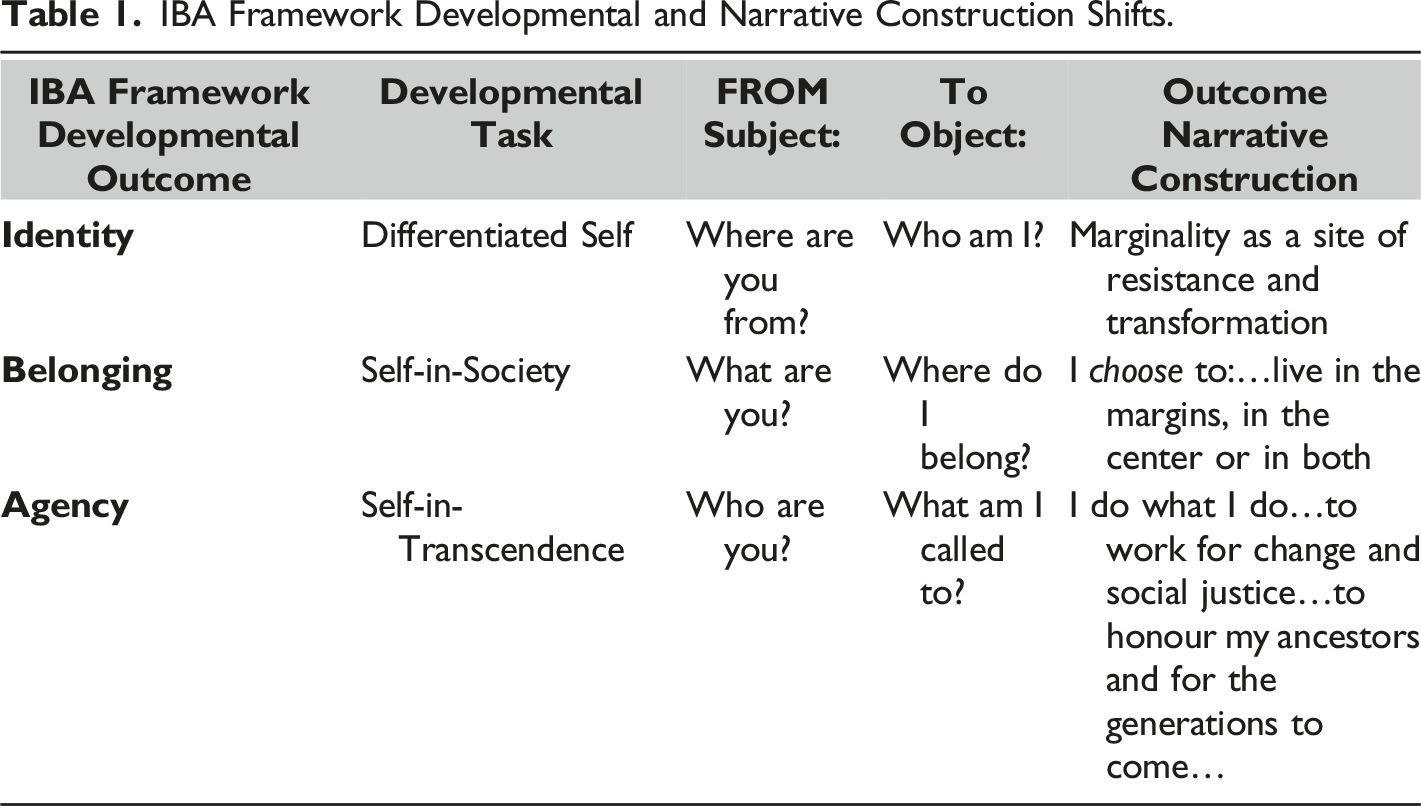
Analytic Reflexivity: IBA Framework and Developmental Perspectives
My observations of the developmental narrative shifts that occurred from the fiction readings and community dialogues prompted me to further analysis to locate the IBA framework within existing developmental theories/perspectives. This further analysis and critical reflection on assumptions is part of the transformative learning process that is inherent to meaning-making and transformation, including assessment of discourse or of reading art as in this case (Mezirow, 1998, 2000). It also represented taking inspiration from analytical autoethnography which integrates an analytical agenda and commitment to theorizing alongside self-reflexivity to further understanding of subjective experiences (Anderson, 2006).
A Constructive Developmental and Ideology Critique
My experience of personal meaning-making and self-reflection throughout the book readings and observations of how others described their experiences prompted me to think of the IBA framework in terms of constructive-development thought. Constructive-developmental theory holds that humans evolve their consciousness and continually develop more complex frames of references or forms of knowing themselves, others and the systems and world around them through meaning-making of experiences. From this perspective, our individual and collective realities are not the preformed scripts we are handed. We ultimately construct or co-construct meaning from our experiences by interpreting what happens to us through the processes of “meaning forming, an activity by which we shape a coherent meaning out of the raw material of our outer and inner experiencing” (Kegan, 2000, p. 52), and (re)forming our meaning forming, “this is a metaprocess that affects the very terms of our meaning-constructing. We do not only form meaning, and we do not only change our meanings; we change the very form by which we are making our meanings” (Kegan, 2000, pp. 52–53). In this frame, our meaning forming and reforming is articulated through the language and narratives we tell of ourselves and others and it acknowledges the story-making reality in which humans exist.
It struck me that consistent with the constructive-developmental lens, participants at the community dialogues were making the social constructions of Black identity, belonging/rootedness and agency objects of our analysis through the fiction narratives. We were taking socially constructed tropes we were subjected to and making them the object of our examination and imagination, such that we could construct new and more complex meanings that change how we identify and engage with the world around us. Kegan (2000, p53-54) describes this subject-object relationship and the way it leads to transformation as follows: That which is “subject” we are run by, identified with, fused with, at the effect of. We cannot be responsible for that to which we are subject. What is “object” in our knowing describes the thoughts and feelings we say we have; what is “subject” describes the thinking and feeling that has us. We “have” object; we “are” subject…When a way of knowing moves from a place where we are “had by it” (captive of it) to a place where we “have it” and can be in relationship to it, the form of our knowing has become more complex, more expansive.
In narrative therapy, this process is also called externalizing—separating the person from their problem-saturated narrative in a way that allows them to be in relationship to it and transform it. Externalization/objectification is what community members were inadvertently accomplishing through individual and collective reflection on the fiction narratives at my book reading events, allowing us to critically examine assumptions and realities of our global African/Black identities (Brookfield, 2000; Hoggan & Cranton, 2015; Mezirow, 1998; White, 2007).
Furthermore, our process went beyond the psychoanalytical/cognitive focus typical of constructive-developmentalism to transformation that emerges from the psychosocial theory of recognition. The theory of recognition holds that transformation also emerges from the sociocultural and affective realms when collective “wrenching” from inner and outer oppressive narratives lead to a more vibrant understanding of selfhood (Gilpin-Jackson, 2014; West, 2014). This, critical self-reflection on identity and dominant oppressive narratives are liberatory lenses to transformative learning, explained, for example, through the Freirean process of conscientization (deepened awareness of oppressive social positionings through reflection) and ideology critique that leads to transformation and emancipatory action (Brookfield, 2000; Mezirow, 1998; White, 2007).
An Afrocentric/Black Lens to Transformative Development from Marginality
In my Eurocentric-educated, colonized and socialized mind, my first frame of reference for making sense of what was emerging from my community engagements of the fiction narratives was through the lens of constructive-developmental theory. This body of work, though useful to my process, was developed within a Eurocentric, linear, stage-based frame, although it has shown utility in understanding more diverse groups, for example, participants “who were mostly nonwhite, nonnative English-speaking, lower-income immigrants…” (Patton et al., 2016, p. 359).
I therefore concluded that a more critical, sociocultural and contextual lens of negotiating core psychological needs such as identity and belonging, from a position of social marginality, was needed to validate my thinking on the emerging IBA framework. Subsequently, in my review of the unpublished conference notes from Ngũgĩ wa Thiong’o, here are some points of note that I highlighted: Eurocentrism as it stands and has stood for many years is driven by the imperial logic: it sees its centrism as the universal center, and the elite of the formerly colonized may unconsciously adopt the same assumption about the universality of the Eurocenter. Afro-centrism has to be a dialectical negation of that process…The Afrocentric idea must be driven by democratic logic; accepting that for Asian, people, Asia is the center, and for European people’s Europe is their center, that no one center is the universal center, but all these centers can connect on the basis of equal give and take… add all the languages of the world to it, that is empowerment. Secure the base, our base, and then connect with the world. Securing our base, the base of our being, is what is assumed by the Afrocentric idea.…(wa Thiong’o, 2019, pp. 9–10).
In that speech and in his many works, Ngũgĩ wa Thiong’o, talks about reclaiming African languages, identity and literature as central to decolonizing minds (wa Thiongʼ;o, 2009, 2012). He did this, for example, by moving to exclusively writings in his mother tongue to center African languages. In addition, I was further ushered towards taking an Afrocentric perspective to the transformational conversations I engaged in and witnessed, such as by recalling the words of Audre Lorde: What does it mean when the tools of a racist patriarchy are used to examine the fruits of that same patriarchy? It means that only the most narrow parameters of change are possible and allowable… Those of us who stand outside the circle of this society’s definition of acceptable women; those of us who have been forged in the crucibles of difference -- those of us who are poor, who are lesbians, who are Black, who are older -- know that survival is not an academic skill. It is learning how to take our differences and make them strengths. For the master’s tools will never dismantle the master’s house. They may allow us temporarily to beat him at his own game, but they will never enable us to bring about genuine change.(Lorde, 1984, pp. 110,112)
However, I wondered what happens for the generations of Black descendants and postcolonial global Africans who have been stripped of their mother tongues and have no access to their original languages such as many of us who were in the community dialogues? Reclaiming identity and language in this context has resulted in the use of folklore, patois, pidgin English, creole languages and other local vernaculars to move towards decolonization and postcolonial transformation. This postcolonial transformation of the English language is itself an act of resistance and: refers not to the transformation of colonial society by imperial power, but the opposite— the transformation of the discourses and technologies of power by the colonized. Such major discourses as literature, history, the representation of place, and ultimately modernity itself have been transformed by the active intervention of postcolonial artists and writers…thus the transformed language “stands for” the colonized culture in a metonymic way…The local writer is thus able to represent his or her world to the colonizer (and others) in a version of the metropolitan language, and at the same time, to signal and emphasize a difference from it. In effect, the writer is saying “I am using your language so that you will understand my world, but you will also know by the differences in the way I use it that you cannot share my experience.” (Ashcroft, 2022, pp. 555,558).
It is a reality that in our complex post-modern and postcolonial existence, those positioned with socially marginalized identities have had their history, culture and languages stripped from them in a way that cannot be completely reclaimed or returned to. Ashcroft (2022) notes that while postcolonial and other socially marginalized writers use writing for transformation as resistance, they are not and cannot act independent of the context and historical forces that have acted on them. “Whereas development—the acultural theory of modernization—acts to force the local into globally normative patterns, transformation shows that those patterns are adjusted to and by the requirements of local values and needs. … By transforming the technologies of power—language, literature, and history, conceptions of space and place, and ultimately modernity itself—postcolonial writers have begun to transform the landscape of power. Such action stands as a model for the power of dominated and oppressed classes on a global scale. (Ashcroft, 2022, p. 567)
The reality of the disrupted cultures of global Africans/Black peoples is echoed by African Human Development Scholar and Educational Psychologist, A Bame Nsamenang, who I quote in the opening of Identities noting that: “…contemporary Africa has a hybrid cultural character that is the product of local and alien mentalities and lifestyles living together in the same communities and individuals. The cultural braid this duality engenders is, theoretically speaking, a more complex lived reality than has hitherto been articulated.”(Nsamenang, 2003, p. 214)
This is a crucially important reality to understand. In the metaphor of the cookie to define emergent systems, the cookie cannot be reduced back to its individual ingredients (Brown, 2017; Holman, 2010). In the systems world, “Everything comes from what preceded it. Nothing is reversible. This is the arrow of Time” (Wheatley, 2017, p. 28).
The impact of this disrupted and altered cultural reality of Black peoples is evident in the theory of Black Identity Development (BID), which chronicles the journey of African-Americans’ socialization into racialization, followed by resistance and rejection of White culture for an embrace of Black culture. The most recent rendition of BID shows in addition the role of an intersectional, multicultural and multidimensional (re)claiming of identities in the final internalization stage of the BID, acknowledging the transformative development process of African Americans/Black peoples requires not only a rejection of marginality, but also a redefinition of selfhood in the context of disrupted cultural realities. Thus, I see the unique transformative development tasks of global Africans/Black peoples as including the need to move beyond identity formation such as in the BID, to an intentional choosing of their place of belonging and their agency for social change actions (Jackson, 2012).
The IBA framework resulting from this critical reflection and analysis calls global Africans/Black peoples, to engage the world with decolonized minds and transformed beings that leads to liberation from social marginality and the agency that enables social action. It is an invitation to an understanding that: Understanding marginality as position and place of resistance is crucial for oppressed, exploited, colonized people. If we only view the margin as sign, marking the condition of our pain and deprivation then a certain hopelessness and despair, a deep nihilism penetrates in a destructive way the very ground of our being…This is a response from the space of my marginality. It is a space of resistance. It is a space I choose…This is an intervention. A message from that space in the margin that is a site of creativity and power, that inclusive space where we recover ourselves, where we move in solidarity to erase the category of colonized/colonizer. Marginality as a site of resistance. Enter that space. Let us meet there. Enter that space. We greet you as liberators. (hooks, 1989, pp. 342–343)
I join bell hooks in issuing this invitation and propose further that marginality for global Africans/Black peoples is also a site of transformation—the personal developmental transformation from the socialization of marginality to becoming social actors/change agents focused on generational impact. Figure 1 Identity, Belonging and Agency (IBA): A Transformative Development Framework for global Africans/Black Peoples.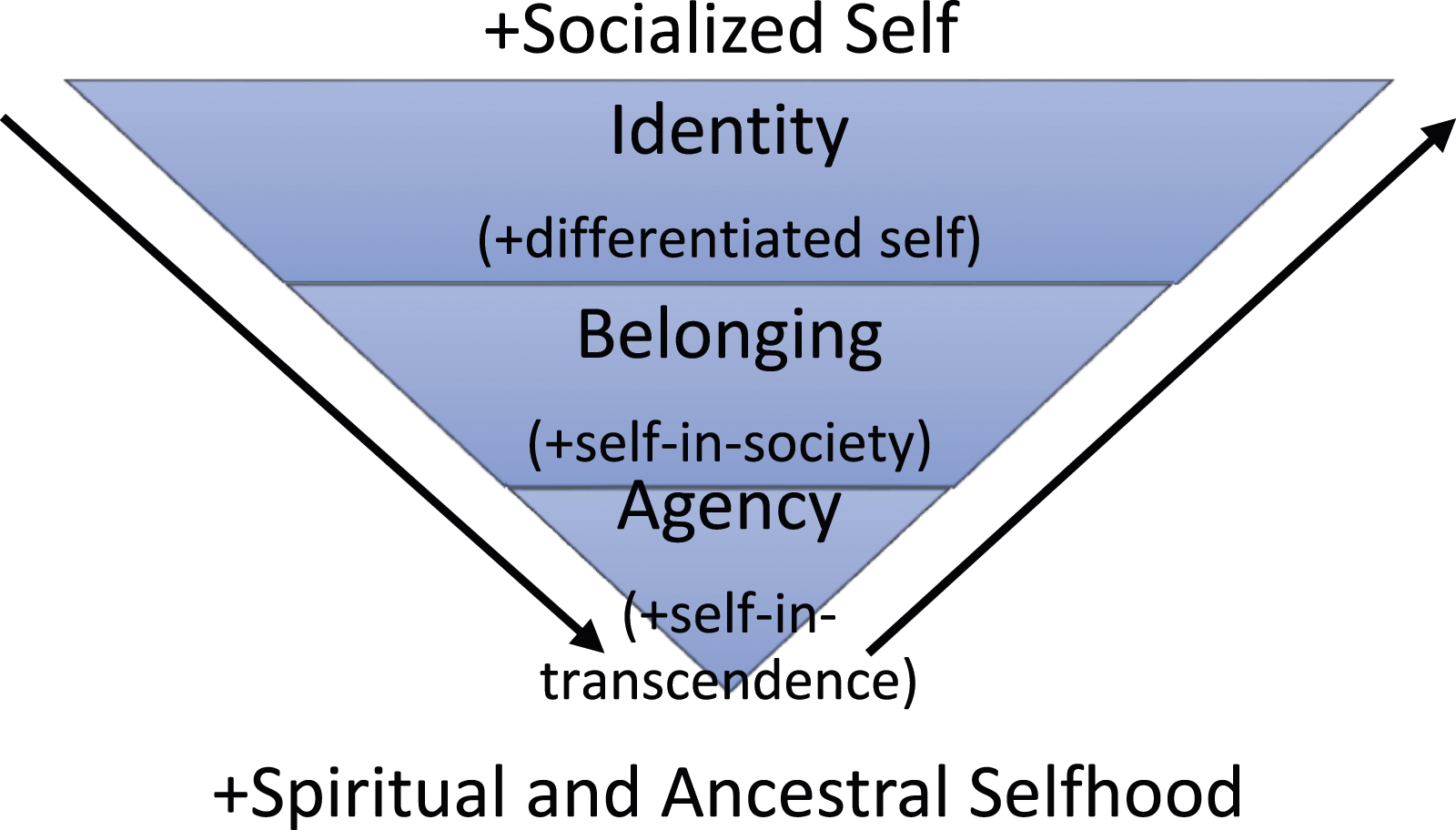
The IBA framework is intentionally framed as an inverted triangle and contrasts with the up-hierarchy of other developmental models such as Maslow’s hierarchy, not because movement through it does not denote developmental growth but because the philosophical orientation is different (Maslow, 1943). In Afrocentric thinking, the socialized self is the assumed ground of all and once the assumed roles within family and community as well as in the social power structures are realized through lived experience, the developmental tasks of the socially marginalized becomes navigating identity, belonging and agency within the context of systemic oppression. This added “course” in the metaphoric curriculum of life (Kegan, 1994), must be taken along with the other complex mental demands of modern and post-modern living.
Movement through the IBA framework progresses downward into groundedness from an identity core, through anchoring to belonging and finally agency. I propose that the entire process is encased in the understanding and shared acknowledgement of the spiritual and ancestral selfhood as was discussed often the community dialogues. For example, when global Africans/Black peoples say things like: “I am my ancestors wildest dreams” or work towards representation for the generations to follow, they are enacting this spiritual and ancestral knowing (Nsamenang, 2003). One participant at the end of the community dialogue my daughter and mother attended said their highlight was unequivocally: “the generations actively involved: mother, self, and daughter.”
Concluding Thoughts: Contributions and Limitations
My experience of fiction reading presented dilemmas within the lived experiences of global Africans/Black people and an opportunity for community dialogues to externalize dominant narratives of marginality. The discourse that ensued resulted in collective meaning-making and conscientization and led to developmental shifts from unhelpful social narratives to self-identity narratives that were empowering. I propose that self-identity location is the first developmental task of global Africans/Black peoples once they become aware of the social marginality assigned to them. Identity, one’s own self-perception, is the core of being and consciousness. When those assigned social marginality become aware of it, their developmental task becomes the work of self-differentiation, or wrenching themselves from being subject to their social assignment by objectifying marginality and choosing a personal location that transforms their experiences of oppression (IIIeris, 2014; Johnson-Bailey, 2012). Next, finding spaces and places of belonging that supports global Africans/Black peoples find home out of experiences of liminality becomes crucial. Finally, a call to agency, which was previously confirmed as a core outcome of transformative learning from fiction reading became the opportunity to transcend marginality (Hoggan, 2016; Hoggan & Cranton, 2015).
This article corroborated previously findings that fiction reading promotes critical reflection, the emergence of new perspectives and desire for change (Hoggan & Cranton, 2015). It further contributes to our knowledge that not only can fiction reading promote transformative learning and transformation outcomes in an educational context or as an individual experience for those whose voices are marginalized (Kostara, 2022), but also as a collective endeavor. Fiction reading can support community meaning-making, transformative learning and the transformation outcome of a call to action (agency) for those experiencing social marginality. It builds further on the emancipatory schools of transformative learning where the unit of analysis is social change to proposing a process of fiction reading that can support conscientization as well as a transformative development framework. It enacts how the holistic lens to transformative learning per Sullivan, is enacted, specifically for global Africans, by leading to deep structural shifts in knowing of self in relation to social structures because it: involves experiencing a deep, structural shift in the basic premises of thought, feelings, and actions. It is a shift of consciousness that dramatically alters our way of being in the world. Such a shift involves our understanding of ourselves and our self-locations; our relationships with other humans and with the natural world; our understanding of relations of power in interlocking structures of class, race, and gender; our body awareness; our visions of alternative approaches to living; our sense of possibilities for social justice and peace and personal joy. (O'Sullivan et al., 2002, p. 11)
Additionally, this article does so from a universal constructive-developmental as well as is situated in an Afrocentric lens to transformative development in the context of marginality.
My critical reflections and analysis surfaced many additional questions that remain unanswered such as: How does consciousness evolve when the basic mental structure or forms that need to be transformed for global Africans/Black peoples is anchored to dehumanizing social narratives? What is the impact of social marginality in accelerating or delimiting the more complex mental capability required to navigate the demands of a modern and post-modern world, with its hidden curriculum demanding adults take more “courses” than we have bandwidth for? What does human development and transformation look like when you overlay social marginality on the already overflowing curriculum of adult life in our era of liquid modernity? (Kegan, 1982, 1994).
However, this article proposes a conceptual framework only which emerged from my own critical reflections and taking an opportunistic autoethnography gaze in which my affinity as a Black African woman preceded my decision to engage in critical and analytic reflection and the proposal of a conceptual framework (Anderson, 2006). There is now an opportunity for further exploration with this framework from both a research and practice perspective. For example, a qualitative research and community dialogue project that occurred during the pandemic to explore the experiences of peoples of African Ancestries revealed strikingly similar themes. Participants made meaning of their global African/Black identities in the context of constant social marginality through deeper anchoring to their diverse identities and negotiating and calling out the need for belonging (Mũrage, 2022). Researchers might now use various forms of qualitative methods for theory-building and exploring the utility of the proposed IBA framework in understanding the transformative development of various socially marginalized communities. Quantitative researchers might develop survey tools to test the IBA framework and conduct studies to explain the relationship between racialized identities and sense of identity, belonging and agency as well as explore the generalizability of the framework.
Footnotes
Declaration of Conflicting Interests
The author(s) declared no potential conflicts of interest with respect to the research, authorship, and/or publication of this article.
Funding
The author(s) received no financial support for the research, authorship, and/or publication of this article.
