




Abstract
As future academics, Doctor of Philosophy (PhD) students are be expected to employ learning-centred approach as stated in the Paris Communique (2018) by the European ministers of education. The limited research available about doctoral students’ conceptions indicates that they range from content- to learning-centred. Although a few studies explored the factors which prompt students’ transformation of conceptions and approach, none specifically focused on PhD students. This comparative case study explored how PhD students describe the transformation in their teaching conceptions and approach towards learning-centredness, and the context surrounding it. The results indicated that participants described the transformation through the gaining of theoretical teaching-related knowledge, being related to dissatisfaction with their own teaching, the application of a learning-centred approach, and time. The teaching–learning context was described mostly as supportive but not always allowing the implementation of transformation. Results suggest that discourse is needed to facilitate critical reflection leading to transformative learning.
When envisioning the future of doctoral education, the European University Association argued that “research and education at doctoral level contributes to the resolution of the environmental, demographic, socio-economic, and political challenges that Europe and the world are facing” (European University Association, 2022, p. 14). To meet such high demands, Doctor of Philosophy (PhD) students and doctoral graduates engage in original research, outreach activities, and teaching. In the Paris Communique (2018), European ministers of education emphasised the need in higher education for the “further development and full implementation of student-centred learning” (European Higher Education Area, 2018, p. 3). Quality of education and the implementation of student-centred teaching rely on qualified teachers willing to engage students as active agents in the learning process, thus preparing them for future jobs which may not yet exist (European Trade Union Committee for Education, 2018).
The conceptions of teaching and learning are the beliefs teachers have regarding the ways of teaching and learning, including the meaning of teaching and learning, and roles of teachers and learners (Mardiha & Alibakhshi, 2020). Conceptions of teaching comprise personal theories that have been developed through experience (Ramsden, 2003). Earlier research has suggested that there is a connection between what are teachers’ beliefs about teaching and what students actually learn (Roxå & Mårtensson, 2009) as well as between the approach to teaching (how one teaches) and the quality of student learning (Trigwell et al., 1999). As future academics, today’s PhD students will be expected to fully implement learning-centred teaching. Therefore, their conceptions and approach to teaching and learning will be significant in facilitating student learning.
An analysis of the limited studies about doctoral students’ conceptions of university teaching indicated that these range from teacher-centred (also known as content-centred) to learning-centred 1 (Mimirinis & Ahlberg, 2021; Torres Ayala, 2013). Less is known about the factors which have prompted transformations of conceptions (Mezirow & Taylor, 2011). Several studies have concentrated on the ways in which formal learning may facilitate transformative effects (Roland, 2020; Singer-Brodowski et al., 2022; Tedford & Kitchenham, 2021); however, even fewer studies have focused on the student experience of transformation (Gillan et al., 2021; Luguetti & Oliver, 2021) and to the knowledge of the authors none specifically on transformation of teaching conceptions and approach of PhD students. Torres Ayala (2013) recognised the need for further studies to identify the experiences that would help PhD students to develop more comprehensive conceptions of teaching and learning. The current study was designed to add to the sparse literature on this topic.
This study formed part of a larger research project which explored how PhD students learn to teach in the higher education context, more specifically the significance of informal conversations about teaching during and after a pedagogical course (Soomere & Karm, 2021), and acceptance by the university teaching community. The purpose of this study was to explore how PhD students describe the transformation in their teaching conceptions and approach towards learning-centredness, as well as the context which surrounds this transformation. The study sought to answer the following questions: 1. How did participants describe the change in conceptualising their teaching/approaches to teaching? 2. How did participants describe the transformation toward learning-centredness? 3. According to participants in the study, how did their teaching–learning environment enable them to implement their transformed teaching concept/approach?
Conceptions of Teaching and Developing Learning-Centredness
Conceptions of teaching describe how teachers think about teaching and learning. Previous research has established that approaches to teaching may be on a continuum from content- to learning-focused. A content-focused approach views teaching as providing information to students who then passively absorb it, whilst a learning-centred approach describes teaching as facilitating learning, and views students as active participants (Postareff & Lindblom-Ylänne, 2008). A learning-centred approach considers the learning context and learners’ prior knowledge, and is dialogic and democratic in nature (Bremner, 2019). Prosser and Trigwell (1999) have suggested that “university teachers who focus on their students and their students’ learning tend to have students who focus on meaning and understanding, while university teachers who focus on themselves and what they are doing tend to have students who focus on reproduction” (p. 142). Hence, learning-centredness is desirable as it fosters a deeper approach to learning.
Pedagogical courses are one means of changing teachers’ conceptions and approach to become more learning-centred. Whereas some authors have claimed that formal pedagogical courses can have a significant impact on conceptions of teaching and learning (Gibbs & Coffey, 2004), others maintained that the impact varies (McChesney & Aldridge, 2021) and some authors, in contrast, claim that the link between pedagogical courses and improvement of student learning remains unproven (Gosling, 2008). The transformation from content-centredness to learning-centredness is complex, as it requires fundamental changes in teachers’ conceptions of teaching and learning, and in their teaching practice (Bremner, 2019; Fullan, 2016). Whilst formal learning does offer opportunities for such complex transformation, it is not experienced by all students (Greenhill et al., 2018). On its own, formal learning appears not to suffice; instead, transformative learning which “reconstructs dominant narratives” (Mezirow, 2000, p. 21) may be required for this profound shift.
Transformative Learning
Transformative learning is defined as “the process by which we transform problematic frames of reference (mindsets, habits of mind, meaning perspectives) – sets of assumptions and expectations – to make them more inclusive, discriminating, open, reflective and emotionally able to change” (Mezirow, 2009, p. 92). A frame of reference is in essence a way of knowing and it has an emotional (how passionately or casually we believe something), social (which groups we identify with), and moral (what we consider ethical) dimension (Kegan, 2009). Frame of reference is divided into two dimensions: habits of mind and points of view. According to Mezirow (2009), habits of mind refer to ingrained patterns of thought, feeling, and behaviour that are steeped in assumptions and form principles that may be related to religion, culture, language, education, politics, psychology, or other spheres. Habits of mind are the set of beliefs, judgements, emotions, and attitudes that are expressed in specific points of view that colour interpretations (Mezirow, 2009).
Transformation occurs as a result of integrating a new meaning perspective with an old one and reconciling the two (Mezirow & Associates, 2000). Transformative learning process may on the one hand be a rational, critical, metacognitive one by which the rationale behind problematic frames of reference and taken for granted assumptions are reassessed (Mezirow, 2009). Cranton (2016) expanded the definition to include extrarational dimension involving social, emotive, and spiritual aspects. Transformations may be epochal or cumulative: epochal transformations are brought about by life crises and result in sudden changes in the frame of reference, whereas cumulative transformations occur in a progressive sequence and take place gradually (Mezirow, 2009).
Transformations often have a variation of the following possible phases (Mezirow 1994, 2009): • “a disorienting dilemma; • self-examination with feelings of fear, anger, guilt or shame; • a critical assessment of assumptions; • recognition that one’s discontent and the process of transformation are shared; • exploration of options for new roles, relationships and action; • planning a course of action; • acquiring knowledge and skills for implementing one’s plans; • provisional trying of new roles” (Mezirow, 1994, p. 94); • “renegotiating relationships and negotiating new relationships” (Mezirow, 1994, p. 224); • “building competence and self-confidence in new roles and relationships; • a reintegration into one’s life on the basis of conditions dictated by one’s new perspective” (Mezirow, 2009, p. 94).
To experience transformative learning, it is not necessary to go through all phases, nor to progress through them in a linear fashion (Mezirow, 1991, 1994). Cranton (2016) posits that there is no one way of transformative learning; it is highly individual and depends on the context. As previous research has indicated, openness to critical self-reflection does not necessarily lead to any corresponding changes in behaviour (Bueddefeld & Van Winkle, 2018). As Mezirow (2000) contends, even when one’s perspective has been transformed, one must choose to act. Such action may be either immediate or delayed, or based on critical consideration, a continued pattern of pre-existing behaviour. There may be challenges to overcome during the process, including situational, emotional, and informational hurdles; additional new learning experiences may also be required.
Transformative learning also involves a consideration of context, both literal and cognitive (Mezirow & Associates, 2000; Snyder, 2008). Cognitive context is influenced by life experiences, through which meaning perspectives are established and evaluated (Mezirow & Associates, 2000). However, critics of Mezirow have contended that contextual constraints may play an even larger role in the outcome of transformative learning than has been recognised (Taylor & Cranton, 2012). In light of the above, the current study explored how the teaching–learning context shapes transformative learning.
Besides considering the context, critical self-reflection is necessary. Critical self-reflection is focused on oneself, one’s culture, problematic feelings and their effects, and the analysis of the origins, essence, and outcomes of one’s own frame of reference (Mezirow, 1998). Snyder (2008) claimed that it allows individuals to become more aware of their subjective perspectives and future aims.
Furthermore, transformations may occur as a result of internal and/or external factors. For example, referring to internal factors, Eraut claimed that critical reflection depends on the “disposition of the learner” (Eraut, 2004, p. 107). Similarly, Taylor (2000) concluded that some learners have a greater disposition for transformative learning. On the other hand, Roxå and Mårtensson (2015) argued that transformation may rest on external factors and be “dependent on traditions, norms, and habits in the respective local context” (Roxå & Mårtensson, 2015, p. 194). As Mezirow (2000) noted, transformative learning happens in a complex real-world context and is affected by a variety of factors, including historical, societal, customary, professional, and ideological ones. Developing the ability to reflect critically on these assumptions and their implications is a major aim of transformative learning (Mezirow, 2000). In sum, transformative learning is a complex process, to which the intentionality of the learner to act, due consideration of the context, and critical self-reflection are fundamental.
Methodology
A qualitative comparative case study research design was selected to explore transformative learning in the way in which participants conceptualised and approached teaching. A case study design was considered to be a suitable method since the aim was to “‘get under the skin’ of a group to find out what really happens - the informal reality which can only be perceived from the inside” (Gillham, 2000, p. 11). This research methodology was deemed appropriate for an exploration of the ways in which the transformation towards learning-centredness occurs, from the point of view of PhD students.
Four individual cases were selected, and then a cross-case analysis of changes in the conceptualisation of and approach to teaching was conducted. By examining different cases, it was possible to observe how, where, and why transformation towards learning-centredness occurred.
Context of the Study
In Estonia, the government establishes the standards for higher education, and institutions of higher education have considerable operational autonomy within the limits of the Higher Education Act (2019). The nominal study duration for a doctoral degree is four years, and doctoral programs are aligned with the Bologna reform (OECD, 2020).
Pedagogical courses within PhD programmes in Estonian universities are not compulsory; however, PhD students may choose to enrol in optional courses to develop their pedagogical knowledge and skills. The pedagogical course offered by the University of Tartu, Estonia, was completed by all participants in the study either in the Estonian- or in an English-speaking group. The course volume was 156 academic hours in total, from which 52 were in contact. These were organised during eight days as six-hour sessions. The second author was a teacher of Estonian-speaking group of the course and many study participants had been her students. The aims of the pedagogical course were threefold: to develop students’ understanding of the learning-centred approach whilst providing them with ideas for active student engagement, to increase the perceived value of teaching, and to foster reflections on and conversations about teaching. Students completed several tasks during the course: developing a syllabus, teaching a 15-minute lesson to adult learners incorporating student engagement techniques, developing a workshop plan, and completing a learning portfolio. The learning portfolio included an essay on learning and teaching, a learning log, and a collection of reflective texts written during the course. The course provided students with opportunities to critically reflect upon their conceptions and experience of teaching from a theoretical perspective.
Participants
A total of 25 interviews were conducted with PhD students as part of a larger study. Purposive sampling was used. The selection criteria for participants were, firstly, completion of a pedagogical course aimed at PhD students at the University of Tartu and, secondly, their opportunities for teaching after the completion of the course.
The primary criterion for inclusion as a case study was the presence of elements of learning-centredness in a participant’s description of their own teaching. A secondary criterion was evidence within participants’ reports of their teaching indicating that their conceptions and approach to teaching had likewise been transformed (e.g. “my teaching before and after the pedagogical course is like night and day”) or in the process of transformation (e.g. “I think it needs more imagination how to implement those [learning-centred] things”). Of the 25 interviews, those 4 cases were selected which best described the journey of transformative learning and which, in addition, illustrated varying degrees of transformation towards learning-centredness (whether during or after the pedagogical course). The data of those participants whose descriptions of their learning experiences lacked the element of transformative learning was excluded from further analysis.
All four participants of case studies were doctoral students at University of Tartu at the time of data collection. They all had between 2- and 20-years’ teaching experience. They also had different disciplinary backgrounds. Their teaching context was mostly at the same university in which they were enrolled as PhD students, with the exception of one participant who taught at an institution of applied higher education in Estonia.
Data Collection
The first two authors were involved in data collection. As one of the interviewers was a teacher of the pedagogical course all participants had completed, she had a unique relationship that could potentially unintentionally transfer to the collection and interpretation of data (Matteson & Lincoln, 2009). This potential bias was acknowledged prior to interviews and minimised by the first author being the primary interviewer. The power imbalance of having two interviewers was also considered. Interviewers made efforts to shift the power dynamic and empower participants by empathising with their experiences and sharing their own stories on the topic as suggested by Velardo and Elliott (2021). Having two interviewers also enabled to obtain richer data as researchers noticed different aspects of the participant answers and asked follow-up questions the other had not considered.
Data was collected via one-on-one semi-structured interviews and written reflections by three participants. Interviewing was considered appropriate as it enabled the interviewee to expand on their experiences in relation to the phenomenon under study; this allowed for a deeper understanding of their behaviour and related intentions (Merriam & Tisdell, 2016). Written reflections were collected at the end of the pedagogical course. All interviews were conducted six months after the participant’s completion of the pedagogical course to allow them time to digest the course content and implement any relevant changes to their teaching practice.
Data Analysis
All 25 interviews were initially analysed with respect to the research questions. Four cases were then selected for a more in-depth analysis of interviews and written reflections. The data was analysed using a qualitative content analysis method. Content analysis aimed to provide a concentrated description and then analyse categories of the phenomenon under investigation (Elo & Kyngäs, 2008). “Complete transformation” was understood in this study to be “an epistemological change rather than merely a change in behavioural repertoire or an increase in the quantity or fund of knowledge” (Kegan, 2009, p. 41). As the study explored the transformation of participants’ teaching conceptions and approach towards learning-centredness, participants’ descriptions of their knowledge and reports of application of the core principles of the learning-centred approach were taken as evidence of the extent to which this transformation had occurred.
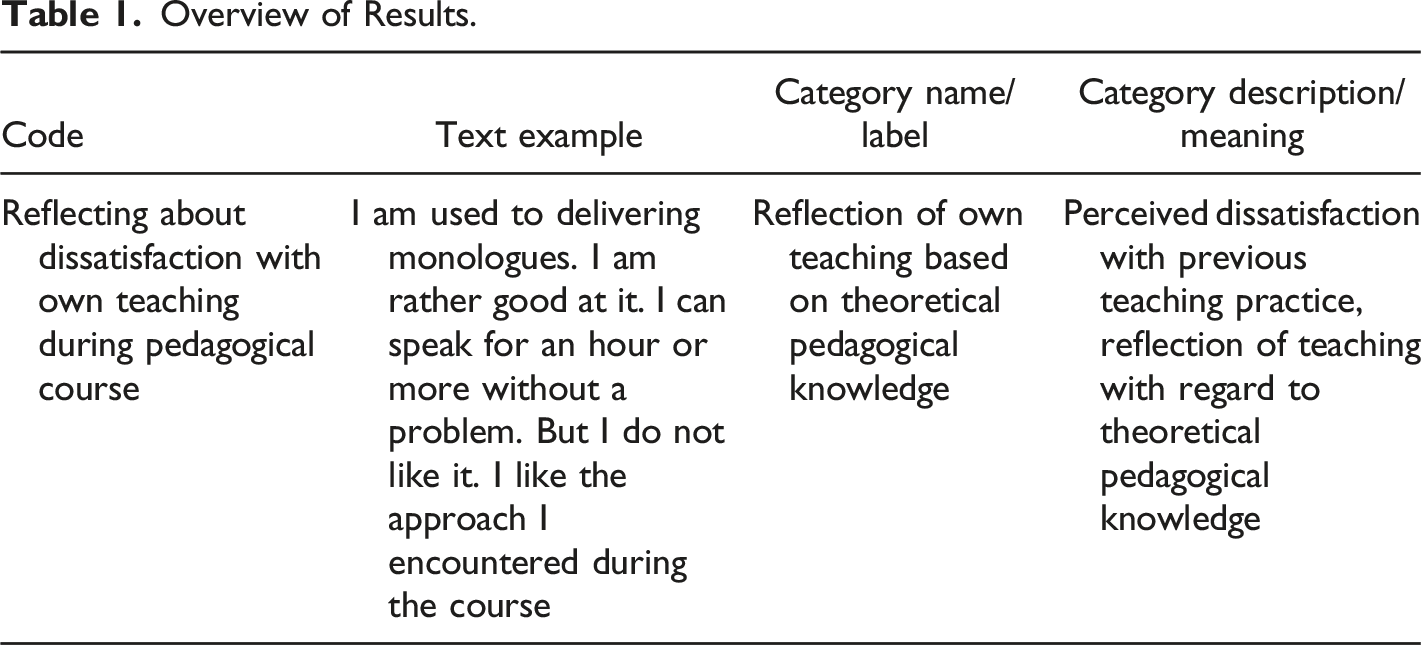
Overview of Results.
Results
The results section is divided into two parts. Firstly, a short overview of each individual case is presented. Secondly, the results for the different research questions are compared.
Noah
Noah’s field of study was related to medical sciences. In Noah’s case, transformative learning had taken place to full effect as his descriptions indicated core elements of the learning-centred approach. Before participating in the study, Noah had already been teaching for a long time, and his transformation towards learning-centredness appeared to have started several years ago. He described dissatisfaction with his teaching, which he was able to reflect on and analyse more deeply after completing the pedagogical course. The pivotal moment for Noah’s transformation towards learning-centredness was the pedagogical course. He described both his conceptions and approach to teaching as having transformed.
According to Noah’s description, his transformation towards learning-centredness after the pedagogical course was not smooth. He described encountering obstacles in his teaching and faced with students’ surface approach to learning. Moreover, Noah experienced a lack of support within the teaching–learning environment.
Robert
Rober’s field of study was related to social sciences. In Robert’s case, transformative learning had taken place to full effect as his descriptions indicated core elements of learning-centred approach. Robert was also an experienced teacher. Although he described some elements of dissatisfaction with his teaching prior to the pedagogical course, the course itself appears to have been a pivotal moment in the transformation of both his conceptions and approach towards learning-centredness.
Robert’s transformation appeared to have been assisted by his previous life experiences which were aligned with the ideas discussed in the pedagogical course. Attending the pedagogical course marked a clear turning point in Robert’s description of his transformation towards learning-centredness. As Robert explained, the events that shaped his journey towards learning-centredness took place over a period of time, which allowed the ideas to sink in gradually and then click with the learning-centred approach which was introduced—and personally experienced—during the pedagogical course. Robert’s transformation was relatively smooth in terms of the external context. He described experiencing support in the teaching–learning environment from the students, his colleagues, and the supervisor.
Rasmus
Rasmus’ field of study was related to social sciences. In Rasmus’ case, there appeared to be elements of transformation, but it was not yet complete as his descriptions included mostly learning-centred features although with some hesitations; however, there were also some content-centred ones. Rasmus had also had several years of teaching experience prior to participating in the study. Although his transformation towards learning-centredness largely appeared to have started during the pedagogical course, he did describe having some prior dissatisfaction with his teaching. He described elements of transformation in both his conceptions and approach towards learning-centredness after the completion of the pedagogical course. Based on his account, Rasmus’s transformation towards learning-centredness appeared to be cumulative, but still in progress.
According to Rasmus, the teaching–learning environment was supportive of his transformation. He described conversations with his supervisor, who was a supporter of the learning-centred approach as meaningful and supporting the transformation towards learning-centredness. He also mentioned colleagues being supportive of his approach.
Saskia
Saskia’s field of study was related to arts and humanities. In Saskia’s case, transformation appeared to be still at a very early stage as her descriptions included few learning-centred elements. Saskia only had a few years’ teaching experience at the time of the study. Although Saskia described some dissatisfaction with her teaching, this did not lead to any major changes in her mostly content-centred teaching approach. She did not describe any major shifts in her conceptions or approach towards learning-centredness after the pedagogical course. Based on her description, Saskia’s transformation towards learning-centeredness still appeared to be in a preliminary stage, although there were some initial indicators of a cumulative process.
Saskia reported that her teaching–learning environment was highly supportive of teaching. Her colleagues valued teaching and encouraged her to participate in the pedagogical course.
The analysis of data relating to What I had not even considered using [before the pedagogical course] was giving an article to students and after it a group chat or discussion in some form. I have used it more consciously, even as an introduction or opening of the lecture where I actually make students work with each other first (Robert).
The next category, change in teaching approach through gaining a theoretical teaching-related knowledge, was mentioned by three participants. As an outcomes-based and constructively aligned syllabus design was part of the course content, gaining this knowledge was reported to be beneficial to participants and was a catalyst for changes in their teaching approach.
The change in approach to teaching as a result of gaining theoretical teaching-related knowledge was also described in terms of an increased level of self-awareness and a re-thinking of the teacher and student roles during the process of teaching and learning. Noah compared his teaching before and after the pedagogical course: I was concentrating on what I know and how to show it. After the course, I realised that my knowledge is only a small part, I have to make them think and act.
While the change of approach was mostly described in positive terms, two participants also reported difficulties in applying the learning-centred approach. Rasmus was more concerned with his internal struggles with the transformation, while Noah described more issues relating to learners’ approach to learning. Noah noted that students did not always welcome his new approach: So, I sent them a little questionnaire that was connected with the course content. […] And then there was pushback – they did not want to do anything themselves and they only wanted a lecture, but I did not agree with that.
Concern for students and their actual learning, and justification of the changed approach was of concern to Rasmus as he seemed to struggle between the traditional approach (how he had been taught) and making changes in line with the principles of the learning-centred approach: So, we started with the wrong premise that it is always been done like that, so we started doing the same. […] And this tradition is very strong within us, so we do the same. […] To think, if we mess people up completely.
Robert mentioned experiencing the learning-centred approach himself during the pedagogical course, which prompted his own change of approach. He explained the significance of the experience as follows: It is true that after the experience here at the pedagogical course my understanding changed completely. I had heard about this inclusive teaching method but going through the course gave me a clearer picture of it. […] So, in a sense I would dare to say that my teaching before and after the course was like night and day.
The analysis of data relating to Are the students ready to digest this information? I had a question about ten years ago, looking into their eyes – do they even comprehend what I am talking about, does their level match the content of the course?
Robert described his dissatisfaction with his own teaching practice after completion of the pedagogical course: I am used to delivering monologues. I am good at it, I can talk for an hour without a problem. But I do not like it. I like the approach I got acquainted with during the course.
Saskia also described some dissatisfaction with her teaching practice but did not see it as a major obstacle and struggled to find ways to use the theoretical knowledge in her teaching. As she explained: I looked up things from my notes [from the course] for this semester, how to perhaps do group work better, but I couldn’t figure out how to implement them.
Both during and after the pedagogical course, all participants mentioned reflecting on the content with regard to their own teaching, although with varying depth and varying actual application to their teaching approach. This reflection was the impetus for reviewing the syllabus design of the courses they taught. It also prompted some participants to notice a lack of open dialogue with students, a lack of support for students’ critical thinking, the absence of choice in learning tasks and the dominance of their own opinions. Noah described his reflection process during the pedagogical course: During the pedagogical course, we had different choices. We could do an interview or participate in group work, and it was then that I started to realise that I always set just one task, and everybody has to do it. What I have done is absurd. It was the point where I started to think.
Similarly, Rasmus felt more dissatisfied with certain aspects of his teaching. He explained that, after reflecting on what he had learned, he had started to pay more attention to assessment practices: When we talked about feedback [during the pedagogical course], I thought about it a lot – I was wondering, do I have it or not? I was haunted by the idea that if you only assess them one time in the end, what is the point of that?
Saskia described attempts to connect the theoretical material to her teaching but mentioned the difficulties she encountered. When preparing for actual teaching, she struggled to connect the two. Other barriers Saskia mentioned included her lack of teaching experience and a lack of imagination. Saskia also questioned the usefulness of undertaking the course prior to gaining teaching experience in university: I would say that this pedagogical course, for it to be more useful, I would have to take it again. […] I mean, I am glad I took the course before I started to teach, but I think it would be more useful when you have taught for some time.
In addition to the reasons noted above, Robert described several impactful events over a period of time which had contributed to his transformation. Firstly, he mentioned making a connection between the learning-centred approach and his earlier experience of being coached (leadership coaching). The ideas presented in the pedagogical course were not alien to Robert, as he had encountered them before, although in a different context. A second significant event that facilitated his transformation was his visit to a foreign higher educational institution. He reflected on witnessing the successful implementation of a learning-centred approach and made connections with the learning-centred approach in the pedagogical course: So, basically all is built on group coaching. Each student comes to school and chooses only the subjects they need for the purposes set for the coming three years. […] I again, some puzzle pieces fell into place when I saw what happened during the pedagogical course. It was not exactly the same, but there were many elements close to it.
Robert’s transformation was also prompted by his interaction with students and by witnessing the learning-centred approach working in his own teaching practice. Finally, the element of time was mentioned by Robert in terms of accepting the learning-centred approach. He described his earlier learning of teaching and reflected on the ideas of learning-centredness that he had encountered in other courses but was not fully able to accept at the time: More than ten years ago I sort of knew psychology, and psychologists deal with this approach that they ask questions and reflect back and all that. But it was alien to me, although I was aware of this approach. But today it is rather natural for me.
The analysis of data relating to So, with her we had really meaningful conversations about teaching. In addition, some practical questions like why it is important what I have written in the syllabus or can I change something, such as evaluation criteria and so on.
His supervisor’s support was described by Robert as the creation of an organisational culture by a knowledgeable and educated professional who understood the learning-centred approach: She is a doctor of pedagogy and knows the field of education. So, in this sense I think it depends on the people who lead and administer.
Both Saskia and Rasmus mentioned that the pedagogical course was suggested to them by university colleagues (in Rasmus’s case, his supervisor). Additionally, Saskia reported that a colleague had invited her to observe her lesson, to see an example of the teaching approach implemented. She had also had colleagues visit her lesson and provide constructive feedback.
In contrast, Noah experienced a lack of environmental support. He described a failed attempt to discuss possible changes in teaching practice with his supervisor: I suggested how we could do things differently. There was no reaction. I don’t know how much you know about body language but when a person sits and crosses his legs, there is no point in talking to him.
After leaving his initial workplace, Noah sought employment in an affiliated institution where he was approached by younger colleagues. As a result, he started a group where he could implement his learning-centred ideas.
Discussion
There are several ways of learning, of which transformative learning is perhaps the most complex. The results of this study indicated that participants transformed their teaching approach towards learning-centredness through their teaching practice (despite some reported difficulties) and by gaining theoretical teaching-related knowledge. Participants’ descriptions of their own transformations included reports of experiencing dissatisfaction with their own teaching, theory-based reflection about their own teaching, making connections with earlier knowledge about the learning-centred approach, witnessing the successful implementation of a learning-centred approach, experiencing the approach working in their own teaching practice, allowing time to accept the approach, and the experience of difficulties when connecting theory to their teaching practice. The teaching–learning environment was generally described as supportive of the transformation, but in one case it was described as being unsupportive. The results also indicated that participants experienced transformative learning not necessarily by going through all phases described by Mezirow (2009; 1994) nor progressing through them in a linear fashion (Cranton, 2016; Mezirow, 1994).
The catalyst for participants’ transformation towards learning-centredness was usually described as a dissatisfaction with their own teaching, described by Mezirow (2009) as a disorienting dilemma. For Noah and Robert, this disorienting dilemma appeared to have grown over time. In contrast, Rasmus appeared to have been most confronted with it during and following the pedagogical course, and Saskia reported very little dissatisfaction with her teaching. The significance given by participants to the disorienting dilemma may also matter. In some cases, this discomfort led to “intuitive” changes in teaching practice, whereas in other cases it did not result in any change to the teaching approach. It could be argued that the more significant the disorienting dilemma, the more likely it is that it will trigger transformative learning. On the other hand, if the cognitive dissonance is too great or is beyond the zone of proximal development (Vygotsky, 1978), learning may not occur. This may explain minimal transformation in case of Saskia. This result is consistent with earlier studies, where it was found that where participants of pedagogical courses felt that their teaching ran smoothly, there was no impetus to learn about teaching or to change their teaching (Pataraia et al., 2015). The disorienting dilemma may also be considered as a cumulative process whereby the gaining of teaching experience and being exposed to contradictory experiences may, as described by Robert and Noah, produce a snowballing effect. This may lead, in turn, to an understanding about the essence and specific nature of the dilemma, and the ability to articulate the issue in need of transformation.
Another crucial element in the transformative learning process is critical self-reflection (Snyder, 2008). Based on the results of the study, Robert, Noah, and Rasmus reflected on their teaching more than did Saskia. What appears to be significant is that the disorienting dilemma in combination with critical self-reflection about teaching experiences seemed to be the main triggers for transformative learning. This result aligns with earlier studies, indicating the crucial role of critical self-reflection (Lewis, 2009; Snyder, 2008).
The results of the study indicate that likelihood and depth of transformation may be dependent on the disposition of the learner, as argued by Eraut (2004) and Taylor (2000), or “the desire to change” (Taylor & Cranton, 2013). Noah’s transformation continued despite a lack of support in his teaching–learning context, illustrating his intrinsic motivation and willingness to change. The disposition of the learner may also be expressed in their degree of openness to change. Those who are predisposed towards being open to new knowledge and have a more fluid way of thinking may find it easier to acknowledge that knowledge is neither static nor stable. In this case, there may be less need for cognitive harmony and a greater ability to accept conflicting information. In contrast, for those who are inclined to be more rigid and less open, it may be difficult to accept disorienting dilemmas, and they may struggle more with accepting new knowledge. Furthermore, acceptance of new knowledge is more likely when there is no threat to one’s identity by the attempt to reconcile the old and the new (Barnes, et al., 2020).
In some cases, transformations involved the self-examination of negative feelings arising from a disorienting dilemma. For example, Noah had feelings of frustration in the transformation towards learning-centredness after trying new roles and implementing his transformed approach. In all four cases, new knowledge and skills were gained during the pedagogical course, and plans were laid for a course of action. In three cases, this was followed by the provisional trying of new roles. At times, this involved some negative experiences, such as pushback from students and supervisors, as well as internal struggles to justify the change. Building competence and confidence in a new role was reported by three participants, and the final step of integrating the new perspective into one’s teaching approach was reported by two (Robert and Noah). As Mezirow (2000) argued, transformation entails making a decision to act based upon a changed meaning perspective. Whereas Robert, Noah, and Rasmus chose to take action immediately after the pedagogical course, Saskia’s actions appear to have been delayed or may even have required new learning experiences.
As several studies indicate, context is significant in the process of transformation (Greenhill et al., 2018; Mezirow & Associates, 2000; Roxå & Mårtensson, 2015). The results of the study supported this, by indicating that it may be beneficial to have a conducive teaching–learning context. However, as Taylor and Cranton (2012) have noted, constraints within a context may influence outcomes. In the cases of Rasmus and Saskia, it may be hypothesised that, as they were either in the beginning or the middle of the transformative process, having external support may be necessary to scaffold further transformation, as Meziow (1994) suggested. In Noah’s case, it appeared that despite the unsupportive context, transformation still took place and even persisted.
Practical Implications
The results of this study have three main implications for teaching practice. The first implication is that the level of transformative learning may be minimal when the relevant pedagogical course is completed too early in the PhD studies, especially for those students with little teaching experience. Where a student has no disorienting dilemmas or major questions to be resolved, the course may remain too theoretical and will offer students only limited opportunities for critical reflection on their own teaching conceptions and approach. It is therefore preferable that students participate in a pedagogical course after first gaining some teaching experience. Additionally, academic developers facilitating these courses must be sensitive to students’ pre-existing frames of reference and assumptions. They need also be aware when trying to assist students to reconcile the content- and learning-centred views that, if students perceive a threat to their identity, they are likely to reject the new meaning perspective.
The second implication is, as Mezirow and Associates (2000) indicated, discourse with others is needed to foster critical reflection. Such critical reflection may be modelled and instilled as a habit during the pedagogical course and engaged in with colleagues in a local context. The final implication is that transformation towards learning-centredness needs to be based on theory- and evidence-based teaching. Therefore, pedagogical courses offered to PhD students must focus on learning-centredness and have a sound theoretical foundation.
Limitations
One limitation of the study is that the data was only collected in an Estonian university context. Another limitation is that data was collected from PhD students who teach, however the perspectives of their students were not captured. Additionally, only one female participant was involved that may obscure a more gender-balanced view of the results.
Recommendations for Further Research
A natural progression of this work would be to examine descriptions by a cohort of international PhD students of the transformation towards learning-centredness in their teaching conceptions and approach, as well as examining the context in which this transformation may occur. Additionally, the findings of this study could be broadened by including the perspectives of PhD students’ own students, as the data in this study was only collected from PhD students themselves. Furthermore, inclusion of a more gender-balanced sample could potentially elucidate new perspectives of transformative learning. Finally, it would be useful to further investigate the teaching context (e.g. facilitating and constraining factors in the environment; more prestigious vs less established universities; research intensive vs teaching focused higher educational establishments) and how contextual elements shape transformative learning.
Footnotes
Acknowledgements
We would like to thank all the doctoral students who participated in this study for sharing their experiences. Appreciation is extended to Suzanne Christina Cheetham for language editing.
Declaration of Conflicting Interests
The author(s) declared no potential conflicts of interest with respect to the research, authorship, and/or publication of this article.
Funding
The author(s) disclosed receipt of the following financial support for the research, authorship, and/or publication of this article: Project “Extending and reinforcing good practice in teacher development” co-funded by European Union ERASMUS + program, number 2016-1-SK01-KA203-022551.

Data Availability Statement
Participants of the study were not asked for consent to their data being publicly shared and therefore the data has not been made available.