




Abstract
This article explores students’ experiences of intellectual, social, and emotional growth during the first year at university and the extent to which these experiences can be considered transformative (Mezirow, 1981). The study is a qualitative interpretive multiple-case study built on semi-structured interviews with students in two higher education contexts, Argentina and Sweden. The results show that most students experience similarly interrelated changes concerning self-confidence, knowledge- and language-abilities, critical thinking, and values and beliefs. For some students, these changes lead to profound shifts in how they perceive themselves and their possibilities. Such transformative experiences are emancipatory and empowering, giving students more control over their lives. Other students are gradually changing, experiencing growth in knowledge, literacy, and self-confidence. However, they do not yet experience profound changes in their worldview and how they perceive themselves. Contextual factors related to family life and future profession affect the significance students attach to experienced changes.
For all students, regardless of background, higher education (HE) means changes in knowledge, abilities, and skills and often in attitudes, values, and assumptions (Freire, 1970; Cranton, 2016). These changes can affect students’ worldviews and how they perceive themselves and their role in society, sometimes leading to transformative experiences (Mezirow, 1981) with profound individual and social implications (Cranton, 2016; Kreber, 2013; Rincón-Gallardo, 2019). A transformative experience means becoming aware of and valuing or questioning the often taken-for-granted assumptions that govern our thinking, feelings, and actions. Such transformations are related to emancipation, independent thinking, and taking control of our lives (Freire, 1970; Mezirow, 1981, 1991, 2000). Thereby it can constitute a catalyst for “the development of confident and engaged citizens, ready to make a real contribution to the social world …” (Rocks & Lavender, 2018, p. 585). Striving for such changes is part of universities’ commitment in many democracies of the world. It is in line with an increasing policy concern to provide fair access to HE to under-represented and excluded groups, which is considered essential for societal and democratic development (Kreber, 2009. These circumstances pose challenges for universities in living up to the expectations and needs of a more extensive and multifaceted group of students (Bergman, 2016; Kreber, 2009). Accordingly, it becomes crucial to understand the challenges and changes students with different backgrounds face in their studies. This study is a qualitative interpretive case study built on interviews with first-year university students in two HE contexts, Argentina and Sweden. It aims to understand students’ experiences of intellectual, social, and emotional growth during their first year of study. To achieve this aim, we ask the following questions: • How, if at all, do the students experience changes in how they perceive themselves and their possibilities during their first year? • What significance do the students attach to experiences of change? • To what extent can experienced changes be defined as transformative?
Students enter university with different experiences, values, and assumptions. Furthermore, based on their social, cultural, and language backgrounds, students are differently prepared for the university’s language- and knowledge-building practices (Hyland, 2009). In the transition to HE, a common experience is a gap between previous studies and the university’s expectations and demands, especially regarding reading, writing, and critical thinking (Hyland, 2009). Such gaps can undermine some students’ self-confidence (Bourdieu & Thompson, 1991; Hyland, 2009). Our interviews contain several examples of emotional use of language (Horton et al., 1990; Freire & Slover, 1983). The students express strong feelings about aspects of their lives and their learning experiences, for example, in words such as “confusion” and “fear of failure” (Moa, Swe) at the beginning of the education. The latter is particularly prominent for students who have previously dropped out of university studies: “I was so scared that I studied all the time,” says Silvina (Arg). For other students, ways of being, reading, writing, and using language are more familiar, depending on family and school background. In today’s heterogeneous student groups, it takes different lengths of time to find an educational identity and reach a sense of belonging in the new environment (O’Keeffe, 2013; Zepke & Leach, 2010). We consider it plausible that these circumstances affect students’ experiences of intellectual, social, and emotional growth.
The present study was conducted at two public universities in different parts of the world: Argentina and Sweden. Since 2014, the two universities have maintained an international collaboration through a Linnaeus–Palme partnership 1 in teacher education and social sciences. This cooperation has generated a rich exchange of ideas and perspectives between staff and students, leading to the discovery of common concerns and interests. An issue that especially caught our attention is that although our institutions are embedded in profoundly different geographical and sociocultural contexts, Argentinian and Swedish students reported similar changes in how they perceived themselves and the world during their first year at university. These changes aroused our curiosity and formed the basis for this case study. Instead of seeing the contextual differences as an obstacle, we conceive this study as a “bridging process” (Crossley, 2009), giving the diverse research contexts a possibility for mutual enrichment. Drawing on Crossley (2009), we believe that perspectives from different parts of the world foster creativity and originality, as well as improved consciousness of the implications of cultural and contextual differences. In this sense, learning from the two countries may give us new and deeper insights into the student’s experiences. In the next section, we briefly present the HE system in Argentina and Sweden and the two universities.
The HE Contexts
The HE system in Argentina consists of 131 institutions, 66 of which are state-run. Public universities are free of charge, and entrance is usually unrestricted, making access possible for broad sectors of society. Since Argentinian students do not have the opportunity to get loans for their living expenses, they commonly live at home with their parents and work in parallel with their studies. Eighty percent of undergraduate students are registered at public universities (Secretaría de Políticas Universitarias [SPU], 2020). Between 2000 and 2019, undergraduate students increased by 35.4% (SPU, 2004, p. 43, 2020). Only 29.6% of students graduate in the estimated time (SPU, 2020), and between 30 and 50% leave university before finishing (García de Fanelli, 2017). The dropout rate is highest during the first year (SPU, 2020) among students from vulnerable social backgrounds who are the first in their families to attend university (García de Fanelli, 2017).
In Sweden, HE is offered by 31 public universities and HE institutes, which account for 90% of full-time students. The remainder attends independent education providers. Admission is restricted and regulated centrally. HE is free of charge for Swedish students, and most finance their living costs with loans and grants from the State (Universitetskanslerämbetet [UKÄ], 2018). Between 2000 and 2020, the number of students in first- and second-cycle 2 studies increased by 35% (UKÄ, 2022). According to Svensson and Berlin Kolm (2017), the dropout rate at the ten more extensive professional degree programs was 20% during the first six semesters. The same report shows that social background and parents’ educational level do not essentially affect dropouts but influence access to university and program choice.
In both countries, HE is regarded as an instrument for upward social mobility. Nevertheless, in Argentina, where poverty affects about 40% of the population (Instituto Nacional de Estadística y Censos [INDEC], 2021), struggles against deep socio-economic inequalities seem to give university education a particularly privileged status in the collective imaginary. A university degree is seen as the gateway to a better salary and a higher position in society. In Sweden, a country with low-income inequality, salary differences according to educational level are less accentuated.
The Argentinian university, placed in a heterogeneous socio-economic context in the Metropolitan Area of Buenos Aires, has become a means for social sectors that traditionally did not study at university to access HE. The Swedish university has significantly transformed an industrial town into a knowledge center. The student population is roughly 20,000 at both universities, and approximately 70% are first-generation university students. Following the two universities’ policies for widening participation, they offer student support: preparatory courses and a writing center (Swe), peer mentoring, scholarship programs, and academic tutoring programs (Arg).
As part of the Western world, both Sweden and Argentina are affected by dynamics that characterize management societies, which means that the States have less responsibility for individual destinies, while individuals have gained more autonomy and freedom, but in an uncertain environment (Grinberg, 2006). Consequently, the HE sector is affected by a neoliberal agenda characterized by marketization, emphasized goals, given and measurable content, more rigid evaluation systems, control, and governance (Lillis, 2019). This development, combined with the increased diversity of students with different experiences, makes dialogue and critical thinking even more important. Intellectual work in the academy needs open and critical spaces “where we are always grappling to understand, theorize and act” (Lillis, 2019), engaging in “deadly serious intellectual’ work” (Hall, 1992). Even if the management philosophy imbues the societies in general, Argentina and Sweden have a solid tradition of public education that is oriented towards inclusion and equal opportunities. In HE, in both countries, policies have been implemented during the last three decades to meet these goals; for instance, the edification of a dozen state universities in the suburbs of Buenos Aires and widening participation policies in Sweden.
Theory
This article draws on the theory of transformative learning developed by Jack Mezirow (1981, 1991, 2000), which we find adequate as a tool for analyzing our data. The central idea of his theory is that critical reflections on assumptions and beliefs make us aware of their limitations and lead to a perspective transformation, meaning that we develop a new frame through which we look at ourselves, our relationships, and our place in the world differently (Mezirow, 1991). The aim is to become aware of one’s subjectivity, which is related to emancipation, autonomous thinking, and taking control of one’s own life (Freire, 1970; Mezirow, 1981, 1991, 2000; Mälkki, 2011). Initially, Mezirow saw perspective transformation as arising from a disorienting dilemma (Mezirow, 1981, p. 7) but later, he acknowledged that it could be a gradual process (Mezirow, 2000). Mezirow’s work follows the tradition of critical theory. It has influences from Habermas and Freire, who both have roots in Karl Marx’s critical theories, particularly when it comes to the idea of critique and domains of learning (Habermas, 1971) and the importance of critical awareness as a condition for transformation (Freire, 1970; Kitchenham, 2008). The emancipatory and dialogical aspects of transformative learning are relevant to both Habermas and Freire. In addition, Mezirow was inspired by American pragmatic philosophy, particularly Dewey’s work on critical reflection, habits of mind, dialogue, participation, and issues of education and democracy (Raikou & Karalis, 2020).
More recent studies have included extrarational dimensions, such as emotional and imaginative (Lawrence & Cranton, 2015). Furthermore, Mälkki (2011) stressed the importance of understanding the interrelation between cognition, emotion, and sociocultural context in transformative learning. A more holistic and integrative approach has been proposed, including both rational and extrarational dimensions and viewing social and individual perspectives as complementary (Cranton & Taylor, 2011; 2012).
The concept of perspective transformation (Mezirow, 1975, 1991) is central to explaining the fundamental shift in perspective that occurs when individuals critically reflect on their assumptions and beliefs and consciously elaborate on new ways of defining their worlds (Benson et al., 2014). Another term introduced by Mezirow (2000) is frame of reference; that is, the web of assumptions and expectations through which we filter how we look at the world. According to Mezirow, the frame of reference integrates two dimensions: habits of mind and points of view. Habits of mind are broad predispositions that we use to interpret the world, supported by premises that we take for granted and are determined by our background, culture, and personal experience (Mezirow, 2000; Cranton, 2016). Our habits of mind are expressed in points of view, defined by Mezirow (2000, p. 18) as “sets of immediate specific expectations, beliefs, feelings, attitudes […]”. Transformative learning occurs when we find an alternative perspective that questions our prior habits of mind and consists of “a deep shift in perspective during which habits of mind become more open, more permeable, and better justified” (Cranton & Taylor, 2011, p. 201).
Mezirow (1991) distinguished three kinds of habits of mind. Epistemic habits of mind concern knowledge and how we learn. Sociolinguistic habits of mind are determined by social norms, cultural expectations, and language use. All habits of mind are embedded in language and situated in social and cultural contexts, which makes sociolinguistic habits of mind crucial in our research. Psychological habits of mind concern our self-concept, inhibitions, and uncertainties and are often related to our childhood experiences (Cranton, 2016). In later studies, Mezirow (2000) included moral-ethical, philosophical, and aesthetic habits of mind. We will mainly concentrate on the first three perspectives as they are most helpful in interpreting the students’ narratives. All six categories must be seen as interconnected, as they influence and overlap each other (Mezirow, 2000; Cranton, 2016), creating “the lens through which we see the world and form the basis for our actions in the world” (Cranton, 2016, p. 22).
Critical reflection is central to transformative learning. Through critical reflection and self-reflection, it is possible to become aware of and assess the assumptions that govern how we think, feel, and act and become aware of our subjectivity (Mezirow, 1981, 1991, 2000; Mälkki, 2011). Mezirow (1991) introduced three types of reflection. Content reflection is defined as a description of a problem; process reflection occurs when we reflect on the process of understanding a problem; and premise reflection involves questioning the foundation of our beliefs, resulting in a more profound transformative experience with significant shifts in identity (Cranton, 2016; Illeris, 2014; Kreber, 2013). These processes can contain social friction and emotional stress leading to ambivalence and resistance to questioning assumptions (Mälkki, 2011). Drawing on (Bourdieu, 1999), Friedman (2016) writes about the challenges of changes that lead to social mobility. The change process is not always an unequivocally positive force but can lead to internal contradictions in self-perception and sense of social belonging; in Bourdieu’s words, a habitus clive or divided habitus (Friedman, 2016).
Our theoretical framework uses influences from three different cultural and intellectual contexts in diverse parts of the world: the US (Mezirow, influenced by Dewey’s work on democracy and education), Europe (Habermas), and South America (Freire). We believe that this construct of transformative learning theory, focusing on questions of democracy, emancipation, and critical thinking, plays a central role in the global context of management societies. Furthermore, we consider it valuable to explore the implications of this conceptual framework of transformative learning in two different contexts—one in Europe and one in South America—where differences and similarities can help us broaden our understanding of transformative learning.
Method
Code Names and Data for the Research Participants.
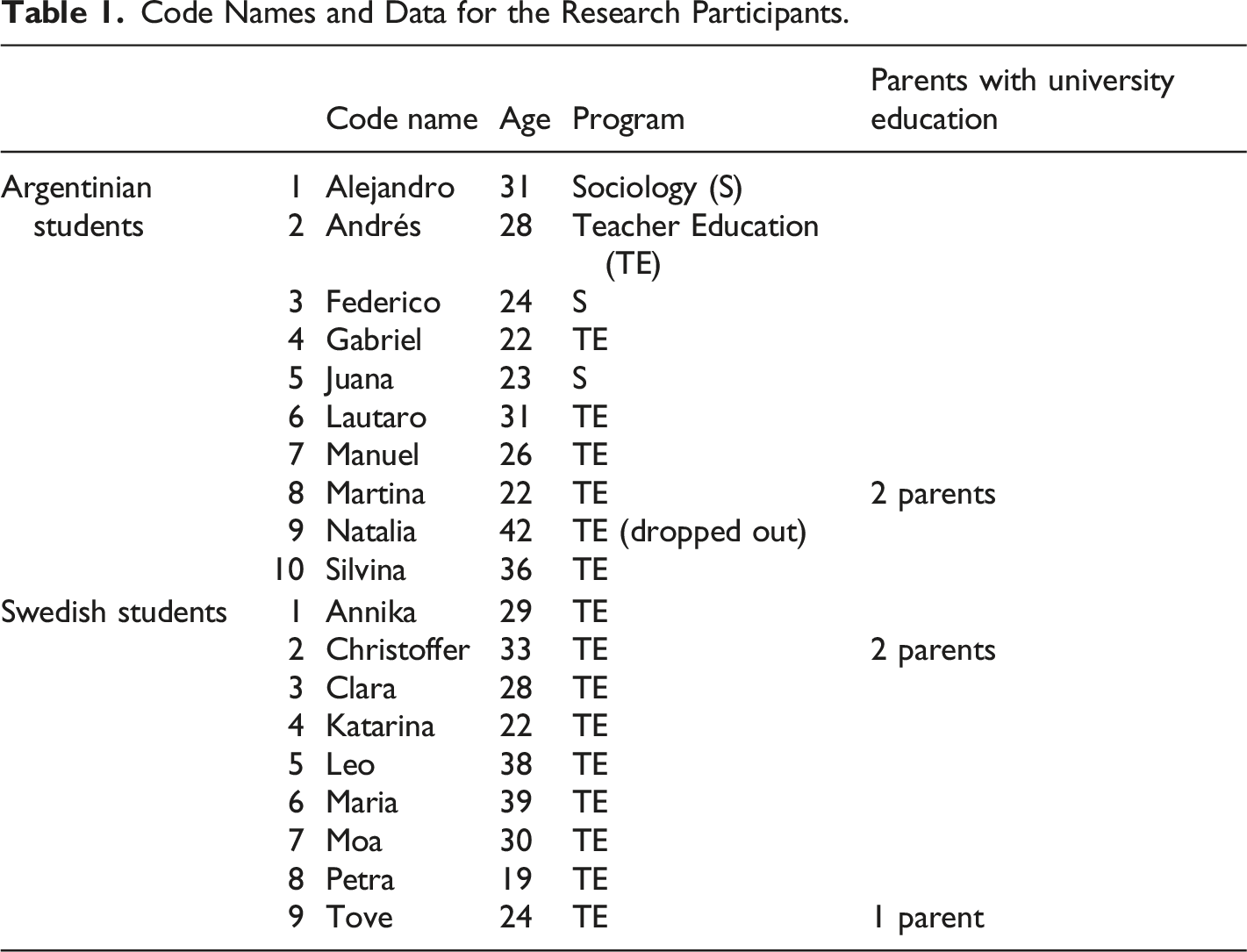
One Argentinian and two Swedish students have at least one parent with a university education comprising at least three years of full-time study. We define the other students as first-generation students in line with Spiegler and Bednarek (2013) since their parents have secondary education or less or postsecondary vocational education. Five Argentinian and two Swedish students have previously discontinued university education. These educational experiences are gloomy, and it took some time before they dared to return to university. The names of the participants were changed to ensure confidentiality.
We gave information about the study and the opportunity to participate to several groups of students at the Argentinian university and one group of 150 students at the Swedish university. All students who expressed interest in participating in the case study were included. The selection procedure could result in solely students with a successful school background and good self-confidence. However, the interviews indicate varied experiences in these concerns. The study was conducted following the ethical guidelines in both countries (Swedish Academy of Science, 2021; Argentinian National Scientific and Technical Research Council, 2006).
We used in-depth interviews to collect detailed information and go beyond surface-level answers (Alvesson, 2011; Kvale & Brinkmann, 2009). The approach was semi-structured with overarching themes. An interview guide supported the interviews (Kvale & Brinkmann, 2009) and ensured they were conducted similarly in the two contexts. In the first interview, conducted in the middle of the fall semester, we asked about age, study background, family, and life situation, and first impressions of the university. The central theme in the second interview, made six months later, was experiences of intellectual, social, and emotional changes. We aimed to ask open-ended questions that gave the interviewees space to narrate and follow their association paths, which is advantageous in capturing perceptions and experiences. The audio-recorded interviews were approximately 60 minutes long each. Transcriptions always involve shifts in relation to the recorded speech and shall therefore be seen as reconstructions. Our aim to access content aspects guided our choice of transcription key. The interviews are reproduced verbatim, mainly with written forms of language to facilitate reading. However, spoken language forms and expressions, essential for the understanding of the interviewee’s stories and perspectives, are retained. This approach is in line with our desire to reproduce the interviewee’s voices and perspectives as closely as possible (Alvesson, 2011; Pérez Prieto, 2007).
Swedish was the natural common work language since it is the mother tongue of the authors. Swedish was also used for the interviews with the Swedish students. The Argentinian interviews were conducted in Spanish, the first language of all the Argentinian students, and then translated into Swedish in connection to the transcription, which may involve further shifts in relation to the recorded speech. While translating the materials into English, the original versions of the interviews in Spanish were also taken into account to reproduce the quotations as accurately as possible. The fact that we conducted the interviews in two different languages and then presented the results in another may affect the quality of the translations and, thus, the study’s results. Influential factors are the translators’ linguistic competence and the interviewer’s knowledge of the culture of the interviewees (Birbili, 2000). Therefore, to clarify the conditions for the interviews with the Argentinian students, we underline that these interviews were conducted by Frida Hessel, who has lived in Argentina for the past 20 years. She is fluent in Spanish and has in-depth knowledge of the countries’ culture. The English translation was done in collaboration between the two authors, thoroughly considering and explaining culture-specific words and expressions.
The first step in the analysis was to search for patterns in the material independent of each other, with both the Argentinian and the Swedish materials available. Through repeated readings and notes, we found possible themes that could contribute to the understanding of students’ experiences of change. Additionally, we made lists of patterns with examples of statements that could form the basis for thematic analysis (Braun & Clarke, 2006). In the next step, we compared our respective theme proposals. After a thorough discussion related to our aim and research questions, we agreed on five themes that merged into three after further readings and discussion. During this process, we gradually gained a better understanding of the material as a whole. Separate parts could then be understood differently, which shed new light on the whole. In this hermeneutic process, the interpretation of the material developed through abduction, a continuous alternation between empirical data and theory, using theories to illuminate and understand different meanings in the material (Alvesson & Sköldberg, 2009). The examples of statements presented in the results section have been judged particularly relevant. We give examples of common statements forming patterns but occasionally statements with relatively little space in the material if it captures something important concerning the research questions. Thus, the occurrence is seen qualitatively (Braun & Clarke, 2006).
Findings
We present the findings in three themes that, together, can provide answers to our research questions. The first theme concerns students’ experiences of growing self-confidence and their reflections on its importance. In the second theme, Tools for expressing oneself and taking a stand, we deal with the significance students attach to different tools they acquire through HE and how these lead to shifts in how they perceive themselves and their possibilities. The third theme concerns changes in perspectives, values, and political consciousness and how these changes affect the students.
Growing Self-Confidence
The first interview reveals feelings of curiosity and optimism among the students but also uncertainty regarding their ability to cope with expectations and demands, mainly on reading and writing. With the use of emotional language, some students describe their first impressions of the university as overwhelming and almost shocking. “a slap in the face” (Annika, Swe), “confusion” (Katarina, Swe), and “like they throw a bucket with cold water on you” (Juana, Arg). Lautaro (Arg) describes his “lonely process to get hold of how to study.” He was offered support from his teachers but never asked for help. “I was too proud, and at the same time, I felt ashamed. I thought, I am at university, and I don’t know how to read and write. How can that be?”. Previous failures in HE seems to have an impact on experiences. One example is Silvina (Arg), who reentered university 10 years after dropping out: “I was so scared that I studied all the time, also when I was walking, while waiting for the bus with my daughter and while I was cooking.” Leo (Swe), who started university after 18 years as a bricklayer, describes the situation as a struggle of putting together a difficult puzzle. “How can I manage to put in all the pieces, and now I have to move on to the next puzzle without finishing the first one.” Commonly, students account for the long time they spend reading and re-reading course literature in order to understand and how they struggle with instructions for examinations and writing assignments. They talk about the fear that their language is not good enough, of running out of time, missing something important, or doing something wrong. During the first semester, students’ fears of failure and dropout make it difficult to feel at home at the university.
However, mainly in the second interview, students at both universities tell about experienced changes that affected their self-confidence, often expressed as a belief in their ability that gradually grew stronger during the first year. Manuel (Arg) did not see the university as a place where he belonged. His parents never expected him to continue to study during his school years since he had problems with both poor grades and behavior. After almost being kicked out of school, his mother said, “You will be a cardboard collector 3 in this life,” words that have etched themselves in his memory. The first successful examinations made him realize that the university does not have to be “a road full of suffering.” Eventually, he freed himself from previous notions of himself and realized that the university was a possibility. Moa (Swe) has similar experiences of failing self-confidence that have influenced her choices since childhood. According to Cranton (2016), such experiences act as a filter for understanding oneself and the surrounding society. Despite academic success with the highest grades on exams, Moa cannot yet believe in the change that has taken place. “I still think of myself as being stupid, knowing nothing. It clashes quite a lot with the one I have become.” Like Manuel, Moa is in a process of change in her psychological habits of mind (Mezirow, 1991), regarding thoughts and feelings about how she sees herself. Through her study results, Moa has become aware of holding a limited or even distorted view of herself, a view that she critically examines but still cannot fully get rid of.
Central to transformative learning “is a process of becoming aware of how assumptions or presuppositions we uncritically assimilated at an earlier age have powerful consequences for how we think, feel and act” (Kreber, 2013, p. 54). This process is described as a growth in authenticity leading to students’ awareness of their real possibilities Manuel and Moa identify their distorted assumptions and envision alternative ways of understanding themselves. Becoming aware of why we think, feel, and act in particular ways and the consequences of doing so are significant for premise reflections, which according to Mezirow (1991), is a prerequisite for transformative experiences. Premise reflections have the potential to lead to a perspective transformation, “a structural shift in the way that a person looks at himself and his relationships” (Mezirow, 1975, p. 162).
Like Manuel and Moa, several students experience that their belief in their capacity gradually increases when they discover that they can cope with requirements and expectations far better than they could imagine. “When I see my grades […] I feel proud of myself, I have the capacity” (Natalia, Arg). Lautaro (Arg), gains a new perspective on himself when he is on an internship: “I see myself in the role, feel that I have the capacity to do it. To say something like that about myself, it’s like, Wow.” Christoffer (Swe), who grew up in a family of academics, feels comfortable in the new environment. However, previous experiences of lack of motivation for studies, followed by school failure, led to initial uncertainty and stress in oral and written examinations. In the second interview, he talks about “an increased security and a self-confidence that grow all the time.” Manuel, Moa, Natalia, Lautaro, and Christopher are students who gradually become aware of and confront their self-concepts and replace them with more supportive perceptions. They move towards greater authenticity. The changes in self-confidence are related to study success and the insight that they have abilities they previously doubted. However, the uncertainty still lingers for students like Leo and Petra, who struggle with several re-examinations during the first year. Still, in the second interview, like most students, they talk about increased self-confidence connected to knowledge and tools for expressing themselves.
Tools for Expressing Oneself and Taking a Stand
Connected to experienced changes, several students stress the importance of getting tools for speaking, writing, and critical thinking and, through these tools, also dare to question and stand behind their opinion. Having tools for what you want to express seems to give better self-confidence and affects students’ ability to participate actively in conversations. The students describe connections between language development, knowledge, a different way of thinking, and better self-confidence. Petra (Swe) says she has grown “above all in knowing what I am talking about.” Clara (Swe) and Katarina (Swe) talk about reflecting and analyzing much more, seeing patterns, using other words, and thinking differently about themselves. Changes in how they think are related to what Mezirow (1991, 2000) describes as changes in habits of mind.
The students describe knowledge as an essential tool for personal development and success in their studies. Gabriel (Arg) previously felt overwhelmed by the knowledge of others. He comments on his development as “a process of endless improvement. It encourages me to continue learning all my life.” Maria (Swe) expresses feelings of joy and curiosity in learning as her main driving force. “Every time I take on a new thing, it leads to curiosity, and I want to learn more; every time I experience this, the world brightens up in some way…”
Similarly, Martina (Arg) talks about an increasing joy in learning that has arisen at pace with changes in her perspective on knowledge. When she entered university, she mainly focused on meeting the instrumental objectives. Today, her motivation is related to “the construction of herself” and “to achieve a more profound knowledge.” A characteristic feature in the Swedish students’ stories is a changed approach to knowledge linked to the future teaching profession. For example, Katarina says: “I want to think about the future, that I need the knowledge to take it further. When that interest exists, I just want to absorb the knowledge.” In the same way, Christoffer states: “It’s about me becoming a better teacher, not getting a good grade.” The teaching profession becomes a motivating force for these students, leading to an appreciation of educational activities and a positive attitude towards knowledge. Their statements resonate with Cranton (2016), who writes that epistemic habits of mind not only concern getting new knowledge but also why we learn and how we acquire and use our knowledge. Students reported experiences indicate that knowledge development is closely related to increased self-confidence and emotions like joy and curiosity and that knowledge can gain new meaning when connected to an upcoming profession where they can contribute to society.
Sociolinguistic habits of mind are related to social norms, cultural expectations, and language use (Mezirow, 1991). We inherit habits and points of view through our interaction with the communities and cultures to which we belong. Questions of truth and what is morally acceptable, assumptions about class, race, gender, religion, etc., and habits of behaving and using language become internalized (Bourdieu & Thompson, 1991; Cranton, 2016; Kreber, 2013). Language use concerns, for example, rules for discussions, when to speak and listen to others, legitimate forms of discourse, and acceptable arguments (Kreber, 2013). Consequently, students’ sociolinguistic habits of mind affect all other aspects of habits of mind.
For first-generation students, norms, and rules for communication can differ from what academic teachers expect. Reading and writing are crucial literacies in the academy, and research shows that many students feel uncertain about coping with the often unclear requirements and expectations (Bergman, 2016; Hyland, 2009). Initially, Frederico (Arg) and Christoffer (Swe) found writing challenging, but eventually, they developed their abilities. Christoffer says he became a better writer during the first year and is ashamed of his texts from the first semester. He states that his writing feels like “a confirmation that I am in the right place, this is what I want to do.” According to O’Keeffe (2013) and Zepke and Leach (2010), a sense of belonging is important for students’ success, but being successful can also strengthen that feeling. Christoffer knows that writing is essential in academic studies, and writing that works well provides security and confirmation that he belongs in the academy. Federico (Arg) referred to himself as “a guy who did not write,” but after developing his writing during the first year, he thinks writing is fun. Clara (Swe) and Katarina (Swe) are happy to participate more in conversations with fellow students, friends, and family. Moa (Swe) dares to participate in discussions, proud to “deliver facts that people did not know.” The linguistic and knowledge tools that students receive and their increased self-confidence allow them to express themself and dare to question and stand for their opinion. These changes are emancipatory and affect social life.
For some students, changes in knowledge and language abilities entail a more profound structural shift in how they see themselves and their relationships. Maria (Swe) states that her language and ways of thinking have changed through her education. “I do not have to scold people for not agreeing.” She illustrates her development by talking about previous conflicts where there was a quarrel because she lacked language, “there was no language.” “I realize how important my education is, to be able to speak correctly […] and then it will be a different outcome.” Maria describes herself as calmer, less impulsive, and a person who can question things and argue her opinion with language and knowledge. Her story suggests that she, during the first year, experienced perspective transformations that had emancipatory effects. Other stories with similar implications come from the Argentinian material. Natalia states that she can now make her voice heard. “I can have an opinion, and it has the same value as someone else’s. Before, I may not have defended my opinion.” Andrés stresses changes in his listening ability after realizing the importance of listening and that contradictions can be good and lead to something new. In Natalia’s, André’s, and Maria’s stories, we can notice experiences of both linguistic, social, emotional, and intellectual growth, leading to changes in feelings, thoughts, and actions. They experience changes in basic premises which can be seen as signs of identity changes (Illeris, 2014, p. 40). Through critical reflection and self-reflection on assumptions and presuppositions, they can envision alternative ways of acting and think about themselves and their possibilities. In Kreber’s words (2013), they are “growing into their authenticity,” which is associated with “revising one’s frames of reference” (p. 130). For Andrés, this also entails recognizing different perspectives and a willingness to listen to others. Thus, students’ experiences of change have social implications. Annika and Leo (Swe), are the only students who explicitly report that their change experiences only concern more knowledge and better presentation skills.
New Perspectives, Changes in Values, and Political Consciousness
Both Argentinian and Swedish students state that their time at university has led them to incorporate new perspectives, which have sometimes also resulted in changes in their values, opinions, and relationships. They frequently use expressions like “open more doors,” “open the head,” or “broadened horizons.” Natalia (Arg) summarized this experience as follows: “University doesn’t only open up new possibilities, it also opens your mind because you don’t think in the same way. It is not the same head after attending university. I feel I’m not the same person.” Many students express that the daily co-existence of dialogue with teachers and students with different backgrounds, thoughts, and values is important for this process. Drawing on Mezirow’s understanding of discourse with others as a way of creating new perspectives, Lawrence and Cranton (2015) suggest that relationships are essential to support and promote transformations, both inside and outside formal learning contexts.
Several students experience being more open-minded and tolerant than before and illustrate this process, pointing out shifts in socio-political values. They have incorporated values that they see as more progressive, inclusive, and modern than before. As Mezirow (2000) proposes, a perspective transformation leads to a more inclusive, critically reflective, integrative, differentiating, and permeable frame of reference. Federico (Arg) and Maria (Swe) reflected on how their values have changed since they entered university. “I always say I’m no longer a thermos, 4 in short, a square. And when I say thermos I mean Catholic, dogmatic, macho, and proudly ignorant,” says Federico. Maria says she no longer classifies people according to prejudices and has a greater acceptance of people with other cultural and religious backgrounds. “I was more racist before […] I guess I was in a bad environment, but now I can think for myself.” Maria, who was never previously concerned about politics, also states that she has gained political interest. What she learned at university awakened her curiosity and made her want to know more. At the same time, she feels that the knowledge enables her to participate in political discussions. “I can express what I think is good or bad about different parties […] last time I voted was the first time I really knew who to vote for.”
Especially the Argentinian students talk about how the changes in perspectives they have experienced also affected their families. Federico and Alejandro introduced new viewpoints concerning sensitive sociopolitical questions at home. “In my family, we never spoke about issues of profound social relevance before,” says Alejandro. He got his father, a retired military and “very right-wing guy,” and his mother, “who just didn’t care about politics,” to “listen attentively” to his ideas. He thinks this was possible because he is a university student and did not “improvise.” Both Federico and Alejandro became involved in politics and convinced their fathers to participate. Federico began to question his family’s dogmas, which he defined as vertical, religious, and traditional. His “first and most traumatic rupture” was to abandon the Catholic faith, which created friction with his parents, who finally accepted his new thoughts.
Silvina and Juana (Arg) come from families that they define as patriarchal. Silvana’s mother, a housewife, believed her daughter’s future was to get married and have a family and never stressed the importance of studying. “University made me question my whole life, what I want, why I do what I am doing,” she states. When Juana talks about her situation at home she uses words that indicate strong feelings. “At home, they are super macho, super homophobic, and super right-winged, and suddenly they pushed me so much that I decided to go to university, and I became left-winged and feminist, I made their life complicated.” As an example of how this impacted her family, her brother gained the courage to come out as gay after questioning her parents’ homophobia. These narratives show that personal and social changes are two complementary dimensions of the transformation process (Cranton & Taylor, 2012). The students experience a structural shift in how they see themselves, their societal role, and the surrounding world. According to Cranton (2016), such a shift has implications for understanding how class, race, and gender structures are intertwined, our vision of alternative ways of living, and our sense of possibilities for social justice.
New perspectives also affect how students view their future life and profession. In general, the more mature students have experienced unskilled and low-paid jobs. University education is a way to improve their employment status, not only to earn more but also to “learn new things,” “feel engagement,” and “work with something you like.” Natalia (Arg), who currently works at a factory, feels that education ensures she will be treated better: “If you didn’t study, you are seen as ignorant.” At her former job, Maria (Swe) felt like she was “stuck in a profound dark hole heavy to climb out of,” and she “didn’t learn anything new.” Silvina (Arg) is now a model for her teenage daughter, a witness to her process: “She had a mum who was a waitress, and now she can say, my mum is an anthropologist and a teacher.”
Discussion
In our interviews, several students report experiences of school failure, and all of them except three are first-generation students. Consequently, uncertainties about knowledge and language abilities exist among them and affect their self-confidence and sense of belonging. A confident language gives freedom to some people, while others remain insecure about their language and, thereby, their position in the social space (Bourdieu & Thompson, 1991). However, for most students in our study, language habitus does not work deterministically. Instead of reproducing existing structures, they develop new knowledge and ways of communicating and acting. In this process, they also alter their view of themselves. Our findings show that only two students, Annika and Leo (Swe), explicitly stated that they experienced changes only concerned more knowledge and better presentation skills. All other students reported experiences of intellectual, social, and emotional changes during their first year of study. These changes are closely interrelated, depend on each other, and promote student success in HE. For students like Federico (Arg), Maria (Swe), and Silvina (Arg), we categorize these experiences as transformative. Their experiences are broad and complex; they question their basic premises and change their view of themselves, the world, and their societal role more profoundly. These experiences indicate changes in habits of mind (Cranton, 2016; Mezirow, 1991) and identity (Illeris, 2014). Also, Natalia (Arg), who dropped out after her first year, underwent essential changes in how she perceives herself and her place in the world. Her experience suggests that HE may involve profound changes even for those students who do not fulfill their education.
Students such as Moa (Swe), Lautaro (Arg), and Clara (Swe) have experienced different changes in self-confidence, epistemic and sociolinguistic habits of mind, as well as in social and family life. Based on the interviews, we understand these changes as not yet affecting them as a profound structural shift in basic premises. However, our results show that it is not a question of slight changes. Instead, these students are in the process of a gradual change that may eventually lead to what Mezirow (2000) defines as a perspective transformation.
The students express similar transformative experiences and attach similar significance to experienced changes. A majority talk about growth in self-confidence through knowledge- and language-development and the importance of obtaining tools for critical thinking and expressing their opinions. They also describe changes in their perspectives, values, and beliefs, sometimes leading to an increased interest in political and social issues. However, there are also differences, which are better understood if we consider cultural and socio-economic contextual factors. In Argentina, many students live with their parents and depend on them financially, while Swedish students, to a greater extent, live on their own and are financially independent. Several Argentinian students’ stories describe how experienced changes impact family ties and lead to tensions with their parents. However, they also tell how they have introduced discussion topics and alternative points of view to them. Striving for a better life is visible in both contexts, especially for students who have work experience from boring and low-paying jobs. Still, it is more accentuated in Argentinian students’ narratives. This might be explained by the Argentinian students perceiving their reality as uncertain. The social and economic instability and the state’s limited capacity to give support and reduce inequalities seem to force individuals to struggle more actively for a better life. For Swedish students, the future profession, with its social responsibilities as a motivating force for change and development, gets greater emphasis in the narratives.
A consistent characteristic in many of the interviews is that the students use words that express strong feelings, positive or negative, both when referring to learning experiences and different aspects of their lives. In this sense, Freire points out that reading, writing, and knowing are intrinsically bound up with the emotional body: “Knowing for me is not a neutral act, not only from the political point of view, but from the point of view of my body, my sensual body. It is full of feelings, of emotions, of tastes” (Horton et al., 1990, p. 23). The students also use metaphors and similes to express their feelings as when Maria (Swe) talk about her former job where she felt “stuck in a profound dark hole heavy to climb out of” or when Leo (Swe) describes the learning situation as a struggle of putting together “a difficult puzzle.” According to Freire and Slover (1983), “naming the world” must be done with the “word universe” of the people who are learning, “expressing their actual language, their anxieties, fears, demands, and dreams” (p. 10). This statement clearly shows the significance Freire gives to the emotional dimension of language. This dimension is noticeable in the powerful words used by the interviewees in our study, words laden with feelings such as anger, disappointment, joy, and enthusiasm.
One limitation of this study is that the interviews were conducted only during the first year of study. In such a short period, it may not be feasible to see changes in habits of mind and signs of transformative learning. According to Mezirow (2000), transformative learning is a process that gradually affects a person’s life. Therefore, it would be interesting to conduct a follow-up study with similar questions, such as when the students have finished their education. Reports about inner conflicts related to change experiences are rare among the students, but there are significant exceptions. Moa (Swe) and Manuel (Arg) experience discrepancies between their academic achievement and their view of themselves. Juanas (Arg) and Frederico’s (Arg) changing perceptions and beliefs lead to conflicts with their families. A study conducted after the education might show more complexity and contain stories of losses and contradictions regarding social belonging. Friedman’s analysis (2016) was made after education and indicated that upward mobility gave emotional imprints like alienation, guilt, and a divided habitus. Another limitation is that the study concerns only one group of students from each university, a total of 19 students. However, the advantages are that the multiple case studies driven by the conceptual framework of transformative learning made it possible to explore the students’ experiences in depth, highlight significant aspects and how they are intertwined, and discover similarities and differences in the two contexts.
Finally, the students’ stories taught us that learners with fragile identities and low self-esteem could experience significant shifts in how they see themselves and their future possibilities through HE. In both contexts, it becomes clear that HE transformative experiences are emancipatory and empowering, giving students more control over their lives and affecting their studies and social life outside the university (Freire, 1970; Mezirow, 2000). Following Rocks and Lavender (2018) and drawing on Freire, we believe HE could be a catalyst for developing confident and engaged citizens prepared to contribute to society. In the same vein, Rincón-Gallardo (2019) points out that education must be seen as a challenge to awaken the capacity of human beings to make the world a better place. This study indicates that such a capacity is not achieved solely through a deep understanding of a discipline. HE must also offer open spaces for critical work and possibilities for students to critically investigate their frames of reference and induce them to believe their role in society is essential. Accordingly, academic teachers need knowledge about the importance of transformative learning in HE teaching practices.
Footnotes
Declaration of Conflicting Interests
The author(s) declared no potential conflicts of interest with respect to the research, authorship, and/or publication of this article.
Funding
The author(s) disclosed receipt of the following financial support for the research, authorship, and/or publication of this article: This study was funded by the research program Disciplinary Literacy and Inclusive Teaching (LIT) at MAU, Human Science Research Laboratory (LICH) at UNSAM, and The Swedish Foundation for International Cooperation in Research and Higher Education (STINT).
