




Abstract
Our study examines transformative learning outcomes of a group coaching format in a postgraduate program of a German University that is based on the cognitive-developmental approach to coaching. We administered a survey based on Kirkpatrick’s 4-Level Evaluation Model and its advancement by Alliger et al. that includes items from the Transformative Outcomes and Processes Scale. Findings suggest that the group coaching was effective on all levels and fostered transformative learning.
Keywords
Transformative learning theory is one of the theoretical foundations for the learning process in coaching (Bachkirova et al., 2010). The importance of transformative learning for coping with present and future tasks in the world has been pointed out (Burns, 2018; Finnegan, 2019). Coaching supports critical reflection, especially regarding the client’s assumptions on the world and the self, as well as working on disorienting dilemmas (Herrera, 2010; Matsuo et al., 2020)—all core elements of transformative learning (Mezirow, 1981), raising the question of how coaching can impact transformative learning. Relevance of different group work settings, for example, to foster personal growth and awareness as a context for transformative learning, has been shown by Schapiro et al. (2012). Group coaching also enables facilitation of extra-rational processes of transformative learning, for example, individuation through self-dialogue (Boyd, 1989) or imaginative and emotional processes (Dirkx, 2006). Thus, group coaching approaches appear to be appropriate to provoke transformative learning.
Though there are research studies in both adult education and psychology that empirically examine different aspects of promoting transformative learning and ego development (on the relationship of both: see below) through structured programs such as coaching, mentoring, or university classroom programs, there is a research gap concerning the promotion of transformative learning through group coaching. This becomes apparent in the following: (a) identity work through transformative autoethnographic dance (Baldwin & Motter, 2021), (b) mindfulness and transformative learning (Kumar, 2021), (c) promoting transformative learning through action research (Gawlicz, 2021), (d) transformative learning through counseling training (Nogueiras et al., 2019), (e) transformative learning by practicing mindfulness (Brendel & Cornett-Murtada, 2019), (f) fostering self-authorship through mentoring (Mondisa & Adams, 2022), (g) group coaching to foster self-reflection (Ostrowski, 2019), (h) group coaching to foster career development, self-reflection, and the general functioning of young sports talents (Stelter et al., 2011), (j) peer mentoring and its impact on meaning making of role (Engler, 2015), and (k) ego development through coaching education (Binder, 2014). Manners and Durkin (2000) provide an overview of several intervention studies on structured programs on ego development. Also see Washburn’s (2021) overview of studies on transformative learning assessment. With only few studies concerning the promotion of transformative learning through group coaching there is a lot of unexplored territory. This study aims to close this gap by examining transformative learning outcomes of a university course designed to foster personal growth and development using approaches that are characteristic of group coaching.
Coaching
We understand coaching as an interactive, “result-oriented, systematic process” (Grant, 2003, p. 254) that is based on a “collaborative, reflective” (Jones et al., 2016, p. 250) equal basis relationship of coach and coachee with the goal to foster “desirable and sustainable change” (Bachkirova et al., 2010, p. 1) and personal growth (Jones et al., 2016, p. 250) in adult development (see also the comparison of definitions in Maltbia et al., 2014). Though some of its techniques derive from psychotherapy, coaching aims at “normal, non-clinical clients” (Grant, 2006).
While in training or consulting the trainer or consultant may present a standardized or tailor-made solution for the client, coaching focuses on increasing insights through self-reflection and critically developing one’s own solutions (Peters, 2017). Coaching must also be distinguished from mentoring, where a usually more experienced person provides “emotional and psychosocial support” (Mondisa & Adams, 2022, p. 339) as well as “guidance and new learning opportunities” (Eby et al., 2013, p. 441) for a usually less experienced person. Coaching is neither characterized by such an asymmetrical relationship nor does it require the coach to be an expert in the client’s field of work or area of life (Jones et al., 2016, p. 250).
There are various approaches to coaching. Ives (2008) distinguishes inter alia goal-oriented coaching and developmental coaching. In the latter “goals emerge rather than emphasizing predetermined goals” (Fusco et al., 2016, p. 9).
Group Coaching: From a Cognitive-Developmental Perspective
We are using a group coaching setting that is based on a cognitive-developmental theoretical approach (Bachkirova, 2010) in the sense of Kegan (1983) and Loevinger (1976).
The cognitive-developmental approach focuses on what is called vertical development in contrast to horizontal development. Vertical is a reference to different underlying theoretical streams suggesting that human development occurs in a (hierarchical) sequence of qualitatively distinguishable stages throughout lifetime (e.g., Fowler, 1981; Kegan, 1983; Kohlberg et al., 1983; Loevinger, 1976; Perry, 1970; Piaget, 2016). Some of these authors focus on certain strands of vertical development (e.g., Piaget on cognitive development, Kohlberg on moral development), whereas Loevinger and Kegan each have a holistic approach including cognitive, emotional, moral, spiritual, interpersonal attitudes, motivational and other aspects of development. Furthermore, they include the construct of a self or ego that is self-reflective. The ego is both a process of the individual’s meaning making of inner and outer experiences (Loevinger, 1976, p. 5) and an identity which represents the results of that process (Manners & Durkin, 2001). Its core function is “the search for coherent meaning in experience” (Hy & Loevinger, 1996, p. 4) in life.
Ego development can be described as a progressive transformation of the self that is conceptualized in different stages of ego development (Hy & Loevinger, 1996). This is not a consistent or continuous process; it occurs in discontinuous steps and each transformation to the next stage may take significant time. With every next stage a significant change occurs in how an individual makes meaning of himself, interpersonal relations, and the wider context of life. It is a recurring process of differentiation and an integration of a new way of meaning making (Kegan, 1983). Though the concepts of ego development and transformative learning differ (e.g., TL has a political dimension that is not to be found in ego development), both concepts essentially focus on changing frames of reference.
Group Coaching: Specifics of the Setting
Group coaching is a special setting, in which one or more coaches facilitate a coaching process for a group of individuals that may either work together in an organizational unit (team coaching) or have no preexisting relationship. Group coaching goals may include individual and collective learning and development. In contrast to individual dyadic coaching, learning extends beyond the coach-coachee relationship. The group itself can contribute to learning (Ostrowski, 2019, p. 62). Most tools used in dyadic coaching can be applied in group coaching and may there be supplemented by peer or group exercises. In addition, group coaching allows specific techniques such as systemic constellations or peer feedback. Developmental group coaching does not require specific work-related objectives as the participants “convene for the purpose of exploring a particular and personally relevant subject” (Fusco et al., 2016, p. 9) such as ego development in the context of our program.
In contrast to team coaching which focuses more on team performance, group coaching is used to promote individual development through feedback from different actors. Participants can benefit from diverse perspectives to detect and reflect self-perception (Kets de Vries, 2014) and “from the challenges, learning, and experience of the other group members; and by linking individuals across their different situations and contexts” (Ostrowski, 2019, p. 54). Although some participants may find the group setting challenging, the perceived discomfort may enhance learning and change (Schulte & Liska, 2021).
Group Coaching: Impact Factors and Effectiveness
Research suggests that individual coaching can have significant positive effects on self-reflection, self-regulation, behavioral change, personal attitude change, performance, coping, well-being, individual skills, resource activation as well as team and organizational performance (Burt & Talati, 2017; De Meuse et al., 2009; Greif, 2021; Jones et al., 2016; Peters & Carr, 2013; Sonesh et al., 2015; Theeboom et al., 2013). The effectiveness varies based on several factors (e.g., skills of coach, coaching process). Individual coaching may even be ineffective or have unintended effects (De Meuse et al., 2009; Schermuly & Graßmann, 2016).
On group coaching effectiveness, there is far less empirical research. Nonetheless, studies have shown that group coaching can foster individual learning and change, critical reflection, meaning making, well-being and social support (for a short overview see Ostrowski, 2019, p. 55). Impact factors for group coaching can also be derived from factors in group therapy. From the 11 factors for effective group therapy Yalom developed based on clinical experience, in particular (a) universality, (b) imparting information, (c) altruism, (d) development of socializing techniques, (e) interpersonal relationships, and (f) emotional experience can be viewed as factors that determine the effectiveness of group coaching (Yalom & Leszcz, 2005; also see Schulte & Liska, 2021).
Method
Group Coaching: Design of the Evaluated Program
Based on the cognitive-developmental approach and with respect to Cox’ (2021) TROPOS instrument, Washburn’s (2021) research framework for transformative learning processes, and Hoggan’s (2016) typology of transformative learning outcomes we designed a program focusing on fostering transformative learning outcomes regarding the “…learner’s profound re-assessment of beliefs…” (Cox, 2021, p. 385) toward self-concept, habits of mind, and worldview as well as social support (also compare communion and connectedness from Washburn, 2021), and the critical assessment of the individual’s goals and purpose.
In the sense of Ives (2008) our program is rather developmental coaching than goal-oriented coaching as the participant’s individual goals arise in the process rather than being precisely defined from the outset. To foster transformative learning we incorporated different approaches (compare Schapiro et al., 2012) such as critical reflection in the sense of Mezirow (2009) and depth psychology in the sense of Boyd (1989) and Dirk (2006). Coaching methods used in the program included narrative storytelling based on image elicitation, reflective journaling, feedback, generative dialogue (in our case the four fields of conversation by Scharmer, 2016), metacognition and inner dialogue (in our case using the inner team model by Schulz von Thun, 2013), systemic constellation work, guided meditation, imaginary journey, embodiments, creative arts-based vision work, sociometry, reflective silent work. Every coaching method that we applied in the group coaching program intended to foster specific transformative outcomes (compare Washburn, 2021, p. 325). For instance, we worked with the inner team model to foster critical re-assessment and re-framing of self-concept, and support self-reflection as well as habits of mind. Feedback and generative dialogue were used to foster social support, reflection of self-concept as well as habits of minds. On a structural level group coaching appears to be especially well-suited to support transformative learning outcomes of social support, as the above-mentioned impact factors indicate.
We considered a specific antecedent: the participant’s ego development stage (see Loevinger, 1976) which was assessed several weeks prior to the group coaching with the Washington University Sentence Completion Test. As >80% of the participants were on the stages E5 and E6 based on Loevinger’s model, we designed our group coaching to support transformative learning that relates to these ego levels. Thus, the coaching program was designed to be disequilibrating for the coachees on these stages as well as personally relevant, emotionally engaging, and interpersonal (compare Manners & Durkin, 2000).
To measure transformative learning, in addition to our own scales we used sub-scales from the TROPOS instrument (Cox, 2021) which appeared well-suited to measure the above-mentioned aspects though they had to be partly modified.
Instructions and demonstrations were given to the entire group, but the actual coaching activities were carried out in small peer groups of three or four participants. The formation of the small groups was self-organized, then the groups stayed fixed to facilitate an environment that is as trusting as possible. Each group coaching process was reflected, and lessons learned were subsequently shared with the entire group. In addition, peer group exercises were documented and reflected by the participants in their journals. Two coaches supported both the peer groups and the individuals by providing feedback, supporting the process, or giving advice.
Preparations in Advance
The course was a non-obligatory part of the master’s program in Economics at a German University. This is in alignment with transformative learning theory where voluntary choice is essential (Mezirow, 2009). Since the number of applying students was higher than the available places, participants were selected by lottery. Before starting the course, participants received access to the university’s digital learning platform in which they found relevant literature and instructions. For the narrative storytelling based on image elicitation, participants were asked to bring 5-10 photographs that show formative elements of their previous development. For this purpose, examples were given based on Montero-Hernandez & Drouin (2021, p. 182), for example, important people in your life who have helped you define who you are OR challenging experiences that have led to personal dilemmas (or inner conflicts).
Program of the Five-Day Group Coaching (Excerpt)
We started with purpose, rules, and roles of the group coaching program and gave a short introduction into (group) coaching and transformative learning followed and conducted sociospatial constellations to get to know each other. The first day then consisted of three steps: Step one was reflective silent journaling (e.g., on the questions: What development impulses am I looking for here? What is my contribution to achieving this?). Step two was the first group coaching exercise in different roles (coachee; peer coach, who leads through the process, and listener). One participant started as coachee, narrated his answers from the previous journaling exercise and replied to possible questions by peer coach. Listeners took notes in the coachee’s journal and subsequently gave feedback based on their listening level according to Scharmer (2016). After the feedback process the coachee tells her peers how it affected her that she was listened to and received feedback in this way. Step three was narrative storytelling based on image elicitation according to Montero-Hernandez and Drouin (2021). Day one was concluded with journaling reflection based on two questions (Who or what emotionally touched me today? What have I learned about myself or observed?).
On the second day a coaching method was introduced that focuses on the social system (based on König & Volmer, 2008). It was applied in peer groups with three roles (coachee, peer coach, listener). The participant with the coachee role shares a personal development topic which affects several related people (e.g., family, circle of friends, team at the workplace) that she would like to work on. The peer coach guides the coachee through her reflection process on the specific topic within the multi-perspectivity of the related system with the goal to gain new insights and behavioral options. The listener listens on the four levels according to Scharmer (2016) and gives feedback.
The third day facilitated inner team experiences based on Schulz von Thun (2013) which was a core element of our concept for the promotion of transformative learning through group coaching. It offers the opportunity to relate intrapersonal dynamics to the complexity and contradictions of the outside world, for example, by examining which inner parts are activated in a conflict situation. Schulz von Thun visualizes the inner parts as team members on flipcharts and gives them proper names (e.g., the critic). Furthermore, he introduces the role of the inner team leader who is supposed to integrate the diverse and sometimes conflicting perspectives and needs. Working with this model aims to identify inner team members and their needs, integrate rejected or unliked inner parts, facilitate inner team dialogue, and thereby develop self-leadership. In our group coaching program, metaplan cards for each inner team member were used for on-floor visualization, thus allowing the coachee a bird’s eye view of the dynamics of the inner parts. Furthermore, the coachee can physically stand on each card and thus associate himself with the inner team member and his needs. Peer group members can function as representatives of inner team members much like in systemic constellations work. This allows, for example, a direct dialogue between inner team members.
After an introduction to the inner team model, a coaching demonstration was carried out with a volunteer participant. At first, the coachee was asked whether she has a specific developmental topic she would like to work on and she broadly described it. Then, inner team members were sought who seem to play a role in relation to the topic. Four of them were selected for the inner team meeting. The coachee was asked to formulate a message that each inner team member could typically articulate in an inner dialogue (e.g., the critic might say: you will fail anyway). Then, the coachee placed all inner team member cards on the floor in relation to each other and reflected that picture. Subsequently the inner team meeting began from the position of the inner leader. For this purpose, the coachee was asked to stand on the card with the appropriate direction of view. The coach led through the process based on questions. The same procedure was used with every inner team member. The coachee was asked to empathize with each role—as if she were exactly this inner person (association is an important counterpart to the dissociation that occurs when looking from the outside). The coach may ask each inner team member questions regarding the coachees topic (e.g., What do you think about the topic that the coachee is concerned with?), the inner team system (e.g., What is your role in the coachee’s life?), on the relationship with the inner leader (e.g., Does she know you exist?), on the future (e.g., What would you do if you had a free choice?). After questioning an inner person, the coachee can switch back into the role of the inner leader (or another inner person) to reflect what was heard. After all inner team members have been heard the inner team conference ends on the place of the inner leader, from where the coachee can look at her topic from a distance (What are the most important insights from the inner team conference? What is there to do?). In a follow-up conversation with the coach the process was reflected, and transfer activities were discussed. After the demonstration, observations from group members were shared, and questions discussed. Then, the inner team meeting was practiced in small peer groups with the roles of coachee, peer coach, listener, using their own development topics. As this process can be very emotional, the peer group setting demands caring supervision by the professional coaches.
Day four consisted of creative arts work to visualize personal visions of their future life, an imaginary meditation journey to support the creative arts work and by again working with the inner team, in this case to facilitate the reflection of their personal vision that was created earlier with the creative arts work. On a walk together, the individual visions were reflected with peers. The day also included group work, in which the different levels of ego development (based on Loevinger) were embodied by the participants. This intended to support a holistic experience of vertical development and a reflection of that experience.
On the final day the embodiment work continued before the course was concluded with time for reflection of the group coaching process (e.g., What did I receive from the group? What difficulties did I cause the group?) and feedback.
Subsequent to the five-day group coaching
Students were asked to continue weekly journaling based on reflection questions for the following 8 weeks (e.g., What is my personal development focus right now? Which inner team members did I notice today?). Furthermore, a peer group coaching session had to be completed using a coaching tool that promotes the reflection of beliefs and assumptions by looking at important people and their specific influence in the coachee’s biography. This coaching method directs at developing frames of reference which are “…the result of cultural assimilation and the idiosyncratic influences of primary caregivers” (Mezirow, 1997, p. 6).
A three-hour online review session was held 8 weeks after the 5-day coaching course. During this session we reflected both the 5-day group coaching as well as the time afterward and looked ahead. In small groups participants deepened self-reflection and process reflection by using the inner team method (e.g., What does my inner team say about the last 2 months since the group coaching seminar?). After sharing insights with the entire group, they did a 15-minute silent journaling activity on what will have developed in them in a year from today.
Participants
Twenty-nine postgraduate students participated in the group coaching program. The age of the participants ranged between 22 and 30 years (mean age is 24.6 years) of which 25 were female and four were male.
Study Design Based on Kirkpatrick’s 4-level Evaluation Model
To examine the effectiveness of this group coaching program on transformative learning we used Kirkpatrick’s well known evaluation model for training effectiveness with some modifications and its enhancement by Alliger et al. (1997) and Bauer and Göhlich (see below). Kirkpatrick’s model consists of four levels for training evaluation: Reactions, Learning, Behavior, Results. The fourth level of Kirkpatrick’s evaluation model focusing on the organizational results of a training program was not included in our study as the program’s participants don’t work in the same company, and thus, the sample is too small for analyzing this level (compare Bauer & Göhlich, 2019, p. 251).
Data was collected based on a quantitative questionnaire that includes three scales with 11 sub-scales and 55 items captured with a 5-point Likert scale (completely disagree – completely agree).
All English-language items were translated to German using the forward-backward translation procedure. The first translation created by one of the authors (Peters) was then discussed with a native English speaker and English teacher at a German university, thereby creating a preliminary version. This was translated back into English by a bilingual, native English speaker who is a professor at a German university. The preliminary version was reviewed in comparison to the backward translation; deviations were identified and discussed, thereby creating the final version. Several items were adapted to suit the specific group coaching format (e.g., using the term group coaching instead of training).
Participants were asked to fill out the questionnaire 8 weeks after the 5-day group coaching program. All 29 participants answered the questionnaire. 23 questionnaires were fully answered, four had one missing item, one had two missing items, and one had five missing items. The latter was excluded from analysis. Percentage of missing values was 1.76%. Based on Cox (2021, p. 387) missing values for the other responses were supplemented for data analysis by using the participant’s mean value in the sub-scale in which the item was missing. That led to 28 responses in total of which five were male and 23 female respondents.
Though the small sample size does not meet ideal requirements for a substantial factor analysis, we can accept these limitations here, as we are conducting an exploratory study. Our main goal is not the development of a quantitative model for transformative learning evaluation but to explore the effectiveness of a group coaching format on TL. To reflect the limited significance of the structure of the data resulting from the relatively small sample size, we used a nonparametric bootstrap method (see Zientek & Thompson, 2007). The factor analysis for the bootstrapped samples resulted in similar structure of factors, so that the informative value of the original data can be regarded as sufficient for the application of a factor analysis.
Reactions
For level one, reactions, we followed an approach used by Bauer and Goehlich (2020) to measure participants reactions to our group coaching program. Alliger and Janak (1989) point out that “…a reaction measure is conceived in attitudinal rather than behavioral terms” (p. 331). We focused on affective reactions such as general satisfaction with the course, judgment on utility of the coaching program (both according to Alliger et al., 1997, p. 343) as well as perceived difficulty of the coaching following Warr and Bunce (1995).
Our scale for reactions consists of three sub-scales to measure (a) general satisfaction (e.g., I enjoyed the coaching seminar very much), (b) utility (e.g., I derive personal use from this coaching seminar) and (c) difficulty (e.g., I found this course very hard to follow). The items are based on existing survey instruments (Gläßler et al., 2002; Grohmann & Kauffeld, 2013; Ritzmann et al., 2014; Warr et al., 1999) but were uniquely composed and adapted to the group coaching format.
For the reactions scale factor analysis confirmed the structure of three factors and it finally consists of (a) satisfaction (with two items), (b) utility (five items) and (c) difficulty (three items) factors that account for 77.12% of variance.
Learning
The second level in Kirkpatrick’s model intends to measure trainings’ learning outcome by quantifying “principles, facts, and techniques understood and absorbed by the trainees” (Alliger & Janak, 1989, p. 331). Alliger et al. (1997) differentiate the sub-categories (a) immediate post-training knowledge, (b) knowledge retention at a later time, and (c) behavior/skill demonstration as a result of the training. As our group coaching program is designed to enhance experience-driven transformative learning it does not appear reasonable to measure this by knowledge tests. As discussed above, our group coaching intends to foster transformative learning with respect to self-reflection and social support emphasizing both the role of the coach as a person as well as the role of peers in personal learning and development. To catch this, the measurement of learning included the aspects (a) learning through/with peers (e.g., I gained new insights through peer feedback) and (b) learning through coaching interventions (e.g., The coaching exercises helped me self-reflect) in addition to a (c) general learning sub-scale which consists of three items from Marsh’s (1987) SEEQ. To specifically measure transformative learning aspects mentioned earlier, we included three sub-scales from the TRansformative Outcomes and PrOcesses Scale (Cox, 2021): (a) social support, (b) attitude toward uncertainty and (c) criticality, although overlaps between social support and learning with/through peers sub-scales were anticipated. Previous studies have shown that the TROPOS survey is a suitable instrument to measure transformative learning in both higher education (Cox, 2021) and the workplace context (Kwon et al., 2021).
Factor analysis showed a five-factor structure for learning. Items that did not sufficiently load on any factor (>.5) were deleted and items that double loaded (<.2 difference between items) on two factors were also taken out. The general learning sub-scale was not provable and thus discarded. About half of the items of the sub-scales learning through/with peers and social support loaded on one factor and the other items of both sub-scales loaded on a second factor, which does appear reasonable considering the interrelations of the theoretical background which led to these scales. This resulted in a learning through/with peers sub-scale that included seven items (with three items from the original TROPOS social support sub-scale added) and an adapted social support sub-scale of five items with one item additionally stemming from the original attitude towards uncertainty sub-scale which fits to Cox’ (2021) report that certain items of his TROPOS sub-scales load on different sub-scales. The learning through coaching interventions sub-scale consists of two items, criticality consists of four items, the final attitude toward uncertainty sub-scale consists of two items. These five factors account for 78.5% of variance.
The factor learning through/with peers accounts for 43.53% of variance. This is particularly interesting because this is a specific impact factor of the group coaching setting. In this respect, we conclude that it is the group coaching format that contributes significantly to transformative learning.
Transfer
Level 3 was originally labeled behavior by Kirkpatrick. Alliger et al. (1997) call it transfer as “…behavior that is retained and applied to the workplace is considered transfer” (p. 346). Since the participants of the focused group coaching program are full time students who do not work in the same company or even do not work at all, a specific measurement of transfer to the job in the sense of Alliger et al. (1997) is not possible.
We attempt to capture transfer by including the aspect of transfer implementation intention according to Machin and Fogarty (2004) “…to assess the trainees’ intention to engage in specific behavior that would facilitate transfer of their skills” (p. 228). Our sub-scale on transfer implementation intention consists of four items (e.g., I will review course materials in order to develop the skills that I have learned) from Machin and Fogarty (2004). As our main intention is the assessment of transformative learning outcomes (of the aspects described above: significant re-evaluation of beliefs on self-concept, personal narrative, worldview, habits of mind, social support, goals and purpose), we included the sub-scale on transformative outcomes from the TROPOS scale (e.g., My deeply held beliefs changed) which measures “…profound re-assessment of beliefs, typified by changed assumptions and a more inclusive, open perspective toward self and others” (Cox, 2021, p. 385).
Measuring level 3 should ideally occur long time after the group coaching program in real life (Cahapay, 2021), which was not feasible here. But conducting the survey 8 weeks after the program realized this ideal at least in terms of time.
Factor analysis basically confirmed the scales for transfer implementation intention and transformative outcomes with those two factors explaining 68.72% of variance. Two of the items from the original transformative outcomes sub-scale (items 2 and 6) loaded strongly (.921 and .853) on a third factor that accounts for another 12.5% of variance. It may be due to our small sample size that this effect occurs. Those items (I developed a greater sense of responsibility toward others and My view of the world changed) represent aspects of transformative learning that are more directed towards the outside world (worldview), whereas the other items tend to be directed on changes of inner processes and self-perception (self-concept). Thus, we kept the separate third sub-scale and labeled it transformative outcomes – social responsibility. We are aware that further research is needed to investigate this aspect. One variable had to be excluded due to double-loading on two factors. Our final scale for transfer consists of the three sub-scales transfer implementation intention (three items), transformative outcomes (five items), and transformative outcomes – social responsibility (two items) that account for 81.23% of variance.
Quantitative Analysis
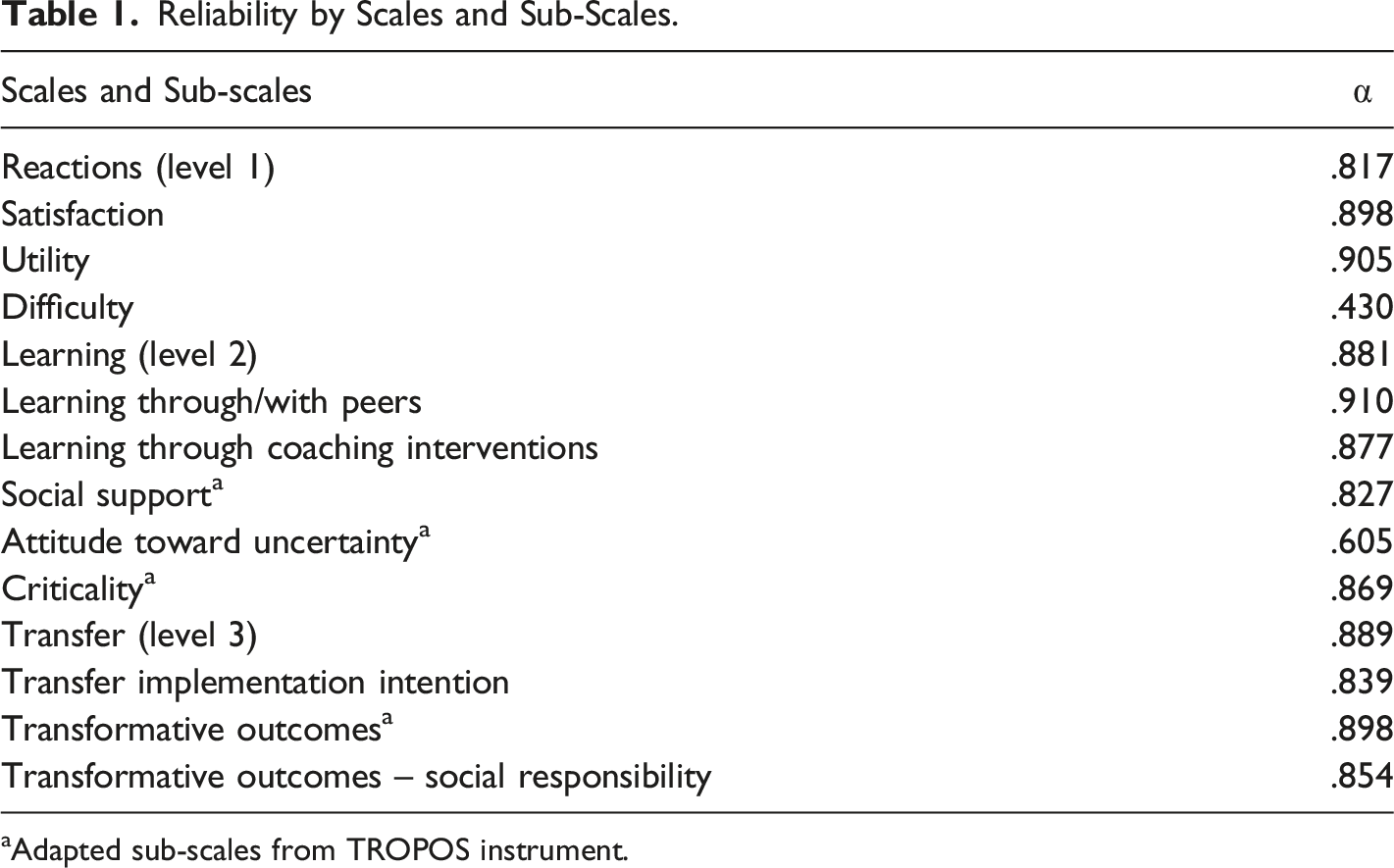
Reliability by Scales and Sub-Scales.
aAdapted sub-scales from TROPOS instrument.
All sub-scales except for difficulty and attitude toward uncertainty show good (α > .80) reliability scores. Low reliability demonstrated for the sub-scale attitude for uncertainty was already found by Cox (2021) but is still included here following Cox’ notion that “…while the internal consistency of attitude toward uncertainty in this sample indicates the sub-scale needs further refinement, individual items help account for overall assessment of TL” (Cox, 2021, p. 388). Factor analysis proved this to be true for our small sample and the adapted sub-scale as well.
Results
Reactions
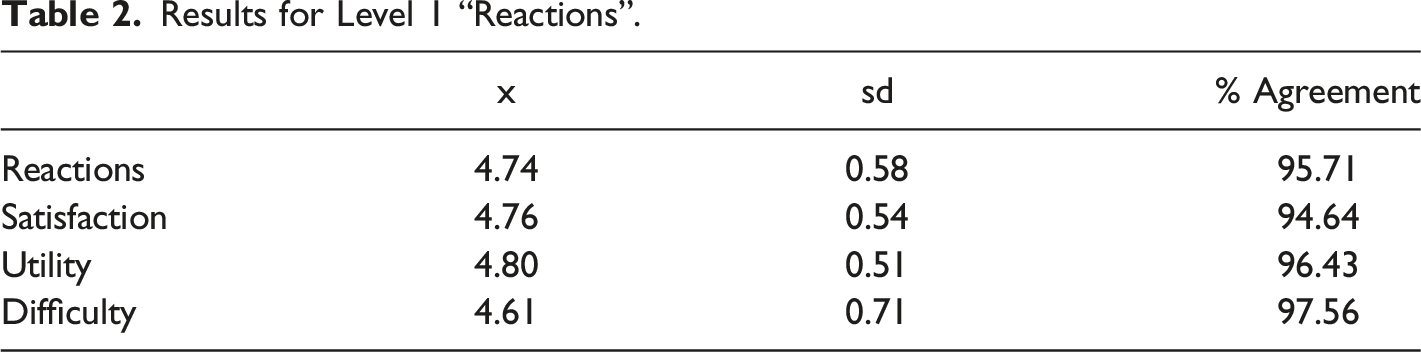
Results for Level 1 “Reactions”.
Learning
Results for Level 2 “Learning”.
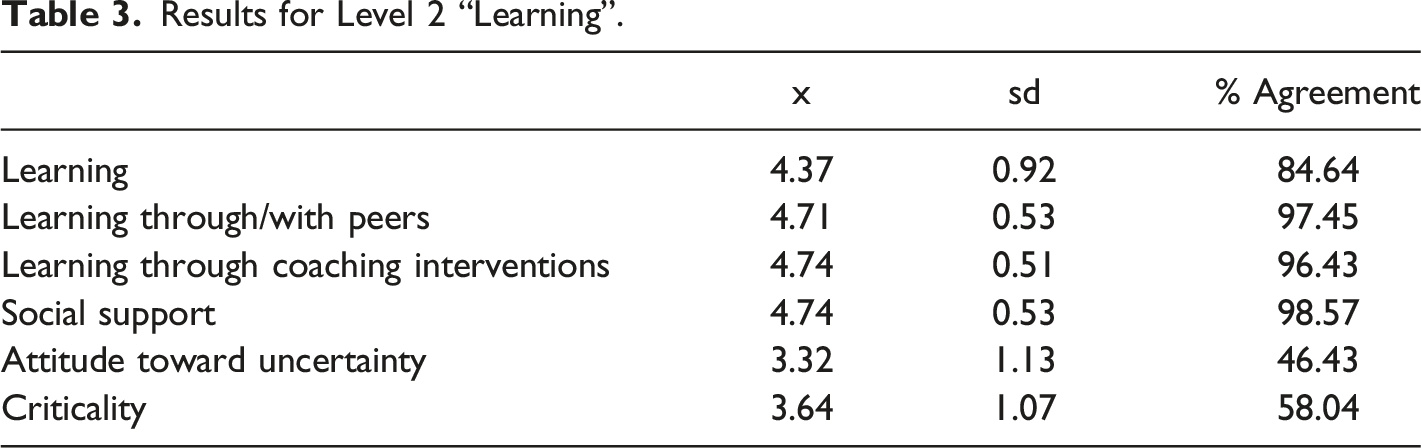
The sub-scale attitude toward uncertainty shows comparatively the lowest agreement. Its mean value of 3.32 and 46.43% of (high) agreement indicate it has partly occurred during the coaching seminar.
Transfer
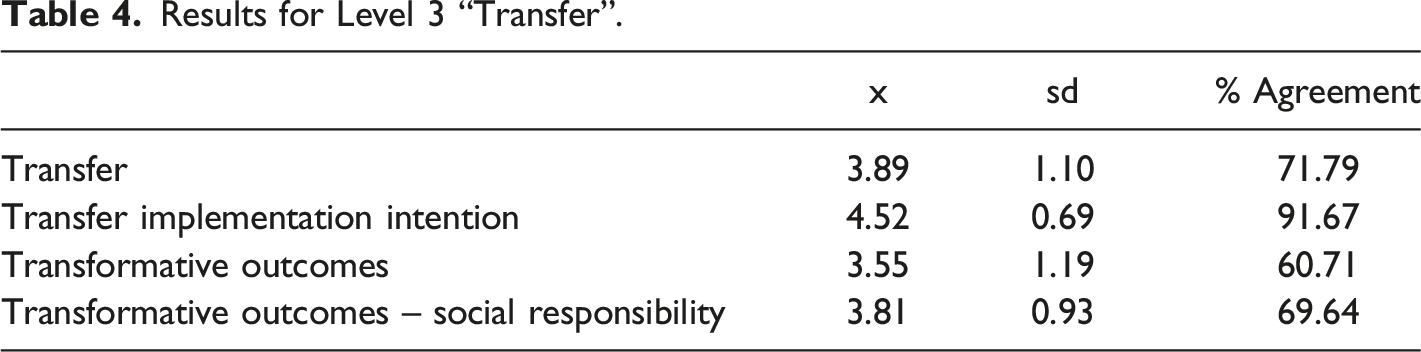
Results for Level 3 “Transfer”.
Discussion and Limitations
Results indicate that the group coaching course was effective on all three levels of the evaluation model and that it facilitated transformative learning. Results for level 3 have their limitations since behavioral transfer was not observed in the field. Nonetheless, the transfer scale (71.79% agreement) allows to conclude the group coaching resulted in transformative learning.
Due to the constructive nature of transformative learning, quantitative data “…are limited in their ability to provide detailed explanations of what people actually experienced” (Kwon et al., 2021, p. 467). A more detailed picture on the specific transformation processes in each participant would require an in-depth analysis, for example, through interviews, analysis of journals or direct observation of the participants in the field.
To further integrate, develop or stabilize the learnings in everyday life of the participants it would be helpful the participants had continuous support from coaches. As this will not be provided after our group coaching, it remains unclear how the students will integrate the learnings over time considering that transformative learning and ego development are processes that occur over longer periods of time including setbacks, too. So, this survey is rather a snapshot in a developmental process. A longitudinal study could provide further insights, especially considering our small sample size.
As the participants were members of different master’s programs it can be assumed that those sub cohorts have shared experiences together during their postgraduate program and may have already been in a transition process. This could have complemented the effect of our 5-day group coaching on transformative learning.
As the group coaching course was announced in advance as a personal experience and development journey that is about each individual’s transformative learning it can be assumed that a self-selection of developmentally interested persons has taken place. Students not interested in such topic or scared off by the group coaching setting may not have applied. Used methods such as embodiment, meditation, or systemic constellation require repeated practice to apply them more deeply and to derive and integrate insights, so the 5 days program enables only first steps of a longer developmental journey.
The group coaching took place in a higher education setting, thus passing the course and receiving a good grade was presumably on the minds of the students. We tried to define the formal examination conditions in advance in such a way that striving for passing the course and a good grade would not be disruptive factors for the developmental process. We communicated that participation in all activities of the course and submission of the complete journal (in which all methods were reflected) are the basis for passing the course. We pointed out that we will not judge the content of the journal. Confidentiality was promised regarding all contents (especially the journal) and actions, and the students had the opportunity to blacken individual passages in their journals that were too personal for them.
Due to the hierarchical relationship between educators and students in our context, it can be assumed that this had an influence on the willingness to be open, vulnerable, or express shameful issues. As depicted above, the relationship of coach and coachee should ideally be one at eye level and we must constitute that this aspect of coaching cannot be implemented purely in a setting at a university. As one of the two coaches in our group coaching is a university outsider, the problem of the hierarchical relationship may have been mitigated somewhat. Ultimately, the analysis of the students’ journals revealed that most of the participants showed an impressive and touching openness and vulnerability. All the more important was the role of the coaches in terms of creating a trusting space, for example, by bringing in their own personal possibly shameful topics and failures. As Lehner (2022) points out, facilitating transformative learning requires the coaches to engage in their own transformative learning, take a critical view on their own inner and outer dynamics, needs, challenges, limitations, or vulnerabilities.
The group coaching provided participants with a transformative learning process that fostered critical re-assessment and re-framing of participant’s beliefs on self-concept, personal narrative, and habits of mind on emotional and cognitive levels. It also supported questioning of worldview, development of personal goals and purpose and the facilitation of social support. Our results show that our group coaching facilitated and fostered transformative learning.
Group coaching holds the potential to promote transformative learning in higher education.
Footnotes
Acknowledgments
We would like to thank Mrs. Marion Quaas-Reinhard for co-designing and co-coaching the evaluated program and Prof. Dr. Conny Scott and Mrs. Janet Wick for helping with the forward-backward-translations. We also acknowledge Prof. Dr. Achim Wübker for helpful discussions concerning the statistical analysis. Also, we thank the students who participated in the group coaching.
Declaration of Conflicting Interests
The author(s) declared no potential conflicts of interest with respect to the research, authorship, and/or publication of this article.
Funding
The author(s) received no financial support for the research, authorship, and/or publication of this article.

Appendix
We have gratefully received permission by the author (Robert C. Cox) to publish the TROPOS instrument together with our German translation as presented in this appendix.
TROPOS instrument (Cox, 2021) and translated German language version. Note. In German language version sub-scale items for social support, attitude toward uncertainty, and criticality preceded by phrase: “Während des Coaching-Seminars” (originally: “While I was a student in the graduate program.”). Items in sub-scale transformative outcomes preceded by the phrase: “Als Ergebnis des Coaching-Seminars” (originally: “As a result of the graduate program.”).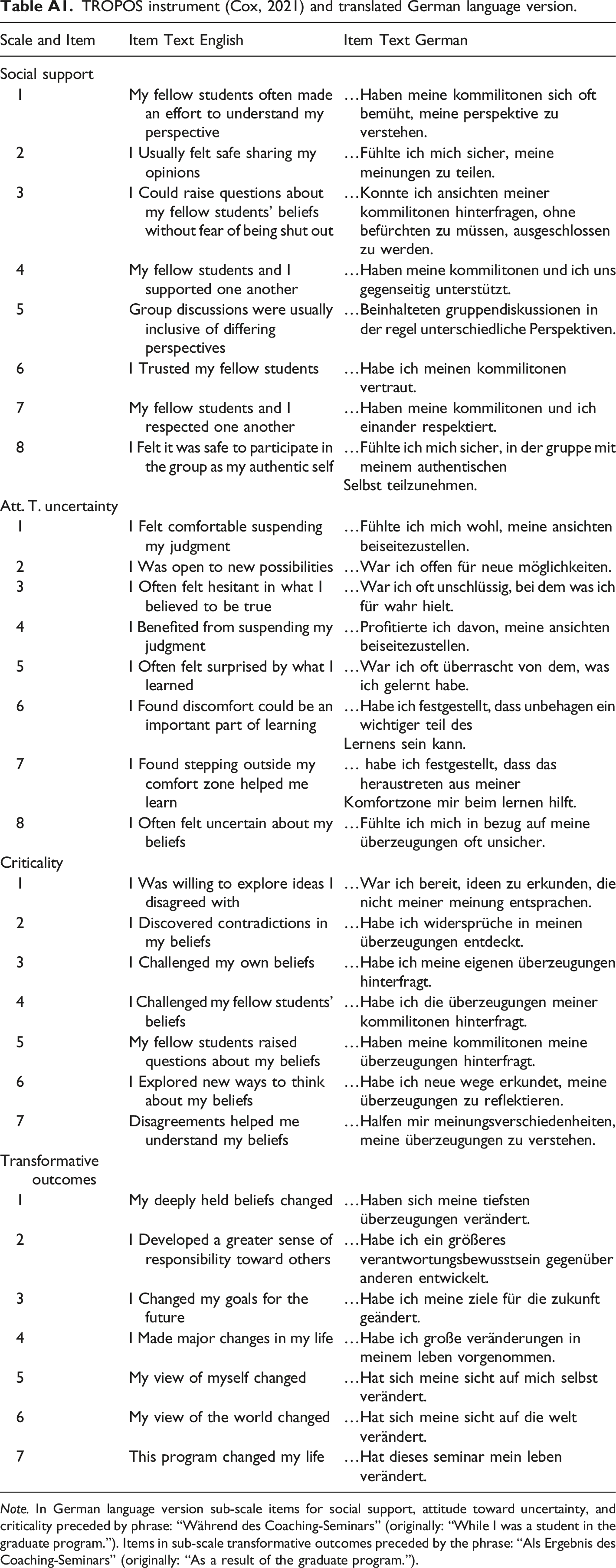
Scale and Item
Item Text English
Item Text German
Social support
1
My fellow students often made an effort to understand my perspective
…Haben meine kommilitonen sich oft bemüht, meine perspektive zu verstehen.
2
I Usually felt safe sharing my opinions
…Fühlte ich mich sicher, meine meinungen zu teilen.
3
I Could raise questions about my fellow students’ beliefs without fear of being shut out
…Konnte ich ansichten meiner kommilitonen hinterfragen, ohne befürchten zu müssen, ausgeschlossen zu werden.
4
My fellow students and I supported one another
…Haben meine kommilitonen und ich uns gegenseitig unterstützt.
5
Group discussions were usually inclusive of differing perspectives
…Beinhalteten gruppendiskussionen in der regel unterschiedliche Perspektiven.
6
I Trusted my fellow students
…Habe ich meinen kommilitonen vertraut.
7
My fellow students and I respected one another
…Haben meine kommilitonen und ich einander respektiert.
8
I Felt it was safe to participate in the group as my authentic self
…Fühlte ich mich sicher, in der gruppe mit meinem authentischen
Att. T. uncertainty
1
I Felt comfortable suspending my judgment
…Fühlte ich mich wohl, meine ansichten beiseitezustellen.
2
I Was open to new possibilities
…War ich offen für neue möglichkeiten.
3
I Often felt hesitant in what I believed to be true
…War ich oft unschlüssig, bei dem was ich für wahr hielt.
4
I Benefited from suspending my judgment
…Profitierte ich davon, meine ansichten beiseitezustellen.
5
I Often felt surprised by what I learned
…War ich oft überrascht von dem, was ich gelernt habe.
6
I Found discomfort could be an important part of learning
…Habe ich festgestellt, dass unbehagen ein wichtiger teil des
7
I Found stepping outside my comfort zone helped me learn
… habe ich festgestellt, dass das heraustreten aus meiner
8
I Often felt uncertain about my beliefs
…Fühlte ich mich in bezug auf meine überzeugungen oft unsicher.
Criticality
1
I Was willing to explore ideas I disagreed with
…War ich bereit, ideen zu erkunden, die nicht meiner meinung entsprachen.
2
I Discovered contradictions in my beliefs
…Habe ich widersprüche in meinen überzeugungen entdeckt.
3
I Challenged my own beliefs
…Habe ich meine eigenen überzeugungen hinterfragt.
4
I Challenged my fellow students’ beliefs
…Habe ich die überzeugungen meiner kommilitonen hinterfragt.
5
My fellow students raised questions about my beliefs
…Haben meine kommilitonen meine überzeugungen hinterfragt.
6
I Explored new ways to think about my beliefs
…Habe ich neue wege erkundet, meine überzeugungen zu reflektieren.
7
Disagreements helped me understand my beliefs
…Halfen mir meinungsverschiedenheiten, meine überzeugungen zu verstehen.
Transformative outcomes
1
My deeply held beliefs changed
…Haben sich meine tiefsten überzeugungen verändert.
2
I Developed a greater sense of responsibility toward others
…Habe ich ein größeres verantwortungsbewusstsein gegenüber anderen entwickelt.
3
I Changed my goals for the future
…Habe ich meine ziele für die zukunft geändert.
4
I Made major changes in my life
…Habe ich große veränderungen in meinem leben vorgenommen.
5
My view of myself changed
…Hat sich meine sicht auf mich selbst verändert.
6
My view of the world changed
…Hat sich meine sicht auf die welt verändert.
7
This program changed my life
…Hat dieses seminar mein leben verändert.