




Abstract
This article shows how a student centered pedagogy called the Improvisational Theater Art Form (ITAF) empowers transformative awareness, growth, and change. In this particular study representative of a larger body of work, 30 undergraduate researcher/participants created improvised games and scenes as expressions of their inner selves to explore “habits of the mind” negatively affecting social living and daily life. ITAF draws upon action research, transformative learning theory, improvisational theater, a democratic learning environment, and learning through play. The purpose of this article is to show how ITAF inspired learners to study the nature of the self, achieve progressive growth and development, and advance the craft of transformative learning and education.
Introduction
ITAF pedagogy is a particular form of improvisational theater designed to support transformative learning (TL) in university classrooms. The idea was to use the spontaneous nature of improvisation to help learners reimagine “distorted assumptions” that have persisted into adulthood. The article shows how the approach was developed and based on selective inquiry and action research to explore how and to what extent ITAF fosters TL. A new three credit hour undergraduate course was developed for this purpose. The transformative effect of improvisation revealed important answers to disturbing thoughts, feelings, and behaviors students had come to accept as normal or beyond human control (Mezirow, 1991; Spolin, 1963).
ITAF is underpinned by the belief that the surreal (more than real) content of an improvised scene liberates original thinking through the creation of realities far different from the typical experiences of everyday life (Fowlie, 1963). In facing moments of disorientation, students instinctively summoned their intuitive resources in order to survive the unpredictable reality of an improvised scene. Imaginative risk taking is applauded by peers awaiting their turn on the ITAF stage. Thus ITAF is not imposed upon learners and instead based on voluntary participation to free the self authentically the moment the student is moved to take action toward deconstructing counterproductive attitudes, beliefs, and perceptions negatively affecting personal relationships, education, employment, and future goals.
The article opens with the author’s background including the scholars and educators who have shaped the development of ITAF. It then addresses some of the psychological challenges affecting transformative learning today. Examples of student activities on a typical classroom day are provided and the action research methodology is explained. Following the presentation of findings I have discussion.
Background of ITAF
Improvisational theater can be traced to the 16th century and the Commedia dell’Arte of the Italian Renaissance (Oreglia, 1968). My particular approach originated with my professional theater training (MFA) and time directing plays in Chicago’s theater scene. Viola Spolin’s son Paul Sills (1927–2008) who co-founded Chicago’s famous Second City taught me the theater games he learned from his mother at Hull House while the Goodman School of Drama at the Art Institute of Chicago taught me the relationship between art and life. Their influence led me to undertake the Ed.D in Adult Education where I learned about the early days of Chicago’s progressive education movement (1889–1926) including the dynamic feminism of Addams and the pragmatic philosophy of Dewey and his laboratory school at the University of Chicago (1896–1904; see Mayhew & Edwards, 1936; Schutz, 2001).
Let me say a little more about the work of these institutions which have played such a strong role in the development of ITAF. Founded by Jane Addams and Ellen Gates Starr in 1889, Hull House united Chicago’s diverse communities through activities based on their cultural heritage and common goals (Cremin, 1961; Meiklejohn, 1960). Amidst these exciting times a young actress by the name of Viola Spolin comes to Hull House in 1924 (Goodson, 2015). Instilled with the radical feminism of Addams, Spolin becomes the founder of modern improvisational theater and she uses her new art form in the social settlement “to express the meaning of life in terms of life itself, in forms of activity” (Addams, 1899, p. 326).
Although I have yet to find evidence that Spolin and Dewey ever met or that Dewey observed her work, the influence of Deweyan philosophy (1910, 1916, 1934) is clear. “We learn through experience and experiencing and no one teaches anyone anything. This is as true for the infant moving from kicking to crawling to walking as it is for the scientist with his equations” (Spolin, 1963, p. 3). It is through this unity of community, art, and nature of life that TL and ITAF form a relationship.
Links Between TL and ITAF
TL’s promise of discovery and progressive change has informed research and teaching methodologies for nearly 50 years. Originating with a 1975 national study focused on adult women reentering university programs, Mezirow’s (1978, 1991) theory has expanded over time to include broader “extrarational” perspectives (Boyd & Myers, 1988; Clover et al., 2013; Fenwick, 2000; Greene, 2009; Kasl & Yorks, 2016; Kucukaydin & Cranton, 2012; Nicolaides & Marsick, 2016; Tennant, 1998).
My particular approach to Mezirow centers on releasing one’s existential freedom to explore distorted assumptions through voluntary participation. TL’s emphasis of self-reliance over dependency and indoctrination had a profound effect on ITAF students who overcame intrinsic distortions by venturing beyond the range of ordinary experience (Adelman, 1993; Greene, 1995; Kneller, 1958; Morris, 1966). Supported by the literature, peers, and ultimately themselves, participants discovered their own inherent genius bringing unification to education and life.
Many scholars have demonstrated the importance of creating transformative experience on deeply personal levels. For example, Lawrence (2008) emphasizes creative play “in a world dominated by cognitive processes” (p. 66). With existential curiosity ITAF students respond to life’s challenges with the aesthetic awareness of the artist. Butterwick and Selman’s (2003) feminist epistemology deconstructs debilitating thought patterns with “high risk storytelling and deep listening” (p. 8). Butterwick and Selman’s (2003) popular theater projects inspired ITAF learners to “show” intrinsic distortions the moment they surfaced into consciousness. Dirkx’s (2006) vision of Jungian psychology reframes semi-conscious emotions into “windows that reveal experienced realities” (p. 17) demonstrating the guiding principles of TL and ITAF. “Specifically, it seeks to explain the way adult learning is structured and to determine by what processes the frames of reference through which we view and interpret our experience (meaning perspectives) are changed or transformed” (Mezirow, 1991, p. xiii).
Thus I want to argue that ITAF can be usefully linked to TL and that both philosophies share a relationship in awakening the learner to how knowledge is constructed, organized, and interpreted. By exploring the ways our beliefs and attitudes are structured and their impact on everyday life, ITAF students cultivated a personal philosophy of existential choice not settle for complacency, scripted instruction, and delimited expectations instead, “courageously enter the area of the unknown and release momentary genius within” (Spolin, 1963, p. 4). Well aware that transformative phenomena surfacing into consciousness will quickly disappear if not acted upon immediately, students seized the moment to free themselves from “forces that limit our options and our rational control over our lives but have been taken for granted or seen as beyond human control” (Mezirow, 1991, p. 87; Moore, 2005). Spolin defines improvisational theater as freedom from “handed-down frames of reference, memory choked with old facts and information, and undigested theories and techniques of other people’s findings” (Spolin, 1963, p. 4).
First, ITAF helps learners reimagine cognitively fixed attitudes and beliefs that have lost their meaning. Although many problems often arise when attempting to blend pragmatism with extrarational phenomena in university settings, failure to wed both spheres of consciousness undermines the pursuit of a more integrative and robust theory of transformative learning and education (Dirkx, Espinoza, & Schlegel, 2018; Hoggan et al., 2017).
For example, Kucukaydin and Cranton (2012) call attention to “the current epistemological crisis” and the difficulty researchers have in assessing the validity of extrarational research claims or developing adequate pedagogy to study them (p. 49). Taylor and Cranton (2013) question researchers’ reluctance to critically analyze primary research findings relying instead upon secondary sources and literature reviews. Scholars’ hesitancy to imaginatively critique the literature places “boundaries around the study of transformative learning that are not only unhelpful, but are strangling the progress of the theory” (Taylor & Cranton, 2013, p. 43). Although practitioners claim to establish safe and productive TL environments, “the research does not expand the current understanding of these assumptions, nor does the research question their integrity” (Taylor & Snyder, 2012, p. 45). Furthermore, Arends (2014) cautions that failure to wed rational and extrarational intelligences poses unconscious threats to scholars’ critical thinking skills by censoring intuitive insight that could propel TL forward. “Reflective practices, therefore, risk countering the very mission of transformation as they may reinforce dominant ways of thinking” (Arends, 2014, p. 360).
Second, ITAF philosophy builds collaborative working relationships essential in deconstructing psychological and ethical concerns that often arise from transformative learning initiatives (Baumgartner, 2001; Cranton, 1994; Ettling, 2006, 2012; Kasl & Yorks, 2002; Lawrence & Butterwick, 2007; Moore, 2005; Taylor, 2007). For example, Ettling’s (2006) idea of “redesigning our course functioning” was met with “heated” student concern (p. 59). Underprepared to address the limitations of cognitive bias students reacted defensively, undoubtedly with hopes of enlightenment. By way of contrast, Jackie’s story. (Davis-Manigaulte et al., 2006) demonstrates the existential courage necessary to blend pragmatism and extrarational phenomena into a meaningful transformative experience. Getting the room ready for the students, I lit candles and put on a tape of the sounds of English meadows, such as birds and rustling leaves. I was a little nervous, wondering what the interns would think, worrying they’d react, "Oh, boy! what is this??" however, they loved it; they just oohed and aahed about the change in environment. And they were very receptive to the activities that followed. I felt very relieved. (pp. 28–29)
Third, ITAF fosters empathy and trust. To understand the significance of compassion in transformative education I call attention to the Black and White consciousness exercise (Yorks & Kasl, 2002) when the White team faced the consequences of the ill-conceived initiative Kasl describes for us here. Now it is our turn. I feel scared. We sit in hesitancy, heads down, making furtive eye contact…I try to connect. I approach several people, stretching out my arms with yearning, offering a crepe paper streamer that might link us. They turn their backs and walk away. I look at the Black team, hoping for acceptance. They are pointing at something in front of me. I gasp in disbelief. We have completely trampled the altar….I feel awash with shame. (p. 178)
Kasl’s existential pain in the absence of empathy is a tragedy. The “improvisational” premise of the piece was chaotic for the White team and horrifying for its Black audience. Unfortunately, “they could not imagine how to translate their propositional knowing into practical action” (p. 188) forced to rely on “symbolic” props of meager significance.
ITAF Course and Pedagogy
ITAF was created by the author to empower transformative experiencing through the social interaction of improvisational theater. To explain how these dynamics work together in practice, I would like to briefly describe a versatile game I call “Get up and Move!” Everyone including myself form a large circle with one volunteer standing center. Sensing an idea that is important to her she calls out “Get up and Move if you’ve fallen victim to social injustice!” Those who have immediately vacate their position and move to a different location around the circle. It is interesting watching us scramble to change places as our volunteer runs for a space of her own, hopefully before someone else takes it. The lone person left standing center must quickly intuit another idea. “Get up and move if you’ve faced job discrimination!” and so forth for several rounds stirring one’s meaning making perspectives. Next, we count off into teams to decide (for example) where we are (Monument to the Great Northern Migration, Chicago’s Bronzeville district), who we are (community residents, police, clergy, political activists) and what we are doing (demonstrating for social change). Now each team presents their scene with a clear beginning, middle, and end. Audiences take notes and occasionally enter the playing space to “freeze” the action for soliloquy, change location, or introduce alternative points of view. Following presentation teams reflect on action (Schön, 1983) sharing their thoughts and insights with the rest of the class. Students receive feedback, analyze their work for content, and plan strategy for future sessions, thereby moving the learning process forward.
ITAF creates its psychological realities through the existential freedom of self-expression. By personifying influential scholars and educators students gain a unique perspective into their contribution to TL. For example, students write the names of authors on scraps of paper and collect them in a hat. Volunteers draw from the hat and read to themselves. “James Harvey Robinson talks about the failure of education; Rousseau and Pestalozzi discuss learning through experience; Addams and Dewey facilitate a game at the Laboratory School; Mezirow teaching at Columbia!” Volunteers take turns portraying their heroes synthesizing intuition with the literature. Authenticity and subtlety are essential to awaken interest and curiosity. Students who correctly identify personages get to draw next. I usually sit at the back of the room taking notes. Following presentation students reflect on action, receive feedback, and brainstorm ideas for future sessions (Schön, 1983). Games are inspired by the collection of articles and book chapters published in CAHA 492 available at university bookstores.
The Capstone Experience Final Exam is created by students and open to the public. The assignment is to design, develop, and present a 45 minute performance piece staged in the round of a large university banquet hall. Our university newspaper interviews learners one week prior to the event publishing an article and photograph. Capstones detail students’ transformative journey joined by an audience of faculty, family, and friends. Capstones conclude with a 10 minute question and answer.
Methodology
I began researching ITAF out of concern for my students’ wellbeing as well as my personal interest in Mezirow’s theory. Action Research (Lewin, 1946, 1947, 1948) with its cycles of progressive change is the perfect vehicle for studying transformative phenomena through ITAF pedagogy. I use a four stage approach of discovery and discussion, exploration, action, and reflection. Together these dynamics form the participant/researcher strategy well known for its collaborative inquiry approach to data collection and analysis (Kemmis & McTaggart, 2007).
Action research represented a radical departure from the technical rationality of its day however, as a social psychologist Lewin was interested in developing cooperative and reflective thinkers (Adelman, 1993; Burnes, 2004; Stark, 2014). I also use Lewin’s (1939, 1951) field theory which can be imagined as “topographical psychology” of prairie, woodland, mountain, and seashore waiting to be investigated (Adelman, 1993, p. 7). Some sections of our intrinsic landscape are active and highly creative while others languish because they do not function well. Lewin believed students should explore unknown regions of the self in order to expand one’s cognitive and affective field range. Well versed in the field theoretical approach, ITAF students know that part of their work is to maintain focus and concentration in order to articulate learning phenomena the moment they surface into consciousness. Schön (1983) calls the self-expression of moment to moment awareness reflection in action.
Sample Selection
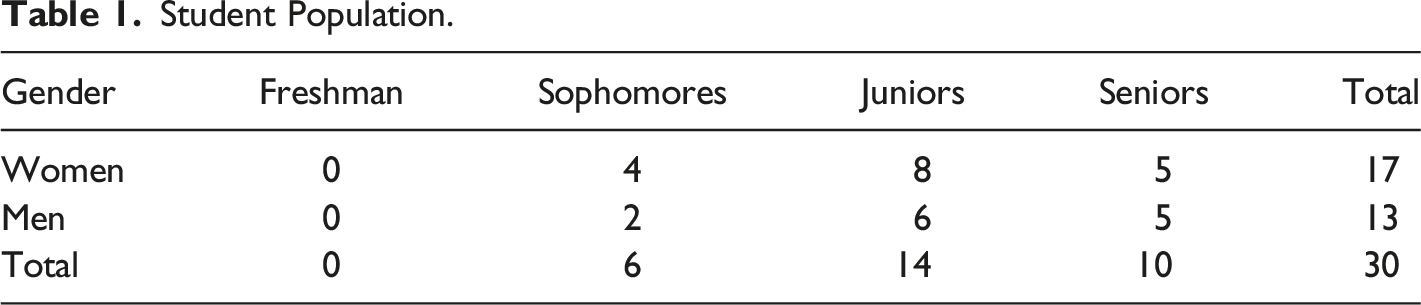
Student Population.
Data Collection
I recorded one 40-minute semi-structured interview in the first 2 weeks of the semester. Students were asked to talk about improvisation, transformative learning, and action research. I recorded a second 40-minute interview in the final 2 weeks of the semester when each participant was handed a printed transcript of their first interview. Speaking freely, learners reflected on their ITAF experience after 13 weeks of coursework. I asked if classroom activities were useful in everyday life and if so, why. A weekly journal writing assignment, research paper, and filmed Capstone final exam provided additional evidence. My field notebook provided a daily record of classroom activities. Students wrote the journal document at home. All assignments are part of the action research process.
Data Analysis
The date was analyzed to discern how ITAF pedagogy was viewed and the impact of the course. Stark (2014) cautions that researcher expectations can unintentionally impact the validity of action research studies so to avoid bias, the students and I shared our thoughts and perceptions each session. Multiple data sources helped us see the whole picture. My role as fellow participant/researcher enabled me to build strong working relationships with students and I became much attuned to the challenges they faced as young adults learning to think for themselves. My field notebook proved invaluable for cross checking my perceptions with classroom activities on any given day. Using TL concepts, I explored the extent to which these experiences and effects could be deemed transformative.
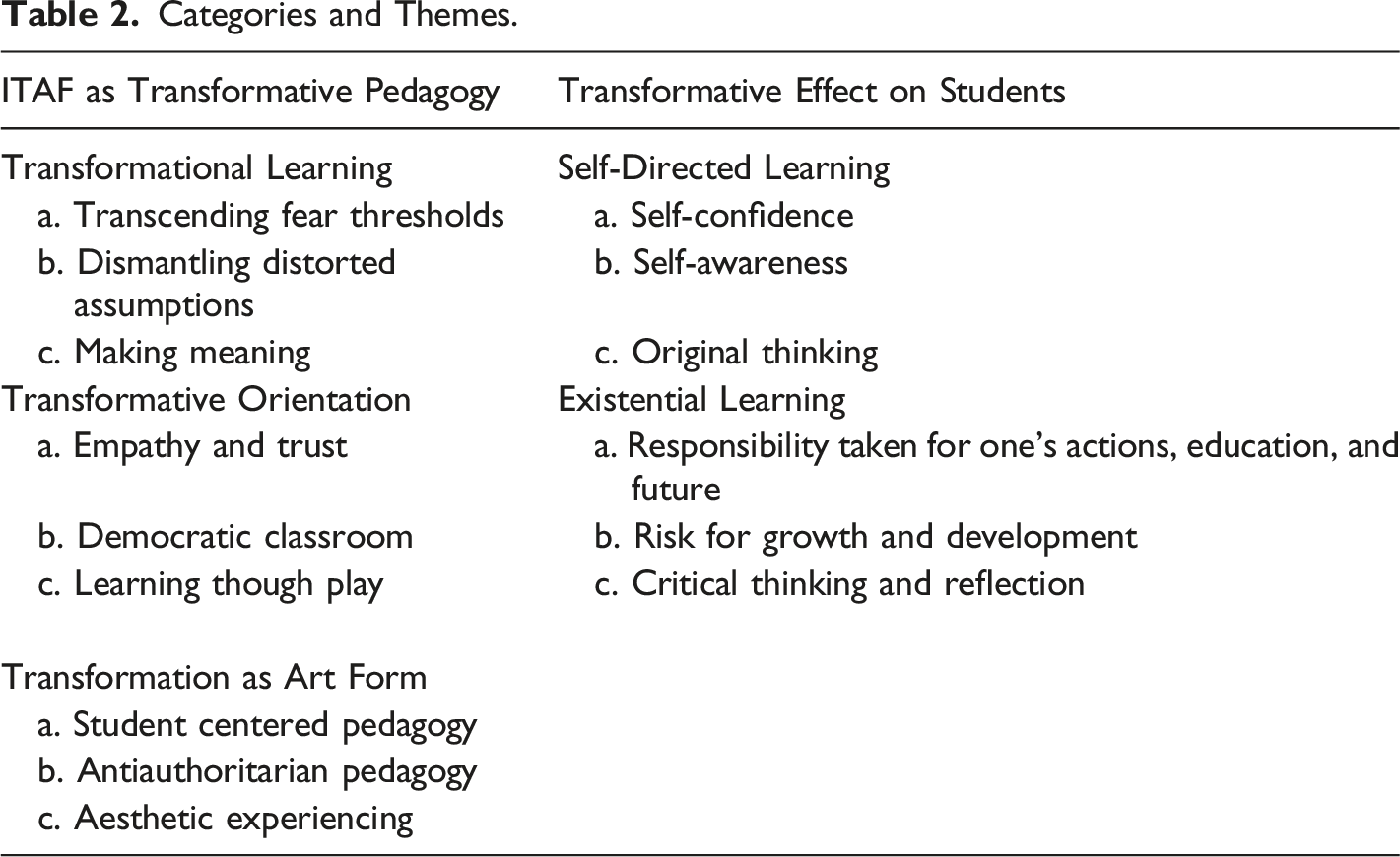
One by one I arranged each participant’s journal entries, transcribed interviews, field notes, and term paper on tables in my office. Reflecting over the evidence I formed an extensive catalog of terms. Words and phrases describing overarching ideas became categories. Patterns indicating a higher order of knowledge creation became themes.
Results and Findings
Categories and Themes.
ITAF as Transformative Pedagogy
Transformational Learning
This section shows how students understood TL through ITAF pedagogy. For example, writing in his third journal Mustafa considered how TL and ITAF work together in practice. “I recognized my concerns from reading the papers. ITAF addresses them through action.”
Transcending Fear Thresholds
Megan registered for CAHA 492 despite her self-doubt by linking the risks of working in an art form with the struggles of everyday life. The following comments were transcribed from her week two interview. I was afraid to even sign up because I knew I’d be judgmental my preferred defense mechanism for avoiding change. My friends were all about your class so I took the plunge. Dreaming that night my demons kicked in. “Are you stupid?” I’m afraid. “Are you crazy?” I fear change. But somehow I was drawn to education as art form. I instinctively knew to confront my demons by moving toward them not running away.
For his seventh journal José contrasted TL and ITAF with the artists of the avant garde. “When we studied The Mannequin Street [see Exposition Internationale du Surréalisme, 1938; Fowlie, 1963] the disorienting images of surrealism are frightening at first because they challenge us to see new perspectives, like TL and ITAF philosophy.” In her week 15 interview Halley talked about the psychological risks often associated with transformative change. “It’s always scary to face a disorientating dilemma. ITAF guides me to self-understanding.”
Dismantling Distorted Assumptions
I define “soliloquy” as the self-expression of one’s intrinsic landscape as revealed in the moment with peers (see Adelman, 1993; Lewin, 1939, 1951). Jan personified my understanding of soliloquy when she read her week five journal entry to the class. My field notebook recorded our discussion. I was feeling sorry for myself and had decided to lay low this session. When you [Author] called for a volunteer to get up and do something interesting I just ran into the center of the classroom in spite of myself and started washing windows. I felt scared and vulnerable. Suddenly for no specific reason my mood was left at the door and it was CAHA class. It was like I was up there with a clean slate and all my sins washed clean. At that moment Doug jumped in and mirrored me for a while. Then he shouted “Don’t look down!” That’s when I realized we were on a scaffold high above Chicago. That scene was a huge dose of reality because a moment before I didn’t want to participate. Now I’m at the center of activity which was very empowering for me. When Ayla flew in via helicopter to rescue us after the safety lines broke I thought how incredibly important it is for me to be flexible and face my challenges unafraid.
Jan attended class despite her decision not to participate. Now she is seated in a circle with 29 peers. After chatting over the news of the day we sit quietly to focus. I said: “Ok, let’s do something interesting.” Jan on her own free will runs into the center of the classroom and spontaneously starts washing windows. Entering the playing space from the security of the group she takes an existential risk. “Once I crossed that threshold I could no longer be afraid” a threshold Mezirow might view as being on the verge of perspective transformation of distorted assumption. I said: “What can you tell us about no longer feeling afraid?” Jan: “It was the environment. I knew the classroom would free me from my fear.” I said: “What fear?” Jan: “Low self-esteem.” Denise: “What does it mean? I watched the situation turn urgent because I believed they needed my help. Was that reality or illusion?” Ayla: “Something compelled me to stand up. I knew I had to do something to help them but what? People started yelling out ideas.” I said: “What did you hear?” Ayla: “Become a bird, kite, carnival balloons, and then Desmond said ‘helicopter’ so I became a helicopter and saved them.”
Making Meaning
It is possible Jan unconsciously knew all along that she would find a transformative catalyst and that the surreal (more than real) context of an improvised scene might dismantle “preexisting structures” surfacing into consciousness (Fowlie, 1963; Mezirow, 1991, p. 42). Thus Jan experienced perspective transformation as the reality of the moment over powered a burden from long ago. In other words, Jan’s presence carried more weight than her troubled past and through courage, action, and reflection, she repositioned her meaning making perspectives to some degree in a flash of transformative insight.
Transformative Orientation
Transformative orientation points to themes of empathy and trust, collaboration, and enjoyment in learning. Together these phenomena serve to create a dependable and responsible learning environment.
Empathy and Trust
Empathy and trust are present in ITAF classrooms simply because the environment permits it to happen (Spolin, 1963). For example, Dana’s determination to become self-reliant garnered the support of her classmates who helped her address insecurities set early in this young woman’s life. “Facing my little girl fantasy regarding masculine misogynistic archetypes terrified me as a kid. CAHA class is safe so I get to work on issues impossible without the concern and trust in our classroom.” Students share sensitive moments every day. Nayeli: “I’ve always felt unloved but when you affirm me I become self-reliant. I can forgive the men who have hurt me but it’s harder to forgive myself.” Caroline comforted Nayeli. “The men in our classroom respect women.” One morning Ayla shared her definition of empathy. “You’ve all helped me see my fear as paper tigers that can no longer hurt me.” Ken replied, “Once we deconstruct a problem it never looks the same again.”
Democratic Classroom
I developed my concept of democracy in the classroom by training actors for the stage. ITAF’s democratic approach to TL liberates one's untapped intrinsic resources on physical, intellectual, and emotional levels as Dana explaines in her week two interview. “Our class is democratic because we aren’t stuck behind desks listening to lectures or watching slide shows. You challenge us to get up and move.” Writing in her fifth journal Denise talked about ITAF’s democratic process. “Your approach isn’t authoritarian nor is it conditional. You guide our thinking to another level.” Aiden shared his thoughts on democracy in his journal week 13. “Students’ needs and interests determine the direction and flow of activities in CAHA giving us control over when and how we contribute to a scene.” Week 14 Darcy talked about the intrinsic responsibility that accompanies ITAF pedagogy. “Our self-governing classroom sets its own course of action because we’ve developed the courage to explore the unknown unafraid.”
Learning Through Play
Stepping outside the bonds of familiarity defines the philosophy of learning through play (Boyd, 2019; Huizinga, 1949; Morris, 1966; Spolin, 1963). For example, journaling week 11 Lyndra wrote how one’s natural inclination for play helped her abandon affectation masking her identity. “Creating our games was frightening at first because I didn’t have time to show the defenses I’d adopted in my teens. Makes me wonder why I needed pretense to survive.” One morning Aamir commented “our games are exposing many dysfunctional perspectives. Understanding why I’ve clung to them is my next challenge.” Six days later Caroline’s soliloquy expressed to us the restorative effect of ITAF no matter how old or young you happen to be. “At 65 I thought learning through play was a ridiculous approach to transformative learning yet you accepted me as one of you. I am renewed every day by our activities even though I’m old enough to be your grandmother.”
Transformation as Art Form
This theory shows how ITAF students transformed status quo perceptions through imaginative thinking and a personal vision. Desmond explored the concept in his journal week nine. “It’s almost the midterm and I find myself insightful because you’ve taught us to see reality as artists.” Student centeredness, antiauthoritarianism, and aesthetic experiencing form the cornerstone of transformation as art form.
Student Centered Pedagogy
As learners’ explored imaginative ways of knowing beyond the range of subject centered pedagogy new perceptions informed educational goals. For example, during her second interview Lilly talked about how ITAF strengthened her commitment to teach. “As a new high school co-teacher I will use my CAHA training to engage my students as individuals, all of us on a journey of knowledge creation.” Week 13 Mike wrote how Schön’s (1983) theory of “rigor or relevance” (high ground or swamp) brought to mind images of “ivory tower isolation” versus “swimming with the creatures of the intrinsic unknown.” Although taking the high ground may seem the logical choice, Mike realized that he alone is responsible for the quality of his education. “As a mechanical engineering student about to enter graduate school I was taught to believe that teachers are omnipotent. That perspective is unfair to them and irresponsible of me.” Schön (1983) writes “the problems of the high ground, however great their technical interest, are often relatively unimportant to clients or to the larger society, while in the swamp are the problems of greater human concern” (Schön, 1983, p. 42).
Antiauthoritarian Pedagogy
Antiauthoritarianism alerted students to the dangers of habituation and subordination in education (Cranton, 1994; Freire, 1971; Mezirow, 1991; Moore, 2005). Itzel analyzed this theme in her term paper. “I had expected the first day to be boring as usual so I settled into my ‘ok, teach me’ mode. Instead we created a 15-minute improvisation. Just like that I was thinking with a spirit I’d not felt since childhood.” Megan’s journal week nine considered the grave toll of power and control on personal growth and development. “ITAF frees me to develop in ways I should have learned in middle and high school but nobody knew how to teach it.” Week 12 I suffered a sprained ankle. Rather than cancel the session I sent an email asking the students to run the class themselves. Lonnie journaled his account of what happened. “We thought nothing of leading class by ourselves. Everyone did their part to make it work. That would not have happened in my other classes.” Katlin wrote “you knew we could handle it and we were excited at the challenge.”
Aesthetic Experiencing
The cathartic excitement of aesthetic experiencing intensified the self-created world of ITAF pedagogy. Denise talked about this heightened state of awareness in her term paper. “Aesthetic experiencing is real learning. We have transformed an ordinary classroom to see the person we want to become.” Week 13 José provided his analysis of aesthetic experiencing. “It’s not like viewing a painting or sculpture instead we show the elation and passion of the artist who created it.” Darcy addressed the phenomenon with her Capstone audience who asked, “How are aesthetics created in your classroom?” Darcy: “It’s the exhilaration from understanding our own psychology that liberates aesthetic experiencing.” However, Lyndra cautioned our final exam guests: “It’s our ability to be free that empowers aesthetic experiencing. If you can’t accept this challenge you’ll wish you’d never signed up.”
Transformative Effect on Students
Self-Directed Learning
Thus far I have established how ITAF works as transformative pedagogy in the classroom. I now turn our attention to ITAF’s transformative effect in everyday life.
Self-Confidence
In her first interview McKenna stated how the courage to improvise gave her confidence to engage people in conversation. “ITAF has made me comfortable in social situations. I listen attentively and respond intelligently to authority figures in particular.” Megan’s fifth journal focused on how an important research study informed her worldview. When we staged the Black and White consciousness exercise [Yorks & Kasl, 2002] I realized that people do the best they can with what they’ve learned. If an exercise is not working in CAHA class we change it and find something that does work. That flexibility has given me the confidence to meet the needs of my family and friends and not turn away.
Self-Awareness
Self-awareness appeared whenever students experienced perspective transformation by confronting dysfunctional habits of the mind (Mezirow, 1991; Nicolaides & Marsick, 2016; Spolin, 1963; Tennant, 1998; Yorks & Kasl, 2002). For example, in her second interview Katlin reflected on how the spontaneous nature of ITAF challenged her to reexamine distorted assumptions believed to be beyond the realm of change. “Controlling my temper was something I didn’t want to do because anger made me feel self-empowered. That perception proved to be a false narrative I didn’t want to accept until I was called out in an improvised scene.” Braydon experienced self-awareness through a series of improvisations exploring altruism. “I identified the origin of my selfishness today. I could feel it kick in when I didn’t want to help the homeless couple in our scene. That moment revealed to me and the entire class how my arrogance has hurt other people.” One morning Harper addressed the part personal responsibility plays in the self-awareness process. “Finding the good in me became my mission. How can I not pay attention when I’m face to face with my own uniqueness?” Dashonte’s words resonated with everyone. “We’re all so easy to read I now understand how good people live their lives.”
Original Thinking
Exploring the creative features of one’s intrinsic landscape brought cognitive and affective intelligences into consciousness fostering original thinking. To illustrate, week 14 Bonna wrote “thinking outside the box” informed her business career. “Our class has inspired me to create my own theories for success instead of trying to be like everybody else.” In his second interview, Mike talked about the unpredictable arrival of original thought. Yesterday I had to lead a panel discussion in my political science class. Instead of judging the presenters like everyone wanted to do I comprehended their perspective. Risking push back from peers when I could have played it safe was alarming but it made me realize I’d been dealt an unexpected hand of transformative insight to which the others were oblivious and did not see.
In the last sentence of his 13th journal Jake talked about the sometimes poignant nature of original thinking. “I now understand emotional disappointment for the kernel of wisdom inside.”
Existential Learning
The courage to explore one’s vast collection of unquestioned assumptions forms the foundation of existential learning (Elias, 1995; Kneller, 1958; Mezirow, 1991). The intrinsic risk of revealing “Who am I?” to self and peers may seem daunting however, by doing so ITAF students gained a wealth of intellectual and emotional insight beyond the range of ordinary experience (Adelman, 1993; Dewey, 1934; Fowlie, 1963; Greene, 2009; Morris, 1966). For example, writing in her 12th journal Mica stated “I am transforming my fear of living life by facing my reality unafraid.”
Responsibility taken for one’s Actions, Education, and Future
In his week 14 interview Dashonte talked about how coming to terms with his difficult adolescence unveiled a courageous and caring vision. Growing up in Roseland at Fenger high school [Chicago] it was hard to stay alive. Gang violence happens every day. I was blindsided by our class because I had to rethink my past to make our improvisations. I’m going back to Fenger now and teach young people everything I have learned from you. As a community activist I have the tools to promote social change.
Risk for Growth and Development
Jake discovered a pathway to growth and development on the first day of class. Everyone was standing around a giant oak tree. You said, “See the tree” [pause]. “Now let the tree see you.” It was the intensity, not that it’s green and has leaves but to see it alive like a human being. I thought where has this been all my life?
Doug’s early life experience captures ITAF’s existential philosophy. Whenever I’m confronted with a difficult improvisation I remember the 9-year-old boy who fell through the ice on Lake Nokomis. I was all alone and scared but I didn’t panic. I knew I could pull myself out of the ice. CAHA class reminds me of my will to survive.
Critical Thinking and Reflection
Critical thinking focuses on finding the truth and wisdom in one's ITAF experiences through unbiased analysis. Students made meaning through private reflection. In the last paragraph of her last journal Bonna personifies the critical thinking/reflection process as she shares a melancholy thought on the priceless yet fragile nature of relationships. On the first day of class we played the name game [Who am I?]. Standing in a circle we spontaneously picked our nickname [accompanied by gesture]. I chose “lovely Bonna” and threw a kiss. My new name became part of my identity. I will never forget walking across campus hearing classmates shout out “hello lovely Bonna!” and how loved I felt. I wonder will I hear “Hello Lovely Bonna!” again?
In addition, ITAF turned pensive through collaboration, discussion, and reflection with peers. Amirius analyzed this theme when asked by his final exam audience, “How did you become a critically reflective thinker?” Amirius: “I became critically reflective when I realized I had to analyze not only my own work but also the work of my peers. It was amazing to see abstract thoughts come to life then figure out how we did it.” Ken: “Without being told we became critically reflective thinkers.” Mike: “Reflection is important but live life in the moment not in the past.”
Summary
ITAF’s art form approach to TL reframed worn-out, dysfunctional attitudes and perspectives through the construction and analysis of improvised scenes. Interestingly, the categories and themes presented in this study interacted simultaneously as a natural part of the creative process. I will now talk about three of ITAF’s most salient features and how they refine the debate on TL.
Discussion
The purpose of this article was to introduce ITAF pedagogy as a philosophy for transformative change, find out if the learning environment supported TL and if so, did learning outcomes prove to have meaning in students’ lives. The research shows the value of engaging learners’ psychological temperaments in safe art form climates to advance the craft of TL. Aesthetic experiencing, antiauthoritarian pedagogy, and existential learning proved to be key components of the ITAF process.
Aesthetic Experiencing
Aesthetic experiencing in the context of ITAF is not objet d’art in the traditional sense instead it is students’ personalities, intelligences, and life experiences interacting simultaneously to address habits of the mind (Dewey, 1934; Greene, 2009; Mezirow, 1991; Spolin, 1963). As participants frequently commented, “we have transformed an ordinary classroom to see the person we want to become.” Dunkel’s (1959) treatise on Democracy and Education (Dewey, 1916) captures the aesthetic experience. “Thus the aesthetic experience is perhaps a paradigm of all experience, a model of experience at its best” (Dunkel, 1959, p. 235).
Antiauthoritarian Pedagogy
ITAF’s antiauthoritarian approach to TL inspired students to see beyond the range of subject centered learning situations where the educator is viewed as the authority figure who takes command of the learning situation (Cranton, 1994; Freire, 1971; Lewin, 1939). While teacher centered learning has its place, lessons generally fall on topics unfamiliar to the existential experiences of the learner (Kneller, 1958; Morris, 1966). For example, students frequently contrasted “ok, teach me” attitudes and perspectives with the personal responsibility of ITAF pedagogy: “I have rediscovered my gifts by transforming the indoctrinations of authoritarian teaching.” One morning students ran the classroom in my absence: “Everyone did their part to make it work. That would not have happened in my other classes.”
Existential Learning
The search for existential truth may have been the most rewarding yet risky journey an ITAF student could make. Initially cries of “frightening, I’m afraid, I’m scared!” were heard as students began to critically analyze the indoctrinations and dysfunctions acquired in youth (Dewey, 1916, 1934; Fowlie, 1963; Mezirow, 1991; Spolin, 1963). Students remarked, “At first I was afraid to volunteer” yet participants intuitively knew to challenge their fear for a moment of transformative insight may suddenly appear, not through something artificially created by me but through the existential courage of the learner. Confident in their ability to confront obsolete indoctrinations students created increasingly challenging improvisations secure in the knowledge that their classmates will be with them along the challenging journey of transformative learning.
Footnotes
Declaration of Conflicting Interests
The author declared no potential conflicts of interest with respect to the research, authorship, and/or publication of this article.
Funding
The author received no financial support for the research, authorship, and/or publication of this article.dsla
