




Abstract
Written in narrative format and guided by concepts and methods borrowed from intuitive inquiry, a transpersonal and holistic approach to scholarship, the article offers insights into the research process of art teachers who were completing their graduate studies in art education during the pandemic year of 2020–2021. By engaging in an arts-based inquiry that brought them to explore aspects of their inner life, also shedding light on our shared cultural and social conditions, the student-scholars demonstrated the transformative potential of creative investigations as a vehicle for self-knowledge and healing. The article points to the importance of connecting artistic endeavor with transformative learning as both reach beyond cognitive responses to knowledge. Our findings support the vision that self-discovery processes lead to integration and social awareness which informs teaching.
Introduction
Art teachers working with children and youth trust that art making helps their students find voice by making the intangible visible. These art teachers are often called to act as healers and social-emotional mentors for their students, but they rarely give themselves the same level of care. As instructors in the field of art education, we have found that such an opportunity arose in an arts research course designed as a capstone experience for our online graduate program. It offered art teachers time and space to experience the benefits of artistic explorations which often lead to a renewed understanding of themselves and of their constantly unfolding identity in the contexts of our wider contemporary culture. At its core, transformative education suggests an inner psychological and social opening that enhances one’s sense of wholeness (Lee et al., 2021), and artmaking provides an entry into what Lee et al. (2021) call contemplative open spaces. Arts practices facilitate reflections that reveal new perspectives (McKay & Sappa, 2020) producing “new forms of thinking and previously unformed ideas [that] can lead to transformational ways of being” (p. 31). This search for self-understanding, healing, and self-care through artmaking was more evident during the pandemic.
Offered through a storytelling format, and guided by concepts of intuitive inquiry, a qualitative research strategy that emerged from transpersonal psychology and seeks to “balance structure and flexibility, exterior and interior, reason and emotion, thinking and feeling, discernment and holism” (Anderson, 2011, p. 16), this article offers insights into the research processes of in-service art teachers who endured the pandemic by engaging in an arts-based inquiry. As their advisors, guides, and instructors, we witnessed how the approaches offered through the course provided opportunities for a renewed sense of well-being by making space to examine ideas and questions that mattered in their lives. If “transformational learning is the ultimate creative process” (Green, 2022, p. 108), we witnessed the creative process of arts-based research as deeply transformational. The process brought art teachers-student researchers to reconnect with aspects of their inner life that also reflected our shared social conditions. Expressions of transformational learning appeared in students' keener awareness of their values and cultural context, and their openness to the perspectives of others (Cranton, 1996).
While Mezirow’s (1991) early articulation of the transformative process posited critical reflection through cognitive and rational approaches as the source of emancipatory learning (Lehner, 2022), the theory has since broadened to include holistic aspects of experiences, such as “intuitive, imaginary, bodily, depth-psychological, spiritual and relational” (p. 92). Writing about her discoveries based on the archetypes in The Heroine/Hero’s Journey, Lehner (2022) observes like Formenti and West (2018) have done before, that a transformative experience involves self-knowing and attending to ways of knowing where one must find the courage to “engage with and learn from the other and otherness, not least in ourselves” (Lehner, 2022, p. 92 as cited in Formenti & West, 2018). Illuminating Lehner’s (2022) conception of individuation or the process of gaining a clearer sense of self (Cranton & Roy, 2003), students in our course found themselves opening up to new frames of reference through an inner journey of questioning and receptivity (Cranton & Roy, 2003). As thinking and feeling beings, they recognized that boundaries between rational thinking and affect are often blurred (Sherman, 2021), and that their learning process extended beyond “cognitive transformation and affective experience to include the broader definition of embodiment, embodied learning” (p. 34). The central process of transformative learning operated through students' engagement with arts and research using their intuitive, imaginative, emotional, and self-reflective responses (Cranton & Roy, 2003) to the contexts we lived in, which for many, was a time of crisis.
From these theoretical anchors and borrowing from intuitive inquiry methods brought into focus and embodied through arts-based reflections and experiential knowledge, the article accounts for our interpretation of our students' inquiries as approaches to negotiating the difficulties of living. One year into the pandemic, isolation and obstacles to communication were our daily challenges. As we mentored them and guided their research, we watched them manifest ways of turning the isolation, anxiety, and traumas into creative forms that conveyed transformation and healing.
Arts-Based Research
The arts-based research course we teach introduces students to qualitative research methods that use the artistic process as the primary strategy to understand and examine experience through different ways of knowing. The design of the course allows students the choice to pursue their own artistic investigation as research or use arts-based methodologies through an engagement with a variety of data sources which are primarily investigated through a creative voice/medium. These data sources include scholarly literature related to the topic of a research question alongside the study of the artistic production and processes of other creators. These transdisciplinary resources are then integrated to support and form new meaning through a personal artistic process and means of production devised by the student. The artistic inquiry is used as a pathway to explore and develop ideas in visual or multimodal forms that both result from and initiate new thinking in a personal and cyclical process of discovery and self-discovery (Anderson & Braud, 2011). Students are guided in turn through scholarly investigation, studio work, reflection, and interpretive writing, the cycles ideally bringing them to deeper levels of inquiry.
An important source of students' accounts of process, which appears predominantly in this article, comes from their reflective research journal exchange, an individual weekly multimedia correspondence we establish with students for the duration of the course. When successful, these exchanges strengthen our mentoring relationship with students as they allow us to develop a more authentic connection with their research and thinking processes.
As instructors we position our pedagogy on the margin of qualitative research, stretching the research process toward a post-conventional stance that allows greater freedom of methods, and complex, open-ended findings. In our experience with mentoring students and researching the potentials of transformative education in arts-based research, we define our pedagogy as a balanced and holistic approach to inquiry that welcomes physical, intellectual, emotional, and spiritual responses to inquiry, this fluid inclusivity being more appropriate to our philosophical stance and the reality of our students' engagement. We recognize the limitations of conventional research methods that insist on empirical and cognitive approaches. As many educators realize and is best articulated by Tolliver & Tisdell (2006), “transformative learning is best facilitated through engaging multiple dimensions of being, including the rational, affective, spiritual, imaginative, somatic, and socio-cultural domains through relevant content and experiences” (p. 38). In connecting their research to artistic practices in the art education discipline, our graduate students contextualize what is fundamentally an introspective process and use a creative and flexible standard of scholarly exchange to document their observations and artistic practice.
Intuitive Inquiry
In intuitive inquiry, a 21st century method articulated by Anderson and Braud (2011), student-researchers are invited to select a topic in which they have an abiding interest, and that in some way has touched their lives, through experience past or present. In the process of researching scholarly and artist literature that substantiates, contextualizes, and allows students to theorize their chosen area of investigation, the engagement with life stories often “prompt changes in the ways they feel and think about the topic, themselves, others, and the world” (p. 1). It is as if their research often begins from an outside question, but soon they are brought into inner experiences and to what Anderson and Braud (2011) describe as “an expansion of the empirical,” as these findings and explorations reach down into “private and unobservable” dimensions (p. 3). In intuitive inquiry, What matters to the researcher may be an ordinary experience latent with symbolic meaning. A transformative or peak experience, or a communal or interpersonal phenomenon that invites inquiry for reasons that only she may apprehend, albeit vaguely, at the start. Intuitive inquiry cultivates the ways of the heart in human science research. (p. 16)
As mentors, we did not intentionally begin guiding students with this research method in mind, but we recognized then, and still do, that our students' investigations often take them to a level of reflection that is beyond the expectations of procedural qualitative research practices. Their approaches to inquiry often reflect a contemplative attention, an “essential kind of knowing that emanates from the heart” (Sherman, 2021, p. 39). Additionally, as they proceed, they develop compassion for others and for themselves (Anderson & Braud, 2011). This compassion becomes central to the development of their research, as they learn to acknowledge their fears, their resistances, and their insights.
We have observed, like Anderson and Braud (2011) do, that, in being allowed to select a topic that is intuitive and personal, the research often “settle along the fault lines” (p. 25) in the life histories or personality of the researcher, and these fault lines turn out to be a great resource. The authors note that “these topics seem to mark places in… [students] psyches or the culture at large that burn brightly. In turn, the findings of their studies tend to illuminate this realm of human struggle for us all” (p. 26). During the pandemic, isolation and trauma were obvious fault lines that called many students to connect with what was sensitive and in need of healing, fault lines that were both personal and communal.
Art as Healer
As academics teaching research in the field of art education, we opted to consider literature and fields that have for long deemed difficult to justify in conventional research. For example, not only did we witness more conversations on wellness and self-care in education since the pandemic began, through the semester, but we also observed spiritual transformations and personal healing that occurred in our graduate students' lives. As a way to articulate what we saw as one of the outcomes of our students’ arts research experiences, we recognized the power of “art as healer” and made connections between artmaking, wellness, and spirituality. Findings from art therapy research as reported by Ettun et al. (2014) suggest that spiritual caregivers, and hospitalized patients who engaged with artmaking, underwent a “transformative spiritual experience, going deep within themselves and by the end feeling greater love and compassion and a sense of connectedness to themselves, their bodies, and to what is beyond ourselves” (p. 2).
While our role as instructors of arts research cannot be conflated with the work of professional therapists, through our conversations and journal exchanges, we sensed how our students found their artistic process healing, while a focus on their research facilitated a deeply felt relief from the stress, anxiety, and other oppressive factors they faced daily as art teachers during the pandemic.
Ettun et al. (2014) suggest that healing is holistic and is felt beyond the body. Furthermore, they state that an “artistic endeavor can be the creation of a personal ritual, especially rituals for transitions” or “ruptures…that suddenly interrupt a person’s life,” (p. 3), and this “ritual is a repeating set of practices that can help people throughout the time of the transition” (p. 5). The abrupt change in our students' teaching practices and life patterns that included for some, turning their homes into a classroom or, for others, simultaneously acting as the online teacher and the parent with children at home without external support, amounted to unanticipated ruptures or transitions. Tapping into their artistic spirits, our students “creat[ed] a language that connects the material with the spiritual and the brokenness of the body with the wholeness of the spirit…This experience of connection is itself one of healing” (p. 2). As instructors, we were brought to reimagine how to engage with our students, recognizing and relating to them holistically instead of as art teachers, graduate students, or artists.
The following stories feature the experiences of three graduate students-art teachers who were part of the cohort in the 2021 iteration of our arts research course. Our intention is not to present their research projects or their findings as they produced it, but to tell these stories through our interpretive lens as instructors.
Sarah
Winter 2021. Vaccines were starting to be available. Sarah expressed much anxiety about finding a research topic. She had been teaching in-person throughout the fall but was eventually forced to quarantine in her small apartment after being exposed to a positive case of coronavirus in her class. For a visualization assignment during the early weeks, Sarah chose to create a collage that responded to the question, “What am I looking for?” An avid hiker and nature enthusiast, Sarah naturally selected hiking metaphors and images to reflect on her journey. She explained, I am avidly searching for something and just don’t fully understand what it is yet. I have been contemplating and reflecting on different ideas as we begin this journey, and I was brought back to some of my thoughts during our first week when I compared this process to being lost on a hike. The anxiety and unease have [sic] slightly subsided, and I believe I have begun taking the first steps in the right direction; I know that I have at least started moving. (S. Kelly, Week 3 assignment, February 8, 2021b)
Like many of her peers, at first, Sarah envisioned many research interests and did not know which direction to choose. As an art teacher, she was worried about her students who all have language-based learning disabilities and was concerned about their safety in school. “The pressure of switching to an online learning model almost overnight and the difficulty of immediately creating engaging virtual lessons was mentally and emotionally exhausting” (S. Kelly, support paper, 2021b, p. 5). In her personal life, she was planning her wedding while working to complete her master’s program. Her journal entries of the period revealed question marks and arrows that pointed to the confusion and anxiety she was experiencing.
During one of our early conversations, Sarah mentioned a small loom she had purchased during the pandemic because the activity of weaving helped her relax. Discussions about the peace she felt while weaving led to an interest in understanding the mental health benefits of the craft. In her need to find practical ways of slowing down and focusing, weaving appeared as the medium and healing process for her anxiety.
Sarah explored scholarly literature about mindfulness and was intrigued by Csikszentmihalyi’s theory of flow, “a state in which people are so involved in an activity that nothing else seems to matter” (Csikszentmihalyi, 1990, p. 4). The sensual quality of rove wool and the repetitive motion of hand weaving provided a sense of therapeutic and calming quality. At the onset, her work was planned and methodical, following a predetermined set of rules and design. However, by mid-semester, and without any external pressure or advice, Sarah chose to challenge herself by using unconventional materials such as the disposable masks that became a part of life during the pandemic. Working against her habitual propensities to carefully plan every step, she discovered that she was able to let go and open to a process that allowed joyful and spontaneous choices and sensory responses to materials (see Figure 1). Weaving had helped her regain her sense of balance. The tactile experience of working with my hands, manipulating rough yarn or fluffy wool roving, was comforting…Taking the time after work to sit still is a welcome contrast compared to what the rest of my day looks like. The process of weaving helps me achieve a more mindful mentality instead of one full of anxiety or worry and lets me focus on and enjoy the present moment instead of fixating on all of the other tasks that need to be accomplished…I looked forward to this new digital detox in the evening. (S. Kelly, support paper, May 2021a, p. 4) Kelly, 2021a, Center Portion of a Circular Weaving (Mixed media), (Support Paper, p. 29).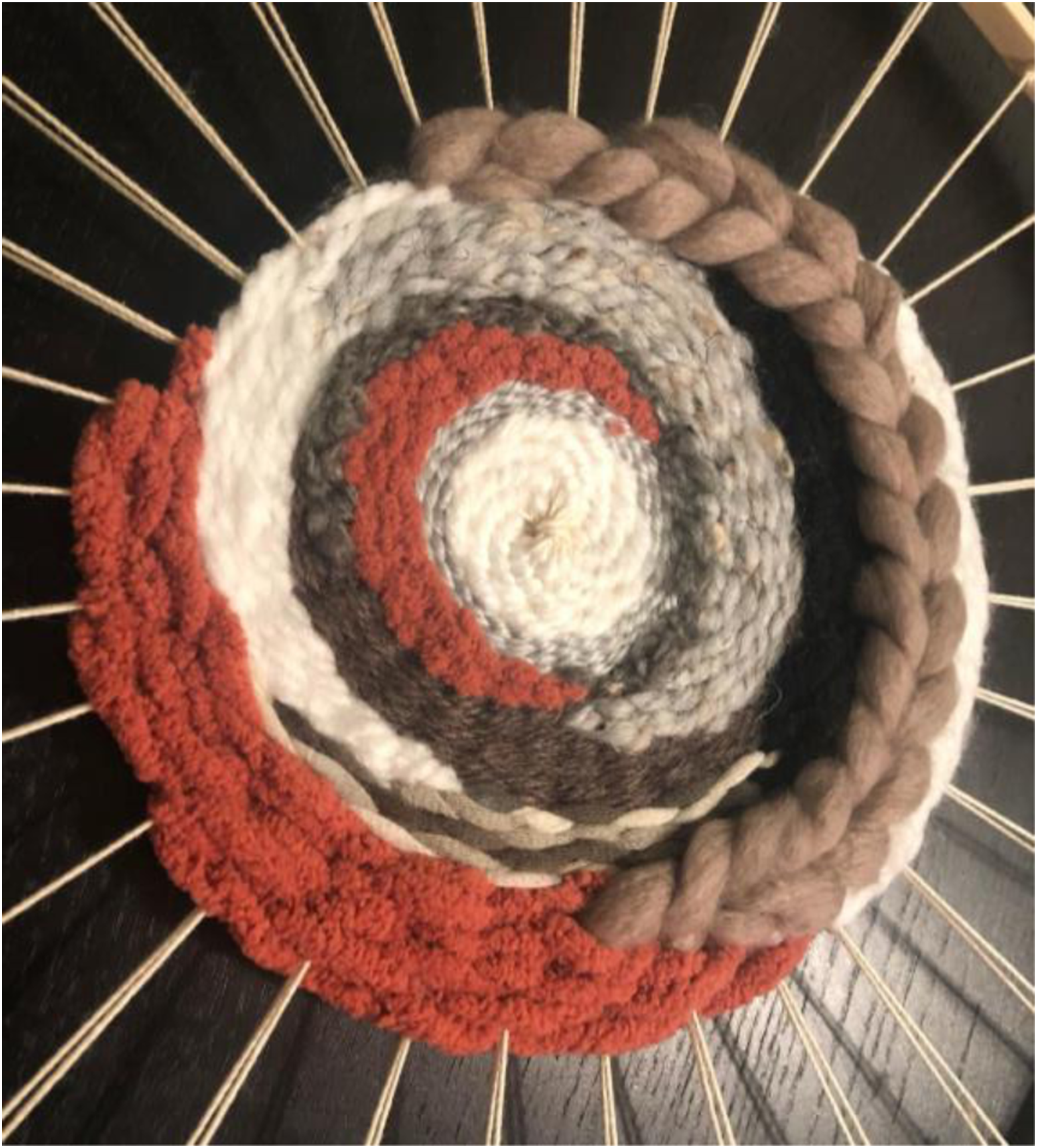
Ettun et al. (2014) reminds us that, The creative act goes beyond just being a moment of forgetting and gains the imprimatur of being an experience of connection to the sublime. At the same time, we should be very careful not to overly put into words that which was expressed in a different language, the language of art. (p. 3)
Jacqueline
Jacqueline literally shuttered herself at home during the pandemic years. Watching the world go by outside her window, she used her isolated condition as a portal to an inner world where visual symbols and spirituality merged with poetry and dreams. Figure 2 Wadsworth, 2021c. Waking Dream of Three Clouds (Mixed media).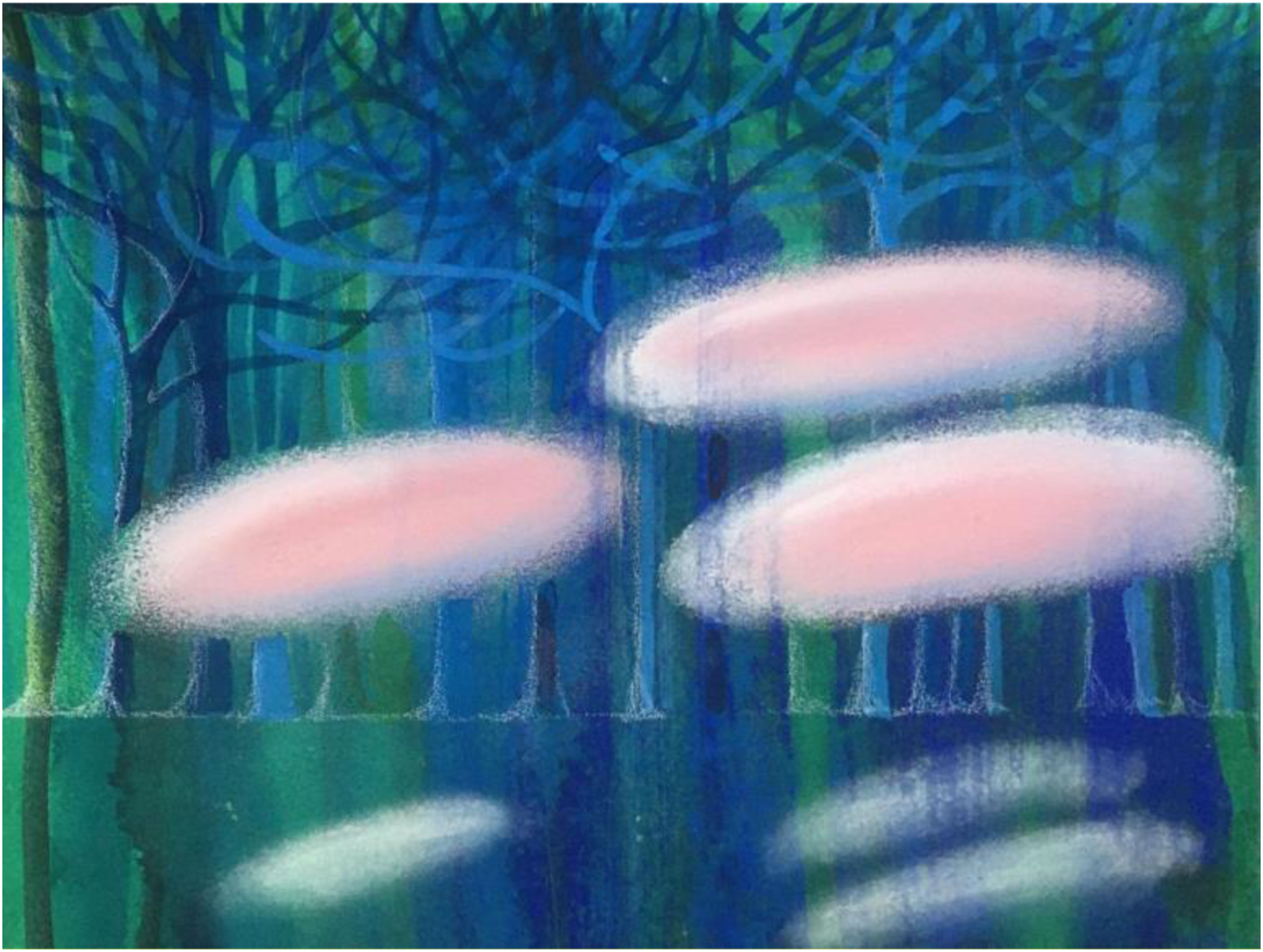
In intuitive inquiry, Anderson and Braud (2011) remind us that, The researcher can use visual imagery for anticipating and planning all of the necessary steps of a research project in the form of imagining [that] can be used to bring new, creative possibilities to mind. This skill can be used in the process of “imaginative variation” in some forms of phenomenological research. (p. 202)
Such a process occupied Jacqueline’s mind. At times, visualizations came to her obliquely and unbidden. At others, imagery appeared with such insistence, she had to paint them and allow them to “speak” to her in return. She felt she had to acknowledge their presence and meaningfulness.
Her research goals were deep, intense, and a holistic approach seemed necessary. Almost halfway into the course, she wondered: How might I illustrate my inner body changes through emotion and sensation? How does that change how I am perceiving my moments? How might I communicate that? How do I communicate being present versus being in my imagination? Existing in the what is and the being versus what I create in my head as the subjective created ego-reality?
(J. Wadsworth, research journal, March 1, 2021a).
She felt that the pandemic had provided her with a space for contemplation and allowed her time to explore and discover greater deeper inner worlds. Being alone in her studio with her books and her thoughts, her mind traveled and made multiple fertile connections. She read profusely, Carl Jung, Ben Okri, Italo Calvino, Paul Harding, Alain de Botton, Haruki Murakami, Jane Hirshfield, etc.
Jacqueline thought about the limitations brought by the pandemic as opportunities to be creative. She wrote, “Art supplies will be limited to what I have on hand, but I know from experience that limitation can increase a sense of inventiveness” (J. Wadsworth, support paper, 2021b, p. 10).
Reading stimulated her imagination and creative spirit. Jacqueline looked for symbolic representations of the soul and spirit on an artistic journey. She found the reproduction of a 1946 surrealist painting by Ende, showing angels floating on the edge of a dark forest, the archetypal image of an entry into a mystical experience, which she perceived as an invitation. She wrote: What I am responding to is the forest as the setting for a mystical experience and when I begin my art making I am seeing this piece in my mind and somehow the feeling I get from this picture becomes embodied. When I look at that picture, it takes me into a space that feels both mystical and strange. It feels otherworldly. (J. Wadsworth, research journal, March 1, 2021a)
She remarked that Campbell (2004) wrote about the forest as a place to be entered at its darkest point, and where one’s own path must be forged. From Okri (2003), she remembered the forest as the home of spirits and ancestors that merge with reality and Murakami’s (2005) forest as the “changing room” between worlds.
Grateful for the process which allowed her to discover the surrealist painting, she observed that, “like breadcrumbs on the forest floor, I find more work whose worlds enter my studio bedroom as if layered upon this world through holographic visions and dreams” (J. Wadsworth, support paper, 2021b, p. 13).
Later on, she added, The forest also serves as a conduit between worlds and as a sort of “changing room” wherein the inner self may change from one physical vessel to the other. Access to this forest, as always, requires a journey, yet the “other world” of the forest also seems to lurk always just beside us, waiting for us to take that one step farther across its boundary, into oblivion. (Stretcher, 2014, cited in J. Wadsworth, 2021a, support paper, p. 17) Waking Dream of Three Clouds In a waking dream three clouds, pinkish yet ominous Hover before a dense and dark forest To enter one would be enveloped, invalid, invisible. Three clouds of the trinity stand guard over the gates of the forest
(Wadsworth, research journal, April 3, 2021a)
She felt, “when I paint I feel the work takes on a personification and speaks to me...as if it were an entity” (J. Wadsworth, research journal, April 3, 2021a, para 4). Jacqueline chose to dive as deeply as possible into the unknown to seek the mysterious and the liminal. With transformation as a goal, she trusted that what she had absorbed through the osmosis of living and of creating would become visible through the artmaking process.
She discovered a creative process that was more alive, where “world and self begin to cohere” (Hirshfield, 1997, cited in J. Wadsworth, support paper, May 2021b, p. 11), and that “traveling into my own inner landscape is the only way I can make visible the sacred space of my own invisible worlds” (p. 11).
Phenomenology was the interpretive lens that allowed her a pre-theoretical experience, an expansion of perception of consciousness, beyond language. Sensing that one is part of something palpable but invisible, feeling a connection to the cosmos or the sacred, is phenomenological by nature. It’s a knowing that isn’t analytical but embodied -- something one lives and something that is often found in the poetic and artistic… Using the forest as the unseen or invisible space of the human psyche, I set out to represent states of being that occurred in response to the work of artists and writers expressing the transcendent. (J. Wadsworth, support paper, 2021b, p. 5)
Olivia
During the second week, Olivia posted her artwork assignment of a mind map (Figure 3) to the group discussion board without any explanation. After learning about the difficulties, she was encountering with the administration at the school where she taught, our interpretation of the mind map gained clarity. During the pandemic, she lived in a Chicago apartment with her sister and her young niece, a situation that likely exacerbated the feeling of confinement. Her artwork pointed to dark moments in her life, but the colors outside the window promised light and hope. Hyman, 2021d. Week 2 Visual Mind Map (Mixed media).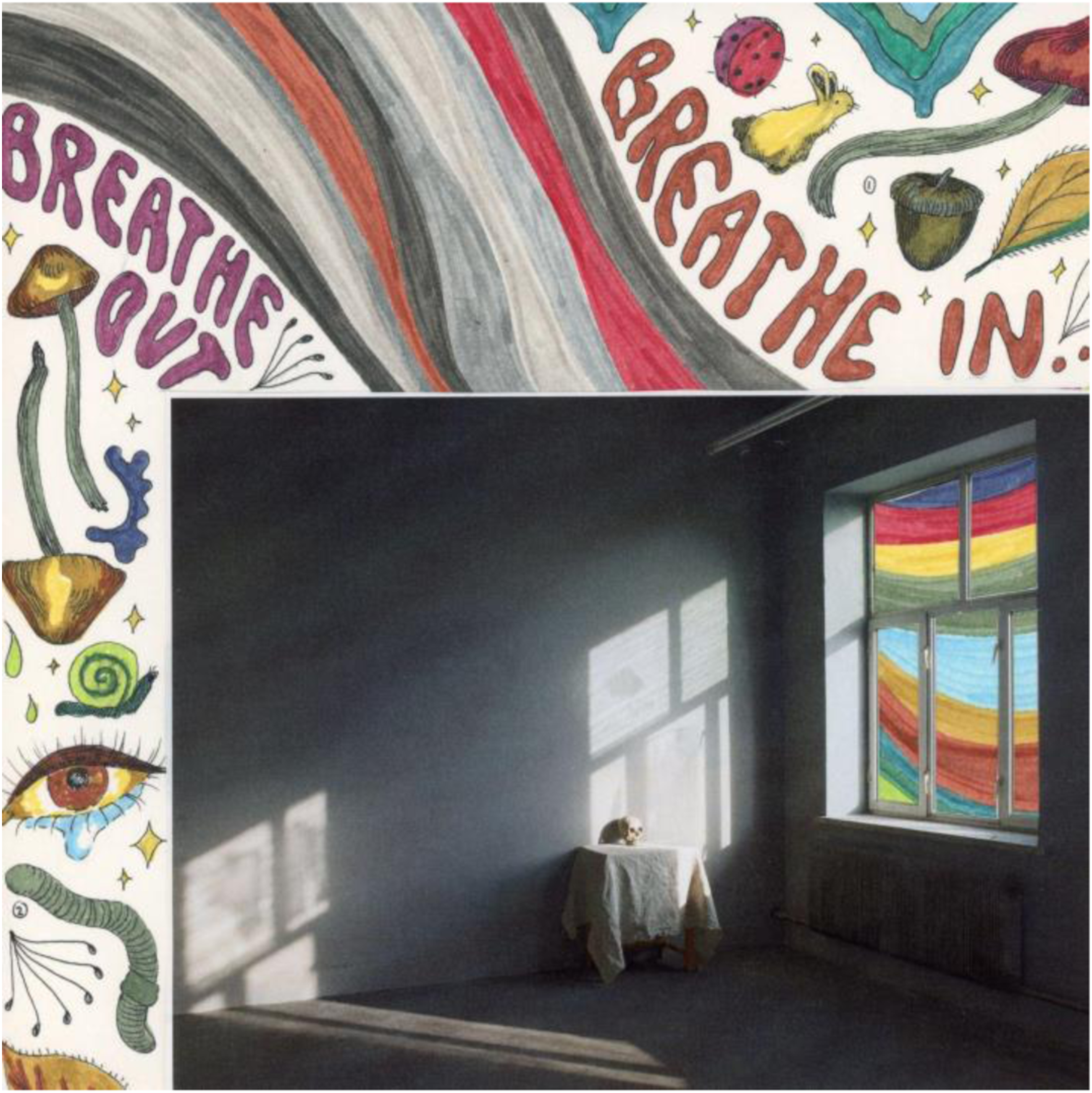
Olivia shared with us how disconnected she felt during that time, and this feeling echoed back to her younger years, deepening the sense of a cyclical loneliness. Despite living in a large city, Oliva painfully missed human connection. Feeling emotionally, mentally, and physically stuck, with a life confined to her apartment, she could not envision the next chapter of her life.
In the first half of the spring semester, Olivia chose to leave her toxic workplace. Leaving her students in the middle of the year was difficult, but she felt the departure necessary.
During that time, she visited her grandparents in Michigan where she found old photographs and letters in the basement of their home. She later wrote about the visit, expressing nostalgia for what seemed like a simple past when people wrote letters to each other, even just sending a note to share a recipe. She contemplated the old black-and-white and sepia-toned images, wondering how it was possible to feel nostalgia for a past that she was too young to have experienced, and longing for a world where people and the surrounding natural environment connected and related in what she imagined were simpler ways.
For her research project, Olivia decided to seek human connections by writing letters to strangers in her city. She prepared a long hand-written letter, which she photocopied for distribution. She wrote, Hello, my name is Olivia…I am an artist. I live in Chicago, IL, although lately, I feel as though I do not live anywhere. Not one place feels like home. I love nature. Nature is breathtaking. It puts everything into perspective. It makes time stand still. It makes you forget where you are. When I was young, I’d explore my neighborhood and my backyard…I’d catch fireflies for hours and squeeze the blades of grass in my toes and pull my foot up to hear the symphony of grass blades snap from their original strand… (O. Hyman, research journal, March 22, 2021c, para 1)
In each of the 100 manila envelope packets that she had prepared, Olivia included three of her photographs, which reinforced the story of what nature meant to her. The letter asked strangers who would read the letter to share their thoughts about the natural environment or about something in their life they wished to share, as a way to make connections. She carefully thought about how she placed the envelopes—at eye or seating level beckoning strangers with the note, “I feel disconnected, please pick me up” (see Figure 4). As a photographer, she documented the experience through thoughtful compositions, almost anthropomorphizing the envelopes. Olivia sitting on a bench, standing by a mural, or looking out at Anish Kapoor’s Cloud Gate sculpture. Hyman, 2021b, Three Documentation Photos, Support Paper, p.13.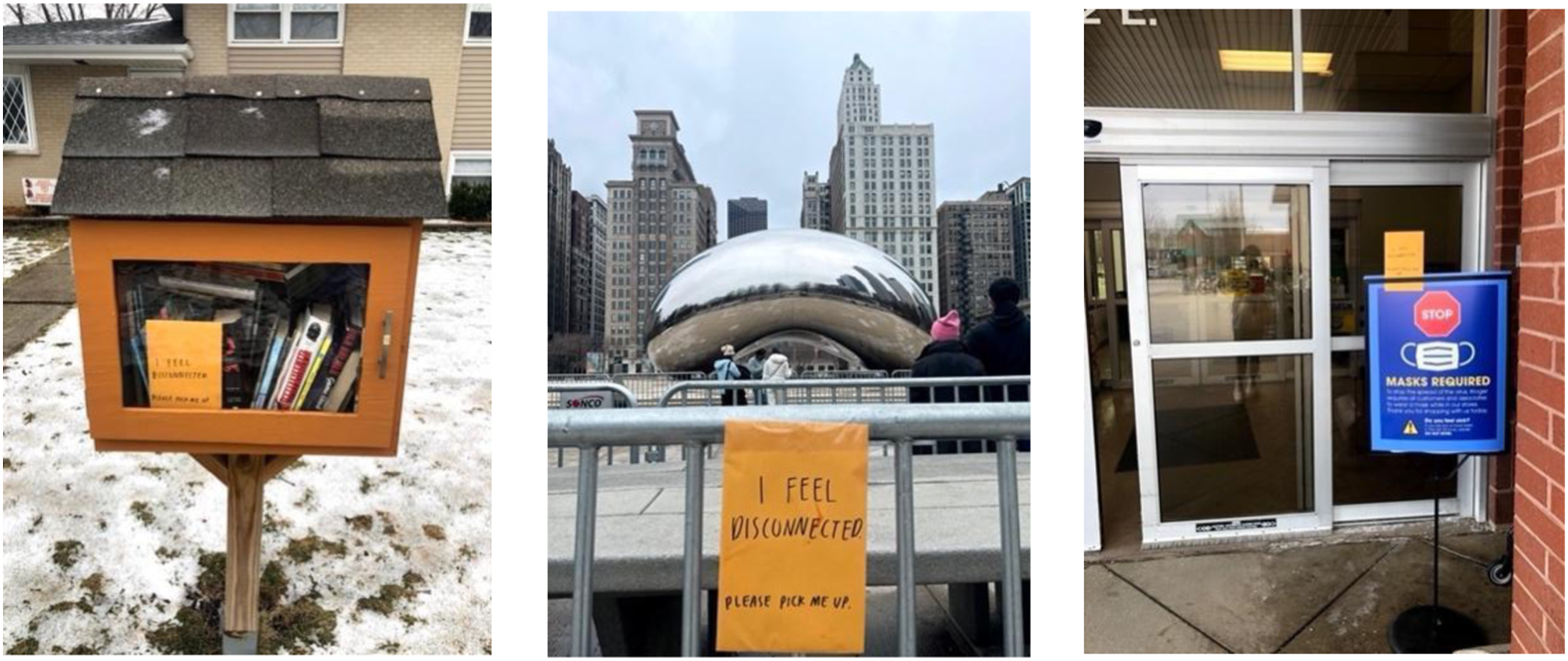
To her surprise and delight, she began receiving responses. Often long hand-written notes or typed, these letters from strangers instantly became her most cherished treasures. Almost all of them shared intimate thoughts on nature, the pandemic, and sometimes their childhood.
Some letters communicated their writer’s nostalgia. Parker wrote, Dear Olivia,....I found your envelope taped to a newspaper vending machine downtown while going for a walk on my lunch break. I half expected anthrax, but my curiosity got the best of me…Unlike you, my memories are not very clear on details…[when I see you photographs] I can remember the feeling of being with somebody [my childhood best friend] who I love, not focused on anything but the task at hand…[One of your photos] makes me feel nostalgic for a place that I haven’t been yet. To me it feels like a yearning to go explore…Thank you for sharing this moment with me. (O. Hyman, thesis art exhibition, 2021a)
A letter writer named Andrea wrote five handwritten pages, sharing the recent death of her grandfather to whom she was close. She wrote, It was never hard to earn his accolade. You simply needed to be the best you could be, and that was enough. For some reason, I have put this pressure on myself to make him proud the way that will make me proud, and in trying to [do] that I felt alone and disconnected…Liv…Please know your project made this stranger feel seen. Thank you. (O. Hyman, thesis art exhibition, 2021d)
Another letter writer, Megan, shared initial details of her painful childhood in rural Georgia that included stories about staying home alone while her immigrant parents worked all the time, living with an alcoholic parent, and a brother who physically abused her. Megan shared stories of her difficult childhood through Olivia’s three photographs and concluded with “I graduated from college on a full scholarship, packed my bags and moved to Chicago, leaving everything behind to start anew. I reached the light. Thank you for this project” (O. Hyman, thesis art exhibition, 2021d).
In the final weeks of the semester, Olivia created a collaged book with all the letters that she received from strangers—who were no longer strangers—filling the book with images that were evocative of nostalgia, and disconnection but also of a newly found spirit of human connection and fulfillment. The book showcased the story of her transformation.
Implications for Art Education
The yearning to understand and explore the movements and longings of the heart are a distinctive aspect of intuitive inquiry. Any human sciences research has to take into account the urgency of transformative experiences in directing investigations that are meaningful and invite the researcher’s imagination (Anderson, 2011). “The researcher studies the fine points of a research account in a manner not unlike a lover exploring a beloved’s hand. Details matter. Secrets matter. The ordinary is extraordinary. The particular is favored” (p. 16).
In a previous article, we have written about observing students' initial reluctance to fully engage with the multi-dimensional inquiry that the process of arts-based research offers. At first, the call to accept the self-investigation that accompanies artistic engagement is received with interest, but we also see students' resistance to letting go of control and opening to the unforeseen, a necessary stage if arts research is to be transformative. Our graduate students' daily school teaching duties are markedly defined by logical and practical self-control. We have learned from them that to loosen the knots of fear and to allow them to unlock their creative realm require patience, time, and supportive strategies. Nevertheless, during the pandemic, the situation was different. Our students' emotional lives were closer to the surface. The fault lines in their lives became for many an invitation to seek deep and meaningful connections with scholarship, artistic practice, themselves, their students, and families.
In supporting teacher’s identity growth and transformation through inquiry that leads to self-knowledge (McKay & Sappa, 2020), arts-based research is conducive to experiential and symbolic discoveries that deepen teaching practitioners’ ability to “make visible the product of creative thought… feel in a multi-sensorial way as well as reflect by using processes not limited to cognition and written language " (McKay & Sappa, 2020, p. 27). Once assimilated, the outcome of that experience further benefits these teachers' students. Global consciousness and a sense of social awareness come initially from the exploration of the inner self. That discovery leads to integration which itself informs teaching (Targ & Hurtak, 2006).
Conclusion
In this article, as art educators, we shared our observations of the outcomes of an arts-based research graduate capstone course. Through our mentoring work, we witnessed how transformative an artistic approach to research could become for art teachers-graduate students who struggled with the traumatic experiences of the pandemic as individuals, teachers, and community members. Our graduate students come from various backgrounds, with different age and maturity levels. There are no demographic indicators such as age, gender, or socioeconomic background that predict how deeply they engage with the process that results in learning and healing. What we have learned to anticipate at each iteration of the course is the initial, and at times, strong resistance to embracing non-conformity, followed by sudden “openings” that transpire for most students and often result in deep transformative learning and growth. We have encountered students who were unwilling (or unable) to trust themselves to open up and be vulnerable. In contrast to what we emphasized above, a resistance to face their “fault lines” might also have stemmed from the uncertainties that the pandemic ushered into various aspects of their lives. Engaging in intuitive inquiry meant opening a space of trust in their approaches to investigating topics and adopting an unconventional qualitative research process invited a holistic commitment to alternative ways of knowing. Nonetheless, bearing witness to the transformative and healing outcomes of these inquiries, our students' research communicated its potential resonance for arts-based researchers and teacher education scholarship.
Footnotes
Declaration of Conflicting Interests
The author(s) declared no potential conflicts of interest with respect to the research, authorship, and/or publication of this article.
Funding
The author(s) received no financial support for the research, authorship, and/or publication of this article.
Author’s Note
This article is adapted from an oral presentation at the Conference of the National Art Education Association, March 2022, New York.
