



Abstract
The relationship between psychopathy and negative behavioral, social, and health outcomes has lead to calls to identify factors that promote change in features of psychopathy. Given that maturation has important implications for changes in personality more broadly, it also may be informative of changes in specific personality traits associated with psychopathy. Rocque’s integrated maturation theory was used in the current study to guide the measurement of psychosocial, adult social role, and identity maturation domains among boys and girls from the Pathways to Desistance Study (n = 1,354). Based on cross-lagged dynamic panel models, within-individual change in temperance (psychosocial maturation), work orientation and consideration of others (adult social role maturation), and moral disengagement (identity maturation) predicted within-individual change in features of psychopathy measured using the Youth Psychopathic Traits Inventory. Maturation may influence features of psychopathy directly or indirectly through changes in a person’s social environment. Understanding why features of psychopathy change is an important step for developing person-oriented intervention strategies.
Psychopathy is defined by deficits in interpersonal (e.g., manipulative, deceitful), affective (e.g., callous-unemotional [CU] traits, lack of remorse), and behavioral (e.g., impulsivity, sensation-seeking) domains of functioning (Andershed et al., 2002). Persons with strong features of psychopathy are at-risk of various negative outcomes, including criminal behavior, poor physical health, unemployment, low educational attainment, additional mental health problems (e.g., anxiety, mood, and substance use disorders), victimization, and an overall poorer quality of life (Beaver et al., 2014; Hemphälä & Hodgins, 2014; Herpers et al., 2016; Saukkonen et al., 2016). Intervention responses to psychopathy have relied primarily on cognitive behavioral therapy to reduce the likelihood of behavioral problems (Polaschek & Skeem, 2018). However, responses that prioritize addressing behavioral problems ignore a variety of other negative social/health outcomes associated with psychopathy (Reidy et al., 2015; Salekin & Lochman, 2008). Therefore, it may be prudent to focus on addressing underlying features of psychopathy (Thornton & Blud, 2007).
Initial pessimism regarding the malleability of features of psychopathy in adolescence (see Salekin, 2002; Seagrave & Grisso, 2002) appears to be unfounded. Using data from the Pathways to Desistance Study, McCuish and Lussier (2020) reported that more than two-thirds of boys involved in the justice system experienced a relative decrease in features of psychopathy. Specifically, those who experienced a relative decrease on the Youth Psychopathic Traits Inventory (YPI; Andershed et al., 2002) averaged a 29.05-point drop in test score (YPI test scores ranged from 50 to 200) and an average rank-order decrease of 454.99 places (out of a possible 1,169 places). Using a different dataset on youth in the justice system, Cauffman et al. (2016) reported that baseline scores on the Psychopathy Checklist: Youth Version (PCL:YV; Forth et al., 2003) were only weakly associated with PCL:YV scores measured two years later (AUC = .62). Thus, changes in features of psychopathy have been observed across different measurement tools, different samples, and both self-report and expert ratings. An important next step is to identify factors that help promote this change (Reidy et al., 2015).
Research has given considerable attention to the role of parents in protecting against the development of, or influencing change in, features of psychopathy. Parents’ messages and reactions to their child’s behavior are considered important to the child’s moral development, avoidance learning, and expressions of remorse (Hoffman, 2001; Krupić et al., 2020). This research, often focusing specifically on CU traits, showed that parental warmth/hostility and parenting style were important to between-group differences and within-individual change in features of psychopathy (e.g., Backman et al., 2018, 2021; Deng et al., 2020; Flexon et al., 2020; Ray, 2018; Salihovic et al., 2014; Zhong et al., 2020). However, parents may have a less important role to play in within-individual changes in features of psychopathy between adolescence and early adulthood. During this age-stage, individuals exert more agency in controlling their own development. Thus, parents are less involved in the socialization of their children (see Nurmi, 1993). This heightened agency warrants the examination of factors that are internal to the individual.
Maturation may be an important promoter of change in features of psychopathy between adolescence and emerging adulthood. During this period, individuals who experience maturation learn to better regulate their behavior and to value and perform well in their social roles. Such individuals also experience a clearer sense of self, improvements in self-esteem, and more favorable attitudes toward prosocial behavior (Rocque, 2015). These aspects of maturation are inconsistent with several features of psychopathy, including sensation-seeking, interpersonal dominance, manipulation, and the tendency to justify negative behavior or deny responsibility for that behavior (Andershed et al., 2002; Forth et al., 2003). It may be more than coincidence that between adolescence and emerging adulthood maturation tends to increase (Monahan et al., 2009) and features of psychopathy tend to decrease (McCuish & Lussier, 2020).
Studies addressing calls to investigate the relationship between psychopathy and maturation (see Skeem & Cauffman, 2003) have focused specifically on psychosocial maturation (e.g., Cauffman et al., 2016; Kimonis et al., 2011). However, recent conceptualizations have acknowledged that maturation is more than this one domain. The integrated maturation theory (IMT) described maturation as the product of psychosocial, adult social role, identity, civic, and neurocognitive domains (Rocque, 2015). These domains have been identified as important precursors to personality change (Caspi & Roberts, 2001) and thus may also be important specifically to psychopathy. The current study used the IMT as a framework for examining whether within-individual changes in maturation influenced within-individual changes in features of psychopathy among boys and girls from the Pathways to Desistance Study (n = 1,354).
The Relationship Between Maturation and Psychopathy
Examining the relationship between maturation and psychopathy aligns with the lifespan developmental model that recognizes the importance of psychological, social, and cultural factors to the development of personality in adolescence and early adulthood (Roberts & Caspi, 2003). The different domains of the IMT have been identified as protective factors against several outcomes that are also associated with psychopathy, including criminal behavior (McCuish et al., 2020) and poorer outcomes in education (Williams & Steinberg, 2011) and employment (DeWitt, 2016).
Understanding adolescent maturation is critical to avoid conflating normative adolescent characteristics like impulsivity and egocentricity with features of psychopathy (Salekin et al., 2001; Seagrave & Grisso, 2002). Psychopathy represents a distinct grouping of maladaptive personality traits, whereas maturation refers to a broad set of capacities (Rocque, 2015; Skeem & Cauffman, 2003) associated with normative development (i.e., tend to improve over time; Caspi et al., 2005). Given that different aspects of maturation have been identified as important to change in broad features of personality (see Roberts & Caspi, 2003; Roberts et al., 2003), it is possible that maturation also influences personality traits specific to psychopathy. The IMT provides a framework for addressing this question by guiding the measurement of psychosocial, adult social role, and identity maturation.
Psychosocial Maturation and Psychopathy
Psychosocial maturation reflects self-regulation and socio-emotional capabilities (Steinberg & Cauffman, 1996). Such capabilities include perspective-taking (e.g., being future oriented), responsibility (e.g., independence, resistance to peer influence, self-reliance), and temperance (e.g., improvements in self control and suppression of aggression). Psychosocial maturation tends to improve between adolescence and early adulthood (Monahan et al., 2009). Prior research found that higher levels of psychosocial maturation were associated with lower levels of psychopathy, behavioral features of psychopathy in particular (e.g., Skeem & Cauffman, 2003). This may be because temperance includes the ability to control impulses and suppress aggression (Steinberg & Cauffman, 1996), which contrasts with behavioral features of psychopathy (Forth et al., 2003). Improvements in psychosocial maturation implies being less impulsive and taking more time to make decisions. This may help persons recognize the impact of their behavior on others (i.e., changes in affective deficits) and improve interactions with others (i.e., changes in interpersonal deficits).
Disaggregating psychosocial maturation into its temperance, perspective, responsibility, and resistance to peer influence components revealed that they relate to offending in different ways. For example, responsibility is positively associated with offending in the Pathways to Desistance Study (McCuish et al., 2020). Whether specific components of psychosocial maturation differentially relate to psychopathy also should be investigated. Another way to build on past research is to move from examinations of between-person differences in psychosocial maturation and features of psychopathy to the investigation of the influence of within-individual changes in psychosocial maturation on within-individual change in features of psychopathy. This is useful for controlling for unobserved heterogeneity between persons (Allison, 2009) and for facilitating more person-oriented treatment strategies (Bergman & Magnusson, 1997).
Adult Social Role Maturation and Psychopathy
Adult social role maturation measures a person’s competency in roles such as employee, intimate partner, and parent. These competencies include having a positive attitude toward work and valuing the ability to complete tasks and overcome challenges (McCuish et al., 2020). Especially in adolescence and early adulthood, a person’s employable skills (Mikkelson & Schweitzer, 2019), attitudes regarding social institutions (Na & Jang, 2019), and the capacity to consider the well-being of their partner (e.g., Nguyen & Loughran, 2018) have been used as indicators of adult social role maturation.
Role demands and work attitudes and experiences influence personality traits (Caspi & Roberts, 2001; Roberts et al., 2003). Employment opportunities that are mentally demanding and require greater levels of independence transcend other life domains by increasing intellectual curiosity and self-directedness outside the workplace (Caspi & Roberts, 2001; Howard & Bray, 1989; Kohn & Schooler, 1983). Role experiences and requirements may also influence changes in features of psychopathy. For example, the consideration of others aspect of adult social role maturation (McCuish et al., 2020) contrasts with detached, uncaring, and uncommitted features of psychopathy (Cooke et al., 2012). A more concerted effort to follow workplace codes of conduct may help individuals move away from interactions characterized by interpersonal dominance, pathological lying, and instant gratification, all of which are associated with psychopathy (Cooke et al., 2012). Social group relationships, which can come from work experiences, have a transformative impact on personality (Reitz et al., 2014), especially when these relationships are valued (Robins et al., 2002). Thus, the positive valuation of conventional social roles may influence changes in attitudes toward others (i.e., affective deficits), changes in interactions with others (i.e., interpersonal deficits), and changes in levels of perseverance and reliability (i.e., behavioral deficits).
Identity Maturation and Psychopathy
Identity maturation reflects self identity and cognitive processes that develop across adolescence and adulthood (Stewart & Ostrove, 1998). Self identity includes more positive self-perceptions, healthy self-esteem, and clarity of self (Rocque, 2015). Cognitive processes associated with identity maturation are essentially the inverse of moral disengagement. Moral disengagement refers to an individual’s endorsement of antisocial behavior. Individuals characterized by moral disengagement avoid negative self-perceptions and self-blame by using cognitive distortions to justify behaviors that they know are wrong (Bandura et al., 1996). Moral disengagement is correlated with psychopathy (DeLisi et al., 2014) but the two represent distinct constructs. Moral disengagement arises from contextual factors such as exposure to antisocial peers (Shulman et al., 2011). Psychopathy refers to personality traits that are pervasive across different contexts as opposed to a response to peer influence (Forth et al., 2003).
Identity maturation is important to personality development (Klimstra, 2013). For example, individuals who become more committed to their identity (e.g., greater clarity of self) show higher levels of conscientiousness and agreeableness and lower levels of neuroticism (Lodi-Smith & Roberts, 2007). Further, individuals who develop a more prosocial sense of self will alter their behavior to conform to this identity. They will also change their peer group to one more supportive of this identity (Roberts & Caspi, 2003). In effect, in response to identity changes, individuals self-select into different environments, personalities, and behaviors to reinforce and validate their new identity. Individuals whose identity change includes viewing themselves more positively, taking responsibility for behavior, and being more accepting of internal sanctions are expected to experience a personality change inconsistent with features of psychopathy (Lodi-Smith & Roberts, 2007).
The Current Study
The lack of information about how to respond to features of psychopathy is a major gap in the literature (Reidy et al., 2015). A step toward addressing this gap involves identifying factors that help explain why features of psychopathy change between adolescence and adulthood (Hawes et al., 2014; McCuish & Lussier, 2020). This can facilitate the development of person-oriented intervention strategies that promote change in underlying traits rather than simply trying to manage behavior (Bergman & Magnusson, 1997; Thornton & Blud, 2007). Given evidence that features of psychopathy manifest as early as childhood (Farrington, 2005), it is more appropriate to consider maturation in adolescence and adulthood as a promoter of change in features of psychopathy as opposed to a factor that protects against the emergence of psychopathy. Explaining changes in features of psychopathy requires attention to factors that are proximal to the timing of this change (Lynam et al., 2008; Salekin & Lochman, 2008). Maturational change and change in features of psychopathy both occur during the transition from adolescence to adulthood (McCuish & Lussier, 2020; Monahan et al., 2009). Moreover, different aspects of maturation have been identified as precursors to changes in personality traits like agreeableness and conscientiousness (Lodi-Smith & Roberts, 2007), which are the antithesis to features of psychopathy. Accordingly, maturation may be useful for helping to understand changes in features of psychopathy as well. Research on maturation and psychopathy has focused primarily on between-group differences in psychosocial maturation (Cauffman et al., 2016). Adult social role and identity domains are also important to the development of maturation (Rocque, 2015) and have been identified as important to change in personality development more broadly (Caspi & Roberts, 2001). Thus, we add to past research by examining the relationship between within-individual change in psychosocial, adult social role, and identity maturation domains and within-individual change in features of psychopathy.
The IMT was used in the current study to guide the measurement of psychosocial, adult social role, and identity maturation. Rocque’s (2015) operationalization of maturation also included civic and neurocognitive maturation, but consistent repeated measures of these domains were not available in the data used in this study. Longitudinal data on formerly incarcerated boys and girls from the Pathways to Desistance Study (n = 1,354) were used to examine the relationship between within-individual changes in maturation and within-individual changes in YPI total scores. We also examined the relationship between within-individual changes in maturation and within-individual changes in scores on the CU, Grandiose-Manipulative (GM), and Impulsive-Irresponsible (II) dimensions of the YPI. On their own, these dimensions insufficiently account for the full psychopathy construct (see Salekin et al., 2018). We examined these individual dimensions simply to better understand whether maturation influenced change in all, or only specific, features of psychopathy. Past research showed that psychosocial maturation’s relationship with psychopathy was primarily due to its ability to account for differences in behavioral features of psychopathy (Skeem & Cauffman, 2003). If maturation only influences change in behavioral features like low self-control, then individuals may simply become more predatory in their interactions with others. Thus, for maturation to help prevent negative outcomes associated with features of psychopathy, maturational change must promote change across different constellations of psychopathy traits.
Method
Participants and Procedures
Data were used from the Pathways to Desistance Study, which involved interviews with boys (n = 1,170; 86.4%) and girls (n = 184; 13.6%) formerly incarcerated in institutions in Phoenix, Arizona and Philadelphia, Pennsylvania. Archived data were made available by the Interuniversity Consortium for Political and Social Research at the University of Michigan (Mulvey, 2013). All participants were convicted of at least one crime and approximately half the sample had a history of felony violent crimes. The percent of boys involved in drug-related crimes was limited to a maximum of 15% to capture more serious offending. Interviews were performed in participants’ homes, in public, and in corrections facilities. Information was kept confidential except in instances of suspected child abuse or imminent danger to others. Most participants self-reported being Black (41.4%), Hispanic (33.5%), or White (20.2%). The remaining participants were listed as ‘Other’ (4.8%).
Follow-up interviews were conducted with participants at 6-month intervals for a 3-year period and then at 1-year intervals for the next four years. Features of psychopathy were measured using the YPI (Andershed et al., 2002), which was implemented at the first follow-up interview. Shorter recall periods could result in less change than longer recall periods. To establish equidistant measurement intervals for the examination of change, only the 12-, 24-, 36-, 48-, 60-, 72-, and 84-month follow-up periods were used. At the start of the 12-month baseline period, participants were an average age of 17.05 (SD = 1.15; Range = 15–20). By the final wave, participants were an average age of 23.03 (SD 1.15; Range = 20–26).
Measures
Psychopathy
The YPI is a 50-item measure with items scored on a 1–4 scale (Andershed et al., 2002). Underlying the YPI are GM, CU, and II dimensions developed to reflect the interpersonal, affective, and lifestyle facets, respectively, from the three factor model of psychopathy (Cooke & Michie, 2001) derived from the Psychopathy Checklist-Revised (Hare, 2003). Studies using data on youth in conflict with the law identified that the YPI was reliable, demonstrated convergent validity and concurrent validity with the PCL:YV, and was informative of offending outcomes (e.g., Andershed et al., 2007; Skeem & Cauffman, 2003). Hawes et al. (2014) showed that the YPI was invariant across the entirety of the follow-up period in the Pathways to Desistance Study and therefore was suitable for measuring psychopathy across the adolescence-early adulthood period. Table 1 presents YPI test scores across the seven waves and shows that test scores declined with age. Across all waves, the average YPI test score was 101.86 (SD = 23.22) and Cronbach’s α values ranged from 0.93 to 0.94. For the GM, CU, and II dimensions, average test scores were 31.53 (SD = 6.79), 37.04 (SD = 11.12), and 33.28 (SD = 8.61), respectively.
Means and Standard Deviations of Key Variables Across the Seven Waves of Measurement.
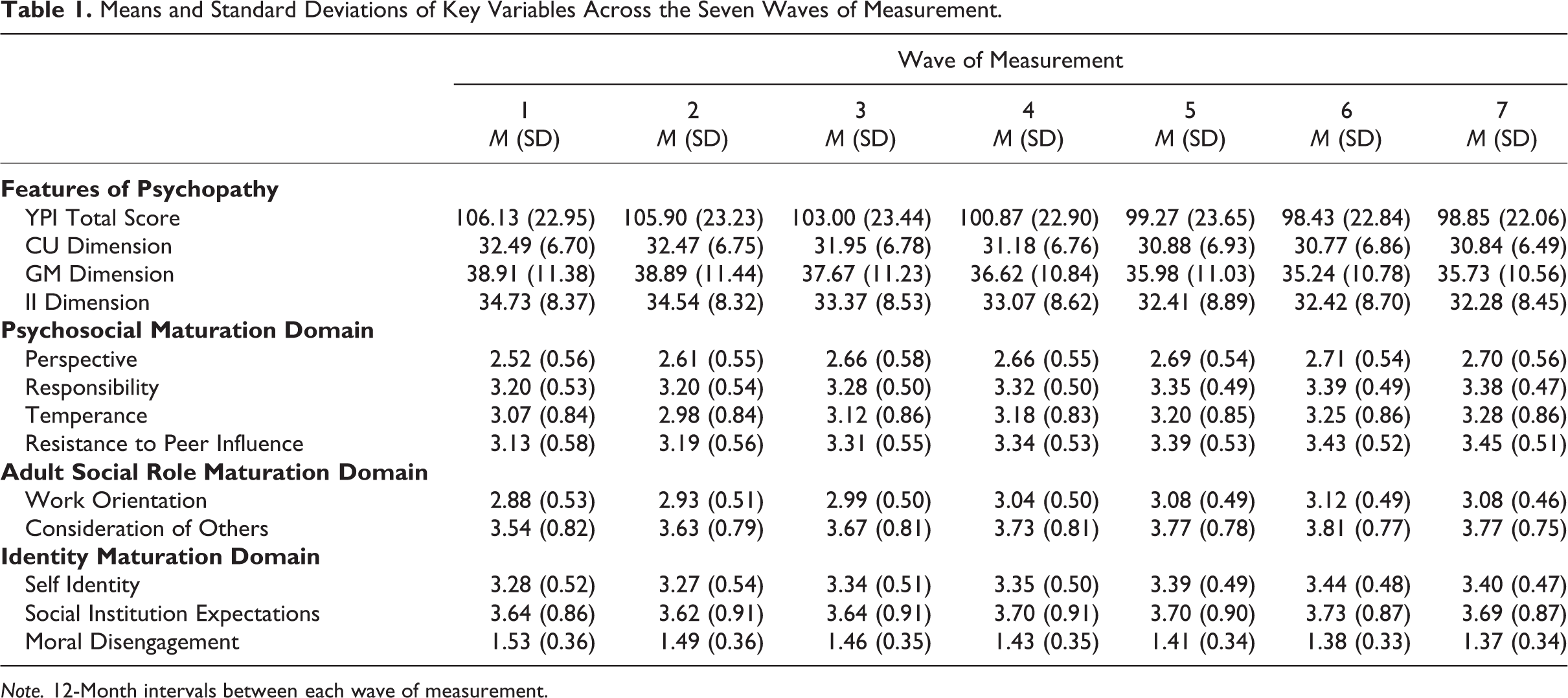
Note. 12-Month intervals between each wave of measurement.
Maturation
The measurement of maturation components from psychosocial, adult social role, and identity maturation domains was guided by prior research testing the IMT (e.g., McCuish et al., 2020). Individual items comprising the scales used to capture each maturation component were not accessible from the publicly available dataset. However, the study’s website reported Cronbach’s α values for scales from the baseline interview (https://www.pathwaysstudy.pitt.edu/index.html). These values ranged from 0.68 (Perspective) to 0.88 (Moral Disengagement). Descriptive statistics reported in Table 1 show that scores on each maturation component increased with age, except for the measure of moral disengagement, where higher values reflected lower levels of maturation.
Psychosocial maturation
The psychosocial maturation domain of the IMT was based on Steinberg and Cauffman’s (1996) specification of four components: perspective, responsibility, temperance, and resistance to peer influence.
Perspective was measured via the Future Outlook Inventory, which is comprised of eight items (e.g., “I will keep working at difficult, boring tasks if I know they will help me get ahead later”) sourced from three scales (the Life Orientation Task (Scheier & Carver, 1985), the Stanford Time Perspective Inventory (Zimbardo, 1990), and the Consideration of Future Consequences Scale (Strathman et al., 1994)). Items were scored from 1 to 4 with higher scores indicating greater perspective. Across all waves, the average item score for the sample was 2.65 (SD = 0.56).
Responsibility was measured using the self reliance subscale from the Psychosocial Maturity Inventory (PSMI Form D; Greenberger et al., 1974) and was represented by participants’ average score across 10 items (e.g., reverse coding of “luck decides most things that happen to me”) scored from 1 to 4 with higher scores indicating greater responsibility. Across all waves, the average item score for the sample was 3.30 (SD = 0.51).
Temperance was measured by summing the Weinberger Adjustment Inventory’s (WAI; Weinberger & Schwartz, 1990) eight-item impulse control subscale (e.g., “I say the first thing that comes into my mind without thinking enough about it”) and seven-item aggression suppression subscale (e.g., “People who get me angry better watch out”[reverse coded]). All items were scored from 1 to 5 with higher scores indicating greater levels of temperance. Across all waves, the average item score for the sample was 3.15 (SD = 0.86).
The resistance to peer influence scale was developed by the Pathways to Desistance Study investigators and measures autonomy and independence (e.g., the extent to which participants were willing to go along with peers or be influenced by them). Participants were presented with ten instances of two conflicting scenarios and asked to identify which scenario most closely resembled their own behavior. Each instance was rated on a scale of 1–4 with higher scores indicating greater resistance to peers. Across all waves, the average item score for the sample was 3.32 (SD = 0.55).
Adult social role maturation
Especially in adolescence and early adulthood, adult social role maturation is not so much about being in the role of employee, intimate partner, or parent, but about whether a person has the qualities to succeed in these roles (McCuish et al., 2020). Entry into such roles too early in a person’s development can be ineffective in preventing negative outcomes (Uggen, 2000). The current study looked at participants’ capacity for meeting role expectations and valuing such roles through three components: work orientation, consideration of others, and attitudes toward social institutions.
Work orientation was measured using the subscale of the same name from the PSMI Form D and captured 10 items scored on a 4-point scale. Higher scores indicated greater work orientation (e.g., an individual’s perseverance and pride in completing tasks). Across all waves, the average item score for the sample was 3.01 (SD = 0.51).
The consideration of others subscale from the WAI was used to measure qualities important to fulfilling parental responsibilities and the needs of intimate partners (McCuish et al., 2020). The scale consisted of seven items (e.g., “Doing things to help other people is more important to me than almost anything else”) scored from 1 to 5 with higher scores indicating greater consideration of others. Across all waves, the average item score for the sample was 3.70 (SD = 0.80).
Expectations regarding social institutions helped capture a person’s attitudes toward social roles and was measured using an adaptation of the Perceptions of Chances for Success scale (Menard & Elliott, 1996). This scale included six items concerning positive expectations about work, family, and interactions with the justice system, with each item scored on a 5-point scale. Across all waves, the average item score for the sample was 3.67 (SD = 0.89).
Identity maturation
Identity maturation reflects more positive self-perceptions and negative attitudes toward deviant behavior (Rocque, 2015). Measures of self identity and moral disengagement were used to capture these two components.
Self identity was measured using the identity subscale from the PSMI. This scale consisted of 10 items, scored on a 4-point scale, that tapped into a participant’s self-esteem, clarity of self, and consideration of life goals. Higher scores indicated a greater understanding of self. Across all waves, the average item score for the sample was 3.35 (SD = 0.51).
The Mechanisms of Moral Disengagement scale (Bandura et al., 1996) includes 32 items measured on a 3-point scale. Items tapped into moral justifications, euphemistic language, advantageous comparisons, displacement of responsibility, diffusion of responsibility, and dehumanization. Thus, lower scores represented more prosocial attitudes and willingness to take responsibility for behavior. Across all waves, the average item score for the sample was 1.44 (SD = 0.35).
Control variables and other covariates
Analyses controlled for within-individual changes in age and the baseline measure of participant gender. Past research indicated that parenting style was important to the development of features of psychopathy (e.g., Backman et al., 2018). Accordingly, analyses also included measures of maternal warmth and maternal hostility, which were derived from the Quality of Parental Relationships Inventory (Conger et al., 1994). Warmth was calculated from the mean of 9 items scored on a 4-point Likert scale and hostility was calculated from the mean of 12 items scored on a 4-point Likert scale. Maternal parenting style referred to whomever the participant considered to be their female caregiver. The current study did not examine paternal measures as they were associated with substantial missing data (i.e., 38% at baseline assessment). Only baseline measures of maternal parenting were included due to substantial missing data at later waves when participants were in adulthood.
Analytic Strategy
Cross-lagged dynamic panel models address questions about the role of within-individual change in specific predictors on within-individual change in the outcome of interest. Cross-lagged dynamic panel models build upon fixed effects models by facilitating the examination of the impact that between-person differences in a specific predictor have on within-indviidual change in the outcome of interest. Unlike fixed-effects analysis, this analysis can also control for lagged change in the outcome variable (Allison, 2015), which helps verify that the relationship between independent variable(s) and dependent variable is not a matter of past changes in the dependent variable (see Allison et al. (2017) for a visual depiction of this type of model). The cross-lagged dynamic panel model (xtdpdml) for Stata (StataCorp, 2019) estimates a series of progressive chained equations over time that satisfies the assumption of independence between error terms and predictor variables (Allison, 2015). The full information maximum likelihood command was specified to deal with missing data (Williams et al., 2018). Complete data across all waves were available for 888 participants (65.6% of the sample). For the YPI and measures of maturation, the prevalence of missing data at any give wave ranged from 6.9% to 16.8% of participants.
We examined whether changes in maturation components predicted changes in features of psychopathy while controlling for (a) lagged changes in features of psychopathy and (b) changes in age. Controlling for earlier changes in features of psychopathy (i.e., the impact of change at time t-1 on change at time t) helped rule out the possibility that the relationship between maturation and psychopathy was related to past changes in features of psychopathy influencing both changes in maturation and changes in psychopathy at later waves. The analyses also included baseline measures of each maturation component, maternal warmth, and maternal hostility to examine whether between-person differences in these constructs impacted the magnitude of within-individual change in features of psychopathy. Four models were produced to examine different outcomes. The first examined changes in total scores on the YPI and the final three examined changes in scores on the CU, GM, and II dimensions of the YPI. Model fit was judged based on χ2 values, root mean square error of approximation (RMSEA) values, and CFI values. χ2 statistics compare the estimated models with saturated models. Larger p values indicate better fitting models. For RMSEA, values less than 0.05 indicate good model fit. For CFI, values greater than 0.95 indicate good model fit (Hu & Bentler, 1999).
Results
Table 2 shows the results from four cross-lagged dynamic panel models examining factors associated with change in the YPI and its CU, GM, and II dimensions. RMSEA and CFI values indicated good model fit across all four models. χ2 values were significant across three of the four models. Significant values mean that the model does not fit the data as closely as a saturated model. However, RMSEA and CFI are generally considered more relevant indicators of model fit because χ2 tests are sensitive to larger sample size (Allison et al., 2017; Williams et al., 2018). The mean-deviation method for panel data was used to check for multicollinearity (Allison, 2009). This involved computing a mean across all waves for all time-varying variables and then subtracting the person-specific mean from the observed values of each variable. This newly calculated variable is then entered into a linear regression analysis to obtain variance inflation values (VIF). Using this procedure for all measures of maturation, age, and a lagged measure of the YPI, VIF values were less than five and thus within acceptable range (Garson, 2014).
Cross-Lagged Dynamic Panel Models of the Relationship Between Maturation and Psychopathy.
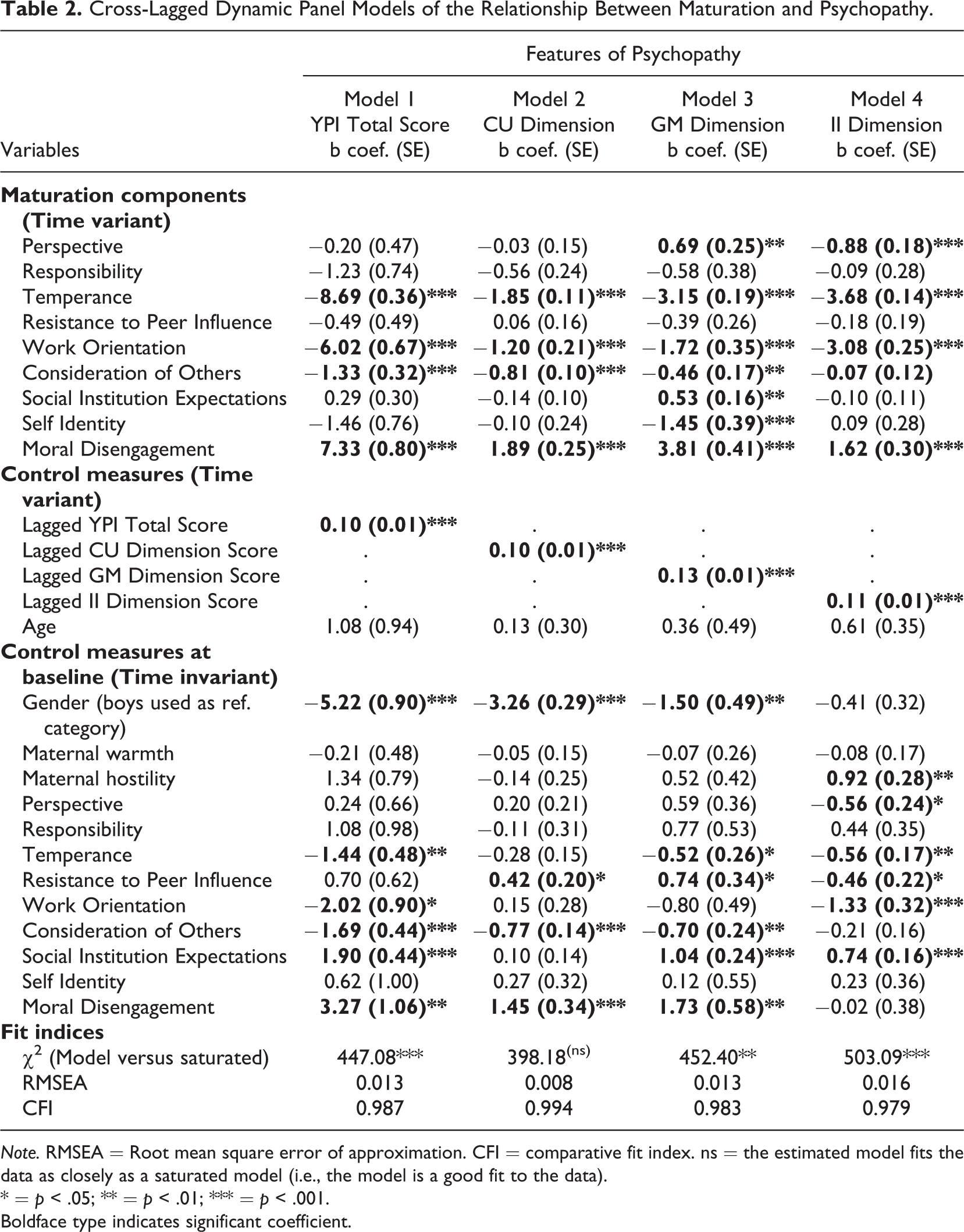
Note. RMSEA = Root mean square error of approximation. CFI = comparative fit index. ns = the estimated model fits the data as closely as a saturated model (i.e., the model is a good fit to the data).
* = p < .05; ** = p < .01; *** = p < .001.
Boldface type indicates significant coefficient.
Model 1 shows that within-individual increases in temperance, work orientation, and consideration of others predicted within-individual decreases in YPI test scores. Within-individual decreases in moral disengagement (i.e., a transition toward more prosocial attitudes and acknowledging responsibility for behavior) predicted within-individual decreases in YPI test scores. Additionally, within-individual increases in YPI test scores at the previous wave were significantly associated with within-individual increases in YPI test scores at the next measurement period. Girls experienced significantly greater within-individual decreases in YPI test scores compared to boys. Higher baseline levels of temperance, work orientation, and consideration of others were associated with within-individual decreases in YPI test scores. Higher baseline levels of social institution expectations and moral disengagement were associated with within-individual increases in YPI test scores.
When looking at the impact of within-individual changes in maturation components on within-individual changes in scores on the CU dimension (Model 2), the same findings emerged as in Model 1. This indicated that various aspects of maturation were informative of within-individual changes in the types of affective deficits that are considered core features of psychopathy (McCuish et al., 2019). Additionally, girls experienced significantly greater within-individual decreases in scores on the CU dimension compared to boys. Regarding baseline maturation, higher levels of consideration of others was associated with within-individual decreases in the CU dimension whereas higher levels of resistance to peer influence and moral disengagement were associated with within-individual increases in the CU dimension.
For the GM dimension (Model 3), regarding within-individual change, each of the significant maturation components from the prior two models remained significant. Additionally, within-individual increases in self identity were associated with within-individual decreases on the GM dimension. Contrary to expectation, within-individual increases in perspective and social institution expectations were associated with within-individual increases on the GM dimension. As with prior models, girls experienced significantly greater within-individual decreases in scores on the GM dimension compared to boys. For baseline maturation, higher levels of temperance and consideration of others were associated with within-individual decreases in the GM dimension whereas higher levels of resistance to peer influence, social institution expectations, and moral disengagement were associated with within-individual increases in the GM dimension.
Within-individual increases in perspective-taking, temperance, and work orientation were associated with within-individual decreases in scores on the II dimension (Model 4). Within-individual increases in moral disengagement were associated with within individual increases in scores on the II dimension. For the baseline measures, higher levels of perspective, temperance, resistance to peer influence, and work orientation were associated with greater within-individual decreases in the II dimension whereas higher levels of maternal hostility and social institution expectations were significantly associated with within-individual increases in the II dimension.
Discussion
Psychopathy is associated with various negative behavioral, health, and social outcomes (Hemphälä & Hodgins, 2014; Herpers et al., 2016; Saukkonen et al., 2016). This has lead to calls to identify factors that influence change in features of psychopathy (see Lynam et al., 2008; Reidy et al., 2015). Maturation may be one such factor. Between adolescence and early adulthood, features of psychopathy tend to decline (McCuish & Lussier, 2020) and maturation tends to improve (Monahan et al., 2009). Maturation is also associated with increases in agreeableness and conscientiousness (Lodi-Smith & Roberts, 2007), which are the antithesis to features of psychopathy like inflexibility and self-centeredness (Cooke et al., 2012). Investigating the influence of maturation on psychopathy also has important implications for calls for intervention strategies that focus on the modification of features of psychopathy (Thornton & Blud, 2007). Intervention strategies for psychopathy typically relied on the use of cognitive behavioral therapy to mitigate the likelihood of future criminal behavior (Polaschek & Skeem, 2018). Focusing instead on how to modify features of psychopathy through improvements in maturation may be a more holistic approach that addresses a broader set of negative outcomes associated with psychopathy (Hemphälä & Hodgins, 2014; Herpers et al., 2016; Saukkonen et al., 2016).
Rocque’s (2015) IMT was used as a framework for the measurement of different components of psychosocial, adult social role, and identity maturation among boys and girls from the Pathways to Desistance Study (n = 1,354). Participants were examined over seven annual waves of data collection. Cross-lagged dynamic panel models identified whether changes in maturation were associated with changes in features of psychopathy during the transition from adolescence to early adulthood. Analyses also examined the relationship between maturational change and changes in scores on the GM, CU, and II dimensions of the YPI. This was done to identify whether maturational change contributed to change in interpersonal and affective features that are generally considered more important to the development of psychopathy (McCuish et al., 2019). Results are discussed with reference to why different aspects of maturation possibly influenced changes in features of psychopathy.
Within-individual increases in temperance (psychosocial maturation) and work orientation and consideration of others (adult social role maturation) were associated with within-individual decreases in YPI scores. Within-individual decreases in moral disengagement were associated with within-individual decreases in YPI scores. These findings were observed while controlling for prior change in features of psychopathy and changes in age. Thus, the relationship between maturation and psychopathy did not appear to be the result of normative declines in features of psychopathy that come with ageing (Hawes et al., 2014), nor was it the result of the tendency for prior changes in features of psychopathy to influence future changes in psychopathy (McCuish et al., 2020).
If maturational changes only influenced changes in behavioral features of psychopathy, it could produce a scenario where individuals maintained high levels of interpersonal and affective deficits while becoming less impulsive. This would be concerning as it could result in a person’s tendency to engage in more instrumentally aggressive behaviors (Blais et al., 2014), which are generally considered to be more serious forms of offending (Laurell et al., 2010). Instead, changes in psychosocial maturation, work orientation, consideration of others, and moral disengagement were significantly associated with within-individual changes in the CU and GM dimensions of the YPI. 1 Emphasizing improvements in different aspects of maturation may be fruitful for treatment strategies focused on changing personality traits associated with psychopathy (Thornton & Blud, 2007). This approach appears feasible given that other studies have identified that different treatment strategies (see Piquero et al., 2016; Riggs-Romaine et al., 2018) and changes in social circumstances (e.g., Forney & Ward, 2019) have resulted in improvements in maturation. Change in features of psychopathy may be a collateral consequence of treatment strategies focused on maturational change.
The literature on maturation and personality can provide insight into the potential mechanisms that explain why maturation influences change in features of psychopathy. We focused specifically on discussing within-individual change in temperance, work orientation, and moral disengagement given that they were the only maturation components that were significantly related to change in all three YPI dimensions. Temperance may directly influence changes in psychopathy because individuals who are better able to control their impulses typically show higher levels of empathy (Kozéki & Berghammer, 1992). Empathy requires an evaluation of people and situations (Eisenberg, 2010). Improvements in temperance provide the self-regulation and impulse control needed to perform this evaluation of other people and situations. Effortful control, which is part of temperance, is also important for prosocial interactions (Eisenberg, 2010). Temperance may therefore influence more positive peer relationships, which is another factor that influences more prosocial personality traits (Reitz et al., 2014) that are the antithesis of features of psychopathy.
Thinking about work orientation, the learning-generalization model suggests that improvements in one life domain do not operate in a silo (Roberts & Caspi, 2003). For example, intellectually-demanding careers influence the pursuit of similar leisure activities (Kohn & Schooler, 1983). Individuals who become more prideful in completing tasks and more persistent under challenging circumstances at work are expected to transfer these traits to other life domains, including relationships outside of work. This may help individuals become more caring, honest, less sensation-seeking, and reliable and accountable, all of which are the antithesis to features of psychopathy (Cooke et al., 2012). The consideration of others component of adult social role maturation may directly influence features of psychopathy by assisting with the development of empathy (Eisenberg, 2010).
Finally, decreases in moral disengagement implies being less likely to justify or minimize criminal behavior, blame others for their own victimization, and endorse antisocial attitudes. Such changes may directly influence a variety of interpersonal features of psychopathy that involve negative interactions with others and manipulation. Given that individuals tend to seek peer groups who reinforce their beliefs (Caspi & Roberts, 2001), decreases in moral disengagement may result in affiliations with a more prosocial peer group. Prosocial peer groups can influence changes in personality traits, especially when relationships are characterized by emotional closeness (Wagner et al., 2014). Decreases in moral disengagement also imply that individuals no longer create cognitive distortions to avoid feelings of distress about negative behavior (Bandura et al., 1996). Accepting these feelings of personal distress and confronting cognitive dissonance is important to the development of empathy (Eisenberg, 2010) and thus may contribute to changes in affective features of psychopathy.
Between-person differences in maturation were also important to changes in features of psychopathy. Participants with higher levels of temperance, work orientation, and consideration of others, and lower levels of moral disengagement, had significantly sharper declines in the slopes for within-individual changes in YPI total scores. The value of within-individual analyses is that they control for unobserved between-person differences (Allison, 2009). However, between-person differences in maturation still may have implications for the extent to which within-individual change in maturation influences within-individual change in features of psychopathy. For example, Boman and Mowen (2018) found that the impact of within-individual change in informal social control on negative social outcomes was greater for individuals with lower baseline levels of informal social control. Future research should investigate whether between-person differences in maturation moderate the relationship between within-individual change in maturation and within-individual change in features of psychopathy.
Limitations and Future Research
Self-reports were used to measure both maturation and features of psychopathy and therefore the current study was limited by shared-method variance. One solution would be to use an expert-rating tool like the PCL:YV (Hart & Cook, 2012). However, the PCL:YV includes several static items (e.g., history of revocation of conditional release) that are not susceptible to change (Lee et al., 2009). Thus, the importance of maturation to changes in psychopathy could be underestimated if relying on the PCL:YV. Contrary to expectation, within-individual increases in perspective and social institution expectations were positively associated with within-individual increases in scores on the GM dimension of the YPI. It is possible that these measures of maturation tapped into self-belief. Some individuals’ self-belief may have stemmed from grandiose and self-aggrandizing features of psychopathy represented in the GM dimension as opposed to normative maturational development and healthy self-confidence.
Given that within-individual changes in offending can influence changes in maturation (McCuish et al., 2020), future research should investigate the bidirectional relationship between maturation and psychopathy. For example, becoming less callous and unemotional may positively influence adult social role maturation by facilitating appropriate performance in such roles (e.g., responding to the emotional needs of intimate partners and children). Future research should also investigate mediating mechanisms in the relationship between maturation, environmental changes (e.g., changes in peer groups, marriage), and features of psychopathy. Sometimes maturation may influence environmental changes that in turn influence psychopathy. In other situations, environmental changes may be important precursors to maturational developments that influence psychopathy. A better understanding of these causal mechanisms is necessary for identifying which factors intervention strategies should target. Implementing such strategies to influence change in personality traits for youth with strong features of psychopathy (Thornton & Blud, 2007) offers an alternative to the traditional approach of emphasizing the correction of behavioral problems associated with psychopathy (Polaschek & Skeem, 2018). Finally, given the possibility of psychopathy variants (e.g., primary versus secondary psychopathy), their potentially unique etiology (Lee et al., 2010), and their association with between-group differences in psychosocial maturation (Kimonis et al., 2011), future research should examine whether variants of psychopathy moderate the relationship between within-individual change in maturation and within-individual change in features of psychopathy.
Conclusion
The identification of factors that influence change in features of psychopathy is “one of the most glaring gaps in the psychopathy literature” (Reidy et al., 2015, 221). Maturation is more than just the biological process of ageing (Rocque, 2015), and its tendency to improve between adolescence and early adulthood (e.g., Monahan et al., 2009) coincides with the tendency for features of psychopathy to decrease (e.g., Hawes et al., 2014). The current study used the IMT as a framework for measuring psychosocial, adult social role, and identity maturation domains. Within-individual changes in components from each of these domains predicted, in the anticipated direction, within-individual changes in features of psychopathy. Prevention and intervention strategies known to be successful in improving maturation (e.g., Piquero et al., 2016; Riggs-Romaine et al., 2018) may have the positive collateral consequence of helping reduce features of psychopathy. Such programs should especially focus on temperance, work orientation, consideration of others, and moral disengagement given their relationship with changes in core interpersonal and affective features of psychopathy.
Supplemental Material
Supplemental Material, sj-docx-1-yvj-10.1177_15412040211030978 - Maturation as a Promoter of Change in Features of Psychopathy Between Adolescence and Emerging Adulthood
Supplemental Material, sj-docx-1-yvj-10.1177_15412040211030978 for Maturation as a Promoter of Change in Features of Psychopathy Between Adolescence and Emerging Adulthood by Evan C. McCuish and Kelsey Gushue in Youth Violence and Juvenile Justice
Footnotes
Acknowledgment
The authors thank the investigators from the Pathways to Desistance Study for making these data publicly available.
Declaration of Conflicting Interests
The author(s) declared no potential conflicts of interest with respect to the research, authorship, and/or publication of this article.
Ethical Approval
The authors attest that they have complied with ethical standards. Archived data were downloaded from the Inter-University Consortium for Political and Social Research.
Funding
The author(s) received no financial support for the research, authorship, and/or publication of this article.

Note
Supplemental Material
Supplemental material for this article is available online.
References
Supplementary Material
Please find the following supplemental material available below.
For Open Access articles published under a Creative Commons License, all supplemental material carries the same license as the article it is associated with.
For non-Open Access articles published, all supplemental material carries a non-exclusive license, and permission requests for re-use of supplemental material or any part of supplemental material shall be sent directly to the copyright owner as specified in the copyright notice associated with the article.
