




Abstract
Although schools are charged with equipping students with disabilities for post-school employment long before graduation, little is known about the work-related preparation of secondary students with extensive support needs. This study examines parent and educator perspectives on the employment preparation, employment skills, and employment barriers of 42 students with extensive support needs who were in their final year of high school. Overall, most students lacked prior hands-on work experiences. Educators and parents varied widely in their views of how well-prepared students were for the world of work, the ways in which they described student work experiences, and their perceived barriers to employment. In particular, parents were often unaware of the career-related services their students had received. We offer implications for research and practice related to expanding school-based services to more explicitly connect these students to paid work prior to graduation and empowering parents throughout their pursuits.
The final year of high school can be an exciting time for young adults on the cusp of adulthood. Graduation introduces new opportunities for an array of pursuits, including further education, independent living, community participation, and new relationships. For most high school students with intellectual disability, it is the pursuit of employment that often garners the most attention (e.g., Burke et al., 2021; Mogensen et al., 2024). Indeed, more than 90% of high school students with intellectual disability expect to obtain paid employment in early adulthood (Wu et al., 2023). Many of these young people and their parents have established post-school transition goals focused on integrated employment (Blustein et al., 2016; Bouck et al., 2021).
Preparation for the world of work, however, must begin long before graduation. High-quality preparation is particularly critical for students who have more extensive support needs (i.e., those with moderate to severe intellectual disability with ongoing support needs across multiple life domains; Taub et al., 2017). Studies have long described the post-school employment pathways of students with significant cognitive impairments as precarious and concerning (see reviews by Almalky, 2020; Qian et al., 2018). Specifically, integrated employment opportunities remain especially elusive in the early years after these students exit high school (Carter et al., 2012; Cheatham & Randolph, 2022). Moreover, many of the jobs these graduates do obtain are marked by low pay, scarce hours, and limited benefits.
The persistence of disappointing post-school employment outcomes highlights the importance of examining the preparation that students with extensive support needs receive throughout secondary school. Career-development experiences—such as career assessments, career and technical education coursework, job fairs, job search instruction, and mentorship—can be especially formative for these students. Moreover, hands-on work experiences—such as internships, apprenticeships, and community-based employment—can be particularly valuable (Rooney-Kron & Dymond, 2023; Schutz & Carter, 2022). Prior studies suggest these influential experiences may be exceptionally rare for students with extensive support needs (Carter et al., 2010, 2021; Rooney-Kron & Dymond, 2022). Knowing whether students accrue a rich combination of career-related experiences by the time they reach their final year of schooling could provide important insights into their preparedness for future employment. This information could also strengthen calls for earlier access to these formative opportunities.
In addition to documenting the preparatory experiences young adults with extensive support needs have received, it is also important to capture the skills they have developed along the way. Employers expect employees to arrive ready to demonstrate an array of work- and social-related skills on the job (e.g., Ju et al., 2012; Young & Rooney, 2023). Students with extensive support needs typically require regular and repeated opportunities to learn and practice these critical skills (Gilson et al., 2017). As they approach their final year of school services, it is important to appraise how well they have acquired the array of skills employers tend to value most highly. Thus, the final year of high school typically represents the last opportunity that most students with extensive support needs will have for substantive generalization and maintenance of employment-related skills. During this period, students with extensive support needs should be afforded time to practice acquired skills in new settings.
Although leaving school with a combination of well-designed employment experiences and strong skills can be advantageous for young adults with extensive support needs, many must still navigate an array of barriers to their post-school employment. Numerous studies have documented the challenges these students face in pursuing paid employment (e.g., Brenner & Dymond, 2023; Schutz et al., 2025; Schutz et al., 2023). For example, Awsumb and colleagues (2022) interviewed educators, agency staff, families, and employers about the factors that can hinder paid employment for high school students with extensive support needs. Collectively, they identified 47 distinct barriers (e.g., school policies, family concerns about safety, student soft skills, availability of job coaches, confusion around adult services, transportation) that can coalesce to impact the accrual of early work experiences. Likewise, Blustein and colleagues (2016) surveyed more than 1,000 parents of elementary and secondary students with intellectual and developmental disabilities about the concerns they held related to their child’s future employment. Yet, to date, studies have not addressed how educators and parents supporting shared students assess these barriers for those entering their final year of school eligibility.
In each of these areas, it is important to solicit the input of multiple stakeholders who know young people with extensive support needs well. Transition is a collaborative endeavor that brings schools and families together in joint planning and shared pursuits. At the same time, educators and parents may have different vantage points from which to evaluate each of these critical areas. As a result, they may converge or diverge in how they describe the employment preparation of students, assess their employment-related skills, and gauge potential barriers to post-school employment (Schutz et al., 2025). Other studies examining the transition assessment process have found that parents and educators do not always align in their views (e.g., Carter et al., 2014). Thus, the purpose of this study was to examine the employment-related experiences, skills, and barriers of high school students with extensive support needs upon entering their final year of public schooling. We addressed the following research questions:
How do parents and educators describe the prior employment preparation of students with extensive support needs?
How do parents and educators describe the employment skills of students with extensive support needs?
How do parents and educators view potential barriers to post-graduation employment?
Method
Participants
This study focuses on the transition preparation of 42 students with extensive support needs. To be included, each student (a) was in their final year of eligibility for public school services; (b) had a significant cognitive impairment, as documented in their Individualized Education Program (IEP); and (c) had a postsecondary transition goal of becoming employed. Twenty students (47.6%) received special education services under the primary disability category of intellectual disability, 15 (35.7%) under the category of autism, and 7 (16.7%) under other categories (i.e., multiple disabilities, functional delay, and language impairment). Students exited high school with a special education diploma (36.6%), an occupational diploma (26.8%), or the alternate academic diploma (36.6%), and 21.4% were female while 78.6% were male. At the time of enrollment, 2.4% of students were age 17, 24.4% were age 18, 31.7% were age 19, 2.4% were age 20, 29.3% were age 21, and 9.8% were age 22. Students were reported to be 54.8% White, 28.6% Black, 16.7% Hispanic or Latino, and 2.4% Asian American. Furthermore, students attended five school districts that were diverse in student enrollment (M = 31,983, range = 2,937–77,435) as well as percentages of students who were Black, Hispanic, or Native American (M = 28%, range = 11%–71%); were from low-income families (M = 21.6%, range = 2%–37%); were English language learners (M = 8.2%, range = 1%–28%); or had disabilities (M = 14.4%, range = 11%–18%). These five districts served students living in a combination of urban (n = 2), suburban (n = 3), and/or rural (n = 5) communities. Of the students enrolled in the study, 37.8% qualified for free or reduced-price meals.
All data were provided by 40 parents and 24 special educators connected to these 42 students. Among the parents, 52.5% were White, 25% were Black, 10% were Hispanic/Latino, 5% indicated other, and 5% did not report their race/ethnicity. Parents were 78.6% mothers, 14.3% fathers, and 7.1% legal guardians. Among the educators, 16.7% were male, 79.1% were female, and 4.2% did not report their gender. Most (83.3%) were White, 4.2% were Black, 4.2% were Asian/Asian American, 4.2% were Hispanic/Latino, and 4.2% identified as Black and White. They averaged 8 years of experience in their current position (range = 0.3–22 years) and 13.2 years of experience in the field (range = 1–40). Educators and parents received $25 for completing the measure used in this study.
Recruitment
All students in this study were participating in a randomized control trial evaluating a school-based intervention focused on evaluating the impact of paid employment during their final year of high school (Schutz et al., 2025). We worked with transition coordinators and special education directors in five school districts in a Southeastern state to identify special educators serving students with extensive support needs. We then met with each identified educator to describe the project and inclusion criteria for them to recruit students. For each eligible student for whom consent and assent were secured, we also asked one parent and one special educator to complete relevant measures about their employment experiences (see next section). Nine educators worked with multiple participating students, and two parents had multiple children participate. However, each completed a separate survey for each participating student. For the sample discussed in this paper, we combined the pre-intervention data of students in both the intervention and comparison groups from the first 2 years of the study.
Data Collection
We developed a measure for parents and a measure for educators to share their perceptions of the employment preparation of students with extensive needs toward the beginning of each student’s final year of high school. Our research team—composed of special education faculty and staff—developed survey items in three steps. First, we gathered relevant items based on their frequency across prior survey research (e.g., Blustein et al., 2016; Carter et al., 2009), literature reviews (e.g., Schutz & Carter, 2022), and interview studies (e.g., Awsumb et al., 2022; Schutz et al., 2023) addressing employment for youth with extensive support needs. For example, we included items relevant to our research questions (e.g., parent views on early work-related experiences) and excluded items outside this scope (e.g., important features of a future job). Second, utilizing a consensus approach, we refined items based on the needs of our participants (e.g., reading levels, applicability). Third, incorporated feedback from colleagues with relevant expertise or lived experiences. The resulting measure examined parent and educator perceptions of: (a) student employment preparation, (b) student employment skills, (c) parent and educator expectations and concerns for students entering the workforce, (d) students’ community and work experiences, and (e) employment barriers. The present study addresses three sections of the measure in accordance with our three research questions: employment preparation, employment skills, and employment barriers. These three sections are described in detail as follows, and additional information on measure categories can be found in Schutz et al. (2025).
Employment Preparation
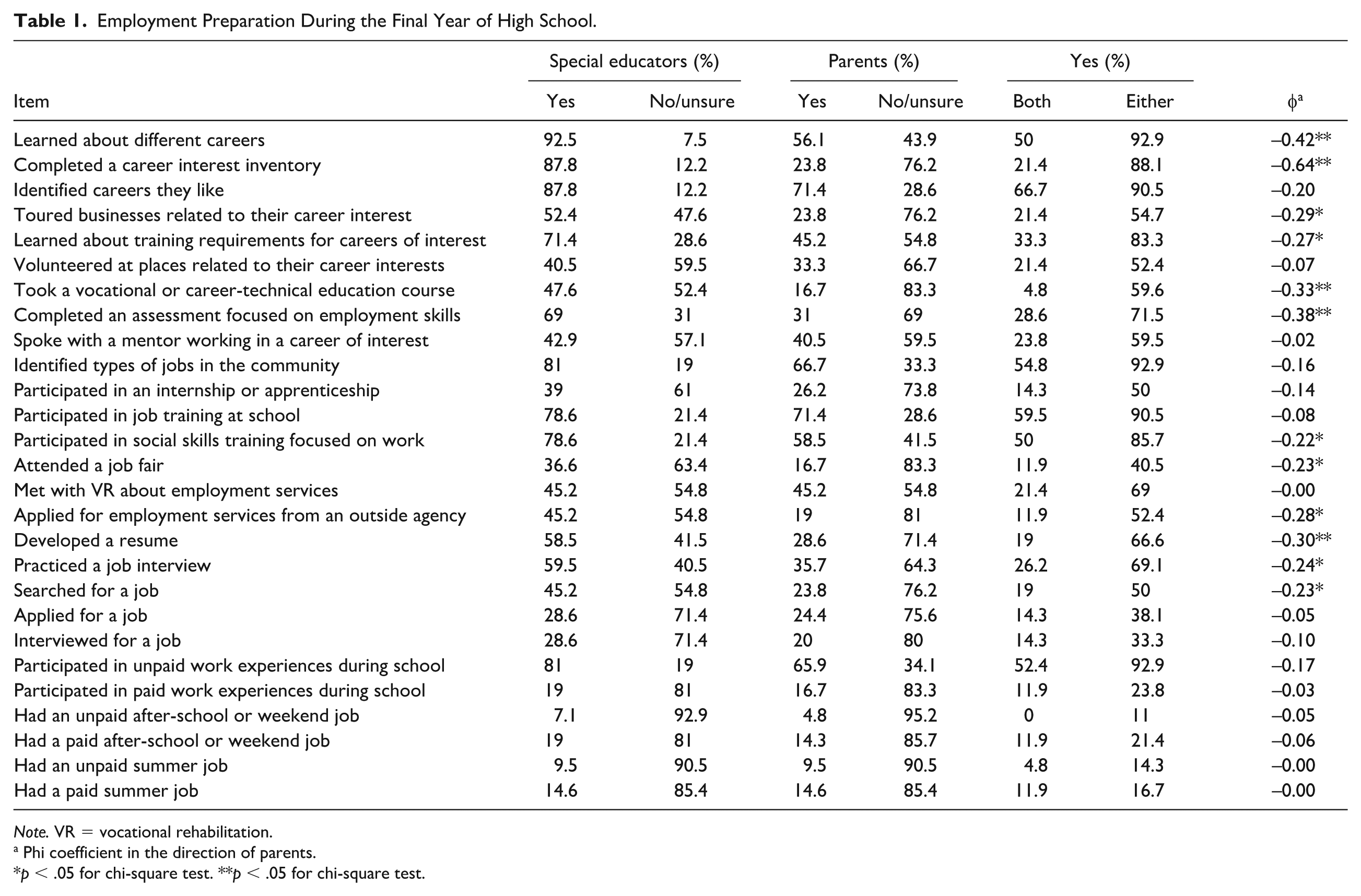
First, we asked parents and educators to indicate whether each student with extensive support needs had participated in each of the 30 provided career-development activities at any time during high school. Examples included learned about different careers, completed a career interest inventory, and attended a job fair (see Table 1). Response options included yes, no, and I don’t know or remember. These items were drawn from prior studies describing common career-development activities (e.g., Awsumb et al., 2020; Carter et al., 2010). Cronbach’s alpha for this section was 0.90, indicating high internal consistency.
Employment Preparation During the Final Year of High School.
Note. VR = vocational rehabilitation.
Phi coefficient in the direction of parents.
p < .05 for chi-square test. **p < .05 for chi-square test.
Employment Skills
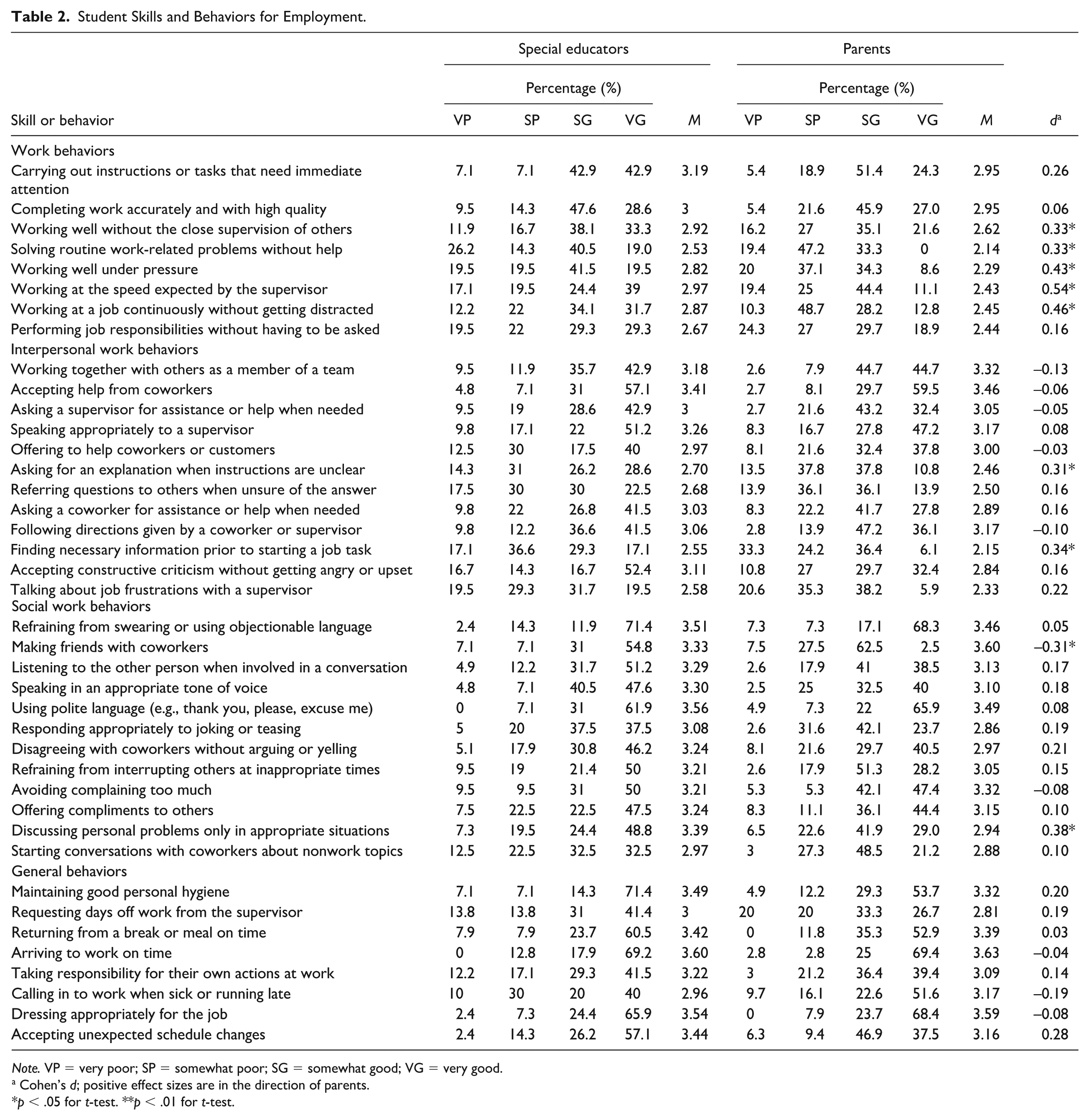
Next, we asked parents and educators to evaluate the employment skills of each student with extensive support needs. We presented a list of 40 validated skills divided into four domains: (a) work performance behaviors, (b) interpersonal work behaviors, (c) social-related work behaviors, and (d) general work behaviors (see Table 2). Work performance behaviors (n = 8) included nonsocial behaviors related to employee productivity (e.g., working well under pressure). Interpersonal work behaviors (n = 12) included interactive behaviors directly related to the performance of job tasks (e.g., working together with others as a member of a team). Social-related work behaviors (n = 12) were ones that contribute to increased social integration and acceptance (e.g., speaking in an appropriate tone of voice). General work behaviors (n = 8) had relevance across a wide variety of entry-level employment positions (e.g., arriving to work on time). Each item was rated using a 4-point, Likert-type scale (i.e., 1 = very poor, 2 = somewhat poor, 3 = somewhat good, 4 = very good) based on how well the parent or educator thought the student would perform each skill in a paid job in the community. These items were adapted from an employer-validated instrument utilized in Carter and Wehby (2003). Cronbach’s alpha for this section was 0.96, indicating high internal consistency.
Student Skills and Behaviors for Employment.
Note. VP = very poor; SP = somewhat poor; SG = somewhat good; VG = very good.
Cohen’s d; positive effect sizes are in the direction of parents.
p < .05 for t-test. **p < .01 for t-test.
Employment Barriers
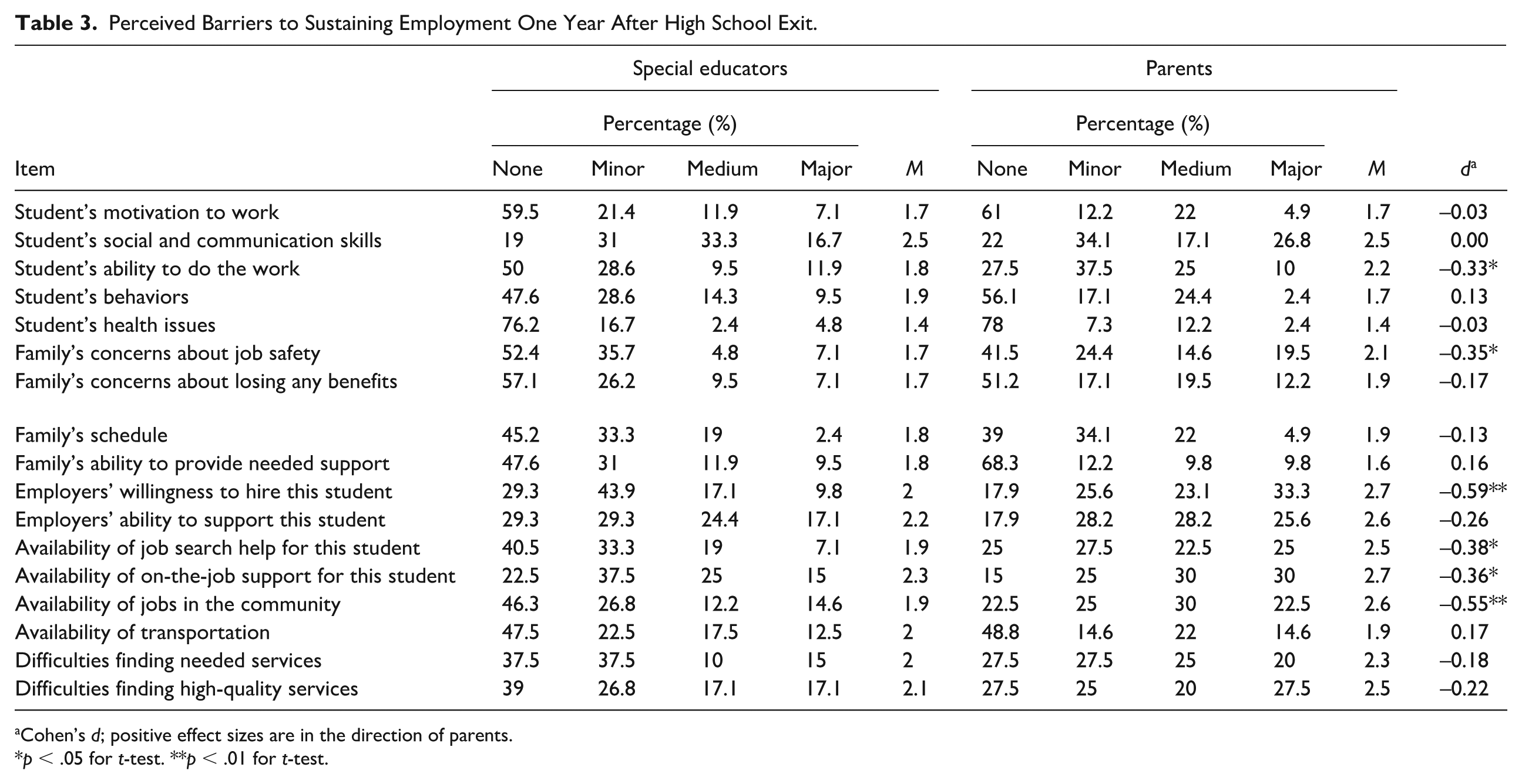
Finally, we asked parents and educators to evaluate potential employment barriers for each student with extensive support needs. We presented a list of 17 hypothetical barriers to paid employment in the first year after leaving high school. Examples included the student’s motivation to work, the family’s concerns about job safety, employers’ ability to support the student, and the availability of transportation (see Table 3). Each barrier was rated using a 4-point, Likert-type scale (1 = not an issue, 2 = minor issue, 3 = medium issue, and 4 = major issue). Finally, respondents could list any other potential barriers to the student working. These 17 items were selected due to their applicability to this study population and frequency in prior literature describing employment barriers (e.g., Awsumb et al., 2022; Blustein et al., 2016). Cronbach’s alpha for this section was 0.93, indicating high internal consistency.
Perceived Barriers to Sustaining Employment One Year After High School Exit.
Cohen’s d; positive effect sizes are in the direction of parents.
p < .05 for t-test. **p < .01 for t-test.
Data Analysis
We used descriptive statistics to summarize parent and educator responses by item for each measure. We used chi-square analyses to compare parent and educator reports of whether students engaged in each career-development activity (RQ1). We calculated effect sizes using phi (φ). As described in the Carter et al. (2021) study, a paired samples t-test was used to compare parent and educator ratings of students’ employment skills (RQ2). We calculated Cohen’s d to estimate the effect size, whereby .20 is considered a small effect, .50 a moderate effect, and .80 a large effect (Cohen, 1988). We also used a paired samples t-test to compare parent and educator ratings of potential barriers to paid work (RQ3).
Results
RQ1: How Do Parents and Educators Describe Students’ Prior Employment Preparation?
Students with extensive support needs were described as having participated in a variety of career-related experiences during high school. As shown in Table 1 (see Either column), the most common experiences involved learning about different careers (92.9%), identifying types of jobs in the community (92.9%), participating in unpaid job experiences in the community (92.9%), participating in job training at school (90.5%), identifying careers they liked (90.5%), and completing an interest inventory (88.1%). The least common experiences involved having a paid after-school or weekend job (21.4%), having a paid summer job (16.7%), having an unpaid summer job (14.3%), and having an unpaid after-school or weekend job (11%).
Educators and parents varied in their reporting of whether their shared student with extensive support needs had participated in employment preparation (see Table 1). Specifically, parents were significantly less likely than educators to report that sample students completed a career interest inventory, χ2(1, N = 83) = 34.39, p < .001, φ = −0.64; learned about different careers, χ2(1, N = 81)= 13.97, p < .001, φ = −0.42; completed an assessment focused on employment skills, χ2(1, N = 84) = 12.19, p < .001, φ = −0.38; took a vocational or career-technical education course, χ2(1, N = 84) = 9.22, p = .002, φ = −0.33; developed a resume, χ2(1, N = 83) = 7.59, p = .006, φ = −0.30; toured businesses related to their career interest, χ2(1, N = 84) = 7.27, p = .007, φ = −0.29; applied for employment services from an outside agency, χ2(1, N = 84) = 6.60, p = .01, φ = −0.28; learned about training requirements for careers of interest, χ2(1, N = 84) = 5.93, p = .02, φ = −0.27; practiced for a job interview, χ2(1, N = 84) = 4.77, p = .03, φ = −0.24; searched for a job, χ2(1, N = 84) = 4.27, p = .04, φ = −0.23; attended a job fair, χ2(1, N = 83) = 4.23, p < .04, φ = −0.23; or participated in social skills training focused on work, χ2(1, N = 83) = 3.87, p = .049, φ = −0.22.
RQ2: How Do Parents and Educators Describe These Students’ Employment Skills?
According to parents, overall employment skill ratings averaged 3 (SD = 0.9) across the 40 items. From highest to lowest, the average ratings by scale were 3.3 (SD = 0.8) for general behaviors, 3.2 (SD = 0.8) for social work behaviors, 2.9 (SD = 0.9) for interpersonal work behaviors, and 2.5 (SD = 0.9) for work behaviors. The highest-rated items were arriving to work on time, making friends with coworkers, dressing appropriately for the job, using polite language (e.g., thank you, please, excuse me), and accepting help from coworkers. The lowest-rated items were working at the speed expected by the supervisor, talking about job frustrations with a supervisor, working well under pressure, finding necessary information prior to starting a job task, and solving routine work-related problems without help.
According to special educators, overall employment skills ratings averaged 3.1 (SD = 1) across the 40 items. From highest to lowest, the average ratings by scale were 3.3 (SD = 0.9) for general behaviors, 3.3 (SD = 0.9) for social work behaviors, 3.0 (SD = 1) for interpersonal work behaviors, and 2.9 (SD = 1) for work behaviors. The highest-rated items were arriving to work on time, using polite language (e.g., thank you, please, excuse me), dressing appropriately for the job, refraining from swearing or using objectionable language, and maintaining good personal hygiene. The lowest-rated items were referring questions to others when unsure of the answer, performing job responsibilities without having to be asked, talking about job frustrations with a supervisor, finding necessary information prior to starting a job task, and solving routine work-related problems without help.
Educators and parents sometimes diverged in their ratings of students’ employment skills (see Table 2). Specifically, the ratings of educators were significantly higher on the following eight items: working at the speed expected by the supervisor, t(34) = 3.18, p = .002, d = 0.54; working at a job continuously without getting distracted, t(37) = 2.82, p = .004, d = 0.46; working well under pressure, t(33) = 2.50, p = .009, d = 0.43; discussing personal problems only in appropriate situations, t(30) = 2.13, p = .02, d = 0.38; finding necessary information prior to starting a job task, t(32) = 1.98, p = .03, d = 0.34; working well without the close supervision of others, t(36) = 1.99, p = .03, d = 0.33; solving routine work-related problems without help, t(35) = 1.98, p = .03, d = 0.33; and asking for an explanation when instructions are unclear, t(36) = 1.86, p = .04, d = 0.31. Parent ratings were significantly higher in just one area: making friends with coworkers, t(39) = −1.98, p = .03, d = −0.31.
RQ3: How Do Parents and Educators View Potential Barriers Post-Graduation Employment?
Across barriers, parents considered an average of 15.6 (SD = 5.3) items to be a medium or major barrier to paid employment in the community (see Table 3). The most prominent barriers were employers’ willingness to hire this student, availability of on-the-job support for this student, employers’ ability to support this student, availability of jobs in the community, and student’s social and communication skills. The least prominent barriers were availability of transportation, student’s behaviors, student’s motivation to work, family’s ability to provide needed support, and student’s health issues. Special educators reported an average of 10.8 (SD = 4.4) items to be a medium or major barrier to paid employment in the community. The most prominent barriers were student’s social and communication skills, availability of on-the-job support for this student, employers’ ability to support this student, difficulties finding high-quality services, and employers’ willingness to hire this student. The least prominent barriers were family’s schedule, family’s concerns about losing any benefits, student’s motivation to work, family’s concerns about job safety, and student’s health issues.
Educators and parents sometimes diverged in their ratings of employment barriers (see Table 3). Specifically, parent ratings were significantly higher for six items. In other words, significantly more parents than educators rated the following to be barriers: employers’ willingness to hire the student, t(37) = −1.61, p < .001, d = −0.59; availability of jobs in the community, t(38) = −3.41, p < .001, d = −0.55; availability of job search help for the student, t(39) = −2.43, p = .01, d = −0.38; availability of on-the-job supports, t(37) = −2.20, p = .02, d = −0.36; the family’s concerns about job safety, t(40) = −2.24, p = .02, d = −0.35; and the student’s ability to do the work, t(39) = −2.12, p = .02, d = −0.33.
Discussion
The purpose of this study was to examine the perspectives of 42 parents and educators on work-related preparation, skills, behaviors, and barriers to employment for their shared students with extensive support needs. We sought to understand (a) their views on the employment preparation of these students with extensive support needs who they supported in their final year of high school, (b) their description of these students’ work behaviors, and (c) potential barriers they report to students sustaining employment following high school. Our findings strengthen the extant data on employment preparation for students with extensive support needs in three ways.
First, it is apparent that parents may need increased support to serve as an integral part of the employment preparation process for students with extensive support needs. Our findings suggest parents are not always aware of or involved in the kinds of preparation and skill-building in which students are engaged toward their employment goals or the experiences they are being provided in school (e.g., learning about different careers, developing a resume, applying for employment services, attending a job fair). Furthermore, parents may not have a chance to view these skills through work-related experiences (Awsumb et al., 2022). Thus, educators should provide parents with regular updates on the development of their student’s employment skills during progress reporting, IEP meetings, and/or via videos showcasing their student’s employment skills. Increased awareness and opportunities to view their students engaging in work-related experiences could empower parents to (a) increase expectations and confidence in their students’ skills and abilities as well as (b) support them in reaching their future goals through activities at home (Awsumb et al., 2022; Blustein et al., 2016). Nonetheless, educators and other school providers need to provide parents with explicit opportunities to participate in these ways.
Second, hands-on community-based work experiences are critical to employment preparation (Rooney-Kron & Dymond, 2023; Schutz & Carter, 2022) but not necessarily provided within the final year of high school for many students with extensive support needs. Most of the students in this study were not participating in many work-related experiences prior to the intervention. Almost 75% of students participated in an unpaid work experience, but more than 75% did not have an opportunity to participate in these opportunities in the community whether paid or unpaid. In addition, less than 40% had volunteered in a place related to their career of interest. Collectively, these metrics of preparation contrast with nearly 75% of students having desired jobs in the community. If students were to participate in hands-on work experiences in the community, their skills and behaviors for employment may have been positively impacted (Gilson et al., 2017; Rooney-Kron & Dymond, 2023; Schutz & Carter, 2022). In fact, parents and educators rated students’ work behaviors lower than other behaviors, but if students have never worked, how could their work behaviors be highly rated? When students with extensive support needs are provided with early work experiences, such generally falls upon educators to provide opportunities in school, during the school day. Finally, students tend to receive preparation that aligns with transition plan requirements (e.g., transition assessment). Yet, less emphasis may be placed on actual work experiences for students with extensive support needs (Carter et al., 2010, 2021; Rooney-Kron & Dymond, 2022), limiting their engagement with opportunities outside of school or with paid work experiences.
Third, an array of barriers to employment persists that still require attention (Awsumb et al., 2022; Brenner & Dymond, 2023; Schutz et al., 2023, 2025). Of note, many of the more commonly discussed barriers related to student or parent concerns (i.e., motivation to work, social and communication skills, ability to do the work, challenging behaviors, family concerns about job safety or losing benefits, availability of transportation) were considered minimal or not a barrier in this study. That few barriers were reported by multiple participants as a medium or major issue is encouraging because it suggests that parents and educators believe early paid work is possible. However, parents were more likely than educators to perceive employer willingness to hire, availability of job search help, availability of jobs in the community, on-the-job supports, and concerns about job safety to be barriers. One potential reason could be due to their limited knowledge of services and connections to employers and providers (Awsumb et al., 2022; Blustein et al., 2016). In concert with our other data, this finding emphasizes the importance of parental involvement, transition teams with aligned expectations, and students having opportunities to practice employment skills in the community. These variables may shift perceptions of these barriers as parents become more aware of types of work preparation available and see their students engaging in early work-related experiences.
Limitations and Implications for Future Research
Several limitations of this study provide opportunities for three areas of future research. First, student perspectives about their own preparation are absent from this study. Although we collected data on students’ satisfaction within a job (e.g., the workplace, pay rate, coworkers), we did not ask about how their time in school helped them develop skills for employment. Adding student voice to address research questions related to their preparation could help to shed light on discrepancies between parent and educator views. Thus, future studies should focus on employing inclusive research approaches that elevate students’ voices about their own employment-related experiences.
Second, our data relied solely on the quantitative survey responses of parents and educators regarding student preparation and hypothetical skills and barriers in a workplace. We are limited in what we can confirm about students’ actual preparation, particularly in light of the discrepancies in parent and educator reporting. This limitation highlights the opportunity for future research to include triangulation of IEP documentation with other sources as well as alternative ways to document transition services that move beyond a focus on compliance and are written in plain language. Future research might also focus on the assistance that educators and other transition team members need to provide services in the community rather than relying solely on in-school experiences (Brenner & Dymond, 2023). Finally, future research could provide opportunities for parents to better understand work-related activities. Parental involvement in work-related activities could attend to ways of showing parents their student engaging in work-related activities to raise awareness, expectations, and support for adulthood employment.
Third, understanding the employment-related profiles (i.e., preparation, skills, perceived barriers, supports, connections to outside agencies and jobs) of students with extensive support needs during their final year of school is perhaps too late to shift their pathways. More detail from earlier timepoints is needed to connect students to work as well as sustain and grow in their employment. Students need (a) time to develop skills, (b) opportunities to maintain and generalize such with feedback for improvement, and (c) time to try employment to discover what they excel at and enjoy. In addition, students’ supports need time to collaboratively prepare students and plan for logistics around employment (e.g., job coaches, natural supports, transportation). Future research must engage in multi-year cohorts beginning prior to the student’s final year to prepare and support students and their families for long-term success.
Implications for Practice
This study’s findings have three main implications for supporting students with extensive support needs as they prepare for and engage in work. First, engaging students in the preparation for and connection to employment during their last year of high school is likely not adequate for this population. Students must incrementally increase their employment skills throughout their time in high school (Schutz et al., 2023) with opportunities to apply, maintain, and generalize the skills they are learning through hands-on experiences and in multiple settings throughout their time in high school. Providing students these experiences during high school is important, but most students are not afforded the opportunities to participate in hands-on work experiences (Carter et al., 2010, 2021; Rooney-Kron & Dymond, 2022), and when they are, such opportunities are happening late in their high school career. Thus, school-based transition teams should aim to begin meaningful employment preparation as early as possible.
Second, relying on the IEP transition plan as the only mechanism for employment-related services may fall short of elevating employment outcomes for this population of students. Although this plan is a good place to start for documenting and ensuring goals are in place, it is also very technical, filled with school-specific lingo, and over-focused on compliance, rather than the meaningful skills, knowledge, or self-determination necessary for post-school success (Burke et al., 2024). Translating the transition plan to practice should include focusing on plain language and tangible services needed to feasibly meet the employment goals of students. While the IEP meeting is one place to touch on employment, engaging in a person-centered employment planning meeting provides a space to focus solely on a student’s employment needs and may lead to more meaningful employment planning and connections (Awsumb et al., 2024; Schutz et al., 2025).
Third, it is essential that educators facilitate parental involvement and knowledge throughout the process. Educators may need support to learn how to engage collaboratively with families in communicating about topics to help support their students with extensive support needs to reach their employment goals, such as the importance of preparing for and working as well as available supports and services for such (Schutz et al., 2025). In addition, families may need to receive information in multiple formats, through multiple avenues, and in alignment with their preferences for communication to feel like their opinions and knowledge are valued. Finally, families are often concerned about their students entering welcoming employment settings with coworkers and managers that value them (Awsumb et al., 2022; Blustein et al., 2016). Thus, families could benefit from explicit opportunities to engage with success stories of students with extensive support needs working to envision their own student in work experiences as well as to connect directly with outside agency supports and employers (Schutz et al., 2023).
Conclusion
Opportunities to engage in paid work during high school are essential for students with extensive support needs to achieve their future employment goals. It is important that these students are prepared for and provided with access to these experiences prior to leaving high school. However, according to their parents and educators, the work-related experiences in which students participated did not often include hands-on work experiences, in the community, or that were paid. Furthermore, parents were not always aware of the services and experiences in which their students were participating. The findings of this study promote that transition stakeholders continue to grow their collaborations around work and prepare students with extensive support needs to participate in early paid work experiences while in high school.
Footnotes
Declaration of Conflicting Interests
The authors declared no potential conflicts of interest with respect to the research, authorship, and/or publication of this article.
Funding
The authors disclosed receipt of the following financial support for the research, authorship, and/or publication of this article: The work reported in this article was support by grant funding from the National Institute on Disability, Independent Living, and Rehabilitation Research-Rehabilitation Research and Training Center (RRTC) on Employment of Transition-Age Youth with Disabilities (HHS-20190ACL-NIDILRR-RTEM-0339.

Editor-in-Charge: Fred Spooner