



Abstract
A transition-aged youth with an individualized education program has the right to free, appropriate public education that includes postsecondary transition planning and services. The documented transition supports need to meet both procedural and substantive requirements. While many court cases have included transition components, few have been decided at the appellate court level. In Gibson v. Forest Hills (2016), Chloe Gibson, a transition-aged youth with intellectual and developmental disabilities, was provided inadequate postsecondary transition planning and services. According to the U.S. Court of Appeals for the Sixth Circuit, Chole’s right to a free, appropriate public education was violated due to procedural errors related to inviting her to individualized education program (IEP) meetings, conducting age-appropriate transition assessments, and including programming leading to supported competitive employment in a community setting. This decision supports the federal requirements of including a transition-aged student’s strengths, interests, preferences, and needs when planning their life after high school.
Keywords
Students with qualifying disabilities who receive special education services are entitled to an individualized education program (IEP) that acts as a map for their annual educational plan. These rights are grounded in the Individuals with Disabilities Education Improvement Act of 2004 (IDEA), whose purpose states that the education of children with disabilities “meet developmental goals and, to the maximum extent possible, the challenging expectations that have been established for all children; and be prepared to lead productive and independent adult lives, to the maximum extent possible” (20 U.S.C. § 1400(c)(5)(A)). When a youth becomes transition-aged, they have a right to postsecondary transition planning and services, which the IDEA describes as
A results-oriented process that is focused on improving the academic and functional achievement of the child with a disability to facilitate the child’s movement from school to post-school activities, including postsecondary education, vocational education, integrated employment (including supported employment), continuing and adult education, adult services, independent living, or community participation (§ 300.43(1)).
Types of IEP Postsecondary Transition Requirements
For transition-aged youth with IEPs, the IDEA includes procedural and substantive requirements for transition planning. These are in addition to general IEP requirements related to the process and plan that apply to students of all ages. In this section, I describe the procedural and substantive requirements in general and those specific to transition IEPs. Then, I will apply these requirements to a court case involving a young woman with multiple disabilities who required a higher level of supports related to postsecondary training, employment, and independent living.
Procedural Requirements—Postsecondary Transition
Yell et al. (2013) described five procedural errors in the IEP process: (a) not including students’ parents in the IEP process, (b) predetermining a student’s IEP services or placement, (c) determining placement before programming, (d) not fielding an appropriate IEP team, and (e) failing to implement the IEP as written. In addition to these general procedural requirements, the IDEA includes four specific requirements related to postsecondary transition: (a) statement of transition needs, (b) student invitation to an IEP meeting, (c) consent for additional attendees, (d) outside agency participation, and (e) summary of performance.
While a statement of needed transition services is a required content element for IEP, the IDEA does not specify format requirements. Some states have elected to include an individualized transition plan (ITP) as part of the IEP; however, other methods exist for meeting this requirement. The local education agency (LEA, that is, school district) must invite a youth with a disability to attend their IEP meeting if the purpose of the meeting is the consideration of the postsecondary goals and the transition services needed to assist the youth in reaching those goals. If the youth does not attend the IEP Team meeting, the public agency must take other steps to ensure their preferences and interests are considered. Finally, with the consent of the parent/legal guardian or a youth who has reached the age of majority, the public agency must invite a representative of any participating agency that is likely to be responsible for providing or paying for transition services after the youth exits high school (§ 300.321(b)).
For transition-aged youth, IEP meeting notifications to parent(s)/legal guardian(s) must include a statement of purpose: the meeting will include a discussion of the student’s postsecondary goals and transition services. Notification should also include that the LEA will invite the youth to the meeting and disclose any other agency that will be invited to send a representative (§ 300.321(b)). Outside agencies may provide vocational training, job coaching, finding employment, funding for job-related equipment, counseling, and assistance in independent living. Examples of these agencies include, but are not limited to, vocational rehabilitation, social services, the Social Security Administration, local ARC offices, and the state department of mental health.
Substantive Requirements—Postsecondary Transition
Yell et al. (2016) also described five substantive errors in the IEP process: (a) failing to conduct a complete and individualized assessment, (b) failing to address all a student’s needs in the present levels of academic achievement and functional performance (PLAAFP), (c) failing to write ambitious, measurable goals, (d) failing to provide comprehensive special education services, and (e) failing to monitor youth progress. In addition to these general substantive requirements, the IDEA includes four specific requirements related to postsecondary transition: (a) ages of transition provision, (b) annual review, (c) age-appropriate transition assessments, (d) measurable postsecondary goals, and (e) a course of study.
The IDEA delineates who is entitled to transition services and defines what those services are. Postsecondary transition components in the IEP must be present no later than when the youth turns 16 or younger if determined appropriate by the IEP team (§ 300.320(b)). Early transition planning and services can be based on individual needs (i.e., those whose disability requires a higher level of support or those at risk of dropping out of school). Beginning these services earlier than 16 can also be a state education agency (SEA) requirement. Over half of the U.S. states and territories begin postsecondary transition planning and services at younger ages (Suk et al., 2020). As with other parts of the IEP, transition planning and services must be updated annually until the youth exits special education services by aging out (also determined by state education departments) or graduating with a regular high school diploma.
Application of Postsecondary Transition Requirements for Chloe Gibson.
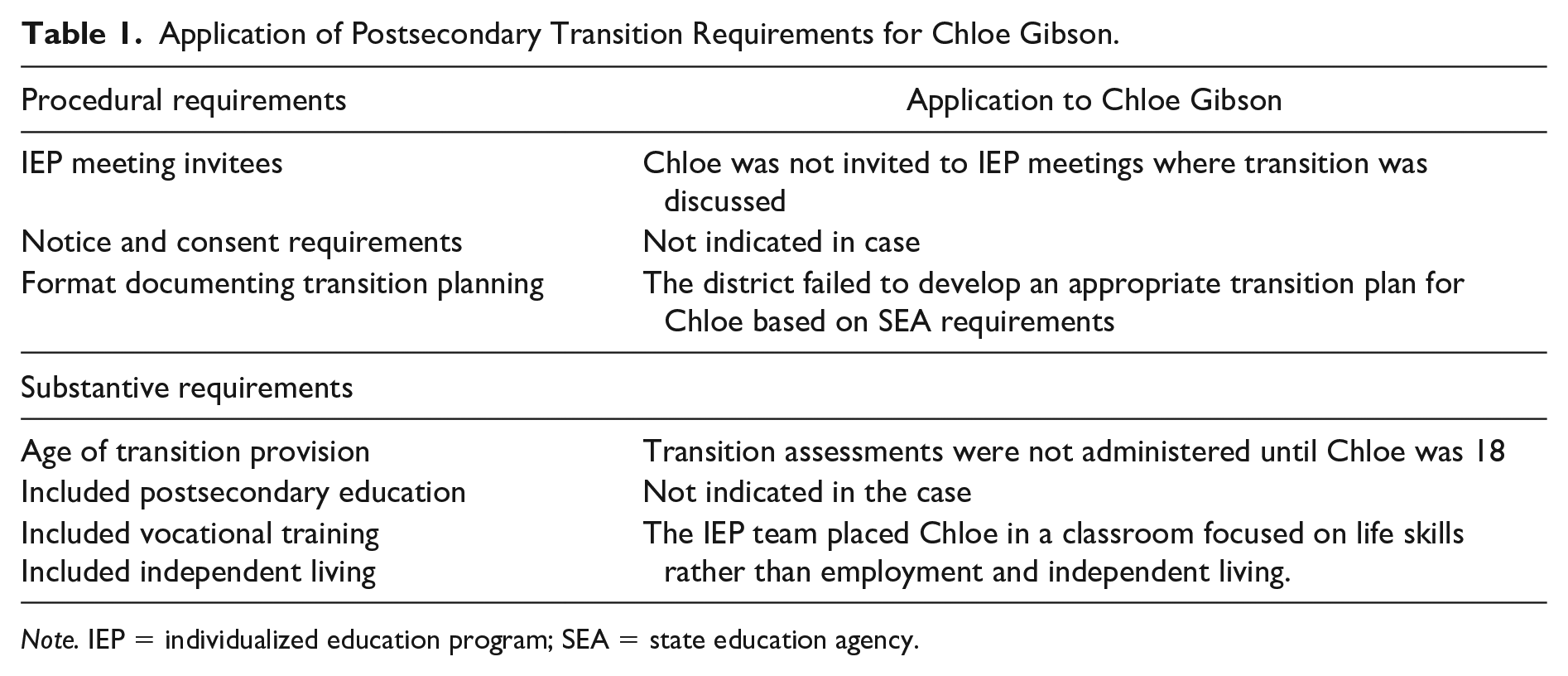
Note. IEP = individualized education program; SEA = state education agency.
The IEP must include appropriate measurable postsecondary goals based upon age-appropriate transition assessments related to training, education, employment, and, where appropriate, independent living skills; the transition services (including courses of study) needed to assist the child in reaching those goals (34 C.F.R. § 300.320(b)); and the transfer of rights at the age of majority (§300.320 [Transition services should focus on the child’s needs, including the child’s strengths, preferences, and interests]). Transition services include instruction, related services, community experiences, developing post-school objectives, acquiring daily living skills, and providing a functional vocational evaluation (§ 300.43(2)).
While many court cases have included transition components, few have been decided at the appellate court level. Jim Gibson, next friend of Chloe Gibson; Laurie Gibson, next friend of Chloe Gibson v. Forest Hills Local School District Board of Education (hereafter Gibson, 2016) is a strong example of the relationship between the IDEA’s procedural and substantive transition requirements, and how those requirements apply to students with disabilities who require a higher level of supports.
Gibson v. Forest Hills (2016)
Chloe Gibson was a young adult who had attended the Forest Hills Local School District since first grade. She had a developmental disability and a seizure disorder that impacted her cognitive, adaptive, and motor skills. She required higher academic, behavioral, and safety support at school. Chloe significantly improved in personal care, food preparation, and communication during elementary and middle school. Academically, Chloe could read at a third-grade level but struggled with counting and telling time. In adaptive skill areas, she could complete repetitive tasks and follow basic routines; however, her progress was inconsistent.
As Chloe transitioned from middle to high school, her parents frequently disagreed with the school district about appropriate special education programming for their child. There were two high school programs that the IEP team considered for Chloe’s high school placement. One was focused on life skills instruction, while the other was focused on competitive employment and independent living. While the school district prioritized personal safety in their decision-making, the Gibsons believed their child could participate in competitive employment. To this end, they asserted that Forest Hill’s promotion of a functional life skills curriculum would deprive their child of learning “basic employment skills” (Gibson, 2016, p. 4). When Chloe was placed in the life skills program against her parents’ wishes, their relationship with Forest Hills “deteriorated rapidly.”
While Chloe progressed in behavior, communication, motor, and reading skills in the life skills programs, she struggled in personal care and problem-solving. She remained dependent on others for prompting and safety. Her parents continued participating in lengthy IEP meetings and focused on the lack of IEP goals related to employment training. Forest Hills insisted that Chloe was better suited for a nonvocational adult program, while her parents requested a transition program focused on access to the workplace. The Gibsons exercised their IDEA due process rights by sending a written request for a hearing to the Ohio Department of Education. The Gibsons asserted that Forest Hills had failed to meet over 20 IDEA obligations, including inadequate vocational assessment, transition plan, and reading and math goals.
Independent Hearing Officer
In Ohio, the first person to hear a due process complaint is an independent hearing officer (IHO). While the hearing with the IHO hearing was pending, Forest Hills and the Gibsons agreed that Goodwill Industries would conduct and vocational assessment of Chloe’s employment skills in three settings: a department store, restaurant, and grocery store. As Chloe unpacked boxes, bussed tables, and collected shopping carts in a parking lot, she demonstrated a positive attitude, followed routines, and responded to prompts. However, “she also required constant supervision, took a long time to complete basic tasks, and lacked awareness of safety” (Gibson, 2016, p. 4). Chloe’s hearing with the IHO lasted 26 days. The IHO concluded that Forest Hills had denied her a free appropriate public education (FAPE) due to inadequate reading and math goals and awarded her 480 hours of compensatory education in these areas. However, the IHO deemed the transition plan sufficient for Chloe, agreeing with the school district that Chloe could not live independently.
State-Level Review Officer
The Gibsons appealed to the Ohio Department of Education, which appointed a state-level review officer (SLRO) to review the IHO hearing record. At this stage, the Gibsons challenged the IHO’s decision in six ways, including the lack of age-appropriate transition assessments and services and their entitlement to attorney fees. Forest Hills declined to appeal the IHO’s decision but challenged the IHO’s judgment that they failed to provide adequate reading and math goals and services in the IEP. The SLRO concluded that the transition planning and services were adequate “in light of the severity of Chloe’s disability” (Gibson, 2016, p. 5) but upheld the order requiring compensatory math and reading instruction.
United States District Court, Southern District of Ohio
Both the family and the school district appealed the SLRO’s decision. The District Court ruled that, in most respects, the school district had provided Chloe with an adequate education. However, their lack of provision for three of the IDEA’s transition-related procedural requirements resulted in a denial of FAPE. Not only did the school district not invite Chloe to IEP meetings where her postsecondary transition was discussed, but they failed also to take other steps to consider her transition-related interests and preferences. Before the Goodwill Industries vocational assessment when Chloe was 19, the school district only provided informal transition assessments.
As a result, the court ordered the school district to provide Chloe with 425 hours of transition-related services. While the Gibsons requested $800,315 in attorney fees as the prevailing party, the court ultimately awarded US$272,359. Both parties appealed this ruling. For the school district’s part, Forest Hills appealed the decision that they provide additional transition services. The parents appealed to the higher court for insufficient attorney’s fees.
U.S. Court of Appeals for the Sixth Circuit
When an appeal moves from one court to another higher court, the higher court must accept the lower court’s findings of fact unless they are “clearly erroneous.” This means that the Court of Appeals was obligated to examine the decision of the lower District Court related to the school district’s procedural violations of the IDEA. Regarding the ruling that Chloe was not invited to her IEP meetings where the postsecondary transition was discussed, both parties agreed that the school district failed to notify the parents that Chloe could attend the meeting if she wanted. The Court of Appeals upheld the District Court’s decision that Forest Hills violated this procedural requirement of the IDEA.
The second procedural requirement was the school district’s failure to take meaningful action to ensure that Chloe’s transition-related preferences and interests were considered during the IEP meeting. According to the three-judge panel,
ignoring a student’s transition-related preferences not only demeans the individual whose future is likely to be shaped by transition planning but also reduces the likelihood that an IEP Team will design an optimal transition program for a child with a disability. (Gibson, 2016, p. 11)
From 2008 to 2010, four attempts by the school district related to preferences and interests were documented in the court record: (a) a psychologist compiled a list of preferred activities by interviewing the parents and observing Chloe in her school classroom, (b) a work-study coordinator provided an informal interest assessment using picture cards depicting various activities, (c) a social worker set down with Chloe to ask her questions about activities she liked and disliked, and (d) a transition specialist observed Chloe performing various jobs. The Court of Appeals agreed with the District Court’s ruling that these steps were insufficient, especially considering the few job-related activities.
During this hearing, the Appellate Court noted key findings from the District Court that supported their decision. For instance, Chloe engaged in the same work activities in the classroom for years; the school district’s special education coordinator admitted that they could have taken her to shadow different jobs, and her special education teacher admitted she could have better prepared her to attend IEP meetings. Ultimately, the U.S. Court of Appeals for the Sixth Circuit ruled that the Forest Hills school district failed to comply with the three procedural requirements. However, multiple procedural errors do not equal a substantive violation. According to the court record, “substantive harm occurs when a procedural violation seriously infringes upon a party’s participation in the IEP process, or when a defect in an IEP ‘result[s] in the loss of educational opportunity’” (Knable, 238 F.3d at 766 in Gibson, p. 14). Based on the evidence provided by some of the IEP team members, a school psychologist, and Chloe’s mother, the judges were unsure that Chloe could have attended her IEP meetings, even if she had been invited.
The second and third errors, a lost opportunity to develop Chloe’s potential for supported employment in a community setting and failure to consider transition preferences or conduct age-appropriate transition assessments, amounted to substantive harm and denial of FAPE. While the Appellate Court acknowledges Chloe’s academic growth, behavior, motor skills, and speech during high school, they also believed an employment-focused transition plan would have allowed her to be more independent in her adult life. The Appellate Court’s ruling also increased attorney’s fees to $300,000.
Discussion
While this case represents one student, the ruling has potential implications for many students with disabilities. This case was decided in the U.S. Court of Appeals for the Sixth Circuit, which includes Kentucky, Michigan, Ohio, and Tennessee. According to the most recent data from the U.S. Department of Education, Open Data Platform (2022), these states educate 645,703 students with IEPs. This means that this decision will influence future legal decisions related to the postsecondary transition requirements of the IDEA.
FAPE Standards
In the Appellate Court’s decision, the three-judge panel used the two-part standard to determine FAPE as outlined in the Board of Education of the Hendrick Hudson School District v. Rowley (1982; hereafter Rowley). Rowley was a significant court case because it was the first one the Supreme Court of the United States (SCOTUS) tried following the full implementation of the Education for All Handicapped Children Act of 1975. (This act was renamed the Individuals with Disabilities Education Act in 1990.) This Rowley standard for determining FAPE included the following questions (Prince et al., 2018):
Was the student’s IEP developed according to the procedural requirements of the law?
Was the IEP reasonably calculated to provide educational benefit?
These two questions covered the procedural and substantive aspects of IEP development and imple-mentation.
It should be noted that this standard was updated in 2017 when SCOTUS decided Endrew F., a Minor, by and Through His Parents and Next Friends, Joseph F. et al. v. Douglas County School District RE–1 (hereafter Endrew). Thirty-five years after the initial FAPE standard was developed, the second part of the Rowley test was amended. Specifically, the substantive question became: Did the school district develop an IEP that was “reasonably calculated to enable the child to make progress appropriate in light of his circumstances?” (Endrew, 2017, pp. 15–16). While the Gibson case was decided using the Rowley test, future special education cases, including those that include postsecondary transition, will be decided considering the Endrew standard.
Implications for IEP Teams
The postsecondary transition requirements in the IDEA 2004 are not based on a student’s level of supports. This means that students who require higher levels of academic and functional support are entitled to the same involvement in their IEP meetings. In this case, the district defended its decision not to invite Chloe to IEP meetings where the postsecondary transition was discussed because they deemed the meetings long and contentious. Yet, the special education teacher admitted that she could have done more to prepare Chloe for these meetings.
Another error was that the IEP team failed to conduct age-appropriate transition assessments or to adequately consider Chloe’s strengths, interests, and preferences. One set of tools to consider a transition-aged youth’s preferences is the Preference Indicators from the Zarrow Center on Transition and Self-Determination (2021). The Preference Indicators were developed specifically for students requiring higher support levels that other transition assessments may not address. For instance, the Personal Preference Indicator (Moss, 2006) allows an individual, family member, or caregiver to indicate a youth’s favorites, feelings, socialization, self-determination, physical indicators, health indicators, and family/community involvement. The Employment Support Indicators planning tool (Moss, 2008) includes questions related to the employment domains of social supports, work setting, and work style supports.
Carter and colleagues (2015) used the Assessment Scale for Positive Character Traits–Developmental Disabilities (Woodard, 2009) to have parents rate their child’s strengths across 10 domains: courage, empathy, forgiveness, gratitude, humor, kindness, optimism, resilience, self-control, and self-efficacy. The 427 participants had transition-aged children with an intellectual disability or autism. All the participants were able to identify at least one strength of their child, with the highest number of ratings appearing on the two positive outlook factors (“I think my child is happy” or “My child seems to enjoy life and is thankful for life’s simple pleasures”).
The school district also failed to prepare Chloe for supported, integrated, competitive employment, focusing instead on life skills attainment. Shogren and colleagues (2018) recommended implementing the Self-Determined Learning Model of Instruction (Wehmeyer et al., 2000) or the Whose Future Is It? curriculum (Wehmeyer & Palmer, 2011) to increase self-determination among transition-aged youth who required a higher level of supports and desired to be in competitive employment settings. Using these curricula, the researchers found that youth self-determination and teacher perception of goal achievement improved.
Conclusion
A transition-aged youth with an IEP has the right to postsecondary transition planning and services that prepare them for postsecondary education/training, employment, and adult living after high school. Youth who require a higher level of education and life supports remain entitled to considerations for supported employment in a competitive setting. While the IEP team makes decisions for educational programming and placement, care should be given to comply with the procedural and substantive requirements of the IDEA regarding postsecondary transition planning requirements. A youth who requires a higher level of supports should be invited to their IEP meeting where postsecondary transition is being discussed, should be evaluated using multiple age-appropriate transition assessments, and should have access to employment-related programming while in high school. While the Gibson (2016) ruling is limited in its scope for legal applications, it may have implications for students in other areas of the United States.
Footnotes
Acknowledgements
This paper is dedicated to my older brother, Aaron L. Tuttle. Your brief life encouraged me to live mine to the fullest. Rest in peace.
Editor-in-Charge: Fred Spooner
Declaration of Conflicting Interests
The author(s) declared no potential conflicts of interest with respect to the research, authorship, and/or publication of this article.
Funding
The author(s) received no financial support for the research, authorship, and/or publication of this article.
