



Abstract
This case report describes the role of occupational therapy (OT) in the recovery of a 33-year-old woman after an abdominal myomectomy due to a large uterine fibroid (a common benign tumor of the uterine muscle). At discharge, her needs to perform daily activities and limitations were identified. Occupational performance was assessed using the Canadian Occupational Performance Measure (COPM) and an occupational profile. She received home-based OT twice weekly for 3 weeks, targeting daily activities, mobility, and pain management. Improvements were observed in COPM scores: functional mobility (performance: from 3 to 9; satisfaction: from 4 to 9) and personal hygiene (performance: from 3 to 8; satisfaction: from 4 to 8). She achieved independence in dressing, bathing, and grooming. This case suggests OT is an essential part of post-myomectomy care. Although based on a single case, the findings highlight the importance of multidisciplinary rehabilitation and the integration of OT in gynecological recovery.
Plain Language Summary
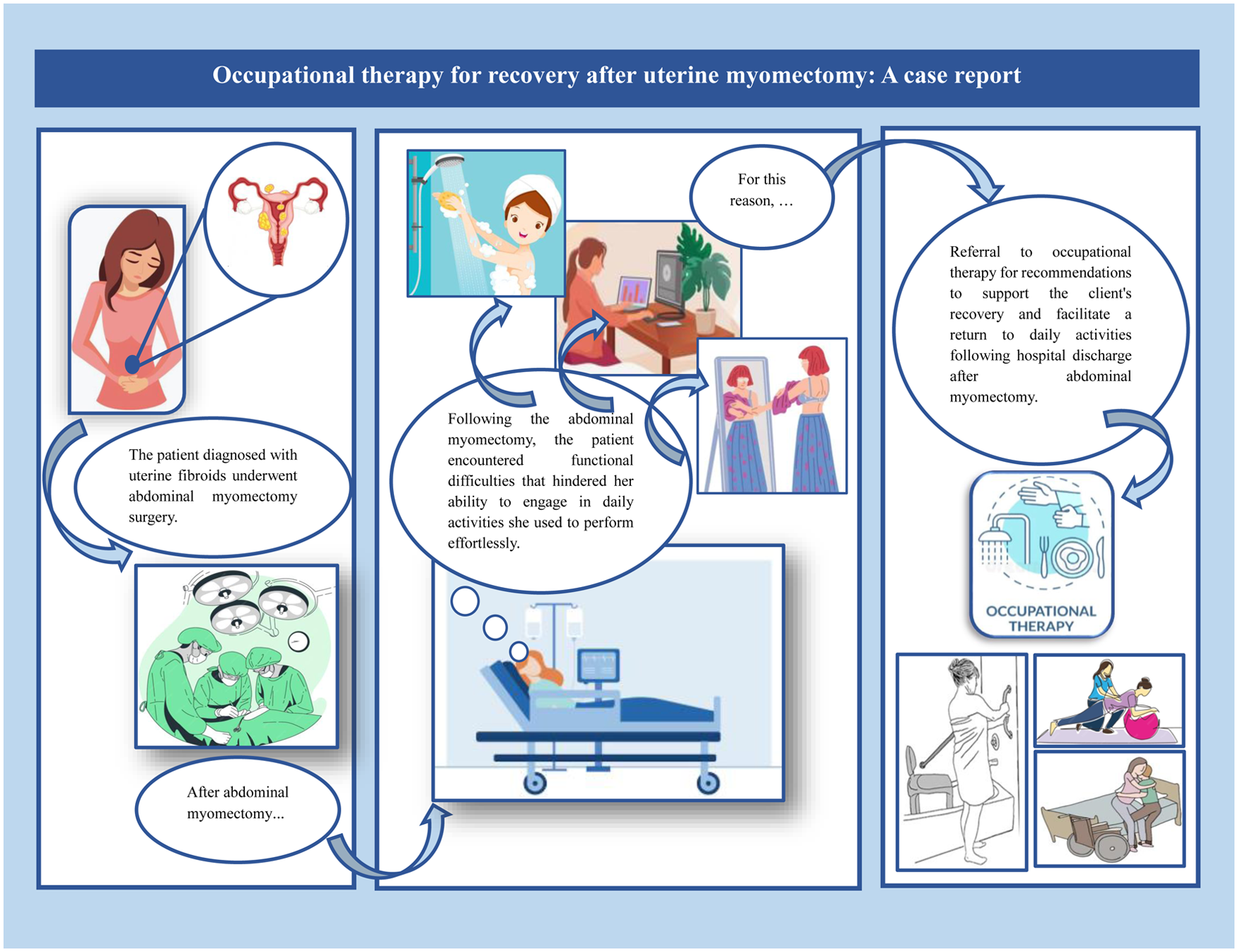
Women face significant challenges in accessing appropriate health care, support for a healthy lifestyle, and services tailored to their specific needs, all of which can be considered complex issues. Addressing these multifaceted problems requires an innovative, multidisciplinary approach. This case report aims to explore the role of occupational therapy within the gynecologic team and to understand the frameworks and processes that facilitate this collaboration after abdominal myomectomy for return to daily activities. A 33-year-old healthy woman presented with a 6-month history of gradual abdominal distension and discomfort. She reported changes in bowel habits and genitourinary symptoms, including constipation and urinary frequency. On examination, a firm, irregular, mobile pelvic mass resembling a 20-week pregnancy was noted. Laboratory tests excluded pregnancy, and transabdominal ultrasonography revealed a pedunculated subserosal fibroid measuring 112 mm × 164 mm, leading to abdominal myomectomy. The patient was discharged the day after surgery and was scheduled for a 6-month follow-up. From an activity of daily living (ADL) and instrumental activities of daily living (IADLs) performance perspective, the Occupational Profile and the Canadian Occupational Performance Measure (COPM) indicated difficulty in performing daily activities. The client attended OT sessions twice a week for 3 weeks, focusing on ADLs. She was eventually able to dress, bathe, groom, and move independently without supervision. In addition, the occupational therapist referred the client to a physical therapy (PT) for specialized treatment aimed at strengthening the pelvic floor muscles and providing scar massage.
Get full access to this article
View all access options for this article.
References
Supplementary Material
Please find the following supplemental material available below.
For Open Access articles published under a Creative Commons License, all supplemental material carries the same license as the article it is associated with.
For non-Open Access articles published, all supplemental material carries a non-exclusive license, and permission requests for re-use of supplemental material or any part of supplemental material shall be sent directly to the copyright owner as specified in the copyright notice associated with the article.
