



Abstract
Sibling relationships are central to family life, and siblings of children with disabilities often play major caregiving roles. Yet, it remains unknown how a child’s cerebral palsy (CP) impacts siblings’ everyday experiences. To describe how siblings of children with CP experience participation in everyday activities and their perceived support and challenges. We used a qualitative descriptive design, semi-structured interviews with 16 families (25 siblings, 16 children with CP, 29 parents) in Switzerland, and qualitative content analysis. Siblings’ participation experiences encompass (a) different types of meaningful activities; (b) distinct support needs, challenges, and feelings of being overlooked; (c) hidden tensions and ambivalent feelings when doing activities. Siblings have diverse experiences including joyful and challenging everyday activities. Tensions arise when navigating roles, family dynamics, and societal expectations. This study underscores the need to prioritize siblings’ perspectives in research and practice to enhance their agency, inclusion, and well-being.
Plain Language Summary
Why was the study done? Siblings of children with disabilities play an important role, but little is known about their everyday experiences. We need to know more about how children experience everyday activities when growing up with a sibling with a childhood-onset disability, such as cerebral palsy (CP). We want to know what supports or challenges them. What did the researchers do? The researchers studied the everyday activities of siblings by interviewing siblings of children with CP and their families. They visited 16 families in Switzerland and asked about their experiences in daily life. What did the researchers find? There were three main findings: (a) Siblings do many different types of activities. Experiencing excitement, family connection, and personal independence were key motivations for doing activities. (b) Siblings described different types of support facilitating their activities, challenges hindering their activities, and feelings of being overlooked within family life. (c) Siblings experience tensions resulting from competing needs within their family and ambivalent feelings when doing activities in different social contexts. What do the findings mean? This study has identified the activities, experiences, resources, and challenges of siblings of children with CP. The findings show concrete activities that matter to siblings, relevant support strategies, and difficulties. However, their everyday activities can be complex. Siblings can be sensitive to the needs of their sibling with CP. They need to balance their own and their family’s needs. Professionals should acknowledge these complex situations. They should support the involvement of siblings in their services. They should also encourage parents to talk about siblings’ needs and involve their perspectives in decision-making, for example, about family activities. Future research needs to find out more about the factors influencing siblings’ participation and support strategies.
Keywords
Introduction
Sibling relationships are among the longest-lasting in a person’s life and influence roles beyond childhood (Devaney et al., 2023). In families with a child with a disability, studies report possible negative effects on siblings’ education (Lobato et al., 2011), psychosocial functioning (Kelada et al., 2022), communication (Schumann et al., 2024), or quality of life (Wakimizu et al., 2020). While participation, defined as involvement in life situations (World Health Organization [WHO], 2001), has become a key interdisciplinary outcome in childhood disability research, the participation of siblings remains underexplored (Linimayr et al., 2025). To better understand siblings’ roles, their everyday experiences must be considered. Although some research highlights their contributions to family-centered rehabilitation (Sutherland et al., 2023), most studies focus primarily on parents (Hodgson et al., 2024). Systemic factors like health care priorities and cultural context may contribute to this gap. In Switzerland, as elsewhere in Europe, health system pressures can strain families managing complex conditions such as cerebral palsy (Jenni & Sennhauser, 2016).
Cerebral palsy (CP), the most common childhood motor disability in industrialized countries, is an early-onset, lifelong neurodevelopmental condition that affects movement and posture due to brain lesions or malformations. It often impacts multiple areas of functioning and participation (Dan et al., 2025). In Switzerland, an estimated 3,000 children live with CP (Kuenzle et al., 2015), indicating that many siblings may be indirectly affected and have unmet needs. Furthermore, a Swiss survey reported that 32% of siblings (n = 95) of children with complex care needs have reduced quality of life and lower psychosocial outcomes compared to European norms (Adler & Schraner, 2022), suggesting that siblings of children with CP may face similar challenges.
From an occupational perspective, participation in occupations is essential to children’s health and well-being (Law et al., 1998). While research has advanced nuanced understandings of participation (Imms & Green, 2020), the term “occupation” is rarely used in interdisciplinary discourse, where “activities” are more commonly referenced (Jarvis & Khetani, 2020). Because “activity” is defined as task execution by an individual (WHO, 2001), relevant aspects of occupation may be missed. Occupations, defined as “everyday activities that people do as individuals, in families and with communities to occupy time and bring meaning and purpose to life” (World Federation of Occupational Therapists [WFOT], 2012), were historically viewed mainly through a developmental lens, emphasizing skill-building (Humphry, 2002). This changed toward acknowledging children’s occupational development and repertoire (Lawlor, 2003; Wiseman et al., 2005). A transactional perspective further emphasized social context, framing occupation as “a main mode of participation in any community” (Cutchin & Dickie, 2013, p. 32). Drawing from this, this paper uses “occupation” and “everyday activities” interchangeably, following WFOT’s definition, to contribute an occupational perspective to interdisciplinary discourse.
To date, little is known about how siblings of children with CP, or other complex conditions, experience participation in everyday activities, or what supports or challenges they encounter. To our knowledge, no international study has yet researched the participation of these siblings. In response and collaboration with the Swiss Cerebral Palsy Registry (Swiss-CP-Reg) (Belle et al., 2022), we launched a national study examining not only children with CP but also their siblings and families. This sub-study aims to explore these siblings’ everyday experiences from an occupational perspective, and was guided by two questions: How do siblings of children with CP experience participation in everyday activities? What supports and challenges do they encounter?
Method
Design
This study follows the Standards for Reporting Qualitative Research (SRQR; O’Brien et al., 2014). We chose a qualitative descriptive design to systematically explore individuals’ experiences (Nayar & Stanley, 2023; Sandelowski, 2010). Qualitative description facilitated a stepwise investigation of manifest and latent content, where manifest content refers to the visible, explicit meaning, and latent content involves interpreting underlying, implicit meanings (Graneheim & Lundman, 2004). This design offered a methodological framework that facilitated shared understandings among researchers from varied disciplinary backgrounds (as found in the field of childhood disability research and this study). In addition, it supported the national mixed-methods project, where this qualitative sub-study was used to explore the topic and inform further quantitative investigations.
Prior to data collection, the project was submitted to the cantonal ethics committee of Zurich (BASEC-Nr. Req-2023-00037), which declared that the study does not fall within the scope of the Swiss Human Research Act. This was confirmed by the ethics committees of Basel, Bern, Vaud, Geneva, St. Gallen, and Ticino. The study adheres to the Declaration of Helsinki (World Medical Association, 2013), with participants being informed, providing written consent, and having the right to withdraw from the study at any time. Their information is treated confidentially.
Participants
We used a purposeful sampling strategy to capture heterogeneous family experiences (Patton, 2022), ensuring diversity in residency (urban, suburban, and rural), language background (German/Swiss German, French, and Italian), socioeconomic status, household composition, and CP severity (ranging from I to V on the Gross Motor Function Classification System [GMFCS]; Palisano et al., 1997). Families were eligible if they had at least one child with CP (aged 2–18 years) registered in the Swiss-CP-Reg with consent to study participation; with at least one sibling (aged 2–18 years) living in the same household; and if they had lived in Switzerland for at least one year. Families were excluded if participation in a joint family interview was not possible (at least one parent and one child present).
We recruited participants between May and November 2023, with the support of the Swiss-CP-Reg and collaborating pediatricians, who approached caregivers to gauge their interest in participating. Study participation was voluntary and had no implications for the child’s medical care.
A total of 16 families (70 individuals) participated, comprising 25 siblings (9 sisters and 16 brothers), 16 children with CP (7 girls and 9 boys), and 29 parents (16 mothers and 13 fathers). Children’s CP severity spanned GMFCS levels I (two children), II (four), III (two), IV (seven), and V (one). Participating families lived in German-speaking (56.5%), French-speaking (31%), and Italian-speaking (12.5%) regions, reflecting Switzerland’s linguistic distribution (BFS, 2022). Annual household incomes ranged from low (<60,000 CHF) to high (>120,000 CHF), which is comparable to Swiss averages for families with children (BFS, 2021). Participants are described in more detail in Table 1. Due to data protection issues, some details (e.g., age) were omitted or grouped.
Description of Participants.
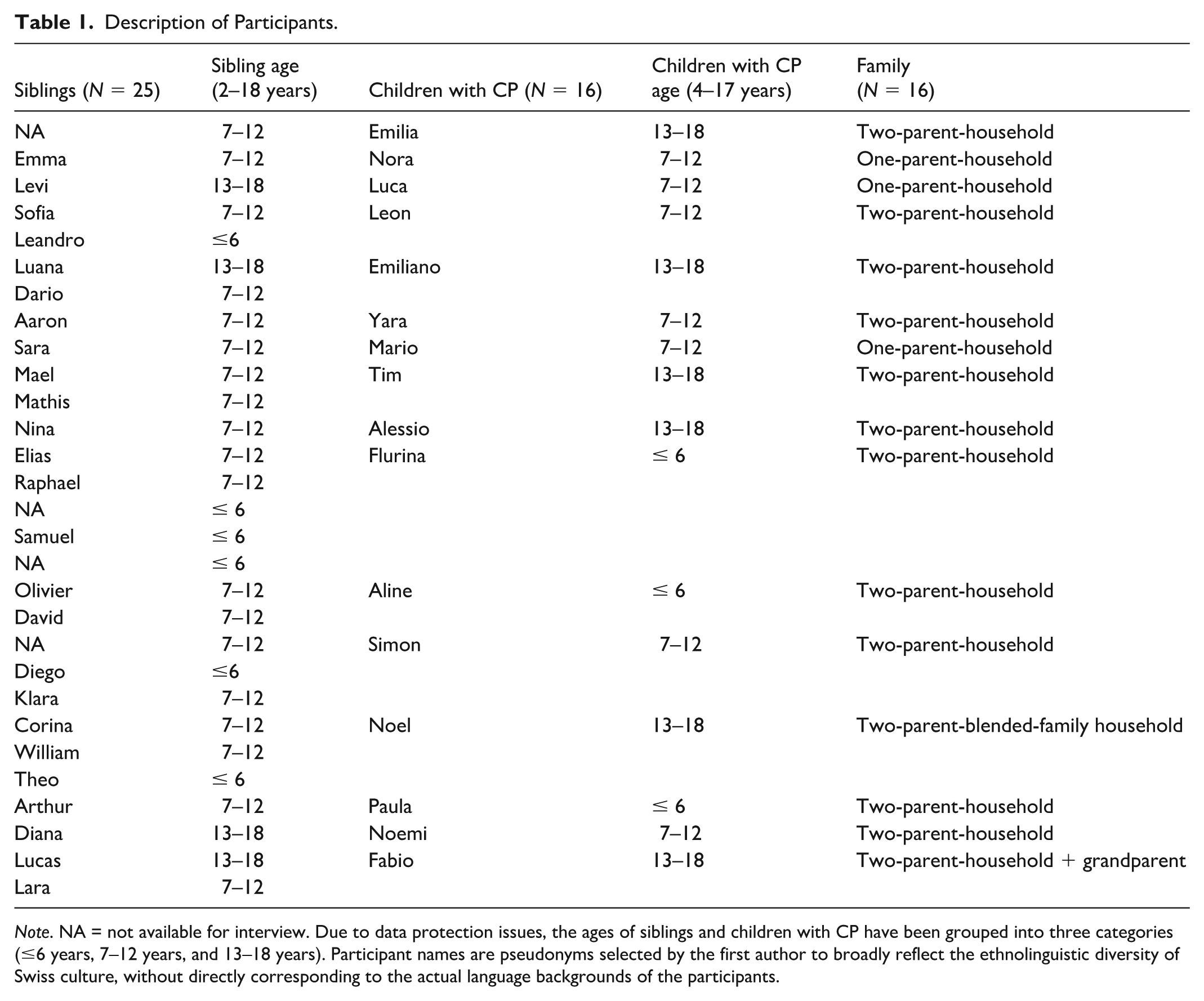
Note. NA = not available for interview. Due to data protection issues, the ages of siblings and children with CP have been grouped into three categories (≤6 years, 7–12 years, and 13–18 years). Participant names are pseudonyms selected by the first author to broadly reflect the ethnolinguistic diversity of Swiss culture, without directly corresponding to the actual language backgrounds of the participants.
Procedure
We developed a semi-structured interview guide. This guide was piloted with two families, refined collaboratively, and then translated into French and Italian. The interviewers, who were trained in either occupational therapy or psychology, were briefed on effective interviewing strategies.
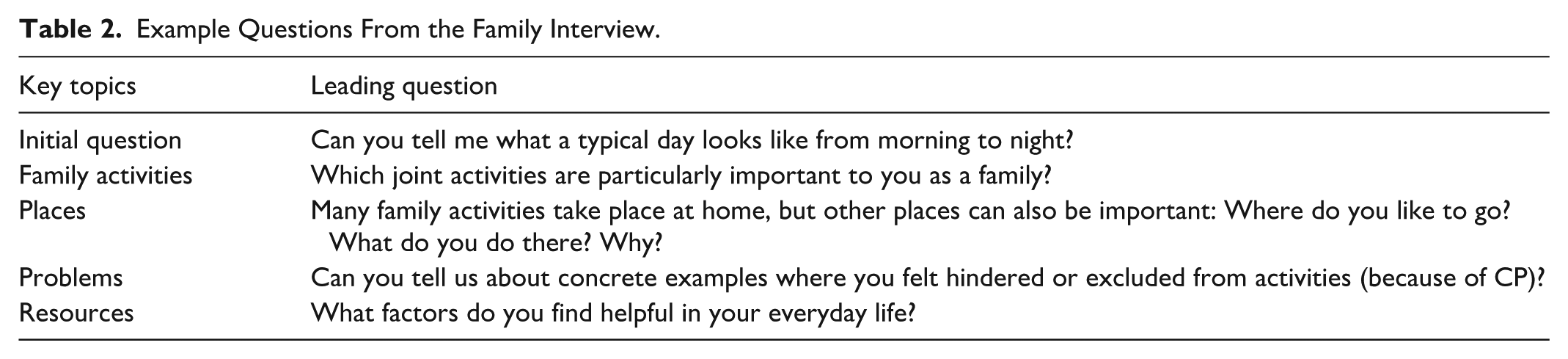
Data collection included interviews with children with CP, siblings, and parents. Between August and December 2023, we conducted joint family interviews, followed by individual interviews with each family member during follow-up appointments or immediately afterward, depending on the family’s convenience. Families chose the interview location, usually at home. Open-ended questions addressed everyday family activities (Table 2), with follow-ups based on responses. Interviewers encouraged children to share perspectives using interactive methods such as pictures, objects, or games. Some children preferred one-to-one interviews, others joined with a parent or sibling, and some declined further participation. Interviewers met regularly throughout data collection to ensure consistency while allowing flexibility for each family’s situation. We audio-recorded all conversations and ensured confidentiality. Individual interviews ranged in length from 6 to 100 minutes, and families contributed an average total of 127 minutes.
Example Questions From the Family Interview.
Translation and Transcription
To address Switzerland’s multilingual context, we applied a reflexive translation process (van Nes et al., 2010), with interviewers conducting the transcription, immediate pseudonymization, and translation into Standard German for analysis. We discussed cultural nuances with bilingual team members. Themes were defined in English, and quotes were ultimately presented in English only due to data protection concerns.
Analysis
We employed a multi-perspective analytical approach using all interview data (siblings, children with CP, parents). We applied qualitative content analysis (Graneheim & Lundman, 2004) to identify manifest and latent content through a structured inductive coding process, enabling systematic analysis on both descriptive and interpretative levels. The first author (JL) led the analysis. The last author (CS) acted as primary reviewer, with additional reviews by the second (JG) and third (SGre) authors. The remaining authors (AB, HH, AT, SGru) contributed to project development, analytic discussions, and reflection on preliminary findings. The remaining authors (AB, HH, AT, SGru) contributed to project development, analytic discussions, and reflection on preliminary findings. Final themes were established by consensus among all authors. Analysis was conducted using MAXQDA software and included the following steps:
repeatedly reading the transcripts to gain a comprehensive understanding of the whole (JL, JG, SGre, CS);
defining the unit of analysis as all transcriptions from family and individual interviews with children with CP, their siblings, and parents (JL, JG, SGre, CS);
identifying meaning units relevant to the research question, focusing on siblings’ perspectives alongside parents’ and children with CP’s accounts of siblings’ occupations (JL, JG, SGre, CS);
condensing meaning units by summarizing them while remaining close to the original text (JL)
assigning inductive initial codes (JL);
grouping codes into categories and subcategories through revision and consolidation (JL, JG, SGre, CS);
identifying overarching themes through iterative review and collaborative discussion aimed at answering the research questions (JL, JG, SGre, CS);
sharing preliminary findings with participants and collecting their feedback (JL);
revising findings based on participant and supervisory feedback (JL, JG, SGre, AB, HH, AT, SGru, CS);
selecting representative quotes and translating them into English to illustrate participants’ perspectives (JL).
Trustworthiness
We addressed trustworthiness following Elo et al. (2014), enhancing credibility through detailed participant descriptions. Dependability was supported by purposive sampling, a consistent interview guide, interviewer training, debriefing, and standardized transcription and translation processes. Collaborative analysis and transparent reporting enhanced confirmability, and detailed procedural and cultural descriptions enhanced transferability. Regular feedback from senior researchers maintained authenticity.
Findings
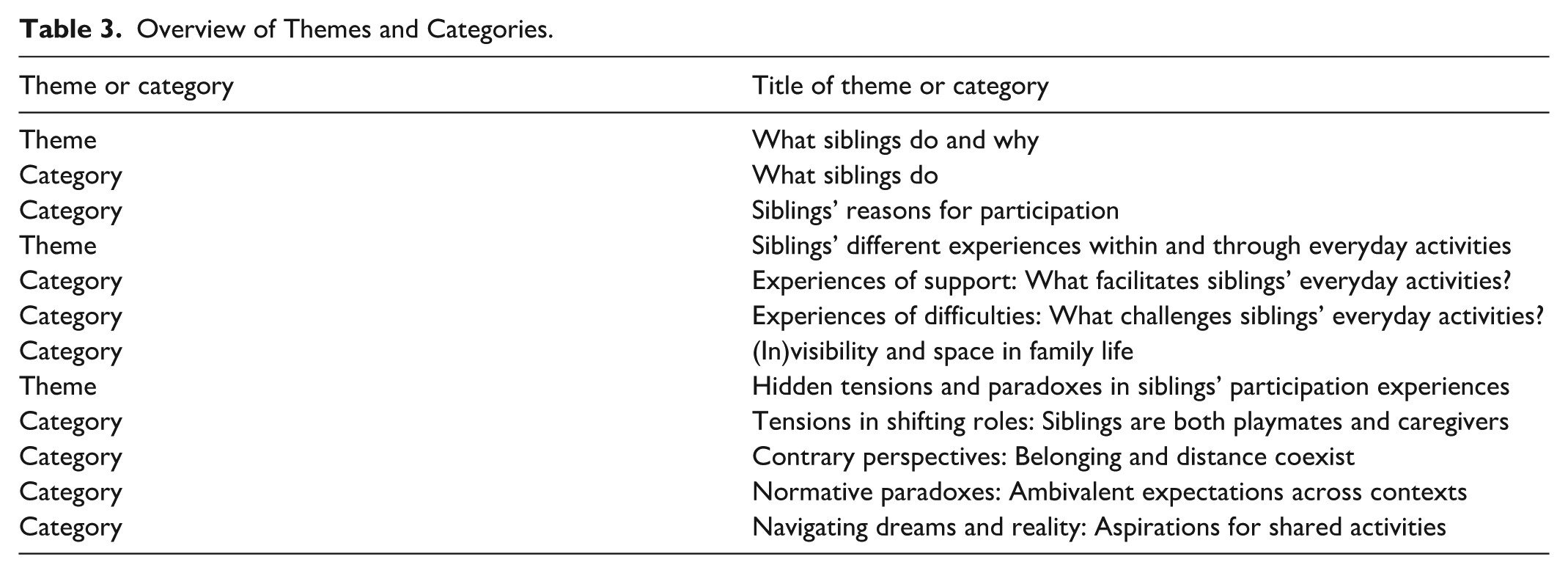
We identified three overarching themes, each capturing different aspects of how siblings experienced participation in everyday activities. Each theme is built from multiple categories (Table 3) and illustrated with quotes. To provide a comprehensive view of siblings’ participation, the themes, categories, and quotes were developed using a multi-perspective approach that incorporates the voices of siblings, children with CP, and parents. Details on the development of themes can be found in a Supplemental file.
Overview of Themes and Categories.
What Siblings Do and Why
This theme was identified as a first aspect of how siblings experience their participation in everyday activities: It shows their various activities across different settings and with different people. These activities were closely tied to their reasons for participating, shaping their overall experiences.
What Siblings Do
Families described a broad range of childhood activities siblings participate in at home (e.g., playing and caregiving), at school (e.g., presentations and recess), and in the community (e.g., shopping and family trips). One family shared:
We tidy the rooms, vacuum. We play outside.
We draw.
We play soccer.
We play board games. We watch a movie.
Yeah, we watch a movie in the evening when everyone is there.
Are there any activities that might be more important to you than others?
Riding horses. [laughs]
Going to the nature reserve.
Siblings particularly valued outdoor activities (e.g., hiking and swimming). Family routines, meeting peers, and private activities in their rooms were similarly important. Shared activities with their brother or sister with CP (e.g., playing games and watching movies) were frequently described and valued by many children with CP and siblings. Some siblings described having a sibling to fight and rumble with as being as meaningful as playing with each other. Shared family activities, whether daily routines (like preparing dinner) or unique outings (like boat trips or amusement parks), were central and joyfully recalled.
Siblings’ Reasons for Participation
Siblings often described exploration, excitement, and joy as key reasons for participating. Two brothers explained why they enjoyed traveling:
Well, that we don’t just stay at home all the time, playing in the garden and so on. We do like to go on trips too. I think it’s important that we see something of the world, not just the garden, the house, and everything. . .
Yeah, and just seeing the neighbourhood and stuff would be a bit boring.
Many siblings valued spontaneity in everyday activities, such as following ideas as they arose or adapting plans on impulse. They highlighted the comfort of simply being together as a family. For many, the sense of togetherness during family activities mattered more than the activities themselves, including those shared with their sibling. Siblings emphasized that their participation, whether in play or caregiving, stemmed from love, connection, and the value of companionship. In contrast, joining their sibling with CP in health care settings, like therapy, was usually seen as a pragmatic necessity. Parents said they often had no choice but to bring siblings to appointments, which typically meant waiting rather than being actively involved. Still, siblings instinctively supported their family members, fetching items or helping as needed. Caregiving was described as “something normal,” naturally integrated into their roles.
Another reason for participation was siblings’ independence: Being self-sufficient at home (e.g., dressing, playing alone) allowed them to engage in activities without parental help, while also enabling greater autonomy outside the home (e.g., attending events, sleepovers). Parents saw this independence as early maturity and valued siblings’ ability to occupy themselves or assist as needed, which facilitated shared family activities.
Siblings’ Different Experiences Within and Through Everyday Activities
This theme explores siblings’ varied and subjective experiences in everyday activities. They described different types of support, challenges, and feelings of being seen or overlooked within family life. This sense of support, difficulty, or (in)visibility often reflected their degree of participation in activities.
Experienced Support: What Facilitates Siblings’ Everyday Activities?
A major support source was having one-on-one time with parents, which siblings valued for the undivided attention it provided (often impossible in the presence of their sibling with CP). They felt relieved from needing to adjust or experiencing their parents’ stress. This allowed for activities that were not feasible with the child with CP (e.g., skiing, tobogganing). Other adults (e.g., neighbors and friends) also provided support, especially in unexpected situations. One family shared:
We have a lot of support around us.
If something unexpected comes up and they need to take me to soccer at the last minute and my dad isn’t there, we know that taking Aline [child with CP] in the car is a bit of a hassle, so it’s easier for them [the neighbours] just to come.
Assisting persons supported family holidays or siblings’ engagement in meaningful activities like playing, doing homework, or following routines.
Experienced Difficulties: What Challenges Siblings’ Everyday Activities?
Some shared activities were described as being more difficult with their sibling with CP (e.g., spontaneous hikes, community events) than others (e.g., watching movies, board games). Siblings expressed frustration when they felt restricted in family activities because they often wanted to “do something with the whole family” (Nina, sister). One adolescent brother, Lucas, shared the difficulty of being separated during rehabilitation stays: [. . .] when Fabio [child with CP] had to go away for treatment, it wasn’t easy to be at home like that, a bit more on my own, or sometimes with a family friend. But we got through it. [. . .] I don’t remember exactly how long it was—two months, three? [. . .] it’s nicer to all be together. Not having mom at home, just us guys, was a bit chaotic. [smiles]
Some siblings were challenged by their brother’s or sister’s behaviors disrupting their own activities, or feeling embarrassed in public when noticing others staring. This seemed to result from a lack of power to change the situation. Consequently, some avoided certain activities, while others withdrew internally, enduring challenges quietly. Limited family communication often shaped these experiences. Some siblings appreciated open family talks and being involved in decisions about family activities. Less open dialogue hindered siblings from expressing their needs.
(In)Visibility and Space in Family Life
Siblings often expressed that “it’s normal to be in the background” because family life centered around the child with CP’s needs. Although they were involved in family activities, they often had to quickly adapt their plans. Conversely, some valued when parents regularly sought their perspectives. As one brother, Mael, noted: Yes, I think it’s good because when you’re alone, you don’t always have all the ideas. Together, we just have more ideas. And it’s good that we discuss it as a family so that not only Dad and Mom are the ones who get to decide.
Outside the family, siblings’ hobbies or play were sometimes overlooked. Parents, preoccupied with caregiving, were often relieved if their siblings kept themselves busy or pursued hobbies, lacking the energy to engage deeply as long as siblings seemed content. Some siblings experienced boredom, as they needed to play quietly due to their sibling’s sensitivity to noise. Others wanted more space, as one sister cautiously said: “Well. . . I wouldn’t really mind if I had my own room now” (Sofia). Some parents worried about siblings being sidelined but felt unable to change the situation.
Hidden Tensions and Paradoxes in Siblings’ Participation
This theme describes more subtle tensions and paradoxes in siblings’ participation: On a deeper interpretative level, the analysis revealed how siblings navigated shifting roles, conflicting perspectives, and the gap between aspirations and reality in their everyday activities.
Tensions in Shifting Roles: Siblings are Both Playmates and Caregivers
Tensions emerged as siblings balanced dual roles—playmate and caregiver—fluidly throughout the day. One family described:
She [girl with CP] loves you a lot, huh? She really likes it when you go to bed with her in the evening and tell her things. What do you tell her?
Sometimes I tell her stories that I’ve made up. And I tell her, but then she has to sleep, so I tell her how to lie down, and when she lies down, she has to drink her bottle. Then, very slowly, I close the door.
Some siblings set caregiving boundaries (e.g., avoiding tasks like diaper changing), while others were less explicit but valued the freedom to choose their involvement. Parents associated this dual role with fostering competence and confidence, although some questioned whether siblings’ maturity arose naturally or was a result of necessity. Siblings echoed this ambivalence, noting the patience and adaptability they developed over time.
In conversations, siblings often acted as “translators,” speaking for their sibling with CP. Though intended to support participation, this sometimes limited the child with CP’s opportunity to express themselves.
Contrary Perspectives: Belonging and Distance Coexist
Another tension emerged in siblings’ accounts of feeling deeply connected to their family yet simultaneously experiencing a sense of distance. Adolescents increasingly sought independence from their families. Parents noted that this growing autonomy sometimes conflicted with shared family responsibilities and the care for the child with CP. Children with CP also felt this tension, seeing their siblings’ expanding autonomy as different from their limited opportunities. As one teenage girl with CP, Emilia, said about her younger sister: Yes, I understand, but she [younger sister] goes away for different weekends, and I might make plans maybe once a month. So I do think. . . it’s a big difference. I notice it when she’s gone and how much I can’t do. When she’s away or sleeping over at a friend’s, it’s fine for me too—I enjoy it, I’m practically alone at home. But yeah. . . the difference is there, and I definitely feel it.
Normative Paradoxes: Ambivalent Expectations Across Contexts
Siblings expressed varied understandings of “normal” family life and activities. They also navigated different normative standards within their family and broader societal expectations, such as comparing family vacations to those of friends. The phrase “We are just normal siblings” was frequently expressed, reflecting their efforts to fit into the image of a typical family while also perceiving differences. Siblings recognized barriers like inaccessible public spaces, but also took pride in doing things differently. One sister said proudly: “We’re not a typical model family” (Luana).
Navigating Dreams and Reality: Aspirations for Shared Activities
Siblings wished for more or specific shared family activities, more personal opportunities, or better support for their sibling with CP. They wanted their family to be less stressed and society to be more accessible. While they talked about past activities that they wanted to be done again or more frequently, siblings also imagined new shared activities with their brother or sister with CP. They dreamed about doing things together that felt out of reach yet remained an important part of their hopes. One sister, Sara, envisioned: I think it would be really cool if he [Mateo] [. . .] could walk on his own, without any device or help from anyone. But I don’t really think he’ll ever be able to do that. [. . .] maybe in the future, if there are better devices to help him learn or something. . . but I don’t really think he could. [. . .] I’d walk this path with him because, um, he thinks walking is really cool [. . .], and then we could play hide-and-seek or tag.
It was remarkable how some siblings seemed to balance the discrepancy between past experiences and an imagined future. They kept longing to share exciting activities with their brother or sister with CP, as one brother said: “I would like to ride roller coasters with him” (Dario).
Discussion
This study explored the experiences of siblings of children with cerebral palsy (CP) in participating in everyday activities. It also examined the supports and challenges they encounter in daily life. The findings expand knowledge about siblings growing up with a brother or sister who has a complex health condition. They illustrate how everyday activities both shape and are shaped by family dynamics, cultural values, and disability.
Siblings described a broad range of activities — from play and sports to caregiving and family outings — with personal, social, and cultural meaning. The emphasis on outdoor and physical activities reflects Swiss cultural norms (Stoecklin et al., 2021), which may create pressure for families of children with CP to appear “typical.” Yet siblings expressed a strong interest in these activities and a desire for shared family experiences. Viewed through an occupational lens, siblings shared more than a list of activities; findings reflect how roles and identities are formed through everyday participation. This aligns with occupational science concepts of doing, being, becoming, and belonging (Hitch & Pepin, 2021; Wilcock, 1999). Being was expressed as a sense of shared togetherness within the family, often prioritized over doing specific activities. Belonging was seen in both inclusion and exclusion in their families and public settings. Becoming reflected evolving roles and responsibilities, consistent with views of children as occupational beings with dynamic repertoires (Humphry, 2002).
A rights-based perspective (Lundy, 2007) underscores that siblings’ experiences deserve recognition independent of their brother or sister with CP. Despite supportive environments, many described feeling invisible, receiving less attention, or facing restrictions in peer relationships, findings consistent with broader disability siblings’ literature (Hanvey et al., 2022). Involvement in family decisions was key for siblings’ sense of agency, echoing calls to center children’s voices in research and practice (Wenger et al., 2021).
A recurring tension emerged between siblings’ dual roles as both playmates and caregivers. These overlapping roles could lead to conflicts, requiring siblings to balance their family responsibilities with their own need for autonomy. This reflects prior research on hidden caregiving burdens (Nygård et al., 2024) but also expands it by showing how participation is influenced not only by CP but also by broader family and social dynamics. Perspectives that consider these influences provide a nuanced understanding of siblings’ experiences and highlight opportunities for interventions that support siblings’ needs, participation, and agency in everyday activities (O’Connor et al., 2021; Whiteford & Hocking, 2012).
Strengths and Limitations
This qualitative, multi-perspective study, including siblings, children with CP, and parents, offers a comprehensive view of siblings’ participation experiences. Including very young children and diverse families strengthened the findings. However, siblings less able or willing to share may be underrepresented. Most families were two-parent households, reflecting Swiss demographics (BFS, 2021), which might limit transferability to other family types. Although these factors are likely to influence experiences, variables such as age, birth order, and CP severity could not be analyzed due to the qualitative design of this study.
Implications for Practice and Research
Occupational therapists and related health professionals should proactively involve siblings in conversations about family activities, care planning, and interventions affecting everyday activities, such as rehabilitation stays. Efforts to support family occupations should also address the needs of siblings. Targeted information regarding sibling support resources and family functioning should be made available. Programs should recognize siblings’ efforts to balance caregiving with autonomy and include them in designing tailored interventions.
Future research should better capture siblings’ perspectives, particularly those struggling to verbalize their needs. Mixed-methods approaches, combining qualitative insights with quantitative data on participation and well-being, can deepen our understanding of influencing factors.
Conclusion
Siblings of children with CP reported meaningful benefits, including quality family time and participation in diverse, enjoyable activities. Their engagement spans shared family occupations, time with siblings and peers, and opportunities to balance family life with valued activities outside the home. However, they also encounter distinct challenges such as role ambivalence, competing family needs, and unexpressed experiences. These challenges often go unrecognized, limiting their ability to influence their circumstances. Conversations about their everyday activities revealed both their priorities and the support they require. Elevating siblings’ voices in research and practice is vital to promote their participation and recognize their active roles in families and society.
Supplemental Material
sj-docx-1-otj-10.1177_15394492251411773 – Supplemental material for Unfolding Participation in Everyday Activities of Siblings of Children With Cerebral Palsy
Supplemental material, sj-docx-1-otj-10.1177_15394492251411773 for Unfolding Participation in Everyday Activities of Siblings of Children With Cerebral Palsy by Johanna Linimayr, Judith V. Graser, Selina Gredig, Alison Borda, Hubertus J. A. van Hedel, Anne Tscherter, Sebastian Grunt and Christina Schulze in OTJR: Occupational Therapy Journal of Research
Footnotes
Acknowledgements
We thank the participating families for their time and willingness to share their experiences and give feedback on the preliminary results. We thank Nicole Tschannen, Marko and Ivana Babic, and their children for participating in a pilot interview and giving valuable feedback on the interview guide. We appreciate the support of Andrea Petrig during the data collection in the Italian-speaking parts of Switzerland. We thank the Swiss Cerebral Palsy Registry for their support in setting up the Parti-CP project (www.parti-cp.ch). The work of the Swiss Cerebral Palsy Registry is supported by the Foundation Cerebral ( ). We thank the members of the steering board (Christopher Newman, Joel Fluss, Christoph Künzle, Claudia Kuehni, Stephanie Jünemann, Andreas Meyer-Heim, Sebastian Grunt, Barbara Goeggel Simonetti, Thomas Dreher & Konrad Stokar) for their direct help in recruiting participants; SwissPedRegistry, member of the Swiss Research Network of Clinical Paediatric Hubs (SwissPedNet), for supporting this study with their research infrastructure; and our colleagues at the Institute of Occupational Therapy, ZHAW, for the valuable discussions.
ORCID iDs
Funding
The authors disclosed receipt of the following financial support for the research, authorship, and/or publication of this article: Swiss National Science Foundation [“Parti-CP” project, grant number 320030_212587]. Open access funding was provided by ZHAW Zurich University of Applied Sciences.
Declaration of Conflicting Interests
The authors declared no potential conflicts of interest with respect to the research, authorship, and/or publication of this article.
Data Availability Statement
The datasets generated and analyzed during the current study are not publicly available due to the impossibility of guaranteeing full anonymization (audio files and transcriptions). To ensure confidentiality and the participants’ rights to the protection of sensitive information, data are only partly available from the authorized institutions upon reasonable request (request contact: Christina Schulze,
Supplemental Material
Supplemental material for this article is available online.
References
Supplementary Material
Please find the following supplemental material available below.
For Open Access articles published under a Creative Commons License, all supplemental material carries the same license as the article it is associated with.
For non-Open Access articles published, all supplemental material carries a non-exclusive license, and permission requests for re-use of supplemental material or any part of supplemental material shall be sent directly to the copyright owner as specified in the copyright notice associated with the article.
