



Abstract
Online awareness is essential to learning from one’s experiences, enabling adaptive self-management, often challenged among adolescents with attention-deficit hyperactivity disorder (ADHD). This study used an online awareness tool, the Occupational Performance Experience Analysis (OPEA), to examine (a) the online awareness of occupational performance of adolescents with ADHD and controls and (b) the potential modifiability of online awareness after a brief mediation redirecting attention to task demands and contextual factors. Seventy adolescents with and without ADHD were administered the OPEA after completing cognitive assessments. The OPEA comprises a verbal description of experiences, scored for representation of main actions, temporal context, and coherence, completed again after mediation. Results point to significantly less coherent descriptions of occupational performance among adolescents with ADHD compared with adolescents without ADHD; modifiability was only examined in the ADHD group and demonstrated significantly more coherent descriptions after mediation. Findings may elucidate online awareness of occupational performance as an occupational therapy intervention target for adolescents with ADHD.
Introduction
Attention-deficit hyperactivity disorder (ADHD) is known as the most common neurodevelopmental cognitive disorder that arises in early childhood and persists in substantial percentages to adolescence and adulthood (American Psychiatric Association [APA], 2013). The symptoms of the disorder are inappropriate degrees of inattention and hyperactive-impulsive behavior that impair functional performance in multiple contexts, such as at home and school (APA, 2013; Barkley, 2015). A central theory of ADHD associates the disorder with underlying deficits in executive functioning (EF; Brown, 2013). EF is an umbrella term used to define higher-level, self-regulatory cognitive processes, such as inhibiting prepotent responses, working memory, and shifting sets required to deal with complex and novel life situations (Miyake & Friedman, 2012). There is strong evidence supporting the relationship between EF and ADHD, and many children, adolescents, and adults with ADHD have been shown to exhibit EF challenges that impact their functional performance and participation in life roles (Brown, 2013).
Adolescence is a particularly challenging period, characterized by increasing demands of life roles (such as academics, social, and self-care) and rising psychological needs for autonomy, along with substantial hormonal and neurobiological changes (Fuhrmann et al., 2015). Thus, the complexity and novelty presented in adolescence are particularly taxing on the EF system. Therefore, considering the EF challenges among individuals with ADHD, these adolescents face additional challenges beyond those of their peers without ADHD. Not surprisingly, ADHD in adolescence is associated with impairment in multiple domains, including academic competence, peer and family interactions, daily activities, higher risks for psychiatric comorbidity, and substance abuse (Gardner & Gerdes, 2015; Gudjonsson et al., 2012; Savolainen et al., 2010).
Living well with a chronic neurodevelopmental cognitive health condition, such as ADHD, requires ongoing self-management, which relies heavily on self-awareness (Turgay et al., 2012). Self-awareness, a multidimensional construct, is the ability to understand one’s strengths and limitations and to monitor and evaluate performance associated with participation outcomes (Toglia & Goverover, 2022; Toglia & Kirk, 2000). The individual is considered to develop two dimensions of awareness as they interpret their occupational experiences over time: intellectual and online awareness. Intellectual awareness is a more general awareness of one’s abilities and challenges derived from an integrative summary of ones experiences over time. Online awareness, the focus of the current study, is defined as self-knowledge that is related to a specific activity or context and is measured before, during, and after the performance.
The importance of this area of research stems from the evidence linking awareness with participation outcomes (Toglia & Goverover, 2022). Online awareness is an essential element in the adaptive process of learning from one’s experiences, applying self-regulatory strategies, preparing for future occupational demands, and ongoing self-management (Lyons & Zelazo, 2011), which are common targets for occupational therapy treatment. Very few studies have been found regarding online awareness among adolescents with ADHD.
Online awareness is typically evaluated by comparing specific performance outcomes such as accuracy or speed with self-evaluation of these outcomes (Toglia & Maeir, 2018). For example, Fabiano et al. (2018) and Fisher et al. (2022) found an overestimation of performance accuracy in a simulated driving task and a measure of EF among adolescents with ADHD. There is a need to expand online awareness evaluations to include adolescents’ experiences by descriptive accounts (in their own words) of their actual performance, beyond their self-estimation on the measure of success or failure after performing a specific task. Complete information of what they encode from their experience, that is, the sequence of events that occurred from the beginning to the end of the task (“what” happened), is very important to direct the essential mediation targeted for better future performance.
This aspect of online awareness, addressing performance experience, relies on an internal process of self-reflection that is difficult to measure (Moon, 2007). Few researchers have operationalized the measurement of self-reflection with different methods, including rating scales, semi-structured interviews (Aukes et al., 2007; Chow & Luzzeri, 2019), as well as free writing and reflective journaling (Lew & Schmidt, 2011). These methods were applied after performance by reconstructing the experience based on memory (Moon, 2007) or through observing video recordings (Hollingsworth & Clarke, 2017).
Encouragingly, reflection training, focusing on redirecting attention to task conditions among preschool-age children, showed a positive effect on EF skills (Espinet et al., 2013). There is a gap in the online awareness literature regarding the self-reflection process after occupational performance experiences among adolescents with ADHD. Furthering our knowledge of how adolescents understand their specific occupational experiences, using the Occupational Performance Experience Analysis (OPEA; Fisher, 2021; Maeir et al., 2018) tool, may add a performance-based dimension beyond general self-report. Considering the dissociations between intellectual and online awareness (Fisher et al., 2022; Toglia & Goverover, 2022), this tool may have a valuable contribution to the occupational therapy process. In addition, considering the modifiable nature of self-reflection in typical development (Espinet et al., 2013), it is important to understand if a brief mediation redirecting attention to the components of task experience may modify online awareness among adolescents with ADHD.
Adolescence is a critical transition toward participation in adult roles. However, adolescents with ADHD have been shown to have poor functional outcomes. It has been strongly suggested that poor awareness of their challenges is a serious obstacle to engagement and persistence in the treatment process (Bussing et al., 2012; Wehmeier et al., 2015) and for adaptive future self-management. The objectives of the current study are (a) to examine the online awareness of occupational performance of adolescents with and without ADHD (ADHD vs. control group) and (b) to examine the potential modifiability of online awareness only for the ADHD group after a brief mediation to redirect their attention to task conditions. Specifically, we hypothesized that (a) the verbal descriptions of occupational performance on cognitive assessments will be less coherent among adolescents with ADHD compared with adolescents without ADHD and that (b) among adolescents with ADHD, the coherence of their verbal description of their occupational performance will improve after a brief mediation redirecting their attention to task demands and contextual factors.
Method
Research Design
This study used a cross-sectional design and focused on online awareness of occupational experiences among adolescents with and without ADHD. The current study was a part of a larger project conducted on adolescents’ intellectual and online awareness (Fisher et al., 2022). After receiving ethical approval from the university medical center’s Helsinki ethics committee, participants were recruited from neuropediatric clinics (ADHD group) and the community (control group) with age- and gender-matching. Participants and their parents signed informed consent.
Participants
A total of 70 adolescents between the ages of 12 and 18 years participated in the current study, attending regular education schools, with (n = 46, Mage = 14.38, male = 67%) and without ADHD (n = 24, Mage = 14.16, male = 58%). Inclusion criteria for participants in the ADHD group were a valid ADHD diagnosis by a neurologist or psychiatrist according to the Diagnostic and Statistical Manual of Mental Disorders (5th ed.; APA, 2013) criteria confirmed by Kiddie Schedule for Affective Disorders and Schizophrenia for School-Age Children—Present and Lifetime Version 2.0 (Kiddie-SADS-PL; Kaufman et al., 1996) administered by an expert psychologist, as well as stable pharmacological status during last 3 months. Exclusion criteria for the ADHD group included an estimated IQ below 85: lower than one standard score on the Block Design and Vocabulary subtests of Wechsler Intelligence Scale for Children IV (Wechsler et al., 2004) administrated by an expert psychologist as well as the use of medications that do not allow for 24-hour pause (e.g., atomoxetine). Exclusion criteria for the control group included ADHD symptomatology according to Conners’ Parent Scales–Revised (CPRS-R; Conner, 2000) based on the cutoff for clinical impairment in both hyperactivity-impulsivity and inattentiveness Diagnostic and Statistical Manual of Mental Disorders (4th ed.; APA, 1994) symptoms’ subscales (T > 65) as well as learning disabilities (based on parent report). The CPRS-R was chosen as a screening tool only for the control group to evaluate the occurrence of nondiagnosed ADHD and known comorbidities for ADHD (e.g., anxiety, oppositional difficulties, and social problems), unlike the Kiddie-SADS-PL that was executed to validate the ADHD diagnosis and common comorbidities in the ADHD group. Another exclusion criterion for both groups was additional primary neurological or psychiatric health conditions based on parent reports (e.g., autism spectrum disorder, cerebral palsy, epilepsy, intellectual disability). To represent the adolescent ADHD population, a common ADHD comorbidity was not an exclusion criterion but evaluated according to Kiddie-SADS-PL and presented in the description of the study group. Participants of the ADHD group did not take medication on the day of the study.
Instruments
Procedure
After receiving ethical approval, physicians and therapists referred adolescents with ADHD to the study. The study was described first to the parents who provided preliminary consent and then were invited with their adolescent to the university research laboratory. Both parents and adolescents provided consent. Parents of both groups were administered the ADHD diagnostic questionnaire and demographic questionnaire. Twenty-four adolescents without ADHD, within the same age range, were recruited through a convenience snowball sampling method. Adolescents without ADHD were screened for ADHD. The study was coordinated by an experienced occupational therapist, a PhD student (O.F., first author). The current methodology for assessing online awareness of both groups comprised two steps attempting to simulate the complexity of daily life experiences. First, complex experiences were simulated via a standardized performance-based battery (MOXO and WCPA) and self-rating on the BRIEF; second, post-performance descriptions were evaluated using the OPEA I with standard scoring criteria, as well as semi-structured brief mediation using OPEA II. For the ADHD group only, a brief mediation using the structured format of the OPEA II was conducted, after which they were asked to repeat the OPEA I again to examine the potential modifiability of their descriptive accounts. Eight participants did not complete the post-mediation description as they were too tired from the long process of the study. No significant differences were found between this group and other participants who completed the second OPEA I description regarding gender, age, and severity of symptoms of ADHD. Only 11 adolescents without ADHD completed the post-mediation process (54% missing values); therefore, no statistical analysis was calculated for this group.
Data Analysis
The data were analyzed with IBM SPSS Statistics (Version 25; IBM Corporation, Armonk, NY, USA). Descriptive statistics were carried out using t tests and chi-square tests to compare demographics (age, gender, and parents’ education and ADHD diagnostic questionnaire). Cohen’s d effect size (ES) was calculated. Due to the ordinal nature of the OPEA’s scores, the nonparametric Mann–Whitney U test was used for comparing each score between the groups, as well as Wilcoxon sign rank test to compare the mediation effect in the ADHD group. Hedges’s g ES was calculated: small effect = 0.2, medium effect = 0.5, and large effect = 0.8.
Results
Characteristics and distribution of both groups are presented in Table 1. No significant age and gender differences were found between adolescents with and without ADHD. A significant difference was found between groups on mother’s education, with higher levels of education for mothers of the ADHD group. However, no significant associations (all p > .1) were found between this variable and all other study measures (ADHD diagnostic questionnaire and OPEA).
Participants Characteristics.
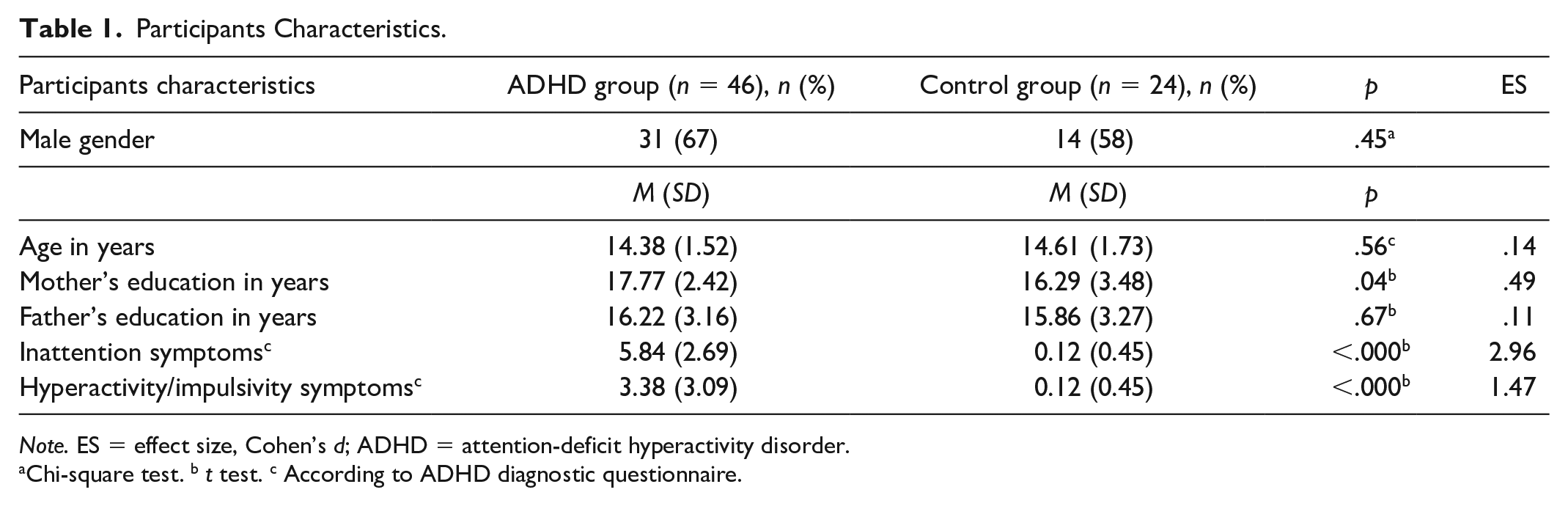
Note. ES = effect size, Cohen’s d; ADHD = attention-deficit hyperactivity disorder.
Chi-square test. b t test. c According to ADHD diagnostic questionnaire.
Online Awareness of Occupational Performance: Between-Group Differences on OPEA I
Significant differences in the expected direction were found between the adolescents diagnosed with ADHD and adolescents without ADHD, on the temporal context and coherence scores of the OPEA I with large ESs. A similar but nonstatistically significant trend was found on the main-action score (see Table 2). The descriptions of occupational experiences of adolescents with ADHD were fractional with minimal representation of main actions, temporal context, and limited coherence, compared with those of adolescents without ADHD. In other words, adolescents with ADHD described their occupational experiences with shorter and less-coherent accounts, lacking sufficient representation of action sequences. For example, Participant 22 diagnosed with ADHD reported, “We did things like tests on the computer and stuff,” versus Participant 06 without ADHD who reported the following: In the beginning, you explained to me about the research and what we were going to do in the meeting. Then I began the computer task. After that, I filled out a questionnaire. Then, you explained to me about the task with all the appointments and calendar and then I started the task. And then you told me that we would finish up with some more questions and that’s it.
OPEA Differences by Group (ADHD vs. Controls) and Before and After Mediation (Within ADHD Group).
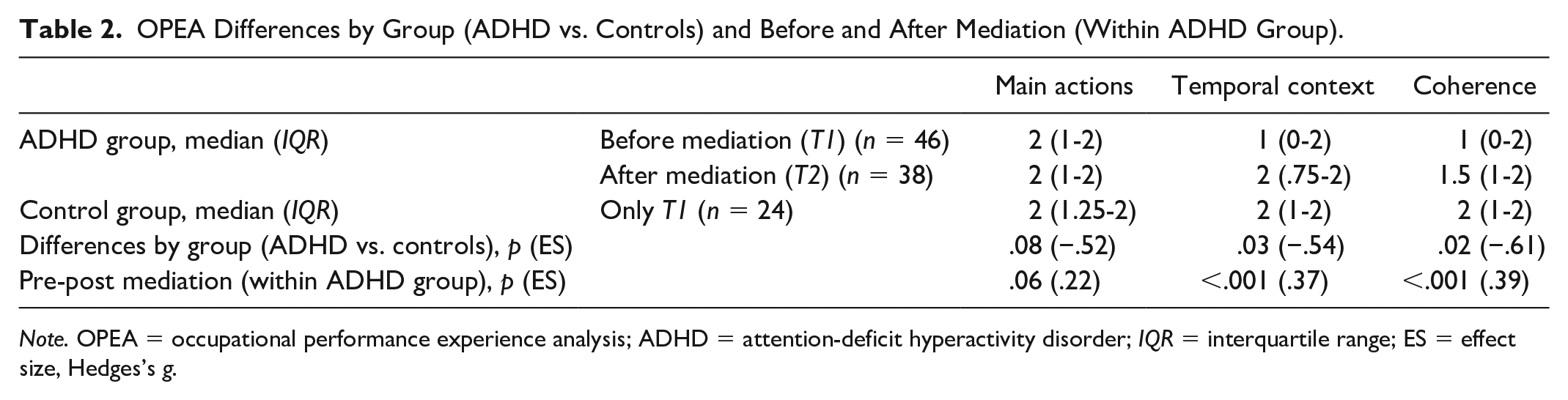
Note. OPEA = occupational performance experience analysis; ADHD = attention-deficit hyperactivity disorder; IQR = interquartile range; ES = effect size, Hedges’s g.
Changes After Mediation on OPEA I (Within ADHD Group)
Within the ADHD group, upon examining the change in OPEA I scores, pre-post mediation revealed significant improvements in temporal context and coherence scores with medium ESs (Table 2). That is to say, these descriptions of adolescents with ADHD were found to be significantly more coherent and time-sequenced after a brief mediation. For example, Participant 22 diagnosed with ADHD reported the following after mediation: In the beginning, we played a game where you have to identify a card with all kinds of confusing things, like shapes on the side and noises for 18 very long minutes. Before that, I had to fill out a questionnaire and also afterwards. After that, I had another task which I inserted on the calendar all kinds of meetings and things that happen during the day, without the times clashing. And also, these final questions, which is very difficult to answer when I’m without Ritalin.
Discussion
The focus of the current study was to examine the online awareness of occupational performance of adolescents with and without ADHD and to understand the potential modifiability of online awareness after a brief mediation redirecting attention to task demands and contextual factors of the ADHD group. To this end, the OPEA tool was used in the current study. The OPEA is a clinical tool that was designed to evaluate and promote online self-awareness, based on descriptive accounts of occupational experiences (Fisher, 2021; Maeir et al., 2018). In line with study hypotheses, findings point to less-coherent descriptions and partial representation of the temporal context of performance among adolescents with ADHD compared with adolescents without ADHD, yet they also demonstrate the potential modifiability of these aspects of online awareness. The novelty of the current study is in providing a window into what adolescents know about their performance and, specifically, how they describe their complex (challenging EF abilities) experiences in terms of coherent representations of action sequences. The current discussion is focused on the differences between groups, as well as the change in verbal descriptions within the ADHD group after a brief mediation. Understanding these experiences with an in-depth self-reflection process may promote occupational therapy interventions for adolescents with ADHD.
Between-Group Differences: Online Awareness of Occupational Performance
Considering that online awareness of occupational performance is difficult to measure (Moon, 2007; Toglia & Kirk, 2000), this standard scoring method of the OPEA I enabled a quantitative representation of group differences in an online awareness process associated with task experience. This method can be compared with the performance-estimation paradigm, which typically measures the discrepancy between self-rating and performance rating of accuracy (Toglia & Maeir, 2018). The novelty of the current study is in attempting to provide a broader lens to online awareness, evaluating the occupational performance experience (e.g., “What did you do?”) and not limited to performance outcomes (e.g., “How many items did I mark correctly.”). Thus, the current findings provide new evidence on a relatively neglected component of online self-awareness that has not been subject to quantitative analyses. The OPEA I requests the clients to describe their experience regarding the research session and reconstruct it as objectively as possible into a verbal description by adapting an imaginary camera view (“Describe the event as if you were filming it. Try to present what the video camera sees,” Online Appendix A). This method revealed the differences between groups, suggesting that self-reflection may be useful for adolescents without ADHD but is too difficult to capture a coherent representation of events for adolescents with ADHD. The findings of less-coherent descriptions among adolescents with ADHD can be explained by neurogenic and psychogenic underlying mechanisms that have been studied in relation to impaired self-awareness in neurorehabilitation. The neurogenic theories attribute unawareness to neurocognitive impairments that preclude the discovery of impaired performance (Tham et al., 2000). The known EF deficits among the ADHD population, such as difficulties in attention, inhibition, working memory, and sense of time (Barkley, 2015), may impede reflection on complex experiences, thus partially explaining the current findings. From the psychogenic theoretical perspective, poor performance could lead to motivated rejection or denial of the experience to protect the self from psychic pain (Kortte & Wegener, 2004). In line with this psychogenic perspective, unawareness in ADHD has been explained with the self-protective hypothesis (Ohan & Johnston, 2002), stigmatization (Wiener et al., 2012), as well as motivational processes (Hoza et al., 2012). Because this study was a preliminary first step in revealing the problem of online awareness of occupational performance experience in this population, further research is needed to study the underlying mechanisms of this phenomenon. According to this literature and following the model of Toglia and Kirk (2000), it can be hypothesized that both neurogenic and psychogenic mechanisms may play a role in explaining the current findings. To the best of our knowledge, this finding is a novel one in the research on adolescents with ADHD and requires further research.
This initial process of reflecting and reconstructing recent events may comprise the first building block of online awareness, which is necessary for ongoing self-management of a chronic neurodevelopmental cognitive health condition such as ADHD (Turgay et al., 2012) and, if lacking, may impede adaptive learning from one’s occupational experiences. Thus, reflecting on one’s performance may be a significant target for an occupational therapy intervention to improve self-management in daily life. The OPEA I scoring may provide a useful method to measure reflection on occupational experiences, with good reliability and the ability to differentiate between groups (ADHD vs. controls).
Changes After Mediation
The self-reflection process on occupational experience involves multiple steps, requiring the individuals to pause, adopt an intentional stance, step back (psychological distancing), consider the context, use self-directed speech, and monitor progress toward a goal (Lyons & Zelazo, 2011). Barkley (2016) emphasizes the need for externalizing the information for people with ADHD: If the process of regulating behavior by internally represented forms of information (working memory or the internalization of self-directed behavior) is impaired or delayed in those with EF deficits, then they will be best assisted by “externalizing” those forms of information. Since covert or private information is weak as a source of stimulus control, making that information overt and public may assist with strengthening control of behavior by that information. (p. 506)
In line with Barkley’s theoretical model, externalizing the self-reflective process via a brief mediation, which redirected clients’ attention to the basic components of experience (such as what, when, and where), was shown to be useful in improving the coherence of their verbal descriptions. This finding is in line with the positive effects that were found for self-reflection training, such as the use of reflective blogs among therapists who participated in a training program of cognitive behavior therapy (Farrand et al., 2010), as well as a short training program for managers that reinforce self-reflection to improve decision-making (Guess et al., 2015).
Limitation and Recommendations for Future Research
The current study has several limitations. The groups were not equivalent in size and gender representation. Furthermore, all participants studied in the regular education framework, and parents’ education level was high. Therefore, it may not be representative of the entire population of adolescents with ADHD. There is a need to expand the current research and examine the OPEA in a larger sample with a broader representation of adolescents with ADHD. A few methodological limitations were found in this study. First, the mediation was executed only for adolescents with ADHD. Second, eight participants from the ADHD group did not complete the OPEA I description after mediation. This lack of data may restrict the generalization of the results on adolescents with and without ADHD. Finally, there was no post-test battery to measure occupational performance. Thereby, understanding the impact of the improvements in online awareness is limited.
Further research is required to explore the associations between the underlying mechanisms of unawareness (neurogenic and psychogenic) with verbal descriptions of occupational performance experiences among this population. Finally, there is a need to investigate the usability of the OPEA in other populations and compare different methods for measuring online awareness via verbal descriptions to capture this complex process.
Conclusions
Regarding the first objective of the current study, findings demonstrate poorer coherence and partial representation of temporal characteristics in the verbal descriptions of occupational performance experiences among adolescents with ADHD, compared with adolescents without ADHD as measured by OPEA I. Regarding the second objective of the current study, the OPEA II, which involves a brief mediated reflection, may provide a useful method to improve the coherence of verbal descriptions of occupational performance experiences. Findings may support occupational therapy interventions for enhancing awareness to improve treatment compliance and self-management among adolescents with ADHD.
Supplemental Material
sj-docx-1-otj-10.1177_15394492231154197 – Supplemental material for Mediated Online Awareness Among Adolescents With and Without ADHD: Using the Occupational Performance Experience Analysis (OPEA)
Supplemental material, sj-docx-1-otj-10.1177_15394492231154197 for Mediated Online Awareness Among Adolescents With and Without ADHD: Using the Occupational Performance Experience Analysis (OPEA) by Orit Fisher, Itai Berger, Ephraim S. Grossman and Adina Maeir in OTJR: Occupational Therapy Journal of Research
Footnotes
Acknowledgements
The authors sincerely thank the parents and adolescents who participated in this study for their trust and for allowing us to learn from their experiences.
Declaration of Conflicting Interests
The author(s) declared no potential conflicts of interest with respect to the research, authorship, and/or publication of this article.
Funding
The author(s) received no financial support for the research, authorship, and/or publication of this article.
Ethical Approval
The study was approved by the Helsinki Ethics Committee of Hadassah Medical Center, no. 0366-16-HMO.

Supplemental Material
Supplemental material for this article is available online.
References
Supplementary Material
Please find the following supplemental material available below.
For Open Access articles published under a Creative Commons License, all supplemental material carries the same license as the article it is associated with.
For non-Open Access articles published, all supplemental material carries a non-exclusive license, and permission requests for re-use of supplemental material or any part of supplemental material shall be sent directly to the copyright owner as specified in the copyright notice associated with the article.
