



Abstract
Latina/o rural students are underrepresented in college and the research of their college choice process. Using Bourdieu’s habitus, and Yosso’s Community Cultural Wealth Conceptual Model, this qualitative study used interviews with 24 Latina/o rural high school students. Our findings explored how school habitus limits college options. Students use navigational capital when selecting a “good program” and rely on familial-capital, high aspirations, and other forms of capital to choose a college.
Introduction
Latina/o rural students face various academic and social barriers that limit their higher education access and degree completion. Further, these students are underrepresented in education research and college enrollment in comparison to urban Latina/o students (Ramirez & Meece, 2017). Thus, more research is needed to understand the rural context and the Latina/o experience in this educational context. To address this research gap, this study explored the college choice process of Latina/o rural students in the state of Texas, a state where just in 2018, 31.8% of the Latina/o population lived in rural communities (U.S. Census Bureau QuickFacts: United States, 2018). The following research questions guided our study: What are the social issues that Latina/o rural students experience in their secondary education that influence their college choice? How are students responding to the familial and communal expectations regarding their life after high school? What do they identify as significant factors in their college choice? We will review these questions utilizing Yosso’s (2005) community of cultural wealth model which challenges the deficit and “other” framing of Latina/o experiences. Yosso illustrates the strength of Latina/o familia and the cultural resources Latina/o students bring to their educational experience.
Literature Review
While the literature on Latina/o rural students is limited in nature, it did reveal important details in Latina/o rural student college choice process. Specifically, the literature revealed a necessary scholarly focus on Latina/o rural students’ pathway to college access and degree completion. The following is a discussion of these scholarly findings.
Community and Parent Involvement in Latina/o Students’ College Choice Process
Morton et al. (2018) concluded that school staff, peers, and family were important to rural students’ college choices but that students expressed fears about finances, their academic preparation, and social integration at faraway campuses. Additionally, Stone’s (2017) work shows how rural students also experience balancing their loyalties to home, with pursuing their college and career aspirations. This does not mean that parent involvement is not present in the college choice process. In fact, the literature shows how parents serve as a support system for their students to pursue a college education. Cabrera et al.’s (2012) work on Latina/o students in a rural community in South Texas highlights how parent involvement plays a role in the ganas or desire to pursue a college education through the encouragement that parents provide, even when they may not have a college education. This is often displayed when parents provide support for their child’s homework assignments, and affirming the value of education (Walker et al., 2011).
The Golden Cage Community Culture in Latina/o Rural Students’ College Choice
McDonough et al.’s (2010) work concluded that rural students are often kept in what they labeled a “golden cage,” a rural community culture that is both a safety net for these students and an obstacle that prevents them from pursuing a college education beyond their local community college. This golden cage creates a distrust of colleges and universities that are not local, creating an environment where a P-12 education is fostered and encouraged but little beyond that. Graduation rates are high among rural students, but college-going is lower.
Latina/o students are more likely to trust the advice of someone they know over more formal sources of information (Pérez, & McDonough, 2008). Therefore, coupled with the golden cage rural community culture, Latina/o students tend to build trusting relations with their immediate resources that have been there for them in these communities. These resources are often school counselors or teachers, limiting the students’ exposure to outside resources for fear that they will fail in a college away from their rural community (Peterson, 2020). These actions limit Latina/o student success and higher education access (Guiffrida, 2008). Therefore Latina/o rural students are likely to attend institutions where they have (1) relatives in surrounding communities, (2) relatives who went to these institutions, or (3) people from their family social circle that Latina/o students know currently work for or attended (Freeman, 2017).
Resistance to Latina/o Academic Support
Although limited research exists on this topic, some literature highlights the resistance to Latina/o academic support in communities (Li & Renn, 2018). Predominantly white communities often do not want to adjust their educational curriculums to fit the needs of Latina/o bilingual students. Latina/o students must overcome triple segregation in the classroom because of who they are, what language they speak, and because of the lack of financial stability (Gándara, 2010). White parents do not want to provide extra tutoring services or divert from their already short-funded schooling budgets to bring in the extra help that bilingual students need (Percy-Calaff, 2008; Villalba et al., 2007).
Latina/o Rural Self-Efficacy
Scholars (Ali & Menke, 2014; Tieken & San Antonio, 2016) found the silver lining in rural student experiences in their self-efficacy. Rural life culture instills a strong sense of high school completion and that pushes students to think about planning their life beyond high school at a much younger age. Ali and Menke (2014) argue for a sense of urgency that can capitalize on the highly reported self-efficacy amongst rural students to help them enroll in college at higher rates and motivate them to persist in achieving degree completion.
Theoretical Framework
We used Bourdieu and Passeron’s (1970/1977) conceptualization of habitus and Yosso’s (2005) Community of Cultural Wealth conceptual framework. Bourdieu helps us understand the systemically oppressive nature of American society and the boundaries of a student’s habitus. In the American context, Bourdieu has been twisted by Coleman (1990) and others to blame the oppressed for their position in the system rather than blame the system. Yosso responded to this deficit thinking by developing her Community of Cultural Wealth Framework. Taken together Bourdieu’s original theory and Yosso’s theory are complementary.
Bourdieu and Passeron’s Cultural Capital Theoretical Framework
Bourdieu introduced the concept of habitus as the norms and expectations of a community or dispositions which are set up by the social structure. For students, these dispositions provide the boundaries around what is possible and expected. Students’ college choice sets are not the infinite number of colleges and universities but the ones that are in the realm of possibility within their habitus, something reinforced by the student’s immediate social structure, that is, family, community, and school (Bourdieu & Passeron, 1970/1977).
Yosso’s Community of Cultural Wealth Model
Yosso’s (2005) Culture of Community Wealth conceptual framework is comprised of aspirational, familial, social, navigational, resistant, and linguistic capital. These forms of capital highlight how Latina/o students can overcome their educational setbacks because of the influences of racism and other systemic issues at play.
Aspirational Capital
Latina/o students go to school with aspirations to succeed, contradicting the common narrative by educators as troublemakers (Rodriguez, 2023), dropouts, and uninterested in pursuing a college education (Carey, 2019). These students want to succeed in school and even more importantly, they aspire to go to college.
Familial Capital
Familial capital refers to the knowledge gained and instilled at home, often by the family and cultural values. This form of capital often transcends the norms of friendship and builds family ties between blood relatives, friends, co-workers, bosses, etc., which creates a community for the Latina/o student. This familia supports the student outside of the confines of the institution. These individuals provide advice, caring, and financial and moral support, amongst other things. Familial capital makes Latina/o students cognizant that their academic success goes beyond their lives, but also it is a success for their families and communities back home.
Social Capital
Yosso’s social capital provides a lens for an understanding of how Latina/o people use their communities to advance in society and even in higher education. Latina/o students often rely on people like their extended family, neighbors, friends, or even former educators, to learn about ways that they can acquire the necessary financial or educational resources. Yosso explains that undocumented groups particularly rely on such networks for economic opportunities.
Navigational Capital
Navigational capital shows that students know how to steer through the education system that is at times negligent or hostile, allowing them to understand the intricate policies and politics rooted in the historical disenfranchisement of students of color. They use these skillsets to seek support services, faculty mentorship, or resources beyond college to achieve degree completion.
Resistant Capital
Latina/o rural students recognize that they face financial and racist challenges that might present obstacles in their college education. Nevertheless, these students have the resistance and will to find ways that will allow them to achieve higher education.
Linguistic Capital
Latina/o students come to higher education institutions with advanced communication skills that come from a bilingual lifestyle and navigating between cultures. Linguistic capital in this paper relates to the ability of Latina/o students to choose a college based on the conversations that they have with individuals who are already at colleges or universities.
Methodology
We explore the college choice process of Latina/o students in rural communities using a case study design (Yin, 2014) with in-person one-on-one interviews. The students in this study stem from eight schools in the Rural Student Success Initiative (RSSI) program out of Texas A&M University’s AgriLife Extension Office. This postsecondary encouragement program seeks to implement student support programs at these schools to raise college-going rates.
We did in-person interviews at seven schools; then Covid-19 caused us to switch to virtual interviews at one. The schools were identified as representative of low-income communities where most parents have not gone to college. They ranged from the Rio Grande Valley to near the Oklahoma border and were broad from east to west. We interviewed students early in the college choice process (8th or 9th) and near their high school graduation (11th or 12th).
We conducted semi-structured interviews with 24 Latina/o students. Interviews were 35 to 60 min and were conducted in a quiet place within the school. Questions covered early and current career choices, discussion of their postsecondary plans, description of their chosen path, and school, community, and family support in their process. We interviewed 12 male and 12 female students with different career interests from truck driving to NASA engineering.
Analytical Approach
Using the constant comparative method for data analysis (Glaser & Strauss, 1967), we independently analyzed the transcripts for coding and themes. We unitized the data and placed each unit in an excel sheet cell. Then we went through units, identified categories and themes, and compared themes and categories until we reached a consensus. This data analysis approach provided a peer review approach to check each other’s potential biases. We come to this research as a Latino male, a recent doctorate from an urban community in South Central Los Angeles, and a White female, a mid-career faculty member who grew up in a rural area in Minnesota.
Findings
Our qualitative scholarly work revealed seven key findings. Those findings are: (1) finances drive their college choice, (2) financial aid knowledge is limited, (3) being closer to home, (4) program quality affects college choice, (5) habitus limits options, (6) college prep courses build confidence in college going, and (7) high aspirations by all.
Whichever is Less Expensive: Finances Drive Their College Choice
Virtually all students mentioned that finances were a major factor in choosing which college to attend. Most of them are choosing to go to local community colleges to save money. For example, a Latino rural student in West Texas shared how:
It would be either affordability or if it’s not online and having to move to the campus or closer to the campus to actually take the courses. And that kind of plays in with affordability because then you’re going to have to relocate. Find a new place to live.
Similarly, a student from Northeast Texas said she was considering the community college because it is “less expensive and quicker to get a degree.” Many students did not distinguish between 2-year and 4-year colleges in terms of quality; however, some knew that they were settling for a community college for financial reasons. One student from West Texas shared, “I’m not excited . . . I guess maybe going to college is exciting because you’re leaving, you’re going somewhere else, and that’s not what I’m getting with this program. . .” For some students, finances might deter them from pursuing a college education altogether. Students do report family support for going to college and helping to fund their education, but their actual resources may be limited.
They Give You Money and You’re in Debt. That’s What I Know: Knowledge and Acceptance of Financial Aid is Very Limited
The primary solution for financing their education is a personal job and family members “helping out.” Federal or state financial aid or scholarships were not identified, and there was very limited knowledge of financial aid procedures. Schools are not presenting financial aid information in a way that reaches Latina/o students. For example, a Latina student in Southeast Texas, mentioned how
Oh, how do I plan to pay for it? I plan to have a job, at least my junior and senior year. And then after I get out of high school, I hope to have enough to pay for the first year and then I’ll have a job of course, throughout college also.
This same student when asked about financial aid added, “They give you money and you’re in debt. That’s what I know. So I don’t really want to have to resort to financial aid, but I will if I have to.” She, like most Latina/o students, understood financial aid as loans, not grants. Prior research on Latina/o students (Hu & St. John, 2001) showed a similar loan aversion and “working my way through” approach to college financing without debt. Yet, based on the schools’ percentage of free lunch students, many of the Latina/o students in this study would qualify for some need-based grant aid. Therefore, the school is still not communicating clear eligibility and the value of financial aid to Latina/o rural students more than 20 years after the Hu and St. John study identified this as a concern.
I Want to be Close to Home: Choosing a College Based on Self-Assigned Familial Obligations and College Proximity
While virtually all talked about their parent’s desire for them to go to college, self-assigned obligations to their families, as well as a desire to be close to family, were factors that dominated their college choice process. They desired to help their family; it was not an expectation they had gotten from their parents. A Latina female student from a Southwest Texas region school shared that her family did not have enough money to send everyone to college. She shared
I have younger siblings, and me as an older sibling, I prefer not to rely on my guardians for the money. And if I don’t do that, that’s going to be kind of difficult. I prefer that the money my guardians have to be put towards my younger siblings.
All but one Latina/o student wanted to go for a postsecondary certificate or higher, yet more than half talked about location as a factor. For example, a Latina female participant from West Texas discussed her desire to support her mother financially, by saying:
I would probably stay close to my mom because she cares. I know why she been doing stuff like that, so just to sit there and support her. And I think that’s what I would be doing after high school - just supporting her and making sure she was okay.
I Feel Like the Education’s Good: Program Quality Affects College Choice
Another factor in college choice for Latina/o rural students was program availability and some assessment of program and university quality. About half of the students spoke about “it’s a good school” or “good program.” As one young woman from the Gulf Coast stated, “I feel like the education’s good, they have like really nice students that go there too.” Yet, when asked to elaborate on what they mean by good, most could only state they heard the program was good there. One student from the Valley excused his plan to go to a community college when he stated, “Yeah. It’s a community college, but it has a really good directing program or a film program. And I wanted to do that.” This focus on program quality was based on the student’s career choice and a sense that going to college is career preparation, not for college experience. Yet, it also illustrates Yosso’s navigational capital. Even though Latina/o rural students could not always articulate what a good program was, they knew it was important and knew there were differences in school quality.
My Cousin Went There: College Choice Set and Career is Limited by the Students’ Habitus
All Latina/o students planning to go to college discussed that they wanted to go to a familiar school that was vouched for by someone they knew. For example, a Latina/o female from South Texas mentioned that she wants to attend “Northwest Vista. . .because my aunt, she is in Digital Media in San Antonio, and she told me to go to Northwest Vista because that is a really good college. Because some of her students went there too.” A lot of these students based their college choices on schools that they knew could help them build a community away from home. For example, a Latino young man from West Texas’s first choice institution for a major in engineering was the University of Houston even though he identified multiple specialized engineering schools and more recognized programs at the flagship universities. His explanation, “What fits me in, like, what fits me. I’d be comfortable with it. Like just way closer to family . . . Houston because like I have family there. My brothers and sisters went to college there.”
Yet it is important to note that campus visits expanded their choice sets. A Latina/o female student at a Southwest Texas school also mentions that field trips played a role in her wanting to go to Texas A&M University-Corpus Christi because she already knew it. She mentioned that on her school field trip, she liked that:
. . . the school wise, we went to classes, and I liked the classes for nursing. Also, we went to the theater, and I loved the theater. The theater’s so beautiful. Because I like acting too. That’s not the only thing I liked about it. I liked the people there. They were so cheerful. They love the school. Even though I know . . . I’m pretty sure I know they just say stuff to bring kids in, but I don’t know, I just fell in love with it for some reason. It just intrigued me.
Latina/o students highlighted that campus visits also played a pivotal role in them knowing the college campus, which meant that their school had endorsed and exposed them to this university. Welton and Martinez (2014) also discussed how schoolteachers and counselors can expand or restrict a student’s choice set. We saw limited career choice sets. The most common explanation for why they chose a particular career was a member of their extended family is in that career. Generally, careers were limited to those careers seen on television or in their extended family (nurse, teacher, lawyer, forensic science). The young man who wanted to be a petroleum engineer said, “Because my brother works out in the oil fields . . . during the summer I went down there.” Formalized career planning activities in school were absent for most of the Latina/o students in the sample, and only those students from the early college high school had well-developed career plans and spoke of their interests and abilities. Despite the schools’ ignoring their career planning needs, these students demonstrated familial support for the students’ career interests and extended family discussions of their career interests to support decision making.
They’re Giving Us a Head Start for College to See What It Feels Like: Dual Credit, Advanced Placement, and Early College Build Confidence
Slightly more than half of the students spoke about taking college courses in high school as a source of confidence that they will be successful in college. One Gulf Coast student stated,
I would say, on a scale of 1 to 10, confidence about college is maybe a 7. And that’s strictly due to - I kind of got to dip my toe in the water, thanks to dual credit. So I’m kind of getting accustomed to doing everything on my own. . ..
A senior young man at a Northeast Texas high school made a similar point, I’ve taken dual credit courses that have helped me already learn how to take college classes, how to manage my time, how to study, how to get to school on time because I got to school late every day until then [when he began taking dual credit in an early period].
This complements the work of Vasti Torres (2006) who concluded that Latina/o students look to faculty at their higher education institution for signals that they belong. These Latina/o high school students are also using their academic experience as a signal of their college readiness. It also illustrates Yosso’s navigational capital as they are using these early college-like experiences to build their skill sets. Latina/o rural students have a sense of how to navigate the higher education system as illustrated by their discussion of time management, studying, etc. Welton and Martinez (2014) also found that when Latina/o students were allowed to take an advanced curriculum they understood the value, but also confirmed this resource was not available to all students of color.
He’s Always Outside Working, and He Doesn’t Want That for Me: High Aspirations for All
All students reported their parents and extended family encouraged high college aspirations. One student speaking of his extended family shared: “My cousins, they push me. They tell me to not give up. Like when I’m stressing out about something, they help me out. They tell me this is how you do it.” Another student from the Gulf Coast region of Texas’ sentiments was typical: “Well, my parents are very supportive. So they want me to do what I want to do.” While not a new finding, it bears repeating because of the early deficit narrative around Latina/o families that portray them as unsupportive of the academic success of their kids (Ogletree & Griffin, 2023). The students in our study spoke of strong family support of their career dreams. Familial capital encouraged these students to push forward in spite of financial obstacles. Thus, this finding supports the counternarrative of Latina/o student parents as supportive and integral in Latina/o students’ desire to pursue college (Jeynes, 2017).
Discussion
We derived a conceptual model that can specifically discuss the experiences of Latina/o students in rural communities. We call this “The Latina/o Rural College Choice Model,” which illuminates how Latina/o rural students consider in their college choice process (see Figure 1).
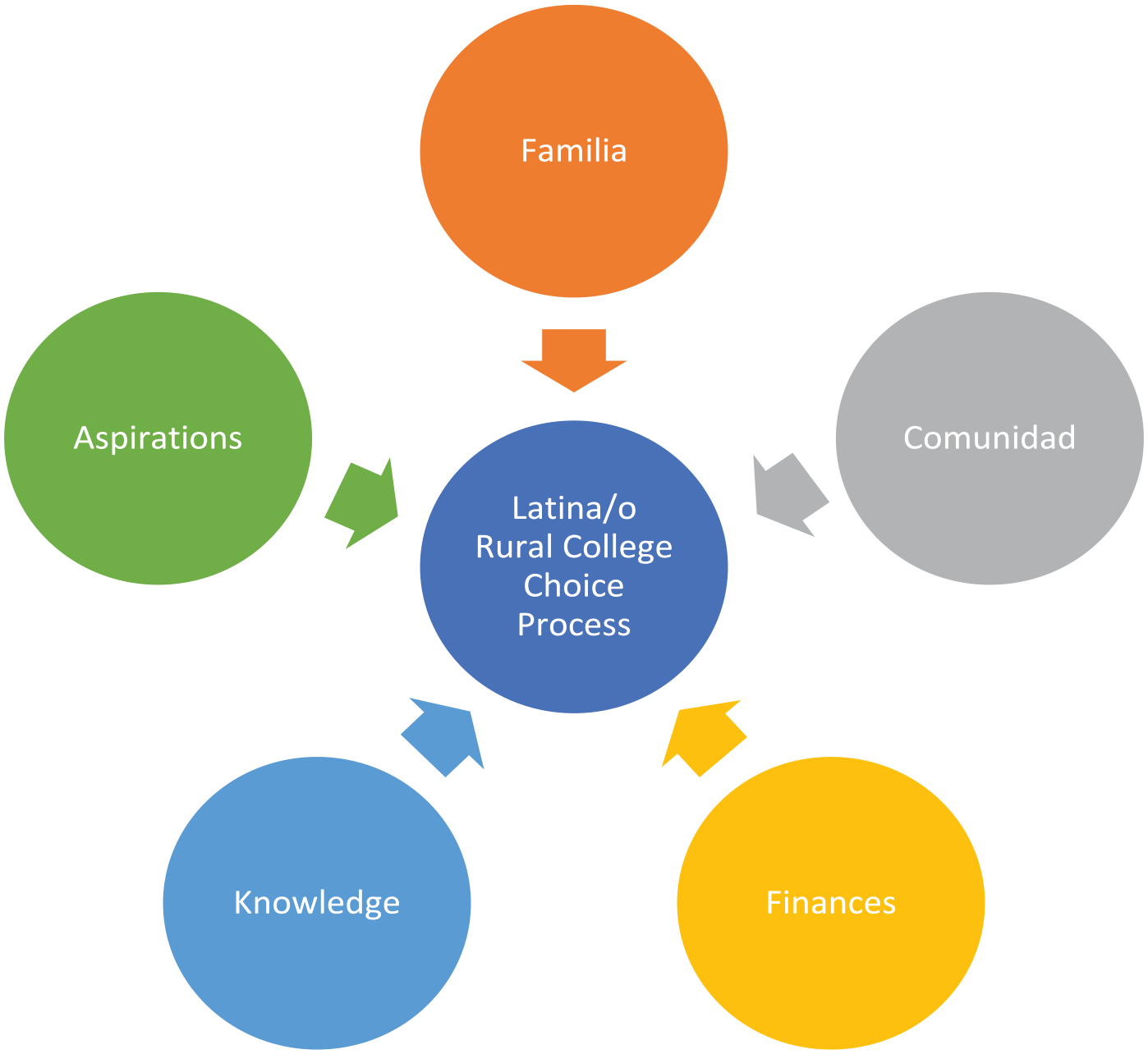
Latina/o rural college choice model.
Familia
Family played an important role in the Latina/o student college choice process. Latina/o students reported that their parents, siblings, and cousins wanted them to pursue a college education. Unfortunately, some Latina/o students did mention that parents did not want their children to go to college far away from home. This is significant because here you have individuals whom these students trust, and they are telling their children “I support you, but I do not want to you to go too far to college.” Extended families also provide information about colleges and vouch for institutions. In channeling Yosso’s (2005) Community of Cultural Wealth, Latina/o students do not make a life-altering decision solely, but with their families.
Comunidad
Latina/o rural students’ comunidad or community niche plays a role in their choice for not seeking college options that will take them far from home. This reassures them of safety, financial viability, and emotional support; but limits their options. Latina/o students shared that their schoolteachers, classes, and counselors advise them on where to go to college or what colleges to consider. Since the school is such a community hub for these Latina/o students, the teachers and administrators heavily invest in their students’ lives and help them better prepare for college. Unfortunately, administrators encourage rural students to only choose among community colleges or 4-year schools in these rural communities. Scholars argue that educators can often deliberately push these students to choose one type of college over another because some students go distant universities and drop out when they do not have the right support system or culture for rural community students (Holland, 2020; McDonough et al., 2010).
Campus visits expanded the students’ community and helped students visualize themselves on the campuses they visited. Additionally, data also highlighted the importance of family going along on-campus visits with the Latina/o student. Once the student and family can visualize the student’s experience at college, they are more open to going away to school. This is consistent with Cortez et al. (2014) who concluded that mothers play an emotional, financial, and moral support role in preparing their students for college.
Finances
Latina/o students encounter economic issues that influence their college choice process as well. While most were worried about how they were going to pay for college, some Latina/o students were limiting their choices to the local community college or local university because it would help minimize the college cost even though they would rather attend a 4-year college. They did not see financial aid as providing access. This illustrates Yosso’s (2005) resistance capital because Latina/o rural students knew that they had college-going financial constraints. Yet they relied on their parents, school community, and extended family members’ consejos (advice), and even conversations on the value of higher education to pursue a higher education.
Knowledge
Early experience with college standards gave Latina/o students the confidence that they would be successful in college. Whether the student was taking courses for college credit or simply honors courses at their high school, it gave them confidence that they could do college. In contrast, knowledge of careers was limited. There were exceptions at the early college high school or some students who had participated in AVID, but overall Latino students described an impoverished career choice process. Most were limited to the careers they saw on television or in their extended family. When the extended family is in a similar socioeconomic status, their careers do not include a rich variety of career interests. Consequently, they need better career exploration, and it cannot wait until they get to college.
Aspirations
Virtually all Latina/o students interviewed wanted to pursue a college education even in 12th grade when plans become more “realistic.” They spoke of strong encouragement from parents and extended family. Such findings explain how Yosso’s Aspiration capital influences the college choice process of Latina/o rural students. They also provide a counternarrative that debunks the negative stereotype that Latina/o students do not want to go to college or that they only pursue community college. Our findings revealed that high schools are in part responsible for Latina/o rural students’ choice of a local community college or university.
Limitations
This study faced several limitations when conducting our interviews. Particularly, Covid-19 completely blindsided our in-person interview process. We tried to switch to virtual interviews, but responses were low. Only two students were interviewed virtually. We also believed that to continue would be a different study about college choice during a pandemic rather than rural Latina/o college choice. Another limitation was that we did not follow through on exploring who went to college. Because intent to enroll is highly predictive of who enrolls in college, and because of Covid-19, we did not confirm enrollment.
Implications for Further Research and Conclusion
While this study contributes to the minimal scholarly work on rural student research, it also leaves room for further growth and further research development around Latina/o rural student college choice process. For example, there needs to be a stronger scholarly focus on the impact that school programming for college choice has on Latina/o rural students when family influence is taken into consideration. We found that the Latinx students were not connecting to their school counselors in the same way as White students. This is a missing important element in the college choice process literature for Latina/o rural students and rural students in general.
Additionally, utilizing a white cultural lens exclusively to develop programming does not help students who are bi-cultural or from a different cultural system. Most of the college choice literature and recommendations for school counselors were developed with a white, middle to upper-class cultural lens. A white lens focuses on children’s independence from parents as they go “off to college” and a white lens does not associate stigma with financial aid like it does with other forms of government assistance, such as welfare. A Latinx cultural lens focuses on the student’s transition to college as a continuation of their membership in the extended family and discomfort with discussing family finances outside the family.
Therefore, as practitioners, we must seek for financial aid information to be more culturally inclusive as the schools in this study were talking to students about grants, but Latina/o students were not hearing that the grants were for them. Further, they need exposure to people who look like them in a variety of professional careers to expand their choice set and can visualize themselves in that role. Therefore, while there is a lot of room for improvement in rural student research, a scholarly focus on Latina/o rural students is a path on the right track toward expanding the overall rural student research agenda in higher education.
Footnotes
Declaration of Conflicting Interests
The author(s) declared no potential conflicts of interest with respect to the research, authorship, and/or publication of this article.
Funding
The author(s) disclosed receipt of the following financial support for the research, authorship, and/or publication of this article: This research was supported by the Greater Texas Foundation through the Texas A&M AgriLife Extension Services under Grant 02 - 424181. All findings and views expressed in this paper are the authors and may not represent the Greater Texas Foundation, or the AgriLife Extension Services. We are grateful for their support.
