



Abstract
Missing data are a common challenge across scientific disciplines. Current imputation methods require the availability of individual data to impute missing values. However, missingness often requires using external data for the imputation, particularly in multisite settings and federated analyses. We introduce a new command,
Keywords
Introduction
Missing data are a common challenge to statistical inference in various scientific disciplines (Carpenter et al. 2023). Commonly, sporadic or partially missing data occur in single studies and can be handled with conventional imputation approaches available with the
While there have been extensive efforts to address systematically missing data in individual participant data meta-analysis with multiple imputation (Burgess et al. 2013; Resche-Rigon et al. 2013; Jolani et al. 2015; Quartagno and Carpenter 2016; Audigier et al. 2018; Resche-Rigon and White 2018; Jolani 2025), a crucial prerequisite for current multiple-imputation approaches is the availability of individual data. However, sharing individual data is often not possible or desired because of logistic, legal, and administrative barriers. Consequently, standard imputation procedures become infeasible because there is no basis for imputation because of the lack of observed data on missing values at certain study sites. While it is possible to restrict the analysis only to studies with complete data, this approach is undesirable because of the potential loss of efficiency and validity (Debray et al. 2013).
In previous work, we described the substantive idea of imputing missing values without sharing individual participant data across study sites (Thiesmeier et al. 2025). This approach can be particularly useful in multisite settings and federated analyses where covariates across study sites are not consistently collected (Popovic 2017). However, software facilitating the imputation without individual data is currently not available. Therefore, we introduce a new command,
The underlying theoretical considerations of imputing missing values without the need of sharing individual participant data have been described in detail in previous work. Resche-Rigon and White (2018) described the fundamental basis of this process as a two-stage imputation process. Chang et al. (2020) presented and evaluated multiple algorithms specifically for distributed health-data networks and aspects of multivariate imputation techniques in federated settings. We further described and evaluated the imputation of systematically missing data for continuous variables using quantile regression (Bottai and Zhen 2013; Thiesmeier, Bottai, and Orsini 2024). An extension of this approach was presented for categorical variables using multinomial logistic regression (Thiesmeier, Hofer, and Orsini 2025).
The remaining parts of this article are structured as follows. First, the methods underlying
Methods
In this section, we outline the general steps ol imputing missing values using external data. We follow notations similar to those presented in Thiesmeier, Bottai, and Orsini (2024) and Thiesmeier, Hofer, and Orsini (2025). Here we consider systematically missing data because they are a common missing-data challenge involving multiple studies. Such missing values may affect important covariates that are not measured or collected. Although the focus is on systematically missing data,
Imputation of missing values using external prediction equations
Let zij denote observations from independent random variables Zij in the jth study. The index i, identifying an individual, ranges from 1 to nj, and the index j, identifying a study, ranges from 1 to J. In addition, let us denote with
First, in each study J ∈ B, fit an imputation model on zi dependent on a set of predictors
Second, the matrices including the regression coefficients
Third,
Finally, a substantive model can be fit in each imputed dataset, and estimates are pooled with Rubin’s rules, provided by
Imputation methods
We have implemented three imputation methods for continuous, discrete, and binary variables in the current version that can be handled with
Continuous variables
A continuous missing variable can be imputed by sharing the estimates of linear predictors of quantile regression models; this has been previously described (Bottai and Zhen 2013; Thiesmeier, Bottai, and Orsini 2024).
In J

There are 99 sets of regression coefficients

where F = [Ui%] and mod = Ui% — [Us%].
Categorical variables
A categorical missing variable zi with K levels can be imputed by sharing k linear predictors of multinomial logistic regression models (Thiesmeier, Hofer, and Orsini 2025). We denote θik as the probability that zi is equal to level k, given a set of predictors
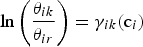
where r is the reference level. The estimated predicted conditional probabilities of falling into the levels of the categorical variable zi are denoted as
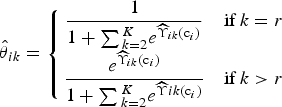
The conditional predicted cumulative distribution function,
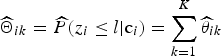
In J ∈ A, a random draw Ui from a continuous uniform distribution U(0,1) is taken.
The mth imputation
Binary variables
A binary (coded as 0 or 1) missing variable can be imputed by sharing the linear predictors of logistic regression models (Thiesmeier, Hofer, and Orsini 2025). When zi is binary, we denote θi as the probability that zi = 1, given a set of predictors
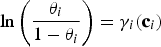
Here

In the set of studies J ∈ A, we take a random draw Ui from a continuous uniform distribution U(0,1) and assign
The syntax
mi impute from

After
Options
Additionally, the options
Stored results
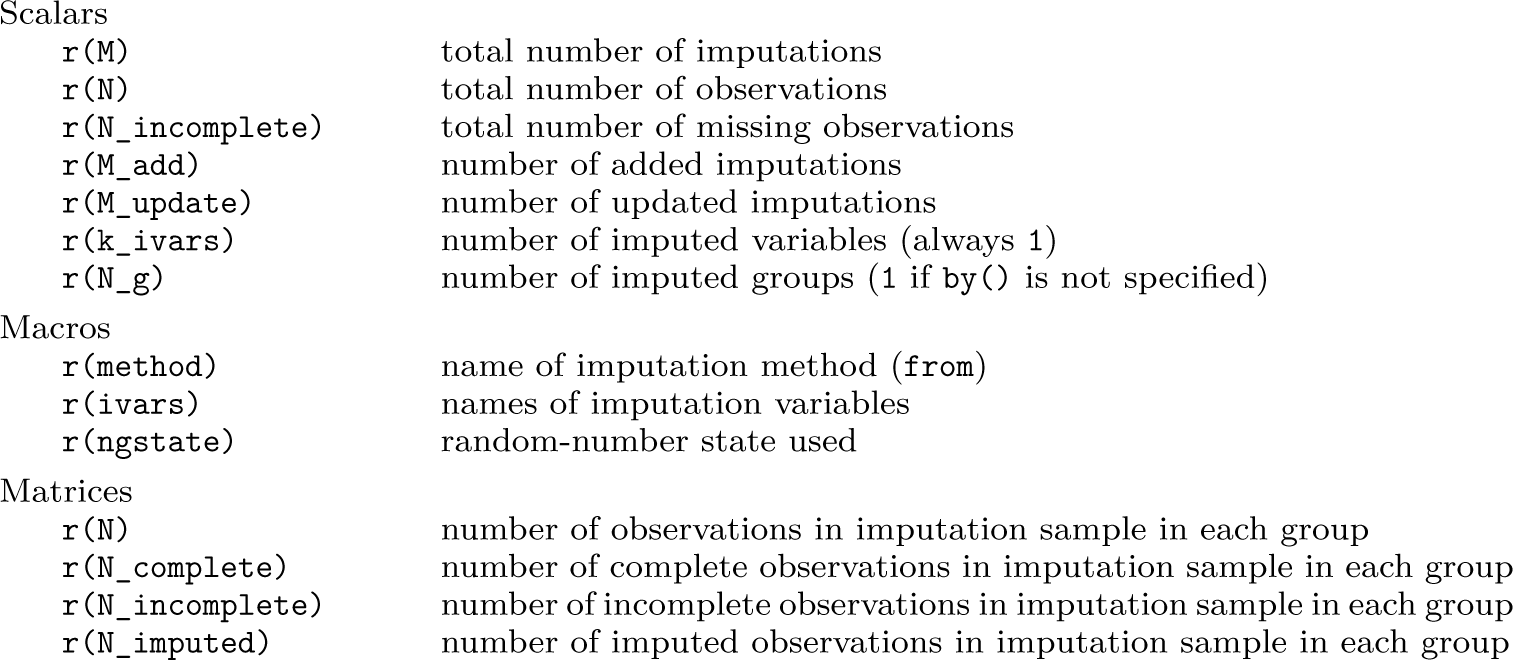
mi_impute_from_get
The command

Options
Stored results

Examples
In the following section, we provide multiple examples to impute missing values with external data. The individual data used for the examples are available as supplementary material.
Example 1: Missing continuous confounder
Considering multiple studies to answer the same research question can improve the gen- eralizability of findings and is increasingly becoming the norm in international research collaborations (Toh et al. 2013). However, data between studies often cannot be shared (Casaletto et al. 2023). In this example, we consider a collaborative research project involving five observational studies. The aim is to estimate the adjusted odds ratio (or) for the exposure in all five studies. All studies have collected data on the outcome (Y), the exposure (X), and two confounding variables (C and Z). However, in study 1, the confounding variable Z is 100% missing, and it is not possible to estimate the fully adjusted OR for the exposure. Either study 1 has to be excluded from the fully adjusted analysis or the adjustment for the confounder Z has to be disregarded. Both options are undesirable. Therefore, we borrow information from studies that have collected data on the confounder Z to impute the missing values in study 1. Table 1 shows descriptive characteristics and estimated
Descriptive statistics and estimated ORs (95% confidence interval [Cl]) with a different degree of adjustment. Q25 = 25th percentile, Q95 = 95th percentile.
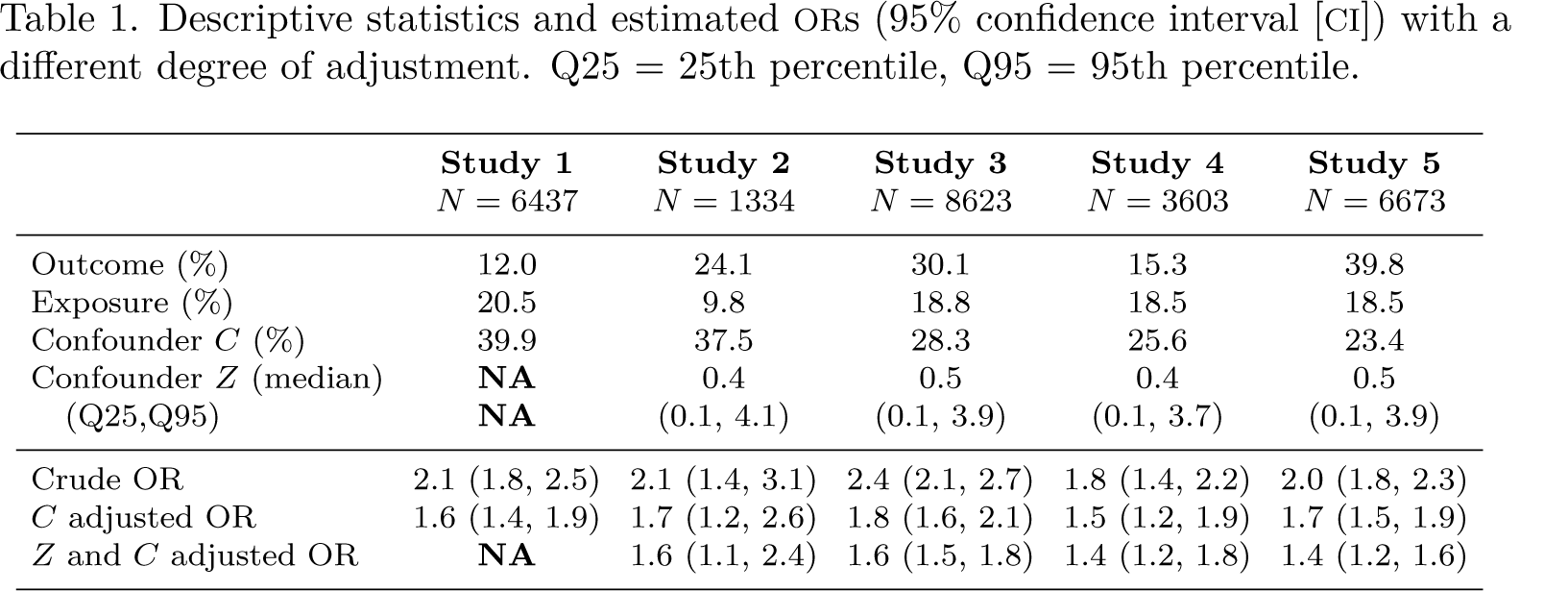
Descriptive statistics and estimated ORs (95% confidence interval [Cl]) with a different degree of adjustment. Q25 = 25th percentile, Q95 = 95th percentile.
We can choose a single study to specify an imputation model for the confounder Z. For example, let us estimate 99 conditional quantiles for Z as a function of Y, X, and C in study 2. The imputation regression coefficients are exported into a text file that is easy to share between studies. In study 1, the text files of the regression coefficients
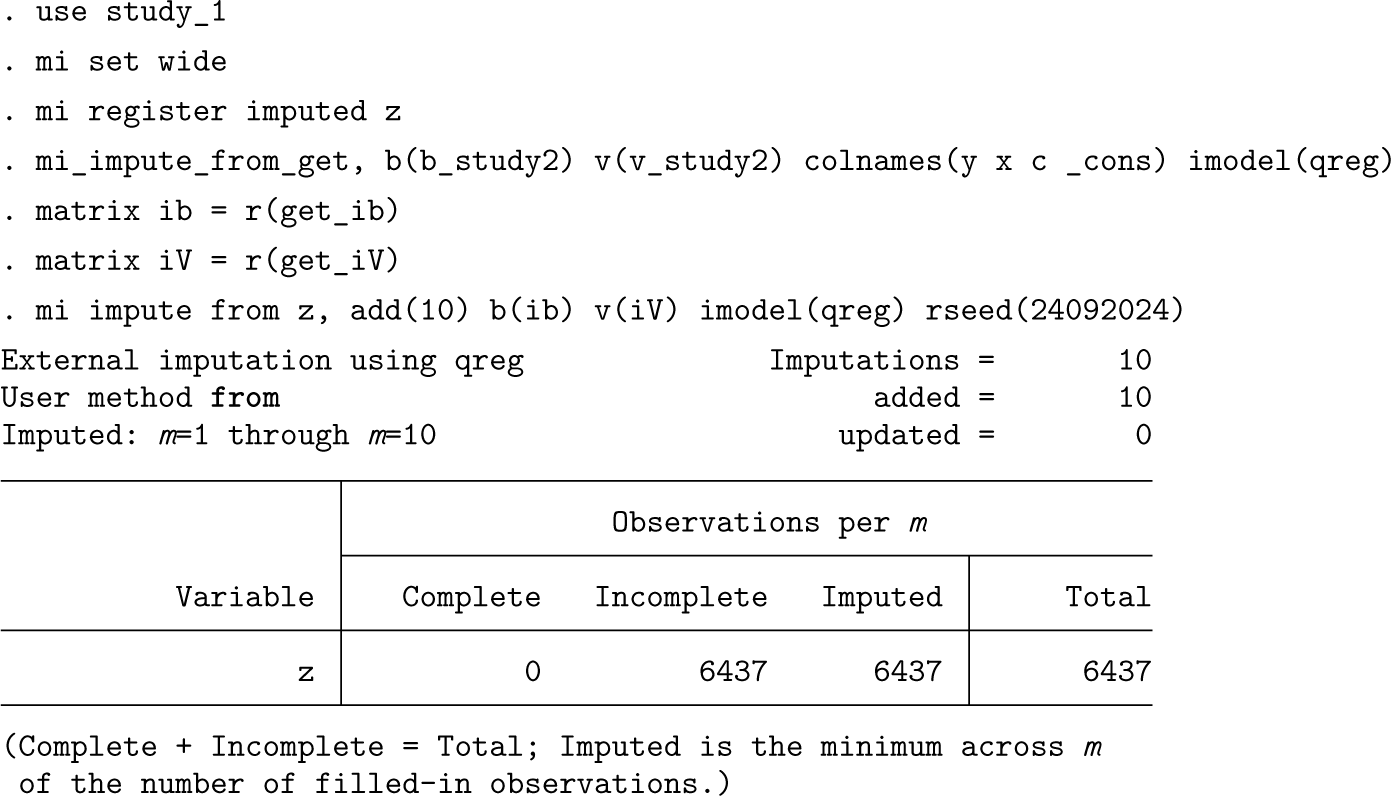
The total number of imputed values equals the total sample size in study 1. The
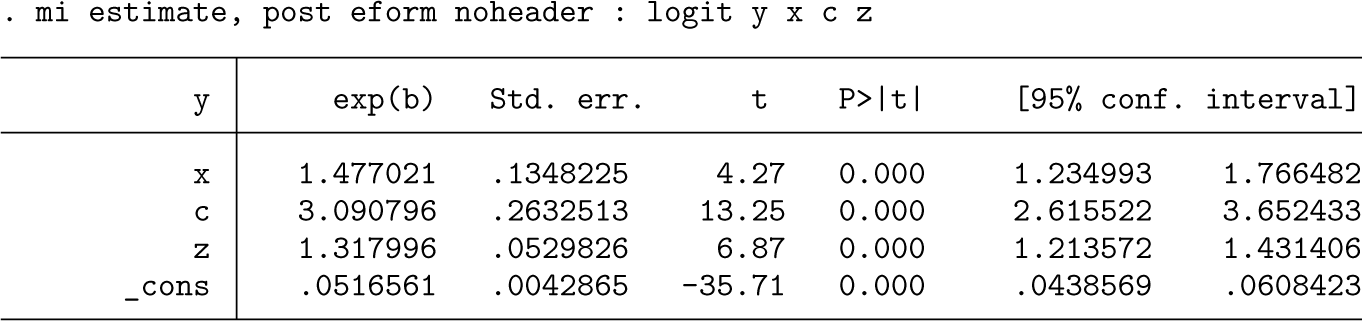
The estimated fully adjusted
Using multiple external studies
Alternatively to using a single study, we can derive an imputation model from all four studies. After specifying a prediction model on Z conditional on Y, X, and C in studies 2, 3, 4, and 5, we import the list of text files of the regression coefficients
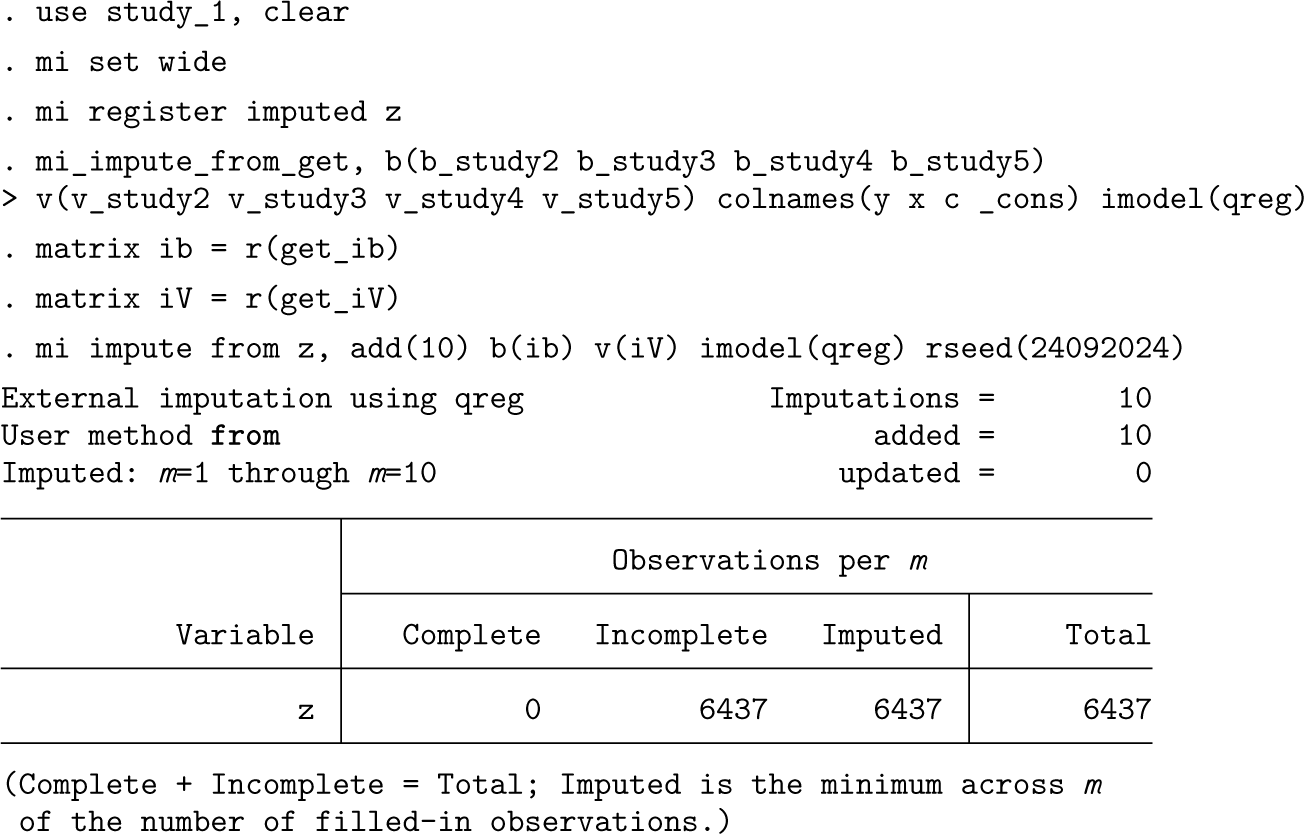
A multivariate logistic regression model is fit in the imputed datasets, and results are combined with Rubin’s rules to obtain a final estimate of the fully adjusted
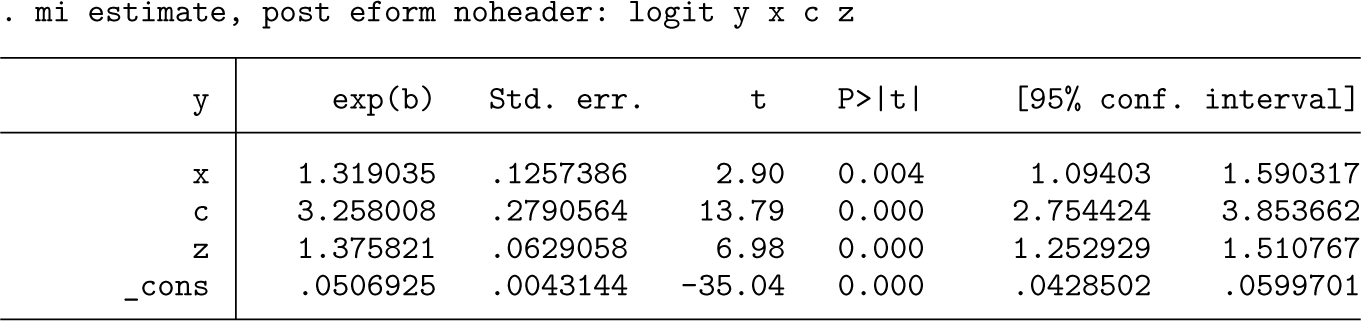
The estimated imputed fully adjusted
All studies were simulated under a heterogeneous data-generating mechanism. The fully adjusted
Example 2: Missing confounder in a federated analysis with 10 large studies
In this section, we extend the challenge of systematically missing confounders and illustrate a more complex example on how to impute missing variables in a federated framework using
Two approaches to deal with systematically missing data are common in federated analyses. First, only studies with available data on C are used in the meta-analysis. However, a complete case analysis can introduce bias in the analysis because the included studies might not be representative of the overall population any more. Second, only variables that have not been measured are omitted from the statistical model at study sites with systematically missing data. This approach, too, increases the risks of bias in the analysis if, for example, the omitted variables are important confounders. Therefore, both approaches are not desirable. Alternatively, we wish to impute data on the missing variable C in the three studies that have not measured it by using information from the seven studies in which C was fully observed.
We implement the following approaches as described in more detail in Thiesmeier et al. (2025).
Control analysis: Ten studies are analyzed with complete data. This approach serves as a reference (that is, control) scenario. Complete case analysis: Seven studies are analyzed with complete data. Three studies with completely missing data on C are excluded. Available data analysis: Ten studies are analyzed, but the confounding variable C is omitted from the statistical model in studies 8, 9, and 10. Analysis after multiple imputation: Ten studies are analyzed. In studies 8, 9, and 10,
We conduct a two-stage meta-analysis in all approaches. First, a logistic regression model on the outcome Y is fit at each study site, including A’ and, where available, C. Second, the effect estimates are pooled with a meta-analytical model with random effects using restricted maximum likelihood.
Figure 1 presents a forest plot showing the individual study effect estimates and the pooled estimate for the control approach without missing data including all 10 studies. The pooled
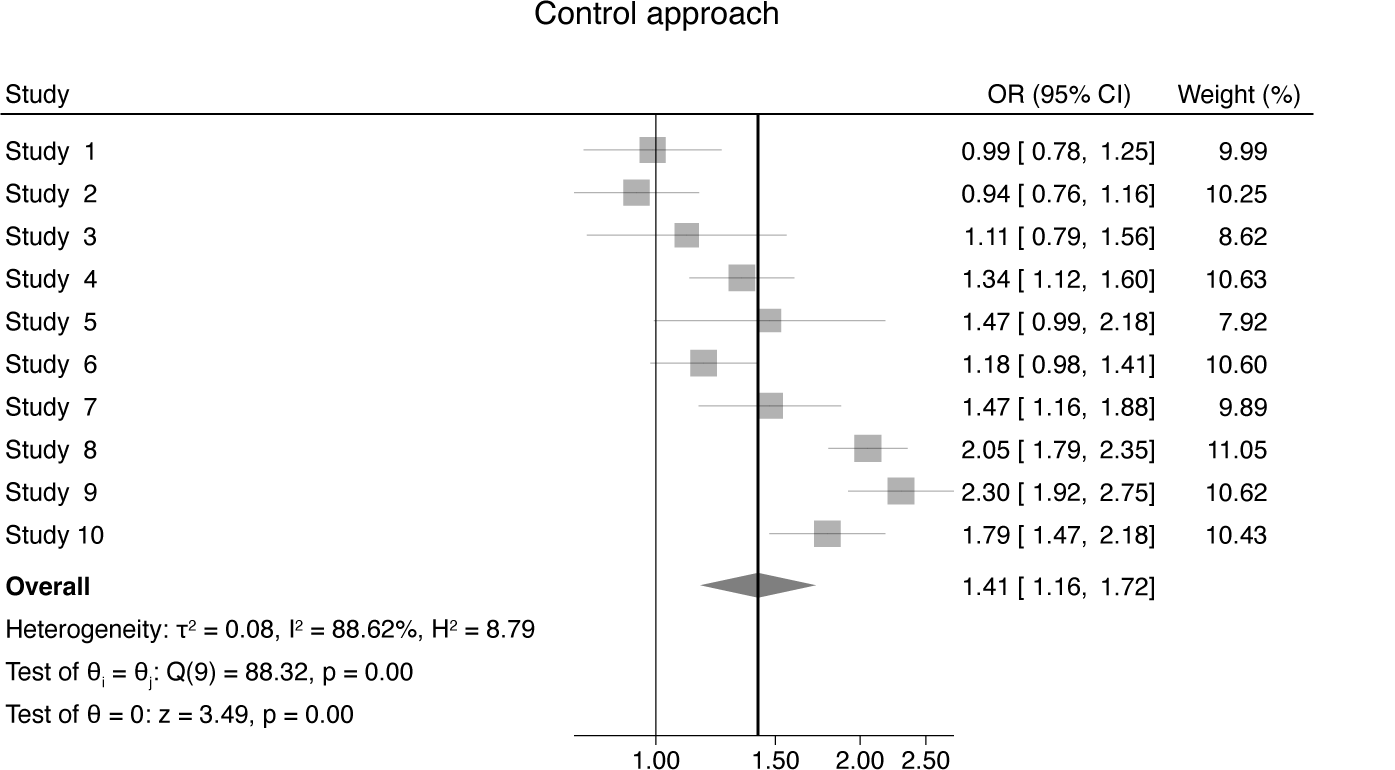
Two-stage meta-analysis of 10 observational studies without missing data
To include all studies in the analysis and adjust for the confounding variable C at study sites where data have not been collected, we used
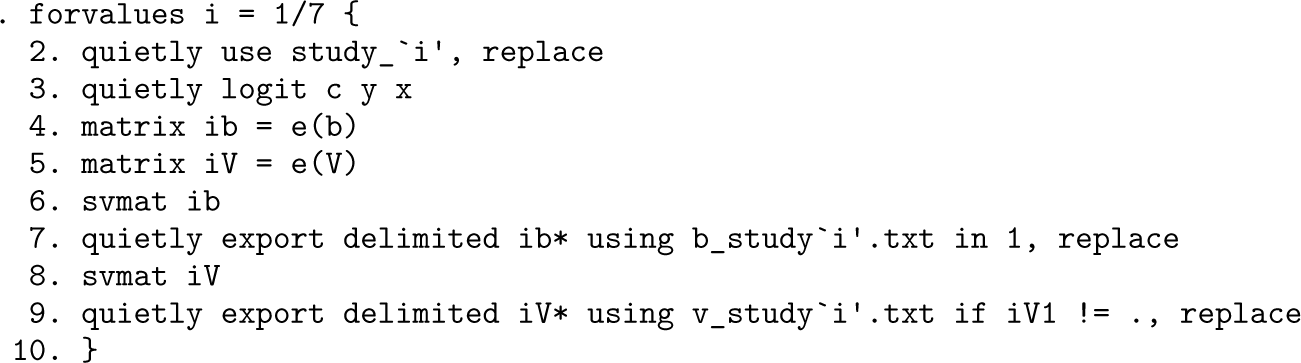
Second, the seven prediction models are pooled with a multivariate random-effects meta-analysis using restricted maximum likelihood. We use
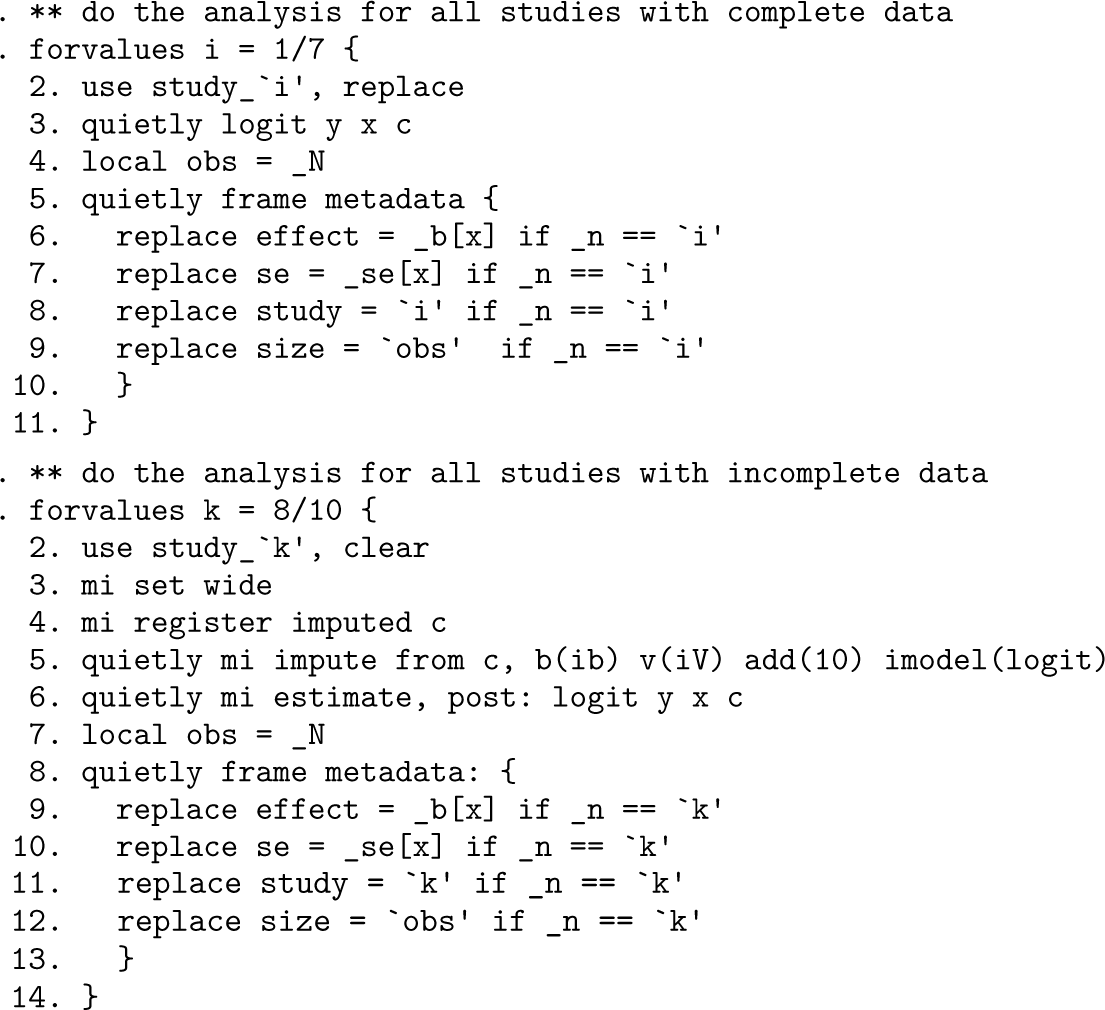
Figure 2 shows the results of all implemented approaches (panel A: Complete case analysis; panel B: Available data analysis; and panel G: Analysis after multiple imputation). The complete case analysis underestimates the overall effect estimate compared with the control approach (
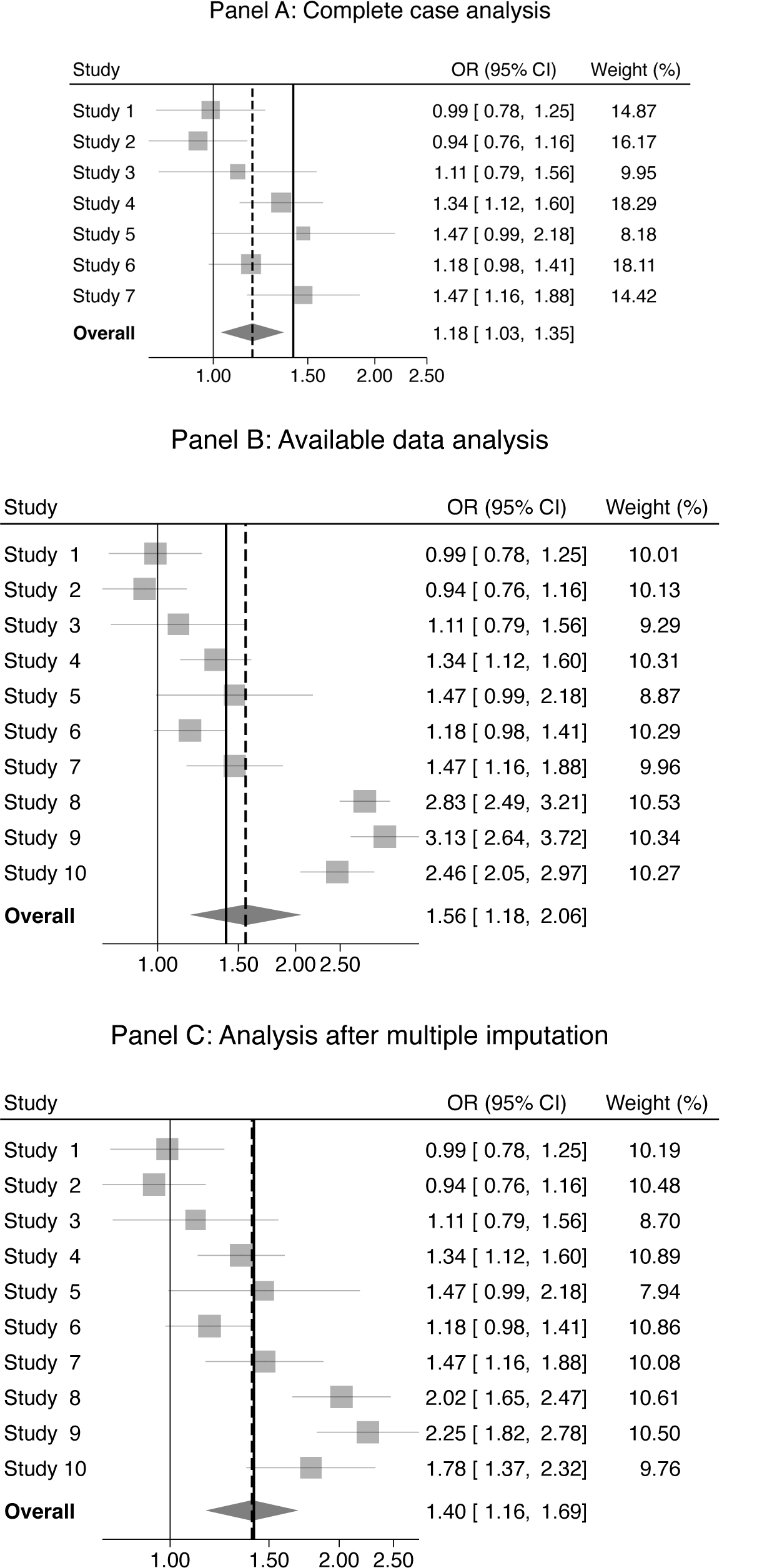
Two-stage meta-analysis of A) 7 studies excluding those with systematically missing data; B) 10 studies excluding the systematically missing variable from the regression model in studies 8, 9, and 10; and G) 10 studies after using multiple imputation to impute the systematically missing confounder in studies 8, 9, and 10. The black line represents the pooled estimate from the control approach (
Multisite trials are often considered to study differential treatment effects (Riley, Lambert, and Abo-Zaid
Characteristics of trial sites 1 and 2, including the number of cases, the baseline failure rate per 1,000 person-years, and the estimated hazard ratio (HR.) (95% Cl) of the treatment X at the low, medium, and high levels of the effect modifier Z.
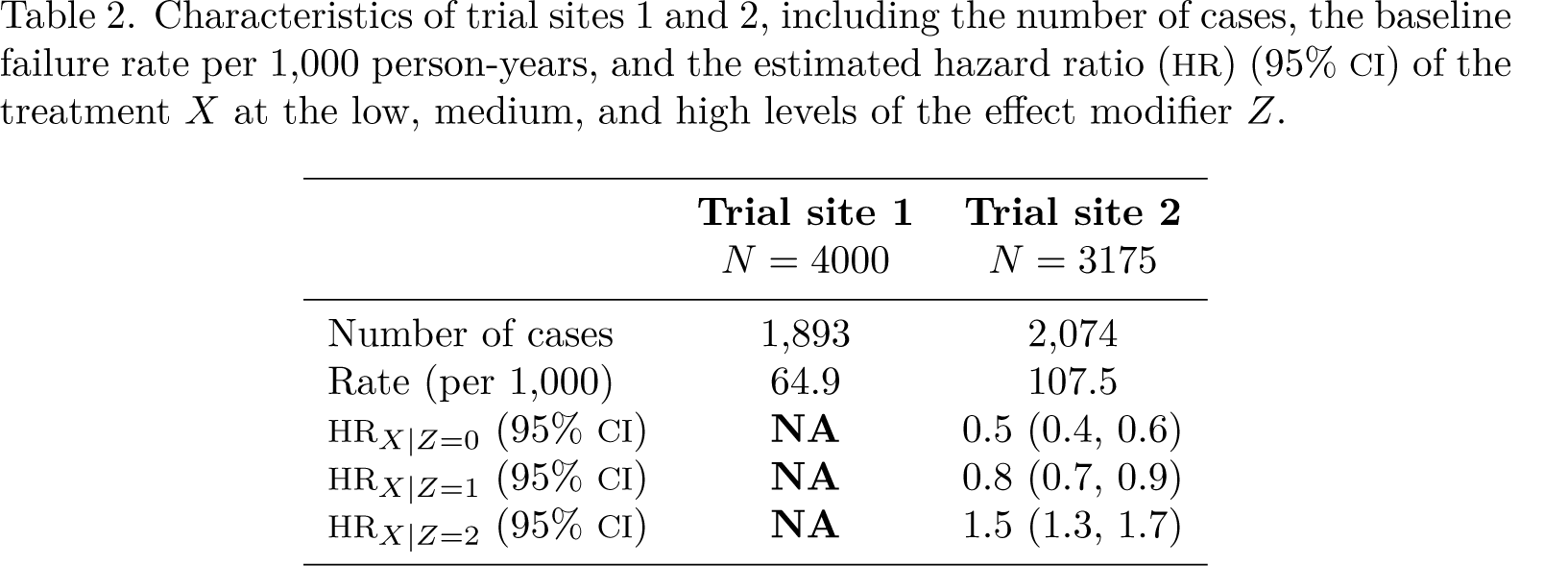
Characteristics of trial sites 1 and 2, including the number of cases, the baseline failure rate per 1,000 person-years, and the estimated hazard ratio (HR.) (95% Cl) of the treatment X at the low, medium, and high levels of the effect modifier Z.
To be able to include both sites in the analysis, we specify a multinomial logistic regression model in trial site
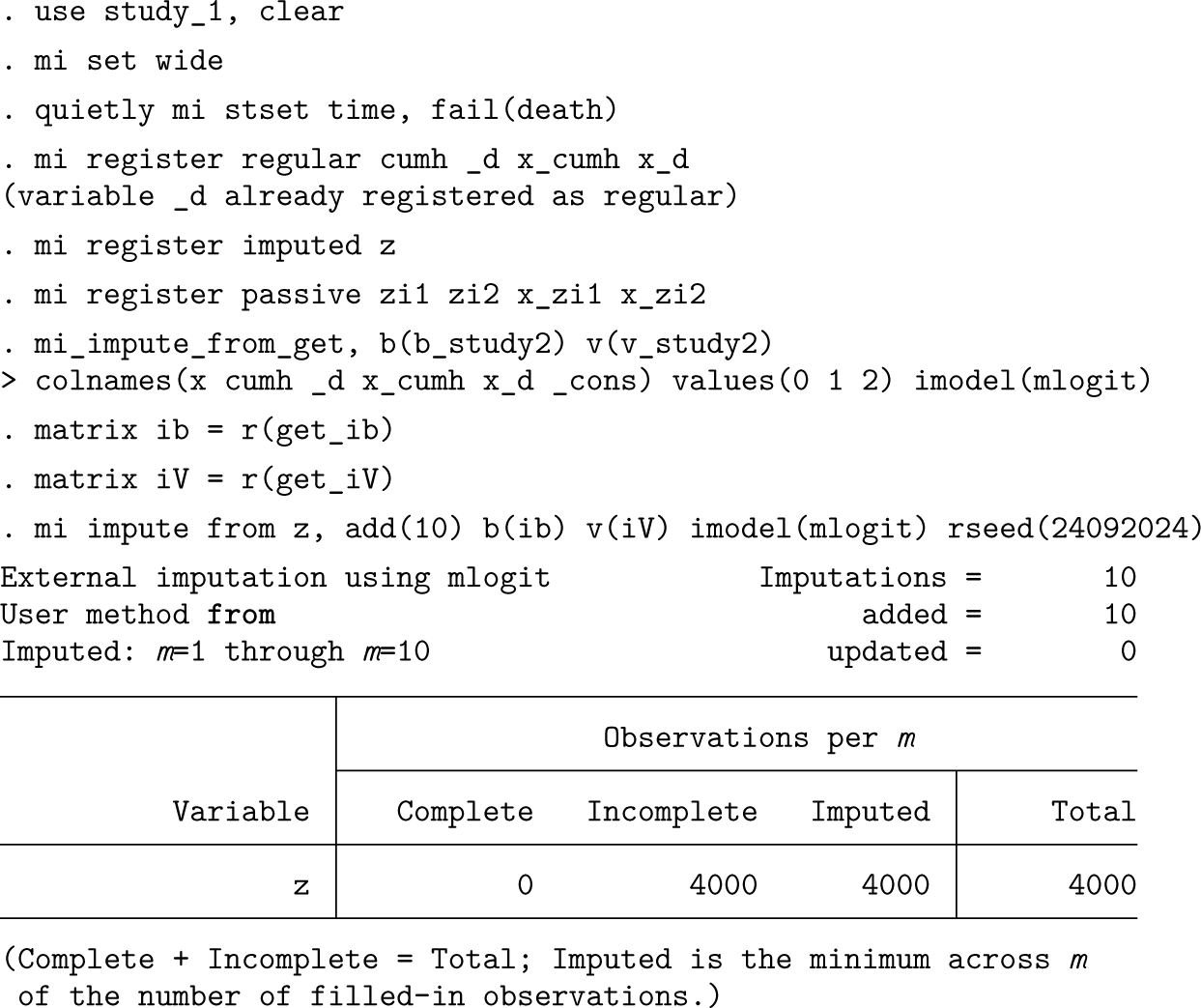
After we impute the missing values for the effect modifier Z, a Cox regression model is fit in each imputed dataset, and the estimates are pooled with Rubin’s rules.
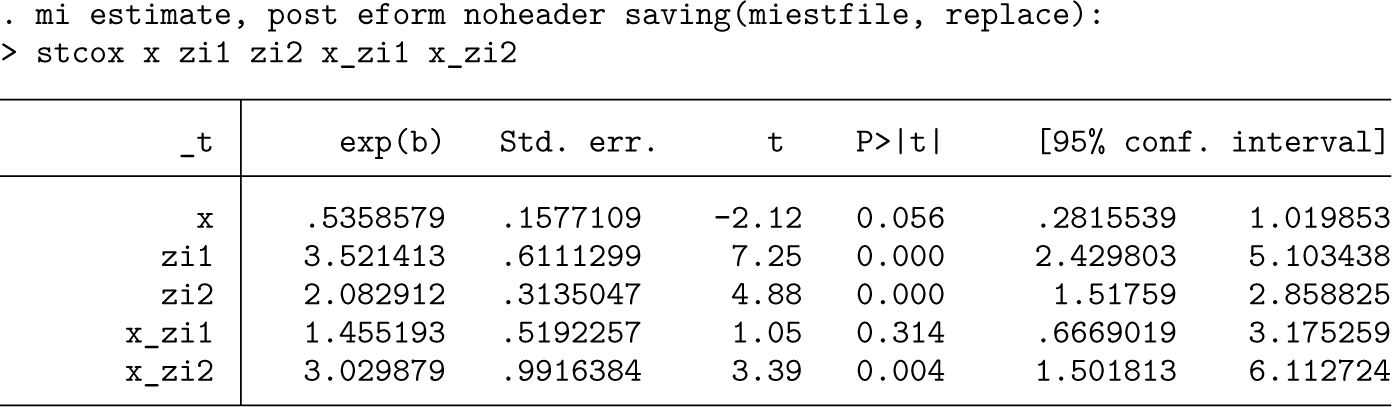
At trial site 1, the effect of the treatment is estimated to reduce the mortality rate by 46% (
Of note, the set values of the trial sites were
Developing prediction models based on large observational studies is common in many health-related research fields (Debray et al. 2017). In this example, we consider a large study in which a prediction model for the outcome Y is specified with all available predictors, say, X and C. The predictive capacity of the model is quantified with the area under the curve
Sample size and AUC of the prediction model in study 1 and the external study 2
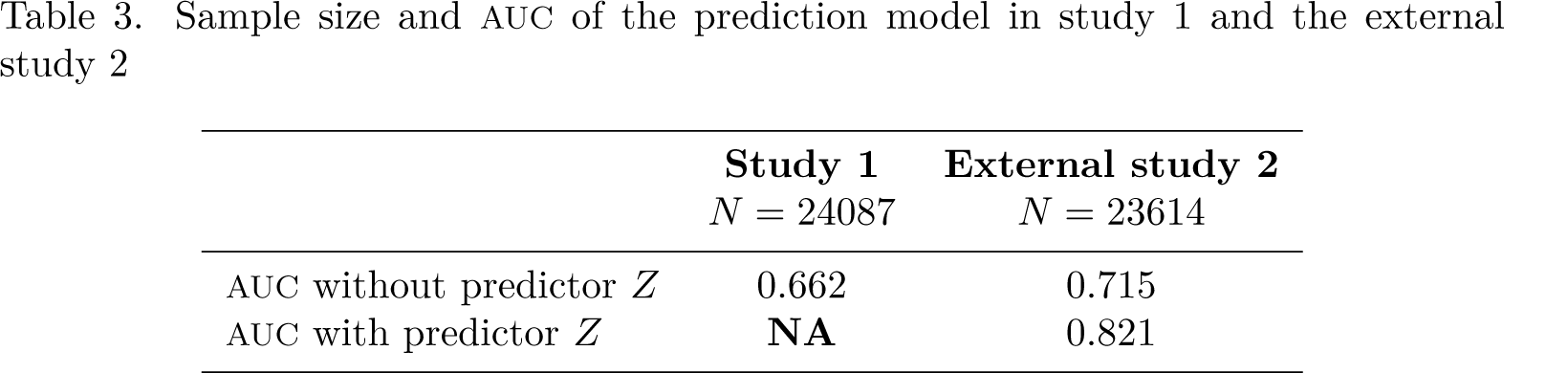
Sample size and
To evaluate the impact of Z on the predictive performance of the model in study 1, we first need to get information on Z in relation to other observed variables in study 2. In study 2, a logistic regression model is specified on Z conditional on Y, X, and C. The regression coefficients and covariance matrix are exported as text files to study 1. The text files are then used for
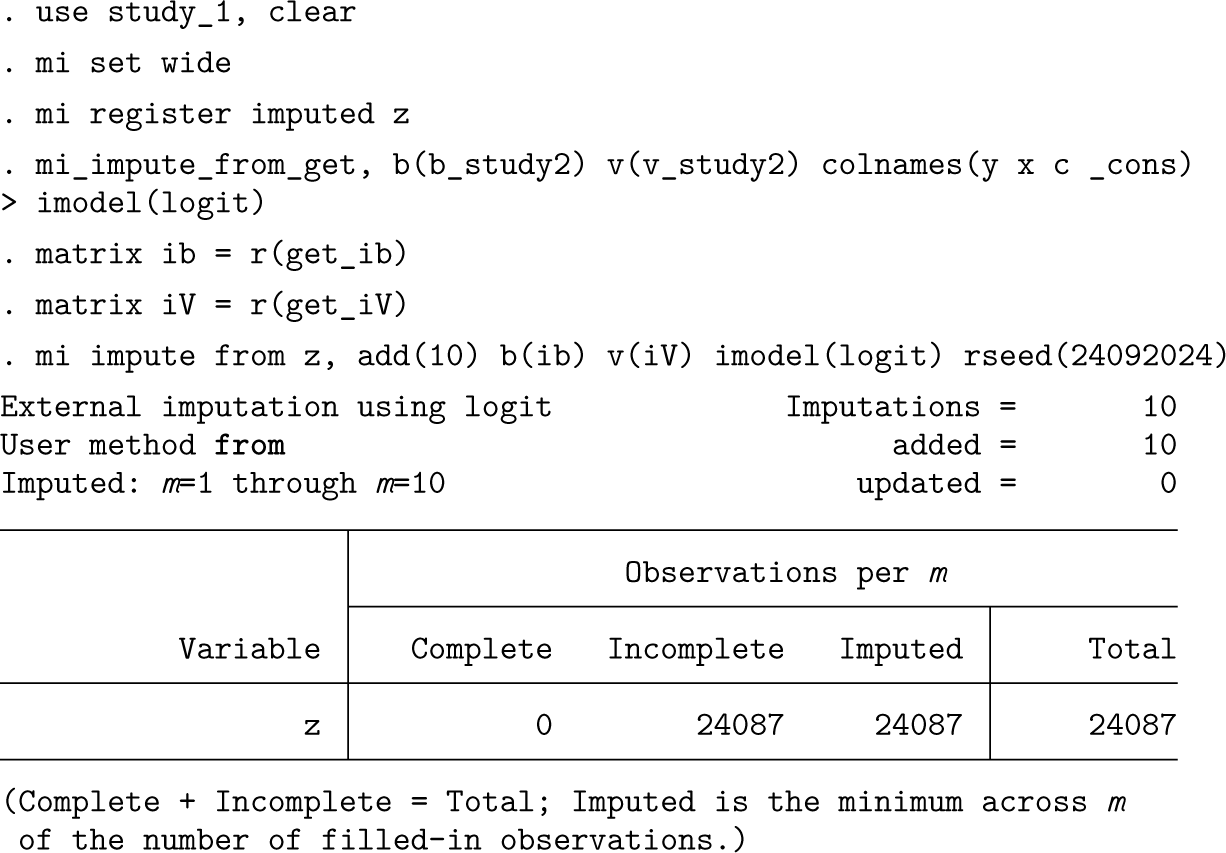
A multivariate logistic regression model is fit in each imputed dataset to obtain 10 estimates for the
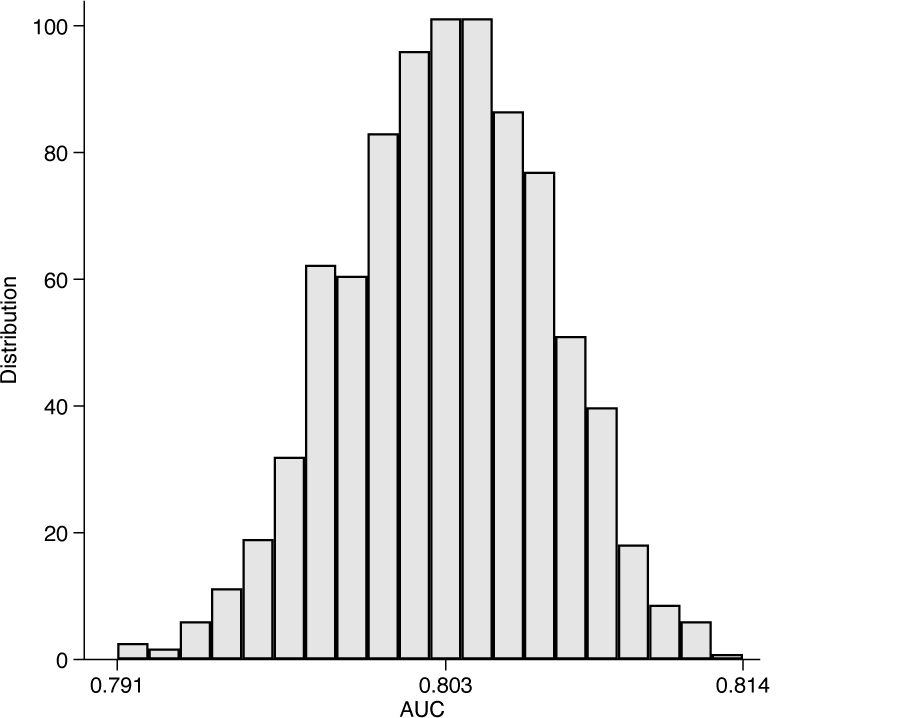
Distribution of the
This example illustrated how
The main use of
Additionally, we showed that
Related concepts also appear in econometrics, where methods such as two-sample two-stage least-squares estimate associations between variables that are never jointly observed, by combining information from structurally related but nonoverlapping datasets (Bjorklund and Jantti 1997; Inoue and Solon 2010). While primarily developed for causal inference, these methods share important features with the described imputation- based strategy for systematically missing values: both rely on shared variables and structural assumptions to recover missing or unobserved information. These parallels illustrate how
Conclusions
We introduced and illustrated a new command,
By enabling users to share model parameters instead of individual data,
While designed for use in the multiple-imputation framework, the method also lends itself to structured sensitivity analysis, allowing researchers to explore the impact of unmeasured or unavailable variables. Future development will focus on improved diagnostics, potential integration with the
Acknowledgments
This work was supported by the National Infrastructure
Programs and supplemental materials
To install the software files as they existed at the time of publication of this article, type

A more recent version of the command may be available from the Statistical Software Components Archive by typing

Supplemental Material
sj-dta-1-stj-10.1177_1536867X251398605 - Supplemental material for Imputing missing values with external data: Applications for multisite settings and federated analyses
Supplemental material, sj-dta-1-stj-10.1177_1536867X251398605 for Imputing missing values with external data: Applications for multisite settings and federated analyses by Robert Thiesmeier, Matteo Bottai and Nicola Orsini in The Stata Journal
Supplemental Material
sj-dta-2-stj-10.1177_1536867X251398605 - Supplemental material for Imputing missing values with external data: Applications for multisite settings and federated analyses
Supplemental material, sj-dta-2-stj-10.1177_1536867X251398605 for Imputing missing values with external data: Applications for multisite settings and federated analyses by Robert Thiesmeier, Matteo Bottai and Nicola Orsini in The Stata Journal
Supplemental Material
sj-dta-3-stj-10.1177_1536867X251398605 - Supplemental material for Imputing missing values with external data: Applications for multisite settings and federated analyses
Supplemental material, sj-dta-3-stj-10.1177_1536867X251398605 for Imputing missing values with external data: Applications for multisite settings and federated analyses by Robert Thiesmeier, Matteo Bottai and Nicola Orsini in The Stata Journal
Supplemental Material
sj-dta-4-stj-10.1177_1536867X251398605 - Supplemental material for Imputing missing values with external data: Applications for multisite settings and federated analyses
Supplemental material, sj-dta-4-stj-10.1177_1536867X251398605 for Imputing missing values with external data: Applications for multisite settings and federated analyses by Robert Thiesmeier, Matteo Bottai and Nicola Orsini in The Stata Journal
Supplemental Material
sj-dta-5-stj-10.1177_1536867X251398605 - Supplemental material for Imputing missing values with external data: Applications for multisite settings and federated analyses
Supplemental material, sj-dta-5-stj-10.1177_1536867X251398605 for Imputing missing values with external data: Applications for multisite settings and federated analyses by Robert Thiesmeier, Matteo Bottai and Nicola Orsini in The Stata Journal
Supplemental Material
sj-dta-6-stj-10.1177_1536867X251398605 - Supplemental material for Imputing missing values with external data: Applications for multisite settings and federated analyses
Supplemental material, sj-dta-6-stj-10.1177_1536867X251398605 for Imputing missing values with external data: Applications for multisite settings and federated analyses by Robert Thiesmeier, Matteo Bottai and Nicola Orsini in The Stata Journal
Supplemental Material
sj-dta-7-stj-10.1177_1536867X251398605 - Supplemental material for Imputing missing values with external data: Applications for multisite settings and federated analyses
Supplemental material, sj-dta-7-stj-10.1177_1536867X251398605 for Imputing missing values with external data: Applications for multisite settings and federated analyses by Robert Thiesmeier, Matteo Bottai and Nicola Orsini in The Stata Journal
Supplemental Material
sj-dta-8-stj-10.1177_1536867X251398605 - Supplemental material for Imputing missing values with external data: Applications for multisite settings and federated analyses
Supplemental material, sj-dta-8-stj-10.1177_1536867X251398605 for Imputing missing values with external data: Applications for multisite settings and federated analyses by Robert Thiesmeier, Matteo Bottai and Nicola Orsini in The Stata Journal
Supplemental Material
sj-dta-9-stj-10.1177_1536867X251398605 - Supplemental material for Imputing missing values with external data: Applications for multisite settings and federated analyses
Supplemental material, sj-dta-9-stj-10.1177_1536867X251398605 for Imputing missing values with external data: Applications for multisite settings and federated analyses by Robert Thiesmeier, Matteo Bottai and Nicola Orsini in The Stata Journal
Supplemental Material
sj-dta-10-stj-10.1177_1536867X251398605 - Supplemental material for Imputing missing values with external data: Applications for multisite settings and federated analyses
Supplemental material, sj-dta-10-stj-10.1177_1536867X251398605 for Imputing missing values with external data: Applications for multisite settings and federated analyses by Robert Thiesmeier, Matteo Bottai and Nicola Orsini in The Stata Journal
Supplemental Material
sj-txt-11-stj-10.1177_1536867X251398605 - Supplemental material for Imputing missing values with external data: Applications for multisite settings and federated analyses
Supplemental material, sj-txt-11-stj-10.1177_1536867X251398605 for Imputing missing values with external data: Applications for multisite settings and federated analyses by Robert Thiesmeier, Matteo Bottai and Nicola Orsini in The Stata Journal
Supplemental Material
sj-txt-12-stj-10.1177_1536867X251398605 - Supplemental material for Imputing missing values with external data: Applications for multisite settings and federated analyses
Supplemental material, sj-txt-12-stj-10.1177_1536867X251398605 for Imputing missing values with external data: Applications for multisite settings and federated analyses by Robert Thiesmeier, Matteo Bottai and Nicola Orsini in The Stata Journal
Supplemental Material
sj-txt-13-stj-10.1177_1536867X251398605 - Supplemental material for Imputing missing values with external data: Applications for multisite settings and federated analyses
Supplemental material, sj-txt-13-stj-10.1177_1536867X251398605 for Imputing missing values with external data: Applications for multisite settings and federated analyses by Robert Thiesmeier, Matteo Bottai and Nicola Orsini in The Stata Journal
Supplemental Material
sj-txt-14-stj-10.1177_1536867X251398605 - Supplemental material for Imputing missing values with external data: Applications for multisite settings and federated analyses
Supplemental material, sj-txt-14-stj-10.1177_1536867X251398605 for Imputing missing values with external data: Applications for multisite settings and federated analyses by Robert Thiesmeier, Matteo Bottai and Nicola Orsini in The Stata Journal
Supplemental Material
sj-txt-15-stj-10.1177_1536867X251398605 - Supplemental material for Imputing missing values with external data: Applications for multisite settings and federated analyses
Supplemental material, sj-txt-15-stj-10.1177_1536867X251398605 for Imputing missing values with external data: Applications for multisite settings and federated analyses by Robert Thiesmeier, Matteo Bottai and Nicola Orsini in The Stata Journal
Supplemental Material
sj-txt-16-stj-10.1177_1536867X251398605 - Supplemental material for Imputing missing values with external data: Applications for multisite settings and federated analyses
Supplemental material, sj-txt-16-stj-10.1177_1536867X251398605 for Imputing missing values with external data: Applications for multisite settings and federated analyses by Robert Thiesmeier, Matteo Bottai and Nicola Orsini in The Stata Journal
Supplemental Material
sj-txt-17-stj-10.1177_1536867X251398605 - Supplemental material for Imputing missing values with external data: Applications for multisite settings and federated analyses
Supplemental material, sj-txt-17-stj-10.1177_1536867X251398605 for Imputing missing values with external data: Applications for multisite settings and federated analyses by Robert Thiesmeier, Matteo Bottai and Nicola Orsini in The Stata Journal
Supplemental Material
sj-txt-18-stj-10.1177_1536867X251398605 - Supplemental material for Imputing missing values with external data: Applications for multisite settings and federated analyses
Supplemental material, sj-txt-18-stj-10.1177_1536867X251398605 for Imputing missing values with external data: Applications for multisite settings and federated analyses by Robert Thiesmeier, Matteo Bottai and Nicola Orsini in The Stata Journal
Supplemental Material
sj-txt-19-stj-10.1177_1536867X251398605 - Supplemental material for Imputing missing values with external data: Applications for multisite settings and federated analyses
Supplemental material, sj-txt-19-stj-10.1177_1536867X251398605 for Imputing missing values with external data: Applications for multisite settings and federated analyses by Robert Thiesmeier, Matteo Bottai and Nicola Orsini in The Stata Journal
Supplemental Material
sj-txt-20-stj-10.1177_1536867X251398605 - Supplemental material for Imputing missing values with external data: Applications for multisite settings and federated analyses
Supplemental material, sj-txt-20-stj-10.1177_1536867X251398605 for Imputing missing values with external data: Applications for multisite settings and federated analyses by Robert Thiesmeier, Matteo Bottai and Nicola Orsini in The Stata Journal
Supplemental Material
sj-txt-21-stj-10.1177_1536867X251398605 - Supplemental material for Imputing missing values with external data: Applications for multisite settings and federated analyses
Supplemental material, sj-txt-21-stj-10.1177_1536867X251398605 for Imputing missing values with external data: Applications for multisite settings and federated analyses by Robert Thiesmeier, Matteo Bottai and Nicola Orsini in The Stata Journal
Supplemental Material
sj-txt-22-stj-10.1177_1536867X251398605 - Supplemental material for Imputing missing values with external data: Applications for multisite settings and federated analyses
Supplemental material, sj-txt-22-stj-10.1177_1536867X251398605 for Imputing missing values with external data: Applications for multisite settings and federated analyses by Robert Thiesmeier, Matteo Bottai and Nicola Orsini in The Stata Journal
Supplemental Material
sj-txt-23-stj-10.1177_1536867X251398605 - Supplemental material for Imputing missing values with external data: Applications for multisite settings and federated analyses
Supplemental material, sj-txt-23-stj-10.1177_1536867X251398605 for Imputing missing values with external data: Applications for multisite settings and federated analyses by Robert Thiesmeier, Matteo Bottai and Nicola Orsini in The Stata Journal
Supplemental Material
sj-txt-24-stj-10.1177_1536867X251398605 - Supplemental material for Imputing missing values with external data: Applications for multisite settings and federated analyses
Supplemental material, sj-txt-24-stj-10.1177_1536867X251398605 for Imputing missing values with external data: Applications for multisite settings and federated analyses by Robert Thiesmeier, Matteo Bottai and Nicola Orsini in The Stata Journal
Supplemental Material
sj-txt-25-stj-10.1177_1536867X251398605 - Supplemental material for Imputing missing values with external data: Applications for multisite settings and federated analyses
Supplemental material, sj-txt-25-stj-10.1177_1536867X251398605 for Imputing missing values with external data: Applications for multisite settings and federated analyses by Robert Thiesmeier, Matteo Bottai and Nicola Orsini in The Stata Journal
Supplemental Material
sj-txt-26-stj-10.1177_1536867X251398605 - Supplemental material for Imputing missing values with external data: Applications for multisite settings and federated analyses
Supplemental material, sj-txt-26-stj-10.1177_1536867X251398605 for Imputing missing values with external data: Applications for multisite settings and federated analyses by Robert Thiesmeier, Matteo Bottai and Nicola Orsini in The Stata Journal
Supplemental Material
sj-txt-27-stj-10.1177_1536867X251398605 - Supplemental material for Imputing missing values with external data: Applications for multisite settings and federated analyses
Supplemental material, sj-txt-27-stj-10.1177_1536867X251398605 for Imputing missing values with external data: Applications for multisite settings and federated analyses by Robert Thiesmeier, Matteo Bottai and Nicola Orsini in The Stata Journal
Supplemental Material
sj-txt-28-stj-10.1177_1536867X251398605 - Supplemental material for Imputing missing values with external data: Applications for multisite settings and federated analyses
Supplemental material, sj-txt-28-stj-10.1177_1536867X251398605 for Imputing missing values with external data: Applications for multisite settings and federated analyses by Robert Thiesmeier, Matteo Bottai and Nicola Orsini in The Stata Journal
Supplemental Material
sj-txt-29-stj-10.1177_1536867X251398605 - Supplemental material for Imputing missing values with external data: Applications for multisite settings and federated analyses
Supplemental material, sj-txt-29-stj-10.1177_1536867X251398605 for Imputing missing values with external data: Applications for multisite settings and federated analyses by Robert Thiesmeier, Matteo Bottai and Nicola Orsini in The Stata Journal
Supplemental Material
sj-txt-30-stj-10.1177_1536867X251398605 - Supplemental material for Imputing missing values with external data: Applications for multisite settings and federated analyses
Supplemental material, sj-txt-30-stj-10.1177_1536867X251398605 for Imputing missing values with external data: Applications for multisite settings and federated analyses by Robert Thiesmeier, Matteo Bottai and Nicola Orsini in The Stata Journal
Supplemental Material
sj-txt-31-stj-10.1177_1536867X251398605 - Supplemental material for Imputing missing values with external data: Applications for multisite settings and federated analyses
Supplemental material, sj-txt-31-stj-10.1177_1536867X251398605 for Imputing missing values with external data: Applications for multisite settings and federated analyses by Robert Thiesmeier, Matteo Bottai and Nicola Orsini in The Stata Journal
Supplemental Material
sj-txt-32-stj-10.1177_1536867X251398605 - Supplemental material for Imputing missing values with external data: Applications for multisite settings and federated analyses
Supplemental material, sj-txt-32-stj-10.1177_1536867X251398605 for Imputing missing values with external data: Applications for multisite settings and federated analyses by Robert Thiesmeier, Matteo Bottai and Nicola Orsini in The Stata Journal
Supplemental Material
sj-txt-33-stj-10.1177_1536867X251398605 - Supplemental material for Imputing missing values with external data: Applications for multisite settings and federated analyses
Supplemental material, sj-txt-33-stj-10.1177_1536867X251398605 for Imputing missing values with external data: Applications for multisite settings and federated analyses by Robert Thiesmeier, Matteo Bottai and Nicola Orsini in The Stata Journal
Footnotes
About the authors
Robert Thiesmeier is a doctoral student in medical science (biostatistics) at the Department of Global Public Health, Karolinska Institutet, Stockholm, Sweden.
Matteo Bottai is a professor of biostatistics at the Division of Biostatistics, Institute of Environmental Medicine, Karolinska Institutet, Stockholm, Sweden.
Nicola Orsini is an associate professor of medical statistics, a senior researcher, and the head of the Biostatistics Team at the Department of Global Public Health, Karolinska Institutet, Stockholm, Sweden.
References
Supplementary Material
Please find the following supplemental material available below.
For Open Access articles published under a Creative Commons License, all supplemental material carries the same license as the article it is associated with.
For non-Open Access articles published, all supplemental material carries a non-exclusive license, and permission requests for re-use of supplemental material or any part of supplemental material shall be sent directly to the copyright owner as specified in the copyright notice associated with the article.
