



Abstract
In this article, we describe
Introduction
Clinicians, researchers, and other key stakeholders require robust tools for statistical description and classification of infant and child growth. Prescriptive growth standards, which describe how a child “should” grow given optimal conditions, should be used to identify nutritionally at-risk infants and inform targeting of therapeutic interventions (Bertino et al. 2007; Ohuma and Altman 2019a). Currently, two sets of global prescriptive standards exist: the World Health Organization (
The Guidance for International Growth Standards (
INTERGROWTH-21st standards
Newborn size
We have included seven
intergrowth -21st newborn size standards
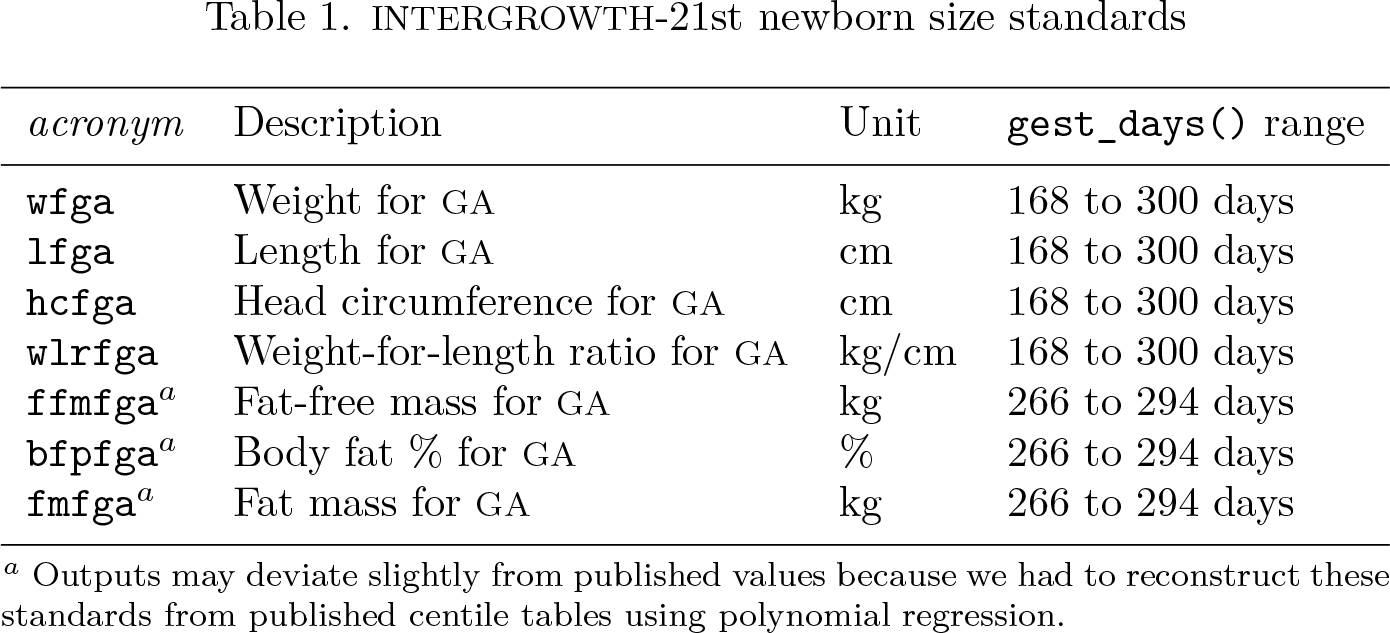
Outputs may deviate slightly from published values because we had to reconstruct these standards from published centile tables using polynomial regression.
The preterm or term newborn size standards were based on singleton birth data from 20,486 mothers from sites in Brazil, China, India, Italy, Kenya, Oman, the
Implementation details for each standard vary based on the measurement type and
Villar et al.’s (2014a) standards for newborn weight, length, and head circumference were fit using the
The weight-for-length ratio standard was also fit using fractional polynomial regression, and the equations for the mean and standard deviation at different
The
INTERGROWTH-21st postnatal growth standards for preterm infants
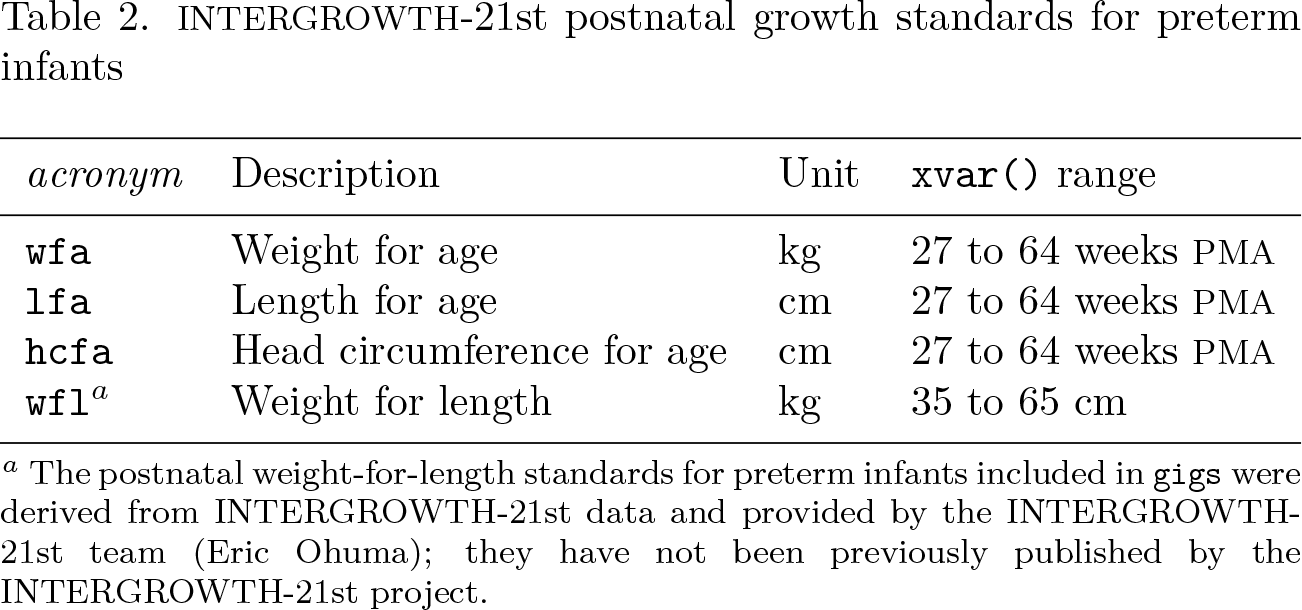
INTERGROWTH-21st postnatal growth standards for preterm infants
The postnatal weight-for-length standards for preterm infants included in
The
intergrowth -21st fetal standards
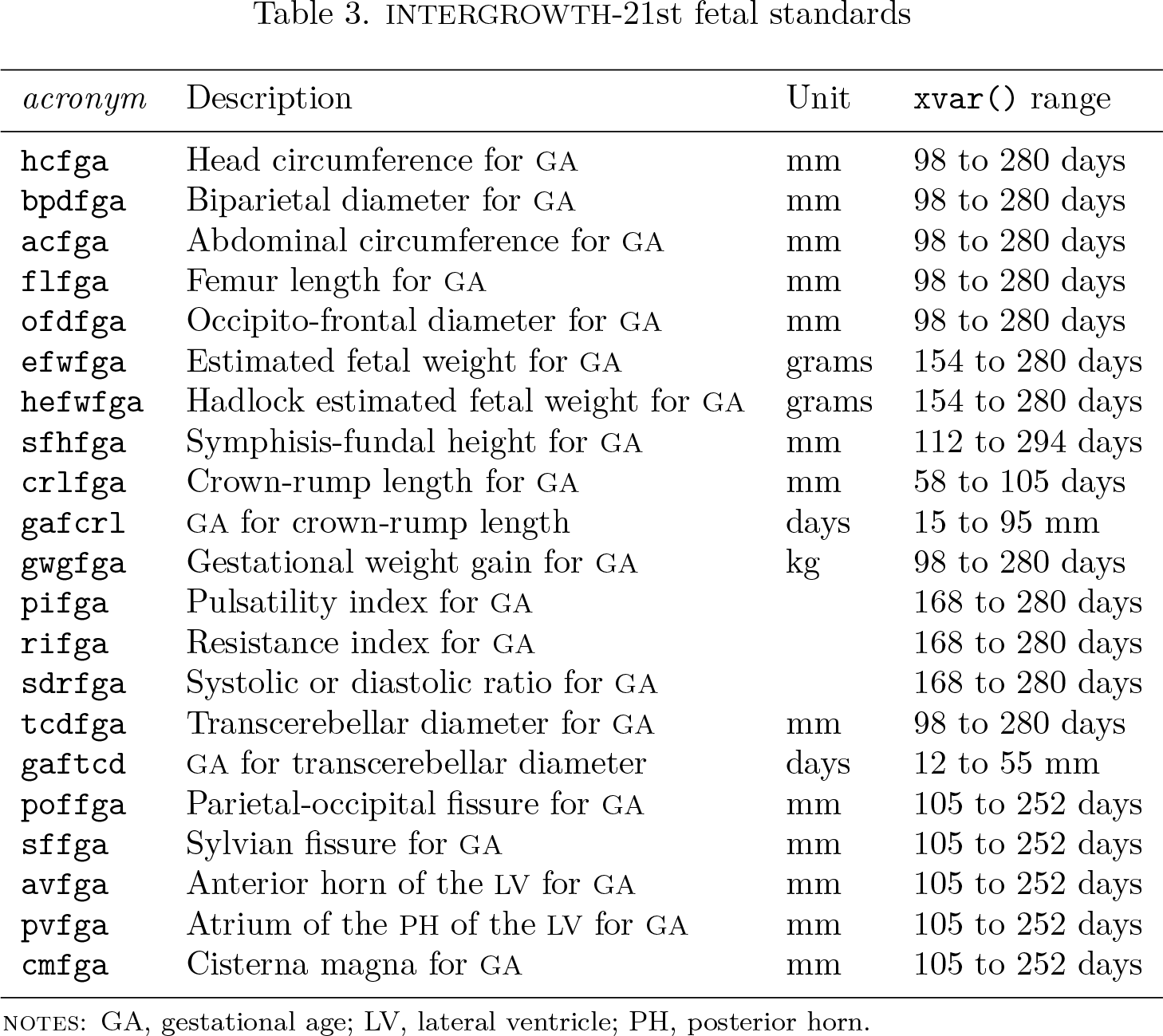
The exact populations used to construct the
The estimated fetal weight (
The crown-rump length (
The gestational weight-gain standard stands out from the other fetal standards because it represents a maternal phenomenon, namely, expected weight changes across a singleton pregnancy in women who had a body mass index between 18.50 and 24.99 in their first trimester (Cheikh Ismail et al. 2016). It is based on 24,977 weight measurements taken from 3,097 normal-weight pregnant women and is included in gigs as a fetal standard to eliminate the need for a separate
For most of the fetal standards, second-degree fractional polynomial regression was used to model the mean and standard deviation of each measure across a range of x variables (Ohuma and Altman 2019b). This was the approach taken for the fetal growth (Papageorghiou et al. 2014b),
For the nonnormally distributed measures of fetal growth, second-degree fractional polynomials were used with more complex models. The
The
The
WHO child growth standards
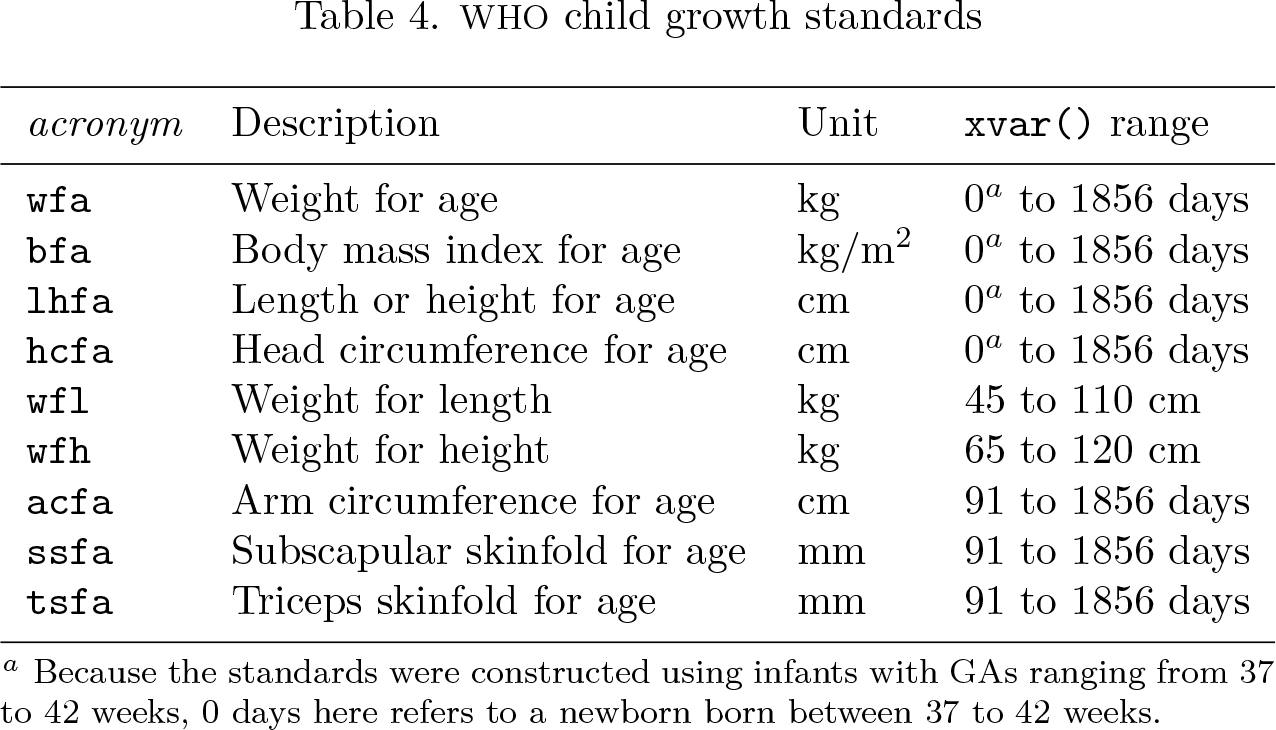
WHO child growth standards
Because the standards were constructed using infants with
For growth classification, we selected cutoffs for different growth outcomes based on existing approaches. For example, our size-for-
Values and labels in the sfga and sfga_severe variables generated by gigs_classify_growth
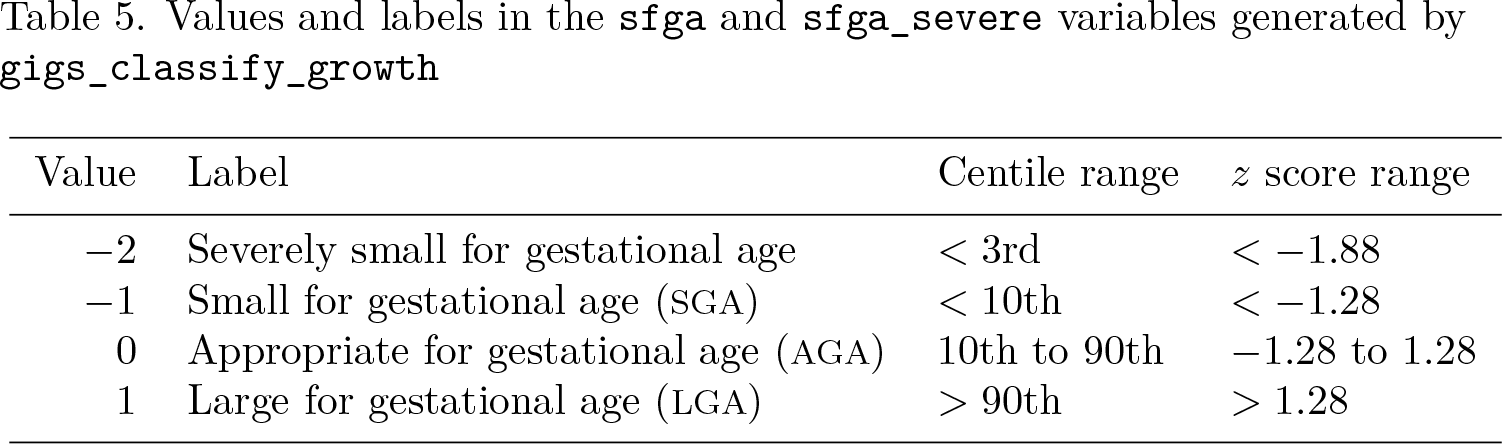
Values and labels in the
Values and labels in the
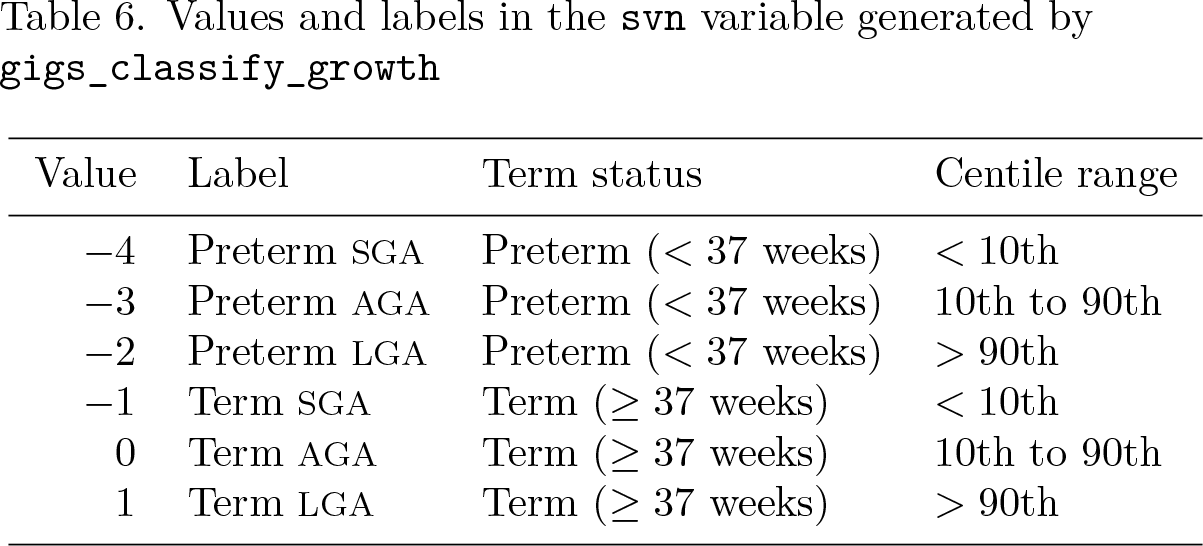
Values and labels in the
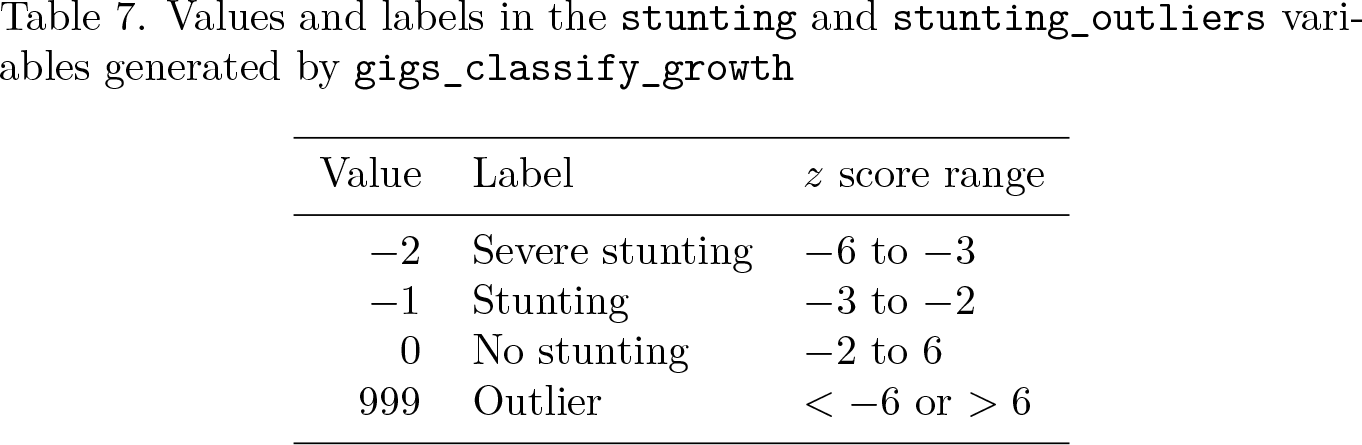
Values and labels in the wasting and
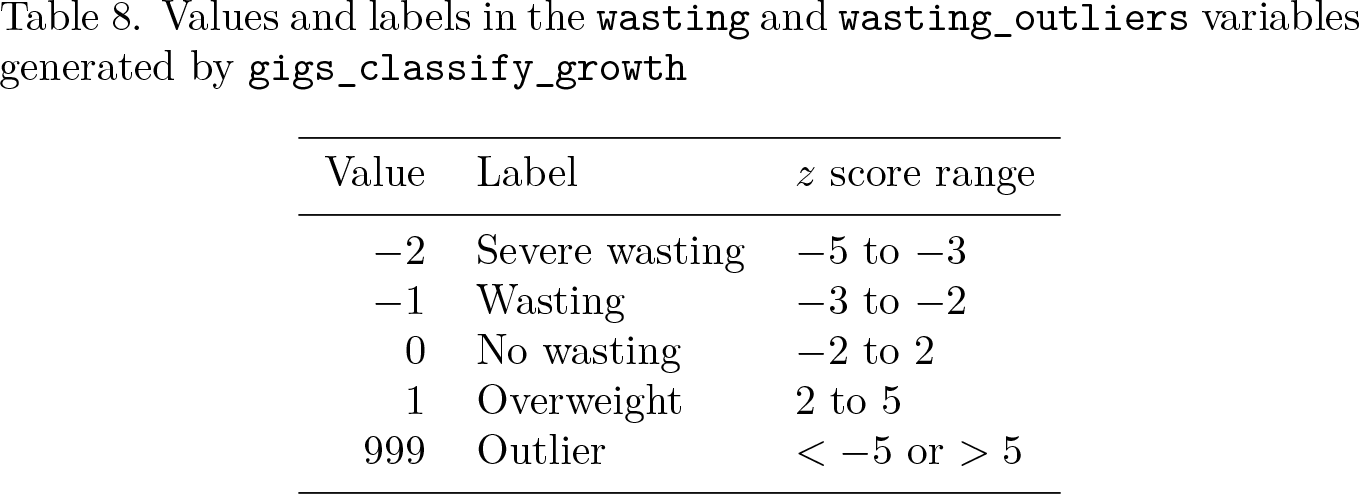
For growth standards based on coefficient tables (that is, the
Though Vidmar, Cole, and Pan (2013) use cubic interpolation for their growth coefficients, they also use coarser growth coefficients for the
We perform our linear interpolation in Mata using the
Confirming the accuracy of gigs
Within the GitHub repository for
Conversion functions
The first set of functions introduced in this package is used to convert between measured anthropometric values and z scores or centiles in the
Syntax
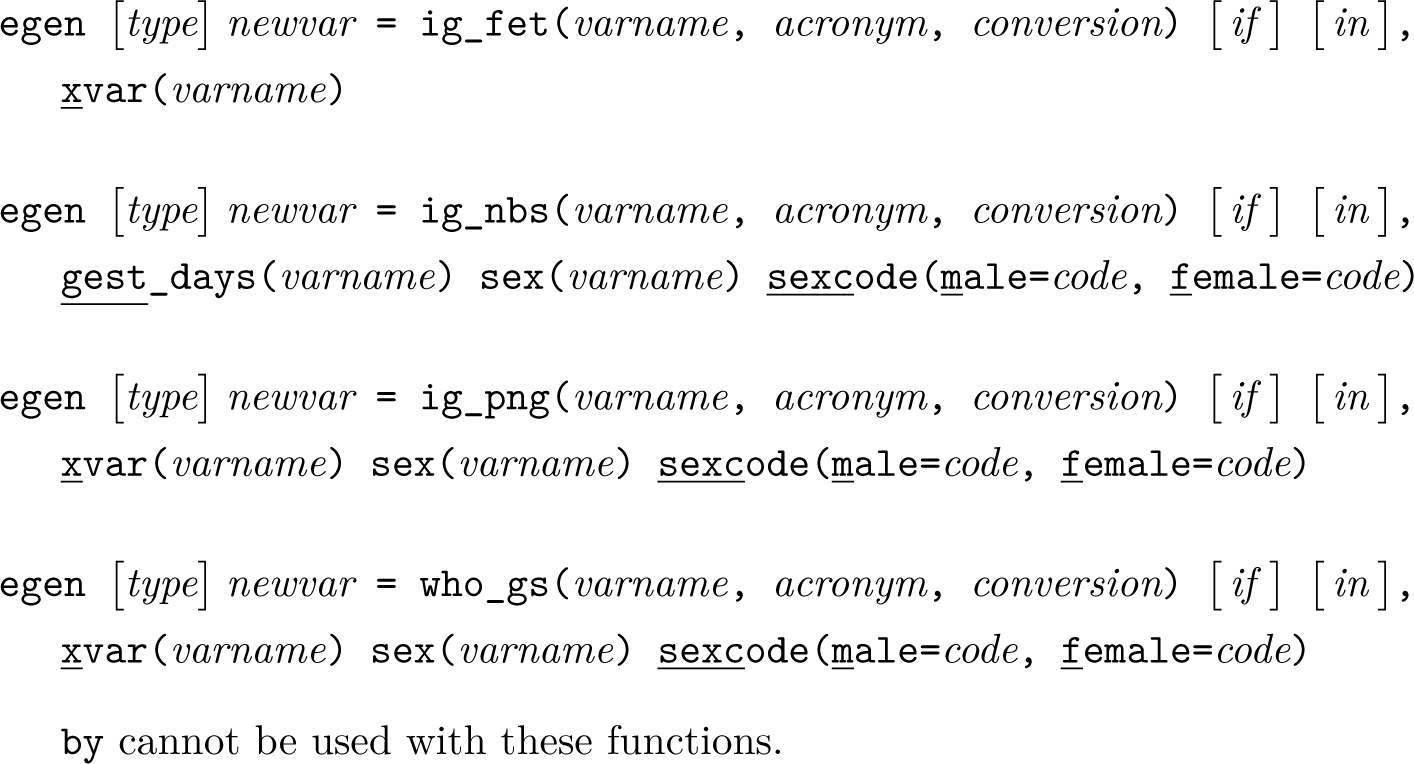
by cannot be used with these functions.
Functions
varname is the variable name in your dataset that you want to convert to a z score, a centile, or an anthropometric measure (for example,
acronym defines the
conversion defines the type of conversion to perform on values in varname and should be one of
varname is the variable name in your dataset that you want to convert to a z score, a centile, or an anthropometric measure (for example,
acronym defines the
conversion defines the type of conversion to perform on values in varname and should be one of
varname is the variable name in your dataset that you want to convert to a z score, a centile, or an anthropometric measure (for example,
acronym defines the
conversion defines the type of conversion to perform on values in varname and should be one of
varname is the variable name in your dataset that you want to convert to a z score, a centile, or an anthropometric measure (for example,
acronym defines the
conversion defines the type of conversion to perform on values in varname and should be one of "v2c" (value to centile), "v2z" (value to z score), "c2v" (centile to value), or "z2v" (z score to value).
Options
Classification command
Syntax

outcomes is text input. Set to
by cannot be used with this command.
Description
Classifications for six growth outcomes are implemented. These are size for
The command generates new variables with the continuous and categorical growth measures—an error will be issued if the names of variables already in your dataset clash with the new variables it wants to generate, or you can have
Specific growth standards are applied for each observation based on the value of the variables supplied by
All “at birth” observations with a
For “postnatal” observations, infants are classed as “preterm” or “term”, where term infants have a
These rules differ slightly for some of the growth indicators. For the newborn-specific categories (
The variables generated for each growth outcome are described below:
Values and labels in the wfa and wfa_outliers variables generated by gigs_classify_growth
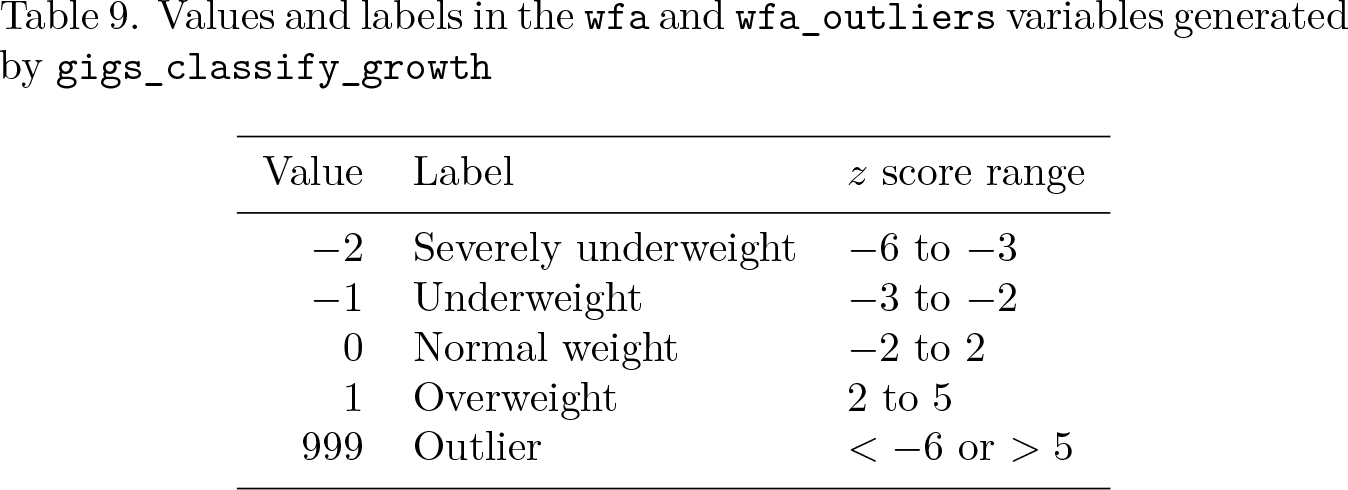
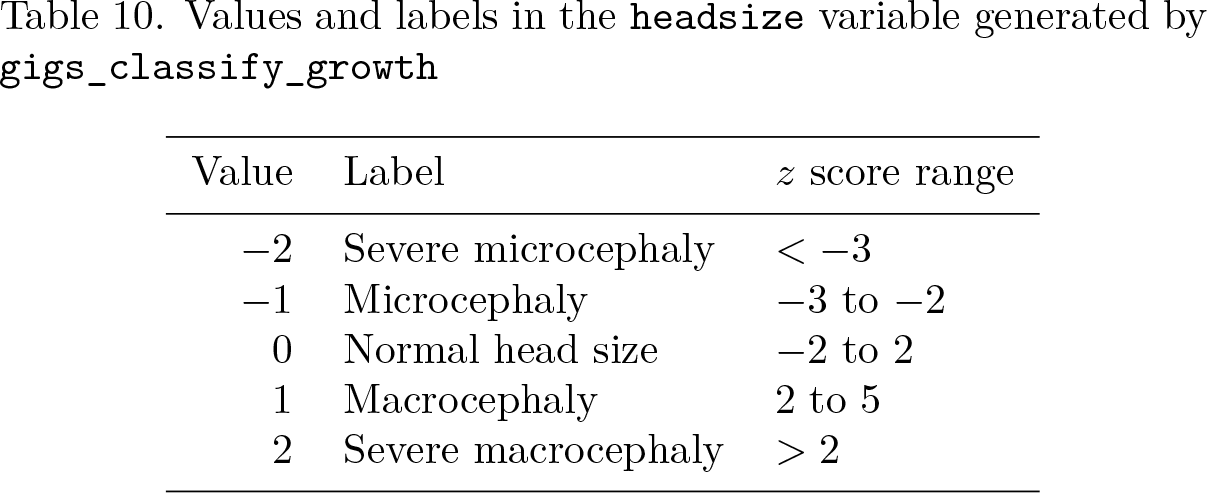
Values and labels in the
Values and labels in the
Examples
For these examples, we are using a small subset of data from the Low-Birthweight Infant Feeding Exploration (
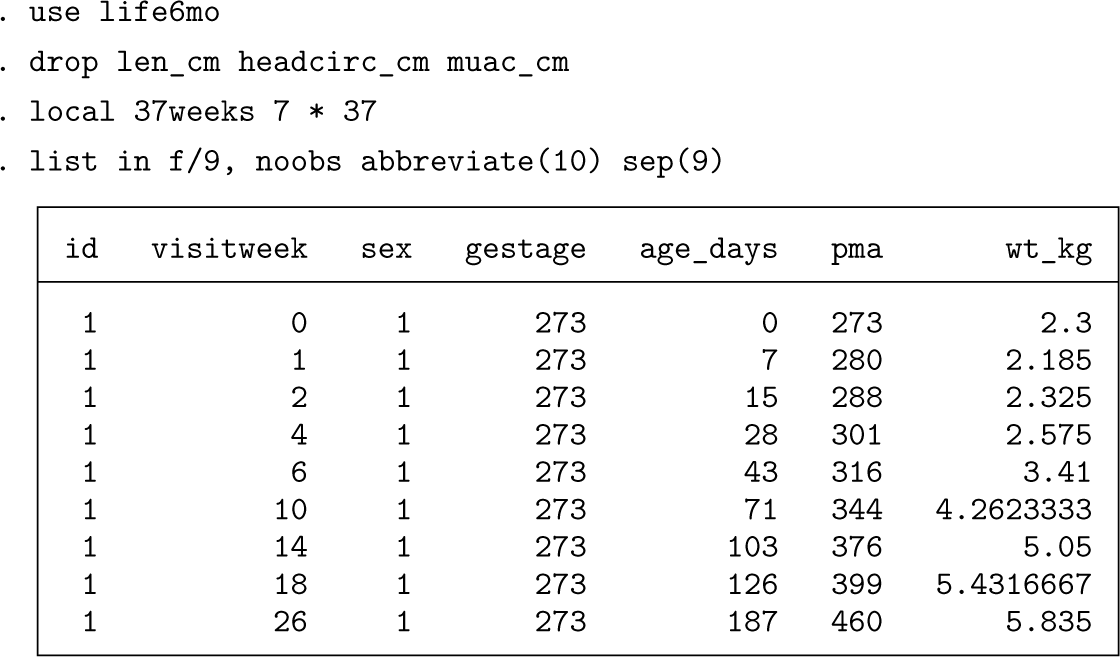
Conversion functions
To generate accurate

Next we calculate

We then generate
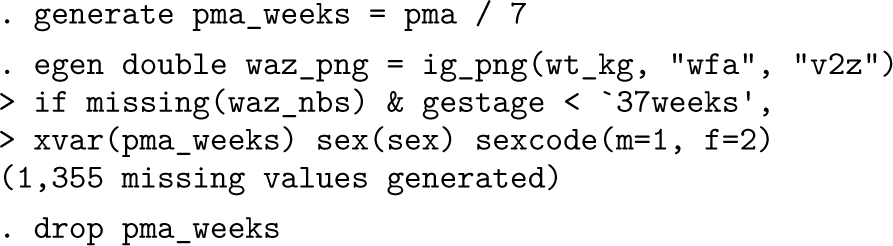
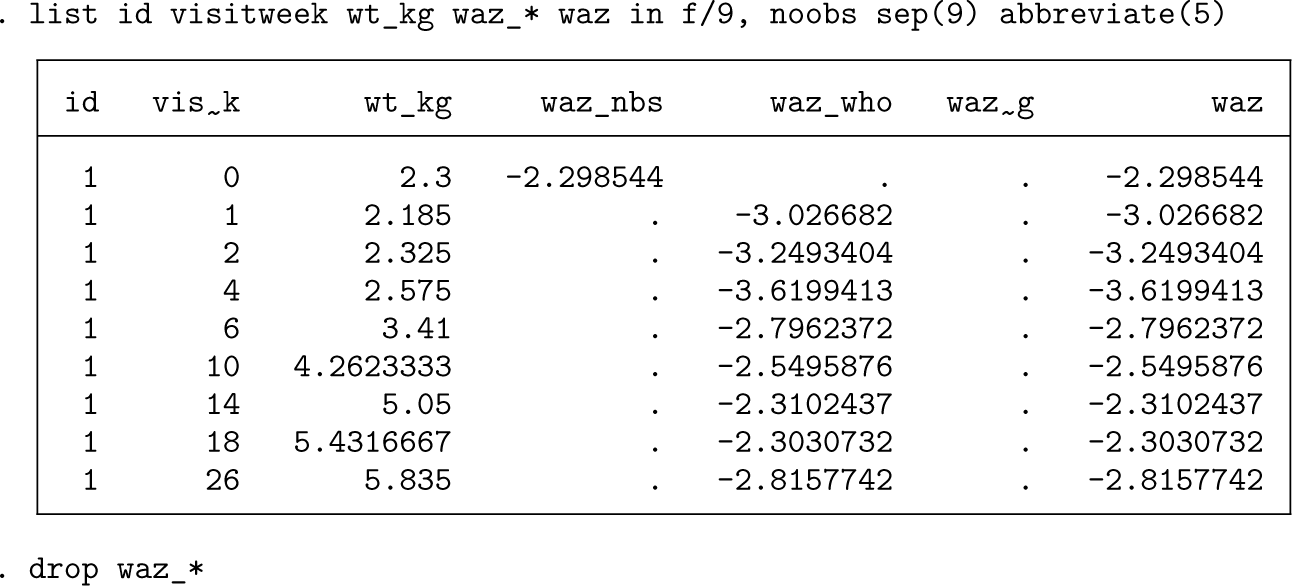
Collapsing these variables into a single variable manually could be prone to error. Fortunately, we can use
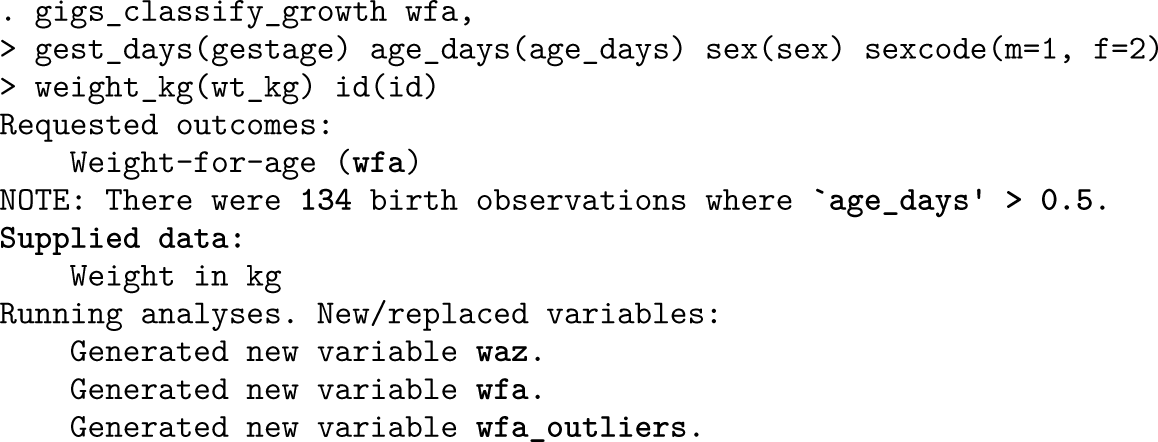
Note how the command lets you know which new variables it has generated and the outcomes you have listed.
We can visualize the
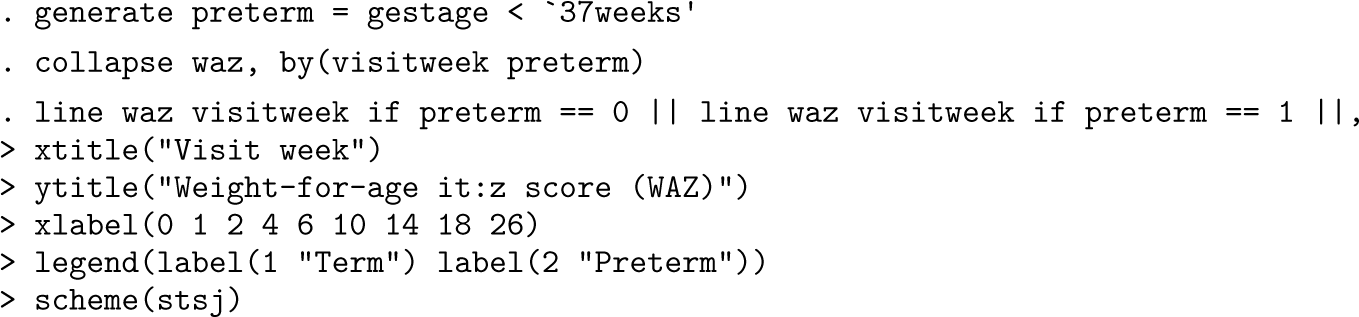
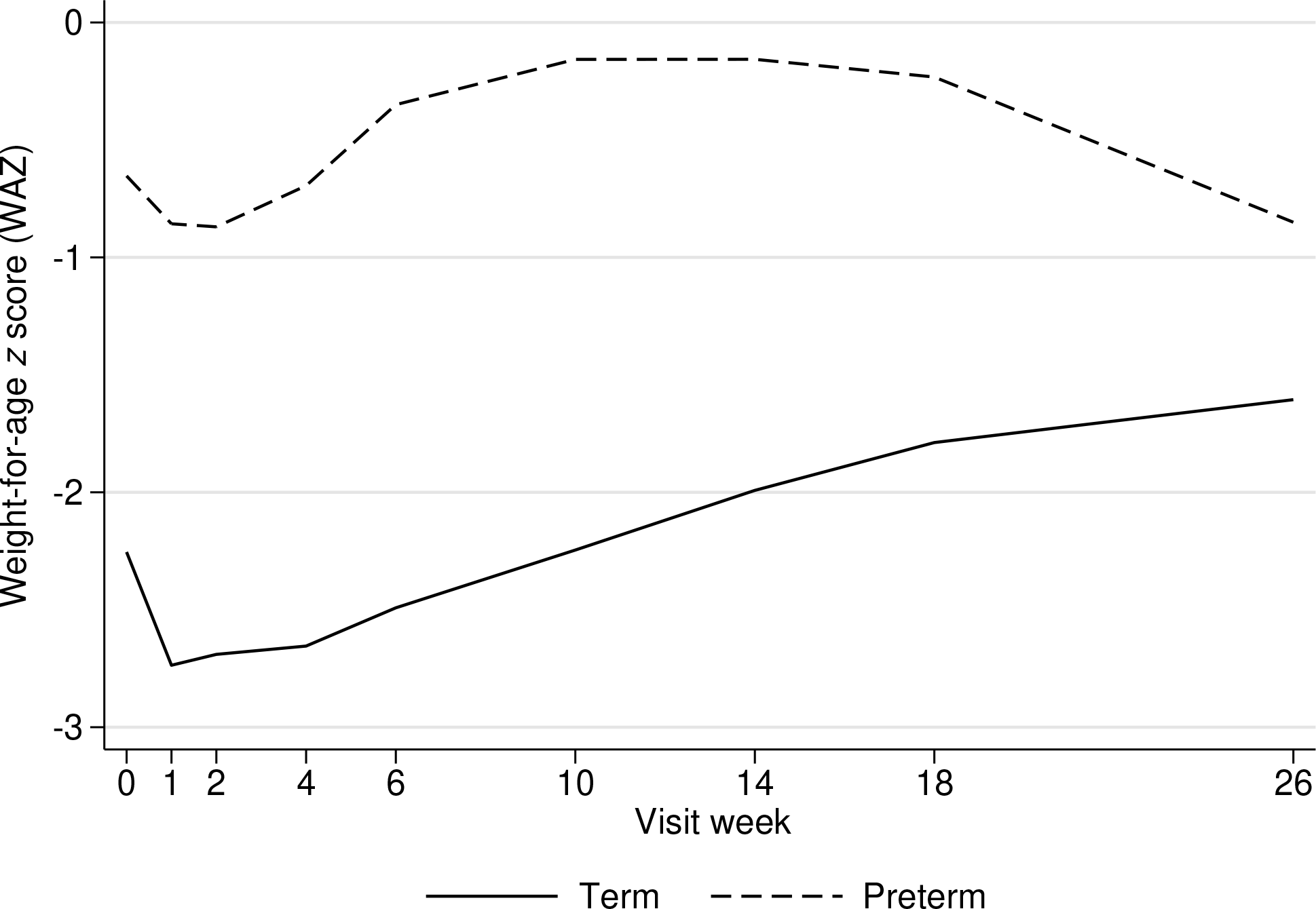
WAZs against visit week for term (solid line) and preterm (dashed line) infants
In our plot, the term infants consistently have lower
We could also categorize the newborn measurements in this study according to their size for
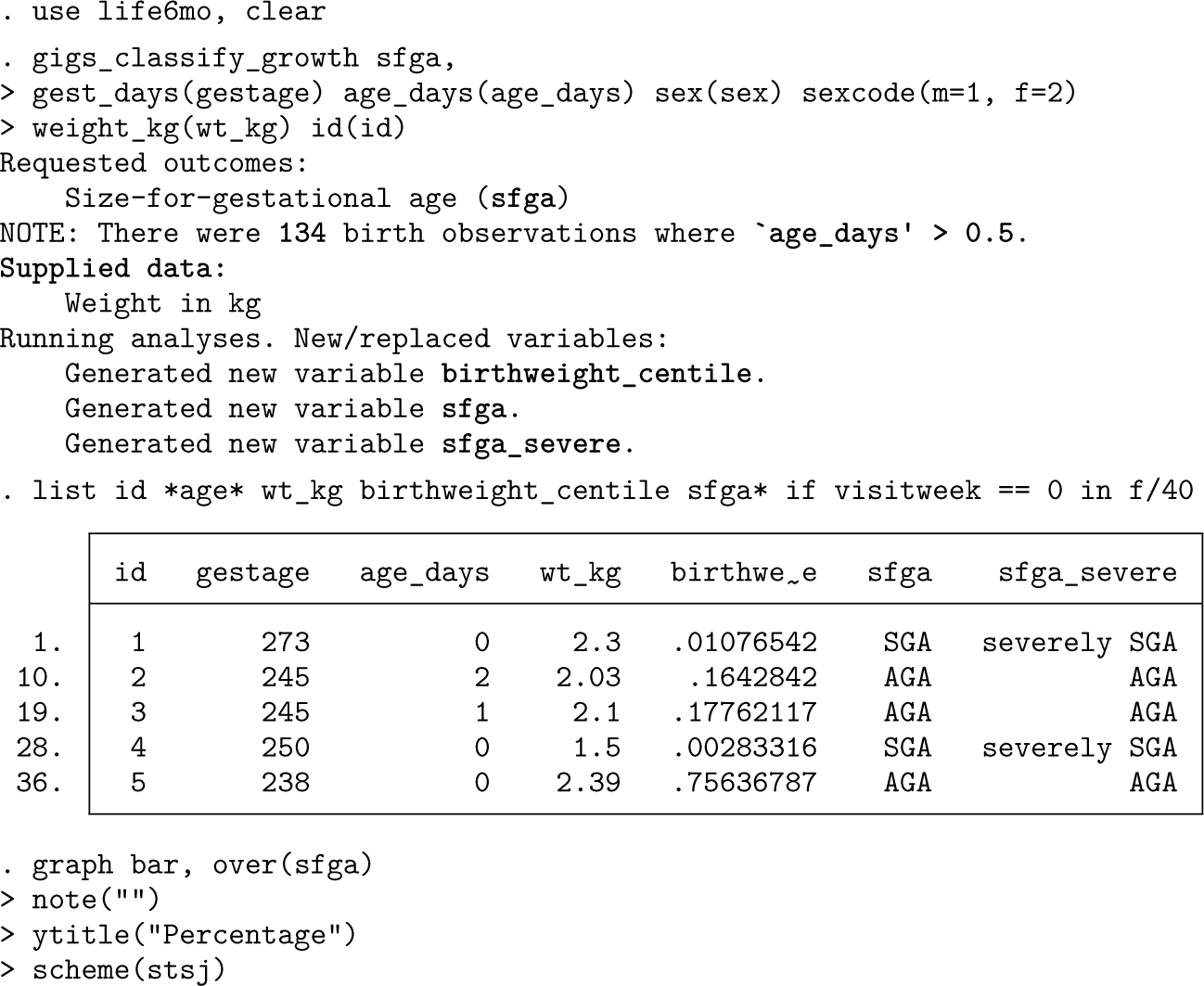
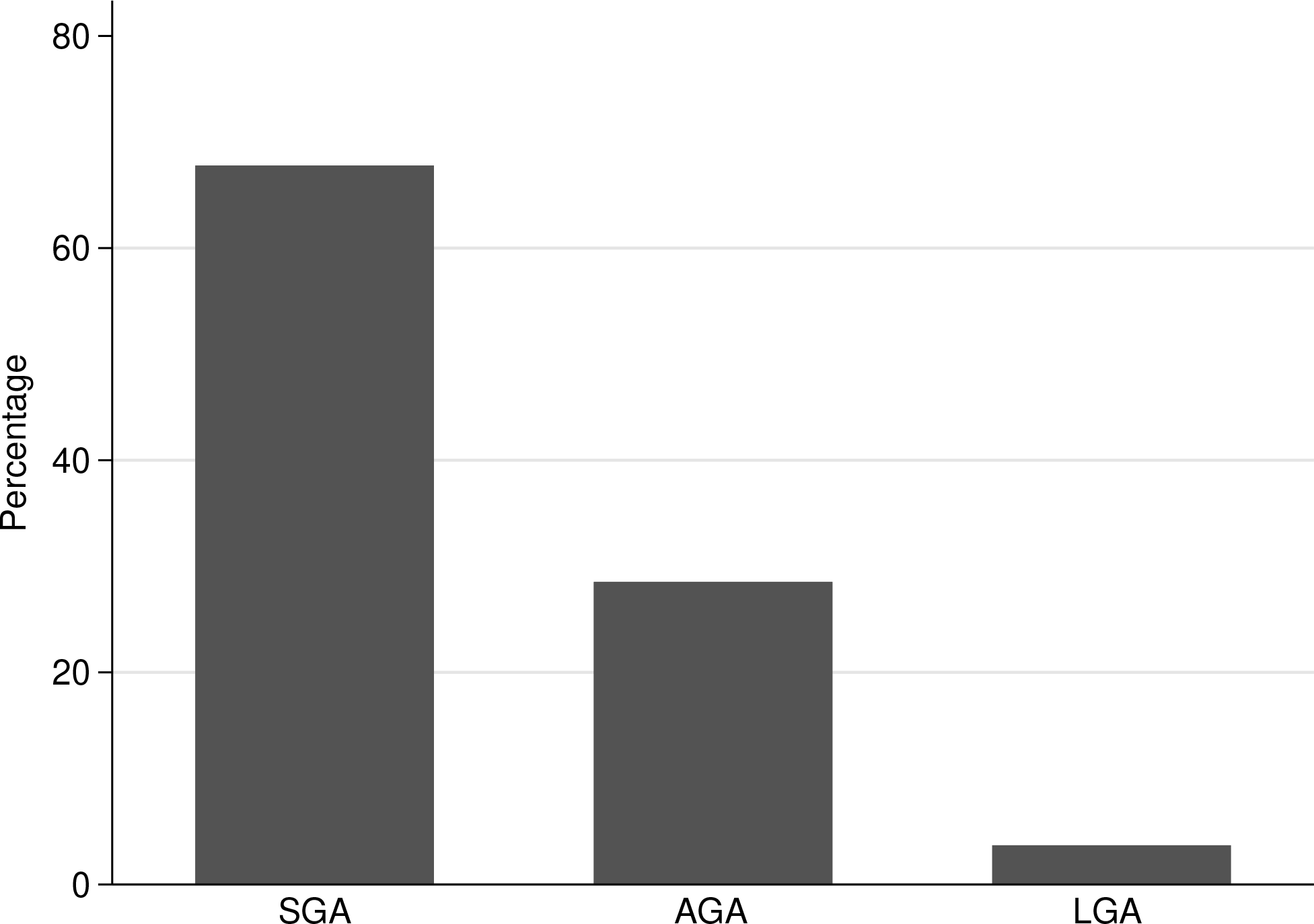
Size-for-
Because our sample has a mixture of term and preterm infants, we can disambiguate these size-for-
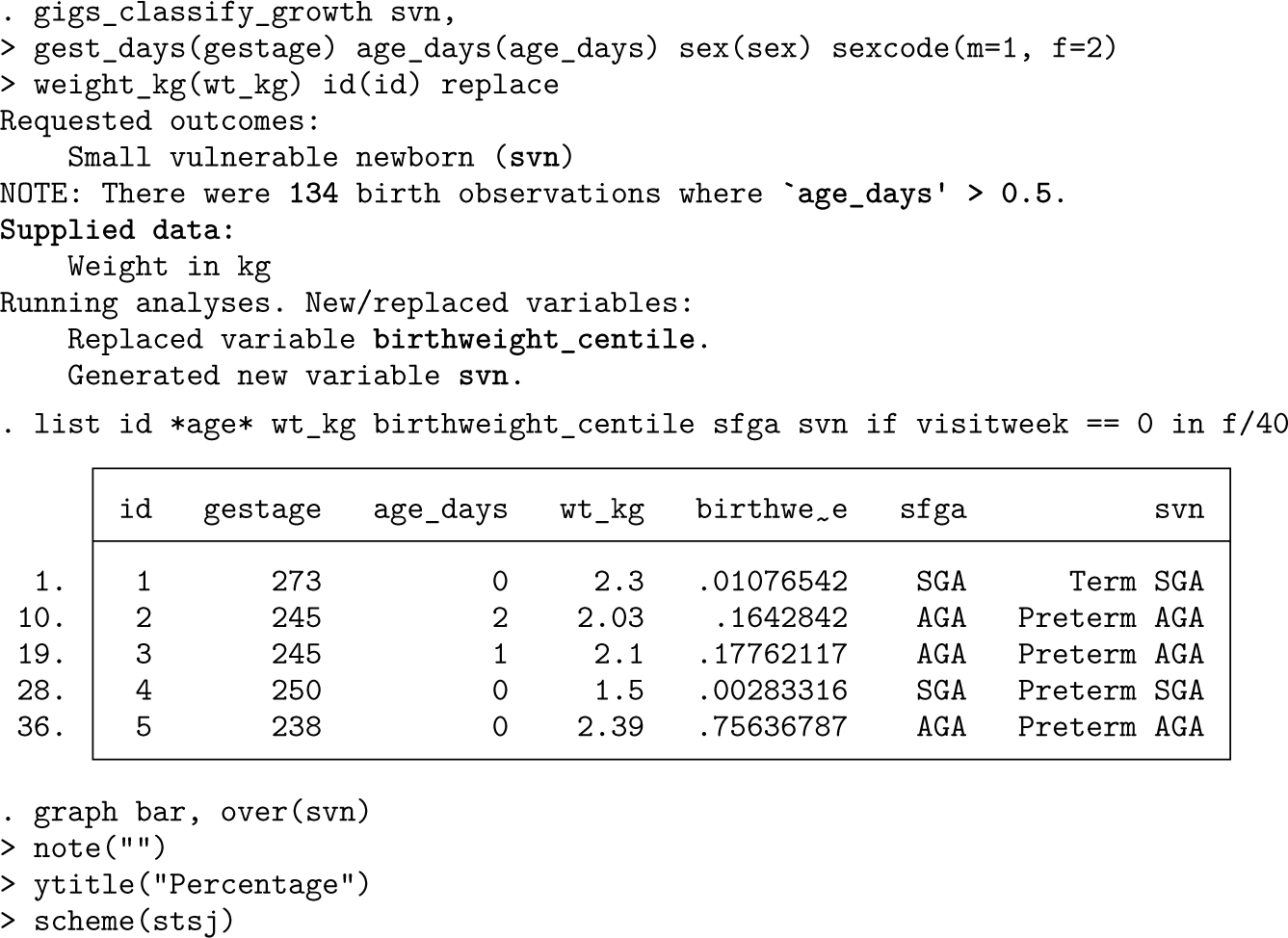
Once this is done, you can then graph the
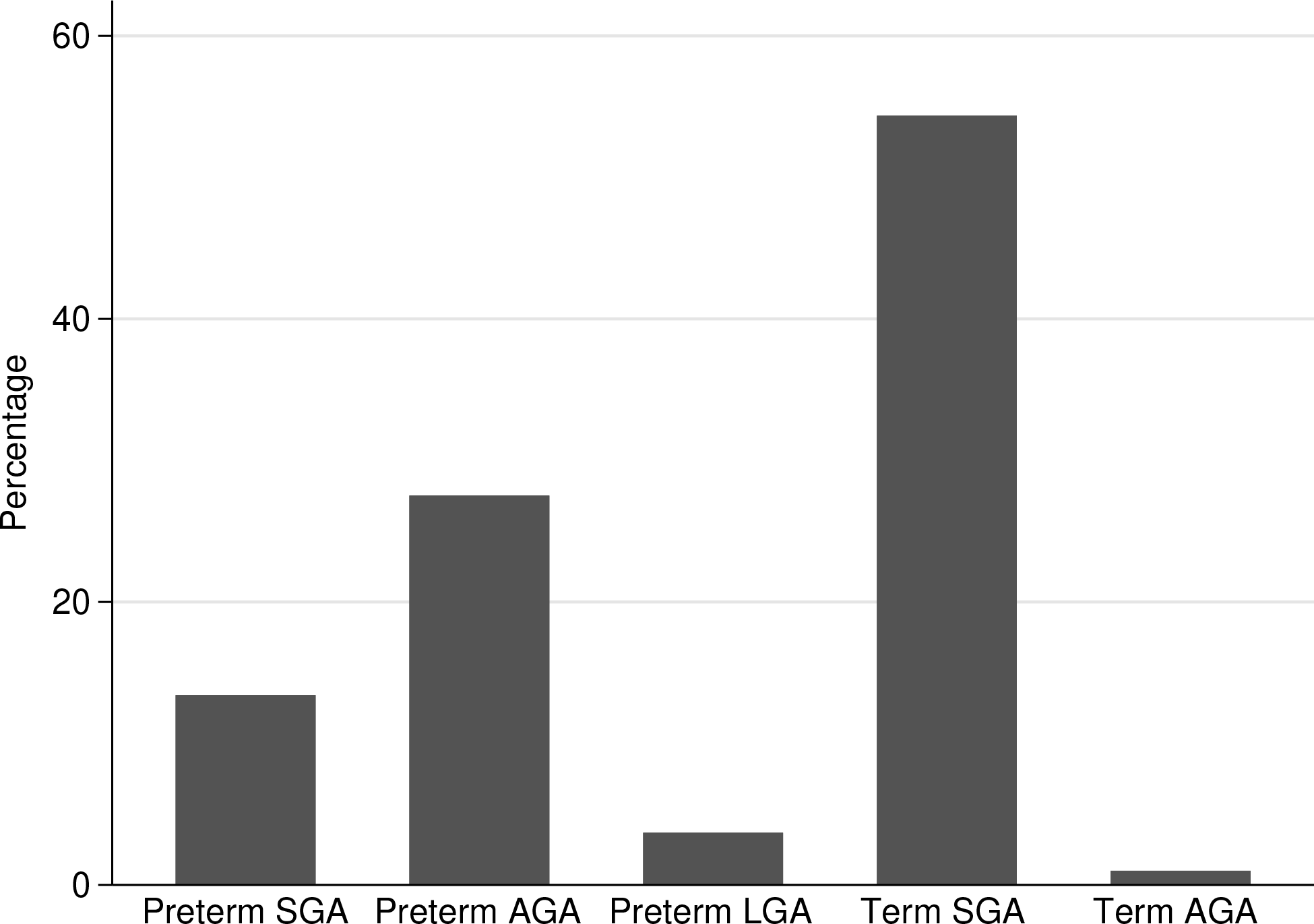
Small vulnerable newborn classification percentages in the
Conclusions
We have illustrated how the new gigs package for Stata can be used for growth analysis in newborns and children by either the generation of z scores or centiles from measured anthropometric indices or classification of observations into specific growth categories.
Supplemental Material
sj-dta-1-stj-10.1177_1536867X251365448 - Supplemental material for gigs: A package for standardizing fetal, neonatal, and child growth assessment with extensions to egen
Supplemental material, sj-dta-1-stj-10.1177_1536867X251365448 for gigs: A package for standardizing fetal, neonatal, and child growth assessment with extensions to egen by Simon R. Parker, Linda Vesel and Eric O. Ohuma in The Stata Journal
Supplemental Material
sj-dta-10-stj-10.1177_1536867X251365448 - Supplemental material for gigs: A package for standardizing fetal, neonatal, and child growth assessment with extensions to egen
Supplemental material, sj-dta-10-stj-10.1177_1536867X251365448 for gigs: A package for standardizing fetal, neonatal, and child growth assessment with extensions to egen by Simon R. Parker, Linda Vesel and Eric O. Ohuma in The Stata Journal
Supplemental Material
sj-dta-11-stj-10.1177_1536867X251365448 - Supplemental material for gigs: A package for standardizing fetal, neonatal, and child growth assessment with extensions to egen
Supplemental material, sj-dta-11-stj-10.1177_1536867X251365448 for gigs: A package for standardizing fetal, neonatal, and child growth assessment with extensions to egen by Simon R. Parker, Linda Vesel and Eric O. Ohuma in The Stata Journal
Supplemental Material
sj-dta-12-stj-10.1177_1536867X251365448 - Supplemental material for gigs: A package for standardizing fetal, neonatal, and child growth assessment with extensions to egen
Supplemental material, sj-dta-12-stj-10.1177_1536867X251365448 for gigs: A package for standardizing fetal, neonatal, and child growth assessment with extensions to egen by Simon R. Parker, Linda Vesel and Eric O. Ohuma in The Stata Journal
Supplemental Material
sj-dta-13-stj-10.1177_1536867X251365448 - Supplemental material for gigs: A package for standardizing fetal, neonatal, and child growth assessment with extensions to egen
Supplemental material, sj-dta-13-stj-10.1177_1536867X251365448 for gigs: A package for standardizing fetal, neonatal, and child growth assessment with extensions to egen by Simon R. Parker, Linda Vesel and Eric O. Ohuma in The Stata Journal
Supplemental Material
sj-dta-14-stj-10.1177_1536867X251365448 - Supplemental material for gigs: A package for standardizing fetal, neonatal, and child growth assessment with extensions to egen
Supplemental material, sj-dta-14-stj-10.1177_1536867X251365448 for gigs: A package for standardizing fetal, neonatal, and child growth assessment with extensions to egen by Simon R. Parker, Linda Vesel and Eric O. Ohuma in The Stata Journal
Supplemental Material
sj-dta-2-stj-10.1177_1536867X251365448 - Supplemental material for gigs: A package for standardizing fetal, neonatal, and child growth assessment with extensions to egen
Supplemental material, sj-dta-2-stj-10.1177_1536867X251365448 for gigs: A package for standardizing fetal, neonatal, and child growth assessment with extensions to egen by Simon R. Parker, Linda Vesel and Eric O. Ohuma in The Stata Journal
Supplemental Material
sj-dta-3-stj-10.1177_1536867X251365448 - Supplemental material for gigs: A package for standardizing fetal, neonatal, and child growth assessment with extensions to egen
Supplemental material, sj-dta-3-stj-10.1177_1536867X251365448 for gigs: A package for standardizing fetal, neonatal, and child growth assessment with extensions to egen by Simon R. Parker, Linda Vesel and Eric O. Ohuma in The Stata Journal
Supplemental Material
sj-dta-4-stj-10.1177_1536867X251365448 - Supplemental material for gigs: A package for standardizing fetal, neonatal, and child growth assessment with extensions to egen
Supplemental material, sj-dta-4-stj-10.1177_1536867X251365448 for gigs: A package for standardizing fetal, neonatal, and child growth assessment with extensions to egen by Simon R. Parker, Linda Vesel and Eric O. Ohuma in The Stata Journal
Supplemental Material
sj-dta-5-stj-10.1177_1536867X251365448 - Supplemental material for gigs: A package for standardizing fetal, neonatal, and child growth assessment with extensions to egen
Supplemental material, sj-dta-5-stj-10.1177_1536867X251365448 for gigs: A package for standardizing fetal, neonatal, and child growth assessment with extensions to egen by Simon R. Parker, Linda Vesel and Eric O. Ohuma in The Stata Journal
Supplemental Material
sj-dta-6-stj-10.1177_1536867X251365448 - Supplemental material for gigs: A package for standardizing fetal, neonatal, and child growth assessment with extensions to egen
Supplemental material, sj-dta-6-stj-10.1177_1536867X251365448 for gigs: A package for standardizing fetal, neonatal, and child growth assessment with extensions to egen by Simon R. Parker, Linda Vesel and Eric O. Ohuma in The Stata Journal
Supplemental Material
sj-dta-7-stj-10.1177_1536867X251365448 - Supplemental material for gigs: A package for standardizing fetal, neonatal, and child growth assessment with extensions to egen
Supplemental material, sj-dta-7-stj-10.1177_1536867X251365448 for gigs: A package for standardizing fetal, neonatal, and child growth assessment with extensions to egen by Simon R. Parker, Linda Vesel and Eric O. Ohuma in The Stata Journal
Supplemental Material
sj-dta-8-stj-10.1177_1536867X251365448 - Supplemental material for gigs: A package for standardizing fetal, neonatal, and child growth assessment with extensions to egen
Supplemental material, sj-dta-8-stj-10.1177_1536867X251365448 for gigs: A package for standardizing fetal, neonatal, and child growth assessment with extensions to egen by Simon R. Parker, Linda Vesel and Eric O. Ohuma in The Stata Journal
Supplemental Material
sj-dta-9-stj-10.1177_1536867X251365448 - Supplemental material for gigs: A package for standardizing fetal, neonatal, and child growth assessment with extensions to egen
Supplemental material, sj-dta-9-stj-10.1177_1536867X251365448 for gigs: A package for standardizing fetal, neonatal, and child growth assessment with extensions to egen by Simon R. Parker, Linda Vesel and Eric O. Ohuma in The Stata Journal
Supplemental Material
sj-orig-2-stj-10.1177_1536867X251365448 - Supplemental material for gigs: A package for standardizing fetal, neonatal, and child growth assessment with extensions to egen
Supplemental material, sj-orig-2-stj-10.1177_1536867X251365448 for gigs: A package for standardizing fetal, neonatal, and child growth assessment with extensions to egen by Simon R. Parker, Linda Vesel and Eric O. Ohuma in The Stata Journal
Supplemental Material
sj-txt-1-stj-10.1177_1536867X251365448 - Supplemental material for gigs: A package for standardizing fetal, neonatal, and child growth assessment with extensions to egen
Supplemental material, sj-txt-1-stj-10.1177_1536867X251365448 for gigs: A package for standardizing fetal, neonatal, and child growth assessment with extensions to egen by Simon R. Parker, Linda Vesel and Eric O. Ohuma in The Stata Journal
Footnotes
Acknowledgments
This work was supported in whole by the Bill and Melinda Gates Foundation, grant number 046290. We also acknowledge Vidmar, Cole, and Pan’s (2013)
5 Programs and supplemental material
To install the software files as they existed at the time of publication of this article, type
As our guidance for the use of international growth standards matures, we will update the package to include conversion functions that automatically apply the  ) prior to becoming available via the Stata Journal in a formal update.
In the meantime, we are confident that our Stata implementation of growth standards from both the
About the authors
Simon R. Parker was a research assistant within the Faculty of Epidemiology and Population Health at the London School of Hygiene and Tropical Medicine. He is now undertaking a PhD within the Unit for Lifelong Health and Ageing at University College London.
Linda Vesel is a senior research scientist and scientific lead of the Vulnerable Infant Portfolio at Ariadne Labs at Brigham and Women’s Hospital and the Harvard T. H. Chan School of Public Health in Boston, MA. She was the coprincipal investigator and scientific lead of the Low-Birthweight Infant Feeding Exploration (LIFE) study and is coprincipal investigator for the Guidance for International Growth Standards project.
Eric O. Ohuma is a professor of medical statistics and epidemiology within the Faculty of Epidemiology and Population Health at the London School of Hygiene and Tropical Medicine. He was formerly lead statistician for the INTERGROWTH-21st project and is coprincipal investigator for the Guidance for International Growth Standards project.
References
Supplementary Material
Please find the following supplemental material available below.
For Open Access articles published under a Creative Commons License, all supplemental material carries the same license as the article it is associated with.
For non-Open Access articles published, all supplemental material carries a non-exclusive license, and permission requests for re-use of supplemental material or any part of supplemental material shall be sent directly to the copyright owner as specified in the copyright notice associated with the article.
