



Abstract
Several new statistical tools and analytical frameworks have been recently developed to measure countries’ and sectors’ involvement in global value chains. Such a wealth of methodologies reflects the fact that different empirical questions call for distinct accounting methods and different levels of aggregation of trade flows. In this article, we describe
1 Introduction
The diffusion of global production networks has called for new statistical tools providing a representation of complex production linkages between and within economies. New types of data sources, the intercountry input–output (ICIO) tables, and new analytical frameworks have been developed to measure supply-and-demand contributions of countries and sectors in global value chains (GVCs). 1 In a nutshell, these frameworks decompose gross exports in terms of their value-added components. This is crucial to unravel production–demand linkages at the global level because, in a world of GVCs, exports embed a relevant amount of imported intermediate inputs. In addition, the direct importer often differs from the market of final absorption. Thus, nowadays traditional trade statistics alone cannot provide an adequate representation of supply and demand interlinkages.
In this article, we describe
More specifically,
In addition, the
We believe that the
The rest of the article is organized as follows. In section 2, we show how to load ICIO tables by using the
Each section shares the same structure. At the beginning, we provide a brief overview of the measures therein discussed. Then, we present the related conceptual framework and discuss, through examples, the relevant
2 ICIO tables
Input–output (IO) models were developed by Leontief (1936) to represent and analyze production and consumption relationships within an economy. The related statistical tools, the IO tables, report the monetary amount of inputs of each sector necessary to produce the total output of a given industry and, in turn, show how this output is used as final consumption (or investment) or as intermediate inputs for other productions. National IO tables distinguish only between domestic and foreign inputs; on the output side, exports represent one of the possible “final” uses of output, as domestic consumption and investment. ICIO tables, which have been developed combining national IO statistics with trade data, describe sale–purchase relationships between industries within and between economies as well as the uses in different final-demand components (for example, consumption, investment, and government spending). In particular, an ICIO table specifies the country–sector pairs that provide intermediate inputs to a given industry and the country–sector pairs to which that industry sells its output—in the case of intermediate products—or the ultimate destination markets for final goods.
In section 2.1, we present the basic conceptual framework of ICIO models, while in section 2.2, we show how to load ICIO tables with the
2.1 Conceptual framework: ICIO models
A generic ICIO model with G countries and N sectors can be represented by the scheme in figure 1, where

ICIO scheme
The specific column j, n of the ICIO table in figure 1 shows how the output of country j and sector n (xj,n
) is produced: sourcing intermediate inputs from the same and other country–sector pairs and adding its own value added,
2.2 Implementation: Loading ICIO tables using the icio_load command
To use the
2.2.1 Syntax
The basic syntax for
For the full list of options, see
2.2.2 Examples
1. To display the list of the directly available ICIO tables and their releases: 5

In this way, the user can always recover which ICIO tables are directly available via the
2. To load a specific year of the ICIO table of interest. For example, the following syntax allows the user to load the year 2014 of the WIOD tables released in 2016 (that is,

3. To load a user-provided ICIO table by specifying

The syntax above shows that the following additional information has to be provided for loading a user-provided table: i) the path to the folder where the
Notice that the table’s
3 Supply, demand, and supply–demand linkages
ICIO tables can be used in combination with long-established accounting relationships (Leontief 1936) to measure the net value of production (GDP) of a country or sector and the value of final demand in a given country or sector, and to pin down the links between the country or sector where the value added originates and the market where it is absorbed in final demand.
In section 3.1, we show how to retrieve from ICIO tables supply, demand, and supply– demand linkages—that is, GDP by country or sector of origin, destination, or both— while in section 3.2, we provide some examples to illustrate how these measures can be computed using
3.1 Conceptual framework: Supply and demand in ICIO models
Given a country s, each unit of its gross output can be either consumed as a final good or used as an intermediate good at home or abroad:

Country r can be either s itself or any given importing country, and
Then the basic relationship between gross output and final demand is given by

where
In each production stage, some value added is generated. The value-added share in each unit of gross output produced by country s (

Premultiplying the right-hand side of (2) by

More specifically, the GDP produced in country s can be computed as

where we have singled out the part that is absorbed at home and the part that is finally consumed abroad in country l, as a final good assembled in country k, which correspond to the “value-added exports” as defined by Johnson and Noguera (2012).
It is also possible to decompose the final demand (FD) of country s by distinguishing between the part of value added domestically produced and the part that originates abroad:

To get a decomposition of GDP by sectors of origin, it is sufficient to substitute the direct value-added

Then the decomposition of value added by combinations of country or sector of origin and country or sector of final destination can be obtained from the GN×GN matrix

3.2 Implementation: Supply and demand with icio
The
3.2.1 Syntax
The list of available country–sector codes for the loaded ICIO table can be displayed by running
As for the save_options of
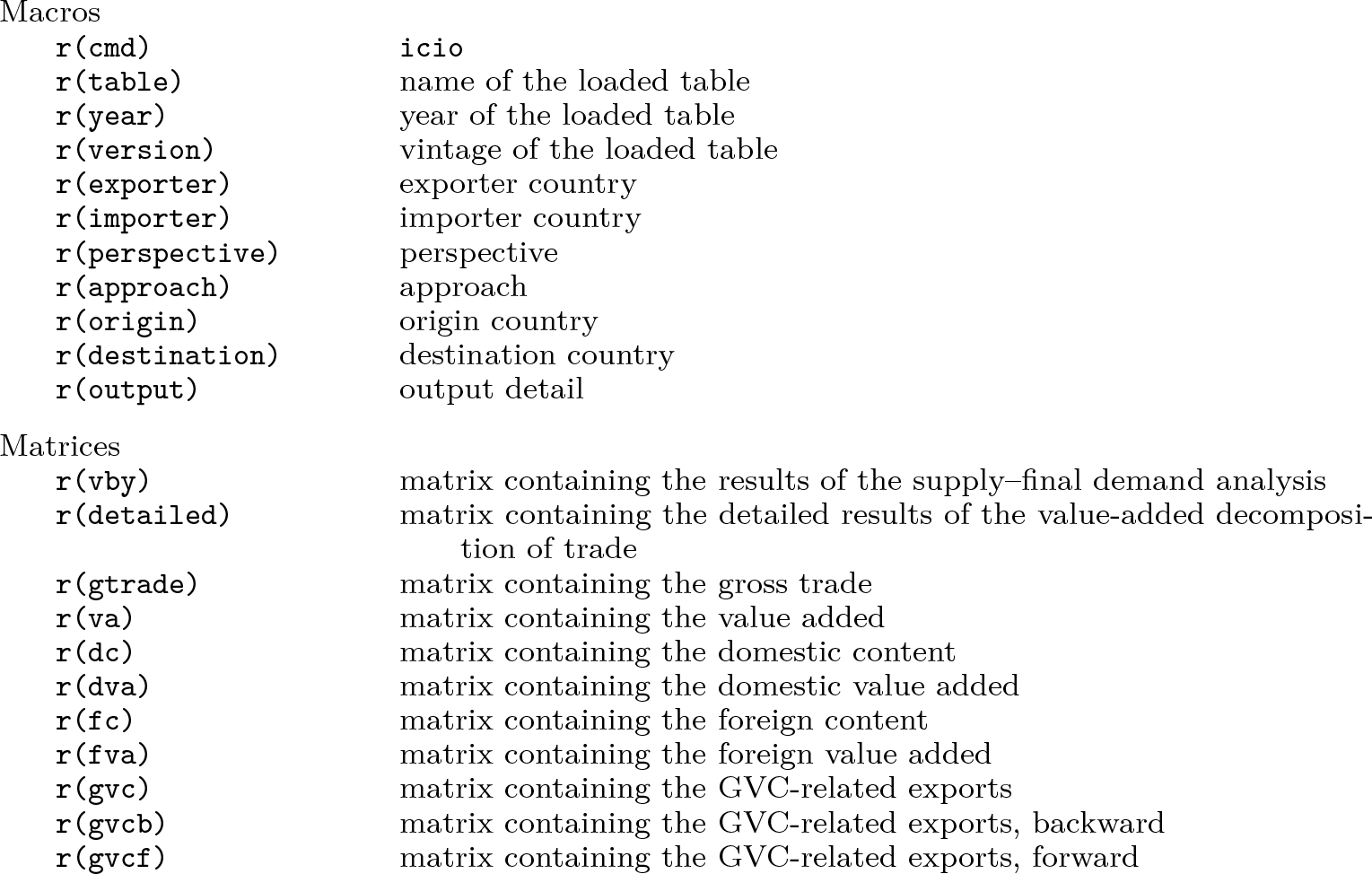
3.2.2 Stored results
3.2.3 Examples
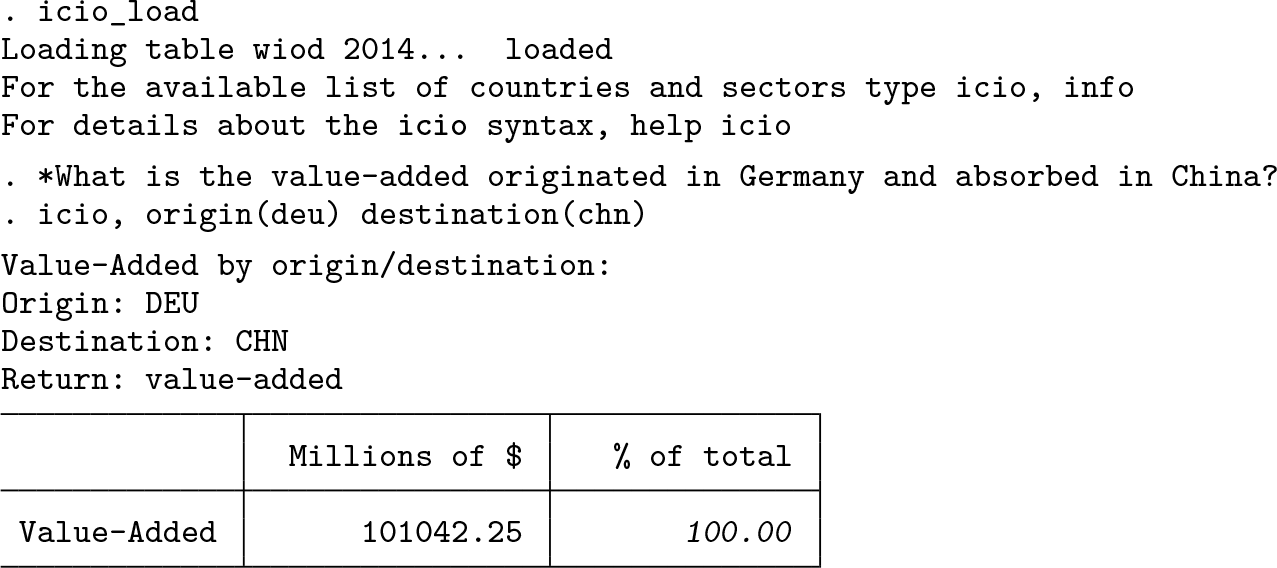
The Stata output displays the value in millions of U.S. dollars and the share of total value added produced in a specific country, when the complete list of countries or sectors of destination is selected by specifying the code

As can be noted, the share of the German GDP absorbed in China (on the total GDP produced by Germany), which is around 2.8%, is obtained either by looking for the

Other examples of questions that could be answered (see the reported syntax) with the analysis of supply–demand linkages through
What is the GDP (value added) produced by each country?
How much value added does each country produce in a given sector (for example, sector code 19)?
What is the aggregate final demand of each country?
Where is the value added produced in the Italian sector 19 absorbed?
Which final demand sectors in China are the most important for the absorption of U.S.-made value added?
Where is the GDP produced in each country absorbed (and save the output as “supply_demand” Excel file in the current working directory)?
How much is the U.S.–Mexico–Canada Agreement (formerly North American Free
Trade Agreement) countries’ final demand in sector 20 satisfied by Chinese productions?
4 Value added in trade flows
The accounting relationships presented in the previous section provide a useful tool to link the origin of value added (GDP) to its absorption in final demand. However, they provide only partial information on overall production processes and cross-country relationships. For instance, no information is provided on the production stages that take place nor on the national borders that are crossed between the stage in which the value added is generated and the stage of its final absorption. Both of the above represent critical information to understand countries’ interdependence in GVCs.
In many empirical applications, it is important to trace value added in gross trade flows, for instance, when we want to measure the value added produced by a country that is involved in a certain trade relationship. Depending on the empirical issue under investigation, it is also necessary to consider trade flows at different levels of disaggregation and analyze their value-added content. In fact, in some cases, we may be interested just to single out the value added embedded in global trade flows or in the total exports or imports of a country. In other cases, the bilateral and sectoral dimensions of trade flows may also matter. For instance, when studying the implications of GVCs, it is relevant to consider the position of a country (or sector) within the production chain and identify its direct upstream and downstream trade partners. This may be relevant to geographically map the production networks and analyze the international propagation of macroeconomic shocks.
A key issue in the value-added accounting of trade regards the definition of “doublecounted” components, that is, items that are recorded several times in a given gross trade flow because of the back-and-forth shipments that occur in a cross-national production process (Koopman, Wang, and Wei 2014). For instance, imagine that a country is exporting cotton. After some processing stage abroad, the cotton is imported back, embedded in some fabric, to be further reexported as apparel. The value of cotton will be counted twice in the aggregate exports of the country, that is, “double counted”—in the first export flow and in the second one, embedded in the apparel—but once in the GDP (that is, value added).
Now imagine that the goal is to allocate the value added across the two export flows. A reasonable way is to consider the cotton production as value added in the first shipment of cotton, and as double counting in the second one, when cotton is embedded in the shipment of apparel. Summing the value-added terms in the two export flows, we end up with consistent aggregate figures at the country level, that is, cotton classified once as value added and once as double counting.
Consider now a different goal, that is, assessing the value added exposed to a specific trade barrier imposed by a partner. To this end, suppose that a tariff impairs the exports of apparel. Now when considering the value added embedded in the second flow, the one exposed to the tariff, that flow of cotton also needs to be accounted for. In this way, we are able to correctly assess the value added that could be impaired by the tariff.
More in general, depending on the type of trade flow and the objective of the analysis, it is necessary to define the “perimeter” according to which something is classified as value added or double counted, that is, a specific accounting “perspective” has to be chosen.
Each perspective is better suited to address specific empirical issues. Whenever the empirical application requires to retrieve the entire value added of a country or sector of origin that is embedded in a given trade flow, as in the second example above, the accounting perspective to be chosen should match the level of disaggregation of the trade flow considered, as reported in the first column of table 1 (for example, “exportingcountry” perspective for aggregate exports, “bilateral” perspective for an aggregate bilateral trade flow, “sectoral-bilateral” perspective for a trade flow between two countries in a given sector, etc.). 9 For instance, suppose a tariff is imposed on the imports of a given sector from a certain partner, and we are interested in evaluating what part of the exporting-country GDP is exposed to the tariff. In this case, we want to consider as value added the entire GDP that is involved in this sectoral-bilateral relationship, even if part of that was previously exported to other countries or sectors (that is, double counted in an exporting-country perspective). The specific sectoral-bilateral relationship becomes the new relevant perimeter, and only the items that enter multiple times in this trade flow are considered as double counted. Indeed, this is what is called a sectoral-bilateral perspective, the one used in the second example on cotton.
A summary of the available perspectives and approaches for each trade flow

However, these measures cannot be summed up to get a precise assessment of valueadded contents in more aggregate trade flows, for example, value added in the total exports of a country. In other words, they are nonadditive. 10 Thus, if we are looking for a breakdown of the value-added measures by sectors of exports, by importing partners, or by sector–partner combinations, consistent with exporters’ aggregate figures as in the first example on cotton, we need to apply the exporting-country perspective also to the decomposition of more disaggregated trade flows (see column two of table 1). In this way, the resulting measures are additive; that is, measures at a more aggregate level can be obtained by summing disaggregate results. This accounting perspective also can be used for other purposes, such as, for instance, to single out the portion of trade in any type of export that crosses just one international border. Indeed, section 5 shows that this is instrumental for measuring GVC-related trade.
Whenever the perspective is set at a more aggregate level compared with the considered trade flow, it is also needed to select an approach to allocate double counting.
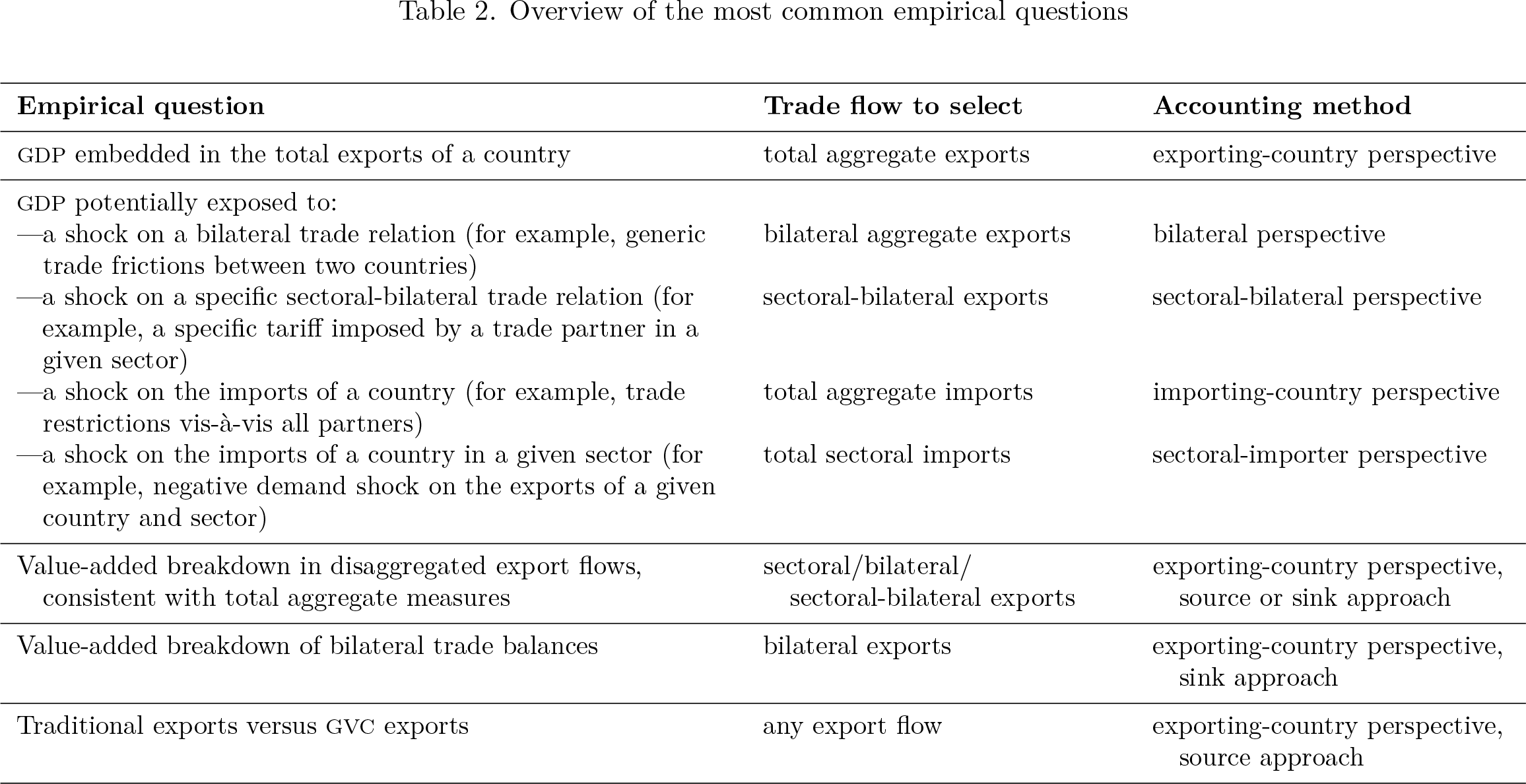
As already mentioned, each perspective is suited to address specific empirical questions. In table 2, we provide a nonexhaustive overview of the most common ones, along with the best-suited accounting method to provide an answer. See section 4.4 for additional examples together with the related
Overview of the most common empirical questions
In the next sections, we show the conceptual framework of the value-added accounting in total exports, following an exporting-country perspective (section 4.1), in bilateral exports, both with a bilateral and an exporting-country perspective (section 4.2), and in all the possible trade flows (section 4.3). Then in section 4.4, we show the implementation in
4.1 Conceptual framework: Value added in total exports
The problem of isolating value added in trade flows has been addressed at length in the literature.
12
To provide a useful starting point, we begin from the analysis of the aggregate exports of a country. Gross exports of country s can be broken down according to the country that initially produced each component. The part that originated in country s itself is referred to as the “domestic content of exports” (

Although the above formula closely resembles those used to decompose the GDP of a country in (3) or the final demand in (4), the two components in (6) cannot be considered as “net” measures of production, that is, value added. In other terms, while they were indeed generated at home and abroad, respectively, they are not a measure of the GDP produced by the different countries. The reason is that
Koopman, Wang, and Wei (2014) isolate these double-counted items in aggregate trade flows by proposing an accounting framework that allows one to single out the entire domestic and foreign value added embedded in the aggregate exports of country s, as well as the double-counted items originally produced at home and abroad. Figure 2 shows a scheme of the basic breakdown of aggregate exports decomposition of total exports.

A scheme of value-added decomposition of total exports based on Koopman, Wang, and Wei (2014), extended by Borin and Mancini (2019)
Notice that
Although the original Koopman, Wang, and Wei (2014) decomposition presents some drawbacks and limitations,
13
the general scheme they proposed remains a useful conceptual framework for the value-added decomposition of trade flows at any level of disaggregation. Indeed, in most cases, the default output of
Different methodologies have been developed in the literature aiming to pin down the value added embedded in gross export flows (see, among others, Wang, Wei, and Zhu [2013]; Koopman, Wang, and Wei [2014]; Borin and Mancini [2015, 2019]; Los, Timmer, and de Vries [2016]; Johnson [2018]; and Miroudot and Ye [2018]). 14 Here we present one of the possible methodologies for measuring value added in aggregate exports—that is, the one proposed by Borin and Mancini (2019) that, in the accounting of domestic value added, is algebraically equivalent to Los and Timmer (2018).
Double counting in the total gross exports of a given country s occurs whenever items that are first exported by s are then reimported and used to produce goods and services to be exported again by country s. Conceptually, one way to distinguish between value added and double counting is to split the production chain in phases, each one delimited by an export flow of country s: what is generated within that particular production phase is accounted for as value added in exports; what comes from further upstream production stages is double counted. This can be implemented in a general ICIO framework by modifying the matrix

We can split the production process along country s’s borders by carving out its intermediate export linkages at any stage of the above series. Algebraically, it can be implemented by setting to 0 the coefficients of matrix
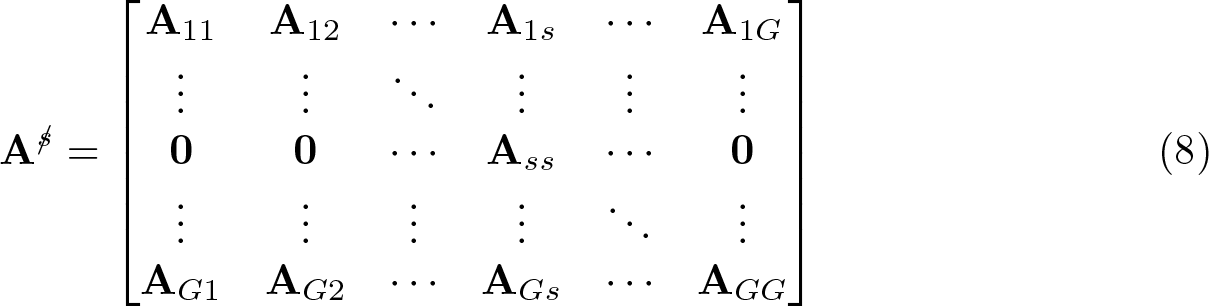
Then the corresponding inverse Leontief matrix is

Given that

Equation (10) reproduces the breakdown of bilateral exports into the main items identified in Koopman, Wang, and Wei (2014) (see figure 2). The double-counted items are measured by isolating the portion of country s that has been already exported by s in a previous stage of the production process. As far as the domestic components are concerned, it is worth noting that
In addition to the breakdown of the value added by country of origin, it is also possible to consider the linkages with the market of final absorption. To this aim, total exports

Then, intermediate inputs imported by the direct partner (

and

It is worth recalling that the two subscripts on final demand matrix
In addition, to identify specific country–sector of origin or destination from (12) and (13), the domestic value added can be broken down in two main aggregate indicators (see figure 2) to distinguish between the

4.2 Conceptual framework: Value-added accounting in bilateral exports
4.2.1 Bilateral perspective
If we are interested in measuring the total value added that crosses a specific bilateral border, for instance, to assess the exposure to tariffs imposed by the bilateral partner, we need an accounting method for value added in bilateral exports that excludes from gross trade figures only the items that are double counted in the same bilateral flow. In other words, the specific bilateral relation represents the perimeter for defining doublecounted flows in gross exports. This matters, for example, when we are interested in singling out the value added crossing a specific border that could be exposed to trade tensions between two countries on each side of the relationship.
By proceeding as for the derivation of the value-added decomposition for aggregate trade flows (see section 4.1), we can modify the input coefficient matrix

Then the corresponding inverse Leontief matrix can be defined as

By analogy, with the derivation of the decomposition of aggregate exports in (10),
we can express the complete decomposition of bilateral exports based on a bilateral perspective:

The measures of domestic value added (
Similarly to the derivation of (11) to (13), (14) can be further developed to consider all the forward production linkages, as well as the countries of completion and the markets of final absorption.
4.2.2 Exporting-country perspective for bilateral trade flows
The methodology presented above provides a correct measure of the whole value added that crosses a specific bilateral border, but these indicators cannot be summed across bilateral destinations to get the correct aggregate measure; that is, they are not additive. Conversely, to obtain a consistent breakdown across bilateral flows, the exportingcountry perspective must also be applied to the decomposition of disaggregated trade flows.
However, in this case, an approach to allocate value-added and double-counted items across the different disaggregated trade flows is needed. To address this issue, we exploit two alternative approaches proposed by Nagengast and Stehrer (2016) and fully derived by Borin and Mancini (2015, 2017).
The source-based approach is when a given item is accounted for as value added the first time it leaves the country of origin and, in the case of multiple crossings, is considered double counted in subsequent shipments. This definition is in line with the logic behind the accounting procedure presented in (7) through (10). 18 The sink-based approach is when a given item is accounted for as value added the last time it leaves the country of origin and, in the case of multiple crossings, is considered double counted in prior shipments. Suppose, for instance, that along the production process a certain item is exported by country A first to country B and then to country C. With the source-based approach, the item is classified as value added the first time it crosses the national border (that is, in the exports toward B), whereas the sink-based approach considers it as value added the last time it crosses the border (that is, in the exports toward C).
As already mentioned, the source approach is useful to separate traditional exports (crossing one border) from GVC exports (crossing more than one border). Instead, the sink approach is more suited for the analysis of bilateral trade balances in terms of value added.
The value-added decomposition of the exports from country s to country r according to a source-based approach of the exporting-country perspective can be obtained simply by substituting the total exports of s in (10) with the considered bilateral trade flow (that is,

As to the value-added decomposition of the exports from country s to country r according to an exporting-country perspective or sink-based approach, it is first necessary to isolate the portion of ultimate shipments within a certain bilateral trade flow.
These “ultimate exports”
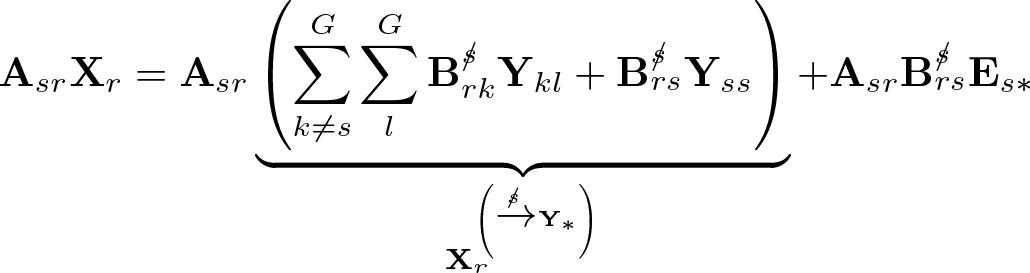
Then the value-added breakdown of bilateral exports can be expressed as

As highlighted above, the three different value-added decompositions of bilateral trade flows in (14), (15), and (16) can be used to address different issues, for instance, the analysis of the exposure to tariffs imposed by the bilateral partner, the analysis of GVC exports, and the analysis of bilateral trade balances, respectively. Nevertheless, it is important to highlight that (i) at the bilateral level, the domestic and foreign contents are the same in the three breakdowns, and only the value-added and doublecounted components differ; and (ii) the value-added and double-counted terms of the two decompositions based on the exporting-country perspective [that is, the source-based perspective in (15) and the sink-based perspective in (16)] differ only at the bilateral level, and when summing across the destinations of a given exporter, we obtain exactly the same aggregate indicators as those in (10). 20
4.3 Conceptual framework: Value-added accounting in different types of trade flows and accounting perspectives
Here we provide an overview of all the trade flows that can be analyzed with
1. a. - Exporting-country perspective: Both the logic and the algebraic formulation of this accounting perspective are presented in section 4.1. - World perspective: This perspective has been considered only for the decomposition of the foreign content of exports. According to this methodology, a certain item is accounted for as foreign value added only once in all (that is, world) trade flows, whereas in the exporting-country perspective it occurs only once in all the exports of a single country. More specifically, by using a source-based (sink-based) approach, a certain item is considered as value added only the first (the last) time it crosses a foreign border, whereas all the other times it does, it is classified as double counted. The decompositions based on a world perspective can be used to address interesting questions regarding the breakdown of total world trade (by aggregating across countries the total exports’ decompositions obtained with b. - Sectoral-exporter perspective: This method, formally derived in Borin and Mancini (2019), can be chosen when the aim of the analysis is to compute the entire value added that is embedded in all the exports of a country in a given sector. This occurs, for instance, when an economic shock (or policy intervention) affects all the exports of a country in a given sector (across all the destinations), and the interest of the analyst is to measure the spillovers from this shock into different country sectors. The domestic and foreign value added embedded in total exports of country s and sector n can be computed similarly as in the decomposition of bilateral flows according to the bilateral perspective [see (14)]. The only difference is that the original matrix of technical coefficients - Exporting-country perspective: This accounting method for the analysis of sectoral trade flows follows exactly the logic of the same perspective described above for the analysis of bilateral trade flows. It provides a breakdown of sectoral exports consistent with the value-added indicators computed for the total aggregate exports of a country. Depending on whether the focus of the analysis is on the origin of the production or on the final absorption, a source- or a sink-based approach needs to be considered, respectively. The algebraic expressions follow closely the formulas in (10) [or (15)] and (16), where total sectoral export flows are singled out through proper diagonalizations of the
2. a. - Bilateral perspective - Exporting-country perspective b. - Sectoral-bilateral perspective: This methodology, developed in Borin and Mancini (2019), is useful for empirical analysis aiming to measure the whole value added of a country entering in the exports of country s in a specific sector (say, n) to an importing country r. It can be used, for instance, to evaluate the GDP exposure to a tariff imposed by a country vis-à-vis a certain partner in a specific sector. As for the previous decompositions, for which the perspective corresponds to the trade flow under investigation, the value-added indicators are derived by modifying the input requirement matrix - Exporting-country perspective: This can be used to obtain a breakdown of total exports’ value-added indicators across sectoral-bilateral flows. The formulation is a direct extension of that used for total sectoral exports to bilateral trade flows.
3. a. - Importing-country perspective: This methodology can be exploited to compute the GDP of a given country j that enters, directly or indirectly, in the total imports of a given country r. This measure is interesting, for instance, when a certain country is going to adopt a general protectionist stance (that is, vis-à-vis all the exporting partners) and we want to compute the portion of the other countries’ GDP at stake. In this case, we define the relevant perimeter at the level of the importing country’s borders as a whole. This can be implemented by following a procedure similar to that used to derive the (exporting) country perspective of section 4.1 and is formally derived in Borin and Mancini (2019). b. - Sectoral-importer perspective: This perspective, derived in Borin and Mancini (2019), can be useful when the focus is on a particular sector of a given importing country, for example, when a certain shock affects only the imports of a country in a specific sector. The derivation is similar to that of the importing-country perspective, where the double-counting perimeter is defined at the level of the sectoral imports of a country.
4.4 Implementation: Accounting for value added in gross trade
Depending on the specific empirical question, the user needs to choose the appropriate
As to the first point, the following types of trade flows are considered: i) aggregate exports, ii) sectoral exports, iii) bilateral exports, iv) sectoral-bilateral exports, v) aggregate imports, and vi) sectoral imports. It is also worth recalling that the option
4.4.1 Syntax
We structured
1. a. Value added and GVC participation in b. Value added and GVC participation in
2. a. Value added and GVC participation in b. Value added and GVC participation in
3. a. Value added in total aggregate imports: b. Value added in total sectoral imports:
4.4.2 methods_* options
The options
A summary of the available perspectives and approaches for each trade flow: Syntax

As already mentioned at the beginning of section 4, whenever the perspective is set at a more aggregate level compared with the considered trade flow, two alternative approaches are available. By using the
4.4.3 results_exports and results_imports options
For the selected trade flow,
For export flows (that is, [results_exports] in the syntax reported at the beginning of this section), the default output is
The detailed output also includes additional indicators of trade in value added that have been singled out in the literature (for example,
As far as import flows are concerned (that is, [results_imports] in the syntax reported at the beginning of this section), the distinction between domestic and foreign items is less relevant because the former would refer only to the items produced, exported, and then reimported by the importing country itself. For this reason, the default in this case is to compute the gross trade value (that is,
4.4.4 origin_destination option
As an additional feature, it is also possible to single out the country–sector where the goods and services were originally produced by specifying the
Similarly, the imported value added (gross content) can be traced back to the country of origin by specifying the option
4.4.5 standard_options
As for the standard options, (that is, [ standard_options ] in the syntax reported at the beginning of this section), the
4.4.6 Examples: Value added in trade flows
In this section, we provide some examples of the insights that
As a running example, we select a specific trade flow, the Chinese total aggregate exports. After loading the year 2014 of the last release of the WIOD tables by using
the user can easily obtain a detailed breakdown of the selected trade flow, both in millions of U.S. dollars and as a share, by using

The detailed decomposition also can be computed for a particular sector of export, for example, “Manufacture of computer, electronic, and optical products” (sector code 17 for the loaded ICIO table), by using 28

We now show how the results can change by using a different perspective on the same trade flow. We move from the default—the exporting-country perspective—to a sectoral-exporter perspective by adding the option

While the output confirms that domestic and foreign contents are not affected by changing perspective, the value-added terms are higher, and consequently, doublecounting items are lower. This is not surprising, because the sectoral-exporter perspective features a more restrictive definition of double counting (see section 4.3).
Which perspective should be used? It depends on the specific empirical question. If the goal is to measure to what extent the GDP of a country could be exposed to a certain shock on the exports of a sector, a sectoral-exporter perspective might be appropriate. Indeed, in this case, the relevant border to trace value added belongs to the exporting country–sector pair. Instead, the default perspective (the exporting-country one) is the most appropriate if the goal is to compute GVC-related trade indices—because to this end the relevant border is always the exporting country’s border—and is suited to obtain measures of value-added trade traced in disaggregated trade flows that are consistent with the aggregate figures. This additivity property is a feature of the exporting-country perspective only.
29
It can be easily verified by showing that value-added components and GVC-related trade in the aggregate Chinese exports—as computed before using the syntax

We now select a different trade flow, moving to bilateral sectoral exports. In particular, we consider the Chinese exports of computer, electronic, and optical products to the U.S. The default assessment of the extent of GVC participation, as well as a breakdown of the flow in terms of value-added components consistent both with the aggregate Chinese exports and with total Chinese exports to the U.S. is obtained using the default exporting-country perspective:
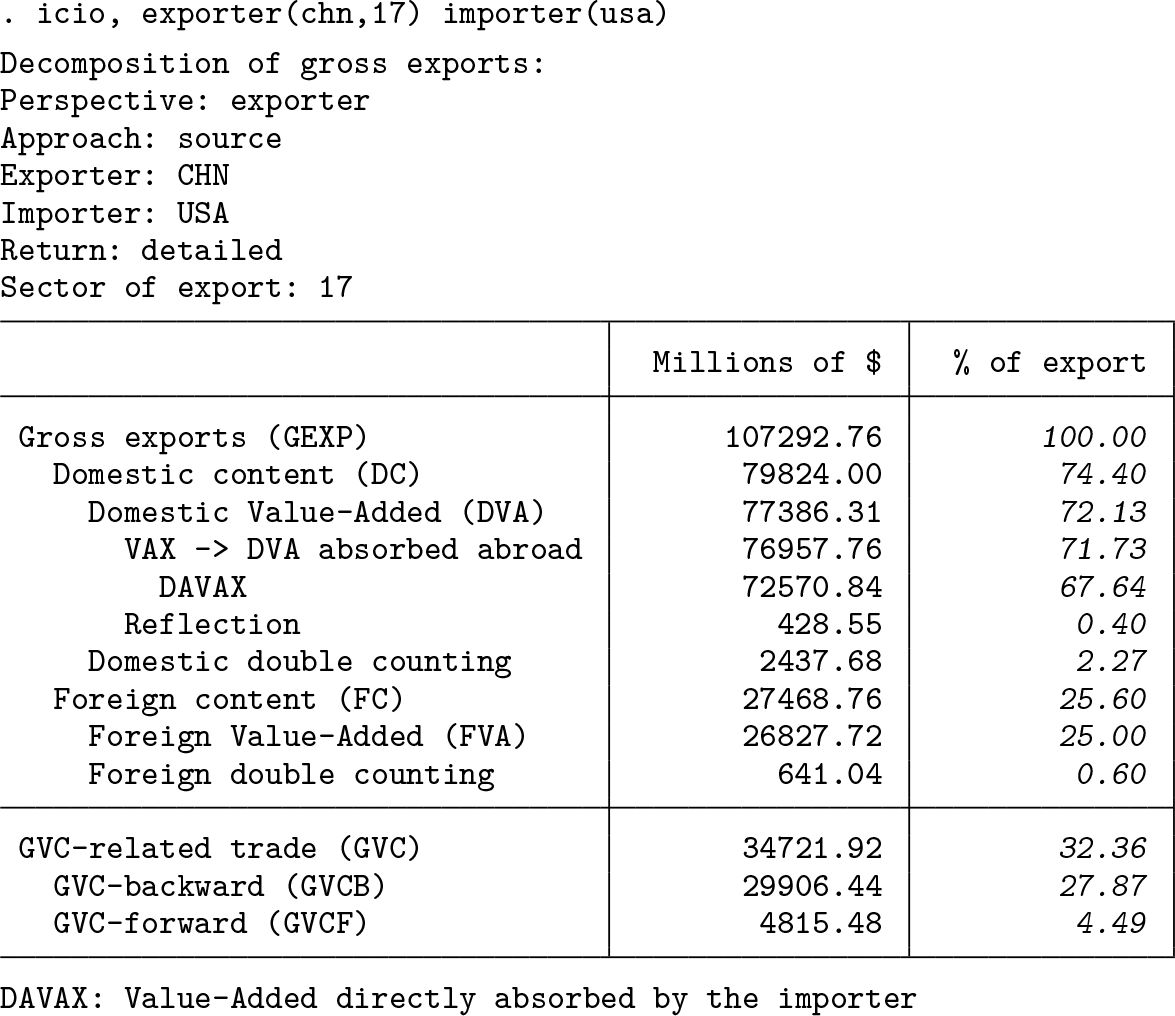
Again, we can select a perspective in line with the level of aggregation of the chosen trade flow, that is, a sectoral-bilateral perspective—

According to WIOD 2014 data, Chinese value added potentially exposed to this tariff turned out to be around $79.8 billion, as shown by the value reported for the
The same reasoning applies when the objective is to choose the best-suited perspective for bilateral aggregate exports. Here the choice will be, again, between the default exporting-country perspective and the bilateral one. For example, suppose that the aim is to quantify the potential exposure of other countries to a U.S.–China trade war. In fact, U.S. and Chinese exports embed a nonnegligible amount of other countries’ foreign value added that would be indirectly exposed to new tariffs. Figure 4.9 of the World Bank’s WDR 2020 reports that around 2% of the value added in the Chinese exports to the U.S. consists of Japan’s GDP. In turn, around 2.6% of the value added in the U.S. exports to China is Canadian GDP. These numbers can be easily obtained using

In the above Stata output, we retrieved only the exposure for countries with the highest value added in the bilateral exports between U.S. and China. Actually, by running the previous syntax with the option

Finally, we consider the analysis of value added in the total imports of a country. To quantify the German GDP potentially exposed to U.S. tariffs vis-à-vis all partners, according to WIOD 2014 data, we can use the following syntax:

The Stata output indicates that around $133 billion of Germany’s value added is imported, directly and indirectly, by the U.S. (around 5.5% of the total U.S. imports) and thus could be exposed to U.S. trade barriers, according to WIOD 2014 data. German GDP exposure to these trade barriers can be computed by taking the ratio with respect to the total German GDP—obtained with
If the goal is to quantify the potential exposure of German value added to a U.S. tariff on a specific sector, for example, motor vehicles from Germany, a sectoral-importer perspective is the right choice.

Again, the relative exposure can be easily obtained by taking the ratio of the absolute exposure ($17.2 billion) with respect to the total German value added in the motor vehicles industry ($147.5 billion). Thus, a U.S. tariff hitting motor vehicle imports from Germany might affect around 11.7% of the value added produced in the same sector in Germany.
Other examples of questions that could be answered using
Which part of a country’s total exports is home produced, that is, domestic GDP?
Which part of a country’s total exports can be traced back to other countries’ GDP?
Where is the foreign value added in German exports produced?
Considering the bilateral exports from Italy to Germany, where is the Italian GDP (domestic value added) reexported by Germany absorbed?
How can the complete breakdown by origin and destination of the value added (both domestic and foreign) for Chinese exports to the U.S. be obtained?
How can the (corrected) Koopman, Wang, and Wei (2014) decomposition be retrieved using
What is the Chinese GDP that at any point in time passes through a certain bilateral trade flow, say, Chinese exports to the U.S.? In other terms, what is the Chinese GDP potentially exposed to U.S. tariffs on imports from China?
What is the German GDP potentially exposed to U.S. trade barriers on all imports?
What is the German GDP that could be affected by U.S. tariffs on imports in sector 20?
What is the exposure of U.S. GDP to a Chinese tariff on U.S. imports in sector 17?
To what extent are Italian sectors exposed to a shock on Germany’s exports in sector 20?
5 Measuring GVC-related exports
Following the original idea by Hummels, Ishii, and Yi (2001), many contributions in the literature have shared the view that the trade flow related to GVC activity should consist of goods and services crossing more than one border along the production process. Borin and Mancini (2015) made this definition operational by proposing a way to isolate traditional trade from gross flows (that is, the portion of trade crossing just one border) and considering the remaining part as a proxy of the GVC-related trade. This GVC indicator presents three desirable features: (i) it is bounded between 0 and 1 because it traces within a particular trade flow its share related to GVC activity; that is, the numerator is a subcomponent of the denominator; (ii) it is additive at any level of aggregation or disaggregation of trade flows; thus, data can be summed at any level (total country exports/world exports/world sector exports/country groups) to obtain the proper GVC participation measures at the desired level of aggregation; and (iii) it can be broken down into two additive terms, that is, a “backward” component corresponding to import content of exports and a “forward” component, which measures the part of domestic production that is supplied to the importing country to be processed and reexported.
In section 5.1, we provide its conceptual framework, and in section 5.2 we show how to compute GVC measures in
5.1 Conceptual framework: GVC participation
The traditional exports of country s to country r can be defined as the production of s that is directly absorbed in r without any further reexport. This component, called

Then, GVC-related exports can be simply obtained by excluding the entire domestic
value added of country s absorbed directly by its direct importer (

Therefore, GVC-related trade share in total exports is given by
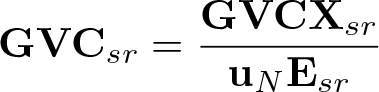
where
For the total exports of country s, the GVC share will be computed as

while at world level, we have

As already mentioned, the overall GVC indicator of (17) can be decomposed into a backward component, corresponding to the

where

and

The
5.2 Implementation: GVC in exports
To compute GVC measures with
5.2.1 Syntax
The
1. GVC participation in total exports of a country: a. GVC participation in b. GVC participation in
2. GVC participation in bilateral exports: a. GVC participation in bilateral aggregate exports: b. GVC participation in bilateral sectoral exports:
The
Also for GVC indicators, it is possible to single out the country–sector where the goods and services were originally produced by specifying the
5.2.2 Examples: GVC-related exports
Imagine that the goal is to compute the GVC-related trade in the agrifood–sector (sector 4 in Eora), as in figure 1.13, panel b of the World Bank’s WDR 2020. For instance, in the case of Tanzania, one of the Sub-Saharan African countries that experienced a significant increase in GVC participation in that sector, the results for 1990 and 2015 can be obtained with the following code:

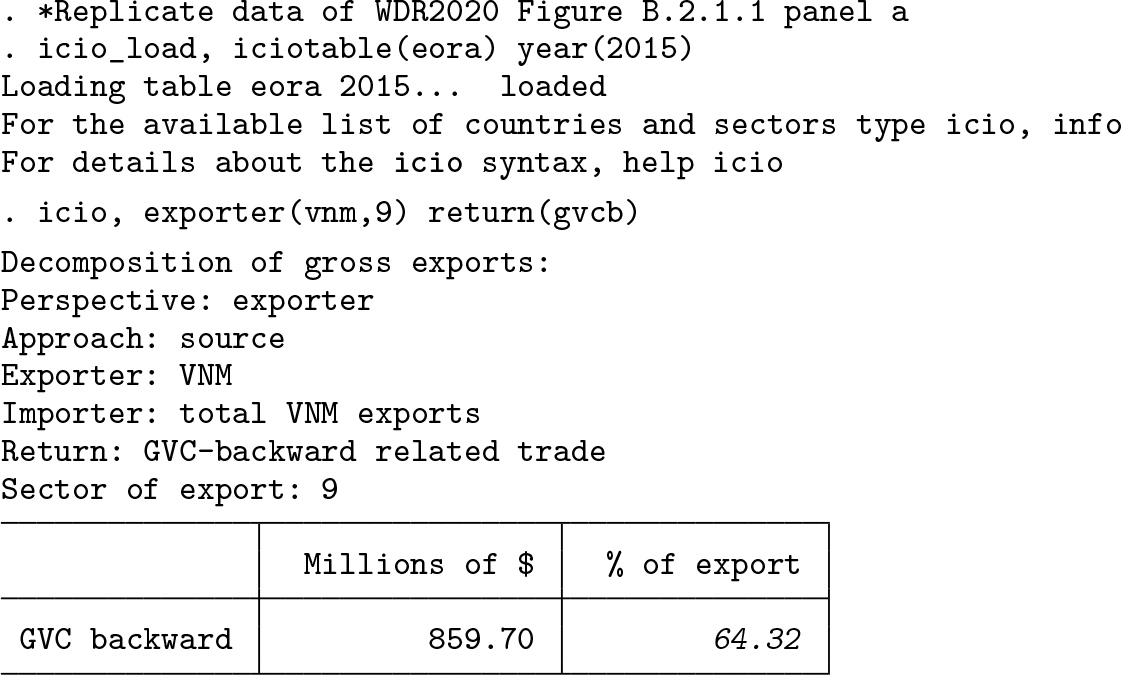
If we want to compute just the backward participation in GVC, for instance, for Vietnam in the electrical and machinery–sector, as in figure B.2.1.1, panel a of the WDR 2020, we can run the following code:
Throughout the WDR 2020, several figures on GVC-related trade at the world level are reported. These measures can be obtained with
Other basic examples of questions on GVC participation and the related syntax are the following:
Which share of the German exports related to GVC is produced in Italy?
Which share of the German exports is related to backward and forward GVC?
6 Conclusion
In this article, we described the new command,
It exploits the most famous ICIO tables—the WIOD (Timmer et al. 2015), the OECD TiVA Database (OECD 2018), the Eora Global Supply Chain Database (Lenzen et al. 2013), and the ADB MRIOT Database—but also allows one to load any user-provided ICIO table.
It provides breakdowns of aggregate, bilateral, and sectoral exports and imports according to the source and the destination of their value-added content, with a careful treatment of double-counted items. These decompositions can be used to assess the exposure of countries and sectors to different kinds of trade shocks, including tariffs, and get indicators for any level of disaggregation of trade flows that are consistent with more aggregate measures; that is, disaggregated indicators can be summed up to get correct measures in more aggregate trade flows.
It can break down export flows in terms of traditional versus GVC trade, at any level of aggregation, also distinguishing between backward and forward participation in GVC.
It is flexible and open because we plan to release updates to include new ICIO databases as soon as they became available, as well as other measures to assess the participation and position of countries and sectors in GVCs and trade policy analysis.
The measures computed with
Supplemental Material
Supplemental Material, sj-zip-1-stj-10.1177_1536867X211045573 - icio: Economic analysis with intercountry input–output tables
Supplemental Material, sj-zip-1-stj-10.1177_1536867X211045573 for icio: Economic analysis with intercountry input–output tables by Federico Belotti, Alessandro Borin and Michele Mancini in The Stata Journal
Footnotes
7 Programs and supplemental materials
To install a snapshot of the corresponding software files as they existed at the time of publication of this article, type
Notes
References
Supplementary Material
Please find the following supplemental material available below.
For Open Access articles published under a Creative Commons License, all supplemental material carries the same license as the article it is associated with.
For non-Open Access articles published, all supplemental material carries a non-exclusive license, and permission requests for re-use of supplemental material or any part of supplemental material shall be sent directly to the copyright owner as specified in the copyright notice associated with the article.
