



Abstract
In this article, we describe the
1 Introduction
Analysis of longitudinal (panel) data has the advantage of allowing consistent estimation of the model parameters even in the presence of unobserved heterogeneity, that is, of decreasing the risk of omitted variables bias. The fixed-effects approach (in Stata, the xtreg command with the fe option) allows estimating the effect of time-varying variables even in the presence of correlation with the error term, provided that the correlation is driven by omitted time-invariant variables, either observed or unobservable (such as individual preferences or gender or firms’ propensity to patent or foundation year). Consistent estimation of the parameters of interest is obtained by using the within-group transformation that removes the individual average from the variables included in the model. Singleton units, that is, those units observed only at one point in time, do not contribute to the analysis, because their within-group transformation is identically equal to zero.
While most textbook examples consider a balanced panel dataset, real data often entail an unbalanced set of units, with a substantial share of singleton observations. In some cases, singletons are due to natural enterprise mortality and refreshment of the sample with new units. This type of attrition is common in databases like Orbis (https://www.bvdinfo.com/en-gb) or the Business Environment and Enterprise Performance Survey (https://www.beeps-ebrd.com/data; https://www.enterprisesurveys.org/). In the case of rotating panels, singletons are the result of the sampling framework. This happens in many labor force surveys in which a share of the observations is replaced in each wave, and the observations that are interviewed only in the first wave are singletons by design. Attrition and singletons can also be due to the death of part of the sample. This is particularly relevant for samples of older people, as in the United States’ Health and Retirement Study (https://hrs.isr.umich.edu/about) or the Mexican Health and Aging Study (http://www.mhasweb.org/). Migration and nonresponse are other common causes of attrition and the resulting presence of singleton observations in longitudinal data.
In this article, we describe the
The article proceeds as follow. Section 2 describes the methodology. Section 3 presents the syntax of the
2 Method
Consider the linear static panel-data model with individual effects (i = 1,…, N; t = 1,…, Ti ),

where yit
represents the dependent variable of interest measured on unit i at time t,
In the setup of (1), the fixed-effects estimator is consistent: the presence of an unbalanced1 panel complicates only the notation but does not affect the properties of the estimator.
Define

In contrast, because of the possibility of correlation between the independent variables and the individual component ui
, the OLS estimator may be biased. Denote with

As an equal number of moment conditions and parameters are added, the estimated coefficients in β are unaffected. However, information from singleton units can be further exploited to obtain efficiency gains under the assumption that the OLS bias is the same for the singletons and those units that are observed more than once. Denote with i = s the singletons: the following moment condition can also be considered [see (3) in Bruno, Magazzini, and Stampini (2020)]:

We propose a GMM estimator based on moment conditions (2), (2), and (3). The computation considers a two-step procedure based on the
The assumption of homogeneity can be tested using a regression framework or on the basis of the test of overidentifying conditions based on the value of the minimized GMM criterion. The two test statistics are provided with the proposed command. Please refer to Bruno, Magazzini, and Stampini (2020) for details.
3 The xtfesing command
3.1 Syntax
The syntax of the

depvar represents the dependent variable, and indepvars the list of independent variables. A subsample of the data can be specified using the if or in qualifier, as usual.
3.2 Options
id(varname) specifies varname identifying the grouping variable. The option can be omitted when the variables identifying the panel dimensions have been specified with the xtset command. In this case, the variable identifying the panel units is considered (if the option is omitted but no xtset command has been defined before
nowindmeijer specifies that the default standard errors computed by Stata’s
level(#) specifies the confidence level. The default is level(95).
3.3 Postestimation command
The xb a + ue ui
+ eit
, the combined residual
3.4 Stored results

4 Example: A wage equation
We consider nlswork.dta, available online from the Stata website:
3
The dataset contains information on young women between the ages of 14 and 26 in 1968. Data are extracted from the National Longitudinal Surveys conducted by the U.S. Department of Labor.
We specify the panel dimensions by using the xtset command:

The dataset contains 4,711 units observed over 15 time periods (from 1968 to 1988, with some gaps). The panel is unbalanced: a description of the dataset structure with xtdescribe yields the following results:

The two most common patterns are indeed singletons: 136 units are observed only in the first time period, and 114 are observed only in the last time period. Singletons also include units with a single observation at any intermediate time, plus units with more than one observation that enter the estimation sample only once because of missing values in the variables considered by the model. This last group is not counted with xtdescribe, which is based on the number of lines occupied by each unit in the dataset.
We consider the logarithm of wage (ln_wage) as dependent variable and include among the independent variables total work experience (ttl_exp) and its square, a dummy variable for union membership (union), the age of the woman, and three dummy variables to identify her residence (south, c_city, and not_smsa).
We first generate the square of the variable ttl_exp:
As a benchmark for the proposed estimation procedure, we also consider the fixed- effects estimator. Robust standard error, clustered over idcode, is considered to account for the possibility of heteroskedasticity and autocorrelation in the idiosyncratic component. Some missing values are present, so the number of units decreases to 4,150. 4

Overall, the estimation sample includes 665 singletons: the presence of singletons is reflected in the number of years of observations, which ranges from 1 to 12.
The same equation is estimated using the Bruno, Magazzini, and Stampini (2020) procedure implemented with the
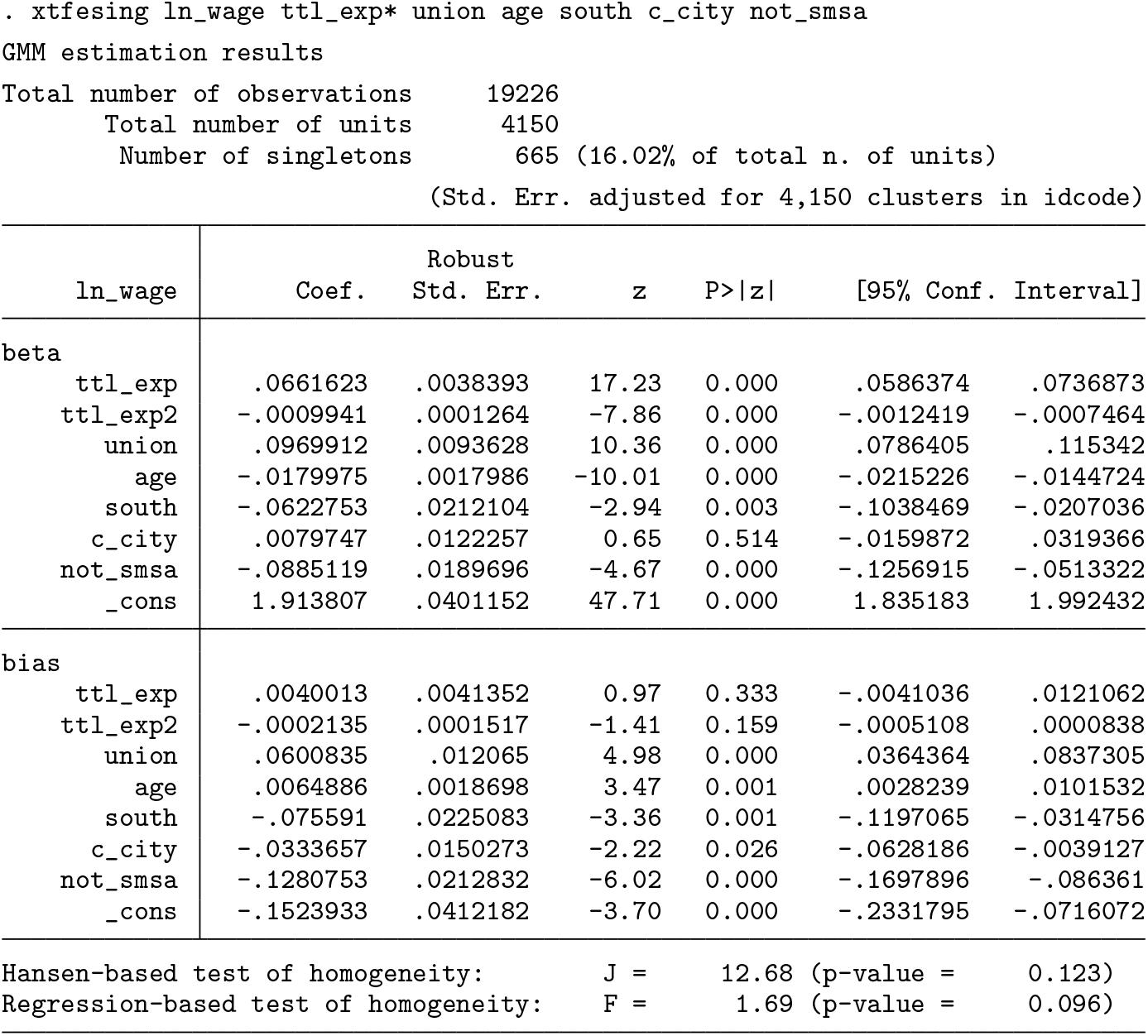
The option id() is omitted because we previously defined the panel through the command xtset. The variable idcode is therefore considered to identify the units.
At the top of the table of results, we have information on the total number of observations (19,226), the total number of units (4,150) and the number of singletons (665, corresponding to 16.02% of the total number of units).
The table of results reports the estimated coefficients for “beta” (the consistent estimator of the coefficient of interest) and the OLS “bias” for each variable in the estimated equation. Note that when the predict command is invoked after
At the bottom, the table reports the two tests of the homogeneity assumption, required for the validity of the proposed approach: The Hansen-based test of homogeneity, corresponding to the test of overidentifying restrictions for the GMM estimation, produces a value of 12.68 with a p-value of 0.123. The regression-based test of homogeneity produces a value of 1.69 with a p-value of 0.096.
Both tests do not reject the null hypothesis of homogeneity at the 5% level of significance, so the Bruno, Magazzini, and Stampini (2020) procedure can be applied to these data.
In this case, the reduction in the standard errors is limited (or null). As Bruno, Magazzini, and Stampini (2020) point out, efficiency gains can be negligible with a long time dimension or when the share of singletons is not substantial.
For illustration, we limit the analysis to the last three years of the dataset (85, 87, and 88). We also restrict the sample by only including white women. In this way, we “artificially” generate a dataset characterized by a small time dimension and a larger (even though, still fairly limited) share of singletons.
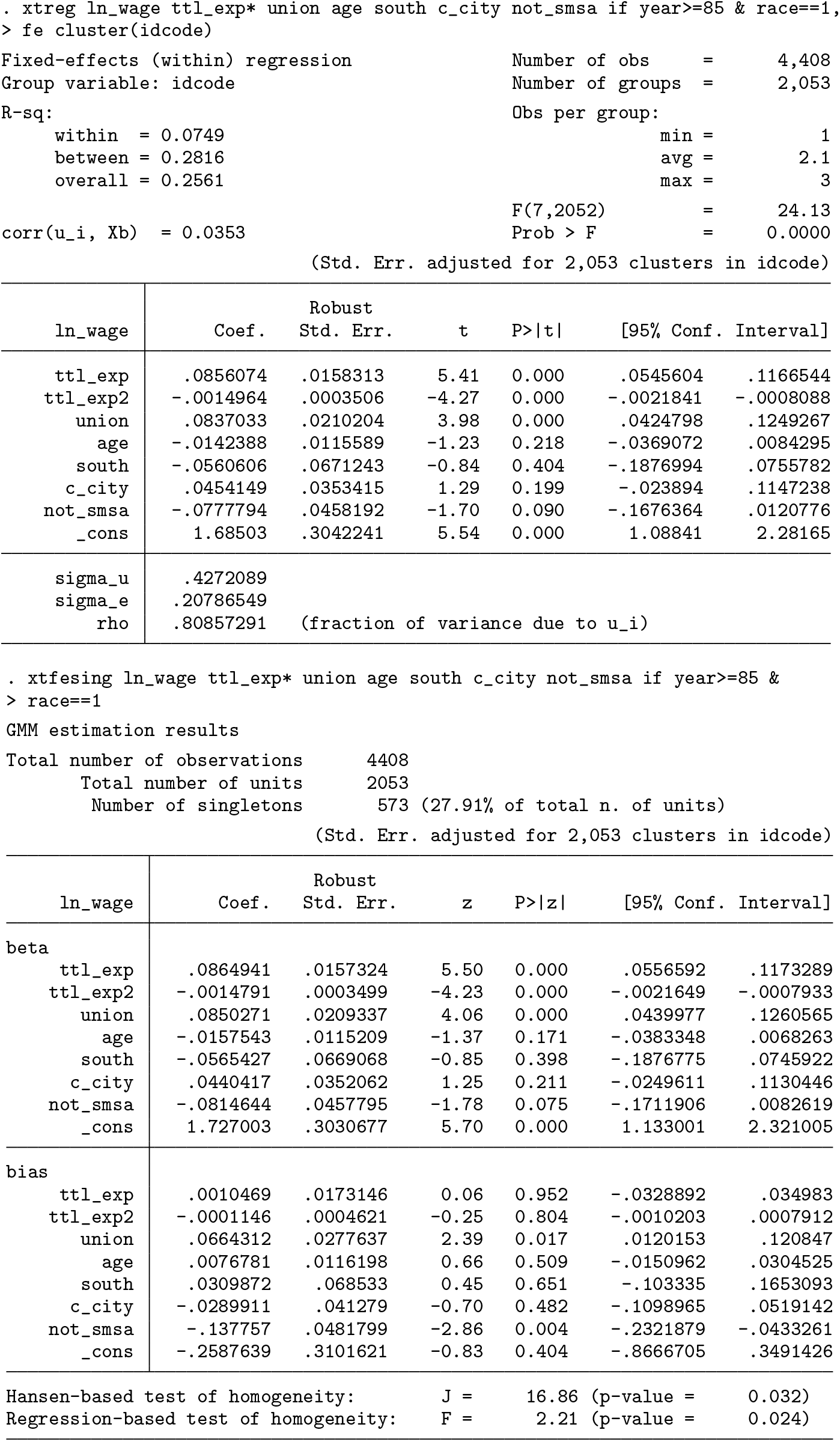
In this case, standard errors tend to be lower when using
Bruno, Magazzini, and Stampini (2020) consider cases in which the share of singletons reaches or exceeds 50%. They show that, in those cases, the procedure implemented by
Supplemental Material
Supplemental Material, st0623 - Using information from singletons in fixed-effects estimation: xtfesing
Supplemental Material, st0623 for Using information from singletons in fixed-effects estimation: xtfesing by Laura Magazzini, Randolph Luca Bruno and Marco Stampini in The Stata Journal
Footnotes
5 Programs and supplemental materials
To install a snapshot of the corresponding software files as they existed at the time of publication of this article, type
Notes
References
Supplementary Material
Please find the following supplemental material available below.
For Open Access articles published under a Creative Commons License, all supplemental material carries the same license as the article it is associated with.
For non-Open Access articles published, all supplemental material carries a non-exclusive license, and permission requests for re-use of supplemental material or any part of supplemental material shall be sent directly to the copyright owner as specified in the copyright notice associated with the article.
