Many applications involve a censored dependent variable, an endogenous independent variable, or both. Chernozhukov, Fernández-Val, and Kowalski (2015, Journal of Econometrics 186: 201–221) introduced a censored quantile instrumental-variable (CQIV) estimator for use in those applications. The estimator has been applied by Kowalski (2016, Journal of Business & Economic Statistics 34: 107–117), among others. In this article, we introduce a command, cqiv, that simplifies application of the CQIV estimator in Stata. We summarize the CQIV estimator and algorithm, describe the use of cqiv, and provide empirical examples.
In 2015, Chernozhukov, Fernández-Val, and Kowalski introduced a censored quantile instrumental-variables (CQIV) estimator. In this article, we introduce a command, cqiv, that implements the CQIV estimator in Stata. Our goal is to facilitate the use of cqiv in many applications.
Many applications involve censoring and endogeneity. For example, suppose that we are interested in the price elasticity of medical expenditure, as in Kowalski (2016). Medical expenditure is censored from below at 0, and the price of medical care is endogenous to the level of medical expenditure through the structure of the insurance contract. Given an instrument for the price of medical care, the CQIV estimator facilitates estimation of the price elasticity of expenditure on medical care in a way that addresses censoring and endogeneity.
The CQIV estimator addresses censoring using the censored quantile regression (CQR) approach of Powell (1986), and it addresses endogeneity using a control function approach. For computation, the CQIV estimator adapts the Chernozhukov and Hong (2002) algorithm for CQR estimation. An important side feature of cqiv is that it can also be used in quantile regression applications that do not include censoring or endogeneity.
We first describe a model of triangular system for CQIV regression. Suppose y is an observed response variable obtained by censoring a continuous latent response y* from below at the level determined by the variable c. Let d be the continuous regressor of interest, possibly endogenous;1w be a vector of covariates, possibly containing c; and z be a vector of (possibly discrete) instrumental variables excluded from the equation for y*. We observe a sample of size n of independent and identically distributed observations from the random vector , which obeys
where v is a latent unobserved variable that accounts for the possible endogeneity of d, x = x(d,w, v) with x(d,w, v) being a vector of transformations of (d,w, v), Qy*(u | d,w, v) is the u-quantile of y* conditional on is the vector of coefficients in the u-quantile function of y* conditional on (d,w, v), Qd(v | w, z) is the v-quantile of d conditional on (w, z), and
This CQIV regression model nests the uncensored case of the quantile instrumentalvariable (QIV) regression by making c arbitrarily small. As an example for the CQIV model, in the Engel curve application of Chernozhukov, Fernández-Val, and Kowalski (2015), y is the expenditure share in alcohol (bounded from below at c = 0), d is total expenditure on nondurables and services, w are household demographic characteristics, and z is labor income measured by the earnings of the head of the household. Total expenditure is likely to be jointly determined with the budget composition in the household’s allocation of income across consumption goods and leisure. Thus, households with a high preference to consume “nonessential” goods, such as alcohol, tend to expend a higher proportion of their incomes, and therefore they tend to have a higher expenditure. The control variable v in this case is the marginal propensity to consume, measured by the household ranking in the conditional distribution of expenditure given labor income and household characteristics. This propensity captures unobserved preference variables that affect both the level and the composition of the budget. Under the conditions for a two-stage budgeting decision process (Gorman 1959), where the household first divides income between consumption and leisure or labor and then decides the consumption allocation, some sources of income can provide plausible exogenous variation with respect to the budget shares. For example, if preferences are weakly separable in consumption and leisure or labor, then the consumption budget shares do not depend on labor income given the consumption expenditure (see, for example, Deaton and Muellbauer [1980]). This justifies the use of labor income as an exclusion restriction.
A simple version of the model (1)–(3) is
where Φ−1 denotes the quantile function of the standard normal distribution. Also assume that is jointly normal with correlation ρ0. From the properties of the multivariate normal distribution, where This result yields a specific expression for the conditional quantile function ,
where is the asymmetric absolute loss function of Koenker and Bassett (1978), is a vector of transformations of is a positive cutoff, and vbi is an estimator of vi (which is described below).
provided that In other words, x′β0(u) is the conditional u-quantile of the observed outcome for the observations for which that is, the conditional u-quantile of the latent outcome is above the censoring point. These observations change with the quantile index and may include censored observations. Chernozhukov, Fernández-Val, and Kowalski (2015) refer to them as the “quantile-uncensored” observations. The multiplier is a selector that predicts if observation i is quantileuncensored. For the conditions on this selector, consult assumptions 4(a) and 5 in Chernozhukov, Fernández-Val, and Kowalski (2015).
cqiv implements the CQIV estimator, which is computed using an iterative procedure where each step takes the form specified in equation (6) with a particular choice of We briefly describe this procedure here and then provide a practical algorithm in the next section. The procedure first selects the set of quantile-uncensored observations by estimating the conditional probabilities of censoring using a flexible binary choice model. Because quantileuncensored observations have a conditional probability of censoring that is lower than the quantile index u. The linear part of the conditional quantile function, is estimated by standard quantile regression using the sample of quantile-uncensored observations. Then the procedure updates the set of quantile-uncensored observations by selecting those observations with conditional quantile estimates that are above their censoring points, and iterate.
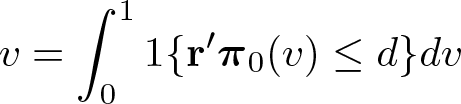
cqiv provides different ways of estimating the control variable v, which can be chosen with the option firststage(string). If Qd(v | w, z) is invertible in v, the control variable has several equivalent representations:
Fd(d | w, z) is the distribution of d conditional on (w, z). Different estimators of v can be constructed based on parametric or semiparametric models for Fd(d | w, z) and Qd(v | w, z). Let r = r(w, z), with r(w, z) being a vector of collecting transformations of (w, z) specified by the researcher. When string is quantile, a quantile regression model is assumed, where is the vector of coefficients in the v-quantile function of d conditional on (w, z), and
The estimator of v then takes the form
where is the Koenker and Bassett (1978) quantile regression estimator, which is calculated within cqiv using the built-in qreg command in Stata, and τ is a small positive trimming constant that avoids estimation of tail quantiles. The integral in (7) can be approximated numerically using a finite grid of quantiles.2 Specifically, the fitted values for prespecified quantile indices (whose number nq is controlled by the option nquant(#)) are calculated, which then yields
When string is distribution, ϑ0 is estimated using distribution regression. In this case, we consider a semiparametric model for the conditional distribution of d to construct a control variable,
where Λ is a probit or logit link function that can be chosen using the ldv1(string) option, where string is either probit or logit. The estimator takes the form
where is the maximum likelihood estimator of at each d (see, for example, Foresi and Peracchi [1995], and Chernozhukov, Fernández-Val, and Melly [2013]).3 The expression (8) can be approximated by considering a finite grid of evenly spaced thresholds for the conditional distribution function of d, where the number of thresholds, nt, is controlled by the option nthresh(#). Concretely, for threshold dj with j = 1,…, nt,
where is a probit or logit estimate with as a dependent variable and ri as regressors.
Lastly, when string is ols, a linear regression model is assumed, and is a transformation of the ordinary least-squares (OLS) residual:
where Φ is the standard normal distribution, is the OLS estimator of , and is the estimator of the error standard deviation. In estimation of (6) using cqiv, we assume that the control function vb enters the equation through This is motivated by the example (4)–(5).
For each desired quantile u, perform the following steps:
0. Obtain from (7), (8), or (9), and construct
Select a set of quantile-uncensored observations where Λ is a known link function, is a vector of collecting transformations specified by the researcher, k0 is a cut-off such that 0 < k0< u, and
Obtain two-step CQIV coefficient estimates, and update the set of quantile-uncensored observations,
Obtain the three-step CQIV coefficient estimates solving the same minimization program as in step 2 with J0 replaced by J1.4
Remark 1 (Step 1). To predict the quantile-uncensored observations, one can use a probit, logit, or any other model that fits the data well. cqiv provides the option ldv2(string), where string can be probit or logit. Note that the model does not need to be correctly specified; it suffices that it selects a nontrivial subset of observations with To choose the value of k0, it is advisable that a constant fraction of observations satisfying is excluded from J0 for each quantile. To do so, one needs to set k0 as the q0th quantile of conditional on where q0 is a percentage (10% worked well in our simulation with little sensitivity to values between 5% and 15%). The value for q0 can be chosen with the option drop1(#).
Remark 2 (Step 2). To choose the cutoff ς1, it is advisable that a constant fraction of observations satisfying is excluded from J1 for each quantile. To do so, one needs to set ς1 to be the q1th quantile of conditional on where q1 is a percentage less than q0 (3% worked well in our simulation with little sensitivity to values between 1% and 5%). The value for q1 can be chosen with the option drop2(#).5
Remark 3 (Steps 1 and 2). In terms of the notation of (6), the selector of step 1 can be expressed as where The selector of step 2 can also be expressed as where and
2.2 Weighted bootstrap algorithm
Chernozhukov, Fernández-Val, and Kowalski (2015) recommend obtaining standard errors and confidence intervals through either weighted bootstrap or nonparametric bootstrap procedures. We focus on the weighted bootstrap here. To speed up the computation, we propose a procedure that uses a one-step CQIV estimator in each bootstrap repetition.
For b = 1,…, B, repeat the following steps:
Draw a set of weights (e1b,…, enb) independent and identically distributed from the standard exponential distribution.
Reestimate the control variable in the weighted sample, andconstruct
Estimate the weighted quantile regression
where is a consistent estimator of for example, the three-stage CQIV estimator βb1(u).
Remark 4 (Step 2). The estimate of the control function, can be obtained by weighted least squares, weighted quantile regression, or weighted distribution regression, depending upon which string is chosen among ols, quantile, or distribution in the option firststage(string).
Remark 5 (Step 3). A computationally less expensive alternative is to set J1b = J1 in all the repetitions, where J1 is the subset of selected observations in step 2 of the CQIV algorithm. This alternative is not considered in the cqiv routine, because while it is computationally faster, it sacrifices accuracy.
Remark 6. As discussed in Chernozhukov, Fernández-Val, and Kowalski (2015), we focus on weighted bootstrap, partly because it has practical advantages over nonparametric bootstrap to deal with discrete regressors with small cell sizes, because it avoids having singular designs under the bootstrap data-generating process. The cqiv procedure allows both weighted and nonparametric bootstraps.
Remark 7. For a cluster bootstrap procedure with clustered data, the bootstrap weights are generated after treating the cluster unit as the unit at which observations are assumed to be independent. In this procedure, the same weight is drawn for all the observations within each cluster.
cqiv conducts CQIV estimation. It can implement both censored and uncensored QIV estimation under either exogeneity or endogeneity. The estimators proposed by Chernozhukov, Fernández-Val, and Kowalski (2015) are used if CQIV estimation or QIV without censoring estimation are implemented. The estimator proposed by Chernozhukov and Hong (2002) is used if CQR is estimated without endogeneity.
All the variables in the parentheses of the syntax are those involved in the first-stage estimation of CQIV and QIV.
3.3 Options
Model
quantiles(numlist) specifies the quantiles at which the model is fit and should contain percentage numbers between 0 and 100. Note that this is not the list of quantiles for the first-stage estimation with the quantile regression specification.
censorpt(#) specifies the fixed censoring point of the dependent variable. The default is censorpt(0). An inappropriately specified censoring point will generate errors in estimation.
censorvar(varname) specifies the censoring variable (that is, the random censoring point) of the dependent variable.
top sets right-censoring of the dependent variable; otherwise, left-censoring is assumed as the default.
firststage(string) determines the first-stage estimation procedure, where string may be specified as quantile for quantile regression (the default), distribution for distribution regression (either probit or logit), or ols for OLS estimation. Be aware that firststage(distribution) can take a long time to execute.
firstvar(varlist) specifies the list of variables other than instruments that are included in the first-stage estimation. The default is all the variables that are included in the second-stage estimation.
nquant(#) determines the number of quantiles used in the first-stage estimation when the estimation procedure is firststage(quantile). The default is nquant(50); that is, 50 evenly spaced quantiles from 1/51 to 50/51 are chosen in the estimation. It is advisable to choose a value between 20 to 100.
nthresh(#) determines the number of thresholds used in the first-stage estimation when the estimation procedure is specified as firststage(distribution). The default is nthresh(50); that is, 50 evenly spaced thresholds (that is, the sample quantiles of depvar) are chosen in the estimation. It is advisable to choose a value between 20 and the value of the sample size.
ldv1(string) determines the limited dependent variable model used in the first-stage estimation when the estimation procedure is firststage(distribution), where string is either probit for probit estimation (the default) or logit for logit estimation.
ldv2(string) determines the limited dependent variable model used in the first step of the second-stage estimation, where string is either probit (the default) or logit.
CQIV estimation
corner calculates the (average) marginal quantile effects for the censored dependent variable when the censoring is due to economic reasons, such as corner solutions. Under this option, the reported coefficients are the average corner solution marginal effects if the underlying function is linear in the endogenous variable; that is, the average of
over all observations. If the underlying function is nonlinear in the endogenous variable, average marginal effects must be calculated directly from the coefficients without the corner option. For details of the related concepts, see section 2.1 of Chernozhukov, Fernández-Val, and Kowalski (2015). The relevant example can be found in section 3.5.
drop1(#) sets the proportion of observations q0 with probabilities of censoring above the quantile index that are dropped in the first step of the second stage (see remark 1 above for details). The default is drop1(10).
drop2(#) sets the proportion of observations q1 with estimates of the conditional quantile above (below for right-censoring) that are dropped in the second step of the second stage (see remark 2 above for details). The default is drop2(3).
viewlog shows the intermediate estimation results. The default is no log.
Inference
confidence(string) specifies the type of confidence intervals. If string is specified as no, which is the default, then no confidence intervals are calculated. If string is specified as boot or weightboot, then either nonparametric bootstrap or weighted bootstrap (respectively) t-percentile symmetric confidence intervals are calculated. The weights of the weighted bootstrap are generated from the standard exponential distribution. Be aware that confidence(boot) and confidence(weightboot) can take a long time to execute.
cluster(string) implements a cluster bootstrap procedure for clustered data when confidence(weightboot) is selected, with string specifying the variable that defines the group or cluster.
bootreps(#) sets the number of repetitions of bootstrap or weighted bootstrap if confidence(boot) or confidence(weightboot) is also specified. The default is bootreps(100).
setseed(#) sets the initial seed number in repetition of bootstrap or weighted bootstrap. The default is setseed(777).
level(#) sets the confidence level. The default is level(95).
Robust check
norobust suppresses the robustness diagnostic test results. There are no diagnostic test results to suppress when uncensored is used.
3.4 Stored results
cqiv stores the following results in e():
Scalars
Macros
Matrices
In the following table, we present the CQIV robustness diagnostic tests suggested in Chernozhukov, Fernández-Val, and Kowalski (2015) for the CQIV estimator with an OLS estimate of the control variable. See section 2.1 of that article for the definitions of k0, ς1, J0, and J1. In our estimates, we used a probit model in the first step, and we set q0 = 10 and q1 = 3. In practice, we do not necessarily recommend reporting the diagnostics in table 1, but we do recommend examining them.
CQIV robustness diagnostic test results for CQIV with OLS estimate of the control variable—homoskedastic design
CQIV-OLS Step 1
k0
Percent J0
Quantile
Median
Min
Max
Median
Min
Max
0.05
0.04
0.04
0.05
47.20
43.30
50.30
0.1
0.09
0.06
0.10
49.10
46.00
51.30
0.25
0.20
0.15
0.24
52.20
50.50
53.70
0.5
0.36
0.26
0.46
55.80
54.80
56.80
0.75
0.43
0.29
0.58
59.40
57.70
61.10
0.9
0.37
0.22
0.58
62.40
60.30
65.10
0.95
0.30
0.18
0.54
64.20
61.40
67.50
CQIV-OLS Step 2
1
Percent J1
Percent Predicted Above C
Quantile
Median
Min
Max
Median
Min
Max
Median
Min
Max
0.05
1.7
1.45
2.01
50.7
46.7
54.9
52.3
48.2
56.7
0.1
1.71
1.44
1.96
52.8
49.5
55.5
54.5
51.1
57.3
0.25
1.71
1.46
1.98
56.3
53.6
58.7
58.1
55.3
60.6
0.5
1.72
1.44
2.02
60.1
57.6
63.4
62
59.4
65.4
0.75
1.73
1.47
1.99
64
61.2
66.8
66
63.1
68.9
0.9
1.75
1.44
2.01
67.4
64.6
70.6
69.5
66.6
72.8
0.95
1.76
1.49
2.02
69.3
65.6
72.8
71.5
67.7
75.1
Percent J0 in J1
Count in J1 not in J0
Quantile
Median
Min
Max
Median
Min
Max
Median
Min
Max
0.05
1.6
1.33
1.85
100
97.7
100
36
0
81
0.1
1.6
1.33
1.85
100
99
100
37
7
74
0.25
1.6
1.33
1.85
100
99.6
100
40
15
68
0.5
1.6
1.33
1.85
100
99.6
100
43
23
78
0.75
1.6
1.33
1.85
100
99.7
100
47
17
74
0.9
1.6
1.33
1.85
100
99.7
100
50
15
88
0.95
1.6
1.33
1.85
100
99.1
100
51
16
97
Comparison of Objective Functions
Objective Step 3
0bjective Step 2
Objective Step 3<0bjective Step 2
Quantile
Median
Min
Max
Median
Min
Max
Median
Min
0.05
5058
4458
5674
5054
4400
5753
0
0.44
0.1
8939
7925
9946
8927
7888
10049
0
0.47
0.25
17292
15100
19839
17271
14741
20052
0
0.44
0.5
22859
18692
27022
22837
18306
27091
0
0.45
0.75
16073
9603
22872
15895
8737
22866
0
0.42
0.9
-1016
-9624
7150
-1047
-10834
9265
0
0.45
0.95
-13815
-24602
-2884
-14034
-27816
-1919
0
0.44
N=1,000, Replications=1,000
In the top section of the table, we present diagnostics computed after CQIV step 1. In the second section, we present robustness test diagnostics computed after CQIV step 2. In the last section, we report the value of the Powell objective function obtained after CQIV step 2 and CQIV step 3. See Chernozhukov, Fernández-Val, and Kowalski (2015) for more discussion.
3.5 Examples
We illustrate how to use cqiv with some examples. For the dataset, we use a household expenditure dataset for alcohol consumption drawn from the British Family Expenditure Survey; see Blundell, Chen, and Kristensen (2007) and Chernozhukov, Fernández-Val, and Kowalski (2015) for a detailed description of the data. We are interested in learning how the share of total expenditure on alcohol (alcohol) is affected by (the logarithm of) total expenditure (logexp), controlling for the number of children (nkids). For the endogenous expenditure, we use disposable income, that is, (the logarithm of) gross earnings of the head of the household (logwages), as an excluded instrument.
Here logexp2 is the squared (logarithm of) total expenditure. Using the cqiv command, the QIV estimation can be implemented with the uncensored option:
In order of appearance, the commands conduct the estimation using OLS in the first stage; the estimation using distribution regression with logistic distribution; the estimation where nkids is the only variable other than the instrument that is included in the first-stage estimation; the estimation with two instruments and calculating the confi- dence interval using the weighted bootstrap; and the estimation calculating the marginal effects when censoring is due to corner solutions. In this last example, logexp2 cannot be included in the first-stage regression when distribution regression is implemented, because logexp2 is a monotone transformation of logexp. Thus, the distribution estimation yields a perfect fit.
5 Programs and supplemental materials
Supplemental Material, st0576 - Censored quantile instrumental-variable estimation with Stata
Supplemental Material, st0576 for Censored quantile instrumental-variable estimation with Stata by Victor Chernozhukov, Ivan Fernández-Val, Sukjin Han and Amanda Kowalski in The Stata Journal
Footnotes
4 Acknowledgments
We thank Simon J¨ager, Blaise Melly, and Sanna Nivakoski for helpful comments.
5 Programs and supplemental materials
To install a snapshot of the corresponding software files as they existed at the time of publication of this article, type
. net sj 19-4
. net install st0576 (to install program files, if available)
. net get st0576 (to install ancillary files, if available)
Notes
References
1.
BlundellR.ChenX.KristensenD.. 2007. Semi-nonparametric IV estimation of shape-invariant Engel curves. Econometrica75: 1613–1669.
2.
ChernozhukovV.Fernández-ValI.GalichonA.. 2010. Quantile and probability curves without crossing. Econometrica78: 1093–1125.
3.
ChernozhukovV.Fernández-ValI.KowalskiA. E.. 2015. Quantile regression with censoring and endogeneity. Journal of Econometrics186: 201–221.
4.
ChernozhukovV.Fernández-ValI.MellyB.. 2013. Inference on counterfactual distributions. Econometrica81: 2205–2268.
5.
ChernozhukovV.HongH.. 2002. Three-step censored quantile regression and extramarital affairs. Journal of the American Statistical Association97: 872–882.
6.
DeatonA. S.MuellbauerJ.. 1980. Economics and Consumer Behavior. Cambridge: Cambridge University Press.
7.
ForesiS.PeracchiF.. 1995. The conditional distribution of excess returns: An empirical analysis. Journal of the American Statistical Association90: 451–466.
8.
GormanW. M.1959. Separable utility and aggregation. Econometrica27: 469–481.
KowalskiA.2016. Censored quantile instrumental variable estimates of the price elasticity of expenditure on medical care. Journal of Business & Economic Statistics34: 107–117.
11.
PowellJ. L.1986. Censored regression quantiles. Journal of Econometrics32: 143–155.
Supplementary Material
Please find the following supplemental material available below.
For Open Access articles published under a Creative Commons License, all supplemental material carries the same license as the article it is associated with.
For non-Open Access articles published, all supplemental material carries a non-exclusive license, and permission requests for re-use of supplemental material or any part of supplemental material shall be sent directly to the copyright owner as specified in the copyright notice associated with the article.